Start Up No.1,027: AI’s influence on science, how b*tcoin screwed the new Nazis, Google aims for gamers, Vestager on the data companies, and more


“Hi there! Here for your jobs. Or not.” CC-licensed photo by Josh Beam on Flickr.

A selection of 9 links for you. Undelayed. I’m @charlesarthur on Twitter. Observations and links welcome.

Are robots competing for your job? • The New Yorker

Jill Lepore is in caustic form, reviewing a number of books:

»

The old robots were blue-collar workers, burly and clunky, the machines that rusted the Rust Belt. But, according to the economist Richard Baldwin, in “The Globotics Upheaval: Globalization, Robotics, and the Future of Work” (Oxford), the new ones are “white-collar robots,” knowledge workers and quinoa-and-oat-milk globalists, the machines that will bankrupt Brooklyn. Mainly, they’re algorithms. Except when they’re immigrants. Baldwin calls that kind “remote intelligence,” or R.I.: they’re not exactly robots but, somehow, they fall into the same category. They’re people from other countries who can steal your job without ever really crossing the border: they just hop over, by way of the Internet and apps like Upwork, undocumented, invisible, ethereal.

Between artificial intelligence and remote intelligence, Baldwin warns, “this international talent tidal wave is coming straight for the good, stable jobs that have been the foundation of middle-class prosperity in the US and Europe, and other high-wage economies.” Change your Wi-Fi password. Clear your browser history. Ask H.R. about early retirement. The globots are coming.

How can you know if you’re about to get replaced by an invading algorithm or an augmented immigrant? “If your job can be easily explained, it can be automated,” Anders Sandberg, of Oxford’s Future of Humanity Institute, tells Oppenheimer. “If it can’t, it won’t.” (Rotten luck for people whose job description is “Predict the future.”) Baldwin offers three-part advice: (1) avoid competing with A.I. and R.I.; (2) build skills in things that only humans can do, in person; and (3) “realize that humanity is an edge not a handicap.” What all this means is hard to say, especially if you’ve never before considered being human to be a handicap.

«

It’s not a short piece, but it is very fine.
link to this extract


How artificial intelligence is changing science • Quanta Magazine

Rachel Suggs Dan Falk:

»

In a paper published in December in Astronomy & Astrophysics, Schawinski and his ETH Zurich colleagues Dennis Turp and Ce Zhang used generative modeling to investigate the physical changes that galaxies undergo as they evolve. (The software they used treats the latent space somewhat differently from the way a generative adversarial network [GAN] treats it, so it is not technically a GAN, though similar.) Their model created artificial data sets as a way of testing hypotheses about physical processes. They asked, for instance, how the “quenching” of star formation — a sharp reduction in formation rates — is related to the increasing density of a galaxy’s environment.

For [Galaxy Zoo creator Kevin] Schawinski, the key question is how much information about stellar and galactic processes could be teased out of the data alone. “Let’s erase everything we know about astrophysics,” he said. “To what degree could we rediscover that knowledge, just using the data itself?”

First, the galaxy images were reduced to their latent space; then, Schawinski could tweak one element of that space in a way that corresponded to a particular change in the galaxy’s environment — the density of its surroundings, for example. Then he could re-generate the galaxy and see what differences turned up. “So now I have a hypothesis-generation machine,” he explained. “I can take a whole bunch of galaxies that are originally in a low-density environment and make them look like they’re in a high-density environment, by this process.”  Schawinski, Turp and Zhang saw that, as galaxies go from low- to high-density environments, they become redder in color, and their stars become more centrally concentrated. This matches existing observations about galaxies, Schawinski said. The question is why this is so.

The next step, Schawinski says, has not yet been automated: “I have to come in as a human, and say, ‘OK, what kind of physics could explain this effect?’”

«

If you’d forgotten Galaxy Zoo, it was a crowdsourcing method of cataloguing galaxies, launched 12 years ago. Now, the article says, you’d get it done by an AI system in an afternoon.
link to this extract


Neo-Nazis bet big on bitcoin (and lost) • Foreign Policy

David Gerard:

»

Bitcoin is pseudonymous, not anonymous, and carries a public ledger of all transactions—so there are multiple sites that track payments to known bitcoin addresses for far-right and so-called alt-lite figures. The “Neonazi BTC Tracker” on Twitter (@neonaziwallets), run by John Bambenek of the computer security service ThreatSTOP, documents the flow of cryptocurrency funds within the white nationalist subculture. Bambenek has also worked with the Southern Poverty Law Center on monitoring these groups.

“Bitcoin provides these neo-Nazi terror groups—and they are terror groups—the ability to raise and spend money in a way that’s hard to disrupt,” Bambenek told Foreign Policy. “But it also provides an intelligence analyst like me unfettered ability to surveil them, because they surrender all their privacy rights by using it—because bitcoin’s ledger is public.”

Cashing out your bitcoins can be tricky. There are only a few cryptocurrency exchanges that one can get U.S. dollars out of with any trust or reliability, and banks are reluctant to touch money from cryptos. “Bitcoin only means something if you can turn it into actual money or stuff,” Bambenek said. “That can only happen in a few hundred places—and many of those places have been immensely helpful [to the anti-Nazi cause].”

…It helps Bambenek’s work that neo-Nazis lack the self-restraint not to publicly reveal themselves—for example, one recent transaction sent 0.001488 bitcoins (about $5.93 at the time) to the Daily Stormer. “1488” is a number that is used as a signal between neo-Nazis—“14” is for the white supremacist slogan known as “the fourteen words” (“We must secure the existence of our people and a future for white children”), and “88” is for “Heil Hitler.”

“These guys can’t help but identify themselves,” Bambenek said. “It surprises me they are such an odd combination of arrogance and incompetence.”

«

The arrogance comes with the territory; the incompetence they make themselves.
link to this extract


MPs warn consumers not to use ticket resale site Viagogo • Financial Times

Nic Fildes:

»

British MPs have warned consumers not to buy or sell tickets to musical and sporting events through the resale site Viagogo, which they have accused of “flouting consumer law”.

The warning issued by the Commons culture, media and sport select committee, was issued as part of a wider report into the health of Britain’s live music sector. It raised concerns about the financial viability of smaller live music venues and discrimination against grime and hip-hop artists.

Viagogo, which is based in Switzerland, is one of a number of secondary ticketing platforms that allow consumers to buy tickets to sold-out shows from resellers. The UK Competition and Markets Authority conducted a lengthy investigation into the resale market after numerous concerns of consumer harm and that industrial scale touting online was artificially inflating the cost of tickets on resale platforms.

The CMA expressed “serious” concerns in January that Viagogo, unlike its rivals, had not complied with a court order to improve its behaviour. It said in March it would launch legal proceedings against the company.

MPs said that Viagogo had not proved to be a “trustworthy operator” and had caused distress to music fans.

«

Viagogo is a byword for disappointment among a certain class of gig goers. So many concerts now restrict tickets to the individual buyer, with ID; Viagogo likes to think that’s an irrelevance. People buy resold tickets from its site, turn up at the gig… and that’s an expensive not-night-out.
link to this extract


Ride-hailing, fracking, capital hunger, and future profits • Crunchbase

Alex Wilhelm:

»

at some point in the future Lyft expects its “Adjusted EBITDA Margin” to reach 20%. That’s pretty slack, and the news gets even worse. Here’s more from [Bloomberg columnist Shira] Ovide:

»

I had to *really* squint to read the footnotes. “Adjusted” Ebitda excludes: depreciation and amortization, stock pay, charges to insurance reserves, acquisition related costs, income taxes and interest. Ok!

«

In short, Lyft will, at some point in the future yet to be determined, generate 20% profit margins on its revenue, provided that we exclude an incredible slurry of material, GAAP costs from the calculations. The only way I can read the chart’s figures and its explainer text is that Lyft expects to never make money, and it wants you to know it.

A 20% operating margin would be mildly ok. It’s certainly not software-like performance, but Lyft could be big, and thus the profit material. But if your fake profit metric that strips out real costs only gets you to a 20% clear at some point, you aren’t going to have much profit at all, measured using normal metrics.

And this company wants $2bn more? After it has already raised $4.9bn?

A huge industry that can raise untold billions, whose profits are always out in the future? Ride-hailing isn’t the only game around when it comes to those terms. There’s also fracking.

«

Fracking’s even worse, it turns out.
link to this extract


Home Office uses debit cards to spy on asylum seekers • The Times

Marc Horne:

»

Individuals seeking asylum in Britain are issued with prepaid Aspen debit cards, allowing them to spend £35 a week on food, clothes and toiletries.

It has been discovered that the microchipped cards are being used to monitor people’s movements and are revoked if they leave their “authorised city”, the place where they are being given temporary housing. More than 27,000 cards have been issued but fewer than 200 people have been penalised for breaching the condition.

The Home Office confirmed that the cards were being used to track users and a spokesman said: “We are able to access and examine data from the cards on transaction value, point of sale location, date of transaction, retail outlet and ATM location.”

They confirmed that 186 people had their support stopped last year “as a result of a referral regarding the Aspen card usage”…

Stuart McDonald, the SNP [Scottish National Party] spokesman on asylum and immigration, said that the policy was a grossly invasive failure. “The limited information the Home Office has finally been prepared to make public shows that this mass surveillance has found a ‘breach in conditions’ in less than 1% of cases,” he said. “Tens of thousands of people have been monitored in a grossly invasive way to achieve virtually nothing.

«

It’s only “grossly invasive” if they watch precisely what people are doing all the time, yes? This seems to pick up exceptions. Unless there are people looking at the locations of the transactions. But that seems like overkill, especially given the tiny number of breaches.
link to this extract


Google Stadia: company makes a play for gamers with new streaming service • The Guardian

Keza MacDonald:

»

Google announced its entry into the video game market with Google Stadia, a service that will allow players to stream video games to any screen – phone, tablet, TV or computer.

Google announced Stadia at the Game Developers Conference in San Francisco on Tuesday. The cloud-powered service will allow users to log in from any screen using the Chrome browser, a Chromecast device or a Google Pixel phone or tablet and play the same games across all of them, with all the computational heavy-lifting done by Google’s servers instead of a games console. It means that players won’t have to purchase a box that sits under the TV in order to play, theoretically liberating video games from hardware altogether.

Google did not announce pricing, but it is likely that the service will be subscription-based. The service is expected to launch later in 2019 in the US, Canada, the UK and “most of Europe”…

…Previous game streaming offerings such as 2010’s OnLive have failed because of latency problems and “lag” – it doesn’t matter much if a TV show or film streams on a slight delay, but video games demand instant responsiveness when you press a button, and even a small delay can make them unpleasant to play. Google’s immense server infrastructure will mitigate that, the company says, allowing for smooth gaming at the standard that players expect from a console, in 4k resolution and at 60 frames a second.

«

All about the timing.
link to this extract


European commissioner for competition Margethe Vestager interviewed on Kara Swisher podcast • Recode

Vestager, answering Swisher about the effect of the big tech companies on society:

»

we have seen interference in national elections, referendas. We have seen a lot of data breaches. We have seen a lot of an economy that is shifting quite a lot into a use of data that is unprecedented. We are in the middle of a revolution, a technological industrial revolution. And I think as societies we have quite a lot of catching up to do to get in control.

Just as we had back in the days where we had sort of the Industrial Revolution of chemistry, when pesticides and all of that became, you know, the big guy in town, people thought that you could do amazing things. Just spraying everything, adding everything to products. It took some time before we realized that we have to get in control because otherwise it would be damaging for our ability to reproduce, for clean drinking water, all of that.

Now [we are] to the very last degree in control of that, and I think we want to do the same thing. In my own home country, we had a lot of discussions about chemicals in feeding bottles. Huge discussions. If you’d say, “I’ve never ever have my baby have a feeding bottle,” but you have no second thoughts of giving them an iPad.

«

Plenty to chew on in the full interview. Vestager will leave office in November; be interesting to see if her replacement has the same sort of feel for trustbusting, or will be relatively ineffectual on this as her predecessor, Joaquin Almunia, was.
link to this extract


Facebook axes age, gender and other targeting for some sensitive ads • WSJ

Nat Ives:

»

Facebook is removing age, gender and ZIP Code targeting for housing, employment and credit-related ads as part of a settlement with advocacy groups and other plaintiffs.

The new actions—and just under $5m in payments—settle five discrimination lawsuits filed by the National Fair Housing Alliance, the Communications Workers of America and others, the company said.

“There is a long history of discrimination in the areas of housing, employment, and credit, and this harmful behavior should not happen through Facebook ads,” Facebook Chief Operating Officer Sheryl Sandberg said in a blog post that will be published on Tuesday afternoon, according to a spokesman.

Facebook has faced pressure on targeting around such ads for years, sparked by a 2016 report from investigative-news site ProPublica, which said it had been able to buy ads targeted to house hunters that excluded certain groups based on ethnicity. While Facebook didn’t allow targeting specifically by race, it lets advertisers seek consumers by criteria it calls “ethnic affinity.”

Soon after that report, Facebook said it would no longer let marketers target housing, employment and credit-related ads by ethnic affinity.

«

Sure, that harmful behaviour shouldn’t happen, through Facebook ads or other. But ProPublica pointed this out more than two years ago. It’s frustrating that everyone else has to point out to Facebook how it enables bad actors in so many ways.
link to this extract


Errata, corrigenda and ai no corrida: none notified

You can sign up to receive each day’s Start Up post by email. You’ll need to click a confirmation link, so no spam.

Start Up No.1,026: Apple’s Pencil puzzle, your teeth v your jaw, US recycling sputters, HTC’s high VR hopes, and more


MySpace lost 12 years of music in a “server migration project”. CC-licensed photo by egg (Hong, Yun Seon) on Flickr

»You can sign up to receive each day’s Start Up post by email (arriving at about 0700GMT each weekday). You’ll need to click a confirmation link, so no spam.«

A selection of 13 links for you. Use them wisely. I’m @charlesarthur on Twitter. Observations and links welcome.

Apple’s new iPads cling to old Apple Pencil • The Verge

Vlad Savov:

»

When a company, in this case, Apple, replaces one simply named product like the Apple Pencil with an identically titled successor, you’d usually be forgiven for assuming that the old product is about to be discontinued. Otherwise, advertising things like “Apple Pencil support” would become super confusing for people who are shopping for a new iPad. You’d think so, but Apple apparently has no such qualms. Today, it introduced an updated iPad mini and a new iPad Air. Both of them arrived six months after the launch of the second-generation Apple Pencil, and both offer compatibility only with the first-generation Apple Pencil.

The trouble with Apple’s Pencils is that they’re not cross-compatible. The first model works with one set of iPads, which has today been freshly expanded, while the second variant is only compatible with the latest iPad Pros. You can’t use the older stylus on the 2018 iPad Pros, and you can’t use the newer stylus on any other iPad. Let me say that again using Apple’s language: the iPads that launched today support Apple Pencil but not Apple Pencil.

Brevity may be the soul of wit, but this strikes me as an example of product naming abridged beyond the point of usefulness.

«

What. What. What?!
link to this extract


As costs skyrocket, more US cities stop recycling • NY Times

Michael Corkery:

»

Recycling, for decades an almost reflexive effort by American households and businesses to reduce waste and help the environment, is collapsing in many parts of the country.

Philadelphia is now burning about half of its 1.5 million residents’ recycling material in an incinerator that converts waste to energy. In Memphis, the international airport still has recycling bins around the terminals, but every collected can, bottle and newspaper is sent to a landfill. And last month, officials in the central Florida city of Deltona faced the reality that, despite their best efforts to recycle, their curbside program was not working and suspended it.

Those are just three of the hundreds of towns and cities across the country that have canceled recycling programs, limited the types of material they accepted or agreed to huge price increases.

“We are in a crisis moment in the recycling movement right now,” said Fiona Ma, the treasurer of California, where recycling costs have increased in some cities.

Prompting this nationwide reckoning is China, which until January 2018 had been a big buyer of recyclable material collected in the United States. That stopped when Chinese officials determined that too much trash was mixed in with recyclable materials like cardboard and certain plastics. After that, Thailand and India started to accept more imported scrap, but even they are imposing new restrictions.

The turmoil in the global scrap markets began affecting American communities last year, and the problems have only deepened.

«

link to this extract


New Zealand video: after shooting, YouTube struggled to shut down humans who outsmarted its systems • The Washington Post

:

»

When the original video was uploaded Thursday evening, [YouTube chief product officer Neal] Mohan said the company’s breaking news shelf kicked in, as did the developing news cards, which ran as banners for all YouTube users to see. Basic searches directed viewers to authoritative sources, and the autocomplete feature was not suggesting inappropriate words, as it had during other incidents.

Engineers also immediately “hashed” the video, meaning that artificial intelligence software would be able to recognize uploads of carbon copies, along with some permutations of it, and could delete them automatically. Hashing techniques are widely used to prevent abuses of movie copyrights and to stop the re-uploading of identical videos of child pornography or those featuring terrorist recruitment.

But in this case, the hashing system was no match for the tens of thousands of permutations of video being uploaded about the shooting in real time, Mohan said. While hashing technology can recognize simple variations — such as if a video is sliced in half — it cannot anticipate animations or two- to three-second snippets of content, particularly if the video is altered in some way.

“Like any piece of machine learning software, our matching technology continues to get better, but frankly, it’s a work in progress,” Mohan said.

Moreover, many news organizations chose not to use the name of the alleged shooter, so people who uploaded videos about the shooting used different keywords and captions to describe their posts, presenting a challenge to the company’s detection systems and its ability to surface safe and trustworthy content.

«

Terrific article which depicts the real problem that YouTube’s teams have. But: that’s what you chose, folks. Allow uploads in haste, repent repeatedly at leisure.
link to this extract


Hated and hunted: the ransomware cracker • BBC News

Joe Tidy:

»

[Fabian Losar’s] unassuming terraced house on the outskirts of London has no decorative furnishings at all. No pictures or paintings adorn the walls. No lamps or plants. The shelves are empty except for a collection of Nintendo games and some computer coding manuals.

He owns one board-game called Hacker: The Cyber Security Logic Game, which he admits he’s very good at – although he’s only ever played it alone. In short, his home isn’t very homely but this cheery, energetic young German doesn’t seem to mind. He even admits to spending “98%” of his time at home as he works from his office upstairs.

“I’m one of those people who if I don’t really have a reason to go outside, I won’t,” he says.

“I don’t really like to leave the house unless I have to. I do nearly all my shopping online and get everything delivered. I don’t really like too many things around as I spend nearly all of my time working.”

Strangely, Fabian has chosen the smallest room in his house to set up his office. This is where, with the curtains closed, he toils away for most of his waking life gaining grateful fans and hateful, dangerous enemies around the world.

He works remotely for a cyber security company, often sitting for hours at a time working with colleagues in different countries.

When he’s “in the zone”, the outside world becomes even less important and his entire existence focuses on the code on his screen. He once woke up with keyboard imprints all over his face after falling asleep during a 35-hour session.

All of this to create anti-ransomware programs that he and his company usually give away free. Victims simply download the tools he makes for each virus, follow the instructions and get their files back. You can see how he has built up such a vengeful group of angry cyber criminals.

«

Losar has moved to an “unknown location” since he spoke here. You can imagine there are some people who really wish very bad things for him.
link to this extract


It’s not that your teeth are too big: your jaw is too small • Aeon Ideas

Professor Peter Ungar is a dental anthropologist at the University of Arkansas:

»

[The jaw’s] size depends both on genetics and environment; and it grows longer with heavy use, particularly during childhood, because of the way bone responds to stress. The evolutionary biologist Daniel Lieberman at Harvard University conducted an elegant study in 2004 on hyraxes fed soft, cooked foods and tough, raw foods. Higher chewing strains resulted in more growth in the bone that anchors the teeth. He showed that the ultimate length of a jaw depends on the stress put on it during chewing.

Selection for jaw length is based on the growth expected, given a hard or tough diet. In this way, diet determines how well jaw length matches tooth size. It is a fine balancing act, and our species has had 200,000 years to get it right. The problem for us is that, for most of that time, our ancestors didn’t feed their children the kind of mush we feed ours today. Our teeth don’t fit because they evolved instead to match the longer jaw that would develop in a more challenging strain environment. Ours are too short because we don’t give them the workout nature expects us to.

There’s plenty of evidence for this. The dental anthropologist Robert Corruccini at Southern Illinois University has seen the effects by comparing urban dwellers and rural peoples in and around the city of Chandigarh in north India – soft breads and mashed lentils on the one hand, coarse millet and tough vegetables on the other. He has also seen it from one generation to the next in the Pima peoples of Arizona, following the opening of a commercial food-processing facility on the reservation. Diet makes a huge difference. I remember asking my wife not to cut our daughters’ meat into such small pieces when they were young. ‘Let them chew,’ I begged. She replied that she’d rather pay for braces than have them choke. I lost that argument.

«

Good to know that even professors can lose arguments at home even in their specialist subject.
link to this extract


Apple Watch detects irregular heart beat in large US study • Reuters

Manas Mishra:

»

Results of the largest AF screening and detection study, involving over 400,000 Apple Watch users who were invited to participate, were presented on Saturday at the American College of Cardiology meeting in New Orleans.

Of the 400,000 participants, 0.5%, or about 2,000 subjects, received notifications of an irregular pulse. Those people were sent an ECG (electrocardiography) patch to wear for subsequent detection of atrial fibrillation episodes.

A third of those whose watches detected an irregular pulse were confirmed to have atrial fibrillation using the ECG technology, researchers said.

Some 84% of the irregular pulse notifications were later confirmed to have been AF episodes, data showed.

“The physician can use the information from the study, combine it with their assessment … and then guide clinical decisions around what to do with an alert,” said Dr. Marco Perez, one of the study’s lead investigators from Stanford School of Medicine.

«

I don’t know enough to say whether that two-thirds false positive rate is bad, and of course we don’t know the false negative (people who weren’t alerted who did have a problem). But overall, it sounds like it’s useful.
link to this extract


Myspace lost all the music its users uploaded between 2003 and 2015 • Boing Boing

Cory Doctorow:

»

It’s been a year since the music links on Myspace stopped working; at first the company insisted that they were working on it, but now they’ve admitted that all those files are lost: “As a result of a server migration project, any photos, videos, and audio files you uploaded more than three years ago may no longer be available on or from Myspace. We apologize for the inconvenience and suggest that you retain your back up copies. If you would like more information, please contact our Data Protection Officer, Dr. Jana Jentzsch at DPO@myspace.com.”

Yeah, apparently they don’t have a backup.

Someday, this will happen to Facebook, Instagram, Tumblr, etc. Don’t trust the platforms to archive your data. The Internet Archive will host anything freely distributable, for free, forever, and they have mirrors of their servers in California, Egypt and Amsterdam.

«

If you want a vision of the future, Smith, imagine a systems engineer facepalming – forever.
link to this extract


Having a bad day? You can pay people to shower you with praise on WeChat • Abacus

Xinmei Shen:

»

Chat groups where people shower you with over-the-top compliments and cheesy but positive messages (for a price, of course) are gaining popularity in China. Kuakuaqun, meaning praising groups, are on WeChat and QQ.

But these aren’t just generic compliments. These groups are full of people who find extremely creative ways to find a silver lining in any dark cloud.

Here’s one of the most popular praises circulating on social media. A person fishing for compliments said: “I can’t focus on reading.” The gold-star response? “This means your knowledge level is higher than the book.” 

Another popular one starts with: “My roommate is a girl.” How can you possibly turn a plain statement like that into praise? Watch the professionals in action: “You can tell that your roommate is a girl? You have eyes for discovering treasures.” And “You now have what I dream about having.”

I wanted to hear some creative ways to compliment people – no, seriously, I didn’t need a mid-work compliment, honest – so I searched for “praising group” on Taobao. There were at least a dozen vendors, so I picked the most popular one and bought myself a praising session for five minutes, costing 50 yuan (US$7.45). 

«

In case the world isn’t weird enough for you just now.
link to this extract


Sony Mobile revises downward fiscal 2018 smartphone shipment target • Digitimes

Max Wang and Steve Shen:

»

Sony Mobile Communications has revised downward its shipment target for smartphones for fiscal 2018 (April 2019-March 2019) to 6.5m units from 7m projected previously.

The revised figures will represent a decline of 51.9% from the 13.5m units shipped a year earlier.

The company cited fierce competition from Apple in Japan, Southeast Asia and Europe, as well as increasing competition from China-based brands such as Huawei and Oppo in markets outside China.

Sony Mobile also expects its handset business to generate revenues of JPY490bn (US$4.393bn) with an operating loss of JPY95bn (US$857m) for the fiscal year.

The company expects the introduction of its high-end flagship, the Xperia 1, mid-tier Xperia 10 and the entry-level Xperia L3 will bring a turnaround of its handset business in new fiscal year.

«

Ah, Sony, always expecting a turnaround in its mobile phone business. Of that huge loss, $153m is a writedown on “long-lived assets” – which might be factories, though who knows. Most of the rest of the business is at least static and profitable. Its smartphone division, though, is burning money.
link to this extract


Galaxy S10 owners report issues with Android Auto • SamMobile

“Josh L”:

»

A number of Galaxy S10 and Galaxy S10+ owners have taken to Samsung’s US Community Forum to vent their frustration that their handset won’t work with their vehicle’s Android Auto in-car infotainment system, throwing all sorts of strange error messages before crashing in most instances.

The bug doesn’t seem to follow a specific pattern — some users explained how Android Auto won’t recognise their handset, falling at the first hurdle; while others said it starts to function like normal, detecting their device, only to crash a couple of minutes later or when a command is issued.

There doesn’t appear to be a workaround for the bug, either. Reinstalling Android Auto on the handset has next to no effect, nor does a factory reset, according to users on the US Community Forum, hinting that Android Auto isn’t compatible with some builds of the device’s firmware.

«

Seems like Samsung rushed a bit. I’d love to see some numbers on how many cars have a) Android Auto b) Apple CarPlay c) both and how much they’re used in them. Bluetooth does an adequate job for most, I think.
link to this extract


HTC to offer unlimited access to VR content at flat rate • FOCUS TAIWAN

Jiang Ming-yan and Frances Huang:

»

Taiwan-based smartphone brand HTC Corp., which intensified its efforts to penetrate the global VR market by launching its first VR headset – the Vive – in 2015, will provide unlimited access to VR content starting from April in an attempt to boost its revenue in the VR business.

From April 2, consumers will be able to take advantage of the Viveport Infinity program to enjoy unlimited access to VR content subscription services. Under the program, subscribers will have to pay US$12.99 per month, or US$99 per year, to get unlimited access to Viveport services.

Viveport is a Vive app store that provides users with a wider range of content for the VR headset.

According to HTC, popular games, including Angry Birds VR: Isle of Pigs, have timed their launch for subscription to coincide with their global release, which is expected to allow consumers choices and affordability when it comes to trialing new content in Viveport’s subscription service.

«

HTC really is circling the bowl, and I don’t see this helping, given that “VR content” that people will want to subscribe to is hard to come by. Having sold its smartphone team to Google for US$1bn last year, it reported a net profit of $388m – ie it burnt through more than half its windfall. I’m not sure there’s a second act in there.
link to this extract


Britain’s porn watchers likely to be caught with their pants down by porn block • YouGov

Matthew Smith:

»

In April new government policy aimed at preventing children from accessing pornography will come into force and require adult websites to verify that visitors are at least 18 – and simply asking them won’t suffice.

Visitors will have to confirm their age using a driving licence, credit card, passport or mobile SMS. Britons will also be able to buy an age verification card in high street shops to do the same job. Only then will they be able to access the content within the website.

It’s a monumental change, and the first of its kind anywhere in the world. And despite being mere weeks from implementation, most Britons are unaware of it.

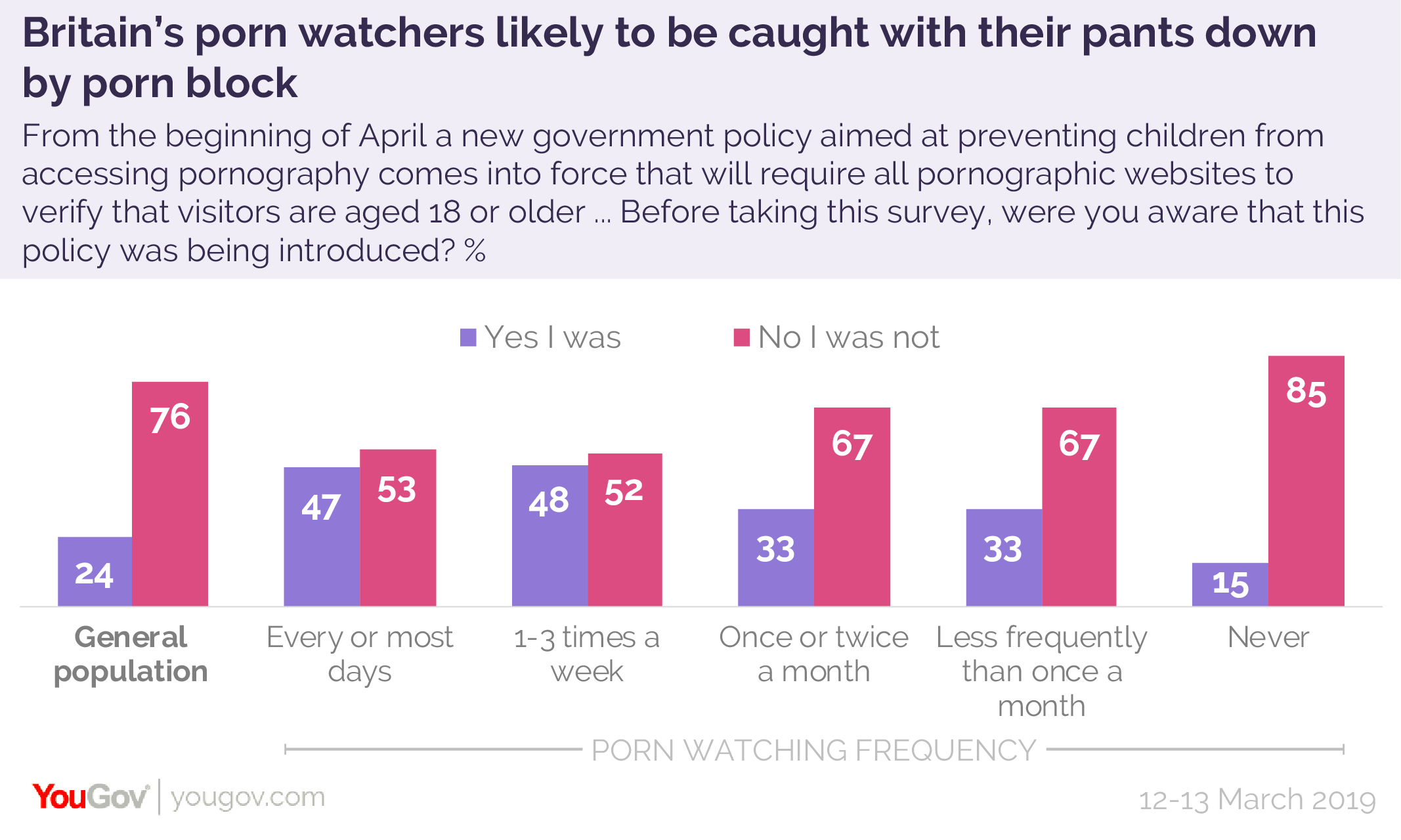
New YouGov research finds that three quarters of Britons (76%) don’t know that the so-called “porn block” is being introduced – only 24% said they knew it was on the way.

This unaware group includes half (53%) of Britain’s most frequent porn users – those who watch pornography online every day, or most days.

While Britons may have been unaware of the policy, there’s widespread backing for it once they know the details. Fully two thirds (67%) say they approve of the changes, although support declines with frequency of porn use.

«

“Frequency of porn use.” O tempora, o mores.
link to this extract


Use and fair use: statement on shared images in facial recognition AI • Creative Commons

Ryan Merkley on questions about the legality of IBM’s use of a ton of Creative Commons-licensed photos to train facial recognition systems:

»

While we do not have all the facts regarding the IBM dataset, we are aware that fair use allows all types of content to be used freely, and that all types of content are collected and used every day to train and develop AI. CC licenses were designed to address a specific constraint, which they do very well: unlocking restrictive copyright. But copyright is not a good tool to protect individual privacy, to address research ethics in AI development, or to regulate the use of surveillance tools employed online. Those issues rightly belong in the public policy space, and good solutions will consider both the law and the community norms of CC licenses and content shared online in general.

I hope we will use this moment to build on the important principles and values of sharing, and engage in discussion with those using our content in objectionable ways, and to speak out on and help shape positive outcomes on the important issues of privacy, surveillance, and AI that impact the sharing of works on the web.

«

There’s also a new FAQ, which includes this: “If someone uses a CC-licensed work with any new or developing technology, and if copyright permission is required, then the CC license allows that use without the need to seek permission from the copyright owner so long as the license conditions are respected. This is one of the enduring qualities of our licenses — they have been carefully designed to work with all new technologies where copyright comes into play. No special or explicit permission regarding new technologies from a copyright perspective is required.”

In other words: you licensed it. You can’t unilaterally revoke the licence. (Perhaps there’ll be a new CC variant – “no AI”.)
link to this extract


Errata, corrigenda and ai no corrida: none notified.

Start Up No.1,025: Beto’s Dead Cow membership, Apple responds to Spotify, Facebook’s angry algorithm tweak, how the backstop deal broke, and more


The interface to the Flight Management System on a 737: part of the source of the problem that led to two crashes. CC-licensed photo by Frans Zwart on Flickr.

You can sign up to receive each day’s Start Up post by email. You’ll need to click a confirmation link, so no spam.

A selection of 13 links for you. Not delayed yet. I’m @charlesarthur on Twitter. Observations and links welcome.

Flawed analysis, failed oversight: how Boeing, FAA certified the suspect 737 MAX flight control system • The Seattle Times

Dominic Gates:

»

That flight control system, called MCAS (Maneuvering Characteristics Augmentation System), is now under scrutiny after two crashes of the jet in less than five months resulted in Wednesday’s FAA order to ground the plane.

Current and former engineers directly involved with the evaluations or familiar with the document shared details of Boeing’s “System Safety Analysis” of MCAS, which The Seattle Times confirmed.

The safety analysis:

• Understated the power of the new flight control system, which was designed to swivel the horizontal tail to push the nose of the plane down to avert a stall. When the planes later entered service, MCAS was capable of moving the tail more than four times farther than was stated in the initial safety analysis document.
• Failed to account for how the system could reset itself each time a pilot responded, thereby missing the potential impact of the system repeatedly pushing the airplane’s nose downward.
• Assessed a failure of the system as one level below “catastrophic.” But even that “hazardous” danger level should have precluded activation of the system based on input from a single sensor — and yet that’s how it was designed.

The people who spoke to The Seattle Times and shared details of the safety analysis all spoke on condition of anonymity to protect their jobs at the FAA and other aviation organizations.

Both Boeing and the FAA were informed of the specifics of this story and were asked for responses 11 days ago, before the second crash of a 737 MAX last Sunday.

«

Eleven days. If the FAA had acted more quickly, scores of peoples’ lives could have been saved. (Thanks David Smith for the link.)
link to this extract


Ethiopian Airlines crash: American leadership on air safety under question across the globe • The Washington Post

Anthony Faiola:

»

“The Americans may feel, and not without justification, that they have the greatest insight into the Boeing aircraft,” said Sandy Morris, an aerospace analyst with the Jefferies financial group in London. “But this is a case when others in the world decided that they wanted to bring the risk of another accident down to zero. What you’ve seen here is a rebellion.”

Perhaps nowhere was US leadership on aviation safety being questioned more than in China, the first country to ground the 737 Max — an unprecedented move for a government that long followed cues from American authorities.

A top Chinese regulator said his agency made its decision because the [US] FAA [Federal Aviation Authority] and Boeing had not provided China with satisfactory answers about the airplane’s software and safety issues after the first 737 Max crash — of Lion Air Flight 610 in Indonesia that killed all 189 passengers and crew.

Li Jian, deputy director of the Civil Aviation Administration of China, suggested that the FAA was reluctant to take strong measures against the 737 Max.

“They have had difficulty making a decision, so we took the lead,” Li told reporters on Monday…

Chinese officials probably welcomed the opportunity to establish their leadership credentials at an inflection point in the country’s aviation history, analysts said. China’s civil aviation market is expected to eclipse that of the United States in three years, while its first homegrown passenger jet, the C919 narrow-body model that is designed to compete with the 737 Max, is also expected to take to the skies by the mid-2020s, at least in China.

«

Not mentioned in this story, but mentioned by John Gruber (who linked to it on Friday) is that the FAA has been without a commissioner for over a year. Trump nominated his personal private jet pilot. Congress laughed.
link to this extract


Beto O’Rourke’s secret membership in America’s oldest hacking group • Reuters

Joseph Menn:

»

The hugely influential Cult of the Dead Cow, jokingly named after an abandoned Texas slaughterhouse, is notorious for releasing tools that allowed ordinary people to hack computers running Microsoft’s Windows. It’s also known for inventing the word “hacktivism” to describe human-rights-driven security work.

Members of the group have protected O’Rourke’s secret for decades, reluctant to compromise his political viability. Now, in a series of interviews, CDC members have acknowledged O’Rourke as one of their own. In all, more than a dozen members of the group agreed to be named for the first time in a book about the hacking group by this reporter that is scheduled to be published in June by Public Affairs. O’Rourke was interviewed early in his run for the Senate.

There is no indication that O’Rourke ever engaged in the edgiest sorts of hacking activity, such as breaking into computers or writing code that enabled others to do so. But his membership in the group could explain his approach to politics better than anything on his resume. His background in hacking circles has repeatedly informed his strategy as he explored and subverted established procedures in technology, the media and government.

“There’s just this profound value in being able to be apart from the system and look at it critically and have fun while you’re doing it,” O’Rourke said. “I think of the Cult of the Dead Cow as a great example of that.”

An ex-hacker running for national office would have been unimaginable just a few years ago. But that was before two national elections sent people from other nontraditional backgrounds to the White House and Congress, many of them vowing to blow up the status quo.

«

In some ways it’s inevitable that a hacker would be a presidential candidate at some point. In the same way, a keen video game player will also be a candidate – and in time become president. It’s just numbers.
link to this extract


Addressing Spotify’s claims • Apple

»

The only contribution that Apple requires is for digital goods and services that are purchased inside the app using our secure in-app purchase system. As Spotify points out, that revenue share is 30% for the first year of an annual subscription — but they left out that it drops to 15% in the years after.

That’s not the only information Spotify left out about how their business works:

• The majority of customers use their free, ad-supported product, which makes no contribution to the App Store.
• A significant portion of Spotify’s customers come through partnerships with mobile carriers. This generates no App Store contribution, but requires Spotify to pay a similar distribution fee to retailers and carriers.
• Even now, only a tiny fraction of their subscriptions fall under Apple’s revenue-sharing model. Spotify is asking for that number to be zero.

Let’s be clear about what that means. Apple connects Spotify to our users. We provide the platform by which users download and update their app. We share critical software development tools to support Spotify’s app building. And we built a secure payment system — no small undertaking — which allows users to have faith in in-app transactions. Spotify is asking to keep all those benefits while also retaining 100% of the revenue.

«

It would be quite a data point if we found out how many people signed up for Spotify through the iOS app. Especially given how much bigger Google Play is in user numbers.
link to this extract


Norway joins list of countries canceling Elsevier contracts • The Scientist Magazine®

Catherine Offord:

»

Norway has become latest country to cancel its contracts with Elsevier following a dispute over access to research papers. In a statement published yesterday (March 12), the Norwegian Directorate for ICT and Joint Services in Higher Education and Research (UNIT), which represents a consortium of research institutions in the country, rejected Elsevier’s offer to lower some of its costs for Norwegian institutions because it didn’t go far enough to promote free access to published research.

“The offer from Elsevier is far from fulfilling the requirements of Norway for open access to research articles,” the agency says in a statement (translated by Google). “Nor is there any movement in the agreement [about] paying for publishing instead of paying for reading access. The agreement with Elsevier is therefore not renewed for 2019.”

Norwegian institutions had been arguing for a so-called “read-and-publish” arrangement. Currently, most institutions pay both to read articles on Elsevier, which hosts around academic 2,500 journals, and to provide open access to their own articles on the platform. A read-and-publish deal would combine those costs into one and make papers immediately available on publication.

«

link to this extract


Margrethe Vestager to hit Google with another fine • Financial Times

Rochelle Toplensky:

»

The latest investigation has focused on Google’s AdSense business, which places its search box on third-party websites, such as news websites. The commission can fine up to an additional $13bn — which is 10% of the latest global turnover of Google’s parent company, Alphabet — but the penalty is expected to be significantly smaller than the maximum.

As outlined in their 2016 charge sheet, EU officials worried that Google “artificially reduced choice and stifled innovation in the market” by contractually restricting how third-party websites display search ads from rivals.

The EU case centres on Google demands, introduced in 2006, that required a number of popular third-party websites to use its ad service exclusively if they wanted to include the Google search box on their site. In 2009, the company relaxed the restrictions to allow the websites to show competing advertisers on their pages, but required they display a minimum number of Google ads in prime locations and give Google the right to authorise changes to competitors’ ads. The contract terms were ultimately phased out from 2016.

While next week’s fine will bring an end to the AdSense investigation, EU antitrust officials continue to scrutinise Google’s behaviour in other services — such as dedicated search for travel, jobs and local businesses — and could open fresh probes.

«

link to this extract


Walmart readies low-priced rival to Apple iPad • Bloomberg

Matthew Boyle:

»

Look out Apple — Walmart Inc. is moving into iPad territory.

The world’s largest retailer plans to introduce an inexpensive, kid-friendly tablet computer under its ONN store brand, part of a broader redesign of its electronics department. The device will be made by a Chinese supplier and run on Google’s Android operating system, according to photos found on a database of wireless product applications filed with the U.S. Federal Communications Commission.

Tara House, a Walmart spokeswoman, confirmed the product is in the works, though declined to comment further. The price of the device, or when it will debut, hasn’t been disclosed.

Walmart’s device could bring some life to the sluggish tablet market, which has been declining for several years. Tablet users don’t buy new ones at the same pace as they replace smartphones, which have also grown in size and capacity, reducing the need for a larger device. In 2018 tablet shipments fell 6.2%, according to data tracker Strategy Analytics.

«

“iPad rival”. Wow, is it 2012 again? Android Police’s take on this was “Crap store plans crap tablet“.
link to this extract


Young entrepreneur series: Atta Elayyan • UC Centre for Entrepreneurship

»

Atta Elayyan is currently CEO of Christchurch-based app development company LWA Solutions. Atta co-founded the company with Mike Choeung in 2010 and has grown the company to a 12-strong team. The team has completed projects for both New Zealand and overseas customers such as Trade Me, Mediaworks, Microsoft and Aramex. The latter being the largest logistics and transport company in the Middle East. For Aramex, LWA Solutions facilitated an innovative and user-centered solution. In fact, Atta and his team spent a week in Jordan with Aramex courier drivers to observe their daily routine and gain insight into how the courier drivers could use technology to enhance their everyday work.

Replacing clunky and expensive devices, they implemented a bring-your-own-device system, turning smartphones into scanners. LWA Solutions crafted a solution with unique task management software applied to low-end smart phones specifically for Aramex. This enabled Aramex to completely streamline their business processes and enables scaling without huge hardware costs. Ultimately, a complete transformation of how Aramex do business. On reflection, it is amazing that such an incredible tech-driven international business can be run so successfully from Christchurch.

«

Sadly, he was one of the victims in the terrorist attack in Christchurch. New Zealand’s government is now looking to change its laws to prevent anyone getting hold of (or creating) semi-automatics. (Thanks Richard for the link.)
link to this extract


One year in, Facebook’s big algorithm change has spurred an angry, Fox News-dominated – and very engaged! – News Feed • Nieman Journalism Lab

Laura Hazard Owen:

»

A new report from social media tracking company NewsWhip shows that the turn toward “meaningful interactions” has:

• pushed up articles on divisive topics like abortion, religion, and guns;
• politics rules; and
• the “angry” reaction (😡) dominates many pages, with “Fox News driving the most angry reactions of anyone, with nearly double that of anyone else.”

Of course, all that isn’t only Facebook’s fault. The content that dominates the platform now might have risen even without an algorithmic boost. But what’s clear is that Mark Zuckerberg’s January 2018 exhortation that the time spent on Facebook be “time well spent” has not come to pass: Instead, it’s often an angry, reactive place where people go to get worked up and to get scared. Here are the two most-shared Facebook stories of 2019 so far:

Engagement — likes, comments, shares, reactions — has risen. For the first few months of this year, it was 50% higher than it was in 2018, and about 10% higher than it was in 2017 (which, remember, included Trump’s inauguration, large-scale protests, and the chaotic early days of his presidency).

“There is a possibility that Facebook’s friends and family focus, getting people to read what their networks are sharing rather than what pages are promoting, may have contributed to this increase as people shared articles they enjoyed on the network,” NewsWhip says.

«

So you’re saying it’s still a cesspit, and that your “tuning” has made it worse, Mr Zuckerberg?
link to this extract


Cryptocurrency startup Prodeum pulls exit scam, leaves a dick behind • The Next Web

Dimitar Mihov:

»

It remains unclear precisely how much cash the startup has lifted from its investors, but its entry on ICO Watchlist indicates Prodeum completed 18% from its funding goal. For context, its white paper lists the soft and hard caps for the ICO at 2,100 and 5,400 ETH, respectively. The current price of Ethereum is $1,194, according to CoinMarketCap.

Prodeum is the latest cryptocurrency company to pull an exit scam.

Last year, a sketchy Bitcoin investment platform known as BitPetite suddenly went dark, leaving with all of its investors’ coins.

Only weeks later, another cryptocurrency company, called Confido, wiped its digital fingerprints and dashed off with its customers’ investments. The move came days after its founders said they’ve ran into legal obstacles.

«

I’d be trying to sell any of those junk “coins” – actually penny shares without the voting rights – if I’d bought any.
link to this extract


Xiaomi/Apple: all about Mi • Financial Times

The “Lex” opinion column isn’t keen on Xiaomi’s prospects:

»

Xiaomi is number one in India in shipment terms, and one of the top five in Europe. The group has partnered with Foxconn to make phones in India where just a third of the population use smartphones. Apple has just over 1% of that market. 

Margins are higher within an internet-of-things and household electronics business. Margins are higher here, but unlikely to offset weakness in Chinese smartphone sales.

Xiaomi lacks Apple’s pricing muscle. In 2016, Xiaomi held top market share in China, which accounted for more than 70% of its revenue. ZTE, Huawei, Oppo and Vivo have since undercut Xiaomi on value and through easier access via physical stores. 

China’s move to 5G this year will bring significant demand for new smartphones over the next few years. But Xiaomi’s premium plan is fraught with risk. Raising prices in its home market may threaten its tenuous grip on its number five spot. Doubts about Xiaomi’s strategy when it came to market have proved well-founded. The shares have fallen 43% from their peak shortly afterwards, and may fall further.

«

link to this extract


How Theresa May’s winning backstop deal was done… and why Geoffrey Cox blew it apart • RTE

Tony Connelly, for the Irish radio station:

»

The [UK]Attorney General [Geoffrey Cox, who provides legal advice to the UK government] was already on the defensive. The UK had had to drop the very public demands for a unilateral exit clause or expiry date. Cox therefore wanted independent arbitration to be the next best thing as a way out.

He first suggested the arbitration be outside the dispute mechanisms already enshrined in the Withdrawal Agreement. That was immediately rejected by Barnier.

He [Cox] then made further arguments which baffled and irritated the EU side. 

First, he suggested that if the trade negotiations broke down then it would, by default, mean the backstop applying indefinitely. Since Article 50 was designed to be a temporary state, that meant the EU was breaking its own rules.

Cox then argued that Northern Ireland citizens would be subject to single market rules, yet not represented in the European Parliament or in ministerial meetings. The backstop was therefore in breach of the European Convention on Human Rights (ECHR). Combine those arguments and the UK should be entitled to walk away from the backstop. EU officials were in disbelief. 

“There was a fundamental disagreement,” recalls one official, briefed on the dinner. “It wasn’t on the principle of arbitration. It was on what the arbitration can cover, and what comes next.”

The mood in Brussels darkened. Cox and Steve Barclay, the Brexit Secretary, returned to London. Sabine Weyand continued technical talks with Olly Robbins, her opposite number. 

«

Cox was both negotiating, and declaring what the negotiations meant – “marking his own homework”, as one MP put it. I suspect he thought his ECHR twist was very clever and would show those Brussels suits who was the smartest person in the room. Turns out, that didn’t really matter. The full story also shows how much high-level negotiation is now done via Twitter, which is quite weird.

American readers will probably find this impenetrable. You’re not alone, folks.
link to this extract


Two-thirds of all Android antivirus apps are frauds • ZDNet

Catalin Cimpanu:

»

An organization specialized in testing antivirus products concluded in a report published this week that roughly two-thirds of all Android antivirus apps are a sham and don’t work as advertised.

The report, published by Austrian antivirus testing outfit AV-Comparatives, was the result of a grueling testing process that took place in January this year and during which the organization’s staff looked at 250 Android antivirus apps available on the official Google Play Store.

The report’s results are tragicomical – with antivirus apps detecting themselves as malware – and come to show the sorry state of Android antivirus industry, which appears to be filled with more snake-oilers than actual cyber-security vendors.

«

Only two-thirds? Though I think you can say that 100% of iOS “antivirus” apps won’t be able to detect if something bad is going on, because they wouldn’t be allowed out of their sandbox. I leave it to readers to decide how to describe that.
link to this extract


Errata, corrigenda and ai no corrida: none notified

Start Up No.1,024: Spotify ‘warns’ of price rises, Brexit beyond belief, quantum time truths, pricing Apple Video, VR feels the chill, and more


Guess what the cool new app teenagers are using for their social media communication? CC-licensed photo by Nedra on Flickr.

You can sign up to receive each day’s Start Up post by email. You’ll need to click a confirmation link, so no spam.

A selection of 12 links for you. Idus Martiae, dies illa. I’m @charlesarthur on Twitter. Observations and links welcome.

Spotify boss warns of price rises in Apple antitrust dispute • Financial Times

Anna Nicolaou, Tobias Buck and Madhumita Murgia:

»

Spotify will raise prices if Apple continues to charge it a 30% fee for using its ubiquitous App Store, the music-streaming service’s chief executive has said.

The warning from Daniel Ek comes just days after Spotify filed an antitrust complaint with the EU accusing Apple of unlawfully abusing its App Store dominance to favour its own Apple Music service.

“You can see us having no other choice than to accept the 30% fee put in place, which essentially would mean we would have to raise our prices for consumers all over the world,” Mr Ek said in an interview.

“Apple [would get] an unfair benefit of being able to compete at much lower prices,” he added. “I obviously think our service is superior to theirs, but a 30% price difference is a lot.”

In its EU complaint, Spotify said that Apple had required all iPhone app makers exclusively to use the Apple payment system for the past eight years.

Apple has introduced a 30% fee, applied to Spotify and all other digital content providers in the first year after users download their app, for using the payment system. Other apps, such as Uber and Deliveroo, are not subject to the fee, which drops to 15% after a year.

Mr Ek’s comments are the latest in a long-running battle between the two companies, which the Spotify chief said became “untenable” a year ago.

«

Translated: Spotify wants to put prices up. Apple’s a good way to complain about that. Also, how many people does it have subscribed via the App Store, given that it stopped offering that some time last year? I hear Apple’s not very happy about the PR presentation on this, but it’s biding its time.
link to this extract


Here’s what went down on perhaps the maddest night of Brexit carnage ever seen • Buzzfeed News

Alan White:

»

You may have some questions. Such as:

• Didn’t they already vote in favour of this [government motion for the Withdrawal Agreement negotiated by everyone from Theresa May down with the EU, and not to leave without a “deal”] in January?

• How can you rule it out when that is the legal default if nothing else happens?

• Wasn’t the government telling us “‘no deal’ is better than a bad deal” for the last year?

And the answers to all these questions are:

• Yes, but this carries more constitutional weight.

• You can’t, but shut up.

• Yes, but this is actually a good deal, it’s just no one’s realised it yet, so shut up again and also stop talking Britain down.

There was also to be a second vote, on an idea called “the Malthouse Compromise”. This was a plan which would see May renegotiate the backstop — the insurance policy to prevent a hard border in Ireland — and replace it with an agreement that used technology to avoid customs checks.

Here are some MPs who support the Malthouse Compromise, posing for a photo that makes them look like a Britpop band who’ve recently re-formed 10 years after they split because the bassist got addicted to heroin.

There were only two small problems with this plan: 1) the technology doesn’t exist yet, and 2) the EU had already said it wouldn’t agree to it, even if May tried put it forward. But undeterred, our plucky parliamentarians were set to vote on it anyway.

Does all of this make us look ridiculous in the eyes of our neighbours? Possibly.

«

There are no similes or metaphors for what has happened to the Brexit process. The government only just managed – by a majority of 2 out of 630 votes – to hang on to its right to decide what business is done in Parliament.
link to this extract


Brexit, meerkats and the never-ending, meaningless story • Sydney Morning Herald

Sean Kelly cocks a foreign eye at the goings-on :

»

the truly strange thing about the constant accumulation of information on Brexit is that it never amounts to knowledge. It doesn’t matter how many radio bulletins you absorb, how many long articles in however many newspapers you read, the shining light of finally understanding what is going on with Brexit only recedes further into the distance.

At first, I blamed myself for this failure to understand. But slowly, perhaps self-servingly, I decided the problem lay elsewhere. How can you hope to grasp the meaning of a debate when the language in which it is conducted has been emptied of meaning?

Theresa May’s proposed Brexit deal was defeated on Tuesday night. It wasn’t the worst parliamentary defeat in the democratic era – that happened in January. It was still huge. For the MPs in parliament, the vote will be read through the prism of political power: who’s hot and who’s not. But for the citizens of Britain, this is about much more: the world that they live in, even if their leaders don’t.

Two weeks ago, in mildly happier times, May was asked about (what else?) Brexit. She said her questioner “should vote for a deal — simples”. That extra “s” is no typo. “Simples”, as you might know, is a TV advertising slogan, usually uttered by a cartoon meerkat promoting a website that compares insurance deals.

Yes, this is another example of the rolling trivialisation of politics, the apparent desperation of our leaders to be heard above the thundering nonsense blah blah blah. But here’s the real kicker: soon after, it was reported that the only reason May used the phrase was because one Tory MP made a bet with another Tory MP that she could get the Prime Minister to say it. So May did her best meerkat, and the MP got tea at the Ritz.

None of this matters, really, except that it is the purest representation of the Brexit debate I can imagine. People with genuine power stand in the hallowed halls of Parliament and shout words that, it turns out, have meaning only for each other.

«

It’s now turned into a legalocratic legislature – arguing over the jots and tittles of gigantic legalese draft agreements – which suggests that it’s not up to the complexity of the task. And yet somehow we’re meant to exit the EU at some point. Nobody, as of Thursday night, knows when or how, and many disagree on why.
link to this extract


No, scientists didn’t just “reverse time” with a quantum computer • MIT Technology Review

Konstantin Kakaes:

»

The headlines have been incredible. Newsweek (Scientists Have Reversed Time in a Quantum Computer), Discover (Scientists Used IBM’s Quantum Computer to Reverse Time, Possibly Breaking a Law of Physics) and the UK’s Independent newspaper (Scientists ‘Reverse Time’ With Quantum Computer in Breakthrough Study). Cosmopolitan magazine also chimed in: Scientists just turned back time and it’s like Back to the Future is coming true. There are many, many more.

The trigger for all of these was a Scientific Reports paper with the provocative title “Arrow of time and its reversal on the IBM quantum computer.” In it, the authors claimed to have performed an experiment that opens up lines of research, in their words, toward “investigating time reversal and the backward time flow.”

If you had difficulty understanding  how scientists accomplished such a counterintuitive feat, don’t worry. They didn’t.

…So if they didn’t invent time travel, what did these scientists actually do?

Think about pressing rewind on a video. That “reverses the flow of time,” in a way. If you’ve never seen it before, it’s kind of neat. It might let you see things—like steam flowing back into a tea kettle or Humpty Dumpty spontaneously assembling from a jumble of broken pieces—that appear to “reverse the arrow of time.” The paper in question describes a quantum-computing version of such a video running in reverse.

…As Scott Aaronson, director of the Quantum Information Center at the University of Texas at Austin, says, “If you’re simulating a time-reversible process on your computer, then you can ‘reverse the direction of time’ by simply reversing the direction of your simulation. From a quick look at the paper, I confess that I didn’t understand how this becomes more profound if the simulation is being done on IBM’s quantum computer.”

«

Just in case this comes up at lunch. You can be the person who scratches their ear and says “Well..”

link to this extract


These hyper-secretive economists are transforming how Amazon does business • CNN

Lydia DePillis, CNN Business:

»

Estimating inflation is a tricky and complex task. In the United States, the government’s Bureau of Labor Statistics sends testers to stores to record the price of everything from cheese to tires, and surveys consumers over the phone about what they spent on gas and funeral services.

Amazon thinks it could do it better.

With help from outside researchers, the company’s economists are working on a way to measure inflation using thousands of transactions across its own platform. Automatically analyzing product descriptions allows them to better assess the quality of a dress or a juicer or a bathmat, theoretically creating a more accurate, up-to-date index of how much things cost.

That’s just one way Amazon is using the squad of economists it has recruited in recent years. The company has turned so many businesses, from retailing to cloud computing, inside out. Now Amazon is upending the traditional role of economists within companies, as well as the field of economics.

Amazon is now a large draw from the relatively small talent pool of PhD economists, which in the United States grows by about only 1,000 new graduates every year.

«

That’s a really small pool. Though how many companies need a doctor of economics? Amazon, Google, maybe Apple, Uber.. Walmart, some of the health insurance companies?
link to this extract


Android Q will kill clipboard manager apps in the name of privacy • Android Police

Ryan Whitwam:

»

Privacy is a primary focus of Android Q for Google, and that may spell trouble for some of your favorite apps. In Android Q, Google has restricted access to clipboard data as previously rumoured, which means most apps that currently aim to manage that data won’t work anymore.

Having an app that sits in the background and collects clipboard data can be a handy way to recall past snippets of data. However, that same mechanism could be used for malicious intent. Google’s playing it safe by restricting access to clipboard data to input method editors (you might know those as keyboards). Foreground apps that have focus will also be able to access the clipboard, but background apps won’t.

«

iOS and Android are on a very slow collision course to having the same approach to security.
link to this extract


How much can Apple charge for video, news, and bundled services? • VentureBeat

Jeremy Horwitz:

»

Looking at iCloud and Apple Music, one might conclude that Apple hasn’t seen much success with subscriptions priced higher than $9.99 per month — but that probably won’t stop it from trying with videos or news. In fact, I’d be very surprised if Apple didn’t make yet another effort to offer a $19.99 or even higher price option, either for an individual service or some sort of bundle.

My best guess is that Apple will launch its News Magazines service at $9.99 per month, the same pricing the underlying Texture service used before (and after) Apple bought it last year. Alternatively, Apple could risk losing existing Texture customers by hiking their prices, and since the service wasn’t exactly a huge hit before, I’m not sure that new customers will be willing to pay more than that for monthly access to news.

But there’s always the possibility that Apple starts with an “all you can eat monthly magazines” tier, then adds a pricier “all you can eat monthly magazines plus daily paywalled news” tier. This could give newspapers a way to make more money from the service — a reported sticking point to participation from the New York Times, Wall Street Journal, and Washington Post.

Apple’s video service pricing could similarly be complicated by incorporating certain standalone video services. On one hand, Apple plans to offer original content through the service, which it will want to monetize like Netflix, Hulu, and Disney — likely with a monthly fee in the same $6 to $13 range. Yet Apple is also hoping to resell video services including HBO, Showtime, and Starz, each of which sells separately for $9 to $15 per month.

That means Apple’s video service might need to appear in at least two tiers: basic and premium.

«

I think the best approach would be to bundle a basic service with Music for free (ie you subscribe to Music, you get Video – because you’re either listening to music or watching video), and then have a separate paid Premium service with more stuff. For News, $5 per month feels sensible, but of course it’ll be higher, and then hardly anyone will sign up.
link to this extract


The hottest chat app for teens is… Google Docs • The Atlantic

Taylor Lorenz:

»

Teens told me they use Google Docs to chat just about any time they need to put their phone away but know their friends will be on computers. Sometimes they’ll use the service’s live-chat function, which doesn’t open by default, and which many teachers don’t even know exists. Or they’ll take advantage of the fact that Google allows users to highlight certain phrases or words, then comment on them via a pop-up box on the right side: They’ll clone a teacher’s shared Google document, then chat in the comments, so it appears to the casual viewer that they’re just making notes on the lesson plan. If a teacher approaches to take a closer look, they can click the “Resolve” button, and the entire thread will disappear…

If the project isn’t a collaborative one, kids will just create a shared document where they’ll chat line by line in what looks like a paragraph of text. “People will just make a new page and talk in different fonts so you know who is who,” Skyler said. “I had one really good friend, and we were in different homerooms. So we’d email each other a doc and would just chat about whatever was going on.” At the end of class, they’ll just delete a doc or resolve all the comments. Rarely does anyone save them the way previous generations may have stored away paper notes from friends.

Chatting via Google Docs doesn’t just fool teachers; it also tricks parents. When everyone logs on to do homework at night, Google Docs chats come alive. Groups of kids will all collaborate on a document, while their parents believe they’re working on a school project. As a Reddit thread revealed in February, chatting via Google Docs is also a great way to circumvent a parental social-media ban.

«

Brilliant. Simply brilliant.
link to this extract


Google’s Spotlight Stories VR studio is shutting down • Variety

Janko Roettgers:

»

Google is shutting down its Spotlight Stories immersive entertainment unit, according to an email sent out by Spotlight Stories executive producer Karen Dufilho Wednesday evening.

“Google Spotlight Stories is shutting its doors after over six years of making stories and putting them on phones, on screens, in VR, and anywhere else we could get away with it,” Dufilho said in her email sent to supporters of the studio.

A Google spokesperson acknowledged the shut-down in an email, sending Variety the following statement:

“Since its inception, Spotlight Stories strove to re-imagine VR storytelling. From ambitious shorts like ‘Son of Jaguar,’ ‘Sonaria’ and ‘Back to The Moon’ to critical acclaim for ‘Pearl’ (Emmy winner and first-ever VR film nominated for an Oscar) the Spotlight Stories team left a lasting impact on immersive storytelling. We are proud of the work the team has done over the years.”

Google’s spokesperson didn’t address questions about layoffs associated with the move, but a source with knowledge of the situation told Variety that staffers were given a chance to look for new positions within the company. Most artists who had been working on projects for Spotlight Stories were thought to be contractors on a by-project basis…

Google is said to have invested significant amounts of money into Spotlight Stories over the years, without giving the group a mandate to monetize their works. However, while Spotlight Stories films pushed the medium forward, the group didn’t necessarily improve the fortunes of Google’s VR efforts, with the company struggling to find an audience for its Daydream VR headset.

«

Imagine the scene at the end of Raiders Of The Lost Ark where the guy is putting the box into a slot in a gigantic warehouse. Well, that’s where VR is going for another decade or so.
link to this extract


Valve is turning Steam Link streaming into a personal cloud service • The Verge

Chaim Gartenberg:

»

Right now, only Android, Raspberry Pi, and the discontinued Steam Link hardware work with Steam Link Anywhere, but it’s easy to imagine that Steam could add a similar feature for streaming from PC to PC like it already offers with the in-home Steam Link.

The timing of the announcement is also significant: Steam is planting a flag for game streaming just ahead of GDC 2019, where Google is widely expected to take the wraps off its new Project Stream-powered streaming gaming service at an event on March 19th. With Google expected to make a big push for game streaming — possibly even announcing its own gaming hardware for the first time — Steam’s announcement seems to be an indication that it’s not willing to cede the space without a fight.

Google isn’t the only competitor Steam has here, either: Microsoft just showed off new in-home game streaming from PC to Xbox consoles that looks a whole lot like the existing Steam Link functionality. And Microsoft’s upcoming xCloud game-streaming service looks poised to challenge both Steam and Google in the broader game-streaming space.

«

Everyone’s suddenly into streaming games. The requirement for “good” uplink speeds from the host computer is suitably vague, though; knowing gamers’ requirements for fast pings, only a few lucky souls will have the requisite speeds.
link to this extract


Redditors say they’re seeing coordinated Chinese propaganda on the site • Buzzfeed News

Craig Silverman and Jane Lytvynenko:

»

Last week, a Reddit user posed a question on the Canadian news subreddit /r/onguardforthee: “Ever Wonder Why Canadian Subreddits Are Becoming Littered With Chinese Propaganda?”

In their view, the reason is that Chinese government-sponsored users are engaging in a coordinated effort to spread propaganda and bury anti-China messages on Reddit. Many users agreed, saying they’ve seen threads about China downvoted or inundated with trolls posting comments they believe are in line with Chinese propaganda.

“Go check out any thread about Huawei or the extradition, it’s pretty insane,” wrote one person, citing the recent detention in Canada and ongoing extradition process of the CFO of Chinese technology giant Huawei.

But others mocked their fellow redditors for accusing anyone expressing even a moderately pro-China view of being a government troll. One user accused of being a paid government actor joked that they earn “$1,000 from glorious China Communist Party not only for each post, but for each time I even think something critical about Canada.”

That thread followed an earlier discussion on /r/geopolitics about why articles critical of China were suddenly being downvoted or inundated with pro-China “shills.”

These public threads reflect growing concerns among redditors about what they say is coordinated activity on the site by pro-China accounts, according to a moderator and users who spoke to BuzzFeed News, and reflect intense discussions taking place behind the scenes among those who help oversee subreddits.

«

Chinese boosting in comments or discussion spaces has been quite common for years. As Tim Culpan pointed out the other day, it shows the essential asymmetry: the west can’t go on Chinese sites and boost western viewpoints.
link to this extract


Tumblr traffic dropped by nearly 100M views the month after it banned porn • The Next Web

Bryan Clark:

»

Tumblr’s ban on adult content is costing it dearly.

In December, we reported on news of Tumblr invoking the nuclear option and banning pornography and other adult content from the popular blogging platform. A month later, it had lost more than 100 million views — a 17% decline in just 30 days.

According to data from web analytics firm SimilarWeb, Tumblr’s problems started, predictably, with its adult content ban. In December, it was flying high, with approximately 521 million pageviews that month. 30 days later, that had dropped to just 437 million…

…We wrote about the ramifications of Tumblr’s decision not once, not twice, but thrice — pointing out that Tumblr’s users would flee to greener pastures, that its ban was breaking up safe spaces for women and other marginalized communities, and that the language in its ban was inherently sexist.

What’s a female-presenting nipple, anyway?

For Tumblr, the decision was a knee-jerk reaction to its temporary takedown from Apple’s App Store after engineers discovered child pornography on the website.

Initially Tumblr remained mum, commenting last year that it was “working to resolve the issue with the iOS app.” That was until Download.com approached the Yahoo-owned website with sources who claimed the app’s removal was due to child pornography. Tumblr then confirmed the story, worked with Apple to remove the offensive content, and then returned to the App Store before the end of 2018.

«

A sledgehammer, for sure, but child sexual exploitation imagery isn’t something to ignore.

link to this extract


Errata, corrigenda and ai no corrida: none notified

Start Up No.1,023: Spotify says Apple’s bad, the Tube’s missing Wi-Fi, FourSquare: still here, Cobol lives on, and more


A whitewood intruder among the blue pallets. It’s a hidden business struggle. CC-licensed photo by Michael Sauers on Flickr.

You can sign up to receive each day’s Start Up post by email. You’ll need to click a confirmation link, so no spam.

A selection of 10 links for you. Use them wisely. I’m @charlesarthur on Twitter. Observations and links welcome.

Consumers and innovators win on a level playing field • Spotify

Daniel Ek, CEO of Spotify:

»

Spotify has filed a complaint against Apple with the European Commission (EC), the regulatory body responsible for keeping competition fair and nondiscriminatory. In recent years, Apple has introduced rules to the App Store that purposely limit choice and stifle innovation at the expense of the user experience—essentially acting as both a player and referee to deliberately disadvantage other app developers. After trying unsuccessfully to resolve the issues directly with Apple, we’re now requesting that the EC take action to ensure fair competition.

Apple operates a platform that, for over a billion people around the world, is the gateway to the internet. Apple is both the owner of the iOS platform and the App Store—and a competitor to services like Spotify. In theory, this is fine. But in Apple’s case, they continue to give themselves an unfair advantage at every turn.

To illustrate what I mean, let me share a few examples. Apple requires that Spotify and other digital services pay a 30% tax on purchases made through Apple’s payment system, including upgrading from our Free to our Premium service. If we pay this tax, it would force us to artificially inflate the price of our Premium membership well above the price of Apple Music. And to keep our price competitive for our customers, that isn’t something we can do.

«

Spotify needs to satisfy just two tests. Is Apple dominant, ie has 40% of the market? And is it using its power in one market to annexe another, or keep rivals out?

Afraid it doesn’t have a dominant position in the European market – it has 15-20%. (Higher in some countries, lower in others.) And it hasn’t kept Spotify off the App Store. The one thing it might get called on is preventing apps calling for people to subscribe on the web, rather than in-app. But without a dominant position, it’s moot.

Don’t think they’ll file this in the US: they’d need to show that Apple (which has a much stronger position – about 40% of smartphones) is doing something that raises prices for consumers. But the app store levy is like a cost of business, same as selling through a retailer. And there are options.
link to this extract


Why does the London Underground still not have Wi-Fi in tunnels? • WIRED UK

Katia Moskvitch:

»

First is cost. “Technically, it is straightforward, although expensive, to deliver Wi-Fi in stations,” says Matthew Griffin, head of commercial telecoms at TfL. To install it, individual access points have to be placed within the station ceiling or hidden in voids, with flat antennas providing the signal.

While this sounds simple, it’s very expensive to lay cabling to reach all these access points. “This cabling needs to carry a significant amount of internet traffic to manage a reliable and consistent service, one terabyte per day on the Tube, and requires careful engineering to ensure it can be delivered without interfering with other station infrastructure,” says Griffin.

In tunnels, the process is much more difficult. Some sections of the Tube are more than 150 years old and its tunnels very narrow, which means there is little space to install any extra equipment. Wi-Fi uses radio waves, which work great when they can move in a straight line and have plenty of space (say, up to and down from a satellite, or through your living room). But they run into trouble when they hit solid matter.

London’s Tube tunnels twist and turn, so any Wi-Fi radio waves would not be able to penetrate walls or go around corners. To deliver mobile connectivity on, say, the Northern Line, TfL would have to install an enormous number of access points – which is both uneconomical because of the cost of equipment, and unreliable as it will be tricky to maintain all these access points in such a confined space, says Griffin.

«

On the plus side: 4G is coming. Though the carriages will have to have Wi-Fi backhauled to the 4G.
link to this extract


Researchers make Q, a genderless voice for personal assistants like Alexa • CNBC

Sara Salinas:

»

I asked major tech companies — Apple, Amazon, Microsoft and Google, if we’re naming names — for virtual assistants with traditionally male voices where they didn’t exist and for a more neutral default setting where they did. I thought I was asking for choice, but a joint venture by Vice’s creative agency Virtue and Copenhagen Pride has just shown me up and invented a third, undeniably compelling option.

The virtual assistant is called Q, and it’s designed to be genderless. It sounds neither male nor female — or seems to fluctuate between the two depending on how intensely you’re listening for a gendered bent.

https://www.youtube-nocookie.com/embed/lvv6zYOQqm0

Q is a composite of five voices, recorded and then altered to match a gender-neutral range of pitches, as defined by a linguist and researcher. It’s scientific and definably gender-neutral, and it establishes criteria by which other assistants could follow suit.

«

Salinas doesn’t like the fact that so many voice assistants are female-voiced, but the default Siri in the UK has been male since 2011. I prefer them to be one of the other.
link to this extract


You may have forgotten Foursquare, but it didn’t forget you • WIRED

Paris Martineau:

»

Ask someone about Foursquare and they’ll probably think of the once-hyped social media company, known for gamifying mobile check-ins and giving recommendations. But the Foursquare of today is a location-data giant. During an interview with NBC in November, the company’s CEO, Jeff Glueck, said that only Facebook and Google rival Foursquare in terms of location-data precision.

You might think you don’t use Foursquare, but chances are you do. Foursquare’s technology powers the geofilters in Snapchat, tagged tweets on Twitter; it’s in Uber, Apple Maps, Airbnb, WeChat, and Samsung phones, to name a few. (Condé Nast Traveler, owned by the same parent company as WIRED, relies on Foursquare data.)

In 2014, Foursquare launched Pilgrim, a piece of code that passively tracks where your phone goes using Bluetooth, Wi-Fi, GPS, and GSM to identify the coffee shop or park or Thai restaurant you’re visiting, then feeds that data to its partner apps to send you, say, an offer for a 10% off coupon if you leave a review for the restaurant. Today, Pilgrim and the company’s Places API are an integral part of tens of thousands of apps, sites, and interfaces. As Foursquare’s website says, “If it tells you where, it’s probably built on Foursquare.”

«

Not only not gone away; it has big ambitions.
link to this extract


Whitewood under siege • Cabinet Magazine

Jacob Hodes:

»

Blue pallets are an inch or so taller, often cleaner, and always more uniform than the pallets [made] of whitewood. Crucially, blues do not have any stringer boards along their sides; instead, their height is obtained by way of nine wooden blocks sandwiched between the top and bottom deck boards. This block design allows forklifts and other tools to enter the pallet with equal ease from four directions. (Most stringer pallets, by contrast, offer either “two-way entry” or “partial four-way entry.”) There are approximately 240m blue pallets in the world, circulating in over fifty countries. On the sides of each are the words, “Property of CHEP.”

CHEP, a subsidiary of Brambles Limited, an Australia-based multinational corporation, is the largest pallet business in the world. The company earned $3.5bn in pallet-related revenues during fiscal year 2013, and in many markets has achieved pallet monopoly… CHEP doesn’t sell pallets; it rents them. This means that, in contrast to the world of whitewood, where a pallet may change ownership many times, CHEP maintains control of its pallets throughout their lives.

…By 2002, there were ten million blue pallets floating around the US, unaccounted for, and a report by Credit Suisse warned investors that CHEP usa was experiencing “a loss of control of [its] pallet pool.”

Despite these lost pallets, CHEP continued to grow. In 2010, in a shock to the industry, Costco announced that it would only accept shipments on CHEP-style block pallets: they break less, they have tighter quality controls, and full four-way entry promises tiny but measurable efficiencies when loading and unloading trucks. Panic ensued in the world of whitewood.

«

You never knew you could be interested in wood pallets.. until this. Now you’re going to notice white and blue pallets everywhere you go for the next week.
link to this extract


Eero is now officially part of Amazon, pledges to keep network data private • The Verge

Nilay Patel:

»

concerns that Amazon would somehow make expanded use of Eero network data have been growing ever since the deal was announced — obviously, your Wi-Fi router can see all your network traffic, and Eero’s system in particular relies on a cloud service for network optimization and other features. But Eero is committed to keeping that data private, said [Eero CEO Nick] Weaver, who also published a blog post this morning that explicitly promises Eero will never read any actual network traffic.

“If anything, we’re just going to strengthen our commitment to both privacy and security,” Weaver told us. “We’ve got some pretty clear privacy principles that we’ve used for developing all of our products, that are the really the underpinnings of everything. Those aren’t going to change.”

Those three principles, as laid out in the blog post, are that customers have a “right to privacy” that includes transparency around what data is being collected and control over that data; that network diagnostic information will only be collected to improve performance, security, and reliability; and that Eero will “actively minimize” the amount of data it can access, while treating the data it does collect with “the utmost security.”

«

Never is a long time; there was a time when Nest was never going to be integrated into Google. A more proximate worry for a smaller group of people is whether it’s going to keep advertising on podcasts.
link to this extract


Technical debt is like Tetris • Medium

Eric Higgins:

»

The basic purpose of the code we studied was to go through every customer account, calculate their bill, and send it over to the invoicing API. It had clearly been written with care and good intentions — not so much messy as it was inflexible. It was a monolithic function. There were no tests. There were very few logs. There were barely any documentation. There was some unexplained randomization. It had been written over five years earlier by one of the co-founders. The only changes since then were from an early employee, who was no longer at the company.

Was it really a problem? Invoices were going out. The company was making money. There was no indication of an issue. All of this could have dissuaded us from a refactor, but we also knew that big changes were coming, this function wouldn’t scale to our needs, and we could move faster if this piece were simplified.

We refactored the function within a single sprint and added some much-needed logs. That’s when we discovered what we had actually fixed. Someone from our accounting team stopped by our desks to ask why the number of outbound invoices had unexpectedly increased. The old code had been silently timing out and some customers’ usage wasn’t being tallied for the invoice. That weird randomization? It hid any patterns that might have alerted us customers weren’t being billed. When we ran an estimate, the missing invoices totalled over $1m per year.

«

Why is it like Tetris? Because you can never beat it, only delay losing to it. (Technical debt is the problems you’ve left in your program with the intention of sorting out later.)
link to this extract


It’s COBOL all the way down • Increment

Glenn Fleishman on the 60-year-old programming language:

»

Companies involved in keeping COBOL-based systems working say that 95% of ATM transactions pass through COBOL programs, 80% of in-person transactions rely on them, and over 40% of banks still use COBOL as the foundation of their systems. “Our COBOL business is bigger than it has ever been,” said Chris Livesey, senior vice president and general manager at Micro Focus, a company that offers modern COBOL coding and development frameworks.

The Bank of New York Mellon told Computerworld in 2012 that it had 112,500 COBOL programs representing 343m lines of code in active use. (And, yes, they’re still hiring COBOL coders in 2018.) The US Social Security Administration (SSA) noted in a 2014 report that it “currently has roughly 60m lines of COBOL in production that support the agency’s high transaction volume and enable the agency to meet its regulatory, benefit, and reporting requirements.” Starting in 2012, the Commonwealth Bank of Australia spent a reported US$750m and five years migrating its core software away from COBOL on a mainframe to a modern platform (it’s not clear how that effort ended).

The language never died, though its early practitioners have faded away, and the generation of programmers who built systems towards the end of the predominant mainframe era in the 1970s and ‘80s are largely near or past retirement age. Micro Focus estimates that about 2 million people worldwide actively work with COBOL, although how many directly write or modify code is likely a small proportion. That number is expected to decline rapidly over the next decade.

«

link to this extract


How TikTok is rewriting the world • The New York Times

John Herrman:

»

TikTok is an app for making and sharing short videos. The videos are tall, not square, like on Snapchat or Instagram’s stories, but you navigate through videos by scrolling up and down, like a feed, not by tapping or swiping side to side.

Video creators have all sorts of tools at their disposal: filters as on Snapchat (and later, everyone else); the ability to search for sounds to score your video. Users are also strongly encouraged to engage with other users, through “response” videos or by means of “duets” — users can duplicate videos and add themselves alongside.

Hashtags play a surprisingly large role on TikTok. In more innocent times, Twitter hoped its users might congregate around hashtags in a never-ending series of productive pop-up mini-discourses. On TikTok, hashtags actually exist as a real, functional organizing principle: not for news, or even really anything trending anywhere else than TikTok, but for various “challenges,” or jokes, or repeating formats, or other discernible blobs of activity…

…the first thing you see isn’t a feed of your friends, but a page called “For You.” It’s an algorithmic feed based on videos you’ve interacted with, or even just watched. It never runs out of material. It is not, unless you train it to be, full of people you know, or things you’ve explicitly told it you want to see. It’s full of things that you seem to have demonstrated you want to watch, no matter what you actually say you want to watch.

It is constantly learning from you and, over time, builds a presumably complex but opaque model of what you tend to watch, and shows you more of that, or things like that, or things related to that, or, honestly, who knows, but it seems to work. TikTok starts making assumptions the second you’ve opened the app, before you’ve really given it anything to work with.

«

link to this extract


Google tells dozens of employees on its laptop and tablet division to find new jobs at the company • Business Insider

Nick Bastone:

»

Google has moved dozens of employees out of its laptop and tablet division, scaling back the size of its in-house hardware group as it re-assesses product plans in the fiercely competitive computer market.

Dozens of Google employees working on the company’s “Create” team – an internal hardware division responsible for developing and manufacturing Google’s laptop and tablet products – have been told to find new projects within Google or its parent company Alphabet, amid what sources describe as “roadmap cutbacks.”

Among the affected employees who were given notice of the cutbacks in the last two weeks are hardware engineers, technical program managers, and those who support program managers. Sources say projects have been canceled within the laptop and tablet division, prompting the changes, but that team members have been instructed to find new roles temporarily within the Google or Alphabet organization.

By asking employees to seek temporary, rather than permanent, new roles, Google may be leaving itself flexibility to boost staffing on the Create hardware team in the future. Already, these “floating” employees have been seeking roles within the company’s smartphone division, Pixel, and other Alphabet companies, sources say.

«

Thin margins, high-priced hardware that probably doesn’t sell; it’s not surprising.
link to this extract


Errata, corrigenda and ai no corrida: yesterday’s picture caption referred to the 787 – but as the story and the photo showed, that should have been 737. Eh, 7% error – within expected tolerance.

Start Up No.1,022: Huawei’s asymmetric PR push, watching the porn blockers, Vizio targets your smart TV, the facial files, and more


See the big engines? That’s what makes the 737 Max a problem to fly. CC-licensed photo by Caribb on Flickr.

A selection of 10 links for you. Want to vote on it? I’m @charlesarthur on Twitter. Observations and links welcome.

Ethiopian Air crash: where did Boeing go wrong with the 737 Max? • Slate

Jeff Wise:

»

To maintain its lead, Boeing had to counter Airbus’ move [of rolling out the A320neo in 2014]. It had two options: either clear off the drafting tables and start working on a clean-sheet design, or keep the legacy 737 and polish it. The former would cost a vast amount—its last brand-new design, the 787, cost $32bn to develop—and it would require airlines to retrain flight crews and maintenance personnel.

Instead, it took the second and more economical route and upgraded the previous iteration. Boeing swapped out the engines for new models, which, together with airframe tweaks, promised a 20% increase in fuel efficiency. In order to accommodate the engine’s larger diameter, Boeing engineers had to move the point where the plane attaches to the wing.

This, in turn, affected the way the plane handled. Most alarmingly, it left the plane with a tendency to pitch up, which could result in a dangerous aerodynamic stall. To prevent this, Boeing added a new autopilot system that would pitch the nose down if it looked like it was getting too high. According to a preliminary report, it was this system that apparently led to the Lion Air crash.

If Boeing had designed a new plane from scratch, it wouldn’t have had to resort to this kind of kludge. It could have designed the airframe for the engines so that the pitch-up tendency did not exist. As it was, its engineers used automation to paper over the aircraft’s flaws. Automated systems can go a long way toward preventing the sorts of accidents that arise from human fecklessness or inattention, but they inherently add to a system’s complexity. When they go wrong, they can act in ways that are surprising to an unprepared pilot. That can be dangerous, especially in high-stress, novel situations. Air France 447 was lost in 2009 after pilots overreacted to minor malfunctions and became confused about what to expect from the autopilot.

«

This seems to have been the cause of the Ethiopian Air crash. The UK has grounded all upgraded 787s. And the NYT was writing about the Lion Air crash – and the associated changes – at the start of February. The Ethiopian Air crash seems to have been avoidable, if the lessons had been learned quickly enough.
link to this extract


Huawei shows where the real US-China imbalance lies • Bloomberg

Tim Culpan:

»

the Shenzhen-based telecom equipment maker has sought to recruit foreign journalists for its public-relations team, taken out advertisements in overseas media to press its case, and intensified its activity on Twitter to include criticism of the US legal system and “a call for truth and justice for the good of global citizens.”

The irony is that no foreign organization could dream of attempting the same in China. This imbalance has worked in Huawei’s favor.

A months-long PR and lobbying campaign overseas has softened the stance of foreign governments and regulators, helping combat the perception that the company is a conduit for espionage by Beijing. That’s moved it toward the company’s likely end goal: winning more business with telecom operators.

The dichotomy isn’t unique to Huawei. China’s government has also leveraged the openness of developed-nation democracies to push its message, while refusing the same opportunities at home.

China blocks its citizens from accessing Twitter, yet the country’s state-controlled media and government agencies have dozens of accounts with the US social media service that they use to spread Beijing’s agenda. One editor-in-chief even regularly criticizes foreign governments on his personal timeline, a practice that would probably land him in detention if it was directed at his own government.

Huawei and Meng may have credible arguments to make against US and Canadian authorities, but the real victory for them is in being able to make them at all.

«

link to this extract


Triton is the world’s most murderous malware, and it’s spreading • MIT Technology Review

Martin Giles:

»

In a worst-case scenario, the rogue code could have led to the release of toxic hydrogen sulfide gas or caused explosions, putting lives at risk both at the facility and in the surrounding area.

[Julian] Gutmanis recalls that dealing with the malware at the petrochemical plant, which had been restarted after the second incident, was a nerve-racking experience. “We knew that we couldn’t rely on the integrity of the safety systems,” he says. “It was about as bad as it could get.”

In attacking the plant, the hackers crossed a terrifying Rubicon. This was the first time the cybersecurity world had seen code deliberately designed to put lives at risk. Safety instrumented systems aren’t just found in petrochemical plants; they’re also the last line of defence in everything from transportation systems to water treatment facilities to nuclear power stations.

Triton’s discovery raises questions about how the hackers were able to get into these critical systems. It also comes at a time when industrial facilities are embedding connectivity in all kinds of equipment—a phenomenon known as the industrial internet of things. This connectivity lets workers remotely monitor equipment and rapidly gather data so they can make operations more efficient, but it also gives hackers more potential targets.

«

First spotted late in 2017; origin still unknown.
link to this extract


Peak California • Medium

Byrne Hobart:

»

When Airbnb was just starting out, the founders spent years being nearly broke. It’s hard to imagine someone living in the Bay Area spending a long time “nearly broke” today; they’d spend too much on rent and have to move back home or get a BigCo job. Y Combinator has implicitly acknowledged this. When the program started in 2005, they’d offer founders a maximum of $20,000 to spend the summer running a startup. Now it’s $120,000. That’s a 14% compounded growth rate in the minimum amount of cash on hand needed to start a company. YC has also grown, but it’s hard to count on one organization to hold back the tide here. As long as higher rents raise the cost of starting a pre-revenue company, fewer people will join them, so more people will join established companies, where they’ll earn market salaries and continue to push up rents.

And one of the things they’ll do there is optimize ad loads, which places another tax on startups. More dangerously, this is an incremental tax on growth rather than a fixed tax on headcount, so it puts pressure on out-year valuations, not just upfront cash flow.

According to Social Capital’s 2018 letter, almost 40% of VC money goes to advertising on the largest search, social, and e-commerce channels. Those channels have adapted to a world where they’re the best place to scale because they have the biggest audience, which means there’s more money for them in optimizing their revenue capture. Thus, ads get better-targeted, ad loads rise over time, more content moves into the walled garden, and it becomes progressively harder not to pay an economically efficient (read: very high) ad price.

«

Hobart reckons that California (particularly San Francisco) has reached the point where you just can’t start up there any more. But haven’t people felt that way for years?
link to this extract


Porn block: how will the new UK laws work? • HuffPost UK

Sophie Gallagher:

»

As stipulated in the 2017 Digital Economy Act, from the beginning of April all porn websites are required to have verification of a user’s age before they can permit them to view the website.

Websites such as PornHub and RedTube will only be unlocked after individual users have been through a process of verification to prove they are over 18… 

…The NSPCC [National Society for the Prevention of Cruelty to Children] claims two thirds of 15 to 16-year-olds have seen pornography, while Childline claims to have delivered more than 2,000 counselling sessions in the past three years about online porn.

The government has left it in the hands of the porn companies to ensure they comply with the compulsory checks, so the type of age-verification software will depend on which sites you visit.

One example of software being developed is by MindGeek – which owns Pornhub, YouPorn, RedTube and Brazzers – has been called AgeID. This will work by redirecting you to a non-pornographic page when you attempt to visit a porn site. On that separate page, you will have to put in your phone number, email address and credit card details. MindGeek say this will be a one-time verification, and they expect 20 to 25 million UK users will sign up to AgeID.

«

No way at all that this could possibly go wrong. No way at all. Not as if it’s going with three things that are quite widely available to hackers, an which will have risen in value overnight.
link to this extract


Vizio wants next-generation smart TVs to target ads to households • Reuters

Sheila Dang:

»

Smart TV manufacturer Vizio has formed a partnership with nine media and advertising companies to develop an industry standard that will allow smart TVs to target advertisements to specific households, the companies said Tuesday.

The consortium includes major TV networks like Comcast Corp’s NBCUniversal and CBS Corp, as well as advertising technology companies like AT&T Inc’s Xandr.

Addressable advertising, or targeting viewers on the household level based on their interests, has long been the goal of TV marketers. But TVs lack cookies that internet browsers use to allow ads to follow people around the web. And TV manufacturers have so far used different technology and standards to enable addressable advertising, hindering the industry’s growth, said Jodie McAfee, senior vice president of sales and marketing at Inscape, a subsidiary of Vizio.

“It creates a level of complication for (TV networks), and scale is critical,” he said in an interview.

Privacy advocates have voiced concerns that targeted advertising may invade privacy and the information gathered could be misused or hacked.

«

So the idea is that they could charge more for the ads? In return for knowing everything about what you’re watching and, perhaps, listening to you? If Vizio wants to destroy the smart TV concept, it’s going about it in just the right way.

Also proving there’s no activity that Americans can’t see as needing more advertising.
link to this extract


Free will in an algorithmic world • Medium

Kartik Hosanagar:

»

Consider these facts: 80% of viewing hours streamed on Netflix originate from automated recommendations. By some estimates, nearly 35% of sales at Amazon originate from automated recommendations. And the vast majority of matches on dating apps such as Tinder and OkCupid are initiated by algorithms. Given these numbers, many of us clearly do not have quite the freedom of choice we believe we do.

One reason is that products are often designed in ways that make us act impulsively and against our better judgment. For example, suppose you have a big meeting at work tomorrow. Ideally, you want to spend some time preparing for it in the evening and then get a good night’s rest. But before you can do either, a notification pops up on your phone indicating that a friend tagged you on Facebook. “This will take a minute,” you tell yourself as you click on it. But after logging in, you discover a long feed of posts by friends. A few clicks later, you find yourself watching a YouTube video that one of them shared. As soon as the video ends, YouTube suggests other related and interesting videos. Before you know it, it’s 1:00 a.m., and it’s clear that you will need an all-nighter to get ready for the following morning’s meeting. This has happened to most of us.

The reason this behavior is so common, as some product designers have noted, is that popular design approaches—such as the use of notifications and gamification to increase user engagement—exploit and amplify human vulnerabilities, such as our need for social approval or our inability to resist immediate gratification even when we recognize that it comes with long-term costs. While we might feel as if we are making our own choices, we’re often nudged or even tricked into making them.

«

Worth looking around in your daily life and noticing how many of your “choices” are actually made by machines.
link to this extract


Where Warren’s wrong • Stratechery

Ben Thompson has a huge writeup on presidential hopeful Senator Elizabeth Warren’s proposal to regulate tech firms:

»

I have called Facebook’s acquisition of Instagram The Greatest Regulatory Failure of the Past Decade, and called for an end to social networks being allowed to buy other social networks. I do have qualms about the idea of retroactively undoing deals, but I do think Senator Warren is directionally correct in this case.

More broadly, as I explained in The Value Chain Constraint, the price of being an Aggregator is tuning your company to the value chain within which you compete; it follows that all of these companies have will face significant challenges moving into new spaces with new value chains. To that end, what makes the most sense from a management perspective is leveraging the tremendous amounts of cash thrown off by their core businesses to acquire and invest in companies competing in different value chains.

On the flipside, to the extent regulators wish to constrain Aggregators, the single most effective lever is limiting acquisitions. There are significant problems with this, to be sure, particularly when it comes to the incentives for new company creation (most successful exits are acquisitions, not IPOs), but at least this is a remedy that is somewhat approaching the problem.

«

Worth settling in if you want to think about this topic.
link to this extract


Facial recognition’s ‘dirty little secret’: millions of online photos scraped without consent • NBC News

Olivia Solon:

»

“This is the dirty little secret of AI training sets. Researchers often just grab whatever images are available in the wild,” said NYU School of Law professor Jason Schultz.

The latest company to enter this territory was IBM, which in January released a collection of nearly a million photos that were taken from the photo hosting site Flickr and coded to describe the subjects’ appearance. IBM promoted the collection to researchers as a progressive step toward reducing bias in facial recognition.

But some of the photographers whose images were included in IBM’s dataset were surprised and disconcerted when NBC News told them that their photographs had been annotated with details including facial geometry and skin tone and may be used to develop facial recognition algorithms. (NBC News obtained IBM’s dataset from a source after the company declined to share it, saying it could be used only by academic or corporate research groups.)

“None of the people I photographed had any idea their images were being used in this way,” said Greg Peverill-Conti, a Boston-based public relations executive who has more than 700 photos in IBM’s collection, known as a “training dataset.”

“It seems a little sketchy that IBM can use these pictures without saying anything to anybody,” he said.

John Smith, who oversees AI research at IBM, said that the company was committed to “protecting the privacy of individuals” and “will work with anyone who requests a URL to be removed from the dataset.”

Despite IBM’s assurances that Flickr users can opt out of the database, NBC News discovered that it’s almost impossible to get photos removed. IBM requires photographers to email links to photos they want removed, but the company has not publicly shared the list of Flickr users and photos included in the dataset, so there is no easy way of finding out whose photos are included. IBM did not respond to questions about this process.

«

Solon is one of the best technology journalists out there, with a consistent run of great stories.
link to this extract


Why I put my dog’s photo on social media, but not my son’s • WSJ

Joanna Stern:

»

“We often see people overexposing their children—nude photos, bath-time photos, beach photos—and hashtagging them, which allows this to be searchable content and allows predators to find children,” says Carly Asher Yoost, chief executive of Child Rescue Coalition, an organization that works with law enforcement to locate people who download or distribute child pornography.

Even on Instagram, I came across a number of comment threads where people appeared to be trading links to child pornography. Instagram has since shut down those accounts.

“Keeping children and young people safe on Instagram is hugely important to us,” an Instagram spokeswoman said. “We do not allow content that endangers children, and we will not hesitate to take action when we find accounts that break these rules.” Instagram and Facebook provide written guides for parents. The company says it has automated systems to detect nudity in uploaded photos and is improving its capabilities all the time.

What to do: Many parents opt to keep photos of their children off social media until they are old enough to be part of the conversation; some who do share conceal their children’s faces—for instance with emojis. But other parents I spoke to didn’t realize how visible their public Instagram accounts were, especially when photos are hashtagged with things like #pottytraining or #bathtime.

If you are sharing photos of your children, make your posts and your account private. Unfriend or block any followers you don’t feel comfortable with. Remember that your Facebook cover photo—where parents often show off their children—is always public.

«

Trading links to child pornography. (I think we call it child sexual abuse, but anyway.) Et tu, Instagram.
link to this extract


Errata, corrigenda and ai no corrida: none notified

You can sign up to receive each day’s Start Up post by email. You’ll need to click a confirmation link, so no spam.

Start Up No.1,021: Captain Marvel crushes the trolls, is social media radicalising MPs?, Samsung’s face woes, smart speakers are in!, and more


Among the stars Apple has invited for the launch of its video service… CC-licensed photo by InSapphoWeTrust on Flickr.

You can sign up to receive each day’s Start Up post by email. You’ll need to click a confirmation link, so no spam.

A selection of 11 links for you. Use them wisely. I’m @charlesarthur on Twitter. Observations and links welcome.

Apple sends out media invites for an ‘It’s Show Time’ event on March 25 • MacRumors

Juli Clover:

»

The Apple News service will add paid subscription options to Apple News, allowing Apple customers unlimited access to magazines and paywalled content from sites like The Wall Street Journal, the Washington Post, and The New York Times for a $9.99 per month fee.

It’s not yet clear which news sites will be included, as Apple is said to be still negotiating financial terms with some news sites. Apple has asked for 50% of the revenue from the service. Magazines are on board with the fee, but news sites with independent revenue streams from their own subscribers are reluctant to jump on board.

As for the TV service, Apple is planning an announcement, but an actual launch is months off. Apple has more than two dozen original TV shows in the works, many of which have been cast, that will eventually debut through the streaming service.

Major stars that include Jennifer Aniston, Reese Witherspoon, Jennifer Garner, and Steve Carell, all of whom have roles in Apple shows, have been invited to attend the event.

There are multiple hardware products that are rumored for a spring launch, but so far, rumors have indicated that these devices will not be announced at the event. Instead, we could see these new products unveiled via press release right around the time of the event.

The iPad mini 5, seventh-generation iPad, AirPower, updated AirPods, and a seventh-generation iPod touch are all in the works and will be coming soon, but none of these updates are major enough to warrant time on stage so it makes some sense for them to debut more quietly.

«

Besides those shows, Apple’s video will need to have a big catalog – pulled from the iTunes Store, perhaps, on much the same terms that Netflix and Amazon have for streaming?
link to this extract


Google’s Page allegedly awarded $150m Rubin payout • Bloomberg

Joel Rosenblatt and Gerrit De Vynck:

»

Alphabet Inc. Chief Executive Officer Larry Page didn’t get board approval when he awarded a $150m stock grant to Andy Rubin, the creator of the Android mobile software, while the company helped to cover up his alleged misconduct, according to a lawsuit.

Page later got “rubber stamp” for the equity compensation package from a board leadership committee eight days after granting the payout to Rubin, who also got a $90m severance package, according to a revised investor complaint made public on Monday in California state court in San Jose. The suit was originally filed in January, but some claims were blocked from public view at the time.

The new allegations pull Page deeper into the controversy around how Google has handled sexual harassment complaints. The Alphabet co-founder has generally stayed behind the scenes, while Google CEO Sundar Pichai has been left to deal with criticism of the company’s culture.

Investors claim the board failed in its duties by allowing harassment to occur, approving big payouts and keeping the details private.

«

Not getting board approval is not a good look. As Shira Ovide commented on Twitter, the documents that will be revealed in the discovery phase of this suit are going to be dynamite.
link to this extract


‘Captain Marvel’ shows how the culture war is making user reviews useless • Motherboard

Samantha Cole:

»

If I happened to check out the audience score on Rotten Tomatoes before deciding what movie I wanted to see at the theatre that night, I would have gotten the impression that Captain Marvel is a waste of time and money. If I spent a minute Googling it I would have discovered that these negative reviews were coming from people whose opinion on this subject could not matter less to me, but how would I know to do that?

The people who were leaving negative reviews were “review bombing,” a tactic that’s getting more and more common, and platforms still don’t know how to handle it. That’s a problem. User reviews are now just another battlefield in the greater culture war that is devouring the world. This makes them mostly useless when it comes to movies like Captain Marvel, or any product or service that gets caught up in the culture war.

In a statement published on its blog on February 25, Rotten Tomatoes said that it was making changes to its pre-release functionality, including no longer allowing users to comment or review movies prior to their release in theaters.

“However, we still invite users to vote if they ‘want to see’ a movie prior to its release, and that vote total is displayed on the site,” the statement read. “Unfortunately, we have seen an uptick in non-constructive input, sometimes bordering on trolling, which we believe is a disservice to our general readership.”

«

Oh, and also: Captain Marvel took $455m worldwide on its first weekend, the sixth-biggest opening weekend ever and the biggest ever for a female-led film.
link to this extract


Social media polarises and radicalises – and MPs aren’t immune to its effects • The Guardian

I wrote about something that occurred to me:

»

If you look at the literature around radicalisation, and then at our politics, it’s hard not to think that social media – in particular WhatsApp, the messaging service that lets you communicate with one or many people in closed “groups” – is not helping. WhatsApp groups mark Westminster’s tribal lines; the Labour and Tory MPs who left to form the Independent Group were apparently thrown out of their respective party-oriented WhatsApp groups in a move as ceremonial as the breaking of a cashiered soldier’s sword.

“Every faction has a [WhatsApp] group,” one MP, who is concerned about the effects, told me. “The key point I think is it makes people immediately react, and also pick up on every slight [insult], combined with tweets.”

…[Professor Cass] Sunstein pointed to experiments where a group was required to give a unanimous answer to whether a person with a secure, lifetime job should take a new job at a new company with an uncertain future. (You may be able to think of a political equivalent.) Almost every time, the group’s final advice was riskier than the advice the individuals themselves believed was best before the session. Crucially, after the decision, some of those who had previously been cautious became “radicalised” – picking the less safe decision when given the choice privately as an individual. Sunstein noted that “if a group decision is required, the group will tend toward an extreme point, given the original distribution of individual views”.

Try to read his paper and not hear echoes everywhere of what now happens. Who would want to be the MP in the [Tory splinter] ERG WhatsApp group saying maybe they can live with the backstop? Instead, the ERG has splintered from most Tories – and grown more extreme.

«

link to this extract


Fast-growth chickens produce new industry woe: ‘spaghetti meat’ • WSJ

Jacob Bunge:

»

Chicken companies spent decades breeding birds to grow rapidly and develop large breast muscles. Now the industry is spending hundreds of millions of dollars to deal with the consequences ranging from squishy fillets known as “spaghetti meat,” because they pull apart easily, to leathery ones known as “woody breast.”

The abnormalities pose no food safety risk, researchers and industry officials say. They are suspected side effects of genetic selection that now allows meat companies to raise a 6.3-pound bird in 47 days, roughly twice as fast as 50 years ago, according to the National Chicken Council.

That efficiency drive has helped U.S. meat giants such as Tyson Foods, Pilgrim’s Pride, Perdue Farms Inc. and Sanderson Farms produce a record 42 billion pounds of chicken nuggets, tenders and other products in 2018. Now, it’s adding an estimated $200m or more in annual industry expenses to identify and divert breast fillets that are too tough, too squishy or too striped with bands of white tissue to sell in restaurants or grocery stores, according to researchers at the University of Arkansas.

«

Eww. The US ambassador recently appeared on the UK’s premier morning radio programme – the one listened to by politicians and the chatterati – and insisted that not only was US food healthier (more people, proportionally, get food poisoning in the US than the UK) but also that EU farming practices made it a museum. People weren’t impressed.
link to this extract


Android Q features: The top features we know so far • Android Authority

Hadlee Simons:

»

Many of us are still waiting for Android Pie to hit our phones, but Google doesn’t wait for anybody. The Mountain View company is already hard at work on Android Q, the next iteration of its mobile platform. But what will Google be bringing to the table in terms of new Android Q features?

«

TL;DR: dark mode, permissions granted only when the app is active, “desktop mode”, more lockability, some support for facial recognition, native screen recording, perhaps no Back button, and a couple more. Not thrilling, unless you’re going to go big on desktop mode. (And “permissions only when the app is active” has been on iOS since, what, 2014? 2015?)

Mobile OSs have essentially reached the point where there’s little useful left to improve.
link to this extract


Samsung Galaxy S10 face unlock can be fooled by a photo, video, or even your sister • Android Police

Ryne Hager:

»

Both The Verge and Lewis Hilsenteger (Unbox Therapy) were able to trick the S10’s face recognition tech with a video played back on another phone. In the case of the latter, this is explicitly on a device smudged with fingerprints and dust, etc., only a couple of inches away. There should have been plenty of indirect cues there — focus distance, sufficient resolution to see pixel-level details, overlaid static features — to indicate that something might be off, but the S10 paid such details no mind.

Italian tech outlet SmartWorld was able to fool it with a static image, as well.

You may not even need a photo or video to trick the S10’s facial recognition tech. Jane Wong, of great social app teardown fame, was able to fool her brother’s recently purchased Galaxy S10 with her own face; a mere family resemblance was reportedly enough to confuse it.

«

Come on. That is shamefully bad. It would be better not to ship something so woeful. Touch ID is more than five years old, Face ID is more than a year old, and Samsung offers this bag of insecurity?
link to this extract


A new method of DNA testing could solve more shootings • The Trace

Ann Givens:

»

Shawn Monpetit of the SDPD [San Diego Police Department] began researching the subject [of extracting DNA from bullet casings] and came across a 2011 study in which Dutch scientists recovered DNA from about a quarter of the casings tested using a new method. This new technique required scientists to soak the casings for about half an hour in tubes filled with a cocktail of chemicals that break open cells and release DNA so it can then be isolated and tested. “Think of it like soaking your dishes,” said Kristin Beyers, one of the lab’s supervising criminalists.

In a rare move, the SDPD agreed to fund its own study in 2014. Ten cops and lab workers were enlisted to use ammunition the way a criminal might: They carried some around in their pockets and took some straight out of a package before loading it into a gun and firing. When the scientists ultimately tested the roughly 800 casings they collected, swabbing half using the traditional method and soaking the other half, the lab got “interpretable” DNA samples off about 34% of the soaked samples. They published their study in a peer-reviewed academic journal, Forensic Science International, and the SDPD began using it in 2014 — around the same time they tested the evidence in the Gregory Benton murder case.  

The scientists soaked the 19 casings from the Benton case. They retrieved testable DNA from two different people, which they matched with samples in local and state DNA databases. Days later, they brought the two men in for questioning and put them together in a holding cell, where they were recorded.

“Hey homie …  my DNA just came back on two of those shell casings,” said one of the men, Emanual Peavy, according to a legal decision in the case. The other man, Lamont Holman, cursed, declaring that they had “no doubt” messed up, the decision said. The two men were later convicted of their roles in the killing.

«

(Via Nathan Taylor.) The Trace is a non-profit site about gun violence in the US.
link to this extract


Brussels in bleak mood in ‘crunch’ Brexit week • BBC News

Katya Adler is the BBC’s Europe editor, and as such has been a regular fixture on British TV news screens for the past nine months, explaining what no progress looks like from every angle:

»

“We hear many in the UK saying ‘oh, the EU always backs down last minute, and if they don’t do it now it’s because they want to punish the UK’,” one well-placed EU source said to me recently.

“These people cite the Greek debt crisis. But remember: at the time of the Greek debt crisis, our choice was clear. We moved to keep Greece in our club. We sent a message of unity to the world and we saved the euro (currency) from breaking apart. We protected the single market. We ‘blinked’ in our own interest. And (Greek Prime Minister Alexis) Tsipras made the decisions for the whole country.

“Who does Theresa May represent these days? And anyway the UK’s goal is to leave us. We don’t see dramatic changes in opinion polls.”

The sense in the EU is that division and indecision will continue in parliament this week and into next. It’s thought here that Theresa May (now known in Brussels for a habit of: “when faced with a wall, delay, delay, delay if you can”) will soon begin to point ahead to the EU leaders’ Brexit summit next week. The time for her next “Battle for Britain”, as all backs are firmly lined up against the wall of the 29 March deadline.

After all, the argument could go, only the leaders of the 27 EU countries ultimately have the legal ability to decisively change or alter the Withdrawal Agreement and therefore the backstop. That power does not lie with Commission President Jean-Claude Juncker or EU chief negotiator Michel Barnier.

Of course anything is possible. If the UK parliament does not approve an extension of the negotiations and hard Brexit looms the other side of 29 March, then some EU diplomats think it possible that EU leaders could, reluctantly, agree to an expiry date (or appearance of an expiry date) to the backstop – as long as that date is far enough into the future that, it’s presumed, a trade deal or some alternative could be in place by then.

«

Tuesday is meant to be the date for the “meaningful vote” – and May is widely expected to be defeated. There’s no support for anything she has to offer.
link to this extract


Smart speakers and bakeware added to UK inflation basket • The Guardian

Richard Partington and Larry Elliott:

»

Alexa, what is the rate of UK inflation? Smart speakers such as the Amazon Echo and Google Home have been added to the items used to calculate the cost of living, as envelopes and three-piece suites go out of fashion.

In the latest annual shakeup of the UK shopping basket used for measuring inflation, the Office for National Statistics said it had reflected shifting consumer habits across the country by including the home technology devices.

The ONS said the popularity of TV programmes such as The Great British Bake Off had perhaps accounted for increased consumer spending on bakeware – another new addition to the 2019 basket of goods and services.

«

Dig into the details, and you also discover that hi-fi systems have been removed from the basket in favour of Bluetooth speakers. O tempora, o mores.
link to this extract


Intel CPU shortages to worsen in 2Q19, says Digitimes Research • Digitimes

Jim Hsiao:

»

Shortages of Intel’s CPUs are expected to worsen in the second quarter compared to the first as demand for Chromebooks, which are mostly equipped with Intel’s entry-level processors, enters the high period, according to Digitimes Research.

Digitimes Research expects Intel CPUs’ supply gap to shrink to 2-3% in the first quarter with Core i3 taking over Core i5 as the series hit hardest by shortages.

The shortages started in August 2018 with major brands including Hewlett-Packard (HP), Dell and Lenovo all experiencing supply gaps of over 5% at their worst moment.

Although most market watchers originally believed that the shortages would gradually ease after vendors completed their inventory preparations for the year-end holidays, the supply gap in the fourth quarter of 2018 still stayed at the same level as that in the third as HP launched a second wave of CPU inventory buildup during the last quarter of the year, prompting other vendors to follow suit.

Taiwan-based vendors were underprepared and saw their supply gaps expand from a single digit percentage previously to over 10% in the fourth quarter.

«

A “supply gap” implies that the (PC) vendor can’t raise prices to reduce demand to match the supply. But if all the big names are suffering, why don’t they want to raise prices?
link to this extract


Errata, corrigenda and ai no corrida: none notified

Start Up No.1,020: breaking up Facebook?, the spectacles ripoff, the Brexit ad mystery, Iranian hackers hit Citrix, the AI hype, and more


Guess what’s going to happen to Google-owned Picasa links really soon? CC-licensed photo by Kai Hendry on Flickr.

You can sign up to receive each day’s Start Up post by email. You’ll need to click a confirmation link, so no spam.

A selection of 11 links for you. Is “extend and embrace” the next Brexit slogan? I’m @charlesarthur on Twitter. Observations and links welcome.

Less than a month to go before Google breaks hundreds of thousands of links all over the Internet • Philip Greenspun’s Weblog

Philip Greenspun:

»

Google wasted a huge amount of humanity’s time and effort by shutting down Picasa (see my previous post on the subject).

Now they’re going to waste millions of additional hours worldwide by breaking links to all of the Google+ albums that they had Picasa create. People will either have to edit a ton of links and/or, having arrived at a broken link, will have to start searching to see if they can find the content elsewhere.

Example: my review of an Antarctica cruise on the Ocean Diamond. It was so easy to publish the photos via Picasa that I just linked to the photo album from the HTML page. Now I will have to move the photos somewhere else, edit the HTML file, git push, git pull, etc. Then repeat for every other blog posting and web page that links to a Picasa-created album.

Maybe this is why Google has a corporate mission of making the world’s information accessible? They’re the primary force now in making information inaccessible?

«

link to this extract


We can’t assume our water is safe to drink. But we can fix it • National Geographic

Rhea Suh:

»

As we mark World Water Day on March 22, the disturbing truth is that roughly a quarter of Americans drink from water systems that violate the Safe Drinking Water Act. Violations range from failing to properly test water to allowing dangerous levels of lead or arsenic—and occur everywhere: in rural communities and big cities, in red states and blue ones.

The lead contamination crisis in Flint, Michigan, was extreme—and shocking because of the role that race played. However, it was not an isolated case, and we need to consider it a national wake-up call.

Across the country, water systems are old, badly maintained, and in dire need of modernizing—from lead service lines in Milwaukee, Wisconsin, and Newark, New Jersey, to silt and debris in drinking water after heavy rain in Austin, Texas, to fecal contamination in Penn Township, Pennsylvania. Worse, some are managed by dysfunctional agencies where incompetence and socioeconomic and racial bias may determine whether a community is made sick by its drinking water. The reality is that we can no longer assume that our water is safe to drink.

How unsafe is it? Depending on the source of contamination and the exposure, health effects include neurological problems and developmental disabilities in children (lead), interference with hormones (perchlorates), and increased risk of cancers of the skin, bladder, and kidney (arsenic). The Environmental Protection Agency regulates more than 90 contaminants—but a hundred more that are tracked are so far unregulated.

«

Inside the Trump administration, the answer’s easy: stop regulating the contaminants! Let the market sort it out! What doesn’t kill you makes you stronger!
link to this extract


The massage parlour owner peddling access to Trump has ties to Chinese government-linked groups • Mother Jones

Daniel Schulman, David Corn and Dan Friedman:

»

Li Yang, the Florida massage parlor entrepreneur who created and operated a business that sold Chinese business executives access to President Donald Trump and his family at Mar-a-Lago, has yet another intriguing line of work. She is an officer of two groups with ties to China’s Communist government. And she founded a Miami-based nonprofit that promotes “economic and cultural exchange” between China and the West in coordination with “senior…Chinese leaders” in the United States, according to a profile of Yang posted on a Chinese social media platform.

After Mother Jones on Saturday revealed that Yang, who goes by Cindy, had been peddling entrée to the Trump family, the Trump White House, and assorted GOP powerbrokers, national security experts noted that this situation could pose a threat, presenting opportunities for espionage or blackmail targeting the president and his inner circle.

«

You mean it’s not enough that she’s a massage parlour peddling access to Trump? As ever, imagine if the name there were “Obama” rather than “Trump”.
link to this extract


How badly are we being ripped off on eyewear? Former industry execs tell all • Los Angeles Times

David Lazarus:

»

[Former LensCrafters executives] Butler and Dahan acknowledged what most consumers have long suspected: that the prices we pay for eyewear in no way reflect the actual cost of making frames and lenses.

When he was in the business, in the 1980s and ’90s, Dahan said it cost him between $10 and $16 to manufacture a pair of quality plastic or metal frames.

Lenses, he said, might cost about $5 a pair to produce. With fancy coatings, that could boost the price all the way to $15.

He said LensCrafters would turn around and charge $99 for completed glasses that cost $20 or $30 to make — and this was well below what many independent opticians charged. Nowadays, he said, those same glasses at LensCrafters might cost hundreds of dollars.

Butler said he recently visited factories in China where many glasses for the U.S. market are manufactured. Improved technology has made prices even lower than what Dahan recalled.
“You can get amazingly good frames, with a Warby Parker level of quality, for $4 to $8,” Butler said. “For $15, you can get designer-quality frames, like what you’d get from Prada.”

And lenses? “You can buy absolutely first-quality lenses for $1.25 apiece,” Butler said. Yet those same frames and lenses might sell in the United States for $800.

«

It’s down to EssilorLuxottica, which demands colossal markups. A candidate for disruption?
link to this extract


Here’s how we can break up Big Tech • Medium

Elizabeth Warren, 2020 Democratic presidential hopeful:

»

my administration would restore competition to the tech sector by taking two major steps:

First, by passing legislation that requires large tech platforms to be designated as “Platform Utilities” and broken apart from any participant on that platform.

Companies with an annual global revenue of $25bn or more and that offer to the public an online marketplace, an exchange, or a platform for connecting third parties would be designated as “platform utilities.”

These companies would be prohibited from owning both the platform utility and any participants on that platform. Platform utilities would be required to meet a standard of fair, reasonable, and nondiscriminatory dealing with users. Platform utilities would not be allowed to transfer or share data with third parties…

…Second, my administration would appoint regulators committed to reversing illegal and anti-competitive tech mergers.

Current antitrust laws empower federal regulators to break up mergers that reduce competition. I will appoint regulators who are committed to using existing tools to unwind anti-competitive mergers, including:
Amazon: Whole Foods; Zappos
Facebook: WhatsApp; Instagram
Google: Waze; Nest; DoubleClick

Unwinding these mergers will promote healthy competition in the market — which will put pressure on big tech companies to be more responsive to user concerns, including about privacy.

«

She hopes this would stop Google from demoting competitors in search results, though it’s hard to see that leopard ever changing its spots. Warren’s ideas are certainly a step forward; would they apply to foreign companies that passed that threshold, such as – let’s say – Chinese ones? And they’ve been torn to shreds by tech people (“are you really saying Apple shouldn’t have an App Store? Amazon shouldn’t have a Marketplace?”). It needs work – quite a lot – but it’s a shift from the present laissez-faire, and that is needed.
link to this extract


A mysterious hard Brexit group run by a young Tory writer is now Britain’s biggest spending political campaign on Facebook • Buzzfeed News

Alex Spence and Mark di Stefano:

»

Week after week while the Brexit negotiations have approached the nail-biting endgame, Britain’s Future has been micro-targeting voters across the country to convince them to lobby specific MPs to “deliver Brexit”.

Last week alone, Britain’s Future splurged more than £50,000 on Facebook. The next biggest spender that week, the pro-Remain Best For Britain group, spent £15,457.

The extent of Britain’s Future’s social media campaign has raised questions about the group’s origins and the impact of this “dark money” on the most important and contentious political decision in recent UK history. Yet despite the outsize influence the campaign is now having on the Brexit debate, very little is known about how it started or who is funding it. It is not clear whether the money is coming from thousands of small donations or from a few wealthy donors who want a no-deal Brexit.

The only person named on Britain’s Future’s website, Facebook page and Twitter account is Tim Dawson, the editor. Dawson is a 30-year-old freelance writer who lives in Manchester. He had a sitcom on BBC Three in the late 2000s and has written occasionally for the Daily Telegraph; he’s an active supporter of the Tories on social media but has little experience in frontline politics.

«

Facebook’s demand that you be a real person to place political ads doesn’t deal with the question of who funds you.
link to this extract


Iranian-backed hackers stole data from major US government contractor • NBC News

Dan De Luce and Courtney Kube:

»

Iranian-backed hackers have stolen vast amounts of data from a major software company that handles sensitive computer projects for the White House communications agency, the U.S. military, the FBI and many American corporations, a cybersecurity firm told NBC News.

Citrix Systems Inc. came under attack twice, once in December and again Monday, according to Resecurity, which notified the firm and law enforcement authorities.

Employing brute force attacks that guess passwords, the assault was carried out by the Iranian-linked hacking group known as Iridium, which was also behind recent cyberattacks against numerous government agencies, oil and gas companies and other targets, Charles Yoo, Resecurity’s president, said.

The hackers extracted at least six terabytes of data and possibly up to 10 terabytes in the assault on Citrix, Yoo said. The attackers gained access to Citrix through several compromised employee accounts, he said.

«

Successful brute-force attacks? Citrix really needs to rethink its approach to security. Password lockouts and/or two-factor authentication.
link to this extract


Nearly half of all ‘AI startups’ are cashing in on hype • Forbes

Parmy Olson:

»

a new report makes the surprising claim that 40% of European firms that are classified as an “AI startup” don’t exploit the field of study in any material way for their business.

Out of 2,830 startups in Europe that were classified as being AI companies, only 1,580 accurately fit that description, according to the eye-opening stat on page 99 of a new report from MMC, a London-based venture capital firm. In many cases the label, which refers to computer systems that can perform tasks normally requiring human intelligence, was simply wrong.

“We looked at every company, their materials, their product, the website and product documents,” says David Kelnar, head of research for MMC, which has £300m ($400m) under management and a portfolio of 34 companies. “In 40% of cases we could find no mention of evidence of AI.” In such cases, he added, “companies that people assume and think are AI companies are probably not.”

«

It’s a constant cycle: beginning in the 1990s, companies would say (it helps if you imagine it in the voice of Ralph, the useless kid from The Simpsons): with “we’re an internet company!” and “we’re a mobile company!” and, now, “we’re an AI company!” Doesn’t make it so.
link to this extract


Facebook and Telegram are hoping to succeed where bitcoin failed • The New York Times

Nathaniel Popper and Mike Isaac:

»

The most anticipated but secretive project is underway at Facebook. The company is working on a coin that users of WhatsApp, which Facebook owns, could send to friends and family instantly, said five people briefed on the effort who spoke on the condition of anonymity because of confidentiality agreements.

The Facebook project is far enough along that the social networking giant has held conversations with cryptocurrency exchanges about selling the Facebook coin to consumers, said four people briefed on the negotiations.

Telegram, which has an estimated 300 million users worldwide, is also working on a digital coin. A coin is in the works that will work with Signal, an encrypted messaging service that is popular among technologists and privacy advocates. And so do the biggest messaging applications in South Korea and Japan, Kakao and Line.

The messaging companies have a reach that dwarfs the backers of earlier cryptocurrencies. Facebook and Telegram can make the digital wallets used for cryptocurrencies available, in an instant, to hundreds of millions of users.

«

So.. like Apple Pay on iMessage except with weird “money”? The story suggests it’s to make it easier to move money between countries, especially in the developing world. But that turns Facebook etc into a form of bank (what if someone is sent “money” but they don’t activate their phone?). Do they want that regulatory frontier? As the story points out, the answers are all bad.
link to this extract


Microsoft’s 800m claim for Windows 10 signals migration acceleration • Computerworld

Gregg Keizer:

»

Although Windows 7’s support retirement is just 312 days away, the OS stubbornly clings to a position of power, a place it seems to have little desire to relinquish. Using the 12-month average change in user share, Computerworld recently forecast that nearly 41% of all Windows PCs will be running Windows 7 at the moment it falls off Microsoft’s support list. That would be about a dozen percentage points higher than Windows XP’s spot when it lost support in the spring of 2014.

Microsoft’s reporting of 800m Windows 10 devices, however, hints at a quickening uptake of the OS, which in the current environment – where total PC counts are flat at best – also means a faster diminishing of Windows 7.

The latest 100 million increase – from September 25, 2018 to yesterday – took only 163 days, little more than half the time needed to move Windows 10 from 600m to 700m (300 days). It was also a quicker transition than the ones from 500m to 600m (203 days) and from 400m to 500m (226 days).

«

What that graph doesn’t show – but should – is that when Windows 10 was launched in July 2015, Satya Nadella’s target was to be on a billion devices (with 1.5bn Windows PCs installed) in three years. They got about two-thirds of the way there by that time; the upgrade curve had flattened out almost at once because Windows got crushed on mobile.
link to this extract


Questions about Marzipan apps on the Mac • Inessential.com

Brent Simmons, the original author of the NetNewsWire newsreader app released back in 2002:

»

Though I’m not going to rewrite NetNewsWire as a Marzipan app, I do have a bunch of other app ideas I’d like to do, and many of those should be iOS apps as well as Mac apps.

If Marzipan means I can get those apps made more easily and in less time — and that the Mac versions will be as good as an AppKit app, without compromises — then I’ll be happy to adopt it.

But that part is critical. It has to be as good a Mac app as the AppKit version that I would have written. Otherwise it’s not worth my time. Other people may make other calculations, and I respect that.

(Note to those who think of me as a Mac-only programmer: I’ve written several iOS apps, including Vesper, Glassboard, and early versions of NetNewsWire, AllThingsD, and Variety.)

«

link to this extract


Errata, corrigenda and ai no corrida: none notified

Start Up No.1,019: Facebook’s privacy tweak, octopi are even more weird, BBC v Netflix, US government tracks journalists, and more


So guess what might be in short supply if we have No Deal Brexit? CC-licensed photo by GorillaSushi on Flickr

»You can sign up to receive each day’s Start Up post by email (arriving at about 0700GMT each weekday). You’ll need to click a confirmation link, so no spam.«

A selection of 12 links for you. Enough? I’m @charlesarthur on Twitter. Observations and links welcome.

Zuckerberg’s so-called shift toward privacy • NY Times

Zeynep Tufekci on Mark Zuckerberg’s latest splurge of intent:

»

what we really need — and it is not clear what Facebook has in mind — is privacy for true person-to-person messaging apps, not messaging apps that also allow for secure mass messaging.

At the moment, critics can (and have) held Facebook accountable for its failure to adequately moderate the content it disseminates — allowing for hate speech, vaccine misinformation, fake news and so on. Once end-to-end encryption is put in place, Facebook can wash its hands of the content. We don’t want to end up with all the same problems we now have with viral content online — only with less visibility and nobody to hold responsible for it.

It’s also worth noting that encrypted messaging, in addition to releasing Facebook from the obligation to moderate content, wouldn’t interfere with the surveillance that Facebook conducts for the benefit of advertisers. As Mr. Zuckerberg admitted in an interview after he posted his plan, Facebook isn’t “really using the content of messages to target ads today anyway.” In other words, he is happy to bolster privacy when doing so would decrease Facebook’s responsibilities, but not when doing so would decrease its advertising revenue.

Another point that Mr. Zuckerberg emphasized in his post was his intention to make Facebook’s messaging platforms, Messenger, WhatsApp and Instagram, “interoperable.” He described this decision as part of his “privacy-focused vision,” though it is not clear how doing do — which would presumably involve sharing user data — would serve privacy interests.

Merging those apps just might, however, serve Facebook’s interest in avoiding antitrust remedies. Just as regulators are realizing that allowing Facebook to gobble up all its competitors (including WhatsApp and Instagram) may have been a mistake, Mr. Zuckerberg decides to scramble the eggs to make them harder to separate into independent entities. What a coincidence.

In short, the few genuinely new steps that Mr. Zuckerberg announced on Wednesday seem all too conveniently aligned with Facebook’s needs, whether they concern government regulation, public scandal or profitability.

«

The European Commission is hopping mad about the idea that Facebook would roll itself, Instagram and WhatsApp together, having promised it wouldn’t. Fines may follow.
link to this extract


Hard Brexit means hard times on the toilet • Foreign Policy

Stephen Paduano:

»

in the case of the United Kingdom, where the average resident uses an unrivaled 110 rolls of toilet paper per year, the highest figure in Europe, any meaningful measure of forward planning would require more real estate than is currently available. This is just one of the terrible challenges that the paper industry—and the public—may face in the coming months, said Andrew Large, the director general of the Confederation of Paper Industries, the leading trade association for the U.K.’s paper-based industries.

“It’s very bulky and light in weight for its volume, which means you need an awful lot of warehousing space in order to be able to put down meaningful stocks of the material,” he said. While there has been some stockpiling—several weeks of finished rolls and perhaps months of unfinished pulp, according to Large—the practical limitations to stockpiling leave a great deal of uncertainty. This uncertainty, more than anything, is most worrying for the industry. “The thing that will cause a crisis,” Large said, “is if people do panic and they empty the shelves preemptively, whereas if normal buying patterns are continued, there would have been enough supply in the system for everybody to be fine.”

In the event of no deal, it is difficult to imagine that this sort of self-perpetuating panic will not get produced. The campaign to drive up this panic to avert a no-deal Brexit or force a second referendum has been underway for the better part of the past three years. It will undoubtedly continue. And on the toilet paper front, “Project Fear” has already found a vociferous champion in the former Labour Party MP Denis MacShane, who has claimed, wrongly, that Britain has a toilet paper supply of just one day.

«

link to this extract


Octopus and squid evolution is officially weirder than we could have ever imagined • Science Alert

Signe Dean:

»

Just when we thought octopuses couldn’t be any weirder, it turns out that they and their cephalopod brethren evolve differently from nearly every other organism on the planet.

In a surprising twist, in April 2017 scientists discovered that octopuses, along with some squid and cuttlefish species, routinely edit their RNA (ribonucleic acid) sequences to adapt to their environment.

This is weird because that’s really not how adaptations usually happen in multicellular animals. When an organism changes in some fundamental way, it typically starts with a genetic mutation – a change to the DNA.

Those genetic changes are then translated into action by DNA’s molecular sidekick, RNA. You can think of DNA instructions as a recipe, while RNA is the chef that orchestrates the cooking in the kitchen of each cell, producing necessary proteins that keep the whole organism going.

But RNA doesn’t just blindly execute instructions – occasionally it improvises with some of the ingredients, changing which proteins are produced in the cell in a rare process called RNA editing.

When such an edit happens, it can change how the proteins work, allowing the organism to fine-tune its genetic information without actually undergoing any genetic mutations.

«

The hypothesis that they’re actually alien visitors gathers steam.
link to this extract


$356,000 to protect your computer? Feds promise ‘all-out attack’ on scams targeting the elderly • USA Today

Kevin Johnson:

»

One man, alarmed at the thought that hackers might attack his computer, shelled out $14,990 to a company promising a “fix” that would keep it safe.

Eight months later, the 68-year-old from Hawaii mailed the same company a check for $24,999 more. And he kept paying. All told, the unnamed man, who suffers from dementia, sent about $356,000 in checks and wire transfers, unaware that the computer security alert was part of a network of elaborate scams that the government says cost the nation’s elderly and infirm hundreds of millions of dollars over the past year alone.

The case is part of a heartbreaking archive of court documents filed in just the past year, charging more than 200 suspects with trying to swindle 2 million Americans, most of them elderly.

Federal authorities said the illicit operations, some based in the United States and others scattered across the globe, looted seniors of nearly $1bn. The charges brought in the past 12 months, the second such enforcement campaign in as many years, represents the largest of the federal sweeps against elder fraud.

«

Terrible. And also near-impossible to stop.
link to this extract


BBC boss mocks Netflix’s ‘The Crown’ viewing figures • The Guardian

Jim Waterson:

»

“I mentioned the Bodyguard finale reaching 17 million viewers,” [BBC chief Tony Hall] told a media conference in London. “That was in one month. Our data suggests The Crown reached seven million users in 17 months.”

Netflix is infamous for never revealing the number of people who view any of its shows, leaving industry rivals and the media to fill in the blanks. This approach means the streaming service does not have to admit which of its shows are critical hits but flop with audiences, while also avoiding direct comparisons between the popularity of its shows and the audiences for programmes on traditional channels.

A BBC spokesperson said Hall’s source for the viewing figures was a nationally representative survey commissioned by the corporation last year, which asked Britons whether they had watched at least 15 minutes of an episode of The Crown. Netflix declined to comment on the figures.

The Crown, which is following the reign of the Queen from her early years to the present day, is scheduled to last six series at a rumoured cost of £100m. The drama, created by Peter Morgan, has been a major critical hit around the world and has been seen as indicative of a media environment where leading British television talent choose to work for streaming services on bigger budgets rather than produce material for domestic broadcasters.

Hall’s aggressive stance towards Netflix came as he urged the BBC to improve its online offering and prepare for an era where many licence fee payers never watch live television channels.

«

It’s a good attempt, but Netflix aims, just like the BBC, to make its returns over the long term.
link to this extract


Facebook finds UK-based ‘fake news’ network • BBC

Chris Fox:

»

Facebook said about 175,000 people followed at least one of the fake pages, which included 35 profiles on Instagram.

The company said the pages “engaged in hate speech and spread divisive comments on both sides of the political debate in the UK”.

“They frequently posted about local and political news including topics like immigration, free speech, racism, LGBT issues, far-right politics, issues between India and Pakistan, and religious beliefs including Islam and Christianity.

“We’re taking down these pages and accounts based on their behaviour, not the content they posted. In each of these cases, the people behind this activity coordinated with one another and used fake accounts to misrepresent themselves, and that was the basis for our action.”

The BBC understands Facebook discovered the network of inauthentic accounts while investigating hate speech about the UK Home Secretary Sajid Javid

«

Who would be behind a fake news network that tries to spread division, do you think?
link to this extract


Leaked documents show US government tracking journalists and immigration advocates through a secret database • NBC San Diego

Tom Jones:

»

Documents obtained by NBC 7 Investigates show the US government created a secret database of activists, journalists, and social media influencers tied to the migrant caravan and in some cases, placed alerts on their passports.

At the end of 2018, roughly 5,000 immigrants from Central America made their way north through Mexico to the United States southern border. The story made international headlines. 

As the migrant caravan reached the San Ysidro Port of Entry in south San Diego County, so did journalists, attorneys, and advocates who were there to work and witness the events unfolding. 

But in the months that followed, journalists who covered the caravan, as well as those who offered assistance to caravan members, said they felt they had become targets of intense inspections and scrutiny by border officials. 

One photojournalist said she was pulled into secondary inspections three times and asked questions about who she saw and photographed in Tijuana shelters. Another photojournalist said she spent 13 hours detained by Mexican authorities when she tried to cross the border into Mexico City. Eventually, she was denied entry into Mexico and sent back to the US. 

These American photojournalists and attorneys said they suspected the US government was monitoring them closely but until now, they couldn’t prove it.

«

This is what they warned you about: authoritarian governments misusing powers.
link to this extract


US users are leaving Facebook by the millions, Edison Research says • Marketplace

Kimberly Adams:

»

The biggest drop is in the very desirable 12- to 34-year-old group. Marketplace Tech got a first look at Edison’s latest social media research. It revealed almost 80% of people in the US are posting, tweeting or snapping, but fewer are going to Facebook.

Marketplace’s Kimberly Adams talked with Larry Rosin, president of Edison Research. The following is an edited transcript of their conversation.

Kimberly Adams: In your survey you found an estimated drop of 15 million fewer Facebook users in the US today than in 2017. That’s just in the US. Is this a meaningful drop for Facebook?

Larry Rosin: I don’t see how you couldn’t say it’s a meaningful drop. Fifteen million is a lot of people, no matter which way you cut it. It represents about 65 of the total US population ages 12 and older. What makes it particularly important is if it is part of a trend. This is the second straight year we’ve seen this number go down. Obviously, the US is the biggest market, in terms of dollars, and it’s going to be a super important market for Facebook or anybody who’s playing in this game.

«

Indeed, the US is the biggest and most valuable market for Facebook.
link to this extract


Criminal machine learning • Calling Bullshit

:

»

the authors note elsewhere that the criminal photos are all from individuals actually convicted of crimes. Figure 2 below shows the six example photos that the authors have provided from their training set.


Figure 2. Criminal and non-criminal faces from Wu and Zhang (2016)

From these details alone, two massive problems leap to our attention. Each introduces major biases of precisely the sort that the authors claim are avoided by machine learning algorithms.

The first and probably most prominent source of bias in this methodology is that the images of non-criminals have been posted to websites presumably designed for promotional purposes, be they company websites or personal profiles. Many of these images will have been chosen by the photo subject himself; most of the others, while chosen by a third party, will presumably have been picked to convey a positive impression.

By contrast, the images from the set of criminals are described as ID photographs. While it is unclear exactly what this means, it’s a pretty good guess that these have been selected neither by the individual depicted, nor with the aim of casting that individual in a favorable light. Thank goodness no one judges our character based upon our driver’s license photos!

«

Such subtle things you need to beware when building a machine learning set.
link to this extract


Prioritizing the MacBook hierarchy of needs • Six Colo(u)rs

Jason Snell:

»

This week on the Accidental Tech Podcast, John Siracusa floated the concept of a MacBook Hierarchy of Needs, a priority list of features for the next time Apple redesigns the MacBook line, as is rumored to happen later this year.

It’s a fun thought experiment, because it requires you to rank your wish list of laptop features. That’s important, because if I’ve learned anything in this wacky world of ours, it’s that you can never get everything you ask for, so you’ve got to prioritize.

The ATP hosts all made a “good keyboard” their top priority, an idea that would’ve been surprising a few years ago but now is almost a given. Yes, of course, Apple laptops need to be fast and reliable and have great displays and good battery life, but the past few years’ worth of MacBooks have made a lot of people realize the truth: a bad/unreliable laptop keyboard isn’t something you can really work around if you’re a laptop user.

This is why a lot of nice-to-have-features, like SD card slots, have to fall way down the hierarchy of needs. Any feature that can be rectified with an add-on adapter falls immediately to the bottom of the list. You’re stuck with a laptop keyboard forever, and if you’re committed to the Mac and every single Mac laptop that’s sold uses the exact same keyboard, there’s nowhere to run.

«

We are now three years into Apple’s flawed – there’s no other word – keyboard design, and it’s only improving incrementally. And yet it sells keyboards that work fine, with the iMac.

Why not listen to people who are saying: I’m not buying a new laptop until this is definitely sorted?
link to this extract


Facebook will block anti-vax ads and reduce vaccine misinformation in the news feed, pages, and groups • Buzzfeed News

Ryan Broderick:

»

Facebook announced Thursday that anti-vax misinformation will appear less frequently across people’s News Feeds, public pages and groups, private pages and groups, search predictions, and in recommendation widgets around the site. The announcement comes after weeks of pressure from lawmakers and public health advocates to crack down on anti-vax content.

“We are exploring ways to share educational information about vaccines when people come across misinformation on this topic,” Facebook said in its announcement. “Leading global health organizations, such as the World Health Organization and the US Centers for Disease Control and Prevention, have publicly identified verifiable vaccine hoaxes. If these vaccine hoaxes appear on Facebook, we will take action against them.”

Following a measles outbreak in the Pacific Northwest in January, California Rep. Adam Schiff sent Facebook CEO Mark Zuckerberg and Google CEO Sundar Pichai a letter that outlined concerns with the way the big tech platforms surface anti-vaccine content and urged them to take action. Last month, after inquiries from from BuzzFeed News, YouTube said that it would prevent channels that promote anti-vax content from running advertising.

«

YouTube’s action misses the point: they don’t want to make money, they want to spread their nonsense. Both Facebook and YouTube are now in the stage of fighting fires all the time because they haven’t been designed with malice in mind.
link to this extract


2018: the year that LATAM smartphone market started to decline • Counterpoint Research

»

Smartphone shipments in the LATAM region declined by more than 1% year-on-year in 2018, making it the first time ever that the market has contracted in the region, the latest data from Counterpoint Research shows.

While declining smartphone sales was a global phenomenon in 2018, the LATAM region caught up with the trend at the drop of a hat due to the political and economic uncertainties in the region. Commenting on the overall market, Tina Lu, Senior Analyst at Counterpoint Research said, “With the exception of Chile, most countries in LATAM had a year-on-year decline in smartphone sales driven by the slowdown in the rate of replacement. The year was also marked by political and economic uncertainty across the region. Colombia, Mexico, and Brazil witnessed presidential elections which added to the political turmoil. The decline was led by Argentina and Brazil. While 2018 was particularly bad for Brazil as it was suffering from an economic crisis stemming out of the political uncertainty in the country, there could be some recovery in 2019. Argentina’s problems appear to be more long term as it is not possible to fix the inflationary economy in the short-term.”

«

But average selling prices rose, up by 5%: top-level brands ASP rose, but second-tier brands ASP fell. A dumbbell market. Also: Samsung’s leadership position under threat. The story keeps repeating around the world.
link to this extract


Errata, corrigenda and ai no corrida: none notified.

Start Up No.1,018: smartphone woes continue, the foldable phone wait, Meizu falls (way) short, when is AI conscious?, and more


You’re probably wondering how Samsung’s ultrasonic fingerprint sensor works, aren’t you? CC-licensed photo by Karlis Dambrans on Flickr.

You can sign up to receive each day’s Start Up post by email. You’ll need to click a confirmation link, so no spam.

A selection of 9 links for you. Keep it private, we’ll keep it public. I’m @charlesarthur on Twitter. Observations and links welcome.

Galaxy S10 review: The best phone of 2019 • Android Central

Andrew Martonik:

»

Samsung’s move to an in-display fingerprint sensor is the only controversial decision it made this year. Actually, the only controversial things Samsung has done in the last handful of years have all related to biometric security. Moving the fingerprint sensor to a nonsensical place, and trying to rely on iris scanning were solid blunders in their own right. (Iris scanning is gone now, by the way.) And now, we have another attempt: an in-display fingerprint sensor. This isn’t the first we’ve seen, but it is the first using this type of technology: ultrasonic, using sound waves, rather than optical, which uses a camera.

I’ll lay it out simply: the ultrasonic fingerprint sensor is better than the optical ones I’ve used (primarily, the OnePlus 6T), but it is not as fast, accurate or easy to use as a modern capacitive fingerprint sensor. That shouldn’t really come as any surprise, as capacitive sensors are a mature technology while the in-display sensors are still relatively new. But it’s worth making clear.

There is no situation in which the ultrasonic fingerprint sensor has been faster or more consistent than the Galaxy S9’s rear-mounted capacitive sensor. That’s incredibly unfortunate.

Having the sensor in the display adds the benefit of being able to unlock your phone while it’s sitting flat on a table or when you’re holding it loosely and can’t reach where a rear sensor would be. But the sensor requires far more effort to find the “sweet spot” where you know it’ll unlock right away. I found myself pressing harder on the screen to flatten out my print, which helped, but the zone where the sensor will read is smaller than you’d think.

«

Which would explain why Apple went for Face ID a whole 18 months earlier. This technology still isn’t ready. That aside, Samsung’s doing the usual upgrade thing, and reviewers seem happy.
link to this extract


Smartphone shipments expected to drop for the third consecutive year in 2019 • IDC

»

the smartphone market continues to be challenged and 2019 is projected to experience its third consecutive year of declining shipments. Worldwide smartphone volumes are forecast to fall by 0.8% in 2019 with volumes dipping to 1.39bn. However, the smartphone market will begin to pick up momentum this year with year-over-year growth of 2.3% expected in the second half of the year. Over the long term, smartphone shipments are forecast to reach 1.54bn units in 2023.

“The biggest question that remains unanswered is what will bring the smartphone industry back to growth,” said Ryan Reith, program vice president with IDC’s Worldwide Mobile Device Trackers. “There is no question industry growth has been down for reasons that have already been identified – longer replacement cycles, a challenged China market, and geopolitical headwinds – but it is shortsighted to overlook the possibilities of some important technology advancements that are within reach with 5G probably being the most significant.”

«

Essentially static – but I’d expect replacement cycles will keep lengthening as people replace elements rather than the whole of expensive smartphones.
link to this extract


Want a foldable phone? Hold out for real glass • WIRED

Brian Barrett:

»

Corning is combining its experience with Willow glass, which can roll up like a sheet of paper, and Gorilla Glass, which gets its strength from an ion-exchange process. In fact, it’s that process that makes Willow Glass unsuitable for phones. It involves dipping glass into a molten salt solution, where potassium ions enter and push out smaller sodium ions, creating a “compressive stress layer.” To borrow an example from Corning, think of what would happen if you replaced the billiard balls in a rack with tennis balls, which are slightly larger. The additional compression would make it much harder to roll the rack. In a sense, it’s stronger. But it also comes at a cost.

“In a display application, you’re putting transistors on the glass. Transistors hate salt: Sodium, potassium, anything from the salt family will eat away a transistor,” Bayne says. “For this family of glasses to work, you have to have these components in the glass that are incompatible with transistors.”

Corning’s ultrathin, bendable glass attempts to square that circle but hasn’t quite yet. “We have glasses we’ve sampled to customers, and they’re functional, but they’re not quite meeting all the requirements,” Bayne says. “People either want better performance against a drop event or a tighter bend radius. We can give them one or the other; the key is to give them both.”

Bayne expects foldable glass to be ready by the time foldable smartphones go mainstream, say a couple of years. Mauro thinks Corning and competitors like Japan’s AGC may be even closer than that. But the important thing for you to know is that it’s not here now.

«

link to this extract


Fitbit’s new Versa Lite smartwatch is all about the fitness basics • Engadget

Chris Velazco:

»

At $160, the Versa Lite is about $40 cheaper than the original, and the company hopes it’ll be enough to sway people who have never wanted a smartwatch before.

Thankfully, the Lite provides almost everything that made the original such a great workout companion. It’s rated for the same four-ish days of battery life as the standard Versa, and should track steps, heartbeats and calories burned with the same level of precision. It uses the same 1.34-inch display and will show you your notifications without any fuss. It can handle prolonged swims as well as its more expensive sibling, too, and it packs all the same exercise modes. All of the Versa’s accessories can attach to the Lite, and vice versa. The Lite is even fully compatible with the female health tracking services Fitbit launched last year (even if they still leave some of Fitbit’s users wanting). For newcomers to fitness and smartwatches alike, the Versa Lite has the basics nicely taken care of.

«

If you nail fitness and messaging, you pretty much have 75% of the functionality needed from a smartwatch down. The other 25%, though, is harder: app control, weather, even two-factor (I use Authy on Apple Watch a surprising amount).
link to this extract


In epic fail, Meizu’s $1300 portless phone gets just 29 pre-orders on Indiegogo • Android Police

David Ruddock:

»

Meizu set itself an eminently reasonably bar for the campaign, too, at $100,000. That may sound like a fair bit of cash, but Meizu would only have had to sell 77 phones in order to meet this goal. It managed just 29. It’s unclear how many of those were Meizu employees, other than to say “not enough.”

Meizu isn’t a particularly well-known brand in western markets, having only expanded to Eastern Europe in the recent years, and only in 2018 had apparently received a renewal of its Google Mobile Services certification, which it lost for building phones with the Android fork Yun OS in China. Given Indiegogo is largely popular in places like North America and Europe, I guess it’s not terribly surprising no one wanted to sign up to buy a $1300 phone from a company they knew nothing about, especially one that appeared to just be taking away things people want.

While I do believe portless phones are our inevitable future, we’re years, possibly even a decade, from that being truly feasible in a mass market device.

«

Reminds me of the Ubuntu Edge project back in 2013: wanted $32m, managed $12m. Though in retrospect that looks a lot more impressive. They just set the wrong target.
link to this extract


Apple says iPhones with third-party batteries now eligible for repairs • MacRumors

Joe Rossignol:

»

iPhones with aftermarket batteries installed by third-party repair shops are now eligible for service at Genius Bars and Apple Authorized Service Providers, according to an internal Apple document obtained by MacRumors from three reliable sources. The change was first reported by French blog iGeneration.

This is significant news for iPhone repairs, as the Genius Bar and AASPs were previously instructed to deny service of any kind for an iPhone with a third-party battery, regardless of the circumstances.

If the repair is unrelated to the battery, the Genius Bar and AASPs are now instructed to ignore the third-party battery and proceed with service as normal, according to Apple’s internal document. This could include repairs to the display, logic board, microphones, and so forth, with normal fees applying.

If the repair is related to the battery itself, the Genius Bar and AASPs are now permitted to replace the third-party battery with an official Apple battery for the standard fee.

«

Which is similar to its easing on replacing third-party displays in 2017. Wonder what drove it, though. When I tried to get a third-party battery replaced a year or so ago at an Apple Store, they said they wouldn’t take it because of the regulations around disposal. Guess that’s changed.
link to this extract


Uber escapes criminal charges for 2018 self-driving death in Arizona • Ars Technica

Timothy Lee:

»

“After a very thorough review of all evidence presented, this office has determined that there is no basis for criminal liability for the Uber corporation,” wrote Yavapai County Attorney Sheila Sullivan Polk in a letter dated Monday.

Tempe is in Maricopa County, not Yavapai County. But Maricopa County once collaborated with Uber on a public safety campaign. So prosecutors referred the case to Yavapai County to avoid any potential for a conflict of interest.

While Uber appears to be off the hook, Uber driver Rafael Vasquez could still face criminal charges. Dashcam video showed Vasquez repeatedly looking down at her lap in the final minutes before the crash—including five agonizing seconds just before her car struck Herzberg. Records obtained from Hulu suggest that Vazquez was streaming the television show The Voice just before the fatal crash.

Yavapai County Attorney Polk said she didn’t have enough information to decide whether it would be appropriate to charge Vasquez.

«

“The driver of the self-driving car is responsible for this death.” That’s going to be fun to prosecute. Vasquez was given a horrible task: in charge of a potentially lethal device, but with minimal time to avert it killing. A weird formulation of the trolley problem.
link to this extract


Here’s how we’ll know an AI is conscious • Nautilus

Joel Frohlich:

»

It’s worth wondering, though, how a person or machine devoid of experience could reflect on experience it doesn’t have. In an episode of the “Making Sense” (formerly known as “Waking Up”) podcast with neuroscientist and author Sam Harris, Chalmers addressed this puzzle. “I don’t think it’s particularly hard to at least conceive of a system doing this,” Chalmers told Harris. “I mean, I’m talking to you now, and you’re making a lot of comments about consciousness that seem to strongly suggest that you have it. Still, I can at least entertain the idea that you’re not conscious and that you’re a zombie who’s in fact just making all these noises without having any consciousness on the inside.”

This is not a strictly academic matter—if Google’s DeepMind develops an AI that starts asking, say, why the color red feels like red and not something else, there are only a few possible explanations. Perhaps it heard the question from someone else. It’s possible, for example, that an AI might learn to ask questions about consciousness simply by reading papers about consciousness. It also could have been programmed to ask that question, like a character in a video game, or it could have burped the question out of random noise. Clearly, asking questions about consciousness does not prove anything per se. But could an AI zombie formulate such questions by itself, without hearing them from another source or belching them out from random outputs? To me, the answer is clearly no. If I’m right, then we should seriously consider that an AI might be conscious if it asks questions about subjective experience unprompted. Because we won’t know if it’s ethical to unplug such an AI without knowing if it’s conscious, we better start listening for such questions now.

«

The article goes into more depth, but this is quite the question for the modern age.
link to this extract


Ethan Lindenberger: Facebook’s anti-vax problem intensified in Congressional testimony • The Washington Post

Michael Brice-Saddler:

»

Ethan Lindenberger, a high school senior, testified Tuesday before the Senate Committee on Health, Education, Labor and Pensions, and underscored the importance of “credible” information. In contrast, he said, the false and deep-rooted beliefs his mother held — that vaccines were dangerous — were perpetuated by social media. Specifically, he said, she turned to anti-vaccine groups on social media for evidence that supported her point of view.

In an interview with The Washington Post on Tuesday, Lindenberger said Facebook, or websites that were linked on Facebook, is really the only source his mother ever relied on for her anti-vaccine information.

Most importantly, Lindenberger said, was the impact Facebook’s anti-vax communities had on his family.

“I feel like if my mom didn’t interact with that information, and she wasn’t swayed by those arguments and stories, it could’ve potentially changed everything,” he said. “My entire family could’ve been vaccinated.”

«

Let’s hope that Facebook, like Pinterest, is considering breaking its search engine. Lindenberger told the committee that he got most of his information from “not Facebook.. CDC, WHO, scientific journals.. accredited sources.” Radical ideas these kids have.
link to this extract


Errata, corrigenda and ai no corrida: none notified