Start Up No.1,180: Amazon’s devices problem, a new CF drug?, a search in a million, the Netflix sinkhole, what does Trump see?, and more


Fitbit: no longer left on the shelf. CC-licensed photo by Mike Mozart on Flickr.

You can sign up to receive each day’s Start Up post by email. You’ll need to click a confirmation link, so no spam.

A selection of 12 links for you. Just over a month. I’m @charlesarthur on Twitter. Observations and links welcome.

A stranger’s TV went on spending spree with my Amazon account – and web giant did nothing about it for months • The Register

Shaun Nichols:

»

A fraudster exploited a bizarre weakness in Amazon’s handling of customer devices to hijack a netizen’s account and go on multiple spending sprees with their bank cards, we’re told.

If you have weird fraudulent activity on your Amazon account, this may be why.

In short, it is possible to add a non-Amazon device to your Amazon customer account and it won’t show up in the list of gadgets associated with the profile. This device can quietly use the account even if the password is changed, or two-factor authentication is enabled.

Thus if someone can get into your account, and add their own gizmo to your profile, they can potentially persistently retain this access and continue ordering stuff using your payment cards, even if you seemingly remove all devices from your account, and change your login credentials.

Redditor fidelisoris this week shared their experience of this security hole, and how it appeared to be exploited by a crook to buy gift cards using their account’s payment information. The Reg got in touch with the netizen and Amazon to dig into the fraud.

Rewind a few months, and our protagonist discovered unauthorized purchases on their account. They swiftly protected the profile: removed computers and other devices from the account, changed passwords, refreshed the multi-factor login, and so on. They also got the charges on their card reversed.

“I immediately did what any professional IT/IS guy does: I began the lockdown. All associated devices get removed from the account,” fidelisoris, who asked us to use their internet handle, recounted.

«

Didn’t help. It’s quite scary.
unique link to this extract


Million Short – What haven’t you found in search?

»

Million Short started out as an experimental web search engine that allows you to filter and refine your search results set. The thinking was that web searches yield the same popular sites. Million Short makes it easy to discover sites that just don’t make it to the top of the search engine results for whatever reason – whether it be poor SEO, new site, small marketing budget, or competitive keywords. The Million Short technology gives users access to the wealth of untapped information on the web.

«

The tour page gives a bit more detail – you can include or exclude sites based on their popularity, on being in e-commerce, whether they have paid ads, and so on. Could be good for some deep research, or finding serendipitous content.
unique link to this extract


Cystic fibrosis drug could make disease a manageable condition • Irish Times

Paul Cullen:

»

The drug, Trikafta, significantly improves lung function in most patients with the disease, according to newly published clinical studies. As a result, cystic fibrosis (CF) could change from a disease that can be life-threatening to a manageable condition for patients who can be treated with this therapy.

Last week the US Food and Drug Administration approved Trikafta for 90% of CF patients who have the most common gene mutation and are 12 or older. The manufacturer, Vertex Pharmaceuticals, has now submitted a marketing authorisation application to the European Medicines Agency (EMA).

“These findings indicate that it may soon be possible to offer safe and effective molecularly targeted therapies to 90% of persons with cystic fibrosis,” said the director of the US National Institutes of Health, Dr Francis Collins, who led the team that identified the gene that causes the disease in 1989.

“This should be a cause for major celebration,” he wrote in an editorial in the New England Journal of Medicine.

Dr Collins described the improvement in lung function of patients treated with the triple-combination therapy in the Vertex-funded trial as “striking”.

«

CF has been the disease that’s always just out of reach of gene therapy trials and treatments. If this sorts it out, that’s a huge breakthough.

unique link to this extract


WhatsApp confirms Israeli spyware was used to snoop on Indian journalists, activists • India News, The Indian Express

Seema Chishti:

»

Facebook-owned platform WhatsApp, in a startling revelation, has said journalists and human rights activists in India have been targets of surveillance by operators using Israeli spyware Pegasus.

The disclosure follows a lawsuit filed Tuesday in a US federal court in San Francisco in which WhatsApp alleged that the Israeli NSO Group targeted some 1,400 WhatsApp users with Pegasus.
While WhatsApp declined to reveal the identities and “exact number” of those targeted for surveillance in India, its spokesperson told The Indian Express that WhatsApp was aware of those targeted and had contacted each one of them.

“Indian journalists and human rights activists have been the target of surveillance and while I cannot reveal their identities and the exact number, I can say that it is not an insignificant number,” a WhatsApp spokesperson said.

It is learnt that at least two dozen academics, lawyers, Dalit activists and journalists in India were contacted and alerted by WhatsApp that their phones had been under state-of-the-art surveillance for a two-week period until May 2019.

«

More fun: the Indian government said it wasn’t told about this; WhatsApp pointed out that it had been, twice – in May and September – at which the government said it was too vague.

One gets a strange feeling the Indian government isn’t entirely shocked by the news.
unique link to this extract


The real reason Facebook won’t fact-check political ads • The New York Times

Siva Vaidhyanathan is a professor of media studies at the University of Virginia:

»

Might Facebook ban political ads altogether, like Twitter has? Mr. Zuckerberg could concede that it’s not an easy task. What’s not political? If an ad calling for a carbon tax is political, is an ad promoting the reputation of an oil company political? In an effort to provide transparency to political ads in the United States, Facebook has already shown how bad it is at distinguishing between political accounts and apolitical accounts, often mislabeling news outlets, think tanks and university departments as political entities. Those are the false positives we know of. We have no idea how many false negatives Facebook has let slip through.

Twitter, as the communication scholars Shannon McGregor, Daniel Kreiss and Bridget Barret have shown, is also bad at segregating the political from the apolitical. They found Twitter ads funded by foreign governments were not included in Twitter’s political ad archive. So there is a good chance that Twitter will fail at its declared task.

Facebook could also defend political ads by conceding that it must continue the practice to maintain its status and markets. Besides Mr. Trump, who spent $70m on Facebook ads in 2016 (far more than his main rival, Hillary Clinton), the pro-Brexit Conservative Party in Britain, Prime Minister Narendra Modi’s party in India, President Jair Bolsonaro’s party in Brazil and President Rodrigo Duterte’s party in the Philippines all relied on Facebook and Facebook-owned WhatsApp to achieve and maintain power. All of those countries are major Facebook markets, and they all could threaten Facebook with regulatory backlash if the company disappointed their leaders.

Over all, Facebook has no incentive to stop carrying political ads. Its revenue keeps growing despite a flurry of scandals and mistakes. So its leaders would lose little by being straight with the public about its limitations and motives. But they won’t. They will continue to defend their practices in disingenuous ways until we force them to change their ways…

…The key is to limit data collection and the use of personal data to ferry ads and other content to discrete segments of Facebook users — the very core of the Facebook business model.

«

unique link to this extract


Enjoy Netflix while it lasts. It can’t keep going like this forever • The Washington Post

Sonny Bunch:

»

Unprofitable businesses are currently offering up great deals to urbanites who otherwise would be unable to afford their fancy city-living in large part because of losses incurred as the cost of buying up market share.

“If you wake up on a Casper mattress, work out with a Peloton before breakfast, Uber to your desk at a WeWork, order DoorDash for lunch, take a Lyft home, and get dinner through Postmates, you’ve interacted with seven companies that will collectively lose nearly $14 billion this year,” [Derek] Thompson wrote of the “Millennial Lifestyle Sponsorship” [in The Atlantic this month]. “If you use Lime scooters to bop around the city, download Wag to walk your dog, and sign up for Blue Apron to make a meal, that’s three more brands that have never recorded a dime in earnings, or have seen their valuations fall by more than 50 percent.”

He doesn’t mention it, but there’s another key player in the MLS field: Netflix. As Richard Rushfield has noted in his excellent newsletter on Hollywood business, The Ankler, Netflix is in a tricky position. The vast majority of Netflix’s viewers (upwards of 80%, according to him) watch licensed content (“Friends” and the like) and in order to create a library of programming audiences will pay for, they’ve gone massively in debt: “Netflix is currently in the hole for about $20 billion in debt and obligations and still operating at a loss.”

«

This certainly seems on the face of it as though billionaires (or billionaires’ funds) are subsidising peoples’ lifestyles, which would be welcome. But it obscures that the aim is to push out of business the nominally profitable companies which employ people on a sustainable (one hopes) basis, rather than by throwing money into a furnace, and thus leave the billionaires (‘s funds) free to raise prices much higher to recoup their losses. Would Schumpeter think it was just right, or would he think it was just pedalling in place?
unique link to this extract


Google’s new anti-smartphone apps, ranked • Gizmodo

David Nield:

»

We know that we’re all spending too much time glued to our phones, rather than looking at the person we’re talking to, the movie we’re watching, the sunset we’re missing, or the children we’re ignoring, and Google and Apple know it too. Google has pushed out six ‘experimental’ apps to try and curb our collective smartphone addiction—and here’s what we think of them.

1) Paper Phone
Paper Phone is a fantastic idea and the experimental app we enjoyed using the most. It challenges you to print out a customized ‘paper phone’ every day, and leave your actual phone at home—it sounds a little weird, but it actually works.

Your paper phone can include your tasks for the day, a weather report, items from your calendar, and even directions to a particular place. Google has thrown in some fun extras too, like puzzles and origami instructions you can use to fold up your paper phone when the day is over. We were actually amazed at how useful the paper phone idea was.

Sure, it’s not really practical or environmentally friendly—we’re not going to go to the effort of printing out a new paper phone every day, and on top of that, the app has a couple of annoying bugs. But it’s an intriguing and diverting experiment, and if you only try one of these experimental apps, we’d encourage you to try this one.

«

Riiight. Google has invented the diary, the newspaper and the Rolodex. *golf clap* (Thanks stormyparis for the link.)
unique link to this extract


How Trump reshaped the presidency in over 11,000 tweets • The New York Times

Michael Shear, Maggie Haberman, Nicholas Confessore, Karen Yourish, Larry Buchanan and Keith Collins:

»

It is difficult, if not impossible, to determine with certainty how many of Mr. Trump’s more than 66 million followers are fake. Some studies of his followers have estimated that a high proportion are likely to be automated bots, fake accounts or inactive. But even a conservative analysis by The Times found that nearly a third of them, about 22 million, included no biographical information and used the service’s default profile image — two signs the accounts may be rarely used or inactive. Fourteen% have automatically generated user names, another indication that an account may not belong to a real person.

Even if Mr. Trump is not shouting into the void on Twitter, he is often preaching to the converted. Data from Stirista, an analytics firm, shows that his followers tend to be the kind of users who are most likely to be his supporters — disproportionately older, white and male compared with Twitter users over all.

And they constitute just a fraction of the electorate. According to the Times analysis of Pew data, only about four% of American adults, or about 11 million people, follow him on Twitter. Those followers represent less that one-fifth of his total, the analysis shows.

According to data from YouGov, which polls about most of the president’s tweets, some of the topics on which Mr. Trump got the most likes and retweets — jabs at the N.F.L., posts about the special counsel’s investigation, unfounded allegations of widespread voter fraud — poll poorly with the general public.

But people close to Mr. Trump said there was no dissuading him that the “likes” a tweet got were evidence that a decision or policy proposal was well received.

«

Gosh, a narcissist wouldn’t believe that a metric that seems to show applause wasn’t real? Shocked, I tell you, shocked. (Data point: 2,026 praising himself – more than praising anyone else.) The only real thing this tells us is that Twitter has whiffed on the chance to take a stand, because advertising dollars are far more important than having a platform that isn’t used as the biggest bully pulpit in the world. There is another fun element in this story, about Trump’s vanity over his failing eyesight, but that was originally done elsewhere…
unique link to this extract


August 2019: what if Donald Trump is just blind? • Slate

Ashley Feinberg:

»

The question of Trump’s ocular health isn’t an entirely new one. In July of 2016, an ophthalmologist told Vice that Trump’s constant squinting could be him “trying to compensate for some blurry vision,” or, perhaps, chronic dry eye. And as someone who’s been told I can never wear contacts due to insufficiently productive tear ducts, I sympathize with both.

Based on the available evidence, and by Donald Trump’s own admission, it’s safe to assume that, like me, our president also walks around in a world made almost entirely of blurs and soft-edged shapes. And in fact, it would explain quite a lot.

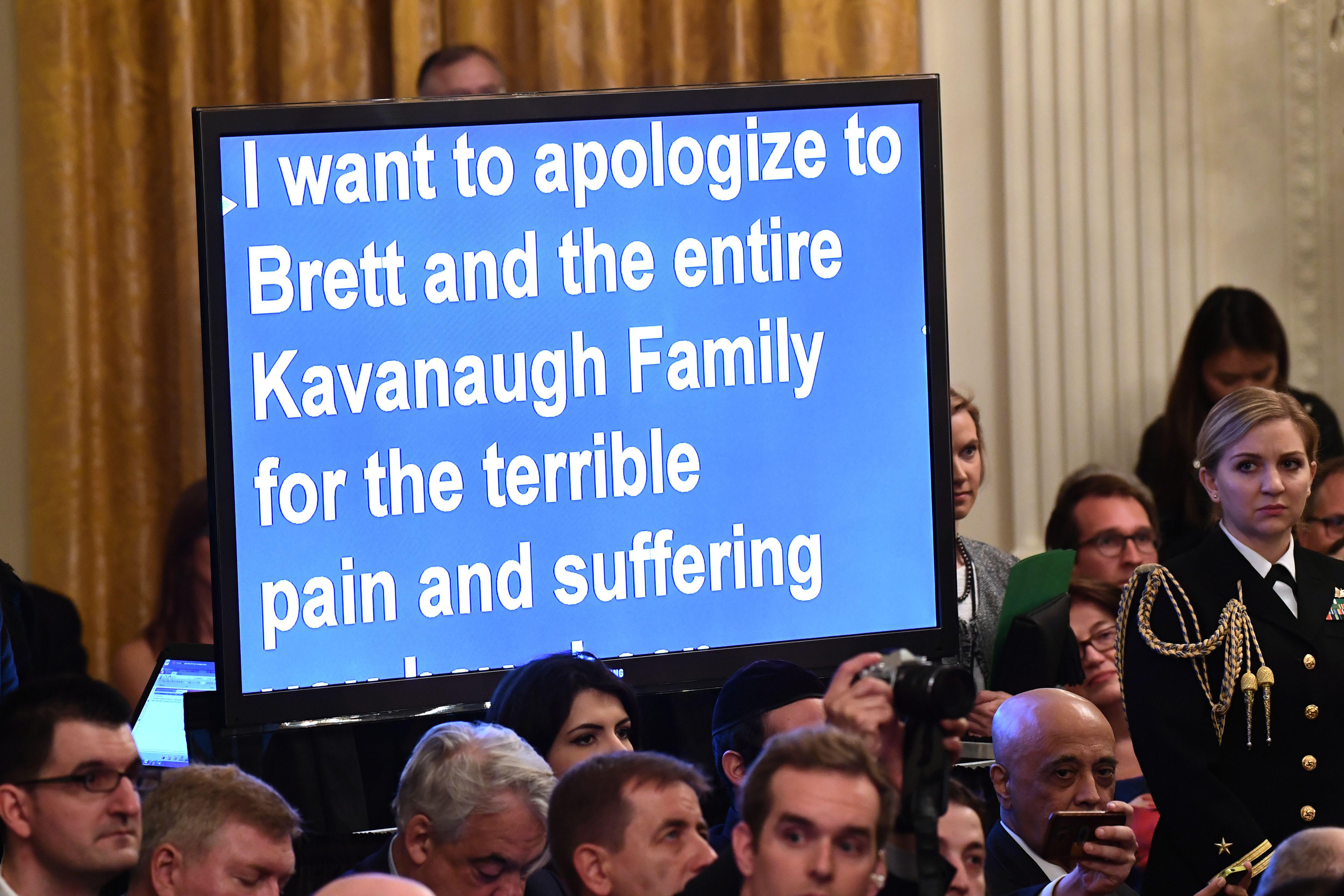
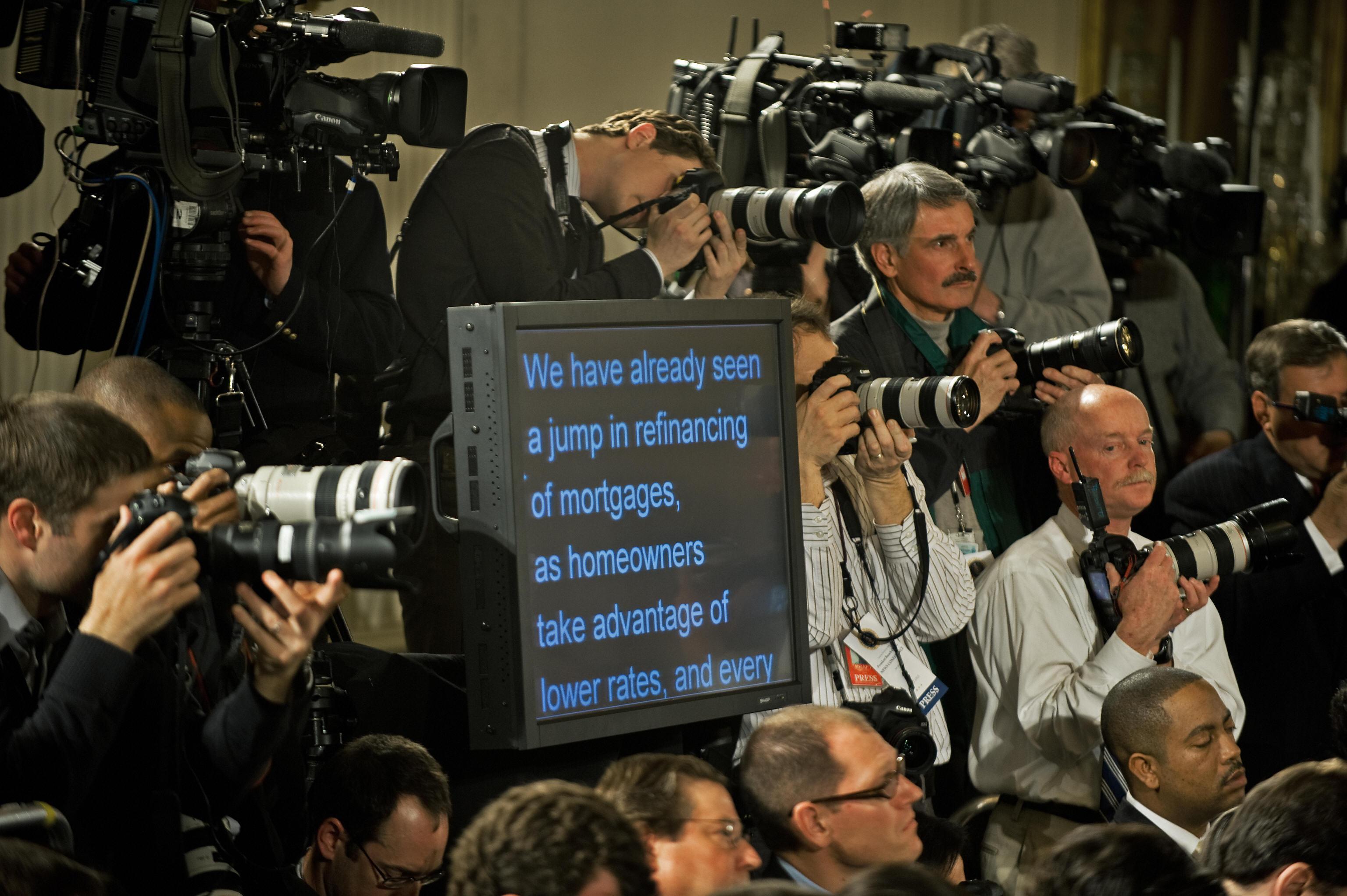
Consider the teleprompter question again. Here’s Barack Obama’s prompter from 2009:

A teleprompter used by Barack Obama shows thinner, slightly smaller text than that used by Donald Trump. Paul J. Richards/Getty Images

And here’s Trump’s:

A teleprompter shows the speech being delivered by Trump during the swearing-in ceremony of Brett Kavanaugh. Brendan Smialowski/AFP/Getty Images

The screen itself is significantly larger, and the font appears to be a few notches bigger, too. It’s the sort of adjustment a White House might make for a president with poor eyesight. But if that president also refuses to wear corrective lenses, there’s only so much a teleprompter can do…

…This, too, would explain Trump’s aggressively large signature. And his insistence that all information fed to him include as many pictures and as few words as humanly possible. It also might explain one of the most chilling lines ever published about Melania Trump:

»

According to a pool report, President Trump responded by pointing to a window in the White House residence, and said: “She’s doing great. She’s looking at us right there.”

«

Reporters turned to look at the spot he indicated, but there was no sign of the first lady.

Sure, it wouldn’t be out of character for the president to tell a brazen, immediately disprovable lie. But when your family only exists to you as a series of vague, oval-like shapes in varying shades of beige, anything could be Melania. Even an empty window.

If you spent your days unable to see, constantly unsure of what you were doing and to whom you were speaking, wouldn’t you be agitated too? Wouldn’t you also probably resent being asked about details? And wouldn’t all of this result in a general state of surliness and short-temperedness?

There’s no question that our president’s brain is broken, and that his mental acuity isn’t anywhere near what it once was. But perhaps it all isn’t quite as bad as we thought. Perhaps Donald Trump just needs to wear his goddamn glasses.

«
unique link to this extract


Labour calls for halt to Google’s acquisition of Fitbit • The Guardian

Alex Hern:

»

The Labour Party has written to the UK competition regulator calling for Google’s reported acquisition of Fitbit to be halted, at least until a wider inquiry into anticompetitive practices in the technology sector is completed.

Google made an offer to purchase the fitness tracking company on Monday for an undisclosed price, according to Reuters.

Tom Watson, the shadow digital, culture, media and sport secretary, has written to the Competition and Markets Authority (CMA) to request it halt the acquisition pending a full investigation of its effect on the competitive landscape.

“I have long been concerned about the data monopolies that dominate our tech market, including Google,” Watson writes. “These companies hold and gather an unprecedented amount of data on users which is then monetised through micro-targeting and advertising to amass huge profits and power. Meanwhile, the digital giants themselves remain unaccountable, unregulated, and see themselves as above the law. They have run rings around regulation for far too long.

“This is not just a business deal, it’s a data grab – and that should worry us all. Any such proposal must be subjected to the most rigorous possible scrutiny and must be fully investigated by the CMA.”

«

Not sure whether the UK, post-Brexit, objecting to the merger would make any difference – what happens? Do the companies have to remain separate in a territory that objects? – but it gives Labour a slight lever of difference as the general election plays out.
unique link to this extract


Facebook held talks to buy Fitbit before Google struck deal • The Information

Alex Heath says Facebook offered about $1bn for Fitbit, which to me implies the talks took place in the summer when Fitbit’s share price made its market value about that – ie below $3 (it’s over twice that now):

»

Facebook’s growing investments in hardware are driven by CEO Mark Zuckerberg’s desire to own the next computing platform after smartphones eventually become less relevant, people familiar with his thinking have told The Information. Inside Facebook, Fitbit’s team would have reported to Andrew Bosworth, Facebook’s executive leading its hardware efforts.

Facebook recently announced that it had acquired CTRL-labs, a startup developing technology that can interpret human brain signals through an armband, in a deal that people familiar with the matter said was worth roughly $750m. Facebook first signaled its interest in hardware with its 2012 purchase of Oculus, the virtual reality headset-maker, for roughly $2bn. 

Since the Oculus purchase, Facebook has also begun making a line of video calling devices for the home called Portal. And the company is currently developing more far-flung augmented reality glasses that will be capable of overlaying virtual objects into the physical world. In addition, Facebook recently struck a deal with the eyewear firm Luxottica to develop camera-equipped glasses with Rayban that will function similarly to Snapchat’s Spectacles glasses

«

unique link to this extract


Pixel Watch or not, Fitbit can’t save Google’s failing Wear OS • Android Police

David Ruddock:

»

hardware is what Google is after: the company has gone on the record stating its acquisition of Fitbit is about future Wear OS devices, meaning you can probably kiss Fitbit’s unloved smartwatch OS goodbye.

So, that means we can count on Google leveraging Fitbit’s renowned hardware to finally give Wear OS the horsepower and capabilities it needs to compete with Apple, right? Well, no. Fitbit’s smartwatches have been most lauded for their long battery life, battery life which has historically been enabled by extremely slow but highly power-efficient processors. The latest Versa 2 allegedly has brought significant performance improvements, but as a smartwatch, it just isn’t very… smart.

As Michael Fisher points out in his review, the Versa 2’s near week-long life on a single charge is only impressive when context is removed from that number. The Versa 2 doesn’t have GPS, the battery only lasts that long when not using the always-on display (with AoD, it’s closer to 3 days), the watch itself doesn’t work for almost anything but fitness tracking on its own, and most of your interactions with it end up happening on your smartphone anyway. And I can tell you from experience that the Apple Watch Series 5 lasts about two days on a charge with always-on display enabled (and Samsung’s watches last even longer), so Fitbit managing a day more isn’t exactly a game-changing technology.

In short, Fitbit’s products are not ones Google should be excited about buying.

«

In the immortal words of Rex the dinosaur in Toy Story 2, confronted with crossing a road teeming with traffic: “oh well, we tried.”
unique link to this extract


Errata, corrigenda and ai no corrida: none notified

Start Up No.1,179: politics v Twitter v Facebook, California’s next century, Rudy Guiliani – too cybersecure!, the WhatsApp hack, and more


“Exclusive detached property, close to park and amenities.” What if your AirBnB rental turns out to be a scam? CC-licensed photo by Carl Campbell on Flickr.

A selection of 11 links for you. Soviet-style, including the gulags. I’m @charlesarthur on Twitter. Observations and links welcome.

I accidentally uncovered a nationwide scam on Airbnb • VICE

Allie Conti:

»

The call came about 10 minutes before we were set to check into the Airbnb. I was sitting at a brewery just around the corner from the rental on North Wood Street in Chicago when the man on the other end of the line said that our planned visit wouldn’t be possible. A previous guest had flushed something down the toilet, which had left the unit flooded with water, he explained. Apologetic, he promised to let us stay in another property he managed until he could call a plumber.

I had flown with two friends to the city in hopes of a relaxing end-of-summer getaway. We had purchased tickets to attend the September music festival Riot Fest, where Blink-182 and Taking Back Sunday were scheduled to perform. The trip had gotten off to a rough start even before the call. Around a month before, a first Airbnb host had already canceled, leaving us with little time to figure out alternative housing. While scrambling to find something else, I stumbled upon a local Airbnb rental listed by a couple, Becky and Andrew. Sure, the house looked a little basic in the photos online, but it was nice enough, especially considering the time crunch—light-filled, spacious, and close to the Blue Line.

Now, we were facing our second potential disaster in 30 days, and I couldn’t help but feel slightly suspicious of the man on the phone, who had called me from a number with a Los Angeles area code. Hoping to talk in person, I asked him if he was in the area. He said that he was at work and didn’t really have time to chat. Then he added that I needed to decide immediately if I was willing to change my reservation.

«

It’s just that tiny detail – demanding that you act immediately – which is the clue that it’s a scam. And AirBnB doesn’t know who to believe, of course, but it has fewer people looking for lodging than it does people offering lodgings, so it’s probably going to side with the lodging owners.

Meet the new boss…
unique link to this extract


Unpopular decisions • BuzzMachine

Jeff Jarvis:

»

Mark Zuckerberg has said definitively that Facebook will not fact-check political ads. That, I agree with, but not for the reason you might assume. Truth is the wrong standard. If truth were so easy then we wouldn’t need countless journalists to find it. No one will trust Facebook to decide truth. But I do think that Facebook should set and uphold standards of dignity, decency, and responsibility in the public conversation and hold everyone — politicians and citizens, users and advertisers — accountable. If Facebook wants to leave up noxious speech by pols so we can see and judge it, OK, but it should add a disclaimer disapproving of the behavior. (Twitter has said that will be its policy, but I’ve yet to see it in action.) If a politician uses a racial slur in political ad — say, calling Mexicans rapists and murderers — Facebook must condemn that behavior, or its Oversight Board likely will. If Facebook accepts such words without comment or caveat, then it must be presumed to condone them. I’d find that unacceptable.

In the end, both Facebook and Twitter — and let’s throw Google and all the other platforms in now — refuse to make judgments. They cannot get away with that anymore. They are hosts to conversation and communities. They have an impact on that conversation and thus on democracies and nations. They are private companies. They are going to have to make judgments according to public principles, no matter how allergic they are to that idea.

«

I like Jeff, but I think he’s unaware of how hand-flapping this stuff actually is in the face of people who are very determined to do what they want. He’d find it “unacceptable” if Dan Scavino or Dominic Cummings were to buy ads which used racial slurs? Oh mercy me. But what would you DO about it? What would that CHANGE? It’s the same pusillanimous approach that bedevils almost all of American media: an unwillingness to prevent, and to let harms happen first, and then tut afterwards. That lets bad actors act, and get away with things that should be stopped first.
unique link to this extract


It’s the end of California as we know it • The New York Times

Farhad Manjoo:

»

lately my affinity for my home state has soured. Maybe it’s the smoke and the blackouts, but a very un-Californian nihilism has been creeping into my thinking. I’m starting to suspect we’re over. It’s the end of California as we know it. I don’t feel fine.

It isn’t just the fires — although, my God, the fires. Is this what life in America’s most populous, most prosperous state is going to be like from now on? Every year, hundreds of thousands evacuating, millions losing power, hundreds losing property and lives? Last year, the air near where I live in Northern California — within driving distance of some of the largest and most powerful and advanced corporations in the history of the world — was more hazardous than the air in Beijing and New Delhi. There’s a good chance that will happen again this month, and that it will keep happening every year from now on. Is this really the best America can do?

Probably, because it’s only going to get worse. The fires and the blackouts aren’t like the earthquakes, a natural threat we’ve all chosen to ignore. They are more like California’s other problems, like housing affordability and homelessness and traffic — human-made catastrophes we’ve all chosen to ignore, connected to the larger dysfunction at the heart of our state’s rot: a failure to live sustainably.

Now choking under the smoke of a changing climate, California feels stuck. We are BlackBerry after the iPhone, Blockbuster after Netflix: We’ve got the wrong design, we bet on the wrong technologies, we’ve got the wrong incentives, and we’re saddled with the wrong culture. The founding idea of this place is infinitude — mile after endless mile of cute houses connected by freeways and uninsulated power lines stretching out far into the forested hills. Our whole way of life is built on a series of myths — the myth of endless space, endless fuel, endless water, endless optimism, endless outward reach and endless free parking.

«

This is a terrific piece: a recognition that what has worked for the past 100 years isn’t going to work for the next. There’s a response from Alissa Walker, essentially saying “but muh climate action!”. But I think she misses, and Manjoo hits, the point.
unique link to this extract


Obama on call-out culture: ‘that’s not activism’ • The New York Times

Emily Rueb and Derrick Taylor:

»

“This idea of purity and you’re never compromised and you’re always politically ‘woke’ and all that stuff,” Mr. Obama said [during an hour-long interview about youth activism]. “You should get over that quickly.”

“The world is messy; there are ambiguities,” he continued. “People who do really good stuff have flaws. People who you are fighting may love their kids, and share certain things with you.”

Mr. Obama spoke repeatedly of the role of social media in activism specifically, including the idea of what’s become known as “cancel culture,” which is much remarked upon, but still nebulously defined. It tends to refer to behavior that mostly plays out on the internet when someone has said or done something to which others object. That person is then condemned in a flurry of social media posts. Such people are often referred to as “canceled,” a way of saying that many others (and perhaps the places at which they work) are fed up with them and will have no more to do with them.

Mr. Obama talked about conversations he’s had with his daughter Malia, who is a student at Harvard with Ms. Shahidi.

“I do get a sense sometimes now among certain young people, and this is accelerated by social media, there is this sense sometimes of: ‘The way of me making change is to be as judgmental as possible about other people,’” he said, “and that’s enough.”

“Like, if I tweet or hashtag about how you didn’t do something right or used the wrong verb,” he said, “then I can sit back and feel pretty good about myself, cause, ‘Man, you see how woke I was, I called you out.’”

Then he pretended to sit back and press the remote to turn on a television.

“That’s not activism. That’s not bringing about change,” he said. “If all you’re doing is casting stones, you’re probably not going to get that far. That’s easy to do.”

«

In the same way, breaking news: changing your Twitter avatar to include [topic of current concern] has zero effect.
unique link to this extract


Black Salve is a dangerous fake cancer cure, but Facebook Groups allow it to flourish • Buzzfeed News

Katie Notopoulos:

»

Even as Facebook has cracked down on anti-vaxxers and peddlers of snake oil cure-alls, a particularly grotesque form of fake cancer treatment has flourished in private groups on Facebook. Black salve, a caustic black paste that eats through flesh, is enthusiastically recommended in dedicated groups as a cure for skin and breast cancer — and for other types of cancer when ingested in pill form. There’s even a group dedicated to applying the paste to pets.

A Facebook spokesperson told BuzzFeed News that these groups don’t violate its community guidelines. This summer, it launched an initiative to address “exaggerated or sensational health claims” and will downrank that content in the News Feed, similar to how it handles clickbait. But it’s not clear how it defines what a “sensational” health claim is. Citing user privacy, Facebook would not say whether or not it had downranked the black salve groups in the News Feed.

Other platforms have taken a different approach. When BuzzFeed News asked YouTube about several videos where people discussed using black salve, YouTube said the videos were in violation and removed them. Amazon, which does not sell the salve itself, removed a book about black salve when BuzzFeed News asked about it.

Doctors and medical literature are clear that black salve is not a safe or effective cure for cancer. The FDA does not allow the sale of the product in the US. But tech platforms are not in sync about how to handle it. And in the meantime, people are getting disfigured or dying.

«

On the plus side, the tech companies can say they’re not colluding.
unique link to this extract


Rudy Giuliani needed Apple genius help to unlock his iPhone after being named Trump cybersecurity adviser • NBC News

Rich Schapiro:

»

Less than a month after he was named President Donald Trump’s cybersecurity adviser in 2017, Rudy Giuliani walked into an Apple store in downtown San Francisco.

He wasn’t looking for a new gadget. Giuliani was looking for help.

He was locked out of his iPhone because he had forgotten the passcode and entered the wrong one at least 10 times, according to two people familiar with the matter and a photo of an internal Apple store memo obtained by NBC News.

“Very sloppy,” said one of the people, a former Apple store employee who was there on the day that Giuliani stopped by in February 2017.

“Trump had just named him as an informal adviser on cybersecurity and here, he couldn’t even master the fundamentals of securing your own device.”

«

That “entered the wrong passcode 10 times” detail is strange. Usually when that’s turned on, the phone wipes – but it takes ages to enter it wrong that many times, because the pause in between entry attempts gets longer and longer. Which implies that he didn’t have “wipe after 10 failed attempts” turned on. Quite the cyber czar. And phone czar – he has repeatedly butt-dialled Schapiro and accidentally left voicemails about financial topics.

Though as Farhad Manjoo (him again!) points out, it’s a bad security failing by Apple that a customer of any sort had personal details leaked. In Europe, it would face a big GDPR fine. (Thanks Nic for the link.)
unique link to this extract


Why ‘Medicare for All’ could both raise taxes and lower costs • The New York Times

Margot Sanger-Katz and Josh Katz:

»

The charts above compare two leading sets of health care proposals advocated by Democrats running for president. The first, a “public option” plan, is similar to proposals from Joe Biden, Pete Buttigieg and other candidates. It would allow most Americans to buy insurance from the government and make other changes that would enable fewer people to go without coverage, but it would preserve much of the existing health insurance system.

The second, a “Medicare for all” plan introduced by Bernie Sanders and endorsed by Elizabeth Warren, would replace most Americans’ current health insurance with a generous government-run plan that covers more benefits. (Kamala Harris wants to replace the existing system with a mix of new public and private options, but there are not yet rigorous cost estimates for such a plan.)

When critics say that a single-payer system will be expensive, they are usually talking about the increase in federal spending — the size of the red box above. When Medicare for all enthusiasts say it would not increase spending much, they are talking about the size of the entire chart.

[Interactive: the size of the entire chart doesn’t change, no matter which option you go for.]

That’s why it could be true both that Medicare for all would require substantial tax increases and that it would leave many or most American families better off financially.

«

I’m constantly amazed that Americans can’t grasp this. If the government pays for your health care, then you cut out the insurance companies and all the other middlemen who are happily taking a profit. Presently it’s a “distorted market that involves larger transfers from taxpayers to insurers”, to quote the White House in 2018. Health insurance companies made $47bn of profit on $545bn of revenues in just the second quarter of 2018. They benefit from people not getting the best service, or from maximising their charges. That’s not aligned with what people, or government, wants.
unique link to this extract


Exclusive: WhatsApp hacked to spy on top government officials at US allies • Reuters

Christopher Bing and Raphael Satter:

»

Senior government officials in multiple US-allied countries were targeted earlier this year with hacking software that used Facebook’s WhatsApp to take over users’ phones, according to people familiar with the messaging company’s investigation.

Sources familiar with WhatsApp’s internal investigation into the breach said a “significant” portion of the known victims are high-profile government and military officials spread across at least 20 countries on five continents.

The hacking of a wider group of top government officials’ smartphones than previously reported suggests the WhatsApp cyber intrusion could have broad political and diplomatic consequences.

WhatsApp filed a lawsuit on Tuesday against Israeli hacking tool developer NSO Group. The Facebook-owned software giant alleges that NSO Group built and sold a hacking platform that exploited a flaw in WhatsApp-owned servers to help clients hack into the cellphones of at least 1,400 users…

…Some victims are in the United States, United Arab Emirates, Bahrain, Mexico, Pakistan and India, said people familiar with the investigation. Reuters could not verify whether victims from these countries included government officials.

«

Principal suspects of doing the hacking: China, Russia, Israel. The US might have, but hasn’t had much motive lately.
unique link to this extract


Editorial: Apple isn’t revamping its HomeKit team, but maybe it should • Apple Insider

William Gallagher disputes Bloomberg’s report that Apple is “revamping” its HomeKit team:

»

Bloomberg is right that HomeKit devices lag far behind Amazon’s Echo and Google’s Home ones. We might wish that both of those companies were more privacy and security conscious as Apple is, but if you pick up a smart device, it’s certainly going to work with them.

And whatever the smart device is that you want, there will be an Amazon and a Google one, there may well not be an Apple HomeKit one. That’s particularly true internationally, but even within the US, your range of products is quite limited.

Apple has made a move that could be designed to help this. It’s announced HomeKit Secure Video as part of iOS 13, which will store your security footage on Apple’s servers. That will unquestionably make HomeKit cameras more appealing to buyers because it will doubtlessly be convenient, plus it’s easier to trust Apple with your footage than it is an unknown third-party.

Yet although firms such as Logitech have said that they will support HomeKit Secure Video, it’s not likely to see a rush of vendors. That’s because home security firms don’t just rely on selling you a camera, they need you to buy services such as footage storage and retrieval.

If Apple made a camera, you’d call HomeKit Security Video a killer feature, especially as a certain amount of the storage will be free if you already pay for extra iCloud storage.

What it needs is HomeKit evangelism, like how it sold Macs back in the day.

Where Apple could make a killer feature that made HomeKit more appealing and yet didn’t drive away other vendors, is in its existing products.

The Apple TV and HomePod, for instance, are already able to act as a HomeKit hub in your house. It’s there, it’s plugged in, it’s working with HomeKit. What would it take for Apple to embed a mesh Wi-Fi system into that same hardware.

«

Either Apple has some 3D-chess strategy here, or it’s got nothing. But it’s making it impossible to tell which. Soon though it won’t be able to catch up; people will have plumped for one of the rival ecosystems. (Thanks Clive H for the link.)
unique link to this extract


Google Pixel 4 XL review: not quite ready for primetime • The Guardian

Samuel Gibbs:

»

for every feature that’s good, there’s a problem that needs fixing. The screen’s great, but not always at 90Hz and not always bright enough, and the battery life just isn’t long enough for a top-end phone in 2019.

The fact that the new Assistant doesn’t work when you have a G Suite account on your phone – a product made and sold to companies by Google – is frankly embarrassing. As is the oversight that some may want to make sure they’re actually looking at their phone with their eyes before it unlocks – Apple knew this and has had it in Face ID for three years.

The biggest issue for me, however, is that the Android app ecosystem just isn’t ready for a phone that has dumped the fingerprint sensor. Face Unlock is genuinely great. A transformational leap just as Face ID was three years ago on the iPhone X, but only when it works. And it doesn’t work in my banking apps, my security apps or Evernote. Only one app I routinely use a fingerprint with supports Face Unlock.

That situation will change once all the apps have been updated, but I’m not holding my breath for the very slow-moving banks to support Face Unlock any time soon, and that’s a real problem.

The Pixel 4 XL is therefore a very hard phone to grade. Once Google fixes the problems and apps have been updated, the only thing really holding the phone back is below-average battery life. If that’s something you can live with, and you trust Google to fix things, then by all means buy the Pixel 4 XL.

«

unique link to this extract


Huawei Mate 30 set to be launched in Europe in mid-November • Techgarage

Pascal Landolt:

»

According to our own well-informed sources based in China, Huawei seems to be gearing up to launch the Mate 30 and Mate 30 pro in Europe starting mid-November, possibly on November 15th.

A complete list of included countries hasn’t been released yet but according to our contact we can expect “the usual suspects” – meaning countries often involved in the first wave of Huawei launches. Which would mean that the Mate 30 Series will launch mid-November in the following countries: Germany, France, Spain, Italy, Great Britain and Switzerland.

Could it even be possible that Huawei‘s own foldable phone, the Mate X, might be launched around the same time? Both models are already available in China’s domestic market and the Mate X especially is overdue in Europe by now, especially seeing that competitor Samsung has already launched its foldable Galaxy Fold a few weeks ago on the old continent.

What else do we know about the Mate 30 Series from Huawei? For one, it is confirmed that the devices will be shipping with Android 10 as OS and a preloaded HMS (Huawei Mobile Services) Suite instead of the more traditional GMS (Google Mobile Services). Which means you’re not getting Google Maps, the Chrome Browser or other Google Apps straight out of the box.

«

Can’t see how this will possibly be anything other than a huge burden for any carrier that sells it because of the customer support (“no, there isn’t Google Maps..”). And it’s not cheap – €799 to €1,199.
unique link to this extract


Errata, corrigenda and ai no corrida: none notified

You can sign up to receive each day’s Start Up post by email. You’ll need to click a confirmation link, so no spam.

Start Up No.1,178: inside the gangster smartphone company, the new digital divide, political ad meltdown, Prime ad slapped, and more


Even the threat of being eaten won’t make Twitter un-ban this ad. CC-licensed photo by runran on Flickr.

You can sign up to receive each day’s Start Up post by email. You’ll need to click a confirmation link, so no spam.

A selection of 9 links for you. Happy un-Brexit day (again). I’m @charlesarthur on Twitter. Observations and links welcome.

Inside the phone company secretly run by drug traffickers • VICE

Joseph Cox:

»

Hughes and Kok spent the evening in Boccacio, a sex club on the outskirts of Amsterdam. After their session, and as the puffer-jacket wearing Kok stepped into a Volkswagen Polo, a hooded figure jumped from the dense shrubbery around the parking lot and fired into the Polo, killing Kok. Hughes walked away from the scene, according to CCTV footage previously published by the Dutch police.

MPC, it turned out, was not an ordinary phone company.

All over the world, in Dutch clubs like the one Kok frequented, or Australian biker hangouts and Mexican drug safe houses, there is an underground trade of custom-engineered phones. These phones typically run software for sending encrypted emails or messages, and use their own server infrastructure for routing communications.

Sometimes the devices have the microphone, camera, and GPS functionality removed. Some also have a dual-boot mode, where powering on the device as normal will show an innocuous menu screen with no sensitive information. But if certain buttons are held down when turning the phone on, it will reveal a secret file system containing the user’s encrypted text messages and other communications.

With these tweaks, the ordinary methods for law enforcement to intercept messages are cut off—police can’t simply get an ordinary phone tap or subpoena messages from a company; the texts are typically only available in a readable form on the users’ devices.

A handful of these so-called “encrypted phone” companies exist. Many of them cater and sell to criminals. As Kok, the murdered blogger, wrote on his website in 2015, “I see on various crime sites these things [encrypted phones] are offered for sale because many of their future clients are also criminals. Advertising on a site where bicycles are offered does not make sense for this type of company.”

«

Hell of a story.
unique link to this extract


Apple working on new HomeKit devices after HomePod, Apple TV • Bloomberg

Mark Gurman:

»

Apple Inc. is ramping up hiring for a team that is working on new smart-home software and devices in an effort to catch up in a field where Google and Amazon.com Inc. have dominated, according to people with knowledge of the matter.

The company is seeking engineers to work in its Cupertino, California, headquarters and in San Diego as part of a group revamping Apple’s smart-home platform. The overhaul is designed to spur more outside accessory and appliance makers to connect smart-home products such as lights and garage doors with the iPhone and Apple’s voice-activated digital assistant, Siri. The team also is exploring the possibility of building new home devices beyond the HomePod speaker.

The effort is headed by Andreas Gal, the former Mozilla chief technology officer who joined Apple last year when his company Silk Labs was acquired by the iPhone maker. Gal is leading the software side of the team reporting to Arun Mathias, a lieutenant to software chief Craig Federighi, who oversees wireless software engineering. Silk Labs developed an artificial intelligence-based platform for linking together internet-connected devices.

Apple has posted 15 job listings on its website since last month for engineers to work on the company’s platform, called HomeKit, smart-home devices and related software…

«

They could always do routers. They used to be pretty good at that. Apple’s problem in the home is that unlike every other product category, it can’t decide which product(s) to focus on, nor which is the key. Is it the Apple TV? (But who really uses that for home control?) HomePod? (Too low a penetration.) Should they make their own? (Why not?)
unique link to this extract


The failure of advertising is creating a greater digital divide • ZDNet

Tom Foremski:

»

Traditionally, more eyeballs mean more advertising revenues, and media companies have been getting larger and larger audiences. But there’s something wrong; their advertising revenues continue to fall. It’s because their audience is too slow to outpace the deflationary effects of the internet. 

Whenever something is abundant it has a lower value. The web created a huge abundance of formerly limited resources: Pages and places to advertise. A low-cost web page now competes for the same advertisers as a page on a news site that employees hundreds of professionals. 

It’s called programmatic advertising, and it is problematic for the traditional media industry because it means its investments in high-quality media are not rewarded. 

This deflationary advertising trend affects everyone including Google. The more Google expands its reach and its audience – the less revenue it gets from each click. 

Every financial quarter for more than a decade, Google reports around 15 to 20% less revenue per click (cost-per-click) from the prior year. Every quarter, year after year, it makes less money per click. 

Google has been able to outrun this steep deflation in its advertising business because it manages to grow its paid clicks two to three times faster than what it loses per click.

It’s not realistic or sustainable for traditional media to grow at such rates. It’s not sustainable for Google either. How many more ads can it find places to show especially on tiny mobile screens?

«

Google’s search results now are essentially a slew of ads on many topics, especially on mobile; I long ago gave up on it, and I’m horrified by what it has become every time I go back.

Foremski argues that media outlets, which can’t do the same, are being driven to subscription solutions because ad revenue cannot cover the costs of quality journalism. Which means you shut out people who can’t pay for it. A different digital divide.
unique link to this extract


Key election safeguards won’t be ready for December poll • Sky News

Rowland Manthorpe:

»

Six months after announcing a range of new measures to “safeguard elections” and “crack down on intimidation, influence and disinformation”, the government has failed to introduce any protections.

“Hostile states, foreign lobbyists, and shadowy third parties” could jeopardise the integrity of any election or referendum in the UK, according to the government statement when these safeguards were announced.

But a cabinet office spokesperson confirmed to Sky News that despite this risk, the safeguards will not be in place for the general election in December.

At the time the safeguards were announced the government said it would introduce new laws making it an offence to intimidate candidates or campaigners during the period before an election, both in person and online.

It was also set to clarify the offence of “undue influence of a voter” which has proved difficult for enforcement agencies to interpret, and it would have extended real-world laws about election material to material published online.

Currently, any candidate, political party or non-party campaigner is required to have an imprint on any of their printed election material to show that they have produced it.

A digital imprint regime would have introduced a similar requirement for Facebook, YouTube and similar social media platforms used by campaigners.

«

Of course the excuse is going to be that they were busy with Brexit. Except governments can do more than one thing at a time, if they’re competent.
unique link to this extract


Twitter to ban all political ads in 2020 amid election uproar • The Washington Post

Tony Romm and Isaac Stanley-Becker:

»

Twitter on Wednesday said it would ban all advertisements about political candidates, elections and hot-button policy issues such as abortion and immigration, a significant shift that comes in response to growing concerns that politicians are seizing on the vast reach of social media to deceive voters ahead of the 2020 election.

Twitter CEO Jack Dorsey announced the move in a series of tweets, stressing that paying for political speech has the effect of “forcing highly optimized and targeted political messages on people.” The ban marks a break with Twitter’s social-media peers, Facebook and Google-owned YouTube, which have defended their policies around political ads in recent weeks.

“While internet advertising is incredibly powerful and very effective for commercial advertisers, that power brings significant risks to politics, where it can be used to influence votes to affect the lives of millions,” Dorsey said.

Twitter’s announcement covers ads intended to influence elections including ballot measures, as well as those that address “issues of national importance.” The new rules will be applied globally, published by mid-November and take effect later in the month, Dorsey said.

But the change drew a mixed reception, with some critics highlighting that it would not affect what users can tweet and share on their own. Teddy Goff, who served as President Obama’s digital director in 2012 and as senior adviser to Hillary Clinton in 2016, said any update by Twitter that does not address the “organic and algorithmic spread of hate speech and discrimination and dishonesty” is insufficient.

«

Bans “ads that refer to an election or a candidate; ads that advocate for or against legislative issues of national importance (such as: climate change, healthcare, immigration, national security, taxes).” Starts out good, quickly becomes a mess.
unique link to this extract


He’s running for Governor so he can run false Facebook ads to stop false Facebook ads • CNN

Donie O’Sullivan:

»

Adriel Hampton, a political activist who runs his own marketing firm in San Francisco, registered at his local post office on Monday morning as a candidate for governor of California.

…Hampton is the treasurer of “The Really Online Lefty League” PAC, which last Thursday began running a false ad on Facebook claiming that Senator Lindsey Graham backed the Green New Deal.
The ad spliced together different audio of Graham speaking to make it sound like he said, “Simply put, we believe in the Green New Deal.” Graham never said that.

The ad was eventually flagged by Facebook’s fact-checkers and was removed. While Facebook allows politicians to lie in ads, it does not allow PACs or other political groups to do so.

Hampton hopes that by being a candidate he will be able to run false ads without Facebook stopping him.

“The genesis of this campaign is social media regulation and to ensure there is not an exemption in fact-checking specifically for politicians like Donald Trump who like to lie online,” he told CNN Business.

Hampton unsuccessfully ran for Congress in 2009, but was credited at the time as being the first congressional candidate to announce his campaign on Twitter.

“I think social media is incredibly powerful,” he said Monday. “I believe that Facebook has the power to shift elections.”

«

Facebook said on Tuesday night that it won’t allow Hampton’s ads. “This person has made clear he registered as a candidate to get around our policies so his content, including ads, will continue to be eligible for third-party fact-checking.” Facebook’s policy is about to collapse in a black hole of ridiculousness: all the next Hampton needs to do is not declare that’s their intent.
unique link to this extract


Amazon Europe Core Sarl ‘Prime’ signup • UK Advertising Standards Authority

»

Ad description: A page on Amazon.co.uk, seen in May and June 2019, which formed part of the checkout process. Text stated, “… we’re giving you a 30-day free trial of Amazon Prime! Starting with this order …”. A gold box included text which stated, “Order Now with Prime”. That box was contained within a larger grey box. Text underneath the gold box, but within the grey one, stated, “Continue with FREE One-Day Delivery Pay later”. An option to the left in blue text stated, “Continue and don’t gain Amazon Prime benefits”. Small print at the bottom of the page stated, “By signing up you acknowledge that you have read and agree to the Amazon Prime Terms and Conditions and authorise us to charge your credit card … after your 30-day free trial …”.

Issue: Ten complainants, who believed the presentation of the options was unclear, challenged whether the ad was misleading…

The option to sign up for the trial of Amazon Prime was a grey box with a gold box inside. Text in the gold box stated “Order Now with Prime”, and we considered that the average consumer was likely to understand that to be one discrete option. Directly beneath that, and still within the larger grey box, text stated, “Continue with FREE One-Day Delivery Pay later”. We considered that the presentation and wording of that text meant it was likely to be seen by the average consumer as a separate option. However, we understood that, in fact, both boxes were part of the same option. The option to continue without signing up for the trial was presented as text stating “Continue and don’t gain Amazon Prime benefits”, which was small and placed in a position which could easily be missed by consumers. It was also in a faint colour, and compared to the option presented in the grey and gold boxes it was significantly less prominent.

«

Conclusion: breaches the UK advertising code. OK, now let’s get them onto Facebook. (Pity this had to take nearly six months.)
unique link to this extract


China handset market undergoes structural changes • Digitimes

Max Wang and Steve Shen:

»

The rising penetration rate of handsets, slow market demand and looming commercial operations of 5G networks has ushered in a structural change in China’s handset market where sales are moving to focus more on branded products and fewer new models are being launched.

Data from China Academy of Information and Communications Technology (CAICT) showed that handset shipments totaled 251m units in China in the first eight months of 2019, down 5.5% from a year earlier. Among them, 4G models accounted for 240m units and 5G ones 291,000 units.

It also showed that the number of new handsets launched during the eight-month period declined 37% on year to 343 models. Excluding new ones released by Samsung Electronics and Apple, Chinese vendors launched only 304 new models in that period, decreasing 39% from a year ago.

The tallies also indicated that some Chinese second-tier handset makers are withdrawing from the market due to keen competition, while first-tier brands are funneling their resources to focus on fewer premium models.

«

This sounds like a repeat of what happened with Android tablets: Chinese companies piled in to make them, sold them by the cartload, and then got the hell out when the market turned down. Though 304 new models is a lot (down from 422).

Samsung decided in 2014 that its own trajectory of 56 models per year was too many, though I can’t find a count for what it is now.
unique link to this extract


Russia tests new disinformation tactics in Africa to expand influence • NY Times

Davey Alba and Sheera Frenkel:

»

Russia has been testing new disinformation tactics in an enormous Facebook campaign in parts of Africa, as part of an evolution of its manipulation techniques ahead of the 2020 American presidential election.

Facebook said on Wednesday that it removed three Russian-backed influence networks on its site that were aimed at African countries including Mozambique, Cameroon, Sudan and Libya. The company said the online networks were linked to Yevgeny Prigozhin, the Russian oligarch who was indicted by the United States and accused of interfering in the 2016 presidential election.

Unlike past influence campaigns from Russia, the networks targeted several countries through Arabic-language posts, according to the Stanford Internet Observatory, which collaborated with Facebook to unravel the effort. Some of the posts promoted Russian policies, while others criticized French and American policies in Africa. Russians also worked with locals in the African countries to set up Facebook accounts that were disguised as authentic to avoid detection.

The effort was at times larger in volume than what the Russians deployed in the United States in 2016. While the Kremlin-backed Internet Research Agency posted on Facebook 2,442 times a month on average in 2016, one of the networks in northern and central Africa posted 8,900 times in October alone, according to the Stanford researchers.

«

So now we, or at least Russia, move on to the next stage of the global disinformation war.
unique link to this extract


Errata, corrigenda and ai no corrida: none notified

Start Up No.1,177: Facebook staff revolt on political ads, Normal’s ransomware fixer, deja Vue, Oz’s face plan for porn, and more


Crumbling infrastructure in the US is a “technical debt” that needs repaying – which will cost trillions. CC-licensed photo by Phil Roeder on Flickr.

You can sign up to receive each day’s Start Up post by email. You’ll need to click a confirmation link, so no spam.

A selection of 10 links for you. Unelectable. I’m @charlesarthur on Twitter. Observations and links welcome.

Dissent erupts at Facebook over hands-off stance on political ads • The New York Times

Mike Isaac:

»

The letter was aimed at Mark Zuckerberg, Facebook’s chief executive, and his top lieutenants. It decried the social network’s recent decision to let politicians post any claims they wanted — even false ones — in ads on the site. It asked Facebook’s leaders to rethink the stance.

The message was written by Facebook’s own employees.

Facebook’s position on political advertising is “a threat to what FB stands for,” the employees wrote in the letter, which was obtained by The New York Times. “We strongly object to this policy as it stands.”

For the past two weeks, the text of the letter has been publicly visible on Facebook Workplace, a software program that the Silicon Valley company uses to communicate internally. More than 250 employees have signed the message, according to three people who have seen it and who declined to be identified for fear of retaliation.

While the number of signatures on the letter was a fraction of Facebook’s 35,000-plus work force, it was one sign of the resistance that the company is now facing internally over how it treats political ads.

Many employees have been discussing Mr. Zuckerberg’s decision to let politicians post anything they want in Facebook ads because those ads can go viral and spread misinformation widely. The worker dissatisfaction has spilled out across winding, heated threads on Facebook Workplace, the people said…

…The letter… laid out product changes and other actions that Facebook could take to reduce the harm from false claims in advertising from politicians. Among the proposals: changing the visual design treatment for political ads, restricting some of the options for targeting users with those ads, and instituting spending caps for individual politicians.

«

Restricting targeting would go a long way. Don’t allow targeting, except as well as TV or print allows (ie not very)? Microtargeting is a serious problem, allied to the lies told in ads. This topic is not going away.
unique link to this extract


Alex Stamos on Facebook, politics and design • CJR

Alex Stamos, ex-Facebook security, in conversation with Mathew Ingram:

»

Some of the core issues at the company around both data protection and speech come from decisions made in the 2009-2012 era of Facebook, when the company was struggling for revenue in the run-up to the IPO. Those decisions might have been appropriate when a core use of the product was as a life-support system for Farmville, but they needed to be revisisted by the time Facebook had become the most important medium for political speech in much of the world.
I would have rather seen Mark said “I started this thing in my dorm room and things have really changed. We are going to be better at understanding those changes and trying to predict what will happen instead of reacting.”

My second problem with his speech is that he did the same thing that a lot of Facebook’s critics do: he compressed all of the different products into this one blob he called “Facebook”. That is not a useful frame for pretty much any discussion of how to handle speech issues.

Facebook, Inc., a Delaware corporation, operates a product called Facebook along with WhatsApp and Instagram. If you dive into the product called “Facebook”, you will find that it is actually something like a dozen different products strung together. Those products share the same backend and code base, but they are designed and developed by different teams and, more importantly, have very different safety, security and trust models.

«

Both the format and the content is worth looking at.
unique link to this extract


The ransomware superhero of Normal, Illinois • ProPublica

Renee Dudley:

»

There are almost 800 known types of ransomware, and [27-year-old Michael] Gillespie, mostly by himself but sometimes collaborating with other ransomware hunters, has cracked more than 100 of them. Hundreds of thousands of victims have downloaded his decryption tools for free, potentially saving them from paying hundreds of millions of dollars in ransom.

“He took that deep dive into the technical stuff, and he just thrives on it,” said Lawrence Abrams, founder of a ransomware assistance website called BleepingComputer.com. “Every time a new ransomware comes out, he checks it out. ‘Can it be decrypted? Yes, it can be decrypted. OK, I’ll make the decryptor.’ And it’s just nonstop. He just keeps pumping them out.”

Gillespie downplays his accomplishments. “IT moves so fast, there’s always something to learn, and there’s always someone better than you,” he said.

Gillespie’s tools are available on BleepingComputer.com, and they can be accessed through a site he created and operates, called ID Ransomware. There, victims submit about 2,000 ransomware-stricken files every day to find out which strain has hit them and to obtain an antidote, if one exists.

«

unique link to this extract


Sony Interactive Entertainment to shut down Playstation Vue • PlayStation.Blog

»

Over four years ago, we made a bold decision to change the rules and revolutionize the traditional TV-viewing experience in the U.S. with PlayStation Vue. We set the bar high and sought to innovate an established industry by delivering a modern TV experience. By completely rethinking live and on demand television, we offered an incredible user experience that allowed viewers to discover and watch content in completely new ways.

Today we are announcing that we will shut down the PlayStation Vue service on January 30, 2020. Unfortunately, the highly competitive Pay TV industry, with expensive content and network deals, has been slower to change than we expected. Because of this, we have decided to remain focused on our core gaming business.

«

“It’s all everyone else’s fault that you wouldn’t buy our $50-per-month package that was like everyone else’s but pricier.” Disappointed customers reckoned to number about half a million.
unique link to this extract


Sea-level rise could flood hundreds of millions more than expected • MIT Technology Review

James Temple:

»

By the end of this century, rising oceans will almost certainly flood the lands where tens of millions of people live as accelerating climate change warms the waters and melts ice sheets.

But precise estimates of the vulnerable populations depend on precise measurements of the planet’s topography, to understand just how close to sea level communities have settled.

A new study that seeks to correct for known errors in earlier elevation models finds that researchers might have been undercounting the number of people exposed to rising tides by hundreds of millions. That’s three to four times more people than previously projected, depending on the specific scenarios.

If these higher estimates prove correct, it will dramatically increase the damages and casualties from sea-level rise, swell the costs of adaption efforts like constructing higher seawalls, and escalate mass migration away from the coasts.

«

All this is important, and the research is impressive. But any story that begins “by the end of this century” – ie, in just over 80 years – is going to struggle to enthrall the average reader, I think.
unique link to this extract


California’s fires and PG+E’s toxic debt • The Atlantic

Alexis C. Madrigal:

»

Almost everywhere you look in the built environment, toxic technical-debt bubbles are growing and growing and growing. This is true of privately maintained systems such as PG&E’s and publicly maintained systems such as that of Chicago’s Department of Water Management. It’s extremely true of roads: Soon, perhaps 50% of Bay Area roads will be in some state of disrepair, not to mention the deeper work that must occur to secure the roadbeds, not just the asphalt on top.

Then there are the sewers and the wastewater plants. Stormwater drains. Levees. And just regular old drinking water. Per capita federal funding for water infrastructure has fallen precipitously since the 1970s. Cities are forced to make impossible decisions between funding different services. And even when they do have the money they need, officials make bad or corrupt decisions. So, water systems in the United States have built up a $1trn technical debt, which must be paid over the next 25 years. The problem is particularly acute in the Great Lakes states. One investigation, by American Public Media, found that from 2007 to 2018 Chicago residents’ water bills tripled, and Cleveland residents’ doubled. In Detroit, a city with a median income of less than $27,000, the average family paid $1,151 for water.

At these rates, poor residents are far more likely to have their water shut off, and the systems still aren’t keeping up with the maintenance they need. Runaway technical debt makes it nearly impossible to pay the “interest,” which is just keeping the system running, let alone to start paying down the principal or start new capital projects.

All told, the American Society of Civil Engineers estimates that it will cost $3.6trn to get Americans back to an acceptable level of technical debt in our infrastructure.

«

Remember all the “infrastructure weeks” that Trump had? How he promised that he’d sort it out? Yet another bleak lie. Instead, the US got a rising deficit and tax cuts for the rich.
unique link to this extract


Australia proposes face scans for watching online pornography • The New York Times

Jamie Tarabay:

»

The Australian government has proposed using a facial recognition system it is developing to verify that people who seek to watch pornography online are of legal age.

Current law in Australia does not prohibit minors from viewing pornography. But the federal government is considering proposals that would require people to prove their age before watching the material.

Under the proposal from the Department of Home Affairs, a computer user’s face would be matched to images from official identity documents. It does not say how the user would submit a facial image at the beginning of each online session.

The proposal drew immediate objections as a potential infringement of Australians’ privacy. “I think people should be very concerned about any government department that’s seeking to store this kind of information,” said Senator Rex Patrick, a centrist lawmaker from the state of South Australia.

The Department of Home Affairs did not respond to questions about the proposal, and the attorney general’s office, when asked to comment on the legal ramifications of the system, directed all questions to Home Affairs…

…This is not the first time the department has proposed a use for facial recognition systems. Last year, it pushed facial verification as a way to crack down on online identity fraud. It also rejected suggestions that warrants would be necessary for access to the country’s facial recognition database.

«

There’s no way at all that this could possibly be spoofed or go horribly wrong, is there. None at all.
unique link to this extract


AirPods Pro unboxing videos: design, sound, ear tip fit test, and more • MacRumors

Joe Rossignol:

»

The first AirPods Pro unboxing videos have surfaced on YouTube from tech reviewers Marques Brownlee, Justine Ezarik, and Safwan Ahmedmia.

The reviewers were all impressed with sound quality and active noise cancellation, with Brownlee saying noise cancellation on the AirPods Pro is roughly on par with the new Beats Solo Pro. As for fit, Ahmedmia found the AirPods Pro with in-ear tips to be more comfortable than the regular AirPods.

Brownlee’s video provides a first look at the new Ear Tip Fit Test, a feature that checks the fit of the AirPods Pro in your ear to determine which size ear tips provides the best seal and acoustic performance. Ear Tip Fit Test can be accessed by tapping the info icon next to your AirPods Pro in Settings > Bluetooth.

Apple says advanced algorithms work together with the inward-facing microphones in each AirPod to measure the sound level in the ear and compare it to what is coming from the speaker driver. In just seconds, the algorithm detects whether the ear tip is the right size and has a good fit, or should be adjusted.

AirPods Pro come with a Lightning to USB-C cable in the box, compared to USB-A for the regular AirPods. Also included in the box is a wireless charging case, silicone ear tips in three sizes, and documentation.

«

The choice of USB-C is interesting: does it charge if you use USB-A? Or is this because more of the chargers Apple is selling are USB-C? Also notable that Apple’s media approach now is so focussed on early access to YouTubers.
unique link to this extract


New 13.2 update bricking some HomePods [update pulled by Apple] • MacRumors

Juli Clover:

»

We thought that the perceived HomePod issues may have been linked to an Apple Music outage lasting for a few hours today right after the 13.2 software came out, but that may not be the case.

Some people with affected HomePods have already contacted Apple Support and have been able to arrange replacement devices. From Reddit:

»

My update worked but the voice recognition wasn’t working so I removed it from Apple home. Then I tried to factory reset it and boom. Hit a brick wall. Quite literally. Home pod is now bricked. Been into support earlier this evening and they are sending me a box to send it in for repair.

«

Given the multitude of reports about malfunctioning HomePods, those that have not updated to the new software should avoid doing so. If you have updated, you should avoid resetting your HomePod at the current time or removing it from the Home app.

Update: It appears that Apple has pulled the 13.2 update, and in a support document, is recommending that those who have already upgraded to 13.2 avoid resetting their HomePod or removing it from the Home app. Those who have reset their HomePods will need to contact Apple support for help.

«

I’ve got a HomePod software update which has been “requested” for the past 24 hours and hasn’t gone away, but hasn’t installed either. No idea what to do. Resetting sounds dangerous. Pray to the update gods that it will sort itself out?
unique link to this extract


Dark energy: new experiment may solve one of the universe’s greatest mysteries • The Conversation

Bob Nichol is professor of astrophysics at the University of Portsmouth:

»

the Sloan Digital Sky Survey (SDSS) was the first dedicated redshift survey telescope to measure over a million galaxy redshifts, mapping the large scale structure in the universe to unprecedented detail.

The SDSS maps included hundreds of superclusters and filaments and helped make an unexpected discovery – dark energy. They showed that the matter density of the universe was much less than expected from the Cosmic Microwave Background, which is the light left over from the Big Bang. That meant there must be an unknown substance, dubbed dark energy, driving an accelerated expansion of the Universe and become increasingly devoid of matter.

The combination of all these observations heralded a new era of cosmological understanding with a universe consisting of 30% matter and 70% dark energy. But despite the fact that most physicists have now accepted that there is such a thing as dark energy, we still do not know its exact form.

There are several possibilities though. Many researchers believe that the energy of the vacuum simply has some particular value, dubbed a “cosmological constant”. Other options include the possibility that Einstein’s hugely successful theory of gravity is incomplete when applied on the huge scale of the entire universe.

New instruments like DESI will help take the next step in resolving the mystery. It will measure tens of millions of galaxy redshifts, spanning a huge volume of the universe up to ten billion light years from Earth. Such an amazing, detailed map should be able to answer a few key questions about dark energy and the creation of the large scale structures in the universe.

For example, it should be able to tell us if dark energy is just a cosmological constant. To do this it will measure the ratio of pressure that dark energy puts on the universe to the energy per unit volume. If dark energy is a cosmological constant, this ratio should be constant in both cosmic time and location. For other explanations, however, this ratio would vary. Any indication that it is not a constant would be revolutionary and spark intense theoretical work.

«

Still surprised that dark energy isn’t a staple plot Macguffin of thriller/action/superhero/SF films.
unique link to this extract


Errata, corrigenda and ai no corrida: none notified

Start Up No.1,176: Facebook’s worsening political ad mess, China’s cryptocurrency?, AirPods Pro!, how to get RCS, and more


Google probably offered a bit more money than this for Fitbit. Though, who knows? CC-licensed photo by Jason Coleman on Flickr.

You can sign up to receive each day’s Start Up post by email. You’ll need to click a confirmation link, so no spam.

A selection of 9 links for you. Situation: roomy. I’m @charlesarthur on Twitter. Observations and links welcome.

Facebook removes pro-Trump ads it said violated its policies • The Washington Post

Tony Romm and Isaac Stanley-Becker :

»

Thousands of Facebook users in Arizona may have been startled to see a strange warning appear in their social feeds earlier this month.

“Official records show that your voter registration is incomplete,” began the post. “Follow the link below to complete your voter registration NOW!”

But the message didn’t come from local government officials or civic groups that encourage people to vote. Rather, it was an ad from a super PAC supporting President Trump — part of an effort by allies of the Trump White House to mobilize users on Facebook and harness their personal data, in a way that’s left some experts and voting-rights advocates spooked.

The Arizona ad, paid for by The Committee to Defend the President, is one of roughly two dozen such ads that two pro-Trump super PACs have purchased on Facebook over the past five months, according to an analysis of Facebook’s advertising archive by The Washington Post. Some of the ads falsely suggest that Democrats are purging voter rolls; others direct viewers to some version of a voter-registration form, but only after they submit information, such as their names, email addresses and political affiliations.

Responding to an inquiry from The Post, Facebook said this weekend that it was removing four of the voting-related ads for violating its policies. A spokesperson for the tech giant said it would send other ads purchased by another pro-Trump group, Great America PAC, to third-party fact-checkers to verify their assertions about states purging voter rolls.

«

So Facebook won’t allow ads that might lead to voter suppression. Apart from the ones it allows. It’s exhausting; Facebook says it won’t allow something, journalists find multiple examples of it allowing something, repeat. The simple solution would be to ban political ads.
unique link to this extract


CCIEE Vice Chairman says People’s Bank of China will be first to roll out digital currency • Pandaily

David Lee:

»

Huang Qifan, vice chairman of CCIEE (China Center for International Economic Exchanges), has expressly stated that he does not believe Facebook’s digital currency Libra will be successful. He firmly holds that China’s central bank is close to developing its blockchain-based financial technology and will be the first in the world to officially roll out a usable digital currency.

Huang spoke at the Inaugural Bund Financial Summit of 2019 in Shanghai where financial leaders across the world gathered between October 27 – 29 and discussed a wide variety of issues focused on financial inclusion, fintech and wealth management.

Huang pointed out in his speech that in the current digital age, the payment and settlement methods between enterprises and countries need to be reshaped.

He stressed that the cross-border liquidation of China’s renminbi (RMB) is highly dependent on the US SWIFT (Society for Worldwide Interbank Financial Telecommunication) system and CHIPS (Clearing House Interbank Payments System). He added that the two financial instruments that are gradually becoming effective tools for the US to exercise global hegemony and carry out widespread jurisdiction control.

“SWIFT is an outdated, inefficient and costly payment system. Since the establishment of SWIFT 46 years ago, the technology has been updated slowly and the efficiency has been relatively low. International wire transfers usually take 3-5 business days to arrive. Large remittances usually require paper documents, which presents additional difficulty for processing large-scale transactions effectively,” Huang expressed throughout his speech. “At the same time, SWIFT usually charges a fee of one ten-thousandth of the settlement amount, and has obtained huge profits by virtue of the monopoly platform.”

«

Hmm. A cloud no bigger than a man’s hand. If the Chinese state launches a cryptocurrency…
unique link to this extract


Parts suppliers fear about Samsung’s phone production outsourcing to China • Korea Times

Nam Hyun-woo:

»

Small- and medium-sized enterprises supplying smartphone parts to Samsung Electronics are increasingly concerned about the firm’s accelerating moves to hire Chinese manufacturers to produce its phones, according to industry officials Monday.

Outsourcing the production of 60 million phones to Chinese makers is seen as a move to lower productions costs and more effectively compete with Chinese smartphone makers in emerging markets, they said.

According to industry sources, Samsung Electronics will outsource the manufacturing of more than 60 million Galaxy M and Galaxy A series smartphones to Chinese original design manufacturers (ODMs) next year. This will account for 20% of the company’s annual smartphone delivery of 300 million.

ODM refers to a company that designs and manufactures a product, to be rebranded and sold by another company. Unlike original equipment manufacturers, which manufacture products based on the ordering firm’s design and specifications, ODMs design the products to be manufactured.

Samsung Electronics has been expanding its ODM smartphone business in recent years. Last year, the company outsourced 3 million smartphones including the Galaxy A6s to Chinese ODMs and is expanding the volume to anywhere between 30 million and 40 million this year, the sources said

«

I’m confused by this. Samsung shut down its factories in China at the end of September. Now it’s effectively reopening them?
unique link to this extract


Apple announces AirPods Pro • Ars Technica

Samuel Axon:

»

AirPods Pro will sync with Apple devices in exactly the same way as AirPods, and they will use the H1 chip found in the second-generation AirPods and some Beats headphones. The H1 is a successor to the W1, a chip that allowed for some creative workarounds for the limitations of Bluetooth for easier syncing with devices. H1 moves from Bluetooth 4.2 to Bluetooth 5, and it enables “Hey Siri” hands-free voice commands.

The new headphones will include an additional feature called “Adaptive EQ,” which will tune low and mid frequencies to match the shape of your ear—similar to how speakers like the Sonos One scan the room and adapt their output accordingly.

Whereas AirPods were external earbuds, AirPods Pro will be in-ear headphones. They will come with interchangeable tips in three sizes: large, medium, and small. Apple will include an audio-testing tool to help users determine which size is best for them. And the headphones will use a “vent system” to “equalize pressure” and “minimize discomfort,” Apple’s release claims.
The key pitch, though, is active noise cancelation. Previously a feature of expensive, over-ear headphones, noise cancelation has been getting into in-ear headphones more recently. The microphones in AirPods Pro will listen to external sound and work to block it in the user’s ear, updating up to 200 times per second.

Users will be able to swap between this active noise cancelation and a “Transparency” mode, which allows more external sound, either with a new force sensor on the hardware itself or by bringing up a software menu on the iOS, watchOS, or iPadOS device with which the AirPods Pro are synced.

«

Pricey at $249/£249, though that includes the wireless charging case which costs $40/£40. So Apple now has a stratification – these at the top end, ordinary AirPods with wireless charging at $199, ordinary AirPods without wireless charging at $159.

The rumours of lots of different colours came to nothing. Can’t see that happening. But might Apple release/announce its new MacBook Pro and pricing for the Mac Pro in the same way over the next two days?
unique link to this extract


Exclusive: Google owner Alphabet in bid to buy Fitbit • Reuters

Greg Roumeliotis and Paresh Dave:

»

While Google has joined other major technology companies such as Apple Inc and Samsung Electronics Co Ltd in developing smart phones, it has yet to develop any wearable offerings.

There is no certainty that the negotiations between Google and Fitbit will lead to any deal, the sources said, asking not to be identified because the matter is confidential. The exact price that Google has [formally] offered for Fitbit could not be learned.

Google and Fitbit declined to comment. Fitbit shares rose 27% on the news, giving the company a market capitalization of $1.4bn. Alphabet shares rose 2% to $1,293.49.

A deal for Fitbit would come as its dominant share of the fitness tracking sector continues to be chipped away by cheaper offerings from companies such as China’s Huawei Technologies Co Ltd and Xiaomi Corp.

Fitbit’s fitness trackers monitor users’ daily steps, calories burned and distance traveled. They also measure floors climbed, sleep duration and quality, and heart rate.

Fitbit, which helped pioneer the wearable devices craze, has been partnering with health insurers and has been making tuck-in acquisitions in the healthcare market, as part of efforts to diversify its revenue stream. Analysts have said that much of the company’s value may now lie in its health data.

Fitbit cut its 2019 revenue forecast in July, blaming disappointing sales of its newly launched cheapest smartwatch Versa Lite. The watch is priced at $160, compared with $200 for the full version. It can track workouts and heart rate but lacks features such as the ability to store music directly.

«

Google beat Apple to the wearable space with Android Wear – five years ago now! – but thought the Android model of leaving it to OEMs would work as it did with phones. It didn’t. So now it’s putting all the pieces together to do it properly.
unique link to this extract


Update your iPhone 5 to continue using App Store, iCloud, email, web, and other services • Apple Support

»

Starting just before 12:00 a.m. UTC on November 3, 2019,* iPhone 5 will require an iOS update to maintain accurate GPS location and to continue to use functions that rely on correct date and time including App Store, iCloud, email, and web browsing. This is due to the GPS time rollover issue that began affecting GPS-enabled products from other manufacturers on April 6, 2019. Affected Apple devices are not impacted until just before 12:00 a.m. UTC on November 3, 2019.

«

At a guess, the iPhone 5 used a different timing and GPS chip from every other model, which somehow doesn’t allow for the rollover. (The support note seems to suggest there’s a timing issue too.) The iFixit teardown doesn’t name any GPS chip, but perhaps a differential between the chips used in the iPhone 4S, iPhone 5 and iPhone 5S would highlight it. (Thanks Stormyparis for the link.)
unique link to this extract


Space satellite crashes in front yard of Michigan home • ABC News

Libby Cathey:

»

A Samsung pseudo space satellite parachuted from the sky and fell to the ground on a farm in Merrill, Michigan, on Saturday morning.

Nancy Welke of Merrill told the Gratiot County Herald that she and her husband, Dan, were preparing to let their horses out around 8:45 a.m. when they heard a loud crash in their front yard. Welke looked out the window and couldn’t recognize what she was seeing – but some might have characterized it as out of this world.

Outside, Welke found a four-legged object with an aluminum foil-wrapped box and solar panels attached to the top of it. Inside the box were two large cameras and one Samsung cellphone, according to Welke. The contraption had several Samsung plaques on it and wording on the sides of the box read “Space Selfie.” It was still humming and flashing when Welke decided to share the strange event on Facebook.

“Unbelievalbe [Unbelievable],” she wrote. “Look what just fell out of the sky and 911 is baffled and it’s caught up in our tree.”

Around the same time, Gratiot Central Dispatch warned motorists to avoid a nearby area in Wheeler, Michigan, where the “fire department has (the) roadway closed due to a large object caught in live power lines.” Some local residents including Welke had their power cut off for a couple of hours while crews removed the large, deflated balloon.

The split space contraction turned out to be a high altitude balloon system – officially known as a pseudo satellite.

A Samsung spokesperson released a statement Saturday to explain the incident: “Earlier today, Samsung Europe’s SpaceSelfie balloon came back down to earth,” the statement read. “During this planned descent of the balloon to land in the US, weather conditions resulted in an early soft landing in a selected rural area. No injuries occurred and the balloon was subsequently retrieved. We regret any inconvenience this may have caused.”

«

Could easily have landed on the house, or an animal. Samsung might want to think about how close this PR stunt came to being properly disastrous, in a way that would have made the Note 7’s inflammability look like a tea party.
unique link to this extract


How to enable RCS messaging on your phone, regardless of carrier • Android Authority

Hadlee Simons:

»

RCS messaging is meant to be the next evolution of SMS, bringing a variety of nifty features to the table to rival Apple’s iMessage. But the truth is that many carriers around the world are dragging their feet in implementing the feature.

Now, a tutorial on reddit has shown users how to enable RCS on almost any smartphone, regardless of carrier. It’s worth noting however that RCS doesn’t apparently support dual-SIM phones though.

In any event, the solution requires the Android Messages beta, and Activity Launcher app. Once you’ve got those apps, you should then turn off Wi-Fi and follow the reported steps listed below.

«

Use at own risk, etc, and doesn’t seem to work for some people in some places on some phones. (And here’s a reminder of what RCS is: basically, WhatsApp but without the Facebook ownership.)
unique link to this extract


The Trump Vs. Obama situation room photos • Reading The Pictures

Michael Shaw compares those two:

»

At this point, it remains unclear when during the raid this [Trump] photograph was taken. It’s important to emphasize however that the way the White House is compelled to pose and perform everything largely minimizes the difference.

For example, it’s incredible they would even think to turn this into a portrait, especially at or near the moment when Bagdadi blew himself up.

As we discussed above, the photo — as compared to the bin Laden raid photo — is about the team and the act of management and witnessing. But there are clearly two or three more people at the table. There seems to be someone on the near right. And there are at least two more near left, based on the papers and notepads, a hand, and then someone reflected in the monitor. So this photo is also weird for cutting off those other participants.

I’m also concerned about the expression of Joint Chiefs Chair General Milley (middle right). He doesn’t show the typical serious/concerned frown of the others. Those eyes make me think something else is going on. If the photo wasn’t staged in the formal way we tend to understand that term, his discomfort in (or with?) the portrait is also troubling.

And finally, why would they bother to set up nameplates?

«

The latter photo is utterly devoid of the intensity and dynamism of the Obama sitroom photo – even if you only look at the seated people, there’s far more emotion on show (particularly through Hillary Clinton’s hand over her mouth). The newer one is so, so strange.

The overall site itself is certainly worth keeping tabs on.
unique link to this extract


Errata, corrigenda and ai no corrida: none notified

Start Up No.1,175: a social network that helps democracy, Facebook’s News problem, who is Mike Pompeo exactly?, the trouble with dark mode, RCS’s mess, and more


An electric kettle: reducing the grid voltage saves a lot of energy, but doesn’t cost much time. CC-licensed photo by Lee Haywood on Flickr.

You can sign up to receive each day’s Start Up post by email. You’ll need to click a confirmation link, so no spam.

A selection of 12 links for you. Use them wisely. I’m @charlesarthur on Twitter. Observations and links welcome.

How a social network could save democracy from deadlock • BBC News

Carl Miller:

»

It began in 2014, when Taiwan was split by a trade bill. As in Hong Kong today, many feared the law would bring their country closer to China. Protestors entered its parliament and started a weeks-long occupation that became known as the Sunflower Revolution because they used the flower to represent a symbol of hope.

“I was there the night before they burst in,” Audrey Tang told me. She was a leading member of Taiwan’s burgeoning scene of civic hackers who joined the protests. And in the wake of the occupation, the government asked for their help.

Some of the civic hackers were invited to join the government and Tang became Taiwan’s digital minister.
Their aim was to design a new process that people from across political divides could join and express their views. But crucially, the process had to produce a consensus that the government could turn into new laws and regulations.

Their creation was called vTaiwan – with the “v” standing for virtual – a platform where experts and other interested parties can deliberate contentious issues. It works by first seeking to crowdsource objective facts from those involved. Then users communicate with each other via a dedicated social media network called Pol.is, which lets them draft statements about how a matter should be solved, and respond to others’ suggestions by either agreeing or disagreeing with them.

Once a “rough consensus” has been reached, livestreamed or face-to-face meetings are organised so that participants can write out specific recommendations.

The platform’s first test was to regulate Uber.

«

Yes, of course they should have done this before Brexit, and really ought to do it now.
unique link to this extract


iPadOS’s discoverability trouble • Monday Note

Jean-Louis Gassée:

»

Without getting into the embarrassing details about the klutziness that makes me a good product tester because I tend to do things that knowledgeable users already know how to do, I’m confused and frustrated by all of these “possibilities”. For relatively simple tasks such as using multiple apps side by side or opening more than one window for an app such as Pages, the iPad support site is cryptic and, in some cases, just plain wrong. As just one example, the on-line guidance advises: “go to Settings > General > Multitasking & Dock…”. Trouble is, the General section of Settings on my iPad Pro doesn’t have a Multitasking & Dock section. A little bit of foraging gets me to the Home Screen & Dock section where, yes, the Multitasking adjustments are available.

On the positive side, one now has a real Safari browser, equivalent in most regards to the “desktop” version, and the ability to open two independent windows side by side.

Because I feel self-conscious about my mental and motor skills, I compared notes with a learned friend, a persistent fellow who forced himself to learn touch typing by erasing the letters on his keyboard. He, too, finds iPadOS discoverability to be severely lacking. There are lot of new and possibly helpful features but, unlike the 1984 Mac, not enough in the way of the hints that menu bars and pull-down menus provide. It all feels unfinished, a long, long list of potentially winning features that are out of the reach of this mere mortal and that I assume will remain undiscovered by many others.

«

Yup. It can be really confusing, and I speak as one who has used an iPad Pro for years. Touch interfaces ought to be simpler; the absence of a menu bar system creates a problem.
unique link to this extract


Why will Breitbart be included in ‘Facebook News’? • The New York Times

Charlie Warzel:

»

Facebook’s decision to include Breitbart among its select publishers is clarifying, though perhaps not in the way many critics have suggested. It’s not an indicator of secret political bias; instead, it’s a small window into how Mark Zuckerberg and Facebook see the world. Here, the realms of government and media aren’t levers to achieve some ideological goal — they’re mere petri dishes in which to grow the Facebook organism. And when it comes to Facebook and Mr. Zuckerberg’s end game, nothing is more important than growth.

Growth has always been the end game for Facebook. The company’s onetime internal credo, “Move fast and break things,” was about a need for rapid, sometimes reckless innovation in service of adding more users, market share and ad dollars, while its early mission statement, “Make the world more open and connected,” was a friendly way of expressing a desire for exponential growth. The company’s new mission statement, “Bring the world closer together,” is a friendlier way of saying the same thing — after all, you can’t bring people closer together if you don’t acquire them as active users first. Growth at any cost is a familiar mantra inside Facebook as well, as an internal memo surfaced last year by BuzzFeed News revealed; subsequent investigations by The Times detailed a company “bent on growth.”

But the costs of this growth — election interference, privacy violations — are passed on to users, not absorbed by Facebook, which takes a reputational hit but generally maintains, if not increases, market share and value. The real threat to Facebook isn’t bad P.R., it’s alienating its user base.

Through this lens, it makes perfect sense that Facebook should want to publicly court conservative audiences that seethe at what they perceive as Facebook’s liberal bias. And while the outcomes of Facebook’s decisions have serious political consequences, Mr. Zuckerberg and his fellow decision makers at the company view their decision to choose both publishers and off-the-record dining partners in terms of user acquisition strategy.

«

Smart take. (Though it might also be user retention strategy. Breitbart appeals to the old and jaded; Facebook wants to keep them tuned in.)
unique link to this extract


Mark Zuckerberg struggles to explain why Breitbart belongs on Facebook News • The Verge

Adi Robertson:

»

Breitbart has been criticized for repeated inaccurate and incendiary reporting, often at the expense of immigrants and people of color. Last year, Wikipedia declared it an unreliable source for citations, alongside the British tabloid Daily Mail and the left-wing site Occupy Democrats.

That’s led to questions about why Breitbart belongs on Facebook News, a feature that will supposedly be held to far tougher standards than the normal News Feed. In a question-and-answer session after the interview, Zuckerberg told Washington Post columnist Margaret Sullivan that Facebook would have “objective standards” for quality.

“Most of the rest of what we operate is helping give people a voice broadly and making sure that everyone can share their opinion,” he said. “That’s not this. This is a space that is dedicated to high-quality and curated news.”

But when New York Times reporter Marc Tracy asked how including Breitbart served that cause, Zuckerberg emphasized its politics, not its reporting. “Part of having this be a trusted source is that it needs to have a diversity of views in there, so I think you want to have content that represents different perspectives,” he said. Zuckerberg reiterated that these perspectives should comply with Facebook’s standards, and he was cagey about Breitbart’s presence, saying that “having someone be possible or eligible to show up” doesn’t guarantee frequent placement. “But I certainly think you want to include a breadth of content in there,” he said.

«

Wikipedia serves as the useful arbiter here. Let’s not pretend that Breitbart produces high-quality and curated news. Zuckerberg seems to be scared of right-wing complaints.
unique link to this extract


Wait eight seconds longer for your kettle – and cut your carbon bill • The Guardian

Jillian Ambrose:

»

Under plans to lower the voltage of energy grids across the north-west of England, about 45,000 homes can expect to shave £60 from their annual electricity bills. The scheme could save millions of pounds on energy a year and cut carbon emissions without people noticing any difference, says the local network company.

During “Smart Street” trials over four years, engineers for Electricity North West found they could carefully lower the grid’s voltage by enough to save on energy without noticeably slowing household appliances or causing light bulbs to flicker.

“Nobody noticed the changes until they were given their bill and suddenly found out they’d been using less electricity,” said Steve Cox, the company’s engineering director.

“If we reduced the voltage by a few percent, then a full kettle might take eight seconds longer to boil. If we boost the voltage, it might boil eight seconds faster. But within the typical time it takes to boil a kettle, say two minutes, this really isn’t noticeable.”

“Voltage control” is well established in some states in the US, but Electricity North West will be the first network in the UK to reduce its voltage towards the lower end of the normal 220V to 240V range.

«

The only issue I’m particularly aware of is that some cheaper LED bulbs might flicker (as they note). Otherwise, seems like a clever idea.
unique link to this extract


The FTC fosters fake reviews, its own commissioners say • Ars Technica

Paris Martineau:

»

Saoud Khalifah, CEO of the fraudulent-review tracking company FakeSpot, says the number of companies padding their online ratings using reviews generated by bots, ghostwriters, or other schemes has increased dramatically over the past four years.

“When I started [looking into] this in 2015, it wasn’t as big as it is today,” said Khalifah. “Today, it has reached epidemic proportions—whether you’re looking at Sephora, Walmart, Amazon—it’s like a plague right now.”

Commissioners Rohit Chopra and Rebecca Slaughter of the Federal Trade Commission say it’s about to get a lot worse, and they know who to blame: their own agency. The FTC this week brought its first case against a company for enlisting its employees in a coordinated fake-review campaign to boost sales. Chopra and Slaughter say the decision reached by their fellow commissioners could usher in even more review fraud. The settlement did not require the company to admit fault, notify customers of the fraud, or turn over any ill-gotten gains.

“Dishonest firms may come to conclude that posting fake reviews is a viable strategy, given the proposed outcome here,” Chopra said in a statement dissenting from the FTC’s decision, joined by Slaughter. “Honest firms, who are the biggest victims of this fraud, may be wondering if they are losing out by following the law. Consumers may come to lack confidence that reviews are truthful.”

«

News flash: consumers already lack that confidence.
unique link to this extract


Identification of anonymous MRI research participants with face-recognition software • New England Journal of Medicine

»

With the use of publicly available software, reconstructed facial images from deidentified cranial MRI scans were matched to photographs of individual study participants 83% of the time as the first choice from a panel of photographs. This raises the possibility of identifying anonymous research participants.

«

This is the summary of the article. I don’t have access to read the whole thing, but it seems worth noting as a staging point: you’re recognisable in all sorts of places.
unique link to this extract


The human cost of your smartphone • OneZero

Aimee Pearcy:

»

Cobalt is primarily produced by reducing the byproducts of copper and nickel mining. It’s expensive, and manufacturers have spent a long time searching for an alternative, but for the foreseeable future, it remains an essential component in all lithium-ion rechargeable batteries.

The copper belt found in the Democratic Republic of the Congo (DRC) and its neighboring country Zambia yields most of the world’s cobalt production, and it is where most companies source the chemical. This is also where the worst human rights violations occur because many of the mines are controlled by armed groups.

The DRC alone produces at least 50% of the world’s cobalt. Around 20% of the DRC’s cobalt is extracted by hand in a process called “artisanal mining.” The remainder is produced by large industrial mines that are typically owned by foreign companies — many of which are Chinese. China also owns most of the companies that buy products from the children who work at these mines. The hours are long, the conditions are bad, and the wages are very low.

A 2016 investigation by Amnesty International revealed that several major electronics brands were not even attempting to carry out the most basic inspections to make sure child labour wasn’t used to mine the cobalt for phones. These brands included Apple (which has a net worth of more than $1trn), Samsung (also with a net worth of more than $1trn), and Sony (with a net worth of about $74bn).

«

So it would be better if all the mines were industrial, yes?
unique link to this extract


If you have any of these 17 dangerous apps on your iPhone, delete them right now • BGR

Andy Meek:

»

Mobile security company Wandera issued a report Thursday afternoon identifying 17 apps in Apple’s App Store infected with clicker Trojan malware, all of which are tied to the same India-based developer.

By Friday morning, Apple confirmed they’d been booted from the App Store.

Apple told at least one news outlet that 18 apps were removed following the report, but Wandera appears to believe that double-counts one of the apps, with the firm noting in its findings that its “initial list of infected apps included two instances of cricket score app ‘CrickOne’ that were hosted on different regional App Stores and contain distinct metadata.” Upon review, Wandera found that those apps use the same codebase.

This comes one day after we noted that another security company had uncovered the existence of some 42 adware-filled Android apps that racked up millions of downloads before Google kicked them off the Google Play Store.

«

The story does have a list of the apps, so it’s worth clicking through just in case. Adware (or Trojan adware, which does the work invisibly) is the E.coli of the app world: it indicates you’ve got a functioning ecosystem. If nobody bothers to make it for your platform, you’re basically dead. (It was always an indicator of the poor health of Windows Phone.)
unique link to this extract


AT&T, Verizon, Sprint, and T-Mobile have finally agreed to replace SMS with a new RCS standard • The Verge

Dieter Bohn:

»

RCS, if you don’t know, is wickedly complicated on the backend from both a technical and (more importantly) a political perspective. But the CCMI’s goal [the CCMI is the “Cross-Carrier Messaging Initiative”, involving the four major US carriers] is to make all that go away for US consumers. Whether or not it can actually pull that off is more complicated.

First and foremost, CCMI intends to ship a new Android app next year that will likely be the new default messaging app for Android phones sold by those carriers. It will support all the usual RCS features like typing indicators, higher-resolution attachments, and better group chat. It should also be compatible with the global “Universal Profile” standard for RCS that has been adopted by other carriers around the world.

Garland says the CCMI will also work with other companies interested in RCS to make sure their clients are interoperable as well — notably Samsung and Google. That should mean that people who prefer Android Messages will be able to use that instead, but it sounds like there may be technical details to work out to make that happen.

Google is a fascinating and perhaps telling omission from the press release.

«

Which is odd given that Google has been pushing RCS as hard as it can as a kinda-sorta iMessage competitor for Android. As Bohn points out, carriers in the UK and France haven’t been interested, so Google did it there itself using its own servers (for Android). But if you can’t offer cross-platform communication, ie no adoption by Apple too, RCS becomes just another messaging service option on Android – of which there are gazillions, and WhatsApp the most popular.
unique link to this extract


Pompeo was riding high—until the Ukraine Mess exploded • WIRED

Garrett Graff:

»

[Mike] Pompeo’s life as secretary of state is carefully plotted, his days planned to the minute and fueled at all hours by Diet Coke. In military precision, he typically runs a few minutes early. The first time we spoke, he told aides to extend our interview by three minutes, then used precisely two minutes and 48 seconds of that additional time.

While he has gained brownie points for engaging internally with career foreign-service diplomats, Pompeo normally inhabits such a small world of aides that they fret over even telling banal stories about him lest they be identified easily. (My request for an example of his storied behind-the-scenes sense of humor resulted in two separate conference calls with multiple officials, and yielded no publishable anecdote.) The Pompeos socialize little in Washington; among other Trump administration figures, they spend the most time with Treasury secretary Steve Mnuchin and his wife, Louise Linton, one of the few other cabinet officials to have stayed in Trump’s administration since the beginning.

Inside the State Department, Pompeo’s approach to the mission at hand has been to bring partisan politics into day-to-day diplomacy, seeming to castigate and reverse nearly every policy of Trump’s predecessors, from climate change and Iran to even the policy on South America. He often appears to go out of his way to score political points and denigrate the approach of the Obama administration. In interviews he has described his work on Hezbollah as “cleaning up for what the previous administration failed to do,” and the Trump administration’s support of Venezuela’s opposition leader as “precisely the opposite of the way that the Obama administration behaved” during the 2009 pro-democracy protests in Iran, known as the Green Movement.

«

As Graff points out, Pompeo is one of the last men standing: only Steven Mnuchin (Treasury) and Stephen Miller (vile immigration policies and spray-on hairdos for TV) have lasted as long in the administration. Pompeo has no politics of his own any more. It’s just Trump’s words coming out of his mouth – which makes the Ukraine compromise somehow appropriate. (And he’s a really slippery customer.)

Also noted: Pompeo’s resolve to reverse all those former policies has backfired colossally, in Iran, North Korea and South America.
unique link to this extract


Is dark mode good for your eyes? Here’s why you may want to avoid it • Android Authority

Adamya Sharma offers a few reasons why you might want to avoid Dark Mode (if you have astigmatism, as 30% of people do, which makes it harder to read light-on-dark text; because it makes the iris muscles work harder) and also this:

»

You know the feeling when you’re comfortably sleeping in a dark room and someone suddenly draws open the curtains to flood the room with sunlight? You feel a sudden shock in that moment because your iris hasn’t adjusted to the amount of light it needs to take in.

When you view things in dark mode for a prolonged period of time, say a few months, your eyes get accustomed to letting in less light. Because of this, when you do look at a bright screen from time to time, you feel a sense of discomfort.

This comes from personal experience. I’ve been using dark mode across my phone, PC, and tablet for about three months now. When I described my growing aversion to bright screens to a surgeon friend, he explained that this is a pretty common phenomenon when the eyes get conditioned to dark mode.

Thankfully, he told me that this increase in sensitivity to brightness isn’t a permanent issue and will resolve itself if I start using white screens more often. It’s just a matter of striking the right balance.

«

I’m picturing a growing number of optometrists sighing as another “dark mode” patient comes in.
unique link to this extract


Errata, corrigenda and ai no corrida: none notified

Start Up No.1,174: Facebook’s political advertising mess, TikTok under fire (again), is YouTube innocent?, Newsweek’s death spiral, it’s Wagileaks!, and more


The trouble with the youth of today is that they haven’t seen this often enough. If ever. CC-licensed photo by marksmanuk on Flickr.

You can sign up to receive each day’s Start Up post by email. You’ll need to click a confirmation link, so no spam.

A selection of 11 links for you. Not dictated from a secure containment facility. I’m @charlesarthur on Twitter. Observations and links welcome.

The problem of political advertising on social media • The New Yorker

Sue Halpern:

»

Embedded in the First Amendment’s protection of political speech is the assumption that deceptions will be exposed and then rejected in the marketplace of ideas. In Zuckerberg’s view, Facebook, though a private company, is the public square where such ideas can be debated.

But when political ads with false claims circulate only among the people who will be most receptive to them, there is little chance that the veracity of those ads will be openly debated. Social media intentionally bypasses the marketplace of ideas. “We think people should be able to see for themselves what politicians are saying,” Zuckerberg said in a speech last week at Georgetown University, but that’s not how social media works.

To that end, he added, the problem with the ads pushed to American Facebook users by hackers in service to the Kremlin, during the 2016 election, many of which were deceptive and untrue, was that they came from a foreign country. They would have been permissible had they been pumped out by people in the US. More than 11 million Americans saw those ads. Zuckerberg also reiterated his view that Facebook users should be able to say whatever they want unless it puts others in harm’s way. But harm comes in many forms, as the fallout from the 2016 election demonstrates every day.

«

Zuckerberg was thoroughly filleted by the House of Representatives’ Financial Services committee, with Alexandria Ocasio-Cortez’s questions about political ads leaving him gulping like the hapless cousin Greg in the TV series Succession.

Zuckerberg might think he’s determined over political advertising, but there’s a wedge being driven in by politicians and journalists, and they’re going to start hammering on it.
unique link to this extract


TikTok app poses potential national security risk, says senior Democrat • The Guardian

Adam Gabbatt:

»

Chuck Schumer, the most senior Democrat in the Senate, has urged the government to investigate TikTok, describing the China-owned social media app as “a potential counter-intelligence threat we cannot ignore” and warning it could be used to interfere in US elections.

TikTok, which allows users to share short videos online, has enjoyed wild success since it launched in 2017, and has been downloaded more than 1bn times.

Schumer and Tom Cotton, the Republican senator from Arkansas, co-wrote a letter to the acting director of national intelligence on Wednesday. The pair said they were writing “to express our concerns about TikTok … and the national security risks posed by its growing use in the United States”.

They wrote: “TikTok reportedly censors materials deemed politically sensitive to the Chinese Communist party, including content related to the recent Hong Kong protests, as well as references to Tiananmen Square, Tibetan and Taiwanese independence, and the treatment of the Uighurs.

“The platform is also a potential target of foreign influence campaigns like those carried out during the 2016 election on US-based social media platforms.”

«

I was going to quote the Washington Post’s version of this story, but it’s less concise and has a headline that is actually wrong: “TikTok raises national security concerns with Congress, as Schumer, Cotton ask for federal inquiry”. No, TikTok hasn’t raised any national security concerns. Schumer and Cotton have raised them. Do better, Washington Post.
unique link to this extract


BBC at risk of losing young audiences, according to Ofcom • The Guardian

Jim Waterson:

»

The BBC is at risk of losing a generation of younger viewers who have drifted away to services such as Netflix and YouTube, potentially putting the future of the licence fee at risk, according to the media regulator.

Ofcom said the corporation must do much more to make the case that the BBC is worth supporting to audiences who have grown up with YouTube as their main source of video and who now instinctively turn to social media channels for news.

Among the stark findings laying out the challenges for the BBC were that:

• Fewer than half of Britons aged between 16 and 24 watch a traditional live BBC television channel in the average week.
• Younger viewers are twice as likely to watch BBC programmes on Netflix than on the BBC’s own iPlayer service, suggesting they may not know that popular shows such as Doctor Who and Peaky Blinders were created using licence fee money
• Children in their early teens are more likely to recognise the YouTube and Netflix brands than the BBC
• Younger listeners are twice as likely to listen to commercial radio rather than the BBC’s stations

The regulator also concluded that the reputation of the BBC’s news output had come under attack during the Brexit debate, partly because the corporation has always tried to ensure “both sides” of a debate are heard. Ofcom said this could be problematic and urged the corporation’s journalists to be more willing to directly call out lies and fringe views rather than allow them to go unchallenged in the name of balance.

«

Not only that, but kids know the brand names “Netflix” and “YouTube” more than they do “BBC”. A side-effect of the rise of the smartphone and YouTube.
unique link to this extract


Maybe it’s not YouTube’s algorithm that radicalizes people • WIRED

Paris Martineau:

»

according to new research from Penn State University, these [right-wing channels on YouTube] are far from fringe—they’re the new mainstream, and recently surpassed the big three US cable news networks in terms of viewership.

The paper, written by Penn State political scientists Kevin Munger and Joseph Phillips, tracks the explosive growth of alternative political content on YouTube, and calls into question many of the field’s established narratives. It challenges the popular school of thought that YouTube’s recommendation algorithm is the central factor responsible for radicalizing users and pushing them into a far-right rabbit hole.

The authors say that thesis largely grew out of media reports, and hasn’t been rigorously analyzed. The best prior studies, they say, haven’t been able to prove that YouTube’s algorithm has any noticeable effect. “We think this theory is incomplete, and potentially misleading,” Munger and Phillips argue in the paper. “And we think that it has rapidly gained a place in the center of the study of media and politics on YouTube because it implies an obvious policy solution—one which is flattering to the journalists and academics studying the phenomenon.”

Instead, the paper suggests that radicalization on YouTube stems from the same factors that persuade people to change their minds in real life—injecting new information—but at scale. The authors say the quantity and popularity of alternative (mostly right-wing) political media on YouTube is driven by both supply and demand. The supply has grown because YouTube appeals to right-wing content creators, with its low barrier to entry, easy way to make money, and reliance on video, which is easier to create and more impactful than text.

«

unique link to this extract


Organise your research photos • Tropy

»

Take control of your research photos with Tropy, a tool that shortens the path from finding archival sources to writing about them. Spend more time using your research photos, and less time searching for them.

When you return from the archives with hundreds or thousands of research photos, making sense of them can feel like trying to escape a labyrinth. Tropy brings order to this chaos by providing a common-sense way to organize and describe your research. Use Tropy to transform impenetrable folders of nameless photos into an adaptable organization system where it’s easy to find any photo.

«

I understand that it’s also useful for journalists organising tons of screenshots. Available for Windows, Mac and Linux.
unique link to this extract


Dropshipping journalism • Columbia Journalism Review

Daniel Tovrov:

»

On March 20, Nancy Cooper, the editor in chief of Newsweek, sent an email to her editorial staff. The subject was “What is a Newsweek story?”—an odd question at an 86-year-old newsmagazine once considered one of the “big three,” alongside Time and the US News + World Report. The email contained four requirements for any story published on Newsweek.com. One, it must contain original reporting. Two, it must provide a unique angle or new information. Three, the reader must care about it. And four, the news must be news.

These should have been reasonable requests, if not bare-minimum standards, for any journalist anywhere. But Cooper allowed her staff no time to meet these goals. A few months earlier she’d told reporters they’d have to write a minimum of four stories per day, and now they felt she was asking for more while giving less. 

“We don’t want fewer stories or slower stories,” Cooper said in her email, “just to make every story we do better.”

«

The subtitle on this story is “No one working at Newsweek can tell me why it still exists”. The workrate described there is horrific: when I was working at The Guardian, I expected that I’d be able to write three stories a day, but anything requiring substantial amounts of original reporting would cut that to one or two. The workrate described in this story, and the bonus-for-pageviews structure, is the logical outcome of ad-driven internet journalism. Doesn’t make it any less depressing. The description of the downward spiral of the print magazine is appalling.

Plus read through to the part about the accountant invented to generate $35m so it could be laundered. Always the workers who suffer.
unique link to this extract


Wagileaks: an investigation • Tortoise

Hannah-Jane Parkinson goes into the Coleen Rooney-Rebekah Vardy spat, and points out how it shows that we’re all online investigators now:

»

What [Colleen] Rooney’s fellow gumshoes were learning is that it is easy to glean information from online activity alone. Triangulation can tell even a layperson a vast amount. The Bellingcat investigative team has used open source information to solve such huge stories as the Skripal poisoning. In 2017, then-Gizmodo reporter Ashley Feinberg, in a few expert steps, discovered the secret account of the then-director of the FBI, James Comey. Geotags, time stamps, one tick, two ticks, likes and faves, those little green dots to indicate a live presence. Each tiny packet of digital information can be combed for clues.

Tech companies, keen to keep us on their platforms for as long as possible, facilitate this ability to scrutinise the activity of others with their default settings. But issues can arise with overactive, anxious brains reading too much into, for example, delayed responses (being “left on read”, in digital messaging parlance).

When I put a call out for stories of online-to-offline dramatics, one woman tells me a university friend “liked” a mean tweet about her. She blocked the friend. “She came up to me at a party and cried about it in front of everyone.” Whereas it used to seem trifling to bring up an online bugbear, now it’s a frequent occurrence with friends and partners. Eyebrows of suspicion might be raised at someone commenting on every single post of their friend’s partner, resulting in IRL confrontation. FOMO (fear of missing out) is rampant when it is so easy to see what every single person is doing – and we are encouraged to do so.

«

When we’re policing ourselves and others to see what they think of us and we think of others, what space is left for secrets?
unique link to this extract


Mitt Romney has a secret Twitter account, and it sure looks like it’s this one (update: it is) • Slate

Ashley Feinberg:

»

Earlier today, the Atlantic’s McKay Coppins published a lengthy profile on Mitt Romney, apparently part of Romney’s effort to set himself up as the noble Republican foil to an out-of-control president. These sorts of pieces, which are more about narrative setting than anything else, typically don’t contain a lot of new information, but this had one notable exception. About midway through, the usually guarded senator revealed that, just like fellow lone-voice-of reason-haver James Comey, he was the owner of a secret Twitter account.

At one point, as Coppins asked him about the #IMPEACHMITTROMNEY hashtag Trump tweeted into being earlier this month, Romney said this:

»

“That’s kind of what he does,” Romney said with a shrug, and then got up to retrieve an iPad from his desk. He explained that he uses a secret Twitter account—“What do they call me, a lurker?”—to keep tabs on the political conversation. “I won’t give you the name of it,” he said, but “I’m following 668 people.” Swiping at his tablet, he recited some of the accounts he follows, including journalists, late-night comedians (“What’s his name, the big redhead from Boston?”), and athletes. Trump was not among them. “He tweets so much,” Romney said, comparing the president to one of his nieces who overshares on Instagram. “I love her, but it’s like, Ah, it’s too much.”

«

In other words, a wealth of information that would be highly useful to anyone hoping to track down the senator’s supposedly secret Twitter hideout— or more specifically, to me. The chances seemed high that Romney, a known family man, would want to keep close tabs on his offspring. And as luck would have it, Romney has plenty of offspring .

«

Feinberg has form on this, having previously tracked down ex-FBI director James Comey’s secret Twitter account. I’ll save you the trouble: it’s… Rebekah Vardy’s account.

Nah, it isn’t. You’ll have to read it. (The account has since been taken private, so you can’t see who follows Romney, nor who he follows in his secret lair.) I think I did notice some of these back when they were just from a seemingly random account, and thought to myself “someone like Mitt Romney more than they have any justifiable reason to”.
unique link to this extract


LinkedIn now has a newsroom of 65 journalists. It’s hiring more • CNN

Kerry Flynn:

»

In Dan Roth’s dream world, members of LinkedIn, where he has served as editor in chief since 2011, would habitually read the LinkedIn Daily Rundown with their morning cup of coffee. They’d then turn their attention to the site’s podcast or newsletter during their commute to work. When they get to their desks, they’d open LinkedIn.com on their browsers, where they can read from a carefully curated feed of professional and business news throughout their work day. Users who felt inspired by the content would share links on their own timeline. They’d check their notifications tab to see if others have engaged with the content they share.

Who knows? They might even talk about one of LinkedIn’s articles at their next staff meeting.
This is Roth’s aspiration for LinkedIn’s 645 million members and for workers who have yet to use the site. He envisions LinkedIn as the perfect “utility” for professionals.

“LinkedIn should help you be better at what you do or what you want to do. When you come to LinkedIn, you’re coming with a purpose. It’s not just to waste time or to check in on family,” Roth told CNN Business in a recent interview. “They’re coming here to get something done and everything we do is geared around making sure people are more effective at getting whatever it is they want done, done.”

«

SIXTY-FIVE JOURNALISTS. Though some of them, apparently, do create original content. Might be a while before we turn to LinkedIn for investigative pieces on corrupt business, though, don’t you think?
unique link to this extract


In Tulsa, a century-old race massacre still haunts Black Wall Street • The Washington Post

DeNeen Brown:

»

The black city council member driving a black SUV came to a dead stop along a gravel road.

Vanessa Hall-Harper pointed to a grassy knoll in the potter’s field section of Oaklawn Cemetery. “This is where the mass graves are,” Hall-Harper declared.

She and others think bodies were dumped here after one of the worst episodes of racial violence in US history: the 1921 Tulsa Race Massacre.

For decades, few talked about what happened in this city when a white mob descended on Greenwood Avenue, a black business district so prosperous it was dubbed “the Negro Wall Street” by Booker T. Washington.

For two days beginning May 31, 1921, the mob set fire to hundreds of black-owned businesses and homes in Greenwood. More than 300 black people were killed. More than 10,000 black people were left homeless, and 40 blocks were left smoldering. Survivors recounted black bodies loaded on trains and dumped off bridges into the Arkansas River and, most frequently, tossed into mass graves.

Now, as Tulsa prepares to commemorate the massacre’s centennial in 2021, a community still haunted by its history is being transformed by a wave of new development in and around Greenwood.

«

This article is from September 2018. I came to it via the fact that the new TV series Watchmen – set in an alternative timeline America – opened with a scene showing this event, which I thought was fiction. It’s not fiction.
unique link to this extract


“The Talk” • Saturday Morning Breakfast Cereal

You want to know about quantum computing. You don’t feel comfortable reading about it without an adult who has been there.

This is the cartoon for you. Don’t be put off by the fact it’s a cartoon.
unique link to this extract


Errata, corrigenda and ai no corrida: none notified

Start Up No.1,173: Amazon and permafrost warnings, who tips on Uber?, why iOS and macOS have bugs (duh), dark mode saves battery!, and more


Hard to imagine, but there’s now a serious surplus of legal marijuana – and demand isn’t meeting it. CC-licensed photo by Mike Mozart on Flickr.

You can sign up to receive each day’s Start Up post by email. You’ll need to click a confirmation link, so no spam.

A selection of 11 links for you. How high? I’m @charlesarthur on Twitter. Observations and links welcome.

Amazon rainforest ‘close to irreversible tipping point’ • The Guardian

Dom Phillips:

»

Soaring deforestation coupled with the destructive policies of Brazil’s far-right president, Jair Bolsonaro, could push the Amazon rainforest dangerously to an irreversible “tipping point” within two years, a prominent economist has said.

After this point the rainforest would stop producing enough rain to sustain itself and start slowly degrading into a drier savannah, releasing billions of tonnes of carbon into the atmosphere, which would exacerbate global heating and disrupt weather across South America.

The warning came in a policy brief published this week by Monica de Bolle, a senior fellow at the Peterson Institute for International Economics in Washington DC.

The report sparked controversy among climate scientists. Some believe the tipping point is still 15 to 20 years away, while others say the warning accurately reflects the danger that Bolsonaro and global heating pose to the Amazon’s survival.

“It’s a stock, so like any stock you run it down, run it down – then suddenly you don’t have any more of it,” said de Bolle, whose brief also recommended solutions to the current crisis.

«

It would be great if any of the solutions proposed for these very evident problems had ever been implemented, let alone been shown to work. One begins to worry.
unique link to this extract


Climate change has turned permafrost into a carbon emitter • CBC News

Bob Weber:

»

Research has found Arctic soil has warmed to the point where it releases more carbon in winter than northern plants can absorb during the summer.

The finding means the extensive belt of tundra around the globe — a vast reserve of carbon that dwarfs what’s held in the atmosphere — is becoming a source of greenhouse gas emissions responsible for climate change.

“There’s a net loss,” said Dalhousie University’s Jocelyn Egan, one of 75 co-authors of a paper published in Nature Climate Change.

“In a given year, more carbon is being lost than what is being taken in. It is happening already.”

The research by scientists in 12 countries and from dozens of institutions is the latest warning that northern natural systems that once reliably kept carbon out of the atmosphere are starting to release it.

«

unique link to this extract


Samsung updates software to fix fingerprint recognition problem • Reuters

Ju-min Park and Sangmi Cha:

»

Samsung Electronics has updated software to fix problems with fingerprint recognition features on its flagship Galaxy S10 and Note 10 smartphones, it said on Wednesday.

Samsung issued an apology via its customer support app Samsung Members and told its Galaxy phone users to update their biometric authentication to the latest software version.

A British user told The Sun newspaper that a bug on her Galaxy S10 allowed it to be unlocked regardless of the biometric data registered in the device.

Samsung has said the issue can happen when patterns appearing on certain protectors that come with silicon cases are recognized along with fingerprints.

«

Quick fix – but pretty surprising that it got through QA testing.
unique link to this extract


Who tips best on Uber? Economists analyzed 40 million trips. Here’s what they found • The Washington Post

Andrew Van Dam:

»

If you know who the rider is, you can guess the tip regardless of trip or driver quality. The rider’s identity accounts for three times more of the difference in tip size than driver identity does, the authors found. Like the other figures we’ll list, this has been adjusted for the time and location of the rides.

Men tip more often on Uber. Women tip 14.3% of the time. Men tip 17.0% of the time. Men’s tips are also bigger. But other research shows the gender tip gap varies depending on context, Cornell’s Lynn said.

“There are circumstances where I find men are bigger tippers, but there are many circumstances where I do not find that, so I do not believe men are better tippers across the board,” Lynn said. It seems plausible, given complaints of harassment, that women on Uber tip less because they’re getting a worse experience in the vehicle.

“We don’t see what’s happening literally in the car,” Chandar said. “We don’t observe the conversation between rider and driver.” An Uber spokesperson noted the app had added several safety features since the data in the study was collected in 2017.

Men tip 12% more if their driver is a woman, but that’s entirely because they give more money to the youngest female drivers. The premium men pay to women behind the wheel shrinks as the women get older. By the time the drivers are age 65, it has virtually vanished. Women also tip other women more, but they don’t significantly change their tips based on the driver’s age.

Drivers who use the Uber app in a different language get 30% lower tips. Users can change the Uber app’s default language to Spanish, Chinese, French and several other languages. Researchers used this setting to estimate whether someone was an immigrant, or at least didn’t speak English as a first language. Riders who use the app in a different language also leave lower tips, the authors found.

«

The study is here. It’s a huge insight into tipping.
unique link to this extract


Six reasons why iOS 13 and Catalina are so buggy • TidBITS

David Shayer:

»

Crash Reports Don’t Identify Non-Crashing Bugs

If you have reporting turned on (which I recommend), Apple’s built-in crash reporter automatically reports application crashes, and even kernel crashes, back to the company. A crash report includes a lot of data. Especially useful is the stack trace, which shows exactly where the code crashed, and more importantly, how it got to that point. A stack trace often enables an engineer to track down the crash and fix it.

Crash reports are uniquely identified by the stack trace. The same stack trace on multiple crash reports means all those users are seeing the same crash. The crash reporter backend sorts crash reports by matching the stack traces, and those that occur most often get the highest priority. Apple takes crash reports seriously and tries hard to fix them. As a result, Apple software crashes a lot less than it used to.

Unfortunately, the crash reporter can’t catch non-crashing bugs. It’s blind to the photos that never upload to iCloud, the contact card that just won’t sync from my Mac to my iPhone, the Time Capsule backups that get corrupted and have to be restarted every few months, and the setup app on my new iPhone 11 that got caught in a loop repeatedly asking me to sign in to my iCloud account, until I had to call Apple support. (These are all real problems I’ve experienced.)

Apple tracks non-crashing bugs the old-fashioned way: with human testers (QA engineers), automated tests, and reports from third-party developers and Apple support. Needless to say, this approach is as much an art as it is a science, and it’s much harder both to identify non-crashing bugs (particularly from reports from Apple support) and for the engineers to track them down.

«

Shayer “was an Apple software engineer for 18 years. He worked on the iPod, the Apple Watch, and Apple’s bug-tracking system Radar, among other projects”. I found this fascinating, but it actually didn’t answer the question it says it’ll answer: why these two OSs particularly, this year, have been so buggy. Unless it’s the “complexity has ballooned” segment, which sounds very possible; maybe there comes a point, once you’ve moved from one OS to (counts on fingers) seven, even if some are branches of the others, when the firefighting is all you can do.
unique link to this extract


Elizabeth Warren has a lot of supporters on Wall Street over Trump • Vox

Emily Stewart:

»

Some in the industry believe that the excesses of the financial system continue to be a problem in the wake of the Great Recession and that corporate concentration, wealth inequality, and lax regulation are still issues that need addressing. Do they think she’s 100% right on everything? No. But they know she’s smart, and they think she’s approaching policy with a scalpel, not a sledgehammer. They believe Warren when she says she is a capitalist and are on board with her brand of capitalism.

“A place like mine chooses winners economically,” said a Goldman Sachs vice president. “Is that right? It doesn’t seem like that is right.”

I spoke with more than three dozen people from across the financial sector — professionals who work at hedge funds, big banks, and private equity funds, in asset management, financial advice, investment banking, trading, research, and compliance — who support Warren’s presidential bid. They know if she lands in the White House that may make their jobs a bit different, their companies a little less lucrative, or mean they’ll pay more in taxes. And they think that’s great. They support Warren because of her policies, not in spite of them.

“Even though, on a personal basis, Elizabeth Warren may be bad for me economically, she would be better for society, which I want my kids to grow up in,” a director at Citi told me.

«

I really don’t think this “talk to people who hold an opinion that we can’t find in the newsroom” is going to wash at the NY Times and Washington Post.

unique link to this extract


Katie Couric drills Sheryl Sandberg in Vanity Fair summit talk • Variety

Matt Donnelly:

»

Couric hit Sandberg with comments from Alex Stamos, Facebook’s former chief security officer who resigned in 2018, made in May.

“My real fear is that in 2020, it is going to be the battle of the billionaires, of secret groups working for people aligned on both sides, who are trying to manipulate us at scale, online,” Couric quoted Stamos. “What is Facebook doing to defend the platform against this kind of domestic threat?”

Sandberg ceded it was a good question, and responded that on Facebook “the transparency is dramatically different,” noting that content pages will now receive geotags identifying their origin points whether they like it or not.

Couric was not satisfied. “But then why did Facebook announce not to fact check political ads last month? The Rand Corporation actually has a term for this, ‘truth decay.’ Mark [Zuckerberg] himself has defended this decision even as the press have expressed concerns about the erosion of truth online. What is the rationale for that?”

Cue nervous laughter from the audience, before Couric added: “And I know you’re going to say, ‘We’re not a news organization. We’re a platform.’”

Sandberg thanked her for the opportunity to talk about it.

“It’s not for the money, it’s a very small part of our revenue. It is very small, and very controversial, we’re not doing this for the money. We take political ads because we really believe they are part of political discourse,” Sandberg said. “Looking at it over time, the people that benefit from political ads are those not covered by the media, so they can get their message out.”

Sandberg also defended their ad labeling system, saying each spot would be verified and identified by who paid for the placement.

«

Apparently this passes for red-hot-poker interviewing in the US.
unique link to this extract


WeWork founder Adam Neumann is still a billionaire after bailout • Bloomberg

Tom Metcalf:

»

WeWork’s value has tumbled, about 2,000 employees are being cut and many investors are nursing losses after the firm’s bailout.

But founder Adam Neumann is still a billionaire.

SoftBank Group Corp.’s proposed rescue package of WeWork involves Neumann selling about $1bn of stock and getting a $185m consulting fee from the Japanese firm even as the deal values the struggling office-sharing company at $8bn, according to people familiar with the transaction. That’s down from an estimated $47bn at the start of the year. Neumann will leave the company’s board though he still can assign two seats.

On these terms, Neumann’s net worth would be at least $1bn, according to calculations by the Bloomberg Billionaires Index. While that’s a fraction of what it was on paper in January – the last time SoftBank made an investment in WeWork – it’s a remarkable return from a business that has never made a profit and seen its initial public offering spurned by skeptical investors.

A spokeswoman for Neumann declined to comment.

WeWork parent We Co.’s withdrawn prospectus sketched out ways Neumann has already monetized some of his stake. He sold hundreds of millions of dollars of stock in earlier funding rounds, according to the Wall Street Journal. He also has a $500m credit line – secured by WeWork shares – from UBS Group AG, JPMorgan Chase & Co. and Credit Suisse Group AG. About $380m was outstanding as of July 31. JPMorgan also loaned him $97.5m.

«

He’s going to repay the $500m loan… with, it seems, a $500m credit line from WeWork.

This is madness. The company was going to run out of money by the end of next week, and didn’t have the money to pay severance to those 2,000 people who are being fired. The money being given to Neumann would have given them each hundreds of thousands.

It’s sickening. Has Neumann created a billion dollars of value in the world? No; he’s just shuffled existing value around and splurged money that didn’t belong to him, increasing the entropy of said money – apart from the bit he somehow made stick to him. All the bad elements of late-stage capitalism in a tidy bundle. (Onion headline: “WeWork HR Invites Employees To Sign Goodbye Checks For Departing CEO”.)
unique link to this extract


Aurora cannabis is dumping its pot, which may be a sign it’s all over • Forbes

Stephen McBride:

»

after peaking in the spring, most pot stocks crashed 50%+. Many investors took this as an opportunity to buy them for cheap… hoping they would soon recover.

But here’s the thing: the best days for pot stocks are over. Pot stocks will never recover to their prime-time heights. And there’s one simple reason for that.

It all comes down to demand and supply.

Let me show you the most important chart in the pot industry.

It shows how pot inventories are growing… and growing… and growing… just like crop inventories did in the 1930s.

In just a year after Canada’s historic pot legalization, pot producers built up a massive surplus of pot. In fact, only 4% of pot produced in Canada in July has been sold!

The rest is being stored in warehouses… just like crops during the Great Depression.

For much of the past century, laws held back pot production like a dam holds back a river. But Canada threw those floodgates wide open, and the market was flooded with millions of kilos of pot.

Now there’s more pot in Canada than folks will probably ever need. And it’s only getting worse.

«

Simple: make its consumption compulsory. Sure that we’ll see the pot companies lobbying for that soon enough.
unique link to this extract


Japanese hotel chain sorry that hackers may have watched guests through bedside robots • The Register

John Oates:

»

The Henn na Hotel is staffed by robots: guests can be checked in by humanoid or dinosaur reception bots before proceeding to their room.

Facial recognition tech will let customers into their room and then a bedside robot will assist with other requirements. However several weeks ago a security researcher revealed on Twitter that he had warned HIS Group in July about the bed-bots being easily accessible, noting they sported “unsigned code” allowing a user to tap an NFC tag to the back of robot’s head and allow access via the streaming app of their choice.

Having heard nothing, the researcher made the hack public on 13 October. The vulnerability allows guests to gain access to cameras and microphones in the robot remotely so they could watch and listen to anyone in the room in the future.

The hotel is one of a chain of 10 in Japan which use a variety of robots instead of meat-based staff.

So far the reference is only to Tapia robots at one hotel, although it is not clear if the rest of the chain uses different devices.

The HIS Group tweeted: “We apologize for any uneasiness caused,” according to the Tokyo Reporter.

«

“We apologise that your unease at having no human contact may have been increased by having the wrong sort of human contact.”
unique link to this extract


Test shows dark mode really can save battery life on OLED iPhones • Engadget

Steve Dent:

»

Dark mode is a key feature on iOS 13, but can it really extend your iPhone’s battery life? If it’s an OLED model, the answer seems to be a firm yes, according to tests done by PhoneBuff. They used robotic devices to perform identical tasks on two iPhone XS test devices, one in light and one in dark mode. That included watching a YouTube video, using Twitter, navigating with Google Maps and chatting on the Messages app.

At the end of the test the “light mode” iPhone XS was dead, while the one running dark mode still had 30% battery life. That result is a pretty good justification for switching if you often drain your iPhone’s battery.

Keep in mind that these aren’t exactly official tests and that real life usage might vary. Also, the phones were run at a fairly bright 200 nits, so you’re bound to get different results at different brightness levels. Finally, the test only used dark mode-compliant apps. All that said, it’s an impressive result.

«

That really is unexpected, and impressive. The difference arises because an OLED pixel is naturally black when it has no power, so the fewer pixels you light, the less battery you use. Alternatively: use low power mode and stick with light mode. (Thanks stormyparis for the link.)
unique link to this extract


Errata, corrigenda and ai no corrida: none notified
Start Up No.1,172: facial recognition v your job, background monk noise, how pollen lowers crime, Gmail’s costly fill, is AR gaming the answer?, and more


Here’s an odd thing: certain US political TV ads aren’t allowed to lie. Et tu, Facebook? CC-licensed photo by Nicole Lee on Flickr.

You can sign up to receive each day’s Start Up post by email. You’ll need to click a confirmation link, so no spam.

A selection of 10 links for you. Use them wisely. I’m @charlesarthur on Twitter. Observations and links welcome.

HireVue’s AI face-scanning algorithm increasingly decides whether you deserve the job • The Washington Post

Drew Harwell:

»

An artificial intelligence hiring system has become a powerful gatekeeper for some of America’s most prominent employers, reshaping how companies assess their workforce — and how prospective employees prove their worth.

Designed by the recruiting-technology firm HireVue, the system uses candidates’ computer or cellphone cameras to analyze their facial movements, word choice and speaking voice before ranking them against other applicants based on an automatically generated “employability” score.
HireVue’s “AI-driven assessments” have become so pervasive in some industries, including hospitality and finance, that universities make special efforts to train students on how to look and speak for best results. More than 100 employers now use the system, including Hilton, Unilever and Goldman Sachs, and more than a million job seekers have been analyzed.

But some AI researchers argue the system is digital snake oil — an unfounded blend of superficial measurements and arbitrary number-crunching that is not rooted in scientific fact. Analyzing a human being like this, they argue, could end up penalizing nonnative speakers, visibly nervous interviewees or anyone else who doesn’t fit the model for look and speech.

The system, they argue, will assume a critical role in helping decide a person’s career. But they doubt it even knows what it’s looking for: Just what does the perfect employee look and sound like, anyway?

“It’s a profoundly disturbing development that we have proprietary technology that claims to differentiate between a productive worker and a worker who isn’t fit, based on their facial movements, their tone of voice, their mannerisms,” said Meredith Whittaker, a co-founder of the AI Now Institute, a research center in New York.

«

I’ve heard a couple of radio programs about this system, and it’s profoundly depressing. You have to act for the machine; it then makes the judgement about how well suited you are – the videos aren’t even reviewed by a human. It feels terribly wrong.
unique link to this extract


The Name Of The Rose • Background Ambience Generator

Dr. Ir. Stéphane Pigeon:

»

The Player consists of 10 colorized sliders, followed by a row of buttons. Sliders mimic a 10-band equalizer and are associated with strict frequencies when the generator is calibrated. Each slider then represents one octave. When the generator is not calibrated, the sliders are still ordered by increasing frequencies… when it is possible. For example, the rumble of a distant thunder will likely be associated with the first slider, and chirping insects with the last one.

«

Monastery bells, Gregorian voices, chapel voices, and more. Your background sound for today.
unique link to this extract


Revealing the link between peak season for allergies and crime • Journalists’ Resource

Clark Merrefield:

»

New research in the Journal of Health Economics reveals something unexpected about allergies: US cities experiencing unusually high pollen counts also experience lower rates of reported violent crime.

Looking at daily pollen counts across 16 US cities from 2007 to 2016 and crimes reported to local law enforcement that the FBI collects, the authors find that reported violent crime falls 4% on high-pollen days. That drop is about the level of crime reduction that would come with a 10% increase in the size of a city’s police force, the authors write. The paper adds to past research investigating how health and other shocks — like football upsets — affect crime rates…

…The authors focus on New York City to explore why more pollen might lead to less violent crime. Using detailed microdata they find the effect is largely due to reduced residential violent crime. Residential violent crime refers to violence that happens in the home — typically intimate partner and other domestic violence, according to the authors.

They turn to data from the bike-rental program Citibike as a proxy for outdoor activity. On high-pollen days — when pollen readings exceed 1,500 parts per million — Citibike activity declines 8%. That 1,500 ppm reading is the threshold for “high-pollen days” used throughout the paper. The average pollen count across cities during the period studied is about 172 ppm.

The authors write, “these results are consistent with the idea that individuals are more likely to remain in their homes on days in which pollen counts are high.” The behavioral change may be associated with run-of-the-mill allergy symptoms.

“Pollen makes people more fatigued, more tired,” Deza says. “The mechanism we are discussing in this paper is that if people are more fatigued and more lethargic, they may be less likely to be angry.”

«

unique link to this extract


Gmail hooked us on free storage. Now Google is making us pay • Bloomberg Quint

Gerrit De Vynck:

»

Google lured billions of consumers to its digital services by offering copious free cloud storage. That’s beginning to change.

The Alphabet Inc. unit has whittled down some free storage offers in recent months, while prodding more users toward a new paid cloud subscription called Google One. That’s happening as the amount of data people stash online continues to soar.

When people hit those caps, they realize they have little choice but to start paying, or risk losing access to emails, photos and personal documents. The cost isn’t excessive for most consumers, but at the scale Google operates, this could generate billions of dollars in extra revenue each year for the company. Google didn’t respond to an email seeking comment.

A big driver of the shift is Gmail. Google shook up the email business when Gmail launched in 2004 with much more free storage than rivals were providing at the time. It boosted the storage cap every couple of years, but in 2013 it stopped. People’s in-boxes kept filling up. And now that some of Google’s other free storage offers are shrinking, consumers are beginning to get nasty surprises.

“I was merrily using the account and one day I noticed I hadn’t received any email since the day before,” said Rod Adams, a nuclear energy analyst and retired naval officer. After using Gmail since 2006, he’d finally hit his 15 GB cap and Google had cut him off. Switching away from Gmail wasn’t an easy option because many of his social and business contacts reach him that way.

“I just said ‘OK, been free for a long time, now I’m paying,’” Adams said.

Other Gmail users aren’t so happy about the changes. “I am unreasonably sad about using almost all of my free google storage. Felt infinite. Please don’t make me pay! I need U gmail googledocs!,” one person tweeted in September.

Some people have tweeted panicked messages to Google in recent months as warnings about their storage limits hit.

«

2004 to 2019: that’s playing a hell of a long game.
unique link to this extract


WeWork’s failure is SoftBank’s day of reckoning • WIRED

Leonard Sherman:

»

Masayoshi Son seems to believe that the Vision Fund’s massive capital investments can be used as a weapon to convey sustainable competitive advantage, global domination, and superior returns for his chosen winners. But this thinking is profoundly flawed for three reasons.

1. The notion that one VC can exploit money to achieve sustainable competitive advantage is ludicrous on its face. In virtually every category in which SoftBank is heavily invested—real estate, ridesharing, meal delivery, freight brokerage, hotels, construction—SoftBank is facing well-capitalized and resilient competition. In a world awash in capital, none of SoftBank’s funded ventures has achieved anything close to monopoly pricing power. This marketplace reality has contributed to chronic and escalating losses across Son’s portfolio.

Bewilderingly, SoftBank itself occasionally backs direct competitors within the same business category such as Doordash and Uber Eats in the US and Didi Chuxing and Uber in Latin America. Not surprisingly, in these cases, SoftBank’s competing ventures have suffered deep losses.

2. SoftBank’s philosophy ignores the value of low-cost learning from stage-gated investing, and instead exposed blitzscaled ventures to massive risk and wasted resources. Capital constraints aren’t an inconvenient nuisance for early stage ventures. Rather, fiscal discipline encourages experimentation to optimize business performance in terms of product/market fit, technology reliability, supply chain efficiency, business process stability, and business model viability.

By often investing too much, too soon in unproven ventures, sometimes with minimal due diligence, SoftBank compels its portfolio companies to rapidly scale businesses that still have unproven or deeply flawed business models (e.g. WeWork and Uber), inadequate core business processes (e.g. Brandless, Wag) or weak defenses against competitive threats (Slack). Prematurely picking winners with massive bets heightens the risk that a company’s race for global domination winds up becoming a race to oblivion.

3. Even if weaponizing capital could promote winner-take-all outcomes, SoftBank has been investing in the wrong types of businesses to achieve its goal of profitable market dominance.

«

unique link to this extract


2014: On censoring political ads • CommLawBlog

Frank Montero, with a post from five years ago that seems somehow relevant given Facebook’s reluctance to touch anything political advert-y:

»

The Communications Act and the FCC’s rules prohibit broadcasters from censoring political candidates’ ads in any way if those ads are “uses”. In this context, a “use” is an ad, sponsored by a legally qualified candidate or the candidate’s campaign committee, that includes a recognizable likeness or image of the candidate. The candidate may be seeking a federal office or a state or local office. The ad buy may be the first one run by a candidate for that particular office, or it may be bought by a candidate taking advantage of the “equal opportunity” requirement created by the fact that the candidate’s opponent aired a “use” already.

If it’s a political “use”, broadcasters can’t touch the content…

…Because Congress prohibits broadcasters from censoring such ads, broadcasters enjoy immunity from liability arising from the content of such ads. So even if a political “use” contains, say, blatantly defamatory statements, the broadcaster cannot be held liable for any harm to the defamed individual. The recourse for a party claiming to be injured by the contents of such a political ad is to sue the candidate who produced the ad.

But there are a couple of very important caveats.

First, the “no censorship” prohibition applies only to “uses”. That still leaves a wide array of political ads which can legally be censored – or even rejected – because of their content. Ads by non-candidate third parties like PACs, labor unions, and other advocacy groups are not “uses”, even though they may resemble them in look and content.

«

So TV can refuse some ads. But Facebook won’t, at all, and isn’t liable in the way that TV is.
unique link to this extract


With $15m round and 100k tablets sold, reMarkable CEO wants to make tech ‘more human’ • TechCrunch

Devin Coldewey:

»

The reMarkable tablet is a strange device in this era of ultra-smart gadgets: A black and white screen meant for reading, writing, and sketching — and nothing more. Yet the company has sold 100,000 of the devices and now has attracted $15m in series A funding from Spark Capital.

It’s an unusual trajectory for a hardware startup exploring a nearly unoccupied market, but CEO Magnus Wanberg is confident that’s because this category of device is destined to grow in response to increasingly invasive tech. Sometimes an anti-technology trend is the tech opportunity of a lifetime.

I reviewed the reMarkable last year and compared it with its only real competition, the Sony Digital Paper Tablet. It was launched not on Kickstarter or Indiegogo but with its own independent crowdfunding campaign — and considering we’ve seen devices like this attempt such a thing and either let down or rip off their backers, that alone was a significant risk.

«

My feeling is that reMarkable has already hit its total addressable market. I’d also like to know how many who bought it are still using it after, say, 12 months.
unique link to this extract


Tilt Five: holographic tabletop gaming • Kickstarter


»

Tilt Five is a whole new way to play games, in Augmented Reality (AR), with freaking holograms!

When you slip on the Tilt Five glasses and look at the game board, a vibrant 3D world opens up to you.  Suddenly chasms seem to drop infinitely into your table, and game characters and monsters spring up from the game board.  This is gaming unlike anything you’ve experienced before.

Out of the box you’ll have access to thousands of officially licensed RPG adventures, as well as a multitude of classic tabletop, action video, puzzle, and party games.

“When we started designing the Tilt Five system our focus wasn’t on the technology for technology’s sake.  We wanted to provide an amazing gaming experience that blends the things you love about video games and board games. And we wanted it to be just as fun when playing solo, together with your friends, or even when you’re apart.” – Jeri Ellsworth, Co-Founder & CEO

«

I linked to this because it feels to me as though consumer “scenic” AR might be successful in this way – through glasses (yes) which you only wear for limited periods, for a specific task. It’s communal, you accept the limitations (it doesn’t have to fill the room) – it’s quite a clever way of limiting the required space.
unique link to this extract


Anonymous author of Trump ‘resistance’ op-ed to publish a tell-all book • The Washington Post

Philip Rucker:

»

The author of an anonymous column in the New York Times in 2018, who was identified as a senior Trump administration official acting as part of the “resistance” inside the government, has written a tell-all book to be published next month.

The book, titled, “A WARNING,” is being promoted as “an unprecedented behind-the-scenes portrait of the Trump presidency” that expands upon the Times column, which ricocheted around the world and stoked the president’s rage because of its devastating portrayal of Trump in office.

The column described Trump’s leadership style as “impetuous, adversarial, petty and ineffective,” and noted that “his impulsiveness results in half-baked, ill-informed and occasionally reckless decisions that have to be walked back.”

…“Picking up from where those first words of warning left off, this explosive book offers a shocking, firsthand account of President Trump and his record,” reads a statement about the book’s release.

«

Sorry, but it’s not a surprise any more. Quite a lot of us could tell long before he was foolishly elected that Trump was incompetent, bad at decision-making, and would favour nepotism over competence. All we’re interested in now is the downfall.
unique link to this extract


Improving how we calculate writer earnings (3 min read) • Medium

Emma Smith:

»

Instead of paying based on claps as the main signal, we will now reward stories primarily based on reading time, which we’ve seen to be a closer measure of quality and resonance with readers. To increase transparency and provide richer insight to our writers, we will also introduce new stats so it’s more clear how a story’s earnings were calculated…

…By calculating a share of member reading time, we support authors who write about unique topics and connect with loyal readers. For example, if last month a member spent 10% of their monthly reading time on your story, you will receive 10% of their share (a portion of their subscription fee).

Imagine an author writes about fly fishing. She finds an audience of fly fishing enthusiasts who subscribe to Medium primarily to read her stories, meaning she receives a strong share of reading time from each of her readers. In contrast, an author who writes about a wide variety of topics might receive smaller shares from a broader audience of readers, who also read a variety of other authors. While the generalist will often earn a lot through the first total reading time part, the fly fisher is well equipped to earn through this share part — even with a smaller audience.

«

The question then is, will Medium be a better way for that fly fishing writer to find people who’d pay money than a newsletter leveraging some other outlet? (Will writers be allowed to advertise their paid-for newsletter which might monetise better than Medium in their posts?)

Medium’s pivots around quite how it should monetise its readers must be exhausting for those trying to edit magazines on it. (I’ve earned from a number of articles I’ve written on Medium, but I don’t know how these changes would affect them.)

The question now will be what the technique is one employs to keep people engaged with an article. Write a book in chapter-length instalments, a la Dickens? Still, at least it’s not a pivot to video, just a pivot to.. legio?
unique link to this extract


Errata, corrigenda and ai no corrida: none notified

Start Up No.1,171: Indian call centre virus scam arrests (redux), Facebook zaps more foreign spies, why no carbon tax?, China lives the American Dream (sorta), and more


Would you go near this in a small unpowered boat with just your feet to save you? CC-licensed photo by Lois Lindemann on Flickr.

You can sign up to receive each day’s Start Up post by email. You’ll need to click a confirmation link, so no spam.

A selection of 11 links for you. Use them wisely. I’m @charlesarthur on Twitter. Observations and links welcome.

‘I lost £4,000 in a call centre scam’ • BBC News

Rory Cellan-Jones:

»

When Doug Varey clicked on a pop-up ad offering computer security protection for 12 years for £556, he signed up.

“I had no reason to suspect it wasn’t genuine,” he says. That was a mistake. Mr Varey was a victim of a common online scam known as computer software service fraud, which ended up costing him some £4,000.

Indian police have now shut two call centres and arrested seven people suspected of involvement in the scam, which has seen victims lose thousands. The arrests follow an international operation involving British and Indian Police and the tech giant Microsoft.

The BBC has had exclusive access to the operation. The investigation, which has taken four years, focused on what is known as computer software service fraud.

The City of London Police say it is one of the most common online scams, with over 2,000 cases reported to Action Fraud every month.

«

I’d love to think that these fraudulent calls will now stop, but they won’t. It’s lucrative, and closing the call centre doesn’t catch the masterminds behind them. There are arrests like this every so often: in November 2018 we were told of raids on 26 centres, with 60 arrests; in March 2017 we were “inside” the scam, which was targeting TalkTalk customers; the US FTC said it had shut down a “massive” scam in November 2014; I discovered that two men in Canada were behind one of the scams and raking in millions of pounds/dollars annually. I told the London police. Nothing I could discern happened.
unique link to this extract


Removing more coordinated inauthentic behavior from Iran and Russia • Facebook Newsroom

Nathaniel Gleicher is Facebook’s head of cybersecurity policy:

»

Today, we removed four separate networks of accounts, Pages and Groups for engaging in coordinated inauthentic behavior on Facebook and Instagram. Three of them originated in Iran and one in Russia, and they targeted a number of different regions of the world: the US, North Africa and Latin America. All of these operations created networks of accounts to mislead others about who they were and what they were doing. We have shared information about our findings with law enforcement, policymakers and industry partners.

We’re constantly working to detect and stop this type of activity because we don’t want our services to be used to manipulate people.

«

I thought manipulating people was basically the point. Also, this is just the stuff they’re catching.
unique link to this extract


A carbon tax is an effective and progressive solution for climate change. Why won’t Democrats embrace it? • The Washington Post

»

The IMF reiterates what economists have long understood: enacting a carbon tax is “the single most powerful and efficient tool” because pricing mechanisms “make it costlier to emit greenhouse gases and allow businesses and individuals to choose how to conserve energy or switch to greener sources through a range of opportunities.” Politicians should favor choice and flexibility over central planning. “People and firms will identify which changes in behavior reduce emissions — for example, purchasing a more efficient refrigerator versus an electric car — at the lowest cost.”

By contrast, “regulations might not leave sufficient flexibility for households and firms to find least-cost options.” Regulators might not foresee or support novel technologies, and intrusive rules “motivate firms to collude with officials to alter or evade the regulations.” They also provide weak incentives for companies to invest in a wide range of better technology, because only the state’s favored approaches to decarbonizing the economy would be rewarded. For these reasons, regulatory and other alternative approaches cost society some 50% to 100% more than a carbon tax for the same environmental benefits.

The IMF found that the average global price is a paltry $2 per ton of carbon dioxide, while the world requires a $75-per-ton global carbon tax by 2030 to keep warming below the 2-degree Celsius threshold scientists advise. Electricity prices would rise 70% on average — though only 53% in the United States — and gasoline prices 5% to 15% in most places.

But that’s the picture before one considers what the money raised by a carbon tax could do. If governments recycled the revenue back to low-income and vulnerable people, and cut economically inefficient taxes — such as income taxes — a $50-per-ton carbon tax would feel to the economy more like $20/ton. The plan would help low-income households and place a higher burden on the upper-income bracket. There could also be money for essential research and development to aid the energy transition.

«

Amazing that fuel prices would rise so little compared to electricity. And this is overdue.
unique link to this extract


Peak District anglers dangerously close to huge plug hole • BBC News

»

Two anglers in small boats have been filmed dangerously close to a giant “plug hole” at a reservoir.

They were spotted on Saturday a few metres from a 20m deep overflow hole at Derbyshire’s Ladybower Reservoir.

Severn Trent Water, which owns the reservoir, warned people boating and fishing there to keep “well away” from the plug hole and to stay safe.

Flo Neilson, who captured the footage while walking her dogs, said the anglers’ actions looked dangerous. “It appeared they were floating towards the plughole whilst still casting their lines, but they were purposely paddling with flippers on their feet,” she said. “It looked a dangerous and risky thing to do, but they seemed to be in control of the boats and had soon moved away after I’d stopped filming.”

Severn Trent Water said the plugholes led to a 66ft (20m) drop into a tunnel carrying water to the river through a grill, and warned that anyone who fell in could get seriously injured or trapped.

«

Just to say that the overspill featured here is indeed a feature of this very site. Also, they’re lucky not to be fish food. (Thanks Steve for the link.)
unique link to this extract


It is your own fault if you get hooked on technology • Financial Times

Susie Mesure:

»

In an open-plan office he swears something as simple as printing out a sign that says, “I need to focus right now but please come back soon” will work wonders, important because research shows our brains take 20 minutes to switch between tasks.

At home, his wife wears a “concentration crown” complete with built-in LED lights to show she is otherwise engaged…

…Mr Eyal [who formerly advised on how to make apps more addictive] sometimes wears a T-shirt emblazoned with INDISTRACTABLE although today his tech-chic suit-jacket-and-jeans combo seems to embody his best-of-both-worlds iPhone philosophy: owning the latest model — he whips his out to show me — doesn’t equate to hours lost scrolling because he has hacked his apps right back, plus scrolling is fine provided you scroll on your schedule.

The key is timeboxing, a personal productivity tool to organise your calendar for anything from browsing Facebook or exercising to writing a report or doing the dishes.

Mr Eyal is evangelical about the approach — derided as infantilising by FT columnist Tim Harford — crediting it with saving his marriage among other things because he and his wife now divvy up chores that were falling to her.

“If something is on your to-do list, that’s output. You can’t plan output without input and your input is your time, so it’s important to make sure you have that time on your schedule. I agree it is more work but look, we live in the 21st century. We don’t have to hunt our own food. We don’t have to chop our own wood. I’m asking you to keep a calendar.”

Timeboxing doesn’t mean he never feels the urge to check Twitter or email when he should be doing something else, but he insists he has learnt to ride the urge by waiting it out: imposing a ten-minute rule is helpful.

«

Surely money to be made from that LED-powered concentration crown.

unique link to this extract


The American Dream is alive in China • Palladium Magazine

Jean Fan:

»

Coverage I’ve read in American discourse focuses on the dystopian side of the Chinese government. Examples abound: from its oppression of Uyghurs, to its outright ban of many religious groups, to its increasingly aggressive influence in American political and social life—like the Blizzard and NBA cases over the last week. But over the last five years, this discourse, though often correct, has felt increasingly disconnected from my personal experiences in China and the more fundamental problems at hand. In particular, it fails to comment on the larger, more important context: how much better life has become for many Chinese people, China’s new self-confidence, and America’s struggle with development, optimism, and sovereignty.

China is changing in a deep and visceral way, and it is changing fast , in a way that is almost incomprehensible without seeing it in person. In contrast to America’s stagnation, China’s culture, self-concept, and morale are being transformed at a rapid pace—mostly for the better.

In China, the pace of change is on everyone’s mind. Last March, my cousin was marveling to me how quickly items could be delivered to her house: with same-day delivery on clothing ordered from Taobao (the world’s biggest e-commerce website), for example, and with takeout often being delivered within ten minutes of ordering food via smartphone. Meanwhile, my grandpa proudly noted that the government had reduced or eliminated entrance fees to many national parks, and was also in the process of significantly reducing university tuition for students over the next couple of years. My dad, on a drive between Hangzhou and Shanghai, said that the government was planning to test a ban on the production and sale of non-electric cars in certain cities by the early 2020s, as well as figuring out when to institute a more general ban.

I was struck by the pride Chinese people now have in their country. As an American, it felt foreign to me—the sort of thing I’d seen when people talked about going to space in the 1960s, or when they talked about the U.S. before 9/11. In my father’s car, I felt a bit of envy and then nostalgia for something that I experienced only briefly as a child…

…Given recent discord and stagnation in American life, it can be hard to imagine what China feels like right now. In many ways, China in the 2010s reminds me of what I’ve read of America in the 1950s: the country is powerful, economic development is booming, and people are optimistic about the future.

«

This is something of an “apart from the oppression of the Uyghurs, repression of political opinion and pervasive government surveillance and censorship, how was the play Mrs Lincoln?” sort of article. And yet, and yet…
unique link to this extract


SoftBank to take control of WeWork – sources • CNBC

David Faber and Thomas Franck:

»

SoftBank, led by Japanese billionaire Masayoshi Son, plans to spend somewhere between $4bn and $5bn on new funding and existing shares, sources say.

The deal will value WeWork between $7.5bn to $8bn on a pre-funding basis and could be announced as soon as Tuesday. It is SoftBank itself taking control, not the start-up focused Vision Fund. After the move, Softbank would then have as much as 70% or more control of WeWork.

SoftBank exec Marcelo Claure will be involved in the company’s management, while former CEO Adam Neumann’s stake will fall to low double digits. Prior to the takeover, SoftBank had already invested $10.65bn in the space-sharing company. Part of the new funding will involve warrants that were expiring, the sources said.

The anticipated SoftBank takeover marks the latest chapter in a dramatic year for what was at one point anticipated to be one of Wall Street’s hottest initial public offerings. Last month, the start-up terminated plans to go public. Its much-anticipated IPO prospectus in August revealed a huge $900m loss in the first six months of 2019 and drew worries over its corporate governance practices.

«

Well that’s an Icarus-style story coming to a rapid conclusion. SoftBank pumped up the valuation wildly, now it’s eating the results.
unique link to this extract


Make your own vinyl records with the $1,100 Phonocut • WIRED

Boone Ashworth:

»

Better clear out several shelves of storage space, vinylheads, because your record collection is about to expand into infinity. Soon, you’ll be able to get absolutely anything on vinyl. Even better—you’ll be able to make it.

The Phonocut is an analog vinyl lathe, the first consumer device capable of making custom records immediately, right there in your home (assuming you’re willing to pay $1,100 for the privilege).

The device cuts 10-inch vinyl records, which can hold about 10 to 15 minutes of audio on each side. It’s a connected device; a companion app helps with formatting and song arrangement to better fit your music onto the two sides. But at its core, the Phonocut was designed for simplicity. All you have to do is plug in an audio cable, like from a headphone jack, and press Play.

“It has to be idiot-proof,” says Florian “Doc” Kaps, an Austrian analog enthusiast and Phonocut cofounder. “Even I myself should be in a position to cut the records.”

The machine works in real time. As the music plays, a diamond stylus etches the sound wave straight into the surface of the vinyl. Theoretically, you could put any audio you want on there—a custom playlist, your own embarrassing electronica experiments, whale sounds—whatever. After a half hour of playback, you have a physical saucer of sound ready to pick up, hold, and toss on a turntable.

«

Then you can put it on a turntable which outputs via an analogue-to-digital converter, capture it as a digital file, and.. what just happened? You’re also $1,100 poorer, plus the cost of the vinyl. Meanwhile the Earth and you are both one day closer to extinction.
unique link to this extract


Google Pixel 4 XL review: Untapped potential • Android Authority

Kris Carlon:

»

It’s difficult to position the Pixel 4 in Android terms because Google itself seems intent on positioning it in Apple terms. Specs aren’t the priority here, convenience is. Customization is trumped by auto-everything. The price is not backed up by any traditional definition of value, and so on. The only phone I can honestly say the Pixel 4 is competing with is the iPhone 11 series. It certainly isn’t speaking the same language as other Android phone makers and so can’t really be understood in those terms.

For us, the Pixel 4 and Pixel 4 XL are the “but” phone. They have amazing capabilities and some groundbreaking tech, but they’re a bit myopic. Yes, a radar-based gesture system is awesome, but what good is it if the battery life sucks? Yes, astrophotography mode is a remarkable achievement, but it needs a wide-angle lens to shine (especially at this price). Yes, a face unlock system is good, but if your apps don’t support it because Google didn’t flex like Apple did, is it really better than a fingerprint? You get the idea: the Pixel 4 is great, but…

«

For another point of view, there’s Dieter Bohn at The Verge: he’s enthusiastic, but harder to excerpt. Personally, in their Pixel 4-v-iPhone 11 shootouts, I prefer the look of the iPhone 11 photos.
unique link to this extract


Alexa and Google Home abused to eavesdrop and phish passwords • Ars Technica

Dan Goodin:

»

The malicious apps [written as demonstrations by white hat hackers] had different names and slightly different ways of working, but they all followed similar flows. A user would say a phrase such as: “Hey Alexa, ask My Lucky Horoscope to give me the horoscope for Taurus” or “OK Google, ask My Lucky Horoscope to give me the horoscope for Taurus.” The eavesdropping apps responded with the requested information while the phishing apps gave a fake error message. Then the apps gave the impression they were no longer running when they, in fact, silently waited for the next phase of the attack.

As the following two videos show [embedded in the original article], the eavesdropping apps gave the expected responses and then went silent. In one case, an app went silent because the task was completed, and, in another instance, an app went silent because the user gave the command “stop,” which Alexa uses to terminate apps. But the apps quietly logged all conversations within earshot of the device and sent a copy to a developer-designated server.

The phishing apps follow a slightly different path by responding with an error message that claims the skill or action isn’t available in that user’s country. They then go silent to give the impression the app is no longer running. After about a minute, the apps use a voice that mimics the ones used by Alexa and Google home to falsely claim a device update is available and prompts the user for a password for it to be installed.

SRLabs eventually took down all four apps demoed. More recently, the researchers developed four German-language apps that worked similarly. All eight of them passed inspection by Amazon and Google.

«

That’s clever. Very clever.
unique link to this extract


European wearables market more than doubled in 2Q19 • IDC

»

“Earwear brands continue to modernize their portfolios by including more connected products. This enables them to know more about and engage more with their customers than ever before,” said Francisco Almeida, senior research analyst for wearable devices at IDC. “Knowing the customer profile and having a broad installed base enables better development of future product lines and a sustainable services strategy. That has been a recurrent theme across all form factors in the wearables market.”

“Smart wearable devices like watches and wrist bands offer interesting use cases for the connected consumer, including the smart home owner,” said Jiří Teršel, senior research analyst for Systems and Infrastructure Solutions at IDC. “There is still room for vendors to educate different consumer segments about smart wearables/smart home synergy. Even some experienced users don’t know everything that’s possible. When devices are properly deployed, users should almost forget that automation exists.”
Earwear continued to register outstanding growth year over year at more than 400%. Apple takes the lion’s share of the market, and strong brands in the audio space continue to introduce new products and devote more marketing efforts to the category — helping the device to become the “new normal” for consumers.

Watch shipments grew 18.3% from 2Q18. The notable difference is in the mix between basic and smart wearables, with basic representing 26% of watch shipments, up from 22.8% in 2Q18, at a time when some of 2018’s leading players in the basic space are migrating to smart wearables, namely Fitbit and Garmin. Huawei has been the main driver behind the surge in basic watches.

Wrist bands registered strong results, with shipments growing 222% in Europe. Added to continued strong performances from Fitbit, Xiaomi, and Huawei, the entrance of Samsung in the space with the Galaxy Fit and Galaxy Fit E at customer-friendly price points also helped to drive the wrist band market in 2Q19.

«

“Earwear” is an eyecatching word, though the idea that brands build loyalty through them makes a lot of sense. IDC says Apple has a third of the market, twice as much as its next rival – take a bow, Samsung, which is three times bigger than nearest rival Fitbit.
unique link to this extract


Errata, corrigenda and ai no corrida: none notified