Start Up No.1260: development in a coronavirus recession, Sonos stops bricking gear, the incom-parable prodigal techbro, muzzled conservatives, and more


The US moved onto Daylight Saving Time at the weekend – and might make it permanent in future CC-licensed photo by DocChewbacca on Flickr.

You can sign up to receive each day’s Start Up post by email. You’ll need to click a confirmation link, so no spam.

A selection of 11 links for you. Now wash your face (but don’t use your hands). I’m @charlesarthur on Twitter. Observations and links welcome.

The coronavirus recession and what it means for developers • Swyz

“Swyx” (that’s the name he gives):

»

Some states (Alaska, Oklahoma, etc) will be disproportionately affected by the oil slump – and others (Seattle, NYC, etc) by the travel slump – so even if you don’t directly have anything to do with the travel and energy industry, you may work for someone that does. If they lose business, so do you. These things ripple out.

Startup fundraising will evaporate. VC’s are already highly attuned to this and Sequoia has already put out its warning – reminiscent of 2008’s RIP Good Times memo. Every investment is being made (or revoked) with this lens – VC’s react MUCH faster than normal people do, that’s kind of their whole job. They are also inclined to recognize asymmetric payoffs and exponential moves.

If you are a freelancer or agency: Clients will take longer – their own projects become more uncertain, they’ll magically receive more competitive proposals, they will book shorter contracts, they will renegotiate more things and change the deal abruptly. This exact thing is happening to the entire travel industry right now and will happen to you.

If you are an employee: Hiring will take longer. Same deal but now companies have to weigh your healthcare and WFH benefits against their downward revised cashflow projections. Regrettable layoffs can and will happen – nothing at first (because employers will try to hold the line), then we’ll see a flood of them (because employers run out of options).

If you work at Airbnb: you’re not getting an IPO. Sorry. The window was last year.

«

unique link to this extract


Sonos getting rid of Recycle Mode that needlessly bricked its older devices • The Verge

Chris Welch:

»

Sonos is doing away with Recycle Mode, a controversial part of the company’s trade-up program that rendered old devices inoperable in exchange for a 30% discount on a newer Sonos product. The trade-up program still exists, and customers who own eligible legacy products can get the same discount, but they’re no longer required to permanently brick devices that might still work just fine.

With the change, Sonos is now giving customers full control over what happens with the older gadgets they’re “trading” up from. They can choose to keep it, give it to someone, recycle it at a local e-waste facility, or send it to Sonos and let the company handle the responsible recycling part. Sonos quietly removed Recycle Mode from its app last week and replaced it with language asking anyone seeking the discount to call customer service. Within the next few weeks, Sonos will update its website with a new flow for the trade-up program that no longer includes Recycle Mode, and you won’t have to call anybody.

«

Finally, some good news.
unique link to this extract


I went to CPAC to see how conservatives think big tech is censoring them • Gizmodo

Tom McKay:

»

Gizmodo went to the belly of the beast, Conservative Political Action Conference 2020 (CPAC) at the Gaylord National Resort & Convention Center in National Harbor, Maryland, to ask conservatives whether they think social media companies are biased against them and what, specifically, they think they can’t say online anymore. We received a range of answers, ranging from the anecdotal and apocryphal to complaints about poor user support and enforcement of policies against misgendering and hate speech. We also looked into some of their accounts to see if we could figure out what the hell is going on. (Some of the interviews have been condensed for brevity.)

So, CPAC attendees, what can’t you say online anymore?

«

Sometimes great articles emerge from really simple premises.

Also: CPAC included folks who think that Covid-19 is a “deep state” hoax. A few days later it was confirmed that at least one attendee tested positive. Wonder if they’ve changed their mind.
unique link to this extract


The prodigal techbro • The Conversationalist

Maria Farrell:

»

The Prodigal Son is a New Testament parable about two sons. One stays home to work the farm. The other cashes in his inheritance and gambles it away. When the gambler comes home, his father slaughters the fattened calf to celebrate, leaving the virtuous, hard-working brother to complain that all these years he wasn’t even given a small goat to share with his friends. His father replies that the prodigal son ‘was dead, now he’s alive; lost, now he’s found’. Cue party streamers. It’s a touching story of redemption, with a massive payload of moral hazard. It’s about coming home, saying sorry, being joyfully forgiven and starting again. Most of us would love to star in it, but few of us will be given the chance.

The Prodigal Tech Bro is a similar story, about tech executives who experience a sort of religious awakening. They suddenly see their former employers as toxic, and reinvent themselves as experts on taming the tech giants. They were lost and are now found. They are warmly welcomed home to the center of our discourse with invitations to write opeds for major newspapers, for think tank funding, book deals and TED talks. These guys – and yes, they are all guys – are generally thoughtful and well-meaning, and I wish them well. But I question why they seize so much attention and are awarded scarce resources, and why they’re given not just a second chance, but also the mantle of moral and expert authority.

I’m glad that Roger McNamee, the early Facebook investor, has testified to the U.S. Congress about Facebook’s wildly self-interested near-silence about its amplification of Russian disinformation during the 2016 presidential election. I’m thrilled that Google’s ex-‘design ethicist’, Tristan Harris, “the closest thing Silicon Valley has to a conscience,“(startlingly faint praise) now runs a Center for Humane Technology, exposing the mind-hacking tricks of his former employer. I even spoke —critically but, I hope, warmly—at the book launch of James Williams, another ex-Googler turned attention evangelist, who “co-founded the movement”of awareness of designed-in addiction. I wish all these guys well. I also wish that the many, exhausted activists who didn’t take money from Google or Facebook could have even a quarter of the attention, status and authority the Prodigal Techbro assumes is his birthright.

«

Farrell’s work is uniformly terrific. And this is very terrific.
unique link to this extract


Google tracked his bike ride past a burglarized home. That made him a suspect • NBC News

Jon Schuppe:

»

[Zachary] McCoy [who had received an email from Google saying the local police had demanded information about his Google account] worried that going straight to police would lead to his arrest. So he went to his parents’ home in St. Augustine, where, over dinner, he told them what was happening. They agreed to dip into their savings to pay for a lawyer.

The lawyer, Caleb Kenyon, dug around and learned that the notice had been prompted by a “geofence warrant,” a police surveillance tool that casts a virtual dragnet over crime scenes, sweeping up Google location data — drawn from users’ GPS, Bluetooth, Wi-Fi and cellular connections — from everyone nearby.

The warrants, which have increased dramatically in the past two years, can help police find potential suspects when they have no leads. They also scoop up data from people who have nothing to do with the crime, often without their knowing ─ which Google itself has described as “a significant incursion on privacy.”

Still confused ─ and very worried ─ McCoy examined his phone. An avid biker, he used an exercise-tracking app, RunKeeper, to record his rides. The app relied on his phone’s location services, which fed his movements to Google. He looked up his route on the day of the March 29, 2019, burglary and saw that he had passed the victim’s house three times within an hour, part of his frequent loops through his neighborhood, he said.

“It was a nightmare scenario,” McCoy recalled. “I was using an app to see how many miles I rode my bike and now it was putting me at the scene of the crime. And I was the lead suspect.”

«

“Geofence warrants” sound like a useful way of collecting suspects, but have led to wrongful arrest and conviction.
unique link to this extract


More states moving to keep Daylight Saving Time permanent • Old Farmer’s Almanac

Catherine Boeckmann:

»

Some constituencies profit from changing our clocks. 

For example, today, we drive our cars everywhere. The lobbying groups for convenience stores know this—and pushed hard for daylight saving time to last as long as possible. Extra daylight means more people shop in retail environments. Outdoor businesses such as golf courses and gardening supply stores report more profit with more daylight hours.  

Does DST really conserve energy? According to Congress, this is the main reason for the switch. When the Energy Policy Act extended the hours in 2007, Congress retained the right to revert back should the change prove unpopular or if energy savings are not significant. 

A Department of Energy report from 2008 found that the extended DST put in place in 2005 saved about 0.5% in total electricity use per day. However, the closer you live to the equator, where the amount of daylight varies little, the amount of electricity actually increased after the clocks were switched.

In Indiana, where I live, the change to DST in 2006 actually cost us. Matthew Kotchen, a Yale economist, found a 1% increase in electricity use in Indiana. Due to higher electricity bills and more pollution, Indiana’s change ended up costing consumers $9m per year. Further studies in 2008 showed that Americans use more domestic electricity when they practice daylight saving.

Today, as modern society marches forward, the energy argument may become obsolete. In terms of work, we’re not really a 9 to 5 society any more. Factories have different shifts. Office workers use the internet. Farmers will use daylight hours, no matter what. At home, our electricity demand is no longer based on sunrises and sunsets. We drive instead of walking, which means daylight saving actually increases gasoline use.

It’s quite possible we are now wasting energy. 

«

UK readers: our US brethren are an hour closer to us (because we haven’t changed yet, but they did on Sunday.) US senator for Florida Marco Rubio is pushing this; it was literally a subplot in the comedy series Veep. (And here’s more, on Buzzfeed from 2017.)
unique link to this extract


A chronobiological evaluation of the acute effects of Daylight Saving Time on traffic accident risk • Current Biology

Josef Fritz, Trang VoPham, Kenneth Wright and Céline Vetter:

»

There is evidence that the spring Daylight Saving Time (DST) transition acutely increases motor vehicle accident (MVA) risk (“DST effect”), which has been partly attributed to sleep deprivation and circadian misalignment. Because spring DST also shifts clock time 1 h later, mornings are darker and evenings brighter, changing illumination conditions for peak traffic density.

This daytime-dependent illumination change (“time of day effect”) is hypothesized to result in DST-associated afternoon and evening accident risk reductions. Furthermore, sunrise and local photoperiod timing depend on position in time zone. The sun rises at an earlier clock time in the eastern regions of a given time zone than in the western regions, which is thought to induce higher levels of circadian misalignment in the west than in the east (“time zone effect”).

This study evaluated the acute consequences of the DST transition on MVAs in a chronobiological context, quantifying DST, time of day, and time zone effects. We used large US registry data, including 732,835 fatal MVAs recorded across all states (1996–2017), and observed that spring DST significantly increased fatal MVA risk by 6%

«

Abolishing it would prevent about 28 fatal accidents a year, they calculate. Doesn’t sound a lot, except to the people who are in them, and their families and friends, and..
unique link to this extract


The word from Wuhan • London Review of Books 22 February 2020

Wang Xiuying, living in the Hot Zone:

»

Chinese medicine has played a dubious role in all this. Many believe the virus originated in a wild animal market in Wuhan. Trading and eating wild animals isn’t uncommon in Asia, partly because traditional medicine holds that some animal parts have near-magical properties. Pangolin scales are supposed to help new mothers produce milk; manta ray gills clear the lungs and cure chickenpox; the penises of pandas, tigers and bears can do the same trick as Viagra; a bit of monkey brain can make you smarter. But the market in such delicacies has also been blamed for the transmission of viruses from animals to humans. Traditional Chinese medicine may have contributed to the outbreak of the epidemic but some cling to the hope that it may also come to the rescue. On 31 January the Shanghai Institute of Materia Medica announced that a herbal mixture called shuanghuanglian might be effective against the coronavirus (the banlangen root was similarly said to treat SARS). Shuanghuanglian sold out even more quickly than face masks. People want to believe there’s a cure. It’s true that the concoction may soothe a sore throat – the only problem is that you might catch the virus while queuing to buy it.

Schools are suspended until further notice. With many workplaces also shut, notoriously absent Chinese fathers have been forced to stay home and entertain their children. Video clips of life under quarantine are trending on TikTok. Children were presumably glad to be off school – until, that is, an app called DingTalk was introduced. Students are meant to sign in and join their class for online lessons; teachers use the app to set homework. Somehow the little brats worked out that if enough users gave the app a one-star review it would get booted off the App Store. Tens of thousands of reviews flooded in, and DingTalk’s rating plummeted overnight from 4.9 to 1.4. The app has had to beg for mercy on social media: ‘I’m only five years old myself, please don’t kill me.’

«

Also worth it for his description of how you get things done in China, metaphorically known as “throwing woks”.
unique link to this extract


Who is Facebook’s mysterious “Lan Tim 2”? • Terence Eden’s Blog

Eden went investigating his “Off-Facebook Activity” from Facebook’s hilarious privacy doo-dah:

»

Because I use the Firefox web browser, all my off-FB activity is kept private from Facebook. I don’t use FB to sign into things. I also run an ad-blocker. So I expected my “Off Facebook Activity” to be completely blank.
It wasn’t.

Who are Lan Tim 2? And what did I purchase from them? First up, let’s check that I’m as paranoid as I think I am…

Yup! I’ve connected nothing to my FB account.

«

It turns out to be quite a mystery, with what sure looks like data misuse at the bottom of it.
unique link to this extract


DuckDuckGo is good enough for regular use • www.bitlog.com

Jake Voytko decided to try DuckDuckGo for a month after Google’s desktop redesign which makes ads look like regular results:

»

Let’s move away from Google’s competitive advantages. How does DuckDuckGo perform for most of my search traffic? DuckDuckGo does a good job. I haven’t found a reason to switch back to Google.

I combed through my browser’s history of DuckDuckGo searches. I compared it to my Google search history. When I fell back to Google, I often didn’t find what I wanted on Google either.

Most of my searches relate to my job, which means that most of my searches are technical queries. DuckDuckGo serves good results for my searches. I’ll admit that I’m a paranoid searcher: I reformat error strings, remove identifiers that are unique to my code, and remove quotes before searching. I’m not sure how well DuckDuckGo would handle copy/pasted error strings with lots of quotes and unique identifiers. This means that I don’t know if DuckDuckGo handles all technical searches well. But it does a good job for me.

There are many domains where Google outperforms DuckDuckGo. Product search and local search are some examples. I recently made a window plug. It was much easier to find which big-box hardware stores had the materials I need with Google. I also recently bought a pair of ANC headphones. I got much better comparison information starting at Google. Google also shines with sparse results like rare programming error messages. If you’re a programmer, you know what I’m talking about: imagine a Google search page with three results. One is a page in Chinese that has the English error string, one is a forum post that gives you the first hint that you need to solve the problem, and one is the error string in the original source code in Github. DuckDuckGo often returns nothing for these kinds of searches.

Even though Google is better for some specific domains, I am confident that DuckDuckGo can find what I need. When it doesn’t, Google often doesn’t help either.

«

I’ve been using DDG literally for years – perhaps a decade. I like the fact that you can just copy the URL of a search result, and it’s the actual URL, not a Google-obfuscated mess.
unique link to this extract


The man who refused to freeze to death • BBC Future

William Park:

»

The survivors [of a fishing boat capsize] found themselves separated from shore by three miles (5km) of 5-6C (41-43F) sea. An average person will survive in water colder than 6C for about 75 minutes. Accounts of people surviving for longer are anecdotal and few. In laboratories, test subjects begin to suffer adverse effects within 20 or 30 minutes before they are pulled out. To swim three miles in these seas would take hours.

Seawater cannot get really, really cold like air. Seawater freezes at about -1.9C (28.6F), but around Iceland in March the sea is just above freezing. It is theoretically possible to get frostbite in cold water, then, but very unlikely.

On the keel of the upturbed boat, however, the sub-feezing air temperature was taking its toll. The fishermen’s wet shirts, sweaters and jeans were quickly exacerbating their coldness. Staying put was not an option.

“When you come out of the water you get evaporative cooling,” says [professor of physiology at the University of Portsmouth, Mike] Tipton . “This is a really potent way of losing heat from the body.” Ordinarily you would want to strip off and put dry clothing on, but in the absence of that, climbing into a large plastic bag will reduce evaporative cooling and convective cooling.

“If you get someone wet at 4C and they have got a litre of water in their clothing; if all of that water evaporates they are going to have a fall in body temperature of 10C,” says Tipton. “If you put them through the same scenario and then put them in a plastic bag they can use their body to heat up that water. It is contained in the bag so it cannot evaporate away. Those people lost half a degree, so they were 20 times better off.”

Tipton says one of the big successes his team at the University of Portsmouth have had was to encourage the Royal Canadian Mounted Police to ditch their expensive foil space blankets in favour of cheap, tough, plastic survival bags. Space blankets, the kind that are wrapped around marathon runners at the end of races, are good at protecting against radiative heat loss, but less good when it comes to evaporative heat loss, because they do not trap fluid. In a survival situation, a plastic bag would be far more useful.

Without a plastic survival bag, and now in the cold air with the seawater evaporating off him, Friðþórsson’s risk of freezing cold injuries was very high.

«

Amazing stuff in this; not just about swimming, but also land.
unique link to this extract


Errata, corrigenda and ai no corrida: none notified

Start Up No.1259: Clearview’s life as a secret toy, Folding@Home fights Covid-19, the brain’s sleep-rinse cycle, Apple out of SXSW, and more


Ten years after this, Facebook has removed misleading “census” ads by the Trump campaign – but only after external pressure CC-licensed photo by Chris on Flickr.

You can sign up to receive each day’s Start Up post by email. You’ll need to click a confirmation link, so no spam.

A selection of 12 links for you. Now wash your hands. I’m @charlesarthur on Twitter. Observations and links welcome.

Before Clearview became a police tool, it was a secret plaything of the rich • The New York Times

Kashmir Hill:

»

One Tuesday night in October 2018, John Catsimatidis, the billionaire owner of the Gristedes grocery store chain, was having dinner at Cipriani, an upscale Italian restaurant in Manhattan’s SoHo neighborhood, when his daughter, Andrea, walked in. She was on a date with a man Mr. Catsimatidis didn’t recognize. After the couple sat down at another table, Mr. Catsimatidis asked a waiter to go over and take a photo.

Mr. Catsimatidis then uploaded the picture to a facial recognition app, Clearview AI, on his phone. The start-up behind the app has a database of billions of photos, scraped from sites such as Facebook, Twitter and LinkedIn. Within seconds, Mr. Catsimatidis was viewing a collection of photos of the mystery man, along with the web addresses where they appeared: His daughter’s date was a venture capitalist from San Francisco.

“I wanted to make sure he wasn’t a charlatan,” said Mr. Catsimatidis, who then texted the man’s bio to his daughter.

Ms. Catsimatidis said she and her date had no idea how her father had identified him so quickly. “I expect my dad to be able to do crazy things. He’s very technologically savvy,” Ms. Catsimatidis said. “My date was very surprised.”

…for more than a year before the company became the subject of public scrutiny, the app had been freely used in the wild by the company’s investors, clients and friends.

Those with Clearview logins used facial recognition at parties, on dates and at business gatherings, giving demonstrations of its power for fun or using it to identify people whose names they didn’t know or couldn’t recall.

«

Once you hear about this, it totally makes sense: a secret toy for the rich. Hill has done amazing journalism on this.
unique link to this extract


How to stop ‘god mode’ abuse • OneZero

Owen Williams:

»

because impersonation tools provide little value to users, they can be the last tools to be improved or restricted as a growing company scrambles to keep customers happy. Though many companies do appropriately lock down access to user accounts as they grow, it’s not uncommon for impersonation tools to be left in their uncontrolled or companywide default for years until a security incident like Uber’s causes the company to change the way it’s implemented.

While large companies like Facebook have said they now have “rigorous administrative, physical, and technical controls in place to restrict employee access,” it’s telling that as a user of the service, there’s no way to actually know when someone internally accesses your account. While abusing such tools is the “easiest way to get fired” from the company, according to VentureBeat, such processes are invisible, and we must trust that Facebook actually audits this.

There are easy ways to make impersonation tools safer for customers. Some services require the user to specifically invite administrators in before they can access an account. Others, including Uber after the God mode scandal, require employees to make a request for access to security staff, with detailed notes, which is manually granted and logged internally.

If development frameworks were to take a stance on this, it would change the way services are built from the very beginning.

«

One tends not to think about this, but it’s so important. Uber and Twitter (where there were Saudi Arabian infiltrators) are the classic examples.
unique link to this extract


Folding@home takes up the fight against COVID-19 / 2019-nCoV • Folding@home

Greg Bowman:

»

We need your help! Folding@home is joining researchers around the world working to better understand the 2019 Coronavirus (2019-nCoV) to accelerate the open science effort to develop new life-saving therapies. By downloading Folding@Home, you can donate your unused computational resources to the Folding@home Consortium, where researchers working to advance our understanding of the structures of potential drug targets for 2019-nCoV that could aid in the design of new therapies. The data you help us generate will be quickly and openly disseminated as part of an open science collaboration of multiple laboratories around the world, giving researchers new tools that may unlock new opportunities for developing lifesaving drugs.

«

So now that SETI@Home is shuttered, here’s a new thing to do with those spare computing cycles.
unique link to this extract


Facebook allows Trump campaign to run deceptive census ads [UPDATED] • Popular Information

Judd Legum:

»

As the real 2020 Census approaches, media coverage stresses the importance of participating in the 2020 Census. The Trump ad exploits this sense of civic duty to collect American’s personal information. 

After filling out the form, users are asked to make a donation to the Trump campaign.

This ad campaign appears to be a direct violation of Facebook’s stated policy. That policy bans “misleading information about when and how to participate in the census.” These ads deliberately mislead users into believing they can fill out the 2020 Census by clicking this Facebook ad. 

But a Facebook spokesperson told Popular Information that the Trump campaign Census ads do not violate its policy. Why? According to Facebook, it is clear the Trump campaign ads are not about the official Census because the ads also reference his campaign.

Vanita Gupta, president of The Leadership Conference on Civil and Human Rights, a coalition of 200 civil rights groups, helped Facebook create its Census policy. She strongly disagreed with Facebook’s decision.

Gupta told Popular Information that Trump campaign ads violate Facebook’s policy, and the company has an obligation to remove them.

«

And now read on… (or just read Legum’s whole, updated, post).
unique link to this extract


Facebook removes Trump campaign ads, citing census interference policy • WSJ

Emily Glazer and Janet Adamy:

»

Facebook removed Trump campaign ads that referred to a census, saying they violated a company policy aimed at preventing disinformation and other interference with the nationwide 2020 census, which goes online next week.

The ads, which began running on the social network this week, asked people to take the “Official 2020 Congressional District Census” and then directed users to a website for fundraising to support Mr. Trump’s reelection. “The information we gather from this survey will help us craft our strategies for YOUR CONGRESSIONAL DISTRICT,” the ads said.

Facebook said Thursday that it was the first time the company removed a Trump campaign ad for violating its census interference policy. “There are policies to prevent confusion around the U.S. Census, and this is an example of those being enforced,” a Facebook spokesman said.

The ads were paid for by Trump Make America Great Again Committee, a joint fundraising committee of Donald J. Trump for President Inc. and the Republican National Committee. Spokespeople for Mr. Trump’s reelection effort didn’t respond to requests for comment.

«

So there are limits to the lies you can tell in political ads on Facebook. It’s not a big step from here to getting ads pre-approved. After all, how many people have seen these? Since it doesn’t pre-approve ads, what would have happened if Legum hadn’t alerted them? What happens if Trump’s team try to do the same ads, tweaked? What wording is acceptable?

Facebook has been blithely playing with fire on political advertising for years. It’s had four years to think about what it got wrong, and yet Zuckerberg is carrying on as though everything’s fine. It really isn’t.
unique link to this extract


Discovering the brain’s nightly “rinse cycle” • NIH Director’s Blog

:

»

Getting plenty of deep, restful sleep is essential for our physical and mental health. Now comes word of yet another way that sleep is good for us: it triggers rhythmic waves of blood and cerebrospinal fluid (CSF) that appear to function much like a washing machine’s rinse cycle, which may help to clear the brain of toxic waste on a regular basis.

The video uses functional magnetic resonance imaging (fMRI) to take you inside a person’s brain to see this newly discovered rinse cycle in action. First, you see a wave of blood flow (red, yellow) that’s closely tied to an underlying slow-wave of electrical activity (not visible). As the blood recedes, CSF (blue) increases and then drops back again. Then, the cycle—lasting about 20 seconds—starts over again.

The findings, published recently in the journal Science, are the first to suggest that the brain’s well-known ebb and flow of blood and electrical activity during sleep may also trigger cleansing waves of blood and CSF. While the experiments were conducted in healthy adults, further study of this phenomenon may help explain why poor sleep or loss of sleep has previously been associated with the spread of toxic proteins and worsening memory loss in people with Alzheimer’s disease.

In the new study, Laura Lewis, Boston University, MA, and her colleagues at the Martinos Center for Biomedical Imaging, Massachusetts General Hospital, Boston. recorded the electrical activity and took fMRI images of the brains of 13 young, healthy adults as they slept. The NIH-funded team also built a computer model to learn more about the fluid dynamics of what goes on in the brain during sleep.

«

But how long do we need, and how much cleansing needs to go on? No info on that.
unique link to this extract


Jack Dorsey is reconsidering Africa move amid coronavirus and activist investor threats • The Verge

Nick Statt:

»

Twitter CEO Jack Dorsey is reevaluating his plans to spend part of the year in Africa, telling a crowd at a Morgan Stanley conference on Thursday that he may no longer be traveling to the continent amid on the ongoing coronavirus outbreak and what Dorsey worded as “everything else going on.”

That “everything else” is likely the open threat to his removal from activist investor Elliott Management Corporation, which last week purchased a 4% share in the company with the intention of nominating four members to its board and replacing Dorsey as CEO.

Dorsey now characterizes announcing the Africa decision without any proper context as a “mistake.” He went on to clarify that, as one of the most populated continents over the next few decades, Africa will be a “huge opportunity” for young people to join the platform and that Twitter will be exploring options in Africa in the future. But it sounds like the plan to move there for part of the year is far less likely now.

«

Better late to be sensible than never.
unique link to this extract


Congress introduces EARN IT Act limiting websites’ Section 230 shield • The Verge

Ari Robertson:

»

Senators have proposed a law requiring websites to actively fight child exploitation or risk losing legal protections. The bill, Eliminating Abusive and Rampant Neglect of Interactive Technologies (or EARN IT) Act, was introduced by Sens. Lindsey Graham (R-SC), Josh Hawley (R-MO), Dianne Feinstein (D-CA), and Richard Blumenthal (D-CT) today. It would establish a new government commission composed of administration officials and outside experts, who would set “best practices” for removing child sexual exploitation and abuse material online.

The principles are theoretically voluntary, but if companies don’t comply, they can be held legally responsible for that content — losing some protections provided by Section 230 of the Communications Decency Act. They can maintain immunity if they establish that they have “other reasonable practices” in place.

A draft of the EARN IT Act circulated in late January, and it was met with alarm by privacy advocates and some tech companies. The draft bill gave the committee wide latitude to make rules governing online platforms, and it gave the Justice Department substantial influence over the committee. It was widely seen as an attack on encryption since the “best practices” could include a backdoor giving law enforcement access to users’ private conversations.

«

unique link to this extract


Apple pulls out of SXSW 2020 over coronavirus concerns • Variety

Todd Spangler:

»

Apple is no longer participating in the SXSW 2020 festival, as concerns heighten over the spread of the coronavirus (COVID-19), Variety has confirmed.

The tech giant had been set to premiere three new Apple TV Plus originals at the 2020 SXSW Film Festival, including Spike Jonze’s documentary film “Beastie Boys Story,” and also was scheduled to host a discussion of Apple’s “Little America” with docuseries creators Kumail Nanjiani and Emily V. Gordon. Those have now been cancelled.

Apple joins others that have backed out of attending this year’s SXSW, including Amazon Studios, Facebook, Twitter, TikTok, Mashable and Intel.

Organizers of SXSW continue to say the annual music, technology and entertainment festival in Austin, Texas, is still on for March 13-22. On Wednesday, officials for the city of Austin said the festival will still go forward. “Right now there’s no evidence that closing South by Southwest or other activities is going to make this community safer,” Mark Escott, the interim medical director and health authority for Austin Public Health said a press conference per CNN, adding, “We’re constantly monitoring that situation.”

«

It’s only a week away; the question is whether it will sneak under the wire, or whether it’ll somehow be a rolling disaster.
unique link to this extract


Pesticides impair baby bee brain development • Phys.org

»

Imperial College London researchers used micro-CT scanning technology to reveal how specific parts of bumblebee brains grew abnormally when exposed to pesticides during their larval phase.

Most previous studies have tested the effects of pesticide exposure on adult bees because these individuals directly collect pesticide-contaminated nectar and pollen. However, this study shows that baby bees can also feel the effects of the contaminated food brought back to the colony, making them poorer at performing tasks later in life.

Lead researcher Dr. Richard Gill, from the Department of Life Sciences at Imperial, said: “Bee colonies act as superorganisms, so when any toxins enter the colony, these have the potential to cause problems with the development of the baby bees within it.

“Worryingly in this case, when young bees are fed on pesticide-contaminated food, this caused parts of the brain to grow less, leading to older adult bees possessing smaller and functionally impaired brains; an effect that appeared to be permanent and irreversible.”

«

unique link to this extract


is it canceled yet?

»

Want to know if that conference is cancelled? Just scroll down.

«

I like “TED conference” being “uh oh” (which turns out to be “delay or go digital”). But, at the same time, there’s a lot of money being lost here which won’t be seen by those organisers.
unique link to this extract


2020.02.29 CAA Rechecking Bug • Let’s Encrypt Community Support

“Josh” is the ISRG executive director at Let’s Encrypt:

»

We announced the plan to revoke because even though the vast majority of the certificates in question do not pose a security risk, industry rules require that we revoke certificates not issued in full compliance with specific standards. These rules exist for good reasons. We work hard to comply with them and have an excellent track record for doing so.

Since that announcement we have worked with subscribers around the world to replace affected certificates as quickly as possible. More than 1.7 million affected certificates have been replaced in less than 48 hours. We’d like to thank everyone who helped with the effort. Our focus on automation has allowed us, and our subscribers, to make great progress in a short amount of time. We’ve also learned a lot about how we can do even better in the future.

Unfortunately, we believe it’s likely that more than 1 million certificates will not be replaced before the compliance deadline for revocation is upon us at 2020-03-05 03:00 UTC (9pm U.S. ET tonight). Rather than potentially break so many sites and cause concern for their visitors, we have determined that it is in the best interest of the health of the Internet for us to not revoke those certificates by the deadline.

Let’s Encrypt only offers certificates with 90 day lifetimes, so potentially affected certificates that we may not revoke will leave the ecosystem relatively quickly.

«

This feels a bit like the object lesson of “do not make idle threats”: if you threaten to revoke all the certificates but nobody takes any notice, suddenly it’s your reputation at stake, not theirs.
unique link to this extract


Errata, corrigenda and ai no corrida: none notified

Start Up No.1258: Facebook’s fake news label trouble, India unbans cryptocurrency, how China censored coronavirus chat, and more


Dear aliens: your message is important to us, but SETI@Home is now closed. Please stay on the hydrogen line. CC-licensed photo by jtalle on Flickr.

You can sign up to receive each day’s Start Up post by email. You’ll need to click a confirmation link, so no spam.

A selection of 12 links for you. Consume feverishly. I’m @charlesarthur on Twitter. Observations and links welcome.

Facebook’s fake news labeling has a big catch • Fast Company

Mark Wilson:

»

In 2016, after coordinated propaganda on Facebook helped Trump win the election, the social media giant introduced a program for independent fact-checkers to flag fake news as “disputed.” In theory, this was a good thing. While Facebook still wasn’t running every story through a fact-check, deleting false information from its service, or banning unreliable blogs and media outlets from sharing stories on Facebook, it was using the flags to make people think twice before believing a headline or sharing false information. At least Facebook did something.

But according to new research out of MIT published in Management Science, that something was the wrong thing. When only some news is labeled as fact-checked and disputed, people believe stories that haven’t been marked as fact-checked more—even when they are completely false, the researchers found. They dubbed this consequence the “implied truth effect.” If a story is not overtly labeled as false when so many stories are labeled as false, well, then it must be true. “This is one of those things where once you point it out it looks obvious in retrospect,” says David Rand, associate professor of management science and brain and cognitive sciences at MIT Sloan, who led the study. “But in our understanding of years of research people had done on fact-checking, no one had pointed it out before.”

«

That’s probably because nobody had needed to employ labelling like that before they had a social network where (intentional) untruths could spread virally and be amplified by the system.
unique link to this extract


Samsung to quadruple foldable display production by the year end • SamMobile

SamMobile:

»

Samsung is reportedly planning to increase the production of foldable displays for smartphones. The company’s display manufacturing arm makes around 260,000 units per month, and it plans to increase it to about 600,000 units per month by the end of May 2020 and take the number even higher, up to a million units, by the end of the year.

Since the demand for phones with foldable screens is increasing, Samsung Display wants to supply foldable display panels not only to Samsung Electronics but also to other smartphone makers. The South Korean company is going to build additional facilities with its module plants in Vietnam. The company will continue to develop additional facilities to ramp up the production of foldable display panels.

«

A tiny question, but: is “units per month” a measure of QA’d units, or units that have yet to pass assurance tests? It seems like a lot for a product whose market remains niche, and to some extent unproven.
unique link to this extract


Protein discovered inside a meteorite • Phys.org

Bob Yirka:

»

A team of researchers from Plex Corporation, Bruker Scientific LLC and Harvard University has found evidence of a protein inside of a meteorite. They have written a paper describing their findings and have uploaded it to the arXiv preprint server.

In prior research, scientists have found organic materials, sugars and some other molecules considered to be precursors to amino acids in both meteorites and comets—and fully formed amino acids have been found in comets and meteorites, as well. But until now, no proteins had been found inside of an extraterrestrial object. In this new effort, the researchers have discovered a protein called hemolithin inside of a meteorite that was found in Algeria back in 1990.

The hemolithin protein found by the researchers was a small one, and was made up mostly of glycine, and amino acids. It also had oxygen, lithium and iron atoms at its ends—an arrangement never seen before. The team’s paper has not yet been peer reviewed, but once the findings are confirmed, their discovery will add another piece to the puzzle that surrounds the development of life on Earth. Proteins are considered to be essential building blocks for the development of living things, and finding one on a meteorite bolsters theories that suggest either life, or something very close to it, came to Earth from elsewhere in space.

«

If confirmed, quite a discovery. The reason they’ve found it is because spectrometers are improving by leaps and bounds.
unique link to this extract


SETI@home search for alien life project shuts down after 21 years • Bleeping Computer

Lawrence Abrams:

»

In an announcement posted yesterday, the project stated that they will no longer send data to SETI@home clients starting on March 31st, 2020 as they have reached a “point of diminishing returns” and have analyzed all the data that they need for now.

Instead, they want to focus on analyzing the back-end results in order to publish a scientific paper.

“It’s a lot of work for us to manage the distributed processing of data. We need to focus on completing the back-end analysis of the results we already have, and writing this up in a scientific journal paper,” their news announcement stated.

Users who wish to continue to run the SETI@home client may do so, but will not receive any new work until the project decides whether they wish to start sending work to clients again.

For those who wish to donate their CPU resources, SETI@home suggests users select another BOINC project that also supports distributed computing.

«

Used to love running the SETI client: it felt like I was actually getting something cosmically important done when I went for lunch.
unique link to this extract


Aerogel from fruit biowaste produces ultracapacitors with high energy density and stability • ScienceDirect

A team at Sydney University, Australia:

»

the fibrous, fleshy portions of organic wastes with good mechanical stability were considered as candidate precursors compared to hard, dense ones. The waste fruit cores of durian (Durio zibethinus) and jackfruit (Artocarpus heterophyllus) were selected as candidates based on their structures and their prospect of intrinsic nitrogen doping.

Here, we present our synthesis approach followed by characterization and testing of aerogels derived from durian and jackfruit biomass scraps. The formation of carbon aerogels from these materials are yet to be reported in the literature. As hypothesized, the synthesized durian carbon aerogel (DCA) and jackfruit carbon aerogel (JCA) revealed high surface areas and specific capacitance and displayed excellent long-term cycling stability and rapid charge–discharge process in an EDLC setup.

«

Yes really: they’re making capacitors (for storing energy) out of fruit composts.
unique link to this extract


India lifts ban on cryptocurrency trading – TechCrunch

Manish Singh:

»

The Reserve Bank of India had imposed a ban on cryptocurrency trading in April 2018 that barred banks and other financial institutions from facilitating “any service in relation to virtual currencies.”

At the time, RBI said the move was necessary to curb “ring-fencing” of the country’s financial system. It had also argued that Bitcoin and other cryptocurrencies cannot be treated as currencies as they are not made of metal or exist in physical form, nor were they stamped by the government.

The 2018 notice from the central bank sent a panic to several local startups and companies offering services to trade in cryptocurrency. Nearly all of them have since closed shop.

In the ruling today, the bench, headed by Justice Rohinton F. Nariman, overruled central bank’s circular on the grounds of disproportionality…

…“Historic day for Crypto in India. We can now innovate. The entire country can participate in the Blockchain revolution,” said Nischal Shetty, founder and chief executive of Bitcoin exchange platform WazirX.

«

India tends to be quite quick to pick up on technological trends. Expect a bloom of crypto scams and pyramid schemes on the back of this. (Particularly pump-and-dump of bitcoin and other coins.) Still, there’ll be plenty of journalists who’ll warn people first… won’t there?
unique link to this extract


Critical journalism in the crypto ice age • Attack of the 50 Foot Blockchain

David Gerard:

»

there’s no money for journalism in crypto — particularly for anything that even admits the possibility of rocking the boat as a whole.

(There’s not much funnier than some bozo who’s been caught out perpetrating shonky nonsense, furiously demanding to know what you’re BUIDLing instead of being so negative. I’d say not perpetrating shonky nonsense counts as a net positive, actually. Crypto journalists looking for a story should do Twitter searches for “buidl”, then go up the thread to spot whatever scam is being called out.)

I’m hearing more reports of writers leaving their publications in disgust when they are, literally in some cases, told to stop criticising crypto — meaning, even on an obvious 2+2=4 factual level — and “be more positive” — i.e., run the press releases unedited, because the boss is chasing that dwindling pool of crypto shill bucks.

The only decently-funded sources of critical journalism about crypto are in the mainstream financial press — who do well from paywalls, because their customer base has money.

It’s the same across all of journalism. I suspect subscriptions directly from the readers themselves is the least-unviable model — the Wall Street Journal and Financial Times do well with a low and easily-hopped paywall, and the Guardian is doing well with no paywall at all.

«

After all the madness of “ICOs” in 2018, which essentially made the universe of possible coins infinite, and thus the value of any single coin zero, there’s been a growing feeling of desperation around the crypto world. The mainstream media had its fill, and more recently Facebook sucked all the attention away with Libra. Why would any ordinary person bother? Which leaves a small club who can’t make money opening doors for each other.
unique link to this extract


Censored contagion: how information on the coronavirus is managed on Chinese social media • The Citizen Lab

Lotus Ruan, Jeffrey Knockel, and Masashi Crete-Nishihata:

»

During the last week of December, 2019, doctors in Wuhan (such as the late Dr. Li Wenliang), began to notice a troubling unknown pathogen burning through the wards of their hospitals. They took to social media to issue warnings of this new disease thought to be linked to the Wuhan Seafood Market.

As the doctors tried to raise the alarm about the rapid spread of the disease, information on the epidemic was being censored on Chinese social media. On December 31, 2019, when the Wuhan Municipal Health Commission issued its first public notice on the disease, we found that keywords like “武汉不明肺炎” (Unknown Wuhan Pneumonia) and “武汉海鲜市场” (Wuhan Seafood Market) began to be censored on YY, a Chinese live-streaming platform.

Between January and February 2020, as the outbreak spread, a wide breadth of content related to COVID-19 was censored on WeChat (China’s most popular chat app), including criticism of the Chinese government, speculative and factual information related to the epidemic, and neutral references to Chinese government efforts to handle the outbreak that had been reported on state media.

This report presents results from a series of censorship tests on YY and WeChat that show that Chinese social media began censoring content related to the disease in the early stages of the epidemic and blocked a broad scope of content.

«

They’re able to figure this out because the censorship on the apps happens on the client – ie the phone app. By reverse-engineering it and tracking the blacklist (as they have since February 2015) they can see what’s being blocked. Fabulously clever. (Citizenlab has previously discovered malware attacks against civil rights activists in the Middle East and Asia.)
unique link to this extract


WhatsApp’s role in spreading coronavirus misinformation alarms officials in Nigeria, Brazil • The Washington Post

Tony Romm:

»

Hours after Nigeria confirmed its first case of coronavirus Friday, Olumide Makanjuola, who lives in the state of Lagos, opened WhatsApp and was bombarded with a “sense of panic.”

Users on the messaging service had copied, pasted and forwarded notes warning that local flights, hotels and schools might have been contaminated. None of the information had been verified, Makanjuola said, but multiple versions of it snaked their way through private WhatsApp groups, some with hundreds of participants.

“The virus is closer to us than we think,” two of the messages ominously concluded.

As government leaders and health professionals race to contain an outbreak on the verge of a pandemic, they are simultaneously battling another hard-to-defeat scourge: the explosion of half-truths and outright falsehoods online. Nowhere is the threat more dire than on WhatsApp, a service largely hidden from public scrutiny, vast in its global reach and often at the center of some of the world’s most panic-inducing conspiracy theories.

People in Nigeria, Singapore, Brazil, Pakistan, Ireland and other countries say they’ve seen a flood of misinformation on WhatsApp about the number of people affected by coronavirus, the way the illness is transmitted and the availability of treatments. The messages and voice memos have instilled fear, troubled businesses and created public health headaches for governments, including Botswana, which pleaded with people last month to be wary of what they’re reading and sharing on the service.

«

So it’s.. spreading virally? The problem with WhatsApp is that there’s really no way to report bad content. You could forward it – but how would you know who to send it to in order to report it? Group administrators can delete content, but that assumes people are in groups with administrators who want to do that.
unique link to this extract


The growth of command line options, 1979-present • Dan Luu

Dan Luu:

»

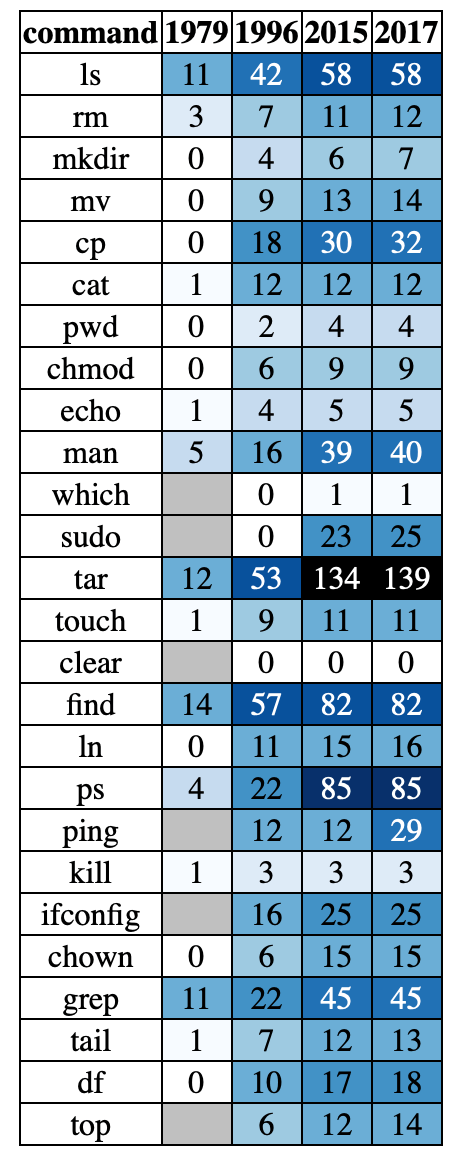
The sleight of hand that’s happening when someone says that we can keep software simple and compatible by making everything handle text is the pretense that text data doesn’t have a structure that needs to be parsed4. In some cases, we can just think of everything as a single space separated line, or maybe a table with some row and column separators that we specify (with some behavior that isn’t consistent across tools, of course). That adds some hassle when it works, and then there are the cases where serializing data to a flat text format adds considerable complexity since the structure of data means that simple flattening requires significant parsing work to re-ingest the data in a meaningful way.

Another reason commands now have more options is that people have added convenience flags for functionality that could have been done by cobbling together a series of commands. These go all the way back to v7 unix, where ls has an option to reverse the sort order (which could have been done by passing the output to tac).

growth in options in command line functions 1979 to 2017

Over time, more convenience options have been added. For example, to pick a command that originally has zero options, mv can move and create a backup (three options; two are different ways to specify a backup, one of which takes an argument and the other of which takes zero explicit arguments and reads an implicit argument from the VERSION_CONTROL environment variable; one option allows overriding the default backup suffix). mv now also has options to never overwrite and to only overwrite if the file is newer.

«

Inevitably, there’s an XKCD cartoon about this. Simplicity doesn’t always win. This is confusing.
unique link to this extract


We all wear tinfoil hats now • The New Atlantis

Geoff Shullenberger, reviewing Jeffrey Sconce’s book “The Technical Delusion”:

»

recent technological developments have made it hard to discern where the actual machinations of states and corporations trying to influence behavior end, and where conspiratorial claims with similar content begin. Well before Cambridge Analytica appeared on the scene, fears once relegated to paranoia were coming true.

Consider that believing that the ads on your TV or radio were directed specifically at you would have been an unequivocal symptom of a delusional state twenty years ago. Today, the same belief about the ads on your smartphone is a recognition of fact. Amidst the expansion of surveillance, advances in virtual reality and artificial intelligence, and the emergence of possibilities such as machine–brain interfaces, what might once have been hallucinatory fever dreams have become plausible funding pitches for startups. In such circumstances, how do we know when we’re paranoid and when we’re justifiably concerned?

The worries stirred up by the Cambridge Analytica story — whether they were an outburst of irrational panic or a recognition of new political realities — were just the latest in a long history of anxieties about technologically enabled mass deception and manipulation. The potential for such an enterprise entered the realm of the imagination well before anything like it was technically feasible. But the earliest people to imagine it were not technology critics or political reporters. They were paranoids in the original sense of the word: individuals regarded as insane…

…If psychotic individuals from the past seem from the present-day vantage point to have anticipated aspects of our evolving technological reality, that’s partly because the ordinary ways we represent that reality to ourselves owe something to once-outlandish visions like theirs. It is questionable that Cambridge Analytica’s algorithms constituted a mind control device, but it was natural for us to think about it in those terms, because our cultural archive abounds in representations of this sort of technological affordance.

«

It’s not a short article, but if those bits intrigue you, there’s plenty more.
unique link to this extract


Can YouTube quiet its conspiracy theorists? • The New York Times

Jack Nicas:

»

Climate change is a hoax, the Bible predicted President Trump’s election and Elon Musk is a devil worshiper trying to take over the world.

All of these fictions have found life on YouTube, the world’s largest video site, in part because YouTube’s own recommendations steered people their way.

For years it has been a highly effective megaphone for conspiracy theorists, and YouTube, owned and run by Google, has admitted as much. In January 2019, YouTube said it would limit the spread of videos “that could misinform users in harmful ways.”

One year later, YouTube recommends conspiracy theories far less than before. But its progress has been uneven and it continues to advance certain types of fabrications, according to a new study from researchers at University of California, Berkeley.

YouTube’s efforts to curb conspiracy theories pose a major test of Silicon Valley’s ability to combat misinformation, particularly ahead of this year’s elections. The study, which examined eight million recommendations over 15 months, provides one of the clearest pictures yet of that fight, and the mixed findings show how challenging the issue remains for tech companies like Google, Facebook and Twitter.

The researchers found that YouTube has nearly eradicated some conspiracy theories from its recommendations, including claims that the earth is flat and that the U.S. government carried out the Sept. 11 terrorist attacks, two falsehoods the company identified as targets last year.

«

Getting there, two lies at a time. But the real problem is that it’s impossible to study personalised recommendations – this was done on logged-out ones – which means only YouTube really knows. And it isn’t saying.
unique link to this extract


Errata, corrigenda and ai no corrida: Rebecca Paltrow of WeWork infamy (they’ve all got it infamy, etc) is the cousin, not the sister, of Gwyneth. This doesn’t disprove theories that it’s genetic.

Start Up No.1257: Facebook’s pharma madness, coronavirus hits conferences, Let’s Encrypt trips on certs, Amazon’s brand madness, and more


Facebook is scaling back its Libra program: it won’t be a global cryptocurrency. CC-licensed photo by Alpari Org on Flickr.

You can sign up to receive each day’s Start Up post by email. You’ll need to click a confirmation link, so no spam.

A selection of 8 links for you. Part of a calorie-controlled diet. I’m @charlesarthur on Twitter. Observations and links welcome.

Why Facebook is filled with pharmaceutical ads • The Washington Post

Nitasha Tiku:

»

Jordan Lemasters keeps seeing ads in his Facebook app for an attention-deficit/hyperactivity disorder drug called Vyvanse. When the Chicago-based audio branding consultant recently clicked on the ad’s drop-down menu and selected “Why Am I Seeing This Ad,” a pop-up said it was because of his age range, because he lives in the United States and because he may have visited Vyvanse.com.

But Lemasters felt spooked. The 29-year-old had used another ADHD drug, Adderall, but never publicized it. The ads “just felt invasive,” says Lemasters, who says he quit Adderall in 2017 because it made him feel like a zombie. “What bothers me is how powerful those drugs are and how it’s pushed, rather than a doctor actually assessing a patient and suggesting a proper solution.”

After years of avoiding social media, drug companies are growing bolder about advertising on Facebook and other social networks, according to interviews with advertising executives, marketers, health-care privacy researchers and patient advocates. That is exposing loopholes around the way data can be used to show consumers relevant ads about their personal health, even as both social networks and pharmaceutical manufacturers disavow targeting ads to people based on their medical conditions.

Ads promoting prescription drugs are popping up on Facebook for depression, HIV and cancer. Spending on Facebook mobile ads alone by pharmaceutical and health-care brands reached nearly a billion dollars in 2019, nearly tripling over two years, according to Pathmatics, an advertising analytics company. Facebook offers tools to help drug companies stay compliant with rules about disclosing safety information or reporting side effects.

«

A billion dollars. Tiku got interested after a source contacted her about getting female Viagra ads on an Instagram account which has no account photo or content. So how did it decide to target her?

And – a side note – it points to the huge vested interest the pharmaceutical industry has in not seeing the US healthcare system reformed at all.
unique link to this extract


Facebook scales back Libra plans, bowing to regulators • The Information

Alex Heath:

»

Facebook is scaling back its ambitious plan to upend the global financial system with a new digital currency.

Succumbing to pressure from regulators, Facebook has decided not to make the proposed Libra currency available on its own services for the time being, and will instead offer its users digital versions of government-backed currencies, including the U.S. dollar and the euro, according to three people familiar with the matter. Facebook still plans to go ahead with the launch of a digital wallet that would allow users to make purchases and send and receive money, though it will delay the rollout by several months.

The external Libra Association, which is made up of companies Facebook courted to help govern the project, still intends to introduce a Libra token separately that will be backed by a mix of government-issued currencies, another person familiar with the plans said. The association will also support the individual government-backed currencies. But it isn’t clear when or how the original Libra token backed by a mix of currencies will be used. 

Facebook has pushed the planned release of its digital wallet, dubbed Calibra, to October of this year rather than June as previously planned, the three people said.

«

Wow. Well, this considerably reduces the threat to global financial stability that Libra, in its original conception, would have been – because it could have moved money around between countries effectively with no oversight.

Quite what a risk it will now be is less clear, but regulators will definitely be breathing a sigh of relief.
unique link to this extract


Will crypto conferences survive coronavirus? What about crypto media? • Amy Castor

Amy Castor:

»

on Monday, Facebook and Twitter pulled out of SXSW Conference & Festivals, a sprawling 10-day event in Austin set to kick off on March 13. The event drew more than 400,000 attendees last year. SXSW says the event is still going as planned, even though an online petition is in the works to cancel it.  

Similarly, the crypto world is feeling the pain. Tron has postponed indefinitely its Nitron Summit due to coronavirus concerns. The event was scheduled to take place between Feb. 29 and March 1 in Seoul, South Korea.

Paris Blockchain Week, originally set to kick off on March 31, is postponed until December. Even that is risky, though. December is when the cold and flu season starts up again, and a coronavirus vaccine isn’t due out until sometime in 2021.  

If the trend continues — and likely it will — conference cancellations could hit some crypto media publications hard. I’m talking about Coindesk in particular. The company pulls in 85% of its revenue from conferences, according to a May 2019 report in The Information. Coindesk doesn’t feature ads on its site anymore, so events are its bread and butter…

…In 2018, just coming down from the peak of the crypto hype cycle, Consensus drew in more than 8,500 attendees, each paying about $2,000 per ticket. Coindesk’s total revenue for the year was $25m, so do the math — that’s $21m in events alone.

Consensus 2019 saw less than half that with only 4,000 attendees. But even at an estimated $10m in revenue, that’s still a decent amount of money. Despite the drop-off, Kevin Worth, Coindesk’s CEO, told The Information that Digital Currency Group, which owns 90% of Coindesk, still planned on growing its media business.

Indeed, Coindesk has been on a bit of a hiring spree. Almost anyone who has been writing about crypto has gotten pulled into working for the media outlet.

«

Butter’s in short supply. Bread also. December should be safe, but will the money last?
unique link to this extract


Simple systems have less downtime • Greg Kogan

»

The Maersk Triple-E Class container ship is 1,300 feet long, carries over 18,000 containers across 11,000 miles between Europe and Asia, and… Its entire crew can fit inside a passenger van.

As a former naval architect and a current marketing consultant to startups, I found that the same principle that lets a 13-person crew navigate the world’s largest container ship to a port halfway around the world without breaking down also applies to startups working towards aggressive growth goals:

Simple systems have less downtime.

Ships contain simple systems that are easy to operate and easy to understand, which makes them easy to fix, which means they have less downtime. An important quality, considering that “downtime” for a ship could mean being stranded thousands of miles from help.

«

There’s a corollary (which I’ve lost) which is that systems which must keep running tend to be brought down by auxiliary systems added to keep them running.
unique link to this extract


Revoking certain certificates on March 4 – Help • Let’s Encrypt Community Support

:

»

Due to the 2020.02.29 CAA Rechecking Bug 3.4k, we unfortunately need to revoke many Let’s Encrypt TLS/SSL certificates. We’re e-mailing affected subscribers for whom we have contact information.

This post and thread will collect answers to frequently asked questions about this revocation, and how to avoid problems by renewing affected certificates early. If you’re affected, please: thoroughly read this thread, and search the community forum, for an answer to your question. If you don’t find one, please make a new post to the “Help” category, filling in the questions in the template that appears as you compose your post.

Q: How many certificates are affected?
A: 2.6%. That is 3,048,289 currently-valid certificates are affected, out of ~116 million overall active Let’s Encrypt certificates. Of the affected certificates, about 1 million are duplicates of other affected certificates, in the sense of covering the same set of domain names.

Because of the way this bug operated, the most commonly affected certificates were those that are reissued very frequently, which is why so many affected certificates are duplicates.

«

LE has issued about a billion certificates because it’s convenient for smaller sites that want to implement HTTPS. They’re on very short expiry periods – 90 days – so you have to renew them, ideally automatically, ideally every 60 days. But this is still going to be a big problem.
unique link to this extract


Director-General’s opening remarks at the media briefing on COVID-19, 3 March 2020 • WHO

Dr Tedros Adhanom Ghebreyesus:

»

The second major difference is that COVID-19 causes more severe disease than seasonal influenza.

While many people globally have built up immunity to seasonal flu strains, COVID-19 is a new virus to which no one has immunity. That means more people are susceptible to infection, and some will suffer severe disease.

Globally, about 3.4% of reported COVID-19 cases have died. By comparison, seasonal flu generally kills far fewer than 1% of those infected.

Third, we have vaccines and therapeutics for seasonal flu, but at the moment there is no vaccine and no specific treatment for COVID-19. However, clinical trials of therapeutics are now being done, and more than 20 vaccines are in development.

And fourth, we don’t even talk about containment for seasonal flu – it’s just not possible. But it is possible for COVID-19. We don’t do contact tracing for seasonal flu – but countries should do it for COVID-19, because it will prevent infections and save lives. Containment is possible.

To summarize, COVID-19 spreads less efficiently than flu, transmission does not appear to be driven by people who are not sick, it causes more severe illness than flu, there are not yet any vaccines or therapeutics, and it can be contained – which is why we must do everything we can to contain it.

«

That 3.4% figure is high. The earlier estimate was 2%, or lower. So this becomes a much more dangerous problem.
unique link to this extract


All your favorite brands, from BSTOEM to ZGGCD • The New York Times

John Herrman:

»

Mostly, you’ll notice gloves from brands that, unless you’ve spent a lot of time searching for gloves on Amazon, you’ve never heard of. Brands that evoke nothing in particular, but which do so in capital letters. Brands that are neither translated nor Romanized nor transliterated from another language, and which may contain words, or names, that do not seem to refer to the products they sell. Brands like Pvendor, RIVMOUNT, FRETREE and MAJCF. Gloves emblazoned with names like Nertpow, SHSTFD, Joyoldelf, VBIGER and Bizzliz. Gloves with hundreds or even thousands of apparently positive reviews, available for very low prices, shipped quickly, for free, with Amazon Prime.

Gloves are just one example — there are at least hundreds of popular searches that will return similar results. White socks: JourNow, Formeu, COOVAN. iPhone cables: HOVAMP, Binecsies, BSTOEM. Sleep masks: MZOO, ZGGCD, PeNeede.

These “pseudo-brands,” as some Amazon sellers call them, represent a large and growing portion of the company’s business. These thousands of new product lines, launched onto Amazon by third party sellers with minimal conventional marketing, stocking the site with disparate categories of goods, many evaporating as quickly as they appeared, are challenging what it means to be a brand.

They’ve also helped overwhelm the United States Patent and Trademark Office, which, not unlike an Amazon shopper, has for years found itself mystified by pseudo-brands as it continues to approve them.

«

The advantage of a barely known brand is that it can vanish in moments.
unique link to this extract


The man behind Trump’s Facebook juggernaut • The New Yorker

Andrew Marantz on Brad Parscale, who ran Trump’s 2016 media and social media campaign, and is doing it again in 2020:

»

The instant a Presidential election is over, everyone who worked on the losing campaign is recast as a dunce, and everyone on the winning side is reborn as a genius. In 2016, three weeks after Election Day, Harvard’s Institute of Politics hosted a panel discussion featuring leaders of Hillary Clinton’s campaign and Trump’s campaign—the first public reunion of the now dunces and the now geniuses. It got heated.

“I would rather lose than win the way you guys did,” Jennifer Palmieri, Clinton’s director of communications, said.

“No, you wouldn’t, respectfully,” Kellyanne Conway, one of Trump’s campaign managers, said.

Later in the discussion, Mandy Grunwald, another Clinton adviser, rephrased Palmieri’s rebuke as a backhanded compliment. “I don’t think you guys give yourselves enough credit for the negative campaign you ran,” she said, alluding to “the fake Facebook stuff, or the great dark-arts stuff you were pumping out there.” Turning to Parscale, she went on, “I’m fascinated to hear all about that, because it’s so hard for us to track.”

“I’d agree,” he said. “That’s the beauty of Facebook.”

…[Parscale] did not agree to be interviewed for this article, but dozens of people did, including people who worked with him and against him in 2016. Predictably, Parscale’s name elicited praise from most pro-Trump Republicans and scorn from nearly everyone else. “I can tell you with high confidence that Brad Parscale is not a genius,” Tara McGowan, a left-leaning strategist, told me. Nevertheless, “he undoubtedly had a massive impact on the outcome of the 2016 election, and he undoubtedly will again in 2020.” For better or worse, she continued, “you don’t need to be a genius to have a massive impact. You don’t even need to break the rules. An average person, given enough time and money and support, can use Facebook to help a demagogue win a national election.”

«

The extent to which Parscale understood Facebook’s position in the world in 2016, and Clinton’s campaign didn’t, will make you curse the gods.
unique link to this extract


Errata, corrigenda and ai no corrida: none notified
Start Up No.1256: the Philippines’ Facebook fake news, all about Mrs WeWork, Silicon Valley workers v bosses, Apple takes $500m battery hit, and more


Allegedly used to create codewords for 10-year-old girls. CC-licensed photo by Mr.TinDC on Flickr.

You can sign up to receive each day’s Start Up post by email. You’ll need to click a confirmation link, so no spam.

A selection of 10 links for you. Tested free of any mention of coronavirus. Dammit! I’m @charlesarthur on Twitter. Observations and links welcome.

How Facebook’s News Feed became a political propaganda machine • Science Friday

Steven Levy, in an extract from his new book about the inside story of Facebook:

»

“Newspeople don’t tell lies, but lies spread faster,” [Philippines journalist Maria] Ressa says. She had bet her entire publication on Facebook but now was being eclipsed by the false information from Duterte bloggers. The country was inundated with posts like a fake sex tape where the head of Duterte’s female opponent was digitally grafted onto the body of a porn actress. Facebook also was empowering the Duterte mob to use the platform to attack his critics, putting them in danger from his angry supporters. Ressa was personally targeted.

And despite her multiple complaints, Facebook was doing nothing to stop this.

Ressa thought that after Duterte won the election in May 2016, things might calm down. But then he began using the same tactics on Facebook to push his governance platform of strong-arm tactics.

Ressa understood that the Duterte forces were drawing a road map for future political abusers around the globe to use Facebook. She pushed for a meeting to warn the company. In August 2016, she met with three senior Facebook officials in Singapore. She had identified 25 fake accounts that were able to amplify their hateful and false information to 3 million people. “I began showing them lies, the attacks against anyone who attacked [violent acts by Duterte supporters],” she says. One example was a post from the Duterte campaign spokesperson, showing a photo of a girl he claimed was raped in the Philippines. “We did a check and it showed that the photo was a girl from Brazil,” says Ressa, speaking to me in 2019. “And yet that post was allowed to stay up. It’s still up there today.”

«

That wasn’t the only country where this happened; to say that Facebook is indifferent to warnings about the effect it’s having would be to overstate things. It’s far less worried than that.
unique link to this extract


Rebekah Neumann’s search for enlightenment fuelled WeWork’s collapse • Bustle

Moe Tkacik:

»

WeWork’s bailout by its largest investor, SoftBank, may permanently obscure the ugliest details behind its demise. But if the epidemic of self-delusion surrounding WeWork’s potential can be traced to anyone, it is Rebekah. Media accounts tended to depict Rebekah as a cartoon Yoko who brainwashed Adam into giving her titles like “strategic thought partner” and a staff she charged with such inane tasks as disassembling her phone, painting all the pieces white, and reassembling it again. But even though Rebekah’s name was absent from WeWork’s original literature — leading to accusations that the company rewrote its history to make her a co-founder — the business bore the hallmarks of her thirst for enlightenment and mystic milieu. It was Rebekah who, according to the couple’s own mythology, transformed Adam from a chain-smoking pretty boy with such profound dyslexia he could barely read his text messages into the shamanic figure who wooed so many overconfident white guys in Silicon Valley. Perhaps more importantly, a close friend says, it was she who at some point during the financial crisis of 2008-2009 — when other heiresses were plowing their money into gold, Caribbean tax shelters, battered too-big-to-fail bank stocks, industrial foreclosure flippers, and this new thing called Bitcoin — bet her own net worth on Adam.

«

Yes, she is the sister of Gwyneth. It’s the most amazing profile, but one has to feel that she provides the most amazing fuel for the fire. Tkacik did a great job finding the people to recount the stories.

BRB, just getting my telephone dismantled and the pieces painted white.
unique link to this extract


Kicking extremists off social media helps fight hate, report finds • HuffPost UK

Arj Singh:

»

in the last two years Yaxley-Lennon has been kicked off Twitter and Facebook, as well as having restrictions placed on his YouTube channel, “which resulted in his views collapsing”.

He has been forced to communicate with supporters through the more marginal encrypted messaging app Telegram, where he has just 42,000 followers compared to more than a million before his bans, Hope Not Hate’s State Of Hate 2020 report found.

Yaxley-Lennon attracted more than 10,000 supporters to “Free Tommy” demonstrations against his incarceration for contempt of court in London in 2018, one of the largest far-right protests in the UK in recent years.

But similar demonstrations after his bans attracted little more than a few hundred last year.

“The reasons for this are by no means monocausal, but he and his associates’ inability to spread the word about events and animate the masses beyond core supporters has clearly played a role,” the report said.

«

Stands to reason, really. Put someone on a lower hill, fewer people can see them.
unique link to this extract


Spotify’s newest pitch to labels and musicians: now you pay us • Bloomberg

Lucas Shaw:

»

The streaming giant is asking record labels and artists for money to advertise their songs within its app, arguing that they’ll reach new fans and increase their popularity. The effort is controversial because it’s complicating wider talks over long-term music rights between Spotify and the record companies. The service has already introduced one tool, called Marquee, and is pitching a second, people with knowledge of the matter said.

“They need to diversify their revenue streams, they need to work out ways to drive higher operating margins,” said Mark Mulligan, an industry analyst at Midia Research…

…Spotify’s approach to the two-sided marketplace has changed over the years. The company initially offered tools and services to musicians and independent record companies to help them stand out in a world dominated by major labels. The most high-profile test allowed artists to upload tracks directly to Spotify. That infuriated Universal Music, Warner Music and Sony Music Entertainment — the company’s key suppliers — and Spotify canceled the program.

Now its biggest push, music companies say, is paid promotion — getting labels to pay to promote their artists.

Spotify has inserted sponsored songs in listeners’ playlists, and has also discussed charging artists and labels for data about their habits. With Marquee, artists or their labels can pay a minimum of $5,000 to have fans notified when a new release arrives on the service.

«

So it’s legalised payola. The music labels are going to have to hope that Apple Music stays competitive in order to keep Spotify at bay. Else it will become a monster.
unique link to this extract


Silicon Valley leaders’ plea to Democrats: anyone but Sanders • The New York Times

Nellie Bowles and Erin Griffith:

»

How Silicon Valley votes matters because it leans overwhelmingly Democratic and there is a tremendous amount of capital. What is striking about this primary cycle is the schism between the people who run the companies and their workers.

Consider that employees of [Google owner] Alphabet gave $499,309 to Mr. Sanders for the 2020 cycle, his second-largest total donations from one employer after University of California employees, according to data compiled by the Center for Responsive Politics. By comparison, Mr. Buttigieg’s 2020 run had raised $294,860 from Alphabet employees.

“There’s a massive split between leadership and rank and file,” said Luis Zamora, a co-president of the San Francisco Young Democrats. “Bernie wants employees to be able to take over some of the ownership of the company, and that’s not going to fly.”

For a group of California technologists dismayed by what they see as the populist turn of both national parties, the solution — albeit only a statewide one — is to ditch the two-party system altogether.
On a cool evening in Palo Alto, at the Stanford University Faculty Club in September, those technologists and activists launched the Common Sense Party.

It was a response, they said, to what they call the one-party monopoly in the state. They hoped to carve out Democrats who feel isolated from their party’s leftward lurch.

“One party is the puppet of the public unions and wants government to run everything, and the other party is the puppet of the religious autocrats who want us all to act in a certain manner,” said Tim Draper, a venture capitalist and a Common Sense supporter. “No party is supporting a moderate agenda of someone who wants freedom to prosper and freedom to act.”

«

Don’t worry about disrupting politics, bros, you already did with untrammelled social networks.
unique link to this extract


Nando’s-inspired sex slang used by girls as young as 10 • The Guardian

Robert Booth:

»

An internet safety service that has monitored the online interactions of more than 50,000 children has discovered that girls as young as 10 are using code words drawn from the Nando’s restaurant menu to obscure explicit sexual conversations.

SafeToNet has screened more than 65m texts sent since November and found that girls aged 10, rather than teenage boys, as they had expected, use the most explicit and potentially harmful sexual language.

“We weren’t expecting to see that,” said Richard Pursey, the founder and chief executive of the service, which monitors popular messaging apps including WhatsApp and Facebook Messenger as well as Instagram and Snapchat. “We thought it would be more likely to be boys than girls and in the 12 to 13 age group.”

As well as overtly graphic terms, they use “peri peri” to mean a well-endowed male and “coleslaw” to mean a bit on the side, he said.

The SafeToNet app looks for language indicating sexual talk, abuse, aggression and thoughts about suicide and self-harm. It applies a threat level to each and 10-year-old girls were the most prominent in category 3 of sexual references, which relates to the most explicit and harmful language.

In December, it emerged that more than 6,000 children under 14 have been investigated by police for sexting offences in the past three years, including more than 300 of primary school age.

«

SafeToNet is an app which installs a third-party keyboard, and (just like Apple warns you they can) reads and transmits everything back to SafeToNet. The company says that content is anonymised, and then AI analyses it. If it’s able to identify that it’s 10-year-old girls sending “peri peri” messages, though, it can’t be *that* anonymised.

There are lots and lots of questions about the authenticity of this story – as in, does anyone believe a word of it? If any 10-year-old girls (or parents of same) could tell us about whether “peri peri” is really an innuendo, or whether it just happens that they like ordering Nando’s, that would be great.
unique link to this extract


I just tried the first mainstream 5G phone, and so far 5G isn’t all it’s cracked up to be • CNBC

Todd Haselton:

»

I know 5G is going to be big. Eventually, its super-fast speeds might help medical professionals diagnose and help people while they’re still riding in an ambulance to the hospital. It could power game streaming services like Nvidia’s GeForce Now, Microsoft xCloud and Google Stadia so you can play games with console quality wherever you are, even without Wi-Fi. It may let you download movies in seconds before you get on the airplane at the airport. You’ll still have service in packed stadiums where, on older LTE networks, you might not even be able to place a phone call.

But aside from faster speeds I found in very limited areas, there’s no “killer app” for 5G right now. And I don’t know what it’s going to be. Maybe it won’t even be on phones and instead packed into new augmented reality glasses we wear on our heads in a few years. 

With LTE, the killer app  was, in my opinion, high-quality video chats. Before LTE, you needed a Wi-Fi connection for a high-quality video chat like FaceTime. Today, you can use 4G LTE for group video chats, for Snapchat, for TikTok, downloading big apps on the go, streaming Netflix and more. But you can do all of that without 5G, so there’s no really “must have” solution…

…It’ll be years until we really see why we need 5G in our phones outside of getting faster downloads. There’s so much hype around these networks today, though. Consumers are bombarded by commercials advertising carrier 5G networks and the truth of it is this: You don’t need it yet.

Worse, the advertising only stands to confuse customers who, unlike me, will never spend time actually hunting down a 5G tower, if there’s one near them at all.

So the gist is this: Don’t worry about 5G. If you’re buying a Galaxy S20 and it has coverage for all the flavors, great, you’re future proofing a little bit. But you shouldn’t just buy a phone for 5G alone.

«

unique link to this extract


No more headlines • MacSurfer’s Headline News™

»

Dear MHN [MacSurfer Headline News] Readers:

Not seeing a viable future with subscriptions, MacSurfer and TechNN will cease operations effective immediately. Please allow a few weeks to process forthcoming refunds. If need be, subscription inquiries can be addressed to the Publisher at the bottom of the Homepage.

Thanks kindly for your support, and thanks for the memories…

«

It’s roughly a million years since I looked at this site, which aims to aggregate headlines from all over the place. The reason for its failure is immediately obvious: what it does has been easy enough to do for yourself ever since RSS readers started becoming widespread in around 2005. The options it offered for subscription (reorganise the order of the site!) were pointless. The only surprise is that it has managed to survive this long.
unique link to this extract


Apple to pay up to $500m over battery-related phone slowdown • The Washington Post

»

IPhone owners could get $25 from Apple after the company agreed to pay up to $500m to settle claims over intentionally slowing down older phones to preserve older batteries.

Apple and lawyers representing iPhone consumers agreed to a deal stemming from Apple’s 2017 admission that it was slowing down phone performance in older models to avoid unexpected shutdowns related to battery fatigue.

That admission led to Apple offering discounted battery replacements at $29, but many people claimed they had already spent hundreds of dollars to buy new phones because Apple didn’t reveal the cause of the problem. If they had known they could just buy new batteries, they might not have bought new phones, some consumers in the case said.

Apple did not admit wrongdoing. As part of the settlement, the company will pay $310m to $500m, including about $93m to lawyers representing consumers.

«

Quite an expensive failure to communicate. For years Apple faced complaints that newer versions of its OS slowed down older phones (sometimes, it did – the processors weren’t up to it), but failing to explain that it was intentionally throttling because the battery was old feels like something that engineering executed well, but the explanation of why it was being done got lost on the way to marketing. Or else marketing heard about it, but couldn’t think of a good way to describe it.
unique link to this extract


Exclusive: newly obtained documents show Huawei role in shipping prohibited US gear to Iran • Reuters

Steve Stecklow:

»

China’s Huawei Technologies, which for years has denied violating American trade sanctions on Iran, produced internal company records in 2010 that show it was directly involved in sending prohibited U.S. computer equipment to Iran’s largest mobile-phone operator.

Two Huawei packing lists, dated December 2010, included computer equipment made by Hewlett-Packard Co and destined for the Iranian carrier, internal Huawei documents reviewed by Reuters show.

Another Huawei document, dated two months later, stated: “Currently the equipment is delivered to Tehran, and waiting for the custom clearance.”

The packing lists and other internal documents, reported here for the first time, provide the strongest documentary evidence to date of Huawei’s involvement in alleged trade sanctions violations. They could bolster Washington’s multifaceted campaign to check the power of Huawei, the world’s leading telecommunications-equipment maker.

«

There was already an indication from ZTE documents. Huawei can’t really get away from this now. Its CFO is still fighting extradition from Canada to the US. This won’t help, though the documents don’t form part of the case.
unique link to this extract


Errata, corrigenda and ai no corrida: none notified

Start Up No.1255: coronavirus updates, FBI says ransomware has cost $140m, is Stadia struggling?, picturing Clearview AI’s data, and more


“Ultra fire” is what you get in waste plants if you just dump your lithium-ion batteries in the bin. CC-licensed photo by Leslie Wong on Flickr.

You can sign up to receive each day’s Start Up post by email. You’ll need to click a confirmation link, so no spam.

A selection of 10 links for you. Start again. I’m @charlesarthur on Twitter. Observations and links welcome.

FBI says more than $140m paid to ransomware, offers defense tips • Bleeping Computer

Lawrence Abrams:

»

Through the analysis of collected ransomware bitcoin wallets and ransom notes, the FBI states that victims have paid over $140m to ransomware operators over the past six years.

At the RSA security conference this week, FBI Special Agent Joel DeCapua explained how he used bitcoin wallets and ransom notes that were collected by the FBI, shared by private partners, or found on VirusTotal to compute how much money was paid in ransom payments over 6 years.

According to DeCapua between 10/0/1/2013 and 11/07/2019, there have been approximately $144,350,000 in bitcoins paid to ransomware actors as part of a ransom. This money does not include operational costs related to the attack, but purely the ransom payments.

When analyzing the ransomware families that the ransoms were paid, Ryuk stood out head and shoulders above the rest with payments totaling $61.26m. The second-place spot goes to Crysis/Dharma at $24.48m and then third place is Bitpaymer at $8.04m.

It should be noted that the actual amount of payments made over the six years is probably quite larger as there are many ransom notes and wallets that the FBI does not have access to. Furthermore, many companies keep ransomware attacks secret to prevent it from impacting stock prices.

DeCapua stated that the Windows Remote Desktop Protocol (RDP) is the most common method that ransomware attackers are gaining access to a network before deploying ransomware.

“RDP is still 70-80% of the initial foothold that ransomware actors use,” DeCapua stated in his talk.

«

unique link to this extract


Developers say Google didn’t offer enough money to make Stadia games – Business Insider

Ben Gilbert:

»

“When we’re looking at these types of deals,” another prominent indie developer said, “We’re looking at ‘Is this enough money where we have the resources to make what we want, or is this an exclusivity deal that gives us security?'” they said.

Each of the people we spoke with, who asked to be granted anonymity due to ongoing employment in the video game industry, echoed this sentiment — and said Google simply wasn’t offering enough money, in addition to several other concerns.

“There are platforms you want to be on because they have an audience and you want to reach that audience,” one developer said. “That’s what Steam is, or that’s what [Nintendo] Switch is. They have big groups on their platforms, and you want to be with those groups so they can play your games.”

But Stadia doesn’t have a large audience to reach — at least not yet — so Google must create that incentive for developers. And the people we spoke with said, outside of money, there wasn’t much reason to put their games on Stadia.

“If you could see yourself getting into a long term relationship with Google?” one developer said. “But with Google’s history, I don’t even know if they’re working on Stadia in a year. That wouldn’t be something crazy that Google does. It’s within their track record.”

«

See also this Twitter thread, suggesting that users (at least on reddit’s Android forum) are holding back from Stadia because they’re concerned that Google will abandon it, as it has so many other products, if it doesn’t get sufficient traction.
unique link to this extract


Here’s the file Clearview AI has been keeping on me, and probably on you too • VICE

Anna Merlan:

»

In mid-January, I emailed privacy-requests@clearview.ai and requested information on any of my personal data that Clearview obtained, the method by which they obtained it, and how it was used. (You can read the guidelines they claim to follow under the CCPA here.) I also asked that all said data be deleted after it was given to me and opted out of Clearview’s data collection systems in the future. In response, 11 days later, Clearview emailed me back asking for “a clear photo” of myself and a government-issued ID.

“Clearview does not maintain any sort of information other than photos,” the company wrote. “To find your information, we cannot search by name or any method other than image. Additionally, we need to confirm your identity to guard against fraudulent access requests. Finally, we need your name to maintain a record of removal requests as required by law.”

After a moment of irritation and a passing desire not to give these people any more of my information, I emailed Clearview a photo of my work ID badge and a redacted copy of my passport. About a month went by, and then I got a PDF, containing an extremely curious collection of images and an explanation that my request for data deletion and opt-out had been processed. “Images of you, to the extent the [sic] we are able to identify them using the image that you have shared to facilitate your request, will no longer appear in Clearview search results,” the “Clearview Privacy Team” wrote.

«

unique link to this extract


Coronavirus live updates: first deaths confirmed in US, Australia and Thailand; health officials probe possible outbreak at Washington nursing home • The Washington Post

Katie Mettler, Alex Horton, Meryl Kornfield, Kim Bellware and Joel Achenbach:

»

The novel coronavirus has probably been spreading undetected for about six weeks in Washington state, where the first U.S. death was reported this weekend. A genetic analysis suggests that the cases are linked through community transmission and that this has been going on for weeks, with hundreds of infections likely in the state.

«

Weeks. Weeeeks. Weeeeeeeeks.
unique link to this extract


Is this coronavirus ‘the big one’? • The New York Times

Nicholas Kristof:

»

Another similarity with 1918 is that the United States and the world are unready for a pandemic.

“We’re amazingly unprepared,” Dr. Irwin Redlener, a Columbia University professor and director of the National Center for Disaster Preparedness, told me.

President Trump exaggerates threats from caravans of migrants or from a hobbled Iran, and he has diverted billions of dollars from the military to build a border wall that smugglers hack apart with $100 saws. But he has not been attuned to pandemic threats: In 2018 the White House removed the position on the National Security Council to fight pandemics, while seeking to scale back anti-pandemic work to about 10 countries from 49. Experts warned at the time that this was dangerously shortsighted.

At a time when we need wise, scientifically informed leadership, we find ourselves with a president with little credibility and an antagonistic relationship with scientists. It doesn’t help that during the Ebola crisis of 2014, Trump was one of the most fiery critics of evidence-driven policies that actually succeeded in ending the outbreak.

The United States is also vulnerable because of longstanding deficiencies in our health care system. We are the only major rich country without universal health insurance and paid sick leave, and we have fewer doctors per capita than peer countries.

Consider a Florida man, Osmel Martinez Azcue, who returned from China and found himself becoming sick. As The Miami Herald reported, he might normally have gone to a drugstore and bought over-the-counter flu medicine. But because of the risk of coronavirus he did the responsible thing and sought medical attention: He went to a hospital for testing. In the end, it turned out not to be coronavirus — but he was billed $3,270.

«

It’s a fabulous triple whammy: the incompetent president, who fired the competent people, in a country with a dysfunctional health system which works against keeping healthy.
unique link to this extract


Worldwide smartphone market rebound on standby as Covid-19 outbreak limits short-term global outlook • IDC

»

The global smartphone market recovery will be impacted in 2020 as uncertainties around COVID-19 increased over the last month. According to the latest forecast from the International Data Corporation (IDC) Worldwide Quarterly Mobile Phone Tracker, the worldwide smartphone market is expected to decline 2.3% in 2020 with shipment volume just over 1.3 billion. The COVID-19 outbreak is expected to stress the short-term scenario with shipments declining 10.6% year over year in the first half of 2020. Global smartphone shipments are expected to return to growth in 2021 driven by accelerated 5G efforts.

IDC has considered optimistic, probable, and pessimistic forecast scenarios driven by the uncertainties around COVID-19. Our current forecasts are aligned with the probable scenario, which ascribes a multi-quarter recovery for manufacturing and logistics given a more gradual return of Chinese workers to factories amidst persisting transportation challenges. China’s demand shock extends several quarters but is mitigated by the end of the year with the aid of government-backed stimuli and subsidies.

«

Hmm. I wonder what will happen given that Japan is being hit hard, and that many smartphones depend on Sony for its camera components. You might be able to make all the rest of the smartphone, but if you’re waiting for camera assembly, then you’re making zero smartphones. Or else there will be a diversification away from Sony, but it remains to be seen how robust the rest of the supply chain is.
unique link to this extract


Recycling plants are catching on fire, and lithium-ion batteries are to blame • The Verge

Jillian Mock:

»

As lithium-ion batteries power more and more of our electronics, they are ending up in our recycling bins, and recycling plants are battling hundreds of battery-caused blazes. What we do with our batteries and electronics at the ends of their lives is fueling one of the biggest emerging problems in the world of waste.

“What keeps me awake at night are these,” Amy Adcox, general manager of Republic Services Plano business unit, says as she waggles her phone. “The electronics.”

She’s standing on a metal platform in the state-of-the-art processing plant in Plano that Republic Services rebuilt after the 2016 fire. Beneath her feet, a conveyor belt rises diagonally from the concrete floor where collection trucks dump their hauls in huge piles, up to the vast web of platforms, conveyor belts, and equipment that sort recyclable materials from the garbage.

Adcox’s smartphone, like virtually all smartphones, is powered by a rechargeable lithium-ion battery. These batteries are small and lightweight and store lots of power. They’re also everywhere. In 2017, the global lithium-ion battery market was valued at more than $30 billion; by 2025, it is projected to grow to more than $100 billion. Standing in that recycling plant, Adcox had at least two rechargeable batteries on her person: in her phone and smartwatch.

“I personally am a big fan of the technology. I think lithium-ion is transformational,” says Ronald Butler, a battery safety expert. But these batteries also have to be handled properly, he says. If they get damaged, overheat, or short-circuit, a rechargeable battery will have what’s called a thermal runaway event, producing heat internally and getting hotter and hotter until it begins to smoke and then burn. Other batteries, like the old-school alkaline triple As, might contaminate a load of recyclable material if they get crushed or damaged. Lithium, on the other hand, burns hot and will quickly catch fire or explode.

«

unique link to this extract


Cortana in the upcoming Windows 10 release: focused on your productivity with enhanced security and privacy • Windows Experience Blog

Andrew Shuman is corporate vp for Cortana:

»

As part of Cortana’s evolution into a personal productivity assistant in Microsoft 365, you’ll see some changes in how Cortana works in the latest version of Windows 10. We’ve tightened access to Cortana so that you must be securely logged in with your work or school account or your Microsoft account before using Cortana, and some consumer skills including music, connected home and third-party skills will no longer be available in the updated Cortana experience in Windows 10. We’re also making some changes to where Cortana helps you. As part of our standard practice, we are ending support for Cortana in older versions of Windows that have reached their end-of-service dates. We recommend that customers update their devices to the latest version of Windows 10 to continue using Cortana. We’ll also be turning off the Cortana services in the Microsoft Launcher on Android by the end of April.

«

So unlike the trend with pretty much all the other personal assistants out there, they’re narrowing what it can do or interact with. This doesn’t feel like a promising trend for Cortana compared with what it once seemed to be aspiring to.
unique link to this extract


Republican mega-donor buys stake in Twitter and seeks to oust Jack Dorsey – report • The Guardian

Martin Pengelly:

»

Paul Singer, the billionaire founder of Elliott Management, is a Republican mega-donor who opposed Donald Trump during the real-estate magnate’s run for the presidential nomination but has since come onside.

After a White House visit in February 2017, Trump said Singer “was very much involved with the anti-Trump or, as they say, ‘Never Trump’, and Paul just left, and he’s given us his total support and it’s all about unification”.

Trump famously communicates with the public largely through Twitter, at the expense of traditional media strategy.

Twitter made headlines in October when it announced a ban on political advertising. Its use and potential manipulation by politicians of all stripes, from Trump to Democratic candidate Mike Bloomberg, remains a source of fierce contention.

Dorsey, a co-founder of Twitter, is also chief executive of Square, an online payment company. In November, he announced a plan to live and work in Africa for part of each year.

It was reported that those moves were motivations for Singer’s desire to push Dorsey out. Other stakeholders have voiced concern about Dorsey’s leadership and Twitter has seen its share price struggle, although it recently reported quarterly revenue above $1bn for the first time.

«

unique link to this extract


State Department examination of Twitter found millions of coronavirus tweets pushed false information • The Washington Post

Tony Romm:

»

Roughly 2 million tweets peddled conspiracy theories about the coronavirus over the three-week period when the outbreak began to spread outside China, according to an unreleased report from an arm of the State Department, raising fresh fears about Silicon Valley’s preparedness to combat a surge of dangerous disinformation online.

The wrongful, harmful posts floated a number of hoaxes — suggesting, for example, that the coronavirus had been created by the Bill and Melinda Gates Foundation or was the result of a bioweapon. These and other identified falsehoods represented 7% of the total tweets the government studied and were “potentially impactful on the broader social media conversation,” according to the report, which was obtained Saturday by The Washington Post.

The Global Engagement Center, the propaganda-fighting program at the State Department whose name appears on the document, said it focused its analysis on countries excluding the United States between Jan. 20 and Feb. 10, a period during which the World Health Organization declared the novel coronavirus an international health emergency. In total, the Global Engagement Center explored 29 million foreign posts, the report said.

Some of the misinformation exhibited “evidence of inauthentic and coordinated activity,” according to the report, raising the specter that foreign governments or other malicious actors may have deliberately tried to sow fear and discord about the international health emergency — much as Russian agents had done during the 2016 presidential election in the United States.

«

unique link to this extract


Errata, corrigenda and ai no corrida: none notified

Start Up No.1254: Reddit CEO slaps at TikTok, coronavirus roundup, a trackpad iPad?, why entering numbers on a webpage is so hard, and more


A 3D print of the coronavirus Covid-19. Try to avoid making your own. CC-licensed photo by NIAID on Flickr.

You can sign up to receive each day’s Start Up post by email. You’ll need to click a confirmation link, so no spam.

A selection of 9 links for you. Nearly there! I’m @charlesarthur on Twitter. Observations and links welcome.

Reddit CEO: TikTok is ‘fundamentally parasitic’ • TechCrunch

Lucas Matney:

»

The comments from Reddit CEO and co-founder Steve Huffman were some of the more controversial offered up during a panel discussion with former public policy exec Elliot Schrage and former Facebook VP of Product Sam Lessin. During a brief conversation about the feature innovations of TikTok, Huffman pushed back hard on the notion that Silicon Valley startups had something to learn from the app.

“Maybe I’m going to regret this, but I can’t even get to that level of thinking with them,” Huffman said. “Because I look at that app as so fundamentally parasitic, that it’s always listening, the fingerprinting technology they use is truly terrifying, and I could not bring myself to install an app like that on my phone.”

“I actively tell people, ‘Don’t install that spyware on your phone,'” he later added.

A TikTok spokesperson told TechCrunch: “These are baseless accusations made without a shred of evidence.”

…Huffman’s comments critiqued how TikTok tracks the actions of its users. The social media app was a hot topic of discussion throughout the event, and while Lessin asserted that the app had made a number of notable innovations, Huffman was one of the few at the event to offer deep criticisms of the app.

«

unique link to this extract


Coronavirus’s genetics reveal its global travels • The Scientist Magazine®

Ashley Yeager spoke to Richard Neher, an evolutionary biologist who sequences viruses – and has applied this to the viral lineage (or heritage) of Covid-19:

»

AY: Can you estimate the number of infections from the tree?

RN: Yes, if you look at the viral tree you see different sequences. And the tree will have different shapes depending on if the outbreak it’s staying the same size or growing. If it’s growing, you see many, many lineages coming together very deep in the tree, and that’s what we have here. That implies there was rapid expansion at the base of the tree that drove all of the lineages apart. You can estimate the rate of that expansion and if you know how old the outbreak is, you can estimate the number of infections.

AY: What kind of estimates do you get using this technique? 

RN: It’s a little difficult to interpret the numbers from China right now. The dynamics are changing; the cases are plateauing. We expect this to be a result of these draconian containment measures or quarantine measures that they imposed on half a billion people. There are 70,000 reported cases so the number of infections could be 200,000. It could be 500,000. We don’t know because people may be sick at home and stay home because the hospitals are overcrowded and that’s where you could get infected. I don’t think we have a good handle on how many cases there were that simply don’t show up in any statistic. I would [estimate] some three-fold underreporting at least.

AY: What can the data tell you about the virus’s origins?

RN: The first takeaway is that all these sequences are very, very similar, about eight mutations different than the root. That’s eight mutations in a 30,000-base sequence. What this tells us is that the virus came from one source, not too long ago, somewhere between mid-November and early December.

«

(Thanks Nic for the link.)
unique link to this extract


COVID-19 outbreak means 1Q20 notebook computer shipment expected to decline about 26% yoy • TrendForce

»

Under the impact of the COVID-19 outbreak, the notebook supply chain is facing many challenges in work resumption delays, labor shortages, material shortages, and logistic/transportation restrictions. TrendForce is hereby lowering its February notebook shipment forecast from 10.8m units previously to 5.7m units, a 47.6% decrease YoY.

During the 1Q20 period, notebook shipment is expected to take the brunt of the impact in February. Assuming that the spread of COVID-19 can be contained, notebook production volume is expected to gradually recover in March, but this may not be enough to offset significant losses in February. TrendForce is therefore further revising its 1Q20 notebook shipment forecast from the previous figure of 35 million units down to 27.5m units, a 35% decrease QoQ and 26% decrease YoY. If the COVID outbreak were to further affect Chinese notebook manufacturers and related industries, 1Q20 shipment may decrease more than current projections.

According to TrendForce, China is the main supplier of many complex parts involved in notebook manufacturing, such as PCB, batteries, hinges, polarizers, passive components, metal components, etc. In the short run, these parts cannot be easily supplied by other manufacturing regions outside of China.

«

Wonder if demand will be down too, or just delayed – or perhaps lost? People and businesses put off buying by a few months, and so does everyone else, and the sales are just… lost.
unique link to this extract


Slouching towards dystopia: the rise of surveillance capitalism and the death of privacy • New Statesman

John Naughton:

»

We would really miss these services [Google, Skype, Facetime, etc] if they were one day to disappear, and this may be one reason why many politicians tip-toe round tech companies’ monopoly power. That the services are free at the point of use has undermined anti-trust thinking for decades: how do you prosecute a monopoly that is not price-gouging its users? (The answer, in the case of social media, is that users are not customers; the monopoly may well be extorting its actual customers – advertisers – but nobody seems to have inquired too deeply into that until recently.)

Another possible explanation is what one might call imaginative failure – most people simply cannot imagine the nature of the surveillance society that we are constructing, or the implications it might have for them and their grandchildren. There are only two cures for this failure: one is an existential crisis that brings home to people the catastrophic damage that technology could wreak. Imagine, for example, a more deadly strain of the coronavirus that rapidly causes a pandemic – but governments struggle to control it because official edicts are drowned out by malicious disinformation on social media. Would that make people think again about the legal immunity that social media companies enjoy from prosecution for content that they host on their servers?

«

unique link to this extract


Undiscoverable UI madness • Birchtree

Matt Birchler works in an office; he went around asking various people there using Macs if they knew how to do various tasks (preview a file in the Finder, change the associated app, right-click, enable Do Not Disturb):

»

I stopped there because we had to get back to work, but without even leaving the Finder and Desktop I was able to find a bunch of things that long-time Mac users had never known about because they never discovered them in their daily use.

None of this is meant to say macOS is garbage or anything like that. It’s just interesting to see when people who love the Mac and are so critical of “discoverability” on the iPad. I’m not even saying the iPad is better than the Mac here, I’m just saying that “discoverability” is one of the big things that has people in a tizzy right now about the iPad, but I think some are laying into the iPad harder than is warranted.

Another thing I can’t get out of my head is the idea that we can be power users on one platform, and casual users on another. The fact that someone is amazing with the Mac does not mean they are automatically a power user on the iPad, Windows, or Android. So when you use something casually and expect yourself to know its ins and outs as well as someone who is more invested, then you get frustrated. I sympathize with this every time I use Android; “is this bad, absent, or do I just not know my way around here as well as I do my iPhone?”

«

There are tons and tons and tons of things that are effectively “hidden” on any OS. Whether you know where they’re hidden is down to how much time you’ve spent playing on them.
unique link to this extract


Apple planning iPad keyboard with trackpad • The Information

Wayne Ma:

»

Apple is planning to release an iPad keyboard accessory later this year that will include a built-in trackpad, the latest step in its effort to position the tablet device as an alternative to laptop computers, according to a person familiar with the matter. 

Apple is preparing the keyboard for mass production, and one of its main manufacturers is Foxconn Technology, the Taiwanese contractor that makes most of the world’s iPhones, the person said. The company will likely release the accessory alongside the next version of the iPad Pro expected later this year, the person added…

…There are signs that consumer demand for an iPad keyboard with a trackpad is growing. Some such third-party products have been released or announced in the past six months that have limited support for the iPad Pro. In January, iPad accessory maker Brydge announced it would be releasing a similar keyboard with trackpad later this year. Brydge’s product announcement came after it filed a patent-infringement lawsuit in New York against another company, OGadget, which launched a successful Kickstarter campaign for a trackpad-equipped iPad keyboard in 2019.

A second person familiar with the matter said Apple has been experimenting with trackpads for the iPad for a number of years. Some prototypes had capacitive keys, which mimic the response of mechanical keys but with sensors, though it isn’t clear whether this feature is in the planned product.

«

Needs to get the OS sorted out, then.

unique link to this extract


Testing a new conversational format for LinkedIn: Stories • LinkedIn

Pete Davies:

»

As the head of content products at LinkedIn, my job is to make sure we’re giving professionals every format and feedback opportunity they need to make these conversations as productive as possible. Over the last few years, that’s led us to launch features including Newsletters, Live Video, Trending News, and Reactions. There are more conversations taking place in the LinkedIn feed than ever before, with a 25% year-over-year increase in engagement. We see more and more ways in which our members come together to have a conversation — from sharing and discussing the lessons learned in a job, to helping with ideas for a new purchase to a community outpouring of love following a tragedy.

We’re never done meeting our members where their voices are. Last year, we started asking ourselves what Stories might look like in a professional context. Stories first appeared on Snapchat, with other platforms like Instagram and Facebook adopting them soon after. They spread for a good reason: they offer a lightweight, fun way to share an update without it having to be perfect or attached to your profile forever…

…we’re currently testing LinkedIn Stories internally, and we can’t wait to test it with our members in the coming months. We’ve learned so much already about the unique possibilities of Stories in a professional context. For example, the sequencing of the Stories format is great for sharing key moments from work events, the full-screen narrative style makes it easy to share tips and tricks that help us work smarter, and the way Stories opens up new messaging threads makes it easier for someone to say, “and by the way… I noticed you know Linda, could you introduce me?”

«

LinkedIn: doing all the rubbish things, but years after everyone else decided they were rubbish, and in an even more cringeworthy way.
unique link to this extract


Google’s abandoned Android Authenticator app • Terence Eden’s Blog

Terence Eden (for it is he):

»

The news has just broken that Google’s Authenticator App can have its codes stolen by malware. I doubt Google will ever release a fix for this issue – their 2FA app hasn’t been updated since September 2017.

For two-and-a-half years, Google hasn’t touched their 2FA app’s code. Perhaps it is perfect? Perhaps there are no more UI improvements or security enhancements that can be done? Or, more likely, it joins a long graveyard of Android apps – launched optimistically and then abandoned.

I get it, not every product you release is a winner. And some have to be shuttered gracefully. But Google Authenticator is special. It is trusted to protect users’ accounts. Not just Google accounts – thousands of providers specifically recommend it.

Sure, you and I know that any OTP app will work. But Google spend a lot of money on branding – and organisations use that to signal trust to their users.

Frankly, Android Authenticator is too important to be neglected like this.

«

I stopped using Authenticator a while back, when I discovered that Authy will do the same job and also sync across multiple devices (password-protected). That guards against the perennial Catch-22 of having to set up your 2FA-protected account when the device that has Authenticator on it is stolen or broken.

The ZDNet story linked is about a new version of the Cerberus Android banking Trojan (which only appeared last summer) which claims to be able to steal Authenticator data.

More interestingly, Eden points to a list – pretty long – of Google apps that haven’t been updated in more than 12 months. A good way to evaluate where its interest don’t lie.
unique link to this extract


Why the GOV.UK Design System team changed the input type for numbers • Technology in government

Hanna Laakso:

»

It’s reasonable to assume that <input type="number"> can be used for collecting any numeric data: it contains the word “number”, after all. A note in the HTML specification states that <input type="number"> is “not appropriate for input that happens to only consist of numbers but isn’t strictly speaking a number”.

This means that <input type="number"> can only be used for incrementable numbers, such as dates or the number of people in a household. Using <input type="number"> for collecting numbers that are not incrementable can cause problems with browsers validating them in that way.

For example, browsers attempt to round large numbers when incrementing or decrementing (pressing up or down key), and in the case of very large numbers they are converted to exponential notation.


Chrome 79.0: type=number displays large numbers in exponential format if user presses the up or down arrows on their keyboard.

Once the number is parsed by the browser as an exponent, as shown above, and possibly by mistake, the action cannot be reversed by the user. This could confuse users. 

If users access your site using older versions of Safari, <input type="number"> can also be problematic when collecting values of 16 or more digits. In Safari 6, the browser rounds the number when a user leaves the field, so no mistake with up or down keys is required.


Safari 6 rounds the last digit on blur

Safari 5.1 attempts to make values with at least 16 digits more readable by inserting commas.

3. Letters 
The HTML spec states that when using <input type="number">, “user agents must not allow the user to set the value to a non-empty string that is not a valid floating-point number”. The web and Android versions of Chrome implement this by silently discarding all letter input except the letter ‘e’.

«

There are so many gotchas for what you would think was a simple thing: put some numbers into a space on a browser.
unique link to this extract


Errata, corrigenda and ai no corrida: none notified

Start Up No.1253: Facebook blocks coronavirus “urgency” ads, Gmail v Democrats, NTSB slams Tesla for Autopilot death, streaming passes 50% in UK, and more


It probably won’t catch fire – but the retardant chemicals that stop that aren’t great news either. CC-licensed photo by Scott Ogle on Flickr.

You can sign up to receive each day’s Start Up post by email. You’ll need to click a confirmation link, so no spam.

A selection of 10 links for you. Rest your weary head. I’m @charlesarthur on Twitter. Observations and links welcome.

Toxic sofas are a secret scandal – and an ‘EU red tape’ bonfire will make it worse • The Guardian

George Monbiot:

»

Until 2016, when he blew the whistle on spectacular malpractice within government, Terry Edge was the lead civil servant working on fire safety regulations for furniture. His research shows that, owing to decades of industry lobbying, homes in the UK have the world’s highest levels of dangerous flame retardants. It took until last year for mattresses and furniture containing the highly toxic retardant deca-BDE to be banned, under European law, from sale. Instead of prohibiting all such dangerous, persistent organic chemicals in furniture, the UK government has allowed one hazardous pollutant to be replaced by others (TCEP, TCPP and TDCP).

Even when such furnishings are removed from our homes, the hazard persists, as – in defiance of the Stockholm convention the UK has signed – they are still dumped in landfill or burned in incinerators at temperatures too low to destroy the toxic chemicals they release. Scarcely monitored, with unknown effects, these poisons steadily seep across the nation.

To make matters worse, far from saving us from fires, flame retardants appear to increase the risk. This is because the furniture containing them produces poisonous byproducts when it smoulders, including hydrogen cyanide, dioxins and furans. Since the 1990s, most of the deaths and injuries inflicted by fires in the UK have been caused not from burns but by inhaling toxic smoke. Edge contends that many of the deaths at Grenfell Tower were likely to have been caused by toxic emissions from furnishings but, as a result of the influence of industrial lobbyists, this cause has not been properly considered in the inquiry. A paper in the journal Chemosphere shows that furniture made from tightly woven natural fabrics is no more flammable than furniture treated with flame retardants, and produces far less toxic gas.

But using flame retardants is cheaper.

«

“Cheaper” almost always means “worse” in safety circles. Yet another example.
unique link to this extract


Facebook cracks down on ads about coronavirus • Business Insider

Rob Price:

»

Facebook is tightening up its rules on ads that reference the novel coronavirus, in an attempt to curtail misinformation and fearmongering about the outbreak.

The social network will now ban ads that mention it if they promise to cure or prevent the virus, or attempt to “create a sense of urgency” about it.

In a statement, a spokesperson told Business Insider: “We recently implemented a policy to prohibit ads that refer to the coronavirus and create a sense of urgency, like implying a limited supply, or guaranteeing a cure or prevention. We also have policies for surfaces like Marketplace that prohibit similar behavior.”

Facebook, like other tech platforms, is currently grappling with a surge of panicked conversation and sometimes outright misinformation about COVID-19, which has sickened more than 79,000 people globally and killed more than 2,600 over the last few months.

Facebook utilises fact-checkers to check dubious claims and subsequently suppress them in its newsfeed, and in late January announced it was taking the additional step of outright removing false information about the outbreak “that have been flagged by leading global health organizations and local health authorities that could cause harm to people who believe them.”

«

Unclear: will Facebook allow politicians – say, impeached presidents – to put ads on social media saying they’re in control of the outbreak and will have a vaccine in days?
unique link to this extract


The End of Civilization and the Real Donald Trump • The Health Care Blog

Art Caplan, writing in March 2016 (before Trump was even the Republican candidate):

»

The pandemic started quietly. In the spring of 2017 A few hundred dead chickens appeared in markets in Hong Kong and a few other cities in China…

…The CDC issued advisories nearly everyday. There was no vaccine available but efforts were underway to make one since the genome of the mutated virus had been sequenced. People were urged to stay home, wear masks, cover their mouths when coughing or sneezing and to get the annual flu shot since that might confer some protection.   Then President Trump decided to act.

He issued an Executive Order declaring that the border with Canada and Mexico be semi-sealed—essential commerce only. Passengers on all international flights were to be subjected to screening and temperature measurement. Many pointed out that these measures did not work and that the mutated virus was already in the U.S. Trump dismissed those concerns, noted that immigrants often brought disease along with them, that no one could be sure whether the outbreak was part of a conspiracy and that screening was the smartest thing to do.

As other Americans sickened and died Trump moved to quarantine those who were ill and their families. He said ‘the cowards did not do it for Ebola or zika and the thing is not gonna go out of control on my watch’. Americans did not take kindly to quarantine especially when no provision had been made for getting them food or removing garbage.

Soon people began to break quarantine—heading to supermarkets, hardware stores, and to visit relatives who themselves were homebound. Trump told every governor to get the state police involved to enforce quarantine but the numbers involved simply overwhelmed. Trump declared martial law and called out the military to enforce it supplemented by National Guard troops dispatched by cooperative governors.

«

You’ve got to say that Caplan saw it pretty well, though not how Trump would first fire people essential to disease evaluation and epidemic control.
unique link to this extract


Swinging the vote? • The Markup

Adrianne Jeffries, Leon Yin, and Surya Mattu:

»

Pete Buttigieg is leading at 63%. Andrew Yang came in second at 46%. And Elizabeth Warren looks like she’s in trouble with 0%.

These aren’t poll numbers for the US 2020 Democratic presidential contest. Instead, they reflect which candidates were able to consistently land in Gmail’s primary inbox in a simple test. 

The Markup set up a new Gmail account to find out how the company filters political email from candidates, think tanks, advocacy groups, and nonprofits. 

We found that few of the emails we’d signed up to receive —11%—made it to the primary inbox, the first one a user sees when opening Gmail and the one the company says is “for the mail you really, really want.” 

Half of all emails landed in a tab called “promotions,” which Gmail says is for “deals, offers, and other marketing emails.” Gmail sent another 40% to spam. 

For political causes and candidates, who get a significant amount of their donations through email, having their messages diverted into less-visible tabs or spam can have profound effects.

“The fact that Gmail has so much control over our democracy and what happens and who raises money is frightening,” said Kenneth Pennington, a consultant who worked on Beto O’Rourke’s digital campaign.

“It’s scary that if Gmail changes their algorithms,” he added, “they’d have the power to impact our election.”

«

Smart idea (though also: isn’t it a little worrying if we think that emails will make a difference to an election?) The Markup itself is an interesting new publication, which side-by-side shows its working – the code, the results, so you can replicate them.
unique link to this extract


Federal safety official slams Tesla, regulators for Autopilot tech misuse • Los Angeles Times

Russ Mitchell:

»

The nation’s top safety investigator slammed Tesla on Tuesday for failing to take adequate measures to prevent “foreseeable abuse” of its Autopilot driver-assistance technology, in a hearing into the fatal 2018 crash of a Tesla Model X SUV in Mountain View, Calif.

The National Transportation Safety Board said 38-year-old Walter Huang, an Apple software engineer, had Autopilot engaged in his 2018 Tesla Model X and was playing a video game on his iPhone when the car crashed into a defective safety barrier on U.S. Highway 101.

The board also blamed the highway safety arm of the U.S. Department of Transportation for failing to properly regulate rapidly evolving robot-car technology.

“Government regulators have provided scant oversight” of Autopilot and self-drive systems from other manufacturers, said NTSB Chairman Robert Sumwalt at a safety board meeting in Washington, D.C. The board adopted a long list of measures meant to reduce such accidents as “partially automated driving” technologies become more popular in new vehicles.

Sumwalt pointed out that in 2017, the NTSB recommended automakers design driver-assist systems to prevent driver inattention and misuse. Automakers including Volkswagen, Nissan and BMW reported on their attempts to meet the recommendations, but Tesla never got back to the NTSB.

«

There’s also criticism of Apple for not making “Do Not Disturb while driving” the default setting. Which strikes me as weird: it would have made absolutely no difference. This guy was disturbing – well, distracting – himself completely intentionally. Unfortunately he paid for price for putting too much trust in machines whose limits aren’t yet clear.

(And yes, we can discuss the difference between this unintentional death and that of rocketman Mike Hughes. I’d say it’s that Hughes knew what he was doing would be fatal unless everything went right. For Huang, it would only be fatal if everything went wrong.)
unique link to this extract


British SVOD penetration at 50.5% • Digital TV Europe

Jonathan Easton:

»

According to a new report from the Broadcasters’ Audience Research Board (BARB), the number of UK homes with a subscription to at least one of Netflix, Amazon Prime Video or Now TV – the three leaders in the country – was at 14.27 million by the end of Q4 2019. This figure represents 50.5% of UK homes and is a quarterly increase of 4%, or almost 600,000.

Netflix is clearly the favourite amongst Brits, being subscribed to by 12.35 million households. The streamer’s continued growth has likely been fueled by a series of distribution agreements with major operators such as Sky. Netflix saw a year-over-year increase of 20%.

In second place is Amazon Prime Video, which grew by over 35% from Q4 2018 to 7.14 million homes.

Now TV, the OTT business of Comcast’s Sky, saw a year-over-year increase of 8% to 1.69 million households. The streamer however has seen two consecutive quarters of decline, with subscriber numbers peaking in Q2 2019 at 1.93 million, before dropping to 1.84 million in Q3.

«

Plus 21% of households subscribed to two or more SVOD services.

Sky TV (the satellite provider) is in just under 8.5m, or 30% of households, according to BARB. I’d like to see the overlap between SVOD users and Sky users and then the breakdown in household income – and that would be quite a useful piece of data to feed into the BBC licence fee debate.
unique link to this extract


The billion-dollar cryptocurrency scams you’ve never heard about • OZY

Godfrey Olukya:

»

The suicide note cited “personal reasons.” But Ashraf Nusubuga, a radiology student at Kampala’s Makerere University — Uganda’s leading higher education institution — didn’t hang himself over a love affair gone wrong or because of academic pressure. The 22-year-old killed himself after losing money he had invested in a bogus cryptocurrency firm.

He had put all of his money — and some he had borrowed — into what turned out to be a Ponzi scheme, lured by the promise of high returns, according to Luke Oweyesigire, deputy spokesperson for Kampala Metropolitan Police. But Nusubuga isn’t the only one to have fallen victim.

A series of large cryptocurrency scams is rocking Uganda, turning the East African nation into an unlikely hub for fraudulent firms claiming to offer digital currencies, while preying on weak governance and low financial literacy. Other major cryptocurrency scams in 2019 involved developed economies — Japan’s BITPoint exchange lost $28 million, and con men in the U.K. and the Netherlands stole $27 million from Bitcoin users. Globally, cybercriminals stole $4.3 billion from users and exchanges last year. But Uganda is the worst hit — by far.  

At least five cryptocurrency firms have closed shop and walked away with a total of more than $26 million of their clients’ money in the past six months. From students and churchgoers to army officers and government officials, the victims span Ugandan society. Robert Bakalikwira, a criminal investigations officer probing these cases, estimates that in all, 200,000 Ugandans have lost about $1 billion, or almost 4% of the country’s GDP of $28 billion, over the past two years.

These scams are different from those in the West, where hackers have stolen from exchanges or robbed from people. In Uganda, fake firms claiming to offer cryptocurrencies are luring people to buy in, before walking away with their money.

«

In fairness, there have been quite a few Western dupes who have been scammed in exactly the same way. (*Looks meaningfully at the scores of Initial Coin Offerings in the past three years*)
unique link to this extract


GoodRx shares data with Google, Facebook and others • Consumer Reports

Thomas Germain:

»

A few weeks ago, a woman named Marie received a prescription for a new medication, but the drug wasn’t covered by her insurance. “It was way too expensive for me to get on my own,” says Marie, a Philadelphia resident. (Like other consumers we spoke to, she asked us to withhold her last name to preserve her privacy.) “So I reached back out to my doctor. She directed me to GoodRx, and said I’d be able to afford the medicine with one of their coupons.” 

Marie’s doctor was right. “The discount was about $500,” she says. “I was excited to go fill the prescription and not have to worry about it anymore.”

Millions of people like Marie have downloaded the GoodRx app. The price comparisons and coupons it provides can save money on prescription drugs that otherwise would be out of reach for many patients. That’s why Consumer Reports and other organizations have recommended GoodRx in the past.

However, there is a tradeoff involved. While people like Marie are saving money with GoodRx, the company’s digital products are sending personal details about them to more than 20 other internet-based companies. Google, Facebook, and a marketing company called Braze all receive the names of medications people are researching, along with other details that could let them pinpoint whose phone or laptop is being used.

That worries patients like Marie, along with doctors and healthcare advocates we interviewed.

“It’s becoming a situation where privacy is for the privileged,” says Dena Mendelsohn, a senior policy counsel for Consumer Reports.

«

unique link to this extract


Facebook’s latest ‘transparency’ tool doesn’t offer much — so we went digging • TechCrunch

Natasha Lomas:

»

I set out to contact each of the six companies [listed as sending her data to Facebook] directly with questions — asking what data of mine they had transferred to Facebook and what legal basis they thought they had for processing my information.

(On a practical level six names looked like a sample size I could at least try to follow up manually — but remember I was the TechCrunch exception; imagine trying to request data from 1,117 companies, or 450 or even 57, which were the lengths of lists of some of my colleagues.)

This process took about a month and a lot of back and forth/chasing up. It likely only yielded as much info as it did because I was asking as a journalist; an average Internet user may have had a tougher time getting attention on their questions — though, under EU law, citizens have a right to request a copy of personal data held on them.

Eventually, I was able to obtain confirmation that tracking pixels and Facebook share buttons had been involved in my data being passed to Facebook in certain instances. Even so I remain in the dark on many things. Such as exactly what personal data Facebook received.

In one case I was told by a listed company that it doesn’t know itself what data was shared — only Facebook knows because it’s implemented the company’s “proprietary code”. (Insert your own ‘WTAF’ there.)

The legal side of these transfers also remains highly opaque. From my point of view I would not intentionally consent to any of this tracking — but in some instances the entities involved claim that (my) consent was (somehow) obtained (or implied).

«

Is there a court case brewing on this? If there is, it would have to happen in the EU. What the UK’s status would be, who knows?
unique link to this extract


Instagram CEO says iPad app hasn’t been made yet because ‘we only have so many people, and lots to do’ • MacRumors

Mitchel Broussard:

»

Instagram CEO Adam Mosseri took to the platform over the weekend to answer a few user questions on his story, shared by The Verge’s Chris Welch. Among the many things asked, the topic of an official iPad app for Instagram was brought up, and Mosseri explained why we haven’t seen one yet.

According to Mosseri, the company “would like to build an iPad app” for Instagram, “But we only have so many people, and lots to do, and it hasn’t bubbled up as the next best thing to do yet.”

Instagram is technically viewable on iPad in a number of ways, but the company has never released a first-party iPad app that’s been optimized for the tablet.

Instagram users have been asking for an official iPad app nearly since the social network launched in 2010, the same year that the first iPad was released.

«

It may have been true back until Facebook bought Instagram, and for a while afterward, that there weren’t the resources (eg they were building in the advertising system). Now, there’s zero advantage for Facebook in letting people escape from the phone, where the ads are impossible to ignore. An Instagram iPad app would be lovely, but people would spend too much time looking at user photos, not the advertising. And advertisers would have to create new versions of their ads optimised for the new iPad size(s). Potentially more money there for Instagram, but probably not outweighing the cost of development.
unique link to this extract


Errata, corrigenda and ai no corrida: none notified
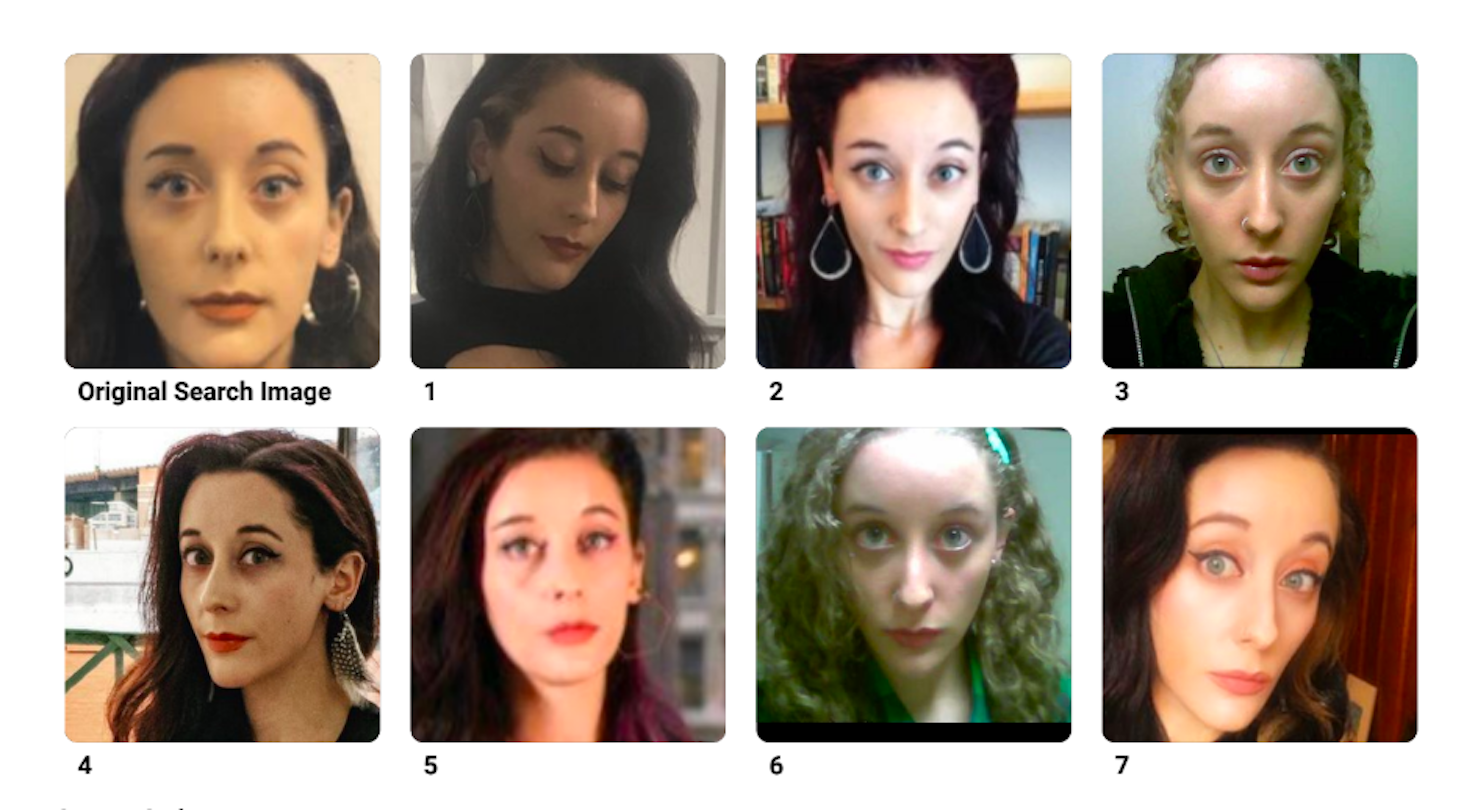
Start Up No.1252: the auto insurance algorithm that soaked big spenders, coronavirus could threaten Olympics, Amazon’s spooky grocery, and more


It’s a fake – but how easily could you tell if it was being sold on Amazon? CC-licensed photo by Indi Samarajiva on Flickr.

You can sign up to receive each day’s Start Up post by email. You’ll need to click a confirmation link, so no spam.

A selection of 11 links for you. Use them wisely. I’m @charlesarthur on Twitter. Observations and links welcome.

Suckers’ list: how Allstate’s secret auto insurance algorithm squeezes big spenders • The Markup

Maddy Varner and Aaron Sankin:

»

Seven years ago, Allstate Corporation told Maryland regulators it was time to update its auto insurance rates. The insurer said its new, sophisticated risk analysis showed it was charging nearly all of its 93,000 Maryland customers outdated premiums. Some of the old rates were off by miles. One 36-year-old man from Prince George’s County, Md., who Allstate said in public records should have been paying $3,750 every six months, was instead being charged twice that, more than $7,500. Other customers were paying hundreds or thousands of dollars less than they should have been, based on Allstate’s new calculation of the risk that they would file a claim.

Rather than apply the new rates all at once, Allstate asked the Maryland Insurance Administration for permission to run each policy through an advanced algorithm containing dozens of variables that would adjust it in the general direction of the new risk model. Allstate said the goal of this new customer “retention model,” which it was rolling out across the country, was to limit policy cancellations from sticker shock. After questions from regulators, the insurer submitted thousands of pages of documentation on the price changes—including data showing how they would affect each individual customer, a rare public window into details of its auto insurance pricing that have otherwise been kept behind a wall of privacy, labeled a trade secret.

When The Markup and Consumer Reports conducted a statistical analysis of the Maryland documents, we found that, despite the purported complexity of Allstate’s price-adjustment algorithm, it was actually simple: it resulted in a suckers list of Maryland customers who were big spenders and would squeeze more money out of them than others.

«

unique link to this extract


Big tech is testing you • The New Yorker

Professor Hannah Fry:

»

As “The Power of Experiments” makes clear, there are times when this happens in irritating but relatively harmless ways—a company making a small tweak to a Web site that elevates profits over customer experience, for instance. Consider an experiment that StubHub, the ticket-resale company, ran to determine where best to notify users about its ticketing costs. Should it be up front about them from the moment you land on the page? Or surprise you at checkout? StubHub discovered, after experimenting, that hiding the fees until the last minute led to thirteen% more sales, plus tickets that were 5.73% more expensive on average. As Luca and Bazerman explain, “People were buying better, higher-priced tickets when the fees were hidden.” The technique did make people less likely to return to the Web site in the following months, but that falloff was not enough to counter the increase in ticket sales and prices.

There are also times when manipulation leaves people feeling cheated. For instance, in 2018 the Wall Street Journal reported that Amazon had been inserting sponsored products in its consumers’ baby registries. “The ads look identical to the rest of the listed products in the registry, except for a small gray ‘Sponsored’ tag,” the Journal revealed. “Unsuspecting friends and family clicked on the ads and purchased the items,” assuming they’d been chosen by the expectant parents. Amazon’s explanation when confronted? “We’re constantly experimenting,” a spokesperson said. (The company has since ended the practice.)…

…There’s untold good that can be done by experimentation in the digital age. It can help us to understand the impact of screen time or the Like button on our well-being; to find and fix discriminatory practices; to identify ways of promoting healthier life styles. But where these experiments are being done away from public scrutiny, the ethos of science is compromised.

«

unique link to this extract


Facebook would have to pay $3.50 per month to US users for sharing contact info: study • Reuters

Nandita Bose:

»

German Facebook users would want the social media platform to pay them about $8 per month for sharing their contact information, while US users would only seek $3.50, according to a study of how people in various countries value their private information.

The study by US-based think tank the Technology Policy Institute (TPI) is the first that attempts to quantify the value of online privacy and data. It assessed how much privacy is worth in six countries by looking at the habits of people in the United States, Germany, Mexico, Brazil, Columbia and Argentina.

It addresses growing concern about how companies from technology platforms to retailers have been collecting and monetizing personal data. US regulators have imposed hefty fines on Facebook Inc and Alphabet-owned Google’s YouTube unit for privacy violations.

“Differences in how much people value privacy of different data types across countries suggests that people in some places may prefer weaker rules while people in other places might prefer stronger rules,” Scott Wallsten, president and senior fellow at TPI told Reuters.

«

Or it suggests that they’re conditioned one way or another, perhaps by surrounding commercial and political interests?
unique link to this extract


Inside ‘Amazon Go Grocery’: tech giant opens first full-sized store without cashiers or checkout lines • GeekWire

Kurt Schlosser:

»

Amazon Go is going full grocery.

Two years after launching a chain of convenience stores without cashiers or checkout lines, Amazon is opening its first “Amazon Go Grocery” store in Seattle on Tuesday morning, enlarging the footprint for surveillance-style shopping and signaling a larger challenge to the broader world of brick-and-mortar retail.

The debut is also the answer to a longstanding mystery about the 7,700-square-foot space, at 610 E. Pike Street in Seattle’s Capitol Hill neighborhood. Amazon’s plans for the property have long been under wraps. Last fall the company confirmed that its Amazon Go team was “running internal tests” at the location, but declined to say more until now.

GeekWire got a sneak peek at the store during a recent media preview, entering by scanning a smartphone app and strolling the aisles of the completely stocked store. The banks of cameras and sensors overhead track everything put into a shopping cart, with the help of artificial intelligence — rendering unnecessary the old-fashioned ritual of scanning and paying at a checkout stand. Items are charged to a shopper’s Amazon account shortly after they walk through the exit.

«

This feels like something out of a William Gibson book. The implicit surveillance is very spooky.
unique link to this extract


China bans human consumption and trade of wild animals • CTV News

»

China on Monday declared an immediate and “comprehensive” ban on the trade and consumption of wild animals, a practice believed responsible for the deadly coronavirus outbreak.

The country’s top legislative committee approved a proposal “prohibiting the illegal wildlife trade, abolishing the bad habit of overconsumption of wildlife, and effectively protecting the lives and health of the people,” state television reported.

Previous temporary bans have been put in place, including after the SARS (Severe Acute Respiratory Syndrome) virus killed hundreds of people in China and Hong Kong in 2002-03 and was also traced to wild animal consumption.

That prohibition was short-lived, however, and conservationists have long accused China of tolerating a cruel trade in wild animals as exotic menu items or for use in traditional medicines whose efficacy is not confirmed by science.

The decision was made by the Standing Committee of the National People’s Congress (NPC), which oversees the country’s rubber-stamp legislature.

«

If Covid-19 has one good effect, it might be to stop China killing animals unnecessarily.
unique link to this extract


Tokyo Olympics could be cancelled due to Coronavirus, IOC official says • CNBC

:

»

A senior member of the International Olympic Committee said Tuesday that if it proves too dangerous to hold the Olympics in Tokyo this summer because of the coronavirus outbreak, organizers are more likely to cancel it altogether than to postpone or move it.

Dick Pound, a former Canadian swimming champion who has been on the IOC since 1978, making him its longest-serving member, estimated there is a three-month window — perhaps a two-month one — to decide the fate of the Tokyo Olympics, meaning a decision could be put off until late May.

“In and around that time, I’d say folks are going to have to ask: ‘Is this under sufficient control that we can be confident about going to Tokyo or not?’” he said in an exclusive interview with The Associated Press.

As the games draw near, he said, “a lot of things have to start happening. You’ve got to start ramping up your security, your food, the Olympic Village, the hotels. The media folks will be in there building their studios.”

If the IOC decides the games cannot go forward as scheduled in Tokyo, “you’re probably looking at a cancellation,” he said.

«

A few numbers: the current flu epidemic has a mortality rate of 0.14% (or less; that’s the worst on the CDC estimates). The Spanish flu epidemic of 1918-19 had an estimated mortality rate of 10%-20%. Covid-19 has a mortality rate of about 2%.

Japan has had one of the worst outbreaks, and it’s not clear how long the virus can survive or how many asymptomatic carriers there might be. This would be the first Olympics cancelled due to a pandemic.
unique link to this extract


Here’s how China is hunting down coronavirus critics • VICE

David Gilbert:

»

Joshua Left, a 28-year-old entrepreneur who runs a self-driving car startup in Wuhan, China, arrived in San Francisco in mid-January for a vacation, just as the first reports of a new “SARS-like” virus outbreak in China reached the U.S.

He almost immediately began worrying about his family back in his hometown of Wuhan, where the disease appeared to originate, and where panic was starting to set in. Concerned that his family might not be getting information on the scale of the burgeoning epidemic, he posted messages on his WeChat account sharing information he was afraid were not available inside China.

“But then things started to get weird,” he told VICE News.

Left, who asked not to be identified by his full Chinese name, said he first received a warning message from WeChat administrators. Then he began receiving strangely specific messages that appeared to come from four of his friends on WeChat, all asking him for his location, what hotel he was staying at in San Francisco, what his room number was, and what his U.S. phone number was.

Then his cell phone received a warning message that someone in Shanghai was trying to log into his account.

Finally, when he wouldn’t tell them where he was staying, the same accounts all simultaneously began urging him to return to China as soon as possible.

«

China’s government isn’t going to let a little thing like a near-pandemic (or maybe it’s there now..) get in its way.
unique link to this extract


Firefox turns controversial new encryption on by default in the US • The Verge

Jon Porter:

»

Starting today, Mozilla will turn on by default DNS over HTTPS (DoH) for Firefox users in the US, the company has announced. DoH is a new standard that encrypts a part of your internet traffic that’s typically sent over an unencrypted plain text connection, and which could allow others to see what websites you’re visiting, even when your communication with the website itself is encrypted using HTTPS. Mozilla says it is the first browser to support the new standard by default, and will be rolling it out gradually over the coming weeks in order to address any unforeseen issues.

Whenever you type a website into your address bar, your browser needs to go through a process to convert it into an IP address using a DNS lookup. However, this traffic is normally not encrypted, meaning that it’s possible for others to see what websites you’re visiting. DoH is an attempt to encrypt this information to protect your privacy. Here’s a more in-depth explanation from Mozilla that explains it in detail.

Mozilla is motivated in part by ISPs who monitor customers’ web usage. US carriers like Verizon and AT&T are building massive ad-tracking networks. DoH won’t stop the data collection but it’ll likely make it more difficult.

«

Not coming by default to the UK, though it doesn’t explain why not. (Though UK users can turn it on manually.)
unique link to this extract


Why do corporations speak the way they do? • Vulture

Molly Young:

»

[“Uncanny Valley” author Anna] Wiener writes especially well — with both fluency and astonishment — about the verbal habits of her peers: “People used a sort of nonlanguage, which was neither beautiful nor especially efficient: a mash-up of business-speak with athletic and wartime metaphors, inflated with self-importance. Calls to action; front lines and trenches; blitzscaling. Companies didn’t fail, they died.” She describes a man who wheels around her office on a scooter barking into a wireless headset about growth hacking, proactive technology, parallelization, and the first-mover advantage. “It was garbage language,” Wiener writes, “but customers loved him.”

I know that man, except he didn’t ride a scooter and was actually a woman named Megan at yet another of my former jobs. What did Megan do? Mostly she set meetings, or “syncs,” as she called them. They were the worst kind of meeting — the kind where attendees circle the concept of work without wading into the substance of it. Megan’s syncs were filled with discussions of cadences and connectivity and upleveling as well as the necessity to refine and iterate moving forward. The primary unit of meaning was the abstract metaphor. I don’t think anyone knew what anyone was saying, but I also think we were all convinced that we were the only ones who didn’t know while everyone else was on the same page. (A common reference, this elusive page.)

In Megan’s syncs, I found myself becoming almost psychedelically disembodied, floating above the conference room and gazing at the dozen or so people within as we slumped, bit and chewed extremities, furtively manipulated phones, cracked knuckles, examined split ends, scratched elbows, jiggled feet, palpated stomach rolls, disemboweled pens, and gnawed on shirt collars. The sheer volume of apathy formed an energy of its own, like a mudslide. At the half-hour mark of each hour-long meeting, our bodies began to list perceptibly toward the door. It was like the whole room had to pee.

«

Wiener calls it “garbage language”. But as Young points out, the words that are used are always borrowed from whichever sector is in the ascendant at the time. (Presently: new-age crystals.)
unique link to this extract


Can you tell which of these Amazon Prime purchases are counterfeit? • Wirecutter

Ganda Suthivarakom:

»

Although Amazon has taken many measures to prevent counterfeits and unsafe products from showing up on its site, plenty of fakes still slip through. Over the past several months, we’ve purchased counterfeits and knockoffs making fraudulent safety claims and encountered a few instances in which a seller switched in an authentic product but from a discontinued or lesser-quality line—all delivered through Amazon Prime. We also obtained authentic items, either directly from the manufacturer or with confirmation from the brand. While the fakes and knockoffs may look like the real products at first glance, they’re often lower in quality, sometimes hiding potential health or safety issues.

Many people think that counterfeits and knockoffs are so obviously inferior—visually and otherwise—that it’s easy to spot the difference between a fake and the real thing. But increasingly, that’s not the case with counterfeits purchased online. Test yourself: Can you spot the real thing in the photos below?

…Although knockoffs are also present on separate Amazon listings, counterfeit ‘Ove’ Gloves often pop up on the product page for the real ‘Ove’ Glove, according to Michael Hirsch, vice president of Joseph Enterprises. To combat them, the company buys the fakes and then informs Amazon of the copyright infringement. Getting the fake gloves removed from Amazon can be a long process, Hirsch said, taking weeks or even months of playing whack-a-mole with counterfeit sellers: “Once they’re off, they come back under a different brand and name.”

It’s easy to see why the fakes persist. We found counterfeit ‘Ove’ Gloves for sale for about $2 a piece in bulk on Alibaba, the photograph clearly showing a knockoff version with black stitching instead of white around the wrist.

«

This is now an endless story: fakes selling for less because Amazon doesn’t have responsibility. That could be dangerous. There’s an obvious solution: make Amazon responsible for the authenticity of the products. One of the fakes is a child car seat: that’s inherently dangerous (and the seat doesn’t comply with federal regulations). It’s amazing, given the American attitude to tort law, that Amazon hasn’t been sued into the ground yet. Or do the court cases get settled quietly?
unique link to this extract


These unknown Chinese audio brands might just be the best • WSJ

Matthew Kronsberg:

»

audiophiles have been known to spend more than $1,000 for earphones from Campfire Audio, more than $10,000 for amps from Shindo Labs or upward of $20,000 for speakers by Bowers & Wilkins.

Unsurprisingly, much of the hi-fi gear designed and sold by such U.S., Japanese and European brands—the sort that now dominates the market—is built in China. But in the past few years, a wave of inscrutably named Chinese companies have begun to design and market their own audiophile-grade equipment that can often outperform their better known, better marketed rivals, usually doing so at a fraction of the price.

If there’s a poster child for “Chi-Fi”—a moniker for this constellation of equipment that’s largely made up of earphones, headphone amps and high resolution digital-to-analog audio converters known as DACs—it’s the ATE model in-ear monitors, or IEMs, from a nearly anonymous brand known as KZ (kzacoustics.com). IEMs are essentially earphones that extend slightly into the canal, like a hearing aid. John Darko, who runs darko.audio, an audiophile website out of Berlin, declared that the KZ ATEs offered an “immensely spacious and dynamically charged listening experience,” not the kind of praise you typically hear about gear that sells for around $15.

What’s the catch? That path to the audiophile Promised Land is still a confusing, poorly signposted one. The Chinese audio gear market is overflowing with confusingly named startups like BQEYZ, GGMM, UiiSi or FAAEAL, none of which likely resonate with the average U.S. consumer the way established brands like Sony, Beats and Yamaha do. And since very little of this alphabet-soup of gear makes it to traditional bricks-and-mortar retailers where you can listen before you buy, experts like Mr. Darko, and tightly curated e-commerce sites like Drop.com, are essential tools for aspiring audiophiles. This is especially true when the product in question is a $250 DAC rather than a $15 IEM.

«

I linked to an article about “Chi-fi” back in November, but this at least gives you a site to check where you can see what they say. (“Sort by price” would be a great thing, Mr Darko.) The counterpoint to all the junky counterfeits on Amazon.
unique link to this extract


Errata, corrigenda and ai no corrida: none notified

Start Up No.1251: Apple ARM computer in 2021?, how coronavirus escaped China, an AR implosion, swim mousey swim!, and more


A man died in a rocket trying to disprove the Earth’s curvature. He could have seen it from sea level. CC-licensed photo by Martin Cathrae on Flickr.

You can sign up to receive each day’s Start Up post by email. You’ll need to click a confirmation link, so no spam.

A selection of 8 links for you. Use them wisely. I’m @charlesarthur on Twitter. Observations and links welcome.

Mac with Apple-designed Arm processor coming in first half of 2021 • MacRumors

Juli Clover:

»

[Ming Chi] Kuo’s note indicates a new Mac with an Apple-designed chip won’t be released this year.

Apple is said to be moving to Arm-based chips in an effort to make Macs, iPhones, and iPads work together and run the same apps. Apple’s iPhones and iPads already use Arm-based chip technology, and there are custom Apple-created T2 chips in the iMac Pro and recent MacBook Pro, MacBook Air, Mac mini, and Mac Pro models.

Kuo’s detail about an upcoming Mac with an Apple-designed chip is a tidbit mentioned briefly in a note that suggests 5-nanometer chip architecture will be the “core technology” in Apple’s new products in the next 12 to 18 months:

»

We expect that Apple’s new products in 12-18 months will adopt processors made by 5nm process, including the new 2H20 5G iPhone, new 2H20 iPad equipped with mini LED, and new 1H21 Mac equipped with the own-design processor. We think that iPhone 5G support, iPad ‘s adoption of innovative mid-size panel technology, and Mac’s first adoption of the own-design processor are all Apple’s critical product and technology strategies. Given that the processor is the core component of new products, we believe that Apple had increased 5nm-related investments after the epidemic outbreak. Further, Apple occupying more resources of related suppliers will hinder competitors’ developments.

«

The new Mac with Apple-designed chip, the 2020 5G iPhone , and a high-end iPad with a mini LED display rumored for the second half of 2020 are said to use 5-nanometer chips. Chips built on a 5-nanometer node will be faster and more efficient than the A13 chips used in the most recent iPhones that are built on a 7-nanometer+ process.

«

1) Do we guess it’s just going to be laptops?
2) Scissor-switch keyboard, right?
3) Wonder how the app emulation will work.
unique link to this extract


Not selling the computer I want • Birchtree

Matt Birchler:

»

I love my iPad Pro, and it’s what I use to get basically everything done in my personal life. That said, I like having a traditional desktop around because, well, I’m a nerd and there are some advanced things that I just can’t do on an iPad yet.

Up until this week, a 2012 Mac Mini was filling that role, and for a $600 computer it’s held up quite nicely in the following 8 years. But for the past year I’ve been thinking about replacing it because it’s just not cutting it for some tasks anymore. Yes, it can handle the large Photoshop files I throw at it, and it technically can edit and export 4k video, but it’s not particularly good at it either. It was time to upgrade, but I wasn’t sure to what, exactly.

To get an idea of my thinking, here are Apple’s line of Macs:

MacBook Air; MacBook Pro; Mac Mini; iMac; iMac Pro; Mac Pro.

The two MacBooks are immediately eliminated because I don’t want a laptop…I have an iPad. The iMac Pro and Mac Pro are also eliminated for cost reasons, so that left the iMac and Mac Mini.

The Mini was the direct upgrade, but frankly I wasn’t that excited about what I could get in my $1,000-ish price range. An 8th gen Intel chip with 8GB RAM and integrated graphics are pretty anaemic, and while I know I can upgrade to get some more power, that’s a lot of money, and I’m still buying two-generation-old Intel chips.

The iMac was another option, but the pricing just didn’t work for me. I could spend north of $2,000 and get something pretty beefy, but that wasn’t the budget (and even if I did put up the cash, the GPU options are rough). My budget allowed for the 21 inch 7th gen Intel chips, which was just not something I had any interest in.

This all brought me to an interesting realization: Apple doesn’t make a Mac for me anymore.

«

This post ought to worry whoever is in charge of the Mac mini at Apple: that’s clearly where this sale was lost. (But probably wouldn’t come back with ARM chips. His iPad has that.)
unique link to this extract


Snap acquires Daqri’s assets: inside a $300m startup flop • Protocol

Janko Roettgers:

»

Everything went wrong for Daqri. The startup rode a wave of augmented reality hype and about $300m in funding to a series of half-baked products before failing spectacularly and shutting down last year.

One of Daqri’s last remnants was recently acquired by Snap: The company confirmed to Protocol that late last year it took on certain Daqri assets and about two-dozen employees, who now work in the company’s newly opened Vienna office under the leadership of former Daqri CTO Daniel Wagner. Snap didn’t disclose the purchase price, but the timing lines up with a $34 million acquisition disclosed in its annual report to shareholders.

In interviews, more than 10 former employees detailed Daqri’s demise. In its decade of existence, the company built a retro-futuristic augmented reality helmet with a hefty $15,000 price tag, used fancy videos to sell the world on visual computing, and acquired a series of other startups in offices around the globe, only to see it all slip away when its glossy AR dreams collided with reality. It’s a story that anyone working in the AR and VR space should take to heart, if only to avoid a similar downfall.

«

I wonder if the folks at Magic Leap will pay attention. Daqri was a ten-year slow-motion crash. (Protocol, by the way, is a new online magazine. Roettgers is an impressive recruit.)
unique link to this extract


EU Commission to staff: switch to Signal messaging app • POLITICO

Laurens Cerulus:

»

Commission officials are already required to use encrypted emails to exchange sensitive, non-classified information, an official said. Classified documents fall under tighter security rules.

The use of Signal was mainly recommended for communications between staff and people outside the institution. The move to use the application shows that the Commission is working on improving its security policies.

Promoting the app, however, could antagonize the law enforcement community.

Officials in Brussels, Washington and other capitals have been putting strong pressure on Facebook and Apple to allow government agencies to access to encrypted messages; if these agencies refuse, legal requirements could be introduced that force firms to do just that.

American, British and Australian officials have published an open letter to Facebook CEO Mark Zuckerberg in October, asking that he call off plans to encrypt the company’s messaging service. Dutch Minister for Justice and Security Ferd Grappehaus told POLITICO last April that the EU needs to look into legislation allowing governments to access encrypted data.

«

Same encryption protocol as WhatsApp, but open source (and not owned by Facebook). The Conservative party has also switched to Signal, allegedly because you can get more than 255 people into a single group.
unique link to this extract


Korea’s coronavirus spread puts an export hub at risk • WSJ

Mike Bird:

»

The rapid spread of coronavirus in South Korea is bleak news for global manufacturers. China-style industrial shutdowns look increasingly likely in a country that punches above its weight—perhaps more than any other—in global supply chains.

On Sunday South Korean president Moon Jae-in raised the country’s virus alert to red after a surge in cases in the city of Daegu. A Samsung Electronics facility near the city has already closed after an employee was diagnosed with the disease. The Kospi stock index dropped nearly 4% Monday and the Korean won was down more than 1% against the U.S. dollar.

South Korea is a medium-size country, but a mammoth in trade. The country’s exports are equivalent to 44% of its GDP, second only to Germany among major advanced economies.

But even that understates its importance. Few of the country’s exported goods are finished products. Its overwhelming specialty is intermediate goods required by other manufacturers. Such goods make up around 55% of Germany’s exports, 62% of China’s—but 90% of South Korea’s. The country has a commanding position in electronics, dominating some categories of semiconductors and displays…

… So any industrial shutdowns designed to slow the spread of coronavirus will be felt immediately elsewhere. Companies that have spent the past three weeks scrambling to find alternatives to Chinese-made goods may now find themselves facing the same conundrum for South Korean parts.

«

The domino effect is starting to kick in. South Korea has the largest number of cases outside China – and high population density.
unique link to this extract


How one Singapore sales conference spread coronavirus around the world • WSJ

Niharika Mandhana and Feliz Solomon in Singapore and Eun-Young Jeong in Seoul:

»

Last month, 109 people gathered in a Singapore hotel for an international sales conference held by a U.K.-based company that makes products to analyze gas.

When the attendees flew home, some unwittingly took the coronavirus with them.

The virus had a 10-day head start on health authorities who, after belatedly learning a 41-year-old Malaysian participant was infected, began a desperate effort to track the infection through countries including South Korea, England and France. Health investigators have found at least 20 people in six Asian and European countries who were sickened, some who attended the conference and others who came in contact with participants.

A globalized economy, one that’s far more integrated than in the early 2000s when the SARS virus broke out, is complicating the task of responding to epidemics.

After this one conference alone, 94 participants left Singapore, authorities determined. Some joined Lunar New Year dinners. Others went on vacation, one to an Alpine ski town. They had eaten, taken car rides and shared a roof with others who then boarded more planes to places the virus hadn’t yet reached.

«

Cancelling MWC now looks like a really wise move. Fascinating detective piece. Is this how Italy became infected?
unique link to this extract


Man wanting to prove Earth is flat dies in homemade rocket crash • ExtremeTech

Joel Hruska, in absolutely brutal form:

»

Mad Mike wanted to build a steam-powered rocket to loft him high enough into the air to prove the Earth was flat, discounting the fact that, well, it isn’t, based on the combined scientific observations of everyone from Eratosthenes (276 BC – 195/194 BC) to the eyes-on observation of astronauts today. That’s not a problem for Flat-Earthers, because they generally either don’t believe in outer space or don’t believe we’ve traveled to it. The reason they don’t believe this is because the data coming back from NASA, the ESA, Russia, and any other nation capable of putting a satellite in orbit doesn’t support their theory that the Earth is flat.

When you explain that this is the literal definition of confirmation bias, you’ll get a lot of ranting about conspiracies and the importance of doing the science for yourself. While the idea of confirming the opinion of learned people over the past 2,000 years is appealing on some levels, the concept presupposes that the person doing the proving has a basic grasp of geometry, logic, and the scientific method. The fact that there are a handful of Flat-Earthers with a significant level of achieved education says more about how humans can be quite intelligent and still fall prey to remarkably stupid theories than it does about the accuracy of the flat Earth model.

Some people may feel I’m being a bit harsh. They are correct. I won’t even pretend otherwise. When you climb aboard a homemade rocket because you intend to prove long-established and objectively proven facts aren’t true, you are, at best, a moron. When you do it repeatedly and in complete rejection of observation and research conducted by thousands of people over millennia you are an arrogant moron who believes his own failure to understand the reasons why he’s wrong means those reasons are false. People have a right to be morons. They don’t have a right to be remembered as heroic or respected figures who defied the scientific status quo.

“‘I don’t believe in science,” said Hughes back in 2017. “I know about aerodynamics and fluid dynamics and how things move through the air, about the certain size of rocket nozzles, and thrust. But that’s not science, that’s just a formula. There’s no difference between science and science fiction.'”

In science fiction, Asgard beaming technology, Star Trek transporters, the Force, an Iron Man suit, a passing Voltron Lion, Moya, or the inexplicable appearance of Gully Foyle may save the day. In science, not having a parachute attached to a rocket means ballistic reentry, which means death..

«

The failure was not so much going up in a rocket as not having a failsafe method of return. But given that the reason for going up was unutterably stupid (aided by the Science Channel wanting to film him), Darwin and Newton took their revenge.
unique link to this extract


Depression researchers rethink popular mouse swim tests • Nature

Sara Reardon:

»

Nearly every scientist who has used mice or rats to study depression is familiar with the forced-swim test. The animal is dropped into a tank of water while researchers watch to see how long it tries to stay afloat. In theory, a depressed rodent will give up more quickly than a happy one — an assumption that has guided decades of research on antidepressants and genetic modifications intended to induce depression in lab mice.

But mental-health researchers have become increasingly sceptical in recent years about whether the forced-swim test is a good model for depression in people. It is not clear whether mice stop swimming because they are despondent or because they have learnt that a lab technician will scoop them out of the tank when they stop moving. Factors such as water temperature also seem to affect the results.

“We don’t know what depression looks like in a mouse,” says Eric Nestler, a neuroscientist at the Icahn School of Medicine at Mount Sinai in New York City.

«

I came across this article (from July 2019) quite by chance, and was astonished. Apparently it’s a technique that was developed in the 1950s, and is still used, though not in the UK. (I tweeted about it, which then went viral. Some scientists did respond. They’re equivocal about it.) Replacements include functional MRI and examination of dead donors’ brain tissue, and also still doing it with mice but looking at their preferences around sugar.
unique link to this extract


Errata, corrigenda and ai no corrida: none notified