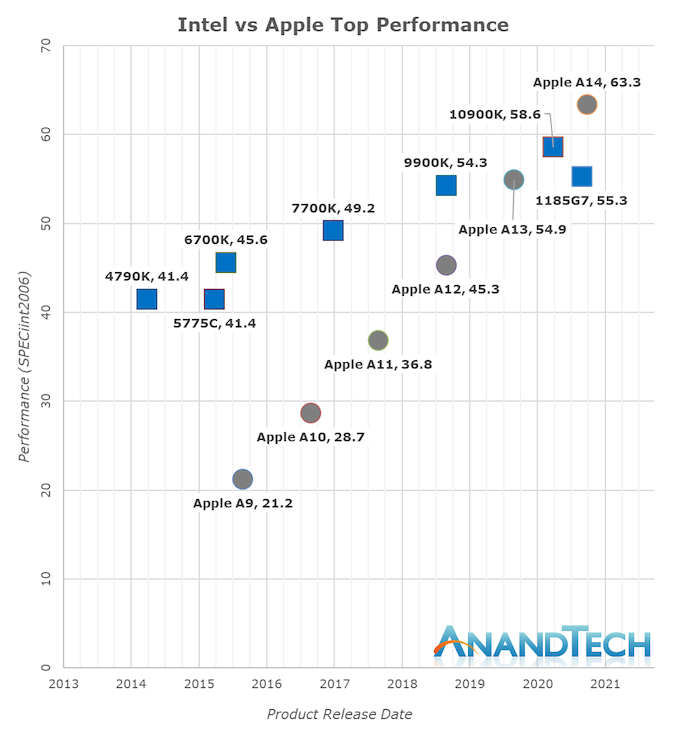

Start Up No.1446: Xiaomi’s Indian rebrand, Apple’s 32-core plans, do benchmarks disfavour Intel?, Uber sells self-driving unit, and more


Nearly one-fifth of Cadillac dealers have given up rather than convert to selling electric cars. CC-licensed photo by Tony Donnelly on Flickr.

You can sign up to receive each day’s Start Up post by email. You’ll need to click a confirmation link, so no spam.

A selection of 9 links for you. Tariff-free. I’m @charlesarthur on Twitter. Observations and links welcome.

How Indian is an Indian phone? • Rest of World

Nilesh Christopher:

»

Anti-China sentiment had already been rising in India’s heartlands before a skirmish in June in a disputed Himalayan border region left 20 Indian soldiers dead. Nationalists started smashing Chinese-made televisions; one minister called for shutting down Chinese restaurants. A few weeks after the skirmish, the Indian government banned TikTok, along with hundreds of Chinese apps, and, in August, passed an unofficial order to phase out dependence on Chinese telecom equipment, including 5G networks. Prime Minister Narendra Modi made a special appearance on television encouraging Indians to be “vocal” in their support for “local” products, creating the #vocalforlocal slogan. 

Chinese smartphone makers like Oppo, Vivo, and Xiaomi — who made up 81% of the Indian market — were left in a precarious position after the clash. Right-wing groups gathered outside Oppo’s factory in the outskirts of Delhi and burnt effigies of Xi Jinping, as they demanded that the plant be closed. Some companies battened down the hatches, suspending their prime-time advertising campaigns. Vivo pulled out as the title sponsor of the country’s biggest sporting event, the Indian Premier League cricket competition, after an aggressive campaign against it on social media. Stray protests took place outside some Xiaomi stores, as threats of vandalism loomed large and mobile shipments from China were stalled for manual inspection at Indian ports.

But while other Chinese brands retreated from the limelight, Xiaomi pursued a unique — and potentially high-risk — strategy: It presented itself as not being Chinese after all, but Indian.

«

Fascinating piece about an audacious move by a (definitely Chinese) phone and gadget maker. What’s easy to overlook (but Christopher notes) is how well it has catered to its local market – such as this: “One feature, Smart SMS, identifies the cluttered text messages that Indian Railways sends to its customers and extracts booking information, turning it into a ticket-like document.” Knowing the importance of railways is obvious to Indians, not so much to those outside.
unique link to this extract


Apple preps next Mac chips with aim to outclass top-end PCs • Bloomberg

Mark Gurman and Ian King:

»

Chip engineers at the Cupertino, California-based technology giant are working on several successors to the M1 custom chip, Apple’s first Mac main processor that debuted in November. If they live up to expectations, they will significantly outpace the performance of the latest machines running Intel chips, according to people familiar with the matter who asked not to be named because the plans aren’t yet public. Intel’s shares slid 2.9% in New York Monday after the news. Apple shares were up 1.3% at 9:46 a.m.

…While Intel gets less than 10% of its revenue from furnishing Apple with Mac chips, the rest of its PC business is liable to face turbulence if the iPhone maker is able to deliver demonstrably better-performing computers. It could accelerate a shakeup in an industry that has long been dependent on Intel’s pace of innovation. For Apple, the move sheds that dependency, deepens its distinction from the rest of the PC market and gives it a chance to add to its small, but growing share in PCs.

…The current M1 chip inherits a mobile-centric design built around four high-performance processing cores to accelerate tasks like video editing and four power-saving cores that can handle less intensive jobs like web browsing. For its next generation chip targeting MacBook Pro and iMac models, Apple is working on designs with as many as 16 power cores and four efficiency cores, the people said.

While that component is in development, Apple could choose to first release variations with only eight or 12 of the high-performance cores enabled depending on production, they said. Chipmakers are often forced to offer some models with lower specifications than they originally intended because of problems that emerge during fabrication.

For higher-end desktop computers, planned for later in 2021 and a new half-sized Mac Pro planned to launch by 2022, Apple is testing a chip design with as many as 32 high-performance cores.

With today’s Intel systems, Apple’s highest-end laptops offer a maximum of eight cores, a high-end iMac Pro is available with as many as 18 and the priciest Mac Pro desktop features as much as a 28-core system. Though architecturally different, Apple and Intel’s chips rely on the segmentation of workloads into smaller, serialized tasks that several processing cores can work on at once.

Advanced Micro Devices Inc., which has been gaining market share at Intel’s expense, offers standard desktop parts with as many as 16 cores, with some of its high-end chips for gaming PCs going as high as 64 cores.

«

I have to say, Bloomberg’s writing is prolix as hell. Other sites, rewriting this, focus on the meat – Apple is looking at a 32-core Pro, and 16-core MacBook Pros, and that’s making Intel investors a wee bit edgy and Apple investors optimistic. The question is, where’s the upside for PC makers? Windows on ARM is a disaster, and Microsoft doesn’t seem inclined to change that.
unique link to this extract


Current x86 vs. Apple M1 performance measurements are flawed • ExtremeTech

Joel Hruska joins those looking for a controversial take:

»

The “flaw” we’re going to talk about isn’t a problem with any specific benchmark or reviewer. It’s a difference in how the Apple M1 allocates and assigns resources versus how x86 CPUs work.

x86 CPUs from AMD and Intel are designed to use a technique known as Symmetric Multi-Threading (SMT; Intel calls this Hyper-Threading). AMD and Intel implement the feature somewhat differently, but in both cases, SMT-enabled CPUs are able to schedule work from more than one thread for execution in the same clock cycle. A CPU that does not support SMT is limited to executing instructions from the same thread in any given cycle.

Modern x86 CPUs from AMD and Intel take advantage of SMT to improve performance by an average of 20-30% at a fraction of the cost or power that would be required to build an entire second core. The flip side to this is that a single-threaded workload is unable to take advantage of the performance advantage SMT offers.

Apple’s 8-wide M1 doesn’t have this problem. The front-end of a RISC CPU allows generally higher efficiency in terms of instructions decoded per single thread. (WCCFTech has a bit more on this).

This is not some just-discovered flaw in the guts of Intel and AMD CPUs — it’s the entire reason Intel built HT and the reason why AMD adopted SMT as well. An x86 CPU achieves much higher overall efficiency when you run two threads through a single core, partly because they’ve been explicitly designed and optimized for it, and partly because SMT helps CPUs with decoupled CISC front-ends achieve higher IPC overall.

In any given 1T performance comparison, the x86 CPUs are running at 75% to 80% of their effective per-core performance. The M1 doesn’t have this issue.

«

Except, as he admits, the reality is clear: the M1 delivers far better performance per watt than Intel chips, and only struggles a bit when emulating x86 code. There’s going to be plenty more struggling around to find ways in which the M1 “isn’t really better” until those 32-core machines appear and stomp on the best AMD and Intel have to offer.
unique link to this extract


Op-Ed: New York Times fights Pornhub with emotional pornography • XBIZ.com

XBIZ (which you may not know is “the world’s leading source for adult industry news and information”, where by “adult” they mean “porn”) has an opinion about Nicholas Kristof’s piece in the NYT about abuse on Pornhub:

»

• [Nicholas] Kristof claims that out of the 6.8 million new videos posted on Pornhub yearly, “many depict child abuse and nonconsensual violence.” The “many” is tendentious here given that Kristof does not provide any concrete data of what percentage it is, how it compares to other adult or mainstream tube sites where bad actors may upload criminal content, or why he is singling out Pornhub for what appears to be an internet-wide issue for any company hosting massive amounts of third-party content

• One of several creepy searches Kristof has performed as “research” for his censorship manifesto, yielded “more than 100,000 videos,” of which he says, apparently by his own viewing and estimation “most aren’t of children being assaulted but too many are”

• Kristof protests that “the issue is not pornography but rape” and accuses Pornhub of “promoting” “assaults on children or on anyone without consent,” before likening the tube site to “Bill Cosby, Harvey Weinstein and Jeffrey Epstein”

• Kristof in his “research” claims that he “came across many videos on Pornhub that were recordings of assaults on unconscious women and girls. The rapists would open the eyelids of the victims and touch their eyeballs to show that they were nonresponsive.” At no point in his article does Kristof clarify whether he reported theses videos to the authorities or the site’s moderators or if he followed up with the company’s response to such a report

«

This piece, which has a tone that’s both defensive and grumpy, seems to want Kristof not to have done his research (as in the second bullet above) but also to have gone above and beyond just researching to actually moderating pretty much everything he found. But I read Kristof’s piece as pointing out that there’s a colossal moderation problem on Pornhub, because just as with sites like YouTube there’s no incentive for those who find bad material (terrorism, incitement) to report it if they search for it, there isn’t on Pornhub. But Kristof’s point is that the implications of this content on Pornhub are far worse than on YouTube, say. Unsurprisingly, Xbix doesn’t really grapple with this point. But it is definitely worried about what might happen to Section 230. (Thanks Droidboxx for the link.)
unique link to this extract


Uber sells ATG self-driving unit to Aurora • CNBC

Jessica Bursztynsky:

»

Uber’s self-driving unit, Advanced Technologies Group (ATG), is being acquired by its start-up competitor Aurora Innovation, the companies announced Monday.

The deal, expected to close in the first quarter of 2021, values ATG at approximately $4bn. The unit was valued at $7.25bn in Apr. 2019 when Softbank, Denso and Toyota took a stake.

Uber CEO Dara Khosrowshahi will join the company’s board, and the ride-sharing giant will invest $400m into the company.

Overall, Uber and ATG investors and employees are expected to own a 40% stake in Aurora, according to a regulatory filing accompanying the deal; Uber alone will hold a 26% stake. The start-up is being valued at $10bn in the transaction, according to a person familiar with the terms of the deal.

“With the addition of ATG, Aurora will have an incredibly strong team and technology, a clear path to several markets, and the resources to deliver,” Chris Urmson, co-founder and CEO of Aurora, said in a statement. “Simply put, Aurora will be the company best positioned to deliver the self-driving products necessary to make transportation and logistics safer, more accessible, and less expensive.”

«

This isn’t about Aurora, it’s about Uber – which is clearly giving up on the idea of making (and possibly running) self-driving systems. The problem with that is that without self-driving systems, Uber has no path to profitability that doesn’t involve raising its prices, and thus becoming uncompetitive against normal taxi services which don’t have its gigantic overheads.
unique link to this extract


About 150 [of 880] US Cadillac dealers to exit brand, rather than sell electric cars • WSJ

Mike Colias:

»

About 150 General Motors dealers have decided to part ways with Cadillac, rather than invest in costly upgrades required to sell electric cars, according to people familiar with the plans, indicating some retailers are skeptical about pivoting to battery-powered vehicles.

GM recently gave Cadillac dealers a choice: Accept a buyout offer to exit from the brand or spend roughly $200,000 on dealership upgrades—including charging stations and repair tools—to get their stores ready to sell electric vehicles, these people said.

The buyout offers ranged from around $300,000 to more than $1m, the people familiar with the effort added. About 17% of Cadillac’s 880 US dealerships agreed to take the offer to end their franchise agreements for the luxury brand, these people said.

Most dealers who accepted the buyout also own one or more of GM’s other brands—Chevrolet, Buick and GMC—and sell only a handful of Cadillacs a month, the people familiar with the effort said.

The skepticism from some Cadillac dealers underscores that, even as investors bid up the value of electric vehicles, questions persist about interest among consumers and the retailers who serve them.

Tesla has become an electric-vehicle juggernaut by selling directly to customers, without franchise dealers, a model several startups intend to follow. Traditional auto makers, on the other hand, are tasked with overlaying their electric-car plans on dealer networks that today make their money selling gasoline-powered vehicles.

«

I test drove a Tesla, out of overwhelming curiosity, the other day. Compared to a fossil fuel car, it’s like being inside a computer: sensors on everything, everywhere. Readings of all sorts, and silence (apart from the radio). Opening the bonnet, the salesman explained that I’d have to keep the windscreen washer fluid topped up. Change the tyres occasionally. But nothing else. A mechanic’s nightmare.

Yet the dealers exiting seem to show a huge failure of imagination. Why not become a charging destination? An update destination? You can’t hang on to the past. (Via John Naughton, again.)
unique link to this extract


Setting the record straight #ISupportTimnit #BelieveBlackWomen • Medium

Google Walkout For Real Change:

»

Dr. Gebru did not resign, despite what Jeff Dean (Senior Vice President and head of Google Research), has publicly stated. Dr. Gebru has stated this plainly, and others have meticulously documented it.

Dr.Gebru detailed conditions she hoped could be met. Those conditions were for
1) transparency around who was involved in calling for the retraction of the paper,
2) having a series of meetings with the Ethical AI team, and
3) understanding the parameters of what would be acceptable research at Google. She then requested a longer conversation regarding the details to occur post-vacation. In response, she was met with immediate dismissal, as she details in this tweet.

Dr. Gebru’s dismissal has been framed as a resignation, but in Dr. Gebru’s own words, she did not resign. All reports under her management received a letter from Megan Kacholia (Vice President of Engineering for the Google Brain organization), stating that Megan had accepted Timnit’s resignation. Megan went around Dr. Gebru’s own manager, Samy Bengio (lead of Google Brain) in sending these emails, which he has stated publicly.

«

Essentially, there’s now an insurgent group within Google which is fighting elements of Google’s management. This can’t end well for Google.
unique link to this extract


Google adds Apple Music support to Assistant smart speakers and displays • The Verge

Dan Seifert:

»

Google has announced that Apple Music is now available on smart speakers and displays that use the Google Assistant, including Google’s own line of Nest products, such as the new Nest Audio. Owners of Assistant smart speakers or displays will be able to set Apple Music as the default service on the speakers and use their voice to play songs, albums, or playlists from it, much like they can do with Spotify, Pandora, or YouTube Premium.

This addition broadens the appeal of Assistant smart speakers and displays to a wider market, and it catches Google’s smart speaker line up to Amazon’s, which has supported Apple Music through Alexa on Echo smart speakers since 2018. As with the other services available on Google smart speakers, you can play Apple Music on multiple speakers at the same time for whole home audio.

With Apple Music on board, the only major services left that aren’t full supported on Google’s smart speakers are Amazon Music and Tidal, both of which are compatible with Echo speakers (which don’t support Google’s YouTube Music service).

«

More interesting is that this puts Apple Music on all the major ecosystems – Apple, Amazon, Google. And of course Sonos. Another little victory for the Services team there.
unique link to this extract


Ikea ends publication of iconic printed catalog • The Verge

Thomas Ricker:

»

After a 70-year run, Ikea is discontinuing the publication of its printed catalog.

Ikea’s decision comes as catalog readership is in decline and the company becomes increasingly more digital. After initially resisting online shopping, the company was forced to embrace it during the pandemic. Ikea says its online retail sales increased by 45% worldwide last year with ikea.com reporting four billion visits. The company has also improved its suite of apps to make discovering and buying products easier, while opening smaller stores located in city centres meant to reach people where they live.

At its peak in 2016, Ikea says that 200 million catalogs were distributed in 32 languages. A BBC documentary once claimed that the Ikea catalog was the largest publication in the world, with more copies printed than either the Bible or the Quran. The first Ikea catalog was put together by Ikea founder Ingvar Kamprad in 1951.

«

I have to say that browsing a physical catalogue is far more satisfying than browsing an app – even an iPad (or tablet) app. You can go as fast as you like, take in much more per (double) page, mark multiple things to compare. Of course Ikea’s online sales have risen like crazy in the past ten months – but so has everyone’s.
unique link to this extract


Errata, corrigenda and ai no corrida: none notified

Start Up No.1445: Pornhub’s rape problem, Google staff row over AI paper, drones do policing, TikTok delayed again, and more


A new filling station in Essex won’t offer petrol – just electrons. CC-licensed photo by JCT 600 on Flickr.

You can sign up to receive each day’s Start Up post by email. You’ll need to click a confirmation link, so no spam.

A selection of 9 links for you. Electable. I’m @charlesarthur on Twitter. Observations and links welcome.

The Children of Pornhub • The New York Times

Nicholas Kristof:

»

Pornhub prides itself on being the cheery, winking face of naughty, the website that buys a billboard in Times Square and provides snow plows to clear Boston streets. It donates to organizations fighting for racial equality and offers steamy content free to get people through Covid-19 shutdowns.

That supposedly “wholesome Pornhub” attracts 3.5 billion visits a month, more than Netflix, Yahoo or Amazon. Pornhub rakes in money from almost three billion ad impressions a day. One ranking lists Pornhub as the 10th-most-visited website in the world.

Yet there’s another side of the company: Its site is infested with rape videos. It monetizes child rapes, revenge pornography, spy cam videos of women showering, racist and misogynist content, and footage of women being asphyxiated in plastic bags. A search for “girls under18” (no space) or “14yo” leads in each case to more than 100,000 videos. Most aren’t of children being assaulted, but too many are.

After a 15-year-old girl went missing in Florida, her mother found her on Pornhub — in 58 sex videos. Sexual assaults on a 14-year-old California girl were posted on Pornhub and were reported to the authorities not by the company but by a classmate who saw the videos. In each case, offenders were arrested for the assaults, but Pornhub escaped responsibility for sharing the videos and profiting from them.

Pornhub is like YouTube in that it allows members of the public to post their own videos. A great majority of the 6.8 million new videos posted on the site each year probably involve consenting adults, but many depict child abuse and nonconsensual violence. Because it’s impossible to be sure whether a youth in a video is 14 or 18, neither Pornhub nor anyone else has a clear idea of how much content is illegal.

…The issue is not pornography but rape. Let’s agree that promoting assaults on children or on anyone without consent is unconscionable. The problem with Bill Cosby or Harvey Weinstein or Jeffrey Epstein was not the sex but the lack of consent — and so it is with Pornhub.

I came across many videos on Pornhub that were recordings of assaults on unconscious women and girls. The rapists would open the eyelids of the victims and touch their eyeballs to show that they were nonresponsive.

«

Kristof spent months on this article, which is as horrifying as you expect.
unique link to this extract


We read the paper that forced Timnit Gebru out of Google. Here’s what it says • MIT Technology Review

Karen Hao:

»

Gebru, a widely respected leader in AI ethics research, is known for coauthoring a groundbreaking paper that showed facial recognition to be less accurate at identifying women and people of color, which means its use can end up discriminating against them. She also cofounded the Black in AI affinity group, and champions diversity in the tech industry. The team she helped build at Google is one of the most diverse in AI, and includes many leading experts in their own right. Peers in the field envied it for producing critical work that often challenged mainstream AI practices.

…Online, many other leaders in the field of AI ethics are arguing that the company pushed her out because of the inconvenient truths that she was uncovering about a core line of its research—and perhaps its bottom line.

…Titled “On the Dangers of Stochastic Parrots: Can Language Models Be Too Big?” the paper lays out the risks of large language models—AIs trained on staggering amounts of text data. These have grown increasingly popular—and increasingly large—in the last three years. They are now extraordinarily good, under the right conditions, at producing what looks like convincing, meaningful new text—and sometimes at estimating meaning from language. But, says the introduction to the paper, “we ask whether enough thought has been put into the potential risks associated with developing them and strategies to mitigate these risks.”

…because the [language] training datasets are so large, it’s hard to audit them to check for… embedded biases. “A methodology that relies on datasets too large to document is therefore inherently risky,” the researchers conclude. “While documentation allows for potential accountability, […] undocumented training data perpetuates harm without recourse.”

The researchers summarize the third challenge as the risk of “misdirected research effort.” Though most AI researchers acknowledge that large language models don’t actually understand language and are merely excellent at manipulating it, Big Tech can make money from models that manipulate language more accurately, so it keeps investing in them. “This research effort brings with it an opportunity cost,” Gebru and her colleagues write. Not as much effort goes into working on AI models that might achieve understanding, or that achieve good results with smaller, more carefully curated datasets (and thus also use less energy).

The final problem with large language models, the researchers say, is that because they’re so good at mimicking real human language, it’s easy to use them to fool people. There have been a few high-profile cases, such as the college student who churned out AI-generated self-help and productivity advice on a blog, which went viral.

«

unique link to this extract


Google workers mobilize against firing of top Black female executive • NBC News

Olivia Solon and April Glaser:

»

Nearly 800 Google employees have joined a solidarity campaign in support of one of the company’s top female executives, a known advocate for diversity in the industry who said she was fired after what her boss described as a dispute over a research paper.

The executive, Timnit Gebru, technical co-lead of Google’s Ethical Artificial Intelligence Team, announced on Twitter late Wednesday that she had been fired after sending an email to co-workers stating that the company’s leadership had forced her to retract a paper focusing on ethical problems involving the kind of artificial intelligence systems used to understand human language, including one that powers Google’s search engine.

The email also detailed her frustration with the company’s efforts to create a more inclusive workspace. She said that she feels “constantly dehumanized” at Google.

Google would not provide comment on Gebru’s firing, but pointed to an email from Google’s head of research, Jeff Dean, to employees, published by the technology newsletter Platformer, in which he said that Gebru had resigned.

«

By the time the story had been published, the number in the campaign was over a thousand. There’s a significance between being fired (Gebru’s line) and resigning: with the latter, you don’t qualify for unemployment and similar benefits. So the difference matters, a lot.
unique link to this extract


How to become a best-selling author on Amazon in five minutes with three dollars • Quartz

Brent Underwood:

»

I would like to tell you about the biggest lie in book publishing. It appears in the biographies and social media profiles of almost every working “author” today. It’s the word “best seller.”

This isn’t about how The New York Times list is biased (though it is). This isn’t about how authors buy their way onto various national best-seller lists by buying their own books in bulk (though they do). No, this is about the far more insidious title of “Amazon Best Seller”—and how it’s complete and utter nonsense.

Here’s what happened in the book industry over the last few years: As Amazon has become the big dog in the book world, the “Amazon Best Seller” status has come to be synonymous with being an actual best seller. This is not true, and I can prove it.

A while ago, I put up a fake book on Amazon. I took a photo of my foot, uploaded it as a book to Amazon, and in a matter of hours had achieved “№1 Best Seller” status, complete with the orange banner and everything.

How many copies did I need to sell to be able to call up my mother and celebrate my newfound authorial achievements? Three. Yes, a total of three copies to become a best-selling author. And I bought two of those copies myself!

The reason people aspire to call themselves “best-selling author” is because it dramatically increases your credibility and “personal brand.” It can establish you as a thought leader. You’re able to show that you not only wrote a book, but that the market has judged it to be better than other books out there.

«

Though this was written in 2017, I doubt any of its truth has changed. There are so many categories that any ebook can become a best-seller (given a few friends) very quickly. The problem of too much, again.
unique link to this extract


Police drones are starting to think for themselves • The New York Times

Cade Metz:

»

Each day, the Chula Vista police respond to as many as 15 emergency calls with a drone, launching more than 4,100 flights since the program began two years ago. Chula Vista, a Southern California city with a population of 270,000, is the first in the country to adopt such a program, called Drone as First Responder.

Over the last several months, three other cities — two in California and one in Georgia — have followed suit. Police agencies from Hawaii to New York have used drones for years, but mostly in simple, manually flown ways. Officers would carry a drone in the trunk of a car on patrol or drive it to a crime scene before launching it over a park or flying it inside a building.

But the latest drone technology — mirroring technology that powers self-driving cars — has the power to transform everyday policing, just as it can transform package delivery, building inspections and military reconnaissance. Rather than spending tens of millions of dollars on large helicopters and pilots, even small police forces could operate tiny autonomous drones for a relative pittance.

That newfound automation, however, raises civil liberties concerns, especially as drones gain the power to track vehicles and people automatically. As the police use more drones, they could collect and store more video of life in the city, which could remove any expectation of privacy once you leave the home.

“Communities should ask hard questions about these programs. As the power and scope of this technology expands, so does the need for privacy protection,” said Jay Stanley, a senior policy analyst with the American Civil Liberties Union’s Project on Speech, Privacy and Technology. “Drones can be used to investigate known crimes. But they are also sensors that can generate offenses.”

«

I’m not sure I follow the logic in “generate offences”. Either you’re committing an offence or you’re not, and the presence of a drone won’t change that. The drones are essentially police dogs that can fly wearing a camera on their chest. I think we’d like them a lot more if they were represented like that.
unique link to this extract


The light of the charge brigade? • Status-Q

Quentin Stafford-Fraser:

»

The British county of Essex is often the butt of jokes here, since it has a few notably unappealing areas, but this is unfair. In general it’s a lovely county with some particularly pretty spots. Just at the moment, though, it has a different kind of jewel in its crown, at least from my point of view, because it’s also home to what looks like one of the coolest car-charging areas on the planet. If you want to see what the future of car travel might be, the place to go is probably the Gridserve Electric Forecourt near Braintree, which opens formally next week.

It has no fewer than 36 rapid chargers, and most of them are very rapid; there are a dozen that can supply 350kW (which almost nothing can actually consume, yet, but they’re future-proofing). 350kW, to give you an idea, would gain you about 25-30 miles of range for every minute you’re plugged in. There’s a bank of the Tesla v3 superchargers, too, which can do up to 250kW.

Now, you might well ask, how can you supply this quantity of electricity, even with that many solar panels? Well, the answer is that, as well as a good grid connection, they have an enormous battery pack next door and a solar farm just down the road. While you’re charging, there are cafes, loos and shops available.

I haven’t visited yet, but it just so happens I’ll be in that area next week, so I may well take a look.

Oh, and they’re hoping to build 100 of these.

«

This is absolutely what the electric car industry needs – though it also needs chargers to be in supermarket car parks, and in ordinary car parks, and in ordinary streets. Electric cars are still too hard to use reasonably for most people. (Via John Naughton.)
unique link to this extract


Denmark to end oil, gas extraction in North Sea • Associated Press

Jan Olsen:

»

The Danish Parliament voted late Thursday to end offshore gas and oil extraction, which had started in 1972 and made the country the largest producer in the European Union. Non EU-members Norway and Britain are larger producers, with a bigger presence in the North Sea.

Denmark is this year estimated to pump a bit over 100,000 barrels of crude oil and oil equivalents a day, according to the government.

That is relatively little in a global context. The U.K. produces about ten times that amount while the US, the world’s largest producer, pumped over 19 million barrels of oil a day last year. Environmental activists nevertheless said the move was significant as it shows the way forward in the fight against climate change.

Greenpeace called it “a landmark decision toward the necessary phase-out of fossil fuels.”

“This is a huge victory for the climate movement,” said Helene Hagel of Greenpeace Denmark. Wealthy Denmark has “a moral obligation to end the search for new oil to send a clear signal that the world can and must act to meet the Paris Agreement and mitigate the climate crisis.”

The 2015 landmark Paris climate deal asks both rich and poor countries to take action to curb the rise in global temperatures that is melting glaciers, raising sea levels and shifting rainfall patterns. It requires governments to present national plans to reduce emissions to limit global temperature rise to well below 2 degrees Celsius (3.6 degrees Fahrenheit).

Denmark has been an early adopter of wind power, with more than a third of its electricity production deriving from wind turbines. They are considered key in the transformation of the energy system and should enable Denmark to no longer be dependent on fossil fuels in 2050 for electricity production.

«

Might not be big in absolute terms, but as Greenpeace says, it’s a significant decision because it’s a whole country. To a large extent, this is how action has to be taken: at governmental level.
unique link to this extract


TikTok sale deadline on hold as talks with US continue • Bloomberg

Kurt Wagner, Shelly Banjo, and Jennifer Jacobs:

»

A deadline set by the Trump administration for the forced sale of TikTok’s US assets will come and go Friday without a final deal, according to people familiar with the discussions.

While the deadline has been extended multiple times, TikTok isn’t expected to receive a new one, said the people, who asked not to be identified because the decision isn’t yet public. TikTok is still in talks with the US government about a sale that satisfies the administration’s national security concerns, but Friday’s deadline will be allowed to lapse while the discussions continue.

The US Treasury Department told TikTok and Chinese parent company ByteDance Ltd. that they won’t face a fine or other punishment for missing the deadline because the sides are still negotiating. The deal, which has been in the works for months, is close to being finished, and the administration is eager to complete it before President-elect Joe Biden takes office on Jan. 20, according to one of the people.

«

The Trump admininstration has either lost interest (as Trump seems to have done in absolutely everything) or hopes to to create some sort of screwup that it will leave in fire in an envelope on the doorstep of the Biden administration.
unique link to this extract


Recovering passwords from pixelized screenshots • LinkedIn

Sipke Mellema:

»

Images can be obfuscated in many ways, which is generally referred to as blurring. Pixelization with box filters can be seen as a subset of blurring techniques. Most blurring algorithms tend to spread out pixels as they try to mimic natural blurs caused by shaky cameras or focusing issues.

These exist many deblurring tools for common tasks, such as sharpening blurry photographs. Unfortunately, the pixelated passwords I’m working with are only a couple of blocks in height, so there is nothing to sharpen.

Recent developments in AI have raised fancy headlines such as “Researchers Have Created a Tool That Can Perfectly Depixelate Faces”. However, the AI does no such thing. This recent PULSE algorithm is similar to Google’s RAISR algorithm from 2016. The AI generates faces that result in the same image when pixelized, but the face it recovers is not the original.

Algorithms such as PULSE seem new, but they stem from a long lineage of deblurring tools. M. W. Buie wrote a tool in 1994 (!) to generate ‘Plutos’, blur them, and match them with observed images.

In a widely known article from 2006, D. Venkatraman explains an algorithm for recovering a pixelized credit card number. The idea is simple: generate all credit card numbers, pixelize them, and compare the result to the pixelized number.

…If not enough information is available to properly smooth the image back together, the technique-of-choice is to pixelize similar data and check if it matches. This is also the basis for my algorithm for recovering passwords from screenshots.

«

And his tool for discovering passwords from blurred images is on Github. Better find a different way to blur them than box filters in future.
unique link to this extract


Errata, corrigenda and ai no corrida: none notified

Start Up No.1444: Facebook acts against vaccine lies, Britain’s creaking bridges, our slowing computers, can movie theatres survive?, and more


South Africans are exercised over a surprising outcome from a lottery draw earlier this week. How likely was it? CC-licensed photo by Tomasz Krawczak on Flickr.

You can sign up to receive each day’s Start Up post by email. You’ll need to click a confirmation link, so no spam.

A selection of 9 links for you. Not refrigerated. I’m @charlesarthur on Twitter. Observations and links welcome.

Covid-19: Facebook to take down false vaccine claims • BBC News

Alistair Coleman:

»

Facebook says it will start removing false claims about Covid-19 vaccines to prevent “imminent physical harm”.

The company says it is accelerating its plans to ban misleading and false information on its Facebook and Instagram platforms following the announcement of the first vaccine being approved for use in the United Kingdom.

Among already-debunked claims that won’t be allowed are falsehoods about vaccine ingredients, safety, effectiveness and side-effects. Also banned will be the long-running false conspiracy theory that coronavirus vaccines will contain a microchip to control or monitor patients.

Facebook has come under fire for what’s been seen as a patchy approach to fake news and false claims, and misleading content about the pandemic is still widely available on its platforms.

…This is a continuation of the policy “to remove misinformation about the virus that could lead to imminent physical harm”, the company said. “This could include false claims about the safety, efficacy, ingredients or side effects of the vaccines [and] false claims that Covid-19 vaccines contain microchips, or anything else that isn’t on the official vaccine ingredient list.

“We will also remove conspiracy theories about Covid-19 vaccines that we know today are false.” However, Facebook warned that these policies, which the BBC understands have been brought forward following the approval of the Pfizer/BioNTech vaccine by the British medicines regulator, will take some time to come into effect. “We will not be able to start enforcing these policies overnight,” a Facebook statement said.

«

This is unusual because usually Facebook just makes content harder to share. Removing it goes against its general ethos. The evolution of its position has been dramatic this year: from hands-off around medical matters, including anti-vaxx nonsense, at the start of the year, to removal of content now.
unique link to this extract


South Africa’s lottery probed as 5, 6, 7, 8, 9 and 10 drawn and 20 win • BBC News

»

An unusual sequence of numbers drawn in South Africa’s national lottery has sparked accusations of fraud after 20 people won a share of the jackpot.

Tuesday’s PowerBall lottery saw the numbers five, six, seven, eight and nine drawn, while the PowerBall itself was, you have guessed it, 10.

The organisers say the sequence is often picked. But some have alleged a scam and an investigation is under way.

It is extremely rare for multiple winners to share the jackpot.

The organisers said 20 people purchased a winning ticket and won 5.7m rand ($370,000; £278,000) each.
Another 79 ticketholders won 6,283 rand each for guessing the sequence from five up to nine but missing the PowerBall.

The chances of winning South Africa’s PowerBall lottery are one in 42,375,200 – the number of different combinations when selecting five balls from a set of 50, plus an additional bonus ball from a pool of 20.

«

You can find the results here – it’s the December 1 draw. The order that they actually came out was 8, 5, 9, 7, 6 and then 10. Not quite as weird (to our sense). Can’t find a film of it, though. Who’d have thought that a lottery might throw up a chance sequence?
unique link to this extract


Half of bridges on England’s busiest roads in ‘poor condition’ • The Times

George Greenwood and Graeme Paton:

»

Nearly half the bridges on England’s busiest roads have key sections in a poor or very poor condition, prompting concerns about traffic chaos while vital repairs are carried out.

An investigation by The Times found that 4,000 of about 9,000 bridges and large culverts on motorways or A-roads showed evidence of defects or damage that may significantly affect their capacity.

Figures obtained under the Freedom of Information (FOI) Act from Highways England, the government-owned company that maintains motorways and major A-roads, show that 858 structures had at least one load-bearing or otherwise crucial section in “very poor condition” as of April 2019. Fourteen bridges and culverts were given the worst possible score of zero, the data shows.

According to official guidance, sections deemed to be in a very poor condition are at risk of failure, with weight restrictions and other measures possibly being imposed to limit further damage. In the case of bridges, this could mean limiting traffic to a single lane and banning heavy vehicles.

In all, there were 141 bridges with very poor parts on the M6. A further 90 were given the lowest rating on the M1, 51 on the M62 and 50 on the M5.

Highways England attempted to keep the data secret and released it only after an 18-month freedom of information battle. A separate disclosure by Transport for London (TfL) shows that about 200 out of 500 bridges and other structures that it maintains in the capital – 40% – also had key sections in poor or very poor condition.

«

Gantries, highway spans and masts are all doing well, but bridges are a definite concern. Can we borrow Infrastructure Week? Except that never sorted out infrastructure in the US.
unique link to this extract


Computer latency: 1977-2017 • Danluu

Dan Luu:

»

I”ve had this nagging feeling that the computers I use today feel slower than the computers I used as a kid. As a rule, I don’t trust this kind of feeling because human perception has been shown to be unreliable in empirical studies, so I carried around a high-speed camera and measured the response latency of devices I’ve run into in the past few months.

…Almost every computer and mobile device that people buy today is slower than common models of computers from the 70s and 80s. Low-latency gaming desktops and the iPad Pro can get into the same range as quick machines from 30 to 40 years ago, but most off-the-shelf devices aren’t even close.

If we had to pick one root cause of latency bloat, we might say that it’s because of “complexity”. Of course, we all know that complexity is bad. If you’ve been to a non-academic non-enterprise tech conference in the past decade, there’s a good chance that there was at least one talk on how complexity is the root of all evil and we should aspire to reduce complexity.

Unfortunately, it’s a lot harder to remove complexity than to give a talk saying that we should remove complexity. A lot of the complexity buys us something, either directly or indirectly. When we looked at the input of a fancy modern keyboard vs. the apple 2 keyboard, we saw that using a relatively powerful and expensive general purpose processor to handle keyboard inputs can be slower than dedicated logic for the keyboard, which would both be simpler and cheaper. However, using the processor gives people the ability to easily customize the keyboard, and also pushes the problem of “programming” the keyboard from hardware into software, which reduces the cost of making the keyboard. The more expensive chip increases the manufacturing cost, but considering how much of the cost of these small-batch artisanal keyboards is the design cost, it seems like a net win to trade manufacturing cost for ease of programming.

«

The table showing latency is really quite surprising – both for what’s at the top, and what isn’t.
unique link to this extract


Post-Brexit Britain will have to do better than this to curb the power of big tech • The Guardian

Michelle Meagher:

»

Last week the government said it was setting up the Digital Markets Unit (DMU) to address the multiple challenges and threats that tech platforms pose. This is part of a flurry of initiatives: the government has also launched a Digital Markets Taskforce to help the Competition and Markets Authority (CMA) design better policy, and commissioned a broader review of UK competition policy under John Penrose, which is due to report by the year’s end.

Will these initiatives deliver? Early signs indicate that the government does not yet appreciate the scale of the problem. Secretary of state for digital Oliver Dowden prefaced his diplomatic reference to a “consensus” of concerns about the sector by saying he is “unashamedly pro-tech”. The report accompanying the DMU announcement confidently promotes the “huge benefits” and economic contribution of the tech firms, while equivocating on “potential harms”. What we’re seeing, broadly, is the spell that a free-market, “tech solutionist” ideology casts over our authorities, allowing monopoly power to run wild, encouraging waves of mergers and paying little attention to questions of power, democracy or inequality.

The latest UK government initiatives are the fruit of last year’s Furman review to protect digital markets – and already some of its strongest proposals seem to have been kicked into the long grass. A recommendation that has survived is a “code of competitive conduct” to govern companies with “strategic market status” (likely to include Facebook and Google). This code, they say, will be “mandatory” and “enforceable”, which is surely the least we might expect.

No code of conduct ever reshaped a market. The new code promises “clear expectations over what represents acceptable behaviour”. This sounds like a very British approach towards companies that are busy smashing up our small businesses, newspapers and high streets, remaking markets for their own benefit.

«

(Meagher is is a competition lawyer and author of Competition is Killing Us: How Big Business is Harming Our Society and Planet – and What to do About it.)
unique link to this extract


Justice Dept. suit says Facebook discriminates against US workers • The New York Times

Cecilia Kang and Mike Isaac:

»

The Department of Justice on Thursday filed a lawsuit against Facebook for hiring discrimination against U.S. workers, in the Trump administration’s latest action against large tech companies.

In the complaint, the department’s civil rights division said Facebook “refused to recruit, consider or hire qualified and available U.S. workers” for more than 2,600 positions, with an average salary of $156,000. Those jobs instead went to immigrant visa holders, according to the complaint.

The action followed a two-year investigation into whether Facebook intentionally favored so-called H1-B visa and other temporary immigrant workers over U.S. workers, the Justice Department said.

“Our message to workers is clear: If companies deny employment opportunities by illegally preferring temporary visa holders, the Department of Justice will hold them accountable,” said Eric S. Dreiband, the assistant attorney general for the civil rights division. “Our message to all employers — including those in the technology sector — is clear: You cannot illegally prefer to recruit, consider or hire temporary visa holders over U.S. workers.”

Andy Stone, a Facebook spokesman, said, “Facebook has been cooperating with the D.O.J. in its review of this issue, and while we dispute the allegations in the complaint, we cannot comment further on pending litigation.”

«

H1-B workers are often effectively indentured workers – they can’t change employer because the employer is the one guaranteeing their visa. So companies like having them more than indigenous workers who could feel free to move on. There’s still some distance to go on this.
unique link to this extract


It’s time for movie theatres to die so movies can live again • Input

Joshua Topolsky:

»

over the last two decades or so, the movie-going experience has been degraded by turns, both in terms of the physical reality of packing hundreds of people into a shared experience with a world of increasing distractions, and in the quality of the “blockbuster” fare being peddled by studios. This pandemic has made us all take a long, hard look at what has really been working for humanity and what hasn’t, and I think the theater experience — at least the massive, multi-screen one we’ve been living with — might be dying at just the right time.

There are myriad contributors to this realization. For me, it starts with the basic reality that a truly epic film-watching experience can now be had in your house, with all the big-screen bombast and overwhelming audio that theaters have long touted as their domain alone. A fairly cheap, big-screen 4K TV, and an accompanying surround sound setup will put you right back in the theater recliner, except you have full control over the experience. Whether that means being able to pause for bathroom and snack breaks, having the option to just switch the film if you don’t like what you’re seeing, or being able to return to something over a period of time, watching at home can not only be as good as watching in a theater — it can be better.

…Would Tenet have been a more successful film if we all could have paid a premium to watch it [at home] on opening day? The numbers suggest yes.

«

All he says may be true, but there are very strong vested interests which want movie theatres to stay open – principally, the theatres. Which have a strong relationship with the studios. But the decision by Warner Bros to debut all of its 2021 films on HBO Max and in theatres simultaneously is going to test that to the limit.

Very doubtful that you’d make back $200m from streaming. You need movies and their big ticket prices.
unique link to this extract


Drone footage shows the shocking collapse of the Arecibo Observatory • The Verge

Loren Grush:

»

The video, captured on December 1st, shows the moment when support cables snapped, causing the massive 900-ton structure suspended above Arecibo to fall onto the observatory’s iconic 1,000-foot-wide dish.

The videos of the collapse were captured by a camera located in Arecibo’s Operations Control Center, as well as from a drone located above the platform at the time of collapse. The operator of the drone was able to adjust the drone camera once the platform started to fall and capture the moment of impact. NSF, which oversees Arecibo, had been doing hourly monitoring of the observatory with drones, ever since engineers warned that the structure was on the verge of collapsing in November. “I think we were just lucky and the drone operator was very adept to see what was happening and be able to turn the camera,” Ashley Zauderer, the NSF program manager for Arecibo Observatory, said during a press conference.

The footage highlights the moment when multiple cables snapped, causing the platform to swing outward and hit the side of the dish. The collapse also brought down the tops of the three support towers surrounding Arecibo, where the cables had been connected to keep the platform in the air.

«

The whole thing happens over the seconds from 0:55 to 1:05; one of the (relatively) thin outer wires abruptly explodes at 1:00, and then there’s a pause before the entire cable fails. It’s like a scene from Gravity.
unique link to this extract


Google illegally spied on and retaliated against workers, Feds say • Ars Technica

Kate Cox:

»

Google fired several different workers late last year amid apparent efforts to organize company employees. Four former employees who were let go last November—Laurence Berland, Paul Duke, Rebecca Rivers, and Sophie Waldman—filed complaints with the NLRB [National Labor Relations Board] almost exactly a year ago alleging that Google’s “draconian, pernicious, and unlawful conduct” was an unlawful attempt to prevent workplace organizing.

A few weeks later, another former Google employee, Kathryn Spiers, was fired after she developed a tool for the company’s internal build of Chrome that notified Google workers of their legal rights to organize. Spiers, too, filed a complaint with the NLRB claiming that Google’s retaliation against her was unlawful.

Google at the time alleged that Rivers, Berland, and others were fired for “intentional and often repeated violations of our longstanding data security policies.” According to the NLRB’s filing, however, Google put several of the rules the employees allegedly violated in place in response to the employee organizing efforts, and those rules were designed to “discourage employees from forming, joining, [or] assisting a union.” The company also unlawfully surveilled employees’ protected activities by viewing an employee slide deck in support of a union drive, as well as by interrogating employees about protected activities.

“Google’s hiring of IRI is an unambiguous declaration that management will no longer tolerate worker organizing,” Berland said in a statement, referring to Google bringing on the infamous union-busting firm as consultants in late 2019. “Management and their union busting cronies wanted to send that message, and the NLRB is now sending their own message: worker organizing is protected by law.”

«

Another Google worker, Timnit Gebru, who worked on ethical AI research was fired on Thursday, apparently for expressing her frustration at her experience in the company. Fired, not resigned.
unique link to this extract


Errata, corrigenda and ai no corrida: none notified

Start Up No.1443: our over-complex world, the metal asteroid, TSMC aims for 3nm, a killer iOS Wi-Fi exploit, Parler gets porny, and more


Hyperbolic paraboloids! And the canister is pretty good for Wi-Fi extenders too. CC-licensed photo by Chris on Flickr.

You can sign up to receive each day’s Start Up post by email. You’ll need to click a confirmation link, so no spam.

A selection of 9 links for you. Disconnected. I’m @charlesarthur on Twitter. Observations and links welcome.

The modern world has finally become too complex for any of us to understand • OneZero

Tim Maughan:

»

I am here to tell you that the reason so much of the world seems incomprehensible is that it is incomprehensible. From social media to the global economy to supply chains, our lives rest precariously on systems that have become so complex, and we have yielded so much of it to technologies and autonomous actors that no one totally comprehends it all.

In other words: no one’s driving. And if we hope to retake the wheel, we’re going to have to understand, intimately, all of the ways we’ve lost control. This is the first entry in a series — called, yes, No One’s Driving — that aims to do exactly that. Each month, we’ll examine a technological system that has grown too complex to be understood by, well, just about any one person, and break down how it has spiraled out of control, why that is dangerous, and what we might do about it.

Most of us do not spend a lot of time thinking about the huge, complex systems that keep our technologically dependent society running. And with very good reason. It takes a certain amount of faith and belief — in ourselves, in capitalism, in the digital platforms that mediate our interactions with it, and in the infrastructures that support all of the above — in order to wake up and get through every day. But eating breakfast, pulling on our business-casual Zoom-appropriate shirts — all those mundane acts are made possible by an almost unfathomably complex, algorithmically calibrated, partly automated, and partly sweatshop-labor-dependent global supply chain.

There are currently over 17 million shipping containers in circulation globally, and at any given time, about 5 or 6 million shipping containers cross the sea. The US alone imports over 20 million shipping containers’ worth of products a year. While it’s common to talk about iPhones and high-end sneakers when we talk about imports from China and Asia, the truth is the vast majority of those containers are stuffed which much more mundane goods: socks, umbrellas, pencils, paper, packing materials, bedsheets, fruit, car parts, frozen food, pharmaceuticals — the endless inventory of physical items that make our modern lives possible.

«

Maughan is a science fiction writer (based in Bristol) whose novel Infinite Detail posits a world where all this breaks down. It’s entertaining, if worrying.
unique link to this extract


The geometry of Pringles, the crunchy hyperbolic paraboloid • Interesting Engineering

Kathleen Villaluz:

»

Perfectly executed geometries are always pleasant to look at as their natural proportions are simply eye-catching. Just like how a perfectly symmetrical human face, that is naturally proportioned with the golden ratio, is always deemed beautiful or pretty. In the case of a Pringle chip, its intersecting curves form a sturdy structure as well as an attractive geometry.

This special geometry is referred to as the hyperbolic paraboloid in the world of mathematics.

What is interesting about a hyperbolic paraboloid is the point where the maximum and the minimum of the two principal curvatures meet each other at a zero point. This is known as the saddle point or the minimax point.

So, what makes it particularly interesting?

The hyperbolic paraboloid’s intersecting double curvature prevents a line of stress from forming, which doesn’t encourage a crack to naturally propagate. That’s why Pringles have that extra crunch in them when you either bite a piece off or when you put a whole Pringle in your mouth.

If you frequently eat Pringles you would know that they never break off symmetrically but instead, they crack in different directions and produce flakes with varying shapes. It’s all due to the hyperbolic paraboloid geometry of each chip.

«

From 2017, but they’re still just as moreish, and the bottom one in a pack doesn’t get crushed just the same as ever.
unique link to this extract


NASA: this rare metal asteroid is worth more than the global economy • Robb Report

Rachel Cormack:

»

Humans just got one more reason to journey to outer space. There’s a rare asteroid the size of Massachusetts orbiting between Mars and Jupiter, and it’s worth an estimated $10,000 quadrillion.

The rarity, known as 16 Psyche, was actually discovered back in 1852, but NASA’s Hubble Telescope has finally given earth-dwellers a closer look. The new study, which was published this week in The Planetary Science Journal, indicates that asteroid’s composition is key to its astronomical value.

To put this touted figure into perspective, when written out in full it boasts a line of zeros that could nearly stretch to the asteroid itself. That’s $10,000,000,000,000,000,000. This makes Psyche 70,000 times more valuable than the global economy, worth about $142 trillion in 2019, or enough to buy and sell Jeff Bezos, whose net worth is just shy of $200 billion, about 50 million times. That’s all thanks to some heavy metal.

Psyche, which spans 140 miles in diameter, appears to made entirely of iron and nickel. This metallic construction sets it apart from other asteroids that are usually comprised of rock or ice.

«

It’s 230 million miles away, of course, and you’d have to think that the price of iron and nickel might just possibly fall if a colossal amount were suddenly made available. Supply and demand, what even are they?
unique link to this extract


TSMC confirms 3nm tech for 2022, could enable epic 80 billion transistor GPUs • PC Gamer

Jeremy Laird:

»

Monster chip foundry TSMC has confirmed its 3nm production node is on track for full mass production in the second half of 2022, according to Chinese tech site ItHome (in Chinese). TSMC reckons its 3nm node will pack in somewhere north of 250 million transistors per square millimetre of silicon, making it at least two and half times more dense than Intel’s latest 10nm node. In theory, TSMC’s 3nm tech could enable a GPU three times more complex than AMD’s new Radeon RX 6000 Series chips.

TSMC, of course, makes all of AMD’s high performance Ryzen CPUs and Radeon GPUs. Until recently, it also produced Nvidia’s top graphics chips, too. Advances like TSMC 3nm tech matter because they allow for more complex, faster computer chips. Like, you know, CPUs and GPUs.

Intel reckons its new 10nm process is good for around 100 million transistors per square millimetre, while TSMC’s most refined 7nm process is rated at 113 million transistors per square millimetre.

While TSMC is promising at least 250 million transistors per square millimetre for its 3nm node, the reality may turn out nearer 300 million. All of which means that in late 2022, TSMC will have the capability of producing chips somewhere between 2.5x and 3x as dense as the 7nm tech used for current AMD CPUs and graphics chips.

«

Apple’s M1 is on 5nm, of course, but going down to 3nm would still mean a dramatic increase in the number of transistors on a chip, and hence even more computing power. This would power, what, the M3?
unique link to this extract


EU criticises ‘hasty’ UK approval of COVID-19 vaccine • Reuters

Francesco Guarascio:

»

The European Union criticised Britain’s rapid approval of Pfizer and BioNTech’s COVID-19 vaccine on Wednesday, saying its own procedure was more thorough, after Britain became the first western country to endorse a COVID-19 shot.

The move to grant emergency authorisation to the Pfizer/BioNTech vaccine has been seen by many as a political coup for UK Prime Minister Boris Johnson, who has led his country out of the EU and faced criticism for his handling of the pandemic.

The decision was made under an ultra-fast, emergency approval process, which allowed the British drugs regulator to temporarily authorise the vaccine only 10 days after it began examining data from large-scale trials.

In an unusually blunt statement, the European Medicines Agency (EMA), which is in charge of approving COVID-19 vaccines for the EU, said its longer approval procedure was more appropriate as it was based on more evidence and required more checks than the emergency procedure chosen by Britain.

The agency said on Tuesday it would decide by Dec. 29 whether to provisionally authorise the vaccine from US drugmaker Pfizer Inc and its German partner BioNTech SE.

«

A difference of about three weeks. Some Tory MPs have been crowing that this was made possible by Brexit; in fact that isn’t true. But the EU’s criticism will be valuable fuel for getting the pro-Brexit crowd (some of whom are insistent Covid is nonsense) to get vaccinated, if only to annoy the EU.
unique link to this extract


An iOS zero-click radio proximity exploit odyssey • Google Project Zero

Ian Beer:

»

In this demo I remotely trigger an unauthenticated kernel memory corruption vulnerability which causes all iOS devices in radio-proximity to reboot, with no user interaction. Over the next 30,000 words I’ll cover the entire process to go from this basic demo to successfully exploiting this vulnerability in order to run arbitrary code on any nearby iOS device and steal all the user data

«

There’s a short video which shows a laptop (screen not visible) doing something, and an array of iPhones just beside it winking off like lights going out in a power cut. If you really want to get into the weeds of how security researchers discover things (this took him six months of hard work, once he had the idea in 2018 after a mistake in an iOS beta by Apple) then you can.

Also: Apple fixed the vulnerability, which is quite an Independence Day-style thing (like when they upload the virus into the attacking spacecraft). Wi-Fi continues to be a fabulous source of security drama, as it has been from the beginning. (Ars Technica has a shorter writeup too.)
unique link to this extract


Windows on M1 Macs: how to run ARM virtualization [Video] • 9to5Mac

Michael Potuck:

»

Last week we saw the first successful virtualization of ARM Windows 10 on an M1 Mac. The good news is that it even appeared to be “pretty snappy.” Now we’ve got a look at a helpful walkthrough and peek at real-world performance in a new video, including the M1 Mac mini blowing away Microsoft’s Surface Pro X.

Alexander Graf was the first to successfully run an ARM Windows virtualization on an M1 Mac. He used the QEMU open source machine emulator and an Insider Preview of Windows.

…YouTuber Martin Nobel shared a useful video of the process to run an ARM Windows virtualization on Apple Silicon as well as a real-world look at the overall impressive performance considering it’s an unofficial workaround.

Impressively, the Martin’s M1 Mac mini benchmarked much higher than Microsoft’s Surface Pro X, almost doubling the single-core score, and coming in almost 2,000 higher in the multi-core score. Sure it’s not a desktop like the Mac mini, but you can get about the same performance from the $999 M1 MacBook Air, a closer competitor to the $999 Surface Pro X.

«

It’s a very roundabout way to do something, but gets it done nonetheless. There must be a lot of meetings going on at Microsoft just now trying to figure out their strategy on this. Allow it? Continue ignoring it?
unique link to this extract


Why did renewables become so cheap so fast? And what can we do to use this global opportunity for green growth? • Our World in Data

Max Roser:

»

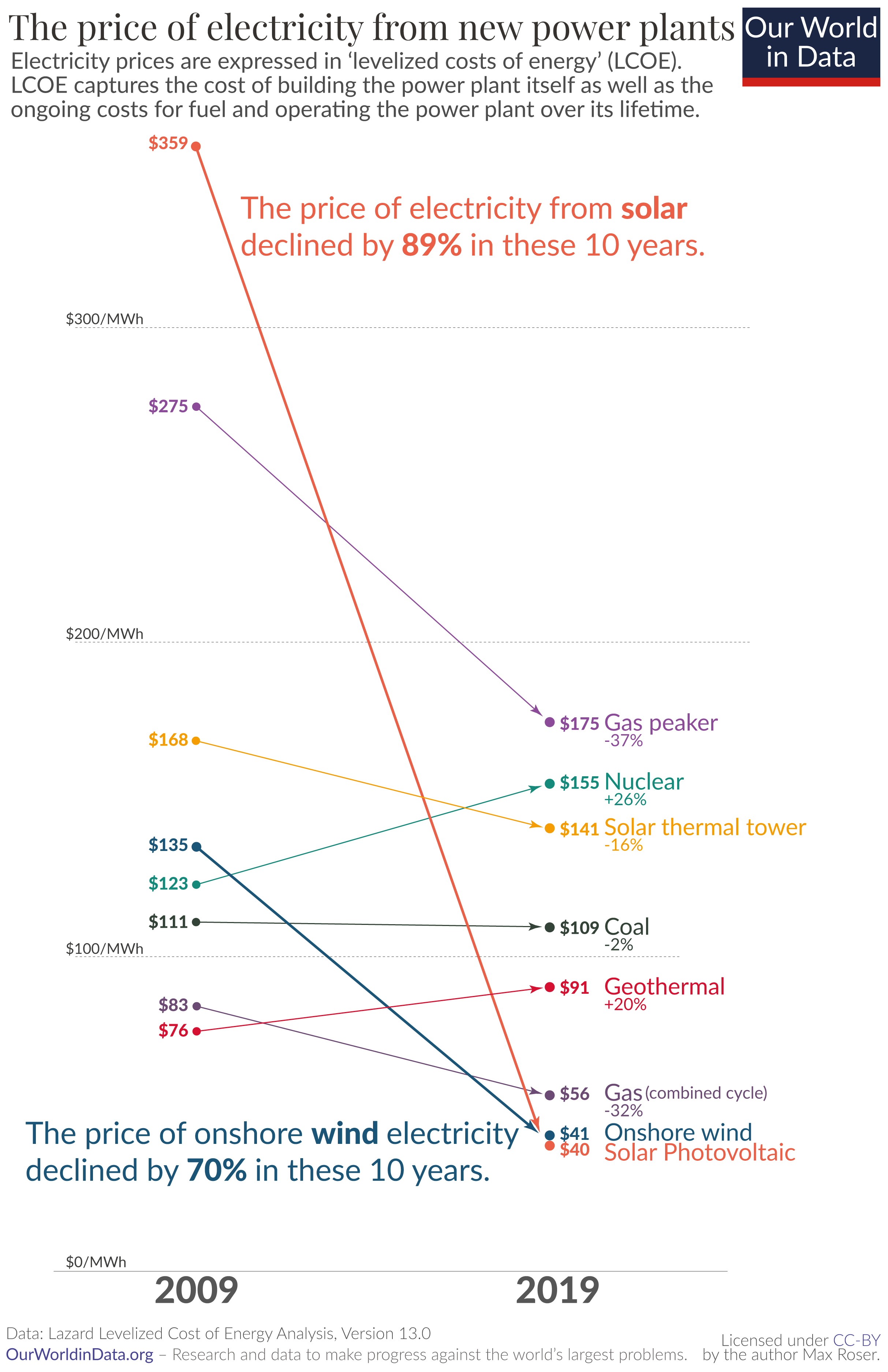
If we want to transition to renewables, it is their price relative to fossil fuels that matters. This chart here is identical to the previous one, but now also includes the price of electricity from renewable sources.

All of these prices – renewables as well as fossil fuels – are without subsidies.

Look at the change in solar and wind energy in recent years. Just 10 years ago it wasn’t even close: it was much cheaper to build a new power plant that burns fossil fuels than to build a new solar photovoltaic (PV) or wind plant. Wind was 22%, and solar 223% more expensive than coal.

But in the last few years this has changed entirely.

Electricity from utility-scale solar photovoltaics cost $359 per MWh in 2009. Within just one decade the price declined by 89% and the relative price flipped: the electricity price that you need to charge to break even with the new average coal plant is now much higher than what you can offer your customers when you build a wind or solar plant.

It’s hard to overstate what a rare achievement these rapid price changes represent. Imagine if some other good had fallen in price as rapidly as renewable electricity: Imagine you’d found a great place to live back in 2009 and at the time you thought it’d be worth paying $3590 in rent for it. If housing had then seen the price decline that we’ve seen for solar it would have meant that by 2019 you’d pay just $400 for the same place.

«

Astonishing chart. Onshore (and offshore) wind really do hold out a lot of hope; next you need other consumption to shift to electricity from fossil fuels too.
unique link to this extract


Parler’s weak moderation attracts pornography • The Washington Post

Craig Timberg, Drew Harwell and Rachel Lerman:

»

Anyone following the #sexytrumpgirl hashtag on Parler, a social media site increasingly popular with conservatives, got an eyeful one recent Thursday evening as images of topless women and links to hardcore pornography websites appeared at a rapid-fire rate, often more than one per minute.

The surge of #sexytrumpgirl posts highlighted a broader dilemma for Parler: The site’s lax moderation policies, in keeping with its claims to being a bastion of free speech, have helped it become a magnet for pornographers, escort services and online sex merchants using hashtags targeting conservatives, such as #keepamericasexy and #milfsfortrump2020.

The pornography threatens to intrude on users not seeking sexual material and has the potential to complicate hopes the site may have to expand advertising, which is now limited. Experts on the impact of pornography say major companies typically avoid having their sales pitches appear alongside controversial imagery.

…Officials at Parler, including chief operating officer Jeffrey Wernick and chief policy officer Amy Peikoff, did not respond to repeated requests for comment on its handling of pornography.

Peikoff defended the company’s approach to content moderation in response to questions for a previous Post story about Parler. “Broadly, our whole guiding principle is that we want to allow everything that the First Amendment protects as speech, and nothing that it doesn’t,” she said.

The U.S. Supreme Court has declared pornographic images of adults to be constitutionally protected speech.

«

Pornography is one of those things (along with spam) that keeps tripping up those who oppose sites being able to remove content they don’t want. Parler, hoist with its own petard there. “One per minute” sounds like nothing, but it’s a tiny site as well.
unique link to this extract


Errata, corrigenda and ai no corrida: none notified
Start Up No.1442: how machine learning is changing financial reports, the trouble with aircraft, Utah monolith takers revealed, and more


The iconic telescope at Arecibo in Puerto Rico has collapsed after cables suspending this system broke. CC-licensed photo by Meredith P. on Flickr.

You can sign up to receive each day’s Start Up post by email. You’ll need to click a confirmation link, so no spam.

A selection of 9 links for you. Unobserved. I’m @charlesarthur on Twitter. Observations and links welcome.

Salesforce to acquire Slack for $27.7bn • The New York Times

Erin Griffith and Lauren Hirsch:

»

Demand for Slack’s products, which allow people to communicate and collaborate with one another, has increased as people work from home during the pandemic. While the company said in September that revenue rose 49% to $216m in the quarter ending in July and that the pandemic had created a “significant increase in demand and usage of Slack,” it also said it did not expect that rise to continue. Layoffs at some of its customers have hurt its business, the company said.

At the same time, Slack has faced increasing competitive pressure from Microsoft. Teams, Microsoft’s collaboration product, reported 115 million daily users in October, up 50% from April. Slack has not provided an update on the 12 million daily users it reported a year ago.
Editors’ Picks

In July, Slack filed a complaint against Microsoft with the European Commission, claiming Microsoft had unfairly bundled Teams with its suite of Microsoft Office work products. Microsoft has offered the software alongside Office since Teams was released in 2017.

“When you’re a scrappy start-up going against an 800-pound gorilla that’s one of the most well-capitalized companies in existence, its tough to compete,” Mr. Park said of Slack. “This is more or less saying, ‘We can’t compete with Microsoft Teams anymore. We need more firepower.’”

«

I wonder if the complaint against Microsoft lapses once Slack becomes part of a much, much bigger company. I don’t think anyone’s expecting the interface to become any more friendly (or platform-specific). The amount works out to roughly $250,000 per paying user, by the way.
unique link to this extract


52 things I learned in 2020 • Fluxx Studio Notes

Tom Whitwell:

»

This year I edited another book, worked on fascinating projects at Fluxx, and learned many learnings.

1. Most cities plant only male trees because it’s expensive to clear up the fruit that falls from female trees. Male trees release pollen, and that’s one of the reasons your hay fever is getting worse. [Jessica Price]

2. In China, 🙂 doesn’t mean happy, it means “a despising, mocking, and even obnoxious attitude”. Use these, instead: 😁😄😀. [Echo Huang]

3. The hold music you hear when you phone Octopus Energy is personalised to your customer account: it’s a number one record from the year you were 14. [Clem Cowton]

4. If Apple AirPods was a standalone business (founded 2016, $12bn revenue, 125% growth, 30–50% margin), it would probably be the most valuable startup in the world. [Kevin Rooke]

5. Sarcasm detection has been a serious problem in computer science since the mid 2000s [Martin Gardiner]

6. All of the ten best-selling books of the last decade had female protagonists [Tyler Cowen]

«

And that’s only the first six. Worth your time every year.
unique link to this extract


Corporate reporting in the era of artificial intelligence • NBER

»

Companies have long seen annual reports and other corporate disclosures as opportunities to portray their business health in a positive light. Increasingly, the audience for these disclosures is not just humans, but also machine readers that process the information as an input to investment recommendations.

In How to Talk When a Machine Is Listening: Corporate Disclosure in the Age of AI (NBER Working Paper 27950), Sean Cao, Wei Jiang, Baozhong Yang and Alan L. Zhang explore some of the implications of this trend. Rather than focusing on how investors and researchers apply machine learning to extract information, this study examines how companies adjust their language and reporting in order to achieve maximum impact with algorithms that are processing corporate disclosures.

To gauge the extent of a company’s expected machine readership, the researchers use a proxy: the number of machine downloads of the company’s filings from the US Securities and Exchange Commission’s electronic retrieval system. Mechanical downloads of corporate 10-K and 10-Q filings have increased exponentially, from 360,861 in 2003 to around 165 million in 2016. Machine downloads have become the dominant mode during this time — increasing from 39% of all downloads in 2003 to 78% in 2016.

…Companies also go beyond machine readability and manage the sentiment and tone of their disclosures to induce algorithmic readers to draw favorable conclusions about the content. For example, companies avoid words that are listed as negative in the directions given to algorithms.

«

First we shape our tools and then they shape us, financial reporting edition.
unique link to this extract


EU urged to address aviation’s full climate impact, including non-CO2 emissions • Climate Home News

Chloé Farand:

»

The aviation sector’s climate impact is three times bigger than the effect of its carbon dioxide emissions alone, according to a study by the European Union Aviation Safety Agency (Easa), the EU’s aviation regulator, commissioned by the European Commission.

The study endorses findings published in the journal Atmospheric Environment, showing that non-CO2 emissions from planes such as of oxides of nitrogen (NOx), soot particles, sulphate aerosols, and water vapour at high altitude together drive significant global heating.

Current EU policies to curb the aviation sector’s growing emissions only take into account carbon dioxide emissions.

The EU estimates direct carbon emissions from aviation account for nearly 4% of the bloc’s total CO2 emissions. But when considering non-CO2 emissions, aviation is likely playing a much bigger role in the EU’s contribution to rising temperatures globally.

Campaigners at Transport & Environment (T&E) say the study is an acknowledgment by the European Commission that the aviation sector’s full impact on warming needs to be addressed — 12 years after it started to consider the issue.

«

Nobody wants to take the hard decisions; and it’s impossible to defect because everyone else will continue. It’s too convenient. Which leads to our next item…
unique link to this extract


Rising seas predicted to flood thousands of affordable housing units by 2050 – The Verge

Justine Calma:

»

The number of affordable housing units vulnerable to flooding could triple by 2050 as the planet heats up, according to a new study. That amounts to more than 24,000 homes that could flood at least once a year by 2050, compared to about 8,000 in 2000.

The study, published in the journal Environmental Research Letters, ranks the states and cities at greatest risk. Its authors also unveiled a new interactive map that people can use to see how their hometown might be affected.

As the world warms, seas rise. That means tides are creeping further ashore, and storm surges are becoming a bigger threat to homes along the coast. The encroaching waters are just one way climate change is transforming cities, and the dangers are piling up on lower-income communities.

“I hope this can guide policy that will help the people who are most vulnerable to coastal flooding, which is low-income people in affordable housing. We feel like we’ve really pinpointed that problem with this study,” said Benjamin Strauss, a co-author of the study who is also chief scientist and CEO of the nonprofit research organization Climate Central. Seventy-five% of the affordable housing stock vulnerable to future floods is concentrated in just 20 cities. Those cities are where policymakers can make the biggest difference in residents’ lives by making housing there more resilient.

Many homes lining American coastlines are vulnerable to flooding — not just affordable housing. The researchers wanted to focus on homes for lower-income residents because they’re often older buildings that could have a harder time standing up to the stress of climate-related disasters. Residents here might also have less money and political clout to push for changes to infrastructure so that their homes are better protected. There’s already a shortage of affordable housing in the US, according to the nonprofit National Housing Trust, which contributed to the study. Climate change could make that situation worse.

«

Ben Shapiro, the helium-voiced rightwinger, has the perfect solution for this: the people whose homes are being flooded should just sell them.
unique link to this extract


The Arecibo radio telescope’s massive platform has collapsed • Scientific American

Meghan Bartels:

»

After two cable failures in the span of four months, Puerto Rico’s most venerable astronomy facility, the Arecibo radio telescope, has collapsed in an uncontrolled structural failure.

The U.S. National Science Foundation (NSF), which owns the site, decided in November to proceed with decommissioning the telescope in response to the damage, which engineers deemed too severe to stabilize without risking lives. But the NSF needed time to come up with a plan for how to safely demolish the telescope in a controlled manner.

Instead, gravity did the job this morning (Dec. 1) at about 8 a.m. local time, according to reports from the area.

…Images shared on Twitter by Deborah Martorell, a meteorologist for Puerto Rican television stations, compare views of the observatory taken yesterday — showing the 900-ton science platform suspended over the massive dish strung up on cables — and today, when the observatory’s three supporting towers are bare.

None of the three towers collapsed fully, which was one of NSF’s key concerns about leaving the structure as it was. Martorell’s image does appear to show some damage in the knot of buildings at the base of one of the support towers, which includes administrative buildings and a public visitor’s center, although the buildings are still standing.

«

Couldn’t be repaired without putting workers at too much risk. This Ars Technica article from earlier in November explains a lot of the why, and also why Arecibo was so famous. The cables began failing at well below their expected stress, which meant none of it could be properly trusted.
unique link to this extract


Earthlings, not aliens, removed the Utah monolith • The New York Times

Serge F. Kovaleski, Deborah Solomon and Zoe Rosenberg:

»

The office of the San Juan County Sheriff at first announced that it was declining to investigate the case in the absence of complaints about missing property. To underscore that point, it uploaded a “Most Wanted” poster on its website, or rather a jokey version of one in which the faces of suspects were replaced by nine big-eyed aliens. But by the end of Monday, the sheriff’s office had reversed its position and announced that it was planning a joint investigation with the Bureau of Land Management, a federal agency.

It was left to an adventure photographer, Ross Bernards, to disclose evidence on Instagram. Mr. Bernards, 34, of Edwards, Colo., was visiting the monolith on Friday night when, he said, four men arrived as if out of nowhere to dismantle the sculpture. Mr. Bernards had driven six hours for the chance to ogle the sculpture and to take dramatic photographs of it. Using upscale Lume Cube lights attached to a drone, he produced a series of glowy, moonlit pictures in which the monolith glistens against the red cliffs and the deep blue of the night sky.

Suddenly, around 8:40 p.m., he said, the men arrived, their voices echoing in the canyon. Working in twosomes, with an unmistakable sense of purpose, they gave the monolith hard shoves, and it started to tilt toward the ground. Then they pushed it in the opposite direction, trying to uproot it.
“This is why you don’t leave trash in the desert,” one of them said, suggesting that he viewed the monolith as an eyesore, a pollutant to the landscape, according to Mr. Bernards.

The sculpture popped out and landed on the ground with a bang. Then the men broke it apart and ferried it off in a wheelbarrow.

«

Oh well. We still don’t know who put it there, of course.
unique link to this extract


Another mysterious monolith has disappeared, in Romania • CNET

Abrar Al-Heeti:

»

In case you thought the story of the mysterious metallic monolith couldn’t get any weirder, just remember it’s 2020 and anything’s possible. After the surprising discovery and subsequent disappearance of a monolith in the middle of the Utah desert earlier this month, it seems a similar object was found in Romania – before also disappearing.

A structure that appears to be identical to the one in the Utah desert was found on Batca Doamnei Hill in Romania on Nov. 26, according to The Mirror. But it didn’t remain for very long; according to a Tuesday report by Reuters, the Romanian monolith disappeared four days later.

“The 2.8 metre (9ft) tall structure disappeared overnight as quietly as it was erected last week,” journalist Robert Iosub of the Ziar Piatra Neamt local newspaper told Reuters. “An unidentified person, apparently a bad local welder, made it … now all that remains is just a small hole covered by rocky soil.”

«

Not really as good as something really remote in Utah, though, is it. That’s 2020’s best mystery yet. (Thanks Gregory for the link.)
unique link to this extract


The rhetoric and the reality of Operation Moonshot • Manchester Evening News

Jennifer Williams:

»

If you were to follow the story of mass testing through ministerial pronouncements alone, you could be forgiven for making a number of assumptions.

You might think everywhere in ‘tier three’ is about to test its entire population using new, rapid turnaround tests, as has been the case in the pilot in Liverpool. You might think, too, that this was about to be carried out by thousands of soldiers.

Equally you might assume there was conclusive evidence that Liverpool’s pilot had been instrumental in bringing rates down on Merseyside – and that there was no debate whatsoever about the effectiveness of the technology being used. 

“This is a success story which we want other parts of the country to replicate,” said Boris Johnson decisively of the Liverpool whole-city testing trial this week. “So we will work with local government, public health leaders and our fantastic armed forces, to offer community testing to tier 3 areas as quickly as possible, opening the way for them to follow Liverpool’s example.” This, he has told MPs, is the route out of the top tier.

The reality is, as usual, more complicated.

Rapid testing, using the kind of new ‘lateral flow’ pregnancy test-style devices being piloted in Liverpool, involving a swab of the nose and throat and a 30-minute turnaround, is indeed about to be rolled out to other places, including – public health departments here hope – in Greater Manchester and other parts of northern England.

But it won’t be like the Liverpool trial. There won’t be thousands of squaddies out on the ground, for starters. In fact currently it is understood there are just four military personnel expected to be involved across the entire North West of England, largely doing logistical planning.

The testing due to begin at Manchester’s universities from this week will largely be carried out not by soldiers but by student nurses and other healthcare undergraduates, after no military support was made available.

Rapid testing won’t happen in every single place currently in tier three, either, because there isn’t the capacity in the national or local system. And where it does, we won’t all be offered a test, Liverpool-style.

«

Williams has been slogging away writing about this topic, which is of enormous importance in the north of England. The reality of Cummings’s Operation Moonshot is more like Operation Firework.
unique link to this extract


Errata, corrigenda and ai no corrida: none notified

Start Up No.1441: how Ocado succeeded, why national economies aren’t households, the PS5 scalpers, the fake electric vehicle story, and more


DeepMind has made a significant breakthrough in forecasting protein folding – and it matters. CC-licensed photo by Enzymlogic on Flickr.

You can sign up to receive each day’s Start Up post by email. You’ll need to click a confirmation link, so no spam.

A selection of 8 links for you. Neatly folded. I’m @charlesarthur on Twitter. Observations and links welcome.

‘It will change everything’: DeepMind’s AI makes gigantic leap in solving protein structures • Nature

Ewen Callaway:

»

The ability to accurately predict protein structures from their amino-acid sequence would be a huge boon to life sciences and medicine. It would vastly accelerate efforts to understand the building blocks of cells and enable quicker and more advanced drug discovery.

AlphaFold came top of the table at the last CASP — in 2018, the first year that London-based DeepMind participated. But, this year, the outfit’s deep-learning network was head-and-shoulders above other teams and, say scientists, performed so mind-bogglingly well that it could herald a revolution in biology.

“It’s a game changer,” says Andrei Lupas, an evolutionary biologist at the Max Planck Institute for Developmental Biology in Tübingen, Germany, who assessed the performance of different teams in CASP. AlphaFold has already helped him find the structure of a protein that has vexed his lab for a decade, and he expects it will alter how he works and the questions he tackles. “This will change medicine. It will change research. It will change bioengineering. It will change everything,” Lupas adds.

In some cases, AlphaFold’s structure predictions were indistinguishable from those determined using ‘gold standard’ experimental methods such as X-ray crystallography and, in recent years, cryo-electron microscopy (cryo-EM). AlphaFold might not obviate the need for these laborious and expensive methods — yet — say scientists, but the AI will make it possible to study living things in new ways.

«

It’s really hard to overstate the importance of this, though it will take years to become apparent; rather as sequencing the human genome in the late 1990s led to us being able to produce an mRNA vaccine in just two days, given its sequence (the rest of the time has been spent on production and trials). The complexity of protein folding is mindblowing: it depends on interactions between existing parts of the protein as it’s produced, which then are influenced by subsequent parts. And it all works.
unique link to this extract


‘Christmas slots went in five hours’: how online supermarket Ocado became a lockdown winner • The Guardian

Harry Wallop:

»

From the viewing platform you can watch these metal cubes endlessly whiz around, moving thousands of plastic crates as if they were playing an enormous game of chess. You occasionally sight bottles of bleach or rosé, packets of noodles and dog biscuits, before they are sent down to a lower level.

“I find it quite mesmerising, like robotic ballet,” says Mel Smith, CEO of Ocado Retail, the UK arm of the business. “The day I decided I wanted this job was when I went to [the warehouse] and thought, this is absolutely the future.”

Smith is a plain-speaking, cheery New Zealander who joined just over a year ago from Marks & Spencer. She was hired in part to oversee the potentially tricky move of Ocado taking on M&S as its main supplier, after its longstanding relationship with Waitrose turned sour. The day I visit, it is just 48 hours after Ocado switched to M&S.

A floor below the robots, Elizabeth, a personal shopper, is standing at pick station number 29. Her average “each” time – Ocado jargon for individual products – is flashed up on a screen in front of her: 6.7 seconds, beating the target of seven seconds. This is how long it takes her to reach into the crate that has flown down a shaft from the floors above, take a product – in this case a bag of Cafédirect Machu Picchu ground coffee – scan its barcode and place it in one of Ocado’s distinctive grey plastic bags.

This is what makes the online retailer so different. If you place an order for a large shop from Tesco, Sainsbury’s or any of the other supermarkets, they will usually send a worker to walk along the aisles and pick your shopping in either an actual store or a so-called “dark store”, which caters exclusively to online shopping. Even if they are very quick, this is likely to take 20 minutes to half an hour. “There’s no way you can pick as quickly in store as here. Nothing like it,” says Simon Nottage, who runs the warehouse and is showing me around. He points to Elizabeth, who is now placing some cat litter into a bag: “This one station will do up to 400 ‘eaches’ an hour.”

«

The start of lockdown in March was like a DDOS attack. But in a good way.
unique link to this extract


Economists urge BBC to rethink ‘inappropriate’ reporting of UK economy • IPPR

The Institute for Public Policy Research (IPPR) is a centrist (in the British, not American, sense) thinktank on economics, and this is from its executive director Carys Roberts:

»

We are writing to you with regards to coverage of the 2020 Spending Review on Politics Live, Wednesday 25th November. Specifically, when responding to the Office for Budget Responsibility’s public sector borrowing projections, BBC News political editor Ms Kuenssberg said that “this is the credit card, the national mortgage, everything absolutely maxed out”, and later went on to comment that “for next few years, there is really no money”. We argue that this commentary misrepresents the financial constraints facing the UK government and reproduces a number of misconceptions surrounding macroeconomics and the public finances.

To focus on the “credit card” analogy, we would argue that this is never an appropriate metaphor for public finances. Maxing out a credit card would imply that the government is approaching a hard limit on its ability to borrow. This is not the case. It is the consensus amongst economists that the government should at this point in time not focus on reducing the deficit, but rather on delivering the spending necessary to secure a recovery from Covid-19. Modelling suggests that public debt as a proportion of GDP could actually fall were the government to embark upon a major investment package boosting jobs and growth, a position similar to that of the IMF in its flagship publication (pp 18-19) on the issue. This is in line with standard macroeconomic literature which stresses the beneficial effects of countercyclical government spending during crises.

Interest rates currently charged on government bonds are at record lows, so much so that the government is set to spend less on debt interest over the next five years than previously forecast, despite the rise in national debt over the course of the pandemic. Moreover, it is likely that interest rates will remain low for the foreseeable future; the interest rate charged on the 30-year gilt is currently 0.88%. These are not the signs of an institution approaching its credit limits.

«

Margaret Thatcher created the idea of the economy being like the household budget in the 1980s, and it stuck firmly in the national consciousness. It also happens to be wrong.
unique link to this extract


We talked to a PS5 scalper about how they got their consoles • Pocket Lint

Max Freeman-Wills:

»

After getting four consoles himself when pre-orders went live, each through manual means, Jack [the PS5 scalper] set about getting ready for launch-day stock. That meant, in practice, buying up the use of bots and proxies through connections on Discord, and choosing where they’d target come launch.

If that sounds hyper-technical, he says “it’s one of those things where once you get into it, it becomes very clear.” The Discord community helps newbies set stuff up, to avoid situations where someone “wastes a load of money on proxies” and badmouths the process. If people make money without too much hassle, more people will buy bots and the developers who act as the beating heart of reseller communities will continue making more and more money themselves. 

Most communities can be found by carefully watching Twitter, he says -“you kind of have to gamble a bit on joining a group and finding one on Twitter, but I think Twitter always has been and always will be one of the best resources for releases like this because you’ve got your chronological timeline”. If you’re let in, the simplest step is to simply pay another reseller to run a bot for you – for a fee of around £50, you’ll have bought a far higher chance of getting a console than your average consumer, with a risk of detection and cancellation to go with it. 

From there things have a steeper learning curve, but the picture Jack paints still summons some dismay – this isn’t something that’s hard to get into if you’re relatively comfortable using computers and browsing the web, which is hardly the highest bar to clear. That said, there is still an undeniable risk to be taken at some point when card details need to be handed over, and addresses (and mates’ addresses) detailed. 

Those risks don’t disappear when you’ve got a console either – resellers regularly have their time wasted by frustrated non-buyers (something that’s easy to see the satisfaction in), which can be harmless but can make them feel vulnerable while it’s happening. In turn, he’s heard about a reseller who was apparently stabbed during a handover this week, showing that more unacceptable levels of anger are bubbling away at scalpers. 

«

He targeted John Lewis, the big department store chain, on the basis that it probably wouldn’t be prepared for an onslaught. And picked correctly. Used to be that sites worried about bots taking them down; now it’s about cleaning them out. Except that’s good for John Lewis, and Sony.
unique link to this extract


How venture capitalists are deforming capitalism • The New Yorker

Charles Duhigg:

»

From the start, venture capitalists have presented their profession as an elevated calling. They weren’t mere speculators—they were midwives to innovation. The first V.C. firms were designed to make money by identifying and supporting the most brilliant startup ideas, providing the funds and the strategic advice that daring entrepreneurs needed in order to prosper. For decades, such boasts were merited. Genentech, which helped invent synthetic insulin, in the 1970s, succeeded in large part because of the stewardship of the venture capitalist Tom Perkins, whose company, Kleiner Perkins, made an initial hundred-thousand-dollar investment. Perkins demanded a seat on Genentech’s board of directors, and then began spending one afternoon a week in the startup’s offices, scrutinizing spending reports and browbeating inexperienced executives. In subsequent years, Kleiner Perkins nurtured such tech startups as Amazon, Google, Sun Microsystems, and Compaq. When Perkins died, in 2016, at the age of 84, an obituary in the Financial Times remembered him as “part of a new movement in finance that saw investors roll up their sleeves and play an active role in management.”

The V.C. industry has grown exponentially since Perkins’s heyday, but it has also become increasingly avaricious and cynical. It is now dominated by a few dozen firms, which, collectively, control hundreds of billions of dollars. Most professional V.C.s fit a narrow mold: according to surveys, just under half of them attended either Harvard or Stanford, and 80% are male. Although V.C.s depict themselves as perpetually on the hunt for radical business ideas, they often seem to be hyping the same Silicon Valley trends—and their managerial oversight has dwindled, making their investments look more like trading-floor bets. Steve Blank, an entrepreneur who currently teaches at Stanford’s engineering school, said, “I’ve watched the industry become a money-hungry mob. V.C.s today aren’t interested in the public good. They’re not interested in anything except optimizing their own profits and chasing the herd, and so they waste billions of dollars that could have gone to innovation that actually helps people.”

«

That’s the core of this piece, which is mostly about WeWork – which is of course the object lesson in VC gone wildly wrong. And what an object. (Theranos had almost no VC money.)
unique link to this extract


Astongate: fake emission figures, an embattled carmaker and a sock puppet PR company • LinkedIn

Michael Liebreich:

»

You may have seen the news story last week about a new report purporting to show that it takes 50,000 miles before an EV’s emissions beat those of a petrol car. First of all, the figures were comprehensively debunked – the correct figure is nearer 16,000 miles – then, over the weekend I uncovered evidence that the report was written by a sock-puppet PR company run from an address owned by Aston Martin’s Director of Global Government and Corporate Affairs.

Before I start, a caveat. This story is about getting the truth out EV carbon emissions, and how much lower they are than internal combustion cars. It does not deal with any other aspect of the environmental footprint of EVs, which are considerable and still require much investment and innovation. Nor does it show that EVs are superior to every other form of transport. Even the best EV will always have a carbon footprint, a material supply chain, and will cause particulate pollution. Active travel – walking, cycling, scooting and so on – should always be our first choice. With that said, let’s get stuck in!

“Astongate”, as I call it, started with widespread coverage of a new study, purporting to show that building an EV involves such huge CO2 emissions that you have to drive it 48,000 miles before it breaks even with a petrol equivalent. It was just the sort of story loved by UK media on the political right – always keen to pour cold water on any sign of green over-reach.

«

It’s quite the story, where an overzealous PR company with links to the car firms managed to plant a story which has been unravelling for days.
unique link to this extract


A lack of transparency is undermining pandemic policy • WIRED

Roxanne Khamsi:

»

I’ve seen this happen again and again since the start of the pandemic: a new, “science-based” Covid-19 measure is prescribed, but the science in support of it is either vague or missing altogether. Just last week, for example, I was working on a story about the latest research into quarantine procedures. The best data to this point suggests that an eight-day stretch of quarantine, combined with a Covid test, provides the same level of protection as the traditional 14-day quarantine. But then I saw New York state’s new policy: Some people who arrived from out of state are allowed to quarantine for just four days. I asked New York’s Department of Health how they’d come to this decision, and they sent me another statement from Cuomo, in which he said only that he’d “worked with global health experts” on the plan. A formal guidance from the state health department gave no research citations, either, but it did find space to boast about New York’s record of “strict adherence to data-driven, evidence-based protocols.”

This problem is hardly limited to one state. While reporting on that same quarantine story, I reached out to Alberta, Canada, which allows for an even riskier-seeming 48-hour period of quarantine for some travelers. What was the scientific basis for this policy? I never heard back.

A lack of transparency has even shown up in guidance from the World Health Organization. Back in March, I emailed the headquarters in Geneva to ask how they felt so certain at the time that the SARS-Cov-2 coronavirus was not “airborne.” The press office responded to my questions with a pair of unhelpful scientific documents. In that case, the decision to omit (or ignore) existing research—which suggested that other coronaviruses are likely to be spread by air—might well have been a deadly mistake.

«

It’s not so much a lack of transparency, as gigantic inertia – being both slow to start shifting from a position, and being slow to change course once headed in a direction. The WHO’s absurd refusal first to recommend masks and then to acknowledge that Covid transmits via aerosol has arguably cost a lot of time, and hence lives.

This is a consequence of organisations with strict organisational flows: they can’t flex. Social media flows more like water.
unique link to this extract


How an anti-lockdown ‘truthpaper’ bypasses online factcheckers • The Guardian

Jim Waterson:

»

photo that was spreading across Facebook, they were confused. The picture – which had been uploaded by users in the UK, US, Australia and elsewhere in the world – showed a headline that made the false claim that a US government agency had declared Covid-19 did not exist. It appeared to be from a real print newspaper, but no credible outlet would publish such a claim.

Then they had a breakthrough: it turned out the headline was from a new self-published conspiracy theorist “truthpaper” called the Light, edited by a man from Manchester who runs a business selling anti-vaccine T-shirts and 9/11 conspiracy merchandise.

The outlet, which has published three issues since it first appeared in September, draws heavily on the gloop of long-running online conspiracies about a new world order, which have attached themselves to the current pandemic. Among other things it encourages people to stop wearing masks and disobey lockdown on the basis that the coronavirus is a hoax.

It has been formed as a reaction to attempts by major tech platforms to clamp down on coronavirus disinformation – but the same tech outlets also help enable its reach: the Light’s distribution relies on a 5,000-strong private Facebook group where volunteers offer to hand out copies and post them through their neighbours’ doors.

«

Claims a circulation of 100,000 – which is sure to be untrue. That would be super-expensive. But shows how they’re trying to route around expectations by producing a printed thing: print is trusted.
unique link to this extract


Errata, corrigenda and ai no corrida: none notified

Start Up No.1440: Facebook readies limited Libra, Twitter aims for safety, the PC malaise era?, the monolith vanishes, Cummings’s error, and more


Road potholes are a constant source of annoyance – and government funding – in the UK. CC-licensed photo by Darren Moloney on Flickr.

You can sign up to receive each day’s Start Up post by email. You’ll need to click a confirmation link, so no spam.

A selection of 11 links for you. Every one counted. I’m @charlesarthur on Twitter. Observations and links welcome.

How a young, queer Asian-American businesswoman is rethinking user safety at Twitter • Protocol

Anna Kramer:

»

No matter how many times you monitor, report and moderate harmful posts, the reactionary model does little to reverse the damage that’s already been done to the people targeted or to prevent it from happening again, [new head of product for conversational safety at Twitter, Christine] Su said. So instead of putting the spotlight just on the posts causing harm, new functions coming from her team will be all about user control, she explained, giving people a wide range of capabilities to react to situations on the platform. “The point is not to make the entire world a safe space: That’s not possible. The point is to empower people and communities to have the tools to heal harm themselves and to prevent harm to themselves and put them in control,” Su said.

The product team gave some clues about what that user control could look like when they described the upcoming audio hangout function, Spaces, in a press call last week. Spaces will allow users to determine who is allowed in the audio room and who can speak, and the team is rolling out the function to women and people from other marginalized communities first, to test out how effective these safety functions can be in practice.

Su also cited recent election-related interventions as examples of how reimagining Twitter in the long term could work; for example, the function that encourages people to read content before reposting it has remained in place for now while the team assesses its long-term value. “You’ve seen over the last year, a willingness of Twitter to rethink its fundamental mechanisms,” she said.

For Su, implementing transformative justice means building tools that create private pathways for apologies, forgiveness and deescalation (somehow, we’ll get apologies before we get an edit button). While she didn’t describe exactly how private apology tools will work just yet, they are intended to become part of “a set of controls that people can take with them around digital spaces, and be able to use them when and if circumstances warrant,” she said.

«

Sounds like quite a weird network that Twitter is going to mutate into.
unique link to this extract


Facebook’s Libra currency to launch next year in limited format • Financial Times

Hannah Murphy:

»

The long-awaited Facebook-led digital currency Libra is preparing to launch as early as January, according to three people involved in the initiative, but in an even more limited format than its already downgraded vision.

The 27-strong Libra Association said in April that it had planned to launch digital versions of several currencies, plus a “digital composite” of all of its coins. This followed concerns from regulators over its initial plan to create one synthetic coin backed by a basket of currencies.

However, the association would now initially just launch a single coin backed one-for-one by the dollar, one of the people said. The other currencies and the composite would be rolled out at a later point, the person added.

Libra’s exact launch date would depend on when the project receives approval to operate as a payments service from the Swiss Financial Market Supervisory Authority, but could come as early as January, the three people said. Finma said it would not comment on Libra’s application, which was initiated in May. 

First launched in June 2019, the scaling down of Libra’s vision comes as it has received a sceptical reception from global regulators, who have warned that it could threaten monetary stability and become a hotbed for money laundering.

«

Still feel this is dangerous, and that Facebook doesn’t understand quite how dangerous. As it didn’t understand how dangerous using its algorithm to encourage people into Groups would be, or its cultural ignorance about what would work and not work in different countries.
unique link to this extract


Welcome to the PC Malaise Era • getwired.com

Wes Miller reckons that PCs (Windows ones) are in the same rut that American cars were in 1973-1983, known as the “Malaise Era“:

»

I’ve said before that Windows has never escaped x86. I’m still not sure if it ever can. So the challenges then come down to three things:

A) Can Intel succeed where they’ve failed for the last 5+ years, at building hybrid processors? The next year to two years should answer this question.

B) Can Microsoft succeed at finally getting application developers to write platform-optimized, energy-respectful, halo applications for the PC? I’ve been writing about the Windows Store for a long, long time. A long time. And I’m still not sure how Microsoft can light a fire under Windows application developers when they’ve lost that mindshare.

C) Can Microsoft begin pushing the Surface platform forward again? This one’s completely up to Microsoft. I’ve seen the rumors of the next Surface Pro… and it’s more of the same – evolutionary, not revolutionary.

I guess we will see in the next 3-5 years whether Intel can cross this chasm; if they can’t, then the future likely belongs to ARM, and that future will likely mean less and less to Microsoft, outside of running classic Win32 applications on x64/x86 Windows.

«

unique link to this extract


Meet the Censored: Andre Damon • TK News by Matt Taibbi

Matt Taibbi:

»

Like many alternative news sites, WSWS [the World Socialist Web Site] noticed a steep decline in traffic in 2016-2017, after Donald Trump was elected and we began to hear calls for more regulation of “fake news.” Determined to search out the reason, the site conducted a series of analyses that proved crucial in helping convince outlets like the New York Times to cover the issue. In its open letter to Google, the WSWS described inexplicable changes to search results in their political bailiwick:

»

Google searches for “Leon Trotsky” yielded 5,893 impressions (appearances of the WSWS in search results) in May of this year. In July, the same search yielded exactly zero impressions for the WSWS, which is the Internet publication of the international movement founded by Leon Trotsky in 1938.

«

The WSWS connected the change to Project Owl, a plan announced by Google in April of 2017 designed to “surface more authoritative content.” When I called Google about a year later for a story on a related subject, they explained the concept of “authority” as an exercise in weighting some credentials over others. So, I was told, an old search for “baseball” might first return a page for your local little league, while a new one would send you to the site for Major League Baseball.

The rub was that Google was now pushing viewers away from alternative sources, such that an article in the New York Times about Trotskyism might be ranked ahead of the world’s leading Trotskyite media organ. Queries had to be right on the nose to call up a whole host of alternative sites, all of which had seen sharp drops in their Google search results.

The WSWS listed many of them: Alternet down 63%, Common Dreams down 37%, Democracy Now! down 36%, , down 25%, etc. Even Wikileaks, in the middle of an international furor over Russiagate, was down 30%.

«

So Taibbi contacted Andre Damon, who runs WSWS:

»

TK: When did the WSWS first become interested in the issue of platform censorship, content moderation, or whatever you want to call it? Actually, what do you call it? Is what’s going on with increased content moderation a first amendment/free speech issue?

Damon: It’s censorship, and it absolutely is a First Amendment issue.

«

Oh good grief. It isn’t censorship (Google isn’t changing what’s on the site, or telling it what to put on the site), and it’s absolutely not a First Amendment issue (the decisions are not made by the government). For the average person, the most relevant, useful, informative site about Trotsky is almost certainly not going to be the WSWS. Failing to understand the principles on which search engines work is like not understanding electricity. (Thanks, Seth, for the link.)
unique link to this extract


Visitors track down mystery desert monolith in Utah • The Guardian

Miranda Bryant:

»

Around 48 hours after news of their finding was made public, pictures appeared on Instagram of people who had managed to find it.

Among them was David Surber, 33, a former US army infantry officer, who drove for six hours through the night to find it after spotting a Reddit post purporting to have found its coordinates.

“Awesome journey out to the monolith today,” he wrote on Instagram, where he also shared its location. “Regardless of who built it or where it came from. It was a positive escape from today’s world. Some for many people to rally behind and enjoy together.”

He said he was alone with the structure, which he described as formed of aluminium and formed of “three pieces riveted together”, for about 10 minutes before others arrived.

“Overall not too crowded you all want to make the journey,” he wrote.

Tim Slane, who shared the coordinates on Reddit, said he worked them out by tracking the flight path of the helicopter.

It is not known what the origins of the object, estimated by Bret Hutchings, the helicopter pilot who discovered it, to be between 10ft and 12ft high (about three metres), are.

But it has been compared to the work of several minimalist sculptors, including the late John McCracken.

A spokesperson for his gallerist, David Zwirner, told the Guardian earlier this week it was not one of McCracken’s works, saying they believed it could be “a work by a fellow artist paying homage to McCracken”.

«

And now it has disappeared. Unclear whether it was stolen, or reclaimed. Or, you know, returned to its previous time/space coordinates. We all expect them to look like blue police boxes, but why should they?
unique link to this extract


Microsoft’s ‘Project Latte’ aims to bring Android apps to Windows 10 • Windows Central

Zac Bowden:

»

Microsoft is working on a software solution that would allow app developers to bring their Android apps to Windows 10 with little to no code changes by packaging them as an MSIX and allowing developers to submit them to the Microsoft Store. According to sources familiar with the matter, the project is codenamed ‘Latte’ and I’m told it could show up as soon as next year.

The company has toyed with the idea of bringing Android apps to Windows 10 before via a project codenamed Astoria that never saw the light of day. Project Latte aims to deliver a similar product, and is likely powered by the Windows Subsystem for Linux (WSL.) Microsoft will need to provide its own Android subsystem for Android apps to actually run, however.

Microsoft has announced that WSL will soon get support for GUI Linux applications, as well as GPU acceleration which should aid the performance of apps running through WSL.

«

Well, it sounds like it might be tricky, and there’s always the question of how you handle touch because a mouse is so much more precise. I wonder if there are any other gotchas that people might have to think about?

»

It’s unlikely that Project Latte will include support for Play Services, as Google doesn’t allow Play Services to be installed on anything other than native Android devices and Chrome OS. This means that apps which require Play Services APIs will need to be updated to remove those dependencies before they can be submitted on Windows 10.

«

Oh well, they tried. Nobody’s going to bother to recompile like that; it would make a lot more sense to build a progressive web app (PWA).

unique link to this extract


Britain’s big pothole problem • The Economist

»

Potholes arouse passions in Britain—not surprisingly, since the country’s road quality ranks 37th in the world, between Slovenia and Lithuania. Councils received 700,000 complaints about potholes last year, says the Federation of Small Businesses. The weather, a topic even more popular among the natives than potholes, is mostly to blame. Potholes form when water seeps under the road surface, breaking the tarmac as it expands and contracts. Budget cuts in the wake of the financial crisis did not help. The Local Government Association (lga) says road maintenance budgets fell from £1.1bn in 2009 to £701m in 2017—the equivalent of 8m potholes. The Asphalt Industry Alliance claims there is a road-repair backlog of £11bn.

But there may be relief in sight for the suspension of the British motor car. Politics is one reason. Traditional Tories—who love cars, particularly fast ones, and tend to live in the countryside, so rely on roads—are particularly infuriated by them. Northern “red wall” seats that the Tories won from Labour in the last election tend to be rural places where the roads are bumpier and the weather worse. Nottinghamshire, home to several of those contested seats, is Britain’s pothole capital, with 253,920 reported in 2017-19. Hence the promise in the Tory manifesto of the “biggest-ever pothole-filling programme”, and a promise of £2.5bn over five years.

Covid is also fuelling the drive against potholes. Rishi Sunak, the chancellor, needs shovel-ready spending opportunities to justify his claim in the spending review on November 25th that “we’re prioritising jobs”. Potholes are ready and waiting for those shovels—hence his commitment that £1.7bn would be spent this year.

«

I seem to recall John Major’s government (in 1992-7) promising to do lots on potholes, as did the May government in 2016. It’s a periodic excitment for Tory governments. I’d love to see a graph showing how the number of potholes has changed over time, and compared to the governments in power. Fixing them is actually in the power of local councils (which also keep the numbers; there isn’t a central figure for the number of potholes), but it’s government funding that makes it happen.
unique link to this extract


Dominic Cummings wanted to rewire the British state, but he needed to change the thinking of those in charge • Politics Home

Sam Freedman worked at the Dept for Education, and got used to the “all caps and punctuation-free email rants to various officials” dubbed “Domograms”:

»

The standard ministerial tenure is around two years. A mere 1 in 10 of the junior ministers appointed in 2010 made it to the end of the Parliament. Given the limited time they have to make an impact the last thing politicians want is a machinery that is geared to long-term, expert-driven, and evidence-based policy making.

There’s a reason why all of Cummings’ treasured examples of high-performance either come from the American military (Manhattan Project; DARPA) or single party states like Singapore or China. They are typically long-term, highly technical programmes, undertaken with no or minimal public transparency, and with the role of politician limited to signing cheques. The absence of any major social reforms from his analysis of success is something of a warning sign that what he wants is not in fact possible, certainly within the confines of British democracy.

The truly baffling thing about Cummings’ worldview is the refusal to see the contradiction between his technocratic utopia of expert scientists driving paradigmatic change and his own rock-solid conviction that whatever policies he happens to support right now must be implemented at maximum speed.

For all his demands for a scientific approach to government not a single policy either of us worked on at the DfE had been properly evaluated through, for example, a randomised control trial, because they were rolled out nationally without any piloting. In technocrat utopia a major policy like the introduction of academies would have been phased in such a way as to allow for evaluation. In the real-world huge amounts of capital (real and political) were spent arguing academies were the way forward, so the suggestion that they might not work couldn’t be countenanced.

«

unique link to this extract


Things I recommend you buy, 2020 edition • Consumer Surplus

Sam Bowman:

»

Here is a list of products that I get a lot of consumer surplus from. I recommend any and all of these. The list spans cooking and kitchen equipment, through “work from home” products (a new 2020 category), to things I use when I go travelling (in normal times, I travel quite often for both work and pleasure). I usually do a lot of research before making any big purchase and I return things to Amazon that I don’t like, so I think I am a fairly reliable source.

This is the third edition of my “Things I recommend you buy” series, and is comprehensive – anything from old editions that is not included is no longer recommended.

«

You’ll probably find you’ve got lots of them, though the knife-sharpening stuff could be good (nothing more annoying than a blunt kitchen knife). You might find an idea for a Christmas present or two. (Note to male readers: don’t buy anything for the kitchen for the other half.)
unique link to this extract


New UK tech regulator to limit power of Google and Facebook • The Guardian

Alex Hern:

»

A new tech regulator will work to limit the power of Google, Facebook and other tech platforms, the government has announced, in an effort to ensure a level playing field for smaller competitors and a fair market for consumers.

Under the plans, the Competition and Markets Authority (CMA) will gain a dedicated Digital Markets Unit, empowered to write and enforce a new code of practice on technology companies which will set out the limits of acceptable behaviour.

The code will only affect those companies deemed to have “strategic market status”, though it has not yet been decided what that means, nor what restrictions will be imposed.

The business secretary, Alok Sharma, said: “Digital platforms like Google and Facebook make a significant contribution to our economy and play a massive role in our day-to-day lives – whether it’s helping us stay in touch with our loved ones, share creative content or access the latest news.

“But the dominance of just a few big tech companies is leading to less innovation, higher advertising prices and less choice and control for consumers. Our new, pro-competition regime for digital markets will ensure consumers have choice, and mean smaller firms aren’t pushed out.”

«

Great ideas, and the CMA effectively has the powers to impose them by diktat; they’re many of the things that the US antitrust suit against Google is trying to make happen, but with far less justification given its antitrust frameworks.

In passing, the business secretary Alok Sharma sure does have a weird resemblance to a younger Martin Sorrell.
unique link to this extract


Pennsylvania Supreme Court dismisses request from Mike Kelly and Sean Parnell to declare mail-in voting unconstitutional in state, deny results from 2020 election mail-in ballots • CBS Pittsburgh

»

The Pennsylvania Supreme Court has dismissed the lawsuit from Congressman Mike Kelly and congressional candidate Sean Parnell to declare universal mail-in voting unconstitutional in the state and deny the votes of the majority of Pennsylvanians who voted by mail in the Nov. 3 election.

The state Supreme Court, in a unanimous decision, threw out the three-day-old order, saying the underlying lawsuit was filed months after the law allowed for challenges to Pennsylvania’s expansive year-old mail-in voting law.

The state’s attorney general, Democrat Josh Shapiro, called the court’s decision “another win for Democracy.”

The week-old lawsuit, led by U.S. Rep. Kelly of Butler, had challenged the state’s mail-in voting law as unconstitutional.

As a remedy, Kelly and the other Republican plaintiffs had sought to either throw out the 2.5 million mail-in ballots submitted under the law — most of them by Democrats — or to wipe out the election results and direct the state’s Republican-controlled Legislature to pick Pennsylvania’s presidential electors.

«

Getting near to losing count, but I think this makes almost 40 lawsuits that the Trump campaign (or grifty associates) has lost in court.
unique link to this extract


Errata, corrigenda and ai no corrida: none notified

Start Up No.1439: MPs call for right to repair, the perfect way to smarten your home, Parallels plans for Windows on M1 Macs, and more


A crime writer would point out that this shows two potential murder weapons, not one. CC-licensed photo by Ted Kerwin on Flickr.

You can sign up to receive each day’s Start Up post by email. You’ll need to click a confirmation link, so no spam.

A selection of 10 links for you. Black! Blaaaack! I’m @charlesarthur on Twitter. Observations and links welcome.

Amazon and Apple ‘not playing their part’ in tackling electronic waste • The Guardian

Sandra Laville:

»

Global giants such as Amazon and Apple should be made responsible for helping to collect, recycle and repair their products to cut the 155,000 tonnes of electronic waste being thrown away each year in the UK, MPs say.

An investigation by the environmental audit committee found the UK is lagging behind other countries and failing to create a circular economy in electronic waste. The UK creates the second highest levels of electronic waste in the world, after Norway. But MPs said the UK was not collecting and treating much of this waste properly.

“A lot of it goes to landfill, incineration or is dumped overseas. Under current laws producers and retailers of electronics are responsible for this waste, yet they are clearly not fulfilling that responsibility,” the MPs wrote.

About 40% of the UK’s e-waste is sent abroad, according to estimates – something the MPs point out is often done illegally.

The tsunami of electronic waste was throwing away valuable resources vital to a sustainable future, the report published on Thursday said.

Globally, thrown-away computers, smartphones, tablets and other electronic waste have a potential value of $62.5bn each year from the precious metals they contain, including gold, silver, copper, platinum and other critical raw materials such as tungsten and indium.

«

They say there should be a “right to repair” and lower VAT for repairs enshrined in law, plus producers obliged to collect and recycle used items. Makes sense, though some items are going to be much, much harder to repair by anyone than others.
unique link to this extract


Parallels Desktop for Mac with Apple M1 chip • Parallels Blog

Nick Dobrovolskiy is SVP of engineering:

»

When Apple Silicon Mac was first announced during the keynote at WWDC on June 22 of this year, Apple demoed a Parallels Desktop for Mac prototype running a Linux virtual machine flawlessly on Apple Silicon. Since WWDC, our new version of Parallels Desktop which runs on Mac with Apple M1 chip has made tremendous progress. We switched Parallels Desktop to universal binary and optimized its virtualization code; and the version that we are eager to try on these new MacBook Air, Mac mini and MacBook Pro 13″ looks very promising. Parallels is also amazed by the news from Microsoft about adding support of x64 applications in Windows on ARM.

«

Being “amazed” by Microsoft doesn’t sound like a good thing for a company that makes its money from being able to run Windows?
unique link to this extract


IoT Unravelled Part 4: making it all work for humans • Troy Hunt

Hunt is better known for his HaveIBeenPwned database, but he’s very into IoT too:

»

My parents aren’t as tech orientated as me and whilst the idea of a connected home appeals greatly to me personally, I doubt they share quite the same level of excitement. That’s fine, I’m not expecting them to geek out at my YAML or get giddy about my Zigbee, but I do want them to be able to use my house.

Light switches are a perfect example of where connected home UX can go down the toilet. My parents are great with light switches, in fact, they have a lot more experience with them than I do. They’re very familiar with the simple premise of flicking a switch to turn a light on and indeed, flicking it again to turn it off. Problem is though, connected lights can create a bit of a conundrum here.

Those lights [in an accompanying tweet] are Atom WiZ Connected RGB LEDs and they talk directly to the Wi-Fi network. They need power to do that and the point Adam is making is that if the light switch on the wall is turned off and the connected light no longer has power, how can you control it digitally? I mean what if you turn it off at the wall then try to ask Alexa to turn it back on? It won’t work as the light is now offline. The workarounds people create for this are, to my mind, sub-optimal.

[Picture of lights with transparent covers over them to stop people turning them off when they need to be “on” all the time to connect to the network.]

If I bring this back to the parents test, how do my mum and dad use these switches? Clearly, they can’t because that’s the whole purpose of the covers, so how do they turn the lights on? I’m not sure how Iain does it, maybe by voice, maybe by motion, maybe by something else altogether. All I know is that from a UX perspective, switch covers are unquestionably an anti-pattern.

«

His solution is a bit dramatic – Wi-Fi controlled relays! – but certainly avoids the anti-patterns that you inevitably run into with smart homes.
unique link to this extract


Daily COVID-19 data is about to get weird • The COVID Tracking Project

Erin Kissane:

»

Based on what we’ve seen over the last eight months of state-reported COVID-19 data, we think two big, potentially misleading things are about to happen to the testing, case, and death numbers that allow us to track the pandemic in the United States.

First, by Thanksgiving Day and perhaps as early as Wednesday, all three metrics will flatten out or drop, probably for several days. This decrease will make it look like things are getting better at the national level. Then, in the week following the holiday, our test, case, and death numbers will spike, which will look like a confirmation that Thanksgiving is causing outbreaks to worsen. But neither of these expected movements in the data will necessarily mean anything about the state of the pandemic itself. Holidays, like weekends, cause testing and reporting to go down and then, a few days later, to “catch up.” So the data we see early next week will reflect not only actual increases in cases, test, and deaths, but also the potentially very large backlog from the holiday.

«

So the fall will be misleading, and the rise will be misleading. But a couple of weeks from now will reveal the truth.
unique link to this extract


Your move, iPad • Becky Hansmeyer

»

It’s clear that Apple wants the iPad Pro to be a device that a wide variety of professionals can use to get work done. And since so many people use web apps for their work, the introduction of “desktop” Safari for iPad was an important step toward that goal. The Magic Keyboard and trackpad was another step.

Here are ten more steps I believe Apple could and should take to help nudge the iPad into this exciting next era of computing.

• Give the iPad Pro another port. Two USB 4.0 ports would be lovely.
• Adopt a landscape-first mindset. Rotate the Apple logo on the back and move the iPad’s front-facing camera on the side beneath the Apple Pencil charger to better reflect how most people actually use their iPad Pros.
• Introduce Gatekeeper and app notarization for iOS. The process of side-loading apps should not be as simple as downloading them from the App Store. Bury it in Settings, make it slightly convoluted, whatever: just have an officially-sanctioned way of doing it.
• Ruthlessly purge the App Store Guidelines of anything that prevents the iPad from serving as a development machine. Every kind of development from web to games should be possible on an iPad. And speaking of games—emulators should be allowed, too.
• Release a suite of professional first-party apps at premium prices. If someone can edit 4K videos in Final Cut on their M1 MacBook Air, they should be able to edit 4K videos in Final Cut on their iPad Pro. I refuse to believe that these pro apps can’t be re-imagined and optimized for a touch experience. If Apple leads the way in developing premium software for iPad, others will follow.
• Make it possible to write, release, and install plug-ins (if appropriate) for the aforementioned first party apps.
• Bring App Library to the iPad and allow widgets to be positioned anywhere on the Home Screen. This isn’t groundbreaking, it just annoys the heck out of me.
• Release a new keyboard + trackpad case accessory that allows the iPad to be used in tablet mode without removing it from the case.
• Introduce Time Machine backups for iPadOS.
• 5G, ofc.

In the end, fostering a vibrant community of iPad app developers can only stand to benefit the Mac (and vice-versa).

«

I’m not sure Apple would want to go this far. And I thought you could already edit 4K video on the iPad? Or at least, video. (Maybe it’s a storage thing?) Trouble is that touch is too inaccurate for such tasks; you need a mouse for the required precision. So much of what the iPad can’t do – or doesn’t do well – is about input precision, because that’s what high-end apps tend to be about.
unique link to this extract


The most unusual murder weapons in crime fiction • CrimeReads

Lynne Truss (of Eats Shoots & Leaves fame):

»

How literal-minded should we be about the word “weapon”? Can I include the bell-pull in Arthur Conan Doyle’s “The Adventure of the Speckled Band”? The bell-pull itself is harmless enough, but—as we all remember—down it travels the trained Indian swamp adder that makes the victim die of fright in a locked room. If we are counting animals as weapons, the murder at the heart of Doyle’s great racing-stables story “Silver Blaze” is also pretty perfect, when it is revealed that the eponymous horse was itself responsible for striking the fatal blow on a wicked man attempting to nobble him. And I am of course reminded of Florida writer Carl Hiaasen’s delicious habit of letting nature take its own special (and often horrifying) revenge on bad guys. Ravenous Floridian alligators seem always to be circling with their mouths open—but it’s not only local fauna that chomp up villains. Lions and rhinos sometimes get a turn as well.

Researching for this piece, I’ve come across mentions of outlandish fictional murders committed by exploding cow (yes!), poison-tipped corkscrews, trick golf clubs, bullets fashioned from ice, and so on. But somehow these weapons don’t speak to me. On the one hand, they seem a bit over-elaborate, and on the other I would feel awful about revealing them without the author’s permission. Somewhere I stumbled on a reference to The Blissfully Dead by Louise Voss and Mark A. Edwards (2015), which suggested that the weapon making the cuts on the victims’ bodies would come as an interesting surprise to the reader, so last week I read it all the way through, only to find I had misunderstood this helpful pointer.

«

Yes, of course she covers the “frozen leg of lamb” one, much earlier. And she ranks those she found by oddness.
unique link to this extract


The decarbonisation of the EU heating sector through electrification: a parametric analysis • ScienceDirect

A team from the European Commission Joint Research Centre:

»

we perform a complete description of the EU heating sector compliant with official statistics and decompose the EU power demand in different uses to define and assess different levels of heat electrification. We find that heat electrification is an effective decarbonisation option, which can reduce the total energy related emissions by up to 17%, if paired with simultaneous expansion of low-carbon energy.

Due to the relative sizes of heat and power demands, we find that most national power systems could cope with higher heat-electrification rates. Specifically, an additional heat pump capacity in the order of 1.1–1.6 TWth can be deployed based on the existing firm power capacity, which would correspond to a heat pump share of 29–45% in space heating. Based on their current power capacity, 12 Member States are prepared for even full electrification scenarios, whereas three Member States could get their power system stressed if 40–60% of all fossil-fuelled technologies are substituted.

«

In other words, gas and oil heating could be replaced with electric heating – though they’re careful to suggest it should be heat pumps (which are very efficient), rather than (if I’m reading it correctly) three-bar heaters.
unique link to this extract


Hancock’s former neighbour won Covid test kit work after WhatsApp message • The Guardian

Felicity Lawrence:

»

An acquaintance and former neighbour of Matt Hancock is supplying the government with tens of millions of vials for NHS Covid-19 tests despite having had no previous experience of producing medical supplies.

Alex Bourne, who used to run a pub close to Hancock’s former constituency home in Suffolk, said he initially offered his services to the UK health secretary several months ago by sending him a personal WhatsApp message.

Bourne’s company, Hinpack, was at that time producing plastic cups and takeaway boxes for the catering industry. It is now supplying about 2m medical grade vials a week to the government via a distributor contracted by the NHS.

Bourne categorically denies he profited from his personal contact with Hancock. However, the case raises questions for the health secretary and is likely to reignite the row over alleged government cronyism during the pandemic.

Contacted last week by the Guardian, Bourne’s lawyers flatly denied that their client had any discussions with Hancock in relation to Covid-19 supplies.

However, on Monday, after being confronted with further details about his interactions with the health secretary, Bourne backtracked. In a phone call with the Guardian, he conceded that he has in fact exchanged text and email messages with Hancock over several months.

«

I think the word is “lied”. With Trump on the way out, perhaps now more attention will be paid to the cronyism happening in the UK.
unique link to this extract


OpenStreetMap is having a moment: the billion dollar dataset next door • Medium

Joe Morrison on how Facebook, Amazon, Microsoft and Apple are now among the biggest contributors to OSM, which started wayyy back in 2004:

»

I wrote earlier this year about the concept of “Commoditizing Your Complement,” in my explanation of why Facebook acquired Mapillary and then gave away all the data they had just purchased for free.

The concept is simple: undermine your competitors’ intellectual property advantage by collaborating with aligned entities to cheapen it with a free and openly licensed alternative.
I would wager that corporate participation in OSM is less about directly monetizing souped-up versions of OSM data provided as modern web services and more about desperately avoiding the existential conflict of having to pay Google for the privilege of accessing their proprietary map data.⁵

Whatever the motivations of these mega-corporations, they’ve succeeded in carving out a niche for themselves within the OSM community whether the hobbyists like it or not. I’d like to highlight a nuance often lost in this discussion — just exactly who are these companies hiring to add data to the map? They are often already-active, enthusiastic contributors to OSM. These are people living the open data fanatic’s dream: getting paid to do a job they find so fulfilling they would otherwise do it for free in their spare time.

… These firms have outgrown your office and your living room. They want to be with you literally every where you go, and constantly seduce you with entertaining and immersive experiences. The more of your attention they can monopolize, the more money they can make from selling chunks of it to advertisers and people developing software on their platforms.

Whether you like their motivations or not, the result is a desire to map the world in higher fidelity and at larger scale than even they can afford to accomplish independently. And that has, for better or worse, brought their interests into alignment with the grassroots OSM community.

«

Started off as a project which mapped London using GPS trackers on courier motorbikes. A Wikipedia for mapping.
unique link to this extract


What would happen if computers never got any faster? • Terence Eden’s Blog

The aforesaid Eden:

»

My first computer was a BBC Micro. It could do basic graphics at a resolution of 640×256 – with 8 different colours. Not a typo. Eight! The mono speaker produced bleeps and bloops. It was basic, in all senses of the word.

Eventually, talented hackers found a way for it to do simplistic 3D graphics and even speech synthesis.
Recently, people have worked out a way to perform ray-tracing on it!

The next computer our house got was the Sega Megadrive. The first game that console saw was, I think, Alex Kidd. A basic 2D platformer. Sure, it was streets ahead of the Beeb, but the graphics weren’t amazing.

But, over the years, they got better. By the time the MegaDrive stopped getting new games in 1997, the graphics and audio available were utterly transformed. In eight years, we’d gone from a limited pallet 2D screen to stunning music, and liquid smooth 2D graphics with parallax and complex transformations.

Some enterprising hackers managed to get Wolfenstein 3D running on hardware which was originally intended for cheap side-scrollers. And nothing about the console had changed. The tools used to create games had improved. The maths and algorithms had leapt ahead. And the ingenuity of the designers had increased. But the physical hardware was identical.

Once you understand a system – deeply understand – it can do things that its designers never thought possible. You can push hardware beyond its apparent limits.

We’re so spoiled today. Every week a newer, faster processor is released. Hardware gets cheaper and we can just throw more chips at the problem.

What would the world be like if that wasn’t the case? What if our progress in computer speed suddenly came to a stop? I think history shows us that we would be able to work around the restrictions to do things which seem impossible.

«

I would say that that’s pretty much been the case for some years now. There’s little real difference between the Intel processors of a few years ago and now, as this Anandtech graph shows: Intel performance has improved by less than 50% over six years. (Apple’s A series chips, on the other hand, have improved performance threefold in less than five years, and show no signs of stopping.)
unique link to this extract


Errata, corrigenda and ai no corrida: none notified

Start Up No.1438: a glimpse inside real Facebook feeds, how old is Utah’s mystery obelisk?, suspicion over Amazon Sidewalk, and more


Gentlemen, the walrus has a bone you don’t. You may or may not feel envious when you know where. CC-licensed photo by Polar Cruises on Flickr.

You can sign up to receive each day’s Start Up post by email. You’ll need to click a confirmation link, so no spam.

A selection of 9 links for you. Use them wisely. I’m @charlesarthur on Twitter. Observations and links welcome.

What Facebook fed the baby boomers • The New York Times

Charlie Warzel got permission to see the Facebook feed of two baby boomers:

»

I went looking for older Americans — not full-blown conspiracy theorists, trolls or partisan activists — whose news consumption has increased sharply in the last few years on Facebook. Neither of the two people I settled on described themselves as partisans. Both used to identify as conservatives slowly drifting leftward until Donald Trump’s takeover of the Republican Party offered a final push. Both voted for Joe Biden this year in part because of his promise to reach across the aisle. Both bemoaned the toxicity of our current politics.

Every day, Jim Young, 62, opens up his Facebook app and heads into an information hellscape. His news feed is a dizzying mix of mundane middle-class American life and high-octane propaganda. Here’s a sample:
A set of adoring grandparents posing with rosy-cheeked babies. “Mimi and Pop Pop’s first visit since March,” the post reads.

Next, a meme of Joe Biden next to a photoshopped “for sale” sign. “For more information contact Hunter,” the sign reads.

After that is a post advertising a “Funny rude” metal sign displaying a unicorn in a tutu giving the middle finger. “Thought of you,” the post reads.

Below that is a screenshot of a meme created by the pro-Trump group Turning Points USA. “Your city on socialism,” the post reads, displaying a series of photos of abandoned buildings, empty grocery store shelves and bleeding men in makeshift, dirty hospital beds.

The feed goes on like this — an infinite scroll of content without context. Touching family moments are interspersed with Bible quotes that look like Hallmark cards, hyperpartisan fearmongering and conspiratorial misinformation. Mr. Young’s news feed is, in a word, a nightmare. I know because I spent the last three weeks living inside it.

Despite Facebook’s reputation as a leading source for conspiracy theories and misinformation, what goes on in most average Americans’ news feeds is nearly impossible for outsiders to observe. Tools like CrowdTangle, which track “engagements” with social media posts, are the best available means to understand what is popular on the platform, though Facebook (which owns the CrowdTangle) argues that CrowdTangle is not a reliable indicator for how many people saw a post.

«

The other was far more sensible. Now read on..
unique link to this extract


How much political news do people see on Facebook? I went inside 173 people’s feeds to find out • Nieman Journalism Lab

Laura Hazard Owen:

»

I decided to approach the question in a different way — by peeking directly into people’s Facebook feeds. Between October 1 and 31, 2020, I surveyed the Facebook habits of, and got real News Feed samples from, 306 people aged 18 or older in the United States. I reached them using Amazon’s Mechanical Turk platform, asking them to send me screenshots of the first 10 posts in their Facebook feeds. (I used the images for classification purposes only. No identifying information is referenced in this story.) After cleaning the data and removing entries that were submitted incorrectly, I had data from 173 people — a total sample of 1,730 Facebook posts. (See more in the methodology section at the bottom of this post. You can see my spreadsheet here.)

In doing this project, I built on Nieman Lab research from three years ago, conducted by my then-colleague Shan Wang, who is now a senior editor at The Atlantic. (We miss you, Shan!) At the time, Shan found that people saw surprisingly little news in their Facebook feeds. Three years later, in one of the craziest news months in U.S. history, my findings were similar: People saw surprisingly little news in their Facebook feeds. (I counted news both from publishers and from links shared by friends and family.)

More than half the people in our survey saw no news at all.

October — which kicked off with Donald Trump revealing that he and the First Lady had contracted coronavirus — was a nonstop news month in the most relentless news year in decades. If there were ever a month that you’d expect people to see a lot of news at the top of their Facebook feeds, it would be October 2020.

Nope. Even using a very generous definition of news (“Guy rollerblades with 75-pound dog on his back“), the majority of people in our survey (54%) saw no news within the first 10 posts in their feeds at all. In Shan’s 2017 survey, that figure was 50%.

«

Pays your money, takes your choice. Facebook argues that this is the difference between “engagement” (what people spend time on) and “reach” (what gets to people).
unique link to this extract


You need to opt out of Amazon Sidewalk • Gizmodo

Victoria Songh:

»

Earlier today, I was one of many people who received an email from Amazon saying that Sidewalk’s launch was “coming to [my] Echo device later this year.” I knew what Sidewalk was, mainly because I’m a gadget reviewer and I recently wrote up the fourth-generation Amazon Echo. Still, the email bugged me. While Amazon was quick to give the general gist of what Sidewalk does, it didn’t spell out what security and privacy precautions Amazon was taking to make sure this secondary network wouldn’t be easily exploited. Instead, it was framed as me, an Echo owner, donating a “small portion” of my internet bandwidth to provide a service to my neighbors. Oh, and in a throwaway sentence near the end, the email said that Amazon Sidewalk would be enabled by default on all supported Echo and Ring devices linked to my account.

On Amazon’s Sidewalk FAQ, there’s a bit more detail, including a comprehensive list of devices that can act as Sidewalk Bridges (but not devices that are Sidewalk-enabled). The FAQ also provides a link to a more detailed whitepaper on the privacy and security used by Sidewalk. TL;DR—Amazon says Sidewalk uses three layers of encryption, and you will never know what other Sidewalk devices are connected to your devices.

You’d forgive some of us for being incredibly skeptical. Perhaps it has something to do with the fact that just last year, Gizmodo was able to map Amazon’s home surveillance network, revealing the possible locations of tens of thousands of Ring cameras across 15 U.S. cities via the Neighbors app. Or the fact Vice and Gizmodo both found instances of hackers breaking into Ring cameras, ultimately leading to a class-action lawsuit. Or, the fact that initially, Amazon did not explicitly state in its privacy policy that humans may listen to voice recordings collected by Echo Devices. Maybe it’s remembering that a Portland couple once learned their Echo had recorded a private conversation and sent it to a colleague due to misinterpreted background noise.

«

US-only, for now, though you’ll expect that Amazon will seek to expand it to other countries.
unique link to this extract


Covert Shores • H I Sutton

HI Sutton (no first name given or found) usually writes about covert submarines, but here he is interested by something very much on dry land :

»

The story goes that a helicopter crew made the chance discovery while counting wild big horn sheep in the Utah desert. The Utah Department of Public Safety Aero Bureau helicopter touched down to investigate.

What they found was a metal monolith about 10-12 feet high. The purpose of the object is not known. We do know where it is however.

It has been geolocated (by others, this person for example (reddit), but I find it very impressive) at 38.343080°, -109.666190°. The techniques used may have included analysis of the area (from the video), and the direction of the sun. But it must have been an incredibly tedious process. So like most OSINT (Open Source intelligence), such as pinpointing radar transmitters by how they disturb satellite images. Or finding submarines at sea.

The site is miles from the nearest road.

It is visible in the most recent Google Earth imagery which is from October 2016. It was not present in the earlier 2015 imagery however. So it has been there between 4-5 years, seemingly unreported.

«

I’m really hoping for “peculiar art installation” though of course “time machine” and “alien spacecraft” remain available.
unique link to this extract


Male walruses have giant ones, but human men not at all: how we lost the penis bone • The Washington Post

Ben Guarino:

»

The baculum, also called the os penis or penis bone, is a puzzling thing. It sits in the tip of the organ, not connected to any larger skeletal structure. Your pet cat has one if it is a he, as does your male dog. Many male mammals do — chimpanzees, gorillas, weasels and bears. The walrus has a particularly impressive baculum, up to 22 inches in length. The bone was even larger in the past. A fossilized, 4.5-foot os penis of an extinct walrus species fetched $8,000 at auction in 2007.

But humans, curiously, do not have penis bones. One reading of Genesis offered an explanation for the disappearing bone by way of creation myth. It was the penis bone, not a rib bone, a pair of biblical scholars argued in 2015, that God removed to fashion Eve from Adam. (This interpretation went over about as well as one might expect.)

As to why humans lack the bones, a study published on Wednesday in the Proceedings of the Royal Society B offered a possible explanation. By the standards of primate reproduction, humans do not need to do the deed for a long enough time to warrant an os penis. Plus, our breeding habits are, in the context of our great ape cousins, fairly low-pressure.

«

News you can use. Well, maybe not. But you’ll wonder about it all day.
unique link to this extract


The AstraZeneca Covid vaccine data isn’t up to snuff • WIRED

Hilda Bastian:

»

The problems start with the fact that Monday’s announcement did not present results from a single, large-scale, Phase 3 clinical trial, as was the case for earlier bulletins about the BNT-Pfizer and Moderna vaccines. Instead, Oxford-AstraZeneca’s data came out of two separate studies: one in the UK that began in May, and another in Brazil, which got started at the end of June. These two studies were substantially different from one another: They didn’t have standardized dosing schemes across the trials, for one thing, nor did they provide the same “control” injections to volunteers who were not getting the experimental Covid vaccine. The fact that they may have had to combine data from two trials in order to get a strong enough result raises the first red flag.

Consider that leading vaccine makers—including AstraZeneca—issued a scientific-rigor-and-integrity pledge back in September, in which they promised to submit their products for approval or emergency use authorization only “after demonstrating safety and efficacy through a Phase 3 clinical study that is designed and conducted to meet requirements of expert regulatory authorities such as FDA.” Note the wording here: These companies did not suggest that they might claim to have demonstrated efficacy through multiple, distinct clinical studies, combined together to get enough data. They said they would use a Phase 3 study—as in, one big one. Yet AstraZeneca has already applied on the basis of this data for approval in Canada, and has plans to do the same in Britain, Europe and Brazil. The company also says it will use the data to apply for emergency use authorization in the US.

The Food and Drug Administration’s guidance for Covid-19 vaccines does allow for emergency use authorization based on interim analyses, but the same document says this must be supported by a minimum level of vaccine efficacy “for a placebo-controlled efficacy trial.” Again: it refers to a trial.

«

Disappointing, but that’s the way that science and medicine progress: facts, analysis, rigour.

unique link to this extract


Compare: Apple’s M1 MacBook Air kills the iPad Pro for the rest of us • ZDNet

Robin Harris:

»

Now that Apple offers Apple Silicon in the MacBook Air, the vast gulf between iPad and Mac performance and battery life has almost disappeared. I’ve been happily using a 12.9-inch iPad Pro for more than a year. I’ve been even happier using the Magic Keyboard, the pricy but excellent add-on keyboard.

But the new MacBook Air has me doubting my life choices. Would I be better served by a MacBook Air? Comparing the two, here’s what I found.

Price: for the same price as a Wi-Fi 1TB iPad Pro and Magic Keyboard – $1,849 – you can get a MacBook Air with a 2TB SSD and 8GB of DRAM. Or save $400 and get the 1TB MacBook Air. That’s a substantial difference.

The difference is more substantial at the entry-level MacBook Air at $999. The equivalent 256GB 12.9-inch iPad Pro costs $1,099 + $349 for the Magic Keyboard. That’s a 45% increment for the additional iPad Pro features.

CPU: the heaviest load I’ve put on my iPad Pro is editing multiple streams of 4k video, which it handled flawlessly. I can’t imagine overloading the even more powerful M1, even with the lowest spec 7 GPU units and 8GB of DRAM. Both CPUs are more than I need, so that’s a wash.

«

And so it goes on, through weight, battery life (better on the MacBook Air!), display, I/O and particularly external video support. About the only place where the iPad is clearly ahead is the webcam.

Which makes it feel as though Apple has… killed its top-end iPad?
unique link to this extract


Kuo: redesigned MacBooks with Apple Silicon to launch in second half of 2021 • MacRumors

Joe Rossignol:

»

Apple plans to release additional MacBook models with Apple Silicon in the second half of 2021, according to analyst Ming-Chi Kuo, as part of the company’s two-year transition away from Intel processors across its Mac lineup.

In a research note today, obtained by MacRumors, Kuo said that these MacBook models will feature a new design. Kuo did not specify which models these will be, but he previously claimed that redesigned 14in and 16in MacBook Pro models with Apple Silicon would launch in the late second quarter or third quarter of 2021.

Other rumored Apple Silicon Macs include a redesigned 24in iMac and a smaller version of the Mac Pro tower.

Apple’s first Macs with its custom M1 chip, including the new MacBook Air, lower-end 13in MacBook Pro, and Mac mini, began arriving to customers last week. Models that continue to use Intel processors for the time being include the 13in MacBook Pro with four Thunderbolt ports, 16in MacBook Pro, iMac, iMac Pro, and Mac Pro.

Kuo added that demand for the new iPad Air has been better than expected. Looking ahead to 2021, he expects that the iPad’s growth momentum will come from the adoption of new technologies such as Mini-LED backlighting and 5G support. Kuo expects a new low-priced iPad to launch in the second half of 2021 — presumably the ninth-generation iPad.

«

Summer of next year (at earliest?) for a 16in M1* MacBook Pro feels like a long time to wait. Apple’s challenge is that the Intel models of the 13in MacBook Pro offer more memory than the M1. (We don’t know if that’s a limitation of the M1 system. I’d guess it’s about chip fabrication, and tempering expectations.) So does it clean up the Intel products at the bottom before it starts offering higher-end laptops? Or does it just quietly drop the Intel models of the lower-end products?
unique link to this extract


Samsung will flood the market with foldable phones next year • Phandroid

Tyler Lee:

»

According to a report from Korea, it appears that Samsung is expected to launch as many as five foldable phones next year. We can sort of guess what at least two of them will be – the Samsung Galaxy Z Fold 3, which is rumored to replace the Note series, and the Galaxy Z Flip 2, the successor to its foldable clamshell smartphone that the company launched this year.

It is unclear what the remaining three models will be, but if the report is accurate, Samsung is being very aggressive with its launch. Hopefully with so many alleged models in the works that Samsung has figured out a way to bring costs down, or at the very least include a model that comes with a lower price tag.

It is interesting that Samsung could be going almost all-in with its foldable phones in 2021, which means that the only “normal” flagship phone will be the Galaxy S21 which last we heard, could be announced in January 2021. We’re not sure if such an forceful strategy will work, but given that Samsung is one of the biggest smartphone makers in the world, perhaps they can leverage some of their customer base to help make foldable phones more mainstream.

«

Oh yes, foldable phones. Basically, the idea that achieved the precise opposite in 2020 of the name recognition achieved by Zoom.
unique link to this extract


Errata, corrigenda and ai no corrida: none notified

Start Up No.1437: new Honor phones to struggle for chips, UK government accused of blocking FOI, Covid’s smart mutation, and more


Facebook can tweak its algorithm so that better-quality news becomes more prominent. Yet won’t make it permanent. CC-licensed photo by vhines200 on Flickr.

You can sign up to receive each day’s Start Up post by email. You’ll need to click a confirmation link, so no spam.

A selection of 10 links for you. Why are there concession stands and concession speeches? I’m @charlesarthur on Twitter. Observations and links welcome.

Facebook struggles to balance civility and growth • The New York Times

Kevin Roose, Mike Isaac and Sheera Frenkel:

»

[In the days following the US election, as Trump falsely claimed widespread electoral fraud] the employees proposed an emergency change to the site’s news feed algorithm, which helps determine what more than two billion people see every day. It involved emphasizing the importance of what Facebook calls “news ecosystem quality” scores, or N.E.Q., a secret internal ranking it assigns to news publishers based on signals about the quality of their journalism.

Typically, N.E.Q. scores play a minor role in determining what appears on users’ feeds. But several days after the election, Mr. Zuckerberg agreed to increase the weight that Facebook’s algorithm gave to N.E.Q. scores to make sure authoritative news appeared more prominently, said three people with knowledge of the decision, who were not authorized to discuss internal deliberations.

The change was part of the “break glass” plans Facebook had spent months developing for the aftermath of a contested election. It resulted in a spike in visibility for big, mainstream publishers like CNN, The New York Times and NPR, while posts from highly engaged hyperpartisan pages, such as Breitbart and Occupy Democrats, became less visible, the employees said.

It was a vision of what a calmer, less divisive Facebook might look like. Some employees argued the change should become permanent, even if it was unclear how that might affect the amount of time people spent on Facebook. In an employee meeting the week after the election, workers asked whether the “nicer news feed” could stay, said two people who attended.

…The trade-offs came into focus this month, when Facebook engineers and data scientists posted the results of a series of experiments called “P(Bad for the World).”

The company had surveyed users about whether certain posts they had seen were “good for the world” or “bad for the world.” They found that high-reach posts — posts seen by many users — were more likely to be considered “bad for the world,” a finding that some employees said alarmed them.

So the team trained a machine-learning algorithm to predict posts that users would consider “bad for the world” and demote them in news feeds. In early tests, the new algorithm successfully reduced the visibility of objectionable content. But it also lowered the number of times users opened Facebook, an internal metric known as “sessions” that executives monitor closely.

«

At this point it’s becoming trivial to say that Facebook is utterly toxic, but it truly is. My forthcoming book will go into more detail. (The cover there is a placeholder, and the publication date might – will? – come forward. The topic is what it’s all about, though.)
unique link to this extract


New Honor expected to capture 2% smartphone market share in 2021 due to limited foundry capacity • TrendForce

»

Despite the change of ownership [sold by Huawei to a Shenzhen company], however, “new Honor” still has to cope with the shortage of foundry capacity in 2021, leading to a forecasted market share of 2%, while Huawei’s market share is expected to reach 4%. It should be pointed out that Apple is expected to capture some demand that was previously aimed at Huawei’s high-end smartphones. At the same time, Huawei’s Chinese competitors Xiaomi, OPPO, and Vivo are expected to ramp up device production. Hence, the volume of new smartphones coming from these sources will exceed the estimated market share gap left by Huawei. Also, if the smartphone market does not have sufficient demand to accommodate the overly inflated production plans in 2021, then brands may have to readjust their production targets.

Huawei had been adopting a coopetition strategy with Honor, which comprised of resource sharing and independent operation, and the latter is expected to return swiftly to the smartphone market through cooperation with channels under its preexisting model of independent operation. However, US sanctions remain as the most pressing concern for new Honor, as they affect its component procurement, R&D, product design, and GMS (Google Mobile Services) integration. Whether new Honor will be free to undertake these activities due to its split from Huawei remains to be seen.

«

A great deal now hinges on what Joe Biden’s administration does in January. Reverse the sanctions on Huawei as an olive branch? Or hold them as a bargaining chip against China for who knows what in return?
unique link to this extract


This Week in Apps: Apple slashes commissions, Twitter launches Fleets, warnings about Parler • TechCrunch

Sarah Perez:

»

According to App Annie data, around 98% of all iOS developers in 2019 (meaning, unique publisher accounts) fell under the $1m annual consumer spend threshold. This supports Apple’s claims that the “vast majority” of developers would benefit. This group of developers accounts for 567,000 unique apps, or 93% of all apps generating revenue through in-app purchases.

Combined, their revenues represented just under 8% of the overall App Store revenue share — in other words, it’s money Apple could stand to lose.

App Annie also found that the group of mid-range developers who are “nearing” that $1 million threshold is really small. The data indicates roughly 0.5% of developers are making between $800,000 and $1 million. And just over 1% are in the $500,000-$800,000 range.

Most developers have much smaller revenue streams, with 87.7% making less than $100,000 in 2019.

«

Useful for understanding that Apple decision to cut commissions (for developers who apply) to 15% from 30% if they have revenues of less than $1m. It sounds like app revenue is extremely bimodal – most of it under $100,000 and then a significant number of really big companies doing well over $1m. Apple will have known this for absolutely ages, meaning it could pick its time to introduce this. It could probably announce a fresh “under $500k” lower-commission tier at some future point without doing much harm to revenues, and gaining the PR benefit again.
unique link to this extract


UK government running ‘Orwellian’ unit to block release of ‘sensitive’ information • openDemocracy

Peter Geoghegan, Jenna Corderoy and Lucas Amin:

»

The British government has been accused of running an ‘Orwellian’ unit in Michael Gove’s office that instructs Whitehall departments on how to respond to Freedom of Information requests and shares personal information about journalists, openDemocracy can reveal today.

Experts warn that the practice could be breaking the law – and openDemocracy is now working with the law firm Leigh Day on a legal bid to force Gove’s Cabinet Office to reveal full details of how its secretive ‘Clearing House’ unit operates. 

Freedom of Information (FOI) requests are supposed to be ‘applicant-blind’: meaning who makes the request should not matter. But it now emerges that government departments and non-departmental public bodies have been referring ‘sensitive’ FOI requests from journalists and researchers to the Clearing House in Gove’s department in a move described by a shadow cabinet minister as “blacklisting”.

This secretive FOI unit gives advice to other departments “to protect sensitive information”, and collates lists of journalists with details about their work. These lists have included journalists from openDemocracy, The Guardian, The Times, the BBC, and many more, as well as researchers from Privacy International and Big Brother Watch and elsewhere.

The unit has also signed off on FOI responses from other Whitehall departments – effectively centralising control within Gove’s office over what information is released to the public.

«

They could always use the excellent WhatDoTheyKnow site, which lets you file FOI claims; though they’re all publicly visible, there are so many that you could effectively hide. And would the Cabinet Office know that they were coming from a journalist? Again, you could adopt an identity. If you’re going to fight Orwellian methods, you have to fight fire with fire.
unique link to this extract


Parler is growing but conservatives are not ready to leave Twitter • The Washington Post

Drew Harwell and Rachel Lerman:

»

“Stop the Digital Inquisition! JOIN PARLER,” tweeted Dan Bongino, a Parler investor and right-wing star who consistently ranks among Facebook’s top-performing link posts nationwide, on Nov. 11, one of his 90 tweets that day — the same day he posted on Parler 51 times.

Madison Gesiotto, a pro-Trump commentator who tweeted to her 190,000 followers that she was “sick of big tech censorship,” has posted five times to Parler but 95 times to Twitter since declaring (in a tweet) that social media is “worse than ever before!”

Perhaps that’s understandable. Conservative provocateurs have mastered the art of getting attention and amplifying opinions on the very social networks they so roundly criticize. But Parler’s rise highlights how the polarized national debate could even further splinter the American Internet, in the same way that news sources and digital social circles have split into parallel partisan realities.

…Parler and Gab now average about 5 million views a month, which makes them, in social media terms, microscopic. Their combined traffic worldwide last month was 0.05% of Facebook’s and 0.22% of Twitter’s, SimilarWeb data show. But Andrew Torba, Gab’s chief executive, said Parler’s growth further validates the “alt-tech ecosystem.”

«

The numbers underplay the effect of those networks being small. Metcalfe’s Law says that the effect of a network grows proportionally to the square of the number of users. On Twitter, you can have colossal effect; on Parler, barely any. Smaller social networks have less impact. Simple as that.
unique link to this extract


Right-wing social media had to divorce from reality • The Atlantic

Renée DiResta:

»

The president himself, while tweeting about how the election was being stolen, amplified accounts that touted OANN and Newsmax as places to find accurate reporting on the truth about his election victory.

And on Parler, the conspiracy-mongering has grown only more frenzied as Trump makes state-by-state fraud allegations. In addition to concerns about Sharpies, the social network abounds with rumors of CIA supercomputers with secret programs to change votes, allegations of massive numbers of dead people voting, claims of backdated ballots, and assorted other speculations that users attempt to coalesce into a grand unified theory of election theft.

How far these ideas spread depends in part on whether mainstream social-media outlets keep moderating content as closely as they did during this election season. For most of Trump’s term, Facebook and others had been loath to crack down on even baseless conspiracy theories, including those repeated by the president himself.

Freedom of expression, the argument went, covers the right to think and say even floridly false things, which were best addressed through corrections and counter-speech. Yet the major platforms concluded that misleading theories about the election were a distinct class of misinformation because of their potential to cause significant harm to the body politic. As the split between reality-based information outlets and those catering to pro-Trump bitter-enders has widened, the distribution of their content is becoming significantly siloed.

This could have two major effects: It may limit the spread of conspiracy theories and reduce the possibility that Facebook and YouTube recommendation algorithms will draw casual users into the world of QAnon. But the bifurcation also raises the possibility that, among those who gravitate to niche platforms like Parler, the discussion may grow even more extreme.

«

As above, I think that if there is a move away from the big social networks to smaller ones, then that will actually be a good thing: less fertile space, and though the echo might be intense, it won’t reach anyone who hasn’t already bought into the nonsense.
unique link to this extract


We will not understand Covid until we give up debating it • Tim Harford

»

We all have a tendency to think with our hearts rather than our heads, and that tendency is sharpened, not dulled, by a vociferous argument. Wishful thinking, tribal loyalty, and tortured logic are ever-present pitfalls, but the pits yawn wider and deeper once a few alpha chimps are yelling at each other about “covidiots” and “face-nappies.”

A disheartening autumn provides us with an interesting case in point. At the end of August, the virus seemed to be in retreat. The prevalence survey published by the Office for National Statistics on 4th September, covering late August, suggested that infections had fallen to 36 per million people per day in England. Even for the highly vulnerable, the risk of taking a day out was looking small. But then each new week showed a large increase, and by 25th September, the estimate of infections was up to 175 per million people per day—mostly in the under-35s, and mostly in London and the north of England.

Those are the facts. But the facts were not of much interest: cabinet ministers blamed the public, lockdown sceptics blamed false positives, and newspaper columnists mocked the government for reversing its stance from “get back to the office” to “actually, stay at home.”

Everyone got their zingers in, but an ordinary citizen, trying to weigh up the health risks she faces, her responsibility to keep others safe, and the threats to her livelihood, is none the wiser. The personal risk remains low for most people, but the fact that cases have risen so rapidly suggests that we have a real challenge on our hands.

The truth, it turns out, is complicated. But complicated is no way to win a shouting match. If we want to understand the virus—and, for that matter, anything else in a complex world—we must first give up on the illusion that what passes for public “debate” is about anything more than scoring cheap points, which inevitably come at the cost of the whole truth.

«

Harford is arguably the UK’s Zeynep Tufekci, and I say that as a marker of great respect. (He’s got a new book out: How To Make The World Add Up. It might make a good Christmas present for a friend.)
unique link to this extract


Why Newsmax supports Trump’s false voter-fraud claims • The New Yorker

Isaac Chotiner interviews Chris Ruddy, CEO of Newsmax, the deluded media outlet which reckons it’s good policy to pretend Trump hasn’t lost the election:

»

Chotiner: I think we know that America’s voting systems are not pristine and shouldn’t be unquestioned. I think the problem is just saying that it was fraudulent, and that the election was stolen. I think that’s the main problem.

Ruddy: I think in very close elections, you might be able to make that claim, if it’s not properly done.

IC: But you’re the head of a news organization, and so if you want to just send reporters to investigate this and prove this, fine, but the Trump Administration in court is not actually showing any of these things. They’re just making the claims, and then not producing any evidence.

CR: Well, I think, for instance, they’ve been showing that there were issues with the mail-in ballots, the process by which they were counted. There was a story that indicated the rejection rates on absentee ballots and mail-in ballots was a lot lower in this election, in many of these swing states. That’s unusual. Now, is that indicative of fraud? I would say it’s not a direct indication, but it’s suggestive. And it’s something that we should look at. [A Times story on the low rejection rates suggested that there were multiple factors, including simplified voting requirements and greater enthusiasm and attentiveness among voters.]

IC: But that’s something that journalists could investigate, rather than making broad claims about it.

CR: Yeah. Well, I think before we even make the claim, we should say, “Hey, look at this anomaly. Why is this the case?” And we start asking about it. But you know what? At the end of the day, it’s great for news. The news cycle is red-hot, and Newsmax is getting one million people per minute, according to Nielsen, tuning into Newsmax TV. I think it’s good.

«

Basically: claiming fraud is great for clicks! Who cares if it’s a lie and we don’t actually bother to investigate it? Essentially, a form of free riding on Trump’s delusional nonsense. Useful to know what democracy is up against, though.
unique link to this extract


Early coronavirus mutation made it harder to stop, evidence suggests • The New York Times

James Glanz, Benedict Carey and Hannah Beech:

»

one mutation near the beginning of the pandemic did make a difference, multiple new findings suggest, helping the virus spread more easily from person to person and making the pandemic harder to stop.

The mutation, known as 614G, was first spotted in eastern China in January and then spread quickly throughout Europe and New York City. Within months, the variant took over much of the world, displacing other variants.

For months, scientists have been fiercely debating why. Researchers at Los Alamos National Laboratory argued in May that the variant had probably evolved the ability to infect people more efficiently. Many were skeptical, arguing that the variant may have been simply lucky, appearing more often by chance in large epidemics, like Northern Italy’s, that seeded outbreaks elsewhere.
But a host of new research — including close genetic analysis of outbreaks and lab work with hamsters and human lung tissue — has supported the view that the mutated virus did in fact have a distinct advantage, infecting people more easily than the original variant detected in Wuhan, China.

«

Outbreaks grew faster, infections happened more quickly. That might, partially, explain why China was less affected if it managed an efficient lockdown. (Though I thought the mutation was called D614G – the replacement at locus 614 of glycine where previously there was aspartic acid residue; it’s on the spike. (Thanks G for the link.)
unique link to this extract


Thread by @BethanyAllenEbr on Thread Reader App • Thread Reader App

Bethany Allen-Ebrahimian is a reporter for Axios:

»

According to sources I have spoken to with knowledge of the matter, this Washington Post story does not accurately characterize Apple’s position on the Uyghur Forced Labor Prevention Act.

It is not accurate to say that Apple’s aim is to water down key provisions of the bill, and it is not accurate to characterize Apple as lobbying against the bill.

(And no, the sources I am citing are not a strident email from Apple’s PR department).

«

You’ll recall that I was a bit dubious about that article: it seemed to accuse Apple of things that it said it was diametrically opposed to, and it wasn’t named in the Act, unlike a number of other companies. (Thread Reader App lets you create a single page from a Twitter thread: to get it to happen, respond to any of the tweets in the thread you want “unrolled” with “@threadreaderapp unroll please” and it will respond so that your off-Twitter friends, or those who just want a simpler life, can read it in one gulp.)
unique link to this extract


Errata, corrigenda and ai no corrida: none notified