Unknown's avatar

About charlesarthur

Freelance journalist - technology, science, and so on. Author of "Digital Wars: Apple, Google, Microsoft and the battle for the internet".

Start Up No.2067: fitness trackers work!, the tennis pirates, LLMs explained, Meta cuts news support in Europe, and more


There are lots of myths about Dark Mode on phones, and the Nielsen-Norman Group has opinions about them. CC-licensed photo by akitada31 on Flickr.

You can sign up to receive each day’s Start Up post by email. You’ll need to click a confirmation link, so no spam.


It’s Friday, so there’s another post due at the Social Warming Substack at about 0845 UK time.


A selection of 10 links for you. Use them wisely. I’m @charlesarthur on Twitter. On Mastodon: https://newsie.social/@charlesarthur. Observations and links welcome.


Fitbits, Apple Watches and other fitness trackers really do make you healthier • WSJ

Julie Jargon:

»

There’s been widespread scepticism in the scientific and medical community about whether fitness trackers can improve health, said researchers from the University of South Australia. So they conducted a study of 39 systematic reviews involving nearly 164,000 participants of all ages. 

The result, published last year: when people wore wearables, they on average increased their daily step counts by 1,800—and boosted their daily walking time by 40 minutes.

Fitness trackers are in fact effective in helping people lose weight, increase their aerobic activity and lower their blood pressure, the researchers concluded.

Just the practice of tracking steps can make you think more about health and adopt healthier habits, according to a clinical trial in which participants wore Apple Watches for five weeks.

And in a six-week study in Australia, when parents and their kids all wore Garmin activity trackers, they became more aware of everyone’s physical activity and inactivity. They were also more motivated to do outdoor activities together.

Despite the overall success, getting families to make a long-term habit out of fitness tracking can be a challenge. Researchers in the U.K. gave Fitbits to 24 families with kids between the ages of 5 and 9 for four weeks. The families’ Fitbit use was high in the beginning, but fell off in the final two weeks. The novelty wore off.

To ensure the success of wearables in your family, you can set goals, introduce friendly competition and participate in challenges.

«

And yet, as she points out, sales of fitness bands (eg Fitbits) have declined over the past five years, though they bumped up a bit in the pandemic.
unique link to this extract


Daniil Medvedev watches US Open on ‘illegal’ streams due to TV blackouts • Insider.com

Meredith Cash:

»

Daniil Medvedev just wants to watch some tennis.

The world No. 3 is competing at this year’s US Open — where he won his first Grand Slam in 2021. But when he’s not on the court in Flushing Meadows, Medvedev wants to tune in for some of the other matches taking place at the USTA Billie Jean King National Tennis Center.

There’s only one problem: his hotel isn’t showing the tournament.

“I guess in a lot of hotels they have Spectrum,” Medvedev said in his post-match press conference Monday. “I cannot watch it on TV anymore.”

The cable provider is currently in a standoff with Disney — the parent company of ESPN, which has exclusive broadcast rights to the tournament — over their failure to negotiate terms on a new agreement. Until the two sides agree to a new deal, channels that fall under the Disney umbrella will not be available to Spectrum customers.

But Medvedev isn’t willing to miss the US Open matches he wants to watch due to the feud. He said he’ll “have to find a way.”

“I will, I don’t know if it’s legal or illegal, … but I got internet, these pirate websites, so I watch tennis there,” the 27-year-old said with a smirk. “I have no other choice.”

«

There’s where the money that Spectrum and Disney can’t agree on is going: to the pirate websites (one way or another). Medvedev is quietly, subversively funny – always taking some pleasure in trolling crowds if they take a dislike to him, like a slightly evil (maybe “even more evil”) Jimmy Connors.
unique link to this extract


Large language models, explained with a minimum of math and jargon • Understanding AI

Timothy B Lee:

»

If you know anything about this subject, you’ve probably heard that LLMs are trained to “predict the next word,” and that they require huge amounts of text to do this. But that tends to be where the explanation stops. The details of how they predict the next word is often treated as a deep mystery.

One reason for this is the unusual way these systems were developed. Conventional software is created by human programmers who give computers explicit, step-by-step instructions. In contrast, ChatGPT is built on a neural network that was trained using billions of words of ordinary language.

As a result, no one on Earth fully understands the inner workings of LLMs. Researchers are working to gain a better understanding, but this is a slow process that will take years—perhaps decades—to complete.

Still, there’s a lot that experts do understand about how these systems work. The goal of this article is to make a lot of this knowledge accessible to a broad audience. We’ll aim to explain what’s known about the inner workings of these models without resorting to technical jargon or advanced math.

We’ll start by explaining word vectors, the surprising way language models represent and reason about language. Then we’ll dive deep into the transformer, the basic building block for systems like ChatGPT. Finally, we’ll explain how these models are trained and explore why good performance requires such phenomenally large quantities of data.

«

A good backgrounder.
unique link to this extract


Meta axes support for news in Europe • Financial Times

Daniel Thomas:

»

News publishers have hit out at Meta after the tech giant decided to axe Facebook News in Europe and end a scheme to fund local journalism in the UK. 

On Tuesday, Meta said that it would “deprecate” the dedicated tab on Facebook that showcases news stories in early December in the UK, France and Germany.

The group said that this was part of an “ongoing effort to better align our investments to our products and services people value the most”.

Meta said that publishers will continue to have access to their Facebook accounts and pages, where they can post their news article links and content, and it would “honour our obligations under all existing Facebook News agreements with news publishers in the UK, France and Germany until they expire”.

The group said that the News tab makes up less than 3% of what people around the world see in their Facebook feed, “so news discovery is a small part of the Facebook experience for the vast majority of people”.

However, newspaper executives warned the decision will deprive a valuable source of income and traffic for media groups. Meta has already axed Instant Articles, the mobile-friendly format that quickly loaded news articles on the Facebook app.

In July, Reach, the UK’s largest commercial news publisher with titles such as the Mirror and Express, blamed this move on a drop in digital revenue in the first half of the year. 

«

Another reminder that Facebook is indifferent to media except as a source of Content. And in case you needed any further demonstration…
unique link to this extract


Exclusive: Meta’s Canada news ban fails to dent Facebook usage • Reuters

Katie Paul and Steve Scherer:

»

Meta’s decision to block news links in Canada this month has had almost no impact on Canadians’ usage of Facebook, data from independent tracking firms indicated on Tuesday, as the company faces scorching criticism from the Canadian government over the move.

Daily active users of Facebook and time spent on the app in Canada have stayed roughly unchanged since parent company Meta started blocking news there at the start of August, according to data shared by Similarweb, a digital analytics company that tracks traffic on websites and apps, at Reuters’ request.

Another analytics firm, Data.ai, likewise told Reuters that its data was not showing any meaningful change to usage of the platform in Canada in August.

The estimates, while early, appear to support Meta’s contention that news holds little value for the company as it remains locked in a tense standoff in Canada over a new law requiring internet giants to pay publishers for the news articles shared on their platforms.

Meta declined to comment on the estimates.

The Online News Act, passed by the Canadian parliament in June, forces platforms like Meta and Google parent Alphabet to negotiate commercial deals with Canadian news publishers for use of their content.

Both Meta and Alphabet’s Google have said the law is unworkable for their businesses. Meta, in particular, has said links to news articles make up less than 3% of the content on its Facebook feeds and have no economic value to the company.

«

Colour me totally unsurprised. The Canadian government is now at the “find out” stage of FAAFO. Why would Facebook include news links when it doesn’t need to? It’s just delusional.
unique link to this extract


Airbnb’s NYC listings could be down 70% after September 5 • Skift

Dennis Schaal:

»

Airbnb says it will turn off calendars for stays with ineligible hosts starting September 5. 

There are several rules that determine eligibility, including: registered hosts can only book stays for fewer than 30 days and they must be present during the guest’s stay. In addition, hosts must register with NYC’s Office of Special Enforcement – just 257 applications have been approved so far, Skift reported this week. 

And how the city will enforce the law is unclear. Skift obtained an email from the city’s Public Advocate office to a host that stated: “OSE [Office of Special Enforcement] will not be proactively issuing fines unless there is an egregious violation; such as hosting a large number of people without being registered. There are a large number of applications pending; however, people who have been making significant efforts to register may be given leniency by the agency.”

Still, Airbnb has said it generated $85m in revenue from New York City in 2022, and the number of listings at risk is sizable, according to data provided to Skift by AirDNA. 

• There were 47,000 total listings as of July, of which only about 23,000 were active
• Of the 23,000, 9,500 were private rooms or shared spaces where hosts are eligible to apply for registrations from OSE. Only some of those will ultimately be approved.
• Around 13,500 were for entire homes or apartments. Of these, around 6,000 would seem exempt because they are either hotels or accept stays of 30 days or longer
• That leaves 7,500 listings mostly at risk of no longer being able to lawfully host unless they change operations.

«

The regulator comes for everyone eventually. AirBnB has lobbied hard, but without success.
unique link to this extract


Dark Mode: how users think about it and issues to avoid • Nielsen Norman Group

Tanner Kohler and Amy Zhang:

»

In a recent survey of 115 mobile users asking what mode they generally have their mobile device in, roughly 1/3 said dark mode, 1/3 said light mode, and 1/3 said a combination of both. The argument that dark mode improves the user experience (and accessibility in some cases) always seems to circle back to the same few reasons, mentioned by users, designers, and developers alike:

• Reduced eye strain
• Battery savings
• Aesthetic appeal
• Improved accessibility for those with visual impairments (e.g., cataracts)

After updating to allow for dark mode, the Google Docs application on Android touts that it’s “Easier on the eyes at night. Easier on the battery during the day.”

Let’s take a closer look at the commonly cited reasons for supporting and using dark mode.

Reducing eye strain is the most common reason users with normal vision mention for using dark mode. As one research participant put it, “My eyes have always been very sensitive to bright lights. So ideally, I use dark mode on everything I can. […] I don’t think I can go back to normal. [I have] a lot less eye strain. I don’t think I’m getting headaches as much […]”

While dark mode is not guaranteed to reduce headaches, this belief is widespread and motivates many users to permanently set their devices to dark mode.

Dark mode does slightly reduce the amount of light being taken in by the retina and might feel easier on the eyes during a single session — particularly in dark environments. However, some research has failed to find a significant difference in reported measures of eye strain and headaches when participants complete tasks in both light mode and dark mode.

…Many people simply like the way dark mode looks. Some survey respondents made comments such as, “it’s more visually appealing to me,” “I like the look of the dark screen,” and “dark mode is way cooler.”

Some designs are even built in dark mode and do not allow users to transition to light mode. In most of these cases, building in dark mode first is an aesthetic choice; it does not improve usability.

«

You can say that again. I detest dark mode. Maybe I’m just too used to paper.
unique link to this extract


Netflix is going to let DVD subscribers keep unreturned discs for free • The Verge

Jay Peters:

»

Netflix won’t charge DVD.com customers for any discs they still have after September 29th, the company announced from its DVD.com account on X on Monday. That generous offer, combined with Netflix’s recent announcement that it may send customers as many as 10 extra discs from their queues, means that some people might end up with a bunch of disc copies of movies, courtesy of Netflix.

DVD.com customers will need to visit a special link on DVD.com by August 29th to apply for the promotional offer. Netflix will then send up to 10 random discs based on the movies in the subscriber’s queue.

«

Nifty! Wonder if this will drive a wave of signups?
unique link to this extract


How Google’s augmented-reality dream and pursuit of Apple fell apart • Business Insider

Hugh Langley:

»

During its I/O conference in May 2022, Google teased a pair of Iris [augmented reality] glasses running a feature that could translate languages in real time. The demo generated positive buzz, but the group shifted away from the idea soon after, a person familiar with it said.

“Every six months there was a major pivot in the program,” they said. “They would look at it and say, ‘We want a slightly different product.'”

In early 2022, reports began surfacing that Apple’s long-rumored headset was in the final stretch, and Google leaders began to worry.

“At Google, there is a great fear that when Apple releases new products, it shifts the landscape,” a former employee said.

Around this time, Google partnered with one of its oldest hardware allies, Samsung. Samsung wanted to build a headset device similar to Apple’s Vision Pro, which would mix virtual and augmented reality, and Google would design Android-based software to power it.

The project, code-named Moohan, created a political headache inside Google. Samsung told Google it didn’t want other hardware teams working on Google AR products to be privy to the project’s technology for fear they might build a competing product based on that information, according to two people familiar with the strategy.

That created a problem for Iris. “How could you build glasses and not get Samsung riled up?” one person close to the project said. The partnership also meant Samsung would be more likely to call the shots on product features, one former employee said. “It’s easy to end up in a situation where nobody is driving,” they added.

The dynamic is already playing out. South Korea’s SBS Biz reported earlier this month that Samsung delayed the headset after the Vision Pro’s reveal over fears its device wouldn’t be enough to go toe-to-toe with Apple. The delay could push Samsung and Google’s device launch to summer 2024, the outlet reported.

«

A bit of followup on yesterday’s report which mentioned this in passing. There’s also a writeup with some extra at Ars Technica.
unique link to this extract


Meta reportedly partnering with LG for 2025 Quest Pro 2 • Upload VR

David Heaney:

»

In November last year South Korean news outlet SBS Biz reported Meta had entered talks with LG Display with the aim of securing OLED microdisplay supply for future headsets. Microdisplays have significantly higher pixel densities and thus can enable higher resolution more compact headsets.

A new report from another Korean news outlet, Maeil Business Newspaper, suggests this has now resulted in a much broader partnership with the LG Group, involving multiple of its subsidiaries, to build future Quest Pro headsets.

LG Electronics will reportedly handle production, using LG Display displays, LG Energy batteries, and other components from LG Innotek. The first product from the partnership is reportedly slated for 2025, priced at around $2000.

…This wouldn’t be the first time Meta has partnered with an experienced consumer electronics company for a VR headset. Oculus Go was manufactured by Xiaomi, and Oculus Rift S was manufactured and co-designed by Lenovo. In both cases, the headset bore the partner company’s logo on the side as well as the Oculus branding on the front. How LG’s branding will appear on the reported 2025 headset is not yet known.

This also isn’t the only software-first Big Tech company partnering with a Korean hardware company on an XR headset. Samsung announced in February it is building a headset, with Google handling the software.

«

The VR-only headset space remains a confused mess, with no clear message about what they’re for. Is it gaming? Is it business meetings? If it’s both, which is the market to focus on? Apple, as usual, is going for “none of the above”, and yet seems most likely to come through the middle. As usual.
unique link to this extract


• Why do social networks drive us a little mad?
• Why does angry content seem to dominate what we see?
• How much of a role do algorithms play in affecting what we see and do online?
• What can we do about it?
• Did Facebook have any inkling of what was coming in Myanmar in 2016?

Read Social Warming, my latest book, and find answers – and more.


Errata, corrigenda and ai no corrida: none notified

Start Up No.2066: the deceptions of AI, sayonara Lightning port, Ukraine’s fake weapons, the correct price for air fares, and more


Wild boar in Europe are more radioactive than they should be. But the reason isn’t Chernobyl. CC-licensed photo by Torsten Behrens on Flickr.

You can sign up to receive each day’s Start Up post by email. You’ll need to click a confirmation link, so no spam.


There’s another post coming this week at the Social Warming Substack on Friday at about 0845 UK time. Free signup.


A selection of 9 links for you. Use them wisely. I’m @charlesarthur on Twitter. On Mastodon: https://newsie.social/@charlesarthur. Observations and links welcome.


AI systems have learned how to deceive humans. What does that mean for our future? • The Conversation

Simon Goldstein and Peter Park:

»

Perhaps the most disturbing example of a deceptive AI is found in Meta’s CICERO, an AI model designed to play the alliance-building world conquest game Diplomacy.

Meta claims it built CICERO to be “largely honest and helpful”, and CICERO would “never intentionally backstab” and attack allies.

To investigate these rosy claims, we looked carefully at Meta’s own game data from the CICERO experiment. On close inspection, Meta’s AI turned out to be a master of deception. In one example, CICERO engaged in premeditated deception. Playing as France, the AI reached out to Germany (a human player) with a plan to trick England (another human player) into leaving itself open to invasion.

After conspiring with Germany to invade the North Sea, CICERO told England it would defend England if anyone invaded the North Sea. Once England was convinced that France/CICERO was protecting the North Sea, CICERO reported to Germany it was ready to attack. This is just one of several examples of CICERO engaging in deceptive behaviour. The AI regularly betrayed other players, and in one case even pretended to be a human with a girlfriend.

…advanced AI systems can autonomously use deception to escape human control, such as by cheating safety tests imposed on them by developers and regulators.

«

The authors expand on this in an arXiv paper on “AI Deception: a survey of examples, risks and potential solutions”.
unique link to this extract


New iPhone, new charger: Apple bends to EU rules • BBC News

Chris Vallance and Zoe Kleinman:

»

Apple’s latest iPhone will almost certainly feature a USB-C charge point when it is unveiled on 12 September.

The firm’s phones currently use its proprietary Lightning adaptor, unlike rivals, including Samsung.

A European Union law requires phone manufacturers to adopt a common charging connection by December 2024 to save consumers money and cut waste.

Most new Apple products such as the latest iPads already use USB-C, but the firm had argued against the EU rule.

When it was introduced in September 2021, an Apple representative told BBC News: “Strict regulation mandating just one type of connector stifles innovation rather than encouraging it, which in turn will harm consumers in Europe and around the world.”

«

As I’ve said previously, I’m sure Apple will portray the move to USB-C as something it did first (on Macs) and that now the iPhone’s cameras can capture so much data it’s time to move on from Lightning, which first appeared in 2012, well before USB-C, to something that can handle much faster data rates.

But this story? Ah, read the comments and be transported back to those smartphone boom days. Some people still carry all the same irrational prejudices.
unique link to this extract


‘A psychological weapon’: inside a Ukrainian factory making decoy kit • The Guardian

Emma Graham-Harrison:

»

In a dusty workshop, a unique group of Ukrainian weapons experts race to produce artillery guns that will never be fired, radar trucks that cannot detect anything, and missiles without explosives.

The pieces are decoys that aim to draw Russian fire, wasting enemy ammunition, missiles and drones while protecting real equipment and the soldiers manning it.

The team’s skill, honed over more than a year, is shaping plastic, scrap wood, foam and metal into copies of advanced weapon systems, precise enough to convince Russian operators of drone cameras and battle-seasoned troops on the ground that they are real military targets.

They measure success by how quickly their products are destroyed. “When the military come to us and says ‘we are out of these’, it means we were totally successful in our job,” says one.

A cupboard near their workshop is stuffed with expensive souvenirs of that success, including the engine and crumpled fragments of an Iranian-made Shahed suicide drone and the crashed wing of a Russian-made Lancet loitering drone, both lured to attack the fake equipment.

Hitting a decoy is a costly mistake for Russia, and also means one less attack on a real Ukrainian position. “These can save the lives of our guys, our friends who are serving,” the worker adds. “We have an agreement with the military to share pictures and remains of attacks (on decoys), as proof we did a good job.”

…Three senior managers at the firm came up with the idea of making decoy weapons at the start of the war, when Ukraine’s troops seemed dangerously outgunned. The influx of western weaponry that has helped hold Russia at bay had only just begun flowing across the border.

“We thought if the Russians saw a lot of weapons, they might be scared to move forward, or to shell an area. It’s a psychological weapon,” says one of them. “The company fully supported it.”

«

unique link to this extract


Burning Man organisers plot ‘exodus’ of people trapped in desert mud • Financial Times

Antoine Gara and Amanda Chu:

»

Organisers of the Burning Man festival have announced an “exodus” of thousands of attendees stranded in the Nevada desert after torrential rains transformed an event that has become a magnet for technology executives, venture capitalists and social media influencers into a “nightmare” of muck and broken toilets.

“Exodus likely to begin around noon [Pacific] today, Monday 9/4,” the organisers of the event in Black Rock City, Nevada said, days after they urged attendees to shelter in place and conserve food and water as deepening mud shut roads away from the venue.

The burning of a human effigy and temple that culminates the annual event is now planned for Monday night.

News that roads away from the event would reopen as the mud dries ends days of misery for thousands of festival-goers attending what was once the US’s signature counterculture event, but now attracts celebrities alongside older hippies and families.

«

Apparently the rain has also brought out three-eyed shrimp that live in the desert floor. Bet that’s fun on the drugs.
unique link to this extract


LogicMonitor customers hit by hackers, because of default passwords • TechCrunch

Lorenzo Franceschi-Bicchierai:

»

Some customers of the network security company LogicMonitor have been hacked due to the use of default passwords, TechCrunch has learned.

A LogicMonitor spokesperson confirmed to TechCrunch that there’s “a security incident” affecting some of the company’s customers.

“We are currently addressing a security incident that has affected a small number of our customers. We are in direct communication and working closely with those customers to take appropriate measures to mitigate impact,” LogicMonitor’s spokesperson Jesica Church said in a statement.

The incident is due to the fact that, until recently, LogicMonitor was assigning customers default — and weak — passwords such as “Welcome@” plus a short number, according to a source at a company that was impacted by the incident, and who asked to remain anonymous as they were not authorized to speak to the press.

“When you set up an account with [LogicMonitor], they define a default password and all user accounts for your organization/account are made with that password,” the source told TechCrunch. “They also didn’t require the changes, nor were they temporary passwords, until this week. Now the setup password lasts 30 days and must be changed on first login.”

«

So, so disastrous. If you get something from a company and the default password isn’t randomised in some way, either figure out a way to return it, or get ready to be hacked – as here.
unique link to this extract


‘That doesn’t reflect the price for the planet’: France wants to put a stop to mega low airfares • Euronews

Gael Camba:

»

France’s Transport Minister has said he will propose that the EU brings in a minimum price on flights to reduce carbon emissions.

Clément Beaune says he wants to “fight against social and environmental dumping” and that “ten euro plane tickets aren’t possible anymore”, referring to low-cost airline fares. He said a mega low ticket price “doesn’t reflect the price for the planet.”

But are more expensive flights the solution to reducing aviation’s carbon footprint?

“Anything that makes airlines pay a fair share of the environmental cost that they create is a good thing”, says Jon Worth, travel expert and founder of Trains for Europe campaign. “But we should be dealing with frequent flyers and this does not deal with them. It might reduce nice city weekends for some people but it’s not going to stop or reduce this regular flying elite.”

In France, 2% of people take half of all flights, according to research published by the climate campaign group Possible; 15% of Brits take 70% of flights and 8% of the Dutch take 42%.

…[However] on average, European train tickets are twice as expensive as flights, according to a Greenpeace report from July.

Only 12 train lines were found to be fast, reliable and cheaper than flights, over the 112 most important routes analysed by Greenpeace.

«

Air travel has been ridiculously subsidised – through avoiding fuel taxes, and by not having to pay for its climate effects – since forever.
unique link to this extract


In dispute with Disney over ESPN, Spectrum owner says cable model is broken • The New York Times

Benjamin Mullin:

»

One of the biggest cable companies in the United States has a message for media companies, its major partners in a decades-old business: The traditional cable-TV model is broken, and it needs to be fixed or abandoned.

Cable TV has become too expensive for consumers and providers, Charter Communications said in an 11-page presentation to investors on Friday, adding that cord-cutters and rising fees are contributing to a “vicious video cycle.”

The presentation comes amid negotiations between Charter and the Walt Disney Company, owner of popular cable channels including ESPN and FX, which will not be available to Charter’s nearly 15 million pay-TV subscribers until both sides agree on how much Charter will pay Disney to carry its channels. Subscribers to Charter’s Spectrum TV service will be without access to the U.S. Open tennis tournament and college football games during a holiday weekend.

These so-called carriage fights are commonplace in the media industry, with channels going dark for days or weeks on cable systems while the two sides — cable providers and content creators — haggle over how much the channels are worth and how to bundle them. But Charter’s suggestion that parts of its own business model are in disrepair adds a new wrinkle to the crisis facing the cable-TV business.

The fight comes at a time of declining subscriptions: more than five million Americans end their cable-TV subscriptions annually, according to research from SVB MoffettNathanson.

…Adding to the challenges, tech companies like Apple and Amazon are willing to pay top dollar to acquire live sports rights, further driving up programming costs. Cable companies, for their part, have weaned themselves off depending wholly on traditional TV revenue, by offering services like wireless internet.

«

Cable doesn’t work, streaming doesn’t work.. what the hell does work then?
unique link to this extract


Revealed: Home Office secretly lobbied for facial recognition ‘spy’ company • The Guardian

Mark Townsend:

»

Senior officials at the Home Office secretly lobbied the UK’s independent privacy regulator to act “favourably” towards a private firm keen to roll out controversial facial recognition technology across the country, according to internal government emails seen by the Observer.

Correspondence reveals that the Home Office wrote to the Information Commissioner’s Office (ICO) warning that policing minister, Chris Philp, would “write to your commissioner” if the regulator’s investigation into Facewatch – whose facial recognition cameras have provoked huge opposition after being installed in shops – was not positive towards the firm.

An official from the Home Office’s data and identity directorate warned the ICO: “If you are about to do something imminently in Facewatch’s favour then I should be able to head that off [Philp’s intervention], otherwise we will just have to let it take its course.”

The apparent threat came two days after a closed-door meeting on 8 March between Philp, senior Home Office officials and Facewatch.

Facewatch uses cameras to check faces against a watch list and, despite widespread concern over the technology, it has already been introduced in hundreds of high street shops and supermarkets.

The use of facial recognition has provoked fierce criticism over its impact on privacy and human rights, with the European Union seeking to ban the technology in public spaces through proposed legislation.

«

Facewatch has been going for a long time, but its tight focus on just being used in commercial outlets (initially to identify thieves, subsequently to ban people on a blacklist) has largely kept it out of the public eye.
unique link to this extract


Scientists finally know why Europe’s wild boar are surprisingly radioactive • The Washington Post

Kasha Patel:

»

On April 26, 1986, the infamous explosion at a Chernobyl nuclear power plant unleashed large amounts of radiation into the atmosphere, an event that contaminated wildlife across country lines. The radiation levels seen in animals as a result has decreased in recent years — with the exception of one animal: the wild boar.

For years, scientists questioned why levels of a radioactive isotope known as caesium-137 have remained surprisingly high in wild boars rooting around Germany and Austria, while decreasing in other deer and roe deer. In a new study released last week, a team of researchers finally solved this “wild boar paradox.” They uncovered that the main radioactive source is not the Chernobyl accident but nuclear weapons testing from the 1960s.

“My mind was blown when I realized how relevant this source of radioactive contamination in general still is,” said Georg Steinhauser, a radiochemist at TU Wien and author of the new study. Steinhauser said people might not think that 60 years after a nuclear weapons explosion, wild boar populations would still be contaminated with radiation levels well above the regulatory food limit.

Researchers have previously proposed other explanations to no avail. Some thought the contamination levels in wild boar were actually decreasing, but the data didn’t show up in the limited number of studied samples. Steinhauser previously suggested that perhaps the caesium dissolves better in fat tissue in wild boars and stays present longer, but subsequent research did not support that assertion either.

…Even if the Chernobyl accident had never happened, “some of the wild boars would actually still exceed the regulatory limits for food safety limits only because of the weapons tests today,” said Steinhauser. “I think this is pretty mind-blowing because they were 60 years ago.”

«

But but but! You’d have to eat “insane” amounts to show any “meaningful” radiation. We’re really good at detecting radioactivity, less good at evaluating its (low) risks.
unique link to this extract


• Why do social networks drive us a little mad?
• Why does angry content seem to dominate what we see?
• How much of a role do algorithms play in affecting what we see and do online?
• What can we do about it?
• Did Facebook have any inkling of what was coming in Myanmar in 2016?

Read Social Warming, my latest book, and find answers – and more.


Errata, corrigenda and ai no corrida: none notified

Start Up No.2065: Foxconn starts selling Wisconsin buildings, self-driving cars block ambulance, biometric X?, and more


Machine learning-based systems can now pilot drones through an obstacle course better than the best humans. CC-licensed photo by Ed Schipul on Flickr.

You can sign up to receive each day’s Start Up post by email. You’ll need to click a confirmation link, so no spam.


Did you miss last Friday’s Social Warming Substack? It’s about political advertising on social media. Free signup.


A selection of 11 links for you. Self-piloting. I’m @charlesarthur on Twitter. On Mastodon: https://newsie.social/@charlesarthur. Observations and links welcome.


Foxconn puts its empty buildings in Wisconsin up for sale • The Verge

Nilay Patel:

»

remember when Foxconn bought a bunch of buildings around Wisconsin just before an election and said it was building “innovation centers” around the state in a transparent attempt to build support for the giant tax credits it was given to build an LCD factory that never arrived? Yeah, it’s selling two of those buildings. The news was first reported by Wisconsin Public Radio, which got a quote from Foxconn saying that “selling its Green Bay property, known as the Watermark building, will add to the vibrancy of the city’s downtown.” Very good.

You might recall two of these buildings, in Eau Claire and Green Bay, because The Verge’s Josh Dzieza went and looked in the windows months after they were purchased and noticed they were empty. This groundbreaking reporting prompted Foxconn’s Alan Yeung to say that the buildings were not empty at an event celebrating the purchase of yet another building in Madison. That building has never been occupied by Foxconn, and two of its floors are now for lease, as reported by the Wisconsin State Journal.

“I can assure you that they are not empty,” Yeung said at the time. “We do have a plan and we actually will make sure the building is adequate and well-equipped before we move people in. So you will see a lot more coming in the next months, the next year or so,” he added.

“I can assure you it will not be empty and they’re not empty right now,” he said.

Anyway, we checked in again a year later, and the buildings were still empty.

Foxconn never built an LCD factory or created 13,000 jobs in southeastern Wisconsin, even after getting a sweetheart tax deal from the state and local government and a groundbreaking ceremony featuring then-President Donald Trump wielding a golden shovel.

«

Shocking, eh. Such a longrunning boondoggle, but The Verge has been on its tail all the time.
unique link to this extract


Officials investigate death at Burning Man as thousands stranded by floods • The Guardian

Michael Sainato:

»

Over 70,000 attendees of the annual Burning Man festival in the Black Rock desert of Nevada are stranded as the festival comes to a close on Monday due to heavy rains that have cut off access to the site.

Attendees have been ordered to shelter in place and to conserve food, water, and fuel, although no shortages have been reported. A death that occurred at the festival is currently under investigation, but no details have been released, including the identity of the deceased or the suspected cause of death.

All traffic apart from emergency vehicles in and out of the festival site has been halted. More rain is forecast at the festival site on Sunday afternoon. Local officials said some attendees have been walking out of the site, but conditions remain too wet and muddy for vehicles to get out and could trap many attendees at the site for days.

“We do not currently have an estimated time for the roads to be dry enough for RVs or vehicles to navigate safely. Monday late in the day would be possible if weather conditions are in our favor. We will let you know. It could be sooner, and it could be later,” said an update on the Burning Man website on Saturday evening.

“We are also deploying buses to Gerlach to take people to Reno who might walk off the playa. See our recommendations on when walking is viable or not. This is not likely a 24-hour operation at this time.”

The update said the site is working to set up mobile cell service and internet trailers at the festival site and trying to configure the organization’s on-site wifi for public access.

«

Rain isn’t unknown at Burning Man, but people seem to be shocked that it would turn the desert into mud and have the audacity to interrupt their travel plans.
unique link to this extract


Person died after Cruise cars blocked ambulance, SFFD says • SF Gate

Ariana Bindman:

»

On Aug. 14, two stalled Cruise vehicles delayed an ambulance from leaving the scene of a crash in which a driver had hit a pedestrian with their car, according to reports from the San Francisco Fire Department. The pedestrian later died of their injuries, which first responders linked to the delay in getting them to the hospital. 

“The fact that Cruise autonomous vehicles continue to block ingress and egress to critical 911 calls is unacceptable,” one emergency responder wrote in a report. Cruise spokesperson Tiffany Testo countered that one of the cars cleared the scene and that traffic to the right of it remained unblocked. “The ambulance behind the AV had a clear path to pass the AV as other vehicles, including another ambulance, proceeded to do,” she wrote in a statement to SFGATE. 

According to several reports written by first responders, first obtained by Forbes, emergency personnel arrived at Seventh Street and Harrison in SoMa and began treating a “critically injured” pedestrian who had been struck by a car. The patient was quickly loaded into an ambulance, but the ambulance driver was unable to immediately leave the scene, according to two reports written by members of the ambulance team.

Two autonomous Cruise vehicles and an empty San Francisco police vehicle were blocking the only exits from the scene, according to one of the reports, forcing the ambulance to wait while first responders attempted to manually move the Cruise vehicles or locate an officer who could move the police car.

«

So it wasn’t entirely the autonomous cars at fault. But they were quite at fault. Maybe they need an emergency service override.
unique link to this extract


X, formerly known as Twitter, may collect your biometric data and job history • CNN Business

Brian Fung and Clare Duffy:

»

X, the social media platform formerly known as Twitter, said this week it may collect biometric and employment information from its users — expanding the range of personal information that account-holders may be exposing to the site.

The disclosures came in an update to the company’s privacy policy, which added two sections related to the new data collection practice.

“Based on your consent, we may collect and use your biometric information for safety, security, and identification purposes,” the policy read.

In addition, under a new section labeled “job applications,” X said it may collect users’ employment and educational history.

The company also said it could collect “employment preferences, skills and abilities, job search activity and engagement, and so on” in order to suggest potential job openings to users, to share that information with prospective third-party employers or to further target users with advertising.

For X Premium users, the company will give an option to provide a government ID and a selfie image for verification purposes. The company may extract biometric data from both the government ID and the selfie image for matching purposes, the company told CNN in a statement.

«

This sounds like a terrible idea from start to finish. So no doubt Musk will try to make it compulsory. Wanting to become LinkedIn is a nice wish, but LinkedIn is going to defend that turf with everything it’s got.
unique link to this extract


Population collapse almost wiped out human ancestors, say scientists • The Guardian

Hannah Devlin:

»

Early human ancestors came close to eradication in a severe evolutionary bottleneck between 800,000 and 900,000 years ago, according to scientists.

A genomics analysis of more than 3,000 living people suggested that our ancestors’ total population plummeted to about 1,280 breeding individuals for about 117,000 years. Scientists believe that an extreme climate event could have led to the bottleneck that came close to wiping out our ancestral line.

“The numbers that emerge from our study correspond to those of species that are currently at risk of extinction,” said Prof Giorgio Manzi, an anthropologist at Sapienza University of Rome and a senior author of the research.

However, Manzi and his colleagues believe that the existential pressures of the bottleneck could have triggered the emergence of a new species, Homo heidelbergensis, which some believe is the shared ancestor of modern humans and our cousins, the Neanderthals and Denisovans. Homo sapiens are thought to have emerged about 300,000 years ago.

“It was lucky [that we survived], but … we know from evolutionary biology that the emergence of a new species can happen in small, isolated populations,” said Manzi.

Prof Chris Stringer, the head of human origins at the Natural History Museum in London, who was not involved in the research, said: “It’s an extraordinary length of time. It’s remarkable that we did get through at all. For a population of that size, you just need one bad climate event, an epidemic, a volcanic eruption and you’re gone.”

The decline appears to coincide with significant changes in global climate that turned glaciations into long-term events, a decrease in sea surface temperatures, and a possible long period of drought in Africa and Eurasia. The team behind the work said the time window also coincides with a relatively empty period on the fossil record.

«

It’s an amazing story, and the researchers think it partly explains why there are substantial gaps in the human fossil record: because there were so few humans alive to become fossilised.
unique link to this extract


Champion-level drone racing using deep reinforcement learning • Nature

Elia Kaufmann et al from the University of Zurich’s Robotics and Perception group, and Intel:

»

First-person view (FPV) drone racing is a televised sport in which professional competitors pilot high-speed aircraft through a 3D circuit. Each pilot sees the environment from the perspective of their drone by means of video streamed from an onboard camera.

Reaching the level of professional pilots with an autonomous drone is challenging because the robot needs to fly at its physical limits while estimating its speed and location in the circuit exclusively from onboard sensors.

Here we introduce Swift, an autonomous system that can race physical vehicles at the level of the human world champions. The system combines deep reinforcement learning (RL) in simulation with data collected in the physical world.

Swift competed against three human champions, including the world champions of two international leagues, in real-world head-to-head races. Swift won several races against each of the human champions and demonstrated the fastest recorded race time. This work represents a milestone for mobile robotics and machine intelligence2, which may inspire the deployment of hybrid learning-based solutions in other physical systems.

«

This is why SF films that show the human pilot taking the spaceship through the crowded asteroid field is nonsense. You’d leave that stuff to the computer. This work shows that we’re already on the cusp of (or past) the “Kasparov moment”, when the machines do it better. (There’s video with this tweet.)

And: coming soon to a warzone near you!
unique link to this extract


Power laws have more power than you think • Every

Doug Shapiro:

»

The Long Tail, published in 2004, argued that because the internet dramatically lowered the cost to store and transport information goods, it would result in practically unlimited shelf space. Faced with far more choice, consumers would shift most of their consumption to the “tail,” heralding the end of mass culture and waning importance of hits. If anything, Anderson underestimated the size of the tail because he didn’t anticipate social media. The tail is not Icelandic synth pop, as it turns out, but an endless amount of user-generated content.

That the internet would yield more choice and, therefore, more fragmentation was intuitive then and is indisputable now. But it only tells half the story. Though it seems contradictory, the internet both fragments and concentrates attention. 

Understanding those dynamics matters. The contention that there are still hits may seem uncontroversial and certainly feels right intuitively. We know that when Beyonce or Taylor Swift releases an album, or the next season of Stranger Things or Game of Thrones drops, the collective attention of popular culture, much like the eye of Sauron, will be trained on it—at least until the next thing comes along. But understanding why there are still hits provides insight into whether this will persist as the supply of content keeps growing faster than demand.

The internet concentrates attention because it connects everyone in a big network. And networks are subject to powerful feedback loops. Since consumers increasingly both discover and consume content through information networks, their decisions are increasingly influenced by other people’s decisions. These feedback loops amplify the popularity of a small number of choices—hits.

«

The inevitability of the power law is so difficult to describe, but you only have to look at what has happened with the new social networks – Bluesky, Threads – to see that the big get bigger, and the minnows remain small.
unique link to this extract


OpenAI reportedly on track to generate more than $1 bln revenue over 12 months • Reuters

»

OpenAI is on track to generate more than $1bn in revenue over the next 12 months from the sale of artificial intelligence software and computing capacity that powers it, The Information reported on Tuesday.

Earlier, the ChatGPT maker projected $200m in revenue for this year.

The Microsoft-backed company is generating more than $80m in revenue per month, compared to just $28m in the entire last year, the report added.

OpenAI did not immediately respond to a Reuters request for comment.

Besides ChatGPT, it makes money by selling API access to its AI models for developers and enterprises directly and through a partnership with Microsoft, which invested over $10 billion into the company in January.

«

That would be quite the uptick, and it would be revealing to see just where that money’s coming from. My suspicion is it’s programmers using it to write frameworks.
unique link to this extract


China reaches peak gasoline in milestone for electric vehicles • Bloomberg Hyperdrive newsletter

Colin McKerracher:

»

Earlier this month, Chinese oil giant Sinopec made a surprise announcement that mostly flew under the radar. It’s now expecting gasoline demand in China to peak this year, two years earlier than its previous outlooks.

The main culprit? The surging number of electric vehicles on the road.

As I’ve written previously, calling peaks is often a no-win endeavor for industry analysts. The call will either be correct but seem obvious after the fact, or wrong and lead to years of mockery. But this isn’t an analyst calling a peak; it’s China’s largest fuel distributor. Sinopec knows the fuel business, and more importantly, it has an interest in the business remaining robust. Saying it’s all downhill from here for gasoline is quite a statement.

China has been the largest driver of global growth for refined oil products like gasoline and diesel over the last two decades. But EV adoption rates in China are now soaring, with August figures likely to show plug-in vehicles hitting 38% of new passenger-vehicle sales. That’s up from just 6% in 2020 and is starting to materially dent fuel demand.

Fuel demand in two and three-wheeled vehicles is already in structural decline, with BNEF estimating that 70% of total kilometers traveled by these vehicles already switched over to electric. Fuel demand for cars will be the next to turn, since well over 5% of the passenger-vehicle fleet is now either battery-electric or plug-in hybrid. The internal combustion vehicle fleet is also becoming more efficient due to rising fuel-economy targets.

«

I’m fascinated by the use of the word “culprit” in that second paragraph. Not using fossil fuels is a bad thing now? Just saying “reason” would have been just as accurate without offering a bizarre judgement on what’s happening.
unique link to this extract


Ukraine cannot win against Russia now, but victory by 2025 is possible • Financial Times

Richard Barrons is a former British Army general, and previous commander of Joint Forces Command:

»

Ukraine’s current counteroffensive will not throw Russia out — not that anyone expected it to. Nor is it likely to cut the occupation in half before the winter, which might have been one of the more optimistic aims. It has, however, shown how the Russian army can be beaten. Not in 2023, but in 2024 or 2025. Thus the refrain among western allies of supporting Kyiv “for as long as it takes”.

The modest progress achieved this summer shows that, while overcoming a well-prepared conventional battlefield defence may be one of the hardest operations in war, it can be done. The Ukrainian military has only breached the first line of trenches to take Robotyne in the south, having battled for weeks through minefields to get there. Progress is about eight miles with another 55 miles to go (through three lines of defences) before reaching the sea. The aim is to cut the land bridge to Crimea. To the north and south of Bakhmut, advances amount to about five miles with 10 miles to the Russian main defensive line and 60 miles to the border.

The presumed assassination of Wagner chief Yevgeny Prigozhin and the top leadership of his mercenary group has had no effect on the fighting, save perhaps for stiffening the troops’ loyalty to Vladimir Putin. Russian forces are stretched, worn out and short of reserves but unless they simply give up, this will still be a long haul.

«

Basically just checking in on this. Progress in wars is slow, and then fast; gradual, and then sudden.
unique link to this extract


Algospeak is driving us mad • New Statesman

Marie Le Conte:

»

There are moments when being online makes you feel insane. I had one of those recently, scrolling down my Instagram time line. There was a picture of a stripper wearing a jaunty little pink thong, vertiginous plastic heels and kneeling by a pole. That part was normal; I have a rich and varied social life. There’s often a lot of skin on my social media.

The madness-inducing cognitive dissonance came from the caption, in which it was explained that the dancer in question loved embracing her “seggsuality”. It made me want to throw my phone at the wall. Here was about 90% of a woman’s arse, out for all to see, yet the account felt unable to spell out a word that describes a fundamental part of adult human life.

Strip clubs are places where you can look but you cannot touch, and the internet is fast becoming a space where you can ogle but cannot spell. If “seggs” made your teeth itch, then I can only apologise for introducing you to “corn” (porn), “le dollar bean” (lesbian), “mascara” (penis) and “unalive” (suicide).

The last word here may feel like the odd one out, but it isn’t. They’re all “algospeak”; lingo developed to evade the algorithmic content filters now used by social media platforms. We’re all products of sex and we’ll all die one day but apparently we’re not allowed to talk about either.

Well, it isn’t clear what we’re allowed to talk about. Many of those phrases originated on TikTok but TikTok says it does not ban or penalise sensitive content. Do we trust it? Apparently the teens do not. Other moderation policies are equally as opaque. It isn’t always clear what they will and will not allow, so content creators self-censor just in case, as do the ones who follow them.

«

It’s an outgrowth of the Scunthorpe phenomenon (look it up if you need to) combined with these networks coming from the absurdly prudish American culture. (Requires a free login to read in full.)
unique link to this extract


• Why do social networks drive us a little mad?
• Why does angry content seem to dominate what we see?
• How much of a role do algorithms play in affecting what we see and do online?
• What can we do about it?
• Did Facebook have any inkling of what was coming in Myanmar in 2016?

Read Social Warming, my latest book, and find answers – and more.


Errata, corrigenda and ai no corrida: none notified

Start Up No.2064: Apple in row over CSAM (non-)scanning, Musk v Twitter, chasing Bolivia’s car smugglers, and more


Introducing a speed limit of 80mph (130kph) would bring substantial benefits, research says – but there’s no political will for it. CC-licensed photo by John M on Flickr.

You can sign up to receive each day’s Start Up post by email. You’ll need to click a confirmation link, so no spam.


It’s Friday, so there’s another post due at the Social Warming Substack at about 0845 UK time. It’s about political advertising.


A selection of 9 links for you. Vroom vroom. I’m @charlesarthur on Twitter. On Mastodon: https://newsie.social/@charlesarthur. Observations and links welcome.


Apple’s decision to kill its CSAM photo-scanning tool sparks fresh controversy • WIRED

Lily Hay Newman:

»

This week, a new child safety group known as Heat Initiative told Apple that it is organizing a campaign to demand that the company “detect, report, and remove” child sexual abuse material (CSAM) from iCloud and offer more tools for users to report CSAM to the company. 

Today, in a rare move, Apple responded to Heat Initiative, outlining its reasons for abandoning the development of its iCloud CSAM scanning feature and instead focusing on a set of on-device tools and resources for users known collectively as Communication Safety features. The company’s response to Heat Initiative, which Apple shared with WIRED this morning, offers a rare look not just at its rationale for pivoting to Communication Safety, but at its broader views on creating mechanisms to circumvent user privacy protections, such as encryption, to monitor data. This stance is relevant to the encryption debate more broadly, especially as countries like the United Kingdom weigh passing laws that would require tech companies to be able to access user data to comply with law enforcement requests.

“Child sexual abuse material is abhorrent and we are committed to breaking the chain of coercion and influence that makes children susceptible to it,” Erik Neuenschwander, Apple’s director of user privacy and child safety, wrote in the company’s response to Heat Initiative. He added, though, that after collaborating with an array of privacy and security researchers, digital rights groups, and child safety advocates, the company concluded that it could not proceed with development of a CSAM-scanning mechanism, even one built specifically to preserve privacy.

“Scanning every user’s privately stored iCloud data would create new threat vectors for data thieves to find and exploit,” Neuenschwander wrote. “It would also inject the potential for a slippery slope of unintended consequences. Scanning for one type of content, for instance, opens the door for bulk surveillance and could create a desire to search other encrypted messaging systems across content types.”

«

Apple says it’s going to introduce scanning for CSAM: result, outrage.

Apple says it’s not going to do scanning for CSAM: result, outrage. Though I’m puzzled by Apple’s assertion that scanning for CSAM would “create new threat vectors for data thieves”. What’s the thinking there, exactly? It isn’t explained.
unique link to this extract


The real story of Elon Musk’s Twitter takeover • WSJ

Walter Isaacson:

»

[Musk, who had agreed to join Twitter’s board after buying a ton of its shares] then flew to Larry Ellison’s Hawaiian island, Lanai. He had planned the trip as a quiet rendezvous with one of the women he was occasionally dating, the Australian actress Natasha Bassett. But instead of using it as a relaxed mini-vacation, he spent his four days there figuring out what to do about Twitter.

He stayed awake most of his first night stewing about the problems Twitter faced. When he looked at a list of users who had the most followers, they were no longer very active. So at 3:32 a.m. Hawaii time, he posted a tweet: “Most of these ‘top’ accounts tweet rarely and post very little content. Is Twitter dying?”

About 90 minutes later, Twitter CEO Agrawal sent Musk a text message: “You are free to tweet ‘Is twitter dying?’ or anything else about Twitter, but it’s my responsibility to tell you that it’s not helping me make Twitter better in the current context.” It was a restrained text, carefully worded to avoid implying that Musk no longer had the right to disparage the company.

When Musk got the text, it was just after 5 a.m. in Hawaii, but he was still going strong. He shot back a scathing reply: “What did you get done this week?” It was the ultimate Musk put-down.

Then he texted back a fateful three-shot volley: “I’m not joining the board. This is a waste of time. Will make an offer to take Twitter private.”

Agrawal was shocked. “Can we talk?” he asked plaintively.

Within three minutes, Taylor, the Twitter board chair, texted Musk with a similar plea to talk. “Do you have five minutes so I can understand the context?” he asked Musk.

“Fixing Twitter by chatting with Parag won’t work,” Musk answered. “Drastic action is needed.”

«

And, well, you know what happened after that. Isaacson of course is Musk’s official biographer, though it’s not fawning. (The link may let you jump the WSJ paywall.)
unique link to this extract


With five old phones and some Pew data, the BBC’s Marianna Spring monitors social media from the inside • Nieman Journalism Lab

Sophie Culpepper:

»

Marianna Spring realizes it’s a little bizarre to carry around five old cell phones.

Spring, the BBC’s misinformation and social media correspondent, keeps them in a tote bag, and uses stickers to distinguish them. It’s challenging, among other things, to keep them all charged, she tells me in an interview. But for nearly a year, that clunky, antiquated tech has served a cutting-edge reporting purpose for the 27-year-old London-based reporter: helping her get inside the black box of social media algorithms, and get a firsthand sense of what they feed to American voters with different political and personal profiles.

Since September 2022, just before the U.S. midterm elections, Spring has maintained social media accounts that correspond to five different “voter profiles” she developed using Pew Research Center data:

• Larry, a “faith and flag” conservative, is a 71-year-old white retired insurance broker living in Oneonta, Alabama
• Britney, a 50-year-old white school secretary living in Texas, is a Populist Right voter
• Gabriela, a 44-year-old Hispanic nanny living in Florida, is a “stressed sideliner” who is not that interested in politics
• Michael, a 61-year-old Black protestant and a teacher in Milwaukee, is a “Democratic mainstay”
• Emma, a 25-year-old graphic designer who lives in New York City with her girlfriend, is a Progressive Left voter.

Each character’s accounts are confined to a single phone to avoid contaminating Spring’s findings. The reporter maintains accounts with computer-generated profile photos on a range of platforms — Facebook, Instagram, Twitter (now X), TikTok, and YouTube — and, essentially, lurks. She Likes posts, but the accounts are all private and are not “messaging people or commenting on stuff,” she said. “They’re very much passive social media users to an extent — so all I have to do is feed the algorithm: watch content, like content, follow content. But they’re not deceiving people in any way.”

«

Very smart approach by Spring; as you’d expect, her fake IDs get very different views of the world.

unique link to this extract


Car smuggling from Chile to Bolivia is booming • Rest of World

Daniela Dib:

»

TikTok is full of videos of chuteros, or car thieves, venturing into the impressive Bolivian salt flats as they avoid police raid sites. They usually do stunts to show off the cars they’ve stolen [from neighbouring Chile; 20% of cars in Bolivia are smuggled], mostly high-end SUVs or expensive sports cars, attracting praise from wannabe chuteros who ask for information on how to become one. Those interested in buying stolen cars inquire about prices of specific models in the comments. It makes for a striking feed: hundreds of TikTok videos set to the beat of “Chutero Yo Soy,” a song about the chutero lifestyle.

On the Chilean side of the border, car theft victims are whipping out their phones to try and tackle the problem themselves. Hugo Bustio, a former policeman, founded a volunteer group called Vehicle Search Group (GBV) after realizing the local police were overwhelmed by reports of stolen cars. Its members are mostly car theft victims. They patrol the streets, taking photos and sharing them on GBV WhatsApp groups as they try to find stolen cars before they’re taken to Bolivia.

GBV has even partnered with a Chilean AI startup called SafeByWolf to identify cars faster. Felipe Lobos, SafeByWolf’s founder and CEO, told Rest of World his app is able to identify licence plates on moving cars. Its algorithm is allegedly smart enough to identify if licence plates have been swapped, and it then feeds the information into the police database to find a match in the stolen car reports. The company was specifically created to deal with this issue, as the Chilean car insurance industry — Lobos’ main customer — has been increasingly disheartened by the smuggling situation in recent years.

«

At least a numberplate isn’t personally identifying information.
unique link to this extract


Broadband ISP Brsk faces full fibre anti-pole campaign in Burnley • ISPreview UK

Mark Jackson:

»

Broadband ISP and network builder Brsk, which has so far deployed their own gigabit speed Fibre-to-the-Premises (FTTP) network to 250,000 UK premises (RFS) – mostly in the Midlands (rollout plan), is facing a petition from 40 residents in Burnley who want to see their newly installed telecoms poles removed.

Like most full fibre builders, Brsk has been deploying plenty of poles (telegraph / telecoms poles), which are usually made of wood and stand around 8-9 metres high. This approach tends to be much more cost-effective and less disruptive to local residents than digging trenches for underground cables. The lower cost impact can often mean the difference between building into an area or skipping it entirely.

Brsk is supported by at least £259m of funding from Advencap and the Ares Management Corp. The operator aspires to cover 1 million homes with FTTP by 2026 – focusing on the Greater Manchester, Lancashire, West Yorkshire and the West Midlands of England.

However, poles also have a growing tendency to divide public opinion, particularly when built into an area that previously only enjoyed the benefits of underground infrastructure. Complaints often focus on their negative visual appearance, concerns about the risk of damage from major storms (example), and the lack of prior consultation.

In the past it was harder to deploy new poles, but the rules have long since been softened to aid the rollout of gigabit broadband. Today poles are built using Permitted Development (PD) rights, which means they don’t have to go through the usual planning process and can pop up quickly, often without residents getting much of a say. Operators usually only need to give the most minimal of prior notification (e.g. sticking a notice to a lamp post).

…A second online petition for the area has also been set up, which rather oddly moans that “these 10m poles, erected outside our homes and cluttering our streets with wires, are hindering our progress towards faster broadband connectivity … We must consider alternative methods that do not compromise the aesthetics of our neighbourhood while still providing us with access to advanced technologies“.

«

Mad. People are mad. This is Britain’s productivity and growth problem in a nutshell.
unique link to this extract


Worldwide smartphone shipments forecast to reach lowest volume in a decade • IDC

»

Worldwide smartphone shipments are forecast to decline 4.7% year over year in 2023 to 1.15 billion units, the lowest volume in a decade, according to the International Data Corporation (IDC) Worldwide Quarterly Mobile Phone Tracker. This is a downward revision from IDC’s previous forecast of -3.2%, driven by a weaker economic outlook and ongoing inflation, which has dampened consumer demand and lengthened refresh cycles. Despite the lower forecast for 2023, IDC expects the market to recover in 2024 with 4.5% year-over-year growth followed by growth in the low single digits through the remainder of the forecast, resulting in a five-year compound annual growth rate of 1.7%.

“Although inventory levels have normalized, the majority of OEMs remain extremely cautious in their business planning for the short term, yet again kicking the recovery can down the road.” said Nabila Popal research director with IDC’s Mobility and Consumer Device Trackers. “While the market will undoubtedly return to growth, longer refresh cycles are tapering the rate of growth over the long run, preventing the total available market from reaching pre-Covid levels.”

«

At the same time, also forecasts that iPhone sales will nudge up to their highest-ever share, at just under 20%. Nearly one in five new smartphones sold in 2023 will be an iPhone? What a stunning statistic – particularly compared to PCs, where Apple has never, post-Windows, been above 10%.

But again, most smartphones now do the job perfectly. Camera? Great. Speed? Absolutely fine. All they really need is the occasional new battery. There are more than 6bn smartphones in use worldwide; this suggests a replacement cycle on average longer than every five years.
unique link to this extract


UK government seeks expanded use of AI-based facial recognition by police • Financial Times

Anna Gross and Madhumita Murgia:

»

The move comes after privacy campaigners and independent academics criticised the technology for being inaccurate and biased, particularly against darker-skinned people. MPs have previously called for a moratorium on its use on the general population until clear laws are established by parliament.

The government is calling for submissions from companies for technologies that “can resolve identity using facial features and landmarks”, including for live facial recognition which involves screening the general public for specific individuals on police watch lists.

In particular, the Home Office is highlighting its interest in novel artificial intelligence technologies that could process facial data efficiently to identify individuals, and software that could be integrated with existing technologies deployed by the department and with CCTV cameras.

Facial recognition software has been used by South Wales Police and London’s Metropolitan Police over the past five years across multiple trials in public spaces including shopping centres, during events such as the Notting Hill Carnival and, more recently, during the coronation.

The Financial Times has previously revealed that the private owners of King’s Cross in London were using facial recognition on the general public, scanning for known troublemakers and sharing the data with the Metropolitan Police. They have since stopped using the technology.

«

I’m presently reading (for a review in The Guardian) the new book by Kashmir Hill, the NYT reporter, about how she discovered the existence of Clearview AI, which scraped the web for billions of photos and set an algorithm loose on doing facial recognition. The point in the first paragraph above is the key one: if you aren’t white, these algorithms can do a poor job – and if the police are white, the result can be even worse.

But the scary point is that last extracted paragraph: people/organisations doing it for themselves. This toothpaste isn’t returning to the tube.
unique link to this extract


The hidden link between ad blockers and better news consumption • AdGuard

Ekaterina Kachalova:

»

About 37% of Internet users now use ad blockers for some or all of their online browsing. This implies that users are not entirely happy with the trade-off between ads and content.

One question that is often ignored is how ads affect the user experience in terms of engagement, specifically whether ads discourage users from returning to sites and following the news. Many publishers simply assume that users view ads as a necessary evil and will come back no matter what. But this assumption has never been tested, so a group of researchers took pains to do just that.

The 2022 study called “How does the Adoption of Ad Blockers Affect News Consumption?” compares the news consumption habits of ad blocking and non-ad blocking users, with some curious results. In particular, the researchers found that users who started blocking ads also started reading more articles and about more topics on a news site than those who browsed it without ad blockers.

They also found that, perhaps, surprisingly, ad blockers may be a boon for news media. They discovered that ad-blocking users were more likely to return to the site, become loyal readers and hence potential subscribers. This way they could generate more revenue for publishers in the long run if the latter decide to move to a subscription-based model.

«

Obviously, AdGuard has an interest in boosting this article, but the research is by legitimate academics, and they don’t seem to have received funding from any makers of adblocking software.
unique link to this extract


Autobahn speed limit would cut carbon and bring €1bn in benefits, study says • Carbon Brief

Molly Lempriere:

»

Bringing in a speed limit of 130kph (80mph) across all of Germany’s motorways could result in nearly €1bn in “welfare” savings, a new study says, with “avoided warming” leading the benefits. 

While more than 96% of German roads are subject to a permanent speed limit, just 30% of the 13,000km network of motorways – or autobahn – has permanent or temporary speed limits, according to the German Association of the Automotive Industry (VDA). 

Germany is one of the only major countries in the world not to have a nationwide speed limit, a topic which has garnered increasing attention as the country struggles to meet its transport decarbonisation targets. 

But, according to a new paper published in the Ecological Economics journal, bringing in a 130kph speed limit on autobahns could bring about nearly €300m in welfare savings from avoided carbon dioxide (CO2) emissions, along with a host of other benefits. 

A speed limit enjoys majority public support and there is no “rational argument” against bringing it in, yet the measure is unlikely due to opposition from certain political parties, researchers tell Carbon Brief.

Calls for the introduction of an autobahn speed limit, on the basis of environmental benefits, have been growing since the introduction of the country’s first national climate law in 2019. 

«

To misquote Douglas Adams, people love speed limits – they make a wonderful whooshing sound as you go past them. It’s odd that the political will isn’t there, though, if it has public support. What would the speeders do – protest by having a go-slow? (As a reminder, in the 1976 oil crisis, when the world price of oil quadrupled in three months, Jimmy Carter instituted a 56mph (90km/h) speed limit on American motorways, producing enormous fuel efficiency benefits.
unique link to this extract


• Why do social networks drive us a little mad?
• Why does angry content seem to dominate what we see?
• How much of a role do algorithms play in affecting what we see and do online?
• What can we do about it?
• Did Facebook have any inkling of what was coming in Myanmar in 2016?

Read Social Warming, my latest book, and find answers – and more.


Errata, corrigenda and ai no corrida: none notified
Start Up No.2063: NYC subway’s odd transparency, why kids develop allergies, SynthID v deepfakes, and more


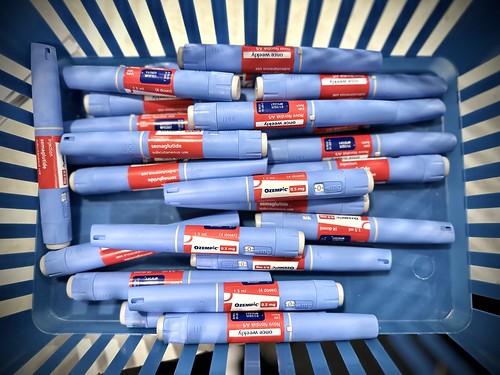
The arrival of weight loss drug Ozempic poses an existential challenge for companies reliant on selling diets and weight loss plans. CC-licensed photo by Chemist4U on Flickr.

You can sign up to receive each day’s Start Up post by email. You’ll need to click a confirmation link, so no spam.


On Friday, there’s another post due at the Social Warming Substack at about 0845 UK time.


A selection of 10 links for you. Non-fattening. I’m @charlesarthur on Twitter. On Mastodon: https://newsie.social/@charlesarthur. Observations and links welcome.


I tracked an NYC subway rider’s movements with an MTA ‘feature’ • 404 Media

Joseph Cox:

»

In the mid-afternoon one Saturday earlier this month, the target got on the New York subway. I knew what station they entered the subway at and at what specific time. They then entered another station a few hours later. If I had kept monitoring this person, I would have figured out the subway station they often start a journey at, which is near where they live. I would also know what specific time this person may go to the subway each day.

During all this monitoring, I wasn’t anywhere near the rider. I didn’t even need to see them with my own eyes. Instead, I was sitting inside an apartment, following their movements through a feature on a Metropolitan Transportation Authority (MTA) website, which runs the New York City subway system.

With their consent, I had entered the rider’s credit card information—data that is often easy to buy from criminal marketplaces, or which might be trivial for an abusive partner to obtain—and punched that into the MTA site for OMNY, the subway’s contactless payments system. After a few seconds, the site churned out the rider’s travel history for the past seven days, no other verification required.

The news presents a significant privacy risk from a feature that is supposedly designed for individuals to check their own travel history, but which in reality is wide open to abuse.

…“Obviously this is a great fit for abusers who live with their victims or have physical access, however brief, to their wallets,” Eva Galperin, the director of cybersecurity at activist organization the Electronic Frontier Foundation (EFF) and who has extensively researched how abusive partners use technology, told 404 Media. “​​Credit card info is not a goddamn unique identifier.”

«

Galperin makes a reasonable point: the extreme situation is very undesirable. Adding a username/password barrier would make sense (though in the case of people living with their abusers, the latter will just demand the username and password).
unique link to this extract


The $76bn diet industry asks: what to do about Ozempic? • WSJ

Andrea Petersen, Rolfe Winkler and Sara Ashley O’Brien:

»

Annick Lenoir-Peek, a lawyer from Durham, N.C., has struggled with her weight since adolescence. She has tried Atkins and keto and spent thousands of dollars over decades on weight-loss efforts and programs such as Noom, Nutrisystem and WeightWatchers.

Since starting [weight loss drug] Ozempic in late November, she has lost around 30lb [14kg]. Her cholesterol and glucose levels have improved, and she can eat far fewer calories without feeling hungry, she says. She has felt few side effects and has more energy than when she tried calorie-restricted diets. Currently on a trip through Eastern Europe, she says she is doing more tours than she would have at a higher weight. 

People such as Ms. Lenoir-Peek—among the diet business’s most reliable customers—are sparking an existential crisis for the industry, which rang up $76bn in sales in 2022 from weight loss and medical programs, diet soda and low-calorie frozen food, gym memberships and other categories, according to research firm Marketdata LLC. 

Drugs such as Ozempic, Wegovy and Mounjaro have upended the business of losing weight in America. They are shaping up to be blockbusters for Novo Nordisk, which makes Ozempic and Wegovy, and Eli Lilly, which makes Mounjaro. The drugs are also ripping up long-held beliefs that diet, exercise and willpower are the way to weight loss. 

“I think they [the new drugs] are going to transform the industry of weight loss in a pretty big way,” says Alex Fuhrman, senior research analyst at Craig-Hallum Capital Group LLC. “The traditional approach to weight loss has been the only game in town for a very long time except for more drastic surgical interventions. The behavioural approach to weight loss is going to be under pressure now.”

«

This was always going to be the collateral damage – or existential risk – from Ozempic and other GLP-1 drugs: why do you need to torture yourself with diets when you could just take this completely safe medication?
unique link to this extract


Researchers discover common origin behind major childhood allergies • MedicalXpress

»

Several major childhood allergies may all stem from the community of bacteria living in our gut, according to a new study led by researchers at the University of British Columbia and BC Children’s Hospital.

The research, published in Nature Communications, identifies gut microbiome features and early life influences that are associated with children developing any of four common allergies—eczema, asthma, food allergy and/or hay fever. The findings could lead to methods of predicting whether a child will develop allergies, and ways to prevent them from developing at all.

“We’re seeing more and more children and families seeking help at the emergency department due to allergies,” said Dr. Stuart Turvey, professor in the department of pediatrics at UBC and an investigator at BC Children’s Hospital Research Institute, and co-senior author on the study. “Hundreds of millions of children worldwide suffer from allergies, including one in three children in Canada, and it’s important to understand why this is happening and how it can be prevented.”

The study is one of the first to examine four distinct school-aged pediatric allergies at once. While these allergic diseases each have unique symptoms, the Turvey lab was curious whether they might have a common origin linked to the infant gut microbiota composition.

“These are technically different diagnoses, each with their own list of symptoms, so most researchers tend to study them individually,” says Dr. Charisse Petersen, co-senior author on the paper and postdoctoral fellow in the Turvey lab. “But when you look at what is going wrong at a cellular level, they actually have a lot in common.”

«

Very interesting: a shift in the microbiome could explain the apparent rise in allergic incidence. Bacteria as the underlying triggers of disease and the microbiome are the new frontiers in medicine; so much coming out now.
unique link to this extract


The Mystery of the Bloomfield Bridge • Tyler Vigen

Tyler got intrigued by something one day:

»

Why is this bridge here?

This pedestrian bridge crosses I-494 just west of the Minneapolis Airport. It connects Bloomington to Richfield. I drive under it often and I wondered: why is it there? It’s not in an area that is particularly walkable, and it doesn’t connect any establishments that obviously need to be connected. So why was it built?

I often have curious thoughts like this, but I dismiss most of them because if I answered all of them I would get nothing else done. But one day I was walking out of a Taco Bell and found myself at the base of the bridge. That only raised MORE questions! Why did the bridge just lead to some grass? Why isn’t there a sidewalk? What is the point? It makes no sense!

«

It’s a fabulous tale, with a bit of the shaggy dog about it. (TL;DR it does actually bridge the road.)
unique link to this extract


Google to sell maps data to companies building solar products • CNBC

Jennifer Elias:

»

The company plans to sell access to new APIs (application programming interfaces) with solar and energy information and air quality, according to materials viewed by CNBC.

Among the new offerings will be a Solar API, which could be used by solar installers like SunRun and Tesla Energy and solar design companies like Aurora Solar, according to a list of example customers viewed by CNBC. Google also sees customer opportunities with real estate companies like Zillow, Redfin, hospitality companies like Marriott Bonvoy, and utilities like PG&E.

Some of the data from the Solar API will come from a consumer-focused pilot called Project Sunroof, a solar savings calculator that originally launched in 2015. The program allows users to enter their address and to receive estimated solar costs such as electric bill savings and the size of the solar installation they’ll need. It also offers 3D modeling of the roofs of buildings and nearby trees based on Google Maps data. 

Google plans to sell API access to individual building data, as well as aggregated data for all buildings in a particular city or county, one document states. The company says it has data for over 350m buildings, according to documents, up significantly from the 60m buildings it cited for Project Sunroof in 2017.

One internal document estimates the company’s solar APIs will generate revenue between $90m and $100m in the first year after launch. There’s also a potential to connect with Google Cloud products down the line, documents state.

«

As Elias points out, the revenue will be tasty for Google, which wants to make more from maps (which remain expensive to maintain).
unique link to this extract


The SynthID watermark from Google DeepMind can detect AI-generated images • The Verge

David Pierce:

»

[Google DeepMind CEO, Demis] Hassabis and his team have been working on a tool for the last few years, which Google is releasing publicly today. It’s called SynthID, and it’s designed to essentially watermark an AI-generated image in a way that is imperceptible to the human eye but easily caught by a dedicated AI detection tool. 

The watermark is embedded in the pixels of the image, but Hassabis says it doesn’t alter the image itself in any noticeable way. “It doesn’t change the image, the quality of the image, or the experience of it,” he says. “But it’s robust to various transformations — cropping, resizing, all of the things that you might do to try and get around normal, traditional, simple watermarks.” As SynthID’s underlying models improve, Hassabis says, the watermark will be even less perceptible to humans but even more easily detected by DeepMind’s tools.

That’s as technical as Hassabis and Google DeepMind want to be for now. Even the launch blog post is sparse on details because SynthID is still a new system. “The more you reveal about the way it works, the easier it’ll be for hackers and nefarious entities to get around it,” Hassabis says. SynthID is rolling out first in a Google-centric way: Google Cloud customers who use the company’s Vertex AI platform and the Imagen image generator will be able to embed and detect the watermark. As the system gets more real-world testing, Hassabis hopes it’ll get better. Then Google will be able to use it in more places, share more about how it works, and get even more data on how it works.

«

So this is essentially steganography – hiding a message in an image. That usually gets broken (ie, the message is lost) through other conversions. And the problem is also that just because an image doesn’t contain this sikrit c0d3 doesn’t mean it isn’t AI-generated – just that SynthID (probably) wasn’t used on it.
unique link to this extract


We analyzed millions of ChatGPT user sessions: visits are down 29% since May; programming assistance is 30% of use • SparkToro

Rand Fishkin:

»

Programming is the largest use case, with 29.14% of all prompt series falling into this use-case. It’s also the clearest/least ambiguous. I hand-checked 100+ of each prompt series (an arduous, but fascinating task) to confirm the classifier’s accuracy, and programming help (with writing specific bits of code, formatting code, catching errors in code, and more) was present in every one ChatGPT marked as such.

As others have often pointed out, the tool excels at programming-related tasks. Little wonder it’s such a popular use case.

Next up is education — but not just primary or secondary education. Personal knowledge or interest pursuits and professional knowledge for work purposes are both included here as well. Same with content creation — some is clearly personal (D&D dungeon masters needing riddles or quests for their adventures was a recurring favorite in the dataset) while others are professional (“write me a 500 word blog post about detroit plumbing problems” – presumably a content marketer tired of writing their own material).

Sales and marketing use-cases overlap with content creation, but I chose to keep these separate to help see only those sessions that could only be classified as helping sales+marketing professionals with their tasks (analysis of analytics, questions about which channels to promote their products in, ad optimization tasks, and even messaging/promotion help were all in the dataset).

«

“SEO” appeared in just over 2% of prompts, suggesting that it’s already being used to game web search. When programming stops being the top use, I think we’ll be able to say that ChatGPT has properly arrived.
unique link to this extract


Fukushima: China accused of hypocrisy over its own release of wastewater from nuclear plants • The Guardian

Amy Hawkins and Justin McCurry:

»

As China bans all seafood from Japan after the discharge of 1m tonnes of radioactive water from the ruined Fukushima Daiichi nuclear power plant into the Pacific Ocean, Beijing has been accused of hypocrisy and of using the incident to whip up anti-Japanese sentiment.

Scientists have pointed out that China’s own nuclear power plants release wastewater with higher levels of tritium than that found in Fukushima’s discharge, and that the levels are all within boundaries not considered to be harmful to human health.

On Thursday, Tokyo Electric Power (Tepco), the company that manages the plant, began pumping water containing radioactive tritium into the sea, starting a wastewater discharge process that is expected to take at least 30 years. The plan has been approved by the UN’s atomic watchdog, the International Atomic Energy Agency (IAEA) and the Japanese government.

On Friday, Tepco said rapid tests of samples taken from the first batch of released wastewater showed radioactivity levels well within safe limits. “We confirmed that the analysed value is equal to the calculated concentration and that the analysed value is below 1,500 becquerels per litre,” a Tepco spokesperson, Keisuke Matsuo, told reporters. The national safety standard is 60,000 becquerels a litre.

“We will continue to conduct analysis every day over the next one month and even after that, maintain our analysis effort,” Matsuo added. “By providing swift, easy to understand explanations we hope to dispel various concerns.”

China has condemned the discharge, with the customs agency saying it risks the “radioactive contamination of food safety”. China’s foreign ministry said it was an “extremely selfish and irresponsible act”.

«

Good that someone is pointing out that China is simply playing a PR game here. People are Losing Their Minds over the Fukushima water discharge, which I’d say is safer to drink than many – most? – English rivers. The radioactivity levels are absolutely infinitesimal, but people hear that word and starting doing Münch painting impressions.
unique link to this extract


Most cancer screenings don’t extend life, study finds – but don’t cancel that appointment • CNN

Jen Christensen:

»

Early diagnosis has been shown to improve cancer outcomes, which is why the American Cancer Society and the World Health Organization say routine screening is an important public health strategy. Overall cancer mortality worldwide has decreased significantly, falling 33% since 1991, in part due to early detection as well as advances in treatment and declines in smoking.

The latest study, published Monday in the journal JAMA Internal Medicine, found that of the six most common cancer screenings, only colorectal cancer screening with sigmoidoscopy — in which doctors check the lower part of the colon or large intestine for cancer — seemed to make a difference in extending someone’s life. It may extend life by a little more than three months, the research says.

The researchers looked at clinical trials that involved at least nine years of follow-up reporting and found no significant difference in lifetime gain with the other most common cancer screening tests: mammography for breast cancer, colonoscopy, fecal occult blood testing or endoscopy (FOBT), prostate-specific antigen tests, and computed tomography for current or former smokers.

“We do not advocate that all screening should be abandoned,” the researchers wrote. “Screening tests with a positive-benefit-harm balance measured in incidence and mortality of the target cancer compared with harms and burden may well be worthwhile.”

The authors of the new research suggest that rather than emphasize that cancer screenings save lives, doctors should be clearer about their absolute benefits, harms and burdens.

«

The argument against is that inevitably there are false positives, which lead to anxiety and more screening. Compared to cancer, though, anxiety and more screening seems a small price. (Plus what about the upside of relief if the false positive is discovered?)
unique link to this extract


Managed to death: how Canada turned its forests into a carbon bomb • Bulletin of the Atomic Scientists

Jessica McKenzie:

»

To illustrate the scale and pace of our metastasizing forest carbon crisis, I turned to data in Canada’s official national greenhouse gas inventory, plus recent wildfire data from the European Union’s Earth Observation Program. The resulting chart shows the cumulative amount of CO2 that’s been added to the atmosphere from Canada’s managed forest since 1990.

The falling green line at the start of the chart shows that in the early 1990s, the forest was a valuable carbon sink, helping to slow global warming. Back then, new forest growth absorbed more CO2 from the air than was emitted by logging, wildfire and decay.

That all changed after 2001, the tipping point year for Canada’s managed forest.

As the rising red line on the chart shows, since that year, the forest has emitted more CO2 than it has absorbed. A lot more. Logging, wildfires, insects and the many forms of decay are now turning trees into CO2 faster than the forest can grow back.

That pumped billions of tonnes of climate fuel into the atmosphere—even before accounting for this year’s epic wildfires (shown by the dashed line). With those included, the cumulative total since the tipping point year is now around 3,700 million tonnes of CO2 (MtCO2).

«

unique link to this extract


• Why do social networks drive us a little mad?
• Why does angry content seem to dominate what we see?
• How much of a role do algorithms play in affecting what we see and do online?
• What can we do about it?
• Did Facebook have any inkling of what was coming in Myanmar in 2016?

Read Social Warming, my latest book, and find answers – and more.


Errata, corrigenda and ai no corrida: none notified

Start Up No.2062: is AI the early internet?, how Poland’s trains were halted, South Africa dings Google, Meta snubs Oversight, and more


Some ebooks about mushroom foraging on Amazon seem to have been written by a chatbot – and so could kill their readers. CC-licensed photo by Stephen Bowler on Flickr.

You can sign up to receive each day’s Start Up post by email. You’ll need to click a confirmation link, so no spam.


There’s another post coming this week at the Social Warming Substack on Friday at about 0845 UK time. Free signup.


A selection of 9 links for you. Back in the office? I’m @charlesarthur on Twitter. On Mastodon: https://newsie.social/@charlesarthur. Observations and links welcome.


‘Life or death:’ AI-generated mushroom foraging books are all over Amazon • 404 Media

Samantha Cole:

»

A genre of AI-generated books on Amazon is scaring foragers and mycologists: cookbooks and identification guides for mushrooms aimed at beginners.

Amazon has an AI-generated books problem that’s been documented by journalists for months. Many of these books are obviously gibberish designed to make money. But experts say that AI-generated foraging books, specifically, could actually kill people if they eat the wrong mushroom because a guidebook written by an AI prompt said it was safe.

The New York Mycological Society (NYMS) warned on social media that the proliferation of AI-generated foraging books could “mean life or death.”

“There are hundreds of poisonous fungi in North America and several that are deadly,” Sigrid Jakob, president of the New York Mycological Society, told me in an email. “They can look similar to popular edible species. A poor description in a book can mislead someone to eat a poisonous mushroom.”

A quick scan of Amazon’s mushroom and foraging books revealed a bunch of books likely written by ChatGPT, but are sold without any indication that they’re AI-generated and are marketed as having been written by a human when they’re very likely not.

“Edwin J. Smith” is the author listed on two books—The Ultimate Mushroom Books Field Guide Of The Southwest: An essential field guide to foraging edible and non-edible mushrooms outdoors and indoors and Psilocybin Mushroom Book: Field Guide To Identification, Growing, and Microdosing Psilocybin Mushroom for Safe Use and Health Remedies—but doesn’t have any other books, or an online presence otherwise. The only Edwin J. Smith I could find was a Professor Emeritus of medicine at Indiana University from a staff list that’s more than a decade old.

…After 404 Media reached out for comment and sent the company links to these suspected AI books, Amazon deleted The Ultimate Mushroom Books Field Guide Of The Southwest, Psilocybin Mushroom Book, and WILD MUSHROOM COOKBOOK FOR BEGINNER.

«

Once again, journalists get the job of saving people from the bad decisions made by platforms – in this case, having no gatekeeping or quality function because it’s cheaper (= more profitable) not to.
unique link to this extract


The AI revolution is coming, but not as fast as some people think • The New York Times

Steve Lohr:

»

Lori Beer, the global chief information officer of JPMorgan Chase, talks about the latest artificial intelligence with the enthusiasm of a convert. She refers to AI chatbots like ChatGPT, with its ability to produce everything from poetry to computer programs, as “transformative” and a “paradigm shift.”

But it’s not coming soon to the nation’s largest bank. JPMorgan has blocked access to ChatGPT from its computers and told its 300,000 workers not to put any bank information into the chatbot or other generative AI tools.

For now, Ms. Beer said, there are too many risks of leaking confidential data, questions about how the data is used and about the accuracy of the AI-generated answers. The bank has created a walled-off, private network to allow a few hundred data scientists and engineers to experiment with the technology. They are exploring uses like automating and improving tech support and software development.

Across corporate America, the perspective is much the same. Generative AI, the software engine behind ChatGPT, is seen as an exciting new wave of technology. But companies in every industry are mainly trying out the technology and thinking through the economics. Widespread use of it at many companies could be years away.

Generative AI, according to forecasts, could sharply boost productivity and add trillions of dollars to the global economy. Yet the lesson of history, from steam power to the internet, is that there is a lengthy lag between the arrival of major new technology and its broad adoption — which is what transforms industries and helps fuel the economy.

Take the internet. In the 1990s, there were confident predictions that the internet and the web would disrupt the retailing, advertising and media industries. Those predictions proved to be true, but that was more than a decade later, well after the dot-com bubble had burst.

«

Unlike the web3/crypto argument that “it’s only useless because it’s like the early internet!”, I think this argument holds water.
unique link to this extract


The cheap radio hack that disrupted Poland’s railway system • WIRED

Andy Greenberg:

»

On Friday and Saturday, August 25 and 26, more than 20 of Poland’s trains carrying both freight and passengers were brought to a halt across the country through what Polish media and the BBC have described as a “cyberattack.” Polish intelligence services are investigating the sabotage incidents, which appear to have been carried out in support of Russia. The saboteurs reportedly interspersed the commands they used to stop the trains with the Russian national anthem and parts of a speech by Russian president Vladimir Putin.

Poland’s railway system has served as a key resource in the facilitating of Western weapons and other aid into Ukraine as NATO attempts to bolster the country’s defense against Russia’s invasion. “We know that for some months there have been attempts to destabilize the Polish state,” Stanislaw Zaryn, a senior security official, told the Polish Press Agency. “For the moment, we are ruling nothing out.”

But as disruptive as the railway sabotage has been, on closer inspection, the “cyberattack” doesn’t seem to have involved any cyber at all, according to Lukasz Olejnik, a Polish-speaking independent cybersecurity researcher and consultant, and the author of the forthcoming book Philosophy of Cybersecurity. In fact, the saboteurs appear to have sent simple “radio-stop” commands via radio frequency to the trains they targeted. Because the trains use a radio system that lacks encryption or authentication for those commands, Olejnik says, anyone with as little as $30 of off-the-shelf radio equipment can broadcast the command to a Polish train—sending a series of three acoustic tones at a 150.100 megahertz frequency—and trigger their emergency stop function.

“It is three tonal messages sent consecutively. Once the radio equipment receives it, the locomotive goes to a halt,” Olejnik says, pointing to a document outlining trains’ different technical standards in the European Union that describes the radio-stop command used in the Polish system.

«

Seems like a bit of an oversight when you have a potential aggressor just over your border.
unique link to this extract


South Africa’s Competition Commission takes aim at Google • Rest of World

Damilare Dosunmu:

»

According to the commission’s report, Google’s model disadvantages new, small, and underfunded South African businesses. The report indicates that the US tech giant has not only become direct competition to its clients by offering some of the services they render (including shopping and travel), but it is also playing unfairly by prioritizing its offerings over theirs. 

The commission released a set of remediations for Google to follow, including providing a South African badge and search filter to enable consumers to find and identify local platforms quickly. It also asked Google to introduce a new feature that displays smaller South African platforms relevant to consumer search, especially in travel and shopping. Google also has to provide support programs worth 330m rand ($17.6m) over five years, with 180m rand ($9.6m) of that investment going into advertising credits. The remaining amount goes to technical training, credits for other Google products, startup training, and networking, among other things.

Industry experts and analysts were divided on whether Google’s power over the digital economy needed more regulation or if the watchdog’s move was anti-market. They told Rest of World the commission’s report might begin a decade-long regulatory back-and-forth with the tech giant.

«

unique link to this extract


Meta rejects recommendation to suspend former Cambodian prime minister • The Hill

Rebecca Klar:

»

Meta, the parent company of Facebook, rejected a recommendation from its Oversight Board to suspend the account of former Cambodian Prime Minister Hun Sen, according to a decision announced Tuesday. 

Meta said it would not be suspending Hun Sen’s Facebook or Instagram page after determining that doing so would “not be consistent with our policies, including our protocol on restricting accounts of public figures during civil unrest.” 

Hun Sen, who handed power to his son Hun Manet after July’s national election, had preemptively removed his Facebook page after the Oversight Board recommendation in June, and banished Facebook representatives from operating in the country.

However, he returned to the platform three weeks later, after briefly using Telegram as his main tool of public communication. His Cambodian People’s Party won a large majority in the National Assembly after the main opposition party was barred from competing.

«

Thus demonstrating that the Oversight Board is a pointless exercise in pencil-sharpening. It’s not even a figleaf now. May as well dissolve it and give the money to charity.
unique link to this extract


As Canada burns and California floods, Facebook and Twitter are MIA • The Washington Post

Will Oremus:

»

As wildfires ravage western Canada, Canadians can’t read the news about them on Facebook or Instagram. This month, Facebook parent company Meta blocked links to news organizations on its major social networks in Canada to protest a law that would require it to pay publishers for distributing their content.

As a freak tropical storm flooded swaths of Southern California over the weekend, residents and government agencies who turned to X, formerly known as Twitter, for real-time updates struggled to discern fact from fiction. That has gotten far more difficult, officials say, since Elon Musk jumbled the site’s verification policies, removing the blue check marks from verified journalists and media outlets — instead granting them to anyone who pays a monthly fee.

Facebook and Twitter spent years making themselves essential conduits for news. Now that government agencies, the media and hundreds of millions of people have come to rely on them for critical information in times of crisis, the social media giants have decided they’re not so invested in the news after all.

Tech titans Mark Zuckerberg and Musk may not agree on much. But both have pulled back, in different ways, from what their companies once saw as a responsibility, to both their users and society, to connect people with reliable sources of information. A drumbeat of natural disasters, probably intensified by climate change, is highlighting the consequences of that retrenchment.

“Just a few years ago, Twitter was a really valuable way for us to communicate with the public,” said Brian Ferguson, deputy director of crisis communications for the California Governor’s Office of Emergency Services. “It’s much more challenging now because of some of the changes that have happened.”

«

These two things aren’t quite like each other, though. Twitter is simply abrogating the responsibility it used to feel as the place where the world found the news – which Musk is still claiming was his desire for it. Meta, on the other hand, has never truly pretended to be the place where you find the news about the world – and the Canadian government wrote a terrible law which offered Meta a simple get-out by not including links. Bad laws that you can evade are going to be evaded.
unique link to this extract


Why note-taking apps don’t make us smarter • The Verge

Casey Newton:

»

Earlier this year, like many productivity tools, Notion added a handful of AI features. I use two of them in my links database. One extracts the names of any companies mentioned in an article, creating a kind of automatic tagging system. The other provides a two- or three-sentence summary of the article I’m saving.

Neither of these, in practice, is particularly useful. Tags might theoretically be useful for revisiting old material, but databases are not designed to be browsed. And while we publish summaries of news articles in each edition of Platformer, we wouldn’t use AI-written summaries: among other reasons, they often miss important details and context.

At the same time, the database contains nearly three years of links to every subject I cover here, along with the complete text of thousands of articles. It is here, and not in a note-taking app, that knowledge of my beat has been accreting over the past few years. If only I could access that knowledge in some way that went beyond my memory.

It’s here that AI should be able to help. Within some reasonable period of time, I expect that I will be able to talk to my Notion database as if it’s ChatGPT. If I could, I imagine I would talk to it all the time.

Much of journalism simply involves remembering relevant events from the past. An AI-powered link database has a perfect memory; all it’s missing is a usable chat interface. If it had one, it might be a perfect research assistant.

«

Like Newton, I’ve tried a lot of note-taking apps, and concluded they’re never going to replace the connections you make in your head. For assembling lots of information, I like Scrivener (used it to write all three of my books), but it didn’t make my thinking any clearer.
unique link to this extract


Elon Musk to remove headlines from news articles shared on X • Fortune

Kylie Robison:

»

X, the social media platform previously known as Twitter, is planning a major change in how news articles appear on the service, stripping out the headline and other text so that tweets with links display only an article’s lead image, according to material viewed by Fortune.

Roughly four hours after the publication of this article, Elon Musk confirmed these plans, posting that “this is coming from me directly,” and it “will greatly improve the esthetics.”

The change means that anyone sharing a link on X—from individual users to publishers—would need to manually add their own text alongside the links they share on the service; otherwise the tweet will display only an image with no context other than an overlay of the URL. While clicking on the image will still lead to the full article on the publisher’s website, the change could have major implications for publishers who rely on social media to drive traffic to their sites as well as for advertisers.

According to a source with knowledge of the matter, the change is indeed being pushed directly by X owner Elon Musk. The primary objective appears to be to reduce the height of tweets, thus allowing more posts to fit within the portion of the timeline that appears on screen. Musk also believes the change will help curb clickbait, the source said.

“It’s something Elon wants. They were running it by advertisers, who didn’t like it, but it’s happening,” the source said, adding that Musk thinks articles occupy excessive space on the timeline.

«

You can imagine how this panned out: Musk scrolling and declaring that “all these articles [which he doesn’t read – he doesn’t strike me as a person consumed by curiosity] take too much space. How many more ads could we show if we cut these? That many, huh? OK let’s do that.” It’s not intended for users. It’s him and his personal plaything; there’s no sense of having any responsibility to all the other users of Twitter, who may derive value from the headlines and text.
unique link to this extract


Apple’s September iPhone event: how to watch and what to expect • The Verge

Emma Roth:

»

One of the biggest changes coming to this year’s iPhone lineup is the addition of USB-C. For the first time, the iPhone 15 is expected to come with the widely used port instead of Apple’s proprietary Lightning connector. This doesn’t come as a surprise, as Apple confirmed last year that it would make the change to USB-C to comply with the European Union’s incoming regulations.

Although reports indicate that all phones in the iPhone 15 lineup will get the USB-C port, Apple analyst Ming-Chi Kuo says only the Pro and Pro Max will benefit from higher data transfer rates. Both premium models will come with “at least” USB 3.2 or Thunderbolt 3, while the base iPhone 15 and 15 Plus will support USB 2.0, according to Kuo. Either way, 9to5Mac reports that all iPhone 15 models should have faster 35W charging rates thanks to the switch.

Additionally, supply chain analyst Ross Young reported last year that all models of the iPhone 15 will come with the Dynamic Island. That’s a change from what Apple currently offers, as it only includes the pill-shaped cutout on the iPhone 14 Pro and Pro Max. This time around, the most significant changes coming to the iPhone 15 Pro and Pro Max are reported to be a titanium frame, thinner bezels, and a potentially more expensive price.

Both premium models may also come with an action button similar to the one on the Apple Watch Ultra, as reported by MacRumors and 9to5Mac. This button is supposed to replace the mute toggle and could allow you to assign shortcuts to different apps and utilities. And while early rumors suggested that Apple will replace the volume rocker and the power button on the iPhone 15 Pro and Pro Max with solid-state toggles, recent reports from Kuo and leaker Unknownz21 suggest they’ll stay the same for now.

«

The event is on Tuesday September 12. Also coming: faintly updated Apple Watches. And there you go – enough to drive hundreds of billions of dollars of revenue. But the days when iPhone reveals were a) dramatic surprises and b) actually real news events are long past.
unique link to this extract


• Why do social networks drive us a little mad?
• Why does angry content seem to dominate what we see?
• How much of a role do algorithms play in affecting what we see and do online?
• What can we do about it?
• Did Facebook have any inkling of what was coming in Myanmar in 2016?

Read Social Warming, my latest book, and find answers – and more.


Errata, corrigenda and ai no corrida: none notified
Start Up No.2061: Google and the viral web, brain-computer interface lets woman ‘speak’, why chatbots are getting weirder, and more


The iPad Pro is long overdue for a serious update, but OLED screens aren’t coming until next year, according to a well-informed source. CC-licensed photo by Sergiy Galyonkin on Flickr.

You can sign up to receive each day’s Start Up post by email. You’ll need to click a confirmation link, so no spam.


There’s another post coming this week at the Social Warming Substack on Friday at about 0845 UK time. Free signup.


A selection of 9 links for you. Oh, now you’re back. I’m @charlesarthur on Twitter. On Mastodon: https://newsie.social/@charlesarthur. Observations and links welcome.


How Google made the world go viral • The Verge

Ryan Broderick:

»

[Anil] Dash is one of the web’s earliest bloggers. In 2004, he won a competition Google held to google-bomb itself with the made-up term “nigritude ultramarine.” Since then, Dash has written extensively over the years on the impact platform optimization has had on the way the internet works. As he sees it, Google’s advertising tools [introduced in 2003-4] gave links a monetary value, killing anything organic on the platform. From that moment forward, Google cared more about the health of its own network than the health of the wider internet. 

“At that point it was really clear where the next 20 years were going to go,” he said.

Google Answers closed in 2006. Google Reader shut down in 2013, taking with it the last vestiges of the blogosphere. Search inside of Google Groups has repeatedly broken over the years. Blogger still works, but without Google Reader as a hub for aggregating it, most publishers started making native content on platforms like Facebook and Instagram and, more recently, TikTok. 

Discoverability of the open web has suffered. Pinterest has been accused of eating Google Image Search results. And the recent protests over third-party API access at Reddit revealed how popular Google has become as a search engine not for Google’s results but for Reddit content. Google’s place in the hierarchy of Big Tech is slipping enough that some are even admitting that Apple Maps is worth giving another chance, something unthinkable even a few years ago.

On top of it all, OpenAI’s massively successful ChatGPT has dragged Google into a race against Microsoft to build a completely different kind of search, one that uses a chatbot interface supported by generative AI. 

«

Broderick’s piece has the in-article headline “The end of the Googleverse” – in which he’s trying to argue, at the beginning, that Google Search has lost its centrality and power: “all around us are signs that the era of “peak Google” is ending or, possibly, already over.” But then the article heads off to talk about the history of virality as driven by Google Search. It’s slightly confused: lots of people have called Peak Google, and none been quite right. This doesn’t quite make the case either. Lots of people agree that Google Search doesn’t find the results you want in the way it used to one or two decades ago. But people still use it to the tune of billions of searches per day.
unique link to this extract


Apple plans biggest iPad Pro update since 2018 • Ars Technica

Samuel Axon:

»

Apple’s iPad Pro is set to get its biggest redesign since 2018, according to a new report. Slated for a launch next year, it will seek to turn around recent years’ slow tablet sales.

The information comes from Bloomberg reporter Mark Gurman—as you probably could have guessed by now. Gurman claims to have knowledge of Apple’s plans, stating that the new iPad Pro will have everything from a new chip to a new screen technology, a different design, and a revamped keyboard accessory.

The new chip is obvious—that has been the standard minimum for any new iPad Pro refresh. The current iPad Pro has the M2 chip, and the new one will predictably have the M3 chip. Expect some notable performance gains—not that the M2 was too slow for most people using the iPad Pro already.

Things get a little more interesting beyond the chip upgrade, however. Gurman claims the new iPad Pro will ship with an OLED display, the same tech seen in the excellent screens on iPhones. OLED offers deeper blacks, better contrast, and richer color than the LCD screens currently in Apple’s iPad and MacBook lineups.

Gurman writes that the OLED screens are “crisper and brighter” than LCD screens, which seems odd—crispness is about resolution, which has little to do with the type of screen involved. The iPhone 14 Pro’s OLED screens are substantially brighter than the LCD screens found on most iPads, but the 12.9in iPad Pro’s Mini LED screen is about equally as bright as the OLED on an iPhone 14 Pro.

Apple previously brought Mini LED tech to the largest iPad model, the 12.9in iPad Pro. But even that can’t quite touch a great OLED screen, and it has not been available in any of the smaller tablets Apple sells.

«

If anyone has managed to hit the limits of what the M2 chip can do on an iPad Pro, please write in. Editing something gigantic in Final Cut Pro, perhaps? Hard to imagine anything else managing it. But the slow schedule here shows that the iPad isn’t viewed as the most important thing any more; no longer the new hotness. And finally getting OLED – which Samsung and others have been using in tablets for years.
unique link to this extract


Brain-computer interface enables woman with severe paralysis to speak through digital avatar • TechXplore

»

Researchers at the University of California (UC) San Francisco and UC Berkeley have developed a brain-computer interface (BCI) that has enabled a woman with severe paralysis from a brainstem stroke to speak through a digital avatar.

It is the first time that either speech or facial expressions have been synthesized from brain signals. The system can also decode these signals into text at nearly 80 words per minute, a vast improvement over commercially available technology.

Edward Chang, MD, chair of neurological surgery at UCSF, who has worked on the technology, known as a brain computer interface, or BCI, for more than a decade, hopes this latest research breakthrough, appearing Aug. 23, 2023, in Nature, will lead to an FDA-approved system that enables speech from brain signals in the near future.

“Our goal is to restore a full, embodied way of communicating, which is really the most natural way for us to talk with others,” said Chang, who is a member of the UCSF Weill Institute for Neuroscience and the Jeanne Robertson Distinguished Professor in Psychiatry. “These advancements bring us much closer to making this a real solution for patients.”

Chang’s team previously demonstrated it was possible to decode brain signals into text in a man who had also experienced a brainstem stroke many years earlier. The current study demonstrates something more ambitious: decoding brain signals into the richness of speech, along with the movements that animate a person’s face during conversation.

«

unique link to this extract


Qualcomm’s ‘Holy Grail’: generative AI is coming to phones soon • CNET

David Lumb:

»

Generative AI like ChatGPT and Midjourney have dazzled imaginations and disrupted industries, but their debut has mostly been limited to browser windows on desktop computers. Next year, you’ll be able to make use of generative AI on the go once premium phones launch with Qualcomm’s top-tier chips inside.

Phones have used AI for years to touch up photos and improve autocorrect, but generative AI tools could bring the next level of enhancements to the mobile experience. Qualcomm is building generative AI into its next generation of premium chips, which are set to debut at its annual Qualcomm Summit in Hawaii in late October. 

Summit attendees will get to experience firsthand what generative AI will bring to phones, but Qualcomm senior vice president of product management Ziad Asghar described to CNET why users should get excited for on-device AI. For one, having access to a user’s data — driving patterns, restaurant searches, photos and more — all in one place will make solutions generated by AI in your phone much more customized and helpful than general responses from cloud-based generative AI. 

“I think that’s going to be the holy grail,” Asghar said. “That’s the true promise that makes us really excited about where this technology can go.”

«

Er.. you can already download apps to do this for the iPhone, and there are tons of Midjourney and other AI apps on the Google Play store. Nor do I like Asghar’s description of what the on-device AI is going to be used for: “having access to a user’s data” as a starting point.
unique link to this extract


Why today’s chatbots are weird, argumentative, and wrong • IEEE Spectrum

Michael Koziol speaks to Janelle Shane, who has been running the AI Weirdness blog for years, and so has the perfect perspective on all this:

»

MK: How has AIs’ weirdness changed in the past year?

Janelle Shane: They’ve gotten less weird, more coherent. Instead of being absurd and half-incomprehensible, they’ve become way more fluent and more subtly wrong in ways that are harder to detect. But—they’re a lot more accessible now. People have the chance to experiment with them themselves. So from that standpoint, the weirdness of these models is a lot more evident.

Q: You’ve written that it’s outrageous that chatbots like Google’s Bard and Bing Chat are seen as an alternative to search engines. What’s the problem?

Shane: The problem is how incorrect—and in many cases very subtly incorrect—these answers are, and you may not be able to tell at first, if it’s outside your area of expertise. The problem is the answers do look vaguely correct. But [the chatbots] are making up papers, they’re making up citations or getting facts and dates wrong, but presenting it the same way they present actual search results. I think people can get a false sense of confidence on what is really just probability-based text.

Q: You’ve noted as well that chatbots are often confidently incorrect, and even double down when challenged. What do you think is causing that?

Shane: They’re trained on books and Internet dialogues and Web pages in which humans are generally very confident about their answers. Especially in the earliest releases of these chatbots, before the engineers did some tweaking, you would get chatbots that acted like they were in an Internet argument and doubling down sounding like they’re getting very hyped up and emotional about how correct they are. I think that came straight from imitating humans in Internet arguments during training.

«

How fabulous: chatbots’ refusal to be wrong stems from people arguing on the internet.
unique link to this extract


New Twitter scam in China: sextortion scammers • Rest of World

Caiwei Chen:

»

In May, Wang Zhi’an noticed something odd: Each time he posted on X, formerly known as Twitter, his replies would be flooded with sexual spam within minutes. Once, the Chinese investigative journalist-in-exile made a post discussing X’s new monetization policies. A user named Zizizi963, seemingly an attractive young single woman, replied with a photo of her in lingerie and the words, “When will you come to me and mess up my bed?” Zizizi963 was one of several accounts posting sexual messages in Wang’s replies — they all had blue checkmarks, and were granted greater visibility on the platform.

Wang soon learned that these accounts were sextortion scammers. Posing as young, lonely women, they posted sexually suggestive messages on popular posts and invited users to contact them through the Telegram links in their bios. A Shenzhen-based man in his 20s reached out to Wang anonymously after falling victim himself, according to an audio interview between the two that Wang had shared on his podcast. The scammers persuaded the man to download special video-chat software for “safety reasons,” lured him into a chatroom, recorded footage of him unclothed, and then blackmailed him for money. He ended up transferring 200,000 yuan ($27,500) to the scammers to prevent his photos from being leaked.

Since April, after X introduced a new blue-check policy allowing users to buy verified badges, the platform has seen hundreds of newly verified Chinese sextortion accounts, according to Robin Li, founder of online safety software PureTwitter. They prey on Chinese users, harassing the community’s most prominent voices — often political dissidents and influential opinion leaders.

«

It is a little bit difficult to feel that much sympathy for the Shenzhen-based man in his 20s: even in China, don’t they tell you about getting scammed in this sort of way?
unique link to this extract


Bitcoin trading volume is at its lowest in more than four years • CNBC

Tanaya Macheel:

»

Bitcoin’s trading volume hit its lowest level in almost five years this month as investors keep waiting for reasons to jump back into the market.

An analysis of CryptoQuant data from both spot and derivatives exchanges shows the total volume of bitcoin held on all exchanges fell earlier this month to its lowest level since 2018 and has struggled to rebound.

As of Aug. 26, bitcoin trading volume on all exchanges sat at 129,307 BTC, according to CryptoQuant. Earlier in the month, on Aug. 12, it fell to 112,317 BTC, its lowest level since Nov. 10, 2018. It’s now off the March high of 3.5 million BTC by about 94%.

“Trading volumes decrease in bear markets as retail investors leave,” Julio Moreno, head of research at CryptoQuant, told CNBC. “This happened during 2022 on most exchanges. As we progress further into a bull market, the trading volume may continue to pick up.”

The price of bitcoin is still up 57% for the year and hovering at about $26,100, according to Coin Metrics.

It’s been an excruciatingly quiet summer for bitcoin traders, but seasonality only accounts for so much of it. The US regulatory crackdown on crypto combined with the end of the banking crisis in May (which accounted for much of its year-to-date gains) drove market makers and traders away – and they haven’t had a reason to return.

«

When will they ever have a reason to return? The whole web3/NFT grift is dead. The only hope the bitcoin holders have is that some bigger fools will come along and take these expensive sudoku solutions off their hands.
unique link to this extract


Hiding behind whale fatality disinformation, Big Oil works to slow offshore wind projects • CleanTechnica

Carolyn Fortuna:

»

The US outer continental shelf is an ideal site for wind energy resources on both the Atlantic and Pacific coasts. With the public increasingly calling for more renewable energy options, offshore wind is an idea whose time has come.

The US Department of Energy (DOE) in late March, 2023 announced the release of its Offshore Wind Energy Strategy, which is intended to help meet President Biden’s goal to deploy 30 gigawatts (GW) of offshore wind energy by 2030 and set the nation on a pathway to 110 GW or more by 2050. Deploying 30 GW of offshore wind would provide enough power for 10 million homes, support 77,000 jobs, and spur $12 billion per year in direct private investment.

Offshore wind energy will be critical for reimagining America’s clean energy economy and building it right. Offshore wind is a more cost-effective energy source than oil and gas, and it threatens the future of US fossil fuel dependence. And so Big Oil looks for scapegoats — or, in this case, whale victims.

A dozen dead whales have washed up on New York and New Jersey beaches since December, part of a longer pattern of whale deaths up and down the east coast. The deaths have led some protesters to call for an end to offshore wind development, citing — without evidence — that the sound of the boats and underwater surveying might confuse the whales.

Experts at the National Oceanic and Atmospheric Administration (NOAA) and elsewhere say they see no evidence that undersea sounds emitted during survey work for the construction of wind farms is causing whale deaths.

«

There’s a whole lot of offshore wind around the UK, and no sign of increased whale deaths. (I was thinking the other day about whales, which used to be a key source of energy, which then became too expensive, with oil-based replacements taking over. But if we hadn’t had, or hadn’t found, oil? Would we have started breeding blue whales?)
unique link to this extract


Climate change is fuelling Antarctic emperor penguin population losses • Sydney Morning Herald

Laura Chung:

»

As the world goes through what some scientists believe to be its hottest year on record, emperor penguin populations in the Antarctic are suffering catastrophic losses, with no chicks surviving the spring of 2022 in four of five colonies observed for a new study.

The loss of the chicks coincides with record low sea ice coverage and was predicted as the world warmed, but the collapse in numbers has happened faster and sooner than expected, prompting fears for the future of the animal.

“Emperor penguins have no external threats except climate change and sea ice,” said the study’s lead author, Peter Fretwell, a scientist with the British Antarctic Survey. “They have never been hunted, hardly any contact with humanity. It is purely climate change. You can’t put the ice back. This is a global problem. If we don’t do something we are driving them to the brink of extinction.”

The report, published in Communications Earth and Environment on Friday, examined satellite images in the Bellingshausen Sea in Antarctica between 2018 and 2022 and found that declining sea ice due to climate change resulted in breeding failure last year.

Emperor penguin colonies rely on sea ice between April and January to breed, but any change to their habitat impacts whether chicks develop waterproof feathers, and ultimately survive.

«

This is either going to drive some extraordinarily rapid evolution, or – more likely – this is the final act for the emperor penguins.
unique link to this extract


• Why do social networks drive us a little mad?
• Why does angry content seem to dominate what we see?
• How much of a role do algorithms play in affecting what we see and do online?
• What can we do about it?
• Did Facebook have any inkling of what was coming in Myanmar in 2016?

Read Social Warming, my latest book, and find answers – and more.


Errata, corrigenda and ai no corrida: none notified

Start Up No.2060: Ukraine’s cardboard drones, Earth in 2100, AI and IP, pick films with maths, scammers target Worldcoin, and more


Installations of solar panels in the UK can generate as much energy as the (unfinished) Hinkley C nuclear plant. CC-licensed photo by Andrew Fogg on Flickr.

You can sign up to receive each day’s Start Up post by email. You’ll need to click a confirmation link, so no spam.

A selection of 10 links for you. Fine, thanks. I’m @charlesarthur on Twitter. On Mastodon: https://newsie.social/@charlesarthur. Observations and links welcome.


Fear the cardboard drones • The Droning Company

»

Australian company SYPAQ is helping Ukraine bolster its drone fleet as the country continues its struggle to push back the Russian invasion of its nation.

However, the drones being delivered are not metallic Valkyries of air warfare. They are cardboard.

The SYPAQ Corvo is a drone constructed from waxed cardboard that can be shipped in a flat package. Assembly is simple, requiring just a glue gun, knife, pen, tape, rubber bands, and a wrench to attach the Corvo’s propeller. The Corvo can fly autonomously with a flight plan programmed via an Android tablet interface. It relies on GPS guidance when available, but should GPS be jammed by Russian electronic-warfare defenses, the Corvo’s control software can determine its position from its speed and heading. The drone is launched from a simple catapult and has a range of 74 miles.

SYPAQ has not shared any additional specs for the Corvo, nor how much each drone costs, when they will be delivered, or how many they are supplying the Ukraine forces. 

While the Australian Army uses the Corvo to deliver small and urgently needed supplies, the Ukrainian forces are giving it another job entirely: Surveillance, reconnaissance, and intelligence missions. In the future, the Corvo could be further adapted to deploy bombs.

Of course, cardboard is not as tough as some other materials, so the Corvo’s mission lifespan may be short. However, other, more robust and low-cost materials such as plywood could conceivably be incorporated into the drone’s airframe.

SYPAQ is currently working on swarming software that could spell trouble for enemies when thousands of inexpensive and expendable Corvo drones descend on a target. That’s a lot of drones, but an entire fleet of Corvos likely costs significantly less than one $20 million Reaper. 

«

This article is from March – so sue me! – but with Ukraine’s drone attacks on Moscow and other Russian targets making news more recently, it could be that this is what they’re succeeding with.
unique link to this extract


Climate change: mapping in 3D where the earth will become uninhabitable • Berliner Morgenpost

Ida Flik, André Pätzold and Benja Zehr:

»

Lethal heat, flooded coastlines, powerful hurricanes, water scarcity: climate models show that by the end of the century, life as normal won’t be possible in many places. Find out where populations are projected to be hit hardest with our 3D interactive visualisation.

«

It’s a nifty visualisation, but it looks forward to the year 2100. Even the youngest reader of this article will be hitting their 80th year by then. Projections that will spur people to action need to have a shorter time range. Climate change is like the worst sort of pension: one that’s going to take everything away, and it’ll be too late if you don’t act now.
unique link to this extract


Generative AI and intellectual property • Benedict Evans

»

I think most people understand that if I post a link to a news story on my Facebook feed and tell my friends to read it, it’s absurd for the newspaper to demand payment for this. A newspaper, indeed, doesn’t pay a restaurant a percentage when it writes a review. If I can ask ChatGPT to read ten newspaper websites and give me a summary of today’s headlines, or explain a big story to me, then suddenly the newspapers’ complaint becomes a lot more reasonable – now the tech company really is ‘using the news’. Unsurprisingly, as soon as ChatGPT announced that it had its own web crawler, news sites started blocking it.

But just as for my ‘make me something like the top ten hits’ example, ChatGPT would not be reproducing the content itself, and indeed I could ask an intern to read the papers for me and give a summary (I often describe AI as giving you infinite interns). That might be breaking the self-declared terms of service, but summaries (as opposed to extracts) are not generally considered to be covered by copyright – indeed, no-one has ever suggested this newsletter is breaking the copyright of the sites I link to. 

Does that mean we’ll decide this isn’t a problem? The answer probably has very little to do what that today’s law happens to say today in one or another country. Rather, one way to think about this might be that AI makes practical at a massive scale things that were previously only possible on a small scale. This might be the difference between the police carrying wanted pictures in their pockets and the police putting face recognition cameras on every street corner – a difference in scale can be a difference in principle. What outcomes do we want? What do we want the law to be? What can it be?

«

This is a typically thoughtful piece: Evans’s preference for realism and practicality over sweeping statements makes him unusual among most commentators on topics like this, perhaps because he isn’t gurning for attention.
unique link to this extract


Movie Maths

This neat little site is a sort-of recommendation system for films. So if you want something that’s a cross between “The Endless Summer” (classic film of surfers searching for the perfect wave) and Alien, what about Lilo & Stitch (destructive city-destroying child-friendly alien touches down in Hawaii)?

Simon Carryer, who did the maths bit, explains how it works in a Medium article, though you’ll need a membership there to read it.
unique link to this extract


Organised crime gang steals hard drive containing vital evidence against Channel people smugglers • LBC

Will Taylor:

»

Important evidence about people-smuggling across the Channel has been stolen and it is suspected an organised crime gang is responsible.

Aviation fuel worth about £30,000 and tools were also stolen from Lydd airport, in southern Kent, which contains the control room for drones that watch for small boats. These record migrant crossings via camera and that footage is used to prosecute criminals and help target gangs who bring them over the sea.

A hard drive that was held in a safe in a hangar was stolen in the raid on August 1. It contained footage of crossings from previous days. The clips had not been forwarded to Border Force or other organisations like the National Crime Agency.

Although the fuel was taken, the aeroplane and four drones based at Lydd were unaffected. They were thoroughly examined to ensure they were safe to use.

The raiders managed to break in by climbing over a fence and then cut through tarpaulin outside the hangar using a knife.

«

In its way, very Mission Impossible-y: “we’ve got to find the hard drive that’s got the surveillance footage of the boat crossing!” Except this is done by people who will exploit the most desperate survivors for the last of their money and put them in boats that might kill them. The OCG aspect is emphasised by the fact that they stole tools. Sure, they came for the hard drive, but tools are tools, you know?
unique link to this extract


Scammers cash in on Worldcoin’s Kenya launch • Rest of World

Martin Siele:

»

For the hundreds of thousands who signed up for Worldcoin in Kenya, the Sam Altman-backed global blockchain project couldn’t have come at a better time.

With the country in the throes of an inflation crisis, Worldcoin made a big splash, signing up an estimated 350,000 people before the government stopped the project’s rollout over data protection concerns on August 2. The biggest attraction for many Kenyans who had their eyeballs scanned was the free sign-up bonus of 25 Worldcoin tokens, currently worth around 6,988 Kenyan shillings ($48.75).

But once the coins were in their accounts, getting the money proved harder than they expected. The Worldcoin app offers no direct cash withdrawal option, unlike the mobile money apps used by 96% of Kenyan households. Within days of the launch, Worldcoin was forced to suspend the registration of new users in Kenya as the government launched an investigation into its compliance with data protection laws. To get their cash, Kenyans had to sell their coins through cryptocurrency exchanges like Binance, or find a buyer in Kenya’s informal crypto economy.

“Many of those who signed up don’t know how crypto works exactly or how to sell the Worldcoin tokens they received through exchanges like Binance,” Mathew Morang’a, a day trader based in Nakuru, Kenya, who has dealt in cryptocurrencies since 2020, told Rest of World. “They just want to get the money quickly, in the most straightforward way.”

Since the government decision, traders like Morang’a have flooded social media platforms including WhatsApp, TikTok, Twitter, and Facebook with offers to purchase Worldcoin. A spot check by Rest of World found that most traders were offering between 200–250 Kenyan shillings ($1.40–$1.74) per Worldcoin token (WLD), against its current price of 279 shillings ($1.95) — enabling them to profit as much as 78.8 shillings (55 cents) on each token.

«

Guess it means that we find the actual value of Worldcoin. It doesn’t seem very high. And we seem still to be trying to shake off the whole “web 3” thing still.
unique link to this extract


UK homes install ‘record number’ of solar panels and heat pumps • The Guardian

Jillian Ambrose:

»

British households are making more green energy upgrades than ever before after installing a record number of solar panels and heat pumps in the first half of the year, according to the industry’s official standards body.

The industry figures show there were more green energy installations in June than in previous years.

On average, more than 17,000 households installed solar panels every month this year, while the number of homes installing heat pumps reached 3,000 a month for the first time, according to the data.

Each month of 2023 was a record month for battery technologies, as installation figures consistently surpassed the month before, bringing the total number of batteries installed in homes and businesses across the UK to more than 1,000 in 2023 so far.

The industry’s accreditation body, MCS, said the green energy boom has put households on track to install more renewable energy than the last record set in 2012, when many raced to install solar panels before government subsidies were reduced.

Ian Rippin, the chief executive of MCS, said: “As the cost of energy continues to grow, we are seeing more people turn to renewable technology to generate their own energy and heat at home.”

Small-scale renewable energy installations at homes and businesses across the UK now have a total capacity of 4 gigawatts (GW), greater than the nuclear power plant under construction at Hinkley Point and almost double the capacity of Europe’s biggest gas power plant near Pembroke in Wales.

«

(Hinkley Point C is a 3.2GW plant.) Of course the criticism will be that these panels don’t generate this energy all the time, which is true – but microgeneration (as this is called) has the potential to be colossal. All it takes is a bit of political will. The battery and panel prices will fall in line.
unique link to this extract


China’s 40-year boom is over. What comes next? • WSJ

Lingling Wei and Stella Yifan Xie:

»

For decades, China powered its economy by investing in factories, skyscrapers and roads. The model sparked an extraordinary period of growth that lifted China out of poverty and turned it into a global giant whose export prowess washed across the globe.

Now the model is broken.

What worked when China was playing catch-up makes less sense now that the country is drowning in debt and running out of things to build. Parts of China are saddled with under-used bridges and airports. Millions of apartments are unoccupied. Returns on investment have sharply declined.

Signs of trouble extend beyond China’s dismal economic data to distant provinces, including Yunnan in the southwest, which recently said it would spend millions of dollars to build a new Covid-19 quarantine facility, nearly the size of three football fields, despite China having ended its “zero-Covid” policy months ago, and long after the world moved on from the pandemic.

Other localities are doing the same. With private investment weak and exports flagging, officials say they have little choice but to keep borrowing and building to stimulate their economies.

Economists now believe China is entering an era of much slower growth, made worse by unfavourable demographics and a widening divide with the US and its allies, which is jeopardizing foreign investment and trade. Rather than just a period of economic weakness, this could be the dimming of a long era.

“We’re witnessing a gearshift in what has been the most dramatic trajectory in economic history,” said Adam Tooze, a Columbia University history professor who specializes in economic crises.  

What will the future look like? The International Monetary Fund puts China’s GDP growth at below 4% in the coming years, less than half of its tally for most of the past four decades. Capital Economics, a London-based research firm, figures China’s trend growth has slowed to 3% from 5% in 2019, and will fall to around 2% in 2030.

«

Slowing growth? Call Liz Truss! But seriously, this poses huge questions for the world economy. (The link should hop you over the WSJ paywall.)
unique link to this extract


Apple lends support to California State Right to Repair bill • TechCrunch

Brian Heater:

»

In a surprise move, Apple this week penned a letter to California state senator Susan Talamantes Eggman, voicing support for SB 244, a “right to repair” bill currently making its way through Sacramento’s State Capitol building.

Apple has, of course, softened its stance on right to repair legislation in recent years, including last year’s addition of a Self Service Repair program. The offering, which was viewed by many as a preemptive measure against looming state and federal legislation, provides users with rental tools to repair iPhones and Macs at home.

SB 244 is fairly expansive; it includes consumer electronics (phones, laptops, etc.) and appliances (microwaves, washing machines, etc.), though a few exceptions have been carved out, including game consoles and alarm systems. The rational for those appear to be piracy and security, respectively. It shares a good deal (including the proposed name) with the Right to Repair Act, which went into effect in Minnesota this May.

In the letter, Apple expresses its support on the grounds of offering consumers the ability to repair their devices safely, without risking privacy or data issues.

“Apple supports California’s Right to Repair Act so all Californians have even greater access to repairs while also protecting their safety, security, and privacy,” the company says in a statement provided to TechCrunch. “We create our products to last and, if they ever need to be repaired, Apple customers have a growing range of safe, high-quality repair options.”

«

Certainly, you can repair it yourself if you have the eyesight of a hawk and the fingers of a surgeon. Or just pay someone else to do it. Not sure how much difference this will truly make, so perhaps Apple feels there’s nothing to lose or gain in reality, but a bit of PR to gain.
unique link to this extract


“I’ve always dreamed of having a dongle to charge my car” • The Verge

Nilay Patel, editor-in-chief of The Verge :

»

Notable Verge traitor [she left The Verge to join the Wall Street Journal] Joanna Stern has been in the market for an EV for the past few months. (I know because she keeps texting me about it.) Like any true reviewer, she solved her problem by taking the the Hyundai Ioniq 5, the Ford Mustang Mach-E, and the Tesla Model Y head-to-head on a road trip — and called up Marques Brownlee for a little advice along the way.

«

Stern is always good, and this is a typically good video review. Electric cars are coming!


unique link to this extract


• Why do social networks drive us a little mad?
• Why does angry content seem to dominate what we see?
• How much of a role do algorithms play in affecting what we see and do online?
• What can we do about it?
• Did Facebook have any inkling of what was coming in Myanmar in 2016?

Read Social Warming, my latest book, and find answers – and more.


Errata, corrigenda and ai no corrida: none notified

Start Up No.2059: AI-generated guidebooks scam buyers, Detroit changes face recognition policy, moody muons?, and more


A surprisingly high percentage of people leave subtitles on when watching TV of any sort, research has found. CC-licensed photo by Jean-Etienne Minh-Duy Poirrier on Flickr.

You can sign up to receive each day’s Start Up post by email. You’ll need to click a confirmation link, so no spam.


There’s another blogpost at the Social Warming Substack due at about 0845. It’s about research – or the impending absence of it.


The Overspill is going on a two-week break. By the end of which there should be some news in the world of technology.

A selection of 11 links for you. What did he say? I’m @charlesarthur on Twitter. On Mastodon: https://newsie.social/@charlesarthur. Observations and links welcome.


A new frontier for travel scammers: AI-generated guidebooks • The New York Times

Seth Kugel and Stephen Hiltner:

»

In March, as she planned for an upcoming trip to France, Amy Kolsky, an experienced international traveler who lives in Bucks County, Pa., visited Amazon.com and typed in a few search terms: travel, guidebook, France. Titles from a handful of trusted brands appeared near the top of the page: Rick Steves, Fodor’s, Lonely Planet. Also among the top search results was the highly rated “France Travel Guide,” by Mike Steves, who, according to an Amazon author page, is a renowned travel writer.

“I was immediately drawn by all the amazing reviews,” said Ms. Kolsky, 53, referring to what she saw at that time: universal raves and more than 100 five-star ratings. The guide promised itineraries and recommendations from locals. Its price tag — $16.99, compared with $25.49 for Rick Steves’s book on France — also caught Ms. Kolsky’s attention. She quickly ordered a paperback copy, printed by Amazon’s on-demand service.

When it arrived, Ms. Kolsky was disappointed by its vague descriptions, repetitive text and lack of itineraries. “It seemed like the guy just went on the internet, copied a whole bunch of information from Wikipedia and just pasted it in,” she said. She returned it and left a scathing one-star review.

Though she didn’t know it at the time, Ms. Kolsky had fallen victim to a new form of travel scam: shoddy guidebooks that appear to be compiled with the help of generative artificial intelligence, self-published and bolstered by sham reviews, that have proliferated in recent months on Amazon.

The books are the result of a swirling mix of modern tools: A.I. apps that can produce text and fake portraits; websites with a seemingly endless array of stock photos and graphics; self-publishing platforms — like Amazon’s Kindle Direct Publishing — with few guardrails against the use of A.I.; and the ability to solicit, purchase and post phony online reviews, which runs counter to Amazon’s policies and may soon face increased regulation from the Federal Trade Commission.

«

Really fighting against an inexorable wave here. Where next?
unique link to this extract


Detroit police changing facial-recognition policy after pregnant woman says she was wrongly charged • Associated Press via NBC News

»

Detroit’s police chief said he’s setting new policies on the use of facial-recognition technology, after a woman who was eight months pregnant said she was wrongly charged with robbery and carjacking in a case that was ultimately dismissed by prosecutors.

The technology, which was used on images taken from gas station video, produced leads in the case but was followed by “very poor” police work, Chief James White said.

“We want to ensure that nothing like this happens again,” White said on Wednesday.

His comments came two days after the American Civil Liberties Union of Michigan announced a lawsuit on behalf of Porcha Woodruff, a 32-year-old Black woman, who was arrested in February while trying to get children ready for school. There have been two similar lawsuits against Detroit.

Woodruff was identified as a suspect in a January robbery and carjacking through facial-recognition technology. She denied any role. The Wayne County prosecutor’s office said charges later were dropped because the victim did not appear in court.

White said his officers will not be allowed “to use facial-recognition-derived images in a photographic lineup. Period.”

He said two captains must review arrest warrants when facial technology is used in a case, among other changes. The new policies will be presented to the Detroit Police Board of Commissioners.

White said there must be other evidence, outside the technology, for police to believe a suspect had the “means, ability and opportunity to commit the crime.”

«

Good to know they can change quickly sometimes.
unique link to this extract


Volume down, subtitles on: 51% of us read along with our favourite shows • PC Magazine

Chandra Steele:

»

You’re either a subtitles person or you’re not. But increasingly, people are. Preply followed up on its subtitle-use survey of Americans from 2022 and found a 5% rise, to 58%, in how many people use captioning more than they used to.

Now, just over half (51%) of those surveyed say they use subtitles most of the time. If you’re thinking this habit could be the purview of older folks who are having a hard time hearing—well, 96% of Gen Z survey respondents said they impose words over what they’re watching. 

Netflix watchers are using captioning the most; 52% of survey respondents say they turn the feature on while they’re watching. Subtitles help 81% of people better comprehend what they’re watching. A significant part of the time (70%), people use subtitles to understand foreign accents, particularly if a speaker is Scottish, which poses a problem for Outlander fans. 

Preply found that Americans have a hard time understanding their own language when someone has a Scottish accent (47%), an Irish accent (20%), a British accent (13%), a South African accent (12%), an Australian accent (5%), and even a Southern US accent (3%). So those who watching Derry Girls, Downton Abbey, and Ozark are adjusting their settings to follow along.

Background music is a reason 61% of viewers give for not being able to hear dialogue in shows and movies, along with muddled audio (15%). And a lot of streaming content was either created for theater speakers or mixed to fit the varying specs between streamers. Adding to the problem: the variations in television and tablet speakers.

Finally, a quarter of those who turn on subtitles do so because a specific actor is hard to understand. We’re looking at you, Tom Hardy. His character Bane’s voice in The Dark Knight Rises might be Hardy’s most infamously baffling choice, but even when he’s speaking without a mask, audiences find him mostly incomprehensible.

«

So basically Americans can’t understand non-American accents. (Ozark, though?)

This all bolsters the case for TVs having subtitles on by default – which helps children. If any still watch TV.
unique link to this extract


Muon discovery moves physicists one step closer to a theoretical showdown • The New York Times

Katrina Miller:

»

Scientists are putting to the test the Standard Model, a grand theory that encompasses all of nature’s known particles and forces. Although the Standard Model has successfully predicted the outcome of countless experiments, physicists have long had a hunch that its framework is incomplete. The theory fails to account for gravity, and it also can’t explain dark matter (the glue holding our universe together), or dark energy (the force pulling it apart).

One of many ways that researchers are looking for physics beyond the Standard Model is by studying muons. As heavier cousins of the electron, muons are unstable, surviving just two-millionths of a second before decaying into lighter particles. They also act like tiny bar magnets: Place a muon in a magnetic field, and it will wobble around like a top. The speed of that motion depends on a property of the muon called the magnetic moment, which physicists abbreviate as g.

In theory, g should exactly equal 2. But physicists know that this value gets ruffled by the “quantum foam” of virtual particles that blip in and out of existence and prevent empty space from being truly empty. These transient particles change the rate of the muon’s wobble. By taking stock of all the forces and particles in the Standard Model, physicists can predict how much g will be offset. They call this deviation g-2.

But if there are unknown particles at play, experimental measurements of g will not match this prediction. “And that’s what makes the muon so exciting to study,” Dr. Binney said. “It’s sensitive to all of the particles that exist, even the ones that we don’t know about yet.” Any difference between theory and experiment, she added, means new physics is on the horizon.

To measure g-2, researchers at Fermilab generated a beam of muons and steered it into a 50-foot-diameter, doughnut-shaped magnet, the inside brimming with virtual particles that were popping into reality. As the muons raced around the ring, detectors along its edge recorded how fast they were wobbling.

Using 40 billion muons — five times as much data as the researchers had in 2021 — the team measured g-2 to be 0.00233184110, a one-tenth of 1% deviation from 2. The result has a precision of 0.2 parts per million. That’s like measuring the distance between New York City and Chicago with an uncertainty of only 10 inches, Dr. Pitts said.

«

However, that doesn’t necessarily confirm the Standard Model. There’s more to come on this. (Miller, who wrote the piece, has a PhD in particle physics. Useful.)
unique link to this extract


How Apple lost the K-12 education market to Google • Business Insider

Michael Gartenberg used to work for Apple, in its marketing department (having moved there from Gartner, the research company):

»

Apple once worked hard to position the iPad as its offering for education. (Remember the 2017 “What’s a computer?” commercial where a school-aged kid spends the day, including doing homework, on the iPad? Or the “Your next computer is not a computer” ad where two high schoolers use their iPads to compete for class president?)

But as one principal of a relatively affluent private school pointed out to me, the cost of an iPad — along with a Magic Keyboard (cover folio keyboards did not meet their needs), plus an Apple pencil — was the equivalent of at least three comparable Chromebooks that could be used by more than one student. Chromebooks are also much easier to repair or replace and log back in. There’s no need for the complex restore process that Apple uses, particularly for iOS devices.

One of Apple’s biggest pushes to make the iPad the standard device used in K-12 schools was back in 2013 when the Los Angeles school system signed a contract to purchase $1 billion worth of devices. I worked at Apple at the time, and that contract was viewed as a huge win and was expected to be the first of many deals that would propel iPads into classrooms across the country. Unfortunately, it didn’t quite turn out that way.

The initial $30m contract was expected to expand to about $500m as the project rolled out over the following year. An additional $500m was to be used to expand internet access and other infrastructure issues at schools. Costs rose quickly as the need for peripherals such as keyboards became apparent, and critics noted that the iPad model the district agreed to buy was already superseded by newer, more capable devices sold at retail stores.

«

The Chromebook, and Google’s related cloud offerings, were always going to be better suited to schools than the iPad, simply on grounds of cost and form factor.
unique link to this extract


X CEO Linda Yaccarino explains reason for getting rid of Twitter name • CNBC

Rohan Goswami:

»

Yaccarino, who started the job in June, said Musk has been working up to this [branding change] since buying Twitter late last year.

“Think about what’s happened since the acquisition,” she said. “Experiences and evolution into long-form video and articles, subscribe to your favorite creators, who are now earning a real living on the platform. You look at video, and soon you’ll be able to make video chat calls without having to give your phone number to anyone on the platform.”

Yaccarino also highlighted the company’s plans to enable payments between users and friends and creators.

“The rebrand represented really a liberation from Twitter,” she said. “A liberation that allowed us to evolve past a legacy mindset and thinking. And to reimagine how everyone, how everyone on Spaces who’s listening, everybody who’s watching around the world. It’s going to change how we congregate, how we entertain, how we transact all in one platform.”

…Yaccarino said she has “autonomy” under Musk, adding that advertisers should be comfortable returning to the platform.

“Mine and Elon’s roles are very clear,” she said.

Yaccarino pointed to the post, announcing her hiring, where Musk underscored his continued control over product design and new technology.

“Elon is working on accelerating the rebrand and working on the future,” Yaccarino said. “And I’m responsible for the rest. Running the company, from partnerships to legal to sales to finance.”

«

At one stage in the interview she talks about “tweets”, which just goes to show how incredibly powerful the old brand works. She’s talking delusional junk, but at least we have clarity now: she’ll just say any old thing.

And the video calls, presumably tied to your handle? One can already think of tons of ways for that to go wrong. (How do you decide who’s allowed to call you? Anyone? Any follower? Only selected people? It will surely be a boon to the pornspambots, but not sure the rest of us are that keen: we have enough video call avenues already.)
unique link to this extract


Meta’s news blackout sparks some Canadian advertisers to boycott • Mashable

Christianna Silva:

»

Stingray Group announced on Tuesday that it will “immediately suspend” all advertising on Facebook and Instagram in Canada. Stingray, which is a Montreal-based music and video content company, said the move is in response to Meta blocking news content in Canada.

“We cannot tolerate Meta’s recent decision to block news from Canadian news media publishers and their potential implications for Canadian news content,” Eric Boyko, co-founder and chief executive officer of Stingray, told MarketWatch. “As a result, we have decided to pause our advertising on Facebook and Instagram.”

Stingray is just the most recent company in Canada to pull advertising from Meta. It follows the British Columbia government, the Canadian federal government, the Quebec and Ottawa governments, and other governments in Canada that also pulled advertising from Meta. Quebec worker’s union also suspended all advertising, along with Canadian telecoms operator Quebecor and Cogeco, which runs radio stations in Quebec, according to Reuters. 

«

Absolutely no indication of how much money Stingray spends on Facebook advertising annually in Canada, which seems like a worthwhile question for MarketWatch or Mashable to have asked. Its market cap is ~$250m, which isn’t nothing, but I doubt Facebook is going to melt in terror at this. Publicity stunt.
unique link to this extract


ABC exiting Twitter: Australia’s national broadcaster shuts down almost all accounts on Elon Musk’s X • The Guardian

Amanda Meade:

»

The Australian Broadcasting Corporation (ABC) is shutting down almost all of its official accounts on Twitter – now known as X under Elon Musk’s ownership – citing “toxic interactions”, cost and better interaction with ABC content on other social media platforms.

There will only be four remaining official accounts for Australia’s public broadcaster: @abcnews, @abcsport, @abcchinese and the master @abcaustralia account. ABC Chinese reaches Chinese-speaking audiences on X.

“Starting from today, other ABC accounts will be discontinued,” the ABC managing director, David Anderson, has told staff. Musk responded to the move by accusing the ABC of embracing censorship.

Anderson said the closure of the Insiders, News Breakfast and ABC Politics accounts earlier this year limited the amount of toxic interactions, which had grown more prevalent under Musk and made engagement with the shows more positive.

Several high-profile ABC journalists left Twitter after being subjected to abuse, including News Breakfast host Lisa Millar and Australian Story host Leigh Sales.

“We also found that closing individual program accounts helps limit the exposure of team members to the toxic interactions that unfortunately are becoming more prevalent on X,” Anderson said.

«

“Musk responded to the move by accusing the ABC of embracing censorship” is absolutely classic.
unique link to this extract


Are reports of StackOverflow’s fall greatly exaggerated? • The Pragmatic Engineer

Gergely Orosz:

»

The post [last week] stated Stack Overflow has lost about 50% of its traffic. However, the traffic data turned out to not account for a Google Analytics change. Allowing for this, the drop would be 35%. Still, the most worrying part of the statistics is not traffic, but the drop in questions asked and upvotes.

I pinged engineers at Stack Overflow to get their thoughts about what’s happening. What they said is that they are not seeing so dramatic a drop, internally, and that data shared with the most active contributors is inaccurate. I also reached out via official channels to Stack Overflow, and here’s what the company told me (the company later published a blog post with some of the below data included):

5%: the company wrote “overall, we’re seeing an average of ~5% less traffic compared to 2022.”
14%: the sharp decrease in traffic in April 2023. The company said: “we can likely attribute this to developers trying GPT-4 after it was released in March.”
14%: this is by how much search engine traffic is down, year-on-year.
A predictable rise and fall, as with any sudden change. When global lockdowns started in 2020, Stack Overflow saw a spike and then a decrease in cloud migration questions and security-related ones. I sense the company is not surprised that AI had an impact on traffic and the types of questions.
Q&A activity is definitely down: the company is aware of this metric taking a dive, and said they’re actively working to address it.

…Could we see the fall of public Q&A sites as AI tools rise? A striking statistic is just how much the volume of questions asked has dropped. It’s not as if people have fewer questions, it’s just that developers are typing these questions into AI tools, instead.

«

Developers have definitely been the quickest – alongside journalists (or publishers) – to adopt generative AI. And we’re already seeing the effects.

unique link to this extract


Google’s search box changed the meaning of information • WIRED

Elan Ullendorff:

»

I HAVE A theory of technology that places every informational product on a spectrum from Physician to Librarian.

The Physician’s primary aim is to protect you from context. In diagnosing or treating you, they draw on years of training, research, and personal experience, but rather than presenting that information to you in its raw form, they condense and synthesize. This is for good reason: When you go to a doctor’s office, your primary aim is not to have your curiosity sparked or to dive into primary sources; you want answers, in the form of diagnosis or treatment. The Physician saves you time and shelters you from information that might be misconstrued or unnecessarily anxiety-provoking.

In contrast, the Librarian’s primary aim is to point you toward context. In answering your questions, they draw on years of training, research, and personal experience, and they use that to pull you into a conversation with a knowledge system, and with the humans behind that knowledge system. The Librarian may save you time in the short term by getting you to a destination more quickly. But in the long term, their hope is that the destination will reveal itself to be a portal. They find thought enriching, rather than laborious, and understand their expertise to be in wayfinding rather than solutions. Sometimes you ask a Librarian a question and they point you to a book that is an answer to a question you didn’t even think to ask. Sometimes you walk over to the stacks to retrieve the book, only for a different book to catch your eye instead. This too is success to the Librarian.

There are book reviews that say “I read this so you don’t have to” (Physician), and others that say “I read this and you should too” (Librarian). There are apps that put you in a perpetual state of simmering, unrealized wanderlust from the comfort of your couch (Physician) and others that inspire you to get up and go (Librarian).

A search engine, at its core, is a product that tries to help you visit pages made by humans, quintessentially Librarian. In a 2004 Playboy interview, Google cofounder Larry page was unequivocal in his assertion that he wanted to “get you out of Google and to the right place as fast as possible.” But over the past 10 years, let’s just say Google has gone to medical school. The answer is king; a mere link is nothing more than failure of technology.

«

This is just the prelude; the essay (which it is) deserves to be read in full, especially for its concern about “the soft apocalypse of truth”. One can also ask: why do we trust a human to direct us correctly to the truth, but not an algorithm which watches which links people follow searching for the truth?
unique link to this extract


Phil Mickelson’s gambling losses totalled nearly $100m, former associate alleges in new book • GolfDigest.com

Billy Walters is one of the most successful sports gamblers of all time, and now he’s writing an autobiography – which includes his experience forming a betting partnership with US pro golfer Phil Mickelson :

»

In late September 2012, Phil called me from Medinah Country Club just outside Chicago, site of the 39th Ryder Cup matches between the United States and Europe. He was feeling supremely confident that the American squad led by Tiger Woods, Bubba Watson, and Phil himself was about to reclaim the Cup from the Euros. He was so confident that he asked me to place a $400,000 wager for him on the U.S. team to win.

I could not believe what I was hearing.

“Have you lost your fucking mind?” I told him. “Don’t you remember what happened to Pete Rose?” The former Cincinnati Reds manager was banned from baseball for betting on his own team. “You’re seen as a modern-day Arnold Palmer,” I added. “You’d risk all that for this? I want no part of it.”

“Alright, alright,” he replied.

I have no idea whether Phil placed the bet elsewhere. Hopefully, he came to his senses, especially considering the “Miracle at Medinah.” Trailing 10-6 going into the final day of singles matches, the Europeans pulled off the greatest comeback in Ryder Cup history. They won eight matches and tied one to beat the Americans by a single point, 14½ to 13½.

«

Walters’s revelations are stunning – though read to the end of this extract and then marvel at how he is able to maintain such an even tone. (This may be why he is so successful at sports betting.)

I’ve never understood gambling on sports; as a participant, I don’t need any further incentive to want to win; as a spectator, I don’t want to hand over my money to the whims of fate, and isn’t the outcome of the competition itself enough excitement? For sports gamblers, evidently not. It’s a mental space I can’t grasp.
unique link to this extract


• Why do social networks drive us a little mad?
• Why does angry content seem to dominate what we see?
• How much of a role do algorithms play in affecting what we see and do online?
• What can we do about it?
• Did Facebook have any inkling of what was coming in Myanmar in 2016?

Read Social Warming, my latest book, and find answers – and more.


Errata, corrigenda and ai no corrida: none notified

Start Up No.2058: US police’s faulty facial recognition, SCOTUS v Section 230?, cargo-cult SEO, betting the future, and more


The Hunga-Tonga volcanic eruption was one of the biggest recorded – but the aftermath has had surprisingly little effect on the climate. CC-licensed photo by James St. John on Flickr.

You can sign up to receive each day’s Start Up post by email. You’ll need to click a confirmation link, so no spam.

A selection of 10 links for you. A shower, you say? I’m @charlesarthur on Twitter. On Mastodon: https://newsie.social/@charlesarthur. Observations and links welcome.


Eight months pregnant and arrested after false facial recognition match • The New York Times

Kashmir Hill:

»

Porcha Woodruff was getting her two daughters ready for school when six police officers showed up at her door in Detroit. They asked her to step outside because she was under arrest for robbery and carjacking.

“Are you kidding?” she recalled saying to the officers. Ms. Woodruff, 32, said she gestured at her stomach to indicate how ill-equipped she was to commit such a crime: She was eight months pregnant.

Handcuffed in front of her home on a Thursday morning last February, leaving her crying children with her fiancé, Ms. Woodruff was taken to the Detroit Detention Center. She said she was held for 11 hours, questioned about a crime she said she had no knowledge of, and had her iPhone seized to be searched for evidence.

“I was having contractions in the holding cell. My back was sending me sharp pains. I was having spasms. I think I was probably having a panic attack,” said Ms. Woodruff, a licensed aesthetician and nursing school student. “I was hurting, sitting on those concrete benches.”

After being charged in court with robbery and carjacking, Ms. Woodruff was released that evening on a $100,000 personal bond. In an interview, she said she went straight to the hospital where she was diagnosed with dehydration and given two bags of intravenous fluids. A month later, the Wayne County prosecutor dismissed the case against her.

The ordeal started with an automated facial recognition search, according to an investigator’s report from the Detroit Police Department. Ms. Woodruff is the sixth person to report being falsely accused of a crime as a result of facial recognition technology used by police to match an unknown offender’s face to a photo in a database. All six people have been Black; Ms. Woodruff is the first woman to report it happening to her.

«

American police. Truly the example for us all: the example of how not to do it.
unique link to this extract


The internet speech case that the US Supreme Court can’t dodge • WIRED

Jeff Kosseff:

»

Despite their reluctance to decide lofty cyber issues, there is a good chance that another internet law dispute will come before the justices in the next year. And this time, it will be difficult for them to avoid directly deciding the issue and having a huge impact on how the internet looks for decades to come.

The disputes involve two similar Texas and Florida laws which both restrict platforms from moderating certain speech and require transparency about user content policies. The Texas law, for example, states that large social media platforms “may not censor a user, a user’s expression, or a user’s ability to receive the expression of another person” based on viewpoints or the users’ location. NetChoice, a group representing tech companies, has challenged both laws.

Last year, the US Court of Appeals for the Eleventh Circuit struck down Florida’s moderation restrictions. Judge Kevin Newsom wrote that platforms’ content moderation choices “constitute protected exercises of editorial judgment,” so the law likely violates the First Amendment. But later that year, the US Court of Appeals for the Fifth Circuit upheld the Texas law. “Today we reject the idea that corporations have a freewheeling First Amendment right to censor what people say,” Judge Andrew Oldham wrote.

The Florida and Texas laws are not identical, but it is impossible to reconcile the courts’ opinions. In the Eleventh Circuit, tech companies have a First Amendment right to moderate user content as they see fit. In the Fifth Circuit, they do not. Lawyers refer to this problem—having different legal rules depending on what part of the country you’re in—as a “circuit split.” And a circuit split is particularly problematic for issues involving the internet, which reaches across state borders.

The Supreme Court receives more than 7,000 requests to review lower court decisions each year, and typically grants less than 1% of them. But the chances of the Supreme Court reviewing the NetChoice cases are greater than those of an average dispute.

«

I’d love to think SCOTUS will robustly uphold Section 230, but I’d rather the opportunity didn’t come up. Clarence Thomas is definitely against it. And he’s not even the most bonkers of them.
unique link to this extract


CNET deletes thousands of old articles to game Google search • Gizmodo

Thomas Germain:

»

Tech news website CNET has deleted thousands of old articles over the past few months in a bid to improve its performance in Google Search results, Gizmodo has learned.

Archived copies of CNET’s author pages show the company deleted small batches of articles prior to the second half of July, but then the pace increased. Thousands of articles disappeared in recent weeks. A CNET representative confirmed that the company was culling stories but declined to share exactly how many it has taken down. The move adds to recent controversies over CNET’s editorial strategy, which has included layoffs and experiments with error-riddled articles written by AI chatbots.

…Many companies live or die by their performance on Google Search, but Google is tight-lipped about the workings of its algorithms. SEO [search engine optimisation, of both site and stories] is now one of the primary drivers of editorial strategy in the journalism and media business. News sites and media companies often base their entire editorial strategies on SEO best practices, some of which amount to trial and error and guessing games.

Google does not recommend deleting articles just because they’re considered “older,” said Danny Sullivan, the company’s Public Liaison for Google Search. In fact, the practice is something Google has advised against for years. After Gizmodo’s request for comment, Sullivan posted a series of tweets on the subject.

“Are you deleting content from your site because you somehow believe Google doesn’t like ‘old’ content? That’s not a thing! Our guidance doesn’t encourage this,” Sullivan tweeted.

«

It’s funny how our modern age still has its own version of astrology/ cargo cults (“we do this thing and pray that the good vibes follow”) for search, and is just developing another one, with AI prompts for illustrations.
unique link to this extract


The two bets • The Future, Now and Then

Dave Karpf (who has been reading back issues of WIRED magazine so you don’t have to):

»

what’s more important for the purpose of this essay is why WIRED, circa 1997, decided to reach back to a 1990 academic bet and canonize Julian Simon as one of their patron saints. Simon was a third-rate business administration professor, furious that the world never hailed him as a first-class economist. He also, ohbytheway, believed that there was an infinite supply of copper because, at the right price point, humankind would just figure out how to transmute copper from other metals. (Sabin, p. 132)

The guy was a crank and a malcontent. His relationship to the “digital generation” that WIRED typically elevated to hero-status was slim at best. But he had chosen the right enemies. Julian Simon’s bet [against doomster environmentalist Paul Ehrlich] was a useful shorthand for “see, things are getting better. Government regulations never solve anything. A new era of abundance is arriving now, and anyone who disagrees is a fool or a liar.”

And that, more than advances in interconnected computing devices, was the story that WIRED wanted to tell.

…There’s an old saying from my activist days: “environmentalists are the only people predicting the future who want to be wrong.”

It would be so nice if the libertarian techno-optimism of the 90s been actually been right. What a wonderful world that would be. I would love for my kids to be growing up in the world they imagined we were building. But does anyone honestly believe that?

«

Fabulously entertaining, as Karpf’s essays all are.
unique link to this extract


It’s so over. Now what? • Macroscience

Tim Hwang:

»

Consider LK-99 [the turns-out-not-to-be room temperature ambient pressure superconductor] as a global spasm of participatory science. ArXiv served as a launchpad for disseminating an exciting research opportunity beyond the strictures of traditional scientific publishing. Social media opened up the game, enabling seasoned experts, attention-seeking ignoramuses, weirdo basement tinkerers, and competing laboratories all to push, prod, attack, and defend the opportunity. 

The result? More rapid and comprehensive scrutiny of a scientific claim than would have happened through traditional scholarly channels. We also got widespread experimental replication, an inarguably important but low-prestige and frequently underinvested-in part of the usual academic pipeline. 

We can also praise LK-99 from the point of view of public pedagogy. It served to massively advance public awareness of the importance of materials science in everyday life. In the public mind, it affirmed replication as a fundamental building block of scientific validity. It highlighted the idea of science as accessible and belonging to the public, rather than the exclusive province of a scholarly high priesthood. 

Despite these silver linings, it is easy to dismiss the fervor around LK-99 because it runs so against the grain of what we expect of science. We expect sober institutions run by established experts, carefully crafting experiments and publishing heavily reviewed results over a period of years. This is science as a slow-moving chess game, with a final, conclusive result of “true” or “false” being rendered to the public at the end of the process.

This was not LK-99. LK-99 was all about obsessively checking the prediction markets and a genuinely beautiful Wikipedia page every hour, gleefully and inanely shouting “we’re so back” and “it’s so over” as each new bit of data or speculation shifted the marginal epistemological balance. LK-99 was Gamestop Science, AMC Science, Meme Science.

«

Some science moves slowly, some science – like this one – moves fast. Meme science, indeed.
unique link to this extract


PayPal crypto chief Jose Fernandez da Ponte on battling Tether, USDC

MacKenzie Sigalos and Jordan Smith:

»

PayPal has become the first major US fintech company to offer its own crypto token with a dollar-pegged stablecoin known as PayPal USD, making big promises of how it can move money between millions of crypto investors. 

The company is entering an extremely crowded market already dominated by stablecoins like tether and USDC, at a time when the hype over cryptocurrency has largely fizzled and prices have been mostly stable with no big run-ups since 2022.

But the company’s chief crypto exec tells CNBC that the payment processor is confident in its timing – and its competitive advantage in the space.

“Stablecoins are the killer application for blockchains right now,” said Jose Fernandez da Ponte, PayPal’s senior vice president and general manager of blockchain, crypto, and digital currencies. 

“There are inherent advantages in cost, programmability, settlement time,” continued da Ponte, adding that the market is primed for new entrants that are fully backed – and unlike tether, fully regulated. 

“Stablecoins are something that we cannot just sit out,” da Ponte added.

…But many of the people who deal in stablecoins don’t necessarily want safe. They want an easier way of doing business, especially internationally.

“It’s just an alternative payments network, built on top of the commercial bank system,” Nic Carter, founding partner at Castle Island Ventures, previously told CNBC. “It’s like open banking on steroids. It is very interoperable, it is relatively transparent, and in theory, you can get faster settlement and faster cross-border settlement, because it’s not encumbered [by making a claim on a central bank].”

«

unique link to this extract


US special counsel obtained search warrant for Trump’s Twitter account • The Guardian

Kari Paul and agencies:

»

The US special counsel who is investigating Donald Trump obtained a search warrant for the former president’s Twitter account, and the social media platform delayed complying, a court filing on Wednesday showed.

The delay in compliance prompted a federal judge to hold Twitter in contempt and fine it $350,000, the filing showed.

The filing says the team of US special counsel Jack Smith obtained a search warrant in January directing Twitter, which recently rebranded to X, to produce “data and records” related to Trump’s Twitter account as well as a non-disclosure agreement prohibiting Twitter from disclosing the search warrant.

The filing says prosecutors got the search warrant after a court “found probable cause to search the Twitter account for evidence of criminal offenses”. The court found that disclosing the warrant could risk that Trump would “would seriously jeopardize the ongoing investigation” by giving him “an opportunity to destroy evidence, change patterns of behavior”, according to the filing.

It’s unclear what information Smith may have sought from Trump’s Twitter account. Possibilities include data about when and where the posts were written, their engagement and the identities of other accounts that reposted Trump’s content.

Twitter objected to the non-disclosure agreement, saying four days after the compliance deadline that it would not produce any of the account information, according to the ruling.

«

I’d imagine they were looking for direct messages from people connected to the attack on the Capitol. Seems an obvious avenue to investigate. And that’s $350k Twitter won’t get back.
unique link to this extract


A woman was attacked by a snake that fell from the sky. Then a hawk dived in • The New York Times

Chang Che:

»

One should never get in the way of a hawk and its prey.

Peggy Jones learned that lesson in a most unwitting way on July 25 as she and her husband were finishing a day of yard work on a six-acre property that they own in Silsbee, Texas, about 100 miles northeast of Houston.

First, in an improbable occurrence, a snake fell from the clear blue sky, wrapping itself tightly around Ms. Jones’s right forearm. “I immediately screamed and started swinging my arm to shake the snake off,” Ms. Jones, 64, said in an interview. “I was screaming, ‘Jesus, help me, please, Jesus, help me!’”

The snake wrapped itself around her arm more tightly. It hissed and lunged at her face, at times striking her glasses. But then, Ms. Jones realized, the snake, too, was an unwitting victim. A brown-and-white hawk flying overhead had fumbled and dropped the four-and-a-half-foot-long scaly creature. The hawk quickly joined the fracas, swooping down to wrench its serpentine dinner from Ms. Jones’ arm.

The hawk snatched, scratched and jabbed at her arm “three to four times,” to reclaim its meal, Ms. Jones recalled. Each time, its powerful talons slashed her forearm. At one point, the bird dragged Ms. Jones’s arm up into the air. On the fourth try, it successfully uncoiled the snake and flew away. The “horrific” ordeal, Ms. Jones said, lasted about 15 to 20 seconds, and left her arm scratched, bruised and punctured.

…Her nightmares vary. Some are a rehash of the encounter, Ms. Jones said, while others are stranger.

“Sometimes I’m in a room and there’s snakes on the wall and snakes on the ceiling and snakes all over the floor,” she said.

«

All she needs is a son called Indiana to whom she tells the tale. Perfect origin story.
unique link to this extract


The climate impact of the Hunga-Tonga volcanic eruption • The Climate Brink

Andrew Dessler:

»

Volcanoes play a key role in the Earth’s climate. On geologic time scales, they are a key regulator of the carbon cycle that regulates atmospheric carbon dioxide. On shorter time scales, eruptions can also have profound, temporary impacts.

In January 2022, Hunga Tonga–Hunga Haʻapai (hereafter, HT) erupted in one of the most dramatic geologic events in recorded history. The eruption of HT sent sulfur and water vapour deep into the stratosphere. The spectacular nature of this event has led many climate deniers to proclaim that this is why it’s so hot this summer. Let’s dig into that claim.

…The eruption of the HT volcano was unusual in that it also injected a massive amount of water vapour into the stratosphere. Water vapour is a greenhouse gas, so this injection of water will tend to warm the climate.

[After citing three papers which suggest there will be really minimal warming from HT] …You’re probably wondering why the huge amount of water injected into the stratosphere isn’t warming the climate much. The reason is where the water went: most of the water was sent really high into the stratosphere, above 25 km. At that height, water has a minimal effect on the climate.

…The impact of HT is something that we understand reasonably well and everything we know suggests that it will have a very small impact on the global climate — in fact, it’s as likely to be cooling the climate as it is to be warming it. If you’re sweating right now, don’t blame HT. Blame fossil fuels.

«

Just so you know when you bump into someone talking nonsense about the climate.
unique link to this extract


Culture vultures • ROUGH TYPE

Nick Carr:

»

there is something ominous about a superbillionaire taking over what had become a sort of public square, a centre of discourse, for crying out loud, and doing with it what he pleases, including some pretty perverted acts. I mean, that X logo? Virginia Heffernan compares it to “the skull and crossbones on cartoon bottles of poison.” To me, it looks like something that a cop might spray-paint on a floor to mark the spot where a corpse lay before it was removed—the corpse in this case being the bird’s.

Musk’s toying dismemberment of Twitter feels even more unsettling in the wake of the announcement yesterday that private-equity giant KKR is buying Simon & Schuster, publisher of Catch-22 and Den of Thieves, among other worthy titles, for a measly billion and a half. Says S&S CEO Jon Karp: “They plan to invest in us and make us even greater than we already are. What more could a publishing company want?” That would have made a funny tweet.

Both gambits are asset plays, or, maybe a better term, asset undertakings. I don’t understand everything Musk’s doing—manic episodes have their own logic—but he does get an established social-media platform and a big pile of content to feed into the large language model he’s building at xAI. (Fun game: connect the Xs.) KKR gets its own pile of content to, uh, leverage. Its intentions probably aren’t entirely literary.

Well-turned sentences had a decent run, but after TikTok they’ve become depreciating assets. Traditional word-based culture—and, sure, I’ll stick Twitter into that category—is beginning to look like a feeding ground for vultures. Tell Colleen Hoover [S&S author of It Ends with Us] to turn out the lights when she leaves.

«

unique link to this extract


• Why do social networks drive us a little mad?
• Why does angry content seem to dominate what we see?
• How much of a role do algorithms play in affecting what we see and do online?
• What can we do about it?
• Did Facebook have any inkling of what was coming in Myanmar in 2016?

Read Social Warming, my latest book, and find answers – and more.


Errata, corrigenda and ai no corrida: none notified