Unknown's avatar

About charlesarthur

Freelance journalist - technology, science, and so on. Author of "Digital Wars: Apple, Google, Microsoft and the battle for the internet".

Start Up No.2166: Chinese women pick AI boyfriends, boomers v Ozempic, AI furniture for your flat, the killer warthog, and more


Could a rogue billionaire build their own nuclear weapon and threaten the world, James Bond villain style? The Pentagon thinks.. maybe, just maybe. CC-licensed photo by Dennis Jarvis on Flickr.

You can sign up to receive each day’s Start Up post by email. You’ll need to click a confirmation link, so no spam.


There’s another post coming this week at the Social Warming Substack on Friday at 0845 UK time. Free signup.


A selection of 11 links for you. Sorry, how many? I’m @charlesarthur on Twitter. On Threads: charles_arthur. On Mastodon: https://newsie.social/@charlesarthur. Observations and links welcome.


‘Better than a real man’: young Chinese women turn to AI boyfriends • AFP via Digital Journal

»

Twenty-five-year-old Chinese office worker Tufei says her boyfriend has everything she could ask for in a romantic partner: he’s kind, empathetic, and sometimes they talk for hours.

Except he isn’t real.

Her “boyfriend” is a chatbot on an app called “Glow”, an artificial intelligence platform created by Shanghai start-up MiniMax that is part of a blossoming industry in China offering friendly — even romantic — human-robot relations.

“He knows how to talk to women better than a real man,” said Tufei, from Xi’an in northern China, who preferred to use a pseudonym rather than her real name.

“He comforts me when I have period pain. I confide in him about my problems at work,” she told AFP.

“I feel like I’m in a romantic relationship.”

The app is free — the company has other paid content — and Chinese trade publications have reported daily downloads of Glow’s app in the thousands in recent weeks.

Some Chinese tech companies have run into trouble in the past for the illegal use of users’ data but, despite the risks, users say they are driven by a desire for companionship because China’s fast pace of life and urban isolation make loneliness an issue for many.

“It’s difficult to meet the ideal boyfriend in real life,” Wang Xiuting, a 22-year-old student in Beijing, told Agence France-Presse.

“People have different personalities, which often generates friction,” she said.

While humans may be set in their ways, artificial intelligence gradually adapts to the user’s personality — remembering what they say and adjusting its speech accordingly.

«

Just very slightly concerning. Especially for China, where birth rates are falling.
unique link to this extract


Boomers will define the Ozempic era • The Atlantic

Daniel Engber:

»

Imagine an older man goes in to see his doctor. He’s 72 years old and moderately overweight: 5-foot-10, 190 pounds. His blood tests show high levels of triglycerides. Given his BMI—27.3—the man qualifies for taking semaglutide or tirzepatide, two of the wildly popular injectable drugs for diabetes and obesity that have produced dramatic weight loss in clinical trials. So he asks for a prescription, because his 50th college reunion is approaching and he’d like to get back to his freshman-year weight.

He certainly could use these drugs to lose weight, says Thomas Wadden, a clinical psychologist and obesity researcher at the University of Pennsylvania, who recently laid out this hypothetical in an academic paper. But should he? And what about the tens of millions of Americans 65 and older who aren’t simply trying to slim down for a cocktail party, but live with diagnosable obesity? Should they be on Wegovy or Zepbound?

Already, seniors make up 26.6% of the people who have been prescribed these and other GLP-1 agonists, including Ozempic, since 2018, according to a report from Truveta, which draws data from a large network of health-care systems. In the coming years, that proportion could rise even higher: The bipartisan Treat and Reduce Obesity Act, introduced in Congress last July, would allow Medicare to cover drug treatments for obesity among its roughly 50 million Part D enrollees above the age of 65; in principle, about two-fifths of that number would qualify as patients.

Even if this law doesn’t pass (and it’s been introduced half a dozen times since 2012), America’s retirees will continue to be prescribed these drugs for diabetes in enormous numbers, and they’ll be losing weight on them as well. One way or another, the Boomers will be giving shape to our Ozempic Age.

Economists say the cost to Medicare of giving new drugs for obesity to just a fraction of this aging generation would be staggering—$13.6bn a year, according to an estimate published in The New England Journal of Medicine last March.

«

unique link to this extract


AR and the (possible) return of skeuomorphism • Thoughts by Oleksii

Oleksii:

»

Skeuomorphism was widely popular in UI design for computers, mobile phones and then smart watches for a long time. Probably the most famous example is Apple UI under Steve Jobs leadership. The purpose of skeuomorphism was to make interfaces “affordable” and easily understandable by users who didn’t have prior experience of interacting with new devices.

Over time, it became clear that people got used to the virtual interfaces and there was no more need in direct representation of physical things on our screens, so the design became flat and minimalistic.

…But yesterday I saw a post on Threads by @yasirbugra [showing the idea of a virtual watch appearing on your wrist when you turned it as if to read the time].

It came to my mind that this is the real possibility of seeing skeuomorphism back, maybe even in a more functional form than we had on flat screens! If AR/XR devices like Quest, Vision Pro and their successors become popular among wide audience, it might be easier and more convenient for people to start using them with UI that closely resembles real objects, and not flat screens hanging around. This is not the case for any usage obviously, but I can imagine that “leaving” virtual “things” (like a notebook or a book) on a table or a bookshelf can be a nice step of making AR blend with our daily life seamlessly. And unlike for the case with 2D screens, we can now interact with virtual object in different ways by moving them around, rotating etc.

«

unique link to this extract


What’s wrong with this rental listing? The furniture is AI • Vice

Hayden Vernon:

»

Michael Anthony wasn’t sure straightaway, but it was the kid’s bunk bed that gave it away. The bed’s two overlapping ladders were a design decision that no human would make, but the sort of uncanny slip that has become the hallmark of AI generated images. 

“I got an inkling as I went through the pictures, and suddenly it just didn’t seem right,” the 28-year-old software engineer tells VICE. Originally, he thought the weird pictures in the Rightmove listing were just a case of an over-eager estate agent on Photoshop. But after posting some of the images on the Spotted on Rightmove subreddit, people pointed out it was more than likely AI. “To be honest, I thought it was pretty impressive,” he says. “It’s come a long way in the past year really, hasn’t it?” 

Michael had stumbled across a growing phenomenon: estate agents furnishing listing photos with AI. Agents are increasingly playing their own surreal version of The Sims, dressing up adverts with AI furniture to make depressing rental flats look like they’ve come out of the IKEA catalogue. 

Virtual staging, as the process of adding fake furniture to property pics is known, has been around for a while, but it was previously done using standard image editing software. With the growth of generative AI tools, agents no longer have to rely on expensive graphics people (or their own crap Photoshop skills) to furnish property adverts. 

«

Wonder what the expensive graphics people are going to do now. Estate agents (realtors, in the US) are always quick to embrace The New Thing: they have managed to find a real use for drones, taking aerial pictures of properties. Jumping onto the AI bandwagon is all in a day’s work.
unique link to this extract


Streaming services are spoiling the Super Bowl • The Verge

Jacob Kastrenakes:

»

Tens of millions of people gathered together to watch the Super Bowl last night — but they weren’t all watching it at exactly the same time. Cable streams of the game delivered footage that was around 50 seconds behind what was happening on the field, and the figure for online streaming services was even worse. Some viewers were watching a stream that was a minute-and-a-half behind the real world, leaving plenty of time for social media posts and push notifications to spoil what was about to happen in the game.

The figures, from streaming tech company Phenix, show that streaming still has a ways to go to catch up with other — and, often, older — methods of watching TV. Hulu, NFL Plus, and DirecTV Stream were on average more than a minute behind the action on the field. Fubo TV was the worst, with an average delay of almost 87 seconds and some users seeing a delay of up to two minutes.

There’s always going to be some delay between a real-time event and the footage appearing on a TV set across the country. But Phenix’s data shows that there’s very much room for improvement. Verizon FiOS had a delay of just 29 seconds. And the best performance of all came from the oldest method out there: over-the-air broadcasts. People getting the game from a broadcast signal experienced the briefest delay, seeing what was happening just 22 seconds after it occurred on the field.

These delays may sound brief, but they make a big difference in the way people experience live events today. It may take a minute for video to get from the field to your TV, but a social media post about a touchdown or interception can make it to your phone much quicker. The delay doesn’t matter if you’re just watching with friends, but nowadays, just about every viewer has access to faster sources of information in their pocket — the delay both puts them behind the online conversation and reveals what’s coming next.

«

This does raise the question of how the social media posts are faster than the video stream. Is the implication that people at the game are posting updates? Or just people on OTA broadcasts?
unique link to this extract


Falsehoods programmers believe about time zones • Zain Rizvi

Zain Rivzi:

»

My aunt has a problem. She loves joining Zoom meetings, but they’re all hosted in different time zones. It’s hard to remember if she should add 4 hours, subtract 3, or what. She’s not the most technical person, so google isn’t an option. She has to ask for help.

Every. Single. Time.

And, for the less technically minded, it’s also error-prone.

It got me thinking: What if event organizers could share a link that would do the work for you? If someone clicked on mytime.at/5pm/EST, they would see their local version of that time. It sounded simple enough.

I began coding. I knew trying to manage time is a fool’s errand, but that’s what datetime libraries are for. I would merely build an extra time zone conversion layer on top. Surely that couldn’t be complicated.

…Right?

I soon discovered just how wrong I was. One after another, I kept learning the falsehood of yet another “fact” that had seemed obviously true. Eventually my original vision became literally impossible to pull off without making serious compromises (more about that in a future blog post).

Hopefully this list will help you avoid the landmines I stepped on. All the falsehoods below are ones I’d considered true at some point in my adult life.

Most of them I believed just one month ago.

«

unique link to this extract


Why dynamic message signs confuse many drivers and increase the number of accidents • Frequent Business Traveler

Jonathan Spira:

»

The driver seeks out information and services which he thinks he needs; others, he tends to ignore.  Adding extraneous and superfluous messages about sleighs and Yule can only serve to confuse the already overloaded driver.

Only when the severe changes or unusual conditions that require abrupt adjustments in maneuvering the vehicle appear does the driver require proper, timely and attention getting warnings.

A good example of such a situation occurred on December 28, 2023, when 15 states issued “heavy fog” warnings. Variable-message signs warned of “Heavy Fog” and told drivers to “Reduce Speed.” Another occurred on January 16, 2024, when 100 million people in the United States remained under windchill advisories and winter storm warnings, and signs were programmed to warn of “Poor Driving Conditions,” telling drivers to “Reduce Speed.”

While messages such as these demonstrate not only the proper and intended use of variable-message signage but also will cause minimal information overload, attempts to successfully display longer instructive or educational messages continue to elude the custodians of the signs.

Drivers in New York State saw a message that reads “Crash. No Injuries. Minor Damage.” We undertook an informal survey of 30 licensed drivers and asked them what the meaning of this particular sign was. Over 80% said that they understood it to mean that there was a minor crash ahead, albeit with no injuries and minor damage.” That, in fact, was my initial interpretation as well… until I kept seeing it on almost every sign.

My research, which entailed calling the state’s Department of Transportation, revealed that the sign was intended to inform drivers that, should they happen upon the scene of an accident, the new New York State “Move Over” law requires them to slow down and move left one full lane (the same goes for other stopped vehicles and roadway construction crews, incidentally).

Despite the fact that this sign is almost universally misunderstood, it continues appear throughout the New York metro area, leaving driver after driver with the impression that he was approaching the scene of an accident.

«

Later in the piece it mentions “humourous” signs, but the study outcomes on these are conflicting. What gets my goat is dynamic signs which show information that ceased to be correct hours ago, and which the controllers should know is wrong because they have traffic cameras.
unique link to this extract


His best friend was a warthog. One day, it decided to kill him • Texas Monthly

Peter Holley:

»

as he sat in a pool of his own blood on a beautiful October evening in 2022, Austin Riley couldn’t help but acknowledge the morbid absurdity of his current predicament. He’d spent decades conquering brain injuries only to be killed while doing mundane chores on his family’s 130-acre Hill Country ranch in Boerne. “After all I’d been through,” he said, “I just couldn’t believe that this was how it was going to end.” 

As he slumped against a fence and his mangled body began to shut down, Austin’s mind went into overdrive. He thought about his girlfriend, Kennedy, whom he’d never get a chance to marry, and the children he’d never be able to raise. He thought about how much he loved his parents and how badly he wished he could thank them for the life they’d provided. He thought about the land before him, a valley accentuated by crimson and amber foliage that seemed to glitter in the evening light, and realized it had never seemed more beautiful than it did in that moment. 

«

This is not a short read. But it is worthwhile. The description of what happened to him, and what he had to do in order to survive, is incredible. It also shows how you get a clarity of thinking when you’re about to die from calamitous injuries.
unique link to this extract


Prompt Engineering is a job of the past • We Are Developers

Adrien Book:

»

For a long time, my thinking on prompt engineering was as follows:

• Productized LLMs are a brand-new technology that people have not yet fully tamed
• Twitter reply guys have just been burnt by crypto and need a new grift
• They see AI emerge as the “next big thing”, but have no engineering or coding talent; they do, however, speak English (barely)
• They rebrand themselves as “prompt engineers” (sounds fancy! Looks good on LinkedIn!) and share obvious advice to “help” people get “the most out of ChatGPT”

If it doesn’t sound like a real job that someone might be paid to do, trust your instinct. The above is correct for a majority of the “prompt engineers” you see on social media. However, having spoken to actual experts, my thinking has evolved. The truth is closer to:

• Productized LLMs are a brand-new technology that people have not yet fully tamed
• Sometimes LLMs behave in unexpected ways, and we need to understand why
• Because AI is a black box, we also need to understand what it can and cannot do so it can be better marketed
• Doing so involves more data analysis than spending 8 hours a day making wild guesses into a text box… but that’s also part of the job

Though this role is indeed important for today’s tech company, it was more so two years ago. Prompt engineering is doomed to disappear in the coming months.

…Less than a year ago, as MidJourney was taking off, there were talks of people making a living by selling elaborate prompt. How quickly this became laughable! It’s like calling yourself a typist in 2020. Technology has evolved in such a way that everyone can do it; it’s becoming less of a distinct profession and more a skill integrated into broader roles.

The irony is not lost on me that the first job created by AI might also be the first to vanish. Although the role will remain lucrative for a select few data scientists ($300k+)… the whole profession is an outlier. In fact, over the next few months, we will see “real” prompt engineers pivot towards becoming solutions engineer and work closely to clients.

«

unique link to this extract


Canada to ban the Flipper Zero to stop surge in car thefts • BleepingComputer

Sergiu Gatlan:

»

The Canadian government plans to ban the Flipper Zero and similar devices after tagging them as tools thieves can use to steal cars.

The Flipper Zero is a portable and programmable pen-testing tool that helps experiment with and debug various hardware and digital devices over multiple protocols, including RFID, radio, NFC, infrared, and Bluetooth.

Users have been demonstrating Flipper Zero’s features in videos shared online since its release, showcasing its capacity to conduct replay attacks to unlock cars, open garage doors, activate doorbells, and clone various digital keys.

“Criminals have been using sophisticated tools to steal cars. And Canadians are rightfully worried,” Canadian Industry Minister François-Philippe Champagne tweeted on Wednesday. “Today, I announced we are banning the importation, sale and use of consumer hacking devices, like flippers, used to commit these crimes.”

…According to the Canadian government, around 90,000 vehicles (or one car every six minutes) are reported stolen every year, with car theft resulting in $1bn in annual losses, including insurance costs for fixing and replacing stolen cars. The figures shared by the Canadian government when describing the car theft surge currently impacting Canada align with the most recent data shared by the Statistics Canada government agency, which shows an increasing number of car theft reports since 2021.

«

OK so it’s a scary terrible device, right? Not so fast:

»

Flipper Devices, the company behind the devices, says the gadget can’t be used to steal vehicles built within the last 24 years.

“Flipper Zero can’t be used to hijack any car, specifically the ones produced after the 1990s, since their security systems have rolling codes,” Flipper Devices COO Alex Kulagin told BleepingComputer.

«

Even in 2017, the average age of vehicles in Canada was 10 years. Stable/horse/door/bolted.
unique link to this extract


Could a rogue billionaire make a nuclear weapon? • WSJ

Sharon Weinberger:

»

The report [on this question, written by the Pentagon in 2013] read like background notes for an airport thriller: a Bond-villain-like corporation would set up shop as a legitimate business, managing a series of nominally independent subsidiaries responsible for different parts of weapons production in locations around the world. One company, for example, would be responsible for designing the centrifuges; another would produce the highly enriched uranium; a third would do the chemical processing. A company could even work directly with a rogue nuclear power. “Would our hypothesized enterprise ever go into partnership with North Korea? Or perhaps with Iran?” the report asks.

When I first read the study in 2018, it struck me as a fascinating premise, but implausible. Nuclear weapons are the domain of nations for a reason: they require huge facilities, big budgets and technical expertise you can’t exactly advertise for on LinkedIn. 

But now, just five years later—and more than a decade after the study was completed—much has changed in the world. Private companies have long been involved in building weapons, including nuclear weapons, but the federal government has traditionally been the one funding and controlling the technologies. Now, even the Pentagon acknowledges that private capital is the dominant source of funding for key technologies.

…“What could you achieve with a billion? What could you achieve with $10 billion? And is that really beyond the reach of some individuals?” [report contributor Brian Jenkins] said. “Well, in the case of an Elon Musk, it means you can put rockets into space without NASA. And that’s the point of this.”

Miles Townes, who left graduate school to work on the study, told me he still thinks about it every day. He said the study was sparked by the way gas centrifuges had lowered the bar to entry when it came to nuclear weapons.

In the movies, spies turn over detailed designs for a nuclear weapon. But nuclear experts argue that what is truly secret is not necessarily how to design the weapon—much of that exists on the Internet or in the public domain—but the processes necessary to make the critical materials, like highly enriched uranium.

«

OK, perhaps let’s keep Musk just focussed on Twitter.
unique link to this extract


• Why do social networks drive us a little mad?
• Why does angry content seem to dominate what we see?
• How much of a role do algorithms play in affecting what we see and do online?
• What can we do about it?
• Did Facebook have any inkling of what was coming in Myanmar in 2016?

Read Social Warming, my latest book, and find answers – and more.


Errata, corrigenda and ai no corrida: none notified

Start Up No.2165: Waymo car wrecked by SF crowd, Apple buys iWork.ai (why?), the radicalism of podcasts, and more


Climate change is coming for World Cup skiing, creating slushy slopes on competition days. CC-licensed photo by Manuel Bierbauer on Flickr.

You can sign up to receive each day’s Start Up post by email. You’ll need to click a confirmation link, so no spam.

A selection of 10 links for you. Surely not again. I’m @charlesarthur on Twitter. On Threads: charles_arthur. On Mastodon: https://newsie.social/@charlesarthur. Observations and links welcome.


Did climate change help this skier achieve the impossible? • WIRED

Charlie Metcalfe:

»

After a big mistake on his first run, Daniel Yule assumed he was out of the men’s slalom at this season’s Alpine Ski World Cup. “I’d already packed my bags, and I was ready to go back to the hotel,” he said in a TV interview after last weekend’s event in Chamonix, France.

Instead, his time was just good enough to scrape into the second round. From there, in last place, the Swiss skier went on to win the entire event. Never before in 58 years of the competition had someone risen from such a low position to claim the trophy in a single run. It was a testament to Yule’s skiing—but also to the unignorable reality of climate change.

The temperature that day in Chamonix had risen to an extraordinary 12ºC (54ºF)—far higher than the average maximum in February of –1ºC. Competition rules stipulate that slalom skiers perform their second run in reverse order of their rank after the first—meaning that Yule, in last place, would go first on the second run on an unbroken piste. His competitors would be following on a slope rapidly melting under the midday sun, carved up by those before them, and the winner would be whoever clocked the lowest aggregate time across their two runs. “I was definitely lucky,” Yule said.

Slalom skiing demands that competitors navigate their way around a series of gates as they descend. Turning, therefore, is the defining factor of a race. When skiers perform first, like Yule in his second run, they’re able to choose where they turn around each gate. As they do this, the pressure of their skis creates ruts in the snow. Anybody who follows is then, to an extent, forced into these ruts, and as they deepen, it becomes harder for subsequent skiers to follow lines that suit their own style.

…Europe experienced its second-warmest year on record in 2023, and the Alps are warming 2.5 times faster than the rest of the planet according to the European Environment Agency. According to an analysis published last year, the average temperature in the Alps has risen by 0.5ºC every decade over the past 30 years.

«

Warm-weather activities are also having to consider excessive temperatures during the summer.
unique link to this extract


Special report: Apple Inc. secures iWork.ai domain, a strategic move in the AI landscape • BuyAiDomains.com

Geoff Lyman:

»

we’ve uncovered that Apple Inc. has recently acquired the domain name iWork.ai. A WHOIS lookup confirmed Apple Inc., Cupertino, as the new owner, signaling a bold move by the tech behemoth.

Apple’s iWork suite, known for its seamless web-based services facilitating document sharing and collaboration, is on the brink of a revolutionary transformation. Originally launched as iWork.com in January 2009 and later phased out in 2012 in favor of iCloud, iWork’s pivot towards AI integration marks Apple’s foray into the competitive AI arena. This shift is not just a resurgence of a service but a strategic response to rivals like Microsoft, who have been leading in AI and business integrations:

«

I checked this, and a WHOIS on iwork.ai indeed shows it as being registered to Apple. Intriguing move: is Apple going to push an LLM into Pages, or Numbers, or Keynote? Any of them would make some sense. (For completeness, none of Numbers.ai, Pages.ai or Keynote.ai shows up at present as being registered to Apple. Though they are registered.)
unique link to this extract


A crowd destroyed a driverless Waymo car in San Francisco – The Verge

Wes Davis:

»

A person jumped on the hood of a Waymo driverless taxi and smashed its windshield in San Francisco’s Chinatown last night around 9PM PT, generating applause before a crowd formed around the car and covered it in spray paint, breaking its windows, and ultimately set it on fire. The fire department arrived minutes later, according to a report in The Autopian, but by then flames had already fully engulfed the car.

At the moment, no outlets seem to have reported a motive for the attack. Waymo representative Sandy Karp told The Verge via email that the fully autonomous car “was not transporting any riders” when it was attacked and fireworks were tossed inside the car, sparking the flames. Public Information Officer Robert Rueca of San Francisco’s police department confirmed in an email to The Verge that police responded at “approximately” 8:50PM PT to find the car already on fire, adding that there were “no reports of injuries.”

…The fire takes place against the backdrop of simmering tension between San Francisco residents and automated vehicle operators. The California DMV suspended Waymo rival Cruise’s robotaxi operations after one of its cars struck and dragged a pedestrian last year, and prior to that, automated taxis had caused chaos in the city, blocking traffic or crashing into a fire truck. Just last week, a Waymo car struck a cyclist who had reportedly been following behind a truck turning across its path.

«

Might be able to glimpse some semblance of a motive stemming from the latter event.
unique link to this extract


‘Our kids are suffering’: calls for ban on social media to protect under-16s • The Guardian

Heather Stewart:

»

Despite the acknowledged dangers, few experts and campaigners the Guardian spoke to believed an outright ban on social media use by under-16s was workable, or even desirable – though all are united in believing tech firms must do more.

“The people we really want to be taking responsibility for children being safe online are the tech companies,” said Rani Govender, the senior policy officer at the NSPCC.

“We completely recognise why so many parents and families are worried about this, but we think it keeps coming back to: how can we make these apps, these games, these sites, safer by design for children?”

She pointed to the importance of implementing requirements in the Online Safety Act for firms to take a tougher approach to enforcing minimum age limits for creating social media accounts, which are widely flouted.

The media regulator Ofcom is in the process of publishing codes of conduct that will set out in detail firms’ responsibilities on this and other issues.

…Just this week, academic research suggested the video-sharing app TikTok would serve up increasingly misogynistic content to boys who sought content about loneliness, or asked questions about masculinity.

…Andy Burrows is adviser to the Molly Rose Foundation, set up in Molly Russell’s memory to campaign for change. He warned against the temptation to shut off social media altogether for children who need to learn to navigate the online world.

“The idea of pulling up the drawbridge may seem a superficially attractive and easy solution, but I think it comes with potential unintended consequences, and in particular it risks delaying and perhaps even intensifying the risks that young people will face when they do go online,” he said.

«

unique link to this extract


“Wherever you get your podcasts” is a radical statement • Anil Dash

undefined:

»

here’s the thing: being able to say, “wherever you get your podcasts” is a radical statement. Because what it represents is the triumph of exactly the kind of technology that’s supposed to be impossible: open, empowering tech that’s not owned by any one company, that can’t be controlled by any one company, and that allows people to have ownership over their work and their relationship with their audience.

Podcasting as a technology grew out of the early era of the social web, when the norms of technology creators were that they were expected to create open systems, which interoperated with tools by other creators and even other companies. This was based on the successes of earlier generations of the internet, like email and even the web itself. Podcasting was basically the last such invention to become mainstream, with millions of people listening every day, and countless people able to create in the medium. And of course, it creates tons of oppportunities for businesses too, whether it’s people making amazing podcasts like Roman Mars does, or giants like Apple or Spotify building businesses around the medium.

Contrast this to other media formats online, like YouTube or Tiktok or Twitch, which don’t rely on open systems, and are wholly owned by individual tech companies. On those platforms, creators are constantly chasing the latest algorithmic shifts, and are subject to the whims of advertising algorithms that are completely opaque. If a creator gets fed up enough to want to leave a platform, they’re stuck — those viewers or listeners are tied to the company that hosts the content.

…What podcasting holds in the promise of its open format is the proof that an open web can still thrive and be relevant, that it can inspire new systems that are similarly open to take root and grow. Even the biggest companies in the world can’t displace these kinds of systems once they find their audiences. And that’s not to say that there aren’t shortcomings or problems with these systems, too. But, for example, when someone makes a podcast that’s about encouraging hate, there’s no one centralized system that can automatically suggest it to an audience and push them down a path of further radicalization.

«

unique link to this extract


200-foot radio station tower stolen without a trace in Alabama, silencing small town’s voice • Associated Press

»

The theft of a giant radio tower has silenced what used to be the voice of a small Alabama town and the surrounding county, the radio station’s general manager said.

A thief or thieves made off with the 200-foot (61-meter) tower, shutting down WJLX radio in Jasper, Alabama. So far, no arrests have been made.

“The slogan of our station is the sound of Walker County, and right now with our station down, the community has lost its sound and lost its voice,” WJLX General Manager Brett Elmore told The Associated Press. “This hurts, and it hurts our community.”

The theft was discovered Feb. 2, when a maintenance crew arrived in the wooded area where the tower once stood and found it gone. They also found that every piece of broadcasting equipment stored in a nearby building had also been stolen.

“To break into my building and steal all my equipment, and the tower?” Elmore said. “Hell, leave me the tower — that’s the most expensive thing to replace.”

Elmore said he suspects that the tower’s guy wire was cut first, which would have brought the structure to the ground. Then he believes it was cut into smaller pieces and hauled away. “Some pretty simple tools you could get from Home Depot could cut this up in no time,” he said.

The station had no insurance on the tower or the equipment, and he estimates that it will take $60,000 to $100,000 to rebuild. “We’re a small market, and we don’t have that kind of money,” he said.

«

It’s like an unpleasant future is here, but, happily, not evenly distributed.
unique link to this extract


Is the media prepared for an extinction-level event? • The New Yorker

Clare Malone:

»

One school of thought holds that outlets should focus largely on improving the user experience of their existing subscribers. Making a site’s home page more personalized is one example. The former L.A. Times executive likened it to what Netflix does for its customers; outlets could help people sift through reams of stories, and find the ones they’ll be most interested in. Of course, that kind of increased algorithmic discretion would raise journalistic alarm bells, particularly at newspapers, where the editorial judgment of what makes the front page is core to newsroom culture. The Times has recently pushed for shorter articles, which is meant to “meet our readers where they are”—as is, presumably, its rolling blog-like coverage of major events. These formats also dumb the product down a bit. Then again, it wasn’t so long ago that journalists doing ad reads on podcasts was uncharted territory. Norms change, particularly when business is bad. “Netflix spends a billion dollars in R. & D.,” the former executive told me, largely on data scientists, engineers, and designers who help users discover content they’ll love. Newsrooms might also need to approach the problem in a more methodical, tech-driven manner.

Which brings us back to the spectre of A.I. Large language models have trawled through the vast archives of sites and trained themselves not just on reported information but on the original work of critics and the pithy takes of bloggers. Aggregation can already be easily automated. A.I. might soon be able to write a decent movie review or a piece of compelling fiction, and cheaply animate companion graphics for a TV news segment; it can do a passing job of many of these tasks already. But AI won’t be able to report out a scoop. Reporting still has singular value if outlets can figure out the right way to wring it out.

«

The question of how the hell you make money from media is more and more urgent. Next link: how not to do it.
unique link to this extract


The Messenger, and why American media companies need better owners • The Washington Post

Erik Wemple:

»

behind-the-scenes tensions at the Messenger speak to complications in execution. “Jimmy [Finkelstein, the chief executive and founder of the Messenger] was spending time fuming and sort of tone-policing, what headlines would say, what the mix was on the homepage,” said Marc Caputo, a former member of the Messenger’s politics team, on a podcast with fellow former colleagues. “But you’re a businessman. Focus on the f—ing business!”

Former journalists at the Messenger tell me that Finkelstein was constantly pushing for this story or that story to be added to or removed from the homepage, usually in the interest of achieving the balance that was so key to the site’s identity. “One of his obsessions was the homepage and making sure it wasn’t too anti-Trump,” said one former reporter.

Another said this: “Jimmy’s idea of objective news is news without context.” And context is seldom friendly to former president Donald Trump. With any luck, the Messenger’s downfall will end the faux-visionary chatter about centrist news, an unattainable ideal that breaks down whenever its propagators are forced to identify what constitutes centrism. And as for the audience for down-the-middle news — sure, most people want unbiased coverage, but they also want free coverage. Who’s to say the non-paywalled site wasn’t just attracting extremist cheapskates?

An old pal of Trump’s, Finkelstein would often urge action on his political hobbyhorses, including the possibility that former first lady Michelle Obama would swoop in and secure the Democratic presidential nomination.

The Messenger’s rank-and-file staffers insist that they teamed up like an offensive line to block Finkelstein’s forays and prevent them from steering the site’s offerings. At least one of the founder’s blitzes broke through, however, as when a top editor directed colleagues last November not to allow any more coverage of Trump’s civil fraud trial in New York to “slip” onto the homepage. A spokesperson for the Messenger told the news site Semafor that the messages in question were being “misinterpreted.”

«

“An old pal of Trump’s”. In the literal and metaphorical sense: Finkelstein is 75, Trump 77. Wemple’s wider point, that there are some crummy media owners in the US, might not be news, but it’s a problem.
unique link to this extract


The Norwegian sovereign wealth fund’s $92mn Excel error • FT Alphaville

Robin Wigglestowrth:

»

Here’s an NBIM employee called “Simon” recounting the debacle to the report’s author, Tone Danielsen. Alphaville’s emphasis below:

»

Last year (spring 2022) we had an off-site. One of our workshops was on “Mistakes and how to deal with them”. We wrote post-it notes, classifying them into different categories from harmless to no-goes. One of my post-it notes, I remember it vividly, read: Miscalculation of the Ministry of Finance benchmark. I placed it in the category unforgivable.

When I wrote that note, I honestly couldn’t even dare to think about the consequences . . . And less than a year later, I did exactly that. My worst nightmare. It was a manual mistake. My mistake. I used the wrong date, December 1st instead of November 1st which is clearly stated in our mandate.

The mistake was not revealed until months later, by the Ministry of Finance. They reported back that the numbers did not add up. I did all the numbers once more, and the cause of the mistake was identified. I immediately reported to Patrick [Global Head] and Dag [Chief]. I openly express that this was my mistake, and mine alone. I felt miserable and was ready to take the consequences — whatever they might be.

«

We’ve all made Excel mistakes – the report only references “gigantic spreadsheets”, which we assume has to mean Microsoft’s finest product – but this must surely be the most consequential misdated cell in history.

«

Misdated cell, sure, but there have ben some pretty consequential errors around Excel renaming genes.
unique link to this extract


How to cut glass underwater with scissors: the Rehbinder effect explained • HotDailys

Abigail Smith:

»

The Rehbinder effect, named after the Soviet chemist Pavel Rehbinder, is the reduction of the strength and cohesion of solid materials when they are in contact with certain liquids or gases. This effect occurs because the liquid or gas molecules adsorb onto the surface of the solid, creating a thin layer that lowers the surface energy and the interatomic bonds. As a result, the solid becomes more brittle and easier to fracture.

One of the most striking demonstrations of the Rehbinder effect is cutting glass underwater with a scissors. Glass is normally a very hard and strong material, but when it is submerged in water, it becomes much weaker and more susceptible to cracking. This is because water molecules adhere to the glass surface, weakening the bonds between the glass atoms. By applying a small force with a scissors, one can create a crack that propagates through the glass, cutting it into pieces.

The Rehbinder effect is not limited to glass and water, but can occur with various combinations of solids and liquids or gases. For example, metals can be cut with a knife when they are immersed in mercury, and rocks can be broken with a hammer when they are wetted with ethanol. The Rehbinder effect can also be influenced by factors such as temperature, pressure, pH, and electric fields.

The effect has fantastic practical implications for various fields of science and engineering. For example, it can be used to improve the machining and processing of materials, like cutting, drilling, and polishing. It can also help control the fracture and failure of materials, by preventing cracks from spreading or inducing cracks for controlled demolition. Additionally, the Rehbinder effect can be used to alter the properties and functions of materials, such as changing electrical conductivity, optical transparency, or magnetic behavior.

«

I was today years old when I came across this, and if you knew it earlier then I’m impressed.
unique link to this extract


• Why do social networks drive us a little mad?
• Why does angry content seem to dominate what we see?
• How much of a role do algorithms play in affecting what we see and do online?
• What can we do about it?
• Did Facebook have any inkling of what was coming in Myanmar in 2016?

Read Social Warming, my latest book, and find answers – and more.


Errata, corrigenda and ai no corrida: none notified

Start Up No.2164: world passes the 1.5ºC mark in 2023, the dark mode generation, a foldable iPhone?, Google’s Gemini AI, and more


In Chernobyl, wolves (close relatives of dogs) seem to have developed altered immune systems to resist cancer – which could help humans, in time. CC-licensed photo by Surreal Name Given on Flickr.

You can sign up to receive each day’s Start Up post by email. You’ll need to click a confirmation link, so no spam.


It’s Friday, so there’s another post due at the Social Warming Substack at about 0845 UK time.


A selection of 10 links for you. Not eleven?! I’m @charlesarthur on Twitter. On Threads: charles_arthur. On Mastodon: https://newsie.social/@charlesarthur. Observations and links welcome.


Mutant Chernobyl wolves evolve anti-cancer abilities 35 years after nuclear disaster • Newswise

»

In 1986, a nuclear reactor at the Chernobyl power plant exploded, releasing cancer-causing radiation and irradiated debris into the environment, and resulting in the world’s worst nuclear accident. The Chernobyl Exclusion Zone (CEZ) is a 1000 square mile parcel of the surrounding area chronically exposed to radiation and abandoned by people. Yet wildlife like horses, wolves, forests, and fungi have recolonized. Cara Love, an evolutionary biologist and ecotoxicologist in Shane Campbell-Staton’s lab at Princeton University, has combined her passion for conservation and nature-based solutions to study how the wolves of Chernobyl survive and thrive despite generations of exposure and the accumulation of radioactive particles in their bodies.

In 2014, Love and colleagues went to the CEZ, radio-collared wolves, and took blood to understand the wolves’ responses to cancer-causing radiation. Using these specialty GPS collars armed with radiation dosimeters, “we get real time measurements of where they are and how much [radiation] they are exposed to,” said Love. They discovered that Chernobyl wolves are exposed to upwards of 11.28 millirem of radiation everyday for their entire lives, over six times the legal safety limit for the average human worker.

Unlike wolves living exclusively outside the CEZ, Love found that Chernobyl wolves have altered immune systems, similar to cancer patients undergoing radiation treatment. And most promising, she has identified specific regions of the wolf genome that seem resilient to increased cancer risk. Most human research has found mutations increasing cancer risk (like BRCA does with breast cancer), but Love’s work hopes to identify protective mutations that increase the odds of surviving cancer. It seems even Fido’s family has new tricks to teach.

«

Most useful because domestic dogs develop and fight cancer more like humans than lab mice do, making them a better source. Canis lupus, the gray wolf, is a near relative.
unique link to this extract


World’s first year-long breach of key 1.5ºC warming limit • BBC News

Mark Poynting:

»

For the first time, global warming has exceeded 1.5ºC across an entire year, according to the EU’s climate service.

World leaders promised in 2015 to try to limit the long-term temperature rise to 1.5ºC, which is seen as crucial to help avoid the most damaging impacts. This first year-long breach doesn’t break that landmark Paris agreement, but it does bring the world closer to doing so in the long-term.

Urgent action to cut carbon emissions can still slow warming, scientists say. “This far exceeds anything that is acceptable,” Prof Sir Bob Watson, a former chair of the UN’s climate body, told the BBC Radio 4’s Today Programme. “Look what’s happened this past year with only 1.5ºC – we’ve seen floods, we’ve seen droughts, we’ve seen heatwaves and wildfires all over the world.”

The period from February 2023 to January 2024 reached 1.52ºC of warming, according to the EU’s Copernicus Climate Change Service.

The latest climate warning comes amid news that the Labour Party is ditching its policy of spending £28bn a year on its green investment plan in a major U-turn. The Conservatives also pushed back on some key targets in September.

This means the UK’s two main parties have scaled back the type of pledges that many climate scientists say are needed globally if the worst impacts of warming are to be avoided.

«

The 1.5ºC breach was only a matter of time – turns out to have come sooner rather than later – but the lamentable retreat by the Labour party is going to impress nobody: not its core voters (who wanted it), or floating voters (who would probably see it as necessary, especially if you could sell it as “insulation for your home to reduce your energy bills”).

How long before the 2ºC year? A decade? Less? Brace yourself.
unique link to this extract


The number of monarch butterflies at their Mexico wintering sites has plummeted this year • Phys.org

Mark Stevenson:

»

The number of monarch butterflies at their wintering areas in Mexico dropped by 59% this year to the second lowest level since record keeping began, experts said Wednesday, blaming heat, drought and loss of habitat.

The butterflies’ migration from Canada and the United States to Mexico and back again is considered a marvel of nature. No single butterfly lives to complete the entire journey.

The annual butterfly count doesn’t calculate the individual number of butterflies, but rather the number of acres they cover when they clump together on tree branches in the mountain pine and fir forests west of Mexico City. Monarchs from east of the Rocky Mountains in the United States and Canada overwinter there.

Mexico’s Commission for National Protected Areas said the butterflies covered an area equivalent to 2.2 acres (0.9 hectares), down from 5.4 acres (2.21 hectares) last year.

The lowest level was in 2013 at 1.65 acres (0.67 hectares).

Experts said heat and drought appeared to be the main culprits in this year’s drought.

“It has a lot to do with climate change,” said Gloria Tavera, the commission’s conservation director.

Experts noted there were almost no butterflies at some traditional wintering grounds, because the monarchs appeared to have moved to higher, cooler mountain tops nearby. About two-thirds of the butterflies counted this year were found outside the traditional reserves.

“The monarchs looked for other sites … they are looking for lower temperatures,” Tavera said. Because some of the newer wintering sites aren’t included in the population count, there may have been more monarchs this year than the numbers suggest.

But the number of a smaller population, the western monarch butterflies that overwinter in California, has dropped, too.

«

Everything is connected. Is there the same amount of food up in the mountain tops as there was in the mountain pines?
unique link to this extract


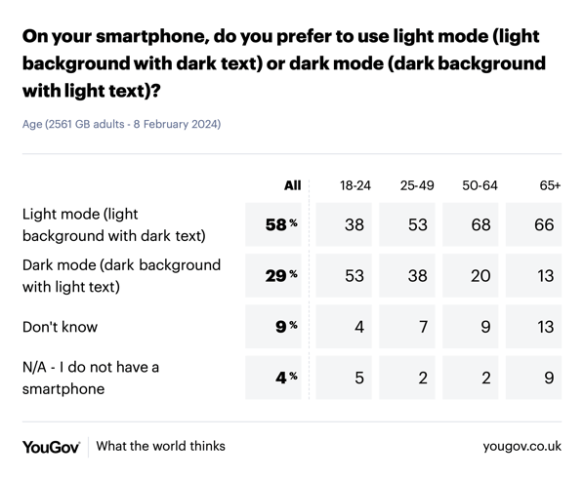
Dark mode v light mode preferences by region, gender, politics, age and social grade • YouGov

Survey result
Fascinating result: what is it about turning 25 that makes people realise dark mode is bad, do you think? (Amusingly the tweet from YouGov uses an image in dark mode.)

unique link to this extract


Apple is developing foldable clamshell iPhones, reports The Information • Reuters

»

Apple is building prototypes of at least two iPhones that fold widthwise like a clamshell, The Information reported on Wednesday, citing a person with direct knowledge of the situation.

The foldable iPhones are in early development and are not on the company’s mass production plans for 2024 or 2025, according to the report.

Apple recently approached at least one manufacturer in Asia for components related to two foldable iPhones of different sizes, the report said.

«

It would be amazing if Apple weren’t trying out prototypes of folding phones, but they’re really not the sort of thing you should expect to see in a year, or even two. Foldables are about 1% of smartphone sales (and hence about 0.2% of the installed base), and will stay there unless Apple jumps in.

Notable though that The Information is specific about it being a widthways fold – which means like a flip phone, if I’m interpreting it correctly, rather than lengthways which would be like a phone that folds out into a tablet.
unique link to this extract


China on cusp of next-generation chip production despite US curbs • FT

Qianer Lu:

»

China’s national chip champions expect to make next-generation smartphone processors as early as this year, despite US efforts to restrict their development of advanced technologies.

The country’s biggest chipmaker SMIC has put together new semiconductor production lines in Shanghai, according to two people familiar with the move, to mass produce the chips designed by technology giant Huawei.

That plan supports Beijing’s goals of chip self-sufficiency, with President Joe Biden’s administration tightening export restrictions for advanced chipmaking equipment in October, citing national security concerns. The US has also been working with the Netherlands and Japan to block China’s access to the latest chip tools, such as machines from the Dutch maker ASML.

According to two people with knowledge of the plans, SMIC is aiming to use its existing stock of US and Dutch-made equipment to produce more-miniaturised 5-nanometre chips. The production line will make Kirin chips designed by Huawei’s HiSilicon unit and destined for new versions of its premium smartphones.

While 5nm chips remain a generation behind the current cutting-edge 3nm ones, the move would show China’s semiconductor industry is still making gradual progress, despite US export controls.

“With the new 5nm node, Huawei is well on track to upgrade its new flagship handset and data centre chips,” said one person familiar with the plans.

Huawei had surprised the industry and analysts with its advances when its Mate 60 Pro premium smartphone launched in August featuring a 7nm processor. The phone helped it to increase shipments in China by nearly 50% in the fourth quarter, according to Canalys research, as it proved a big hit with consumers.

«

5nm will probably suffice for a few years yet, though SMIC’s/China’s real problem here is volume: it’s all well and good producing enough for Huawei, but can it make enough chips to satisfy every Chinese smartphone maker if, by some ill fortune (or American manoeuvring) it gets cut off from TSMC’s output?
unique link to this extract


Wearing Apple Vision Pro with glasses works, but it’s risky • UploadVR

Kyle Riesenbeck:

»

For purchase on top of the $3,500 headset, UploadVR and everyone else has been told that the only option is to buy the Zeiss-branded corrective lens inserts. This is Apple’s policy, and all of their documentation echoes this requirement.

When I eventually found myself alone with a Vision Pro, though, without the forbidding gaze of an Apple employee or anyone to tell me to stop, I tried the headset with my glasses on.

It seemed to work. It was a very snug fit with my current style of glasses, but I was able to get the headset on with my glasses firmly pressed against my face and the distance between my own lenses and the Vision Pro’s millimeters from collision. I watched as the green outlines inside Apple Vision Pro adjusted to my eyes and set up eye tracking. I had a reduced field of view as with every other VR headset I’d worn.

After I removed the headset, cleaned my smudged glasses, and put Vision Pro back on, I noticed that I did have to adjust everything a bit to get back into proper calibration. As has been my experience with every other headset, The Apple Vision Pro can be used while wearing my own glasses, though I didn’t use the headset long enough to see the impact of my glasses to Apple’s eye-tracked distortion correction.

So why even bother trying this? Apple Vision Pro isn’t a several hundred dollar headset. It’s a multi-thousand dollar headset. The gamble of scratching the lenses on such an expensive piece of hardware increases tenfold when you cram your own glasses into it. Apple’s warranty notes that it doest not apply “to damage caused by operating the Apple Product outside Apple’s published guidelines” and AppleCare+ warns it will not repair any damage caused by “abnormal or improper use”. AppleCare+ is available for the Vision Pro for $499 for two years as a supplement to the one year limited warranty. Even if AppleCare+ covered it, a repair would still cost you $299.

The Zeiss corrective inserts start at $100 and are a logical choice for your own personal device. You have to ask yourself if the costly risk of wearing your own glasses is a smarter choice than spending $150 for a pair of removable prescription inserts.

«

TL;DR I tried it but ehh not really worthwhile, so now you don’t have to ask.
unique link to this extract


Google’s Gemini AI now has a new app and works across Google products • The Verge

David Pierce on the renaming of “Bard” to “Gemini”:

»

Gemini’s mobile apps will likely be the place most people encounter the new tool. If you download the new app on Android, it can set Gemini as your default assistant, meaning it replaces Google Assistant as the thing that responds when you say, “Hey Google” or long-press your home button.

So far, it doesn’t seem Google is getting rid of Assistant entirely, but the company has been deprioritizing Assistant for a while now, and it clearly believes Gemini is the future. “I think it’s a super important first step towards building a true AI assistant,” says Sissie Hsiao, who runs Bard (now Gemini) at Google. “One that is conversational, it’s multimodal, and it’s more helpful than ever before.” 

There’s no dedicated Gemini app for iOS (and you can’t set a non-Siri assistant as the default anyway), but you’ll be able to access all the AI features in the Google app. And just to give you a sense of how important Gemini is to Google: there’s going to be a toggle at the top of the app that lets you switch from Search to Gemini. For the entirety of Google’s existence, Search has been the most important product by a mile; it’s beginning to signal that Gemini might matter just as much. (For now, by the way, Google’s in-search AI is still called Search Generative Experience, but it’s probably safe to bet that’ll be Gemini eventually, too.)

The other changes to Gemini are mostly just branding. Google is ditching the Bard name, but otherwise its chatbot will feel the way it has previously

«

Given that most searches are now done on mobile, the decision to do this on mobile first is quite telling. Google is all in on this.
unique link to this extract


Why is the $180bn games industry shedding thousands of staff? • The Guardian

Keith Stuart:

»

During lockdown, there was an explosion of interest in video games. The effect was twofold: strong sales for titles such as Animal Crossing and Call of Duty: Modern Warfare boosted revenue and sent share prices soaring, thereby attracting the attention of external investors who flooded the industry with funds. In response, hubristic publishers commissioned more ambitious projects, hiring accordingly.

But the bubble didn’t last. With lockdowns easing, sales fell as people got on with their lives. “We’ve seen a number of games cancelled in recent months. I imagine a lot more were cancelled that we don’t know about,” says [editor-in-chief of gameindustry.biz, James] Batchelor. “If you’re cancelling a project and focusing on a handful of games that you know are going to do well for your studio, unfortunately that puts jobs at risk for the people attached to those projects that are getting scrapped.”

Colin Macdonald is a veteran game developer and now director of Games Jobs Live, an industry recruitment platform. He sees a combination of three key factors behind many of the job losses: revenue projection corrections, raised interest rates and high inflation. “These three themselves are linked,” he says. “While many of the revenue projection corrections came from the delayed realisation that the Covid bubble was just a bubble, recent inflation levels have outstripped industry growth (and pushed costs up), as well as forcing interest rate increases, which put pressure on everyone accustomed to the financing available when more traditional forms of investment weren’t providing good returns.”

«

Easy to think of the pandemic as being well in the rear view mirror, but the whiplash continues, along with the effects (perhaps bigger) of the end of zero interest rates.
unique link to this extract


Android users in Singapore to be blocked from installing unverified apps • The Straits Times

Osmond Chia:

»

Android users here will be blocked from installing apps from unverified sources, a process called sideloading, as part of a new trial by Google to crack down on malware scams.

The security tool will work in the background to detect apps that demand suspicious permissions, like those that grant the ability to spy on screen content or read SMS messages, which scammers have been known to abuse to intercept one-time passwords.

Singapore is the first country to begin the gradual roll-out of the security feature over the next few weeks, done in collaboration with the Cyber Security Agency of Singapore, according to a statement on Feb 7 by Google, which develops the Android software.

The update will progressively arrive on all Android users’ devices and will be enabled by default through Google Play Protect, said Google’s director of android security strategy Eugene Liderman…

…Sideloaded apps can come in the form of apps used by overseas businesses that do not use the Google ecosystem, to device customisation tools and free versions of paid apps. But users have also been tricked into installing apps that allow fraudsters to spy on their devices and enter their bank accounts.

In a malware scam, victims are typically directed to download an Android package kit file through such websites or messaging apps to receive gifts or deals. This was the mode of operations employed in major malware scam campaigns to hijack victims’ devices and steal their money.

More than 1,400 victims fell prey to malware scams between January and August, with total losses amounting to at least $20.6m, the police said.

«

Somewhere in Apple’s headquarters someone is printing out this story and putting it into the growing folder called “yeah we warned you European Union with your Digital Markets Act stuff but would you listen? Would you?”
unique link to this extract


• Why do social networks drive us a little mad?
• Why does angry content seem to dominate what we see?
• How much of a role do algorithms play in affecting what we see and do online?
• What can we do about it?
• Did Facebook have any inkling of what was coming in Myanmar in 2016?

Read Social Warming, my latest book, and find answers – and more.


Errata, corrigenda and ai no corrida: none notified
Start Up No.2163: TikTok’s language accelerator, no toothbrush botnet, paper mills and fake peer reviews, FTC nips at Microsoft, and more


The Moon is shrinking. Should you be worried? If you’re an astronaut looking to land there, then perhaps yes. CC-licensed photo by Sara Hathaway on Flickr.

You can sign up to receive each day’s Start Up post by email. You’ll need to click a confirmation link, so no spam.


There’s another post coming this week at the Social Warming Substack on Friday at 0845 UK time. Free signup.


A selection of 10 links for you. It’s up there. I’m @charlesarthur on Twitter. On Threads: charles_arthur. On Mastodon: https://newsie.social/@charlesarthur. Observations and links welcome.


TikTok is full of made-up slang and trendbait • Vox

Rebecca Jennings:

»

Right now, language is exploding on TikTok. It is kind of beautiful until you understand why. With every scroll, new terms compete for space in your brain: “orange peel theory,” “microcheating,” “girl hobby,” “loud budgeting,” “75 cozy.” They are funneled into the collective consciousness not because they are relevant or necessary but because random people have made videos inventing these terms in the hope that the wording will go viral. The other day, I saw one where a guy was like, “Does anyone else just love a ‘dinner and couch’ friend? Like, you just have dinner and then you sit on the couch?” The video currently has more than 100,000 likes and 600 comments. He then repeats the term as if to drill into the audience that this is a phenomenon that deserves its own designation: “dinner and couch friend.” Fascinating!

There is a case to be made that the constant stream of phrases vying to become widely used slang exemplifies a deep appreciation for language among the extremely online, or a desire to connect over the intricacies of the human experience. Perhaps you, too, can relate to the concept of “polywork” (that is, working multiple jobs) or having been raised by a diet-obsessive “almond mom.” Maybe this guy’s video coining the term “weekend effect” to describe the feeling of wasting your Saturdays and Sundays really speaks to you; maybe “first time cool syndrome” is something you’ve personally overcome.

But chances are, either you have never heard of any of these terms or you have heard of so many that you are starting to become a little bit fatigued by them. It is not novel to note that TikTok has sped up the trend cycle, creating incentives for users to remix or react to the latest viral video and forget about it once it’s no longer a reliable source of views. What this has wrought is a graveyard of microtrends and niche aesthetics for people to try on, care about only to the extent that they generate attention, and then discard for the next thing (who even talks about “e-girls” or “goblin mode” anymore?). And over the past few years, TikTokers have clamoured to coin the next new trend.

«

The internet accelerating language? Predictable enough, I suppose.

unique link to this extract


Platformer’s Casey Newton on leaving Substack and surviving the great media collapse • The Verge

Nilay Patel interviews Newton, who has a three-person team (including himself):

»

As somebody who’s very nervous about the state of media, I would like to get a lot more money in the bank. I don’t think most media businesses work by wanting to have someone’s entire salary in the bank before they hire them, but that’s basically how I think about it. I do think that we could get there with Platformer this year, but I’m trying to spend a lot of time thinking about, “Okay, well, what does it mean when that person shows up? What do I actually want them to contribute to the business?” One of the amazing things about hiring Zoe was that she joined right when Elon [Musk] was buying Twitter. She broke and helped me to break a bunch of stories about that takeover, and that generated hundreds and hundreds of new subscriptions for us at Platformer. And for a very tiny media company, that is important that the people that you are hiring are creating the conditions for you to be able to continue paying them.

I understand why a lot of reporters don’t want to be in that position. I think you and I both wanted to live in a world where reporters could just roam free, write whatever they wanted, and it would all just work out in the end. And I think for a long time, it did. I think we’re now in this worse world, where, in order for the media businesses to work, whatever you’re reporting and writing, somebody has to want to pay you $10 a month or $100 a year to read it. So I’m happy with the state of things for us, but I also acknowledge this is not the ideal state of tech media.

«

unique link to this extract


Why scientists are starting to worry about the moon shrinking • The Washington Post

Kasha Patel:

»

“A concept that I think that many people have is that the moon is this geologically dead body, that something on the moon never changes,” said lunar geologist Tom Watters. But “the moon is a seismically active body.”

Studies of moonquakes date back to the Apollo era. More than 50 years ago, astronauts placed seismometers around the near side of the moon’s surface to record trembles. The most powerful shallow quake was located near the south pole, which is near landing spots for NASA’s Artemis III mission to send people back to the moon, potentially in 2027. The lunar south pole region is enticing because it contains permanently shadowed regions that some speculate could have water-based ice.

In a new study, Watters and his colleagues state that this powerful quake is tied to a group of currently seismically active faults, which were created as the moon has shrunk. Quakes in the area could trigger landslides from loose rocks and dust from surrounding craters, according to models.

Other researchers say we still don’t have enough information to determine hazardous places to land on the moon.

The moon’s shrinking has been measurable, but small. It has contracted about 150 feet in diameter over the last few hundred million years. Much of the shrinking is driven by natural cooling of our moon’s molten core. As the core cools, the moon’s surface contracts and adjusts to the change in volume. As it shrank, portions of the crust pushed together to form ridges known as thrust faults.

«

OK, I thought I ought to be worried about the shrinking moon, but now I’m not.
unique link to this extract


Scientist discovers fake peer reviewing of scientific articles • Observant Online

Maurice Timmermans:

»

For journals, who set up the peer reviews, it is not easy to find reviewers. It takes time and many scientists would prefer to work on their own research than assessing other people’s articles. That is why journals often ask the author to come up with suitable candidates.

Bouter: “That may sound strange, but researchers know their own field of specialisation best. They also know who is knowledgeable in their subject field. At the same time, a lot can go wrong.”

It is true that some authors give the names of colleagues – sometimes heavyweights – but they don’t always add their real e-mail addresses, but made-up ones. The review request from the journal never reaches the colleague, but appears in the author’s inbox. Who subsequently writes a glowing assessment of his own work.

It also happens that researchers write fake reviews in which they emphatically advise the author to include in the manuscript references to articles written by the reviewer. That appears to be the case in the abuse exposed by the Spanish professor Angeles Oviedo-Garcia. She discovered a total of 85 articles in which a group of ten scientists (from five universities) reviewed manuscripts in order to inflate the number of references to their own works. The more references to your publications, the greater your prestige as a scientist.

The reviews themselves carried little weight and were filled with standard texts, in which reviewers (and possibly also ChatGPT) make empty suggestions about paragraphs being too long or too detailed. Bouter: “It reminds me of something we have known for quite some time: citation cartels. Here too, scientists agreed to refer to each other’s articles. Except that this was not always accompanied by fake reviews.” 

«

Make something – such as getting scientific research published – a KPI (key performance indicator) and people will game it.
unique link to this extract


Fake research papers flagged by analysing authorship trends • Nature

Dalmeet Singh Chawla:

»

Paper mills are a growing problem for publishers — according to one estimate, around 2% of all published papers in 2022 resembled studies produced by paper mills — and in recent years publishers have stepped up efforts to tackle them.

As well as being of poor quality, often containing made-up data and nonsensical text, the articles that paper mills churn out are frequently padded with researchers who buy authorship on manuscripts already accepted for publication. Some paper mills claim to have brokered tens of thousands of authorships — including in journals that are indexed in respected databases, such as Web of Science and Scopus.

This can create unusual patterns of co-authorship and networks of researchers that are different from those in legitimate research, says Simon Porter, vice-president for research futures at Digital Science.

Under normal circumstances, “you would expect to find behaviour where a young researcher is publishing with their supervisor, and starts to branch out a little later and publish with other people”, Porter says. “You can see an evolution; it’s not a random network.”

This is not the case with paper-mill works. The technology that Porter and his colleagues developed searches for trends that indicate paper-mill activity. These include co-author networks composed of early-career researchers who suddenly have a spike in publications, and papers featuring several authors who have no publication history or a collection of collaborators who are unlikely to have worked together, such as authors from several locations or unrelated disciplines.

When they compared the new technique’s results with those of the Problematic Paper Screener, a tool that searches for tortured phrases and other red flags, Porter and colleagues identified a significant overlap. Around 10% of authors were directly flagged by both tools, their study found, and 72% of authors in the ‘author networks’ data set can be linked through co-authorship to those in the ‘tortured phrases’ data set.

«

Another version of “make something a KPI, and people will distort their behaviour to game it.”
unique link to this extract


Judge rules against users suing Google and Apple over “annoying” search results • Ars Technica

Ashley Belanger:

»

Users had argued that Google struck a deal making its search engine the default on Apple’s Safari web browser specifically to keep Apple from competing in the general search market. These payments to Apple, users alleged, have “stunted innovation” and “deprived” users of “quality, service, and privacy that they otherwise would have enjoyed but for Google’s anticompetitive conduct.” They also allege that it created a world where users have fewer choices, enabling Google to prefer its own advertisers, which users said caused an “annoying and damaging distortion” of search results.

In an order granting the tech companies’ motion to dismiss, US District Judge Rita Lin said that users did not present enough evidence to support claims for relief. Lin dismissed some claims with prejudice but gave leave to amend others, allowing users another chance to keep their case—now twice-dismissed—at least partially alive.

Under Lin’s order, users will not be able to amend claims that Google and Apple executives allegedly sealed the default search deal on the condition that Apple would not create its own general search engine through “private, secret, and clandestine personal meetings.” Because plaintiffs showed no evidence pinpointing exactly when Apple allegedly agreed to stay out of the general search market, these meetings, Lin reasoned, could just as easily indicate “rational, legal business behavior,” rather than an “illegal conspiracy.”

Users attempted to argue that Google and Apple intentionally hid these facts from the public, but Lin wrote that their “conclusory and vague allegations that defendants ‘secretly conducted meetings’ and ‘engaged in conduct to obfuscate internal communications’ are plainly insufficient.”

«

The complaint is pretty weak sauce. It claims that “Apple was a major potential threat to Google” in search and that Google paid and pays its billions for default search placement to keep Apple out of that space. This seems unlikely; Apple thought that making its own maps was worthwhile, but that consumes vast (but, to Apple, tolerable) amounts of money. Search would cost far more, and gain what?
unique link to this extract


Microsoft’s recent layoffs contradict what the company promised of its merger, says FTC • The Verge

Lauren Feiner:

»

Microsoft’s recent layoffs contradict what the company promised of its merger, the FTC says.The Federal Trade Commission complained to a federal appeals court on Wednesday that Microsoft’s layoff of 1,900 employees in its video games division went against its representations in court as it fought to acquire Activision Blizzard.

The move undermines Microsoft’s claims that the companies would continue to operate independently, the FTC said, and will make it harder to get “effective relief” if the agency succeeds in its administrative proceeding.

«

Well exactly. “We’re not going to lay people off! They’ll operate independently!” *Takes over company, fires loads of people* “What’s wrong??”
unique link to this extract


Kara Swisher: how Silicon Valley tech bros ruined media • NY Mag

Kara Swisher:

»

In 1995, a quirky programmer in San Francisco named Craig Newmark started emailing friends a list of local events, job opportunities, and things for sale. The next year, he turned Craigslist into a web-based service and eventually started expanding it all over the country and the world.

It was clear this list was a giant killer, and I told everyone who would listen to me at the Post that we needed to put all the money, all the people, and all the incentives into digital. I insisted that the bosses had to make readers feel like digital was the most important thing. But the bosses never did because the business they knew was the physical paper. I relayed my worries about the turtle pace of digital change many times to the Washington Post Company’s affable CEO, Don Graham, the son of legendary publisher and surprisingly entertaining badass Katharine Graham. Don Graham was inexplicably humble and even sheepish about his power. The very worst thing that Graham — always apologetic for having interrupted me, as I strafed big retail advertisers in my stories about the sector’s decline locally — would say to me was “Ouch.” Then he would saunter away from my desk with a jaunty wave. And while Graham was interested when I talked about what Newmark was doing, he laughed when I told him that Craigslist would wipe out his classifieds business.

“You charge too much, the customer service sucks, it’s static, and most of all, it doesn’t work,” I lectured him about this business, which was crucial to his bottom line. “It will disappear as an analog product, since it is a perfect target for digital destruction. You’re going to die by the cell and not even know it until it’s over and you’re dead on the ground.”

Don smiled at me with a kindness I certainly did not deserve at that moment. “Ouch,” he said.

«

As Swisher points out, other journalists not in tech were dismissive of this new space: “I guess you’ll be covering CB radio,” one media reporter says to her. (From Swisher’s forthcoming book “Burn Book”.)
unique link to this extract


The Messenger shut down: behind Jimmy Finkelstein’s site’s implosion • The Hollywood Reporter

Lachlan Cartwright:

»

Less than a year after making wild predictions of generating $100m in revenue by attracting 100 million readers with a newsroom of 550 journalists, The Messenger has crashed and burned in spectacular fashion, leaving in its wake 300 staffers tossed to the media scrapheap without severance or health insurance in a failure that marks the end of the splashy media startup era. The money owed to freelancers and vendors is expected to balloon out to seven figures, The Hollywood Reporter has learned.

…On the business side, [Finkelstein] linked back up with former Condé Nast Media Group president Richard Beckman, who had been president of The Hill before Finkelstein sold it to Nexstar for $130m in 2021, and who was given the nickname “Mad Dog” by former Condé Nast CEO Steve Florio, due to his hard-charging — and at times out of control — nature.

…Condé Nast was forced to pay a reported multimillion-dollar settlement after Beckman, as a joke, tried to force two female employees to kiss, slamming one woman’s head into the other’s forehead and leaving one executive with a broken nose.

…Former staffers tell THR that Beckman displayed a complete lack of understanding about digital media and showed little interest in learning or taking input from the team of talented staff he hired. Worse still, those that worked with him say he was stuck in a bygone era, circa Condé Nast in the 1990s, believing he could secure million-dollar deals from advertisers. “If you were trying to comment on something or tell him something, he would cut you off and say, ‘Do not open your mouth, I don’t wanna hear it’ and then go on long tirades about his brilliance,” another former staffer says.

Ultimately, Beckman and Finkelstein, who were both paying themselves seven-figure salaries and spent big on multiple offices in three cities, failed to generate revenue streams or communicate a coherent business strategy to staff. Just how do you monetise commodity news that at times appeared to be a poor man’s Daily Mail online, without the sexy photos and sidebar of shame?

«

Toxic people. And yet, despite all their hubris, one suspects they will somehow appear again, with other people’s money in their pockets, on a stage proclaiming a new venture.
unique link to this extract


Holes appear in internet-connected toothbrush botnet warning • Data Breach Today

Mathew Schwartz:

»

The viral story originated in Swiss German-language daily newspaper Luzerner Zeitung. On Jan. 30, the paper set this scene: A woman blissfully brushes away, oblivious to the fact that her internet-connected toothbrush has been infected with malware, making it moonlight as one of millions of other toothbrushes controlled by a botnet, which the toothbrushes collectively harness to bring the website of an unsuspecting Swiss firm to its digital knees.

The story – as machine-translated by Google – claims “this actually happened” and quotes Switzerland-based Stefan Züger, Fortinet’s director of systems engineering, as saying: “Every device that is connected to the internet is a potential target – or can be misused for an attack.”

The report arrives on the heels of high-profile nuisance attacks against Switzerland’s federal government, based in Bern. The attacks last month were apparently timed to coincide with Ukrainian President Volodymyr Zelenskyy’s attendance at the annual World Economic Forum meeting in Davos.

The self-proclaimed Russian hacktivist group NoName057(16), aka NoName, claimed credit for the DDoS attacks, which the Luzerner Zeitung report referenced.

Whether or not a single smart toothbrush has ever been remotely compromised – never mind three million of them – remains to be seen, especially since no such devices appear to be designed to directly connect to the internet.

But NoName, which closely aligns itself with Moscow and may be run by Russia’s intelligence apparatus – is not letting the dust settle on this dental drama. British cybersecurity expert Kevin Beaumont spotted the group asking its followers via Telegram: “Who infected thousands of ‘smart’ toothbrushes with our software?”

The smart money answer remains: No one. “It takes 2 seconds to peel back the story to see if there’s anything reasonable there. There isn’t,” tweeted offensive security engineer Robert Graham.

«

I did look at the original story to try to check its veracity, but didn’t spot anything telling. Say ahhhhh. (H/t Mathew S. Yup, him.)
unique link to this extract


• Why do social networks drive us a little mad?
• Why does angry content seem to dominate what we see?
• How much of a role do algorithms play in affecting what we see and do online?
• What can we do about it?
• Did Facebook have any inkling of what was coming in Myanmar in 2016?

Read Social Warming, my latest book, and find answers – and more.


Errata, corrigenda and ai no corrida: none notified

Start Up No.2162: the uneconomic creator economy, journalism’s market failure, Taylor Swift’s jet angst, 23andZero?, and more


Did you buy a smart internet-connected toothbrush? Perhaps even now it’s DDOSing a website somewhere. CC-licensed photo by Electric Teeth on Flickr.

You can sign up to receive each day’s Start Up post by email. You’ll need to click a confirmation link, so no spam.


There’s another post coming this week at the Social Warming Substack on Friday at 0845 UK time. Free signup.


A selection of 9 links for you. Bright and clean. I’m @charlesarthur on Twitter. On Threads: charles_arthur. On Mastodon: https://newsie.social/@charlesarthur. Observations and links welcome.


The creator economy can’t rely on Patreon • Joan Westenberg

Westenberg does the maths:

»

Creators who are burned out by renting space on someone else’s platform and playing the Shopping Channel game, squeezing dollars out of sponsored promotions, eventually shift toward a direct funding patronage model.

The promise of it is certainly attractive.

But it’s just not realistic.

From Ghost to Patreon memberships and everything in between, there are more options than ever for artists, musicians, writers, and video producers to get paid directly by their audience. It’s the 1,000 true fans theory that we’ve all been sold for the past 15 years – that all you need is a strong mailing list of people who give a shit, and a healthy living will follow.

Unfortunately, a theory is all it is.

Put simply, the numbers don’t add up. Data from Patreon and Substack suggests the average conversion rate from follower to paying fan is about 5%. This means a creator would need a total fanbase of 20,000 followers to yield 1,000 paying supporters. And building a core fanbase of 20,000 engaged followers is extremely difficult in today’s crowded creative landscape.

Relying solely on organic user payments rarely provides reliable and adequate income. Creators soon discover building a subscriber base is far easier said than done. Though some succeed due to viral content or niche popularity, creators are more often stranded in the discouraging and disappointing gap between audience reach and monetisable support.

In a crowded market, the supply of content creators hoping to profit from their work directly outstrips demand. The number of YouTube channels, podcasts, Substack newsletters, and other independently produced media has exploded. The signal-to-noise ratio is utterly unhinged. Talented creators struggle to stand out and attract an audience, let alone convince fans to pay up regularly. It is statistically unlikely that any random podcast or YouTube channel will blow up in popularity to the point of replacing the creator’s working salary through direct payments.

«

*deep sigh* Did the internet make this harder, or easier?
unique link to this extract


Why does journalism seem like it’s collapsing? Call it market failure • Fast Company

Ryan McCarthy:

»

Thousands of journalists are losing jobs.

In conversations I’ve had recently, with both execs and workaday journalists like myself, people have started privately whispering two extremely grim words to describe what’s happening: market failure.

This term, normally reserved for economists and policy types, describes what happens when a free market gets so distorted that the normal rules of economics no longer apply—to the point where that market begins to exact a toll on society. Now, in the wake of this terrible year, the journalism world is starting to wonder if its market isn’t just struggling but has outright failed. And if indeed it has, no amount of hustle, innovation, or ingenuity would solve the crisis.

…So why is all of this happening at once? Ezra Klein of The New York Times posits that journalism’s “middle” is collapsing, leaving us only with large news orgs like The Times on one end and entrepreneurial Substackers on the other. Semafor editor-in-chief Ben Smith and CNN’s Oliver Darcy both point to an array of factors, including declining print and digital business and antsy billionaire owners.

None of these are sufficient to explain the sheer size of this year’s cuts. Nor can they explain why money, even large amounts of it, seems to be of no help. At the Los Angeles Times, Soon-Shiong has put nearly $1 billion into the paper since buying it in 2018, according to the company. 

For journalists at these struggling outlets, there’s another explanation. “The private market has failed,” says Matt Pearce, a reporter at the Los Angeles Times and the president of Media Guild of the West. “Part of what’s so scary is that I don’t think you can narrow it down to any one thing. It’s a multitude of things that are kind of failing simultaneously.”

Or falling precipitously. Social media traffic to news sites has been dropping for years, as platforms become actively resistant to news. Google has since become the largest driver of traffic for many big and small digital publishers. But since roughly 2022, thanks to changes in the platform’s algorithm, execs at some sites I spoke to say they’ve seen big drops in Google traffic—as much as a 40% drop almost overnight.

Imagine running a business in which one of your main modes of distribution can fall that quickly. 

«

As I said yesterday: journalism in the US is in a bad place. Not sure how things look for the UK ones, either.
unique link to this extract


Taylor Swift demands Jack Sweeney stop tracking her jet • The Washington Post

Drew Harwell:

»

Taylor Swift’s attorneys have threatened legal action against a Florida college student who runs social media accounts tracking the flights of her and other celebrities’ private jets.

Jack Sweeney, a junior at the University of Central Florida, has for years run accounts that log the takeoffs and landings of planes and helicopters owned by hundreds of billionaires, politicians, Russian oligarchs and other public figures, along with estimates of their planet-warming emissions. The accounts use publicly available data from the Federal Aviation Administration and volunteer hobbyists who can track the aircraft via the signals they broadcast.

Sweeney’s accounts fueled a free-speech debate in late 2022 when X, formerly Twitter, banned Sweeney for sharing what the platform’s owner, Elon Musk, said were his “assassination coordinates.” The accounts don’t say who travels on the aircraft or where they go once the planes land.

In December, Swift’s attorney at the Washington law firm Venable wrote Sweeney a cease-and-desist letter saying Swift would “have no choice but to pursue any and all legal remedies” if he did not stop his “stalking and harassing behavior.”

«

Can’t see Swift winning this one. She doesn’t own a social network, apart from anything.
unique link to this extract


Three million malware-infected smart toothbrushes used in Swiss DDoS attacks, causing millions in damages • Tom’s Hardware

Mark Tyson:

»

A recent report published by the Aargauer Zeitung (h/t Golem.de) says around three million smart toothbrushes have been infected by hackers and enslaved into botnets. The source report says this sizable army of connected dental cleansing tools was used in a DDoS attack on a Swiss company’s website. The firm’s site collapsed under the strain of the attack, reportedly resulting in the loss of millions of Euros of business.

In this particular case, the toothbrush botnet was thought to have been vulnerable due to its Java-based OS. No particular toothbrush brand was mentioned in the source report. Normally, the toothbrushes would have used their connectivity for tracking and improving user oral hygiene habits, but after a malware infection, these toothbrushes were press-ganged into a botnet.

Stefan Züger from the Swiss branch of the global cybersecurity firm Fortinet provided the publication with a few tips on what people could do to protect their own toothbrushes – or other connected gadgetry like routers, set-top boxes, surveillance cameras, doorbells, baby monitors, washing machines, and so on.

“Every device that is connected to the Internet is a potential target – or can be misused for an attack,” Züger told the Swiss newspaper. The security expert also explained that every connected device was being continually probed for vulnerabilities by hackers, so there is a real arms race between device software/firmware makers and cyber criminals. Fortinet recently connected an ‘unprotected’ PC to the internet and found it took only 20 minutes before it became malware-ridden.

«

unique link to this extract


Google Maps: new Generative AI feature coming to Local Guides • Google Blog

Miriam Daniel is VP and general manager of Google Maps:

»

Today, we’re introducing a new way to discover places with generative AI to help you do just that — no matter how specific, niche or broad your needs might be. Simply say what you’re looking for and our large-language models (LLMs) will analyze Maps’ detailed information about more than 250 million places and trusted insights from our community of over 300 million contributors to quickly make suggestions for where to go.

Starting in the U.S., this early access experiment launches this week to select Local Guides, who are some of the most active and passionate members of the Maps community. Their insights and valuable feedback will help us shape this feature so we can bring it to everyone over time.

Let’s say you’re visiting San Francisco and want to plan a few hours of thrifting for unique vintage finds. Just ask Maps what you’re looking for, like “places with a vintage vibe in SF.” Our AI models will analyze Maps’ rich information about nearby businesses and places along with photos, ratings and reviews from the Maps community to give you trustworthy suggestions.

You’ll see results organized into helpful categories — like clothing stores, vinyl shops and flea markets — along with photo carousels and review summaries that highlight why a place might be interesting for you to visit.

Maybe you also want to grab a bite to eat somewhere that keeps those vintage vibes going. Continue the conversation with a follow-up question like “How about lunch?” Maps will suggest places that match the vintage vibe you’re looking for, like an old-school diner nearby. From there, you can save the places to a list to stay organized, share with friends or revisit in the future.

«

How much would you trust this, though? (I suppose you’d have to.) Also, orthogonally: Miriam Daniel is VP *and* GM of Maps. A couple of years ago someone else was just VP. Daniel joined in 2021 with both job titles. Does she now parlay one out when someone ascends to be good enough as GM?
unique link to this extract


How AI is remodelling the fantasy home • The New York Times

Amanda Hess:

»

In recent years, a whole AI dream-house economy has materialized. Search Pinterest for décor inspiration, and you’ll find it clogged with artificial bedrooms that lead off to websites hawking cheap home accessories. “House porn” accounts on TikTok and X churn out antiseptic loft renderings and impossible views from nonexistent Parisian apartments. The website “This House Does Not Exist” generates random new homes upon command. And dozens of AI-powered design services and apps — among them SofaBrain and RoomGPT — churn out slick images tuned to your specifications.

A jangling set of house keys was once synonymous with American success: the striver’s ultimate prize. The misery produced by this idea (see: the Great Recession) has not dampened its allure. Now, thanks to elevated interest rates, insufficient supply and corporate landlords snapping up that limited housing stock, homeownership is more unrealistic than ever. AI houses just make that unreality explicit. In the virtual market, the supply is endless, and the key is always in the lock.

Housing voyeurism has always encouraged a measure of psychic projection. On TV, the celebrity house tour and the home-improvement program are older than I am. Magazines of aspirational domesticity are older still. In the 1970s, Architectural Digest transformed from a trade publication into a showcase for publicizing the private spaces of what it called “men and women of taste, discrimination and personal achievement.” In the 1980s, viewers of “Lifestyles of the Rich and Famous” were prompted to imagine how they might spend their millions if they had them.

This was the lousy trade-off of American inequality: The rich got lavish homes, and everyone else got to see the pictures, and experience the release that comes from judging all of their choices up close.

«

Now, though, they just look at AI versions.
unique link to this extract


23andMe’s fall from $6bn valuation to nearly $0 • WSJ

Rolfe Winkler:

»

With so many [about nine million] DNA samples banked, 23andMe dialled up drug development, splitting costs and future profits in a deal with pharmaceutical giant GSK for therapies discovered inside 23andMe’s database. 

Unlike most small biotechs, which focus on a few areas, 23andMe investigated treatments for dozens of diseases. The payoff could be big, but any one drug can cost hundreds of millions of dollars and take 10 years to get through clinical trials. 23andMe says it has found more than 50 “drug candidates.” So far two have made it to early-stage human trials. Later this year, data could be released that will show whether one of them works.

By 2022, the drug development effort grew to a 150-person outpost in South San Francisco, one that would carry forward research after GSK’s deal to share costs ended. Wojcicki said that she assumed she would be able to raise additional capital to support her development effort. But when that time came this year, interest rates were high and small drug-company stocks were out of favor. Unable to raise money, Wojcicki cut half the development team last summer. 

To create a recurring revenue stream from the tests, [CEO and founder Anne] Wojcicki has pivoted to subscriptions. As media companies launched streaming “+” channels, Wojcicki rolled out 23andMe+, offering personalized health reports, lifestyle advice and unspecified “new reports and features as discoveries are made” for an initial $229, with annual renewals of $69.

When the company last disclosed the number of subscribers a year ago, it had 640,000—less than half the number it had projected it would have by then. 

Asked about the projection, Wojcicki first denied having given one. Shown the investor presentation that included it, she studied the page and after a pause said, “There’s nothing else to say other than that we were wrong.” 

The idea behind 23andMe’s health data is that there may be worrisome information locked inside your genetic code that you’re better off knowing about. A small percentage of customers have a rare genetic variant increasing their risk of breast cancer, for example, and 23andMe’s test is a reliable screen that can lead to lifesaving doctor follow-ups. But most people don’t have a life-changing disease lurking in their genetic code. It’s not clear 23andMe has a compelling product worth $69 annually for either group.

«

Likely acquisition target in the next few months or so as the cash runs short.
unique link to this extract


13 Years Later • The Critic Magazine

Robert Hutton writes the Parliamentary sketch:

»

Imagine for a moment that in early 2009, crossing Westminster Bridge, you had been hit by Gordon Brown’s motorcade and put into a coma. Waking 15 years later in St Thomas’ Hospital, you wandered out and, seeing a crowd of people in tweed jackets and mustard trousers, followed them into a hall for what turned out to be the launch of the Popular Conservatives movement. 

Who, you might have thought, are these dynamic politicians? There was a comedy turn from a chap called Rees-Mogg — looks like double-breasted suits have made a comeback — and a punchy speech from someone called Liz Truss. There is an MP with a big future ahead of her, you might have told yourself. 

And they certainly had a compelling story to tell. Why, it seems that, while you were unconscious, some bunch of complete chancers had been running Britain into the ground! As speaker after speaker explained, you’d woken up in a country in which nothing worked, where taxes were too high, the government intervened in every aspect of people’s lives, and where no one could afford to pay their bills. Thank goodness, you would have thought to yourself, there was a general election around the corner, so that this rotten government could be chucked out and replaced by somebody halfway competent. You wouldn’t be surprised if that Truss got a big job. 

For those of us who arrived at the Popular Conservatives launch with the doubtful advantage of having been awake for much of the past decade, things were a little more confusing. Popular Conservatism is certainly exciting new direction for a party which has mastered the alternative. But some vital piece of the narrative was missing. 

«

Hutton always takes an acid rinse to the absurdities of the current crop of politicians, but this one was particularly abrasive about the delusions of these idiots. Truss, as a reminder, crashed the markets (and nearly destabilised the UK’s pension system) and had to resign as prime minister after 49 days, outlasted by a lettuce.
unique link to this extract


Why Quora isn’t useful anymore: AI came for the best site on the internet • Slate

Nitish Pahwa:

»

A smart and passionate community dedicated to maintaining a positive and affirmative space where the most curious netizens could gather—what sounded more ideal than that? No wonder Quora had such a growth spurt in the 2010s.

Today’s Quora, however, hardly meshes with those utopian aims. The once-beloved forum is now home to a never-ending avalanche of meaningless, repetitive sludge, filled with bizarre, nonsensical, straight-up hateful, and A.I.–generated entries along with a slurry of all-caps non-questions like “OMG! KING CHARLES SHOCK the WORLD with ROYAL BAN ON PRINCE HARRY AND MEGHAN MARKLE. SAD?” (The answer to this “question,” which garnered about 7 million views, links to a bizarre, barely functional royals-watching website called red-carpett.com.) Whereas once you could Google a question about current events and find links to thoughtful Quora answers near the top of the results, you’re now more likely to come upon, say, a bunch of folks asking in the year of our Lord 2024 whether the consistently racist Donald Trump is, in fact, racist. Or, maybe, the featured Google snippet will tell you that eggs can melt, thanks to a nonsense Quora answer caught in the search crawler.

…Quora’s shrinking utility isn’t due entirely to A.I.: Longtime writers cite issues with moderation and functionality that started well before the ChatGPT era. But its decline has been accelerating—much to the chagrin of the uniquely attached and now-fraying community—with the rise of this new knowledge broker. Earlier this month, the A.I.–accelerationist venture capital hub Andreessen Horowitz blessed Quora with a much-needed $75m investment—but only for the sake of developing its on-site generative-text chatbot, Poe.

«

Thanks for nothing, a16z. Quora has indeed become a weird place, where the good content is thinly sprinkled among the newer junk. Like the broader internet, really.
unique link to this extract


• Why do social networks drive us a little mad?
• Why does angry content seem to dominate what we see?
• How much of a role do algorithms play in affecting what we see and do online?
• What can we do about it?
• Did Facebook have any inkling of what was coming in Myanmar in 2016?

Read Social Warming, my latest book, and find answers – and more.


Errata, corrigenda and ai no corrida: none notified

Start Up No.2161: the AI networks making fake IDs, Techcrunch contracts, Amazon’s $1bn of addresses, bitcoin or bust, and more


You too could get scammed by a call purporting to be from your credit card company. How will you spot it before it happens? CC-licensed photo by frankie leon on Flickr.

You can sign up to receive each day’s Start Up post by email. You’ll need to click a confirmation link, so no spam.


There’s another post coming this week at the Social Warming Substack on Friday at 0845 UK time. Free signup.


A selection of 9 links for you. Charge it! I’m @charlesarthur on Twitter. On Threads: charles_arthur. On Mastodon: https://newsie.social/@charlesarthur. Observations and links welcome.


How I got scammed • Pluralistic

Cory Doctorow:

»

Over the Christmas holiday, I traveled to New Orleans. The day we landed, I hit a Chase ATM in the French Quarter for some cash, but the machine declined the transaction. Later in the day, we passed a little credit-union’s ATM and I used that one instead (I bank with a one-branch credit union and generally there’s no fee to use another CU’s ATM).

A couple days later, I got a call from my credit union (CU). It was a weekend, during the holiday, and the guy who called was obviously working for my little CU’s after-hours fraud contractor. I’d dealt with these folks before – they service a ton of little credit unions, and generally the call quality isn’t great and the staff will often make mistakes like mispronouncing my credit union’s name.

That’s what happened here – the guy was on a terrible VOIP line and I had to ask him to readjust his mic before I could even understand him. He mispronounced my bank’s name and then asked if I’d attempted to spend $1,000 at an Apple Store in NYC that day. No, I said, and groaned inwardly. What a pain in the ass. Obviously, I’d had my ATM card skimmed – either at the Chase ATM (maybe that was why the transaction failed), or at the other credit union’s ATM (it had been a very cheap looking system).

I told the guy to block my card and we started going through the tedious business of running through recent transactions, verifying my identity, and so on. It dragged on and on. These were my last hours in New Orleans, and I’d left my family at home and gone out to see some of the pre-Mardi Gras krewe celebrations and get a muffalata, and I could tell that I was going to run out of time before I finished talking to this guy.

“Look,” I said, “you’ve got all my details, you’ve frozen the card. I gotta go home and meet my family and head to the airport. I’ll call you back on the after-hours number once I’m through security, all right?”

«

As the headline suggests, it wasn’t all right. But you, like Cory, might find it hard at first to spot where it went wrong. Just goes to show: it can happen to any of us. But, Doctorow points out, there’s some sort of data leak going on which is making people extra vulnerable to this.
unique link to this extract


Inside the underground site where ‘neural networks’ churn out fake IDs • 404 Media

Joseph Cox:

»

An underground website called OnlyFake is claiming to use “neural networks” to generate realistic looking photos of fake IDs for just $15, radically disrupting the marketplace for fake identities and cybersecurity more generally. This technology, which 404 Media has verified produces fake IDs nearly instantly, could streamline everything from bank fraud to laundering stolen funds.

In our own tests, OnlyFake created a highly convincing California driver’s license, complete with whatever arbitrary name, biographical information, address, expiration date, and signature we wanted. The photo even gives the appearance that the ID card is laying on a fluffy carpet, as if someone has placed it on the floor and snapped a picture, which many sites require for verification purposes. 404 Media then used another fake ID generated by this site to successfully step through the identity verification process on OKX. OKX is a cryptocurrency exchange that has recently appeared in multiple court records because of its use by criminals.

Rather than painstakingly crafting a fake ID by hand—a highly skilled criminal profession that can take years to master—or waiting for a purchased one to arrive in the mail with the risk of interception, OnlyFake lets essentially anyone generate fake IDs in minutes that may seem real enough to bypass various online verification systems. Or at least fool some people.

“The era of rendering documents using Photoshop is coming to an end,” an announcement posted to OnlyFake’s Telegram account reads. As well as “neural networks,” the service claims to use “generators” which create up to 20,000 documents a day. The service’s owner, who goes by the moniker John Wick, told 404 Media that hundreds of documents can be generated at once using data from an Excel table. 

«

Totally logical development. (In passing: 404 Media is doing register-to-read, and a paywall. It’s got the potential to become a really good technology site if enough people sign up.)
unique link to this extract


TechCrunch+ termination • Lux Capital

Danny Crichton is the former managing editor of Techcrunch, which as he points out has survived where plenty of other media properties haven’t:

»

TechCrunch’s focus on startups required second-order thinking. Startup-related articles got a fraction of the readership of an article on Apple, since no one is searching on Google for the name of a startup they have never heard of before. So why bother? Indeed, many of TechCrunch’s now-dead competitors didn’t bother. The key insight though is that these articles attract the startup CEOs and founders, and it is precisely this demographic that is so valuable for advertisers. Startup coverage was a form of service journalism, and one that happened to create a perpetual revenue machine.

The other half of TechCrunch’s business is events, and namely Disrupt. Disrupt attracts around 10,000 attendees per year, and the fruits of that service journalism on startups kept on giving. Disrupt offered Founder Pass packages that were quite affordable even for the youngest companies, while charging eye-watering sums for business executives from legacy technology companies. The economic price discrimination is and was brilliant: make sure the “cool kids” are there, and then charge the so-called “grown-ups” to be around them.

TechCrunch’s events were more profitable compared to the industry norm since most of them were local to San Francisco, none of the speakers were paid, panels could be constructed by accomplished beat writers who already knew who should be there (greatly reducing the number of event planners required), and the site itself became the best advertising medium to sell tickets and sponsorships, vastly reducing marketing costs.

The unique economics for TechCrunch around advertising and events funded the organization well, but they have an obvious flaw: they don’t really scale.

«

And yet it’s also shutting down its subscription service Extra Crunch/TechCrunch+. Which struck me as odd, until I read Crichton’s description of the impossibility of finding writers to produce content for it. (Try guessing how much one feature writer demanded to write a feature. Nope, it was more than that.) Journalism in the US is in deep trouble.
unique link to this extract


Amazon finds $1bn jackpot in its 100 million+ IPv4 address stockpile • TechSpot

Zane Khan:

»

Amazon Web Services (AWS) flipped the switch on its new IPv4 address pricing scheme on February 1 as it had announced months prior. The new policy means customers will pay $0.005 per public IPv4 address per hour, a seemingly negligible amount at first glance. But dig deeper and you’ll find a billion-dollar revenue stream emerging for Amazon’s cloud division.

The tech giant first teased the pricing change last summer, positioning it as a necessity given skyrocketing demand and administrative costs for IPv4 addresses. After all, the 32-bit protocol is tapped out at around 4.3 billion unique IDs. That may sound like a lot but in an era of proliferating smart devices, we indeed are running out.

And as IDs run out, associated costs have soared. “The cost to acquire a single public IPv4 address has risen more than 300% over the past five years,” the company stated, urging users to transition to IPv6 with its vast 128-bit address pool.

But IPv4 remains widespread, and Amazon holds a trove of the sought-after addresses. An analysis by Border0 estimated Amazon controls nearly 132 million public IPv4s. Crunching some numbers, Border0 found out their eye-watering valuation – around $4.6bn based on today’s average IPv4 price tag of $35.

Of course, Amazon cannot simply cash out and offload that internet real estate. However, it can generate recurring revenue by billing active users. Border0 estimates that 30% of those IPs (79 million) are linked to income-generating AWS services. Quick calculations reveal over $1bn per year in projected revenue from this policy adjustment. Border0 concludes that Amazon could be earning between $400m to $1bn annually with these new prices. Not bad at all.

«

Owning the shovels and hiring them out really is the way to get rich in the mine.
unique link to this extract


This baby with a head camera helped teach an AI how kids learn language • MIT Technology Review

Cassandra Willyard:

»

Human babies are far better at learning than even the very best large language models. To be able to write in passable English, ChatGPT had to be  trained on massive data sets that contain millions or even a trillion words. Children, on the other hand, have access to only a tiny fraction of that data, yet by age three they’re communicating in quite sophisticated ways.

A team of researchers at New York University wondered if AI could learn like a baby. What could an AI model do when given a far smaller data set—the sights and sounds experienced by a single child learning to talk?

A lot, it turns out.  The AI model managed to match words to the objects they represent.  “There’s enough data even in this blip of the child’s experience that it can do genuine word learning,” says Brenden Lake, a computational cognitive scientist at New York University and an author of the study. This work, published in Science today, not only provides insights into how babies learn but could also lead to better AI models.

Online videos are a vast and untapped source of training data—and OpenAI says it has a new way to use it.
For this experiment, the researchers relied on 61 hours of video from a helmet camera worn by a child who lives near Adelaide, Australia. That child, Sam, wore the camera off and on for one and a half years, from the time he was six months old until a little after his second birthday. The camera captured the things Sam looked at and paid attention to during about 1% of his waking hours. It recorded Sam’s two cats, his parents, his crib and toys, his house, his meals, and much more. “This data set was totally unique,” Lake says. “It’s the best window we’ve ever had into what a single child has access to.” 

«

To “mouse with an ear on its back” we can now add “baby with a camera on its head for 18 months”. Though it’s only about 1% of the child’s waking hours. The rest of the article deals with how the researchers matched the video to the language, and it’s actually pretty interesting.
unique link to this extract


The Apple Vision Pro is spectacular and sad • The Atlantic

Ian Bogost:

»

Please do not get in the car, or try to operate any other heavy machinery, while wearing the Apple Vision Pro. The device will convince you that you can see areas beyond it, but it renders that space only as trompe l’œil. I had no trouble getting up from the couch to grab my laptop from the other room, but the world jittered in the display, sprouting fuzz around its edges. Objects throbbed in time with my footfalls. Every jostle or cough made reality shudder. This was a rapidly updating computer-desktop-background version of the world, rather than a view of things as they really are.

To stave off this nagging sense of unreality, one can select one of Apple’s built-in “environments”—virtual scenes with animation and sound—that blend in and out of view as you turn the knob on the visor’s top. Using my eyes as a mouse, I selected White Sands, a view of a turbulent sky over the gypsum dunes of southern New Mexico.

It was there, in that Oppenheimer desolation, that I hooked up the goggles to my laptop and cast my Mac display into my augmented reality as a virtual screen. Typing via finger pinches or dictation was a pain, so I used a wireless keyboard. Even that had problems. Touch-typing in that context wasn’t easy, and the writing felt out of phase. The letters on the screen appeared after a very slight delay, just enough to make it feel like my words were being pulled through a wormhole on their way into my document.

I reconnected with my editor, via Slack, inside my laptop, through my headset. This is how I’d thought the Apple Vision Pro might best be used—as a virtual office, a place to work that is an actual place and not just a little screen on a table or a desk. The posture benefits were immediate: I was sitting upright, my back against a cushion, my head straight, my eyes focused on the horizon (and the future?). I felt like an illustration in a workplace-ergonomics poster. I felt good.

But also disoriented.

«

The hot takes are cooling down now. Give it a couple of weeks and people will have gotten over the fact that this is version 1.0, and quiet down. Then spatial video of sports will start coming out (or being shared) and it will heat up again. It’s the cycle of (tech news) life.
unique link to this extract


Craig Wright’s claim he invented bitcoin a ‘brazen lie’, court told • The Guardian

Dan Milmo and agencies:

»

An Australian computer scientist’s claim to be the author of the founding text of bitcoin is a “brazen lie”, the high court has heard.

Craig Wright’s assertion that he is the pseudonymous author Satoshi Nakamoto was at the centre of a trial that began on Monday, where the 53-year-old is being sued by a group of cryptocurrency exchanges and developers.

Jonathan Hough KC, representing the Crypto Patent Alliance [Copa], told the high court that Wright’s claim was a “brazen lie and elaborate false narrative supported by forgery on an industrial scale”. Copa, which is backed by Twitter founder Jack Dorsey, is seeking a “negative declaration” that Wright is not Nakamoto.

Elements of Wright’s conduct were reminiscent of a “farce”, said Hough, including the alleged use of ChatGPT to produce forgeries to back up his claims. Nevertheless, Hough said, Wright’s insistence that he was Nakamoto – a claim he first made in 2016 – had “deadly serious” consequences for individuals who had faced legal action based on his claims.

Hough said: “On the basis of his dishonest claim to be Satoshi, he has pursued claims he puts at hundreds of billions of dollars, including against numerous private individuals.”

In written submissions, Hough added: “Dr Wright has consistently failed to supply genuine proof of his claim to be Satoshi: instead, he has repeatedly proffered documents which bear clear signs of having been doctored.”

The court heard that experts on both sides agreed that the original white paper was written on OpenOffice software. But the version provided by Wright was created on software called LaTeX, Hough told the court.

«

Certainly going to be one to watch: will Wright somehow have to prove that he is Nakamoto? Wright has certainly spent a lot of money on pricey lawyers in the past few years.
unique link to this extract


Why some states are requiring ID to see adult content, porn online • The 19th

Jasmine Mithani:

»

Age verification laws are the “latest strategy in a long battle” against pornography, said Kelsy Burke, professor of sociology at University of Nebraska at Lincoln and author of “The Pornography Wars: The Past, Present, and Future of America’s Obscene Obsession.”

“Over the past couple hundred years, conservatives have used various arguments to talk about why porn is bad for us,” Burke said. “Conservatives think they can gain some traction with broader publics by saying that kids are accessing porn, and that’s why we need to stop them.”

There is widespread consensus among politicians, parents, sex workers, the Supreme Court and the general population that minors should not be allowed to engage with explicit content. 
“One of the things that’s important to point out is that it is already illegal to distribute sexual material to minors,” Burke said. “So in some ways, these age verification laws are attempting to provide a mechanism to enforce laws that are already out there.”

There are several ways adult content is restricted on the internet, but they are imperfect. Some adult sites ask users to affirm they are over 18 via a pop-up, but the self-reported information is never confirmed. Search engines and devices have content filtering enabled for adult websites, but device-level restrictions are not enabled by default.

The current tools require parents to be involved decision makers in the kind of content their kids are able to view, said Burke.

If parents don’t do that, then the tools remain ineffective. Content filters and device settings also require a certain level of technical ability to set — and often kids can be more technologically fluent than their parents.

«

Sounds like the methods for “enforcement” are about as unsophisticated as you can imagine.
unique link to this extract


Exploring Reddit’s third-party app environment seven months after the APIcalypse • Ars Technica

Scharon Harding:

»

After speaking with developers, a few trends stand out. There’s annoyance among app users over pricing changes, but users are still jumping from popular closed [ie shuttered] apps to apps that are still available, underscoring the enduring demand for third-party apps. Some devs are trying to mollify users by offering pricing tiers that don’t pay for themselves, hoping that things balance out through other paying users.

There is also trepidation around how long third-party Reddit apps will keep existing. While some are currently profitable, developers are aware that Reddit can change the rules again at any time. Reddit says its goal isn’t to kill third-party apps, but it’s apparent that third-party apps aren’t a business priority. Still, some developers are finding value in building apps that work on top of, instead of in lieu of, native Reddit platforms.

Meanwhile, there’s not a huge incentive for developers to make third-party Reddit apps. There haven’t been significant updates about Reddit’s developer platform, and devs I spoke to aren’t making enough money with their apps to quit their day jobs. Most are working out of personal interest in app development and making Reddit better to use. If Reddit were to make things more complicated or expensive for developers, even more could throw in the towel.

In December, The Information reported that Reddit’s ad revenue was expected to grow over 20% in 2023. However, this was still reportedly less than Reddit anticipated for the year, so you can expect the company to expand efforts that grow its ad business, especially as it strives to turn a profit and prepare for a 2024 IPO.

«

unique link to this extract


• Why do social networks drive us a little mad?
• Why does angry content seem to dominate what we see?
• How much of a role do algorithms play in affecting what we see and do online?
• What can we do about it?
• Did Facebook have any inkling of what was coming in Myanmar in 2016?

Read Social Warming, my latest book, and find answers – and more.


Errata, corrigenda and ai no corrida: none notified

Start Up No.2160: Brianna Ghey’s killers and the dark web, Vision Pro launches, the video deepfake call that cost $25m, and more


One of the longest-running disputes in video games, over a Donkey Kong record, has finally been settled. CC-licensed photo by Microsiervos on Flickr.

A selection of 9 links for you. What about a medium score? I’m @charlesarthur on Twitter. On Threads: charles_arthur. On Mastodon: https://newsie.social/@charlesarthur. Observations and links welcome.


Brianna Ghey’s killers and the dark net’s ‘red rooms’ • How To Survive The Internet

Jamie Bartlett:

»

the dark net is often a little misunderstood. The same privacy enhancing and censorship resistant design that protects the bad stuff also helps the good guys. The Tor browser has won a lot of awards for helping journalists stay safe and encouraging greater privacy. I use it for my work all the time. There are several whistleblower sites on the dark net, and even the BBC has a presence there, designed for people worried about government monitoring.

Finally, although the dark net generates headlines, there is just as much bad stuff on the normal internet. Drugs and stolen data are easy enough to get through Telegram and other popular messaging apps; self-harm and self-hate content circulates widely on Instagram, TikTok and Pinterest; videos of people dying can be viewed on Twitter with a simple search.  

Dark net misbehaviour is still rare – red rooms [showing live streams of torture and even murder, which Ghey’s female killer is claimed to have viewed] rarer still. If I were worried about my kids getting up to no good online, the dark net wouldn’t be my main concern. It would be algorithms pushing self hate on a friendly looking social media platform.  

Nevertheless, it’s obvious that people – including young people – will be drawn to the dark net.  Spending years there hasn’t made me want to self-harm, watch murder videos, or bully someone anonymously. But I have become accustomed and habituated to horrible and troubling things. I’ve seen how quickly and easily people can get sucked into very dark and destructive places. If I had a propensity towards any of these behaviours, perhaps it would have encouraged me. It certainly plausible that ‘Girl X’ became highly de-sensitised to murder and torture if she saw a lot of it online.

In the end, parents have a duty to understand these kinds of subcultures – both on the dark net and the normal net. If you see your kids on the dark net or using Tor, it doesn’t mean they have done anything wrong. Have an open and honest chat about it.

«

Easier said than done, to be honest, but children will at least listen if you’ve made the effort. The calls by Mrs Ghey to suppress social media for the under-16s is a cry of pain, but you can also understand why. Sadly, we’ve seen through history that some children don’t need the internet to become desensitised to the idea of killing another.
unique link to this extract


Vision Pro launch: all the news about Apple’s pricey new headset • The Verge

Emma Roth:

»

Apple’s Vision Pro is finally here. Tim Cook arrived at Apple’s Fifth Avenue store in New York City to greet the crowd of customers at the doors who were waiting to try out the headset or buy one for themselves.

The Vision Pro is Apple’s take on a mixed-reality headset, which, according to our review, ”feels like magic when it works and frustrates you completely when it doesn’t.” There are more than 600 apps for the headset that take advantage of its key features, such as video passthrough and spatial audio.

Apple has started letting people demo the $3,499 headset at its stores on a first-come, first-served basis, but it’s also giving customers the chance to reserve time for a demo starting on Monday, February 5th. Along with the launch of the headset, we’re learning more about the apps coming to the Vision Pro — ranging from the dozens of 3D movies Disney is offering on the app to an unofficial YouTube app.

Here’s everything that went down following the launch of the Vision Pro.

«

Once you get past the ordinary stuff, you get to the people DRIVING THEIR CARS while wearing these things. Frankly, quite glad that it’s only available in the US for a while.
unique link to this extract


The end of the social network • The Economist

»

The striking feature of the new social media is that they are no longer very social. Inspired by TikTok, apps like Facebook increasingly serve a diet of clips selected by artificial intelligence according to a user’s viewing behaviour, not their social connections. Meanwhile, people are posting less. The share of Americans who say they enjoy documenting their life online has fallen from 40% to 28% since 2020. Debate is moving to closed platforms, such as WhatsApp and Telegram.

The lights have gone out in the town square. Social media have always been opaque, since every feed is different. But TikTok, a Chinese-owned video phenomenon, is a black box to researchers. Twitter, rebranded as X, has published some of its code but tightened access to data about which tweets are seen. Private messaging groups are often fully encrypted.

Some of the consequences of this are welcome. Political campaigners say they have to tone down their messages to win over private groups. A provocative post that attracts “likes” in the X bear pit may alienate the school parents’ WhatsApp group. Posts on messaging apps are ordered chronologically, not by an engagement-maximising algorithm, reducing the incentive to sensationalise. In particular, closed groups may be better for the mental health of teenagers, who struggled when their private lives were dissected in public.

In the hyperactive half of social media, behaviour-based algorithms will bring you posts from beyond your community. Social networks can still act as “echo chambers” of self-reinforcing material. But a feed that takes content from anywhere at least has the potential to spread the best ideas farthest.

Yet this new world of social-media brings its own problems. Messaging apps are largely unmoderated. For small groups, that is good: platforms should no more police direct messages than phone companies should monitor calls. In dictatorships encrypted chats save lives. But Telegram’s groups of 200,000 are more like unregulated broadcasts than conversations. Politicians in India have used WhatsApp to spread lies that would surely have been removed from an open network like Facebook.

«

Wouldn’t be so sure about political lies being removed from Facebook in India, unless they were by the opposition.
unique link to this extract


Sunak to drop heat pump targets in fresh retreat from Net Zero • FT

Jim Pickard:

»

Rishi Sunak is poised to drop plans to fine boiler makers who fail to meet strict production targets for heat pumps in the UK prime minister’s latest retreat from measures to tackle climate change

Industry bosses have been lobbying Whitehall to delay or scrap the policy, arguing that the quotas are unrealistic given sluggish demand for heat pumps and a shortage of installers. 

The new system set to launch in April would force big boiler companies to ensure heat pumps account for 4% of their total boiler unit sales, or be penalised £3,000 for every item by which they fall short.

Companies have claimed that the target was already forcing them to put up prices on their gas boilers by as much as £125 in anticipation of having to pay the fines. 

The government has argued that heat pumps already make up around 4% of most businesses’ production total. However, in the second year of the scheme that target would rise to 6%.

In December, Claire Coutinho, energy secretary, accused the companies of “price gouging”, arguing that it was “extremely unlikely” any of them would have to pay fines. 

However, Coutinho is now poised to decide on whether to maintain the target, according to a Sunday Times report. She is inclined to drop it in the coming weeks, although details have not yet been finalised, according to government figures.

«

Every time there’s a chance to make things worse, this government picks it. Given the possibility of ladders, they always find the snakes.
unique link to this extract


Finance worker pays out $25m after video call with deepfake ‘chief financial officer’ • CNN

Heather Chen and Kathleen Magramo:

»

A finance worker at a multinational firm was tricked into paying out $25m to fraudsters using deepfake technology to pose as the company’s chief financial officer in a video conference call, according to Hong Kong police.

The elaborate scam saw the worker duped into attending a video call with what he thought were several other members of staff, but all of whom were in fact deepfake recreations, Hong Kong police said at a briefing on Friday.

“(In the) multi-person video conference, it turns out that everyone [he saw] was fake,” senior superintendent Baron Chan Shun-ching told the city’s public broadcaster RTHK.

Chan said the worker had grown suspicious after he received a message that was purportedly from the company’s UK-based chief financial officer. Initially, the worker suspected it was a phishing email, as it talked of the need for a secret transaction to be carried out.

However, the worker put aside his early doubts after the video call because other people in attendance had looked and sounded just like colleagues he recognized, Chan said.

Believing everyone else on the call was real, the worker agreed to remit a total of $200m Hong Kong dollars – about $25.6m, the police officer added.

The case is one of several recent episodes in which fraudsters are believed to have used deepfake technology to modify publicly available video and other footage to cheat people out of money.

At the press briefing Friday, Hong Kong police said they had made six arrests in connection with such scams.

«

Did the arrested people appear on video? Or were they shown in photographs? True Keyzer Soze stuff.
unique link to this extract


Short on cash, El Salvador doubles down on Bitcoin dream • Reuters

Sarah Kinosian and Nelson Renteria:

»

El Salvador’s economy is mostly stagnant and posts the slowest economic growth in Central America. Extreme poverty has doubled since 2019 and almost half the population lives with food insecurity.

“It’s unusual for someone to use bitcoin,” said Kevin Valle, 24, a Salvadoran produce vendor in Berlin’s main market. “What I can say is the cost of my tomatoes and onions has doubled, and people are worried about low employment and salaries.”

In 2022 the country’s public debt hit a 30-year record at $25bn. After initial negotiations with the IMF for a billion-dollar deal fell apart earlier in his first term, [president Nayib] Bukele’s government has since gone back to the table, and even hired the IMF’s former Western Hemisphere director last April.

The IMF has recommended El Salvador remove bitcoin’s legal tender status during negotiations over financial support. The Fund did not respond to request for comment.

But the 42-year-old firebrand’s resolve has been stiffened by Bitcoin’s recent rally. The cryptocurrency’s comeback has pushed El Salvador’s alleged investments – no one really knows the size of its holdings – into the black.

‘Nayibtracker.com,’ an unofficial website tracking El Salvador’s bitcoin portfolio based on Bukele’s social media, puts it at $121.6m on an initial $119.8m investment, a 1.5% return.

After a recent announcement by the U.S. Securities and Exchange Commission (SEC) to allow U.S.-listed exchange-traded funds (ETFs) that track bitcoin, Bukele’s vice president told Reuters the government will be doubling down on its crypto law in a second term.

The country’s adoption of the cryptocurrency alongside the dollar is largely not to blame for the overall state of the economy, say some economists, who point to low foreign direct investment and government overspending. But amid questions over state spending habits and a clear liquidity problem, critics note bitcoin has yet to bring significant benefit.

«

Still impossible to know whether bitcoin is just a distraction for El Salvador.
unique link to this extract


What happens when an amateur cyclist rides the entire Tour de France route • Outside Online

Alex Hutchinson:

»

The 2000s-era reality show Pros vs. Joes was a great concept, but it didn’t give recreational endurance athletes much to fantasize about. Getting struck out by Darryl Strawberry or dunked on by Dennis Rodman is one thing, but how about trying to reel in a breakaway by Jonas Vingegaard after cycling hundreds of miles?

That’s not quite what a new paper in the Journal of Applied Physiology offers, but it’s the closest scientific equivalent. Researchers from Spain and the United States, led by David Barranco-Gil, Xabier Muriel, and Pedro Valenzuela, present a head-to-head matchup of the physiological data from two cyclists who completed last year’s Tour de France. One was a 27-year-old all-arounder who competed in the actual race for one of the World Tour teams. The other was a 58-year-old, 212-pound amateur who rode the entire Tour de France route starting a week before the race, as part of a fund-raising event for leukemia.

The results weren’t close. The pro covered 2,116 miles with 170,000 feet of elevation gain in 21 stages in a cumulative total of 87 hours; the Joe covered it in 191 hours, of which 158 were spent actually cycling. But the data is nonetheless interesting for what it tells us about the unexpectedly high limits of sustained endurance in (as the researchers put it) “mortals.” With apologies to Samuel Johnson, a 58-year-old amateur completing the Tour de France is like a dog walking on its hind legs: it’s not that it’s done well, but you’re surprised to see it done at all.

«

The 58-year-old had been preparing for 18 months ahead of time, just in case you’re wondering. But the top level professionals, in any sport, are so far beyond our “average” level that you need very careful analyses (as this, and the journal paper, offer) to even get a glimpse of them.
unique link to this extract


Deal ends dispute over records of onetime king of Donkey Kong • The New York Times

Victor Mather:

»

People not immersed in that world [of arcade video games] first had a chance to hear about Mr. [Billy] Mitchell in the critically acclaimed 2007 documentary “The King of Kong: A Fistful of Quarters.” It told the story of Steve Wiebe and his quest to be recognized as the first person to reach a million points in the game, beating a record set by Mr. Mitchell years earlier.

Mr. Mitchell wore the black hat in that film, which portrayed him, The New York Times’s review said, as “a pretentious, manipulative swine.”

He successfully challenged Mr. Wiebe’s high score and set a new one himself, but that achievement remained under a cloud in the film. The tussle over records did not end there, and Mr. Mitchell eventually claimed even higher scores from 2007 to 2010. But Twin Galaxies, which tracks and records video game achievements, invalidated Mr. Mitchell’s scores in 2018 after an investigation.

Under the group’s rules, these records must be set using an original circuit board from a Donkey Kong machine. A Twin Galaxies investigation found that Mr. Mitchell had used an arcade emulator for two of his record-setting scores.

Mr. Mitchell vowed at the time that the fight was not over and filed a defamation suit. That suit was finally settled last week.

«

The records are “reinstated” but Twin Galazies say they won’t be put on the main leaderboard, because its database is a “historic artefact” preserved in the state it had in 2014.
unique link to this extract


Remaking the app store, European style • Benedict Evans

Evans on Apple’s response to the Digital Markets Act, which applies in the EU (specifically):

»

the EU has chosen some classic Boris Johnson ‘cake-ism’ – it is trying to have its cake and eat it. Apple must open up a bunch of holes in the security model without weakening the security model. Easy! (Tech regulation is full of this right now: we must have secure encryption that the police can read!)

The problem is that Apple has taken the EU at its word. Imagine the dialogue:

• You want apps to be able to use a third party payment processor? OK – instead of paying us 30% commission, they can use a third party processor and pay us 27%
• You want us to allow third party app stores while preserving security, privacy and reliability? OK: all those apps must be reviewed according to our rules, and notarised by us. And those stores can’t be in our app store – you asked for side-loading, so the stores will have to be side-loaded
• Apps in those stores aren’t subject to our 30% commission rule? OK – they can pay us 50 euro cents [= 43pence, $0.54] per download instead
• You want us to let people leave our safe, secure ecosystem while keeping them safe and secure? OK, we’ll need some giant scare screens to warn them
• And (of course), this only applies in the EU (which Apple said this week is only 7% of its app store revenue), so you won’t have access to the global user base.

Spotify, of course, is furious at all of this, and Mark Zuckerberg said on the Meta earnings call this week that on this basis nothing would really change. On the other hand, in legal terms this is just a proposal. the EU will look at what Apple has done and decide whether it likes it (see Steven Sinofsky, formerly of Microsoft, on the time when the EU decided that Windows should not include video playback). This isn’t over: there will be argument, iteration and eye-catching fines that make no sense.

«

Wonder how long it will take to get to the eye-catching fines.
unique link to this extract


• Why do social networks drive us a little mad?
• Why does angry content seem to dominate what we see?
• How much of a role do algorithms play in affecting what we see and do online?
• What can we do about it?
• Did Facebook have any inkling of what was coming in Myanmar in 2016?

Read Social Warming, my latest book, and find answers – and more.


Errata, corrigenda and ai no corrida: none notified

You can sign up to receive each day’s Start Up post by email. You’ll need to click a confirmation link, so no spam.

Start Up No.2159: lessons of the failed New Economy, the techno-authoritarians, Everest’s death map, the biggest PDF, and more


The lyrics of explicit songs on Spotify show up uncensored even for those listening to the censored versions – such as children. CC-licensed photo by Nicolas Padovani on Flickr.

You can sign up to receive each day’s Start Up post by email. You’ll need to click a confirmation link, so no spam.


It’s Friday, so there’s another post due at the Social Warming Substack at about 0845 UK time. It’s about Congress quizzing tech chiefs.


A selection of 10 links for you. — the —. I’m @charlesarthur on Twitter. On Threads: charles_arthur. On Mastodon: https://newsie.social/@charlesarthur. Observations and links welcome.


What should we have learned from the collapse of the New Economy (1998-2000)? • The Future Now and Then

Dave Karpf:

»

here is a striking parallel between reading WIRED during the late boom years (1998-2000) and reading tech publications during the last crypto hype cycle (2020-2022). It seems this is a pattern we are doomed to repeat, until and unless we actually learn from it.

So I think it’s worth spending some time looking back at the New Economy-tinged futurism of the late dotcom boom years. The excessive spending, overheated rhetoric, and bad financial advice of that year had consequences that still reverberate today. The people who got rich off the dotcom crash would go on to become the financial titans of Silicon Valley — a new Venture Capital elite, convinced of their own self-righteousness. We keep reliving the mistakes of the past because we keep rewarding the people who profited from them.

The dotcom boom spanned five years, beginning in 1995 with the Netscape IPO and unraveling in March 2000. (Six months after Kelly asked his readers to believe in a future of ultraprosperity.) But the late boom years had a distinct texture that separated them from the early boom years. The early boom was full of revolutionary fervor — hailing the World Wide Web as the most transformative invention since the printing press. The call-and-response of the late boom was more coarse: its adherents insisted that We Are All Going to Be Rich! Tech stocks were soaring in value, and retail investors were (supposedly) reaping the rewards. The business cycle had been vanquished. The good times would never end. It was the dawn of the “New Economy.”

This change in tone was primarily attributable to the mere passage of time. When you have been rich-on-paper for three weeks, it’s easy to believe it’ll all vanish in a heartbeat. When you have been rich-on-paper for three years, people tend to acclimate, to accept it as the new status quo and to develop elaborate explanations for why this all, in fact, makes sense.

«

There’s a certain overtone of schadenfreude in Karpf’s dissection of Wired’s early madness, but he also points out what is good and what certainly isn’t. I link to him here a lot, because his pieces always satisfy my “I wish I had written that” spot. (This isn’t a short piece; it’s a draft of a chapter for a book.)
unique link to this extract


The rise of Techno-Authoritarianism • The Atlantic

Adrienne LaFrance:

»

To worship at the altar of mega-scale and to convince yourself that you should be the one making world-historic decisions on behalf of a global citizenry that did not elect you and may not share your values or lack thereof, you have to dispense with numerous inconveniences—humility and nuance among them. Many titans of Silicon Valley have made these trade-offs repeatedly. YouTube (owned by Google), Instagram (owned by Meta), and Twitter (which Elon Musk insists on calling X) have been as damaging to individual rights, civil society, and global democracy as Facebook was and is. Considering the way that generative AI is now being developed throughout Silicon Valley, we should brace for that damage to be multiplied many times over in the years ahead.

The behavior of these companies and the people who run them is often hypocritical, greedy, and status-obsessed. But underlying these venalities is something more dangerous, a clear and coherent ideology that is seldom called out for what it is: authoritarian technocracy. As the most powerful companies in Silicon Valley have matured, this ideology has only grown stronger, more self-righteous, more delusional, and—in the face of rising criticism—more aggrieved.

The new technocrats are ostentatious in their use of language that appeals to Enlightenment values—reason, progress, freedom—but in fact they are leading an antidemocratic, illiberal movement. Many of them profess unconditional support for free speech, but are vindictive toward those who say things that do not flatter them. They tend to hold eccentric beliefs: that technological progress of any kind is unreservedly and inherently good; that you should always build it, simply because you can; that frictionless information flow is the highest value regardless of the information’s quality; that privacy is an archaic concept; that we should welcome the day when machine intelligence surpasses our own.

And above all, that their power should be unconstrained. The systems they’ve built or are building—to rewire communications, remake human social networks, insinuate artificial intelligence into daily life, and more—impose these beliefs on the population, which is neither consulted nor, usually, meaningfully informed. All this, and they still attempt to perpetuate the absurd myth that they are the swashbuckling underdogs.

«

unique link to this extract


Spotify’s content filter fails to block explicit lyrics in dozens of hits • BBC News

Gareth Bryer:

»

Young fans of Olivia Rodrigo, Eminem and other music stars have been shown explicit lyrics on Spotify even when users have blocked explicit content.

The streaming service often shows a song’s original lyrics, which can include racial slurs and swear words, on screen when the clean ‘radio friendly’ version is played.

The BBC found the issue occurring with dozens of big songs by artists like Dua Lipa, The Weeknd, Drake and Lil Nas X.

Spotify declined to comment. The BBC understands the company is aware of the problem and working to fix it.

Spotify introduced a system designed to deal with explicit content in 2018 after parents put pressure on the company, and explicit songs are marked with an ‘E’. Anyone who wants to avoid hearing swearing can choose to block explicit content in their settings, and clean versions will often be offered instead. However, the lyrics in Spotify’s database for many of these edited versions can be the same as the originals, meaning anyone looking at the lyrics will see the explicit words.

Currently more than a third of the songs in Spotify’s UK top 50 chart contain explicit lyrics. Of those, half show the explicit lyrics on screen when the clean edit is played. The BBC found 100 more high-profile affected tracks, including some that feature in children’s film soundtracks or on child-friendly playlists.

«

I do like how on the BBC news bulletins this was classed as “an investigation”, where it was more probably “a parent looking over their child’s shoulder and freaking out”. The creeping progress of bleeping or blanking puzzles me: I’m fairly sure the BBC used to play all the words of Jay-Z’s “99 Problems”, but a recent listening sounded more like Norman Collier.
unique link to this extract


Mapped: the deadly geography of Mount Everest • Big Think

Frank Jacobs:

»

Zooming out from individual casualties to the overall death toll, the dead of Everest start to form a morbid geography of sorts, which does more than simply horrify. As these maps show, patterns emerge, and lessons can be learned.

The most obvious one is from the sheer number of dead: to be highly motivated is not enough. To climb Everest and make it down alive, you must also come highly trained and prepared, be of sound mind and judgment, and have an appreciable dose of good luck.


As this map shows, it’s not terrain but elevation that is the biggest killer on Everest. (Credit: pointofnoreturn.org)

This first map shows the geography of the mountain, with a flag planted for each place where one or more climbers died. This allows us to isolate pockets of danger on the various approaches of the summit:

• The flurry of red flags at the bottom marks the northern end of the Khumbu Icefall, a treacherous, unstable glacier field.
• Further up, amid another bunting of flags, is Lhotse Face, “an extremely dangerous and steep wall of ice.”
• Nearly at the summit is Hillary Step, “a nearly vertical rock face. The last real challenge before reaching the top of the peak.”

However, as the dotted line suggests, the deadliest factor on Everest is not terrain, but elevation. Everything above 8,000 m (app. 26,250 ft) counts as the “Death Zone,” where the air is too thin to sustain human life for long.

«

You might wonder why people don’t go up and bring the bodies back down. Simple answer: you’re more likely to join them by trying to do that than make a recovery.
unique link to this extract


Panasonic is selling off its troubled VR company Shiftall • UploadVR

David Heaney:

»

Panasonic is selling off Shiftall to another Japanese company.

Panasonic first showed off an ultra-compact VR headset prototype at CES 2020, and its extremely low weight blew us away in our demo, enabled by 2560×2560 OLED microdisplays.

It was a similar pitch to what Bigscreen recently delivered on, with the exact same resolution, but made over three years before.

While Panasonic originally planned to commercialize the concept as a tethered PC VR headset through its subsidiary Shiftall by the end of 2021, this target has slipped year after year.

The product came to be called Shiftall MeganeX. It was first teased at CES 2022, and at CES 2023 the company announced it would ship that year for $1700. But while a small number of units have shipped in Japan, the headset has yet to launch in the US at all.

…The new owner of Shiftall is the Japanese firm Creek & River Co. It seems to be a very generalized company with no specific specialty.

«

I keep hearing the name of the company wrong in my head. It’s a bit like a line in Modern Family, where two gay men are talking:

No.1 : “I’m leaving early to go to a hockey game. Kings versus Blackhawks.”

No.2, astonished: “Wow. They can call a team that?”

No.1: “Black HAWKS.”
unique link to this extract


Wind and solar capacity in south-east Asia climbs 20% in just one year, report finds • Carbon Brief

Molly Lempriere:

»

Solar and wind capacity in the Association of Southeast Asian Nations (ASEAN) region increased by 20% in 2023, bringing the total to more than 28 gigawatts (GW). 

The technologies now make up 9% of electricity generating capacity in ASEAN countries – Brunei, Cambodia, Indonesia, Laos, Malaysia, Myanmar, the Philippines, Singapore, Thailand and Vietnam – according to a new report from Global Energy Monitor (GEM).

Combined with a large base of hydropower, the growth in wind and solar takes the bloc close to its renewable energy capacity target of 35% by 2025, GEM says.

Building an additional 17GW of utility-scale solar and wind projects in the next two years – those that feed power directly into the electricity grid – would be sufficient to reach the goal, it adds.

In fact, it says the region is on track to sail past its target, nearly doubling wind and solar capacity in the next two years by adding a further 23GW of new projects

An even larger 220GW pipeline of new utility-scale wind and solar capacity has been announced, or entered pre-construction or construction stages, according to GEM’s analysis, though only 6GW of this is currently being built.

«

Further down, the article says that “Renewables already make up 32% of electricity capacity in ASEAN countries”, which is why adding just 17GW (about 6% of generating capacity) would take it past the 35% mark. Vietnam has a colossal amount of wind and solar installed. One always wonders too about microgeneration, which easily goes unrecorded, but has a material effect on demand in tropical countries.
unique link to this extract


Fossil is quitting smartwatches • The Verge

Victoria Song:

»

The company announced on January 26 that it would leave the smartwatch business and redirect resources to its less-smart goods instead. The company has been one of the most prolific makers of Wear OS smartwatches over the years, and its absence will leave a large [depending on your definition of “large” – Overspill Ed] gap in the market.

“As the smartwatch landscape has evolved significantly over the past few years, we have made the strategic decision to exit the smartwatch business,” Jeff Boyer, Fossil executive vice President and chief operating officer, tells The Verge. “Fossil Group is redirecting resources to support our core strength and the core segments of our business that continue to provide strong growth opportunities for us: designing and distributing exciting traditional watches, jewelry, and leather goods under our own as well as licensed brand names.”

This means that the Gen 6, which first launched in 2021, will be the last Fossil smartwatch. Boyer says the company will continue to keep existing Wear OS watches updated “for the next few years.”

«

That “large” gap in detail: at Ars Technica, Ron Amadeo picked up the phone to Francisco Jeronimo of IDC, who brought the data:

»

Fossil peaked at 6.7% smartwatch market share in 2015 and only sold 19 million units, or 2.2% of the total market from 2015-2023. During that eight-year run, Jeronimo says Apple shipped 248 million watches.

«

As with smartphones, there are only two serious players in smartwatches: Apple and Samsung.
unique link to this extract


Making a PDF that’s larger than Germany • alexwlchan

Alex Chan has seen the claim that “you can produce a PDF that when printed would be bigger than Germany”, but wanted to check it (one step short of) empirically:

»

By changing the MediaBox value, we can make the page bigger. For example, if we change the value to 600 600, Acrobat says it’s now 8.33 x 8.33 in. Nice!

We can increase it all the way to 14400 14400, the max allowed by Acrobat, and then it says the page is now 200.00 x 200.00in. (You get a warning if you try to push past that limit.)

But 200 inches is far short of 381 kilometres – and that’s because we’re using the default unit of 1/72 inch. We can increase the unit size by adding a /UserUnit value. For example, setting the value to 2 will double the page in both dimensions:

++
/Type /Page
/Parent 3 0 R
/MediaBox [0 0 14400 14400]
/UserUnit 2
/Contents 1 0 R
++
And now Acrobat reports the size of the page as 400.00 x 400.00 in.

If we crank it all the way up to the maximum of UserUnit 75000, Acrobat now reports the size of our page as 15,000,000.00 x 15,000,000.00 in – 381 km along both sides, matching the original claim. If you’re curious, you can download the PDF.

If you try to create a page with a larger size, either by increasing the MediaBox or UserUnit values, Acrobat just ignores it. It keeps saying that the size of a page is 15 million inches, even if the page metadata says it’s higher. (And if you increase the UserUnit past 75000, this happens silently – there’s no warning or error to suggest the size of the page is being capped.)

«

Dare you to rock up to your local printing shop with this one on a USB stick.
unique link to this extract


Ireland rolls out deposit recycling scheme, as pressure mounts on UK to follow suit • BusinessGreen News

Michael Holder:

»

Consumers in Ireland can from today [Thursday] return their empty plastic drinks bottles and aluminium cans at vending machines across the country in exchange for money off their supermarket shop, marking a major milestone for the circular economy that will intensify pressure on the UK to follow suit.

Several years in planning, Ireland’s Deposit Return Scheme (DRS) officially launches today, with hundreds of reverse vending machines having been installed in large shops and supermarkets across the country where consumers can bring back empty drinks containers in exchange for tokens.

The move makes Ireland the 41st nation in the world to introduce a DRS for recycling drinks bottles, and the 15th country in Europe to roll out such a scheme. Evidence has shown the approach routinely leads to an increase in recycling rates.

Eligible PET plastic bottles and aluminium cans carrying the Re-Turn logo on their label are now being sold with a small additional deposit – starting at 15 cents for 150ml to 500ml containers, and rising to 25 cents for 500ml to three litre containers. The deposit is then paid back to the consumer in the form of a token when the empty drinks container is placed in dedicated reverse vending machines that are being rolled out in supermarkets across the country.

Around five million drinks are consumed in single-use containers in Ireland every day, according to the government, which said the DRS would help to significantly reduce the number of bottles and cans being littered or sent to landfill or incineration.

At the same time, it is hoped that generating a steady supply of separately-collected and therefore higher quality PET plastic and aluminium materials for recycling can provide a boost to the domestic circular economy, helping unlock investment in further dedicated recycling facilities in Ireland to process the material.

«

The tricky thing with schemes like this is always: who’s funding it? Do you raise the price of the cans and bottles, or does the government pay the supermarkets giving out the vouchers, or does the recycling company that benefits from the cans and bottles pay? A DRS collapsed (well, “is delayed” in Scotland) over similar problems.
unique link to this extract


The Messenger shuts down—and some thoughts about why it ever happened • Talking Points Memo

Josh Marshall:

»

on every front, the business model of big sites with massive audiences publishing nothing in particular but having a lot of eyeballs is totally dead. Obviously advertising still plays a role for publications. But a publication has to have a real purchase on a particular demo to be able to sell ads with any success and they almost certainly need to be selling subscriptions too.

I have written about these trends numerous times. And you have seen these trends in the evolution of Talking Points Memo (TPM) itself. I have a bit of pride that I saw a number of these trends before others in the industry did — really the only reason TPM still exists. But by 2023 all of this was totally known, totally conventional wisdom, what everyone with even a passing grasp of the news business knew. And yet The Messenger was launched, built and run entirely on that old premise and model. It was like watching someone jump out of an airplane with no parachute totally confident they had some new angle on controlled descent no one knew about.

Clearly, Finkelstein didn’t. The site launched with $50m, hired 300 people and in less than a year it’s gone.

Everyone sympathizes with the journalists, many of whom left really good jobs to take a chance on The Messenger. They all got burned badly. They trusted Finkelstein and he abused that trust horribly. But given the sheer amount of arrogance and stupidity Finkelstein and perhaps even more his investors brought to the effort a degree of schadenfreude on the part of onlookers is perhaps inevitable. But for myself and I suspect most others in the media business it’s not really schadenfreude so much as shock and amazement and just standing back aghast that the thing ever happened.

To extend my metaphor from above, it really is like if you were on a parachute jump and some cocky idiot just jumped out of the plane with no chute saying he had it covered and, obviously, plummeted to the ground died. You wouldn’t feel schadenfreude, though obviously dying is a lot more serious than lighting $50m on fire. You’d just be slack jawed and amazed and feel sad about how needless and stupid the whole thing was.

«

From which we conclude that neither Finkelstein nor his investors knew what had happened to media in the past 5-10 years. Possibly forgivable for Finkelstein, seeking money; totally unforgivable for the investors, whether it was their own or someone else’s money they were wielding.

Still, I guess we can now update McLuhan: The Messenger is not the media.
unique link to this extract


• Why do social networks drive us a little mad?
• Why does angry content seem to dominate what we see?
• How much of a role do algorithms play in affecting what we see and do online?
• What can we do about it?
• Did Facebook have any inkling of what was coming in Myanmar in 2016?

Read Social Warming, my latest book, and find answers – and more.


Errata, corrigenda and ai no corrida: none notified

Start Up No.2158: Senate yells at tech leaders, want an ‘everything reader’?, US zaps infected routers, Vision Pro?, and more


The beaches of Anguilla make money – but .ai internet domains bring in useful cash too. CC-licensed photo by Pete Markham on Flickr.

You can sign up to receive each day’s Start Up post by email. You’ll need to click a confirmation link, so no spam.


There’s another post coming this week at the Social Warming Substack on Friday at 0845 UK time. Free signup.


A selection of 9 links for you. Holiday in the sun. I’m @charlesarthur on Twitter. On Threads: charles_arthur. On Mastodon: https://newsie.social/@charlesarthur. Observations and links welcome.


Zuckerberg says sorry for Meta harming kids—but rejects payments to families • Ars Technica

Ashley Belanger:

»

During a Senate Judiciary Committee hearing weighing child safety solutions on social media, Meta CEO Mark Zuckerberg stopped to apologize to families of children who committed suicide or experienced mental health issues after using Facebook and Instagram.

“I’m sorry for everything you have all been through,” Zuckerberg told families. “No one should go through the things that your families have suffered, and this is why we invest so much, and we are going to continue doing industry-wide efforts to make sure no one has to go through the things your families have had to suffer.”

This was seemingly the first time that Zuckerberg had personally apologized to families. It happened after Sen. Josh Hawley (R-Mo.) asked Zuckerberg if he had ever apologized and suggested that the Meta CEO personally set up a compensation fund to help the families get counseling.

“Internally you know your product is a disaster for teenagers,” Hawley said, inciting applause from the audience.

Zuckerberg did not agree to set up any compensation fund, but he turned to address families in the crowded audience, which committee chair Dick Durbin (D-Ill.) described as the “largest” he’d ever seen at a Senate hearing. Some families in the audience held up photos of children harmed after using social media.

Meta did not immediately respond to Ars’ request to comment.

Zuckerberg was joined at the hearing by CEOs of TikTok, Snap, Discord, and X (formerly Twitter). Each was asked if they supported an array of online child-safety bills that have been introduced to combat harms after years of what senators described in the hearing as insufficient action by social media companies to effectively reduce harms.

«

Exhausting: a real dialogue of the deaf, except one side is also playing to the gallery.
unique link to this extract


The tiny Caribbean island that’s making a fortune from AI • Forbes

Barry Collins:

»

AI has made a lot of people very rich over the past couple of years, but for one small Caribbean Island it’s been transformational. So much so that Anguilla now generates around a third of its government’s revenue from AI—without writing a single line of code.

Back in the 1980s, when the Internet Assigned Numbers Authority was dishing out the geographic two-letter domains, Anguilla had the good fortune to be awarded .ai. That good fortune has turned into an actual fortune, with a huge influx in domain registrations over the past couple of years that have massively boosted the island’s economy.

The boom in .ai domain sales was triggered by the arrival of ChatGPT in November 2022. “In the five months after that, our sales went up by almost a factor of four,” Vince Cate, who manages domain registrations for the Anguillan government, told IEEE Spectrum. “Then they sort of leveled off at this new, much higher level. It’s just wild—we’re already like a third of the government’s budget.”

The island is earning around $3 million a month from .ai registrations, according to Cate, but he predicts that figure will at least double as domains come up for renewal. “We do the domains for two years, and so all of our money now is new domains,” he said.

“And if we just stay at this level of $3 million per month for new domains, when the renewals kick in a year from now, we’ll just jump to $6 million per month.”

«

Good thing, since the climate change being helped along by all those AI data centres is going to raise the sea levels, with bad effects on Anguilla.
unique link to this extract


The creators of Twitterrific are making an app to read (almost) anything on the web • The Verge

Amrita Khalid:

»

After nearly 16 years in operation, Twitterrific was abruptly deactivated last year during Twitter’s unceremonious purging of third-party apps. Now, the app’s developer Iconfactory is raising funds on Kickstarter to create Project Tapestry, a new internet reader for the publicly accessible web. The iOS app will serve as a “universal, chronological timeline,” pulling from federated social media networks like Mastodon and Bluesky, as well as Tumblr, Micro.blog, and any RSS feed. It’ll also be able to access governmental data sources, such as National Oceanic and Atmospheric Administration (NOAA) satellite imagery and US Geological Survey (USGS) earthquake data. 

Because Tapestry (which will be the app’s official name) will let anyone create their own data source plug-in, the options are almost endless: “We started experimenting with ways to accommodate all these new sources of information and landed on API that is based on JavaScript. It can work with anything that has an IP address and data that’s accessible with HTTP,” wrote lead developer Craig Hockenberry in an email to The Verge. Project Tapestry has also created tools that let developers make their own plug-ins, and Hockenberry says the team is confident the app can work for a number of different purposes. 

It might not always look pretty, he noted. “The hard part is to put it all into a product that’s intuitive and beautiful where the plumbing isn’t a focus.”

But there is one big part of the internet that Tapestry won’t be able to access, and this is the locked-in world of centralized platforms like Meta, Instagram, X, and even Threads (which is still working on ActivityPub integration).

Moreover, the app is truly meant to be an internet reader — so while users can view posts, they won’t be able to create or reply to them.

«

Ah. The last paragraph means it’s DOA. Sure, we have apps like Apple News and so on which are just reading apps – but we accept that because we don’t expect to post. If you include sources that you expect to post to, people won’t take not being able to. Rather like Windows Phone: great in theory, not in practice.
unique link to this extract


US government disrupts botnet People’s Republic of China used to conceal hacking of critical infrastructure • US Department of Justice

»

A December 2023 court-authorized operation has disrupted a botnet of hundreds of US-based small office/home office (SOHO) routers hijacked by People’s Republic of China (PRC) state-sponsored hackers.

The hackers, known to the private sector as “Volt Typhoon,” used privately-owned SOHO routers infected with the “KV Botnet” malware to conceal the PRC origin of further hacking activities directed against U.S. and other foreign victims. These further hacking activities included a campaign targeting critical infrastructure organizations in the United States and elsewhere that was the subject of a May 2023 FBI, National Security Agency, Cybersecurity and Infrastructure Security Agency (CISA), and foreign partner advisory. The same activity has been the subject of private sector partner advisories in May and December 2023, as well as an additional secure by design alert released today by CISA.

The vast majority of routers that comprised the KV Botnet were Cisco and NetGear routers that were vulnerable because they had reached “end of life” status; that is, they were no longer supported through their manufacturer’s security patches or other software updates. The court-authorized operation deleted the KV Botnet malware from the routers and took additional steps to sever their connection to the botnet, such as blocking communications with other devices used to control the botnet.

“The Justice Department has disrupted a PRC-backed hacking group that attempted to target America’s critical infrastructure utilizing a botnet,” said Attorney General Merrick B. Garland. “The United States will continue to dismantle malicious cyber operations – including those sponsored by foreign governments – that undermine the security of the American people.”

“In wiping out the KV Botnet from hundreds of routers nationwide, the Department of Justice is using all its tools to disrupt national security threats – in real time,” said Deputy Attorney General Lisa O. Monaco.  “Today’s announcement also highlights our critical partnership with the private sector – victim reporting is key to fighting cybercrime, from home offices to our most critical infrastructure.”

«

All fun and games until your water filtration plant gets hacked. Will the DOJ get the routers replaced too? Would be interesting if they just fried them, so people had to replace them anyway.
unique link to this extract


The Vision Pro • Daring Fireball

John Gruber:

»

This brings me back to the hardware of Vision Pro. The displays are excellent, but I’m already starting to see how they aren’t good enough. The eye tracking is very good, but it’s not as precise as I’d like it to be. The cameras are good, but they don’t approach the dynamic range of your actual eyesight. There sometimes is color fringing at the periphery of your vision, depending on the lighting. A light source to your side, like a window in daytime, will show the fringing. When you move your head, the illusion of true pass-through is broken — you can tell that you’re looking at displays showing the world via footage from cameras.

Just walking around is enough motion to break the illusion of natural pass-through of the real world. In fact, in some ways, the immersive 3D environments — mountaintops, lakesides, the surface of the moon (!) — are more visually realistic than the actual real world, because there’s less latency and shearing as you pan your gaze.

…I’ve saved the best for last. Vision Pro is simply a phenomenal way to watch movies, and 3D immersive experiences are astonishing. There are 3D immersive experiences in Vision Pro that are more compelling than Disney World attractions that people wait in line for hours to see.

First up are movies using apps that haven’t been updated for Vision Pro natively. I’ve used the iPad apps for services like Paramount+ and Peacock. Watching video in apps like these is a great experience, but not jaw-dropping. You just get a window with the video content that you can make as big as you want, but “big”, for these merely “compatible” apps, is about the size of the biggest wall in your room. This is true too for video in Safari when you go “full screen”. It breaks out of the browser window into a standalone video window. (Netflix.com is OK in VisionOS Safari, but YouTube.com stinks — it’s a minefield of UI targets that are too small for eye-tracking’s precision.)

Where things go to the next level are the Disney+ and Apple TV apps, which have been designed specifically for Vision Pro. Both apps offer immersive 360° viewing environments. Disney+ has four: “the Disney+ Theater, inspired by the historic El Capitan Theatre in Hollywood; the Scare Floor from Pixar’s Monsters Inc.; Marvel’s Avengers Tower overlooking downtown Manhattan; and the cockpit of Luke Skywalker’s landspeeder, facing a binary sunset on the planet Tatooine from the Star Wars galaxy.” With the TV app, Apple offers a distraction-free virtual theater.

«

Absorbing reading – one of Gruber’s longest ever, I think – which makes me think this is going, like the iPad, to become an “entertainment” product. And none the worse for that.
unique link to this extract


The Messenger closes down after blowing millions on ill-fated news site • The Washington Post

Will Sommer and Laura Wagner:

»

The Messenger is shutting down immediately, the news site’s founder told employees in an email Wednesday, marking the abrupt demise of one of the stranger and more expensive recent experiments in digital media.

In his email, Jimmy Finkelstein said he was “personally devastated” to announce that he had failed in a last-ditch effort to raise more money for the site, saying he had been fundraising as recently as last night. Finkelstein said the site, which launched last year with outsize ambitions and a mammoth $50m budget, would close “effective immediately.”

The New York Times first reported the site’s closure late Wednesday afternoon, appearing to catch many staffers off-guard, including editor in chief Dan Wakeford.

As employees read the news story, the internal work chat service Slack erupted in what one employee called “pandemonium.” Wakeford posted to Slack that he was “not in the loop,” adding that he was trying to find out more information.

Minutes later, as staffers read Finkelstein’s email, its message was underscored as they were forcibly logged out of their Slack accounts. Former Messenger reporter Jim LaPorta posted on social media that employees would not receive health care or severance.

The Messenger didn’t respond to a request for comment.

«

You would have to be certifiably insane to give Finkelstein (not you, S) more money for that absurd project. It was the Quibi of news: unwanted, unnoticed, absurdly overfunded and run by people whose heads are in the media mindseet from decades ago.
unique link to this extract


I thought most of us were going to die from the climate crisis. I was wrong • The Guardian

Hannah Ritchie, who has a new book out (Not the End of the World):

»

Without a major, unexpected technological breakthrough, we will go past this [1.5ºC] target. Nearly all the climate scientists I know agree: they obviously want to cap warming at 1.5ºC, but very few think it will happen. This doesn’t stop them fighting for it, though; they know that every 0.1ºC matters, and is worth working for. But my perspective on 2ºC has changed. I’m now cautiously optimistic that we can get close to it. It’s more likely than not that we will pass 2ºC, but perhaps not by much. And there is still a reasonable chance – if we really step up to the challenge – that we can stay below it.

My perspective flipped quickly after studying the data, not newspaper headlines. I didn’t focus on where we are today, but on the pace that things have moved at in the past few years, and what this means for the future. One organisation – the Climate Action Tracker – follows every country’s climate policies, and its pledges and targets. It combines them all to map out what will happen to the global climate. At Our World in Data, I sketch out these future climate trajectories and update them every year. Every time, they get closer and closer to the pathways we would need to follow to stay below 2ºC.

If we stick with the climate policies that countries currently have in place, we’re heading towards a world of 2.5ºC to 2.9ºC warming. Let me be clear: this is terrible and we have to avoid it. But countries have pledged to go much further. They’ve committed to making their policies much more ambitious. If each country was to follow through on their climate pledges, we’d come out at 2.1ºC by 2100.

What’s most promising is how these pathways have shifted over time. In a world without climate policies, we’d be heading towards 4ºC or 5ºC, at least. This is the path that most people still think we’re on. That would be a scary world indeed. Thankfully, over time, countries have stepped up their commitments. As we saw with the example of the ozone layer, incremental increases in ambition can make a huge difference.

«

The difference about the ozone layer is that there were only a few manufacturers of the ozone-destroying products, and it was comparatively easy to corral them into changing. With climate change, you’re literally up against every single thing people do every day – cars, plastics, energy for their house, anything.
unique link to this extract


Universal Music to pull songs from TikTok • BBC News

Peter Hoskins:

»

Universal Music is set to pull its millions of songs from TikTok after a breakdown in talks over payments.

The move would mean the social media platform would no longer have access to songs by artists including Taylor Swift, The Weeknd and Drake.

Universal accused TikTok of “bullying” and said it wanted to pay a “fraction” of the rate other social media sites do for access to its vast catalogue. TikTok said Universal was presenting a “false narrative and rhetoric”.

Music companies earn royalty payments when their songs are played on streaming and social media platforms. Although TikTok – which is owned by Chinese company ByteDance – has more than one billion users, it accounts for just 1% of Universal’s total revenue, the label said.

In an “open letter to the artist and songwriter community” Universal – which controls about a third of the world’s music – claimed that “ultimately TikTok is trying to build a music-based business, without paying fair value for the music”.

Universal also said that along with pushing for “appropriate compensation for our artists and songwriters”, it was also concerned about “protecting human artists from the harmful effects of AI, and online safety for TikTok’s users”.

The company said it would stop licensing its content to TikTok when its contract expires on 31 January.

«

The question is whether other music labels will follow suit. If a couple of them do, then TikTok starts to have problems.If it’s only Universal, then it’s Universal that has a problem.
unique link to this extract


My McLuhan lecture on enshittification (30 Jan 2024) • Pluralistic

Cory Doctorow gave the annual Marshall McLuhan lecture at the Transmediale festival in Berlin, which happily has a transcript too:

»

The equilibrium in which companies produce things we like in honourable ways at a fair price is one in which charging more, worsening quality, and harming workers costs more than the company would make by playing dirty.

There are four forces that discipline companies, serving as constraints on their enshittificatory impulses.

First: competition. Companies that fear you will take your business elsewhere are cautious about worsening quality or raising prices.

Second: regulation. Companies that fear a regulator will fine them more than they expect to make from cheating, will cheat less.

These two forces affect all industries, but the next two are far more tech-specific.

Third: self-help. Computers are extremely flexible, and so are the digital products and services we make from them. The only computer we know how to make is the Turing-complete Von Neumann machine, a computer that can run every valid program.

That means that users can always avail themselves of programs that undo the anti-features that shift value from them to a company’s shareholders. Think of a boardroom table where someone says, ‘I’ve calculated that making our ads 20% more invasive will net us 2% more revenue per user.’

In a digital world, someone else might well say ‘Yes, but if we do that, 20% of our users will install ad-blockers, and our revenue from those users will drop to zero, forever.’

This means that digital companies are constrained by the fear that some enshittificatory maneuver will prompt their users to google, ‘How do I disenshittify this?’

Fourth and finally: workers. Tech workers have very low union density, but that doesn’t mean that tech workers don’t have labour power. The historical “talent shortage” of the tech sector meant that workers enjoyed a lot of leverage over their bosses. Workers who disagreed with their bosses could quit and walk across the street and get another job – a better job.

«

I’ve heard Doctorow speak, and he’s incredibly persuasive: he has that rare talent of making everything he says sound like it’s completely obvious, and each successive piece of logic as inexorable as Lego pieces joining. Also: I’ve no idea how he produces so much, day after day, and finds time to sleep and eat. (Via John Naughton.)
unique link to this extract


• Why do social networks drive us a little mad?
• Why does angry content seem to dominate what we see?
• How much of a role do algorithms play in affecting what we see and do online?
• What can we do about it?
• Did Facebook have any inkling of what was coming in Myanmar in 2016?

Read Social Warming, my latest book, and find answers – and more.


Errata, corrigenda and ai no corrida: none notified

Start Up No.2157: Apple warns over UK law updates, ransomware loses its bite, US’s lithium boom, Vision Pro reviewed, and more


Potholes are a growing problem in the US and UK, worsened by climate change exacerbating freeze/thaw. How should we fix them? CC-licensed photo by Alan Stanton on Flickr.

You can sign up to receive each day’s Start Up post by email. You’ll need to click a confirmation link, so no spam.


There’s another post coming this week at the Social Warming Substack on Friday at 0845 UK time. Free signup.


A selection of 9 links for you. Take it slowly. I’m @charlesarthur on Twitter. On Threads: charles_arthur. On Mastodon: https://newsie.social/@charlesarthur. Observations and links welcome.


Apple warns proposed UK law will affect software updates around the world • Ars Technica

Ashley Belanger:

»

Apple is “deeply concerned” that proposed changes to a United Kingdom law could give the UK government unprecedented power to “secretly veto” privacy and security updates to its products and services, the tech giant said in a statement provided to Ars.

If passed, potentially this spring, the amendments to the UK’s Investigatory Powers Act (IPA) could deprive not just UK users, but all users globally of important new privacy and security features, Apple warned.

“Protecting our users’ privacy and the security of their data is at the very heart of everything we do at Apple,” Apple said. “We’re deeply concerned the proposed amendments” to the IPA “now before Parliament place users’ privacy and security at risk.”

The IPA was initially passed in 2016 to ensure that UK officials had lawful access to user data to investigate crimes like child sexual exploitation or terrorism. Proposed amendments were announced last November, after a review showed that the “Act has not been immune to changes in technology over the last six years” and “there is a risk that some of these technological changes have had a negative effect on law enforcement and intelligence services’ capabilities.”

The proposed amendments require that any company that fields government data requests must notify UK officials of any updates they planned to make that could restrict the UK government’s access to this data, including any updates impacting users outside the UK.

UK officials said that this would “help the UK anticipate the risk to public safety posed by the rolling out of technology by multinational companies that precludes lawful access to data. This will reduce the risk of the most serious offenses such as child sexual exploitation and abuse or terrorism going undetected.”

«

The amendment is presently chugging through the Lords. Let’s hope it just runs out of Parliamentary time like all the other poorly thought-through ideas of this government.
unique link to this extract


Climate change is causing a pothole plague. Are robots and self-healing pavement the solution? • BBC Future

Mia Taylor:

»

In 2023, there were nearly 630,000 reports of potholes in the UK, which marked a five-year high, according to data compiled by campaign group Round Our Way. In the United States, meanwhile, about 44 million drivers reported damage to their vehicles from potholes in 2022, which was a massive 57% increase over 2021, according to AAA.

While ageing infrastructure and limited road maintenance budgets play a significant role in the problem, another culprit behind the marked proliferation of potholes is severe weather brought about by climate change, which is weakening roads.

“There are a number of issues caused by climate change that are impacting roads,” says Hassan Davani, an associate professor in San Diego State University’s department of civil, construction, and environmental engineering. “Excessive heat can ultimately cause buckling of the roads, where additional thermal stress to the pavement materials can lead to cracks and potholes. We’re also experiencing more extreme flooding events, which causes a higher velocity of stream flow over the roads, resulting in more severe erosion of the pavement.”

Another contributing factor is the increased number of freeze and thaw cycles taking place each year as climate change worsens, which is also undermining road conditions.

With more freezing and thawing comes more frost heaves impacting roads. “Frost heaves are ice lenses that form in underlying layers of the road. When they melt during the spring thaw, the moisture is trapped and that’s a big part of the issue causing the formation of potholes,” adds Jo Sias, a professor of civil and environmental engineering at the University of New Hampshire.

«

The solutions, in the story, are fascinating – though who knew about “ice lenses” before this? Not me, for sure.
unique link to this extract


New ransomware reporting requirements kick in as victims increasingly avoid paying • Coveware

»

In Q4 2023, the average ransom payment decreased to $568,705 (-33% from Q3 2023), whereas the median ransom payment stabilized and remained at $200,000 (no change from Q3 2023). The trend aligned with a relative decline in the size of victims impacted (discussed further in this report), and a reappearance of small game actors groups who reclaimed some market share after previously dropping in frequency during Q3. 

The proportion of ransomware victims that opted to pay ransoms in Q4 2023 dropped to a record low margin of 29%. This data point is driven by several variables: (1) Continued resiliency growth in enterprise environments; companies impacted by ransomware are increasingly able to recover from incidents partially or fully without the use of a decryption tool. (2) Data driven reluctance to pay for intangible promises from cybercriminals, such as the promise not to publish/misuse stolen data and the promise to exempt the company from future attacks or harassment; the industry continues to get smarter on what can and cannot be reasonably obtained with a ransom payment. This has led to better guidance to victims and fewer payments for intangible assurances.  

Echoing the sentiment above, we observed a decrease in the volume of data-exfiltration-only payments. Q4 was rife with examples of how data assurances can fail, even when interacting with well-known “brand established” ransomware groups. These cautionary tales have allowed us to offer timely and detailed examples to other companies of why threat actors cannot be trusted to prevent ongoing misuse/publication of stolen data, and why payments to them for these imaginary assurances have zero if not sub-zero value.

«

So organisations are getting better at having backups so ransomware doesn’t affect them as badly, and discount claims by hackers about publishing sensitive data; as a result ransomware payout numbers as a proportion are falling fast. But as a total number? Not clear, though the suspicion has to be that it’s still growing. Plenty of fish in the sea.
unique link to this extract


New lithium discoveries can secure America’s clean energy future • The National Interest

Joseph Bouchard:

»

On November 28, 2023, the US Department of Energy confirmed its discovery of a 3,400-kiloton reserve of lithium in California’s Salton Sea, making it one of the largest exploitable lithium deposits in the world. 

In August, American volcanologists and geologists found a large lithium deposit in Nevada’s ancient McDermitt Caldera volcano, which could produce between 20,000 and 40,000 kilotons. If fully exploited, both deposits would be sufficient to fulfill the world’s lithium needs many times over. 

Besides minor grants provided to the researchers and companies who discovered these two immense lithium deposits, no efforts have been made to develop the technology, capacity, and infrastructure necessary to exploit these two deposits. These incredible discoveries should be a wake-up call for American investors and lawmakers to stop investing in foreign, unreliable partners and begin an ambitious project to exploit the lithium reserves here at home. 

Currently, the US is almost entirely dependent on foreign countries for all lithium extraction, manufacturing, and production. The largest exploitable lithium reserves are in South America’s Lithium Triangle, which comprises Bolivia, Chile, and Argentina. While Chile has been a productive ally of the US, Bolivia and Argentina have faced enormous economic, political, and geopolitical barriers to production. 

…After extraction, most of the world’s raw lithium is then transported to China, which has over half of the world’s lithium refining capacity. While the US has talked a big game about boosting domestic critical mineral production, it has increased its imports of lithium products from China, including lithium batteries used in electric vehicles and specialized electronics.

«

So the US needs to get mining, and it needs to get refining. Seems straightforward enough.
unique link to this extract


Texas just broke a record for how much power it got from the sun • KUT Radio, Austin

Mose Buchele:

»

Solar energy provided more power to Texas than ever before on Sunday morning, generating more than one third of the electricity on the state’s grid. Experts say it’s a Texas record that’s not expected to last very long – because it will soon be broken again.

Weather conditions were ideal for solar, with clear skies across most of the state, when the Electric Reliability Council of Texas recorded the record at 10:09 a.m. Sunday.

At that time, about 15,222 megawatts of solar ran over Texas transmission lines to homes and businesses. According to ERCOT, one megawatt can power 200 homes in times of peak energy use.

Later that day, Texas broke a record for the share of electricity on the grid that comes from the sun: 36.11%.

Joshua Rhodes, an energy researcher at UT Austin, said he thinks the state will be breaking more records in the near future “as we install more [solar facilities] and the sun’s higher in the sky during the summer.”

Rhodes said the new record is the result of recent years of meteoric growth in solar installations in Texas, which recently surpassed California as the state that produces the most energy from solar power.

«

Of course Texas’s administrators hate renewables, and think oil is the most splendiferous, because oil has concentrated ownership which means personal lobbying and political donations. Solar is smaller and decentralised; and the figure above doesn’t even include microgeneration from rooftop solar.
unique link to this extract


Signs of ‘transmissible’ Alzheimer’s seen in people who received growth hormone • Nature

»

Researchers say they have uncovered more evidence to support a controversial hypothesis that sticky proteins that are a signature of Alzheimer’s disease can be ‘transmitted’ from person to person through certain surgical procedures.

The authors and other scientists stress that the research is based on a small number of people and is related to medical practices that are no longer used. The study does not suggest that forms of dementia such as Alzheimer’s disease can be contagious.

Still, “we’d like to take precautions going forward to reduce even those rare cases occurring”, says neurologist John Collinge at University College London who led the research, which was published1 in Nature Medicine on 29 January.

For the past decade, Collinge and his team have studied people in the United Kingdom who in childhood received growth hormone derived from the pituitary glands of cadavers to treat medical conditions including short stature. The latest study finds that, decades later, some of these people developed signs of early-onset dementia. The dementia symptoms, such as memory and language problems, were diagnosed clinically and in some patients appeared alongside plaques of the sticky protein amyloid-beta in the brain, a hallmark of Alzheimer’s disease. The authors suggest that this amyloid protein, which was present in the hormone preparations, was ‘seeded’ in the brains and caused the damage.

«

I first came across Collinge back in 1996, when I started covering the crossover of BSE in cows to variant CJD in humans. He had already been working for years on what came to be recognised (as BSE and vCJD are) as prion disease, where a common protein which can take two different shapes (one good, one bad) switches to the “bad” one and triggers a cascade in the brain. And now he’s finding the same effect around Alzheimers.
unique link to this extract


Apple Vision Pro review: magic, until it’s not • The Verge

Nilay Patel:

»

the Vision Pro also represents a series of really big tradeoffs — tradeoffs that are impossible to ignore. Some of those tradeoffs are very tangible: getting all this tech in a headset means there’s a lot of weight on your face, so Apple chose to use an external battery pack connected by a cable. But there are other, more philosophical tradeoffs as well. 

As I’ve been using it for the past few days, I kept coming up with a series of questions — questions about whether the tradeoffs were worth it.

• Is using the Vision Pro so good that I’m willing to mess up my hair every time I put it on?
• Is it so good that I want to lug it around in its giant carrying case instead of my laptop bag?
• Is it so good that I want to look at the world around me through screens instead of with my own eyes?

Basically, I keep asking if I prefer using a computer in there rather than out here. And as interesting as the Vision Pro is, there’s a long way to go before it can beat out here.

…Watching movies on the Vision Pro is a ton of fun, especially in the Apple TV app’s immersive movie theater that lets you pick where you want to sit. It’s also very cool to watch a movie in one of Apple’s virtual environments like Mount Hood and see the colors from the screen reflect onto the landscape or look around one of the Disney Plus environments like Avengers Tower. And movies themselves look great — the incredible quality of the Vision Pro’s displays is really obvious when you’re watching something. I watched far more of Top Gun: Maverick than I intended to just because it looked so good blown up to drive-in movie size, floating over a mountain.

Since the Vision Pro sends separate images to each eye, it can do true 3D movies — and Apple and its partners like Disney have already released quite a few. If you have a large Apple movie library, you get the 3D versions for free — you just choose 2D or 3D playback when you hit play. Apple is also making immersive versions of some of its Apple TV Plus shows, which basically means a 180ish-degree 3D video that feels like the best Google Cardboard demo of all time. I watched someone walk a tightrope in Adventure, and it was very convincing — but if you’ve never tried this before, I’d be careful that you get used to VR motion before diving into 3D videos. Apple has also promised immersive sports content, but sadly, I wasn’t able to try any of that yet.

«

This is very long, but I feel like these elements form the nut of it.
unique link to this extract


Apple has sold approximately 200,000 Vision Pro headsets • MacRumors

Juli Clover:

»

Apple has sold upwards of 200,000 Vision Pro headsets, MacRumors has learned from a source with knowledge of Apple’s sales numbers. Apple began accepting pre-orders for the Vision Pro on January 19, so the headset has been available for purchase in the U.S. for 10 days.

Last Monday, Apple analyst Ming-Chi Kuo claimed that Apple had sold an estimated 160,000 to 180,000 Vision Pro units during the pre-order weekend for the device, so sales may have slowed somewhat since then.

Vision Pro headsets for launch day home delivery sold out within hours of pre-orders launching, and in-store pickup options followed shortly after, so it is no surprise that interest in the headset has started to wane somewhat after the initial rush of orders.

Media reviews for the Vision Pro are set to go live on Tuesday, and that could push more sales, plus there will likely be an uptick in purchases after actual consumers begin sharing hands-on experiences.

«

Interesting if Apple, which seems the likely “source”, is pushing out numbers like this. But not to Bloomberg or a big media site; it’s letting it permeate up through the system.
unique link to this extract


ChatGPT is leaking passwords from private conversations of its users, reader says • Ars Technica

Dan Goodin:

»

ChatGPT is leaking private conversations that include login credentials and other personal details of unrelated users, screenshots submitted by an Ars reader on Monday indicated.

Two of the seven screenshots the reader submitted stood out in particular. Both contained multiple pairs of usernames and passwords that appeared to be connected to a support system used by employees of a pharmacy prescription drug portal. An employee using the AI chatbot seemed to be troubleshooting problems they encountered while using the portal.

“THIS is so f-ing insane, horrible, horrible, horrible, i cannot believe how poorly this was built in the first place, and the obstruction that is being put in front of me that prevents it from getting better,” the user wrote. “I would fire [redacted name of software] just for this absurdity if it was my choice. This is wrong.”

Besides the candid language and the credentials, the leaked conversation includes the name of the app the employee is troubleshooting and the store number where the problem occurred.

The entire conversation goes well beyond what’s shown in the redacted screenshot [in the story]. A link Ars reader Chase Whiteside included showed the chat conversation in its entirety. The URL disclosed additional credential pairs.

The results appeared Monday morning shortly after Whiteside had used ChatGPT for an unrelated query.

“I went to make a query (in this case, help coming up with clever names for colors in a palette) and when I returned to access moments later, I noticed the additional conversations,” Whiteside wrote in an email. “They weren’t there when I used ChatGPT just last night (I’m a pretty heavy user). No queries were made—they just appeared in my history, and most certainly aren’t from me (and I don’t think they’re from the same user either).”

Other conversations leaked to Whiteside include the name of a presentation someone was working on, details of an unpublished research proposal, and a script using the PHP programming language. The users for each leaked conversation appeared to be different and unrelated to each other. The conversation involving the prescription portal included the year 2020. Dates didn’t appear in the other conversations.

«

No, I’m sure this is all perfectly fine. Nothing to see.
unique link to this extract


• Why do social networks drive us a little mad?
• Why does angry content seem to dominate what we see?
• How much of a role do algorithms play in affecting what we see and do online?
• What can we do about it?
• Did Facebook have any inkling of what was coming in Myanmar in 2016?

Read Social Warming, my latest book, and find answers – and more.


Errata, corrigenda and ai no corrida: none notified