
Unknown's avatar

About charlesarthur

Freelance journalist - technology, science, and so on. Author of "Digital Wars: Apple, Google, Microsoft and the battle for the internet".

The iPad Pro: when software delays meet ‘real work’ reviewers


Illustration drawn on iPad Pro 2 with Sketchbook by Susan Murtaugh on Flickr. CC-BY licensed.

How long do you think it takes to redesign an iPad? Specifically, how long do you think Apple’s designers were working on the redesign of the iPad Pro that was unveiled in October 2018, three years after the first generation of iPad Pros?

I’d go for about two years. Probably not more, but probably not much less. Back in late 2016, the team doing the initial design specs for the 2018 hardware would have had a few targets in mind – particularly, USB-C for its connector port, an interface introduced on the Mac line in 2015. They’d have known it was going to be on more and more Macs by the time this hardware came out. They’d know that the iPhone wasn’t intended to have USB-C, but that was OK: the iPad they were working on was for the Pro line, and something big was coming up for that. Faster GPUs! Faster CPUs! And – get this – up to a terabyte of storage. That’s desktop-class – except this is SSD storage, so dramatically faster than most 1TB desktops. This was going to be a lean, mean, professional machine with minimal bezels, and a new generation of Face ID. The hardware trajectory was mapped out. (There was already a parallel effort on the summer 2017 update to the Pro line, but that didn’t change much apart from shaving a little weight and improving the screen characteristics.)

The software roadmap said the iPad OS would get a big feature upgrade befitting the new “Pro” devices. So iOS 12 would be shown off in mid-2018, and then in the autumn (“fall” to you Americans, “spring” to you lovely antipodeans) the software itself would arrive, and soon afterwards the devices – which would really flex their Pro muscles, because the designers knew that the CPU and GPU performance was going to blow standard PCs away.

It would all be so easy.

But then something happened. While the designers were working through 2017, it transpired that iOS 11 wasn’t quite as solid as had been thought. (As evidence: even in July 2018, websites could still run “11 most common iOS 11 problems and how to fix them” and expect serious traffic.)

Apple’s software teams must have seen very early after iOS 11’s release (that’s late 2017) that there were serious problems which needed deep attention. And so in January 2018 software vice-president Craig Federighi held an internal meeting where he said that plans for the big updates that had been scheduled for iOS 12 were being put off for a year. Instead, iOS 12 would be a “solidify and speed up” release – as happened with MacOS X with the “Snow Leopard” update in 2009.

Ah. So now the new iPad Pro design is steaming down the tracks – everything long ago locked in, factories booked, release dates figured out – but, the iPad Pro team mouths in silent frustration, you’re going to hang us out to dry with just these little tweaks rather than the full-fat thing that we were promised? That’s not the ‘Pro’ iPad we wanted to release.

This, I think, is the scenario that played out inside Apple. Ina Fried (author of the Axios story about Federighi breaking the news to the team) and Mark Gurman have filled in some detail; Gurman in particular tweeted in May that iOS 13

“will have a big iPad-focused feature upgrade as well, including an updated Files app. some other things in the works are tabs in apps like in MacOS, same app side by side”

“An updated Files app”, huh? I wonder if that, hmmmmm, might have been able to show the files on, oh, let’s hazard a guess, USB-attached drives? And the “same app side by side” feature (ie, you want to look at two copies of the same document, or two documents at once, in an app such as Pages) is something whose absence a lot of people have commented on lately. It’s faintly possible that these leaks about features reached Gurman from people who were on or near the iPad Pro team, and who were trying to send a signal – however faint – to the future about what the iPad Pros that were also yet to come would be able to do.

Delays: part of life


The new iPad Pro: pros use it too. Photo by AdamChandler86 on Flickr. CC-BY licensed.

This sort of thing has happened before, most recently with the Apple TV release of 2015, when Tim Cook stood on a stage and declared “we believe the future of TV is apps”, and showed off a device that had been delayed so long that some of its team had left up the company to a year earlier. Everyone’s reaction was “huh? What apps? Why apps?” The reason for the delay was that Apple had spent ages – literal years – trying to get US TV content producers to agree to turn their offerings into apps, but the producers wouldn’t budge, and wouldn’t budge, and finally Apple just decided to see if it could make the market happen by putting the hardware out there. (It’s happening, perhaps, but incredibly slowly. Meanwhile Netflix and Amazon are gathering all the cord cutters who are watching TV… through apps.)

In other words, the reason why the new iPad Pros aren’t “replacing your laptop” just yet is that iOS 11 fell short of what was planned. Rather than ignore that, Apple chose to sacrifice some peoples’ short-term satisfaction with the iPad Pro release in favour of pleasing the much larger population that would be using iOS 12. So iOS 12 is faster on old hardware than iOS 11, and it’s more stable. Both are boons for all iOS 12 users.

But this lack of key improvements to iOS 12 in turn meant that the new iPad Pros – introduced in October as “an uncompromising vision of computing for the modern world” – received what we could call a crouching ovation from reviewers.

Nilay Patel, at The Verge, wrote a review which is not so much excoriating as exhausted, saying that no matter how fast the hardware is, “it’s still an iPad”.

This is true, but I think we now have a clearer idea why it’s “still an iPad”: because the software got delayed.

That’s the sort of thing that happens when you’re running a big corporation. You have a product roadmap, but then some part of it – hardware, software, chip design – gets waylaid and you have to change your plans. Apple is fortunate in having an established product so that it could pretend that the software miss didn’t happen and could Carry On Regardless. (Such delays used to have much bigger effects. When Apple misread the market in 2000, and offered Macs with DVD-ROM drives instead of CD-burning drives, at a time when everyone was much more interested in burning MP3s to CD than watching films on their PCs, it crashed to a quarterly loss. But it wasn’t all bad: it forced the acquisition of SoundJam, later iTunes, and the program to create the iPod. You know the rest.)

Probably there are some people down there in the iPad team dreaming about What Might Have Been. But Apple’s in this for the long term. A delay of nine or 12 months isn’t relevant here. What’s the concern? PCs will make a comeback? Windows detachables or ChromeOS detachables will take over the world? Nope.

Down to work

Even so, I think people are still too down on the iPad Pro as a device on which to do lots of work. The most common argument is “I can’t throw away my laptop and just use an iPad because I have to do [task X] on my laptop.”

I think this slightly misses the point. Apple isn’t saying “never use your laptop again”. It’s saying “your old laptop’s fine. But when it comes time to buy some new equipment, why not get an iPad Pro instead?” It supplants and extends, not replaces, but the distinction can be hard to perceive. Matt Gemmell, who has shifted entirely to using an iPad, apart from when he needs to see what his site looks like on a different browser, makes this point pretty well in a piece about his new big iPad:

Also, be extremely skeptical of anyone who makes a judgement about switching to an iPad when they haven’t actually done it themselves (this goes for most judgements about most things throughout life). This group includes the apparent majority of tech journalists, most of whom seem to have an annual ritual of spending one week with the newest iPad, and then saying it’s not a laptop replacement yet in some general sense. How would you even know? I certainly didn’t until six months or so in.

I agree with this; I didn’t adjust to using an iPad fully until I had to, but then found the switch pretty comfortable, to the extent that I now pick up the iPad in preference to my (much heavier) MacBook Pro when going out because I know I can do all the things I need to do with it: between Scrivener for writing, and Pythonista and Workflow/Shortcuts for knocking together ad-hoc scripts, I can get done what I need on the hoof. Update: if you’re looking for more ways to Get Things Done on an iPad, I recommend Federico Viticci’s archive of Shortcuts over at MacStories, which have downloadable ways to do all sorts of things – 89 at present – which includes zipping and unzipping files, scheduling, reminders, etc.

OK, but. There have been some reasonable criticisms of the hardware. Patel points to the lack of a 3.5mm headphone jack – “a curious omission, since so many iPads are used essentially as televisions, and so many pro media workflows demand low-latency audio monitoring”. This is a good point, though I think the “used as a TV” one is slightly stronger than the latter.

Clearly, Apple is trying to drive people towards AirPods on the consumer side. For professionals, though, you can get a USB-C hub from places like Hypershop which will offer you a 7-port dongle for $80 which includes a 3.5mm headphone jack, USB-A and Thunderbolt. You’d hope that somewhere in there you’d be able to find a port you can hook into for professional production.

Patel also points out the files thing (you plug in a hard drive via USB, it doesn’t show up). Could it be this got pulled from iOS 12 in that January software reset? Does that mean the hard drive will show up in iOS 13? Well, never say “definitely”, but I’d think the chances were good.

So the reviews which are saying “well, it’s not there yet” have merit. It’s worth reading Craig Mod’s piece about feeling conflicted by his iPad Pro: he likes the fact that it’s lighter and more robust, but getting some things done feels like a struggle instead of a process. (John Gruber describes using the iPad to get stuff done as “like typing with mittens on – when I get to the Mac, it’s like taking them off.”)

The Work Thing


This isn’t my iPad. But look – emacs! Photo by Tatsuo Yamashita on Flickr. CC-BY licensed.

Except I have to say – I like working on the iPad Pro. I’ve been using it since the first generation. I tend to feel that these days if you have tasks which require putting physical plugs with hard drives into a computer, then they’re either quite antiquated tasks, or very specialised ones.

The hard drive non-appearance is clearly an obstacle to Getting Stuff Done. Although can I say.. I don’t miss external hard drives? There’s a gajillion places you can store stuff for free in the cloud (iCloud, Google Drive, Dropbox, OneDrive, I’ve barely begun) and you don’t have to wonder if today is the day the drive is going to die. From time to time I back up my Mac using SuperDuper!, and nowadays doing so feels like a strange chore transplanted from the past, like sweeping a chimney or shoeing a horse. My iPad’s files just back themselves up while I sleep.

So if you need a hard drive – really need it – then either your workflow hasn’t adapted to the fact that we’re in a multi-screen world, or you need the extra heft that desktop/laptop processors can offer. And that’s fine! Nobody is going to look down on you for having a job like that. Quite the opposite.

But equally, I’m going to discount the “use case” of watching a film or listening to music that’s stored on an external hard drive for pleasure (rather than work, ie video processing or other functions), because these days that’s a smaller and smaller use case, in the west at least. We have streaming video services and streaming audio services streaming out of our whatevers, and we can download those files to our devices when online to view while offline. Also, what sort of monster watches a film on their PC rather than on a TV?

As for plugging stuff in – printers? as Steve Sinofsky pointed out, “printers have been wireless for a decade”. It’s almost perverse to physically plug a computer in to a printer. I just don’t.

What Patel’s examples say to me is that the interface between the old world (PC form factor, saves to external hard drives) and the new world (phone and tablet form factor, saves to cloud) isn’t sorted out. It’s still too hard to get stuff from the old world to the new, like some interdimensional portal plot device in a sci-fi film.

Dog food afternoon

What’s needed to get the iPad taken seriously as a contender to replace the laptop? Sure, people need to adjust their workflows. But there are a couple of things Apple could do which would make it attractive to developers – because this thing is really fast. (How fast? I’m not exactly sure. But I timed the Python script which generates the 14 graphs in this post on my 2012 retina MacBook Pro, this 12.9in iPad, and the iPhone X. Results: MBP (core i7, Ivy Bridge): 23.6 seconds. iPad (A9X chip): 10.3 seconds. IPhone X (A11 chip): 3.3 seconds. If the new iPads have improved as one might expect, that’s going to take around 1.5 seconds, which is a huge improvement even over four years.)

So here’s what Apple could do to stop those “well, it’s an iPad, isn’t it?” reviews.

• First, the hard drive thing. But that might be coming anyway.
• Second, implement second screens – properly. At the moment, though you can plug in a second screen, it only mirrors the first rather than extending the desktop.
Update: of course as soon as I hit “publish” and walked away to do something more important, I realised what I’d overlooked: that second-screen support implies some way to control the cursor on the second screen, and that you can’t assume touch on that screen. So either you need some sort of trackpad, or you need a window on the iPad which acts as a cursor control for both screens. Not an insuperable problem, but a tricky one to do satisfactorily. However a second screen is an important part of the next, key step, which is…
• Xcode on iPad. If you want developers to adopt this thing wholesale, you need to enable them to write apps on and for it. The iPad Pro is definitely fast enough. I’d love to know what’s holding Apple back from doing this; rather as in the early 2000s it had MacOS X on PowerPC and also Intel, it’s sure to have versions of Xcode running on iOS and/or the ARM architecture. If there’s one thing developers keep asking for, it’s Xcode on iPad. But you need the other parts too: proper hard drive access, proper second screening.

The simple way to make this happen would be for Apple to dogfood it: force the iOS team to work on iPads. This however is a chicken-and-egg situation, with the added problem that you start with a chicken which can’t even lay an egg.

I think we have an inkling that Apple was going to have done this by now; except, for reasons we don’t know about, it didn’t. And though this is something we hear each year, perhaps Xcode is coming to the iPad – or the A-series chip – with the next release of iOS.

But even if it doesn’t, you know what? The iPad Pro is a pretty remarkable platform for a lot of work.

Start Up No.946: the iPad debate goes on, Iran say Israel cyberattack failed, Kenya v Big Tech, Foxconn v Wisconsin, and more


American doctors are really frustrated with their hospital software – because they didn’t get involved in its design. Photo by Matt Madd on Flickr.

You can sign up to receive each day’s Start Up post by email. You’ll need to click a confirmation link, so no spam.

A selection of 11 links for you. Use them wisely. I’m @charlesarthur on Twitter. Observations and links welcome.

Why doctors hate their computers • The New Yorker

Atul Gawande:

»

My hospital had, over the years, computerized many records and processes, but the new system would give us one platform for doing almost everything health professionals needed—recording and communicating our medical observations, sending prescriptions to a patient’s pharmacy, ordering tests and scans, viewing results, scheduling surgery, sending insurance bills. With Epic [the software used in about half of American hospitals], paper lab-order slips, vital-signs charts, and hospital-ward records would disappear. We’d be greener, faster, better.

But three years later I’ve come to feel that a system that promised to increase my mastery over my work has, instead, increased my work’s mastery over me. I’m not the only one. A 2016 study found that physicians spent about two hours doing computer work for every hour spent face to face with a patient—whatever the brand of medical software. In the examination room, physicians devoted half of their patient time facing the screen to do electronic tasks. And these tasks were spilling over after hours. The University of Wisconsin found that the average workday for its family physicians had grown to eleven and a half hours. The result has been epidemic levels of burnout among clinicians. Forty% screen positive for depression, and seven% report suicidal thinking—almost double the rate of the general working population.

Something’s gone terribly wrong. Doctors are among the most technology-avid people in society; computerization has simplified tasks in many industries. Yet somehow we’ve reached a point where people in the medical profession actively, viscerally, volubly hate their computers.

«

Turns out it’s because staff, not doctors, made the calls on how Epic would work – but doctors are important users too.
link to this extract


SMT solving on an iPhone • James Bornholt

»

Cross-compiling Z3 [a theorem prover from Microsoft Research] turns out to be remarkably simple, with just a few lines of code changes necessary; I open sourced the code to run Z3 on your own iOS device. For benchmarks, I drew a few queries from my recent work on profiling symbolic evaluation, extracting the SMT generated by Rosette in each case.

As a first test, I compared my iPhone XS to one of my desktop machines, which uses an Intel Core i7-7700K—the best consumer desktop chip Intel was selling when we built the machine 18 months ago. I expected the Intel chip to win quite handily here, but that’s not how things turned out.

The iPhone XS was about 11% faster on this 23 second benchmark! This is the result I tweeted about, but Twitter doesn’t leave much room for nuance, so I’ll add some here.

• This benchmark is in the QF_BV fragment of SMT, so Z3 discharges it using bit-blasting and SAT solving.
• This result holds up pretty well even if the benchmark runs in a loop 10 times—the iPhone can sustain this performance and doesn’t seem thermally limited. That said, the benchmark is still pretty short.
• Several folks asked me if this is down to non-determinism—perhaps the solver takes different paths on the different platforms, due to use of random numbers or otherwise—but I checked fairly thoroughly using Z3’s verbose output and that doesn’t seem to be the case.
• Both systems ran Z3 4.8.1, compiled by me using Clang with the same optimization settings. I also tested on the i7-7700K using Z3’s prebuilt binaries (which use GCC), but those were actually slower.

«

OK, that’s quite a niche application. A classic LOB – line of business, ie application-specific – app. It’s what people used to love Windows for. The iPhone’s GPU makes it terrific for this particular LOB app over Intel.
link to this extract


Apple’s new anti-tracking feature in Safari takes toll • Ad Age

George Slefo:

»

Nearly half of the $88bn spent on digital advertising went toward search last year and the Safari update is already starting to disrupt digital giants like Google.

For instance, the new version makes it more difficult for advertisers to deploy a practice known as remarketing lists for search ads, commonly called RLSA, that allows brands to segment different Google search audiences using their own data. Brands use RLSA to target consumers who visit their website, or abandon items in their shopping cart, through Google search. But “ITP 2 essentially kills the ability to use RLSA in the Safari browser,” says Mark Ballard, VP of research at digital agency Merkle.

According to Merkle, the use of RLSA dropped soon after ITP2 came into effect, hitting a seven-month low for the month of September. “The trouble is there are still more questions than answers as to what ITP 2 is going to do,” Ballard says. “It may take some months to develop and we have to watch the data to see what comes of it.”

«

Safari has a 50% share on mobile in the US, apparently. That’s from about 40% of smartphones in the US.
link to this extract


Iran accuses Israel of failed cyber attack • Yahoo News

»

Iran’s telecommunications minister accused Israel on Monday of a new cyber attack on its telecommunications infrastructure, and vowed to respond with legal action.

This followed comments from another official last week that Iran had uncovered a new generation of Stuxnet, a virus which was used against the country’s nuclear program more than a decade ago.

“The Zionist regime (Israel), with its record of using cyber weapons such as Stuxnet computer virus, launched a cyber attack on Iran on Monday to harm Iran’s communication infrastructures,” Telecommunications Minister Mohammad Javad Azari-Jahromi said.

“Thanks to our vigilant technical teams, it failed,” he said on Twitter. Iran would take legal action against Israel at international bodies, he added, without giving details.

«

Follows on from this in the Times of Israel:

»

Iranian infrastructure and strategic networks have come under attack in the last few days by a computer virus similar to Stuxnet but “more violent, more advanced and more sophisticated,” and Israeli officials are refusing to discuss what role, if any, they may have had in the operation, an Israeli TV report said Wednesday.

The report came hours after Israel said its Mossad intelligence agency had thwarted an Iranian murder plot in Denmark, and two days after Iran acknowledged that President Hassan Rouhani’s mobile phone had been bugged. It also follows a string of Israeli intelligence coups against Iran, including the extraction from Tehran in January by the Mossad of the contents of a vast archive documenting Iran’s nuclear weapons program, and the detailing by Prime Minister Benjamin Netanyahu at the UN in September of other alleged Iranian nuclear and missile assets inside Iran, in Syria and in Lebanon.

«

Pretty difficult to figure out what’s going on. Probably more than Iran is admitting, less than Israel is claiming.
link to this extract


Why Big Tech pays poor Kenyans to teach self-driving cars • BBC News

Dave Lee went to the slum of Kibera, on the east side of Nairobi, Kenya:

»

Brenda does this work for Samasource, a San Francisco-based company that counts Google, Microsoft, Salesforce and Yahoo among its clients. Most of these firms don’t like to discuss the exact nature of their work with Samasource – as it is often for future projects – but it can be said that the information prepared here forms a crucial part of some of Silicon Valley’s biggest and most famous efforts in AI.

It’s the kind of technological progress that will likely never be felt in a place like Kibera. As Africa’s largest slum, it has more pressing problems to solve, such as a lack of reliable clean water, and a well-known sanitation crisis.

But that’s not to say artificial intelligence can’t have a positive impact here. We drove to one of Kibera’s few permanent buildings, found near a railway line that, on this rainy day, looked thoroughly decommissioned by mud, but has apparently been in regular use since its colonial inception.

Almost exactly a year ago, this building was the dividing line between stone-throwing rioters and the military. Today, it’s a thriving hub of activity: a media school and studio, something of a cafeteria, and on the first floor, a room full of PCs. Here, Gideon Ngeno teaches around 25 students the basics of using a personal computer.

What’s curious about this process is that digital literacy is high, even in Kibera, where smartphones are common and every other shop is selling chargers and accessories, which people buy using the mobile money system MPesa.

«

Terrific story, pointing out the contradictions – “magic” tech enabled by low-paid humans in distant countries who receive low pay because high pay would distort the market, but who are even so given the money and knowledge to break out of poverty. You could call it “good capitalism”.
link to this extract


Why WhatsApp became a hotbed for rumours and lies in Brazil • WIRED

Antonio García Martínez:

»

Facebook took an interesting step in Brazil to stem the deleterious effect of WhatsApp: It limited the message-forwarding feature to 20 people, down from the previous limit of 250. That brings the limit below what’s known as Dunbar’s number, which is the number of strong social relationships a person can maintain (somewhere around 150). With this change, users can’t broadcast salacious gossip or fake news or deceptive video to all their family and friends.

This hopefully slows or stops the flow of false information and disrupts the echo chamber of in-group rumor-mongering. Facebook apparently has no plans to lift the forwarding limit even now that the election is done. For the moment, the company judges that the power of unfettered and universal group chatting is incompatible with social harmony.

It’s still early days. There were 70 years between Gutenberg printing a book and Luther posting his theses. We haven’t even begun to see the real impact of our printing press—the socially mediated, globally connected smartphone––but we’d best get ready for a world in which it engulfs everything. Will the solution be to reinforce institutions that created the world we know, or will it evolve past those moribund institutions to some new way of mediating our communication? A recent Pew study showed that youngsters are better at distinguishing fact from opinion than the olds.

Perhaps the new generation, born into a world where global connectivity is a given—but the commanding position of Wired or The New York Times is not—will cobble together some way to maintain institutions like democracy while ones like newspaper editors expire.

«

Martinez is quite the optimist.

link to this extract


Apple iPad Pro review 2018: the fastest iPad is still an iPad • The Verge

Nilay Patel:

»

The one thing iOS can do with external storage devices is import photos: if you plug in a camera or a memory card from a camera, iOS 12 will automatically pop open the camera import screen and let you import photos into your camera roll.

That’s it. That is the sole way iOS 12 can address external storage. And to make matters worse, you are required to import to the system camera roll — you can’t import photos directly into an app like Lightroom CC. Apple has to be in the middle.

I use Lightroom CC all the time, and I would love to manage and edit all my photos on an iPad Pro, especially since editing with the Apple Pencil is so much fun on this display. But I have no desire to import hundreds of RAW files into my camera roll and iCloud photos account. When I brought this up, Apple very proudly pointed to a new Siri Shortcut from Adobe that imports photos from the camera roll into Lightroom and then automatically deletes them from the camera roll.

I couldn’t test that Lightroom Siri Shortcut, since it’s not yet available. But I can tell you that macro-based hacks around the limitations of an operating system are not usually included in bold visions of the future of computing, and that Siri Shortcut is a pure hack around the limitations Apple has imposed on the iPad Pro.

Oh, but it gets worse. I shoot photos in JPG+RAW, and the iOS PhotoKit API only allows apps to grab one or the other from the camera roll. So I could only import my RAW images into Lightroom, leaving the JPGs behind to clutter up my camera roll and iCloud storage. That’s untenable, so I just gave up and imported everything directly into Lightroom using my Mac, because my Mac doesn’t insist on abstracting the filesystem away into nonsense.

This little Lightroom vignette is basically the story of the iPad Pro: either you have to understand the limitations of iOS so well you can make use of these little hacks all over the place to get things done, or you just deal with it and accept that you have to go back to a real computer from time to time because it’s just easier. And in that case, you might as well just use a real computer.

«

Contrast with John Gruber’s review: he raves about the iPad’s benchmarks compared to far more expensive, er, Macs, and then says

»

Personally, I still prefer the smaller size. But I don’t use an iPad as my primary portable for work, and these new iPad Pros aren’t going to change that.

«

Patel’s critique has merit: if you aren’t good at digging into the software that’s available with the OS, then you will be frustrated at some point if you’re very particular about what you do. (And the lack of hard drive connectability is weird.) But most people just shoot pictures and edit them.
link to this extract


Tablet market falls 10% as a handful of vendors claim victory in Q3 2018 • Strategy Analytics

Just filling in the tablet detail (we had IDC’s yesterday, which put the “tablet market” at 36.4m for the same period; Strategy Analytics says 39.7m, which is a 10% difference). You already know Apple is the biggest single vendor. And:

»

• Android shipments fell to 24.3m units worldwide in Q3 2018, down 11% from 27.2m a year earlier and up 4% sequentially. Market share fell 1 percentage point year-on-year to 61% as many branded Android vendors find it very difficult to compete on price in the wake of Apple lowering its iPad prices. Amazon had lower year-on-year results for the second quarter in a row as last year’s Prime Day was much more tablet-heavy than this year. We expect branded vendors to find a comfortable position from which to compete in lower price tiers with high quality tablets but the larger question is how quickly Chrome will become an offsetting factor for Android as users seek more functionality.

• Windows shipments fell 12% year-on-year to 5.7m units in Q3 2018 from 6.5m in Q3 2017. Shipments increased 3% from the previous quarter as back-to-school and enterprise demand continued to help this segment.

«

The fact that Windows tablets aren’t making any headway indicates, to me, that people just don’t want to use Windows in a tablet. Simple as that. Be interesting to see whether Strategy Analytics breaks out ChromeOS tablets in the next quarter(s).
link to this extract


Did Scott Walker and Donald Trump deal away the Wisconsin governor’s race to Foxconn? • The New Yorker

Dan Kaufman:

»

For [Racine mayor Cory] Mason, Foxconn represents a rare opportunity to revitalize his struggling home town. “We’re seeing incumbent companies raise wages in anticipation of Foxconn potentially attracting their employees away,” Mason said. “And they’re talking about over eleven thousand construction jobs just to build the Foxconn facility. That’s before you talk about the hundreds if not thousands of jobs needed to expand the interstate, the jobs that will be needed to put in all the water-utility infrastructure.”

Mason reiterated Foxconn’s promise that it will eventually create thirteen thousand “permanent” jobs in Wisconsin. But the company recently changed the type of factory it plans to build, downsizing to a highly automated plant that will only require 3,000 employees, 90% of them “knowledge workers,” such as engineers, programmers, and designers. Almost all of the assembly work will be done by robots. Gou, Foxconn’s chairman, has said he plans to replace 80% of Foxconn’s global workforce with “Foxbots” in the next five to ten years. The company still says it will hire 13,000 employees in Wisconsin, but it has fallen short of similar promises in Brazil, India, and Pennsylvania, among other places. Foxconn has already replaced 60,000 workers who were earning roughly $2.50 an hour in China…

…In an editorial published on UrbanMilwaukee.com, William Holahan, a professor emeritus at the University of Wisconsin-Milwaukee business school, and Charles Kroncke, a former professor at the school of business at the University of Wisconsin-Madison, calculated that if Foxconn’s taxpayer subsidies were given to random entrepreneurs, the money would generate more than 90,000 jobs.

They note that Foxconn’s plant will be 20 miles from the Illinois border, so many employees will likely not be Wisconsin residents. And, they argue, it is impossible to consider the jobs created by Foxconn a net gain, because the company’s taxpayer subsidy is taking away billions of dollars from the public sector, where it might be used to repair Wisconsin’s deteriorating roads or hire teachers to fill out short-staffed rural schools. Already, $90m from the state transportation budget has been redirected from highway work in other parts of the state for Foxconn’s development.

«

If it all works out, the subsidies might break even by 2042. The majority of Wisconsin voters are against the plan. Urbanmilwaukee has argued hard against it. (The urbanmilwaukee site is worth a browse just to see how “other” news sites can look.)
link to this extract


China smartphone shipments to fall over 10% in 4Q18, says Digitimes Research • Digitimes

Luke Lin and Ashley Huang:

»

Smartphone shipments in the China market went down 6.9% on year in the third quarter of 2018 and are expected to continue to fall by over 10% as telecom operators have reduced subsidies for the purchase of 4G models and the device replacement cycle is lengthening, according to Digitimes Research.

On a quarter-by-quarter basis, Huawei managed to ramp up its smartphone shipments by 20% in the third quarter; Xiaomi and Oppo both saw their shipments expand by a single-digit rate; and Vivo recorded a single-digit decline in the quarter.

As compared to a year earlier, only Huawei and Xiaomi posted shipment gains in the third quarter; Oppo and Vivo both saw their shipments decline by double-digit rates during the period.

Buoyed by the Double 11 shopping festival, total smartphone shipments in China are likely to post a sequential gain in the fourth quarter, but the fourth-quarter figures are expected to drop over 10% as compared to a year earlier, Digitimes Research estimates.

«

China is the world’s biggest smartphone market; this is going to squeeze some of the small players, who will have already been going through a tough time. Likely to get worse before it gets better.
link to this extract


GDP: Trump tariff, trade war hit to economy • Business Insider

Bob Bryan:

»

There’s mounting anecdotal evidence that President Donald Trump’s trade war is causing trouble for the US economy and businesses. But Friday’s report on third-quarter gross domestic product may be the best hard evidence yet that the tariffs are causing major disruptions in the economy.

GDP rose at an annualized rate of 3.5% in the third quarter. But the contribution of net exports of goods and services — the measure of how much trade added or subtracted to GDP growth — was a dismal -1.78 percentage points.

It was the largest negative contribution to GDP growth for trade in 33 years; in the second quarter of 1985, trade subtracted 1.91 points.

In other words, if trade were a net neutral, neither adding to nor subtracting from GDP growth, third-quarter GDP growth would have been a dynamite 5.3%.

If trade had matched its average contribution since 2015, a 0.33-point drag, GDP growth would have come in at 5%.

«

It is counterintuitive that what looks like a really strong GDP figure is hiding problems, but inventory build by companies trying to get ahead of tariffs in the past quarter won’t be repeated. Which implies a big GDP slowdown in the next quarter.

Of course, if the Democrats get a solid (or even middling) win in the midterm elections, Trump and his media proxies will blame them. If the Republicans hang on, any slowdown will be someone else’s fault.
link to this extract


Errata, corrigenda and ai no corrida: none notified

Start Up No.945: how Google (accidentally) unravelled a CIA network, the impossible laptop, smartphones’ dwindling battery life, USB-C iPhones?, and more


“The AI says it’s time to pass.” Photo by thearcticblues on Flickr.

You can sign up to receive each day’s Start Up post by email. You’ll need to click a confirmation link, so no spam.

A selection of 15 links for you. Literally. I’m @charlesarthur on Twitter. Observations and links welcome.

The CIA’s communications suffered a catastrophic compromise • Yahoo News

Zach Dorfman and Jenna McLaughlin:

»

Though the Iranians didn’t say precisely how they infiltrated the network, two former U.S. intelligence officials said that the Iranians cultivated a double agent who led them to the secret CIA communications system. This online system allowed CIA officers and their sources to communicate remotely in difficult operational environments like China and Iran, where in-person meetings are often dangerous.

A lack of proper vetting of sources may have led to the CIA inadvertently running a double agent, said one former senior official — a consequence of the CIA’s pressing need at the time to develop highly placed agents inside the Islamic Republic. After this betrayal, Israeli intelligence tipped off the CIA that Iran had likely identified some of its assets, said the same former official.

The losses could have stopped there. But U.S. officials believe Iranian intelligence was then able to compromise the covert communications system. At the CIA, there was “shock and awe” about the simplicity of the technique the Iranians used to successfully compromise the system, said one former official.

In fact, the Iranians used Google to identify the website the CIA was using to communicate with agents. Because Google is continuously scraping the internet for information about all the world’s websites, it can function as a tremendous investigative tool — even for counter-espionage purposes. And Google’s search functions allow users to employ advanced operators — like “AND,” “OR,” and other, much more sophisticated ones — that weed out and isolate websites and online data with extreme specificity.

According to the former intelligence official, once the Iranian double agent showed Iranian intelligence the website used to communicate with his or her CIA handlers, they began to scour the internet for websites with similar digital signifiers or components — eventually hitting on the right string of advanced search terms to locate other secret CIA websites. From there, Iranian intelligence tracked who was visiting these sites, and from where, and began to unravel the wider CIA network.

«

Iran then cooperated with China to identify US agents there, and then more widely identified US agents worldwide. Stunning piece of reporting. A long read, but worth it. Because of this, a number of US agents in China were caught and executed – the latter fact was reported separately of this a while back.
link to this extract


Why limiting free users to 1,000 photos on Flickr is a smart move • Thomas Hawk Digital Connection

The pro photographer writes:

»

Oath is basically an advertising company and when you are advertising at people you need to be able to advertise to your most profitable customers to make the service work. When you give your most profitable customers (i.e. the ones with money) the option to pay to opt out of ads they do and will. What you are left with is a bunch of accounts by heavy users who are either poor Americans or more likely poor overseas accounts or very light users who can put up with ads but won’t see very many because they are only on your site 2 minutes a week. Whatever the case, you are basically providing a terabyte of enterprise storage, bandwidth, support, etc., to customers who cannot economically be supported by advertising.

In order for Flickr to survive it has to be a long-term profitable business. SmugMug knows a thing or two about how to do this as their primary model for over a decade has been entirely subscription based. As someone who wants to be able to host my photos on Flickr for the 50 remaining years I likely have left on this planet (and even after my death) in order to publish 1,000,000 photos, it’s important to me that Flickr has a long-term viable business model. This means that strongly encouraging free users (who are not currently paying their way) to migrate to paid Pro is important.

I do think it is important for Flickr to offer a free account in order to give people an opportunity to try out the service to see if it is for them. 1,000 photos gives you plenty of opportunity to do just that. It gives you hundreds, even thousands, of hours to explore and enjoy the service without paying — but if you are a heavy user of the site and are using over 1,000 photos of space, at some point you ought to pay.

«

There is a LOT of discussion about this, though I’m told it only affects 3% of users. (Then again, that’s a lot of people even so.) Don McAskill, the SmugMug (and now also Flickr) CEO points out that the pro offering is less than half the price of Apple, Google or Amazon. (Google charges only apply for photos over 16 megapixels though.)
link to this extract


Your smartphone’s location data is worth big money to Wall Street • WSJ

Ryan Dezember:

»

Thasos gets data from about 1,000 apps, many of which need to know a phone’s location to be effective, like those providing weather forecasts, driving directions or the whereabouts of the nearest ATM. Smartphone users, wittingly or not, share their location when they use such apps.

Before Thasos gets the data, suppliers scrub it of personally identifiable information, Mr. Skibiski said. It is just time-stamped strings of longitude and latitude. But with more than 100 million phones providing such coordinates, Thasos says it can paint detailed pictures of the ebb and flow of people, and thus their money.

Alex “Sandy” Pentland, a Massachusetts Institute of Technology computer scientist who helped launch Thasos, likens it to a circulatory system: “You can look at this blood flow of people moving around.”

…Thasos won’t name its clients, but Mr. Skibiski says it sells data to dozens of hedge funds, some of which pay more than $1m a year. Thasos’s largest investor is Ken Nickerson, who helped build PDT Partners into a quantitative-investing mint inside Morgan Stanley .

This month, Thasos is set to start offering data through Bloomberg terminals. A measure of mall foot traffic will be widely available; detailed daily feeds about malls owned or operated by 30 large real-estate investments trusts cost extra.

«

link to this extract


The quest to build the impossible laptop • Gizmodo

Alex Cranz:

»

In a recent barrage of new products, Microsoft, Apple, Google, Lenovo, and HP have all shown off computers that are trying to tackle one of the industry’s most vexing problems: How do you make a keyboarded computer that’s also a great tablet? How do you attach a keyboard to a tablet without ruining the whole thing? Every manufacturer is trying to create a device that can do it all.

Over the last few months, we’ve talked to top computer designers to get to the bottom of just why it’s so hard to design the tablet-laptop hybrid device we’ve taken to calling “the impossible laptop.” In the video above, we explore the history of these 2-1 devices and take a close look at some of the new products we’re really excited about going into the future.

Creating the perfect “2-in-1″ device seems to defy engineering. The processor has to be fast enough to handle demanding multitasking while low-power enough to fit in a thin chassis. The device has to work perfectly both with your fingers on the display and your fingers on a touchpad and keyboard. And the hinge, the critical mechanism that allows the device to transition from laptop to tablet and back, needs to be just right.

«

I felt Cranz sets up the right questions but doesn’t quite get to the bottom of the problem. To me, it’s all about the hinge.
link to this extract


Study: false news spreads faster than the truth • MIT Sloan school of management

»

A new study published in Science finds that false news online travels “farther, faster, deeper, and more broadly than the truth.” And the effect is more pronounced for false political news than for false news about terrorism, natural disasters, science, urban legends, or financial information.

Falsehoods are 70% more likely to be retweeted on Twitter than the truth, researchers found. And false news reached 1,500 people about six times faster than the truth.

The study, by Soroush Vosoughi and associate professor Deb Roy, both of the MIT Media Lab, and MIT Sloan professor Sinan Aral, is the largest-ever longitudinal study of the spread of false news online. It uses the term “false news” instead of “fake news” because the former “has lost all connection to the actual veracity of the information presented, rendering it meaningless for use in academic classification,” the authors write.

To track the spread of news, the researchers investigated all the true and false news stories verified by six independent fact-checking organizations that were distributed on Twitter from 2006 to 2017. They studied approximately 126,000 cascades — defined as “instances of a rumor spreading pattern that exhibits an unbroken retweet chain with a common, singular origin” — on Twitter about contested news stories tweeted by 3 million people more than 4.5 million times. Twitter provided access to data and provided funding for the study.

The researchers removed Twitter bots before running their analysis. They then included the bots and ran the analysis again and found “none of our main conclusions changed.”

«

link to this extract


Those colorful Sonos One speakers go on sale November 5th • Engadget

»

Sonos is finally breaking away from the bland black and white color schemes that typically accompany speakers and is spicing things new with new, vibrant options. In collaboration with Danish design brand HAY, Sonos is releasing a run of the Sonos One speaker that will be available in yellow, green, red, pink and gray. Despite originally being slated for a September release, the limited edition speakers will be available starting on November 5th.

If you’d like to get your hands on one of the Sonos One speakers with a fresh coat of paint, you’ll have to pay extra for it. The limited run of color speakers will sell for $229 – a $30 premium on top of the $199 retail price for the Sonos One in black or white. The color-dipped speakers will only be available through Sonos.com, Hay.com, the Sonos store in Manhattan and the Museum of Modern Art design store. You won’t be able to grab the limited edition speaker through other electronics sellers like Amazon or Best Buy.

«

In case you need a coloured something to match some indoor furnishings. Best sound for the price on the market, I’d say. But don’t seem to be available in the UK, sadly.
link to this extract


Smartphone battery life: iPhone XS battery isn’t as good as the X. Which phone outlasts them all? • The Washington Post

Geoffrey Fowler:

»

CNET, which like me found conspicuous dips in battery life between the iPhone 8 and iPhone X (and Samsung’s Galaxy S8 and S9), tests screens at 50% brightness playing a looping video with Airplane Mode turned on.

What we both discovered: phones with fancy screens that are especially high-resolution or use tech such as OLED perform worse. (That tech can require more power to push out light.) So if you want your phone to last longer, turn down the screen’s brightness. Or stop looking at your phone so many times each day, if you can break our nationwide spell of phone addiction.

Tom’s Guide throws another factor into the mix: the cellular connection. It makes phones run through a series of websites streamed over LTE. Unlike me, it also saw a big battery life hit to the Pixel 3 XL versus the Pixel 2 XL.

Another lesson: If you want the battery to last longer, use WiFi when possible — or even Airplane Mode when you don’t need to be reachable. Both Apple and Android phones also offer low-power modes (not reflected in our testing) that reduce some draining data functions without taking you offline.

The counterexample is Consumer Reports, which found the new iPhone XS lasted 25% longer than last year’s iPhone X. Its test uses a finger robot — yes, you read that right — to make phones cycle through lots of different functions and apps, including pauses in use where the screen turns off.

Consumer Reports is likely better testing the phone’s processor, an area where a number of companies — but particularly Apple — have made efficiency gains.

So overall, are battery lives decreasing or increasing? “You can’t make a straight trend,” says Consumer Reports director of electronics testing Maria Rerecich.

I wish companies had more standardized ways to talk about battery life.

«

Struggling for a mobile connection will kill your battery. If you need Wi-Fi but not a mobile connection, switch to Airplane mode, and then turn the Wi-Fi back on. Boom! Longer battery life.
link to this extract


Samsung’s quarterly earnings show increased overall profit, but continued decline in mobile • Android Police

Ryne Hager:

»

Samsung published its third-quarter financials yesterday, and results are mixed. Although profits and revenue are up (both year over year and quarter over quarter), the mobile division continues the decline set last quarter. Interestingly, that’s not as a result of sales, but rather increased marketing costs and unfavorable currency developments. Nonetheless, it expects those mobile earnings to decrease further next quarter, even as smartphone shipments rise…

…Samsung’s third-quarter IT & Mobile Communications (read: phone) profits are always on the lower side in Q3, and at 2.22 trillion KRW (~$1.98bn) that’s a decline both quarter over quarter, year over year, and the lowest numbers Samsung has seen since Q1 2017. Interestingly, this isn’t a result of a decline in flagship sales, but rather mid and low-end devices.

The company expects phone sales to rise for Q4/the end of the year, but since those late-year sales require correspondingly higher marketing costs, profitability won’t be as high.

«

Analysts reckon Samsung’s phone sales declined quite sharply in Q3 on a year-over-year basis. Things are getting compressed in the phone market.
link to this extract


Guess who’s the leading headphone brand? • Music Industry Blog

»

Smart speakers and interactive dashboards are both competing for consumer ear time, but will never claim back the same share of listening from headphones that speaker-based listening enjoyed in the 80s and 90s. We live much more itinerant and connected lives now, with the smartphone our eternal companion. Headphones represent a marketplace with an unprecedented scale and ubiquity.

MIDiA has just published a new report exploring this marketplace and one of the key findings may surprise you: Apple is the market leader in headphone ownership.

Just as Apple stole Sony’s leading position in portable audio players, it is now doing the same with headphones. When its three headphone brand categories are combined (EarPods, AirPods, Beats – an Apple company) Apple has the leading market share in headphone ownership with 24%. Sony is second with 22%, followed by fellow traditional CE stalwarts Panasonic and Bose. The top four corporate-level headphone brands represent 61% of the total, illustrating just how fragmented the rest of the market is, with countless brands competing for share. Interestingly, Apple is the only top 20 headphone brand whose owners are not majority male.

«

Did not expect that. (MIDiA’s report looks at headphone people have specifically chosen to buy, I think, rather than those which come in a box, because otherwise you’d think it would be Samsung, right?)
link to this extract


Chelsea is using our AI research for smarter football coaching • The Conversation

Varuna de Silva is a lecturer at the Institute for Digital Technologies at Loughborough University:

»

The best footballers aren’t necessarily the ones with the best physical skills. The difference between success and failure in football often lies in the ability to make the right split-second decisions on the field about where to run and when to tackle, pass or shoot. So how can clubs help players train their brains as well as their bodies?

My colleagues and I are working with Chelsea FC academy to develop a system to measure these decision-making skills using artificial intelligence (AI) – a kind of robot coach or scout, if you will. We’re doing this by analysing several seasons of data that tracks players and the ball throughout each game, and developing a computer model of different playing positions. The computer model provides a benchmark to compare the performance of different players. This way we can measure the performance of individual players independent of the actions of other players.

We can then visualise what might have happened if the players had made a different decision in any case. TV commentators are always criticising player actions, saying they should have done something else without any real way of testing the theory. But our computer model can show just how realistic these suggestions might be.

«

Tricky to do, because every situation is unique – and when something similar arises, how do you know if it’s sufficiently similar or different to do something else? Possibly pointing this out is something good managers have done instinctively for years. Now it’s the AIs’ turn.
link to this extract


Gartner, IDC were both wildly wrong in guessing Apple’s Q4 Mac shipments • Apple Insider

Daniel Eran Dilger:

»

The fact that Gartner and IDC were both so wrong about Apple’s Mac sales is particularly shocking because Apple reports its Mac shipments every quarter, making it easier to refine the model that analysts use to make their sales projections. No other PC maker issues verified sales data every quarter, meaning there’s no way for outside estimates to check their own math against reality.

If Gartner and IDC are that wrong about Mac shipments, their PC numbers are even more untrustworthy.

And of course, moving forward into fiscal 2019, Apple will no longer report its Mac and iPad unit sales each quarter. That means the final verifiable data we now have to challenge analyst estimates will be gone. The only way we will know that Apple isn’t doomed is if it is still in business.

The direction of the market on a quarterly basis (in terms of unit market share and growth) will also be a huge question mark. The only way we will know that Gartner and IDC have unreliable data is that they’ve had unreliable data and insight in the past. After all, IDC once predicted that both Windows Phone and Windows Tablets would be hits that crushed the growth Apple’s iPhone and iPad, without offering any actual facts supporting the idea either time.

It is pretty clear that the PC market has not been growing, even if the guesswork numbers from Gartner and IDC can’t really be relied upon to be factual. But we also know that Gartner and IDC have spent the last decade issuing gerrymandered data to make it look like tablets—specifically iPads sold by Apple—weren’t having any material, discernible effect on PC sales, undeniably to make Microsoft’s Windows business look better than it was.

«

DED’s point (on the gerrymandering) is that the iPad did have an effect on general PC sales back in 2013, and arguably contributed to the fall in the consumer PC market that we’ve seen since 2011. It’s pretty hard to argue against that: for many home users, an iPad really can do everything their older PC could. (So can their smartphone.) But of course, those who frame the debate win the debate – and as he says in the “gerrymandering” article, linked, by framing the iPad as “not a PC” both Gartner and IDC could suggest the iPad wasn’t important.

Plus the fact that they always get Apple’s “PC” numbers wrong isn’t encouraging, given that Apple is going to stop releasing them.

Speaking of tablets…
link to this extract


Tablet market sees modest decline of 8.6% as slate and detachable categories continue to struggle • IDC

»

Slate tablets accounted for the majority of the market with 31.6m units, down 7.9% from the previous year. Detachable tablets also declined, down 13.1% from the previous year, to account for 4.8m unit shipments.

“The detachable market has failed to see growth in 2018, a worrying trend that has plagued the category off and on since the end of 2016,” said Lauren Guenveur, senior research analyst for IDC’s Tablet team. “In October we finally saw the highly anticipated refreshes of Apple’s iPad Pro and Microsoft’s Surface Pro, as well as new products by Samsung and Google, which lead us to believe that the last quarter of the year will turn the detachable category around, at least for the time being. Increasingly sparse are new products by the top-tier PC OEMs as they remain more focused on their convertible portfolio, a move that will ultimately affect the overall trajectory of the detachable market going forward.”

“The tablet market is more like the traditional PC market than ever before,” said Jitesh Ubrani, senior research analyst with IDC’s Worldwide Quarterly Mobile Device Trackers. “Not only do these markets move in sync with each other, but the decreasing margins and overall decline, particularly in slate tablets, has led to the top 5 companies capturing a larger share as many small vendors have exited the space or simply treat the tablet market with a much lower priority. Even among the top 5, it is essentially Apple and to a lesser extent Samsung that continue to invest heavily in product innovation and marketing. This has helped the two companies to set themselves apart from the rest.”

«

Have a look at the numbers: Apple has over 25% share, and “others” – one suspects mostly cheap Chinese media consumption tablets, or perhaps a few for commercial applications – nearly a third. There’s just no room for profit as the market contracts, squeezing harder even than the PC market.

Only Apple, Samsung and Amazon have a real reason to be there: Apple makes profit, Samsung sells its screens and reinforces its brand, and Amazon uses it as a trojan horse for its content offerings.
link to this extract


Signing into Google now requires JavaScript • PCMag UK

Matthew Humphries:

»

Attempting to sign in with JavaScript disabled in your browser will result in a “Couldn’t sign you in” message appearing, suggesting JavaScript either isn’t supported by your browser or turned off. The only solution is to turn it back on or use a more modern browser. The good news is, there’s plenty of choice with Chrome, Edge, Firefox, Safari, Opera, Vivaldi, and even Internet Explorer offering support and JavaScript turned on by default.

Google doesn’t see this demand for JavaScript as being a big problem because according to the search giant only 0.1% of Google Account users turn it off. The internet is becoming increasingly JavaScript-reliant anyway, so it’s unlikely that tiny percentage will grow in the future.

There’s no details on what Google’s risk assessment actually entails, and I don’t expect any to be forthcoming. Why would Google publicly share how it’s checking the security of a sign-in process? That would only make it a weaker process as the more information an attacker has about how it works, the better the chances of them finding a way to circumvent it.

«

Not really. It’s pretty hard to run Javascript from a command line, which is how lots of faked or automated signins (especially using stolen credentials) would be done. This – plus, I suspect, unrevealed monitoring of keystroke patterns to figure out if there’s a human behind the login – would ensure you have to have a person behind the keyboard.

Flip it over. Why would Google enforce the use of something if it doesn’t improve security?
link to this extract


Apple’s iPad Pro A12X nearly matches top-end x86 CPUs in GeekBench • ExtremeTech

Joel Hruska:

»

There are persistent rumors that Apple will start swapping Intel CPUs for its own silicon in 2020. From there, it’s easy to connect the dots and think that this is evidence of Intel’s own performance collapse, the end of x86, etc. Digging deeper into results often gives a more nuanced picture of what’s going on and where the limits and problems are. For example: One potential reason these results favor Apple is that Apple is still building its laptops with DDR3-2133, while its iPads use LPDDR4 at higher clocks. In theory, a laptop with DDR4-2400 instead of DDR3-2133 would perform a bit better in these tests.

If Apple wants to truly take the general-purpose CPU performance crown away from Intel by 2020 and replace x86 silicon with its own ARM chips, it’s going to have to either improve those areas of performance where it still lags far behind its competitor or say goodbye to the community of Mac users that rely on superior performance in those types of mathematical operations. That’s going to cost the company power and die area at some level. This is by no means an insurmountable problem — it’s more-or-less exactly what Intel did when it transformed its Pentium M Dothan core (2003) into Nehalem (2008). Dothan was a great CPU with some multimedia processing weak spots compared with its predecessors. Over time, Intel fixed those weaknesses and added new capabilities, setting the stage for a brand-new architecture to debut a decade ago.

The other major issue Apple will have to continue to work on is the suitability of iOS as a serious work platform. iPad Pro reviews have always praised the tablet for its build quality and performance. The question of whether you can use it as a replacement for a traditional laptop (including a Mac laptop) has always come down to software support and ease-of-use.

«

link to this extract


The iPad Pro’s USB-C port is great. It should be on my iPhone, too • CNET

Stephen Shankland:

»

You’re not as likely to connect cameras or thumb drives to your iPhone, but there are good reasons for USB-C there, too.

First, you’d be able to charge in more places, including from your MacBook or iPad Pro charger. That means less junk on your desk or in your suitcase and less of a problem if you forget something. Maybe it’ll even mean some price pressure on Apple’s expensive chargers, too. (We can dream, right?)

Second, USB-C is the best way out of the industry’s abandonment of 3.5mm audio jacks. Because face it, they’re not coming back. With USB-C iPhones, you’d be able to use one set of earbuds or headphones with your laptops, phones and whatever devices you buy in the future.

Third, Apple’s choices send an important message to any other tech company. A USB-C iPhone would help car manufacturers, speaker makers and others embrace USB-C and deliver on its all-purpose promise. That may never happen — Apple didn’t respond to requests for comment — but today’s iPad Pro already sends a message to electronics makers that Lightning’s future is uncertain and that Apple appreciates what USB-C has to offer.

The USB-C advantages may not be worth it for you today. Especially if you don’t have a newer Mac, don’t want to spend $9 for an Apple USB-C adapter for your favorite old headphones with a 3.5mm jack, or have accessories like speaker dock reliant on a Lightning port.

But it’s worth it to me, for charging and earbuds today and for digital photography on my next laptop-free vacation.

«

I may have to do a matrix of the objects Apple has which use Lightning, and which use USB-C. (Former: iPad, iPad mini, 10.5in iPad Pro, iPhones, AirPods; latter: new iPad Pros, MacBook, MacBook Pro. Neither: old MacBook Air – still on sale – desktops and Mac mini.)

As for the iPhone: I’d expect USB-C there in 2020.
link to this extract


Errata, corrigenda and ai no corrida: none notified

Start Up No.944: smartphones post-boom, Apple slows down, Facebook saturates, Google staff walk out, VR’s too pricey, and more


Two million children – of 14 million – in the UK have access to something like this. Photo by methodshop .com on Flickr.

You can sign up to receive each day’s Start Up post by email. You’ll need to click a confirmation link, so no spam.

A selection of 11 links for you. Satisfied yet? I’m @charlesarthur on Twitter. Observations and links welcome.

Two million children now using smart speakers in the UK • Strategy Analytics

»

at least two million children are now using smart speakers in the UK, particularly for listening to music, searching for information and hearing jokes and funny stories. The analysis is based on an online survey of 1002 smart speaker users carried out in July/August 2018.

Listening to music is by far the most popular activity for children who use a smart speaker. 78% are using it to listen to music at least weekly and more than half at least once a day. Children’s usage of smart speakers is quite different from that of adults: children are more likely to use them to listen to jokes and play games, while adults are more likely to listen to the news and get weather information.

The research also found that more than half of children who use a smart speaker use it to help with homework, learn vocabulary or practice spelling. But in a third of homes where smart speakers are used and children are living, the children are not using a smart speaker at all.

David Watkins, Director, Smart Speakers at Strategy Analytics commented: “Some parents are clearly quite happy that their children are making use of smart speakers. They are mostly for entertainment, but they also have uses which are more serious, and, some would say, valuable.”

«

There are roughly 14 million children (under 16) in the UK. This is incredibly rapid adoption, if the survey is robust.
link to this extract


Skype is getting a call recording feature nearly 15 years after it launched • The Verge

Tom Warren:

»

Microsoft is finally adding call recording to Skype. Later this month, Skype will be updated to include built-in call recording. The new feature will be cloud-based, allowing you to access Skype call recordings across devices including Windows, Mac, iOS, Android, and even Linux. “Call recording is completely cloud-based, and as soon as you start recording, everyone in the call is notified that the call is being recorded,” explains Microsoft’s Skype team. “Call recordings combine everyone’s video as well as any screens shared during the call.”

«

This might sound like a boon to podcasters – except they want to capture the sound going into the microphone, not the sound once it’s been encoded by Skype. So podcasting on the iPad still hasn’t arrived. (Thanks Stormyparis for the link.)
link to this extract


Free isn’t cheap enough • The Blog of Palmer Luckey

You know, he’s an Oculus (the VR people bought by Facebook) founder:

»

In the end, hardware sales are a meaningless metric for the success of VR.  They matter only as a means to an end, a foundation to enable the one thing that truly matters: Engagement.  Engagement is all that matters.  Engagement is Everything!

This is just as true in the present day.  Hardware sales get a lot of attention and speculation from analysts and consumers alike, but the real name of the game revolves around the number of people logging in and spending money each week, the life force that makes everything actually go.  Recent market experiments with cheap VR hardware have shown that there are millions of people willing to buy said hardware, but very few among them continue to use the hardware or invest in the software ecosystem for very long.  This is true even when people get the hardware for free – the millions of cardboard boxes fulfilling their ultimate destiny on the back shelf of a closet don’t do much for the VR industry.  Why the lack of use?  Quality of experience.  If the free hardware was as good as the visor described in the first paragraph and paired with good content, a mass-market VR revolution would occur practically overnight.

And what if that visor cost $999 instead of $99?  Price is certainly a relevant factor in the rate of VR adoption, but not a dominant one – as someone who has had to eat my hat multiple times in pursuit of keeping costs low, I feel like I intimately understand what it must have felt like to deal with the response to the E3 2006 Playstation 3 price announcement.  Five hundred and ninety nine US dollars?!  The hypothetical visor provides quite a bit more for your money, though – it may not sell billions of units, but it would certainly sell by the hundreds of millions.  Lower pricing for existing VR technology can help expand the size of the active and engaged userbase, but not to nearly the degree many people would expect.  I want to take this a step further and make a bold claim: No existing or imminent VR hardware is good enough to go truly mainstream, even at a price of $0.00. 

«

link to this extract


Global smartphone shipments down 6.0% in Q3 2018 as the leading vendor and the largest market face challenges • IDC

»

While the overall smartphone market has declined for four straight quarters, two things stand out as major factors in the third quarter. Samsung, the largest smartphone vendor in terms of market share, accounting for 20.3% of shipments in 3Q18, declined 13.4% year over year in the quarter. And secondly, China, which is the largest country market for smartphone consumption, accounting for roughly one third of global shipments, was down as well for the sixth consecutive quarter.

Samsung had a challenging quarter with shipments down 13.4% to 72.2m units shipped. The market share leader continues to feel pressure from all directions, especially with Huawei inching closer to the top after its second consecutive quarter as the number two vendor. In addition, growing markets like India and Indonesia, where Samsung has held leading positions for many years, are being changed by the rapid growth of Chinese brands like Xiaomi, OPPO, and vivo.

Meanwhile, China’s domestic market, which represents roughly one third of all smartphones consumed, has been in decline since the second quarter of 2017, and 3Q18 was the sixth consecutive quarter where the market sees contraction. China was down 11% in the first half of 2018 (1H18), and the challenges continued into 3Q18. Overall IDC expects this decline to decelerate with the market returning to flat growth in 2019.

«

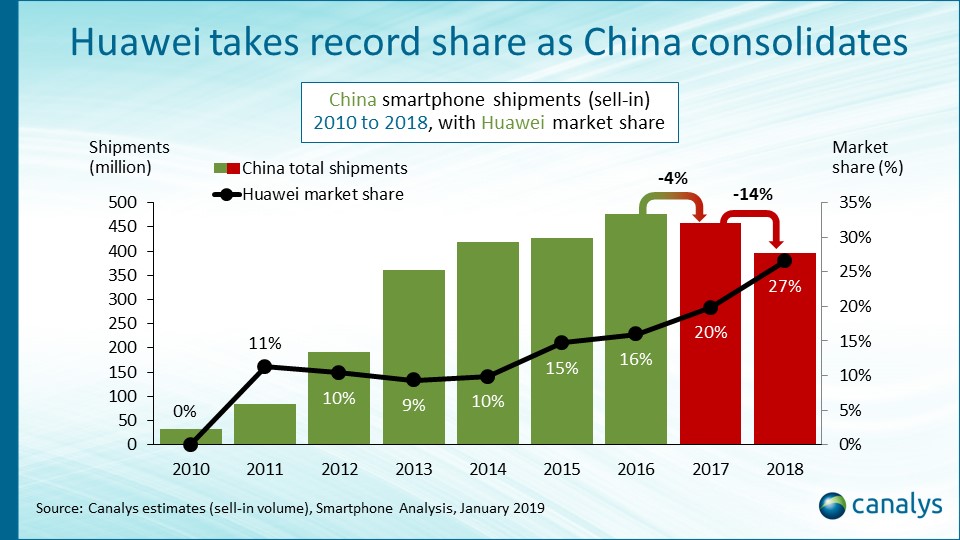
Apple down to third place, with a 13.2% share (46.9m); Huawei was 14.6% (52.0m). Xiaomi, which a couple of years ago was struggling, is now 4th, with 9.7% share (34.3m). Chinese smartphone companies thriving even as China sales slow.

The smartphone boom is over. What follows now flows from that.
link to this extract


Apple holiday forecast misses on iPhone demand; shares fall • Bloomberg

Mark Gurman:

»

Apple chief executive officer Tim Cook cited weakness in some emerging markets, currency volatility, the timing of new iPhones and uncertainty about whether Apple can meet demand for all the new models it recently released, according to an interview with Reuters.

IPhone unit sales barely grew from a year earlier, even though new flagship iPhones came out in the fiscal fourth quarter this year. That was a disappointment, considering there were no big iPhone launches in the same period last year.

The company sold 46.9m iPhones in the quarter, generating revenue of $37.2bn. The period included about a week and a half of sales of the high-end iPhone XS and iPhone XS Max models. The average iPhone selling price was $793. Analysts were looking for 48.4m iPhone units in the quarter, and an average selling price of $729.

The company released new iPhones in September, and upgraded iPads and Macs were introduced earlier this week. Apple raised prices on most of the devices, a relatively recent strategy to offset slowing unit sales growth. It’s a bet that consumers will continue to pay up for access to the company’s specialized and tightly integrated hardware and software.

«

Apple also announced that it will no longer give out unit sales data for iPhones, iPads or Macs. The interpretation is that emerging markets are slowing down, and that unit sales are going to drop (even if average sale prices, ASPs, rise), and it doesn’t want that on the record. It’s now about keeping ASP up to mask any unit problems – and so keeping Wall St happy.

Wall St isn’t happy, though, because it sees less information as less transparency, and so less visibility about the future.
link to this extract


Facebook growth slows as Zuckerberg says developed countries are saturated • The Guardian

Gabrielle Canon:

»

While Facebook also reported continued growth in daily active users this quarter, use of the platform in the west may be waning – which may spell bad news for the company that’s been hit with several scandals and increases in government regulation.

Between the second and third quarters, the company reported an increase of average users from 1.47 billion to 1.49 billion, and a decline in the growth rate from 11% to 9%.

User rates in the US and Europe remained mostly static, and the small growth came in other areas of the world.

On the call, Zuckerberg framed the numbers as a sign that Facebook had remained stable and was saturated in “developed countries”.

He emphasized that the company was expanding its ability to deliver stories and video, and would increase efforts to build communities – replacing that as a priority above newsfeed – with new offers like dating connections that will be rolled out soon.

“These are services that benefit from having everyone you know connected on a single platform,” he said, adding that it had been a tough but important year for the company.

«

link to this extract


Google walkout: global protests after sexual misconduct allegations • The Guardian

Matthew Weaver and Alex Hern in London, Victoria Bekiempis in New York, Lauren Hepler in Mountain View and Jose Fermoso in San Francisco:

»

The mostly young workers listened to some of their co-workers address the crowd, such as Demma Rodriguez, who heads equity engineering at Google in New York.

“Enough is enough is enough!” she shouted, to cheers. “Every single person at Google is exceptional … it is absolutely disgusting that anyone thinks you can be less than exceptional, worse than that, you can be negligent about sexual assault, sexual harassment and abuse of power.”

One man protesting, who declined to give his name, said he participated in the walkout because “I have a sister, a mother.”

He added: “I’m here for all the women in my life.”

Many were too nervous to talk to reporters, while some said they had been told by bosses not to or to refer the media to the company’s PR department.

But Amelia Brunner, 25, a software engineer, who has been with the company for three years, said that while she hasn’t experienced sexual harassment, she has endured different treatment at work because of her gender.

“People will doubt my work a lot more than they will doubt my male colleagues,” she said. “You will get talked down more in meetings.”

She said that while she has a “loud personality” that helps her overcome this, others may not.

“Theres a trickle-down effect “ she said. “How are you supposed to rise in the ranks?”

«

A reminder that it’s because of claims that some men were paid millions of dollars to leave Google in the face of sexual harassment allegations. In the UK, there has been a similar NDA-payoff row – though the people who got the payoffs were women who disliked their treatment at the hands (or mouth) of Philip Green, head of one of the biggest retailers. So it’s not just Google.
link to this extract


An AI lie detector is going to start questioning travellers in the EU • Gizmodo

Melanie Ehrenkranz:

»

The virtual border control agent [in Hungary, Latvia and Greece] will ask travellers questions after they’ve passed through the checkpoint. Questions include, “What’s in your suitcase?” and “If you open the suitcase and show me what is inside, will it confirm that your answers were true?” according to New Scientist. The system reportedly records travelers’ faces using AI to analyze 38 micro-gestures, scoring each response. The virtual agent is reportedly customized according to the traveler’s gender, ethnicity, and language.

For travelers who pass the test, they will receive a QR code that lets them through the border. If they don’t, the virtual agent will reportedly get more serious, and the traveler will be handed off to a human agent who will asses their report. But, according to the New Scientist, this pilot program won’t, in its current state, prevent anyone’s ability to cross the border.

This is because the program is very much in the experimental phases. In fact, the automated lie-detection system was modeled after another system created by some individuals from iBorderCtrl’s team, but it was only tested on 30 people.

«

Hmm. 30 people? Feels like this is going to have some teething problems.
link to this extract


Why we’re changing Flickr free accounts • Flickr Blog

»

Today, we’re announcing updates to our Free and Pro accounts that mark a new step forward for Flickr. To be candid, we’re driving toward the future of Flickr with one eye on the rearview mirror; we’re certain that Flickr’s brightest days lay ahead, but we remain acutely aware that past missteps have alienated some members of our community. We also recognize that many of the clues for how best to build the future of Flickr can be found in our own, rich history.

Many of today’s announcements are unequivocally positive things: a new, simplified login with any email you prefer; improvements to the Pro account; and additional partner perks. The changes to our Free accounts are significant, and I’d like to explain why these changes are necessary and why we’re confident they’re the right path forward for Flickr.

Beginning January 8, 2019, Free accounts will be limited to 1,000 photos and videos. If you need unlimited storage, you’ll need to upgrade to Flickr Pro.

In 2013, Yahoo lost sight of what makes Flickr truly special and responded to a changing landscape in online photo sharing by giving every Flickr user a staggering terabyte of free storage. This, and numerous related changes to the Flickr product during that time, had strongly negative consequences.

First, and most crucially, the free terabyte largely attracted members who were drawn by the free storage, not by engagement with other lovers of photography. This caused a significant tonal shift in our platform, away from the community interaction and exploration of shared interests that makes Flickr the best shared home for photographers in the world. We know those of you who value a vibrant community didn’t like this shift, and with this change we’re re-committing Flickr to focus on fostering this interaction…

…making storage free had the unfortunate effect of signaling to an entire generation of Flickr members that storage—and even Flickr itself—isn’t worth paying for.

«

Storing all those photos is actually “staggeringly expensive”, says new owner for which money is emphatically NOT no object. The terabyte thing was always crazy, but who would tell Marissa?
link to this extract


Someone paid thousands of foreigners 20 cents each to hide HuffPost’s negative coverage of a Democratic PAC • HuffPost UK

Alexander Thorburn-Winsor and Paul Blumenthal:

»

A HuffPost article that critically covered a Democratic political action committee abruptly disappeared from the top results in Google search after a contractor hired thousands of workers outside of the U.S. this spring to help suppress negative coverage of the PAC’s activities.

HuffPost’s April 2016 report investigated the tactics of End Citizens United, a political action committee founded by three former staffers at the Democratic Congressional Campaign Committee, the party’s official organ dedicated to electing Democrats to the House of Representatives. ECU, which worked to elect Democratic candidates who support campaign finance reform, used aggressive and expansive email campaigns to rake in millions of dollars in online donations. The PAC’s pushy tactics angered other nonprofits working toward campaign finance reform, which came to think of the PAC as an arm of the Democratic Party stealing their donors with deceptive email marketing.

Until this spring, HuffPost’s story was the second to come up in a generic Google search for “End Citizens United.” But in the spring of 2018, an anonymous US-based contractor paid at least 3,800 workers in countries around the world through the crowdsourcing firm Microworkers to manipulate what stories would come up when people searched for the PAC in Google, according to public job listings on Microworkers reviewed by HuffPost.

«

Political wrangling gets worse and worse. I like the irony of using a PAC to end PACs.
link to this extract


Tech and media website Re/code to be folded into Vox.com • WSJ

Benjamin Mullin:

»

The decision to fold Recode into Vox comes more than three years after Vox Media announced the acquisition of the media and technology site in an all-stock deal whose financial terms weren’t disclosed. Jim Bankoff, Vox Media’s chief executive, said at the time that Recode’s conference business was an attractive asset for the company.

Ms. Swisher, a former Wall Street Journal reporter, co-founded Recode with her then-colleague, the technology journalist Walt Mossberg, after the pair parted ways with Wall Street Journal parent Dow Jones in 2013. They were among a wave of high-profile journalists who left their employers to found their own media companies around that time. Jessica Lessin, also a former Wall Street Journal reporter, left to found The Information, a news and technology site, in 2013. Alex Blumberg, a former This American Life producer, co-founded Gimlet Media, a podcasting company, in 2014. Ezra Klein left the Washington Post in 2014 to start Vox.com with Ms. Bell and the journalist Matt Yglesias.

Recode’s traffic has declined in recent months, as some of the site’s marquee journalists have left the company for jobs at other news organizations. The site attracted 1.36m unique visitors in September 2018, a 50% decrease from its audience of 2.77m unique visitors during the same period the year before, according to comScore. By comparison, the Verge, another Vox-owned tech website, drew 25.9m unique visitors in September.

Mr. Mossberg retired last year, and reporters such as Edmund Lee, Tony Romm and Johana Bhuiyan have all left Recode in the past year. Ms. Swisher has begun writing for the New York Times, which she joined as an opinion contributor in July.

«

I think Re/code has never quite had the heft that All Things Digital, its forebear spinoff from the WSJ, had – partly because it started from nothing. The Verge did too, but aims to be a sort of technology wire service: the Reuters or AP of the web.

I don’t see Re/code thriving from here, though.
link to this extract


Errata, corrigenda and ai no corrida: none notified

Apple’s results: 14 new graphs tell the financial story

Apple released its fiscal fourth-quarter results (calendar third quarter) to the end of September on Thursday. So following up on my post from earlier this week, here’s what the data tells us about that period – which already feels like it’s in the rear-view mirror, what with the iPhone XR and new iPads and Macs having been launched just in the past couple of days, mid-quarter.

But analysing the effects of those is going to be more difficult than this: Apple announced that it’s no longer going to provide unit sales data. We’ll only have revenues for iPhones, iPads and Macs. This is being interpreted as an attempt to hide bad news that’s surely on the way for unit sales; Apple isn’t happy about this interpretation, and insists that its user base is growing, and that a focus on unit sales – the horse race – distracts from what’s really going on. It wants people to look at the growth in (high-margin? We’ll find out because it will reveal, next quarter) areas such as Services.

Anyway! On with the graphs. First, average selling prices (ASPs). Shed a tear, it’s the last time we’ll be able to do them like this.

Next, the divisional revenues. Note how Services is definitely the second-biggest.

And let’s see the hardware v services breakdown more clearly in the next two graphs. First, just broken out.

And now – apologies for its slight lack of clarity – the growth in Hardware (on the left axis, in purple) v Services (on the right, in brown). Services is growing faster than Hardware.

Now: the overall picture of products sales. Again, we’re not going to be able to do this again, so feast your eyes. And look at how FLAT everything is. Unit sales growth has stopped for the past two years.

And next we have operating profit (green) and revenue (orangey). The gap is actually growing: Services seems to be less profitable than Hardware, as we knew. But both still trending up.

Now some more detail on the iPhone. Look at that uptick in ASP! And look at how flat sales are on the 4Q moving average. The growth has gone out of the market overall; global smartphone sales were actually down 6% in this period, so Apple actually grew its share by standing still.

The iPads too: Apple owns the tablet market, but the tablet market is well past its peak.

How about Macs? Sales are once more flat (the line with dots), ASPs are up. That ASP line will probably go up next quarter – though we won’t know exactly how much.

Now to the graphs which tell us how the machine is working: inventory and R+D. You’d expect that inventory would build ahead of a big launch, and then fall, and so it proves. Even so, it’s big…

But if you look at it as a percentage of hardware revenue, inventory is really high. REALLY high. Heading up to 2%, which implies lots of things sitting in warehouses. I’ve had a look at Apple’s filings, and it doesn’t break down inventories into raw goods/work-in-progress/finished, so we can’t know if that’s self-driving cars being built or the iPhone XR (then unreleased) sitting in Chinese factories. Probably the latter, mostly.

As to the future: research and development spending. Look, it’s up!

And as a percentage of revenue, it’s also at a historic high. This either balances out the inventory stuff, or is somehow caused by it.

Finally, the geographical breakdown. The Americas (particularly the US) is driving this, but notice how things are slower in China and the rest of Asia. Europe generates more revenue than China; there’s no sign of that changing in a hurry. Apple’s hope that China would become its No.2 source of revenue seems to have been dashed.

And that’s it! Comments welcome, including suggestions for the colours. I may redraw these so that the lines are more clearly labelled, but will leave the text alone.

Start Up No.943: the first bendy phone (from an unknown), Snapchat sues ‘influencer’, iPad Pro v the old world, the ad fraud silence, and more


You know what helium does to balloons. But what does it do to iPhones (and not Android phones)? Photo by Ed Visoso on Flickr.

A selection of 10 links for you. Swords/ploughshares, laser pointers/?. I’m @charlesarthur on Twitter. Observations and links welcome.

Royole’s bendy-screen FlexPai phone unveiled in China • BBC News

Leo Kelion:

»

A little-known California-based company has laid claim to creating the “world’s first foldable phone”. Royole Corporation – a specialist in manufacturing flexible displays – unveiled the FlexPai handset at an event in Beijing.

When opened, the device presents a single display measuring 7.8in (19.8cm) – bigger than many tablets. But when folded up, it presents three separate smaller screens – on the front, rear and spine of the device. The six-year-old company said it would hold three “flash sales” to consumers in China on 1 November to offer the first product run.


The firm says that when folded the spine of the device will be used to show notifications. Photo: Royole

The phones will be priced between 8,999 and 12,999 yuan ($1,290 to $1,863; £1,011 to £1,460) depending on the memory and storage specifications selected.

In addition, Royole said it would also offer a slightly different version of the devices to developers across the world the same day. It intends to start deliveries in “late December”. The launch has caught many industry watchers by surprise.

«

Alternative futures: “Grandpa, how did Royole become the biggest company in the world?”

Or: “Why didn’t any realise that nobody wants a flexible phone screen?”

Plenty of room in the middle, of course.
link to this extract


Once paralyzed, three men take steps again with spinal implant • The New York Times

Benedict Carey:

»

David Mzee broke his neck in 2010. He was a college student in Zurich at the time, an athlete who enjoyed risk and contact, and he flipped off a trampoline and onto a foam pad. “The foam pad, it didn’t do its job,” he said.

Mr. Mzee, now 33, is one of three men who lost the use of their legs years ago after severe spinal injuries, but who now are able to walk without any supports, if briefly and awkwardly, with the help of a pacemaker-like implant, scientists reported on Wednesday.

The breakthrough is the latest achievement in the scientific effort to understand and treat such life-changing injuries. Several recent studies have restored motion to paralyzed or partially paralyzed patients by applying continuous electrical stimulation to the spinal cord.

The new report, described in the journal Nature, is the first demonstration of so-called patterned stimulation: an implant sends bursts of targeted stimulation to the muscles that intend to move. In effect, the stimulation occurs on an as-needed basis, roughly mimicking the body’s own signaling mechanism.

«

The BBC report, with video, is truly amazing.
link to this extract


Luka Sabbat sued for failure to influence • Variety

Gene Maddaus:

»

PR Consulting Inc. says it signed an influencer agreement with Sabbat on Sept. 15, the day after he was first photographed with Kardashian. The PR company filed the lawsuit in New York Supreme Court, alleging that Sabbat breached his agreement to post three Instagram stories and one post to his Instagram feed in which he would be wearing the spectacles.

Sabbat made only one Instagram story and one post to his feed, and did not submit the post to PR Consulting for pre-approval, the suit alleges. Sabbat also reneged on an agreement to be photographed in public wearing the spectacles during the Milan or Paris Fashion Weeks, according to the suit.

Under the contract, Sabbat was to be paid $60,000 — with $45,000 paid up front. The suit seeks reimbursement of the $45,000 plus another $45,000 in additional damages.

«

You’re asking “who?” He’s an actor known for.. hmm two films. OK he says he’s a “creative entrepreneur exploring the worlds of art and fashion”. Not technology, then.
link to this extract


‘Stalkerware’ website let anyone intercept texts of tens of thousands of people • Motherboard

Joseph Cox and Lorenzo Franceschi-Bicchierai:

»

A website and app designed to let users monitor their children, employees, or illegally spy on their spouse inadvertently allowed anyone who was using the service to obtain information contained within other peoples’ accounts and intercept the communications of around 28,000 users, Motherboard has confirmed following a tip from a hacker.

The app, called Xnore, can be installed on Android, iPhone, and BlackBerry devices, and collects Facebook and WhatsApp messages, GPS coordinates, emails, photos, browsing histories as well as records phone calls. Customer accounts were exposed by a map feature on Xnore’s website. The flaw allowed anyone who viewed the HTML code of the page to see the mobile identifier used by Xnore to view any collected data. This identifier could then be used to add the intercepted data of someone else’s account to your own.

This new breach of a consumer spyware company—sometimes dubbed ‘stalkerware’ or ‘spouseware’ due to its common target audience of abusive partners—shows how truly lax the security of many of these companies really is. Regardless of whether customers use these apps for legal purposes, they’re putting the intercepted data of their victims—be them their children, employees, or spouses—in serious jeopardy…

…When users download the Xnore app, they are provided a mobile identifier; a string of characters and numbers unique to their device. Xnore offers a free trial so anyone can download the software and start intercepting communications.

The hacker pointed Motherboard to a section of Xnore’s website containing a map. Although the map itself appeared to be non-functional at the time of viewing, a dropdown menu let users select from a slew of mobile identifiers. Viewing the HTML source for that page reveals the identifiers of Xnore users. Motherboard ran a script to extract all of the mobile identifiers included in the exposed data, and found over 28,000 in total. That number matches the total number of Xnore targets the hacker says they found.

«

Couldn’t one effectively disable this simply by turning off its permissions on the phone? And wouldn’t kids figure that out?
link to this extract


MacBook Air vs. iPad Pro: what is Apple’s best new computer? • The Verge

Vlad Savov:

»

In the years since Apple last upgraded the MacBook Air in a meaningful way, I’ve noticed much of my work time gradually shifting to my smartphone, with the laptop taking a secondary role, deployed only when I need the larger screen and more comfortable keyboard. That’s in large part because of the always-on connection of the phone, the immediacy of everything I can do on it, and the connectedness to all of the most popular social and work communication apps. The number of times I’ve caught myself using my phone in front of an open laptop on my lap has been growing.

At its outset, the iPad was dismissed as being merely a “jumbo iPhone,” but in 2018, we might want to start asking if that’s a criticism or a form of praise. The best apps today are being developed for the iPhone and, by the extension of iOS, as the common platform for the iPad. iOS is the operating system of Apple’s future, macOS is the operating system of Apple’s past. As a writer, I find plenty of apps like iA Writer to deposit my loquaciousness into on iOS. As a photographer, I’m excited that real Photoshop is arriving on the iPad. And as a casual gamer, I recognize that iOS gives me vastly more entertainment options that macOS.

«

Similar views are expressed by Lauren Goode in a Wired article:

»

Yesterday’s event had its fair share of subtly awkward moments as Apple tried to present its two philosophies for how it believes you’re supposed to use a computer. On the one hand, there was a new laptop. This clamshell design still matters, Apple was insisting. Moments later, the company was touting a tablet it clearly sees as the real future of computing, something better and more advanced than a notebook. Cook even called the iPad not only the most popular tablet, but also, “the most popular computer in the world.”

«

Lots of people are prepared to tell you that you’ll never be able to do X on an iPad. Given that Photoshop is on the way, audio recording (say, of a Skype interview) is about the only thing left to fix. A gazillion podcasters will rejoice and buy an iPad when that happens.
link to this extract


This ad fraud scheme stole millions, but almost no one in the advertising industry wants to own up to it • Buzzfeed News

Craig Silverman:

»

A massive ad fraud scheme that Google acknowledged stole close to $10m from its ad networks and partners has been shut down after BuzzFeed News revealed its existence last week. But as of today more than 30 companies that unwittingly helped the fraudsters earn money won’t comment on how many fraudulent ads they sold, or say the amount is small or nonexistent.

The fraud operation exposed by BuzzFeed News last week involved more than 125 Android apps and websites that tracked real human users and used this data to program bots to mimic their behavior as a way to evade fraud detection systems. These bots opened apps and loaded webpages in order to generate fake ad views, and therefore revenue for the fraudsters. The affected apps and websites were distributed among a web of shell and front companies to hide their true owners and obscure the scale of the operation.

BuzzFeed News contacted 36 companies that carried ad inventory for the affected apps and sites, or otherwise helped them monetize at some point. Almost none shared specifics about how much money was stolen via their platforms, or whether they will be issuing refunds. Ultimately, the money is stolen from the brands and other companies who bought ads on the affected websites or in apps.

Experts say this lack of transparency is endemic in the digital ad industry, which has a large and growing fraud problem that sees criminals steal billions of dollars a year from advertisers. Many brands now grudgingly accept that a certain amount of the money they spend on digital will be lost to fraud. But when fraud is discovered, as in this scheme or in multiple BuzzFeed News exposés published in the past 12 months, almost no one wants to talk about where the money went, or who stole it.

«

Smart followup by Silverman to his own story; he’s contacted 22 of 36 companies involved, and it only accounts for $300,000. Estimates of how much might have been funnelled away are in the hundreds of millions.

“Nothing to see here, move along” is the story in ad fraud land.
link to this extract


From Silicon Valley elite to social media hate: the radicalization that led to Gab • The Washington Post

Craig Timberg, Drew Harwell, Elizabeth Dwoskin and Emma Brown:

»

Andrew Anglin, creator of the neo-Nazi site Daily Stormer, began posting frequently on Gab, according to reports at the time. The site exploded with new, pseudonymous users posting viral misinformation, hate speech and memes that echoed white-supremacist or anti-Semitic tropes — what Donovan called “an echo chamber of the most disgusting content offered online.”

Google then banned the service from its app store, saying that “social networking apps need to demonstrate a sufficient level of moderation, including for content that encourages violence and advocates hate against groups of people.” In response, Gab sued the search giant.

But the bans and crackdowns haven’t curbed Gab’s growth. There are now about 800,000 users, said Sanduja, compared with 10,000 two years ago. The company’s few employees are all under 30 and number fewer than half a dozen, including Torba and his wife, Sanduja said.

But there are signs that the company’s fractious public image has taken a toll on its leadership. Ekrem Buyukkaya, a Turkey-based developer who co-founded Gab with Torba, said on Sunday that he would step down as the company’s chief technology officer because of “attacks from the American press.” The company had previously said in an SEC filing that Buyukkaya’s work was crucial to its “future success.” Buyukkaya did not respond to requests for comment.

The growth of Gab’s fan base, however, has helped fund an aggressive expansion designed to bring new users into the fold. In an SEC filing in March, Gab said it had more than $600,000 in cash, up from $16,000 in 2016, and had made $100,000 in revenue, primarily from subscriptions.

«

I’d be surprised if the FBI isn’t crawling all over Gab; now you know where 800,000 of the most likely domestic terrorists are. Though hate on that level must be self-limiting in some way. Mustn’t it?
link to this extract


George Soros and the migrant caravan: how a lie multiplied online • USA Today

Brad Heath, Matt Wynn and Jessica Guynn:

»

By Oct. 16 – four days after the caravan departed – the combined following of accounts mentioning both Soros and the caravan had reached 2 million, still a pebble in the flood tide of social media. (The total includes some duplicates because people follow more than one account.)

On Twitter, someone with the username “LibertyBell1000” warned about 42,000 followers that Soros had “manufactured yet another immigrant caravan ‘crisis.’ ” Another, using the name “WhoWolfe,” asked “Anybody else think Soros and the Dirty Dems are behind this?”

More posts spread across Facebook. Trump supporter Randy Penrod posted in a group called “The Deplorable’s,” with about 186,000 members, “Our stable leader just called out the Soros conspired invasion of new Democrat voters in a tweet just moments ago.”

Tap, tap, tap.

It took just one more day for the theory to reach critical mass, breaking through into widespread public consciousness.

The evening of Oct. 17, a Republican member of Congress posted a video on Twitter of what he said was people in Honduras handing out small sums of money to migrants.

“Soros? US-backed NGOs? Time to investigate the source!” he wrote.

Rep. Matt Gaetz would later concede that he was mistaken about where the video was shot (it was Guatemala). But by then his message had metastasized, spreading far beyond the 153,000 people who follow the north Florida congressman’s tweets.

Conservative commentator Ann Coulter retweeted it to her 2 million followers. So did Sarah Carter, a journalist who’s a frequent guest on Fox News.

«

(The URL says El Paso Times, but it’s the story that appeared in USA Today; but its website was having conniptions about European users over that story. No idea why.)
link to this extract


Twitter should kill the retweet • The Atlantic

Taylor Lorenz:

»

Retweets prey on users’ worst instincts. They delude Twitter users into thinking that they’re contributing to thoughtful discourse by endlessly amplifying other people’s points—the digital equivalent of shouting “Yeah, what they said!” in the midst of an argument. And because Twitter doesn’t allow for editing tweets, information that goes viral via retweets is also more likely to be false or exaggerated. According to MIT research published in the journal Science, Twitter users retweet fake news almost twice as much as real news. Some Twitter users, desperate for validation, endlessly retweet their own tweets, spamming followers with duplicate information.

Retweets were introduced, ironically, to make Twitter better. At the time, the company’s co-founder Biz Stone declared that “we hope interesting, newsworthy, or even just plain funny information will spread quickly through the network making its way efficiently to the people who want or need to know.” Retweets were an early way for the company to ensure that the most interesting and engaging content would bubble up in the feed and keep users entertained.

But for more than two and a half years, the company has shown people tweets based on an algorithmic accounting of exactly what the most interesting and engaging content is (yes, part of that algorithm takes user behavior like retweets into account). It has also tested suggesting tweets, recommending accounts to follow based on interest, and built Moments to surface noteworthy tweets about news events. The retweet isn’t just dangerous; it’s redundant.

«

Before the retweet was a function, one had to manually copy the content of a tweet and put “RT” or “MT” (modified tweet) in front of it. This friction meant something had to be really worthwhile to achieve any velocity.

Increasingly it looks as though adding friction (back in) is the way to make social networks more reasonable.
link to this extract


IPhones are allergic to helium • iFixit

Kyle Wiens on the strange case of a helium leak at a hospital which bricked newer iPhones and Watches – but not Android phones:

»

Every phone has gyroscopes and accelerometers with micrometer-thin elements. My initial theory, shared by some on Reddit, was that the helium molecules were small enough to get inside these chips and interfere with the mechanical workings.

But there are two problems with this idea: One, Apple isn’t alone in using MEMS gyroscopes—every phone has them. Why weren’t the Android phones affected? Perhaps there’s a bug in iOS that causes crashes when it gets faulty data from the gyro? But the bug impacted Apple Watches, too—and they run WatchOS. Additionally, iPhones earlier than the 6 weren’t affected. It seems unlikely that this was a new software bug that impacted both iOS and WatchOS.

So what else could it be? Well, at the heart of every electronic device is a clock. Traditionally, these are quartz oscillators, crystals that vibrate at a specific predictable frequency—generally 32 kHz. When they were first invented, they enabled the first digital ‘quartz’ watches. Now, these frequency generators are at the heart of every electronic device.

Without a clock, the system stands still. The CPU flat out doesn’t work. The clock is literally the heartbeat of a modern device.

But quartz oscillators have some problems. They don’t keep time as well at high (and low) temperatures, and they’re a relatively large component—1×3 mm or so. In their quest for smaller and smaller hardware, Apple has recently started using MEMS timing oscillators from a specialized company called SiTime to replace quartz components.

Specifically, they’re using the SiT512, ‘the world’s smallest, lowest power 32 kHz oscillator.’ And if the MEMS device was susceptible to helium intrusion, that could be our culprit!

«

The electron microscope pictures are amazing too.
link to this extract


You can sign up to receive each day’s Start Up post by email. You’ll need to click a confirmation link, so no spam.

Errata, corrigenda and ai no corrida: none notified

Start Up No.942: Spotify v labels, Apple’s messed-up Mac line, Google’s harassment hassle, Arizona’s solar swizz, and more


Apple’s new iPad Pro: USB-C – and video editing. Photo by tua ulamac on Flickr.

You can sign up to receive each day’s Start Up post by email. You’ll need to click a confirmation link, so no spam.

A selection of 13 links for you. Fewer for the rest. I’m @charlesarthur on Twitter. Observations and links welcome.

Spotify may already be too big for the labels to stop it competing with them • MIDiA Research

Mark Mulligan:

»

At this stage we move on to a prisoners’ dilemma scenario for the majors:

• All of the majors help Spotify’s case by over prioritising Spotify as a promotional tool in light of its share of total listening compared to radio, YouTube, other streaming services etc
• WMG and SME probably couldn’t afford to remove their content from Spotify but would be watching UMG, the only one that probably feel confident enough to do so
• However, UMG would be thinking if it jumps first and removes its content, each of the other two majors would benefit from it not being there (and would probably be secretly hoping for that outcome)
• Each other major would be thinking the same, and regulatory restrictions prevent the majors from discussing strategy to formulate a combined response
• But even if UMG did pull its content, this would hurt Spotify but would not kill it (Amazon Prime Music launched without UMG and spent 15 months growing just fine until UMG came on board)
• Spotify could easily tweak its curation algorithms to minimise the perceived impact of the missing catalogue, making it ‘feel’ more like 10%
• So, the likely scenario would be each major paralysed by FOMO and so none of them act

Thus, maybe Spotify is already nearly big enough to do this, and could do so next year.

«

Does Apple Music offer enough of a counterbalance to this? That the labels could go there instead? Probably not, given Spotify’s size.
link to this extract


MacBook Air 2018: hands-on with Apple’s new ultra-thin laptop • The Verge

Dieter Bohn:

»

you’re here to learn about the screen, so I’ll just tell you that it’s great — at least compared to the old MacBook Air. It’s not True Tone, but it is a full Retina Display with the same resolution as the 13-inch MacBook Pro. The smaller bezels make a big difference in making the computer more portable, but it doesn’t feel cramped like the smaller MacBook sometimes can. The bezels are black, and the whole thing is a glossy glass now, which might annoy some people, but that’s most laptops these days. Bottom line: it’s pretty much on par with the screens on the MacBook Pros from what I can see.

The keyboard is Apple’s “3rd generation,” which is another way of saying that it has super minimal key travel but is a little bit quieter and (hopefully) a little more dust-resistant than older MacBook Pros. It’s also been fine-tuned to try and fix some of the big issues that plagued the initial and follow-up runs of MacBook Pros over the last two years. It’s still pretty clacky sounding, though, but I’ll need to take it into a quiet room (no easy feat right now) to really see how it sounds. It’s still a polarizing design, even this many years in, but I don’t think that’s a reason not to upgrade.

Build quality is top notch, as you’d expect. The device, like the new Mac mini, is now made of 100% recycled aluminum, a first for Apple’s laptop line. The lid opens with a single finger to reveal the massive touchpad, which is Force Touch now. I’m glad there are two USB-C ports, both Thunderbolt-enabled, but I am just a little sad that MagSafe is truly dead now. Overall, the trade-off is worth it, I think, but you are probably going to need to buy some dongles. There’s a headphone jack, too, which is a thing that I have to mention simply because it’s not a given anymore.

I didn’t get a chance to test out Touch ID, but I’m pleased to see that Apple figured out that it was the best part of the Touch Bar MacBook Pros, and it bought just it and the T2 chip over. It’s a lot more button-like than what you’ll find on a MacBook Pro.

«

link to this extract


Apple iPad Pro (2018) hands-on: even closer to a computer • Engadget

Chris Velazco:

»

Much as I like this new design, there is one thing that rubs me the wrong way, and it has a lot to do with the mixed messages Apple is sending. In its presentation, Apple made it clear that music professionals like DJs have been fans of the iPad for awhile and that the new power afforded to them by the A12X Bionic chipset would help them spice up their performances. That’s cool and all, but I wonder how those DJs feel about the iPad Pro lacking a headphone jack. Seems kind of important, no?

People who lean on iPad Pros to actually get stuff done should benefit from the A12X Bionic, a tweaked version of the chipset we first got to know in the iPhone XS. I haven’t been playing with these iPads for too long, and it’s difficult to tell exactly what kind of performance gains to expect based off these demos. That said, the handful of AR apps I tried out seemed smoother and more stable than ever, and a setup dedicated to visually lush DJ software looked appropriately rad. We’ll see how they do in real-world testing soon.

Speaking of important, how about that USB-C? The shift has been rumored for years, but it’s finally here, and it stands to change the way people think about how to use iPads. In the past, if you wanted to hook other devices up to your iPad, you’d have to rely on peripherals and connectors to bridge the gap between Lightning and whatever else your hardware required. Moving to a standard USB-C port makes the new Pro line feel more akin to a proper computer, and Apple has already pitched several ways that professionals have been able to work these iPads into their daily flows.

«

Pretty good accompanying video. The squared-off design reminds me of the iPad..4, was it? The USB-C won’t support an external hard drive, since you’re wondering.
link to this extract


Apple’s laptop line is more of a mess than ever • Engadget

Daniel Cooper:

»

Imagine that you’ve got $1,300 and you’d like to buy a new Apple laptop. Which one do you choose? The $1,299 MacBook, the new $1,199 MacBook Air or the cheapest MacBook Pro, which also retails for $1,299. If you really want TouchID then you’ll opt for the Air, but if you’re looking for the “best” then the Pro is the only answer. Not that you’d understand that from the price list, thanks to Apple’s crushing inability to properly differentiate its products.

Apple’s cluttered product lineup is hardly a new problem, but the situation with its laptops is now getting a little bit silly. The company is selling three laptops at roughly the same price with little beyond potential battery life to differentiate them. For instance, of the trio, two are considered for the “thin and light” crowd, offering small size at the expense of power. But the smaller of the pair costs $100 more, despite having a slower CPU and weaker graphics.

The revived MacBook Air, meanwhile, makes the MacBook look like even more of a misstep than it was before. After all, unless you’re seriously hankering for a laptop that small, why not just buy its far-better sibling? If the 12-incher was sold for, say, $899, then it would be much easier to take it seriously. And that price isn’t an unreasonable proposition, either, since the 11-inch MacBook Air sold for that much before its axing.

«

Obviously I’m not linking to this just because it links to my article with 14 graphs about Apple’s financial performance. He has a point with the $1300 price; the ASP for Macs overall (laptops plus pricey desktops) was around $1450 in midyear. When the MacBook / Air / Pro can all be bought in some form at the same price, things are indeed messed up.
link to this extract


Apple confirms iOS 12.1 shipping today with 32-person Group Facetime • Ars Technica

Sam Machkovech:

»

[Tim] Cook highlighted a few features shipping in 12.1, most notably a Group Facetime feature that will support a whopping 32 simultaneous participants.

As Apple’s announcement site clarifies:

»

FaceTime uses on-device intelligence to display the most prominent speakers on the call, automatically highlighting the current speaker by bringing them to the forefront. It automatically sizes each person’s image depending upon how active they are in the conversation, based on duration of speech, volume and even motion. Participants who are not active will appear at the bottom of the screen until they speak. A simple tap also brings a participant front and center.

«

Additionally, dual-SIM support via eSIM, which was announced as an upcoming feature in September, will finally be enabled for iPhone XS and XR models. And Cook said users can expect an additional 70 emoji throughout iOS, which are largely made up of this suite of characters announced earlier this year as part of the Unicode Emoji 11.0 set.

«

Cleverly, if you join one of these FaceTime love-ins after it has started, you don’t ring in. I’d like to think it’s going to be better than standard conference calls. A few years too late to win the enterprise market, though.
link to this extract


The battle for solar energy in the country’s sunniest state • The New Yorker

Carolyn Kormann:

»

[The billionaire Tom] Steyer and his coalition say that the problem is simple: A.P.S. [Arizona Public Service, the largest utility in the state of Arizona] is an investor-owned company, motivated primarily by its responsibility to protect profits for its shareholders, many of whom reside out of state. In 2017, the company made $488m, an increase of $46m from the previous year. The Arizona Corporation Commission (A.C.C.), a five-member elected “fourth branch” of state government, is supposed to keep the utility’s monopoly in check—setting limits on capital investments and pricing, while guaranteeing a certain margin of profit.

But critics have long argued that the arrangement incentivizes utilities to “gold-plate,” or make inessential investments. (The phenomenon even has a name: the Averch-Johnson effect.) For A.P.S., a $200m gas-fuel plant would be more lucrative than a $20m solar array because the utility can charge higher rates to recoup its investment costs.

Kris Mayes, a former Republican A.C.C. commissioner, who helped write the language of Prop 127, told me the Averch-Johnson effect explains why, in 2017, A.P.S. called for more than 5,000 megawatts of new natural-gas additions, and almost no utility-scale renewables. “If they were truly acting in public interest,” Mayes said, “they would not be proposing 5,400 hundred megawatts of new natural-gas plants.”

«

Perverse incentives: they abound.
link to this extract


Months before Pittsburgh shooting, Stripe and PayPal were warned about Gab • Daily Beast

Kelly Weil:

»

The Twitter user @DeplatformHate has been documenting the far right’s partnerships with Silicon Valley for nearly a year and repeatedly tweeted about Stripe’s ties to Gab in August. After Stripe’s general counsel reached out on August 17, Deplatform Hate sent him and Stripe’s CEO a long email on August 24, documenting the issue.

“Gab is a massive hive mind of neo-Nazis that have actively doxed journalists families that work on stories of neonazi violence,” Deplatform Hate wrote in an August 24 email shared with The Daily Beast, in which he cited white supremacists who used Gab to publish journalists’ personal information, including home addresses.

Deplatform Hate shared the messages on the condition of anonymity, citing harassment by neo-Nazis.

One targeted journalist “had his mother in the Bronx get a bomb threat. You can muddy the story of ‘oh but the first amendment’—you’re a lawyer. You know that doesn’t hold up in the US and that private companies can have moral systems if they’re not discriminating against protected classes. Last time I checked, Nazis weren’t a protected class.” Stripe declined to comment on the email.

«

link to this extract


A new study finds potentially manipulative ads in apps for preschoolers • The Washington Post

Hamza Shaban:

»

Researchers from the University of Michigan C.S. Mott Children’s Hospital looked at more than 100 apps, mostly from the Google Play app store, and found that nearly all of them had at least one type of ad, often interwoven into the apps’ activities and games. The apps, according to the researchers, used a variety of methods to deliver ads to children, including commercial characters, pop-up ads, in-app purchases, and, in some cases, distracting ads, hidden ads or ads that were posed as gameplay items.

The authors suggest that the deceptive and persuasive nature of the ads leaves children susceptible to them, because of their lack of mental development in controlling their impulses and attention.

“Our findings show that the early childhood app market is a Wild West, with a lot of apps appearing more focused on making money than the child’s play experience,” Jenny Radesky, a developmental behavioral expert and an author of the study, said in a statement. “This has important implications for advertising regulation, the ethics of child app design, as well as how parents discern which children’s apps are worth downloading.”

Children use mobile devices one hour every day, on average, highlighting the importance of researching what they encounter and how it may affect their health, Radesky added.

«

link to this extract


Introducing reCAPTCHA v3: the new way to stop bots • Google Online Security Blog

Wei Lu, Google product manager:

»

with reCAPTCHA v3, we are fundamentally changing how sites can test for human vs. bot activities by returning a score to tell you how suspicious an interaction is and eliminating the need to interrupt users with challenges at all. reCAPTCHA v3 runs adaptive risk analysis in the background to alert you of suspicious traffic while letting your human users enjoy a frictionless experience on your site.

In reCAPTCHA v3, we are introducing a new concept called “Action”—a tag that you can use to define the key steps of your user journey and enable reCAPTCHA to run its risk analysis in context. Since reCAPTCHA v3 doesn’t interrupt users, we recommend adding reCAPTCHA v3 to multiple pages. In this way, the reCAPTCHA adaptive risk analysis engine can identify the pattern of attackers more accurately by looking at the activities across different pages on your website. In the reCAPTCHA admin console, you can get a full overview of reCAPTCHA score distribution and a breakdown for the stats of the top 10 actions on your site, to help you identify which exact pages are being targeted by bots and how suspicious the traffic was on those pages.

«

If this means I don’t have to be the human doing the work spotting traffic signs for Google’s self-driving cars before I can visit a page, I’m all for it.
link to this extract


Google sexual harassment allegations: Google X still employs an accused executive • Slate

April Glaser:

»

There is a history of interoffice romance at Google and X that goes all the way up to the C-suite. Brin, who hangs around X regularly, had a very public affair-turned-relationship with the former marketing manager of Google Glass, according to a 2014 Vanity Fair story. The Times also reported last week that former Google CEO Eric Schmidt once “retained a mistress to work as a company consultant.” And according to the Times, David Drummond, Alphabet’s chief legal officer, had an extramarital relationship with an employee in his department beginning in 2004, which they eventually disclosed to the company. That employee, who had a child with Drummond, was transferred to the sales division and later left Google, while his career at the company “flourished.”

“There’s an increasing sense that Larry and Sergey may be the problem,” said one source within X, who is not authorized to speak with the press and requested anonymity, speaking to a culture of impunity for men who initiate interoffice relationships with women working under them. “I don’t think they’re abusers, but they’ve sheltered them. They clearly think there’s some amount of value they’re getting out of these men that outweighs the women they’re preying on.” In response to the Times’ reporting, Alphabet told the paper it takes harassment seriously and that “We investigate and take action, including termination. In recent years, we’ve taken a particularly hard line on inappropriate conduct by people in positions of authority. We’re working hard to keep improving how we handle this type of behavior.”

«

link to this extract


Google engineers are organizing a walkout to protest the company’s protection of an alleged sexual harasser • Buzzfeed News

Caroline O’Donovan and Ryan Mac:

»

The protest, which is expected to happen on Thursday, comes in light of a story by the New York Times last week into the alleged misbehavior of Android creator Andy Rubin and other executives at the company, some of whom still have positions of prominence at Google. Google gave Rubin a reported $90 million exit package in 2014, following an investigation into an allegation that he had coerced another employee to perform oral sex on him. That investigation reportedly found that allegation to be credible.

“Personally, I’m furious,” said one Google employee who requested anonymity. “I feel like there’s a pattern of powerful men getting away with awful behavior towards women at Google‚ or if they don’t get away with it, they get a slap on the wrist, or they get sent away with a golden parachute, like Andy Rubin. And it’s a leadership of mostly men making the decisions about what kind of consequences to give, or not give.”

«

link to this extract


New ban: do not post in support of Trump or his administration • RPGnet

RPGnet is “the oldest and largest independent roleplaying site on the internet”, founded in 1996:

»

We are banning support of Donald Trump or his administration on the RPGnet forums. This is because his public comments, policies, and the makeup of his administration are so wholly incompatible with our values that formal political neutrality is not tenable. We can be welcoming to (for example) persons of every ethnicity who want to talk about games, or we can allow support for open white supremacy. Not both. Below will be an outline of the policy and a very incomplete set of citations.

We have a community here that we’ve built carefully over time, and support for elected hate groups aren’t welcome here. We can’t save the world, but we can protect and care for the small patch that is this board.

Policy outline:
1. We are banning support of the administration of President Trump. You can still post on RPG.net even if you do in fact support the administration — you just can’t talk about it here.
2. We are absolutely not endorsing the Democrats nor are we banning all Republicans.
3. We are certainly not banning conservative politics, or anything on the spectrum of reasonable political viewpoints. We assert that hate groups and intolerance are categorically different from other types of political positions, and that confusing the two legitimizes bigotry and hatred.
4. We are not going to have a purge — we will not be banning people for past support. Though if your profile picture is yourself in a MAGA hat, this might be a good time to change it.
5. We will not permit witch-hunts, progressive loyalty-testing, or attempting to bait another into admitting support for President Trump in order to get them banned. The mod staff will deal harshly with attempts to weaponize this policy.
6. It is not open season on conservatives, and revenge fantasies against Trump and Trump supporters are still against the rules.

«

This punctuated evolution in discourse is fascinating – at least on the small organisations.
link to this extract


On Instagram, 11,696 examples of how hate thrives on social media • NY Times

Sheera Frenkel, Mike Isaac and Kate Conger:

»

“Social media companies have created, allowed and enabled extremists to move their message from the margins to the mainstream,” said Jonathan A. Greenblatt, chief executive of the Anti-Defamation League, a nongovernmental organization that combats hate speech. “In the past, they couldn’t find audiences for their poison. Now, with a click or a post or a tweet, they can spread their ideas with a velocity we’ve never seen before.”

Facebook said it was investigating the anti-Semitic hashtags on Instagram after The New York Times flagged them. Sarah Pollack, a Facebook spokeswoman, said in a statement that Instagram was seeing new posts related to the shooting on Saturday and that it was “actively reviewing hashtags and content related to these events and removing content that violates our policies.”

YouTube said it has strict policies prohibiting content that promotes hatred or incites violence and added that it takes down videos that violate those rules.

Social media companies have said that identifying and removing hate speech and disinformation — or even defining what constitutes such content — is difficult. Facebook said this year that only 38% of hate speech on its site was flagged by its internal systems. In contrast, its systems pinpointed and took down 96% of what it defined as adult nudity, and 99.5% of terrorist content.

YouTube said users reported nearly 10 million videos from April to June for potentially violating its community guidelines. Just under one million of those videos were found to have broken the rules and were removed, according to the company’s data. YouTube’s automated detection tools also took down an additional 6.8 million videos in that period.

A study by researchers from MIT that was published in March found that falsehoods on Twitter were 70% more likely to be retweeted than accurate news.

«

It’s like they built a road and they’re standing there watching cars crash into each other continually, and saying “wow, look at that” rather than seriously trying to just close the damn road.
link to this extract


Errata, corrigenda and ai no corrida: none notified

Start Up No.941: why beacons died, tech giants face new UK tax, how Night Sight works, XR portraits for everything!, comments go sour (again), and more


A dork’s obsession with Mirai Nikki led to a botnet name – and his downfall. Photo by Shelling Bisetsu on Flickr.

A selection of 11 links for you. Guaranteed free of previously eradicated diseases. I’m @charlesarthur on Twitter. Observations and links welcome.

Why Android Nearby, iBeacons, and Eddystone failed to gain traction • VentureBeat

Kyle Wiggers:

»

It’s tough to convince customers to download a service they’ve never used, even with the promise of discounts — especially considering up to 70% haven’t heard of beacons.

Power and range limitations pose an additional challenge. Only about 40% of users in North America report using Bluetooth (though it’s worth noting that on most newer devices, Bluetooth interacts passively with BLE beacons), and Bluetooth signals are more easily obstructed by physical objects than Wi-Fi. Though they last for years in some cases, beacons’ batteries also have a finite lifespan. Deployment takes a lot of planning and testing.

Beacons tend to be spammy, too. Google cited “a significant increase in locally irrelevant … notifications” as the reason it decided to discontinue Nearby Notifications, and not without good reason. One recent study showed a 313% decline in shopping app use by customers who received more than one beacon notification in a single location.

And then there’s the matter of privacy. Few in-store apps are explicitly clear about what sort of location and behavioral information they’re collecting, which can include metrics like visits, unique visitors, new visitors, popular paths, repeat visits, retention, and more. The same goes for APIs like Google’s Nearby, which came under fire from privacy advocates concerned about how the audio component of the beacons is recorded and stored.

None of that’s to suggest beacons are entirely dead. Big-name retailers like Walmart, Rite Aid, and Target continue to trial BLE beacon-powered in-store shopping experiences; Google’s providing beacons to retailers in the US and UK; and overall annual beacon shipments are expected to hit 565 million units by 2021.

«

I’m struggling with the concept of a 313% decline in shopping app use. Did people delete the app off friends’ phones as well as their own?

But it’s another example of how you can’t force technology on people if they think it’s for someone else’s benefit, not their own. (I suspect people probably understand the tradeoff they’re making with Google and Facebook, given their rejection of beacons.)
link to this extract


Hammond targets US tech giants with ‘digital services tax’ • The Guardian

Rupert Neate:

»

Office for Budget Responsibility (OBR) forecasts suggest the tax [on profitable companies which have revenues over £500m globally] could raise just £30m each from the likes of Facebook, Amazon and Google. The levy will be charged at a rate of 2% and only apply against revenue from search engines, social media platforms and online marketplaces…

…Facebook paid £15.8m in UK tax last year despite collecting a record £1.3bn in British sales. Globally, Facebook made $20bn (£15.3bn) of profit on total sales of $40bn last year, meaning it converted half of its sales into profits. However, in the UK 5% of sales were converted into UK-taxable profits. The social media firm paid very little tax in the UK because its profits were reduced by a £444m charge for unexplained “administrative expenses”.

Margaret Hodge, a Labour MP and former chair of the public accounts committee, said it was “absolutely outrageous” how little tax US Facebook paid in the UK.

Hammond said he was “already looking forward to my call from the former leader of the Liberal Democrats”. Sir Nick Clegg, the former Lib Dem leader and deputy prime minister, last week started work as Facebook’s head of global policy and communications.

Clegg’s brief will include explaining to world leaders why Facebook pays so little tax outside of the US. When he was deputy prime minister Clegg spoke out against people and firms who game the international tax system, saying the public are “rightly angered” by a “wealthy elite” who paid “an army of accountants” to avoid tax.

Amazon paid £4.5m in UK tax last year, despite sales of £8.7bn. Google paid £49m on UK 2017 sales of £7.6bn. The auction site eBay paid £1.6m on sales of £1bn, but was later forced to pay an additional £6m after a review by HMRC.

Hammond made clear that the new tax would not be an online sales tax, which “would fall on consumers of those goods – that is not our intention”.

He also sought to reassure the UK’s thriving digital startup community that the tax is not designed to hinder their growth, saying it would be structured to ensure “established tech giants rather than our tech startups shoulder the burden”.

«

It doesn’t seem like a lot of money being raked in. Sure, tax is due on profits rather than revenues, but the profit-dodging really is excessive.

Side note: Neate is the “wealth correspondent”. Seems appropriate he is writing about this.
link to this extract


How Google’s Night Sight works, and why it’s so good • ExtremeTech

David Cardinal:

»

Google, in essence, combined these uses of multi-image capture to create better low-light images. In doing so, it is building on a series of clever innovations in imaging. It is likely that Marc Levoy’s Android app SeeInTheDark and his 2015 paper on “Extreme imaging using cell phones” were the genesis of this effort. Levoy was a pioneer in computational imaging at Stanford and is now a Distinguished Engineer working on camera technology for Google. SeeInTheDark (a follow-on to his earlier SynthCam iOS app) used a standard phone to accumulate frames, warping each frame to match the accumulated image, and then performing a variety of noise reduction and image enhancement steps to produce a remarkable final low-light image. In 2017 a Google Engineer, Florian Kanz, built on some of those concepts to show how a phone could be used to create professional-quality images even in very low light…

…Given how long image stacking has been around, and how many camera and phone makers have employed some version of it, it’s fair to ask why Google’s Night Sight seems to be so much better than anything else out there. First, even the technology in Levoy’s original paper is very complex, so the years Google has had to continue to improve on it should give them a decent head start on anyone else. But Google has also said that Night Sight uses machine learning to decide the proper colors for a scene based on content.

That’s pretty cool sounding, but also fairly vague. It isn’t clear whether it is segmenting individual objects so that it knows they should be a consistent color, or coloring well-known objects appropriately, or globally recognizing a type of scene the way intelligent autoexposure algorithms do and deciding how scenes like that should generally look (green foliage, white snow, and blue skies for example). I’m sure once the final version rolls out and photographers get more experience with the capability, we’ll learn more about this use of machine learning.

«

link to this extract


Let’s talk about comments on Android Police • Android Police

The team there have noticed a new trend in vitriol:

»

It’s called discussion hijacking (which is essentially just trolling), and we’re going to be deleting comments we feel hijack the discussion from here on out. What does it mean to hijack the discussion, exactly? One example is an angry remark that, while technically “on topic,” doesn’t actually add anything to the discussion but vitriol. Replying “fuck the notch!” in all caps on any article about a phone with a notch is not helpful. And yes, someone was actually doing that.

Another example hijacking we’ve frequently seen—likely because of growing political unrest in the United States (home to over 40% of our readers)—is shifting the discussion to completely unrelated political topics. To show you what we mean, the below comment was left on a post about a Pixel 3 bug:

This commenter clearly is attempting to start a fight, not engage in a discussion of the post topic. Comments like this are no longer going to be tolerated. Another example: this comment on a post about new Android license fees in the European Union, where someone randomly decided to complain about welfare in Sweden. It’s not as obvious in its baiting as either of the first two, but the intent is clear: to hijack a discussion of the post topic and turn it into a bad faith mud-slinging match about socialism.

Finally, in case you’re thinking it doesn’t get worse than this: it does! This comment was on an article about Verizon’s Pixel 3, which actually prompted us to write this post.

Bonus: This person threatened us when we banned him.

These comments don’t contribute to the discussion at all — they hijack the discussion and (oftentimes, purposefully) attract hateful responses from people with opposing views.

«

Gee, ya think? How soon before we all just give up on internet comments? It’s increasingly hard to argue that they’re in any way better than just getting people to write an email. Or, actually, write a letter.

And while we’re on the topic of repellent content…
link to this extract


Gab forced offline over apparent tie to Pittsburgh synagogue shooter • Ars Technica

Timothy Lee:

»

Gab is two years old and claims around 800,000 users. As mainstream social media sites like Facebook and Twitter have cracked down on hate speech, Trump-supporting entrepreneur Andrew Torba set up Gab as a “free speech” alternative. Gab bans explicit advocacy of violence, but garden-variety hate speech is allowed on the platform. Gab’s permissive rules have attracted far-right figures like Richard Spencer and David Duke.

Gab has repeatedly clashed with major technology platforms over concerns about the extremist content on the site. Gab was forced to change domain providers in 2017 after its old provider threatened to cancel the site’s domain. Also last year, Google banned Gab’s app from the Play Store, citing the app’s lack of hate speech filtering. (Apple never allowed Gab to offer an iOS app in the first place.)

In August, Gab was nearly banned from Microsoft’s Azure platform over anti-Semitic Gab posts. Gab got a reprieve when the Gab user behind the posts agreed to take them down.

But in the wake of the Pittsburgh synagogue shooting, Gab has faced a lot more pressure from mainstream service providers. PayPal banned Gab over the weekend, as did payment processor Stripe. Medium and Joyent also refused service to Gab. The final straw was GoDaddy, which gave Gab 24 hours to find a new domain provider.

It’s a bit surprising that Gab wound up on GoDaddy because GoDaddy was one of the first domain providers to ban the neo-Nazi site the Daily Stormer last year.

«

link to this extract


Ahead of Apple’s earnings and new kit: 14 graphs to think about • The Overspill

Apple announces its earnings to the end of September on Thursday, and new hardware today, Tuesday. So I’ve looked at what its financials to the end of June tell us about what we might expect, with graphs like this:

»

We don’t know what the ASP for the Apple Watch or various doodads such as Beats headphones are, but these are the big-ticket items that Apple sells. The general story? Look at how the iPad ASP keeps getting beaten down. And look at how the iPhone ASP has looked perky in the past four quarters. Ditto for the Mac, though it’s only at the level it used to be after some years when it fell regularly. You can’t see any effect from $5,000 Mac Pros in there, can you?

«

The graph of iPad ASP v sales, and the geographical sales, tell quite the story.
link to this extract


iPhone XR: a deep dive into depth • Halide

Ben Sandofsky:

»

Halide 1.11 will let you take Portrait mode photos of just about anything, not just people.

We do this by grabbing the focus pixel disparity map and running the image through our custom blur. When you open Halide on iPhone XR, simply tap ‘Depth’ to enable depth capture. Any photo you take will have a depth map, and if there’s sufficient data to determine a foreground and background, the image will get beautifully rendered bokeh, just like iPhone XS shots.

You’ll notice that enabling the Depth Capture mode does not allow you to preview Portrait blur effect or even automatically detect people. Unfortunately, the iPhone XR does not stream depth data in realtime, so we can’t do a portrait preview. You’ll have to review your portrait effects after having taken the photo, much like the Google Pixel.

Is it perfect? No — as we mentioned, the depth data is lower quality than dual-camera iPhones. But it’s good enough in many situations, and can be used to get some great shots:

«

Always assuming it passes app review. Apple’s into a strange cat-and-mouse with people finding clever stuff to do with the data it provides; it certainly makes the XR an even more attractive phone.
link to this extract


Mirai co-author gets six months confinement, $8.6m in fines for Rutgers attacks • Krebs on Security

Brian Krebs:

»

Paras Jha, a 22-year-old computer whiz from Fanwood, N.J., was studying computer science at Rutgers when he developed Mirai along with two other convicted co-conspirators. According to sentencing memo submitted by government prosecutors, in his freshman and sophomore years at Rutgers Jha used a collection of hacked devices to launch at least four distributed denial-of-service (DDoS) attacks against the university’s networks.

Jha told investigators he carried out the attacks not for profit but purely for personal, juvenile reasons: “He reveled in the uproar caused by the first attack, which he launched to delay upper-classmen registration for an advanced computer science class he wanted to take,” the government’s sentencing memo stated. “The second attack was launched to delay his calculus exam. The last two attacks were motivated in part by the publicity and outrage” his previous attacks had generated. Jha would later drop out of Rutgers after struggling academically.

In January 2017, almost a year before Jha’s arrest and guilty plea, KrebsOnSecurity identified Jha as the likely co-author of Mirai — which sprang to notoriety after a record-smashing Sept. 2016 attack that sidelined this Web site for nearly four days.

That story posited that Jha, operating under the pseudonyms “Ogmemes” and “OgRichardStallman,” gave interviews with a local paper in which he taunted Rutgers and encouraged the school to consider purchasing some kind of DDoS protection service to ward off future attacks. At the time, Jha was president and co-founder of ProTraf Solutions, a DDoS mitigation firm that provided just such a service.

«

The case of Mirai, and Jha, is part of a chapter in my book Cyber Wars; Krebs’s detective work in piecing together the tiny clues he left (accidentally) to his online identity was outstanding. That may not have been how the FBI tracked Jha down, but after Krebs’s work it became Jha’s task to deny it, because the evidence was so overwhelming.

Of note is that prosecutors didn’t push for jail time because Jha and two co-conspirators “helped investigators with multiple other ongoing cybercrime investigations”. Jha was thus already on five years’ probation. And that $8.6m is going to be hard to find, at least legally.
link to this extract


Apple’s iconic stores struggle in China • The Information

Wayne Ma:

»

Apple had to navigate a maze of government bureaucracy to obtain everything from business and tax licenses to construction, fire and customs permits for imported building materials, former employees say. The regulatory framework in China is far more complicated than in the US, with many more layers of government, these former employee say, and it’s far more opaque. Employees frequently scrambled to chase down permits and local approvals to keep store openings on track, they said.

Two former employees said it was common for Apple to receive calls from low-level government bureaucrats asking for free iPhones and other products. Apple had a zero-tolerance policy toward bribery, they said.

In addition, Apple found itself in a tug-of-war between the Beijing and Shanghai local governments over taxes, forcing it to split its retail stores in China between two legal entities to appease city officials. In Shanghai, for example, the city government wouldn’t allow Apple to build a store until it created an additional legal entity in the city, which siphoned away some of Apple’s taxes that would have gone to Beijing, according to three former employees. “It eventually became a huge operational nightmare as every vendor had to have two contracts,” one former Apple employee said…

…Apple, too, had to contend with scalpers, known as “yellow cows” in colloquial Chinese. These scalpers swarmed its stores and elbowed out other customers during product launches and in-store promotions.

In 2016, for example, Apple offered Chinese students a pair of free Beats headphones with the purchase of a laptop as part of a back-to-school sale with the goal of hooking young customers on Apple products. Instead, scalpers hijacked the promotion by organizing busloads of hired students to buy the products, according to four former Apple employees familiar with the matter.

One morning, two charter buses pulled up to an Apple store in Beijing carrying about 80 students led by a man holding a flag like a tourist guide, according to a former employee who witnessed the event. One man lined them up outside the store and assigned each student a number. A second handed them a credit card once inside. A third waited outside to collect the laptops and headphones.

«

Amazed that Apple would leave itself open to such an obvious scam.
link to this extract


IBM to acquire Red Hat for about $33bn • WSJ

Robert McMillan:

»

IBM rivals Amazon.com and Microsoft have jumped ahead of it in recent years in the business of providing computing power and software for rent. But Ms. Rometty said in an interview that the market is moving into a second chapter in which customers will want to work with multiple cloud providers. That should boost interest in so-called hybrid services in which companies run programs that use computing resources from their own servers and web services from IBM and others at the same time, she said.

“This is an inflection point,” Ms. Rometty said.

Red Hat will help IBM with that effort because it is a leading provider of open-source software and services that help companies bridge different platforms, she said.

The deal comes nearly seven years into Ms. Rometty’s struggle to revamp the 107-year-old company by shrinking older, slower-growth lines of business and focusing heavily on cutting-edge technologies like artificial intelligence and cloud computing. That effort led to nearly six years of falling revenue, which IBM finally reversed in January with three straight quarters of growth.

But in the latest quarter IBM’s revenue dipped 2.1%, despite the booming corporate tech-buying market. IBM’s stock price is down 19% over the past year. For this year, analysts expect IBM to record $79.75bn in revenue and adjusted profits of $13.80 a share, according to S&P Global Market Intelligence. In 2011, the year before Ms. Rometty became CEO, IBM posted $106.92bn in revenue and adjusted profits of $13.44 a share.

IBM plans to pay $190 a share for Red Hat in what IBM said would be its largest acquisition ever. IBM plans to use cash and debt to make the acquisition. At the end of the third quarter, it held $14.7bn in cash.

«

Putting the acquisition into debt won’t hurt too much (debt is cheap at present; as long as you make *some* profit you can service it). IBM’s hope seems to be that it can be a provider to the properly big cloud companies, or else persuade corporations it is their real friend.

I don’t think it will work. The IBM era is really dead; this is its last gasp, a final twitch. IBM got into open source early on, so the acquisition made sense there. But it doesn’t have the lock on enterprise it used to. Younger rivals (Google! Amazon! Microsoft, 75 years younger!) have disrupted it thoroughly, and it’s not coming back from that.

Ben Thompson has what I think is the same viewpoint over at Stratechery.
link to this extract


Fox News and the rest of the right-wing media can’t escape responsibility • Washington Post

Max Boot:

»

This nonstop drumbeat of over-the-top invective and irrational conspiracy theories can drive otherwise sane conservatives to extremism — and it can drive those who were already unstable to violence. The New York Times reports that until 2016, Cesar Sayoc’s Facebook page was full of “decadent meals, gym workouts, scantily clad women and sports games. . . . But that year, Mr. Sayoc’s social media presence took on a darker and more partisan tone.” That’s when he began posting “stories from Infowars, World Net Daily, Breitbart and other right-wing websites,” which “showed a fascination with Islamist terrorism, illegal immigration and anti-Clinton conspiracy theories.”

Naturally, when Sayoc sent letter bombs to Trump’s critics, the right-wing media claimed it must be a “false flag” operation. Once the preserve of the paranoid radio host Alex Jones, this lunacy is now propagated by the likes of Ann Coulter, Rush Limbaugh, Dinesh D’Souza, Frank Gaffney, Donald Trump Jr. and Michael Savage. D’Souza tweeted: “Fake sexual assault victims. Fake refugees. Now fake mail bombs. We are all learning how the media left are masters of distortion, deflection & deception.” Trump himself appeared to give winking support to this crackpot theory by referring to “this ‘Bomb’ stuff.” Even after Sayoc’s arrest, few “false flag” theorists recanted or apologized.

There is partisanship on both sides of the political spectrum, but no left-wing outlets propagate extremism as successfully or widely as conservative media do. A new study of “Network Propaganda” by three Harvard researchers notes that liberals, by and large, get their news from sources such as The Post, the Times, NPR and CNN that, regardless of any political bias, also engage in rigorous fact-checking. Conservatives, by contrast, are being brainwashed by right-wing media that are an “echo chamber” for “rumor and conspiracy theory.”

«

Boot is a former Republican who has grown sick and tired of the handwaving away of extremism by his ex-party.
link to this extract


Errata, corrigenda and ai no corrida: none notified

You can sign up to receive each day’s Start Up post by email. You’ll need to click a confirmation link, so no spam.

Start Up No.940: Pixel 3 v iPhone XS camera, how to make solar win, is China hijacking net traffic?, Gab faces mute, and more


Hard to think VR headsets haven’t caught on in a big way, isn’t it? Photo by Nan Palmero on Flickr.

You can sign up to receive each day’s Start Up post by email. You’ll need to click a confirmation link, so no spam.

A selection of 12 links for you. Use them wisely. I’m @charlesarthur on Twitter. Observations and links welcome.

The dream of virtual reality is dying • The Outline

Joshua Topolsky:

»

Several prominent studios have shut down or ceased VR efforts, including Viacom and AltspaceVR, and Microsoft is a steadfast “no” when it comes to dipping its toes in the water via the Xbox. Sony has boasted about sales of the PSVR hitting 3 million in two years, but there are 82 million PS4 units in the hands of consumers (and keep in mind that Microsoft sold 35 million Kinects but still discontinued the product). With cumbersome hardware (which, let’s be honest, looks really stupid to most people), absurd PC requirements, and nearly no AAA titles to lure the curious into the world of VR, it’s becoming increasingly unlikely that we’ll see a major shift to virtual reality any time soon.

Also worth noting: if you’re looking to Magic Leap for a kind of bridge to the future with its AR efforts, don’t get too wound up. Brian Merchant’s excellent and detailed feature story for Gizmodo on the company’s struggles to get around the same hardware, software, and consumer adoption issues that plague VR make it clear there is no easy answer in this space.

«

The top quote is from the CEO of CCP Games, responsible for Eve:Online, who says “We expected VR to be two to three times as big as it was, period… A lot of people bought headsets just to try it out. How many of those people are active? We found that in terms of our data, a lot of users weren’t”.

But would two or three times larger have really given it enough momentum? Anyway, off it goes through the Trapdoor of Doom (a little-known opening in the Hype Cycle).
link to this extract


Stripe steps away from Gab network after synagogue shooting • Irish Times

Tim Bradshaw:

»

Stripe and PayPal, as well as hosting provider Joyent, all said they would stop Gab from using their services, citing violations of their terms of services, which do not allow hate speech.

Gab slammed the moves as “direct collusion between big tech giants” against it.

Stripe, the Silicon Valley-based online payments company established by Limerick brothers Patrick and John Collison, said over the weekend that it was suspending transfers “effective immediately”.

The company said Gab founder Andrew Torba had not “provided us sufficient evidence that Gab actually prevents violations of our policies”.

“If there’s more information you can provide on how exactly Gab will moderate its platform for adult content and other violations of our ToS [terms of service], we’re open to having a phone call this week to discuss,” the payments company said.

The moves are likely to reopen the debate about the limits of free speech online and the potential for social networks to radicalise users.

Gab was launched two years ago by tech entrepreneur Andrew Torba, who became frustrated with what he perceived as a bias against conservative views on California-based social networks such as Facebook and Twitter.

«

(Bradshaw being syndicated from the FT. This seems to be the edition where we find people being syndicated, as you’ll see.)
link to this extract


Attacks on Jewish people rising on Instagram and Twitter, researchers say • NBC News

David Ingram:

»

Researchers who study social media say that they are seeing an increase in anti-Semitic posts from far-right users of Instagram and Twitter and that the services aren’t doing enough about it.

Separate researchers who were independently looking at the two social networks said attacks on Jewish people had spiked on both services ahead of the midterm elections on Nov. 6, similar to a rise in harassment before the 2016 presidential election.

Many but not all of the posts mention billionaire investor and philanthropist George Soros, the researchers said. Soros is frequently the subject of unfounded conspiracy theories, and his home was among the targets in a series of attempted bombings this month.

Jonathan Albright, a researcher at Columbia University in New York who directs a center on digital forensics, told NBC News that the amount of anti-Semitic material posted to Instagram and tied to Soros was possibly the worst sample of hate speech he had seen on the site.

The recommended top posts for the hashtag “#soros” on Instagram on Thursday included a photo of Soros with the caption “I am the devil” and a cartoon suggesting that Soros and other targets of the explosive devices were themselves behind the bombs, a “false flag” conspiracy theory that gained traction online before the arrest of a Florida man on Friday.

«

link to this extract


China systematically hijacks internet traffic: researchers • iTnews

Juha Saarinen:

»

Researchers have mapped out a series of internet traffic hijacks and redirections that they say are part of large espionage and intellectual property theft effort by China.

The researchers, Chris Demchak of the United States Naval War College and Yuval Shavitt of the Tel Aviv University in Israel, say in their paper that state-owned China Telecom hijacked and diverted internet traffic going to or passing through the US and Canada to China on a regular basis.

Tel Aviv University researchers built a route tracing system that monitors BGP announcements  and which picks up on patterns suggesting accidental or deliberate hijacks and discovered multiple attacks by China Telecom over the past few years.

In 2016, China Telecom diverted traffic between Canada and Korean government networks to its PoP in Toronto. From there, traffic was forwarded to the China Telecom PoP on the US West Coast and sent to China, and finally delivered to Korea.

Normally, the traffic would take a shorter route, going between Canada, the US and directly to Korea. The traffic hijack lasted for six months, suggesting it was a deliberate attack, Demchak and Shavitt said.

Demchak and Shavitt detailed other traffic hijacks, including one that saw traffic from US locations to a large Anglo-American bank’s Milan headquarters being terminated in China, and never delivered to Italy, in 2016.

«

link to this extract


The global tech backlash is just beginning • The Toronto Star

Christopher Mims:

»

The largest tech businesses reach more people than any other companies have in history, and by many metrics they have also grown at unprecedented speeds. The companies themselves argue tech is bringing great benefits to people and improving their lives, yet when they enter industries, they consolidate power and make competitors miserable in ways not seen since the Gilded Age.

As people around the world become more familiar with the internet, their views tend to change from enthusiasm to caution. A survey by the Centre for International Governance Innovation reveal that in Kenya, for example, people are singularly positive about the impact of tech, whereas in North America and Europe, people are more concerned about Big Tech’s overreach.

“Familiarity breeds contempt,” says Fen Hampson, director of global security and politics at CIGI, who conducted the survey.

As the backlash plays out, it has the potential to subdivide the internet, forcing the biggest players to create separate products and procedures for different regions. The results—following a costly, complicated and protracted transition—will be better for consumers in some cases, and significantly worse in others. Europe and the U.S. The global tech backlash starts in the West, where countries have been feeling the results of Big Tech’s growing power the longest.

«

(Syndicated from his home at the WSJ. Free to read!)
link to this extract


Corporate tax and tech companies in the UK • Tax Watch UK

George Turner:

»

In this paper we seek to estimate the revenues made by five of the largest technology companies in the world – the Tech 5 – from their UK customers. The companies included in the study are: Apple, Google, Facebook, Cisco Systems and Microsoft. We then estimate the profits these companies are making from their UK sales based on the published profit margins of those companies. From there we can make an estimate of how much tax these companies would generate in the absence of profit shifting.

In total we estimate that in 2017 these five companies earned revenues of £23.4 bn from UK customers. We further estimate that profit attributable to these sales was £6.6bn, which at the prevailing rates would have given a tax liability of £1.26bn.

The profits declared in the accounts of the UK subsidiaries of these companies, and their tax liabilities, were far less. In total, the accounts of the main UK subsidiaries of the companies we looked at suggested a combined tax liability of £191m. This is more than £1bn less than we calculate would have been due if the accounts of the UK subsidiaries of the Tech 5 more accurately reflected the revenues and profits made from UK customers.

These findings bring into focus just how much money the UK government is losing to profit shifting by large multinationals every year, and how efforts to combat this practice have largely failed. To put this into context, HMRC estimates that corporation tax avoidance by all large companies costs the Treasury just £700m a year.

«

It’s budget day in the UK. But according to Turner, “We find that years of naming and shaming, tax investigations and efforts to change the tax system have largely failed.”
link to this extract


The death of FilmStruck is a dark day in the history of movies • Slate

Joanna Scutts:

»

The strangled corporate newspeak of the memo announcing the closure, with its reference to the “learnings” to be gleaned from the FilmStruck experiment, engenders the same kind of helpless rage as the tortured syntax of Donald Trump’s tweets—it’s so painfully revealing of the kind of grandiose carelessness that is the hallmark of power right now.

As Warner gears up to face down Disney with its direct-to-consumer streaming service, launching next year, it’s clear that the company has no interest in catering to passionate fans of its back catalog, only in chasing the largest possible audience for its new releases. What’s not clear is why it has to be a zero-sum game, and why efforts at preservation and education have to be eliminated in order to chase the biggest possible audience and present them with a library far broader than it is deep. As the screenwriter John August recently pointed out, there are still hundreds of movies from the home-video era that are not available to stream, and the availability of older titles is even more of a patchwork. This is a slow erosion of cultural heritage under the guise of infinite availability. Titles that are not available to stream will be harder to assign in classes, will cease to bubble up into the cultural awareness, and will eventually cease to matter.

«

It seems possible – likely, even? – that Warner could just add the Filmstruck catalogue to whatever it launches next year? Yet this seems to be completely discounted as an idea. What would Warner lose by doing that?
link to this extract


Let’s store solar and wind energy – by using compressed air • The Conversation

Seamus Garvey is professor of dynamics at the University of Nottingham:

»

The concept seems simple: you just suck in some air from the atmosphere, compress it using electrically-driven compressors and store the energy in the form of pressurised air. When you need that energy you just let the air out and pass it through a machine that takes the energy from the air and turns an electrical generator.

Compressed air energy storage (or CAES), to give it its full name, can involve storing air in steel tanks or in much less expensive containments deep underwater. In some cases, high pressure air can be stored in caverns deep underground, either excavated directly out of hard rock or formed in large salt deposits by so-called “solution mining”, where water is pumped in and salty water comes out. Such salt caverns are often used to store natural gas.

Compressed air could easily deliver the required scale of storage, but it remains grossly undervalued by policymakers, funding bodies and the energy industry itself. This has stunted the development of the technology and means it is likely that much more expensive and less effective solutions will instead be adopted. At present, three key problems stand in the way of compressed air…

«

One of them is that it’s too long-lived. Weirdly. Because money likes things that work quickly, not over the course of 50 or 100 years.
link to this extract


The secret to making green tech like solar panels go mainstream • Daily Beast

Tarpley Hitt:

»

[MIT professor David] Rand and [Yale psychology grad student Gordon] Kraft-Todd used the data—conveniently split into two distinct groups of towns, towns where representatives installed solar panels and towns where representatives did not—to figure out what made customers adopt solar energy. They found that when people saw an ambassador who used solar panels, they were inclined to buy one for themselves. As part of each campaign, Solarize tapped several locals to serve as “solar ambassadors,” or people who would act as the primary representatives for the campaign in their town.

Rand and Kraft-Todd focused on these figures, wondering what made some ambassadors better than others.

They found that figures who were central to city operations–an alderperson, a well-known community volunteer, or other public servants–were often tapped for their name recognition, even if they didn’t have solar energy in their own homes.

As a result, only a small minority of the “solar ambassadors” actually used the energy they were talking so much about. In Rand and Kraft-Todd’s survey of 58 towns, only 32.7% of the ambassadors had actually installed solar panels through the Solarize program. They didn’t walk the talk, and solar panel adoption was weak in these towns.

But in towns where the ambassador had panels themselves, 62.8% more people adopted solar panels.

«

It’s very much about “I’ll do what you do, not what you say.”
link to this extract


AIs trained to help with sepsis treatment, fracture diagnosis • Ars Technica

John Timmer:

»

The new research isn’t intended to create an AI that replaces these doctors; rather, it’s intended to help them out.

The team recruited 18 orthopedic surgeons to diagnose over 135,0000 images of potential wrist fractures, and then it used that data to train their algorithm, a deep-learning convolutional neural network. The algorithm was used to highlight areas of interest to doctors who don’t specialize in orthopedics. In essence, it was helping them focus on areas that are mostly likely to contain a break.

In the past, trials like this have resulted in over-diagnosis, where doctors would recommend further tests for something that’s harmless. But in this case, the accuracy went up as false positives went down. The sensitivity (or ability) to identify fractures went from 81% up to 92%, while the specificity (or ability to make the right diagnosis) rose from 88% to 94%. Combined, these results mean that ER docs would have seen their misdiagnosis rate drop by nearly half.

Neither of these involved using the software in a context that fully reflects medically relevant circumstances. Both ER doctors and those treating sepsis (who may be one and the same) will normally have a lot of additional concerns and distractions, so it may be a challenge to integrate AI use into their process.

«

That is the point, isn’t it: it’s great when you’re not trying to figure out which of 15 different possible wrong things is wrong with the patient.
link to this extract


Pixel 3 vs. iPhone XS camera face-off: why Google wins • Tom’s Guide

Caitlin McGarry:

»

The iPhone XS takes more natural shots with colors that are more true to life. Its dual-lens shooter takes portraits that also are more DSLR-like than the Pixel’s. But the Pixel 3 edges out the iPhone XS thanks to the help of software that turns out bright, crisp and colorful photos, even in at night. We’re betting the Pixel 3’s low-light images will look even better when the promised Night Sight features debuts in a software update. With Night Sight, the Pixel will then combine several low-light frames to fill in details and make the final image look brighter.

Some photographers don’t want software doing all the work. In that case, the iPhone XS provides a more natural-looking shot you can take to the next level with your own editing (or an artfully applied Instagram filter). But the Pixel 3’s camera will only get smarter, and we’re looking forward to seeing what other features are in store.

«

The sort of comparison we’ve been looking for. The Pixel 3’s smart stacking of exposures to do Night Sight (but it’s more than that) and for street scenes is quite something.
link to this extract


Apple: the second-best tech company in the world • The Outline

Joshua Topolsky:

»

Apple’s lack of data (and its inability or unwillingness to blend large swaths of data) actually seems to be one of the issues driving its slippage in software innovation. While Google is using its deep pool of user data to do astounding things like screen calls or make reservations for users with AI, map the world in more detail, identify objects and describe them in real-time, and yes — make its cameras smarter, faster, and better looking — Apple devices seem increasingly disconnected from the world they exist in (and sometimes even their own platforms).

As both Amazon and Google have proven in the digital assistant and voice computing space, the more things you know about your users, the better you can actually serve them. Apple, on the other hand, wants to keep you inside its tools, safe from the potential dangers of data misuse or abuse certainly, but also marooned on a narrow island, sanitized and distanced from the riches that data can provide when used appropriately.

«

I’m willing to be corrected, but I don’t think it’s deep pools of user data that Google’s using for Call Screening or Duplex. It’s AI systems which have been taught on quite different sets of data from email. (I don’t know what they have been taught on.) Certainly, user data makes maps better, and the data from Google Photos does – that’s probably a key input to the photo system on the Pixel 3.

But that data does exist, and whether Apple starts to use it more broadly is a key question for the future. It’s the collision of questions: can you improve the camera (and other systems) without embedded AI? At present the answer seems to be no. (Though might that be just because when everything’s getting AI, getting AI seems like the only answer.)
link to this extract


Errata, corrigenda and ai no corrida: none notified

Ahead of Apple’s earnings and new kit: 14 graphs to think about

On Tuesday Apple’s holding a big event in New York – 10am EST, 2pm GMT (which we’re now on in the UK). And then on Thursday it announces its financial results for the quarter to the end of September, which marks the end of its financial year.

(OK, Apple held its event. And Engadget wrote an item about it, and linked to this! Welcome, Engadget clickers-through, and clickers-through from sites which rip off Engadget’s content. This isn’t all there is to the site: You can sign up to receive each day’s Start Up post, a collection about 10 links on tech, science, and who knows what else, by email at about 0800 GMT. You’ll need to click a confirmation link, so no spam. Or just come back here each day after 0700 GMT. OK, on with the show.)

With many thanks to Dr Drang, I’ve been shuffling Python for the past, oh, a while, using Pythonista and its included matplotlib, plus of course Apple’s financials, to put together some graphs showing what the story so far – that is, ahead of its financials – are. When we have those, I’ve also got a Python script that will scrape the PDF (yes it will! Unless they’ve changed something and begun to break out Wearables revenue or Apple Watch sales, which would be both good and bad) and update the graphs. So we get two bites of this particular charticular cherry.

So here are the graphs, in an order that I think makes a vague kind of sense. Every one tells its own little story, I think.

Graph 1: ASPs for hardware. The little blobs are – if the legend isn’t clear enough – the data point for the year-before quarter, so when we’re looking at the end of the financial 3rd quarter (FQ3, as here) then it shows FQ3 for previous financial years. In all these graphs I’ve gone back 40 quarters – 10 years – unless there isn’t the data to support it. I figure 10 years is enough to get a view.

Of course we don’t know what the ASP for the Apple Watch or various doodads such as Beats headphones are, but these are the big-ticket items that Apple sells. The general story? Look at how the iPad ASP keeps getting beaten down. And look at how the iPhone ASP has looked perky in the past four quarters. Ditto for the Mac, though it’s only at the level it used to be after some years when it fell regularly. You can’t see any effect from $5,000 Mac Pros in there, can you?

This shows how the iPhone dominates everything, of course. But look too at Services – which began outstripping all other hardware back in FQ2 of 2016 (ie early in 2016) and apart from a brief attempt by the Mac around Christmas 2017, hasn’t looked back. More people subscribing to Apple Music, more people paying a little bit for iCloud; it adds up.

This is the same story, but showing you how little (if you like) services are. I think it also shows that bar graphs are bad at illustrating data, especially when you compare it to the one above and the one below. At the suggestion of Kevin Marks, I’ve redrawn it so that Services are on the bottom – which I think shows its rise and relative size well.

But how fast is it rising compared to hardware sales? Let’s see…

Note that this is a two-axis graph – hardware (iPhone, Mac, iPad, ‘Other’) on the left, Services on the right, figures in $m. They have different scales: Hardware is getting on for 5-10x the size of Services. But Services is growing faster – look how its slope is steeper than the moving average for hardware. (The moving average is for the past four quarters, also known as the “trailing twelve-month” average. This is good for ironing out blips like you see from the very seasonal hardware business.)

Another view of the main hardware lines that we know. It was a form of this graph by Dr Drang that got me interested in plotting all this stuff. Notice that big bump in the iPhone moving average in 2015, caused by the huge sales of the iPhone 6 (with the large screen) at the end of 2014. Ben Thompson makes the point that the introduction of the big screens pulled forward a ton of purchases, but since then it seems to have settled into a steady state, albeit yo-yoing hugely by a factor of nearly 2.

The iPad meanwhile had its day of glory but is now settling into a sort of respectable middle age. Unless, of course, Apple comes up with something dramatic on Tuesday. An iPad Pro that can appeal to would-be Mac buyers? Except it gets more money from Mac buyers. (See the ASP graph at the top.) Or are iPads better for Apple because they create more services revenue? Hmm. Macs, meanwhile, chug along, not varying much on this view.

Another twin-axis graph, where the aim is to show trends in overall profitability. You might expect that if there’s more Services business, Apple would make more money – that’s usually the trend in services – but the widening gap between the two lines (Revenue, in orange, is going up faster than Operating profit, in green) suggests otherwise. Maybe it really is better to sell stuff you can drop on your foot. Based on this, the best profitability was from late in 2011 to the end of 2013, when the Op Profit line is “above” (relatively) the revenue line. That’s the iPhone 4S/5/5S era.

Putting both sales and ASP onto a single graph reveals something: although average sales are steady, the ASP is going up, quite sharply. (Neil Cybart has also pointed to this recently, and thinks it’s due to aftermarket iPhone use – people sell their on, or give to a relative, and then go out and buy a shiny new expensive one.) Again, is this going to continue? There’s no obvious reason why it shouldn’t – though Apple might need to worry about people deciding not to upgrade at all.

As for the strange low iPhone ASP at the 2008 mark – Apple used to have a strange accounting method which depressed the figure. It’ll disappear with the next set of results.

Ah, the iPad – the reason (or part of it) we’re talking today. From those lofty ASPs at the start, it has all gone a bit downhill. Obvious reason: the iPad mini, introduced in October 2012. (The led to the left-hand of the three peak years there.) Since then the price has mostly stabilised, but the introduction earlier this year of a cheaper low-end full-size iPad (which is actually cheaper than the mini) seems to have depressed the ASP even more. One expects Apple will want to reverse this with pricier iPads on Tuesday. (Since you’re wondering: I think that the Smart Keyboard and other appendages for the iPad count as “Other” in revenue terms; the Pencil isn’t part of the iPad line directly.)

So now, the Mac. What’s Apple going to do about the MacBook Air? And the MacBook? The data here show contrasting stories: ASP is going up (yay!) but sales are trending down (boo!). What is the product that will get those people who have been sitting on their hands to come out and buy? Clearly, the iMac Pro hasn’t had a big effect on sales (though maybe it juiced the ASP). For the same reason, don’t expect the Mac Pro to make a big impact on this graph when it appears in a few quarters: laptops are more than 80% of Mac sales.

To me the answer seems to be: come up with an even more attractive MacBook Air. Price it about the same. Give it a retina screen. That’s about all you need. Oh, and a “professional” Mac mini of course. Who could forget that?

Starting to dig in to the weeds a little now. Inventory is “stuff you’ve got sitting in warehouses and haven’t sold to carriers or other middlemen”. You can see how it jumps each year, but it *really* jumped by the end of the first (calendar) quarter of 2018. In general, the more stuff (especially different items) you have to sell, the bigger the inventory figure. So let’s get a clearer idea of what’s going on: what if you look at inventory as a percentage of hardware revenue?

Hmm, so for years Apple was really good at handling this: inventory was less than 1 PER CENT of hardware revenue. Then in 2016 – Apple Watch/band time? – it bumped up. And though it keeps going down beneath that 1% number, the trend seems to be up. Tim Cook hates inventory: he likens it to milk, which can go off. There probably aren’t many MacBook Airs and old iPad Pros in that inventory number (we’ll have a clearer idea of how well it planned after Thursday’s financials).

So why is it so big? Well, one possibility is that some of this inventory isn’t stuff that will get sold any time soon. “Inventory” isn’t a block; you have “finished goods inventory”, “work-in-progress inventory” (ie it’s being put together) and “raw goods inventory” (just parts on the floor). I think Apple does break this out in at least some of its SEC filings, so might have a closer look separately. The balance of finished-v-WIP-v-raw can tell you a lot.

Research and development! It’s going up! This is probably not a surprise. Heading towards $4bn per quarter, which strikes me as a lot of money.

What if we try the same thing as with inventory, to look at how R&D has shifted with revenue? This obviously jumps around somewhat; the line to look at is the moving average, The dip in 2011-13 is interesting (and unexplained by anything I know about). And now? It’s zooming up – self-driving cars and augmented reality glasses, right?

Finally: by geographies. Again, look at the moving average more than the individual numbers. Apple only started breaking out geographies with retail included in 2012, which is why the graph starts there. (Before that it had retail as a separate “area”. It also used to give you operating income for each geography, which is a hell of a data point.)

What do we see here? The Americas (principally US and Canada) zooming off into the distance. But the really notable one to me is China, which is the line that if you start on the left is third down (Americas, Europe, China, AsiaPac, Japan.)

China zooms up in 2015 – there’s the iPhone 6 effect again – but then falls back quite dramatically, so that Europe has now overtaken it again for the past couple of years. It’s possible that all the expectations around China were misplaced. It’s big, but its growth is only as strong as Europe unless something dramatic happens next quarter. But even that would only be a quarter, not a trend.

The Americas, meanwhile, are zooming ahead. That’s where the strong growth seems to be.

But let’s check back in a few days!

One note about the graphs: you’ll notice (now I mention it) that I haven’t used any “percentage change” graphs. I tried a few experimentally, but it turns out they just look a mess. Using the TTM/4Q moving average (same thing) gives you a clearer idea of what’s happening, and picking out the corresponding quarter does the job of telling growth or shrinkage pretty well. Percent growth has its place, but I didn’t find it to be on any of these graphs.