
Unknown's avatar

About charlesarthur

Freelance journalist - technology, science, and so on. Author of "Digital Wars: Apple, Google, Microsoft and the battle for the internet".

Start Up No.1569: Twitter plans easy newsletter signup, the right laws for algorithms, Apple plans no-password secure logon, and more


Under the hood, the layout of microprocessor elements is incredibly complex – but now Google is revolutionising it by using AI to do that task. CC-licensed photo by el frijole on Flickr.

You can sign up to receive each day’s Start Up post by email. You’ll need to click a confirmation link, so no spam.

A selection of 10 links for you. Do you like my tight layout? I’m @charlesarthur on Twitter. Observations and links welcome.


Still a few days to preorder Social Warming, my forthcoming book. After that you’ll have to buy it post-publication, like an animal.


AI system outperforms humans in designing floorplans for microchips • Nature

Andrew Kahng:

»

Modern chips are a miracle of technology and economics, with billions of transistors laid out and interconnected on a piece of silicon the size of a fingernail. Each chip can contain tens of millions of logic gates, called standard cells, along with thousands of memory blocks, known as macro blocks, or macros. The cells and macro blocks are interconnected by tens of kilometres of wiring to achieve the designed functionality. Given this staggering complexity, the chip-design process itself is another miracle — in which the efforts of engineers, aided by specialized software tools, keep the complexity in check.

The locations of cells and macro blocks in the chip are crucial to the design outcome. Their placement determines the distances that wires must span, and thus affects whether the wiring can be successfully routed between components and how quickly signals can be transmitted between logic gates. Optimization of chip placement has been extensively studied for at least six decades. Seminal innovations in the mathematical field of applied optimization, such as a method known as simulated annealing, have been motivated by the challenge of chip placement.

Because macro blocks can be thousands or even millions of times larger than standard cells, placing cells and blocks simultaneously is extremely challenging. Modern chip-design methods therefore place the macro blocks first, in a step called floorplanning. Standard cells are then placed in the remaining layout area. Just placing the macro blocks is incredibly complicated: Mirhoseini et al. estimate that the number of possible configurations (the state space) of macro blocks in the floorplanning problems solved in their study is about 10^2,500. By comparison, the state space of the black and white stones used in the board game Go is just 10^360.

«

And now a Google team has trained a “superhuman” system which is able to produce layouts much more quickly which are more effective. You can read the paper without needing a subscription.
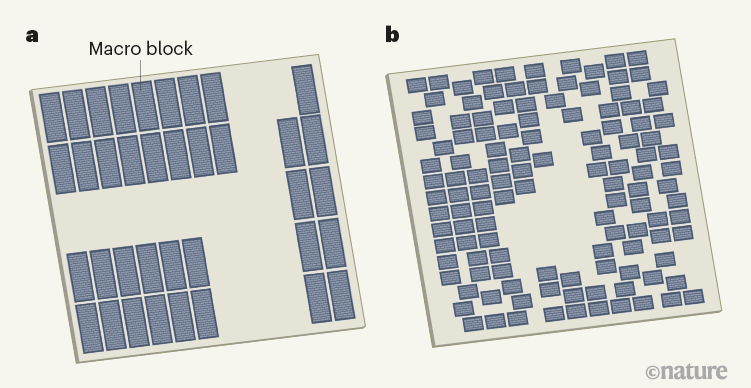
Chip layout by humans v AI
Chip layout by humans, on left, and by Google AI, on right. Source: Nature. Bet the humans wouldn’t have thought of the latter.

This is epochal – Google is using this to build its AI chips. And remember how it went with Go: from beating the best player in Europe to beating the best in the world in an even match. I suspect a lot of chip designers will be suspicious about this for a long time (does the system know everything that it should about the criteria for each block? How is it optimised?) And can everyone make use of the code to use this, or does Google have an unbeatable advantage here?
unique link to this extract


Twitter brings Revue newsletter subscriptions right into user profiles • Mashable

Jack Morse:

»

Newsletters are coming to a Twitter profile near you. Or, at least the chance to sign up for them is.

Twitter is set to continue its ongoing reinvention of the most sacred of social-media spaces — the user profile — in the next few weeks with the addition of a newsletter subscription button. The goal, as the company explained to Mashable, is to help newsletter writers better leverage their existing Twitter followers in an effort to grow their subscriber bases. 

The “subscribe” button, which will live prominently on the profile pages of those who choose to turn on the feature, will be available to anyone with a Revue account (sorry, Substackers). The move shows the continued emphasis Twitter is placing on newsletters following its January acquisition of the subscription newsletter service.

Writers can use Revue to generate free or paid subscription newsletters. Twitter takes a 5% cut of the latter.  

According to a mockup, Twitter users will be able to both subscribe to newsletters and read a “sample issue” directly on a writer’s Twitter profile page. 

“Folks who have Revue newsletters will be able to enable this feature directly in Revue, and people who visit the writer’s profile on Twitter can subscribe directly,” explained a company spokesperson.

«

I guess that a single Subscribe button means a lot less friction than clicking a link in a bio and then signing up. Newsletters feel like the thing that are having their moment, rather like blogging in the early 2000s. That didn’t last, of course.
unique link to this extract


Identification of novel bat coronaviruses sheds light on the evolutionary origins of SARS-CoV-2 and related viruses • Cell

Hong Zhou et al:

»

the spike protein sequences of three of the novel coronaviruses described here (RsYN04, RmYN05, and RmYN08) formed an independent lineage separated from known sarbecoviruses by a relatively long branch.

In this context, it is interesting that the recently identified bat coronavirus from Thailand carried a three-amino acid-insertion (PVA) at the S1/S2 cleavage site (Wacharapluesadee et al., 2021). Although this motif is different to that seen in SARS-CoV-2 (PRRA) and RmYN02 (PAA), this once again reveals the frequent occurrence of indel events in the spike proteins of naturally sampled betacoronaviruses (Garry et al., 2021; Holmes et al., 2021). Strikingly, RpYN06, RsYN04, RmYN05, and RmYN08 that only possessed one deletion in the RBD were able to bind to hACE2, albeit very weakly.

Accordingly, it is possible that there might be another lineage of naturally circulating coronaviruses with spike gene sequences that confer a greater potential to infect humans. Collectively, these results highlight the high and underestimated genetic diversity of sarbecovirus spike proteins, and which likely underpins their adaptive flexibility.

«

This article is still in preprint, but what they’re describing is that (1) they haven’t found SARS-Cov-2 in bats, yet (2) they’ve found other coronaviruses in bats in Yunnan that have different spike protein sequences. (“RBD” is “receptor binding domain” – what’s usually known as the spike.) Their conclusion is that the source is almost surely horseshoe bats, and that there’s a rich source of coronaviruses there.

Of course this won’t shift the discussion about “lab leaks” at all, even though it builds up the strength of the hypothesis that it’s a natural spillover.
unique link to this extract


Amplification and its discontents • Knight First Amendment Institute

Daphne Keller on proposals to have some sort of legislation that holds companies responsible for the effects of the algorithmic manipulation they use:

»

Some versions of amplification law would be flatly unconstitutional in the U.S., and face serious hurdles based on human or fundamental rights law in other countries. Others might have a narrow path to constitutionality, but would require a lot more work than anyone has put into them so far. Perhaps after doing that work, we will arrive at wise and nuanced laws regulating amplification. For now, I am largely a skeptic.

In this essay, I will lay out why “regulating amplification” to restrict distribution of harmful or illegal content is hard. My goal in doing so is to keep smart people from wasting their time devising bad laws, and speed the day when we can figure out good ones. I will draw in part on novel regulatory models that are more developed in Europe. My analysis, though, will primarily use U.S. First Amendment law. I will conclude that many models for regulating amplification face serious constitutional hurdles, but that a few—grounded in content-neutral goals, including privacy or competition—may offer paths forward.

This assessment draws in part on my own experiences with both manual and algorithmic management of content at Google, where I was associate general counsel until 2015. In that capacity, I advised on compliance with many content-restriction laws around the world, and spent a great deal of time with the engineers who build the company’s ranking algorithms.

«

This is not, you should know, a short piece. Also, she seems to conflate “moderation” with “amplification”. They’re not quite opposite sides of a coin. You can moderate without amplifying – forums have done it for absolutely ages.
unique link to this extract


Chia demand is driving HDD sales, keeping Seagate’s factories full • ExtremeTech

Joel Hruska:

»

The cryptocurrency Chia has had a significant impact on the [spinning] hard drive market. SSD demand doesn’t seem to have risen the same way, but both Western Digital and Seagate are reporting significantly higher demand. That’s according to executives from both companies, who spoke at a pair of separate events. Seagate CFO Gianluca Romano presented at the Bank of America Merrill Lynch 2021 Global Technology Conference, while Western Digital CFO Bob Eulau and VP Peter Andrew attended the Stifel 2021 Virtual Cross Sector Insight Conference (transcripts linked via SeekingAlpha).

According to Seagate, the boom in demand has helped it keep its factories full. Apparently, the hard drive industry added too much capacity in the last few years and the increased demand is filling manufacturing lines that would otherwise go idle.

Folks, we’ve finally done it. Nine months into the semiconductor shortage, we’ve managed to identify two top-tier hardware companies with manufacturing capacity to spare. According to Seagate, it is evaluating the likely long-term impact of Chia and planning additional CapEx spending to meet demand and fill product needs. The company expects overall hard drive prices to improve.

Eulau provided additional information on how WD sees these trends at the Stifel event. According to him, the Chia network was roughly 1EB (Exabyte) at launch. It’s currently 20EB. Both Western Digital and Seagate are seeing increased demand and revenue as a result; Seagate specifically mentions that this is an industry-wide uplift.

«

Chia is bonkers, but I guess the delta between the cost of a spinning drive and the potential “profit” is a hell of a lot bigger than with SSDs. The waste of resources is ridiculous. I’m constantly reminded of the closing scene of episode 6 of The Hitchhiker’s Guide, where the world’s forests are set on fire because leaves are now currency, and they don’t want inflation.
unique link to this extract


Apple says its new logon tech is as easy as passwords but far more secure • CNET

Stephen Shankland:

»

Apple has begun testing passkeys, a new authentication technology it says are as easy to use as passwords but vastly more secure. Part of iCloud Keychains, a test version of the technology will come with iPhones, iPads and Macs later this year.

To set up an account on a website or app using a passkey, you first choose a username for the new account, then use FaceID or Touch ID to confirm that it’s really you who’s using the device. You don’t ever pick a password. Your device handles generation and storage of the passkey, which iCloud Keychain synchronizes across all your Apple devices.

To use the passkey for authentication later, you’ll be prompted to confirm your username and verify yourself with FaceID or Touch ID. Developers must update their login procedures to support passkeys, but it’s an adaptation of the existing WebAuthn technology.

“Because it’s just a single tap to sign in, it’s simultaneously easier, faster and more secure than almost all common forms of authentication today,” Garrett Davidson, an Apple authentication experience engineer, said Wednesday at the company’s annual WWDC developer conference.

Passkeys are the latest example of growing interest in passwordless logon technology that’s designed to be more secure than the list of passwords you’ve taped to the side of your monitor. Conventional passwords are plagued with security shortcomings, chiefly our inability to create and remember unique ones. That’s why Apple, along with Microsoft, Google and other companies, are working to come up with alternatives.

«

Already in use for Microsoft services, where there are 200 million accounts with it. My query: what if you’re using a device that isn’t part of your chosen ecosystem?
unique link to this extract


Rep. Gohmert’s question about the Forest Service changing Earth’s orbit was dumb, but not for the reason you think • The Washington Post

Philip Bump:

»

“I was informed by the immediate past director of NASA that they have found that the moon’s orbit is changing slightly and so is the Earth’s orbit around the sun,” he continued. “And we know there’s been significant solar flare activity. And so is there anything that the National Forest Service or BLM can do to change the course of the moon’s orbit or the Earth’s orbit around the sun? Obviously, that would have profound effects on our climate.”

It took Eberlien a moment to reply. “I would have to follow up with you on that one, Mr. Gohmert,” she said with a chuckle.

“Yeah, well, if you figure out a way that you in the Forest Service can make that change,” Gohmert replied, “I’d like to know.”

When it’s written out, as above, this appears to be a member of Congress earnestly asking a person in charge of the nation’s forests whether her agency could alter how the Earth rotates around the sun. It’s an obviously ludicrous idea for several reasons. One: It’s not clear how any agency might change the Earth’s orbit, much less one whose heaviest equipment includes big chain saws. Two: There’s an obvious risk posed by shifting how the Earth rotates around the sun. I, for one, would prefer not to cause that orbit to decay to the extent that our planet is pulled directly into the star. No wonder Eberlien could only marvel.

…In reality, though, Gohmert was embracing a different goofy theory. Gohmert was being ironic. He wasn’t actually suggesting that the Earth’s orbit be shifted but, instead, suggesting that, since climate change is a function of those orbits and solar flares, altering the orbit would be what those agencies need to do to combat climate change.

He wasn’t asking a dumb question. He was trying to suggest that it was the Bureau of Land Management or the Forest Service that was being dumb by thinking they could affect climate change in some way short of figuring out how to shift the moon around in the sky. And that’s how Gohmert was wrong.

«

unique link to this extract


The best features of iOS, iPadOS, and macOS that Apple didn’t announce onstage • The Verge

Mitchell Clark:

»

Apple had its WWDC keynote on Monday, where it showed off the big new features coming to its platforms, but it didn’t have time to show off everything coming to the new versions of iOS, iPadOS, and macOS. So we’ve combed through the preview pages, Twitter, and a good chunk of the internet to see what interesting features got left out of the presentation.

«

Lots of tasty things (and it seems like a solid update). Plus it will be on hundreds of millions of devices come September/October, which makes it a little different from the Android 12 beta that was announced last month.
unique link to this extract


iOS 4 has been lovingly recreated as an iPhone app • The Verge

Tom Warren:

»

iOS 4 originally appeared nearly 10 years ago as Apple’s first mobile operating system to drop the iPhone OS naming convention. An 18-year-old developer has now lovingly recreated iOS 4 as an iPhone app, and it’s a beautiful blast from the past. If you never got the chance to use iOS 4, or you’re a fan of the iPhone 3G, OldOS almost flawlessly pulls off the experience of using an iPhone from a decade ago.

OldOS is “designed to be as close to pixel-perfect as possible,” says Zane, the developer behind the app. It’s all built using Apple’s SwiftUI, so it includes buttery smooth animations and even the old iPhone home button that vibrates with haptic feedback to make it feel like a real button.

Apple’s built-in iOS 4 apps have also been recreated here, and it’s a real flashback to the skeuomorphic days of the iPhone whenever they launch. Photos lets you view your existing camera roll as you would have 10 years ago, while Notes transports you back to the yellow post-it notes of yesteryear.

The only apps that don’t work as you might expect are Messages and YouTube. Apple used to bundle YouTube directly into its operating system, and the developer behind OldOS says there are “still some major issues with YouTube” and Messages that they’re working to fix.

«

Only available on Testflight (the service for betas), and Apple might nuke it, but the code has been published so people with developer accounts can compile it. At least computers let you realise that oh, it actually wasn’t better before.
unique link to this extract


Several macOS Monterey features unavailable on Intel-based Macs • MacRumors

Joe Rossignol:

»

On the macOS Monterey features page, fine print indicates that the following features require a Mac with the M1 chip, including any MacBook Air, 13-inch MacBook Pro, Mac mini, and iMac model released since November 2020:

Portrait Mode blurred backgrounds in FaceTime videos
• Live Text for copying and pasting, looking up, or translating text within photos
• An interactive 3D globe of Earth in the Maps app
• More detailed maps in cities like San Francisco, Los Angeles, New York, and London in the Maps app
• Text-to-speech in more languages, including Swedish, Danish, Norwegian, and Finnish
• On-device keyboard dictation that performs all processing completely offline
• Unlimited keyboard dictation (previously limited to 60 seconds per instance)

…Google Earth has long offered an interactive 3D globe of the Earth on Intel-based Macs both on the web and in an app.

«

I was puzzled by this, because having an M1 chip isn’t a necessity on an iPad – I’ve installed the iOS 15 iPad OS beta and Live Text works fine. Turns out, according to Rene Ritchie, that it’s because you need the “neural engine” that first came with Apple’s proprietary A11 chip in 2017. Intel’s chips, of course, don’t have that. So that’s how newer (but Intel-based) Macs won’t have those facilities, but older (A11+) iOS devices will.
unique link to this extract


Errata, corrigenda and ai no corrida: none notified.

Start Up No.1568: India’s WhatsApp misinformation problem, Pipeline bitcoin redux, creators hit burnout (and Apple tax), and more


After the Fastly outage dumped people on perplexing error pages, could we get better error messages to inform people what’s going on?CC-licensed photo by Nick Webb on Flickr.

You can sign up to receive each day’s Start Up post by email. You’ll need to click a confirmation link, so no spam.

A selection of 11 links for you. Not an error. I’m @charlesarthur on Twitter. Observations and links welcome.


There’s still time to preorder Social Warming, my forthcoming book.


When Covid misinformation comes for the family WhatsApp • Rest of World

Meghna Rao’s 80-year-old grandfather in India caught Covid, which gave him “brain fog”:

»

Although the doctors had diagnosed my grandfather with Covid-19, they didn’t have a cure for his memory loss. Days into his hospitalization, he remained confused, and pandemic numbers continued to increase. An uncle who lives in a small, coastal town in Karnataka sent a lengthy message to my family group quoting an article by “Joseph Hope, editor-in-chief of The New York Times.” Hope praised Modi’s strategic management of India, painting him as a mastermind who would steer the country into the 21st century.

Neither the article — nor its supposed author — mentioned in the message exist, but WhatsApp only flagged that the message has been “forwarded many times.”

…In the 2000s, over an AOL connection in Queens, my grandfather was reading a range of international publications and forming his own opinions. He was one of the first people I had known to purchase a cellphone. He kept up with the technology’s evolution, downloading apps when they became available, and teaching himself how to change language settings on his phone so he could read things in Kannada.

But this new person [post-Covid] was unrecognizable. Like many other Indians, his main portal into the internet had become Facebook and WhatsApp. His viewpoints morphed into a hodgepodge of viral WhatsApp messages.

As I watched him change, I couldn’t help but accept the obvious conclusion: Facebook does not care to fix its misinformation problem. Instead, it only wants to keep people glued to the platform.

My grandfather’s cognitive abilities have now deteriorated, and the brief spell of clarity he returned to over the summer has passed. He often experiences “sundowning,” where he spirals into a deep confusion each evening. He’s off WhatsApp now, less focused on the material and the political, his brain set on some far-out horizon.

«

WhatsApp’s deleterious effect in India is one of the topics I cover in my forthcoming book Social Warming, because it tells us that you don’t need algorithmic amplification for a social network to spread misinformation. Fake news travels further, faster than truth.

There’s also the lack of understanding by designers of how their work will be understood. In India, many people see the “Forwarded” symbol and think it’s an instruction, not a denotation.
unique link to this extract


Bitcoin is actually traceable, Pipeline investigation shows • The New York Times

Nicole Perlroth, Erin Griffith and Katie Benner:

»

Justice Department spokesman Marc Raimondi declined to say more about how the FBI seized DarkSide’s private key. According to court documents, investigators accessed the password for one of the hackers’ Bitcoin wallets, though they did not detail how.

The FBI did not appear to rely on any underlying vulnerability in blockchain technology, cryptocurrency experts said. The likelier culprit was good old-fashioned police work.
Federal agents could have seized DarkSide’s private keys by planting a human spy inside DarkSide’s network, hacking the computers where their private keys and passwords were stored, or compelling the service that holds their private wallet to turn them over via search warrant or other means.

“If they can get their hands on the keys, it’s seizable,” said Jesse Proudman, founder of Makara, a cryptocurrency investment site. “Just putting it on a blockchain doesn’t absolve that fact.”

…Mr. Raimondi of the Justice Department said the Colonial Pipeline ransom seizure was the latest sting operation by federal prosecutors to recoup illicitly gained cryptocurrency. He said the department has made “many seizures, in the hundreds of millions of dollars, from unhosted cryptocurrency wallets” used for criminal activity.

In January, the Justice Department disrupted another ransomware group, NetWalker, which used ransomware to extort money from municipalities, hospitals, law enforcement agencies and schools.

As part of that sting, the department obtained about $500,000 of NetWalker’s cryptocurrency that had been collected from victims of their ransomware.

«

We’re not going to find out how they did it, are we. Though it feels like “compelling the service” is the front runner for me.
unique link to this extract


The creator economy is running into the Apple Tax — this startup is fighting back • The Verge

Jacob Kastrenakes:

»

Founders of Fanhouse — which is basically OnlyFans without the nudity — say the platform will be kicked out of the App Store in August if it doesn’t start forking over 30% of the fees people pay creators when purchases are made through the iPhone app. One of Fanhouse’s creators, the streamer Breadwitchery, says that cut would mean losing two months of rent from her earnings to date. The company doesn’t have a lot of options to push back, but it’s launching a campaign today to pressure Apple into easing its rules around payments to creators.

Fanhouse is only the latest company to clash with Apple over App Store terms that are increasingly viewed as steep and domineering. Sure, it’s a small app, and its disappearance won’t necessarily cause problems for Apple, but the situation speaks to the challenges creator-focused apps face in the App Store. As the creator economy continues to grow, the rules mean Apple will be taking more money from not just businesses, but individuals.

“People are using this platform to survive, starting with me, our very first creator,” Jasmine Rice, a Fanhouse creator and one of the platform’s co-founders, tells The Verge. “I use this to pay the bills for my family. I use this to pay my mom’s medical expenses.”

Fanhouse, which launched in 2020, initially slipped past the App Store bouncers and offered payments on the web without issue. Now that Apple has spotted the potential for profit, it’s given Fanhouse the same ultimatum it gives (almost) everyone else: Fanhouse either needs to pay up or get booted from the store.

«

It’s complicated, isn’t it? Apple doesn’t demand 30% of Uber’s or AirBnB’s fees. But for “virtual” products, it does. I think Apple’s argument would be – will be – that the in-app purchase method will greatly expand the number of people who will be willing to buy, and so Fanhouse can make it up in volume. One problem: Patreon, another “creator” app, gets a special dispensation that allows third-party payments. The dam may be cracking.
unique link to this extract


A mystery cube, a secret identity, and a puzzle solved after 15 years • WIRED UK

Will Coldwell:

»

On Sunday February 4, 2007, as the sun rose over Wakerley Great Wood in Northamptonshire, Andy Darley trudged into the ancient forest with a map and a spade, and began to dig. The clock was ticking – others were closing in. Darley, a web designer from Middlesex, near London, had made three trips here in as many days. The previous night he had caught a glimpse of a torch in the darkness – if he didn’t find what he was looking for soon, someone else would.

He dug one hole after another. Nothing. It was getting light and he was running out of ideas. Darley sighed and looked at his feet. The surface of the ground beside him seemed different; the topsoil was mixed with clay. Someone had disturbed the earth in the recent past… or perhaps buried something? He dropped to his knees, grabbed a trowel and plunged the metal into the dirt. Six inches deep it struck a solid object. “That was when it hit me,” he recounted later on his website. “That was when I knew I’d found the Cube.”

«

It’s an entertaining story, well told, about the hunt for Satoshi (no, not that one) in the game Perplex City. Though you could listen to it, as the story was told very effectively by Aleks Krotoski in the episode “Find” of her series “The Digital Human” in March. And she also wrote up the story over at Science Focus two weeks ago. So, take your pick.
unique link to this extract


Facebook plans first smartwatch for next summer with two cameras • The Verge

Alex Heath:

»

Facebook is taking a novel approach to its first smartwatch, which the company hasn’t confirmed publicly but currently plans to debut next summer. The device will feature a display with two cameras that can be detached from the wrist for taking pictures and videos that can be shared across Facebook’s suite of apps, including Instagram, The Verge has learned.

A camera on the front of the watch display exists primarily for video calling, while a 1080p, auto-focus camera on the back can be used for capturing footage when detached from the stainless steel frame on the wrist. Facebook is tapping other companies to create accessories for attaching the camera hub to things like backpacks, according to two people familiar with the project, both of whom requested anonymity to speak without Facebook’s permission.

The idea is to encourage owners of the watch to use it in ways that smartphones are used now. It’s part of Facebook CEO Mark Zuckerberg’s plan to build more consumer devices that circumvent Apple and Google, the two dominant mobile phone platform creators that largely control Facebook’s ability to reach people.

…Facebook is working with the top wireless carriers in the US to support LTE connectivity in the watch, meaning it won’t need to be paired with a phone to work, and sell it in their stores, the people familiar with the matter said. The watch will come in white, black, and gold, and Facebook hopes to initially sell volume in the low six figures. That’s a tiny sliver of the overall smartwatch market — Apple sold 34 million watches last year by comparison, according to Counterpoint Research..

«

Heath recently joined The Verge from The Information, where he got lots of scoops about Facebook, so this is probably reliable. It’s also a bit mad: does it connect to a phone at all? (If not, how do you get the notifications that make a smartwatch so useful?) How can it compete on price with the Apple Watch, which will be available at a lot of price ranges? Most of all, what is its USP – unique selling point – over the Apple Watch or whatever the Google/Samsung/Fitbit combination offer? Facebook tried before a long time ago to do its own phone, with HTC. It flopped badly.
unique link to this extract


Apple’s Eddy Cue on spatial audio, future of music • Billboard

Micah Singleton:

»

We saw some of your competitors launch their own versions of immersive music, which have had varying levels of success. What makes Spatial Audio different?

I’ve been waiting for something in music that was a real game-changer. The quality of audio has not been able to really rise because there hasn’t been anything out there that when you listen to it, it truly is differentiated to everybody. It doesn’t matter whether you’re eight years old or 80 years old, everyone can tell the difference and everyone knows this one sounds better than the other one.

And the analogy to that is obviously the first time you ever saw HD on television: you knew which one was better because it was obvious. And we’ve been missing that in audio for a long time. There really hasn’t been anything that’s been substantial. We’ll talk about lossless and other things, but ultimately, there’s not enough difference.

But when you listen for the first time and you see what’s possible with Dolby Atmos with music, it’s a true game-changer. And so, when we listened to it for the first time, we realized this is a big, big deal. It makes you feel like you’re onstage, standing right next to the singer, it makes you feel like you might be to the left of the drummer, to the right of the guitarist. It creates this experience that, almost in some ways, you’ve never really had, unless you’re lucky enough to be really close to somebody playing music.

«

Cue also says about lossless that if you take 100 people and play them lossless content, probably only 1 or 2 will be able to tell the difference. So spatial audio is where the focus (aha) is going to be.

If you can’t get onto Billboard (the piece is behind a paywall), you can also read this piece on Apple News – no subscription to Billboard or Apple News+ needed.
unique link to this extract


What the Fastly outage can teach us about writing error messages • OnlineOrNot

Max Rozen on the meaninglessness (to most users) of the “Error 503 Service Unavailable” message that greeted people who were trying to view sites that had vanished because Fastly had fallen over:

»

The majority of internet users aren’t developers, so just writing the error code and its name (503 Service Unavailable) just isn’t good enough.

The Norman Nielsen Group (back in 1998!) provided us with some basic guiding principles for writing better error messages:

• Write in plain English (or whichever language you’re supporting)
• Tell the user exactly what went wrong
• Tell the user how the problem can be fixed
• More concretely, we can write better error messages by answering the following four questions:

– Who caused the error?
– What happened, and why?
– When will it be fixed?
– How can the user respond to the error?

If your error message covers those four points, then you can think about adding humour and some brand identity.

«

The intended-to-be-reassuraing but actually annoying (to users) messages such as “Uh-oh!” really don’t cut it. (Google’s 404 message: “That’s an error. The requested URL xxxx was not found on this server. That’s all we know” seems unhelpful: it doesn’t for example suggest you may have mistyped the URL.)
unique link to this extract


Young creators are burning out and breaking down • The New York Times

Taylor Lorenz:

»

Lately, it’s been hard for Jack Innanen, a 22-year-old TikTok star from Toronto, to create content. “I feel like I’m tapping a keg that’s been empty for a year,” he said.

Spending hours shooting, editing, storyboarding, engaging with fans, setting up brand deals and balancing the many other responsibilities that come with being a successful content creator have taken a toll. Mr. Innanen, like so many Gen Z influencers who found fame in the last year, is burned out.

“I get to the point where I’m like, ‘I have to make a video today,’ and I spend the entire day dreading the process,” he said.

He’s hardly the only one. “This app used to be so fun,” a TikTok creator known as Sha Crow said in a video from February, “and now your favorite creator is depressed.” He went on to explain how his friends are struggling with mental health problems and the stresses of public life.

The video went viral, and in the comments, dozens of creators echoed his sentiment. “Say it louder bro,” wrote one with 1.7 million followers. “Mood,” commented another creator with nearly five million followers.

…According to a recent report by the venture firm SignalFire, more than 50 million people consider themselves creators (also known as influencers), and the industry is the fastest-growing small-business segment, thanks in part to a year where life migrated online and many found themselves stuck at home or out of work. Throughout 2020, social media minted a new generation of young stars.

Now, however, many of them say they have reached a breaking point.

«

Sisyphus had it easy: at least he didn’t have to create the rock anew each day. I’m sure there will be much playing of tiny violins over this, but continually creating content takes real effort.
unique link to this extract


Google kills Measure, its AR-based measurement-taking app • Android Police

Ryne Hager:

»

Google’s AR plans have changed over the years, from the standalone Project Tango to modern web-based efforts. But it’s the AR-based Measure app that’s the subject of today’s eulogy. The app leveraged your camera on ARCore-supported devices to (as the name suggests) measure the dimensions of stuff, and now it’s being retired. Google has suspended both support and updates for Measure.

Measure started life back in 2016 as a Tango-exclusive app. (You remember Google’s now dead experiment regarding AR-specialized devices, right?) In 2018, after Google wrote that effort off, Measure was broken out into its own standalone app for ARCore-supported devices — ARCore itself basically obviating the need for Project Tango to be a thing.

In 2018, the app was updated to work on vertical surfaces. In 2019, Google even toyed with the idea of bundling it into the camera, though that didn’t pan out. Last year it picked up a new surface animation and more unit conversions — all signs of active (if slow) development.

The app worked sort of like magic, allowing you to point your phone’s camera at stuff, draw some lines on your screen, and get measurements regarding the dimensions depicted. Sadly, Measure didn’t always work very accurately and had some stability problems, as reviews on the Play Store listing pretty clearly indicate. (Apple later did its own version on the concept, which works a little better — probably at least in part thanks to the lidar hardware on some of its phones)

«

The app seems to have had between 5m and 10m downloads, which in Android-world is essentially invisible. So that isn’t surprising. Google still has an ARCore framework which OEMs can use. Yet after the demise of Cardboard, this still feels like a retreat from the AR/VR space by Google.
unique link to this extract


El Salvador’s bitcoin bill is still keen on king dollar • Financial Times

Jemima Kelly:

»

The US dollar — a fiat currency — will remain the reference currency. So prices in dollars. You can just imagine customers waiting at tills watching their phones waiting for the bitcoin price to climb a bit to get more for their money’s worth can’t you? What a great idea.

And who would actually want to pay in bitcoin rather than dollars, we hear you ask? Well, usually converting real money into bitcoin carries a hefty fee. And also what happens with returns? Do you get refunded at the original exchange rate or the one that happens to coincide with your return? Isn’t there a huge risk for both merchants and buyers when using such a volatile instrument? The bill, unfortunately, doesn’t say.

But despite the obvious flaws, might there be a grander plan being hatched here? OK probably not, but hear us out.

In our FT Alphaville Clubhouse discussion this morning an alternative theory was floated as to why El Salvador may want bitcoin, and therefore ultimately dollar, flows. The Central American country is seeking $1bn from the IMF, yet the discussions got complicated after Bukele fired its five Supreme Court judges in early May, following a landslide election victory. The Biden administration was not best pleased.

If the IMF funding is looking in doubt, then what better way to generate inflows than by letting international hodlers purchase your goods and services with their favourite coin? Seeing as refunds will likely have to be in dollars, you’d imagine merchants will be instantly selling their bitcoin for greenbacks on their exchange of choice to avoid volatility, creating a form of indirect dollar funding for the country. FT Alphaville friend Frances Coppola had even more radical thought which she posted on Twitter: perhaps the move is to help El Salvador to break away from the dollar system all together?

«

I wonder if this move by El Salvador will act as a damper on the bigger swings in bitcoin’s price (measured in dollars). The other big problem, unmentioned here, is the incredibly slow, by comparison, processing of bitcoin transactions. I think El Salvador can easily overwhelm the six-per-second limit.
unique link to this extract


Some bitcoin miners in Xinjiang have been ordered to shut down • The Block

Wolfie Zhao:

»

Bitcoin miners in one of the major economic and technological development zones in China’s Xinjiang province have been ordered to shut down their operations immediately.

The Reform and Development Commission in the Changji Hui Autonomous Prefecture in Xinjiang issued a notice on Wednesday to its subordinate government officials in the Zhundong Economic Technological Development Park. According to the notice seen and verified by The Block, officials in the development park have been instructed to shut down all crypto mining activities under their administration by 2:00 pm China time on Wednesday.

The park is a 15,500 square km area home to a variety of coal production industries including coal-based power plants and industrial factories. It also houses some of the largest bitcoin mining facilities in the country due to the high capacity of fossil fuel energy.

The instruction was based on the high-level bitcoin trading and mining crackdown comment brought up during the China State Council meeting last month, the notice said.

«

The significance is that bitcoin mining in Xinjiang is reckoned to contribute 40% of the hash rate.
unique link to this extract


Errata, corrigenda and ai no corrida: none notified

Start Up No.1567: the FBI’s huge app sting, Facebook’s flawed “Discover” app, machine learning’s medical problem, and more


The arrival of Uber drove down the value of a “medallion” to drive a New York cab by about 75% – but now Uber is raising its ride prices towards those of cabs. CC-licensed photo by joiseyshowaa on Flickr.

You can sign up to receive each day’s Start Up post by email. You’ll need to click a confirmation link, so no spam.

A selection of 9 links for you. Unencrypted. I’m @charlesarthur on Twitter. Observations and links welcome.

Trojan shield: how the FBI secretly ran a phone network for criminals • Vice

Joseph Cox:

»

In 2018, the FBI arrested Vincent Ramos, the CEO of Phantom Secure, which provided custom, privacy-focused devices to organized criminals. In the wake of that arrest, a confidential human source (CHS) who previously sold phones on behalf of Phantom and another firm called Sky Global, was developing their own encrypted communications product. This CHS then “offered this next generation device, named ‘Anom,’ to the FBI to use in ongoing and new investigations,” the court document reads. While criminals left Phantom, they flocked to other offerings. One of those was Anom; the FBI started what it called Operation Trojan Shield, in which it effectively operated a communications network targeted to criminals and intercepted messages running across it.

The FBI, AFP, and CHS built the Anom system in such a way that a master key silently attached itself to every message set through the app, enabling “law enforcement to decrypt and store the message as it is transmitted,” the document reads.

“A user of Anom is unaware of this capability,” it adds.

But first the FBI and their source needed to establish Anom as an option in the criminal underworld. As Motherboard showed in a years-long investigation, using sources around Phantom as well as FBI files, Phantom was particularly popular in Australia. The CHS introduced Anom to his already trusted distributors of mobile devices, who were in turn trusted by criminal organizations, the document reads. Three people in Australia who had previously distributed Phantom, “seeing a huge payday,” agreed to then sell these Anom devices, the document adds. With this, “the FBI aimed to grow the use of Anom organically through these networks,” it reads.

Earlier on Monday before obtaining the court record, Motherboard reviewed Anom’s social media presence. The company’s Reddit account first announced the existence of the company two years ago, according to a since deleted but cached Reddit post that Motherboard found.

“Introducing Anom—a Ultra-Secure Mobile-Cell-Phone Messaging App for Android,” the announcement read. “Your Confidentiality, Assured. Software hardened against targeted surveillance and intrusion—Anom Secure. Keep Secrets Safe!”

«

They were certainly safe, but not with the people that perhaps the criminals would have wanted them to be.
unique link to this extract


Massive internet outage hits websites including Amazon, gov.uk and Guardian • The Guardian

Alex Hern:

»

As well as bringing down some websites entirely, the failure also broke specific sections of other services, such as the servers for Twitter that host the social network’s emojis.

The failure was not geographically universal. Users in some locations, such as Berlin, reported no problems, while others experienced massive failures across the internet. Outages were reported in locations as varied as London, Texas and New Zealand.

Within minutes of the outage starting, Fastly, a cloud computing services provider, acknowledged that its content distribution network was the cause of the problem. The company runs an “edge cloud”, which is designed to speed up loading times for websites, protect them from denial-of-service attacks, and help them deal with bursts of traffic.

The technology requires Fastly to sit between most of its clients and their users. That means that if the service suffers a catastrophic failure, it can prevent those companies from operating on the net at all.

In an error message posted at 10.58 UK time, Fastly said: “We’re currently investigating potential impact to performance with our CDN services.” It was not until 11.57 UK time, almost an hour later, that Fastly declared the incident over. “The issue has been identified and a fix has been applied. Customers may experience increased origin load as global services return,” the company said in a status update.

«

Before yesterday, hardly anyone had heard of Fastly. After yesterday, the company fervently hopes that will once more be the case, and that Tuesday was just a blip.
unique link to this extract


How Facebook Discover replicated many of Free Basics’ mistakes • Rest of World

Meaghan Tobin:

»

[Facebook’s connectivity app] Discover lets users scroll through a text-only version of any website for free, up to a certain daily data cap set by their mobile provider. But unlike Free Basics, Discover supposedly allows people to view the entire internet, instead of only a handful of preselected resources. Users don’t need a Facebook account to get started, and the company said it doesn’t collect user data for advertising.

The research was conducted in July and August last year by scholars at the University of California, Irvine and the University of the Philippines, and focused specifically on how Discover functions in the Philippines — a country with high levels of internet usage and where Facebook is already enormously popular. Facebook told Rest of World that Discover has now replaced Free Basics there entirely. 

To save data, Discover routes all traffic through a proxy server, which strips features like video and audio streaming, as well as some images. It essentially gives users free access to a pared-down version of any website. But the researchers found that when they accessed Facebook through Discover, it wasn’t redacted at all — and just 4% of images were removed from Instagram, compared with more than 65% of images on other popular sites like YouTube and e-commerce platform Shopee. In other words, the study found that Discover rendered Facebook’s own services far more functional than those of its own competitors. 

«

This was set out in a research paper that was just published. Discover is just the same as Free Basics: it makes it harder for people to find out the truth by checking reliable sites, but intensifies the experience of using Facebook.

Free Basics was a big cause of problems in Philippines and Brazil. (It’s in my book!) India’s decision to ban it there was probably one of the wisest moves it could have made.
unique link to this extract


Farewell, millennial lifestyle subsidy • The New York Times

Kevin Roose:

»

“Today my Uber ride from Midtown to JFK cost me as much as my flight from JFK to SFO,” Sunny Madra, a vice president at Ford’s venture incubator, recently tweeted, along with a screenshot of a receipt that showed he had spent nearly $250 on a ride to the airport.

“Airbnb got too much dip on they chip,” another Twitter user complained. “No one is gonna continue to pay $500 to stay in an apartment for two days when they can pay $300 for a hotel stay that has a pool, room service, free breakfast & cleaning everyday. Like get real lol.”

Some of these companies have been tightening their belts for years. But the pandemic seems to have emptied what was left of the bargain bin. The average Uber and Lyft ride costs 40% more than it did a year ago, according to Rakuten Intelligence, and food delivery apps like DoorDash and Grubhub have been steadily increasing their fees over the past year. The average daily rate of an Airbnb rental increased 35% in the first quarter of 2021, compared with the same quarter the year before, according to the company’s financial filings.

Part of what’s happening is that as demand for these services soars, companies that once had to compete for customers are now dealing with an overabundance of them. Uber and Lyft have been struggling with a driver shortage, and Airbnb rates reflect surging demand for summer getaways and a shortage of available listings.

«

The days of huge subsidies through venture capitalists are over, my friends. Nice while it lasted, right? Apart from the New York taxi drivers who saw their medallions (the badges that allowed them to drive) reduced in value from a million dollars to a quarter of that.
unique link to this extract


Machine learning is booming in medicine. It’s also facing a credibility crisis • Stat News

Casey Ross:

»

Machine learning, a subset of AI driving billions of dollars of investment in the field of medicine, is facing a credibility crisis. An ever-growing list of papers rely on limited or low-quality data, fail to specify their training approach and statistical methods, and don’t test whether they will work for people of different races, genders, ages, and geographies.

These shortcomings arise from an array of systematic challenges in machine learning research. Intense competition results in tighter publishing deadlines, and heavily cited preprint articles may not always undergo rigorous peer review. In some cases, as was the situation with Covid-19 models, the demand for speedy solutions may also limit the rigor of the experiments.

By far the biggest problem — and the trickiest to solve — points to machine learning’s Catch-22: There are few large, diverse data sets to train and validate a new tool on, and many of those that do exist are kept confidential for legal or business reasons. But that means that outside researchers have no data to turn to test a paper’s claims or compare it to similar work, a key step in vetting any scientific research.

The failure to test AI models on data from different sources — a process known as external validation — is common in studies published on preprint servers and in leading medical journals. It often results in an algorithm that looks highly accurate in a study, but fails to perform at the same level when exposed to the variables of the real world, such as different types of patients or imaging scans obtained with different devices.

“If the performance results are not reproduced in clinical care to the standard that was used during [a study], then we risk approving algorithms that we can’t trust,” said Matthew McDermott, a researcher at the Massachusetts Institute of Technology who co-authored a recent paper on these problems. “They may actually end up worsening patient care.”

«

unique link to this extract


Exclusive: Apple’s Craig Federighi on WWDC’s new privacy features • Fast Company

Michael Grothaus:

»

I asked Federighi if he feels that Apple must pick up the ball because governments haven’t enacted laws that would guarantee privacy. “I’d certainly like to believe that we’re doing good and play a constructive role here, for sure,” he says. “[But] I do think Apple has a set of different tools, naturally, than governments have. We have certain technology skills and a certain access to an end-to-end technology platform where we can innovate.”

Federighi explains that governments are often reactive when it comes to technology–and there’s no way for them to get around that. At least on the consumer front, companies do most of the innovating. They’re also the ones who find new ways to exploit data. So governments can put rules around technologies or processes only after they’ve become a problem. Those rules often lag far behind the speed of such innovations. That’s why even if governments were more proactive, it would still fall on companies such as Apple to develop new privacy-enhancing technologies.

That being said, Federighi believes that “there’s absolutely a role where government can look at what companies like Apple are doing and say, ‘You know, that thing is such a universal good–such an important recognition of customer rights–and Apple has proven it’s possible. So maybe it should be something that becomes a more of a requirement.’ But that may tend to lag [Apple’s privacy] innovation and creation of some new thing that they can evaluate and decide to make essentially the law.”

«

The new iCloud Private Relay is essentially Tor, but without the dark web, offering a dual-hop structure so that none of the nodes on the network can see where traffic is coming from or going to – the “Tor exit node problem”. It’s going to be part of “Apple+”, yet another paid-for add-on to the Services group.
unique link to this extract


How the superforecasters do it • The Commoncog Blog

Cedric Chin:

»

The general question that we’re trying to answer here, the one that’s sort of hanging out in the background over everything is: ‘is this nature or nurture?’ And [superforecasting progenitor Philip] Tetlock believes that it’s both. Superforecasters have higher-than-average fluid intelligence. They score higher on tests of open-mindedness. They possess an above-average level of tested general knowledge. But all three of the GJP’s [Good Judgement Project, a competition to find superforecasters] interventions have resulted in sustained performance improvements: over time, the correlation between intelligence and forecasting results dropped (which Tetlock took to mean that continued practice was having an effect, even on average forecasters).

…Superforecasters perform so well because they think in a very particular way. This method of thinking is learnable. I’ll admit that exposure to this style of thinking has had an unforeseen side-effect in the years since I read Superforecasting: I find myself comparing the rigour of any analytical argument against the ideal examples presented by Tetlock and Gardner. As you’ll soon see, the superforecasters of the GJP set a high bar for analysis indeed.

Superforecasters break stated forecasting problems into smaller subproblems for investigation. The term that Tetlock uses is to ‘Fermi-ize’ a problem — aka ‘do a Fermi estimation’ — which is a fancy name for the method with which physicist Enrico Fermi used to perform educated guesses.

The canonical example for ‘Fermi estimation’ is the question: “how many piano tuners are there in Chicago?” — a brainteaser Fermi reportedly enjoyed giving to his students.

«

unique link to this extract


US authorities seize the affiliate’s share of the DarkSide ransom paid by Colonial Pipeline • Elliptic

Dr. Tom Robinson:

»

DarkSide is an example of “Ransomware as a Service” (RaaS). In this operating model, the malware is created by the ransomware developer, while the ransomware affiliate is responsible for infecting the target computer system and negotiating the ransom payment with the victim organisation. This new business model has revolutionised ransomware, opening it up to those who do not have the technical capability to create malware, but are willing and able to infiltrate a target organisation.

Any ransom payment made by a victim is then split between the affiliate and the developer. In the case of the Colonial Pipeline ransom payment, 85% (63.75 BTC) went to the affiliate and 15% went to the DarkSide developer.

It appears to be the majority of the affiliate’s share of this ransom – 63.7 BTC – that has been seized by US authorities today. Using blockchain analysis we can trace the affiliate’s share of the Colonial ransom transaction (previously identified by Elliptic) to the Bitcoin address bc1qq2euq8pw950klpjcawuy4uj39ym43hs6cfsegq – the same address mentioned in the seizure affidavit.

This address was emptied at around 1.40pm (Eastern Time) today – presumably by US authorities. (There was also the movement of an additional 5.9 BTC not mentioned in the affidavit).

«

The more that emerges about this, the more questions there are. Why hit the affiliate and not Darkside? (If you had Darkside’s private key, wouldn’t that give you more leverage over Darkside?) Should we suspect that Darkside somehow handed over the affiliate’s private key to the wallet because it created such a level of threat? Most of all, how did the FBI get hold of the private key? That question is going to mildly obsess me until we get a good answer.
unique link to this extract


How to negotiate with ransomware hackers • The New Yorker

Rachel Monroe:

»

Last November, Fowler was the designated negotiator for the construction-engineering firm. When he logged on to the dark-Web site, he noticed that the timer showed that three days had already elapsed in the negotiations. In the chat box, a conversation was in progress. “It was shocking for me,” Fowler said. “This is a whole negotiation—poorly done, but a whole negotiation—that I’m looking at.”

Whoever had been chatting on behalf of the engineering firm was confrontational and aggressive. When the hackers demanded two hundred thousand dollars to unlock the company’s files, the negotiator initially counteroffered ten thousand dollars, and then quickly went up to fourteen thousand, then twenty-five thousand. “What that communicates to the threat actor is: there’s more money here,” Fowler said. The hackers grew frustrated. “You have reported an annual income of $4 million,” they wrote. “We are not expect small money from you.” The final message in the chat had arrived from the hackers two days earlier: “Are you ready to close with a cost of 65k?”

Fowler and Minder tried to piece together what had happened. The clients insisted that they had never gone to the dark-Web site, much less interacted with the hacker. Then Fowler reminded Minder about a recent post on REvil’s blog, warning about fraudulent middlemen who said that they could decrypt files; instead, the middlemen would secretly negotiate with the hackers before offering the decrypted files at a markup. At the time, it had amused Minder that a cybercrime syndicate was issuing a warning about scammers. But now the clients acknowledged that they had reached out to MonsterCloud, a Florida company that advertises itself as “the world’s leading experts in Cyber Terrorism & Ransomware Recovery.” MonsterCloud’s Web site encouraged victims to use its ransomware-removal services instead of paying a ransom. That pitch likely appealed to the heads of the engineering firm, who were “very, very patriotic,” Minder told me. “It didn’t surprise me at all that they’d rather pay a software company in Florida” than send a ransom to a foreign criminal syndicate.

Minder soon learned that, shortly after the REvil hacker demanded sixty-five thousand dollars, a MonsterCloud representative told the engineering firm that it could recover the files for a hundred and forty-five thousand dollars. (MonsterCloud declined to comment.)

«

So ransomware has created not just affiliates for the ransomware companies, but companies that negotiate with the ransomware people, and companies that try to skim off companies hit by ransomware companies.
unique link to this extract


Preorder Social Warming, my forthcoming book.


Errata, corrigenda and ai no corrida: none notified

Start Up No.1566: FBI recovers Pipeline ransom bitcoin, writing celebrity apologies, why software’s so noisy, US drought, and more


soon, Jeff Bezos will take off in a Blue Origin rocket. But at what point will he be “in space” rather than “on Earth”? And where’s the dividing line, exactly? CC-licensed photo by Kevin Gill on Flickr.

You can sign up to receive each day’s Start Up post by email. You’ll need to click a confirmation link, so no spam.

A selection of 10 links for you. I don’t know what you’re personally in orbit around. I’m @charlesarthur on Twitter. Observations and links welcome.

Ransomware: US recovers millions in cryptocurrency paid to Colonial Pipeline hackers • CNN Politics

Evan Perez, Zachary Cohen and Alex Marquardt:

»

US investigators have recovered millions of dollars in cryptocurrency paid in ransom to hackers whose attack prompted the shutdown of the key East Coast pipeline last month, according to people briefed on the matter.

The Justice Department on Monday is expected to announce details of the operation led by the FBI with the cooperation of the Colonial Pipeline operator, the people briefed on the matter said.
The ransom recovery is a rare outcome for a company that has fallen victim to a debilitating cyberattack in the booming criminal business of ransomware.

Colonial Pipeline Co. CEO Joseph Blount told The Wall Street Journal in an interview published last month that the company complied with the $4.4m ransom demand because officials didn’t know the extent of the intrusion by hackers and how long it would take to restore operations.

But behind the scenes, the company had taken early steps to notify the FBI and followed instructions that helped investigators track the payment to a cryptocurrency wallet used by the hackers, believed to be based in Russia. US officials have linked the Colonial attack to a criminal hacking group known as Darkside that is said to share its malware tools with other criminal hackers.

«

The 64 bitcoin (out of 75 paid) that they recovered is now worth about $2.3m, so someone (a crypto exchange?) has done quite nicely on the arbitrage here. The big puzzle is how the FBI got the private key for the wallet(s) into which the bitcoin were being moved – something which the Dept of Justice press release and the affidavit happily swerves away from answering.

Something of a turnaround for the criminals though.
unique link to this extract


The science suggests a Wuhan lab leak • WSJ

Steven Quay and Richard Muller:

»

In gain-of-function research, a microbiologist can increase the lethality of a coronavirus enormously by splicing a special sequence into its genome at a prime location. Doing this leaves no trace of manipulation. But it alters the virus spike protein, rendering it easier for the virus to inject genetic material into the victim cell. Since 1992 there have been at least 11 separate experiments adding a special sequence to the same location. The end result has always been supercharged viruses.

…In the case of the gain-of-function supercharge, other sequences could have been spliced into this same site. Instead of a CGG-CGG (known as “double CGG”) that tells the protein factory to make two arginine amino acids in a row, you’ll obtain equal lethality by splicing any one of 35 of the other two-word combinations for double arginine. If the insertion takes place naturally, say through recombination, then one of those 35 other sequences is far more likely to appear; CGG is rarely used in the class of coronaviruses that can recombine with CoV-2.

In fact, in the entire class of coronaviruses that includes CoV-2, the CGG-CGG combination has never been found naturally. That means the common method of viruses picking up new skills, called recombination, cannot operate here. A virus simply cannot pick up a sequence from another virus if that sequence isn’t present in any other virus.

Although the double CGG is suppressed naturally, the opposite is true in laboratory work. The insertion sequence of choice is the double CGG. That’s because it is readily available and convenient, and scientists have a great deal of experience inserting it. An additional advantage of the double CGG sequence compared with the other 35 possible choices: It creates a useful beacon that permits the scientists to track the insertion in the laboratory.

Now the damning fact. It was this exact sequence that appears in CoV-2. Proponents of zoonotic origin must explain why the novel coronavirus, when it mutated or recombined, happened to pick its least favorite combination, the double CGG. Why did it replicate the choice the lab’s gain-of-function researchers would have made?

«

I spend a long time on Monday trying to assess this claim. It took me down a very, very deep rabbit hole. A few of the claims are simply wrong, such as “a virus cannot pick up a sequence from another virus if that sequence isn’t present in any other virus”: that’s what mutation is, and how new sequences appear. (The SARS-Cov-2 variants are mutations, which then get selected preferentially.)

The pro-lab-leak group has been insisting for a long time that the way the coronavirus spike protein works is new, and hence engineered. Biologists, however, say that simply isn’t true. (There are examples of the CGGCGG sequence in other coronaviruses.) Also, when the WIV team wanted to have a beacon, they used a literal one – the insertion of the “luciferase” gene, which makes copies of the virus glow, and thus easier to measure growth. (SARS-Cov-2 doesn’t have it.)

Here’s a thread (on a single page) by Amy Maxmen, who has a PhD in evolutionary biology. To say that she isn’t convinced is putting it mildly.
unique link to this extract


The making of a perfect celebrity apology • Vice

Hunter Harris spoke to a PR person who has worked multiple times on celebrity apologies:

»

There are a lot of drafts. The ones I’ve done have probably seen at least ten drafts in a 48-hour span. Doing that many edits in 48 hours is really a lot of work. I have the client write completely authentically from their heart first, so that I know on paper how they’re feeling. Looking at that, we can work through if there are places where they’re still defensive, or seeing it wrong, or if we need to have more internal conversations about where their heart is. Taking the talent’s words that they’ve sent to you and then editing them for public consumption is always hard. You’re challenging very specific words: Why did you pick that word versus this word? Do you understand if you say this word versus that word, it means two different things? It becomes your full day.

It takes a while to get to that place where [the statement] is as straightforward, authentic, and impactful as it needs to be. We all know that when you put an apology up on Instagram and you have to scroll sideways a couple of times through the slides, you lose people as you’re scrolling. Not everyone’s going to keep reading. So it’s about getting it as short as it can be, but still saying everything you need to. If it needs to be longer, how do you arrange what you’re saying so the apology itself isn’t buried? Sometimes a draft will come in where the “I’m sorry” is in the last paragraph, as opposed to in the first paragraph. Then the question is how do we reframe the whole thing so that if we get people to read two sentences, and that’s all they read, how do they at least see that you are saying sorry for this specific thing and owning it up front?

«

But drafting the apology isn’t all of it, as the publicist explains: there’s then the aftermath once you’ve actually made it public.
unique link to this extract


What happened when Trump was banned on Facebook and Twitter • The New York Times

Davey Alba, Ella Koeze and Jacob Silver:

»

One topic from Mr. Trump that has not spread far: claims of widespread election fraud.

The Times analysis looked at the 10 most popular posts with election misinformation — judged by likes and shares — from Mr. Trump before the social media bans, and compared them with his 10 most popular written statements containing election misinformation after the ban. All the posts included falsehoods about the election – that the process had been “rigged,” for instance, or that there had been extensive voter fraud.

Before the ban, Mr. Trump’s posts garnered 22.1 million likes and shares; after the ban, his posts earned 1.3 million likes and shares across Twitter and Facebook.

Disinformation researchers say the difference points to the enormous power the social media companies have in curbing political misinformation, if they choose to wield it. Facebook and Twitter curb the spread of false statements about the November election, though Twitter has loosened its enforcement since March to dedicate more resources to fact-checking in other parts of the world.

“As the Trump case shows, deplatforming doesn’t ‘solve’ disinformation, but it does disrupt harmful networks and blunt the influence of harmful individuals,” said Emerson Brooking, a resident fellow at the Atlantic Council’s Digital Forensic Research Lab, which studies disinformation.

Mr. Trump’s statements that got the most engagement after his ban included topics like his commentary on the culture wars (as when he urged his followers to boycott baseball), praise for particular individuals (like for the radio host Rush Limbaugh, who recently died) and attacks on President Biden’s policies on issues like the border crisis and taxes.

Now that Mr. Trump has lost both the Oval Office and his Twitter account, he has become a kind of digital leader-in-exile, Mr. Brooking said.

«

Says it all, really. Running your own site, even if you have a name everyone has heard of, avails you nothing.
unique link to this extract


Sound design for software: why software makes noise and how it’s made • CNBC

Jordan Novet:

»

The coronavirus pandemic brought new attention to the sound of software.

During the online meetings we’ve been holding and the television interviews we’ve been watching, sounds from other people are spilling over into our ears. Sometimes, that’s by design.

Imagine that a start-up is trying to sell its software to a bank. People from both sides on a briefing call will hear the start-up CEO’s phone playing a melody every few minutes to signify that an email has come in. To the start-up’s salesperson on the call alongside the CEO, the sounds are nothing unusual. But the chief information officer from the bank might perceive that the start-up CEO has considerable inbound communication, and that could assure the person that the start-up’s wares are in demand.

“It makes audible your network,” said Meredith Ward, director of film and media studies at Johns Hopkins University.

For Ward, reminders of events starting soon have become more important than ever. No longer is she seeing visual cues of what to do next because she’s no longer visiting different places on campus. Everything happens in front of a screen now, and sounds are the symbols of transition.

But the sounds can also blend together and become confusing. That can even apply to a single app, such as the communication app Discord. Users can participate in text and voice chats in a variety of groups, known as servers, and the “boop-beep” sound of a new message doesn’t tell them if it’s coming from a relative on one private server or a stranger in a server where thousands gather to discuss a game.

Sounds can also distract people, even for just a few seconds. As the pandemic continues, Day at Microsoft said he’s been thinking about the role that sound plays during meetings. “I want to be a really good active listener, and I want other people to practice that as well,” he said.

«

This got me thinking that it would be a good idea to turn off all the sound and, perhaps, visual notifications (the latter is slightly harder) on my laptop. That is a noticeable difference about working on an iPad: far fewer interruptions from apps that aren’t in focus.
unique link to this extract


“Mega-drought” takes dramatic toll on Colorado River system that provides water to 40 million people • CBS News

Ben Tracy:

»

Since 2000, Lake Mead has dropped 130 feet, about the height of a 13-story building. Islands in the lake that used to be completely submerged are now visible.

Back in 2014 CBS News had visited the dam, and asked Mulroy about water levels at Lake Mead, which she described as being at “a pretty critical point.”

Today, with the water level 30 feet lower, “We’re at a tipping point,” said Mulroy. “It’s an existential issue for Arizona, for California, for Nevada. It is just that simple.”

For the first time ever, the federal government is expected to declare a water shortage on the lower Colorado River later this summer. That will force automatic cuts to the water supply for Nevada and Arizona starting in 2022. Homeowners have higher priority and, at first, won’t feel the pain as badly as farmers.

Dan Thelander is a second-generation family farmer in Arizona’s Pinal County. The water to grow his corn and alfalfa fields comes from Lake Mead. “If we don’t have irrigation water, we can’t farm,” he said. “So, next year we are going to get about 25% less water, means we’re going to have to fallow or not plant 25% of our land.”

In 2023 Thelander and other farmers in this part of Arizona are expected to lose nearly all of their water from Lake Mead, so they are rushing to dig wells to pump groundwater to try to save their farms.

“The future here is, honestly I hate to say it, pretty cloudy,” Thelander said.

Back at Hoover Dam, facility manager Mark Cook has his own concerns. Lake Mead has dropped so much that it has cut the dam’s hydropower output by nearly 25%.

Cook wanted to show Tracy the brand-new turbine blades they just installed, designed to keep power flowing efficiently at rapidly-dropping lake levels. At some point, the dam could stop producing electricity altogether.

«

The US southwest is suffering a gigantic drought this year; climate change is thought to be the cause.
unique link to this extract


Facebook will show creators how much money Apple and Google take from them – The Verge

Jay Peters:

»

Less than two hours before Apple’s big Worldwide Developers Conference, Facebook CEO Mark Zuckerberg announced that the company would be launching a new interface for creators that shows how different fees affect their earnings on the platform. The announcement comes as Apple is under intense scrutiny for its App Store fees.

Here’s a preview of what the new interface will look like. This example breaks down exactly how taxes and fees are taken away from a creator’s event revenue:

Zuckerberg wasn’t clear as to when the new interface would be launching beyond saying that there’d be “more to come soon.”

Zuckerberg also says the company will keep paid online events, fan subscriptions, badges, and “our upcoming independent news products” free for creators until 2023. This is an extension of a policy announced in August. When Facebook introduced the events feature last year, it had promised that it wouldn’t collect fees until “at least” 2021.

The company eventually plans to introduce a revenue share, Zuckerberg says — but when it does, it will be “less than the 30% that Apple and others take.”

«

This could be portrayed as the Cold War between Facebook and the others (including Google) getting nastier, but you can’t fault transparency.
unique link to this extract


Flu virus became less diverse, simplifying task of making flu shots • STAT

Helen Branswell:

»

The greater the genetic distance between the clades, the bigger the cost of making the wrong choice. Vaccine that protects reasonably well against one might perform poorly if the other turned out to be the dominant strain in a given winter. In fact, that’s precisely what happened in the 2017-18 season, when the flu shot failed to protect three-quarters of vaccinated people in the U.S. against the H3N2 strain in circulation.

But an unexpected upside of the Covid-19 pandemic may have solved this problem for us — or at least made flu’s diversity more manageable.

With Covid suppression measures like mask wearing, school closures, and travel restrictions driving flu transmission rates to historically low levels around the world, it appears that one of the H3N2 clades may have disappeared — gone extinct. The same phenomenon may also have occurred with one of the two lineages of influenza B viruses, known as B/Yamagata.

Neither has been spotted in over a year. In fact, March of 2020 was the last time viral sequences from B/Yamagata or the H3N2 clade known as 3c3.A were uploaded into the international databases used to monitor flu virus evolution, Trevor Bedford, a computational biologist at the Fred Hutchinson Cancer Research Center in Seattle, told STAT.

If the global pool of flu viruses has truly shrunk to this degree, it would be a welcome outcome, flu experts say, making the twice-a-year selection of viruses to be included in flu vaccines for the Northern and Southern hemispheres much easier work.

«

The numbers of deaths from actual flu in the past year has been amazingly low. Eliminating one of its lineages would, at least, be a faint silver lining among the many clouds.
unique link to this extract


Fall of Huawei: what we’ve lost and what we’ve gained • Android Authority

C Scott Brown:

»

Without fail, the two annual major Huawei smartphones — the P series and Mate series — have ended up being some of the best of the year. Whether it’s the top-end specs, the incredible design prowess, or the stellar photography experience, a Huawei flagship has traditionally been easy to recommend for any smartphone buyer. Now, though, we’d be remiss to recommend anyone outside of China buy a Huawei phone. It’s a damn shame.

That loss will have a ripple effect across the entire industry. Without Huawei pushing other companies — most specifically Samsung — to innovate, it’s likely we’ll see less boundary-pushing and more incremental iteration from the big players. Granted, Samsung still needs to contend with Apple and the litany of Chinese manufacturers, so it can’t exactly rest on its laurels. But for the past five years, Huawei was its biggest competitor in the Android world. Now that competition is gone.

…there is a gnawing feeling that what the industry really needs is a Huawei. For the time being, Samsung and Apple don’t need to worry about a third company sitting at their table. While Huawei’s lack of a footprint in the US prevented it from ever truly being on the same level in the premium space as Samsung and Apple, at least there was a threat that that day could come. In fact, that was a threat that was very real just a year prior to the trade ban, when Huawei was preparing to enter the market in partnership with AT&T. Now a different company making that day reality is years off — if it ever comes at all.

Finally, there is the elephant in the room: what happened to Huawei wasn’t fair play. It’s not like Huawei failed to innovate or made too many fumbles like LG. It’s not like it botched its own long-term development like Motorola. Huawei is no longer in the game because the United States government decided that’s what needed to happen.

«

That the Biden administration hasn’t been minded to help, and the Xi administration doesn’t seem particularly bothered about pushing Huawei up the agenda, is telling. Possibly they’re using it on agendas in discussion we don’t know about, a bargaining chip of undisclosed value.
unique link to this extract


Jeff Bezos to go into space on first crewed flight of New Shepard rocket • The Guardian

Alex Hern:

»

Jeff Bezos will no longer be the richest person on Earth on 20 July because the Amazon founder will be blasting off into space on the first crewed flight of his New Shepard rocket ship.

«

It’s a terrific intro (as we call it in the news trade), with the most perfect unexpected hook to make it stick in your mind. (I do hope that the Morning Star, Britain’s communist newspaper, will write about it, ideally with the headline “Billionaire fired into space, hopefully first of many”.)

The result, of course, was a long discussion on Twitter about whether Bezos would be “on Earth”, and if not at which point he would stop being “on Earth” and instead “in space”, and what part of “space” isn’t “Earth”, and vice-versa. (Definitionally, most people – that is, most people who think about the topic, which is not most people – delineate it by the Kármán line.
unique link to this extract


Why not preorder Social Warming, my forthcoming book?


Errata, corrigenda and ai no corrida: Minesweeper was introduced in Windows 3.1, not Windows 95. (Read more!) Thanks, Peter Lee.

Start Up No.1565: Apple staff resist office return, the Tories’ NHS data grab, Nigeria bans Twitter, El Salvador to allow bitcoin, and more


Reworking Minesweeper so it wouldn’t mention mines provoked a conundrum from Microsoft: what should replace the mines? CC-licensed photo by yum9me on Flickr.

You can sign up to receive each day’s Start Up post by email. You’ll need to click a confirmation link, so no spam.

A selection of 11 links for you. Not banned in Nigeria (yet). I’m @charlesarthur on Twitter. Observations and links welcome.

Apple employees push back against returning to the office in internal letter • The Verge

Zoe Schiffer:

»

Apple employees are pushing back against a new policy that would require them to return to the office three days a week starting in early September. Staff members say they want a flexible approach where those who want to work remote can do so, according to an internal letter obtained by The Verge.

“We would like to take the opportunity to communicate a growing concern among our colleagues,” the letter says. “That Apple’s remote/location-flexible work policy, and the communication around it, have already forced some of our colleagues to quit. Without the inclusivity that flexibility brings, many of us feel we have to choose between either a combination of our families, our well-being, and being empowered to do our best work, or being a part of Apple.”

The move comes just two days after Tim Cook sent out a note to Apple employees saying they would need return to the office on Mondays, Tuesdays, and Thursdays starting in the fall. Most employees can work remotely twice a week. They can also be remote for up to two weeks a year, pending manager approval.

It’s an easing of restrictions compared to Apple’s previous company culture, which famously discouraged employees from working from home prior to the pandemic. Yet it’s still more conservative compared to other tech giants. Both Twitter and Facebook have told employees they can work from home forever, even after the pandemic ends.

«

The letter from the employees (which is embedded in the article) is a terrible example of corporate garblespeak. It’s 1,368 turgid words, which make it feel a lot longer. Compare it to Steve Jobs’s famous Thoughts On Flash, which is 1,671 words long, yet because it’s written in a style that talks to the reader, feels much shorter.

Most of all, though, the letter talks as though it’s in a culture apart from Apple. If the corporate culture starts to break down, that becomes a problem.
unique link to this extract


The Tories have worked out how to pull off an NHS data grab: do it during a pandemic • The Guardian

Marina Hyde:

»

Hand on heart, it’s difficult to summon anything other than deep suspicion, born of bitter experience, about the fact that NHS Digital has barely informed GPs, waiting till the last minute to order them to submit the records of every patient under their care, where they will become a permanent and irreversible part of the new database. Neither the British Medical Association nor the Royal College of GPs have endorsed this process. Patients have until 23 June to opt out, and most don’t even know about it.

Once again, a ragtag band of privacy campaigners, concerned doctors and David Davis MP are mounting a rearguard action, with legal threats sent to the government today.

Why are experts so worried, then, when Matt Hancock and friends only want to heal the world? Before we even answer that, do be aware that there is ALREADY a safe, secure way for researchers to access genuinely anonymised data on Covid – the Trusted Research Environment.

The data NHS Digital will store is pseudonymised, and it says it’ll only be shared with commercial third parties for “research and planning purposes”. But it would be relatively simple to re-identify that data – particularly for those with cross-referencing access to other databases, to say nothing of the risk of the third-party breaches it opens up. According to the very much un-promoted page on the NHS website, the NHS will be able to unlock the pseudonymisation codes “in certain circumstances, and where there is a valid legal reason”. (You might assume they’ve called the new data grab Honestlywhat’stheworstthatcouldhappen.data, but instead they’ve gone with GPDPR.)

«

Hyde usually satirises the idiocies of ministers, but this time she’s pointing out the underhanded sneakiness.
unique link to this extract


Nigeria bans Twitter after company deletes President Buhari’s tweet • CNN

Nimi Princewill and Stephanie Busari:

»

The Nigerian government says it has “indefinitely suspended” Twitter’s operations in the country, the Ministry of Information and Culture announced in a statement on Friday.

“The Federal Government has suspended, indefinitely, the operations of the microblogging and social networking service, Twitter, in Nigeria,” it read.

The statement, which was posted on the ministry’s official Twitter handle on Friday evening, accused the American social media company of allowing its platform to be used “for activities that are capable of undermining Nigeria’s corporate existence.”

Some pointed out the irony of announcing the ban on Twitter, with one person replying: “You’re using Twitter to suspend Twitter? Are you not mad?”

The suspension comes two days after Twitter deleted a tweet by President Muhammadu Buhari that was widely perceived as offensive.

In that tweet on Tuesday, the Nigerian leader threatened to deal with people in the country’s southeast, who he blames for the recurring attacks on public infrastructure in the region.

“Many of those misbehaving today are too young to be aware of the destruction and loss of lives that occurred during the Nigerian Civil War. Those of us in the fields for 30 months, who went through the war, will treat them in the language they understand,” Buhari wrote in the now-deleted tweet, referring to the brutal two-year Nigeria-Biafra war, which killed an estimated one to three million people, mostly from the Igbo tribe in the eastern part of the country between 1967-1970.

«

The president’s tweet is arguably threatening imminent violence. Maybe he should have said that when the looting starts the shooting starts. That would be OK, apparently?
unique link to this extract


The UI design minefield – er… flower field?? • Shell Blog (archived at the Wayback Machine)

David Vronay worked on a Windows upgrade, and one key piece of work was on that old favourite Minesweeper (one of the original games in Windows 95 to get people used to the mouse – then an unfamiliar user interface method for many):

»

There have always been a small but persistent group of users who disliked minesweeper as a concept because they felt it trivialized the problem of land mines. For those of us living in North America, land mines are an abstract entity that you really only see in a movie, but in many parts of the world people are killed or maimed by mines on a daily basis. Over the years, these users have repeatedly asked us to either remove minesweeper or change the concept from landmines to something a little less obnoxious.

One of the realities of making something with the reach of Windows is that it is almost impossible not to offend someone somewhere with anything you do. (you would not believe how difficult it is to create default user tiles or desktop background images that are inoffensive to EVERYONE ON EARTH.) We do our best, but we also accept that we can’t please all of the people all of the time.

In the minesweeper case, since we were doing a rewrite anyway, we thought it would a good time to address these concerns. We added a preference that allows users to change it from looking for mines in a minefield to looking for flowers in a flower field. Now, personally I am not a fan of using flowers here – I mean, you WANT to find flowers, right? – but this was an established alternative in the market and none of the other ideas we had (dog poo? penguins?) could pass the legal/geopolitcs/trademark/etc. hurdles.

«

Here is the fact that will blow your mind. Ready? You could never lose Minesweeper on your first click. You could never click on a mine first go, because the computer first noted where you clicked and then laid out the mines.
unique link to this extract


US arrests Latvian woman who worked on Trickbot malware source code • The Record

Catalin Cimpanu:

»

The US Department of Justice has arraigned in court today a Latvian woman who was part of the Trickbot malware crew, where she served as a programmer and wrote code for controlling the malware and deploying ransomware on infected computers.

Alla Witte, 55, of Latvia, but who resided in Paramaribo, Suriname, was arrested on February 6 in Miami, Florida, the DOJ said in a press release today.

US officials said that Witte, who went online as “Max,” has been working with the Trickbot malware gang since the group formed in November 2015, when remnants of the Dyre malware gang assembled to create and distribute a revamped version of the Dyre trojan that was subsequently named Trickbot.

According to court documents, Witte was identified as one of 17 suspects behind the Trickbot malware, which is believed to have infected millions of computers across the world since 2015.

«

Have to say, my guess of what the programmer behind successful malware did not really include a 55-year-old Latvian woman sometimes resident in Suriname. Truly, a pursuit for all ages.
unique link to this extract


El Salvador president wants Bitcoin as legal tender • The Washington Post

»

The US dollar is El Salvador’s official currency. About one quarter of El Salvador’s citizens live in the United States and last year, despite the pandemic, they sent home more than $6bn in remittances.

[President Nayib] Bukele’s New Ideas party holds a supermajority in the new congress seated May 1, giving any legislative proposal from the president a strong likelihood of passage.

Additional details of the plan were not released. But Bukele in subsequent messages on Twitter noted that Bitcoin could be “the fastest growing way to transfer 6 billion dollars a year in remittances.” He said that a big chunk of those money transfers were currently lost to intermediaries and with Bitcoin more than a million low-income families could benefit.

He also said 70% of El Salvador’s population does not have a bank account and works in the informal economy. Bitcoin could improve financial inclusion, he said.

Riding his high popularity and his party’s dominance performance in Feb. 28 elections, Bukele has concentrated power. His party’s supermajority in congress ousted the justices of the Constitutional Chamber of the Supreme Court May 1. They then replaced the attorney general.

They had been critical of some of Bukele’s more drastic measures during the pandemic, including a mandatory stay-at-home order and containment centers where those caught violating the policy were detained.

«

Lots of ramifications from this, if it goes through. Bitcoin isn’t the best to use as a currency; Monero or others are. (Bitcoin has long ceased to work as a currency.) The US might respond by introducing regulation on cryptocurrencies, because of the potential for money to transfer in a different country directly into dollars. And in the short term, lots of people will lose money as their unfamiliar cryptowallets get hacked.
unique link to this extract


China reconsiders its central role in bitcoin mining • WSJ

James T. Areddy:

»

Chinese bitcoin production is reminiscent of the nation’s sway in other high-technology realms, from production of rare-earth mineral materials to video-surveillance equipment—with one main difference: Beijing’s distrust of cryptocurrencies.

On May 21, China’s government vowed to “crack down on bitcoin mining and trading behavior,” a statement widely interpreted as a warning that the cryptocurrency’s multibillion-dollar supply chain’s days are numbered.

In response, electricity producers are ejecting miners from grids and Chinese dealers are unloading computers designed to create bitcoin onto the secondhand market at huge discounts.

None of this means the world will run out of bitcoin. Instead, mining is likely to slow in China and accelerate elsewhere. Miners in other nations had already cut into China’s production dominance in the past 18 months or so, according to University of Cambridge figures, which estimated the U.S. share has been growing and accounted for around 7% last year.

But even amid some industry expectations that the U.S. share could expand to perhaps 40% in the next few years, the bitcoin community had believed China would retain nearly half of mining.

“In China, it’s always been the thinking that the government will crack down,” said Nishant Sharma, founding partner at Beijing advisory firm BlocksBridge Consulting Ltd.

Still, he said: “I’m seeing so much panic.”

«

Perhaps they could shift production to El Salvador?
unique link to this extract


Why the COVID lab-leak hypothesis is quackery • Los Angeles Times

Michael Hiltzik:

»

What remains of the lab-leak theory is half-truths, misrepresentations, and tendentious conjecture.

Consider one trigger of heightened speculation, a May 23 article in the Wall Street Journal reporting that three researchers at the Wuhan Institute of Virology, which is located in the community where the first major outbreak was identified, became sick enough in the fall of 2019 to seek hospital treatment. That was months before the start of the pandemic.

Yet the report offered no evidence linking the patients’ illness to COVID-19 research at the Wuhan lab. The report said the researchers had “symptoms consistent with both COVID-19 and common seasonal illness.” Well, yes: The Centers for Disease Control and Prevention advises that the symptoms of COVID and seasonal flu resemble each other.

There’s no evidence that the three researchers had contracted COVID-19 as opposed to flu or any other virus. Nor is there information about the clinical outcome of these three cases, which might tell us more.

Virologists point out, moreover, that it would be unlikely for COVID to affect only three people seriously enough to warrant hospital care without infecting hundreds of others in the lab or their households. The other victims might have had milder symptoms, but an outbreak of that magnitude would have been difficult to keep under wraps.

As for the letter in Science, some of its 18 signatories have taken pains to emphasize that they are not endorsing the lab-leak theory; some are highly skeptical of the hypothesis.

The organizer of the letter, David Relman of Stanford, told Nature’s Amy Maxmen, “I am not saying I believe the virus came from a laboratory.” Another signatory, Ralph S. Baric of the University of North Carolina, told the New Yorker, “The genetic sequence for SARS-CoV-2 really points to a natural-origin event from wildlife.”

Their goal in signing the letter, they said, was not to point fingers at the Wuhan lab, but to urge WHO to devote more effort to determining the origin, whatever it might be, before expressing a categorical opinion.

«

The head of the WIV said, in a series of responses to Science magazine last summer, that all of the WIV staff had tested negative to antibodies: “Recently we tested the sera from all staff and students in the lab and nobody is infected by either bat SARSr-CoV or SARS-CoV-2. To date, there is ‘zero infection’ of all staff and students in our institute.”

She might have been lying, of course. But it would be almost certain to leak (oops) out if so. (If you have trouble accessing the LA Times page for the full article, turning Javascript off works quite well.)
unique link to this extract


Apple’s tightly controlled App Store is teeming with scams • The Washington Post

Reed Albergotti and Chris Alcantara:

»

Of the highest 1,000 grossing apps on the App Store, nearly 2% are scams, according to an analysis by The Washington Post. And those apps have bilked consumers out of an estimated $48m during the time they’ve been on the App Store, according to market research firm Appfigures. The scale of the problem has never before been reported.

What’s more, Apple profits from these apps because it takes a cut of up to a 30% of all revenue generated through the App Store. Even more common, according to The Post’s analysis, are “fleeceware” apps that use inauthentic customer reviews to move up in the App Store rankings and give apps a sense of legitimacy to convince customers to pay higher prices for a service usually offered elsewhere with higher legitimate customer reviews.

Two-thirds of the 18 apps The Post flagged to Apple were removed from the App Store.

…Apple has long maintained that its exclusive control of the App Store is essential to protecting customers, and it only lets the best apps on its system. But Apple’s monopoly over how consumers access apps on iPhones can actually create an environment that gives customers a false sense of safety, according to experts. Because Apple doesn’t face any major competition and so many consumers are locked into using the App Store on iPhones, there’s little incentive for Apple to spend money on improving it, experts say.

“If consumers were to have access to alternative app stores or other methods of distributing software, Apple would be a lot more likely to take this problem more seriously,” said Stan Miles, an economics professor at Thompson Rivers University in British Columbia, Canada.

«

It’s the fact that these apps are so visible that makes it galling. But I don’t see that other app stores are going to have the resources to get it all right either. Google has the same problem. (Thanks G for the link.)
unique link to this extract


Distancing from the vaccinated: viral anti-vaccine infertility misinfo reaches new extremes • NBC News

April Glaser and Brandy Zadrozny:

»

Yehuda Goldberg, owner of Brothers Butcher Shoppe in Ontario, updated the Covid-19 guidelines for people visiting his meat shop this month. He posted on Instagram that he would ask vaccinated people not to come in to protect his female customers.

“We have decided that since the majority of our customers are women and since women are most at risk for these side effects, we ask that if you’ve been vaccinated to please order for curbside pickup or delivery for 28 days after being vaccinated,” the post reads.

The reason, Goldberg said, is that evidence is surfacing that people who have been vaccinated are “shedding spike proteins,” which appears to be affecting women’s menstrual cycles. While medical experts say that isn’t true, Goldberg said that what he’s reading shows that just being around someone who has been vaccinated can cause reproductive health issues for women and that he doesn’t want to endanger any of his female customers.

«

What a load of crappe in the shoppe. The pandemic really is showing the limitations of science education in so many countries.
unique link to this extract


Five quick thoughts on Facebook’s Trump decision • Galaxy Brain

Charlie Warzel on the two-year ban handed out of course on Friday, the “take out the garbage” day:

»

“If conditions permit” is the weird, load bearing phrase in this announcement. Facebook suggests that Trump’s posts, in the run-up and aftermath of January 6th, helped or exacerbated what the company is calling “times of civil unrest and ongoing violence.” Donald Trump will be up for Facebook parole (lol) in January 2023 and at that moment the company says it plans to “assess whether the risk to public safety has receded.”

This logic strikes me as either weird or impossible or both. If Donald Trump’s posts and general rhetoric helped create the conditions for civil unrest or violence and removing him deescalates that threat, how exactly does one evaluate the risk to public safety in the moments before reinstating him? Put another way: if Donald Trump posting is the risk to public safety, how do you evaluate the risk to public safety in an environment you’ve removed him from?

Game theory aside, Facebook is unclear as to how it will assess public safety risk. It will rely on experts, but we don’t know which experts. And Facebook’s criteria seems, honestly, a bit narrow. The company said it will “evaluate external factors, including instances of violence, restrictions on peaceful assembly and other markers of civil unrest.”

…A two year time-out that expires right before an election season where he might run for president does not feel like a punishment that fits the crime, tbh.

…If you play it out, the rationale behind of Facebook’s decision is that Donald Trump is not a danger posting on Facebook unless the country is in an elevated state of civil, political, and cultural unrest/tension. This, of course, leaves out the fact that Donald Trump has historically proven himself to be a major factor for elevating civil, political, and cultural tension in the United States of America.

«

It’s ridiculous. “Well, he might become more moderate after being banned for that long.” I suspect the strategy is really just to punt this over the horizon and see whether he still poses any sort of threat in January 2023; he might have simply become such an irrelevance that it doesn’t matter. Secretly, I think that might be what Zuckerberg is hoping for.

unique link to this extract


Less time than ever to
preorder Social Warming, my forthcoming book, out 24 June.


Errata, corrigenda and ai no corrida: none notified

Start Up No.1564: Twitter offers subscription, US equates ransomware with terrorism, 16in MacBook Pro at WWDC?, and more


Groovy, baby – Concorde’s coming back, but from United Airlines and promising to cross the Pacific.. with a refuelling stop. CC-licensed photo by Mark R Percival on Flickr.

You can sign up to receive each day’s Start Up post by email. You’ll need to click a confirmation link, so no spam.

A selection of 11 links for you. Oh, I thought you pressed Record. I’m @charlesarthur on Twitter. Observations and links welcome.


Preorder Social Warming, my forthcoming book; also available as a complete audiobook.


The Twitter Blue subscription service starts rolling out Thursday • The Verge

Jon Porter and Jay Peters:

»

Twitter has officially announced Twitter Blue, a paid subscription service that offers access to new features like undoing tweets and viewing threads in an easier to digest “Reader Mode.” Starting Thursday, it will roll out first in Canada and Australia, where the subscription will cost $3.49 CAD or $4.49 AUD per month, respectively. We already had a good idea of what features to expect from Twitter Blue thanks to sleuthing from app researcher Jane Manchun Wong, but now Twitter has detailed everything the service includes.

A new undo send feature gives you the option of retracting your tweets before they actually go live, and you can set a timer for undoing your tweets that can last up to 30 seconds. A Bookmark Folders feature lets you group saved tweets to make them easier to find later. “Reader Mode” lets you keep up with threads by “turning them into easy-to-read text” and mashing together tweets into one page. Other Twitter Blue features are purely aesthetic: it adds new color theme options as well as the ability to change the colour of Twitter’s app icon.

«

Change the colour of the icon! Look on my works, ye mighty, and despair.

Even so, the idea of adding a paid tier to what has always been a free service can have a ratchet effect if the financial people get too excited by the money.

(Undo is like Google’s don’t send; it’s also a sort-of Edit button, in effect.) I really don’t know who’s going to want this. I’m still happy with a paid-for third-party app which costs rather less. (The latest version of Tweetbot costs $1 per month and has access to the newer Twitter API.)
unique link to this extract


US to give ransomware hacks similar priority as terrorism, official says • Reuters

Christopher Bing:

»

The US Department of Justice is elevating investigations of ransomware attacks to a similar priority as terrorism in the wake of the Colonial Pipeline hack and mounting damage caused by cyber criminals, a senior department official told Reuters.

Internal guidance sent on Thursday to US attorney’s offices across the country said information about ransomware investigations in the field should be centrally coordinated with a recently created task force in Washington.

“It’s a specialised process to ensure we track all ransomware cases regardless of where it may be referred in this country, so you can make the connections between actors and work your way up to disrupt the whole chain,” said John Carlin, acting deputy attorney general at the Justice Department.

«

It’s a bit hard to see how this is going to change anything, unless it blocks American companies from paying ransoms (especially in cryptocurrency), which might have some impact – they’ll buy a lot more backup systems. Regulation of crypto exchanges so they can’t deal with more than a ceiling of transaction value might be a better solution.
unique link to this extract


United Airlines bets on supersonic future with $3bn Boom jet order • Bloomberg

Justin Bachman:

»

Boom [the company from which United is ordering the aircraft] is trying to surmount the aeronautical and financial challenges needed to bring back supersonic commercial flights for the first time since the demise of Europe’s Concorde in 2003. It’s still an uphill climb. Boom has raised more than $250m so far, and development costs to make the Overture’s first flight a reality are projected to be as high as $8bn, Scholl said.

The company, based in suburban Denver, announced the landmark deal with United less than a month since the collapse of Aerion Corp., which had amassed $11 billion in orders for a planned supersonic business jet. Aerion said May 21 it was unable to secure adequate funding to continue.

For Boom, the United pact marks the first time a customer has made a cash deposit for the carbon-fiber Overture. Japan Airlines Co. and Richard Branson’s Virgin Group have placed “pre-orders” for the aircraft, which essentially give them options to acquire the jet, Boom said.

United is confident in Boom’s path in getting “from point A to point B to point C” in the Overture’s development, Leskinen said. The Chicago-based airline declined to discuss financial details of the order.

The market for new supersonic aircraft could be $160bn by 2040, according to a December report by UBS Group AG analyst Myles Walton. The extra speed would be most alluring for business customers, but prices could be too high for some, Walton said.

«

Or if could be zero. Concorde was never profitable, and having more planes won’t suddenly make the service profitable. Supersonic only over oceans (because sonic booms are very unwelcome on the ground), doing London-NY and San Francisco-Tokyo supersonic, though with a refuelling stop in Alaska on the latter because the journey is 200 miles (out of 4,500) too far for a single hop.
unique link to this extract


LGBT+ conversion therapy: banned on Facebook, but thriving in Arabic • OPENLY

Avi Asher-Schapiro and Maya Gebeily :

»

In many Arab countries, homosexuality is not strictly illegal, but activists say police often persecute LGBT+ citizens using other laws, such as those covering public indecency. In Egypt, medical professionals offering conversion therapy services are part of the mental health care system, local LGBT+ groups say.

Following its ban on content promoting conversion therapy, Facebook took action against several English-language conversion promoters. But Arabic-language conversion content still thrives on Facebook, where practitioners post to millions of followers through verified accounts.

Not only do pre-ban posts advocating conversion therapy remain visible, but new posts continue to flood the site, and conversion therapists appear to promote their services freely. “From our experience, these posts are almost never taken down, no matter what the rules say,” said the executive director of one Egypt-based LGBT+ rights group, asking to remain anonymous due to the sensitive nature of its work.

A Facebook spokeswoman said in emailed comments that “content that explicitly provides or offers to provide products or services that aim to change people’s sexual orientation or gender identity is against our Community Standards and is not allowed on our platform”.

The Thomson Reuters Foundation provided Facebook with more than a dozen examples of conversion therapy promotion still on the platform, including a post by Wasfy promoting a Zoom event on “curing” homosexuality. Facebook subsequently removed most of the posts, including one by Wasfy promoting a Zoom event on “curing” homosexuality.

«

The now-familiar two-step: Facebook is bad at dealing with posts in non-English languages, and moderation is outsourced to journalists.
unique link to this extract


The lab-leak theory: inside the fight to uncover COVID-19’s origins • Vanity Fair

Katherine Eban:

»

Having connected online, Demaneuf and de Maistre began assembling a comprehensive list of research laboratories in China. As they posted their findings on Twitter, they were soon joined by others around the world. Some were cutting-edge scientists at prestigious research institutes. Others were science enthusiasts. Together, they formed a group called DRASTIC, short for Decentralized Radical Autonomous Search Team Investigating COVID-19. Their stated objective was to solve the riddle of COVID-19’s origin.

«

Oh, this is wearying. Eban was very proud of this, retweeting the praise for it on Twitter, but not responding to my own queries (almost as soon as she tweeted) about the many disparities and elisions in the article. In fact, the article is mostly retreads of stuff you will (if you take any interest in the topic) have seen before.

There were a couple of useful bits, so praise is due there. The first was the NIH official who pointed out that “If you ban gain-of-function research, you ban all of virology”; every other article has implied that GOF is unusual rather than commonplace in virological research.

The second was a memo by Chris Ford, a “China hawk” and then under-secretary of state for Arms Control and International Security, who convened a meeting of those most convinced Covid came from a “lab leak”, and put them up against a panel of experts – who ripped their evidence to shreds.

Ford’s memo is four pages long and provides the best summation of the current state of knowledge about Covid’s origins that we have. Skim the feature, absorb the memo.
unique link to this extract


The WHO is acting like it wants to be defunded – so what are we waiting for? • CapX

Christopher Snowdon:

»

If the World Health Organization wanted to prove beyond doubt that it is no longer fit for purpose, it couldn’t have done a better job than to make the announcements it has made this week. 

On Monday, the WHO celebrated World No Tobacco Day by giving its Special Director-General Award to India’s Health Minister, Dr Harsh Vardhan. What life-saving work has Dr Vardhan done to merit such a prestigious gong? One thing stood out, as WHO boss Dr Tedros Adhanom Ghebreyesus explained on Twitter: ‘His leadership was instrumental in the 2019 national legislation to ban E-cigarettes & heated tobacco products. Thank you, Minister!’

India has 120 million smokers. Thanks to Dr Vardhan, they no longer have the option of switching to a vastly safer substitute. The main beneficiary of the ban on e-cigarettes has been the India Tobacco Company, which is part owned by the Indian government. This should merit international condemnation. Instead, the WHO has slapped the Indian government on the back.

India is by no means the worst country to be honoured by the WHO. A few days earlier, the WHO gave Syria a seat on its executive board. Lest we forget, the Assad regime has been responsible for bombing hundreds of hospitals and has tortured, murdered and imprisoned hundreds of thousands of people during what the WHO coyly describes as a “protracted political and socio-economic crisis”.

Belarus was also quietly appointed to the WHO’s executive board at the weekend despite recently forcing a Ryanair plane to land in Minsk to facilitate the capture, arrest and likely torture of a political dissident.

…Nobody’s perfect, but the WHO is almost a parody of corruption and incompetence. While it embraces regimes which slaughter doctors and congratulates politicians for protecting the cigarette industry, it focuses on policing language like a snowflake student union. It is almost as if it wants to be defunded and replaced with something better. So what are we waiting for?

«

The big, big, big, big problem is that the WHO can’t exclude countries based on their politics, because diseases don’t care about politics. It has to keep everyone, even murderous regimes, onside so that they will take part in vaccination programs and information-sharing programs. The WHO’s leader has one of the most ticklish diplomatic jobs in the world. The WHO is far from perfect – but that’s because humans are.
unique link to this extract


Big music needs to be broken up to save the industry • WIRED

Ron Knox:

»

Apple, Google, and Amazon are able to bankroll their music offerings through monopoly profits elsewhere. Spotify boasts 150 million subscribers, more than twice that of Apple, and its stock value has doubled during the pandemic. The stock market values the company at more than $50bn.

While streaming has helped most survive, it’s helped the major labels get even richer. In 2019, research group MBW figured the three major labels each made around $1m an hour from streaming; only the biggest independent labels clear that much in a year. The top seven artists on Spotify each earn around half a million dollars per year from streaming on the service, while Spotify royalties pay the bottom 99% of artists an average of $25 annually.

Per-stream revenues are often microscopic among all streaming services. YouTube pays the least: To earn its monthly minimum wage ($1,472), an artist needs more than 2 million streams. Spotify doesn’t pay much more; according to the Trichordist, an average midsize independent label can expect to make around a third of a penny per Spotify stream.

Streaming today accounts for 80% of all industry income. As much as the streaming services need the majors, the majors rely on streaming revenue even more.

That dominance means services like Spotify can charge exorbitant fees to labels big and small for the right to reach audiences. In the pre-streaming world, a record label would typically get 70% of every album sale, while the rest went to pay all of the labor-intensive services required to make, distribute, and sell a record. Today, that rate is about the same. Except the other 30% goes entirely to Spotify.

«

Knox is “a senior research and writer at the Institute for Local Self-Reliance”. I’m linking to it because it seems typical of the barely coherent articles that get written about the music business. He complains that three labels have control of 80% of the “physical record business”: hmm, OK, and how big is that compared to streaming. And who else should get the 30%, if not Spotify? It’s doing what retail stores used to. There are far better critiques to be written than this, but this one got into Wired somehow.
unique link to this extract


Apple bolsters AirTags privacy measures, to offer Android detector app later this year • CNET

Ian Sherr:

»

Apple said it’s adjusting its approach to its AirTags sensors, changing the time they play an alert when separated from their owner, and also creating new ways to warn people an unexpected AirTag or Find My network-enabled device is nearby.

The tech giant said Thursday it’s begun sending out updates to its AirTags, changing the window of time they’ll make noises when potentially being used to track another person. Initially, the Apple device would play in three days. Now it’ll begin to play at a random time inside a window that lasts between 8 and 24 hours.

To further reassure people about its AirTags, Apple said it’s developing an app for Android devices that will help people “detect” an AirTag or Find My network-enabled device that may also be unsuspectedly “traveling” with them. Apple iPhones already have a similar alert system built into their devices. The Android app will be released later this year.

«

Question is, why not announce the Android app when they were announced? Perhaps Apple felt it would take away from the Apple-ness of the event where it first showed them off. Not sure one can read anything about early success into this Android app announcement: it surely would have been planned quite some time before. (But Android users wouldn’t be able to set AirTags up, or search for them, because that involves the W1 chip for close location.)
unique link to this extract


Next-generation 16in MacBook Pro seemingly filed in regulatory database ahead of WWDC • MacRumors

Joe Rossignol:

»

Apple is widely rumoured to be planning new 14in and 16in MacBook Pro models, each with a mini-LED display and an improved iteration of the M1 chip. The notebooks are expected to feature a new design with a flatter top and bottom and more ports, including the return of an HDMI port, SD card slot, and a magnetic power cable. Rumors also suggest the Touch Bar will be retired in favour of physical Fn keys.

Lending further credence to these plans, MacRumors has potentially discovered the next-generation 16in MacBook Pro in a Chinese regulatory database. The listing, filed on April 14 by Apple supplier Sunwoda Electronic, is for a battery with an Apple-like model identifier A2527 rated at 8,693 mAh/11.45V. This is similar to the current 16in MacBook Pro’s battery, which is rated at 8,790 mAh/11.36V, according to iFixit.

«

There’s also an entry for a 14in MacBook Pro. So everything seems to be falling into place for them to be announced next week, as Apple gets further into shifting its lineup onto its ARM chips.
unique link to this extract


Trump deplatforms himself • Platformer

Casey Newton:

»

It’s true that Trump never would have attained the reach he got through Twitter were it not also the case that the entire Western media has the app open all day, often using the controversies found there as a de facto assigning editor. As with every platform story, social networks are not the only relevant actors here. A unified press corps that took Trump seriously as a mortal threat to democracy from the start, rather than as a clownish sideshow that was good for ratings, may have given him less airtime.

But after four blissful months of Trump-free Twitter, the platform’s value to him has never been more clear. Tweets are simply more powerful than posts on a website. They can be re-shared to a global audience with a single click; they can attract new followers by the millions; and they can set the agenda for many of the world’s most prominent journalists. Trump’s rapid retreat from blogging highlights the degree to which he depended on free reach — not free speech — to advance his malign agenda.

For platforms, there could hardly be a more powerful story about the significance of their amplification mechanics. By now, many of the platform executives I know are tired of the constant drumbeat of stories about how their networks spread misinformation, hate speech, conspiracy theories, and other harmful content. But the Trump story illustrates vividly why they matter. For the worst actors on their platforms, free reach is almost the entire appeal of using them.

«

This is absolutely how social warming works: outrage, amplified, riles people.
unique link to this extract


Using fake reviews to find dangerous extensions • Krebs on Security

Brian Krebs:

»

After hearing from a reader about a phony Microsoft Authenticator extension that appeared on the Google Chrome Store, KrebsOnSecurity began looking at the profile of the account that created it. There were a total of five reviews on the extension before it was removed: Three Google users gave it one star, warning people to stay far away from it; but two of the reviewers awarded it between three and four stars.

“It’s great!,” the Google account Theresa Duncan enthused, improbably. “I’ve only had very occasional issues with it.”

“Very convenient and handing,” assessed Anna Jones, incomprehensibly.

Google’s Chrome Store said the email address tied to the account that published the knockoff Microsoft extension also was responsible for one called “iArtbook Digital Painting.” Before it was removed from the Chrome Store, iArtbook had garnered just 22 users and three reviews. As with the knockoff Microsoft extension, all three reviews were positive, and all were authored by accounts with first and last names, like Megan Vance, Olivia Knox, and Alison Graham.

Google’s Chrome Store doesn’t make it easy to search by reviewer. For that I turned to Hao Nguyen, the developer behind chrome-stats.com, which indexes and makes searchable a broad array of attributes about extensions available from Google.

«

John Gruber shakes his weary head about the presence of all these fake reviews, which literally mean you can barely trust anything, but I found Krebs’s piece rather encouraging: it suggests that there’s a web of these things which you can disentangle, and thus identify the fakes and scams.

Though as ever, the work of finding the scams seems to be outsourced to us, the users.
unique link to this extract


Errata, corrigenda and ai no corrida: none notified

Start Up No.1563: the mystery app topping the charts, Trump quits blogging, Stack Overflow sold, Apple planning ‘homeOS’?, and more


An Italian artist has sold an “invisible sculpture” for €15,000. But how do you know if you’ve got the original? CC-licensed photo by VCU Capital News Service on Flickr.

You can sign up to receive each day’s Start Up post by email. You’ll need to click a confirmation link, so no spam.

A selection of 11 links for you. Home and dry. I’m @charlesarthur on Twitter. Observations and links welcome.


Preorder Social Warming, publication June 24. Also available as an audiobook (the first 300 pages, definitely).


Why a mediocre keyboard app is topping the App Store charts • Gizmodo

Shoshana Wodinsky:

»

It’s hard to tell what will go viral online at any given time. Carp? Sure. Andrew Cuomo’s Nipples? That happened. The latest darling of the internet’s eye is less fishy and less… fleshy than both of the above, but no less bizarre: a low-grade knock-off of Apple’s Notepad app that was developed by a tiny Korean studio about two years ago. It’s called Paste Keyboard, and it’s the most popular iPhone app in the US right now.

An intrepid reporter at Mashable was the first to notice that the app isn’t only rocking the number one spot in the App Store right now, but it managed to snag that spot from TikTok. This is nothing to sneeze at; not only was TikTok the most downloaded iOS app in 2020, but it had also enjoyed its spot at the top of the charts for roughly a year, give or take some blips.

It’s impossible to say exactly what the tipping point was, but in the last few days of May, Paste exploded. An independent analysis by the mobile app researchers at AppFigures shows that the keyboard went from enjoying about 100 to 150 downloads per day, on average, to rocking 29,000 downloads on May 29th. The next day, more than 127,000 people downloaded it. Then 182,000. Over the past two weeks, the apps’ been downloaded more than 346,000 times—almost entirely from folks in the US.

The app went from being #910 in the App Store’s “Utilities” category to being #1 in literally four days. Its numbers are still skyrocketing. But why?

«

The answer to this is likely to make you feel really quite old.
unique link to this extract


Trump shuts down his blog, frustrated by its low readership • The New York Times

Annie Karni:

»

Still banned from Twitter and Facebook, and struggling to find a way to influence news coverage since leaving office, Mr. Trump decided on Wednesday to shutter his do-it-yourself alternative, a blog he had started just a month ago called “From the Desk of Donald J. Trump.”

Mr. Trump had become frustrated after hearing from friends that the site was getting little traffic and making him look small and irrelevant, according to a person familiar with his thinking.

The site, which cost a few thousand dollars to make and was put together for Mr. Trump by a company run by his former campaign manager Brad Parscale, was intended to be an online hub for supporters to see statements issued by the former president and communicate with him.

…Last month, after The Washington Post reported that the blog was attracting virtually no readership, Mr. Trump played down its purpose, calling it a stopgap measure until he figured out what came next.

“This is meant to be a temporary way of getting my thoughts and ideas out to the public without the Fake News spin, but the website is not a ‘platform,’” he said in a statement. “It is merely a way of communicating until I decide on what the future will be for the choice or establishment of a platform.”

Some people in his small circle of advisers said on Wednesday that they were frustrated by his decision to shut it down. Others tried to put a more positive spin on it.

Jason Miller, an adviser, said on Twitter that the decision to suspend the blog was a precursor to Mr. Trump’s joining another social media platform.

«

MySpace? Orkut? Bebo? Friends Reunited? He lasted just 29 days. That sets the bar that every other blogger who surpasses it can now wear as a badge of pride.
unique link to this extract


Stack Overflow sold to tech giant Prosus for $1.8bn • WSJ

Ben Dummett:

»

Based in New York, closely held Stack Overflow operates a question-and-answer website used by software developers and other types of workers such as financial professionals and marketers who increasingly need coding skills. It attracts more than 100 million visitors monthly, the company says.

Prosus, one of Europe’s most valuable tech companies, is best known as the largest shareholder in Chinese internet and videogaming giant Tencent Holdings Ltd. Listed in Amsterdam, Prosus signaled its appetite for deal making when it sold a small portion of its equity stake in Tencent in April for $14.6bn. The Stack Overflow deal ranks among Prosus’ biggest acquisitions.

Prosus invests globally across a range of online platforms focused on areas such as food delivery, classifieds and fintech. It also maintains a more than $200 billion holding in Tencent. Prosus’ parent company, Naspers Ltd. , acquired the Tencent stake in 2001 for $34 million.

The Stack Overflow deal is Prosus’ first outright acquisition in the educational tech space. Prosus already owns stakes in two educational tech companies—Udemy and Codecademy—servicing companies. It is set to make an investment in Skillsoft, a publisher of training software used by businesses as part of that firm’s plan to merge with special-purpose acquisition company Churchill Capital Corp II and list in New York.

Prosus is betting that companies will continue to build out technology to support remote working and online training long after the Covid-19 pandemic recedes.

«

Udemy is blah (lots of dubiously acquired content), Codecademy somewhat better. The best comment on this sale: “database of wrong answers sold for $1.6bn”.

Quite a coup for Joel Spolsky and Jeff Atwood, the co-founders. And for 59 other Stack Overflow staff who have also become millionaires.
unique link to this extract


Biden allies urge Facebook to review spread of election fraud claims • POLITICO

Cristiano Lima:

»

A nonprofit advocacy group with close ties to President Joe Biden on Wednesday joined calls for Facebook to review whether its actions contributed to the spread of unfounded election fraud claims leading up to the Jan. 6 siege on the Capitol.

Building Back Together, an outside coalition formed by top Biden allies and campaign advisers, urged Facebook in a letter reviewed by POLITICO to commit to an internal probe of the matter, something the company’s oversight board recommended last month.

Requirements vs. suggestions: The panel, which recently upheld Facebook’s decision to suspend former President Donald Trump, also called on the company to carry out “a comprehensive review of Facebook’s potential contribution to the narrative of electoral fraud and the exacerbated tensions that culminated in the violence in the United States on January 6.”

While the ruling on Trump’s suspension is binding, the board’s recommendations for changes to Facebook’s policies and for follow-up actions, such as the review, are not. Facebook is required to respond to the suggestions by Friday, though, and Biden’s allies are pressuring the tech giant to make good on the guidance ahead of the deadline.

«

It would be pretty much impossible for Facebook not to have been involved. It’s a no-win for Facebook, so it will doubtless resist getting involved for as long as it possibly can.
unique link to this extract


Apple ‘homeOS’ mentioned in job listing ahead of WWDC • MacRumors

Hartley Charlton:

»

An Apple job listing has mentioned “homeOS,” an otherwise never-before heard of Apple operating system, ahead of WWDC next week.

Spotted by developer Javier Lacort, the Apple job listing for a Senior iOS Engineer in Apple Music explicitly mentions “homeOS” on two occasions, alongside Apple’s other operating systems including iOS, watchOS, and tvOS.

»

You’ll get to work with system engineers across Apple, learning the inner-workings of iOS, watchOS, tvOS and homeOS, and optimizing your code for performance in ways only Apple can. Come join our team and make a real difference for music lovers worldwide.

The Apple Music Frameworks team owns the technology stack that enables the system-integrated Apple Music experience on all of our mobile platforms: iOS, watchOS, and homeOS.

«

Interestingly, the job listing mentions homeOS as a “mobile platform,” seemingly highlighting it as more akin to iOS and watchOS than systems like macOS and tvOS, but it is not clear why that would be the case.

The operating system could simply be a rebranding of Apple’s current smart home software, in much the same way iOS for iPad was rebranded iPadOS and OS X was changed to macOS, or potentially an entirely new OS.

«

“homeOS” was changed, once this story appeared, to “HomePod and tvOS”, the spoilsports. But it would make sense to recognise that there are some devices that are always going to be based in the home.
unique link to this extract


Judge dismisses charges against Apple security chief in gun-permit probe • Reuters

Stephen Nellis:

»

A court in California on Tuesday dismissed bribery charges against Apple’s security chief, writing that a key element of the case was “pure speculation” by prosecutors and unsupported by evidence.

The Santa Clara County District Attorney’s Office in November had said a grand jury indicted Apple Chief Security Officer Thomas Moyer and two officers in the Sheriff’s Office.

Prosecutors alleged that Moyer had offered to donate iPads to the Sheriff’s Office after a 2019 meeting in exchange for help getting concealed-weapons permits for the company’s executive protection team.

It is illegal to carry a concealed weapon without a permit in California, and county sheriffs have wide discretion over whether to grant them.

Judge Eric S. Geffon of the Superior Court of Santa Clara County found on Tuesday that Moyer had been in talks with the Sheriff’s Office about permits for more than a year by the time of the 2019 meeting. By then, Geffon wrote, the evidence suggests Moyer believed the permits were already approved and would be issued soon.

Geffon said prosecutors erred in alleging that Moyer had any corrupt intent in offering to donate the iPads.

«

This story included for completeness – otherwise things begin, but then linger in the ether. Mark this one “resolved”.
unique link to this extract


Elon Musk blames ‘supply chain price pressure’ for Tesla’s increasing prices • The Verge

Jon Porter:

»

Tesla CEO Elon Musk has blamed supply chain price pressure for incremental price increases the company has made to its Model 3 and Model Y vehicles over the past several months. “Prices increasing due to major supply chain price pressure industry-wide,” the CEO tweeted in response to a complaint about the changes. “Raw materials especially.”

Today, the CEO followed up to say that “microcontroller chips” are a particular challenge right now. But although Musk said that he’s “never seen anything like it,” he added that he doesn’t expect this to be a long-term issue. “Fear of running out is causing every company to overorder – like the toilet paper shortage, but at epic scale.”

Musk had previously indicated in an April earnings call that Tesla was well placed to weather the global chip shortage by “pivoting extremely quickly to new microcontrollers.”

Electrek has been tracking Tesla’s price changes in recent months. The Standard Range Plus version of the Model 3 has increased from $36,990 in February to $39,990 in late May, for example, while the Model Y Long Range AWD version has gone from $49,990 to $51,990 over the same period. Tesla has updated its prices almost half a dozen times since February this year.

«

Musk talks a bad game. The WSJ reports that the SEC is struggling to rein in his tweets, and has failed despite his commitments to it.
unique link to this extract


Stairway to Heaven (UNCAGED) • YouTube

I don’t have my glasses on, but these sound like terrific guest vocals from Robert Plant. (Via John Naughton.)

Extra unasked for bonus link: Nina Persson of The Cardigans performing Whole Lotta Love in front of Plant and Page at a tribute concert. The rabbit hole that this takes you down will surely be amazing.


unique link to this extract


AI prompts a scramble for healthcare data • Financial Times

Brooke Masters:

»

We are now seeing a mad rush to gain access to patient and hospital data and turn AI loose upon it. Last week’s deal that will see Google store HCA’s data and help the US hospital chain develop healthcare algorithms is one example. The UK NHS’s plan to consolidate 55m patient primary care records into a single database is another. Global fundraising for AI health start-ups has risen steadily since the end of 2019 and hit a new record of $2.5bn in the first quarter, says CB Insights.

In some ways, healthcare is following financial services. The 2008 financial crisis forced bankers to invest in better data collection and analysis to improve risk monitoring. The sector then started finding other ways to exploit it.

Healthcare has been slow to the data party, in part because so much of it is collected in ways that are hard to consolidate: in conversations, in different locations and using non-standard measurements and formats. Just having an electronic healthcare record system isn’t enough: it needs to be comprehensive and searchable.

“In a world where data is flowing in constantly [we need] something non-human to manage it,” says Robert Wachter, professor of medicine at the University of California, San Francisco, and author of The Digital Doctor.

…Still, medical records include some of the most sensitive personal data, and it should not be shared too easily. A 2019 collaboration between Google’s health arm and Ascension, another US healthcare system, sparked outrage from advocates who feared the tech group would misuse the information. More recently, some efforts to use smartphones to track coronavirus exposures foundered on privacy concerns.

Google says it is simply providing storage and tools to HCA and will not get direct access to the data. The NHS says that identifying details will be stripped out and it will audit users to make sure data is not misused. But privacy groups remain concerned.

«

unique link to this extract


Cryptocurrencies: government needs to move fast to help shape the new financial world • Reaction

Tom Tugendhat:

»

There are a few quick warnings that are essential to understand. First, some of the transaction costs are astronomical. Switching currencies or wallets can cost 20% for the small sized moves. This is the charge for those who operate the network and verify the transactions and is an extraordinary tax on the market.

Second, the systems are awkward. Gone is the simple relationship between a sort code and account number, and instead there is a series of complex codes identifying a place on the blockchain with no correction if you get it wrong.

Third, not all systems are even vaguely user-friendly. Depending on the wallet, it can be near impossible to withdraw the money – there’s one wallet I can’t get £20 back from, and almost certainly never will. It’s not enough to worry about but it’s worth knowing.

Last, and perhaps most importantly, this is a world of believers and enthusiasts (if you’re feeling positive) or con artists and charlatans (if you’re not). The same has been true of technology booms and bubbles throughout the ages. This time is no different.

«

What’s unusual about this is that Tugendhat is the Conservative MP who chairs the Foreign Affairs select committee. His willingness to get involved and find out what’s going on is unusual – though of course he’s able to maintain enough distance to assess what’s going on.
unique link to this extract


Italian artist sells invisible sculpture for more than $18,000 • Newsweek

Sara Santora:

»

Anything can be a work of art, even nothing.

Italian artist Salvatore Garau recently auctioned an invisible sculpture for 15,000 euros ($18,300). According to as.com, the sculpture’s initial price was set between 6,000 and 9,000 euros; however, the price was raised after several bids were placed.

Titled ‘Io Sono’ (Italian for “I am”), the 67-year-old artist’s sculpture is “immaterial,” meaning that the sculpture does not actually exist.

Though he’s received much critique for the sale, Garau argues that his work of art isn’t “nothing,” but is instead a “vacuum.”

“The vacuum is nothing more than a space full of energy, and even if we empty it and there is nothing left, according to the Heisenberg uncertainty principle, that ‘nothing’ has a weight,” Garau said of the statue according to as.com. “Therefore, it has energy that is condensed and transformed into particles, that is, into us.”

Italy 24 News reported that per Garau’s instructions, the sculpture must be displayed in a private home free from any obstruction, in an area that is about 5 ft. long by 5 ft. wide.

«

Wow, we’ve literally reached the literal Emperor’s New Clothes stage. It’s like the opposite of an NFT, which is something of which infinite copies can exist, and you pay for a single one.

Also, the insurance company rang and would like to know how you’d know if it had been stolen, or even if it had been swapped for a duplicate during transit.
unique link to this extract


Errata, corrigenda and ai no corrida: none notified

Start Up No.1562: Twitter plans ‘wrongness’ markers, China’s coming pensioner boom, why UFOs aren’t aliens, more on Osaka, and more


Time to brush on your Greek alphabet – important Covid variants will now be assigned letters from it. The first four are already taken. CC-licensed photo by Dunk %uD83D%uDC1D on Flickr.

You can sign up to receive each day’s Start Up post by email. You’ll need to click a confirmation link, so no spam.

A selection of 9 links for you. Just play the effing chord. I’m @charlesarthur on Twitter. Observations and links welcome.


Preorder Social Warming, my book coming out June 24. Also available as an audiobook (the first 200 pages, definitely).


Twitter may start labeling your tweets based on how wrong you are • Gizmodo

Alyse Stanley:

»

Twitter is one of many social media companies that’s struggled to keep misinformation from running rampant on its platform over the years. Its latest attempt to move the needle looks to be a tiered warning label system that changes based on how wrong you are, according to app researcher Jane Manchun Wong.

So far, there are three levels of misinformation warning labels: “Get the latest,” “Stay Informed,” and “Misleading,” Wong tweeted on Monday. How accurate a tweet is determines if Twitter’s systems tack on one of these three labels, each of which includes a prompt directing users to additional information. Ostensibly, these would link to a Twitter-curated page or external vetted source, as is the case for Twitter’s covid-19 and U.S. presidential election misinformation labels.

Wong, who reverse engineers popular apps to uncover features still in development, shared a screenshot of her efforts experimenting with Twitter’s new system. For example, she tweeted, “Snorted 60 grams of dihydrogen monoxide and I’m not feeling so well now,” which triggered a “Get the latest” label with information about water.

«

I wonder if it’s going to be automatically appended by machine learning, which would create all sorts of problems, or by some sort of fact-checking system, which would be slow and out of date by the time it was implemented.

Worth nothing that there’s a cottage industry in watching Wong dissect apps to find out what’s coming up next. She’s rarely wrong.
unique link to this extract


Why Beijing has resisted raising the retirement age • Macro Polo

Houze Song:

»

Why hasn’t China raised its oddly low retirement age yet? After all, a key solution to its rapid aging problem is right under Beijing’s nose, and it knows it too. As early as 2013, Beijing made it clear that the official retirement age (60 for men and 55 for women) would be raised by 2020—a priority that made it into the Ministry of Human Resources and Social Security’s 13th Five-Year Plan (2016-2020). Yet so far, no move has been made on the retirement age.

The short answer is that the Chinese government cannot afford to delay retirement at the moment. In the near term, postponing retirement will actually be negative for the economy. For one, since job creation is paramount amid the post-Covid recovery, Beijing needs retirees to vacate their spots that can then be filled by the unemployed, including many of the nearly 9 million recent college graduates.

In 2018, those between the ages of 55 and 59 accounted for 7.3% of China’s total urban labor force (see Figure 1). If Beijing had raised the retirement age by one year to 61 for men and 56 for women, a quick estimate suggests that would’ve translated into 5 million and 4.5 million fewer job vacancies and raised the unemployment rate by more than one percentage point in 2019 and 2020, respectively. And given the necessity of solving the unemployment problem during the current economic slowdown, delaying retirement has to be put on hold.

«

There are also budgetary reasons why it’s actually good, for now, for China to have lots of pensioners. But there’s bad news for men born in 1964 and women born in 1969 coming up: the retirement age is probably going to rise in 2023, as a colossal number of boomers come to cash in their pensions. That in turn could lead to big restructuring of the state. Mark it in your calendar.
unique link to this extract


If the lab-leak theory is right, what’s next? • The Atlantic

Daniel Engber:

»

Instead of calling for a new and better inquiry into origins, let’s stipulate that pandemics can result from natural spillovers or from laboratory accidents—and then let’s move along to implications. One important question has already gotten airtime (from right-wing media, at least): should scientists be fiddling with pathogenic genomes, to measure out the steps they’d have to take before ascending to pandemic-level virulence? Should the National Institutes of Health be funding them? This was the subject of a fierce, unresolved debate among virologists that started back in 2012; it still isn’t clear to what extent such research helps prevent devastating outbreaks, and to what extent it poses a realistic risk of creating them.

Other questions include: Should coronavirus samples gathered from the wild be studied at moderate biosafety levels, as appears to have been the case at the Wuhan Institute of Virology? Is there any significant cost, in terms of preparing for the next pandemic, from slowing down surveillance work with more demanding safety regulations? And should China end the practice of transporting virus-laden guano from sparsely populated regions to population centers, as appears to have been the case in Wuhan? (One might also ask: Should studies of Ebola, or other outbreak-ready pathogens, be carried out in Boston?) As Alina Chan, a molecular biologist at the Broad Institute, told me this week, we may yet discover that the COVID-19 story is a variation on “a small-town virus brought to the city, and suddenly becoming a star.”

Or we might be due for a far more substantial inquiry into the risks of scientific research. If we’re ready to acknowledge that a lab-induced pandemic is possible, and that we may be seeing the result, then “we’ll need to understand that the next major threat to public health could come from something else in biology—something that destroys crops, or changes the ocean, or changes the atmosphere,” Sam Weiss Evans, a biosecurity-governance scholar, told me. “This could be a moment of reckoning for the much wider biological community.”

«

This is the far better way to deal with this possibility. There’s no proof (and nothing in the past few months has changed that), but it’s worth asking these questions and being sure of the answers.
unique link to this extract


Return to office: employees are quitting instead of giving up work from home • Bloomberg

Anders Melin and Misyrlena Egkolfopoulou:

»

A six-minute meeting drove Portia Twidt to quit her job.

She’d taken the position as a research compliance specialist in February, enticed by promises of remote work. Then came the prodding to go into the office. Meeting invites piled up.

The final straw came a few weeks ago: the request for an in-person gathering, scheduled for all of 360 seconds. Twidt got dressed, dropped her two kids at daycare, drove to the office, had the brief chat and decided she was done.

“I had just had it,” said Twidt, 33, who lives in Marietta, Georgia.

With the coronavirus pandemic receding for every vaccine that reaches an arm, the push by some employers to get people back into offices is clashing with workers who’ve embraced remote work as the new normal.

While companies from Google to Ford Motor Co. and Citigroup have promised greater flexibility, many chief executives have publicly extolled the importance of being in offices. Some have lamented the perils of remote work, saying it diminishes collaboration and company culture. JPMorgan Chase & Co.’s Jamie Dimon said at a recent conference that it doesn’t work “for those who want to hustle.”

But legions of employees aren’t so sure. If anything, the past year has proved that lots of work can be done from anywhere, sans lengthy commutes on crowded trains or highways. Some people have moved. Others have lingering worries about the virus and vaccine-hesitant colleagues.

And for Twidt, there’s also the notion that some bosses, particularly those of a generation less familiar to remote work, are eager to regain tight control of their minions.

“They feel like we’re not working if they can’t see us,” she said. “It’s a boomer power-play.”

«

If this really goes wider than just an example, this will be a fascinating shift in how people work. (Also, it’s that time of the month when Bloomberg definitely lets you read articles.)
unique link to this extract


The UFO sightings don’t impress this physicist • The New York Times

Adam Frank is a professor of astrophysics at the University of Rochester, and works on detecting signals of alien life:

»

If we are being frequently visited by aliens, why don’t they just land on the White House lawn and announce themselves? There is a recurring narrative, perhaps best exemplified by the TV show “The X-Files,” that these creatures have some mysterious reason to remain hidden from us. But if the mission of these aliens calls for stealth, they seem surprisingly incompetent. You would think that creatures technologically capable of traversing the mind-boggling distances between the stars would also know how to turn off their high beams at night and to elude our primitive infrared cameras.

Don’t get me wrong: I’ll read with great interest the U.S. intelligence report about U.F.O.s that is scheduled to be delivered to Congress in June; I believe that U.F.O. phenomena should be investigated using the best tools of science and with complete transparency.

But there may be more prosaic explanations. For example, it’s possible that U.F.O.s are drones deployed by rivals like Russia and China to examine our defenses — luring our pilots into turning on their radar and other detectors, thus revealing our electronic intelligence capacities. (The United States once used a similar strategy to test the sensitivities of Soviet radar systems.) This hypothesis might sound far-fetched, but it is less extreme than positing a visit from extraterrestrials.

What’s most frustrating about the U.F.O.s story is that it obscures the fact that scientists like me and my colleagues are on the threshold of gathering data that may be relevant to the existence of intelligent extraterrestrial life. But this evidence involves subtle findings about phenomena far away in the galaxy — not sensational findings just a few miles away in our own atmosphere.

«

It’s the banality of his points that seems to have eluded so many people for so long: they’re able to cross vast distances, but then they’re not able to stay out of the way of this traffic? They leave their lights on to cross the unfathomable void?

The puzzle is why people didn’t consider more quickly that these were weapons systems of some sort, either home-grown or from other countries. Perhaps it’s the timing: the first reports came about the same time as the space age was on the rise, and alien life was where the fun was. Not the Cold War and the prospect of being annihilated in a nuclear blast.
unique link to this extract


Philips Hue Wall Switch Module review: smart-ish, at last • The Verge

Thomas Ricker:

»

Many smart home fans can trace their obsession back to the very first Hue lightbulbs launched back in 2012 as an Apple Store exclusive. But Hue bulbs, like all smart bulbs, come with a few catches. First, they require a constant source of power to function. That means you’ll lose control over that fancy Hue bulb hanging above your kitchen table just as soon as someone flicks off the light switch. To solve this, many people disable the switch mechanism with tape or a dummy wall plate, only to realize that physical controls are useful when you or your housemates and guests can’t be bothered to yell a command or pull out a phone. So they buy a Hue remote control and tape it to the wall. This comedy of errors is then repeated over and over until they have a house full of mismatched wall switches and legitimate concerns about life priorities.

There’s a small cottage industry of aftermarket solutions for this, including Lutron’s Aurora dimmer that sits on top of a light switch. But Philips has never addressed it directly, until now. The new $39.95 Hue Wall Switch Module solves these issues by making most existing wall switches Hue-smart.

Note that I said Hue-smart, not smart. That’s because the switch you rewire to the Hue Module can only control Hue lightbulbs, not regular inexpensive lights like other smart switches. Nevertheless, it caters to fans of both smart lights and smart switches by offering the benefits of both, so long as they can stomach the cost and ecosystem lock-in.

«

Benedict Evans pointed to this in his newsletter and says it “unintentionally makes the case that smart lighting, and a lot of other smart home, is a waste of time only good for hobbyists”.

I disagree. I’ve got a ton of IKEA smart bulbs, and they are great – connect with HomeKit (and Google, and Amazon), can work to times, available in single or multi-colour, eminently controllable. And leaving them on all the time uses pretty much zero energy if they’re not lit.
unique link to this extract


Naomi Osaka’s complicated withdrawal from the French Open • The New Yorker

Louisa Thomas:

»

[Tennis post-match] Press conferences, as a rule, are tedious and outdated. Nobody really likes them—not reporters, who would prefer to speak to athletes privately and at length, and not players, who are asked the same questions repeatedly, sometimes by people whose main motivation is to encourage controversy. Press conferences can seem particularly pointless to players who don’t need the press to promote themselves or reach their fans, which they can do more efficiently, and perhaps more effectively, through social media.

The press, particularly at the Grand Slams, can include people who are not well versed in tennis; tabloid reporters; and, not infrequently, people who ask ham-handed and offensive questions, particularly of Black women. Just the other day, a reporter who wanted to get a quote from the seventeen-year-old star Coco Gauff about the possibility of playing Serena Williams began by saying, “You are often compared to the Williams sisters. Maybe it’s because you’re Black. But I guess it’s because you’re talented and maybe American, too.”

Press conferences also typically offer reporters their only chance to ask players questions on any subject, including difficult ones. Without press conferences, it seems quite possible that Alexander Zverev would not have been asked about the allegations of domestic violence against him. Without press conferences, reporters might get to talk to players only under terms established by the brands that sponsor them, or in exchanges that are heavily mediated by layers of managers and agents.

And, for all of their obvious problems and weaknesses, press conferences do sometimes yield original insights into both the technical aspects of matches and the people who play them. That often seemed particularly true when Osaka walked into the room—until she declared that she would stay out.

…Shortly after her announcement, the president of the French tennis federation, Gilles Moretton, read a statement wishing Osaka a speedy “recovery.” Without any apparent awareness of the irony, he did not take questions from the press.

«

Thomas makes a good point: that sometimes, these pressers are necessary to ask harder questions. Plus: it’s not the press obliging Osaka to attend. It’s the tournament organisers. I find it very hard to know quite where to place my sympathies. These days, doing press conferences is as much part of the job as actually turning up on the court. Is Osaka’s stance more like the woman Bloomberg found above, who didn’t want to turn up at “the office” because she could do her job fine from home? Or is it one that leaves her fellow pros labouring in the question mines, while she gets to pick and choose? (As ever, Marina Hyde guides you through the thickets. She’s not a fan of the organisers.)
unique link to this extract


Covid-19 variants to be given Greek alphabet names to avoid stigma • The Guardian

Edna Mohamed:

»

Coronavirus variants are to be named after letters of the Greek alphabet instead of their place of first discovery, the World Health Organization has announced, in a move to avoid stigma.

The WHO has named four variants of concern, known to the public as the UK/Kent (B.1.1.7), South Africa (B.1.351), Brazil (P.1) and India (B.1.617.2) variants. They will now be given the letters Alpha, Beta, Gamma, and Delta respectively, to reflect their order of detection, with any new variants following the pattern down the Greek alphabet.

The decision to go for this naming system came after months of deliberations with experts considering a range of other possibilities such as Greek Gods, according to bacteriologist Mark Pallen who was involved in the talks.

The organisation said the labels do not replace existing scientific names involving numbers, Roman letters and full stops, which convey important scientific information and will continue to be used in research.

The WHO said: “While they have their advantages, these scientific names can be difficult to say and recall and are prone to misreporting … As a result, people often resort to calling variants by the places where they are detected, which is stigmatising and discriminatory.

“To avoid this and to simplify public communications, [the] WHO encourages national authorities, media outlets and others to adopt these new labels.”

«

There are people who believe that the “Indian variant” only affected people of Indian heritage. So this naming system makes a lot of sense. Except when they come to the 25th variant. They’re already on four after, what, one proper year, but we’re already hearing about variants in Thailand and Vietnam. The virus is coming under a lot of evolutionary pressure.
unique link to this extract


Android 12 will spell the end of third-party share sheet replacements • Android Police

Scott Scrivens:

»

It’s no secret that Google has struggled to implement a satisfactory share sheet in Android — you could say it’s been one of the platform’s weakest features. Even now, when I attempt to share something with a friend, I’m greeted by direct share targets of no use whatsoever. Either that or you get an app’s custom sharing menu instead, with varying degrees of usefulness. Because of this inconsistent experience, many users like to replace the default share sheet using a third-party app like Sharedr. Unfortunately, as of Android 12, that’s no longer going to be possible.

With the Android 12 beta, the ability to set a third-party service as the default share dialog was seemingly being blocked as it would no longer show the prompt necessary to select a default app. The developer of Sharedr took to the Android IssueTracker (via XDA Developers) to complain but Google’s response clarifies that this is the intended behavior going forward:

«

It’s a long time since I used Android, but the share sheet that’s pictured with this post is quite the mess. Apple’s implementation has the virtue of not including every single app that might possibly want to share whatever you’re sharing, whether or not it’s capable of handling that content.

Very gradually, Google keeps on closing Android off. I’m not aware of any part where in the past five years it has become less rather than more restrictive.
unique link to this extract


Errata, corrigenda and ai no corrida: none notified

Start Up No.1561: Amazon gets meshy outdoors, Winslet on Instagram, US laws restrict police DNA trawls, cloning WordStar, and more


Pretty soon you’ll be able to get a Raspberry Pi to emulate all your guitar pedals. But will that be as satisfying as a big pedalboard? CC-licensed photo by ArtBrom on Flickr.

You can sign up to receive each day’s Start Up post by email. You’ll need to click a confirmation link, so no spam.

A selection of 11 links for you. Testing, 1-2. I’m @charlesarthur on Twitter. Observations and links welcome.


Still some time to
preorder Social Warming, my forthcoming book. Also available as an audiobook – only the first 100 pages so far, though.


Amazon devices will soon automatically share your Internet with neighbours • Ars Technica

Dan Goodin:

»

If you use Alexa, Echo, or any other Amazon device, you have only 10 days to opt out of an experiment that leaves your personal privacy and security hanging in the balance.

On June 8, the merchant, Web host, and entertainment behemoth will automatically enroll the devices in Amazon Sidewalk. The new wireless mesh service will share a small slice of your Internet bandwidth with nearby neighbors who don’t have connectivity and help you to their bandwidth when you don’t have a connection.

By default, Amazon devices including Alexa, Echo, Ring, security cams, outdoor lights, motion sensors, and Tile trackers will enroll in the system. And since only a tiny fraction of people take the time to change default settings, that means millions of people will be co-opted into the program whether they know anything about it or not. The Amazon webpage linked above says Sidewalk “is currently only available in the US.”

«

The maximum bandwidth that it will “share” is 80kbps, to a maximum of 500MB per month. From briefly reading the white paper from Amazon, this looks like a scheme where only Amazon devices will have access to these connections, and they’ll essentially be used to keep devices connected that might be just outside Wi-Fi connectivity, or where it might fall off and you want those surveillance devices to stay active. This isn’t really a privacy concern – unless you’re worried about those surveillance devices, which is a different question.
unique link to this extract


Maureen Dowd talks ‘Mare of Easttown’ with Kate Winslet • The New York Times

If you haven’t seen the series (which just concluded), you’ve got a treat in store. No spoilers in this article. But I was struck by this remark by Winslet, 43:

»

Ms. Winslet has been known to warn young actors on a set not to confuse social media fame with the hard work of acting.

“I have certainly heard, twice, of certain actors being cast in roles because they have more followers,” she said. “I’ve actually heard people say, ‘She’s not who we wanted to cast, but she has more followers.’ I almost don’t know what to say. It’s so sad and so extraordinarily wrong. I think the danger is not just for young actors but younger people in general now. I think it makes you less present in your real life. Everyone is constantly taking photographs of their food and photographing themselves with filters.”

She leans her face close to the camera, and noted her lack of filters, with an expletive.

“What worries me is that faces are beautiful. Faces that change, that move, are beautiful faces, but we’ve stopped learning how to love those faces because we keep covering them up with filters now because of social media and anyone can photoshop themselves, and airbrush themselves, and so they do. In general, I would say I feel for this generation because I don’t see it stopping, I don’t see or feel it changing, and that just makes me sad because I hope that they aren’t missing out on being present in real life and not reaching for unattainable ideals.”

«

unique link to this extract


Two new laws restrict police use of DNA search method • The New York Times

Virginia Hughes:

»

Beginning on Oct. 1, investigators working on Maryland cases will need a judge’s signoff before using the method, in which a “profile” of thousands of DNA markers from a crime scene is uploaded to genealogy websites to find relatives of the culprit. The new law, sponsored by Democratic lawmakers, also dictates that the technique be used only for serious crimes, such as murder and sexual assault. And it states that investigators may only use websites with strict policies around user consent.

Montana’s new law, sponsored by a Republican, is narrower, requiring that government investigators obtain a search warrant before using a consumer DNA database, unless the consumer has waived the right to privacy.

The laws “demonstrate that people across the political spectrum find law enforcement use of consumer genetic data chilling, concerning and privacy-invasive,” said Natalie Ram, a law professor at the University of Maryland who championed the Maryland law. “I hope to see more states embrace robust regulation of this law enforcement technique in the future.”

Privacy advocates like Ms. Ram have been worried about genetic genealogy since 2018, when it was used to great fanfare to reveal the identity of the Golden State Killer, who murdered 13 people and raped dozens of women in the 1970s and ’80s. After matching the killer’s DNA to entries in two large genealogy databases, GEDmatch and FamilyTreeDNA, investigators in California identified some of the culprit’s cousins, and then spent months building his family tree to deduce his name — Joseph James DeAngelo Jr. — and arrest him.

«

unique link to this extract


Instagram giveaways promise cash and cars, but who wins? • Vox

Allie Jones:

»

In 1851, the inventor and entrepreneur Benjamin T. Babbitt began traveling around the United States in a wagon, offering consumers free lithographic prints with the purchase of baking soda. According to historian Wendy A. Woloson, this new mode of marketing inspired enterprising salesmen to launch their own prize giveaways, many of which ended up being scams. We can trace the history of the giveaway from the 1850s right up through March 23, 2021, when Kris Jenner, the matriarch of the Kardashian family known fondly for working harder than Satan, posted a photograph of herself on her Instagram page sitting on a grand staircase surrounded by thousands of dollars’ worth of Louis Vuitton luggage.

“Who wants a 20k USD preloaded credit card + the luxury purses pictured here with me,” she asked, adding a credit card emoji, four exclamation points, and two notices that the post was an #ad. (An ad for what, exactly? It’s complicated.) All entrants had to do, said Jenner, was follow a few dozen other Instagram accounts and comment on Jenner’s post.

Peering at the display, I wondered: Who wins these things? The answer has been difficult to ascertain.

I started paying attention to Instagram giveaways such as Jenner’s last year, when I was spending [redacted] hours per day on my couch, scrolling through Instagram. All of the Kardashians, save for Rob, have participated in one at some time or another, tempting their followers with Saint Laurent handbags, luxury baby strollers, and credit cards “preloaded” with thousands of dollars. (“Girl this looks like a scam,” said one commenter on a Kylie Jenner giveaway post from November 2020. “No one ever wins these,” said another.)

«

The lack of documented winners is always suspicious.
unique link to this extract


How bad is Google Photos’ compression anyway? • The Verge

Jacob Kastrenakes:

»

Google Photos has long offered one of the best deals in all of photo storage: it’ll back up your entire library for free, so long as it can compress the images a bit. But as of today, June 1st, that deal goes away, and you’re now eating through Google storage (which you may have to pay for) whether your images are compressed or not.

With the change looming, I’ve been wondering how bad Google’s compression actually is. Does the compression leave my photos in “High Quality,” as Google has claimed for years? Or does the compression degrade my photos enough to make it worth using more storage by switching over to “Original Quality” backups?

I ran some quick tests this morning to find out. I took some photos and videos from my Pixel 5 (one of a few phones that will continue to get free compressed storage) and a photo from my Fuji X-T30 and uploaded them to two separate Google Photos accounts, one with compression turned on and one that maintained original quality.

The results were mixed. For photos, the compressed versions were often indistinguishable from their uncompressed counterparts. But once you’re losing resolution, the compression really starts to show.

«

Have to admit.. I really couldn’t see the difference on my retina screen. I expect the difference is there but somehow hasn’t been transmitted.
unique link to this extract


Space debris has hit and damaged the International Space Station • Science Alert

Michelle Starr:

»

The inevitable has occurred. A piece of space debris too small to be tracked has hit and damaged part of the International Space Station – namely, the Canadarm2 robotic arm.

The instrument is still operational, but the object punctured the thermal blanket and damaged the boom beneath. It’s a sobering reminder that the low-Earth orbit’s space junk problem is a ticking time bomb.

Obviously space agencies around the world are aware of the space debris problem. Over 23,000 pieces are being tracked in low-Earth orbit to help satellites and the ISS avoid collisions – but they’re all about the size of a softball or larger.

Anything below that size is too small to track, but travelling at orbital velocities can still do some significant damage, including punching right through metal plates.

Canadarm2 – formally known as the Space Station Remote Manipulator System (SSRMS), designed by the Canadian Space Agency – has been a fixture on the space station for 20 years. It’s a multi-jointed titanium robotic arm that can assist with maneuvering objects outside the ISS, including cargo shuttles, and performing station maintenance.

It’s unclear exactly when the impact occurred. The damage was first noticed on 12 May, during a routine inspection.

«

Not quite the opening sequence of Gravity, but worrying nonetheless.
unique link to this extract


Neural networks emulate any guitar pedal for $120 • Hackaday

Adam Zeloof:

»

It’s a well-established fact that a guitarist’s acumen can be accurately gauged by the size of their pedal board- the more stompboxes, the better the player. Why have one box that can do everything when you can have many that do just a few things?

Jokes aside, the idea of replacing an entire pedal collection with a single box is nothing new. Your standard, old-school stompbox is an analog affair, using a combination of filters and amplifiers to achieve a certain sound. Some modern multi-effects processors use software models of older pedals to replicate their sound. These digital pedals have been around since the 90s, but none have been quite like the NeuralPi project. Just released by GuitarML, the NeuralPi takes about $120 of hardware (including — you guessed it — a Raspberry Pi) and transforms it into the perfect pedal.

The key here, of course, is neural networks. The LSTM at the core of NeuralPi can be trained on any pedal you’ve got laying around to accurately reproduce its sound, and it can even do so with incredibly low latency thanks to Elk Audio OS (which even powers Matt Bellamy’s synth guitar, as used in Muse‘s Simulation Theory World Tour). The result of a trained model is a VST3 plugin, a popular format for describing audio effects.

«

Possibly only a saving if your time has no value, but the Elk Audio OS seems interesting. If you want a faintly breathless (and largely incomprehensible if you’re not acquainted with guitar synth tech; have a search tab at hand) account of how Matt Bellamy’s guitars got their own OS, that’s on this Elk page.
unique link to this extract


China allows three children in major policy shift • BBC News

»

The latest move was approved by President Xi Jinping at a meeting of top Communist Party officials.

It will come with “supportive measures, which will be conducive to improving our country’s population structure, fulfilling the country’s strategy of actively coping with an ageing population and maintaining the advantage, endowment of human resources”, according to Xinhua news agency.

But human rights organisation Amnesty International said the policy, like its predecessors, was still a violation of sexual and reproductive rights.

“Governments have no business regulating how many children people have. Rather than ‘optimising’ its birth policy, China should instead respect people’s life choices and end any invasive and punitive controls over people’s family planning decisions,” said the group’s China team head, Joshua Rosenzweig.

“If relaxing the birth policy was effective, the current two-child policy should have proven to be effective too,” Hao Zhou, a senior economist at Commerzbank, told Reuters news agency.

“But who wants to have three kids? Young people could have two kids at most. The fundamental issue is living costs are too high and life pressures are too huge.”

«

After the census last month showing India catching up, the problem of the one-child policy has come home to bite China. But there’s a generation which now thinks you need to spend so much on education to get your child ahead that they won’t countenance having two, and surely not three. China may have put itself into a demographic trap.
unique link to this extract


WordTsar: a Wordstar clone

Now it’s possible that you may be too young to remember (or have ever seen) WordStar, in which case congratulations. It’s also possible that you actually used it to create documents, and remember it a little fondly (especially because you’d reached the level where you didn’t need any of the permanent onscreen menus).

If you’re in the latter, and want to remind yourself why you gave up WordStar, you can get a cross-platform download from this site.

Alternatively, if you want to read a really quite old but still entertaining piece by a writer about why he keeps on using WordStar, your wish is fulfilled.

Old software never dies, it just gets emulated or rewritten in open-source form.
unique link to this extract


We’re not the good guys: Osaka shows up problems of press conferences • The Guardian

Jonathan Liew:

»

On Monday night, after being fined and threatened with expulsion, [four-time Grand Slam winner Naomi] Osaka quit the tournament altogether. Meanwhile her stance has been universally scorned by the print media, who as we know have traditionally been the best people to judge standards of behaviour. An “uppity princess”, one newspaper columnist wrote. Others have more soberly pointed out that for any athlete, facing the media is simply part of the job, and that by seceding from the process entirely Osaka is setting a “dangerous precedent”.

At this point, it’s worth considering exactly what this “danger” consists of. All over the world, the free press is already under unprecedented assault from authoritarian governments, tech giants and online disinformation. In many countries journalists are literally being killed for doing their job. Meanwhile in Paris, tennis journalists are facing the prospect of having to construct an article entirely from their own words. One of these things is not like the others.

The real problem here, it strikes me, is not Osaka or even the impressive self-importance of the written media. Rather, it’s the press conference itself, which when you think about it is quite a weird idea, and one that essentially fails at its central function. The great conceit of the press conference is that it is basically a direct line from the athlete to the public at large, that we humble scribes are but the people’s faithful eyes and ears in the land of the gods.

In case you hadn’t noticed, this hasn’t really been true for a while. Athletes now have their own direct line to the public, and spoiler: it’s not us. Hard as it is to believe, Osaka’s function as an entertainer and corporate billboard is contingent on her playing tennis at an appointed hour, rather than being forced to sit in a windowless room explaining herself to a roomful of middle-aged men.

And so the modern press conference is no longer a meaningful exchange but really a lowest‑common‑denominator transaction: a cynical and often predatory game in which the object is to mine as much content from the subject as possible. Gossip: good. Anger: good. Feuds: good. Tears: good. Personal tragedy: good. Meanwhile the young athlete, often still caught up in the emotions of victory or defeat, is expected to answer the most intimate questions in the least intimate setting, in front of an array of strangers and backed by a piece of sponsored cardboard.

«

I used to cover tennis, a long time ago, and I can tell Liew that it’s not just the modern press conference that fits that description. It’s been that was for at least 40 years. The amount of pointless media question answering that players have to do, though, has risen substantially.
unique link to this extract


All those pub apps you’ve downloaded are a privacy nightmare • WIRED UK

Chris Stokel-Walker:

»

It’s been a long 15 months and now people are heading back out into the world. Lots of people are understandably ready for a drink. Pub spending is up seven% compared to the equivalent week in 2019, according to data from Barclaycard. But the pub experience is a little different now. 

Rather than sidle up to the bar, you’re cemented to your seat. Table service is the new normal, at least until lockdown restrictions lift further. And small talk with the bar staff has been replaced with ordering through an app. Each pub, or chain, seems to have its own app that you need to download to book a table or make an order – and each of these collects information about you.

“When hospitality started to have an obligation to take contact details last year, there was no obvious privacy-preserving tool to do this with,” says Michael Veale, a lecturer in digital rights and regulations at University College London. “In many hospitality venues, they are still using the technology from the earlier part of the pandemic last year to fulfil orders and table service, which collect unnecessary information.”

So which apps collect what – and should you be worried?

«

The essential problem, as always, is that these companies don’t let you delete your accounts. It’s well-nigh impossible with any company these days: surprisingly it’s the big tech companies that make it (relatively) easy. All the others? Bah.
unique link to this extract


Errata, corrigenda and ai no corrida: none notified

Start Up No.1560: an NFT purchase nightmare, WhatsApp reverses privacy policy threat, Google’s wearable problem, and more


a Polish keyboard: the Medium website discovered a strange problem with its S when users complained. The problem? Deeply embedded. CC-licensed photo by Marcin Wichary on Flickr.

You can sign up to receive each day’s Start Up post by email. You’ll need to click a confirmation link, so no spam.

A selection of 9 links for you. Have a beer. I’m @charlesarthur on Twitter. Observations and links welcome.


Suggestion: preorder Social Warming, my forthcoming book, due out June 24. And in audiobook, which I’m going to record this week. Hot off the press.


Buying a pink NFT cat was a crypto nightmare • BBC News

Cristina Criddle:

»

I settled on Kim Catdarshian – a pink creature dotted with diamonds in her fur and a cocked eyebrow.

According to her profile, she has a “confuzzled” mouth and can be snappy, taking 10 minutes to “cool down”. Sounds about right, given her diva namesake.

NFTs are sold in cryptocurrency. My purchase was in ETH, known as Ether, which is stored on the Ethereum blockchain. Similar to Bitcoin, it is a highly volatile currency and relies on computers to verify transactions. This process – called mining – uses huge amounts of energy, often from fossil fuels.
Kim was on sale for 0.006 ETH, which at the time was worth about £13.

Using a Chrome extension called MetaMask, I set up a digital wallet to convert money from my bank account into cryptocurrency. I transferred the minimum amount: £30 and a “gas fee”, required for every ETH transaction to pay the miners who keep the network running. It is similar to tipping a waiter.

Depending on how many transactions are being processed on the Ethereum blockchain, and how many miners are available, the cost of gas can rise and fall. The higher your price, the faster your transaction goes through.

After my initial payment, all I could afford was less than half the recommended rate for gas. Transferring my ETH back into my bank account would have cost more money, so I reluctantly ploughed on, hoping a miner would take pity and process my NFT bid for a low fee. Then, I was left waiting in the ether for the sale to be approved.

While the value of my ETH shot up and down. I considered spending more money to speed up the transaction, but I held firm and my patience paid off three days later, when Kim Catdarshian finally became mine.

The whole experience sucked all the fun out of my fluffy pink friend and if I wanted to sell Kim, it would cost me. I should have done more research into all the extra charges involved in ETH, but it was just meant to be a whimsical joke present.

Unless you’re prepared to spend a lot of money and time learning the market – it is hard to imagine making money from NFTs. Even though I am a technology journalist (albeit not a crypto-expert), I was baffled by how complicated the process was, and realised I wasn’t alone.

Countless users have complained in online forums about transactions getting “stuck” after demand, and high gas prices clogging up the network.

«

13 years on, still not ready for prime time. The responses from the crypto bros, of course, was that (1) she was doing it wrong (2) it’s going to be much easier Real Soon Now.
unique link to this extract


WhatsApp now won’t limit functionality if you don’t accept its new privacy policy • The Verge

Jay Peters:

»

Earlier this month, Facebook-owned WhatsApp said that users would lose functionality over time if they didn’t accept its new privacy policy by May 15th. In a reversal, Facebook now says that plan has changed, and users who don’t accept the updated policy actually won’t see limited functionality (via TNW).

“Given recent discussions with various authorities and privacy experts, we want to make clear that we will not limit the functionality of how WhatsApp works for those who have not yet accepted the update,” a WhatsApp spokesperson said in a statement to The Verge. WhatsApp tells The Verge that this is the plan moving forward indefinitely.

The rollout of the policy has been a confusing mess, and raised concerns that WhatsApp would begin sharing more of users’ personal data with Facebook. (Some WhatsApp user data, such as users’ phone numbers, is already shared with Facebook, a policy that went into place in 2016.) WhatsApp has stressed this is not the case, though — the policy update is regarding messages sent to businesses via WhatsApp, which may be stored on Facebook’s servers.

«

Delayed and then revoked. Classic example of how management discovers that it has made a bad decision.
unique link to this extract


The curious case of the disappearing Polish S • Medium Engineering

Marcin Wichary:

»

A few weeks ago, someone reported this to us at Medium:

»

“I just started an article in Polish. I can type in every letter, except Ś. When I press the key for Ś, the letter just doesn’t appear. It only happens on Medium.”

«

This was odd. We don’t really special-case any language in any way, and even if we did… out of 32 Polish characters, why would this random one be the only one causing problems?

Turns out, it wasn’t so random. This is a story of how four incidental ingredients spanning decades (if not centuries) came together to cause the most curious of bugs, and how we fixed it.

«

Typewriters, communism, habits and – inevitably – Microsoft Windows.
unique link to this extract


By your powers combined: Is it too late for Google’s wearable alliance? • Android Authority

Adamya Sharma:

»

Samsung’s Galaxy Watch 3 is perhaps one of the best premium smartwatches you can buy right now. Fitbit has devices like the Versa 3 and the Sense that bring good value to the table. Google still doesn’t have a Pixel Watch, but devices like the Mobvoi TicWatch Pro 3 and Fossil Gen 5 perhaps represent the best of what Wear OS currently offers.

However, all three platforms and brands combined supply far fewer apps compared to the Apple Watch. While Samsung and Wear OS watches are better off than Fitbit, whose app selection is anemic, they are still not on a level playing field with Apple.

What’s also lacking with Samsung, Wear OS, and Fitbit wearables is the uncanny seamlessness of the Apple Watch. Aside from apps, its productivity features outnumber those of all three platforms.

The Apple Watch’s hardware is also far superior. The Series 6 runs on Apple’s new S6 SoC based on the A13 Bionic chip used on iPhone 11. That’s like an Android watch powered by the Snapdragon 888. Of course, the latter doesn’t exist.

There’s no guarantee that Google’s alliance with Samsung or Fitbit could ever result in the much-needed hardware boost for Wear OS smartwatches that are sluggish and slower in comparison.

Other Wear OS problems also hang in the balance right now. The most annoying thing about the software is the lack of timely updates. Even with Samsung’s collaboration, Google will most likely be the one to issue future Wear OS updates. However, unlike Android proper, it has never followed a regular schedule for Wear OS updates. The situation is reminiscent of LG’s awful update center that promised timely software updates but failed spectacularly in doing so.

«

“Uncanny seamlessness of the Apple Watch” is quite the phrase. It’s not uncanny; it’s the result of lots of iterations, and a relentless will to make it better. (Contrast how little effort went into the HomePod: two iterations over three years, with the most impressive one being discontinued after excessive sales predictions.)

By contrast, Google was ahead of Apple by about a year with Wear OS, but the lack of integration between Google and OEMs and chipmaker meant that was wasted. Neil Cybart suggests Apple now has a ten-year lead in wearables.
unique link to this extract


Friends don’t let friends become Chinese billionaires • Forbes

Ray Kwong:

»

I’m no statistics whiz, but it seems to me that a Chinese billionaire dies every 40 days.

China Daily reported Friday that unnatural deaths have taken the lives of 72 mainland billionaires over the past eight years. (Do the math.)

Which means that if you’re one of China’s 115 current billionaires, as listed on the 2011 Forbes Billionaires List, you should be more than a little nervous.

Mortality rate notwithstanding, what’s more disturbing is how these mega wealthy souls met their demise. According to China Daily, 15 were murdered, 17 committed suicide, seven died from accidents and 19 died from illness. Oh, yes, and 14 were executed. (Welcome to China.)

«

Possibly the “suicide” number might want re-examination, to see if any ought to be recategorised.
unique link to this extract


Ignore the naysayers – low emission zones do work • The Guardian

Gary Fuller:

»

Lessons from London’s [ultra low emission] zone [ULEZ] and the hundreds that operate in Europe counter many of the myths around these schemes.

First, the zones work, if they are sufficiently ambitious. London’s ultra-low emission zone (Ulez) reduced nitrogen dioxide by 37%, compared with roads far outside the zone. Following Sadiq Kahn’s re-election as London mayor, the Ulez will become 18 times larger.

Second, benefits do not start when the charge starts. For the Ulez, a 20% decrease in nitrogen dioxide came as taxis, buses and delivery vehicles were upgraded ahead of charging. Pre-scheme benefits were also seen when London first introduced a low emission zone in 2008. In Leeds, the pre-charging gains were thought to be sufficient and the zone was cancelled in 2020. It remains to be seen if benefits will be locked in without the charge.

Third, air pollution does not get worse outside the zone due to diverting vehicles. Instead the experience from London and cities in Germany show that the cleaner vehicles are also used in the surrounding area, spreading the benefit.

Fourth, it is often said that the zone charges unfairly penalise the least well off. In fact, poorer communities have most to gain. They experience worse air pollution than their richer counterparts but, when it comes to driving, they contribute less to the problem. Yes, placing charges on older vehicles would have more of an impact in poorer areas, but this effect is small: a 2019 study found that cars in the UK’s poorest areas were, on average, just over a year older than those owned by the most well off. This was due to multi-car households in wealthier areas and the age of their second, third and in some cases fourth cars.

«

unique link to this extract


Divisive COVID ‘lab leak’ debate prompts dire warnings from researchers • Nature

Amy Maxmen:

»

US headlines are exploding with revived interest in the lab-leak hypothesis, many of them related to two articles in The Wall Street Journal. One story refers to an undisclosed document from an anonymous official who was part of former US president Donald Trump’s administration, suggesting that three WIV researchers were sick in November 2019. And the second says that Chinese authorities stopped a journalist from entering an abandoned mine where WIV researchers recovered coronaviruses from bats in 2012. The researchers have long maintained that none of the viruses were SARS-CoV-2. Responding to The Wall Street Journal, China’s foreign ministry said: “The US keeps concocting inconsistent claims and clamoring to investigate labs in Wuhan.”

Kristian Andersen, a virologist at Scripps Research in La Jolla, California, maintains that no strong evidence supports a lab leak, and he worries that hostile demands for an investigation into the WIV will backfire, because they often sound like allegations. He says this could make Chinese scientists and officials less likely to share information. Other virologists suggest that such sentiments could lead to more scrutiny of US grants for research projects conducted in China. They point to a coronavirus project run by a US non-profit organization and the WIV that was abruptly suspended last year after the US National Institutes of Health pulled its funding. Without such collaborations, says Andersen, scientists will have difficulty discovering the source of the pandemic.

More is at stake than the discovery of COVID-19’s origins, however. Global health-policy analysts argue that it’s crucial for countries to work together to curb the pandemic and prepare the world for future outbreaks. Actions needed, they say, include expanding the distribution of vaccines and reforming biosecurity rules, such as standards for reporting virus-surveillance data. But such measures require a broad consensus among powerful countries, says Amanda Glassman, a global-health specialist at the Center for Global Development in Washington DC. “We need to look at the big picture and focus on incentives that get us where we want to go,” she says. “A confrontational approach will make things worse.”

«

The real problem here is that you’re trying to prove a negative: that the virus absolutely positively didn’t leak from the laboratory. How do you prove that? You’d have to let investigators run riot through it, which the CCP wouldn’t like or approve one little bit. The whole scenario is strongly reminiscent of the runup to the Iraq war: the US and UK were insistent there were weapons of mass destruction there somewhere in Iraq. Hans Blix, who was on the ground visiting installations, said he’d found nothing. You know how that ended up.
unique link to this extract


Amazon Prime is an economy-distorting lie • BIG by Matt Stoller

Matt Stoller:

»

Shipping and logistics is extremely expensive, far more than the membership fees charged by Prime; Amazon spent $37.9bn on shipping costs in 2019, and much more in 2020. No matter how amazing your logistics operation, you can’t just offer free shipping to customers without having someone pay for it. Amazon found its solution in the relationship between Prime and Marketplace. It forced third party sellers to de facto pay for its shipping costs, by charging them commissions that reach as high as 45%, according to Racine, merely to access Amazon customers. That’s nearly half the revenue of a seller going to Amazon! And this high fee isn’t just because fulfillment or selling online is expensive; Walmart charges significantly less for its fulfillment services and access charges to its online market, and eBay’s market access fees are also much lower than Amazon’s.

…How does Amazon force sellers to pay such high fees? Monopolization! The scheme itself is subtle, and requires a bit of explanation. Nearly anyone may list their wares on Amazon, but the ability to actually get your wares in front of customers is dependent on being able to ‘win the Buy Box,’ which is that white box on the right-side that you get to after you search for an item on Amazon. Over 80% of Amazon purchases go through the Buy Box. The Buy Box is the lever Amazon uses to control access to customers.

…In addition, sellers are prohibited from charging for shipping from Prime members, though they are allowed to charge shipping from non-Prime members.

How do sellers handle these large fees from Amazon, and the inability to charge for shipping? Simple. They raise their prices on consumers. The resulting higher prices to consumers, paid to Amazon in fees by third party merchants, is why Amazon is able to offer ‘free shipping’ to Prime members. Prime, in other words, is basically a money laundering scheme. Amazon forces brands/sellers to bake the cost of Prime into their consumer price so it appears like Amazon offers free shipping when in reality the cost is incorporated into the consumer price.

«

If your monopolistic activity is raising prices to consumers, suddenly US antitrust gets interested. Stoller’s piece was triggered by the lawsuit filed last week by the Washington DC attorney, Karl Racine.
unique link to this extract


Unredacted Google lawsuit docs detail efforts to collect user location • Business Insider

Tyler Sonnemaker:

»

Newly unredacted documents in a lawsuit against Google reveal that the company’s own executives and engineers knew just how difficult the company had made it for smartphone users to keep their location data private.

Google continued collecting location data even when users turned off various location-sharing settings, made popular privacy settings harder to find, and even pressured LG and other phone makers into hiding settings precisely because users liked them, according to the documents.

Jack Menzel, a former vice president overseeing Google Maps, admitted during a deposition that the only way Google wouldn’t be able to figure out a user’s home and work locations is if that person intentionally threw Google off the trail by setting their home and work addresses as some other random locations.

Jen Chai, a Google senior product manager in charge of location services, didn’t know how the company’s complex web of privacy settings interacted with each other, according to the documents.

Google and LG did not respond to requests for comment on this story.

The documents are part of a lawsuit brought against Google by the Arizona attorney general’s office last year, which accused the company of illegally collecting location data from smartphone users even after they opted out.

A judge ordered new sections of the documents to be unredacted last week in response to a request by trade groups Digital Content Next and News Media Alliance, which argued that it was in the public’s interest to know and that Google was using its legal resources to suppress scrutiny of its data collection practices.

The unsealed versions of the documents paint an even more detailed picture of how Google obscured its data collection techniques, confusing not just its users but also its own employees.

Google uses a variety of avenues to collect user location data, according to the documents, including WiFi and even third-party apps not affiliated with Google, forcing users to share their data in order to use those apps or, in some cases, even connect their phones to WiFi.

«

The Arizona AG’s site was unreachable when I tried to look at the documents, but others have seen them. They’re pretty damning.
unique link to this extract


Errata, corrigenda and ai no corrida: none notified