
Unknown's avatar

About charlesarthur

Freelance journalist - technology, science, and so on. Author of "Digital Wars: Apple, Google, Microsoft and the battle for the internet".

Start Up No.1579: Facebook drives political divides, Garcia-Martinez on Silicon Valley, are you a serial killer?, crypto “experts”, and more


Your smart TV wants to know whether you’re watching it. How are you going to respond? CC-licensed photo by rickremington on Flickr.

You can sign up to receive each day’s Start Up post by email. You’ll need to click a confirmation link, so no spam.

A selection of 12 links for you. Is that enough? I’m @charlesarthur on Twitter. Observations and links welcome.


• Why do social networks drive us a little mad?
• Why does angry content seem to dominate what we see?
• How much of a role do algorithms play in affecting what we see and do online?
• What can we do about it?
• Did Facebook have any inkling of what was coming in Myanmar in 2016?

Order Social Warming, my new book, and find answers – and more.


After repeatedly promising not to, Facebook keeps recommending political groups to its users • The Markup

Corin Faife and Alfred Ng:

»

Four days after the Jan. 6 insurrection on Capitol Hill, a member of the “Not My President” Facebook group wrote in a post, “remember, our founding fathers were seen as terrorist [sic] and traitors.” 

A fellow group member commented, “I’ll fight for what’s right, this corruption has to be stopped immediately.” 

Three months later, Facebook recommended the group to at least three people, despite Facebook CEO Mark Zuckerberg’s repeated promise to permanently end political group recommendations on the social network specifically to stop amplifying divisive content. 

The group was one of hundreds of political groups the company recommended to its users in The Markup’s Citizen Browser project over the past five months, several of which promoted unfounded election fraud claims in their descriptions or through posts on their pages. 

Citizen Browser consists of a paid nationwide panel of Facebook users who automatically send us data from their Facebook feeds. 

In a four month period, from Feb. 1 to June 1, the 2,315 members of the Citizen Browser panel received hundreds of recommendations for groups that promoted political organizations (e.g., “Progressive Democrats of Nevada,” “Michigan Republicans”) or supported individual political figures (e.g., “Bernie Sanders for President 2020,” “Liberty lovers for Ted Cruz,” “Philly for Elizabeth Warren”). In total, just under one-third of all panelists received a recommendation to join at least one group in this category. 

«

Facebook was very sniffy about the Citizen Browser project, but it keeps turning up evidence that Facebook doesn’t do what it promises. (Just try a search on “Facebook ‘citizen browser’“.)
unique link to this extract


Are the most influential websites peer-produced or price-incentivized? Organizing value in the digital economy • Alex Pazaitis, Vasilis Kostakis, 2021

»

The overwhelming majority of the most popular websites are owned by for-profit-maximization companies. One cannot argue against that. However, the extent to which they are organized around price-incentives is highly debatable. On one hand, paid professionals work for maintaining and improving these platforms. Moreover, paid professionals produce content that directly or indirectly contributes value to the platforms. In the currently dominant organizational reality, the price incentive is often considered as a feature that determines the design of our organizations. And, as was discussed, the design may qualify some behaviors over others.

On the other hand, one should consider the amount of value that unpaid users contribute to the most popular websites. The voluntary contribution is a form of peer production utilized by companies with the ultimate goal to maximize shareholder value. In addition, a considerable part of the vital infrastructure of the most popular websites is produced in CBPP, whereas price incentives, where present, are still considered peripheral. Finally, price-incentives alone can neither create nor guarantee the complex relations impelling the digital economy. As Bollier (2014: 175) reminds as, “the commons is . . . a sector of the economy (and life!) that generates value in ways that are often taken for granted.” Similarly, the contribution of CBPP in the so-called “digital economy” largely goes unnoticed at the level of scholarly and political discussion that can make a difference.

Measuring how much of website content is price-incentivized or peer-produced gets us already in the wrong direction. Any measurement is not neutral, and, in a market-driven economy, measure of value is only reflected in the exchange of one thing for another.

«

This is an analysis of the Carr-Benkler Wager (don’t worry, there’s a link below), made 15 years ago. That’s long enough ago for something to shake out. In my view, it’s actually a win for Benkler. But see what you think.
unique link to this extract


August 2006: What is the Carr-Benkler wager? • The Guardian

Me, a callow youth back in August 2006:

»Though sounding like something out of higher maths it’s much simpler: a bet between two high-profile bloggers about whether in two years (or perhaps five) people will get paid for submitting content to sites like Digg and Flickr.

On the two sides: Nicholas Carr, a former executive editor of the Harvard Business Review; and Yochai Benkler, a professor of law at Yale University whose book, The Wealth of Networks: How Social Production Transforms Markets and Freedom, suggests that new types of collaboration let people be more productive than profit-seeking ventures.

Carr, however, thinks the lure of money will prove far more effective in finding top content pickers.

Wrote Carr (at roughtype.com), “the reason ‘social media'”- such as Digg or Reddit – “has existed outside the price system up until now is that a market hadn’t yet emerged for this new kind of labor. We weren’t yet able to assign a value – in monetary terms – to what these workers were doing … We couldn’t see the talent for the crowd. Now, though, the amateurs are being sorted according to their individual skills, calculations as to the monetary value of those skills are starting to be made, and a market appears to be taking shape.”

Benkler then challenged Carr: “We could decide to appoint between one and three people who, on some date – let’s say two years from now, on August 1st 2008 – survey the web or blogosphere, and seek out the most influential sites in some major category: for example, relevance and filtration (like Digg); or visual images (like Flickr). And they will then decide whether they are peer production processes or whether they are price-incentivized systems … I predict the major systems will be primarily peer-based.”

«

Necessary context from the paper above, of course.
unique link to this extract


Bad Apple* • The Pull Request

Antonio García Martínez (yes, him):

»

Trendy management philosophy’s love for “bringing your whole self to work,” and somehow conjoining the multitude of an individual’s identities—cultural, artistic, religious, political, sexual—with one’s professional persona is a deranged recipe for endless mayhem. Nobody actually brings their “whole self” to work; if you spoke to your colleagues as you do your partner after sex or your friends after the fifth pint, you’d be sacked from any job even faster than I was.

What’s perhaps most preposterous is that these reality checks need to be forcibly repeated to working adults in some of the cushiest and most prestigious companies in the world. In an absurd follow-on to my situation, not only did Apple employees petition their company to issue a statement about the Israel/Palestine situation—as if having a foreign policy position were germane to a public tech company—but they also petitioned to not have to go back to work inside an office.

If people getting paid over six-figures at a two-trillion-dollar company refuse to come into work at the spectacular billion-dollar headquarters where every luxury is provided, then those employees have lost all grasp on reality and have no right to petition anyone about anything.

This unholy trinity—the quasi-religion of wokeness, corporate ingestion of the corrosive social-media machinery and a deluded view of working life—is what bedevils the newest generation of American companies. Once you let the mob accrue influence internally, short of taking a hard stand managerially as Coinbase did, you have no option but concede to their demands and offer the mob the object of their desire (or rage) on a plate. Every company who goes down this path will be limping from crisis to crisis forever (as Google is).

«

Martinez isn’t exactly patient, nor a model of diplomacy. I note that he doesn’t describe his time at Apple (NDA’d, perhaps?) and talks about the generalities. He’s much more like the hard-charging people of Silicon Valley of the 1970s and 1980s. He thinks Steve Jobs “wouldn’t have lasted a day” in his own company now. Maybe not down in the ranks, but Jobs was pretty handy at firing people.

Hard to take the temperature, but I suspect the future is much more with people like Martinez, because they don’t care who they annoy: they just want to succeed.
unique link to this extract


Google turned me into a serial killer • Hristo Georgiev

Hrito Georigev:

»

As I was scrolling through my inbox today, I stumbled upon an e-mail from a former colleague of mine who wanted to inform me that a Google search of my name yields a picture of me linked to a Wikipedia article about a serial killer who happens to have the same name as mine.

I quickly popped out my browser, opened Google and typed in my name. And indeed, my photo appeared over a description of a Bulgarian serial killer.

My first reaction was that somebody was trying to pull off some sort of an elaborate prank on me, but after opening the Wikipedia article itself, it turned out that there’s no photo of me there whatsoever.

It turns out that Google’s knowledge graph algorithm somehow falsely associated my photo with the Wikipedia article about the serial killer. Which is also surprisingly strange because my name isn’t special or unique at all; there are literally hundreds of other people with my name, and despite of all that, my personal photo ended up being associated with a serial killer. I can’t really explain to myself how this happened, but it’s weird. In any case, I am now in the process of reporting this Knowledge Graph bug to Google.

After sharing the news with some friends and getting a good laugh out of the whole situation, a short rumination on what had happened made me consider how this could have gone down a much darker path. Sure, after taking the time to read the Wikipedia article, one can easily figure out that I’m not a serial killer though one can never be so sure. However, the fact that an algorithm that’s used by billions of people can so easily bend information in such ways is truly terrifying.

«

But of course: Google isn’t about accuracy or truth. It’s about popularity (maybe he’s the most-linked Hrito Georigev? There can’t be that many).

Sure, it’s just an accident. How many others are there out there? We don’t know. Why don’t we know? Because nobody’s checking, except for the ones accused of being serial killers.
unique link to this extract


Microsoft: list of features that are deprecated or removed in Windows 11 • MSPoweruser

Pradeep Viswav:

»

Microsoft’s upcoming Windows 11 OS comes with several new features and improvements. As you expect from a major OS update, Microsoft is also removing several features that were available in Windows 10. For example, Timeline is gone. Also, the Tablet mode feature. You can find the full list of features that are removed in Windows 11 below.

• Cortana will no longer be included in the first boot experience or pinned to the Taskbar
• Desktop wallpaper cannot be roamed to or from device when signed in with a Microsoft account
• Internet Explorer is disabled. Microsoft Edge is the recommended replacement and includes IE Mode which may be useful in certain scenarios
• Math Input Panel is removed. Math Recognizer will install on demand and includes the math input control and recognizer. Math inking in apps like OneNote are not impacted by this change
• News & Interests has evolved. New functionality has been added which can be found by clicking the Widgets icon on the Taskbar
• Quick Status from the Lockscreen and associated settings are removed
• S Mode is only available now for Windows 11 Home edition
• Snipping Tool continues to be available but the old design and functionality in the Windows 10 version has been replaced with those of the app previously known as Snip & Sketch
• Start is significantly changed in Windows 11…

«

So goodbye Cortana, essentially? And the cut-down “S Mode” doesn’t seem to have cut through. No Tablet mode? The 2010 attempt to get ahead of Apple is finally dead.
unique link to this extract


Why is the Intellectual Dark Web suddenly hyping an unproven COVID treatment? • Vice

Anna Merlan:

»

Some time ago, a furious debate erupted across the United States: Do people have the right to promote, prescribe, and use an unproven drug for a serious illness? Many asked an attendant question: Was there a vast and sinister conspiracy to keep that drug’s stunning efficacy hidden from the American public? 

The product was called laetrile. It was derived from apricot pits, and throughout the 1970s it was championed by a small but extremely loud group of people as a suppressed and miraculous cancer cure. It was not, as it turned out, a cure at all: Laetrile, also known as “Vitamin B17,” showed little to no anti-cancer activity in a large National Cancer Institute study, and multiple studies also warned that taking too much of it could lead to cyanide poisoning. Still, thousands of Americans, including actor Steve McQueen, flocked to clinics in Mexico for treatment before the FDA declared the product illegal in 1980. Since then, it’s made several comebacks online, each time marked by a chorus of people claiming that its real effectiveness has been deliberately concealed by unscrupulous medical Powers that Be. 

Because everything old is always made exhaustingly new again, during the COVID-19 pandemic the same pattern pioneered by laetrile advocates has played out several times. The first anti-COVID drug to be held out as a secret miracle cure was hydroxychloroquine, boosted by world leaders like Donald Trump and Jair Bolsonaro. Now, increasingly, it’s the anti-parasitic drug ivermectin, which can be used to treat some skin conditions and is widely used in veterinary medicine.

«

Merlan does this very neatly – putting it into the historical context. (Ivermectin is part of a number of studies, but some distance from approved.)
unique link to this extract


Why we shouldn’t listen to crypto ‘experts’ • Financial Times

Jemima Kelly:

»

recently I’ve been struck by one increasingly common jibe, because it inadvertently undermines the supposedly altruistic aims of the bitcoin brigade: “Have Fun Staying Poor.”

This meme has become so common in cryptoland that a song has been written in its honour; you can even buy T-shirts emblazoned with the phrase. The taunt is directed at so-called “no-coiners” like me whenever we express scepticism. Whether or not our criticism is warranted is irrelevant. The thinking is that because the price is so obviously going to keep going up forever, those of us who don’t buy into it are going to be mired in poverty while those who invested get filthy rich.

If such a system sounds reminiscent of a Ponzi scheme, that’s because it is. Although some of the traditional characteristics — such as a head or central administrator or the existence of cash transfers — are lacking in bitcoin, others are not. Those who get in at the start must continuously draw in new believers to keep the whole thing going. Many of them market themselves as “crypto experts”, pushing the currencies as a solution to a host of financial and economic issues they often have no expertise in. As prominent bitcoiner Antony “Pomp” Pompliano unashamedly tweeted to his almost 1m followers recently, “Every bull market has to indoctrinate the new class of crypto enthusiasts”.

“Technically it doesn’t work quite like a Ponzi, but you get the same net result,” says Martin Walker, director of banking and finance at the Center For Evidence-Based Management. “The brilliance of the whole crypto scam is that you don’t actually have to generate any income to pay anyone, so you don’t run out of money because you’re making people believe in ‘number go up’.”

«

Her point, of course, is that they’re not “experts”; they’re just people who got into the pyramid scheme early and now need to unload in order to profit. As she notes, this is a zero-sum game: for someone to cash out, someone else has to put cash in.
unique link to this extract


Are you still there? • ROUGH TYPE

Nicholas Carr:

»

Late Tuesday night, just as the Red Sox were beginning a top-of-the-eleventh rally against the Rays, my smart TV decided to ask me a question of deep ontological import:

Are you still there?

To establish my thereness (and thus be permitted to continue watching the game), I would need to “interact with the remote,” my TV informed me. I would need to respond to its signal with a signal of my own. At first, as I spent a harried few seconds finding the remote and interacting with it, I was annoyed by the interruption. But I quickly came to see it as endearing. Not because of the TV’s solicitude — the solicitude of a machine is just a gentle form of extortion — but because of the TV’s cluelessness. Though I was sitting just ten feet away from the set, peering intently into its screen, my smart TV couldn’t tell that I was watching it. It didn’t know where I was or what I was doing or even if I existed at all. That’s so cute.

I had found a gap in the surveillance system, but I knew it would soon be plugged. Media used to be happy to transmit signals in a human-readable format. But as soon as it was given the ability to collect signals, in a machine-readable format, media got curious. It wanted to know, and then it wanted to know everything, and then it wanted to know everything without having to ask. If a smart device asks you a question, you know it’s not working properly. Further optimization is required. And you know, too, that somebody is working on the problem.

«

Always a treat when Carr decides to blog.
unique link to this extract


BuzzFeed valued at $1.5bn in deal to go public via special-purpose merger • The Guardian

Edward Helmore:

»

BuzzFeed, the news, digital media and lifestyle company, has announced plans to become a publicly traded company through a special purpose acquisition company (Spac) that could value the 15-year-old New York-based firm at $1.5bn.

The company, initially known for listicles and online quizzes, also announced plans to buy Complex Networks, a global youth network that engages with millennials and Gen Z, from phone giant Verizon and publisher Hearst for $300m.

BuzzFeed has been on an acquisitions spree over the past year, merging with HuffPost in November and following a consolidation trend in digital media startups.

It has has become a contender in the news business, this year winning a Pulitzer for a series on China’s Uyghur detention camps, while simultaneously building what it describes as “identity-driven” lifestyle brands and licensing consumer products including food, cookbooks, Tasty branded cookware and affiliate commerce.

BuzzFeed will join a number of companies this year that have followed the non-traditional Spac path, which does not require the participation of an underwriting financial institution or attract the same level of oversight as a traditional initial public offering.

«

It had looked as though Buzzfeed wasn’t going to make it over the finishing line (well, the IPO line) after drastic cuts and layoffs. But here it comes. The cash should make its initial venture capitalist backers happy, and it can bounce along as a media entity for the foreseeable future.
unique link to this extract


Half the world owns a smartphone • Strategy Analytics

»

According to new research from Strategy Analytics, half the world’s entire population now owns a smartphone in June 2021. Some 4 billion people use a smartphone today. It has taken 27 years to reach this historic milestone.


Exhibit 1: Global Smartphone User Base: % of World Population(1) (Source: Strategy Analytics, Inc.)

Yiwen Wu, senior analyst at Strategy Analytics, said, “We estimate the global smartphone user base has risen dramatically from just 30k people in 1994 to 1.00 billion in 2012, and a record 3.95 billion today in June 2021. With an estimated 7.90 billion people in total on the planet in June 2021, it means 50% of the whole world now owns a smartphone. It has taken 27 years to reach this historic milestone.”

Linda Sui, Senior Director at Strategy Analytics, added, “The world’s first modern smartphone, IBM Simon, was launched commercially in the United States way back in 1994. This was followed by other famous models, such as the Nokia 9110 Communicator in 1998 and Ericsson R380 for Europe in 2000. Apple iPhone popularized the smartphone in 2007, while Google Android democratized the smartphone with an affordable software platform from 2008.”

Neil Mawston, executive director at Strategy Analytics, added, “Half of humanity now owns a smartphone. The smartphone is the most successful computer of all time. Smartphones today are used by 4 billion people worldwide, from urban California to suburban China and rural Africa. Consumers and workers love the convenience, utility, and safety of having a connected computer in their pocket. Smartphones have become an essential daily tool. We predict 5 billion people will be using smartphones worldwide by 2030.”

«
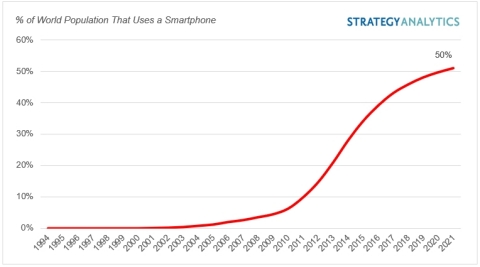
Notice how it all took off in 2010/2011: the iPhone 4 and multiple Android models, particularly the Samsung Galaxy S, first launched in 2010. Arguably, Apple lit the fuse, but Samsung provided the gunpowder.

And – once you get smartphones in that many people’s hands, social networks take off too.
unique link to this extract


Mystery of the wheelie suitcase: how gender stereotypes held back the history of invention • The Guardian

Katrine Marçal:

»

Advertisements for products applying the technology of the wheel to the suitcase can be found in British newspapers as early as the 1940s. These are not suitcases on wheels, exactly, but a gadget known as “the portable porter” – a wheeled device that can be strapped on to a suitcase. But it never really caught on.

In 1967, a Leicestershire woman wrote a sharply worded letter to her local newspaper complaining that a bus conductor had forced her to buy an additional ticket for her rolling suitcase. The conductor argued that “anything on wheels should be classed as a pushchair”. She wondered what he would have done if she had boarded the bus wearing roller-skates. Would she be charged as a passenger or as a pram?

The woman in the fur coat [pictured wheeling a suitcase on wheels in 1952, 20 years before the “official” invention of the wheeled suitcase] and the Leicestershire woman on the bus are the vital clues to this mystery. Suitcases with wheels existed decades before they were “invented” in 1972, but were considered niche products for women. And that a product for women could make life easier for men or completely disrupt the whole global luggage industry was not an idea the market was then ready to entertain.

Resistance to the rolling suitcase had everything to do with gender. Sadow, the “official” inventor, described how difficult it was to get any US department store chains to sell it: “At this time, there was this macho feeling. Men used to carry luggage for their wives. It was … the natural thing to do, I guess.”

Two assumptions about gender were at work here. The first was that no man would ever roll a suitcase because it was simply “unmanly” to do so. The second was about the mobility of women. There was nothing preventing a woman from rolling a suitcase – she had no masculinity to prove. But women didn’t travel alone, the industry assumed.

«

unique link to this extract


Errata, corrigenda and ai no corrida: none notified

Start Up No.1578: Tim Cook lobbies on antitrust, John McAfee found dead, Tim Berners-Lee on his NFT, and more


How much tuna – and which species – is there in a Subway tuna sandwich? PCR testing might tell us. CC-licensed photo by Like_the_Grand_Canyon on Flickr.

You can sign up to receive each day’s Start Up post by email. You’ll need to click a confirmation link, so no spam.

A selection of 11 links for you. Hello, caller, what’s your query? I’m @charlesarthur on Twitter. Observations and links welcome.


It’s out today! Find a bookshop, or take the shortcut and order Social Warming, my just-published book. Scissor statements, polarisation, Myanmar, and much more – including suggestions for how to fix the problem.


Tech giants, fearful of proposals to curb them, blitz Washington with lobbying • The New York Times

Cecilia Kang, David McCabe and Kenneth P. Vogel:

»

In the days after lawmakers introduced legislation that could break the dominance of tech companies, Apple’s chief executive, Tim Cook, called Speaker Nancy Pelosi and other members of Congress to deliver a warning.

The antitrust bills were rushed, he said. They would crimp innovation. And they would hurt consumers by disrupting the services that power Apple’s lucrative iPhone, Mr. Cook cautioned at various points, according to five people with knowledge of the conversations.

The calls by Mr. Cook are part of a forceful and wide-ranging pushback by the tech industry since the proposals were announced this month. Executives, lobbyists, and more than a dozen think tanks and advocacy groups paid by tech companies have swarmed Capitol offices, called and emailed lawmakers and their staff members, and written letters arguing there will be dire consequences for the industry and the country if the ideas become law.

…Amazon’s top lobbyist, Brian Huseman, rarely speaks publicly about bills before there is a vote. But with the House Judiciary Committee expected to vote on the bills on Wednesday, he warned in a statement on Tuesday that the legislation “would have significant negative effects on the hundreds of thousands of American small- and medium-sized businesses that sell in our store and tens of millions of consumers who buy products from Amazon.”

Google’s senior vice president for global affairs, Kent Walker, has also made calls to lawmakers in recent days, and the company’s top lobbyist, Mark Isakowitz, has weighed in on how the bills would alter how people use the internet. “American consumers and small businesses would be shocked at how these bills would break many of their favorite services,” he said in a statement. A spokesman for Facebook, Christopher Sgro, said that antitrust laws “should promote competition and protect consumers, not punish successful American companies.”

«

Obviously Pelosi’s office leaked all this; it’s part of the PR effort against the tech companies. The tech firms should be capable of better on the PR front, though possibly it’s going to happen behind closed doors, at lunches and meetings.
unique link to this extract


Antitrust posturing • Benedict Evans

He’s been reading the US antitrust bills so you (or I) don’t have to:

»

[the 2020 Congressional] report [from tech antitrust hearings] was also, to be charitable, very rushed, with great chunks of advocacy pasted in without any scrutiny, and with significant errors of fact every few pages. Perhaps the worst example of this was the claim that tech startup creation has ‘sharply declined’ in the last decade. This is an important claim, and if it was true we would obviously need broad and urgent intervention – but in fact, it was based on a data set that ended in 2011, which was both nine years out of data and just at the end of the financial crisis. People in tech agree on very little, but everyone would agree we’re in the hottest market for tech startup creation in history – any relevant data would tell you that tech startup creation has actually risen by three to four times in the last decade.

This report has now been followed by five proposed tech antitrust bills, published on Friday. Given the background, and the current US political environment, these are aggressive. However, like the report, they contain a mix of real concerns, good ideas, and some pretty questionable logic.

…Unfortunately, the ‘Ending Platform Monopolies’ law is impossibly broad. Google, Apple, Facebook, Amazon and Microsoft would be banned from doing anything on their platforms that anyone else might do, and from anything that might be a conflict of interest. They would not just be banned from favouring their own products – they’d be banned from having any products at all that they could theoretically favour.

This of course comes from a framing that ‘if you own a platform you can’t compete on it’ – Apple or Google should not have any products or features that compete with companies on their platforms. That sounds very clear – Elizabeth Warren made it a mantra. But what if I want to sell a camera app for your iPhone? OK, so Apple can’t include a camera app – or a clock, or an email app, or indeed a user interface or a file system. An Android phone has its own TCP/IP stack (in the 90s Windows did not, and you had to buy one), but other people would like to sell you that if it wasn’t there, so that’s a clear conflict of interest and has to go.

There’s a very basic misunderstanding at play here – you can’t ban a platform from having ‘any’ feature, service or product that someone else might want to make, because that describes literally every single thing that a platform does.

«

It’s a hopeless mess, and the expectation is that three of the four main bill will die so a single main one can go through with bipartisan support. Sounds like they could kneecap all their companies in the process.
unique link to this extract


Algorithm of harm: Facebook amplified Myanmar military propaganda following coup • Global Witness

»

After Myanmar’s military seized power in a coup on 1 February 2021, imprisoning the country’s democratically elected leaders, Facebook banned the armed forces from its platform. The company cited the military’s history of exceptionally severe human rights abuses and the clear risk of future military-initiated violence. But a month later, as soldiers massacred hundreds of unarmed civilians in the streets, we found that Facebook’s own page recommendation algorithm was amplifying content that violated many of its own policies on violence and misinformation.

In the lead up to the annual Armed Forces Day celebration on 27 March, the bloodiest day since the coup (see graph below), Facebook was prompting users to view and “like” pages containing posts that incited and threatened violence, pushed misinformation that could lead to physical harm, praised the military and glorified its abuses.

Offline that day, the military killed at least 100 people in 24 hours, including teenagers, with a source telling Reuters that soldiers were killing people “like birds or chickens”. A 13-year-old girl was shot dead inside her home. A 40-year-old father was burned alive on a heap of tyres. The bodies of the dead and injured were dragged away, while others were beaten on the streets.

What happens on Facebook matters everywhere, but in Myanmar that is doubly true. Almost half the country’s population is on Facebook and for many users the platform is synonymous with the internet. Mobile phones come pre-loaded with Facebook and many businesses do not have a website, only a Facebook page.

«

This is so depressing. I devote a whole chapter of Social Warming to how the internet – really, just Facebook – came to Myanmar, and how many times people on the ground warned Facebook that it was having serious effects on existing ethnic tensions, in a country where people didn’t understand “Likes”. And still it goes on.
unique link to this extract


Tim Berners-Lee defends auction of NFT representing web’s source code • The Guardian

Alex Hern:

»

The creator of the world wide web announced his decision to create and sell the digital asset through Sotheby’s auction house last week. In the auction, which began on Wednesday and will run for one week, collectors will have the chance to bid on a bundle of items, including the 10,000 lines of the source code to the original web browser, a digital poster created by Berners-Lee representing the code, a letter from him, and an animated video showing the code being entered.

“This is totally aligned with the values of the web,” Berners-Lee told the Guardian. “The questions I’ve got, they said: ‘Oh, that doesn’t sound like the free and open web.’ Well, wait a minute, the web is just as free and just as open as it always was. The core codes and protocols on the web are royalty free, just as they always have been. I’m not selling the web – you won’t have to start paying money to follow links.

“I’m not even selling the source code. I’m selling a picture that I made, with a Python programme that I wrote myself, of what the source code would look like if it was stuck on the wall and signed by me.

“If they felt that me selling an NFT of a poster is inappropriate, then what about me selling a book? I do things like that, which involve money, but the free and open web is still free and open. And we do still, every now and again, have to fight to keep it free and open, fight for net neutrality and so on.”

…Although this sale is the first time Berners-Lee has openly embraced the cryptocurrency community, the underlying technology has much that appeals about it, he said. Berners-Lee has settled on similar solutions in his own project, Solid, which aims to decentralise the web. “The blockchain world is pretty separate from the web, except where they connect in different places. But one of the problems with the web’s design is that it uses it uses domain names, which are at core a centralised system.

“Solid and the blockchain both attract people who want sovereign identity, sovereign power as a person.

«

unique link to this extract


Scientist finds early coronavirus sequences that had been mysteriously deleted • The New York Times

Carl Zimmer:

»

The new analysis, released on Tuesday, bolsters earlier suggestions that a variety of coronaviruses may have been circulating in Wuhan before the initial outbreaks linked to animal and seafood markets in December 2019.

As the Biden administration investigates the contested origins of the virus, known as SARS-CoV-2, the study neither strengthens nor discounts the hypothesis that the pathogen leaked out of a famous Wuhan lab. But it does raise questions about why original sequences were deleted, and suggests that there may be more revelations to recover from the far corners of the internet.

“This is a great piece of sleuth work for sure, and it significantly advances efforts to understand the origin of SARS-CoV-2,” said Michael Worobey, an evolutionary biologist at the University of Arizona who was not involved in the study.

Jesse Bloom, a virologist at the Fred Hutchinson Cancer Research Center who wrote the new report, called the deletion of these sequences suspicious. It “seems likely that the sequences were deleted to obscure their existence,” he wrote in the paper, which has not yet been peer-reviewed or published in a scientific journal.

Dr. Bloom and Dr. Worobey belong to an outspoken group of scientists who have called for more research into how the pandemic began. In a letter published in May, they complained that there wasn’t enough information to determine whether it was more likely that a lab leak spread the coronavirus, or that it leapt to humans from contact with an infected animal outside of a lab.

«

It is very clever work – Bloom spotted that though index links were gone, the data wasn’t removed from the cloud, and pulled back a set of SARS-Cov-2 sequences from a number of early patients. Yet the “variety of coronaviruses” points, to me at least, to a greater likelihood of a zoonotic (not lab) origin. It’s as though the virus was initially like a radio trying to tune into a faint station: the genome jumps all over. Then it suddenly stabilises on the properly infectious form. So why did China get the sequences deleted? At a guess, paranoia, and its continuing desire for control.
unique link to this extract


John McAfee: Antivirus software entrepreneur found dead in Spanish prison cell • Sky News

Tom Gillespie:

»

Antivirus software entrepreneur John McAfee has been found dead in his prison cell after Spain’s National Court approved his extradition to the US, the Catalan justice department has said.

Prosecutors in the US state of Tennessee had charged the 75-year-old with evading taxes after allegedly failing to report income made from promoting cryptocurrencies while he did consultancy work.

The British-American businessman, who was born in Gloucestershire in the UK, was also charged with evading tax in relation to income from speaking engagements and selling the rights to his life story for a documentary.

In a statement obtained by Reuters news agency, the Catalan justice department said “everything points” to suicide.

Security personnel at the Brians 2 prison near Barcelona tried to revive McAfee before his death was confirmed by the jail’s medical team, a statement from the regional Catalan government said.

«

He lived about four or five lives. The entrepreneur part, the wild living. His Wikipedia entry is probably sufficient obituary for now.
unique link to this extract


How Reddit turned its millions of users into a content moderation army • TechRadar

Joel Khalili:

»

When it comes to content moderation, which has become an ever more high-profile problem in recent years, Reddit opts for a different approach compared to other large social platforms.

Unlike Facebook, for example, which outsources much of the work to moderation farms, Reddit relies in large part on its communities (or subreddits) to self-police. The efforts of volunteer moderators are guided by rules defined by each individual subreddit, but also a set of values authored and enforced by Reddit itself.

The company has come under criticism for this model, though, which some have interpreted as laissez-faire and lacking in accountability. But Chris Slowe, Reddit CTO, says this is a total mischaracterization.

“It may seem like a crazy thing to say about the internet today, but humans on average are actually pretty good. If you look at Reddit at scale, people are creative, funny, collaborative and derpy – all the things that make civilization work,” he told TechRadar Pro.

“Our underlying approach is that we want communities to set their own cultures, policies and philosophical systems. To make this model function, we need to provide tools and capabilities to deal with the [antisocial] minority.”

«

The suggestion that you should let users police Facebook, rather than paid-for moderators, has been made quite a few times. Facebook disagrees.
unique link to this extract


[headline omitted so Gmail doesn’t dump this in spam] • ESPNFC

»

The supporters of Young Boys Bern have not had too much to celebrate in the 19 years since their team last won the Swiss league title.

Long since eclipsed by the likes of FC Basel and Grasshoppers Zurich, the club from the Swiss capital has even got a reputation for enjoying its status as a perennial loser.

«

Following yesterday’s headline about a moray eel, this story (from 2005) was offered by Matt F. I’m afraid you’ll have to go and read it yourself for the headline. But it’s worth your while.
unique link to this extract


The big tuna sandwich mystery • The New York Times

Julia Carmel sent some tuna from Subway (which is being sued over a claim that its tuna isn’t tuna) to a lab for a PCR test:

»

Finally, after more than a month of waiting, the lab results arrived.

“No amplifiable tuna DNA was present in the sample and so we obtained no amplification products from the DNA,” the email read. “Therefore, we cannot identify the species.”

The spokesman from the lab offered a bit of analysis. “There’s two conclusions,” he said. “One, it’s so heavily processed that whatever we could pull out, we couldn’t make an identification. Or we got some and there’s just nothing there that’s tuna.” (Subway declined to comment on the lab results.)
To be fair, when Inside Edition sent samples from three Subway locations in Queens out for testing earlier this year, the lab found that the specimens were, indeed, tuna.

Even the plaintiffs [suing Subway, claiming it isn’t selling tuna] have softened their original claims. In a new filing from June, their complaints centered not on whether Subway’s tuna was tuna at all, but whether it was “100% sustainably caught skipjack and yellowfin tuna.”

With all testing, there are major caveats to consider. Once tuna has been cooked, its DNA becomes denatured — meaning that the fish’s characteristic properties have likely been destroyed, making it difficult, if not impossible, to identify.

All of the people I spoke with also questioned why Subway would swap out its tuna.

“I don’t think a sandwich place would intentionally mislabel,” Mr. Rudie from Catalina Offshore Products said. “They’re buying a can of tuna that says ‘tuna.’ If there’s any fraud in this case, it happened at the cannery.”

Peter Horn, the director of the Ending Illegal Fishing Project at the Pew Charitable Trusts, agreed that it would be difficult to place blame on Subway if this were the case.

«

unique link to this extract


Fight over hospital’s COVID-19 vaccine mandate ends with 153 workers out of a job • Ars Technica

Beth Mole:

»

Houston Methodist hospital system had placed 178 employees on a two-week, unpaid suspension on June 7 for failing to meet the hospital system’s vaccination mandate, which it had set on April 1. The unpaid two-week suspension was essentially the employees’ last chance to get vaccinated before facing termination.

During that time, some of the workers “became compliant with the policy,” a hospital spokesperson told the Houston Chronicle Tuesday. But 153 did not and either quit during their suspension or were fired on Tuesday. Houston Methodist CEO Marc Boom had previously noted in a letter to employees that 27 of the 178 suspended workers had received one dose of a COVID-19 vaccine going into the suspension.

The resignations and firings end weeks of public protest by the small group of workers who objected to the mandate, which was otherwise largely successful. According to numbers released by Boom, about 97% of the hospital’s nearly 26,000 employees are fully vaccinated, while about 2.4% received a valid exemption or were granted a deferral for pregnancy or other reasons.

Still, the minority fought back vigorously against the mandate. They staged protests outside hospital facilities, and 117 of the workers filed a lawsuit in federal court. The employees claimed that the mandate is unlawful and forced them to be “human subjects” in a clinical trial of an “unapproved drug.” Among their more startling claims, they alleged that the mandate violates the Nuremberg Code, a set of 10 ethics principles for conducting human trials written in response to Nazi atrocities. In making the claim, the hospital staff likened the vaccine requirement to horrifying medical experiments carried out in concentration camps during World War II.

«

The judge’s ruling is pretty brutal (against them). Seems to me though that the staff owe a duty of care to the people in the hospital. It’s the same as the hospital demanding that they don’t juggle chainsaws on duty.
unique link to this extract


Google faces antitrust probe in India in smart TV market • Tech In Asia

Kul Bhushan:

»

The move comes after two lawyers in India filed a case against the US-based search giant last year.

According to the complainants, Google – in agreements it made with TV companies – bars these firms from developing their own operating systems (OS) based on “forked Android” code. The complainants allege that the rules set by Google restrict freedom of action for manufacturers of all smart mobile devices and TVs and not just devices on which Google’s Play Store or Android TV operating system (OS) is pre-installed.

Google, however, has denied the charges.

“The emerging smart TV sector in India is thriving due in part to Google’s free licensing model, and Android TV competes with numerous well-established TV OSs such as FireOS, Tizen, and WebOS. We are confident that our smart TV licensing practices are in compliance with all applicable competition laws,” a Google spokesperson said in a statement.

India’s smart TV market has grown exponentially in recent years. About 8 million smart TVs were sold in the country in 2019, out of which three in five smart TVs in the country run on the Android operating system, according to a Reuters report.

«

Not sure why the smart TV makers wouldn’t be able to fork Android. OK, they wouldn’t have any Google services on them – just like happens in China – but they’d be able to offer what they want. And as the article says, there are plenty of competing TV OSs. But hey, it’s Antitrust Season everywhere.
unique link to this extract


Errata, corrigenda and ai no corrida: none notified

Start Up No.1577: Google faces new EU antitrust trial, Brave gets into search, Iran halts crypto miners, the missed lockdown, and more


You might think that the sea animal capable of grabbing food from the land is a pizza pie, but in fact it’s… CC-licensed photo by Richard Ling on Flickr.

You can sign up to receive each day’s Start Up post by email. You’ll need to click a confirmation link, so no spam.

A selection of 10 links for you. Scientifically approved. I’m @charlesarthur on Twitter. Observations and links welcome.


Just one day to
preorder Social Warming, my forthcoming book. After that, you’re just “buying” it.


Google faces EU antitrust probe of alleged ad-tech abuses • WSJ

Sam Schechner and Parmy Olson:

»

The European Union opened a formal antitrust investigation into allegations that Google abuses its leading role in the advertising-technology sector, the most wide-ranging case yet to look at that pillar of the tech giant’s business.

The European Commission, the EU’s top antitrust enforcer, said Tuesday that its investigation, which has been under way informally since at least 2019, will look at a broad array of allegedly anticompetitive business practices around the Alphabet unit’s brokering of advertisements and sharing of user data with advertisers across websites and mobile apps—one of the newest areas of antitrust scrutiny for the company.

Some of the EU’s investigation will cover similar ground to a case filed last year against Google by a group of U.S. states led by Texas. Similar areas include Google’s allegedly favoring its own ad-buying tools in the advertising auctions it runs.

But the EU probe will also cover complaints that haven’t yet been the subject of formal inquiries anywhere, including Google’s alleged exclusion of competitors from brokering ad buys on Google-owned video site YouTube.

…“Online advertising services are at the heart of how Google and publishers monetize their online services,” said Margrethe Vestager, the EU’s antitrust chief. “We are concerned that Google has made it harder for rival online advertising services to compete in the so-called ad tech stack.”

…The EU said Tuesday that it estimated the overall online display advertising business in the EU to have totaled €20bn, equivalent to $23.8bn, in 2019, with a major role for Google as an intermediary.

«

Antitrust. Antitrust everywhere.
unique link to this extract


Malware hides inside Steam profile pictures: what you need to know • Make Use Of

Ankush Das:

»

SteamHide is a form of malware that hides within Steam profile picture’s metadata, warns security company GDATA.

Technically, the PropertyTagICCProfile value of an image is changed to encrypt and hide the malware, which normally stores information to help printers detect the colors of an image.

This value is a part of the EXIF data that exists in an image to help you identify the camera used and other related information. The profile picture or the image is not the malware itself, but it is a container for the malware.

So, if you are using Steam or have downloaded or accessed an image from Steam, this does not affect your computer. That’s because the malware is inactive until it’s decrypted by a separate malware downloader.

The image or the profile picture helps in the distribution of malware to an infected computer without getting detected by any antivirus software.

The infected computer in question must have a downloader (a malicious file downloaded via email attachments or websites) which extracts the malware from the Steam profile image, which is publicly accessible. In other words, it downloads the malware by connecting to the image hosted on Steam platform.

«

Quite clever: a sort of binary malware, where the individual pieces aren’t dangerous, but the combination is. And, crucially, can slip past antivirus – because it’s a form of steganography.
unique link to this extract


When an Eel Climbs a Ramp to Eat Squid From a Clamp, That’s a Moray • The New York Times

That’s all. Just the headline. The reporter Sabrina Imbler wrote it as the “dek” (aka subheading) but the section editor Michael Roston determined it should be the headline. It deserves some sort of prize, standing alongside “Super Caley go ballistic, Celtic are atrocious” in the all-time pantheon of headlines you can sing.
unique link to this extract


Stewardship of global collective behavior • PNAS

Elke Weber, Joseph Bak-Coleman, Carl Bergstrom and 14 others:

»

Here, we build on our understanding of disturbed complex systems to argue that human social dynamics cannot be expected to yield solutions to global issues or to promote human wellbeing without evidence-based policy and ethical stewardship.

The situation parallels challenges faced in conservation biology and climate science, where insufficiently regulated industries optimize profits while undermining the stability of ecological and earth systems. Such behavior created a need for urgent evidence-based policy in the absence of a complete understanding of the systems’ underlying dynamics (e.g., ecology and geosciences).

These features led Michael Soulé to describe conservation biology as the “crisis discipline” counterpoint to ecology—an analogy to the relationship between medicine and comparative physiology (20). Crisis disciplines are distinct from other areas of urgent, evidenced-based research in their need to consider the degradation of an entire complex system—without a complete description of the system’s dynamics. We feel that the study of human collective behavior must become the crisis discipline response to changes in our social dynamics.

«

Delightful. As Adewale Adetugbo pointed out, they’ve written the peer-reviewed scientific-language version of Social Warming. Great minds… (well, theirs are, at least.)
unique link to this extract


Brave Search beta now available in Brave browser, offering users the first independent privacy search/browser alternative to big tech • Brave Browser

»

Starting today, online users have a new independent option for search which gives them unmatched privacy. Whether they are already Brave browser users, looking to expand their online privacy protection with the all-in-one, integrated Brave Search in the Brave browser, or users of other browsers looking for the best-in-breed privacy-preserving search engine, they can all use the newly released Brave Search beta that puts users first, and fully in control of their online experience. Brave Search is built on top of a completely independent index, and doesn’t track users, their searches, or their clicks.

Brave Search is available in beta release globally on all Brave browsers (desktop, Android, and iOS) as one of the search options alongside other search engines, and will become the default search in the Brave browser later this year. It is also available from any other browser at search.brave.com

«

According to Techcrunch,

»

the company acquired technology and developers who had previously worked on Cliqz, a European anti-tracking search-browser combo which closed down in May 2020 — building on a technology they’d started to develop, called Tailcat, to form the basis of the Brave-branded search engine.

«

And Techcrunch also concludes that “The market for privacy consumer tech is growing.” Which has a lot of truth to it. Brave’s search looks OK; you’d really need some sort of continual comparison to see how it matches up against DuckDuckGo.
unique link to this extract


Facebook and Google quietly bankroll a new tech policy battle • Gizmodo

Shoshana Wodinsky:

»

A coalition of 13 different think tanks and advocacy groups penned an open letter to the U.S. House Judiciary Committee on Monday warning lawmakers about two major antitrust bills that lawmakers are set to vote on later this week. Instead of wrangling Big Tech, the letter says, these bills would “dramatically degrade” if not outright break the gizmos and gadgets we love using every day.

“We believe that voters want Congress to fix things that are broken—not break or ban things that they feel are working well,” the letter reads. “We strongly encourage you to reject these proposals.”

What that letter (naturally) leaves out, however, is how every org that signed this letter is, in some way, being funded by the same companies that would be subject to the provisions of the bills in question.

«

Notably missing from the funders is Apple. Wonder if it is going to start some lobbying now.
unique link to this extract


Iran seizes 7,000 cryptocurrency computer miners, largest haul to date • Reuters

»

Iranian police have seized 7,000 computer miners at an illegal cryptocurrency farm, their largest haul to date of the energy-guzzling machines that have exacerbated power outages in Iran, state media reported on Tuesday.

In late May, Iran banned the mining of cryptocurrencies such as Bitcoin for nearly four months as part of efforts to reduce the incidence of power blackouts blamed by officials on surging electricity demand during the searingly hot and dry summer.

Tehran police chief General Hossein Rahimi said the 7,000 computer miners were seized in an abandoned factory in the west of the capital, the state news agency IRNA reported.

Bitcoin and other cryptocurrencies are created through a process known as mining, where powerful computers compete with each other to solve complex mathematical problems. The process is highly energy-intensive, often relying on electricity generated by fossil fuels, which are abundant in Iran.

According to blockchain analytics firm Elliptic, around 4.5% of all bitcoin mining takes place in Iran, giving it hundreds of million dollars in revenue from cryptocurrencies that can be used to lessen the impact of US sanctions.

«

Quite the dilemma: do the mining and the lights go out; stop the mining and you don’t get the asset that can be silently swapped for hard currency.
unique link to this extract


Mathematicians welcome computer-assisted proof in ‘grand unification’ theory • Nature

Davide Castelvecchi:

»

Mathematicians have long used computers to do numerical calculations or manipulate complex formulas. In some cases, they have proved major results by making computers do massive amounts of repetitive work — the most famous being a proof in the 1970s that any map can be coloured with just four different colours, and without filling any two adjacent countries with the same colour.

But systems known as proof assistants go deeper. The user enters statements into the system to teach it the definition of a mathematical concept — an object — based on simpler objects that the machine already knows about. A statement can also just refer to known objects, and the proof assistant will answer whether the fact is ‘obviously’ true or false based on its current knowledge. If the answer is not obvious, the user has to enter more details. Proof assistants thus force the user to lay out the logic of their arguments in a rigorous way, and they fill in simpler steps that human mathematicians had consciously or unconsciously skipped.

Once researchers have done the hard work of translating a set of mathematical concepts into a proof assistant, the program generates a library of computer code that can be built on by other researchers and used to define higher-level mathematical objects. In this way, proof assistants can help to verify mathematical proofs that would otherwise be time-consuming and difficult, perhaps even practically impossible, for a human to check.

Proof assistants have long had their fans, but this is the first time that they had a major role at the cutting edge of a field, says Kevin Buzzard, a mathematician at Imperial College London who was part of a collaboration that checked Scholze and Clausen’s result. “The big remaining question was: can they handle complex mathematics?” says Buzzard. “We showed that they can.”

«

This is a deep topic, but illustrative of the way that computers are becoming woven into the frontiers of everything. (If you don’t like it, then obviously you’ll say that the rot started with a computer proving the four-colour theorem in 1976. Which, honestly, still feels like cheating.)
unique link to this extract


Key epidemiological drivers and impact of interventions in the 2020 SARS-CoV-2 epidemic in England • Science Translational Medicine

Neil Ferguson, Anne Cori and 29 others:

»

We fitted a model of SARS-CoV-2 transmission in care homes and the community to regional surveillance data for England. Compared with other approaches, our model provides a synthesis of multiple surveillance data streams into a single coherent modelling framework allowing transmission and severity to be disentangled from features of the surveillance system. Of the control measures implemented, only national lockdown brought the reproduction number (Rteff) below 1 consistently; if introduced one week earlier it could have reduced deaths in the first wave from an estimated 48,600 to 25,600 (95% credible interval [95%CrI]: 15,900–38,400). The infection fatality ratio decreased from 1.00% (95%CrI: 0.85%–1.21%) to 0.79% (95%CrI: 0.63%–0.99%), suggesting improved clinical care.

«

It’s the lockdown point that’s critical: one week earlier could have saved 23,000 lives through the knock-on effects of delayed or averted infection.

Of course this will be dismissed by lockdown sceptics because Neil Ferguson is a co-author. Such is the attitude of some of the public to science.

The other key point:

»

The estimated cumulative proportion of the population ever infected with SARS-CoV-2 ranged from 7.6% (95% CrI: 5.4%–10.2%) in the South West to 22.3% (95% CrI: 19.4%–25.4%) in London

«

“Herd immunity” by infection would have killed a colossal number of people.
unique link to this extract


Apple Watch accessory maker Wristcam raises $25m • TechCrunch

Brian Heater:

»

Other wearable makers have flirted with video and images on wrist-worn devices, but the feature is far from mainstream.

Industry leader Apple certainly doesn’t seem to be rushing into the idea, so Wristcam went and did it for them with the launch of a band sporting its own camera capable of shooting 4K images and 1080p video. The product launched late last year, following a successful crowdfunding campaign.

Now its makers are going a more traditional funding route, announcing a $25m raise led by Marker LLC. “We will use the funding to scale our team, Wristcam production, go to market, and R&D of our computer vision engine for wearables,” CEO Ari Roisman told TechCrunch.

Part of that funding involves effectively doubling the company’s headcount by early next year and helping deliver updates to some of the demands and concerns that have arisen since the product’s “public beta” launch in December.

«

Pebble started as a crowdfunder on Kickstarter; this too. I’m not sure that the market for “cameras on your wrist for when you’re making video calls” is really that big, though. Yet the company says it has sold “thousands” of them, retailing at $299 each. Fine, but expanding that to tens of thousands is the hard part.
unique link to this extract


Errata, corrigenda and ai no corrida: none notified

Start Up No.1576: Google’s culture under the microscope, TikTok’s beauty problem, does spatial audio squash vocals?, and more


From sitting cross-legged on the ground, can you get up without using your hands? That might predict your lifespan. CC-licensed photo by Michael Coghlan on Flickr.

You can sign up to receive each day’s Start Up post by email. You’ll need to click a confirmation link, so no spam.

A selection of 10 links for you. What sort of riders exactly? I’m @charlesarthur on Twitter. Observations and links welcome.

Google executives see cracks in their company’s success • The New York Times

Daisuke Wakabayashi:

»

a restive class of Google executives worry that the company is showing cracks. They say Google’s work force is increasingly outspoken. Personnel problems are spilling into the public. Decisive leadership and big ideas have given way to risk aversion and incrementalism. And some of those executives are leaving and letting everyone know exactly why.

“I keep getting asked why did I leave now? I think the better question is why did I stay for so long?” Noam Bardin, who joined Google in 2013 when the company acquired mapping service Waze, wrote in a blog post two weeks after leaving the company in February.
“The innovation challenges,” he wrote, “will only get worse as the risk tolerance will go down.”

Many of Google’s problems, current and recently departed executives said, stem from the leadership style of Sundar Pichai, the company’s affable, low-key chief executive.

Fifteen current and former Google executives, speaking on the condition of anonymity for fear of angering Google and Mr. Pichai, told The New York Times that Google was suffering from many of the pitfalls of a large, maturing company — a paralyzing bureaucracy, a bias toward inaction and a fixation on public perception.

The executives, some of whom regularly interacted with Mr. Pichai, said Google did not move quickly on key business and personnel moves because he chewed over decisions and delayed action. They said that Google continued to be rocked by workplace culture fights, and that Mr. Pichai’s attempts to lower the temperature had the opposite effect — allowing problems to fester while avoiding tough and sometimes unpopular positions.

A Google spokesman said internal surveys about Mr. Pichai’s leadership were positive.

«

As I mentioned before, the restiveness within the company is both a symptom and a cause. This is going to be an uncomfortable few years for Google – US antitrust is looming, and it still can’t break out beyond being an advertising company.
unique link to this extract


Google’s messaging mess: a timeline • The Verge

Chaim Gartenberg:

»

Here’s a breakdown of Google’s major messaging offerings over the years, with currently active services in bold:

Email: Gmail

Messaging services: Google Talk, Google Plus Huddle, Google Hangouts, Google Allo, Google Chat, plus innumerable chat features built into other Google products we won’t mention here

SMS/RCS services: Google Voice, Android Messages app with RCS chat integration

Video conferencing services: Google Talk, Google Voice, Google Plus Hangouts, Google Duo, Google Meet

Collaboration software: Google Wave, Google Plus circles, Google Docs chat, Google Chat
Within that mess of product names are two core issues: Google’s apparent love of launching new services and its inability to combine products under one umbrella.

Competitors like WhatsApp demonstrate what the opposite approach could be: a chat service tied to a user’s phone number that allows for video and voice, all from one app. Or there’s Apple’s iPhone approach, which ties email addresses and phone numbers to two services: iMessage for text and FaceTime for audio and video.

Google keeps falling into the same cycle, though, one that has repeated itself throughout the years. It’ll build out new services, integrating them into more areas of its product lineup, then try to wipe the slate clean, launch new services that (eventually) replace the old set, and start the cycle anew.

Here are the four eras of Google messaging so far…

«

Amazing to have already had four such eras, and it’s no wonder nobody can understand them. If Google had to compete without being able to hang their messaging offerings off Gmail and Android, nobody would use them.
unique link to this extract


You may not want to get your beauty tips from TikTok • The New York Times

Jessica Schiffer:

»

“I always know when something is trending on TikTok because I’ll have an influx of patients coming in and asking me about the same thing,” said Dr. Niket Sonpal, a gastroenterologist in New York.

Most of the time, that “thing” is a beauty or wellness tip that’s gone viral on the video-sharing platform, without evidence that it actually works. The advice may be ineffective or outright dangerous, from drinking chlorophyll to induce weight loss to using sunscreen only in select areas to “naturally” contour your face.

“We talk about TikTok all the time in my office,” said Dr. Dendy Engelman, a dermatologist and cosmetic surgeon in New York, “and I think it might be worse than other platforms because people are really looking to create content with that wow factor, the thing that will go viral, even if it’s not grounded in science.”

It’s not surprising that the app that brought us the “Benadryl challenge” (taking large doses of the antihistamine to induce hallucinations) and “the Everclear test” (doing shots of the high-proof alcohol) is not a fount of doctor-approved beauty guidance. But many consumers throw reason and caution to the wind when faced with these trends, underscoring a growing subversion of authority in which an influencer’s word is replacing that of experts.
“It’s funny because patients are often so timid in our office about trying treatments,” Dr. Engelman said. “But when they see something done on Instagram from an 18-year-old influencer, they’re like, ‘Sure!’”

«

It’s a microcosm of scientists’ experience in the past 18 months. “That wow factor, the thing that will go viral, even if it’s not grounded in science.”
unique link to this extract


Spatial Audio • Lefsetz Letter

Bob Lefsetz (who often comes across as one of the grouchiest men in the music business):

»

I fired up Apple Music last night on my iPad. There’s Zane Lowe’s dog and pony show linked to above, but there’s also 127 demo tracks, as in Apple is trotting these out to demonstrate the greatness of Spatial Audio. I pulled up ones I was familiar with.

Now I was listening on wired Sennheiser headphones, which retail for about $300, far better than what most punters are listening on, never mind the bass-heavy, distorting of the music Beats, talk about a marketing job.

And the tracks were, as I said, definitely different. Not radically different, but there was more space…

But then I started getting reviews e-mailed to me.

And just now I went back. Now I’m listening via my computer, with $700 Audeze headphones with a separate headphone amp. And what I’ve learned is…the Spatial Audio and stereo versions are not only different, the process affects the punch, the essence of the originals!

I compared Spatial Audio tracks to their HD equivalents on Amazon Music and I found exactly what one writer said: the vocal gets lost. Instead of being up front and in your face, it’s buried more in the mix.

Let’s start with Apple’s demo track, “What’s Going On.” In the stereo mix Marvin Gaye is up front, the band is backing him, in the Spatial Audio version, the band is surrounding him, on the fringe, background vocals popping up way up to the right, Marvin is just an element, not the essence, it’s a cornucopia of music, but it’s not the legendary track, it’s absolutely different, a sacrilege.

Same deal with the Doors’ “Riders On the Storm.” Pat Benatar’s “We Belong.”

«

Every new audio format is always, always demonstrated using Riders On The Storm. It’s also pretty much always the kiss of death. I wonder how many people will be able to tell the different with spatial audio.
unique link to this extract


Towing a Tesla at 70 mph replenishes battery at fast charger rates • Inside EVs

Andrei Nedelea:

»

The fact that you can charge an electric vehicle by towing it in gear is common knowledge among those with knowledge of how EVs work – you’re basically just relying on regen to put juice back into the battery, using the motor as a generator. Many have attempted it as more of a gag and more often than not in order to make a YouTube video that will attract a lot of views; this latest attempt is no different.

We’re pretty sure very few people actually charged their EVs in this manner, even when they completely ran out of juice and stopped on the side of the road. Calling a tow truck seems like a safer bet than towing your dead EV behind another vehicle to charge it back up again…

Rich, the guy behind the Warped Perception YouTube channel, known for many crazy perception-warping videos about cars and engines, had his very own Tesla Model S towed behind another vehicle (a Mercedes-Benz E55 AMG, no less) at a constant 70 mph and drew several important conclusions.

Firstly, the vehicle did not display any error messages or any warnings that what was being done to it was harmful to the vehicle or unsafe in any way. It looked like it could take many more miles of what it was being subjected to without issue.

Secondly, while towing the Model S at 70 mph, the battery was being replenished at an accelerated rate. He had the car towed for some 25 miles, putting back electricity into the batter at a rate of 65 kW – not quite Supercharger speeds, not even V1 or V2 Superchargers that could muster up to 150 kW, but still pretty decent.

«

So… if your electric car runs out of charge, all you need is for the tow truck to tow you quite fast and you’re good again?
unique link to this extract


Can the sit-rise test really predict longevity? • The Washington Post

Erin Strout:

»

The test requires you to lower yourself to the floor, crisscross style, without bracing yourself with your hands, knees, arms, or sides of your legs. If you can stand back up, again without the aid of those body parts, you’ve scored a perfect 10 (five points for sitting, five points for standing). You lose a point every time you support yourself with a forbidden joint or appendage.

The researchers tested 2,002 adults 51 to 80 years old, and then followed them until a participant died or until the study concluded, which was a median of 6.3 years. In that time, 159 people died — only two of whom had scored a perfect 10. Those who had the lowest score of zero to three points had a risk of death that was five to six times higher than those who scored eight to 10 points.

“It is well known that aerobic fitness is strongly related to survival, but our study also shows that maintaining high levels of body flexibility, muscle strength, power-to-body weight ratio and co-ordination are not only good for performing daily activities, but have a favourable influence on life expectancy,” Araújo said in a 2012 news release.

Sure, the test is a good measure of leg and core strength, as well as balance. Older adults who have such muscular strength and flexibility are less likely to fall. And falls are the leading cause of unintentional-injury-related deaths for people ages 65 and older, according to the Centers for Disease Control and Prevention.
But what if you can’t do it? Are you doomed? Should you plan for an early demise? If so, a test of about a dozen 35 to 40-something friends at a recent dinner party revealed that more than half of us should probably get our affairs in order, pronto.

«

I tried this, and apparently I died five years ago. Fine going down, pretty well stuffed coming back up. (Gets better with a bit of practice, but you need flexible hips.)
unique link to this extract


Soviets once denied a deadly anthrax lab leak. US scientists backed the story • The New York Times

Anton Troianovski:

»

“We all have a common interest in finding out if it was due to a laboratory accident,” Matthew Meselson, a Harvard biologist, said in an interview this month from Cambridge, Mass., referring to the coronavirus pandemic. “Maybe it was a kind of accident that our present guidelines don’t protect against adequately.”

Dr. Meselson, a biological warfare expert, moved into a spare bedroom in the home of a friend at the C.I.A. in 1980 to study classified intelligence suggesting that the Soviet anthrax outbreak could have been linked to a military facility nearby. Six years later, he wrote that the Soviet explanation of the epidemic’s natural origins was “plausible.” The evidence the Soviets provided was consistent, he said, with the theory that people had been stricken by intestinal anthrax that originated in contaminated bone meal used as animal feed.

Then, in 1992, after the Soviet Union collapsed, President Boris N. Yeltsin of Russia acknowledged “our military development was the cause” of the anthrax outbreak.

Dr. Meselson and his wife, the medical anthropologist Jeanne Guillemin, came to Yekaterinburg with other American experts for a painstaking study. They documented how a northeasterly wind on April 2, 1979, must have scattered as little as a few milligrams of anthrax spores accidentally released from the factory across a narrow zone extending at least 30 miles downwind.

“You can concoct a completely crazy story and make it plausible by the way you design it,” Dr. Meselson said, explaining why the Soviets had succeeded in dispelling suspicions about a lab leak.

In Sverdlovsk, as Yekaterinburg was known in Soviet times, those suspicions appeared as soon as people started falling mysteriously ill, according to interviews this month with residents who remember those days.

Raisa Smirnova, then a 32-year-old worker at a ceramics factory nearby, says she had friends at the mysterious compound who used their special privileges to help her procure otherwise hard-to-find oranges and canned meat. She also heard that there was some sort of secret work on germs being done there, and local rumors would attribute occasional disease outbreaks to the lab.

«

So there’s a point that authoritarian states tend to cover up their accidents, and that a plausible story will get backing from all over. This story has been known for ages, of course (it has its own thorough Wikipedia entry, and plenty of past writeups), but we’re now at the stage where anything that seems congruent with malfeasance will grab people’s interest.

Contrast that to the reasonable point I saw made on Twitter by a virologist the other day: given that Covid mostly looks like a cold or flu, might the reason why Covid-19 was first identified in Wuhan be that it’s a city, and where they have a lab capable of sequencing novel viruses? Trouble is, that doesn’t involve a conspiracy.
unique link to this extract


One-million-litre biological weapon test sphere at Frederick, Maryland • Atlas Obscura

Tony Dunnell:

»

Back when it was operational, “The 8-Ball” looked like something the Red Skull would build in a cliff-top Nazi fortress before Captain America came in and smashed it all. Test Sphere 527, as it was also known, was a 40-foot-diameter steel sphere with a one-inch-thick carbon steel hull and a one-million-litre total volume. Total weight: 131 tons.

For most of its operational existence, which stretched from 1951 to 1969, it was enclosed within a 60-foot cube-shaped building sheathed in metal. The sphere itself was gas tight and climate controlled, and the entire complex routinely rated on a slight negative pressure so that any leaks would only allow clean air to enter, rather than allowing contaminated air to escape.

The point of all this was for the aerobiological study of “agents highly pathogenic to man and animals,” including nasty airborne biological weapons. “Hot” biological bombs were detonated inside the sphere, and the pathogen-filled munitions were tested in various ways.

«

Which is a totally astonishing thing to do. You’d need to be really, really confident about your one-inch metal sphere. Then they would hook volunteers up to it and get them to breathe the “infected” air. Happily, none died. (Thanks G for the link.)

unique link to this extract


Canon uses AI cameras that only let smiling workers inside offices • PetaPixel

Michael Zhang:

»

This may sound like something straight out of a sci-fi movie, but Canon has rolled out new AI cameras that use “smile recognition” technology to ensure that only happy employees are allowed into its offices.

Back in 2020, the China-based Canon subsidiary Canon Information Technology introduced an “intelligent IT solution” for corporate offices that includes 5 different functional modules, one of which is “smiley face access control.”

“In addition, based on the corporate culture of ‘moving and always being’, Canon has always advocated the concepts of ‘laughing’ and ‘big health’, and hopes to bring happiness and health to everyone in the post-epidemic era,” Canon wrote in a press release. “Therefore, in the […] intelligent IT solution, a new experience of smile recognition is specially incorporated. It is hoped that smiles can let everyone relax and get healthy, so as to create a more pleasant working atmosphere and improve efficiency.”

In a new report about tech workers in China being subjected to surveillance tech, Nikkei Asia writes that Canon Information Technology has deployed these AI cameras at its Beijing headquarters to only allow smiling employees to enter the offices or book conference rooms.

Some workers, however, are speaking out about the intrusiveness of such technology.

“So now the companies are not only manipulating our time, but also our emotions,” one worker wrote on Weibo (the popular Chinese microblogging service), according to the report.

«

I guess it would create a unified working atmosphere where everyone hates the cameras.

unique link to this extract


Open for business? The trouble with bringing down mainland China’s coronavirus travel barriers • South China Morning Post

Zhuang Pinghui and Simone McCarthy:

»

When the coastal province of Fujian announced at the end of April it would cut the quarantine required for some Taiwanese visitors, authorities hoped the example could test the water.

The idea was to reduce the time in isolation from 14 days to just two as part of a pilot programme, but a week later, the plan was abandoned.

After months without incident, an outbreak of local cases of the coronavirus in Taiwan forced Fujian to put reopening on hold. The about-face highlighted the uncertainty and difficulties for the country as a whole to bring down the border barriers and restart international travel.

China’s great wall against transmission of the coronavirus from overseas had been in place since the early days of the pandemic.

For anybody trying to get into China, there are strict measures, including allowing only business travellers, and requirements for multiple negative Covid-19 tests and mandatory quarantines of between 14 and 21 days. 

The aim is to keep imported cases at bay while authorities press on with a vaccination drive at home to reach herd immunity, the point where enough people are inoculated against the disease that transmission becomes very limited.

A top World Health Organization (WHO) official estimated on Tuesday that at least 80% of the population would have to be vaccinated to significantly lower the chance that an imported coronavirus case could generate new cases or spawn a wider outbreak.

So far, 878.5 million doses have been administered in the country’s mass inoculation drive and China should reach its first phase target of vaccinating 40% of the population, or 560 million people, by June 30.

«

It’s easy to have forgotten that China’s still very worried about further Covid outbreaks.
unique link to this extract


Preorder Social Warming, my forthcoming book. Comes out Thursday.


Errata, corrigenda and ai no corrida: none notified

Start Up No.1575: the G7 superspreaders, hacking USB sticks for cryptowallets, GPU prices ease, social media soft power, and more


Everyone’s saying that… Joni Mitchell’s album Blue is 50 years old. And still amazing. CC-licensed photo by Elyse on Flickr.

You can sign up to receive each day’s Start Up post by email. You’ll need to click a confirmation link, so no spam.

A selection of 10 links for you. Should not have got on this flight without a PCR test. I’m @charlesarthur on Twitter. Observations and links welcome.

G7 summit was ‘super spreading’ event for Cornwall as cases rocket after Johnson and Biden visit • i

David Parsley:

»

Britain’s recent G7 summit of world leaders was a superspreader event that has led to a sharp increase in Covid-19 infections in the surrounding communities, according to the latest data.

Cornwall business leaders, politicians and residents are calling for the Government to “save the summer” following a huge rise in Covid-19 infections following the visit from world leaders, their entourages, the world’s media and thousands of police last weekend. 

Areas of Cornwall where G7 events were focused saw infections rise more than 2,000% in the seven days leading up to the end of the meeting between global leaders .

The freshest exclusives and sharpest analysis, curated for your inbox

One concerned local told i: “It looks like a superspreader event to me, and now it’s spreading.” 

The area around Carbis Bay, where the summit took place, and Falmouth, where the world’s media were based along with many of the 6,000 of officers policing the event and protesters, are now suffering some of the highest rates of infection in the country. 

The rate of Covid-19 infections in Cornwall and the Isles of Scilly during the week to, and including, 13 June has risen from 2.8 per 100,000 people on the Sunday before G7 began to 81.7 per 100,000. This compares to a national average of 77.4 per 100,000. 

But it is in the areas most closely linked to G7 events where rates are of particular concern to local health chiefs.

The rate of infection in St Ives and Halsetown has risen 2,450% in the seven day period to 733.2 per 100,000 people in the seven days to 13 June, when the summit came to an end. In the council ward of St Ives East, Lelant & Carbis Bay the rate has risen by 800% to 294.9 per 100,000 people in the same period. 

«

Bet it all comes down to time spent indoors in big groups, one way or the other. Covid really loves them. Quite a contrast to open-air events such as football matches or gigs, which haven’t shown any evidence of contributing to spread.
unique link to this extract


Criminals are mailing altered Ledger devices to steal cryptocurrency • Bleeping Computer

Lawrence Abrams:

»

Scammers are sending fake replacement devices to Ledger customers exposed in a recent data breach that are used to steal cryptocurrency wallets.

Ledger has been a popular target by scammers lately with rising cryptocurrency prices and the popularity of hardware wallets to secure cryptofunds.

In a post on Reddit, a Ledger user shared a devious scam after receiving what looks like a Ledger Nano X device in the mail.

As you can see from the pictures [in the article], the device came in an authentic looking packaging, with a poorly written letter explaining that the device was sent to replace their existing one as their customer information was leaked online on the RaidForum hacking forum.

“For this reason for security purposes, we have sent you a new device you must switch to a new device to stay safe. There is a manual inside your new box you can read that to learn how to set up your new device,” read the fake letter from Ledger.

“For this reason, we have changed our device structure. We now guarantee that this kinda breach will never happen again.”

Even though the letter was filled with grammatical and spelling errors, the data for 272,853 people who purchased a Ledger device was actually published on the RaidForums hacking forum in December 2020. This made for a slightly convincing explanation for the sending of the new device.

…Based on the photos, security researcher and offensive USB cable/implant expert Mike Grover, aka _MG_, told BleepingComputer that the threat actors added a flash drive and wired it to the USB connector.

“This seems to be a simply flash drive strapped on to the Ledger with the purpose to be for some sort of malware delivery,” Grover told BleepingComputer in a chat about the photos.

«

That’s quite a bit of sneaky. That’s the first time I’ve ever heard of an operation with such detail outside a state-sponsored attack. (Maybe I’ve just overlooked a few?)
unique link to this extract


Falling Europe GPU pricing suggests shortage is easing • Tom’s Hardware

Aaron Klotz:

»

According to ComputerBase, graphics card prices have begun to drop as much as 50% in Europe. Availability has also improved significantly, with sales of most GPU models from both AMD and Nvidia doubling month-over-month. This report comes on the heels of ASRock, a GPU maker, noting that GPU pricing is easing as demand from Chinese cryptocurrency miners wanes. 

More budget-oriented cards like the Nvidia GeForce RTX 3060 and AMD Radeon RX 6700 XT are seeing the most positive results, with a near 50% drop in price compared to last month. For flagship cards like the RTX 3080 and RX 6800 XT, however, prices haven’t moved as much. They have dipped a respectable 10-15% which is still a very positive change considering the shortage issues plaguing the technology industry.

In the United States, GPU pricing is slowly catching up to Europe, but it’s still going down nonetheless. A Redditor named ‘u/xclm’ has created a chart comparing GPU prices of cards sold on eBay with the amount of mining horsepower it’s capable of, over the course of the past month.

He found that prices are dropping reasonably well with a 20% average price drop for all cards this month compared to May, and the higher-performing cards like the RTX 3090 have seen an even higher drop of 32% in price.

This change in market behavior is mostly attributed to China regulating crypto mining, and the big drop in the value of large cryptocurrencies like Ethereum and Bitcoin.

«

Everything’s connected. The bitcoin hashrate chart is half what it was at its high in May.
unique link to this extract


Why PCs are turning into giant phones • WSJ

Christopher Mims:

»

Perhaps the single most useful feature of our phones is their near-constant connection to the internet through a cellular network. That missing piece might not come to our laptops as quickly as other elements of mobile computing.

The challenge isn’t getting LTE and 5G modems into our PCs—that has been possible for years. It’s that carriers have yet to figure out their end, says Patrick Moorhead, president of the technology consulting firm Moor Insights & Strategy. They’re concerned about potentially data-hungry devices like PCs overwhelming their networks, he adds. (Imagine a cell tower designed to handle occasional bursts of data traffic lighting up with a few dozen laptops streaming “The Avengers” in 4K.)

The good news is that 5G represents a chance to align incentives so that it is easier for individual buyers of laptops to easily get data plans. “All these carriers are making all these capital expenditures, and they need to make a return on their investment in spectrum and equipment,” adds Mr. Moorhead. “We’re going to be in an oversupply of connectivity.”

Windows laptops for some time have had the ability to connect to cellular networks without consumers having to buy the kind of physical SIM card that smartphones rely on, says a Qualcomm spokesman. Currently, the Microsoft Surface Pro X supports such “e-SIM” technology, and allows purchase of data plans through an app, he adds.

Despite the connectivity challenge, analysts predict that the recent uptick in sales of PCs will persist. Reasons for this include unfilled demand in the education market, a shift to people buying new PCs every four to five years instead of the usual six to seven, and the way that “work from home” has meant employees need their own devices, rather just sharing them as they have in some workplaces such as call centers, says Jitesh Ubrani, an analyst at IDC covering smartphones, tablets and PCs.

«

The revival of the PC has been quite the surprise: we didn’t think our home PCs were good enough for the job, so we replaced them? Companies splurged lots of money making sure that people could Zoom contentedly? Sure would be good to know who, precisely, splashed the cash. Corporate or consumer?
unique link to this extract


Big tech, startups race to cool data centres around the world • Bloomberg

Ivan Levingston and Will Mathis:

»

All those videos, emails, bank statements, photos, shopping carts, airline reservations, and so, so, so much more sluicing around the internet eventually end up in the millions of data centers scattered across the globe. With all that stuff coming and going, those places are getting crowded—and hot. David Craig can’t do much about the congestion, but he says he’s got a fix for the heat: A liquid that bathes the cores of processors to keep things at a relatively chilly 50 degrees Celsius (122 Fahrenheit). “As we process much more data, the chips are becoming three, four, five times hotter,” says Craig, chief executive officer of Iceotope Technologies Ltd., a U.K. startup focused on cooling strategies for computing.

Data centers consume 2% to 4% of the world’s electricity, and almost half of that power goes to cooling, according to the Uptime Institute, a consulting firm in Seattle. Early on, most data was kept on-site at the banks, universities, or corporations that generated it, where cooling often meant little more than opening the window. Today, a growing share of the world’s data is consolidated in megacenters with thousands of processors, and the vast majority of them use traditional air conditioning. While some heat is good for computers, too much can cause systems to crash, and with each generation of computer chips running faster and hotter, the systems will soon be too hot for even the most efficient air conditioner. Finding better ways to keep temperatures down could save the industry some $10 billion a year on electricity alone, according to Uptime. “Air just isn’t a very effective medium for transferring heat,” says Rabih Bashroush, global head of IT advisory services at Uptime.

«

So we should use water, or at least liquid? Got it.
unique link to this extract


Drought-stricken communities push back against data centers • NBC News

Olivia Solon:

»

On May 17, the City Council of Mesa, Arizona, approved the $800 million development of an enormous data center — a warehouse filled with computers storing all of the photos, documents and other information we store “in the cloud” — on an arid plot of land in the eastern part of the city.

But keeping the rows of powerful computers inside the data center from overheating will require up to 1.25 million gallons of water each day, a price that Vice Mayor Jenn Duff believes is too high. “This has been the driest 12 months in 126 years,” she said, citing data from the National Oceanic and Atmospheric Administration. “We are on red alert, and I think data centers are an irresponsible use of our water.”

Duff was the only Mesa City Council member to vote against the development. But she’s one of a growing number of people nationwide raising concerns about the proliferation of data centers, which guzzle electricity and water while creating relatively few jobs, particularly in drought-stricken parts of the United States.

«

OK, so don’t use water. Got it.
unique link to this extract


Social media are turbocharging the export of America’s political culture • The Economist

»

Take Brazil. Its political scene is full of YouTubers and Facebook influencers. These include supporters of Jair Bolsonaro, the president; critics of the government such as Felipe Neto, who rose to fame making videos for young people; and a vast market of political content-makers in between. “There is a lot of influence, even unconscious, of the [American] discourse. What’s happening there, comes here,” says Mr do Val, citing debates on face masks or race. This is not as simple as copying and pasting American arguments, he cautions. Rather, America provides the templates that anyone anywhere can apply.

According to Whitney Phillips, a media researcher at Syracuse University in New York, America’s role in shaping political debates comes not just from the norms it promotes. It also “flows from its cultural production—the actual stuff of media and memes”, she writes in “You Are Here”, a new book examining global information flows. One reason America’s influence is greater now, she says, is that “social media is global. And there are way more people outside the United States who use Facebook than in the United States.”

Consider the Black Lives Matter (blm) protests which erupted in America in 2020. They inspired local versions everywhere from South Korea, where there are very few people of African descent, to Nigeria, where there are very few people who are not. In Britain, where the police typically do not carry firearms, one protester held aloft a sign that read, “demilitarise the police”. In Hungary, where Africans make up less than 0.1% of the population, a local council tried to install a work of art in support of the blm movement, only to earn a rebuke from the prime minister’s office. Last year the Hungarian government released a video declaring, “All lives matter.”

«

Social media has enabled more spread of “soft power” than ever before. In that context, the rise of TikTok (and its suppression of Hong Kong-related and Uighur-related content) is significant.
unique link to this extract


My life in the Apple ecosystem (and more): 6FPS • Chuq von Rospach

Chuq worked at Apple (on mailing lists, from what I used to see) and then at Palm on developer relations:

»

when I talk about App Stores and developer programs and how developers should be treated, I point all this out to show that it’s not exactly theoretical for me, it’s personal. I’ve lived that life, fought those wars (and at Palm, more or less lost at every opportunity, but that’s a sad story for another time). And to a degree, it’s why I’ve always hesitated talking about Apple and their developer programs and App Store. 

Because to me, Apple does an absolute crap job of taking care of their developers. The defining word that comes to mind to me is “arrogance”. An expectation that the developers need Apple, so Apple doesn’t have to reciprocate. 

And with the IOS App store, Apple is absolutely correct. Developers need to be on IOS. It’s far less true on MacOS, and if you’ve ever taken a look at the Apple TV App Store, you can easily see how ludicrously poorly that platform is considered by developers. 

Apple has never been that interested or great at relationships with developers, and I say that with great respect for many members of Apple’s DTS/Devrel teams, some of whom are friends and who have spent years fighting the good fight internally as well.

It’s gotten worse over the years, and while I will cut Apple some slack — I don’t think people remotely understand the complexity and difficulty of doing things at the scale Apple has to do them — but where Apple has over the years had opportunities to improve things for developers and make these platforms more appealing, they have consistently chosen to not take those opportunities. There’s zero reason the App Store cut is still 30%, other than Apple believing it can get away with it. 

…Apple drove its developer relationship for decades based on attitudes of entitlement and arrogance, and never invested in creating a developer community that wanted to work with Apple, and instead just expected them to always have to work with it.

We are now at the start of a time where I think Apple will come to regret doing that, but it’s far too late to fix or to stop what I see as the inevitable shift towards regulations aimed at Apple’s App store policies. And because Apple has spent so long believing it can bully and bluster those around it — and mostly succeeding because of its size and scale, I think the next few years as the regulators gear up adn get going it’s going to be interesting, and ultimately, Apple will learn some hard lessons.

«

unique link to this extract


June 2020: Beware! iCloud backups are deleted after 180 days • TidBITS

Adam Engst:

»

TidBITS reader Walter Ian Kaye had a simple question: “Did you know Apple deletes iCloud backups over 180 days old? I didn’t. 😭”

I’m always bemused when I discover myself adopting one of my son’s expressions, and my immediate reaction was a teen-speak refrain from his high school years: “Wait, what?”

I had no idea that Apple deleted iCloud backups after 180 days, and a quick poll in the TidBITS Slack channel showed that it wasn’t common knowledge among other TidBITS staffers and contributing editors.

But a quick Google search revealed that the policy is far from new—I see perturbed iCloud users complaining as far back as 2014, and Take Control author Kirk McElhearn mentioned the fact in a 2013 Macworld article.

Apple does document this fact in various places, including in the iCloud User Guide, the Manage Your iCloud Storage support document, and the iCloud Terms and Conditions. But if you were expecting that you might be warned about such a limitation in the iOS interface, such as on the screen where you enable iCloud Backup or learn more about what’s backed up, you’d be disappointed.

Apple’s acknowledgment of the deletion policy is not quite as hidden as the plans for demolishing Arthur Dent’s house in The Hitchhiker’s Guide to the Galaxy. But the effect is roughly the same if you were planning on restoring from your iCloud backup, only to discover that Apple had deleted it, with the only warning being in support documents you’ve never read.

«

That’s not iCloud documents, but whole-device backups. Resurfaced on Twitter this weekend, as someone had backed up their iPad with their drawings on it to iCloud, then tried to restore it more than six months later. No backup. As Engst pointed out, it might make sense for Apple to warn people that a backup is about to be deleted. Hasn’t happened. (If this might happen, back it up on your computer.)
unique link to this extract


Joni Mitchell talks with Cameron Crowe about health, ‘Blue’ • Los Angeles Times

Cameron Crowe on Mitchell’s wonderful album, 50 years old this week:

»

Q: You take off for Greece in early 1970, and thus begins your adventure of living in the Matala caves. Matala becomes the setting for some of the most beloved songs on “Blue.” Why Greece?
JM: I was ready for an adventure. Penelope was a girl I knew and she was going, and I asked if I could tag along. We were both friends of Leonard (Cohen), so we wanted to see his island (Hydra). I brought a flute and my dulcimer. In Hydra, I climbed to the top of a mountain and played among the goats and sheep with my flute. In Athens we went to this place where the poets hung out, it was like a moving crap game because the Junta were busting up public meetings. There was a kind of an apple-crate guitar there that some of the poets played. I bought it off them for $50. I was so missing my guitar. We went into the Athens underground and I sat on the ground down there, like a busker. I played, and people threw money at me.

Q: Was anybody keeping tabs on you? Had you cut ties with everybody back home?
JM: Nobody knew where I was back home, or how to get hold of me. Eventually I found a phone to let everyone know that I was still alive and kicking. [Laughs.] But everywhere we went in Greece, people would say to us, “Sheepy, Sheepy, Matala Matala!” We didn’t know what that meant. It meant, “Hippie, hippie, go to the caves of Matala! That’s where your kind are!” So we rented a car and took a ferry boat and we arrived there. It was dark. We went down to the water’s edge. And when we were looking out towards Turkey, Penelope started thinking about her namesake, you know, Penelope, the wife of Ulysses. Just as we were talking, we heard an explosion, and when we turned around we saw Cary (Raditz) being blown out the door of a restaurant. He was a cook, and he had been lighting the stove and it exploded. I said to Penelope, “What an entrance! I’ve got to go and meet him.” So we walked over there and he was dressed in a white turban and white shirt and white baggy pants like gauze. He’d come from the city of Banaras, in India. The explosion had singed all the hair on his arms and legs. It went right through his clothes. And that’s how I met Cary. He exploded into my life, just like that.

«

I love knowing the stories that go with the songs: that Cary is a real person. And of course little Green was too. And Blue is on a par with a Picasso masterpiece. (I’m told the article is behind a paywall, but the Javascript on my browser broke so I couldn’t see it. Same when I tried to read it on Apple’s Reader.)
unique link to this extract


Out this week:

preorder Social Warming, my forthcoming book.


Errata, corrigenda and ai no corrida: none notified

Start Up No.1574: half of ads on fake news via Google, the ‘green vortex’ saving the US, airlines may drop a pilot on long-haul, and more


Groundskeepers are the unseen force in football, able to alter how quickly or slowly a pitch plays, to the home team’s advantage. CC-licensed photo by Daniel Novta on Flickr.

You can sign up to receive each day’s Start Up post by email. You’ll need to click a confirmation link, so no spam.

A selection of 10 links for you. It’s Friday, after all. I’m @charlesarthur on Twitter. Observations and links welcome.


Less than a week to preorder Social Warming, my next book.


Nearly half of all ads on fake news sites come from Google, study finds • Morning Brew

Ryan Barwick:

»

Fake news is a problem. Yet the sites that publish it keep surviving because ad servers keep sending them advertisements.

According to a white paper published last month by researchers at the University of Michigan School of Information, 48% of ad traffic on “fake” news publishers is served by Google. Nearly a third (32%) of “low credibility sites” like Breitbart, Drudge Report, and Sputnik News were delivered by Google.

The researchers analyzed more than 1,700 publishers, identifying 545 as either “fake” (sites filled with pseudoscience and straight-up lies) or “low credibility” (hyper-partisan), using a data set compiled by Melissa Zimdars, an associate professor at Merrimack College.

Additionally, the researchers found that the “top-10 credible ad servers,” like Lockerdome and Outbrain, make up 66.7% of fake and 55.6% of low-quality ad traffic. Even so, the researchers said that the dollars these firms make from such placements represents a “negligible fraction” of their overall revenue.

Using digital emulators that mimicked browsing behaviour on the sites, the researchers could identify which ad servers were supporting misinformation sites.

The researchers didn’t reach out to Google, but the search engine told Marketing Brew in a statement that the company removed ads from “more than 1.3 billion pages that breached” its policies in 2020.

«

They’re not a problem for Google. It’s in the position of not caring what adverts appear where; it just wants those that appear to be served by it, so it gets paid. One of the key elements of social warming: indifference caused by a conflict of broader ethics with corporate aims. (Corporate aims pretty much always win.)
unique link to this extract


China isn’t the issue. Big Tech is • The New York Times

Shira Ovide:

»

Here’s what an official at NetChoice, a group that represents Google, Facebook and Amazon, told The Washington Post about the crop of Big Tech regulation bills: “At the same time Congress is looking to boost American innovation and cybersecurity, lawmakers should not pass legislation that would cede ground to foreign competitors and open up American data to dangerous and untrustworthy actors.”

And this is what the Information Technology and Innovation Foundation, a policy group that gets funding from telecommunications and tech companies, said this week about the appointment of Khan as FTC chair: “In a time of increased global competition, antitrust populism will cause lasting self-inflicted damage that benefits foreign, less meritorious rivals.”

Sounds bad! You might notice that these statements don’t name China, which is the magic word to make stuff happen in Washington. But that’s what they mean by referencing unnamed foreign rivals.

Yes, it’s reasonable for Americans to want strong US companies in a competitive global economy. But making a handful of tech kings play fair isn’t likely to break them.

As for the security arguments, the logic doesn’t work if you think about it for more than two seconds. Does preventing Amazon from selling its own brand of batteries — as one congressional bill might do — hold America back from fighting foreign cyberattacks? Nope. How do proposals that might restrain giant companies from doing whatever they want with our personal information weaken America on the world stage? They do not.

«

unique link to this extract


The ‘green vortex’ is saving America’s climate-change future • The Atlantic

Robinson Meyer:

»

That 2009 climate bill, the one that President Barack Obama couldn’t pass? It required the US to cut greenhouse-gas emissions 17% by 2020 as compared with their all-time high. Yet last year, our emissions were down 21%. The same bill said that the US had to generate 20% of its electricity from renewables by 2020. Last year, we met that target. We will surpass it in 2021.

These numbers are not a mere fluke. Last year was a singular, awful moment in economic history, but even accounting for the effects of the COVID-19 recession, America’s real-world emissions last decade outperformed the Obama bill’s targets. From 2012 to 2020, real-world U.S. emissions were more than 1 billion tons below what the bill would have required, according to my analysis of data from Rhodium Group, an energy-research firm. (Of course, had the bill passed, the U.S. might have done even better.)

Meanwhile, across the economy, companies are learning how to decarbonize. Ford is already producing more electric Mustang Mach-Es than gas-powered Mustangs; General Motors, Honda, Volvo, and Jaguar have promised to stop selling gas cars altogether by 2040. Royal Dutch Shell was court-ordered last month to cut its emissions, and shareholders just forced Exxon to replace a quarter of its board with climate-concerned activist investors. Most important of all, the costs of solar and batteries have declined in the United States by a factor of 10 over the past decade, and the cost of wind has fallen 70%. Ten years ago, virtually no analyst thought they would fall so low. The International Energy Agency made headlines this year when it called solar “the cheapest electricity in history,” but the entire apparatus of renewable energy has seen cost declines.

What gives? America is supposed to be doing nothing right. Yet we’re making progress anyway. How? Why?

«

Meyer’s argument is that there’s a virtuous cycle (though he calls it the “green vortex”). I’m not sure I buy it. (Also: why do subs allows phrases like “declined by a factor of 10” through? “Fell by 90%”, they mean.)(Thanks G for the link.)
unique link to this extract


Amazon is blocking Google’s FLoC — and that could seriously weaken the system • Digiday

Kate Kaye:

»

Most of Amazon’s properties including Amazon.com, WholeFoods.com and Zappos.com are preventing Google’s tracking system FLoC — or Federated Learning of Cohorts — from gathering valuable data reflecting the products people research in Amazon’s vast e-commerce universe, according to website code analyzed by Digiday and three technology experts who helped Digiday review the code.

Amazon declined to comment on this story.

As Google’s system gathers data about people’s web travels to inform how it categorizes them, Amazon’s under-the-radar move could not only be a significant blow to Google’s mission to guide the future of digital ad tracking after cookies die — it could give Amazon a leg up in its own efforts to sell advertising across what’s left of the open web.

“This move is in direct correlation with Google’s attempt to provide an alternative to the third-party cookie,” said Amanda Martin, vp of enterprise partnerships at digital agency Goodway Group. She called Amazon’s choice to block FLoC on most of its sites another example of the chess moves Google, Apple, Facebook and Amazon are making as data privacy pressures force the destruction of the foundation of data tracking across the internet: the third party cookie.

With the help of three technologists, Digiday watched last week as Amazon added code to its digital properties to block FLoC from tracking visitors using Google’s Chrome browser.

«

The post-cookie world is getting so, so complicated. Though one could always hope it will mean the end of those bloody cookie consent popups.
unique link to this extract


Nuclear energy: fusion plant backed by Jeff Bezos to be built in UK • BBC News

Matt McGrath:

»

A company backed by Amazon’s Jeff Bezos is set to build a large-scale nuclear fusion demonstration plant in Oxfordshire.

Canada’s General Fusion is one of the leading private firms aiming to turn the promise of fusion into a commercially viable energy source.

The new facility will be built at Culham, home to the UK’s national fusion research programme.
It won’t generate power, but will be 70% the size of a commercial reactor.

General Fusion will enter into a long-term commercial lease with the UK Atomic Energy Authority following the construction of the facility at the Culham campus.

While commercial details have not been disclosed, the development is said to cost around $400m.
It aims to be operational by 2025.

…A major international effort to build a fusion reactor is underway in the south of France with the Iter project. But this $20bn venture has been hampered by delays and isn’t likely to be working effectively until after 2035.

Frustrated by the slow progress, private companies across the world have been following their own approaches, and General Fusion’s effort is seen as one of the most advanced.

«

“Significant” amounts of government money supplied to make Culham attractive. Good way to keep those who used to work there re-employed.
unique link to this extract


Airbus, Cathay ‘Project Connect’ plan to ditch two pilots in cockpit for long-haul flights • Traveller.com

»

The programme, known within Airbus as Project Connect, aims to certify its A350 jet for single-pilot operations during high-altitude cruise, starting in 2025 on Cathay passenger flights, the sources said.

High hurdles remain on the path to international acceptance. Once cleared, longer flights would become possible with a pair of pilots alternating rest breaks, instead of the three or four currently needed to maintain at least two in the cockpit.

That promises savings for airlines, amid uncertainty over the post-pandemic economics of intercontinental flying. But it is likely to encounter resistance from pilots already hit by mass layoffs, and safety concerns about aircraft automation.

…Proponents suggest single-pilot operations may be accepted by a flying public used to crew leaving the cockpit for bathroom breaks. They also point to higher error rates from human pilots than automated systems.

Both arguments miss the point, according to a source close to Lufthansa – who said the airline’s executives were advised last year that the programme could not meet safety goals.

Flying solo for hours is a “completely different story”, the source said, citing the 2009 AF447 disaster as an example of malfunctions occurring in cruise. The Air France A330’s copilots lost control after its speed sensors failed over the Atlantic, while the captain was resting.

“Airbus would have had to make sure every situation can be handled autonomously without any pilot input for 15 minutes,” the source said. “And that couldn’t be guaranteed.”

«

But the AF447 crash was caused by too many pilots, or one too many. It’s not an argument against having fewer (better than the unfortunate one who triggered the crash) pilots.
unique link to this extract


Aliens wouldn’t need warp drives to take over an entire galaxy, simulation suggests • Gizmodo

George Dvorsky on a study from Columbia University:

»

Things start off slow in the simulation, but the civilization’s rate of spread really picks up once the power of exponential growth kicks in. But that’s only part of the story; the expansion rate is heavily influenced by the increased density of stars near the galactic center and a patient policy, in which the settlers wait for the stars to come to them, a result of the galaxy spinning on its axis.

The whole process, in which the entire inner galaxy is settled, takes one billion years. That sounds like a long time, but it’s only somewhere between 7% and 9% the total age of the Milky Way galaxy.

Another neat aspect of the video is that it shows a civilization transitioning from Kardashev II status—in which it harnesses the power of entire star systems—to a full-blown Kardashev III civilization, which has tapped into the energy output of the entire galaxy (more about the Kardashev scale here).

That a civilization might want to embark on such an ambitious enterprise might seem implausible, but it’s important to remember Steven J. Dick’s Intelligence Principle, which states that the “maintenance, improvement and perpetuation of knowledge and intelligence is the central driving force of cultural evolution, and that to the extent intelligence can be improved, it will be improved,” as the science historian wrote in his 2003 paper, “Cultural Evolution, the Postbiological Universe and SETI.” Our civilization keeps pushing the envelope of what’s possible, and we have no reason to believe this urge will cease any time soon. Hence the assumption that advanced civilizations will eventually seek to occupy every corner of the galaxy and set up camp around precious energy sources, namely stars.

«

Don’t know whether to be worried or not now. Are they just about to arrive? After all, we’re near the edge of the spiral arm. Or are we being overlooked intentionally or by accident?
unique link to this extract


Influence

»

Players take turns to select and color a tile. At the end of a turn, each tile will influence its neighbors by imparting some of its color.

If a tile gains enough color to pass the threshold, it can no longer be selected and will have a dark border. Conversely, a tile can lose its dark border and become selectable if it loses enough color.

The game ends when all tiles pass the color threshold. The player with the most colored tiles wins!

«

Like a watered-down version of Go, but it’s Friday, enjoy yourself!
unique link to this extract


‘The Silicon Valley of turf’: how the UK’s pursuit of the perfect pitch changed football • The Guardian

William Ralston:

»

When it comes to sports-turf management, the UK is a talent factory like no other. “We’re 10 years more advanced than anywhere else in the world,” Richard Hayden, author of Fifa’s official handbook on pitch maintenance, told me. “If you want to work in technology, you go to Silicon Valley. Well, the UK is the Silicon Valley of turf!”

The English grounds-management sector alone is valued at more than £1bn and employs more than 27,000 people, with specialists in every area, from seed enthusiasts who can breed grasses that grow in the shade to scientists who develop chemicals to make grass greener. In West Yorkshire, the Sports Turf Research Institute is an R&D powerhouse, studying everything from how quickly water passes through different types of sand to how the fineness of a stem of grass influences the roll of a golf ball. In hardware, too, the UK has no rival. Bernhard and Company in Warwickshire make the world’s best sharpening systems for mower blades; Allett, in Staffordshire, provides elite mowing and maintenance equipment, as does Dennis, based in Derbyshire. Dennis mowers are used across the world’s top sports arenas, from Wimbledon to Barcelona’s Camp Nou and Manchester United’s Old Trafford. Calderwood uses them at PSG, too.

The turf-care techniques developed in the UK have been applied in tennis, golf, rugby and just about any professional sport that takes place on grass. But it is football, with its vast wealth and global fanbase, that has powered the revolution. No groundskeeper would claim their work was the main reason for any team’s success, but, just as Olympic swimmers don’t compete in beach shorts and professional cyclists shave their legs, top football teams obsess over tiny details that can be the difference between winning or losing. When Pep Guardiola arrived at Manchester City in 2016, he asked for the grass to be cut to just 19mm, in line with the ultra-fast pitches he had demanded at his previous clubs, Barcelona and Bayern Munich. (In the end he had to settle with 23mm, because short grass is more vulnerable to wear and Manchester’s cold climate means it can’t recover quickly.

«

Now I really want to know the grass length of each of the pitches that each Euros match is played on. The speed of playing surfaces matters in every sport (that has a playing surface…), yet it’s so overlooked.
unique link to this extract


In token crash postmortem, Iron Finance says it suffered crypto’s ‘first large-scale bank run’ • Yahoo Finance

Kevin Reynolds:

»

A near-total collapse in the price of a share token of a decentralized finance (DeFi) protocol was “the world’s first large-scale crypto bank run,” the people behind Iron Finance said in a blog post providing a postmortem. The run brought the worth of the protocol down from $2bn to near zero on Wednesday.

A “negative feedback loop” was created when a series of large holders tried to redeem their IRON tokens and sell their iron titanium (TITAN), the token of the Iron Protocol, the post said. That, in turn, caused more TITAN holders to run for the virtual hills, leading to what the team labeled “a classic bank run.”

“What we just experienced is the worst thing that could happen to the protocol, a historical bank run in the modern high-tech crypto space,” the post said.

The run was enabled by the fact that Iron Finance is only partly collateralized. It had enough for normal day-to-day operations, but just like in the bank run depicted in the movie “It’s a Wonderful Life,” if everyone wants their money all at once, the bank can’t pay up. Unfortunately for Iron Finance, there was no George Bailey around on Wednesday.

«

The blogpost itself is pretty much incomprehensible. In essence, as they say, it’s like the bank in Wonderful Life, and the trigger was an arbitrage opportunity – if you sold the token when it was below a certain price, you’d get more than that price in real money. So of course everyone did, which drove the price lower, which increased the arbitrage opportunity. (There’s another writeup here.)

*First* large-scale bank run, demonstrating that cryptoassets have zero inherent value. The folk at Tether, which essentially underpins most crypto exchanges but it only 3% backed by real funds, might be worried.
unique link to this extract


Errata, corrigenda and ai no corrida: none notified

Start Up No.1573: antitrust laws would stall Apple apps, Facebook plans ads inside Oculus VR, Spotify copies Clubhouse, and more


Under a new rule, the Associated Press won’t name people arrested for minor offences. You may be able to think of one. CC-licensed photo by Andrew Feinberg on Flickr.

You can sign up to receive each day’s Start Up post by email. You’ll need to click a confirmation link, so no spam.

A selection of 10 links for you. Face the camera. I’m @charlesarthur on Twitter. Observations and links welcome.


Obligatory book promo for
Social Warming, my forthcoming book. Out June 24. (Premature bookjaculations still welcomed.)


Apple pre-installed apps would be banned under antitrust package • Bloomberg

Rebecca Kern:

»

Apple Inc. would be prohibited from pre-installing its own apps on Apple devices under antitrust reform legislation introduced last week, said Democratic Representative David Cicilline, who is leading a push to pass new regulations for U.S. technology companies.

Cicilline told reporters Wednesday that a proposal prohibiting tech platforms from giving an advantage to their own products over those of competitors would mean Apple can’t ship devices with pre-installed apps on its iOS operating platform.

“It would be equally easy to download the other five apps as the Apple one so they’re not using their market dominance to favor their own products and services,” the Rhode Island Democrat said.

The proposal is part of a package of bipartisan bills that would impose significant new constraints on how tech companies operate, restricting acquisitions and forcing them to exit some businesses. The House Judiciary Committee will mark up the five bills in a hearing next week, Representative Jerrold Nadler of New York, the committee’s chairman, said.

Cicilline said the self-preferencing prohibition would also apply to Amazon.com Inc.’s Prime subscription service because it disadvantages some sellers who rely on the e-commerce platform.

When asked whether Microsoft Corp., which was subject to an epic antitrust case in the 1990s, would be subject to the measures, Cicilline said it would be up to the Justice Department and the Federal Trade Commission to make that determination.

«

Totally bonkers. Here’s what would actually happen: you’d go to buy a phone in a carrier store (as many people do) and they’d preload their own App Store and a ton of intrusive tracking junk apps.

Is there any evidence that people who are not developers are dissatisfied with how Google and Apple set things up right now? If so, I haven’t seen it.
unique link to this extract


Facebook to begin testing ads inside Oculus virtual reality headsets • CNBC

Salvador Rodriguez:

»

Facebook on Wednesday announced that it will begin testing advertisements that will appear within the company’s Oculus virtual reality headsets.

In May, the company said that it would begin running ads within the Oculus mobile app, but the announcement on Wednesday is the first time the social media company says it will show ads within its VR headsets.

The Oculus headset ads will first appear in the shooter game Blaston from Resolution Games. Ads will also begin appearing in two other Oculus apps over the coming weeks, Facebook said.

Oculus headset ads could be a significant step for Facebook, which derives more than 97% of its overall revenue from advertisements. Currently, those ads are primarily shown to users within the company’s Facebook and Instagram social networks.

Facebook also said these ads could provide new ways for software developers to generate revenue.

The ads will follow Facebook’s advertising principles and give users the same controls they have on Facebook. This includes the ability to hide specific ads or hide those from specific advertisers. Users can also select “Why am I seeing this ad?” to access more information about the ads they are shown.

«

Why are you seeing this ad? Because, Smith, if you want a picture of the future, imagine an ad being shown on two screens inches from your eyes – forever. Definitely, as Aaron Levie of Box noted wryly, “what VR was missing for mass adoption.”
unique link to this extract


Covid doom predictions that never happened • Noahpinion

Noah Smith:

»

Unfortunately, many of the bad predictions about COVID-19 came true. The people who saw cases ramping up exponentially, and warned that this was going to be a mass death event, were right, while the people who minimized the threat and waved it away were wrong. And a lot of people are dead because we didn’t listen to the former.

But economic predictions are a different story. When unemployment spiked to Great Depression levels in the early days of lockdown, it seemed to me — and to many, many others — like this downturn was destined to turn into a decade of mass economic hardship. Fortunately, that was completely off the mark! I got it very wrong and Paul Krugman got it right — with no financial crisis and no big overhang of debt, the economy simply wasn’t destined for a repeat of 2008-12. Though the recovery has proven bumpy thus far, but most economists still forecast a relatively swift return to the pre-pandemic growth trend.

«

Pretty much everything that was feared economically didn’t happen – except for (only US?) universities, where roughly 1 in 8 jobs vanished and enrollments for next year are down. Smith admits that Paul Krugman called it correctly, perceiving that this wasn’t a financial crisis, and there was no debt overhang, so things could snap back quickly.
unique link to this extract


AP says it will no longer name suspects in minor crimes • Associated Press

David Bauder:

»

The Associated Press said Tuesday it will no longer run the names of people charged with minor crimes, out of concern that such stories can have a long, damaging afterlife on the internet that can make it hard for individuals to move on with their lives.

In so doing, one of the world’s biggest newsgathering organizations has waded into a debate over an issue that wasn’t of much concern before the rise of search engines, when finding information on people often required going through yellowed newspaper clippings.

Often, the AP will publish a minor story — say, about a person arrested for stripping naked and dancing drunkenly atop a bar — that will hold some brief interest regionally or even nationally and be forgotten the next day.

But the name of the person arrested will live on forever online, even if the charges are dropped or the person is acquitted, said John Daniszewski, AP’s vice president for standards. And that can hurt someone’s ability to get a job, join a club or run for office years later.

The AP, in a directive sent out to its journalists across the country, said it will no longer name suspects or transmit photographs of them in brief stories about minor crimes when there is little chance the organization will cover the case beyond the initial arrest.

«

A form of the “right to be forgotten”, which has been implemented in Europe since May 2014. Good to see that the AP has finally realised how this “internet” thing works, though.
unique link to this extract


Creating a trustworthy reviews experience • About Amazon

Amazon says it blocked more than 200 million fake reviews before they even got onto its sites, but:

»

Due to our continued improvements in detection of fake reviews and connections between bad-actor buying and selling accounts, we have seen an increasing trend of bad actors attempting to solicit fake reviews outside Amazon, particularly via social media services. Some use social media services on their own; in other cases, they hire a third-party service provider to perpetrate this activity on their behalf. However, bad actors regularly try to take this transaction outside Amazon to obscure our ability to detect their activity and the relationship between the multiple accounts committing or benefiting from this abuse. As a result, we use a number of techniques, including advanced machine learning, to try to detect groups of connected entities—customer accounts, selling accounts, products, brands, and more. However, it’s also clear that this is an industry-wide battle, and we need to work together to make faster progress.

When we detect fake reviews that may have been perpetrated outside Amazon, we regularly report the activity to the social media company where it occurred. In the first three months of 2020, we reported more than 300 groups to social media companies, who then took a median time of 45 days to shut down those groups from using their service to perpetrate abuse. In the first three months of 2021, we reported more than 1,000 such groups, with social media services taking a median time of five days to take them down. While we appreciate that some social media companies have become much faster at responding, to address this problem at scale, it is imperative for social media companies to invest adequately in proactive controls to detect and enforce fake reviews ahead of our reporting the issue to them.

«

Basically blaming Facebook, without naming Facebook. Part of the big problem is that the “fake” reviews often come from people who have effectively been bribed to give a good review. (Possibly the motive behind the removal of a few brands from Amazon recently.)
unique link to this extract


The COVID-19 lab leak theory is short on evidence and long on guesswork • Foreign Policy

Justin Ling:

»

The lab leak theory says the furin cleavage site, a tiny enzyme dangling from the virus, is key to understanding the novel coronavirus’s origin.

Goldstein agrees. But, he said, that cleavage site actually points toward the virus’s natural origin.

“You cannot, in a normal cell culture, maintain the furin cleavage site,” he told me. When the COVID-19 virus is replicated in a cell culture in a lab, he said, the furin cleavage tends to delete itself. A peer-reviewed paper, published in late April in Nature, noted that habit and identified seven other papers that found a similar deletion.

So if researchers were using traditional methods and their preferred cell lines to try to force the virus to replicate, mutate, and change, the furin cleavage site would likely disappear.

The gain-of-function proponents say this furin site is too well adapted for humans to be an accident. But Goldstein said the opposite is true. The cleavage site is imperfect, so odd, that it could have only been a freak of nature. “No virologist would use that cleavage site,” he said.

It is possible to replicate the virus in a lab while preserving the cleavage site, Goldstein added, but it would “require doing things differently than everyone does them.” And, crucially, it would require them choosing cell cultures that replicate the virus more slowly.

So the researchers would have had to make a series of inefficient and strange decisions to preserve a tiny, novel, odd enzyme. Indeed, the researchers at Imperial College London behind the April Nature article found that the addition of four amino acids in the virus’s spike protein “occurred during its emergence from an animal reservoir and created a suboptimal furin [cleavage site].” Another study published in January in Stem Cell Research demonstrated how these furin sites naturally evolve in many coronaviruses.

«

Sure that we’re going to see the Daily Mail and NY Post and WSJ write up that research real soon now. (Thanks G for the link.) We all became epidemiologists, and now we’re all becoming virology genomic experts.
unique link to this extract


Segmentation faults: how machine learning trains us to appear insane to one another • doxa

Jon Stokes:

»

Imagine a world where the following things are true:

1. Big Tech platforms make money by micro-targeting ads to their users, so that ads that are more accurately and narrowly tailored are more valuable to platforms and advertisers than ads that are more general.
2. Following on the above, the more fine-grained segments you can slice your audience into, the better you can service the long tail of advertisers. So there’s an ad-driven market for audience segmentation that the platforms want to meet.
3. Advertising works, and in general, a human’s behaviors, preferences, values, and even basic tenets of their worldview can be modified by the media they’re exposed to.
4. Our society is getting more fragmented and polarized, as existing groups splinter apart online and new, often smaller groups and clusters form around different ideas, claims, worldviews, and identity characteristics.

I understand there are legitimate objections to each point above, but just go with it for a moment. Imagine that the above accurately describes our present social reality in 2021.

If I’m right, then it seems quite possible that the first items in the list above — i.e., tech platforms have created a lucrative advertising market for an atomized, segmented audience — is leading directly to the last item in the list — i.e, to our increasingly atomized, segmented public.

«

In the “great minds thinking alike” category, I’d offer this as Jon coming up with the same realisation about how (some elements of) social warming emerge as me. Though he chose a different name for the phenomenon.
unique link to this extract


Spotify’s Clubhouse competitor Greenroom is here • The Verge

Ashley Carman:

»

Spotify’s live audio app, Greenroom, formally launched on Wednesday on iOS and Android, marking the company’s first real attempt at creating a social media platform. The social audio app, which is similar to Clubhouse, allows users to host live conversations about sports, music, and culture.

Today’s launch doesn’t come with a marquee creator announcement or specific event planned, but instead, the company is taking the opportunity to encourage people to sign up and figure out how they’ll want to use the app. Some of its core functionality, a person close to the situation says, will eventually make its way to the actual Spotify app, so the team will monitor what happens in Greenroom closely.

The app is built on Locker Room, which Betty Labs created and Spotify acquired in March. That app focused solely on sports content, so users who have been logged on since the start will have to get used to seeing more than just sports talk, which is likely the biggest change. Other noticeable changes to the app are mostly visual. It now has a Spotify green-and-black color scheme, as well as a new logo and font. Functionality-wise, it also now features native recording, which will allow users to save their shows and distribute them as podcasts. (Of course, Spotify owns Anchor, so one could easily imagine shows eventually being natively moved to the creation software for further editing and publishing.)

«

This seems like a better idea than Clubhouse, inasmuch as it’s about sports – and people like talking about sports, which also gives it a structure by default, based on the time of events.

Anyway, remember Clubhouse? If these Statista figures are reliable, it’s not quite dead. Interest is biggest in Asia, while in the US it’s totally fizzled.
unique link to this extract


Cryptocurrency miners bought 700,000 GPUs in Q1 2021 • ExtremeTech

Joel Hruska:

»

According to JPR, component prices for GPUs have increased by as much as 70%. I’m perfectly willing to believe that board manufacturers have boosted their own prices to compensate for that, but the current GPU market remains ludicrously inflated. Component prices may be up 70%, but GPU prices have been up 2.5x – 4x.

The data below does not include the notebook market. “DT PC w/o WS” means “Desktop PC without workstations,” meaning Quadro and Radeon Pro shipments are not included here.

Attach rates — the percentage of PCs that ship with a discrete graphics card — have trended downwards in the desktop market, with a very clear bump towards the end of 2020. Note, however, that even as the graphics attach rate has dropped once more, the total number of AIB (Add-In Boards) being sold has skyrocketed. In other words: we’re not seeing a huge demand spike because OEMs like Dell, HP, and Lenovo are suddenly selling lots of systems with high-end graphics cards. We’re seeing a huge spike in AIB shipments because of cryptocurrency mining. The last time AIB shipments sparked like this was 2017-2018. That time period corresponds to the second cryptocurrency bubble.

JPR estimates that miners bought 700,000 midrange and high-end GPUs in Q1 2021, accounting for about 25% of the AIB market and roughly half a billion dollars in cash. None of that revenue flows to Nvidia or AMD; it’s all being captured by the channel partners. JPR notes that electricity prices in Mongolia are around 4.5 cents per kW, explaining how these farms remain profitable (and why it’s impossible to compete with them if you have to pay residential rates for electricity).

«

Compared to the PC market, of around 70m units per quarter, that… doesn’t feel that big?
unique link to this extract


Now the UK is investigating the Apple and Google duopoly • Android Authority

Hadlee Simons:

»

The UK’s Competition and Markets Authority (CMA) has announced that it’s investigating both Apple and Google over its smartphone operating systems, app stores, and web browsers (h/t: Android Central). More specifically, the authority says it’s checking whether the two companies are stifling competition across a variety of digital markets.

“The CMA is concerned this could lead to reduced innovation across the sector and consumers paying higher prices for devices and apps, or for other goods and services due to higher advertising prices,” read an excerpt of the announcement. This investigation will also look at the power Apple and Google have over businesses like app developers.

This announcement doesn’t name any specific third-party apps or companies, but the likes of Spotify, Tinder owner Match, and Tile have all criticized Apple and Google’s business practices in recent months. These criticisms center on the app store holder’s cut of sales, changes to app store rules, and competing products by platform holders.

Google has already been slapped on the wrist over its Android-related practices. The firm was previously slapped with a $5bn fine by the EU in 2018 for requiring OEMs to bundle specific apps, incentivizing the use of its products, and preventing OEMs from running Android forks. Meanwhile, Apple is currently embroiled in a legal battle with Epic that could have major ramifications for its App Store and iPhone business practices.

«

Views from anyone welcome to July 26, and the CMA would particularly like to hear from app developers. CMA is giving itself 12 months to conclude the study.
unique link to this extract


Errata, corrigenda and ai no corrida: none notified

Start Up No.1572: AirBnB’s hush-money team, Lina Khan to chair FTC, US gets antitrust-y, PGP turns 30, China’s (radiation) leak, and more


The NeXTStep code that built the first web browser at Cern: now you can buy an authorised copy of this free software. CC-licensed photo by United States Mission Geneva on Flickr.

You can sign up to receive each day’s Start Up post by email. You’ll need to click a confirmation link, so no spam.

A selection of 10 links for you. In antitrust we trust. I’m @charlesarthur on Twitter. Observations and links welcome.


Contains no football:
Social Warming, my forthcoming book. Available in all formats. Except film.


Inside Airbnb’s ‘black box’ safety team: company spends millions on payouts • Bloomberg

Olivia Carville:

»

That team is made up of about 100 agents in Dublin, Montreal, Singapore, and other cities. Some have emergency-services or military backgrounds. Team members have the autonomy to spend whatever it takes to make a victim feel supported, including paying for flights, accommodation, food, counseling, health costs, and sexually transmitted disease testing for rape survivors. A former agent who was at Airbnb for five years describes the approach as shooting “the money cannon.” The team has relocated guests to hotel rooms at 10 times the cost of their booking, paid for round-the-world vacations, and even signed checks for dog-counseling sessions. “We go the extra mile to ensure anyone impacted on our platform is taken care of,” Bunch says. “We don’t really worry about the brand and image component. That stuff will take care of itself as long as you do the right thing.”

Former agents recall cases where they had to counsel guests hiding in wardrobes or running from secluded cabins after being assaulted by hosts. Sometimes the guests were the perpetrators, as with an incident when one was found in bed, naked, with his host’s 7-year-old daughter. Agents have had to hire body-fluid crews to clean blood off carpets, arrange for contractors to cover bullet holes in walls, and deal with hosts who discover dismembered human remains.

The work can be so stressful that agents have access to cool-down rooms with dimmed lighting to create a soothing atmosphere for answering harrowing calls. And it can take a heavy toll. Some former agents say they suffer from vicarious trauma. On the job they tried to remember that everything that happens in life can happen in an Airbnb. That perspective was drilled into new recruits during 12-week training sessions: Just as nightclubs can’t eliminate sexual assaults and hotels can’t stop human trafficking, Airbnb can’t prevent bad actors from using its platform.

«

Well, sort of, except for the quote from Chris Sacca, who turned down the chance to invest at an early stage because he could see problems were inevitable.
unique link to this extract


Web inventor Berners-Lee to auction original code as NFT • Financial Times

Tim Bradshaw:

»

Sir Tim Berners-Lee is auctioning his original source code for the web in the form of a “non-fungible token”, as digital collectibles continue to fetch millions of dollars despite the recent sell-off in cryptocurrencies.

The auction at Sotheby’s will be the first time that Berners-Lee has been able to raise money directly from one of the greatest inventions of the modern era, with the proceeds benefiting initiatives that he and his wife Rosemary support.

“The idea is somebody might like a digitally signed version of the code, a bit like plenty of people have asked for physically autographed copies of the book,” Berners-Lee said.

Auctioneers hope that the one-of-a-kind digital artefact will ignite interest in NFTs beyond their mainstay of artworks, games and sports memorabilia. Investment in NFTs has waned since March’s record-breaking $69.3m sale of Beeple’s “Everydays: The First 5000 Days”.

In an interview with the Financial Times, Berners-Lee, 66, said the auction was an “opportunity to look back . . . 30 years on from the initial code, which was very, very simple, to the state [of the web] now, which has some wonderfully simple aspects to it but also has a lot of issues of various sorts”.

«

Written in NeXTStep, and he was at a NeXTStep developers’ conference ready to show the code to Steve Jobs – it was Jobs’s NeXT boxes that the code ran on – when Jobs was pulled away by an aide to catch his plane back to the US. One of those amazing meetings that didn’t happen.

Whether this will successfully goose the market for NFTs, who knows. I’d rather have a signed printout of the code. A bit 20th century, perhaps.
unique link to this extract


Ikea and Sonos want you to hang your speakers on a wall • Gizmodo

Victoria Song:

»

According to Ikea, a major problem with home speakers is that people don’t know exactly where to put them without sticking out like a sore thumb. The benefit of the picture frame form factor is that it makes use of vertical wall space, and is meant to be showcased as opposed to hidden. This tracks with the first two Symfonisk speakers [with Sonos], which launched in 2019. One doubled as a table lamp, while the other could work as a bookshelf.

“We’re making it possible to furnish with sound, rather than speakers,” said Stjepan Begic, product developer at Ikea, during the launch event.

There will be two versions that come in white or black and can be mounted or placed on the floor against a wall. It comes with a 3.5-meter cable, and the extraneous cord can be spooled in a cavity in the back. If you buy two, you can also create a daisy chain to power them with a single cable. The buttons are on the backside, and the frame itself only extends 6 cm from the wall. For connectivity, the speakers support AirPlay 2 and Wi-Fi, but not Bluetooth.

«

Seems to me the big problem here is the power cord. Either you actually plaster it into the walls, which isn’t a trivial task (chiselling! Plastering/filling! Painting, possibly a whole chunk of wall!), or you just let it dangle, which is going to be unsightly. However, you can just rest it – like any other speaker – on a table or similar.

Smart of Sonos to get in with Ikea like this: a smart way to expand its business without having to build gigantic stores.
unique link to this extract


Pandemic push: tablet shipments up 53% YoY in Q1 2021 • Counterpoint Research

»

The global tablet market saw a big revival during the pandemic, emerging from a long slump. The market grew by 19% YoY in 2020 due to the increasing demand for large-screen mobile devices spurred by remote work, online education and extended stay-at-home orders. Continuing the growth trajectory, the market grew 53% YoY in Q1 2021 after reaching a five-year high in Q4 2020, according to Counterpoint Research’s latest Global Tablet Market Report. However, in QoQ terms, it came down by 22% due to the quarter being an off-season period.

…The top tablet makers seem to have benefited from less competition in the growing market. Many [smaller] tablet players had earlier downsized or closed the business, while Huawei sharply lost its share due to the US ban.

…Apple sold 33% more iPad units worldwide in 2020 than in 2019, and continued to lead the market, expanding its share to 37% in Q1 2021. Despite the off-season effect, Apple improved its performance in all major regions, particularly in Japan, where its sales continued to hit all-time highs. Senior Analyst Liz Lee said, “The basic iPad models accounted for 56% of the overall iPad shipments in Q1 2021. The iPad Air and iPad Pro series came next with 19% and 18% shares, respectively.

«

The tablet market still belongs, essentially, to Apple. But the rise in demand is remarkable. Work, or leisure? I don’t think the analysts know.
unique link to this extract


The Cicilline salvo • Stratechery

Ben Thompson:

»

[Each of the four antitrust bills introduced in the US Congress] is obviously targeting the aforementioned big four consumer tech companies, but Microsoft, despite not being a target of the subcommittee, clearly falls under the definition. There may be more covered companies as well, if not now then in the near future:

• Visa has a market cap of $515bn, and processes $11 trillion in payments. Obviously the vast majority of those payments go to merchants, and the largest portion of credit card fees go to banks, but “net annual sales” is not clearly limited to a company’s actual revenue; meanwhile, the company is clearly covered under the second definition of an online platform (Mastercard has a market cap of $363bn).
• JPMorgan Chase has a market cap of $477bn and total assets of $3.7 trillion. Obviously the bank would argue it is not an “online platform” and that “net annual sales” is different than assets, but the former in particular seems like a questionable distinction.
• Walmart has a market cap of $394bn and a gross merchandise volume (GMV) of around $439bn and is estimated to have 80,000 marketplace sellers, up from 50,000 a year ago.
• PayPal has a market cap of $323bn and total payment volume of $277bn, up 39% year-over-year.
• Shopify has a market cap of $162bn and GMV of $119bn, which nearly doubled year-over-year.

At a minimum “net annual sales” needs to be more clearly defined: is it total payment volume, gross merchandise value, or company revenue? And what specifically makes something an online platform — and why do we care about the difference?

«

It’s clearly something of a mess, and not very clear how it will play out. Are they going to offer “theme park” exceptions where if you have retail stores (Walmart) or offer process credit card payments (Visa, Mastercard) you’re OK? Except that would get Apple and, well, the other companies off.
unique link to this extract


Tech antitrust pioneer Lina Khan will lead FTC, reports say • The Verge

Russell Brandom and Makena Kelly:

»

“The Biden administration’s designation of Lina Khan as Chair of the Federal Trade Commission is tremendous news,” Sen. Elizabeth Warren (D-MA), who championed breaking up Big Tech in her 2020 presidential campaign, said in a statement Tuesday. “Lina brings deep knowledge and expertise to this role and will be a fearless champion for consumers.”

The news broke during a Senate Judiciary antitrust hearing on smart home tech Tuesday, when Sen. Amy Klobuchar (D-MN) noted that Khan would act as chairwoman of the FTC, surprising many in the audience. Multiple news outlets have gone on to confirm Klobuchar’s statements. The White House did not immediately respond to a request for comment by The Verge.

First nominated in March, Khan will give Democrats a majority on the commission, filling a vacancy left by Republican appointee and chair Joseph Simons who resigned in January. Khan’s appointment signals an increased focus on antitrust regulation against major tech companies, which has been a focus of her legal scholarship. Khan rose to prominence after a 2017 paper, titled “Amazon’s Antitrust Paradox,” arguing that new antitrust statutes were necessary to prevent anti-competitive behavior from online platforms like Amazon. More recently, Khan played a significant staff role in assembling the House Antitrust report on competition in digital markets.

«

Looks like it’s antitrust season in the US.
unique link to this extract


I saw millions compromise their Facebook accounts to fuel fake engagement • Rest of World

Sophie Zhang:

»

While my work at Facebook protecting elections and civic discourse has been widely reported on, that was conducted in my spare time. My actual job and team focused on stopping the use of inauthentic accounts to create engagement through likes, comments, shares, fans, and more. Such accounts are rare in the West, but common in the Global South. 

During my time at Facebook, I saw compromised accounts functioning in droves in Latin America, Asia, and elsewhere. Most of these accounts were commandeered through autolikers: online programs which promise users automatic likes and other engagement for their posts. Signing up for the autoliker, however, requires the user to hand over account access. Then, these accounts join a bot farm, where their likes and comments are delivered to other autoliker users, or sold en masse, even while the original user maintains ownership of the account. Although motivated by money rather than politics — and far less sophisticated than government-run human troll farms — the sheer quantity of these autoliker programs can be dangerous. 

Self-compromise was a widespread problem, and possibly the largest single source of existing inauthentic activity on Facebook during my time there. While actual fake accounts can be banned, Facebook is unwilling to disable the accounts of real users who share their accounts with a bot farm. 

«

Well that explains a lot.
unique link to this extract


How software is eating the car • IEEE Spectrum

Robert Charette:

»

Ten years ago, only premium cars contained 100 microprocessor-based electronic control units (ECUs) networked throughout the body of a car, executing 100 million lines of code or more. Today, high-end cars like the BMW 7-series with advanced technology like advanced driver-assist systems (ADAS) may contain 150 ECUs or more, while pick-up trucks like Ford’s F-150 top 150 million lines of code. Even low-end vehicles are quickly approaching 100 ECUs and 100 million of lines of code as more features that were once considered luxury options, such as adaptive cruise control and automatic emergency braking, are becoming standard.

…Vard Antinyan, a software quality expert at Volvo Cars who has written extensively about software and system complexity, explains that as of 2020, “Volvo has a superset of about 120 ECUs from which it selects to create a system architecture present within every Volvo vehicle. Altogether, they comprise a total of 100 million lines of source code.” This source code, Antinyan says, “contains 10 million conditional statements as well as 3 million functions, which are invoked some 30 million places in the source code.”

How much and what types of software resides in each ECU varies greatly, depending on, among other things, the computing capability of the ECU, the functions the ECU controls, the internal and external information and communications required to be processed and whether they are event or time triggered, along with mandated safety and other regulatory requirements. Over the past decade, more ECU software has been dedicated to ensuring operational quality, reliability, safety and security.

“The amount of software written to detect misbehavior to ensure quality and safety is increasing,” says Nico Hartmann, Vice President of ZF’s Software Solutions & Global Software Center at ZF Friedrichshafen AG, one of the world’s largest suppliers of automotive components. Where perhaps a third of an ECU’s software was dedicated to ensuring quality operations ten years ago, it is now often more than half or more, especially in safety critical systems, Hartmann states.

«

unique link to this extract


PGP’s 30th Anniversary • Phil Zimmermann

Earlier this month marked the 30th anniversary of Zimmermann uploading the code to the internet:

»

In 2004, Robert Morris Sr., who had retired from NSA, told me that when PGP first appeared on the scene along with its source code, the NSA was particularly worried that the source code would show a lot of people how to develop strong public key crypto software, and the skills would proliferate.

Here we are, three decades later, and strong crypto is everywhere. What was glamorous in the 1990s is now mundane. So much has changed in those decades. That’s a long time in dog years and technology years. My own work shifted to end-to-end secure telephony and text messaging. We now have ubiquitous strong crypto in our browsers, in VPNs, in e-commerce and banking apps, in IoT products, in disk encryption, in the TOR network, in cryptocurrencies. And in a resurgence of implementations of the OpenPGP protocol. It would seem impossible to put this toothpaste back in the tube.

Yet we now see a number of governments trying to do exactly that. Pushing back against end-to-end encryption. We see it in Australia, the UK, the US, and other liberal democracies. Twenty years after we all thought we won the Crypto Wars. Do we have to mobilize again? Veterans of the Crypto Wars may have trouble fitting into their old uniforms. Remember that scene in The Incredibles when Mr. Incredible tries to squeeze into his old costume? We are going to need fresh troops.

The need for protecting our right to a private conversation has never been stronger. Many democracies are sliding into populist autocracies. Ordinary citizens and grassroots political opposition groups need to protect themselves against these emerging autocracies as best as they can. If an autocracy inherits or builds a pervasive surveillance infrastructure, it becomes nearly impossible for political opposition to organize, as we can see in China. Secure communication is necessary for grassroots political opposition in those societies.

It’s not only personal freedom at stake. It’s national security. The reckless deployment of Huawei 5G infrastructure across Europe has created easy opportunities for Chinese SIGINT. End-to-end encryption products are essential for European national security, to counter a hostile SIGINT environment controlled by China. We must push back hard in policy space to preserve the right to end-to-end encryption.

«

The point of weakness now isn’t getting E2EE out there; it’s the app stores for phones, which have become our primary means of communicating. (Sending encrypted email is a guaranteed way of getting a visit from the security services in a country where you’re a suspect, of course.)
unique link to this extract


How serious is the nuclear power plant radiation leak in China? • New Scientist

Adam Vaughan:

»

Do we know what’s causing the problem?

Framatome parent firm EDF, which has a 30% stake in the company that owns the plant, said yesterday that the problem appears to be an issue with the casing of one or more fuel rods. Rods contain the uranium used to create a fission reaction. In a statement, EDF said there had been an “increase in the concentration of certain noble gases in the primary circuit” in reactor number one at the power station. The primary circuit is the part of the plant that transfers heat from the reactor to water, generating steam and producing electricity. The noble gases include krypton and xenon.

Has there been a radiation leak?

Yes. New Scientist understands there has been a radiation leak at the plant. However, it is solely within the primary circuit, which is within multiple layers of containment. The radiation leak doesn’t extend beyond the circuit and no radioactive material has been detected outside the plant. “If the inert gases are in the primary coolant then it is unlikely that any radioactivity will be released outside of the reactor,” says Claire Corkhill of the University of Sheffield, UK.

How long has this been going on for?

EDF first received reports of increases in contamination in the primary circuit in October 2020. The government of Hong Kong, which is 130 kilometres from the plant, has said there was an “operational event” at the plant on 5 April, which involved the release of a “very small amount of gas”. The gas wasn’t named.

«

Watching brief on this one. Anyway, finally we can all agree there has been a leak in China.
unique link to this extract


Errata, corrigenda and ai no corrida: none notified

Start Up No.1571: valuing our content-driven lives, fake chips boom, the shipping container crisis, how graphs got started, and more


A few days ago, Mark Zuckerberg offered Roger Waters a lot of money to use Another Brick in The Wall in an advert. The response, was, well… CC-licensed photo by AleBoSS on Flickr.

You can sign up to receive each day’s Start Up post by email. You’ll need to click a confirmation link, so no spam.

A selection of 11 links for you. That’s not how you play Breakout. I’m @charlesarthur on Twitter. Observations and links welcome.


Still a few days to preorder Social Warming, my forthcoming book. Apparently WH Smith has had at least one premature bookjaculation, with one reader (👋 JoeOC) receiving theirs. Other reports welcome.


How memes become money • The Atlantic

Kaitlyn Tiffany:

»

What counts as user content—and is thus for sale—can be defined more broadly still: Some of the biggest IP disputes on the social audio app Clubhouse, for example, have been over general premises for interaction. In February 2021, a group of friends who’d been gathering in an Asian-diaspora chat set up a new chat room where people pretended to moan like whales. Then a bunch of influencers heard how popular it was and made rip-offs. Around the same time, a group of white NYU students were accused of stealing the idea of a “shoot your shot” dating-show room from the many Black creators who had been hosting similar rooms for months. The students have now signed on with a major talent agency, with the goal of creating a “cross-platform franchise.”

At this point, when most of our interactions happen in this handful of highly commodified spaces, who could be blamed for feeling like everything they do is—or at least feels like—commerce? “I’m actually very torn on this,” says Stacey Lantagne, a law professor at the University of Mississippi who researches copyright in the digital age. She’s seen white influencers steal ideas from people of color who never see any compensation, and she wants this to be corrected somehow. Yet it’s difficult to advocate for fairness without perpetuating the logic that all human expression can and should be for sale. “I’m really resistant to the idea that everything we do needs to be owned,” Lantagne told me.

…Selling an NFT of a tweet isn’t about fostering an audience or creating a sustainable source of income to support a creative life. It’s the newest, most direct way of converting attention into money, and of plucking a unit of content out of its cultural context—the conversation it was part of, the historical moment that made it significant, the people who saw it and got excited about it—and presenting it for purchase.

It’s appropriate to give credit to people for their creativity and compensate them for their labor. It’s empowering to siphon value from the social-media companies that have been making billions off our personal lives. But it’s also a kind of giving up.

«

(Thanks G for the link.)
unique link to this extract


Heatwave scorches the Middle East • NASA Earth Observatory

»

With meteorological summer just underway, some parts of the Northern Hemisphere were already feeling the heat in early June 2021. In particular, the early-season heat has been scorching countries across the Middle East.

The map above shows air temperatures in the region on June 6, 2021. The map was derived from the Goddard Earth Observing System (GEOS) model and depicts air temperatures at 2 meters (about 6.5 feet) above the ground. The darkest red areas are where the model shows temperatures around 50°C (122°F).

The GEOS model, like all weather and climate models, uses mathematical equations that represent physical processes (such as precipitation and cloud processes) to calculate what the atmosphere will do. Actual measurements of physical properties, like temperature, moisture, and winds, are routinely folded into the model to keep the simulation as close to observed reality as possible.

Indeed, local ground stations recorded temperatures that climbed above the 50°C mark in at least four Middle Eastern countries, including Iran, Kuwait, Oman, and the United Arab Emirates (UAE). According to news reports, Sweihan in the UAE hit 51.8°C (125.2°F) on June 6, 2021, which was the country’s highest temperature on record for the month of June. Countries in Central and South Asia were also reported to have seen extraordinarily high temperatures for the time of year.

«

unique link to this extract


YouTube is ground zero for fraudulent election audit advocacy • Media Matters for America

Olivia Little and Kellie Levine:

»

YouTube has become the epicentre of fraudulent election audit advocacy, even though this content seems to violate the platform’s election misinformation guidelines. Fifteen right-wing YouTube channels are spreading videos that promote the Arizona audit — and sometimes advocate for more such audits in other states — in a push to justify the illegitimate process. 

By housing this extremist election misinformation (which is reliant on the debunked claim that the 2020 election was stolen, an idea that led to the January 6 Capitol insurrection), YouTube has become complicit in its rapid spread. Some of these videos also run ads, meaning both the creator and YouTube are benefiting financially.

Arizona is conducting an audit of ballots in Maricopa County in an attempt to overturn the 2020 presidential election results. The Arizona audit is rooted in baseless conspiracy theories about the outcome of the presidential election and has sparked interest in similar efforts in other states, including Michigan, Georgia, and New Hampshire. 

There are at least 15 active YouTube channels that are sharing videos and livestreams with “updates” on the right-wing push for election audits, sometimes relying on right-wing media sources known for spreading misinformation. This content appears to violate YouTube’s election misinformation policy, which prohibits “content that advances false claims that widespread fraud, errors, or glitches changed the outcome of any past U.S. presidential election.” Despite this policy, the 15 channels had accumulated over 54 million combined views as of June 10.

«

Faintly related, from Reuters:

»

YouTube will no longer allow political or election ads in its coveted masthead spot at the top of the site’s homepage nor ads for alcohol, gambling and prescription drugs, it said on Monday.

In an email to advertisers, seen by Reuters, YouTube said the change built on its move last year to retire all full-day masthead ads.

«

unique link to this extract


ERCOT calls on Texans to conserve power amid high summer demand, forced outages • KUT Radio, Austin’s NPR Station

Mose Buchele:

»

The Electric Reliability Council of Texas on Monday asked people to conserve energy throughout the week as the supply of electricity on the Texas grid ran the risk of falling short of demand.

Texans should reduce their electricity use through Friday, ERCOT said.

It is the second time the state’s grid operator has made such a request since devastating blackouts gripped Texas in February.

In a media release, ERCOT blamed the tight grid conditions on more electric generators than usual being shut down for repairs. The grid operator said 11,000 megawatts of generation capacity — about the amount of energy it takes to power 2.2 million homes on a summer day — is unavailable due to those forced outages. One megawatt of electricity can usually power about 200 homes on a summer day.

According to ERCOT, about 73% of that unavailable power comes from “thermal” generators, typically gas and coal plants, being offline.

…At a signing ceremony last week, Gov. Greg Abbott said that “everything that needed to be done was done to fix the power grid in Texas.”

But grid experts have warned that the risk of big blackouts remains unless the state does more to overhaul its deregulated energy market and provide more backup power in times of emergency. They say that risk will only increase as the temperature rises, unless more electric generators are brought back online.

“I shudder to think what things would be [like] if we were actually having a heat wave,” said Dan Cohan, a civil engineering professor at Rice University.

«

This isn’t caused by a heat wave? And they still haven’t confronted the problem.
unique link to this extract


Why we are in a shipping crisis that’s sparking shortages • Business Insider

Rachel Premack with a deep look at the many moving (not fast enough, not in the right place) parts in the global supply chain:

»

By late January 2021, some 55 vessels were crowded around the LA and Long Beach ports, reportedly sitting in the ocean for up to two weeks. FreightWaves noted that it took longer for some of these ships just to get unloaded than it was for them to cross the Pacific. 

Why is there a delay to unload these ships? The boom in demand is, of course, one leading reason. American ports are also seeing a shortage of labor. There’s an ongoing shortage of the longshoremen who who undertake the critical task of getting these containers off the ship and onto trucks or trains. Dozens were quarantined due to the coronavirus at varying points last year.

Above all, when something goes astray with ocean shipping, there’s a major butterfly effect. A ship that’s unloaded two weeks late in Los Angeles is also going to be two weeks late when it arrives back in, say, Chittagong, Bangladesh to load up on IKEA furniture. The ship before that may have been two weeks late, too, so the carrier might just cancel the ship IKEA was expecting space on, Sundboell said. Then IKEA will have to scramble for another way to move your nightstand — and potentially every order they had after that, which will now be pushed down the road.

Halfway into 2021, the situation has not improved.

There’s another shortage giving rise to our shortages: A lack of shipping containers. Or rather, a lack of containers where they need to be.

«

The thing to watch apparently is the Drewry World Container Index: prices per container have risen more than threefold since June last year.
unique link to this extract


Five new bills aim to break up Big Tech platforms, force them to play nice • Ars Technica

Tim De Chant:

»

“Right now, unregulated tech monopolies have too much power over our economy,” said Rep. David Cicilline (D-R.I.), who introduced one of the bills. “They are in a unique position to pick winners and losers, destroy small businesses, raise prices on consumers, and put folks out of work. Our agenda will level the playing field and ensure the wealthiest, most powerful tech monopolies play by the same rules as the rest of us.”

“Big Tech companies are stifling American innovation with their monopolistic behavior,” said Rep. Lance Gooden (R-Tex.), who co-sponsored two of the bills. “By acquiring their competition and eliminating alternatives in the marketplace, they are denying fair access to the free market for small businesses across the country.”

While the legislation would not ban the platforms outright, it would subject companies to new regulations that would constrain their ability to provide certain products and services, while leveling the playing field for competitors.

«

The analysis of the bills that I’ve seen suggests they’re so far over the top that they’d effectively ban platforms from offering any sort of useful services at all. Don’t expect the bills to survive in this form, but it’s going to be a concern for the companies.
unique link to this extract


When graphs are a matter of life and death • The New Yorker

Hannah Fry:

»

auto race of the season is looming; it will be broadcast live on national television and could bring major prize money. If his team wins, it will get a sponsorship deal and a chance to start making some real profits for a change.

There’s just one problem. In seven of the past twenty-four races, the engine in the Carter Racing car has blown out. An engine failure live on TV will jeopardize sponsorships—and the driver’s life. But withdrawing has consequences, too. The wasted entry fee means finishing the season in debt, and the team won’t be happy about the missed opportunity for glory. As Burns’s First Law of Racing says, “Nobody ever won a race sitting in the pits.”

One of the engine mechanics has a hunch about what’s causing the blowouts. He thinks that the engine’s head gasket might be breaking in cooler weather. To help Carter decide what to do, a graph is devised that shows the conditions during each of the blowouts: the outdoor temperature at the time of the race plotted against the number of breaks in the head gasket. The dots are scattered into a sort of crooked smile across a range of temperatures from about fifty-five degrees to seventy-five degrees.

The upcoming race is forecast to be especially cold, just forty degrees, well below anything the cars have experienced before. So: race or withdraw?

This case study, based on real data, and devised by a pair of clever business professors, has been shown to students around the world for more than three decades. Most groups presented with the Carter Racing story look at the scattered dots on the graph and decide that the relationship between temperature and engine failure is inconclusive. Almost everyone chooses to race. Almost no one looks at that chart and asks to see the seventeen missing data points—the data from those races which did not end in engine failure.

«

I too fell into the cognitive trap. You get shown the proper graph. Then Fry hits you with the real punch: that data isn’t from car racing. A fascinating read – especially if you’ve never seen an Ibry graph of train lines.
unique link to this extract


The global chip shortage is creating a new problem: more fake components • ZDNet

Daphne Leprince-Ringuet:

»

the current times are opening up a golden opportunity for electronic component counterfeiters and fraudsters to step in.  

“If next week, you need to get 5,000 parts or your line will shut down, you will be in a situation of distress purchase and you will put your guard down,” Diganta Das, a researcher in counterfeit electronics at the Center for Advanced Life Cycle Engineering (CALCE), tells ZDNet. “You won’t keep to your rules of verifying the vendor or going through test processes. This is likely to become a big problem.” 

As part of his research, Das regularly monitors counterfeit reporting databases like ERAI, and although it is too early to notice a surge, he is confident that the number of reports will start growing in the next six months as companies realize they have been sold illegal parts. 

The problem, of course, is unlikely to affect tech giants whose reliance on semiconductors is such that they have implemented robust supply chains, and will typically only purchase components directly from chip manufacturers. 

Those at risk rather include low-volume manufacturers whose supply chain for semiconductors is less established – but it could include companies in sectors that are as critical as defence, healthcare and even automotive.

«

The last time counterfeiting was a big problem in chips was when cheap capacitors screwed up various PC manufacturers from 2002.
unique link to this extract


Facebook asked Pink Floyd’s Roger Waters for “Another Brick in the Wall II” to promote Instagram. He told Zuckerberg… • Boing Boing

Mark Frauenfelder reports what Roger Waters said (at a meeting seeking to get Julian Assange freed):

»

This is something that I actually put in my folder when I came out here today, you have no idea what it is. Nobody does because it arrived on the internet to me this morning. It’s a request for the rights to use my song, “Another Brick in the Wall II” in the making of a film to promote Instagram.

So it’s a missive. It’s a missive from Mark Zuckerberg, to me, right? Arrived this morning with an offer of a huge, huge amount of money. And the answer is, “Fuck you. No fucking way.”

And I only mention that because this is insidious. It’s the insidious movement of them to take over absolutely everything you know. So those of us who do have any power, and I do have a little bit in terms of the control of the publishing of my songs I do anyways, so I will not be a party to this bullshit, Zuckerberg.

[Quoting email]: We want to thank you for considering this project, we feel that the core sentiment of this song is still so prevalent and necessary today, which speaks to how timeless the work…”

It’s true. And yet they want us, they want us to join it. They want to use it to make Facebook and Instagram even bigger and more powerful than it already is. So that it can continue to censor all of us in this room and prevent this story about Julian Assange getting out to the general public so the general public could go “What? What? No, no more.”

«

What I like about Waters is that even at 77 years old, he’s still a moody teenager who sees the world in black and white. (I bet he doesn’t tidy his room either.) That’s an asset for creativity: always something to grind against.

Also, wanting to use “Brick in the Wall” is the most unimaginative choice. (Yes, OK, it was their biggest single.) Wouldn’t “Money” work better for Instagram? Or maybe “One Of These Days” – the lyrics certainly fit what Facebook’s effects are.
unique link to this extract


pOrtal, a seamless sci-fi video link between cities ª Kottke

»

pOrtal is a project that allows for people in two different locations to interact via circular video screens. Right now, the link is between Vilnius, Lithuania and Lublin, Poland but there are plans to add more cities (Reykjavik/Vilnius and Vilnius/London to start). The production is a bit over-the-top (e.g. the video), but the idea of fun, seamless, sci-fi presence between two locations is a good one.

«

The concept is rather like a Doctor Who or other SF trope: you can see the people through there, but you can’t touch them. It’s simultaneously great and frustrating. (That link goes to the equal best Doctor Who episode ever. The other equal best is Blink. Don’t @ me.)
unique link to this extract


AT&T graciously offers free device downgrades for customers affected by 3G shutdown • Android Police

Jules Wang:

»

AT&T is shutting down its 3G network next February and is prepared to give its customers a new phone for free lest their current one becomes useless —that is, they can’t place calls over LTE. Just don’t expect the carrier to go to great costs for your replacement.

Mobile subscribers recently received the latest in a string of emails about the 3G shutdown telling them about the free phone offer. All they have to do is head to att.com/AcceptMyPhone, verify their phone number, and then they’ll be able to arrange for the new phone to arrive in a few weeks.

The new phone customers will get is the AT&T RADIANT Core. It was introduced as an option for the comapny’s prepaid customers in October of 2019 with an MSRP of $70 (though it’s half off at the moment) and comes with a 480p display, a single 5MP rear camera, 16GB of storage (it takes a 64GB microSD card, though), 1GB of RAM, a removable 2,500mAh battery, and Android 9 Pie (Go edition). Hey, at least it has VoLTE.

«

The word “graciously” here isn’t meant entirely seriously. This is the deal for Android users; for iPhone users (and you’d need to be using an iPhone 4S from 2011; the iPhone 5 introduced 4G) they get the new iPhone SE. Not a bad reward if you’ve managed to survive using a ten-year-old phone, I’d say.
unique link to this extract


Errata, corrigenda and ai no corrida: none notified

Start Up No.1570: goodbye camera bumps?, how rightwing firms fooled Facebook, El Salvador’s payment problem, and more


Installing plexiglass was a big business in 2020 – but there’s zero evidence it stops the spread of Covid. CC-licensed photo by International Monetary Fund on Flickr.

You can sign up to receive each day’s Start Up post by email. You’ll need to click a confirmation link, so no spam.

A selection of 10 links for you. Try to focus. I’m @charlesarthur on Twitter. Observations and links welcome.


Not much time left to
preorder Social Warming, my forthcoming book. Out June 24 and already on sale in some overexcited bookshops (looking at you, Waterstone’s in Cambridge. Other reports of premature bookjaculation welcome.)


Say goodbye to your camera bump: miniaturized optics through new counterpart to lens • Phys.org

»

Can you describe the new optical element your team [at the University of Ottowa] developed, the spaceplate?

Orad Reshef: Light naturally “spreads out” when it is traveling, and every optical device we know of relies on this spread; we wouldn’t know how to design cameras without it. For example, in every telescope, there is a large gap between the eyepiece and the objective lens to give light room to spread.

A spaceplate simulates the same spreading that light would experience traveling a large distance in a small device. To light, a spaceplate looks like more space than it occupies. In a way, the spaceplate is a counterpart to the lens, doing things the lens can’t do to shrink down entire imaging systems.

We introduced the idea of a spaceplate in our paper, experimentally demonstrating it and showing it is compatible with broadband light in the visible spectrum that we use to see.

Jeff Lundeen: We considered what would happen if you manipulated light based on the angle rather than the position of a light ray. Lenses act via the position of the ray. Angle is a completely novel domain, and no one had shown that it could be used to make something particularly useful. We identified a useful application, compressing space. And then we showed that we could actually design and experimentally demonstrate plates that do exactly that.

…How could this technology be used? What are the applications of the spaceplate in our daily lives?

Orad Reshef: A spaceplate can be used to miniaturize many optical systems, be it a display or a sensor. For example, an advanced spaceplate can enable paper-thin telescopes or cameras; it could be used to remove the camera bump on the back of your smartphone.

Jeff Lundeen: People lug around large cameras with huge telephoto lenses. If we can sufficiently improve the spaceplate’s performance, I envision the possibility of building smaller, lighter cameras with much better performance. In particular, the spaceplate combined with metalenses would allow us to make the entire back surface of, say, an iPhone Max, into a flat and thin camera. It would have as much as 14 times better resolution and low-light performance than those large and heavy cameras.

«

I honestly don’t understand how this works – I think it needs much better explanation. But the potential seems amazing. (Thanks Richard B for the link.)
unique link to this extract


Revealed: rightwing firm posed as leftist group on Facebook to divide Democrats •The Guardian

Julia Carrie Wong:

»

A digital marketing firm closely linked to the pro-Trump youth group Turning Point USA was responsible for a series of deceptive Facebook ads promoting Green party candidates during the 2018 US midterm elections, the Guardian can reveal.

In an apparent attempt to split the Democratic vote in a number of close races, the ads purported to come from an organization called America Progress Now (APN) and used socialist memes and rhetoric to urge leftwing voters to support Green party candidates.

Facebook was aware of the true identity of the advertiser – the conservative marketing firm Rally Forge – and the deceptive nature of the ads, documents seen by the Guardian show, but the company determined that they did not violate its policies.

Rally Forge would go on to set up a pro-Trump domestic “troll farm” for Turning Point Action, a “sister” organization of Turning Point USA, in 2020, earning a permanent ban from Facebook.

“There were no policies at Facebook against pretending to be a group that did not exist, an abuse vector that has also been used by the governments of Honduras and Azerbaijan,” said Sophie Zhang, a former Facebook employee and whistleblower who played a small role in the investigation of the Green party ads.

She added: “The fact that Rally Forge later went on to conduct coordinated inauthentic behavior with troll farms reminiscent of Russia should be taken as an indication that Facebook’s leniency led to more risk-taking behavior.”

…“These admins are connected to Turning Point USA,” one staffer from the civic integrity team said, according to internal task management documents seen by the Guardian. “This is very inauthentic. I don’t know what the policy here is but this seems very sketchy.”

«

A story as old as.. Facebook. And also seems to violate US campaign finance laws.
unique link to this extract


Can Bitcoin become a real currency? Here’s what’s wrong with El Salvador’s crypto plan • The Conversation

John Hawkins is a senior lecturer in politics and economics at the University of Canberra:

»

having two legal tenders will complicate matters – particularly when one of those currencies is subject to wild swings in its value.

Consider the provision in the new law that “all obligations in money expressed in USD, existing before the effective date of this law, may be paid in bitcoin”.

Even that is complicated. How, and by whom, will the amount of bitcoins necessary to pay a debt be determined? Will it be based on the Bitcoin price at the time the debt was incurred, or when the debt falls due?

The difference of even a few days could be significant.

If the expectation is the price of Bitcoin is going to rise, why would you want to buy things with it? Why not wait? If the expectation is the price is going to fall, why would you want to accept it? For most transactions, using US dollars will still make the most sense.

…A second reason given by Bukele is that Bitcoin “will have 10 million potential new users” and is “the fastest growing way to transfer 6 billion dollars a year in remittances”.

This apparently refers to both the population of El Salvador (about 6.5 million) and Salvadorans living abroad, many of whom send money home to help their families. In 2020 these remittances totalled US$5.9 billion, or 23% of El Salvador’s GDP.

While any cryptocurrency can well facilitate more efficient transfers (without the charges banks impose), the significance of remittances to the Salvadoran economy points to another issue. El Salvador is a poor country, with one of the lowest rates of internet use in the Americas – 33% in 2017, according to World Bank data.

How many vendors, street hawkers or farmers are equipped to handle cryptocurrency transactions? US dollars will more than likely remain the default currency.

«

I want to know: 1) what are the criteria by which we should measure success or failure of this experiment? 2) How long should we allow before making that decision? Nobody yet seems to have set this out.
unique link to this extract


I now own the Coinhive domain. Here’s how i’m fighting cryptojacking and doing good things with content security policies • Troy Hunt

Hunt of course runs Have I Been Pwned, but this is about a cryptomining ad called Coinhive:

»

in Feb 2018 I wrote about The JavaScript Supply Chain Paradox: SRI, CSP and Trust in Third Party Libraries wherein someone had compromised a JS file on the Browsealoud service and injected the Coinhive script into it. In that blog post I included the code Scott Helme had de-obfuscated which showed a very simple bit of JavaScript, really just the inclusion of a .js file from coinhive.com and the setting of a 32-byte key. And that’s all an attacker needed to do – include the Coinhive JS, add their key and if they wished, toggle a few configurations. That’s it, job done, instant crypto!

And then Coinhive was gone [in March 2019]. (Also – “the company was making in an estimated $250,000 per month” – crikey!) The site disappeared and the domain stopped resolving. Every site that had Coinhive running on it, either by the design of the site owner or at the whim of a cryptojacker, stopped mining Monero. However, it was still making requests to the domain but without the name resolving anywhere, the only signs of Coinhive being gone were errors in the browser’s developer tools.

In May 2020, I obtained both the primary coinhive.com domain and a few other ancillary ones related to the service, for example cnhv.co which was used for their link shortener (which also caused browsers to mine Monero). I’m not sure how much the person who made these available to me wants to share so the only thing I’ll say for now is that they were provided to me for free to do something useful with. 2020 got kinda busy and it was only very recently that I was finally able to come back to Coinhive. I stood up a website and just logged requests. Every request resulted in a 404, but every request also went into a standard Azure App Service log. And that’s where things got a lot more interesting.

«

Millions of compromised machines out there, and Russia and China are key suspects for the source.
unique link to this extract


Plexiglass is everywhere, with no proof it keeps Covid at bay • Bloomberg

Carey Goldberg:

»

Sales of plexiglass tripled to roughly $750 million in the U.S. after the pandemic hit, as offices, schools, restaurants and retail stores sought protection from the droplets that health authorities suspected were spreading the coronavirus.

There was just one hitch. Not a single study has shown that the clear plastic barriers actually control the virus, said Joseph Allen of the Harvard T.H. Chan School of Public Health.

“We spent a lot of time and money focused on hygiene theater,” said Allen, an indoor-air researcher. “The danger is that we didn’t deploy the resources to address the real threat, which was airborne transmission — both real dollars, but also time and attention.”

“The tide has turned,” he said. “The problem is, it took a year.”

For the first months of Covid-19, top health authorities pointed to larger droplets as the key transmission culprits, despite a chorus of protests from researchers like Allen. Tinier floating droplets can also spread the virus, they warned, meaning plastic shields can’t stop them. Not until last month did the World Health Organization and US Centers for Disease Control and Prevention fully affirm airborne transmission.

That meant plastic shielding had created “a false sense of security,” said building scientist Marwa Zaatari, a pandemic task force member of the American Society of Heating, Refrigerating and Air-Conditioning Engineers.

“Especially when we use it in offices or in schools specifically, plexiglass does not help,” Zaatari said. “If you have plexiglass, you’re still breathing the same shared air of another person.”

«

So blindingly obvious if anyone thought about it. The irony is that so many other NPIs – non-pharmaceutical interventions – were taken, and yet improving ventilation by opening windows wasn’t.
unique link to this extract


Fresh Covid-19 outbreaks in Asia disrupt global shipping, chip supply chain • WSJ

Stella Yifan Xie in Hong Kong, Costas Paris in New York and Stephanie Yang in Taipei:

»

An outbreak at one of the world’s busiest ports in southern China has led to global shipping delays, while infections at key points in the semiconductor supply chain in Taiwan and Malaysia are worsening a global chip shortage that has hindered production in the auto and technology industries.

The new headaches add to inflation concerns, after China and the U.S. this week recorded their biggest annual jumps in factory-gate prices and consumer prices, respectively, in more than a decade. If such problems continue—and get worse—they could weigh on global growth.

For much of last year, China, Taiwan and many other parts of Asia kept the pandemic in check better than the U.S. and Europe and limited some of the economic damage. But as vaccination rates have risen in the West, governments have started rolling back restrictions and economies are revving up.

Immunization efforts in Asia, meanwhile, have lagged behind and authorities have largely kept in place tougher border controls to keep the virus out. Still, Covid-19 has spread. Thailand has been battered over the past two months by its worst ever surge of new cases, while Vietnam—an increasingly popular manufacturing hub that largely avoided earlier infection waves—has also suffered.

Low vaccination rates across Asia could keep in place social distancing rules and travel bans, which would disrupt manufacturing and suppress consumer spending.

«

unique link to this extract


Don’t fall for these three lab-leak logical traps • The Atlantic

Daniel Engber on “ways to think (and not think) about the possible scenarios”:

»

The lab-leak theory isn’t singular; rather, it’s a catchall for a continuum of possible scenarios, ranging from the mundane to the diabolical. At one end, a researcher from the Wuhan Institute of Virology might have gone out to sample bat guano, become infected with a novel pathogen while in the field, and then seeded it back home in a crowded city. Or maybe researchers brought a specimen of a wild-bat virus back into the lab without becoming infected, only to set it free via someone’s clothes or through a leaky sewage pipe.

The microbiologists Michael Imperiale and David Relman, both former members of the National Science Advisory Board for Biosecurity, told me several weeks ago that lab-leak scenarios of this rather more innocent variety—involving the collection and accidental release of a naturally occuring pathogen—were the most probable of all the non-natural possibilities. Yet the most prominent opinionating on this topic has clustered at the other end of the continuum, at first around the dark-side theory of a bioweapon gone awry, and then around the idea that a harmless virus had been deliberately transformed into SARS-CoV-2 (and released by accident) after a reckless series of tabletop experiments.

That’s another pitfall in this debate: a tendency to focus only on the most disturbing and improbable versions of the lab-leak hypothesis, and to downplay the rest. The mad-scientist trap sprays a mist across the facts by presuming scientific motivations; it posits that researchers could have caused the pandemic only if they’d been trying to create infectious pathogens.

«

I’m not sure I’d call it a “lab leak” if a researcher goes to Yunnan and catches it and brings it back in a zoonotic infection – how is that a “leak”? We don’t call it a “farm leak” and call for an end to farming when people catch avian flu or swine flu, despite their proven roles in causing pandemics.

There’s also former US State Dept assistant secretary Christopher Ford, who’s pretty annoyed at the discourse and the lack of evidence around it. We’re no closer to any answers, but maybe we’ll get better questions.
unique link to this extract


How an Alzheimer’s ‘cabal’ thwarted progress toward a cure • STAT

Sharon Begley:

»

Ruth Itzhaki often felt like she was in a house of mirrors. A molecular neurobiologist at England’s University of Manchester, in 1991 she discovered pathogens — herpes simplex virus type 1 — in the brains of elderly people who had died with Alzheimer’s and carried the most common gene for the disease. It was the first indication that infectious agents might play a role in Alzheimer’s, raising the possibility that eliminating them (and the resulting immune response, including inflammation) might stop or even reverse it.

Nearly half a dozen journals rejected Itzhaki’s paper before it was accepted by the Journal of Medical Virology, not a bad journal but not a leading one. A frequent reason top journals declined to publish her papers, as they did those of other amyloid skeptics, was previous rejections. As one peer reviewer wrote about a funding proposal Itzhaki submitted in 2010, “very few [of your] papers have appeared in the most highly regarded journals.”

“And here I thought research should be judged on its own merits,” Itzhaki said.

Like other doubters, Itzhaki wasn’t dismissing the idea that amyloid has a role in Alzheimer’s; she was questioning whether it was the cause, and therefore a good drug target. She saw it as a consequence of the true cause — making amyloid the gravestones of brain neurons killed by something else and not their assassins. In that case, targeting amyloid would no more revive dead neurons than removing headstones would resurrect bodies in a cemetery.

Funders did not beat a path to her laboratory door. When Itzhaki was an advisor on a proposed clinical trial of an antiviral drug for Alzheimer’s, one scientist who assessed it for a private foundation wrote, “The novelty of this approach appears to be quite lacking,” according to documents she shared with STAT. To which Itzhaki wondered, the thousands of clinical trials based on eliminating amyloid, which keep getting funded, are novel?

«

It may be time to rethink the “amyloid plaques are the cause rather than the effect” model of Alzheimer’s. This article seems to show that modern science struggles to turn the supertanker on such topics.
unique link to this extract


Why I’m not worried about GB News • Odds and Ends of History

James O’Malley:

»

When the channel [GB News] launches on June 13th, it will inevitably attract a huge amount of attention. It will be the top trending topic, and everyone will be watching.

Except, in reality, everyone won’t be. It’ll feel that way on Politics and Media Twitter, and we’ll no doubt see viral clips of hosts railing against pulling down statues or woke mobs or whatever. But the reality is that the vast majority of people will not notice a new channel appearing listed on the bottom of the programme guide.

I think it’s completely plausible to imagine that when the viewing figures come in they are roughly in line with those of Russia Today or Al Jazeera. Some shows might have so few people watching that they will register as “zero” viewers with BARB, the agency that collates the figures. Then we’d see negative stories and the high profile initial talent jumping ship after their contracts run out, leading to the funders getting cold feet about the whole endeavour. A few months in, the channel could be starved of cash and enthusiasm, before the plug is unceremoniously pulled.

But on the other hand, what about Fox News? Doesn’t its success in the US, and the fact that GBN reportedly has a £60m war chest to launch with suggest that it is going to be a hit? I think the problem with this comparison is that the economics of television in this country are very different.

For example, unlike in the US, where Fox News and CNN are paid by cable companies to carry them, in this country the deal tends to work the other way around. Here, broadcasters pay hefty fees to get listed in the Sky Guide, and on Freesat’s EPG, and so on. This is important as one of the reasons Fox News has continued to survive despite losing stacks of major advertisers is because it can always rely on the carriage fees. GB News won’t have this and will need to find advertisers if it wants to be self-sustainable.

Similarly when it comes to bringing in cash, the channel will be limited by regulation. In the US, news programmes are often sponsored. The hosts of MSNBC’s Morning Joe have Starbucks cups displayed prominently on their desk. This isn’t allowed on news programming by Ofcom in the UK. So GBN will instead have to rely on the largesse of the manufacturers of walk-in baths, funeral insurance and whatever other companies like to advertise on obscure channels on daytime television.

«

Let’s regroup in a year and see what we think. Commercial breakfast TV wasn’t given much chance, and commercial TV news hardly washes its face, yet they survive. It might pull through.
unique link to this extract


Rupert Murdoch writes down value of The Sun to zero • Financial Times

Alex Barker:

»

The bleak year left News Group Newspapers, a subsidiary of Murdoch’s NewsCorp that operates The Sun and The Sun on Sunday, nursing a pre-tax loss of £201m, even after slashing its costs and marketing. 

The grim medium-term outlook for the print revenues, which carried the business through its heyday, forced the company to write down the asset by £84m, an impairment that left The Sun brand with zero carrying value. 

The estimate of The Sun’s asset value was based on the assumption that the titles, according to management estimates in the accounts, would not return to positive growth.

Other one-off charges included £80m of legal costs relating to the phone hacking scandal, including £52m of fees and damages paid to civil claimants. Total legal charges amounted to £54m in 2019. 

The accounts mark one of the worst years in the history of The Sun, which under Murdoch became Britain’s best-selling daily newspaper, with formidable political sway and a circulation that peaked at close to 5m in the mid-1990s. 

After 42 years as the UK’s best-selling newspaper, The Sun lost its title to the Daily Mail last year, with its circulation — which is no longer made public — falling below 1m daily copies on average. NewsUK said The Sun’s brands reached 36.5m adults in the UK via its print titles and website.

The Sun has experimented with various digital business models to try to make up for the decline of its core business, including an online paywall that it introduced for two years and then dropped in 2015. NewsUK, the operating company for Murdoch’s UK businesses, has tried to expand The Sun brand into audio, betting and gaming.

«

Does anyone actually believe that print revenues will ever rise? Hard to believe that The Sun will ever actually die. There’s sure to be a megalomaniac billionaire here or there who will buy it and try to “restore it to its former glory”, which will of course fail (looks significantly at Newsweek).
unique link to this extract


Errata, corrigenda and ai no corrida: none notified