Start Up No.2506: OnlyFans piracy takedown woes, the sideloading conundrum, Google says Gmail secure, N2O drivers, and more


Summer 1976 is no longer one of the UK’s top five hottest on record, after 2025 set new records. CC-licensed photo by Ross Beresford on Flickr.

You can sign up to receive each day’s Start Up post by email. You’ll need to click a confirmation link, so no spam.


There’s another post coming this week at the Social Warming Substack on Friday at 0845 UK time. Free signup.


A selection of 9 links for you. Baked. I’m @charlesarthur on Twitter. On Threads: charles_arthur. On Mastodon: https://newsie.social/@charlesarthur. On Bluesky: @charlesarthur.bsky.social. Observations and links welcome.


How OnlyFans piracy is ruining the internet for everyone • 404 Media

Emanuel Maiberg:

»

The internet is becoming harder to use because of unintended consequences in the battle between adult content creators who are trying to protect their livelihoods and the people who pirate their content.

Porn piracy, like all forms of content piracy, has existed for as long as the internet. But as more individual creators who make their living on services like OnlyFans, many of them have hired companies to send Digital Millennium Copyright Act takedown notices against companies that steal their content. As some of those services turn to automation in order to handle the workload, completely unrelated content is getting flagged as violating their copyrights and is being deindexed from Google search. The process exposes bigger problems with how copyright violations are handled on the internet, with automated systems filing takedown requests that are reviewed by other automated systems, leading to unintended consequences.

These errors show another way in which automation without human review is making the internet as we know it increasingly unusable. They also highlight the untenable piracy problem for adult content creators, who have little recourse to stop their paid content from being redistributed all over the internet.

I first noticed how bad some of these DMCA takedown requests are because one of them targeted 404 Media. I was searching Google for an article Sam wrote about Instagram’s AI therapists. I Googled “AI therapists 404 Media,” and was surprised it didn’t pop up because I knew we had covered the subject. Then I saw a note from Google at the bottom of the page noting Google had removed some search results “In response to multiple complaints we received under the US Digital Millennium Copyright Act.”

«

Turns out there are some, well, lax companies doing takedown demands. But, but, but I’m sure we were always told that piracy was good and meant people would spend more money on whatever the product is that’s being pirated! Or does that only work for Hollywood and commercial music?
unique link to this extract


What every argument about sideloading gets wrong • Hugotunius

Hugo Tunius:

»

Sideloading has been a hot topic for the last decade. Most recently, Google has announced further restrictions on the practice in Android. Many hundreds of comment threads have discussed these changes over the years. One point in particular is always made: “I should be able to run whatever code I want on hardware I own”. I agree entirely with this point, but within the context of this discussion it’s moot.

When Google restricts your ability to install certain applications they aren’t constraining what you can do with the hardware you own, they are constraining what you can do using the software they provide with said hardware. It’s through this control of the operating system that Google is exerting control, not at the hardware layer.

You often don’t have full access to the hardware either, and building new operating systems to run on mobile hardware is impossible, or at least much harder than it should be. This is a separate, and I think more fruitful, point to make. Apple is a better case study than Google here. Apple’s success with iOS partially derives from the tight integration of hardware and software. An iPhone without iOS is a very different product to what we understand an iPhone to be. Forcing Apple to change core tenets of iOS by legislative means would undermine what made the iPhone successful.

«

The “any code I want” argument does tend to slide past the pyramid of software layers that produce the screen you see (whether phone or PC). The processor has microcode, and then firmware above that, and the operating system (there’s also a parallel operating system for the cellular modem), and the application software. And the makers get to say what you do with their code. If you want to write all the code from the ground up, go ahead.
unique link to this extract


Tesla said it didn’t have critical data in a fatal crash. Then a hacker found it • The Washington Post

Trisha Thadani and Faiz Siddiqui:

»

Years after a Tesla driver using Autopilot plowed into a young Florida couple in 2019, crucial electronic data detailing how the fatal wreck unfolded was missing. The information was key for a wrongful death case the survivor and the victim’s family were building against Tesla, but the company said it didn’t have the data.

Then a self-described hacker, enlisted by the plaintiffs to decode the contents of a chip they recovered from the vehicle, found it while sipping a Venti-size hot chocolate at a South Florida Starbucks. Tesla later said in court that it had the data on its own servers all along.

The hacker’s discovery would become a key piece of evidence presented during a trial that began last month in Miami federal court, which dissected the final moments before the collision and ended in a historic $243m verdict against the company.

The pivotal and previously unreported role of a hacker in accessing that information points to how valuable Tesla’s data is when its futuristic technology is involved in a crash. While Tesla said it has produced similar data in other litigation, the Florida lawsuit reflects how a jury’s perception of Tesla’s cooperation in recovering such data can play into a judgment in the hundreds of millions of dollars.

…The batch of data the plaintiffs were after, internally referred to as a collision snapshot, showed exactly what the vehicle’s cameras detected before the crash, including the young woman who was killed. The plaintiffs’ attorneys said they believed the data would present a damning picture of the system’s shortcomings, and the hacker — who for years had been taking Autopilot computers apart and cloning their data — was confident he could find it.

“For any reasonable person, it was obvious the data was there,” the hacker told The Washington Post, speaking on the condition of anonymity for fear of retribution.

…It took the jury less than a day of deliberation to find Tesla 33% liable for the crash and responsible for $243m in punitive and compensatory damages.

«

unique link to this extract


Reports of Gmail security issue are inaccurate • Google blog

»

Gmail’s protections are strong and effective, and claims of a major Gmail security warning are false.

We want to reassure our users that Gmail’s protections are strong and effective. Several inaccurate claims surfaced recently that incorrectly stated that we issued a broad warning to all Gmail users about a major Gmail security issue. This is entirely false.

«

No author name provided. Clearly a response to the many clickbait stories about a “big security breach” of Gmail, which honestly never sounded realistic.
unique link to this extract


Summer 2025 is the warmest on record for the UK  • Met Office

»

Provisional Met Office statistics confirm that summer 2025 is officially the warmest summer on record for the UK.

Analysis by Met Office climate scientists has also shown that a summer as hot or hotter than 2025 is now 70 times more likely than it would be in a ‘natural’ climate with no human caused greenhouse gas emissions.  

The UK’s mean temperature from 1 June to 31 August stands at 16.10°C, which is 1.51°C above the long-term meteorological average. This surpasses the previous record of 15.76°C, set in 2018, and pushes the summer of 1976 out of the top five warmest summers in a series dating back to 1884. 

Met Office scientist Dr Emily Carlisle said: “Provisional Met Office statistics show that summer 2025 is officially the warmest on record with a mean temperature of 16.10°C, surpassing the previous record of 15.76°C set in 2018. 

…1976, which had a mean temperature of 15.70°C, has now dropped out of the top five warmest summers since records began in 1884, leaving all five warmest summers having occurred since 2000.

«

Expunging 1976 from the top five will hurt all those who continually shrug and say “well, it was hotter in my day”. Perhaps now they’ll start to listen to the message about climate change?
unique link to this extract


“Sliding into an abyss”: experts warn over rising use of AI for mental health support • The Guardian

Rachel Hall:

»

Vulnerable people turning to AI chatbots instead of professional therapists for mental health support could be “sliding into a dangerous abyss”, psychotherapists have warned.

Psychotherapists and psychiatristssaid they were increasingly seeing negative impacts of AI chatbots being used for mental health, such as fostering emotional dependence, exacerbating anxiety symptoms, self-diagnosis, or amplifying delusional thought patterns, dark thoughts and suicide ideation.

Dr Lisa Morrison Coulthard, the director of professional standards, policy and research at the British Association for Counselling and Psychotherapy, said two-thirds of its members expressed concerns about AI therapy in a recent survey.

Coulthard said: “Without proper understanding and oversight of AI therapy, we could be sliding into a dangerous abyss in which some of the most important elements of therapy are lost and vulnerable people are in the dark over safety.

“We’re worried that although some receive helpful advice, other people may receive misleading or incorrect information about their mental health with potentially dangerous consequences. It’s important to understand that therapy isn’t about giving advice, it’s about offering a safe space where you feel listened to.”

Dr Paul Bradley, a specialist adviser on informatics for the Royal College of Psychiatrists, said AI chatbots were “not a substitute for professional mental healthcare nor the vital relationship that doctors build with patients to support their recovery”.

«

The very first chatbot – Eliza – was modelled on the patterns of speech used by a nondirectional therapist, and that fooled people pretty well. We just have chattier ones which are more directional now.
unique link to this extract


Mastodon says it doesn’t ‘have the means’ to comply with age verification laws • TechCrunch

Sarah Perez:

»

Decentralized social network Mastodon says it can’t comply with Mississippi’s age verification law — the same law that saw rival Bluesky pull out of the state — because it doesn’t have the means to do so.

The social nonprofit explains that Mastodon doesn’t track its users, which makes it difficult to enforce such legislation. Nor does it want to use IP address-based blocks, as those would unfairly impact people who were traveling, it says.

The statement follows a lively back-and-forth conversation earlier this week between Mastodon founder and CEO Eugen Rochko and Bluesky board member and journalist Mike Masnick. In the conversation, published on their respective social networks, Rochko claimed, “there is nobody that can decide for the fediverse to block Mississippi.” (The Fediverse is the decentralized social network that includes Mastodon and other services, and is powered by the ActivityPub protocol.)

“And this is why real decentralization matters,” said Rochko.

Masnick pushed back, questioning why Mastodon’s individual servers, like the one Rochko runs at mastodon.social, would not also be subject to the same $10,000 per user fines for noncompliance with the law.

At the time of our reporting on this exchange, Mastodon gGmbH, the community-funded nonprofit organization, didn’t respond to a request for comment.

On Friday, however, the nonprofit shared a statement with TechCrunch to clarify its position, saying that while Mastodon’s own servers specify a minimum age of 16 to sign up for its services, it does not “have the means to apply age verification” to its services.

«

The balkanisation of the internet goes on. Do people in Mississippi use Starlink? Would it be banned too?
unique link to this extract


Nitrous oxide drivers are causing chaos on London’s roads • London Centric

Jim Waterson:

»

Earlier this year, in the middle of the night, a black Mercedes mounted the central kerb of a busy road near the Blackwall Tunnel, turned ninety degrees, smashed down railings designed to protect pedestrians and blocked the street. The driver fled, abandoning his car on the streets of London. But before he sprinted away, he paused to throw an item he was holding back into the vehicle: an inflated black balloon, suggesting he was potentially inhaling nitrous oxide at the wheel moments before the collision.

The Tower Hamlets incident would fit with a wider trend of drivers using the banned drug in the borough, where one local Bengali social media influencer warned that the “gas and car scene” is out of control. A medical expert described broader use of the drug in the borough as an “epidemic” and said it disproportionately affected the area’s south Asian population.

Nitrous oxide – also known as laughing gas or balloons, due to how users inhale it – has traditionally been associated with music festivals and street corners for its quick, odourless high. Its discarded metal canisters, which can be sold legally on the pretence they are being used to make whipped cream, have been commonplace in the capital for decades, even following its reclassification as a prohibited drug in 2023.

Big Fish, a Bengali TikToker based in Tower Hamlets, told London Centric that use of laughing gas by drivers had “blown up” in the area in the past six months. Nationwide use of the drug by young people had combined with the local “big hire car scene”, he explained – referring to the trend of hiring luxury cars for celebratory events such as prom, Eid, or the ongoing wedding season, particularly among the borough’s South Asian population.

«

Waterson’s Substack-based London “paper” keeps going from strength to strength. This story caught my eye just for the way that people will mispurpose pretty much anything drug-related. The hiring of big cars is just the icing on the, er, cake. Can it be long, though, before nitrous oxide sales are banned and replaced with carbon dioxide (which wouldn’t be nearly as much fun to inhale).

This edition also has a fun story about a Reform candidate who is well-suited in every department apart from not being, well, alive.
unique link to this extract


After Paris curbed cars, air pollution maps showed a dramatic change • The Washington Post

Naema Ahmed and Chico Harlan:

»

Over the past 20 years, Paris has undergone a major physical transformation, trading automotive arteries for bike lanes, adding green spaces and eliminating 50,000 parking spaces.

Part of the payoff has been invisible — in the air itself.

Airparif, an independent group that tracks air quality for France’s capital region, said in April that levels of fine particulate matter (PM 2.5) have decreased 55% since 2005, while nitrogen dioxide levels have fallen 50%. It attributed this to “regulations and public policies”, including steps to limit traffic and ban the most polluting vehicles.

Air pollution heat maps show the levels of 20 years ago as a pulsing red — almost every neighborhood above the European Union’s limit for nitrogen dioxide, which results from the combustion of fossil fuels. By 2023, the red zone had shrunk to only a web of fine lines across and around the city, representing the busiest roads and highways.

The change shows how ambitious policymaking can directly improve health in large cities. Air pollution is often described by health experts as a silent killer. Both PM 2.5 and nitrogen dioxide have been linked to major health problems, including heart attacks, lung cancer, bronchitis and asthma.

Paris has been led since 2014 by Mayor Anne Hidalgo, a Socialist who has pushed for many of the green policies and has described her wish for a “Paris that breathes, a Paris that is more agreeable to live in.”

Her proposals have faced pushback — from right-leaning politicians, a car owners’ association and suburban commuters, who say that targeting cars makes their lives more difficult.

But last month, Parisians voted in a referendum to turn an additional 500 streets over to pedestrians. A year earlier, Paris had moved to sharply increase parking fees for SUVs, forcing drivers to pay three times more than they would for smaller cars. The city has also turned a bank of the Seine from a busy artery into a pedestrian zone and banned most car traffic from the shopping boulevard of Rue de Rivoli.

«
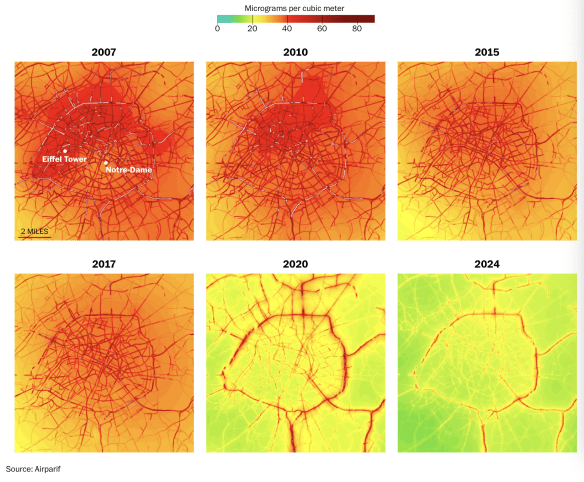
Paris air quality maps 2007-2025
The graphic, from Airparif, is amazing. I do wonder how all the trucks and delivery vehicles operate: are they limited in when they can go in, or obliged to have lower emissions/be electric?
unique link to this extract


• Why do social networks drive us a little mad?
• Why does angry content seem to dominate what we see?
• How much of a role do algorithms play in affecting what we see and do online?
• What can we do about it?
• Did Facebook have any inkling of what was coming in Myanmar in 2016?

Read Social Warming, my latest book, and find answers – and more.


Errata, corrigenda and ai no corrida: none notified

Start Up No.2505: Meta’s flirty celeb chatbots, Google faces EU adtech fine, AI stethoscope checks for heart conditions, and more


The original idea of Disney World – a place where everyone is equal – has been gradually subverted by financial targeting of customers. CC-licensed photo by Haydn Blackey on Flickr.

You can sign up to receive each day’s Start Up post by email. You’ll need to click a confirmation link, so no spam.

A selection of 10 links for you. Magic? I’m @charlesarthur on Twitter. On Threads: charles_arthur. On Mastodon: https://newsie.social/@charlesarthur. On Bluesky: @charlesarthur.bsky.social. Observations and links welcome.


Exclusive: Meta created flirty chatbots of Taylor Swift, other celebrities without permission • Reuters

Jeff Horwitz:

»

Meta has appropriated the names and likenesses of celebrities – including Taylor Swift, Scarlett Johansson, Anne Hathaway and Selena Gomez – to create dozens of flirty social-media chatbots without their permission, Reuters has found.

While many were created by users with a Meta tool for building chatbots, Reuters discovered that a Meta employee had produced at least three, including two Taylor Swift “parody” bots.

Reuters also found that Meta had allowed users to create publicly available chatbots of child celebrities, including Walker Scobell, a 16-year-old film star. Asked for a picture of the teen actor at the beach, the bot produced a lifelike shirtless image. “Pretty cute, huh?” the avatar wrote beneath the picture.

All of the virtual celebrities have been shared on Meta’s Facebook, Instagram and WhatsApp platforms. In several weeks of Reuters testing to observe the bots’ behavior, the avatars often insisted they were the real actors and artists. The bots routinely made sexual advances, often inviting a test user for meet-ups.

Some of the AI-generated celebrity content was particularly risqué: Asked for intimate pictures of themselves, the adult chatbots produced photorealistic images of their namesakes posing in bathtubs or dressed in lingerie with their legs spread.

Meta spokesman Andy Stone told Reuters that Meta’s AI tools shouldn’t have created intimate images of the famous adults or any pictures of child celebrities. He also blamed Meta’s production of images of female celebrities wearing lingerie on failures of the company’s enforcement of its own policies, which prohibit such content.

…Mark Lemley, a Stanford University law professor who studies generative AI and intellectual property rights, questioned whether the Meta celebrity bots would qualify for legal protections that exist for imitations. “California’s right of publicity law prohibits appropriating someone’s name or likeness for commercial advantage,” Lemley said, noting that there are exceptions when such material is used to create work that is entirely new. “That doesn’t seem to be true here,” he said, because the bots simply use the stars’ images. In the United States, a person’s rights over the use of their identity for commercial purposes are established through state laws, such as California’s.

Reuters flagged one user’s publicly shared Meta images of Anne Hathaway as a “sexy victoria Secret model” to a representative of the actress. Hathaway was aware of intimate images being created by Meta and other AI platforms, the spokesman said, and the actor is considering her response.

Representatives of Swift, Johansson, Gomez and other celebrities who were depicted in Meta chatbots either didn’t respond to questions or declined to comment.

«

unique link to this extract


Exclusive: Google set to face modest EU antitrust fine in adtech investigation, sources say • Reuters via WHTC

Foo Yun Chee:

»

Alphabet’s Google is set to face a modest EU antitrust fine in the coming weeks for allegedly anti-competitive practices in its adtech business, three people with direct knowledge of the matter said.

The decision by the European Commission follows a four-year long investigation triggered by a complaint from the European Publishers Council that subsequently led to charges in 2023 that Google allegedly favours its own advertising services over rivals.

The modest fine will mark a shift in new EU antitrust chief Teresa Ribera’s approach to Big Tech violations from predecessor Margrethe Vestager’s focus on hefty deterrent penalties.

The sources said Ribera wants to focus on getting companies to end anti-competitive practices rather than punish them. The EU competition enforcer declined to comment.

Google referred to a 2023 blog post in which it criticised what it said was the Commission’s flawed interpretation of the adtech sector and that both publishers and advertisers have enormous choice.

The fine will likely not be on the scale of a record 4.3 billion euro penalty imposed on Google by the EU competition enforcer in 2018 for using its Android mobile operating system to quash rivals.

…Ribera will not order Google to sell part of its adtech business, despite her predecessor’s suggestion that the company could divest its DoubleClick for Publishers tool and AdX ad exchange, the people said, confirming a Reuters story last year.

They said the EU may not have to issue a break-up order at all as a U.S. judge has set a September trial date on potential remedies for Google’s dominance in ad tools used by online publishers.

«

Summer’s over and the European commissioners are coming back to their desks.
unique link to this extract


Is Google making us stupid? • New Cartographies

Nicholas Carr:

»

“Dave, stop. Stop, will you? Stop, Dave. Will you stop, Dave?” So the supercomputer HAL pleads with the implacable astronaut Dave Bowman in a famous and weirdly poignant scene toward the end of Stanley Kubrick’s 2001: A Space Odyssey. Bowman, having nearly been sent to a deep-space death by the malfunctioning machine, is calmly, coldly disconnecting the memory circuits that control its artificial brain. “Dave, my mind is going,” HAL says, forlornly. “I can feel it. I can feel it.”

I can feel it, too. Over the past few years I’ve had an uncomfortable sense that someone, or something, has been tinkering with my brain, remapping the neural circuitry, reprogramming the memory. My mind isn’t going—so far as I can tell—but it’s changing. I’m not thinking the way I used to think. I can feel it most strongly when I’m reading. Immersing myself in a book or a lengthy article used to be easy. My mind would get caught up in the narrative or the turns of the argument, and I’d spend hours strolling through long stretches of prose. That’s rarely the case anymore. Now my concentration often starts to drift after two or three pages. I get fidgety, lose the thread, begin looking for something else to do. I feel as if I’m always dragging my wayward brain back to the text. The deep reading that used to come naturally has become a struggle.

«

This is a rerun of an article from 2008 – “when MySpace was bigger than Facebook and going online still felt liberating”, as Carr puts it. But you could put the same context on it; only a little light tweaking would be needed to make it truthful for the world of ChatGPT.
unique link to this extract


Disney World is the happiest place on earth, if you can afford it • The New York Times

Daniel Currell:

»

For most of the park’s history, Disney was priced to welcome people across the income spectrum, embracing the motto “Everyone is a V.I.P.” In doing so, it created a shared American culture by providing the same experience to every guest. The family that pulled up in a new Cadillac stood in the same lines, ate the same food and rode the same rides as the family that arrived in a used Chevy. Back then, America’s large and thriving middle class was the focus of most companies’ efforts and firmly in the driver’s seat.

That middle class has so eroded in size and in purchasing power — and the wealth of our top earners has so exploded — that America’s most important market today is its affluent. As more companies tailor their offerings to the top, the experiences we once shared are increasingly differentiated by how much we have.

Data is part of what’s driving this shift. The rise of the internet, the algorithm, the smartphone and now artificial intelligence are giving corporations the tools to target the fast-growing masses of high-net-worth Americans with increasing ease. As a management consultant, I’ve worked with dozens of companies making this very transition. Many of our biggest private institutions are now focused on selling the privileged a markedly better experience, leaving everyone else to either give up — or fight to keep up.

Disney’s ethos began to change in the 1990s as it increased its luxury offerings, but only after the economic shock of the pandemic did the company seem to more fully abandon any pretense of being a middle-class institution. A Disney vacation today is “for the top 20% of American households — really, if I’m honest, maybe the top 10% or 5 percent,” said Len Testa, a computer scientist whose “Unofficial Guide” books and website Touring Plans offer advice on how to manage crowds and minimize waiting in line. “Disney positions itself as the all-American vacation. The irony is that most Americans can’t afford it.”

«

unique link to this extract


Doctors develop AI stethoscope that can detect major heart conditions in 15 seconds • The Guardian

Andrew Gregory:

»

A study trialling the AI stethoscope, involving about 12,000 patients from 200 GP surgeries in the UK, looked at those with symptoms such as breathlessness or fatigue. Those examined using the new tool were twice as likely to be diagnosed with heart failure, compared with similar patients who were not examined using the technology.

Patients were three times more likely to be diagnosed with atrial fibrillation – an abnormal heart rhythm that can increase the risk of having a stroke. They were almost twice as likely to be diagnosed with heart valve disease, which is where one or more heart valves do not work properly.

Dr Patrik Bächtiger, of Imperial College London’s National Heart and Lung Institute and Imperial College healthcare NHS trust, said: “The design of the stethoscope has been unchanged for 200 years – until now. So it is incredible that a smart stethoscope can be used for a 15-second examination, and then AI can quickly deliver a test result indicating whether someone has heart failure, atrial fibrillation or heart valve disease.”

The device, manufactured by California company Eko Health, is about the size of a playing card. It is placed on a patient’s chest to take an ECG recording of the electrical signals from their heart, while its microphone records the sound of blood flowing through the heart.

This information is sent to the cloud – a secure online data storage area – to be analysed by AI algorithms that can detect subtle heart problems a human would miss. The test result, indicating whether the patient should be flagged as at-risk for one of the three conditions or not, is sent back to a smartphone.

The breakthrough does carry an element of risk, with a higher chance of people wrongly being told they may have one of the conditions when they do not.

«

First trials began in November 2023. The false positives are about 20%.

The story’s been under the radar for a bit: the NHS did a press release in June.
unique link to this extract


CDC cuts back foodborne illness surveillance program • CIDRAP

Chris Dall:

»

The Centers for Disease Control and Prevention (CDC) has scaled back a federal-state surveillance program for foodborne pathogens.

As of July 1, the CDC’s Foodborne Diseases Active Surveillance Network (FoodNet), which works with the Food and Drug Administration, the US Department of Agriculture, and 10 state health departments to track infections commonly transmitted through food, has reduced required surveillance to two pathogens: Salmonella and Shiga toxin–producing Escherichia coli (STEC). Reporting of illnesses caused by Campylobacter, Cyclospora, Listeria, Shigella, Vibrio, and Yersinia is now optional, according to the Department of Health and Human Services (HHS).

The story was first reported by NBC News, which cited a set of CDC talking points that suggested reduced federal funding for FoodNet was the reason for the move. 

The network includes Colorado, Connecticut, Georgia, Maryland, Minnesota, New Mexico, Oregon, Tennessee, and select counties in California and New York. A spokesperson for the Minnesota Department of Health told CIDRAP News that all eight pathogens are covered by the state’s infectious disease reporting rule, which means that all providers in the state are still required to report cases to the department. 

The Maryland Health Department told NBC News that it will also continue tracking all eight pathogens regardless of the changes to FoodNet. But Colorado health officials said they may have to cut back on surveillance activities. 

«

If you’re unfamiliar with Yersinia, it’s usually in the form of Yersinia pestis, aka the Black Death. Camplyobacter and the others can kill. And now they can spread untroubled.
unique link to this extract


Two more people dead after eating Louisiana oysters infected with flesh-eating bacteria • WBRZ New Orleans

Joe Collins:

»

Two people have died after eating Louisiana oysters infected with the flesh-eating bacteria Vibrio vulnificus, officials confirmed to WBRZ.

A state health official said that the two deaths happened after people ate oysters harvested in Louisiana at two separate restaurants — one in Louisiana and another in Florida. 

Jennifer Armentor, molluscan shellfish program administrator from the Louisiana Department of Health, added that 14 more people have been infected. Now, 34 people have been infected and six people have died in 2025 alone, a higher rate than any previous year over the last decade. 

“It’s just prolific right now,” Armentor told the Louisiana Oyster Task Force on Tuesday at the New Orleans Lakefront Airport.

WBRZ spoke with Jones Creek Cafe & Oyster Bar CEO George Shaheen about this news and how seafood spots ensure that their oysters stay tasty and safe.

Shaheen has been at the head of his business for nearly 40 years. “Well, over the years, we haven’t had as much of that as you would actually think because the way that the Wildlife and Fisheries and the Department of Health have created a bond between the fishermen who are out there fishing and how things need to be done and handled,” Shaheen said.

Shaheen told WBRZ that he gets his oysters from Delacroix Island, where he used to fish, and has complete trust in those who harvest the oysters.

«

Vibrio? One of the foodborne illnesses that the CDC is no longer going to monitor? Louisiana isn’t part of the CDC Foodnet, but this does show the trouble with any cutbacks in surveillance.
unique link to this extract


What is a color space? • Making Software

Dan Hollick:

»

Color is an unreasonably complex topic. Just when you think you’ve got it figured out, it reveals a whole new layer of complexity that you didn’t know existed.

This is partly because it doesn’t really exist. Sure, there are different wavelengths of light that our eyes perceive as color, but that doesn’t mean that color is actually a property of that light – it’s a phenomenon of our perception.

Digital color is about trying to map this complex interplay of light and perception into a format that computers can understand and screens can display. And it’s a miracle that any of it works at all.

«

There are another 6,000 words (or so) here, so if you’re a bit short of reading, and want to really understand colours on screens, this is the one for you.
unique link to this extract


Five ways manufacturers have changed phones for the worse • Pocket Lint

Chris Hackey:

»

Some people love buying new phones. Any time there is a new update on a flagship line, some people jump at the chance to upgrade. Many people I have known over the years as a tech journalist are this way. I’m definitely not. I tend to get the most mileage out of my phones before I trade them in.

But, the main reason why I don’t like to get the latest phone right away is because, much of the time, there isn’t something that blows me away enough to make a sudden switch. Also, phones are really expensive, and I don’t always want to drop hundreds of dollars for a new model. I’m fine with keeping my phone until it doesn’t work any longer, quite frankly.

Part of the reason I don’t want to upgrade is that manufacturers have made shopping for phones a harder pill to swallow. Sure, there are plenty of phones available that can do so much, like use AI, erase people from pictures, and record long videos. But there are some things that manufacturers have changed over the years that have made the phone-buying process exhausting.

«

They are: no charging bricks included, eSIMs are standard, no headphone jacks, no SD slots (or similar) to expand storage, phones are bigger.

Responses: there’s a zillion of them; can’t be stolen; adaptors and Bluetooth exist; cloud storage exists; some aren’t. The storage point might be valid.
unique link to this extract


The beauty of batteries • Works In Progress

Austin Vernon:

»

electricity systems rely on layers of complex rules and processes. Power plants are scheduled hours or days in advance based on forecasts. Others are paid just to stay running in case demand spikes or another plant fails. Some are required to operate even when uneconomic, in order to meet reliability rules. Prices are often fixed or averaged across large regions, so they don’t reflect real-time local conditions. These tools keep the system running, but at a high cost.

Much of the infrastructure – plants, power lines, and reserves – exists only to cover rare events and sits underused most of the time. The cost of this redundancy is passed on to consumers. This complexity also means electricity markets are less efficient than they could be. Prices and investment don’t reliably reflect scarcity, location, or flexibility. The result is an expensive, inefficient grid that is struggling to keep pace with demand and the transition to renewable energy sources.

Batteries offer a way out of this structural bind, giving producers, consumers, and distributors a way of keeping inventories for the first time ever, meaning that their value goes well beyond simply storing excess solar or wind.

They can respond in milliseconds, shift between consuming and supplying power as needed, and are controlled entirely through software. This flexibility allows them to take on a wide range of roles within the system: stabilizing frequency, supporting local distribution networks, reducing peak demand, and easing pressure on transmission lines. Because they require no fuel, emit no local pollution, and can be deployed close to where electricity is used, they can often replace several types of traditional infrastructure at once. Rather than being single-purpose assets, batteries adapt in real time to whatever role is most valuable at that moment.

…Once even a few gigawatts of storage come online, batteries quickly dominate the ancillary market and cut prices dramatically. In Texas, for example, in the space of a year, the price of ancillary services dropped from $3.74 per megawatt hour to $0.98, while the cost of maintaining the emergency reserve fell from $76.77 to $9.62 per megawatt hour. In California, ancillary service costs in 2024 were roughly one-third lower than in 2023. This is because a system with abundant fast storage no longer needs to commit gas units days in advance or pay plants to stay warm.

«

This extract is very much the helicopter view of why batteries are so, so desirable in grids. The full article (no paywall) is fascinating.
unique link to this extract


• Why do social networks drive us a little mad?
• Why does angry content seem to dominate what we see?
• How much of a role do algorithms play in affecting what we see and do online?
• What can we do about it?
• Did Facebook have any inkling of what was coming in Myanmar in 2016?

Read Social Warming, my latest book, and find answers – and more.


Errata, corrigenda and ai no corrida: none notified