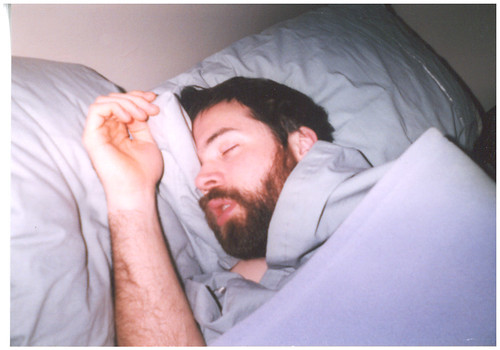
Some people have a genetic mutation that lets them function perfectly well on four hours’ sleep rather than eight. The sods. CC-licensed photo by Pete on Flickr.
You can sign up to receive each day’s Start Up post by email. You’ll need to click a confirmation link, so no spam.
There’s another post coming this week at the Social Warming Substack on Friday at 0845 UK time. Free signup.
A selection of 9 links for you. Awake, awake. I’m @charlesarthur on Twitter. On Threads: charles_arthur. On Mastodon: https://newsie.social/@charlesarthur. On Bluesky: @charlesarthur.bsky.social. Observations and links welcome.
AI-powered Coca-Cola ad celebrating authors gets basic facts wrong • 404 Media
Emanuel Maiberg:
»
In April, Coca-Cola proudly launched a new ad campaign it called “Classic,” celebrating famous authors and the sugary drink’s omnipresence in culture by highlighting classic literary works that mention the brand. The firm that produced the ad campaign said it used AI to scan books for mentions of Coca-Cola, and then put viewers in the point of view of the author, typing that portion of the text on a typewriter. The only issue is that the AI got some very basic facts about the authors and their work entirely wrong.
One of the ads highlights the work of J.G. Ballard, the British author perhaps best known for his controversial masterpiece, Crash, and David Cronenberg’s film adaptation of the novel. In the ad, we get a first person perspective of someone typing a sentence from “Extreme Metaphors by J.G Ballard,” which according to the ad was written in 1967. When the sentence gets to the mention of “Coca-Cola,” the typeface changes from the generic typewriter font to Coca-Cola’s iconic red logo.
…J.G. Ballard never wrote a book called “Extreme Metaphors,” and he never wrote the words that appear on the page in the ad. In reality, “Extreme Metaphors,” actual full title: Extreme Metaphors: Selected Interviews with J. G. Ballard 1967-2008, is a book edited by Dan O’Hara and Simon Sellars which collects interviews with J.G. Ballard that was published in 2012, three years after the author’s death.
The words in the ad were not written, but spoken by Ballard in an interview with the French Magazine Littéraire in 1985. Ballard spoke in English, the magazine translated his words to French, and O’Hara told me he translated that printed French back to English.
“The sequence of words being typed out by the imagined J. G. Ballard in the ad was never written by him, only spoken, and the only person ever to type that exact sequence out in English is me,” O’Hara told me.
«
The advert even misspells “Shanghai”, a mistake that infuriates O’Hara. The company used an extract which mentioned.. the fizzy drink. That AI’s going to have to answer to the Coca-Cola Corporation. (Thanks tanrenzu for the link.)
unique link to this extract
How Google forced publishers to accept AI scraping as price of appearing in search • Press Gazette
Charlotte Tobitt:
»
Google considered allowing publishers to opt out of their data being used for AI grounding and still appear in search results but described it as a “hard red line”.
New documents disclosed in the remedies portion of an antitrust trial into Google’s search monopoly in the US reveals the tech giant preferred not to give publishers the option as it was “evolving into a space for monetisation”.
A US judge ruled in August that Google has an illegal search monopoly and new documents have now been published amid a remedies trial held to decide what, if anything, should be done.
Possible remedies could include forcing Google to sell the Chrome browser and share data with competitors. The UK’s Competition and Markets Authority has since launched its own investigation of Google’s search dominance.
Slides prepared by Google director of product management Chetna Bindra in April last year ahead of the US rollout of AI Overviews (then called Search Generative Experience) show the controls Google considered offering to publishers to enable them to opt out of their data being used for various purposes.
Option number one would have been no changes to how publishers could opt out of or limit the display of their content in search. “If not satisfied, they can choose to opt out of indexing.” This option was described as “likely unstable”.
…Google said in 2019 that all versions of an experiment equivalent to no-snippeting in search (“only URLs, very short fragments of headlines, and no preview images”) resulted in “substantial traffic loss to news publishers”.
“Even a moderate version of the experiment (where we showed the publication title, URL, and video thumbnails) led to a 45% reduction in traffic to news publishers.”
«
Just in case anyone thought Google had publishers’ best interests at heart: nope. If it could keep everyone on Google properties forever all the time, it would.
unique link to this extract
In a ‘misinformation’ age, we need to know what the fact is going on • The Independent
The head of the fact-checking organisation Full Fact is Chris Morris (no, not that one):
»
This is a moment of crisis for anyone who cares about verifiable facts.
They are the building blocks which ensure citizens have access to accurate information, and they help people make informed choices on the issues that matter most. Only by creating a better, less toxic information environment can free speech gain greater currency.
But dramatic changes in technology and politics have converged: we are in danger of being swept away by a deluge of false, misleading or artificially generated junk online, leaving many people either stuck in echo chambers or unsure what they can believe. Four in 10 UK adults in an Ofcom survey last year said they had encountered misinformation in the previous four weeks. Others struggle to separate fact from fiction.
At the same time, the Trump administration is rewriting the rules of American engagement around the world, and challenging western political assumptions. Earlier this year, Vice-President JD Vance came to Europe to talk about the enemy within. He described misinformation as an ugly Soviet-era word, and suggested anyone using it wanted to tell others what to think. In turn, social media platforms – run by the most powerful corporations on the planet – are responding to political pressures by backing away from commitments to work with independent fact-checkers in order to find and expose information that causes real-world harm.
Let’s be clear: checking the facts doesn’t restrict debate; it strengthens it by grounding it in truth. It’s certainly not censorship, as Meta boss Mark Zuckerberg claimed in an abrupt about-turn at the beginning of this year. Verifying facts adds important context to complex conversations, and it creates more speech, not less.
«
This is all turning into an almighty mess. Zuckerberg and Musk don’t care whether something is true or false, only whether it gooses engagement they rely on to make their apps money.
unique link to this extract
Germ-theory skeptic RFK Jr. goes swimming in sewage-tainted water • Ars Technica
Beth Mole:
»
Over the weekend, America’s top health official, Robert F. Kennedy Jr., shared pictures on social media of himself fully submerged in the sewage-tinged waters of Rock Creek in Washington, DC. His grandchildren were also pictured playing in the water.
The creek is known for having a sewage overflow problem and posing a health hazard to any who enter it. The National Park Service, which manages the Rock Creek Park, strictly bars all swimming and wading in Rock Creek and the park’s other waterways due to the contamination, specifically “high levels of bacteria.”
A notice on the NPS website advises “Stay Dry, Stay Safe,” warning, “Rock Creek has high levels of bacteria and other infectious pathogens that make swimming, wading, and other contact with the water a hazard to human (and pet) health. Please protect yourself and your pooches by staying on trails and out of the creek. All District waterways are subject to a swim ban—this means wading, too!”
The urban creek is contaminated mainly because of the numerous century-old municipal sewer lines that run under the park. These lines have cracked over time and leak sewage, according to Marchant Wentworth, an environmental consultant who submitted a report on the problem to the DC Council in 2021.
«
Too many jokes which write themselves. Let’s see how sick he gets. Quite possibly nothing happens if he has no open wounds and kept his mouth shut. Which doesn’t make the pollution any less bad.
unique link to this extract
Jony Ive’s next product is driven by the ‘unintended consequences’ of the iPhone • The Verge
Emma Roth:
»
Former Apple designer Jony Ive says the work on his next product is driven by owning the “unintended consequences” associated with the iPhone. During an interview with Stripe, Ive said there’s “not anything that I can be more preoccupied or bothered by” than the potentially adverse effects smartphones have on their users.
“I think when you’re innovating, of course, there will be unintended consequences,” Ive said. “You hope that the majority will be pleasant surprises. Certain products that I’ve been very, very involved with, I think there were some unintended consequences that were far from pleasant.”
…“I think even if you’re innocent in your intention, I think if you’re involved in something that has poor consequences, you need to own it,” Ive said. “That ownership, personally, has driven a lot of what I’ve been working on that I can’t talk about the moment, but look forward to being able to talk about at some point in the future.”
When talking about AI, Ive mentioned that he finds it encouraging that “it’s very rare for there to be a discussion about AI, and there not to be the appropriate concerns about safety.” He adds that he was “extremely concerned about social media, and there was no discussion whatsoever.”
«
I guess he could design a device where it’s impossible to find the power switch to turn it on? He came pretty close to that nirvana a few times in the past, after all.
unique link to this extract
Substack gets ‘Trump bump’ as subscriptions soar • Financial Times
Daniel Thomas:
»
Substack has added more than 1m subscribers since Donald Trump’s triumph in the US election last November, as the online platform benefits from the shift towards creator-led journalism.
Substack, a platform for writers and other content creators, reached 5mn paid subscriptions in March, across publications and podcasts. The platform attracted an additional 1mn subscribers between November and March alone, helping it generate positive cash flow in the first quarter.
Substack, which is backed by investors including Wall Street banker Omeed Malik and polling expert Nate Silver, offers journalists, politicians and commentators the opportunity to get paid directly by their audience via subscription fees.
The platform has benefited from an influx of traditional media executives such as former CNN star Jim Acosta drawing in new audiences.
Acosta and other journalists are cutting out traditional media channels and building large communities of followers, while new media groups such as Bari Weiss’s Free Press have based their businesses on the platform.
The US Department of State, headed by Marco Rubio, joined Substack last month, joining other US politicians such as Pete Buttigieg. Brands and corporations are also using the platform to reach consumers
“There has definitely been a big moment of interest around the election and then the first 100 days [of the Trump presidency]. There’s been a spate of people in that universe coming,” said Substack co-founder Chris Best.
Journalists were leaving traditional outlets, he added, including “a bunch of people who decanted from the Washington Post” in protest at the policies of its owner Jeff Bezos.
«
The most common complaint one now sees on Substack is that it’s impossible (and expensive) to keep up with all the good writing and that they should offer some sort of bundling system for paywalled blogs. Yes, people want to reinvent the magazine. (The newspaper seems to be dead outside of the existing media properties.)
unique link to this extract
The zero‑sum mindset is no mystery • Financial Times
Tim Harford:
»
There are many ways to describe Donald Trump’s approach to government, or the philosophy of the new Reform party in the UK, but “zero sum” is a useful one.
The zero-sum thinker frames the world in terms of winning and losing, us and them. If one person is to get richer, someone else must get poorer. If China is doing well, then the US must logically be doing badly. Jobs go either to the native born, or to foreigners. In contrast, the centrist dads among us see win-win solutions.
[The economist Stefanie] Stantcheva and her colleagues at Harvard’s Social Economics Lab have been asking: what sort of person tends to see the world as zero sum? There are some surprising findings. For example, there are few clearer refutations of a zero-sum mindset than a thriving city, in which people flock to be with others, and the social, cultural, educational and financial opportunities that result. Yet Stantcheva’s research found that urban areas are more prone to zero-sum thinking than rural ones, perhaps reflecting our failure to build new homes.
…Young people in the US tend to see the world as zero sum, reflecting the fact that they have grown up in a slower-growth economy than those born in the 1940s and 1950s. A similar pattern emerges across countries: the higher the level of economic growth a person grew up with, the less likely they are to see the world in zero-sum terms. People whose ancestors were enslaved, forced on to reservations or sent to concentration camps are more likely to see the world in zero-sum terms. And, intriguingly, while people with little education are often zero-sum thinkers, people with PhDs may be more zero-sum than anyone, which speaks volumes about the scramble for scarce scholarships and research positions in elite education.
The world is full of opportunities for mutual benefit, so zero-sum thinking is a tragedy and a trap. But it is not a mystery. If we want to understand why so many people see the world in zero-sum terms, we only have to look at the fact that our dysfunctional politics and our sluggish economies have needlessly produced far too many zero-sum situations. Fix that problem and maybe economics will one day be cool again.
«
(For those who don’t have an FT subscription, this article should be on timhardford.com in a few days’ time.)
unique link to this extract
Rare genetic mutation lets some people thrive on just four hours of sleep • Live Science
Patrick Pester:
»
Some lucky people have rare genetic mutations that enable them to feel well-rested after just four hours of sleep, while the rest of us need around eight hours to function.
Now, researchers have identified one of these mutations, named SIK3-N783Y, in a human super-sleeper. The team then studied the mutation in genetically modified mice and found that the mice carrying this mutation also got less shut-eye, according to a new study.
The newly identified mutation is one of several that researchers have linked to shorter sleep patterns. Scientists hope that by understanding the genetics of natural short sleepers, who seem to thrive on less sleep, they can develop better treatments for sleep disorders.
“Our bodies continue to work when we go to bed,” detoxifying themselves and repairing damage, study co-author Ying-Hui Fu, a neuroscientist and geneticist at the University of California, San Francisco, told Nature. “These people [natural short sleepers], all these functions our bodies are doing while we are sleeping, they can just perform at a higher level than we can.”
The researchers published their findings in the journal PNAS.
«
What do those four-hour people feel after eight hours or six hours, though? Chronically over-rested? Absolutely amazing?
One could imagine a future gene-picking world where this one gets chosen a lot.
unique link to this extract
A cheat sheet for why using ChatGPT is not bad for the environment • The Weird Turn Pro
Andy Masley:
»
The question this post is trying to answer is “Should I as an individual boycott ChatGPT or limit how much I use it for the sake of the climate?” and the answer is a resounding and conclusive “No.”
It’s not bad for the environment if you or any number of people use ChatGPT, Gemini, Claude, Grok, or other large language model (LLM) chatbots. You can use ChatGPT as much as you like without worrying that you’re doing any harm to the planet. Worrying about your personal use of ChatGPT is wasted time that you could spend on the serious problems of climate change instead.
«
This is a shorter version of a much longer post by Masley. Here’s his basic calculation:
»
Throughout this post I’ll assume the average ChatGPT query uses 3 Watt-hours (Wh) of energy, which is 10x as much as a Google search. This statistic is likely wrong. ChatGPT’s energy use is probably lower according to EpochAI.
«
That’s a lot lower than most people have been thinking.
unique link to this extract
| • Why do social networks drive us a little mad? • Why does angry content seem to dominate what we see? • How much of a role do algorithms play in affecting what we see and do online? • What can we do about it? • Did Facebook have any inkling of what was coming in Myanmar in 2016? Read Social Warming, my latest book, and find answers – and more. |
Errata, corrigenda and ai no corrida: none notified
 The Overspill: when there's more that I want to say