

The US wants to get rid of all its lead water pipes in ten years – a decade after the Flint scandal. CC-licensed photo by Louise Devitt on Flickr.
You can sign up to receive each day’s Start Up post by email. You’ll need to click a confirmation link, so no spam.
There’s another post coming this week at the Social Warming Substack on Friday at 0845 UK time. Free signup.
A selection of 9 links for you. Like the petrol. I’m @charlesarthur on Twitter. On Threads: charles_arthur. On Mastodon: https://newsie.social/@charlesarthur. Observations and links welcome.
Google faces US government attempt to break it up • The Guardian
Jack Simpson:
»
The Department of Justice has filed court papers that say it is considering enforcing “structural remedies” that would prevent Google from using some of its products such as Chrome, Android and Play, which the DoJ argues give the company an advantage over rivals.
Other actions being considered include blocking Google from paying to have its search engine pre-installed on smartphones and other devices.
Google, which is owned by Alphabet, said it would challenge any case by the DoJ and that the proposals marked an “overreach” by the government that would harm consumers.
The latest filing comes after a court ruling in August in favour of the DoJ that found Google, which controls 90% of the global search market, had violated antitrust laws and spent billions building up an illegal monopoly. The ruling paved the way for the current lawsuit by the justice department that will rule on potential actions to counteract Google’s market domination.
The filing said Google’s conduct had resulted in “interlocking and pernicious harms” to users, and the importance of restoring competition to a market, which was “indispensable” to Americans, could not be overstated.
The judgment said: “Plaintiffs are considering behavioural and structural remedies that would prevent Google from using products such as Chrome, Play, and Android to advantage Google search and Google search-related products and features – including emerging search access points and features, such as artificial intelligence –over rivals or new entrants.”
The move may also prevent Google from being able to pay major phone companies such as Apple and Samsung for Chrome to be the default browser on their devices. In 2021, Google paid companies $26.3bn to ensure its search engine was the default option in the products.
«
To be decided by the judge some time next summer, but the landscape in a few years will likely look very different.
unique link to this extract
Biden sets 10-year deadline for US cities to replace lead pipes nationwide • AP News
Matthew Daly and Michael Phillis:
»
A decade after the Flint, Michigan, water crisis raised alarms about the continuing dangers of lead in tap water, President Joe Biden on Tuesday set a 10-year deadline for cities across the nation to replace their lead pipes, finalizing an aggressive approach aimed at ensuring that drinking water is safe for all Americans.
Biden announced the final Environmental Protection Agency rule during a visit to the swing state of Wisconsin in the final month of a tight presidential campaign. The announcement highlights an issue — safe drinking water — that Kamala Harris has prioritized as vice president and during her presidential campaign. The new rule supplants a looser standard set by former President Donald Trump’s administration that did not include a universal requirement to replace lead pipes.
“Folks, what is a government for if it cannot protect the public health?” Biden asked a crowd of union members at a cavernous Department of Public Works warehouse in Milwaukee. The city has the fifth-highest number of lead pipes in the nation, according to the EPA.
Decades after the dangers of lead pipes were clear, more than 9 million lead pipes remain in use, a fact Biden called shameful.
«
Ten years later, and there’s another ten years to go? I thought Britain might have done better, but then found this June 2023 article which says that there are at least three million lead pipes in the network. It turns out to be a shockingly high proportion – a third of homes have some lead piping.
unique link to this extract
FEMA adds misinformation to its list of disasters to clean up • The Verge
Lauren Feiner:
»
The Federal Emergency Management Agency (FEMA) is fighting misinformation on top of a major storm cleanup in Florida as Hurricane Milton rapidly intensifies just after Hurricane Helene rocked the state.
FEMA Administrator Deanne Criswell told reporters on a call Tuesday that misinformation around the storms is “absolutely the worst I have ever seen,” according to Politico. FEMA posted a rumor response page about the hurricane, and though it’s not the first time it’s taken that kind of approach, Criswell said, “I anticipated some of this, but not to the extent that we’re seeing.”
FEMA’s rumor response page includes fact-checks to claims made by former President Donald Trump, like that the agency will only provide $750 to disaster survivors. FEMA says that’s just the amount provided quickly through “Serious Needs Assistance” for food and emergency supplies, but survivors could still be eligible for other types of funds, too. Other fact-checks include debunking the false claim that FEMA disaster response resources were diverted to border issues. FEMA says “Disaster Relief Fund money has not been diverted to other, non-disaster related efforts.”
Elon Musk, one of Trump’s most prominent tech backers, has also contributed to the misinformation, according to FEMA officials. Musk claimed on X last week that FEMA was “actively blocking citizens who try to help.” FEMA’s acting director for response and recovery, Keith Turi, told ABC that’s “absolutely not true. FEMA does not block anyone from helping or assisting. We do not confiscate supplies and use them for other purposes. In fact, we do the exact opposite.”
«
Personally I’m already wondering what happens to Musk’s interest in X/Twitter if (as increasingly seems possible) Trump does not win. Will he really think it’s worth burning all that money for something which failed to achieve what he wanted in propaganda terms? Will he just let it decline, or will he try to sell it?
unique link to this extract
Xiaohongshu helps Southeast Asia with tourism recovery post Covid-19 • Rest of World
Zhaoyin Feng:
»
At 5 a.m., the air around Ijen volcano in eastern Java, Indonesia, is thick with bright yellow smoke. Undeterred, young Chinese tourists don gas masks and flock to the rim of the active volcano crater at sunrise, eager to capture the perfect photo. Steps away from a sheer drop into the turquoise volcanic lake, some whip out their phones to check Xiaohongshu, a Chinese social media app, for the best vantage point. Within hours, their snapshots may join the thousands already shared on the platform.
Aang Koen is familiar with this phenomenon. The 48-year-old Indonesian owns a travel agency in Surabaya and organizes tours to Ijen. For years, his clientele was predominantly European, but since early 2023, Koen’s business has undergone a dramatic shift. Now, 60% of his clients are Chinese, most of whom found him on Xiaohongshu.
“My business is getting famous,” he told Rest of World. Ijen was little-known among Chinese travelers before the end of the Covid-19 pandemic, Koen said, but the volcano rim pictures on Xiaohongshu have made it a popular destination. Almost all of his Chinese clients asked to include Ijen in their tours.
Xiaohongshu is often referred to as “China’s Instagram,” but it offers something that Instagram and other social media apps generally do not: in-depth, user-generated travel advice and itineraries. Travel posts on the app often include comprehensive hotel and restaurant reviews, tips on transportation logistics, and curated lists of shops and attractions, all complemented by stunning snapshots. With over 300 million monthly active users, Xiaohongshu has become a beloved resource among young Chinese travelers, many of whom consider it their go-to travel guide.
«
Literally the rest of the world, and pretty much unknown to almost anyone in the western world. Apart from you, of course.
unique link to this extract
The bill finally comes due for Elon Musk • The Verge
Andrew Hawkins:
»
For almost as long as he’s been CEO of Tesla, Elon Musk has been bullshitting us about self-driving cars.
In 2016, he said Tesla self-driving cars were “two years away.” A year later, it was “six months, definitely,” and customers would be able to actually sleep in their Tesla in “two years.” In 2018, it was still a “year away” and would be “200% safer” than human driving. In 2019, he said there would be “feature complete full self-driving this year.” There hasn’t been a year go by without Musk promising the imminent arrival of a fully driverless Tesla.
This week, it’s finally here. Or at least that’s what Musk says.
On October 10th, Tesla will reveal its long-awaited “robotaxi,” a supposedly fully autonomous vehicle that Musk has said will catapult the company into trillion-dollar status. It will be some combination of “Uber and Airbnb,” Musk said during a recent earnings call, allowing Tesla owners to serve as landlords for their driverless cars as they roam about the cityscape, picking up and dropping off strangers. And it will be futuristic in its design, with Bloomberg reporting that it will be a two-seater with butterfly wing doors. Musk has been calling it the “Cybercab.”
The event, which will be held on the film lot of Warner Bros. in Burbank, California, will be the culmination of almost a decade of blown deadlines and broken promises from Musk, a moment when the richest man in the world will finally be forced to stop hiding behind his own bluster and actually show us what he’s been working on.
«
I detect a certain amount of scepticism on the part of Mr Hawkins here. All, one has to agree, justified.
unique link to this extract
Protein structure prediction wins the Nobel • Ars Technica
John Timmer:
»
Chemically, proteins are a linear string of amino acids linked together, with living creatures typically having the choice of 20 different amino acids for each position along the string. Most of those 20 have distinctive chemical properties: some are acidic, others basic; some may be negatively charged, others positively charged, and still others neutral, etc. These properties allow different areas of the string to interact with each other, causing it to fold up into a complex three-dimensional structure. That structure is essential for the protein’s function.
Typically, figuring out the structure involves laborious biochemistry to purify the protein, followed by a number of imaging techniques to determine where each of its atoms resides. But in theory, all of that should be predictable since the structure is just the product of chemistry and physics. Since any amino acid could potentially interact with any other on the chain, however, the complexity of making predictions rises very rapidly with the length of the protein. Extend it out past a dozen amino acids long, and it could quickly humble the most powerful supercomputers.
A lot of work over the years went into trying to figure out computational shortcuts. DeepMind, by contrast, did what it did best and put an AI on the case. For protein folding, the AI was trained on two large existing data sets. One included every protein structure that had been solved through lab work, allowing it to extract general principles for how different amino acids typically interact. The second was the sequence of every protein we’ve determined, allowing it to identify proteins related through evolution and determine what sorts of flexibility can be tolerated in a given structure.
The net result is software that produced reasonable structural predictions, easily beating every other software package we’d developed in a regular computational challenge. DeepMind has since used it to generate predictions for most of the existing protein-coding genes in the databases (it still struggles with excessively long ones) and has continued to upgrade the software. The predictions aren’t perfect, and some appear to stumble badly, but when the alternative is simply a string of amino acids and a shrug, this represents a major advance.
«
The Nobel Prize in Chemistry went jointly to Demis Hassabis and John Junper of DeepMind for their AlphaFold work (described above), and also to Professor David Baker, who did a variant of that. Notable how quickly this has won the Nobel: AlphaFold only appeared in 2020.
unique link to this extract
Quantifying ‘The Kevin Bacon Game’: a statistical exploration of Hollywood’s most connected actors • Stat Significant
Daniel Parris:
»
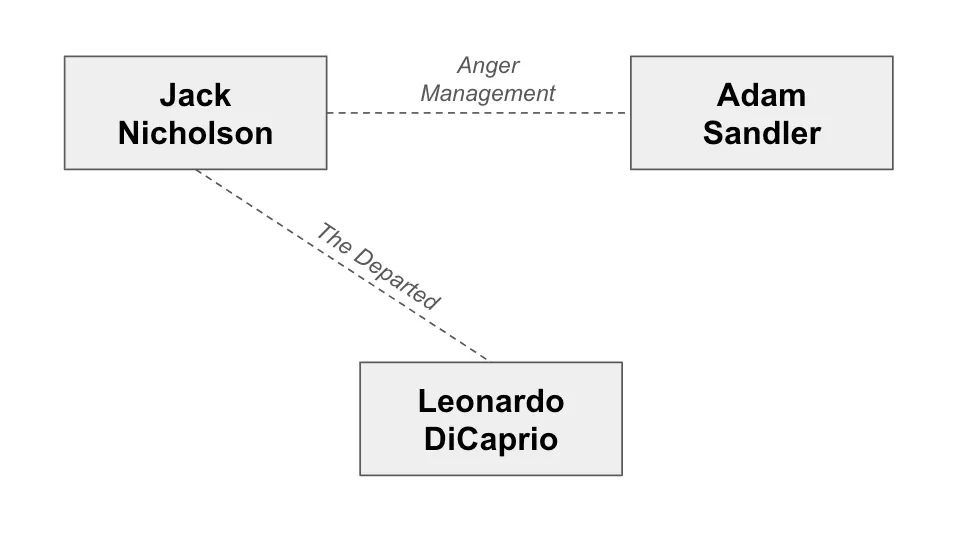
This modeling technique also broadly applies to the film industry, where we can create networks using actors as nodes and movies as edges. Consider the following example graph with Jack Nicholson, Adam Sandler, and Leonardo DiCaprio:
Nicholson and Sandler were in Anger Management together.
DiCaprio and Nicholson were both in The Departed.
The resulting graph looks something like this:
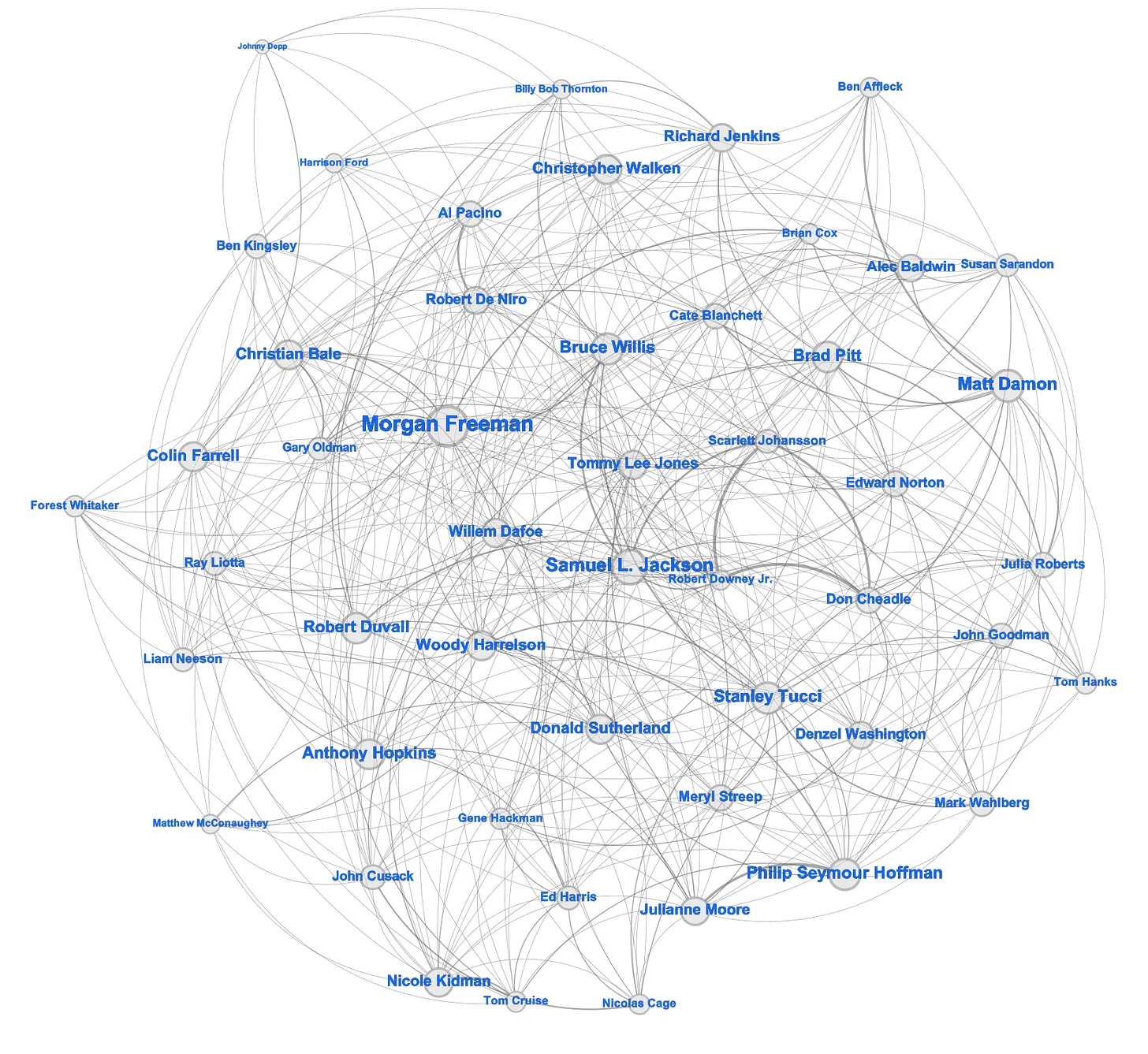
We can build a network featuring every actor in Hollywood and then calculate which figures are most central to the film industry’s casting graph. Below is an example network of the 50 most connected actors in entertainment (to use more than 50 examples would render the visual unreadable). The actors (nodes) that are largest and most central, like Morgan Freeman and Bruce Willis, are ideal fodder for the Kevin Bacon game—a cheat code for connecting disparate careers via extensive movie credits.
An example network of actors connected by co-starring film credits.We’ll use “eigenvector centrality” to measure an actor’s network importance, which considers both direct connections and the influence of second and third-order connections. A higher score means an actor is more central to our casting network.
When we calculate our centrality metric for every actor in the film industry, our top scorers are prolific performers who have appeared in numerous ensemble projects (which is not surprising at all).
«
I won’t spoil the surprise, but see if you can guess who the most connected actor is. (It’s no longer Kevin Bacon, though with all the adverts he’s doing for EE, maybe he could claim still to be. Brm-tish.)
unique link to this extract
How Meta brings in millions off political violence • The Markup
Colin Lecher and Tomas Apodaca:
»
After the attempted assassination of Donald Trump in July, the merchandise started showing up on Facebook.
Trump, fist in the air, face bloodied from a bullet, appeared on everything. Coffee mugs. Hawaiian shirts. Trading cards. Commemorative coins. Heart ornaments. Ads for these products used images captured at the scene by Doug Mills for the New York Times and Evan Vucci for the Associated Press, showing Trump yelling “fight” after the shooting. The Trump campaign itself even offered some gear commemorating his survival.
As the Secret Service drew scrutiny and law enforcement searched for a motive, online advertisers saw a business opportunity in the moment, pumping out Facebook ads to supporters hungry for merch.
In the 10 weeks after the shooting, advertisers paid Meta between $593,000 and $813,000 for political ads that explicitly mentioned the assassination attempt, according to The Markup’s analysis. (Meta provides only estimates of spending and reach for ads in its database.)
Even Facebook itself has acknowledged that polarizing content and misinformation on its platform has incited real-life violence. An analysis by CalMatters and The Markup found that the reverse is also true: real-world violence can sometimes open new revenue opportunities for Meta.
While the spending on assassination ads represents a sliver of Meta’s $100 billion-plus ad revenue, the company also builds its bottom line when tragedies like war and mass shootings occur, in the United States and beyond. After the October 7th attack on Israel last year and the country’s response in Gaza, Meta saw a major increase in dollars spent related to the conflict, according to our review.
«
You could say: oh but Meta isn’t taking a position! But the difference is that in the age of print newspapers, there would have been questions raised before these adverts would get printed; they might even be rejected on the grounds of poor taste, or profiting from political violence – which implicitly normalises it.
unique link to this extract
Reach bosses in drive to increase websites’ story volumes • HoldtheFrontPage
Paul Linford:
»
Bosses at [UK newspaper group] Reach plc have launched a drive to increase story count across its network of regional websites in a bid to boost online traffic.
Company chiefs want to increase article volume in order to boost page views, which have been badly hit by algorithm changes from major referrers such as Google and Facebook.
While there are no individual targets for journalists, reporters on office-based shifts will be expected to generate more stories in order to increase the overall volume of articles on the group’s ‘Live’ newsbrands.
One internal email, seen by HTFP, suggests an average count of eight stories a shift for reporters working in the office, although this would not apply to those who are sent out on stories.
The email, sent by a senior Reach editor, states: “We need to make more of shifts where people are not going out as drivers of volume. In practice, if you’re on a general shift and you’re not on a job, it should be at least eight stories a shift.”
The latest IPSOS traffic figures published by HTFP last week showed a mixed picture for Reach’s leading websites.
While Birmingham Live increased its page views by a third during August compared to the same month in 2023, other big city brands such as the Liverpool Echo, Chronicle Live, Bristol Post and Nottingham Post all saw significant year-on-year decreases.
The overall thinking behind the latest move was set out out in an email from Paul Rowland, editorial director of the Live network, which has also been seen by HTFP.
«
When I finished at The Guardian (ten years ago), I thought I was doing OK if I got three stories written in a day, as much as anything because there were probably only three stories worth writing. Eight is just bonkers. There truly isn’t that much news, especially not at the local level. And this is all going to be AI-driven, until the AIs take it all over.
unique link to this extract
| • Why do social networks drive us a little mad? • Why does angry content seem to dominate what we see? • How much of a role do algorithms play in affecting what we see and do online? • What can we do about it? • Did Facebook have any inkling of what was coming in Myanmar in 2016? Read Social Warming, my latest book, and find answers – and more. |
Errata, corrigenda and ai no corrida: none notified
 The Overspill: when there's more that I want to say