
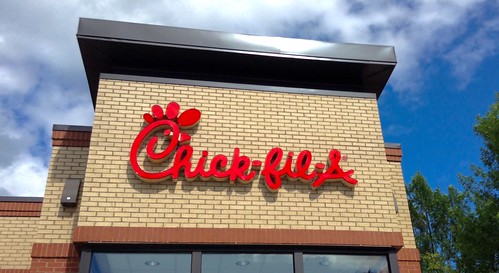
The US streaming services are about to get more crowded with the arrival of.. a fast-food chain? CC-licensed photo by Mike Mozart on Flickr.
You can sign up to receive each day’s Start Up post by email. You’ll need to click a confirmation link, so no spam.
There’s another post coming this week at the Social Warming Substack on Friday at 0845 UK time. Free signup.
A selection of 10 links for you. Spicy! I’m @charlesarthur on Twitter. On Threads: charles_arthur. On Mastodon: https://newsie.social/@charlesarthur. Observations and links welcome.
How the Harris campaign beat Trump at being online • The New Yorker
Kyle Chayka:
»
The Trump team has always drawn many of its ideas from the darker corners of the Internet (for one recent example, see J. D. Vance’s misogynistic obsession with “childless cat ladies”), but the emerging Harris campaign, all of a month old, has found a different kind of traction by embracing the Web’s native formats. Watching its use of popular TikTok sounds—such as Lady Gaga saying during an interview, “No sleep, bus, club, another club . . .” over a montage of Harris-Walz tour stops—feels a bit like hearing parents use their children’s high-school slang.
But it has proved remarkably effective at connecting with the app’s users. According to the Harris-Walz campaign, its TikTok team is made up of five staffers all under the age of twenty-five; the same team had been working for Joe Biden’s reëlection, but the tone since the transition has become strikingly loose.
The campaign has been responsive to what is trending day to day on the platform, creating a kind of call-and-response between itself and Harris fans. In addition to @KamalaHQ, which was renamed from @BidenHQ, the team recently made a personal account for Harris, something that Biden never maintained. Over the weekend, Walz also got his own TikTok account, launching with a very casual video alongside his rescue pooch Scout. Canine friends are a good bet on social media. (Trump, unfortunately, has been reported to suffer from “anti-dog prejudice.”)
«
It’s a really interesting look at how the two campaigns are trying to engage people online. (Also: trust nobody who does not trust dogs.)
unique link to this extract
Why car parks are the hottest space in solar power • BBC News
Chris Baraniuk:
»
There’s more than just cars and empty spaces in this car park. Huge arrays of angled solar panels sit atop jet black steel supports, soaking up the sun and shading the vehicles beneath.
Outside the offices of a major car manufacturer in the south of England, there are now more than 2,000 panels in total with a peak capacity of just under 1 megawatt (MW). That’s enough to power hundreds of homes.
“They are looking stunning,” declares Guy Chilvers, business development manager at SIG, the firm that supplied the solar canopies. These structures make car parks more visually appealing, he insists, while admitting, “I would say that”.
Solar car parks or car ports enable electricity production in open spaces that tend to be positioned conveniently near to energy-guzzling facilities such as hospitals, shopping centres or offices. The canopies have additional benefits in that they protect cars from rain and snow, or hot sun in the summer.
In a drive to boost clean energy production, the French Senate recently approved, external legislation that makes it mandatory for all existing and new car parks with 80 spaces or more to be covered by solar panels.
While there is no equivalent requirement in the UK, solar car parks have been around for years and there are signs that they are beginning to boom here. With electricity prices currently still elevated, many businesses are turning to on-site renewables to try to keep costs down in the long run.
There is a huge opportunity to turn more British car parks into solar farms, according to a new report published by the countryside charity CPRE and the UCL Energy Institute.
«
Chick-Fil-A to launch its own streaming service • Deadline
Peter White:
»
Chick-Fil-A is moving aggressively into the entertainment space with plans to launch a slate of originals for its own streaming platform.
Deadline understands that the fast-food firm has been working with a number of major production companies, including some of the studios, to create family-friendly shows, particularly in the unscripted space. It is also in talks to license and acquire content.
We hear that this includes a family-friendly gameshow from Glassman Media, the company behind NBC’s The Wall, and Michael Sugar’s Sugar23, which is behind series such as Netflix’s 13 Reasons Why. Deadline understands this show has been handed a ten-episode order.
Budgets on the unscripted side are believed to be in the range of $400,000 per half-hour. Sources told us the idea is to launch later this year and there’s also talk of scripted projects and animation.
«
*wearily* Why not. Why the hell not. And Netflix can start a fast food chain. Why not.
unique link to this extract
August was Medium’s first profitable month — ever • TechCrunch
Kyle Wiggers:
»
August was online publishing platform Medium’s first profitable month — ever.
That’s according to Medium CEO Tony Stubblebine, who on Wednesday published a recap of Medium’s recent digital Medium Day 2024 conference. Stubblebine says that Medium had over a million members as of April, and that more members “than ever before” are subscribing to the company’s paid plans. (He didn’t volunteer a figure for that second claim.)
Stubblebine had previously pledged Medium would reach profitability this year.
“There’s a side story about how good engineering has saved us money on our server bills,” Stubblebine writes. “But mostly it was as simple as making something members wanted to subscribe to … Even as we cut other costs to make Medium profitable, we paid the writers more.”
Founded in 2012, Medium hosts a hybrid of blogs, newsletters and other forms of the written word. It’s been accused in the past of being a dumping ground for get-rich-quick scams and listicles. But, as Stubblebine notes in his post, the company has undertaken a number of efforts to improve its overall content mix.
«
Twelve years is a looooong time for a startup to chug along not making money: lucky that Ev Williams (its founder) has an estimated net worth of a couple of billion.
Even so, hard to see it succeeding when Substack exists in the world.
unique link to this extract
San Francisco’s nocturnal taxi ballet • The Atlantic
Charlie Warzel:
»
For the past few nights, I’ve concerned myself with the private lives of autonomous vehicles.
It started when I read a news story about a San Francisco apartment complex whose residents were repeatedly awoken at 4 a.m. by honking self-driving taxis. The building overlooks an open-air parking lot that Waymo recently leased to store its vehicles. In the wee hours of the morning—between ferrying home overserved bar crawlers and picking up commuters during the morning rush hour—dozens of the autonomous white sedans fill the lot, power down, and wait to be summoned.
Sometimes, too many awaken at the same time and back up while trying to make their way to the exit, only to find the lanes clogged by their brethren. Angling for position, the taxis engage in a series of polite reversals and turns that quickly gives way to gridlock. Now hemmed in, the cars begin to negotiate their movements, each one offering a gentle horn honk to signal its presence; before long, they’re producing a symphony of toots, turn signals, and low-speed shuffling.
The spectacle was captured on video by Sophia Tung, an engineer whose home looks down on the lot. She first noticed the Waymos late last month, when they colonized the lot without warning, their ambient beeps and scoots so omnipresent that she heard them in her dreams.
Tung was mesmerized by the cars’ movements. “I found myself just staring at it for 10 minutes at a time, watching these machines figure each other out,” she told me. “It was like watching a fish tank.” Her amusement quickly turned into a side project: Tung set up a webcam and started livestreaming the view from her window, adding some chill music as a soundtrack.
…Waymo eventually caught wind of the stream and released an update to prevent the vehicles from honking.
But they still drive around in the lot.
«
I founded a pioneering tech magazine. Tech killed it off • The Guardian
Michael Antonoff:
»
Sound & Vision once commanded respect. Sony, Netflix, even 60 Minutes all visited the magazine’s 45th floor offices north of Times Square. Apple hand-delivered its first iPod to the magazine to get the opinion of technical editors before the company had even announced the game-changing product. I had the good fortune to jog around the Central Park Reservoir with a thousand tunes in my pocket when people were still carrying cassette players and radios.
Today’s version of the magazine is a far cry from those days. There is just one issue left. AVTech Media Ltd, a British publisher, confirmed to the Guardian on 20 August that it would shutter Sound & Vision’s print edition after the forthcoming October/November issue. The magazine’s website, which has a miniscule editorial budget compared to the print edition, will continue. The hard truth is that digital advertising has failed to live up to the revenue heights of print advertising.
…I majored in magazines at Syracuse’s journalism school. Every magazine I’ve worked for over the decades has joined the dustbin of history; I guess what I really majored in was obituary writing.
«
If you’ve read the book Gone Girl, this will sound really familiar.
unique link to this extract
Story raises $80m at $2.25bn valuation to build a blockchain for the business of content IP in the age of AI • TechCrunch
Ingrid Lunden:
»
AI giants like Anthropic, OpenAI and Stability AI have faced a lot of heat over how they’ve scraped data and rode rough-shod over others’ intellectual property when training and operating their foundational models. Now a startup called Story — which today is announcing $80m in funding — is bidding to rebalance the scales with a blockchain-based platform to help IP owners track usage more effectively.
In the words of CEO and co-founder, S.Y. Lee, the aim is to build a more “sustainable” IP ecosystem fit for the next generation of digital consumers and builders. The startup says its approach is to think of IP like Lego and use blockchain to make that possible. “Anyone can fork and remix your IP permissionlessly while you capture the upside,” Lee said in an interview with TechCrunch.
«
A blockchain-based platform for AI use of IP, eh. It’s like a holy confluence of buzzwords set up to attract venture capitalists. And guess who one of the lead funders is? Yes, crypto boosters a16z.
I don’t think they’re going to see much – if any – return on their $80m.
unique link to this extract
The discovery of “dark electrons” in solid matter • Breeze in Busan
Maru Kim:
»
In a landmark discovery, Professor Geun-Su Kim and his team at Yonsei University have identified the presence of ‘dark electrons’ in solid materials, a finding that has been published in Nature Physics on July 29, 2024. This discovery has significant implications for the field of quantum physics and could provide insights into several unresolved issues, including the mechanisms behind high-temperature superconductivity.
Dark states, where electrons neither absorb nor emit light, were previously thought to be limited to isolated atoms and molecules. The prevailing belief was that such states could not exist within the structured environment of solid materials. However, this new research demonstrates that electrons can indeed exist in dark states within solids, under specific conditions.
The discovery is rooted in the phenomenon of quantum interference.
…This discovery not only challenges existing beliefs about electron behaviour in solid materials but also opens new avenues for research into quantum materials and technologies. Professor Kim and his team believe their findings will provide significant insights into other complex phenomena in physics, such as the secrets of high-temperature superconductors. Understanding and manipulating dark states in solids could lead to advancements in quantum computing and other technologies that rely on precise control of quantum states.
Professor Kim highlighted the broader implications of their findings: “Recognizing the existence of dark electrons in solid materials offers a crucial key to understanding previously inexplicable quantum phenomena.” The research team plans to leverage this discovery to address other enduring mysteries in modern physics, potentially leading to practical applications that could transform various technological fields.
«
Dark matter, dark energy, dark electrons..
unique link to this extract
How accurate are wearable fitness trackers? Less than you might think • The Conversation
Cailbhe Doherty:
»
the quantified self movement still grapples with an important question: can wearable devices truly measure what they claim to?
Along with my colleagues Maximus Baldwin, Alison Keogh, Brian Caulfield and Rob Argent, I recently published an umbrella review (a systematic review of systematic reviews) examining the scientific literature on whether consumer wearable devices can accurately measure metrics like heart rate, aerobic capacity, energy expenditure, sleep and step count.
At a surface level, our results were quite positive. Accepting some error, wearable devices can measure heart rate with an error rate of plus or minus 3%, depending on factors like skin tone, exercise intensity and activity type. They can also accurately measure heart rate variability and show good sensitivity and specificity for detecting arrhythmia, a problem with the rate of a person’s heart beat.
Additionally, they can accurately estimate what’s known as cardiorespiratory fitness, which is how the circulatory and respiratory systems supply oxygen to the muscles during physical activity. This can be quantified by something called VO2Max, which is a measure of how much oxygen your body uses while exercising.
The ability of wearables to accurately measure this is better when those predictions are generated during exercise (rather than at rest). In the realm of physical activity, wearables generally underestimate step counts, by about 9%.
However, discrepancies were larger for energy expenditure (the number of calories you burn when exercising) with error margins ranging from −21.27% to 14.76%, depending on the device used and the activity undertaken.
Results weren’t much better for sleep.
«
The approximately quantified self.
unique link to this extract
Teen builds his own nuclear fusion reactor at college as part of his A* grade in his A-levels • Daily Mail Online
Elizabeth Haigh:
»
A brainy teen successfully built his own nuclear fusion reactor at college and received an A* grade.
Cesare Mencarini, 17, built the reactor to generate neutrons as part of his Extended Project Qualification (EPQ), for which he achieved an A* in his A-Level results today.
Before embarking on his ambitious project, Cesare had to convince his teachers it wasn’t dangerous – and then spent another 18 months making his vision a reality. It is believed to be only nuclear reactor built in a school environment and he showcased his work at the Cambridge Science Festival recently.
He also achieved top grades in maths, further maths, chemistry and physics while studying at Cardiff Sixth Form College in Wales. Cesare plans to work at the Interface and Analysis Centre at the University of Bristol in Gloucestershire for a year before applying for a degree in engineering. He hopes to ‘encourage other young people to develop ideas’ and think about how they ‘can improve our world.’
Current nuclear power stations use nuclear fission, which involves splitting atoms into smaller parts to create energy. But nuclear fusion has been hailed as a potentially planet-saving energy source, as it involves fusing atoms together, which creates a massive amount of energy.
The main problem preventing fusion from being used is the astronomical temperatures required before atoms begin joining together.
Cesare, who is from Italy, said: ‘The college was initially concerned that this project, which I have also used for my EPQ, was dangerous. However we did full risk assessments and the staff have been so supportive. I had to adapt the design to fit in with the budget and my aim is to encourage other young people to develop ideas and think about how we can improve our world and be innovative. The purpose of the reactor is to produce the necessary conditions for fusion to take place.
«
Isn’t it great when the journalist has absolutely no idea what they’re writing about? I think this is actually a neutron generator – first generated in the 1930s.
unique link to this extract
| • Why do social networks drive us a little mad? • Why does angry content seem to dominate what we see? • How much of a role do algorithms play in affecting what we see and do online? • What can we do about it? • Did Facebook have any inkling of what was coming in Myanmar in 2016? Read Social Warming, my latest book, and find answers – and more. |
Errata, corrigenda and ai no corrida: none notified
 The Overspill: when there's more that I want to say