
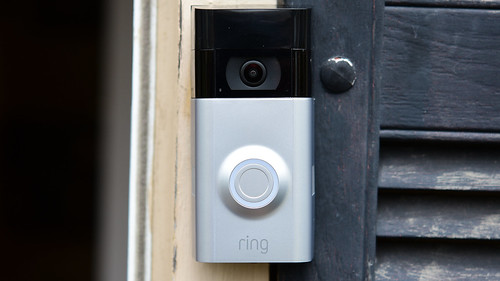
Canvassers in the UK general election are having to cope with the new generation of smart doorbells. CC-licensed photo by slgckgc on Flickr.
You can sign up to receive each day’s Start Up post by email. You’ll need to click a confirmation link, so no spam.
There’s another post coming this week at the Social Warming Substack on Friday at 0845 UK time. Free signup.
A selection of 9 links for you. Go away, I’m in. I’m @charlesarthur on Twitter. On Threads: charles_arthur. On Mastodon: https://newsie.social/@charlesarthur. Observations and links welcome.
Canvassing to empty houses: knocking on doors in the smart doorbell era • The Guardian
Raphael Boyd:
»
Canvassers from all major political parties have been warned about how careful they must be while knocking on doors. One campaign manager went as far as warning staff that they were being recorded at all times, in order to avoid the type of controversy that enveloped a Tory caught removing opposition leaflets from a home in May.
Danny Chambers, a Liberal Democrat candidate in Winchester, said there were benefits to smart doorbells for canvassers, including not just being able to talk to someone when they’re in the next room but when they are 1,000 miles away.
“I knocked on this door a few weeks ago but got no response. I tried their Ring doorbell and the man who lived there answered.” Chambers said he engaged the man in small talk, asking where he was, thinking he was perhaps just in the next room or sitting in his back garden. “He wasn’t even just out of the house, he was out of the country. He was sitting on a beach in Spain. He called his wife over and they both chatted to me for five minutes. They were lovely, and I think I got their vote.”
Chambers has found that the presence of doorbell cameras has also given some candidates a higher chance of knocking on a door they would otherwise have avoided.
“I went round a house but saw anti-canvassing ‘don’t knock here’ signs on the windows so I just left some leaflets. I was nearly out of the gate when the lady who lived there called me back, having seen me on her ring doorbell. Instead of abuse for leaving the leaflets, she asked me why I didn’t want to talk to her, and told me that the no-canvassing signs were to keep Tories away and she was more than happy to chat to me.”
The sense that smart doorbells are opening doors that may otherwise remain closed has been felt across the campaign trail.
«
Terrific piece of journalism, spotting how a piece of technology has changed a social practice that we thought was completely embedded and beyond disruption. (There’s a nice story somewhere of a candidate who carried a brown parcel, pretending they had a delivery, to beat this defence.)
unique link to this extract
This London non-profit is now one of the biggest backers of geoengineering research • MIT Technology Review
James Temple:
»
A London-based nonprofit is poised to become one of the world’s largest financial backers of solar geoengineering research. And it’s just one of a growing number of foundations eager to support scientists exploring whether the world could ease climate change by reflecting away more sunlight.
Quadrature Climate Foundation, established in 2019 and funded through the proceeds of the investment fund Quadrature Capital, plans to provide $40m for work in this field over the next three years, Greg De Temmerman, the organization’s chief science officer, told MIT Technology Review.
That’s a big number for this subject—double what all foundations and wealthy individuals provided from 2008 through 2018 and roughly on par with what the US government has offered to date.
“We think we can have a very strong impact in accelerating research, making sure it’s happening, and trying to unlock some public money at some point,” De Temmerman says.
Other nonprofits are set to provide tens of millions of dollars’ worth of additional grants to solar geoengineering research or related government advocacy work in the coming months and years. The uptick in funding will offer scientists in the controversial field far more support than they’ve enjoyed in the past and allow them to pursue a wider array of lab work, modeling, and potentially even outdoor experiments that could improve our understanding of the benefits and risks of such interventions.
“It just feels like a new world, really different from last year,” says David Keith, a prominent geoengineering researcher and founding faculty director of the Climate Systems Engineering Initiative at the University of Chicago.
«
Another topic where one just wants to keep a weather (haha) eye on what’s happening. We know, in effect, how to reflect more sunlight; the problem is not doing too much, and how to do it in a way that is, if not reversible, then stoppable. But that amount of money won’t pose any risk of villainy, for now.
unique link to this extract
US Surgeon General: social media platforms need a health warning • The New York Times
Vivek Murthy really is the US surgeon general:
»
It is time to require a surgeon general’s warning label on social media platforms, stating that social media is associated with significant mental health harms for adolescents. A surgeon general’s warning label, which requires congressional action, would regularly remind parents and adolescents that social media has not been proved safe. Evidence from tobacco studies show that warning labels can increase awareness and change behavior. When asked if a warning from the surgeon general would prompt them to limit or monitor their children’s social media use, 76% of people in one recent survey of Latino parents said yes.
To be clear, a warning label would not, on its own, make social media safe for young people. The advisory I issued a year ago about social media and young people’s mental health included specific recommendations for policymakers, platforms and the public to make social media safer for kids. Such measures, which already have strong bipartisan support, remain the priority.
Legislation from Congress should shield young people from online harassment, abuse and exploitation and from exposure to extreme violence and sexual content that too often appears in algorithm-driven feeds. The measures should prevent platforms from collecting sensitive data from children and should restrict the use of features like push notifications, autoplay and infinite scroll, which prey on developing brains and contribute to excessive use.
Additionally, companies must be required to share all of their data on health effects with independent scientists and the public — currently they do not — and allow independent safety audits. While the platforms claim they are making their products safer, Americans need more than words. We need proof.
«
That last paragraph there suggests that he’s putting the cart before the horse. The evidence still points in both directions at once: towards it being bad, yet also towards it being good.
Adobe’s hidden cancellation fee is unlawful, FTC suit says • Ars Technica
Ashley Belanger:
»
Adobe prioritized profits while spending years ignoring numerous complaints from users struggling to cancel costly subscriptions without incurring hefty hidden fees, the US Federal Trade Commission (FTC) alleged in a lawsuit Monday.
According to the FTC, Adobe knew that canceling subscriptions was hard but determined that it would hurt revenue to make canceling any easier, so Adobe never changed the “convoluted” process. Even when the FTC launched a probe in 2022 specifically indicating that Adobe’s practices may be illegal, Adobe did nothing to address the alleged harm to consumers, the FTC complaint noted. Adobe also “provides no refunds or only partial refunds to some subscribers who incur charges after an attempted, unsuccessful cancellation.”
Adobe “repeatedly decided against rectifying some of Adobe’s unlawful practices because of the revenue implications,” the FTC alleged, asking a jury to permanently block Adobe from continuing the seemingly deceptive practices.
Dana Rao, Adobe’s general counsel and chief trust officer, provided a statement confirming to Ars that Adobe plans to defend its business practices against the FTC’s claims.
…To lock subscribers into recurring monthly payments, Adobe would typically pre-select by default its most popular “annual paid monthly” plan, the FTC alleged. That subscription option locked users into an annual plan despite paying month to month. If they canceled after a two-week period, they’d owe Adobe an early termination fee (ETF) that costs 50% of their remaining annual subscription. The “material terms” of this fee are hidden during enrollment, the FTC claimed, only appearing in “disclosures that are designed to go unnoticed and that most consumers never see.”
For individual users, accessing Adobe’s suite of apps can cost more than $700 annually, Bloomberg reported. For many users suddenly faced with paying an ETF worth hundreds while losing access to services instantly, the decision to cancel is not as straightforward as it might be without the hidden fee. the FTC alleged.
Because Adobe allegedly only alerted users to the ETF in fine print—by hovering over a small icon or clicking a hyperlink in small text—while the company’s cancellation flows made it hard to end recurring payments, the FTC is suing and accusing Adobe of deceptive practices under the FTC Act.
«
Popcorn time. And of course there will be class action suits to follow, because the FTC isn’t going to dole out recompense to those who have suffered.
unique link to this extract
The Encyclopedia Project, or how to know things in the Age of AI • Public Books
Megan Cummins:
»
It all started with Kung Fu Panda. As the final line of credits crawled up the screen, the kids bounced excitedly on the couch. With their heads full of the impossibilities of talking pandas and dragons common to today’s cartoons, my youngest asked a fair question: “Is kung fu really real?”
“I wanna know the history of kung fu,” the eldest chimed sagely. This was music to my husband’s ears, who was waiting for an entrée to introduce them to martial arts. “Yes, kung fu is real,” he explained. “And it has a long history. Let’s look it up.”
And that’s when our family movie night took a turn toward dystopia.
Our kids aren’t allowed to just look things up online themselves. Like many parents, we guide them through trying to find something trustworthy, so as to avoid online sludge. We have an especially draconian approach to YouTube. We search through multiple layers of proxies, private browsers, and peer sites, so that Google can’t infer who we are or our preferences. So when my husband typed in a few search terms and scrubbed through several clips before settling on one, we had some confidence in our due diligence. It certainly looked like a comprehensive introduction to kung fu.
At first, a male voice droned over a flurry of images. Thirty seconds in, my husband whispered, “I think this text is AI generated.” Fifteen seconds later, I whispered back, puzzled, “I think the voice is AI generated too.” Then, in the foreground, we spotted six fingers on a character.
«
You might be able to guess what happened next. Hard to know how many other families will follow, but it would be quite a revival, on a par with vinyl. Though I don’t know why they didn’t just look up Wikipedia.
unique link to this extract
AI took their jobs. Now they get paid to make it sound human • BBC Future
Thomas Germain:
»
Writer Benjamin Miller – not his real name – was thriving in early 2023. He led a team of more than 60 writers and editors, publishing blog posts and articles to promote a tech company that packages and resells data on everything from real estate to used cars. “It was really engaging work,” Miller says, a chance to flex his creativity and collaborate with experts on a variety of subjects. But one day, Miller’s manager told him about a new project. “They wanted to use AI to cut down on costs,” he says. (Miller signed a non-disclosure agreement, and asked the BBC to withhold his and the company’s name.)
A month later, the business introduced an automated system. Miller’s manager would plug a headline for an article into an online form, an AI model would generate an outline based on that title, and Miller would get an alert on his computer. Instead of coming up with their own ideas, his writers would create articles around those outlines, and Miller would do a final edit before the stories were published. Miller only had a few months to adapt before he got news of a second layer of automation. Going forward, ChatGPT would write the articles in their entirety, and most of his team was fired. The few people remaining were left with an even less creative task: editing ChatGPT’s subpar text to make it sound more human.
By 2024, the company laid off the rest of Miller’s team, and he was alone. “All of a sudden I was just doing everyone’s job,” Miller says. Every day, he’d open the AI-written documents to fix the robot’s formulaic mistakes, churning out the work that used to employ dozens of people.
«
Germain has been busy looking at what AI is doing to writing jobs. And the next…
unique link to this extract
AI detectors get it wrong. Writers are being fired anyway • Gizmodo
Thomas Germain:
»
Kimberly Gasuras doesn’t use AI. “I don’t need it,” she said. “I’ve been a news reporter for 24 years. How do you think I did all that work?” That logic wasn’t enough to save her job.
As a local journalist in Bucyrus, Ohio, Gasuras relies on side hustles to pay the bills. For a while, she made good money on a freelance writing platform called WritersAccess, where she wrote blogs and other content for small and midsize companies. But halfway through 2023, the income plummeted as some clients switched to ChatGPT for their writing needs. It was already a difficult time. Then the email came.
“I only got one warning,” Gasuras said. “I got this message saying they’d flagged my work as AI using a tool called ‘Originality.’” She was dumbfounded. Gasuras wrote back to defend her innocence, but she never got a response. Originality costs money, but Gasuras started running her work through other AI detectors before submitting to make sure she wasn’t getting dinged by mistake. A few months later, WritersAccess kicked her off the platform anyway. “They said my account was suspended due to excessive use of AI. I couldn’t believe it,” Gasuras said. WritersAccess did not respond to a request for comment.
«
The arms race will, of course, have collateral damage. The question is what the scale of that collateral damage is, and we don’t actually have any way of knowing that.
unique link to this extract
What Is ChatGPT Doing … and Why Does It Work? • Stephen Wolfram Writings
Stephen Wolfram excels at explaining complicated topics in comprehensible ways, so if you want to be able to explain it to other mortals, here’s your guide:
»
That ChatGPT can automatically generate something that reads even superficially like human-written text is remarkable, and unexpected. But how does it do it? And why does it work? My purpose here is to give a rough outline of what’s going on inside ChatGPT—and then to explore why it is that it can do so well in producing what we might consider to be meaningful text. I should say at the outset that I’m going to focus on the big picture of what’s going on—and while I’ll mention some engineering details, I won’t get deeply into them. (And the essence of what I’ll say applies just as well to other current “large language models” [LLMs] as to ChatGPT.)
«
Will I need to spend a lot insulating my home to get a heat pump? • The Guardian
Jillian Ambrose:
»
Independent experts argue that households don’t need nearly as much insulation as they might think for a heat pump.
A study of almost 750 UK homes previously referenced in this series by the independent research and technology organisation the Energy Systems Catapult (ESC), found that 85% of homes – from south-east Scotland and Newcastle to south-east England – did not require any extra insulation to have a heat pump successfully installed.
About 15% of properties required some energy efficiency upgrades – but in the majority of cases this was loft insulation, which costs less than £1,000 and can be done with minimal disruption. Only “a few” properties required cavity wall insulation – which carries a cost of about £2,700 – or the replacing of old doors.
This finding is backed up by UK data collected by Heat Geek, a startup that trains specialist heat pump installers and helps to match them with potential customers. From a dataset of more than 100 properties it found that heat pumps were still able to warm uninsulated homes more efficiently than gas boilers.
In one example, a mid-century, mid-terrace house with uninsulated cavity walls recorded a heat pump efficiency score of 4.99 (a score of 3 or above means the device is cheaper to run than a gas boiler). Heat Geek found even a detached home built before 1900 with uninsulated solid walls recorded an efficiency of 4.24. Both homes had loft insulation.
Andrew Sissons, a deputy director at Nesta, a charity which undertakes research into home heating innovation, said: “Insulation is a good thing to do in its own right – but your home doesn’t need to be insulated to get a heat pump.”
A well-insulated home can make heat pumps run more efficiently but it is more important to make sure that the correct size heat pump and radiators are installed, he said.
«
It’s that last bit which makes one squint a bit. Upgrading radiators isn’t cheap. Also, if you live in a flat, where does it draw air from, and where does it sit?
unique link to this extract
| • Why do social networks drive us a little mad? • Why does angry content seem to dominate what we see? • How much of a role do algorithms play in affecting what we see and do online? • What can we do about it? • Did Facebook have any inkling of what was coming in Myanmar in 2016? Read Social Warming, my latest book, and find answers – and more. |
Errata, corrigenda and ai no corrida: none notified
 The Overspill: when there's more that I want to say