
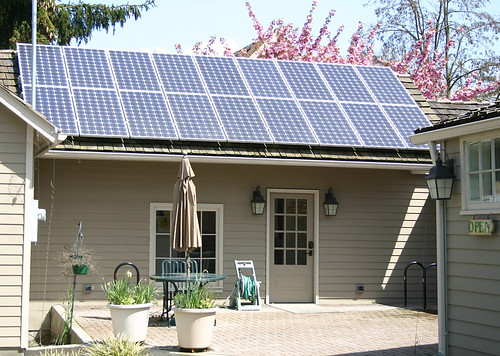
Solar panels can dramatically cut the running costs of a home – but usually, only the well-off can afford them. How do we help those who can’t? CC-licensed photo by Oregon State University on Flickr.
You can sign up to receive each day’s Start Up post by email. You’ll need to click a confirmation link, so no spam.
It’s Friday, so there’s another post due at the Social Warming Substack at about 0845 UK time. It’s about a tricky job where AI started taking over – and made humans better at it, at least for a time.
A selection of 9 links for you. Use them wisely. I’m @charlesarthur on Twitter. On Threads: charles_arthur. On Mastodon: https://newsie.social/@charlesarthur. Observations and links welcome.
Instacart’s AI recipes look literally impossible • 404 Media
Emanuel Maiberg:
»
I hate cookbooks without pictures. We eat with our eyes first, as chefs love to say, but what’s more important to me is that if I’m making a dish for the first time, I want to see what the final product should look like to know I did it right. It’s not so much about presentation as it is about knowing that I browned the chicken skin enough.
An image of a recipe will not be this useful, I think, if it was AI-generated, and especially so if the fact that the image was AI-generated wasn’t disclosed by the recipe. That, to my surprise, is exactly the case with thousands of recipes the grocery delivery service Instacart is suggesting to its users. Some of the recipes include unheard of measurements and ingredients that don’t appear to exist. Business Insider first reported about Instacart’s AI generated recipes in January.
Generally, I try to avoid using Instacart if possible because it treats its workers badly, but I had just come back from the hospital with a newborn and was desperate enough to pay a lot of money to have eggs and some other basics delivered to my doorstep. As I was browsing, I noticed that Instacart was offering me recipes that appeared to complement the ingredients I was looking at.
The concept doesn’t make a ton of sense to me—I’m going to Instacart for the ingredients I know I need for the food I know I’m going to make, not for food inspiration—but I had to click on a recipe for “Watermelon Popsicle with Chocolate Chips” because it looked weird in the thumbnail.
Since I have eyeballs with optical nerves that are connected to a semi-functioning brain I can tell that the image was generated by AI. To be more specific, I can see that the top corner of the plate doesn’t match its square shape, that the table-ish looking thing it’s resting on is made up of jumbled slats (AI is particularly bad at making these series of long, straight lines), and then there are the titular watermelon popsicles, which defy physical reality. They clip into each other like bad 3D models in a video game, one of them to the left appears hollow, and for some reason they are skewered by what appears to be asparagus spears on the bottom end and capped by impossible small watermelon rinds at the top.
«
But also, chocolate chips on watermelon? Instacart juggled around the images once it was found out, but it’s still using AI. Are we really feeding people recipes that AI has dreamed up? Because that doesn’t sound like a good idea.
unique link to this extract
The solar panel theory of socioeconomic unfairness • BusinessGreen
James Murray:
»
In his 1993 novel Men at Arms, the late, great comic writer Terry Pratchett deployed one of his characters to present what was to become a famous economic theory: “A man who could afford fifty dollars had a pair of boots that’d still be keeping his feet dry in ten years’ time, while the poor man who could only afford cheap boots would have spent a hundred dollars on boots in the same time and would still have wet feet. This was the Captain Samuel Vimes ‘Boots’ theory of socioeconomic unfairness.”
A similar phenomenon is at risk of undermining the net zero transition. A solar panel theory of socioeconomic unfairness, if you will.
Solar panels and other clean technologies slash energy and fuel bills for households, while minimising exposure to future energy price hikes and air pollution. A recent analysis from the Energy and Climate Intelligence Unit calculated the average household that improved its energy efficiency, installed solar panels and a heat pump, and switched to an EV would enjoy running costs that were nearly £2,000 a year lower than a household with no clean technologies in place. Which is great, but like Pratchett’s boots you can only access those savings if you can afford to deploy the technologies in the first place. Meanwhile, poorer households spend thousands of pounds more on their energy bills and are still cold.
To make this unfairness worse still, it is lower income households that are most exposed to the higher food and insurance costs that are resulting from worsening climate impacts, not to mention the inherently regressive short term levies imposed on energy bills to help fund the necessary upfront investment in cleaner energy infrastructure that should curb costs in the long term.
Of course, the costs and benefits associated with solar panels are not quite as simple as Pratchett’s expensive boots. When it comes to climate change we really are all in it together. Everyone benefits from improved air quality, reduced fossil gas imports, and lower carbon emissions. But while there are net gains for the economy as a whole, it remains true the financial savings are most immediately apparent for those who can afford to deploy clean technologies relatively early in the transition.
«
There are of course schemes in the UK where a company will install the panels and either take a cut of the feed-in tariff or just treat the installation as a long-term loan; that makes it more affordable. (Also, I don’t think Pratchett invented the idea; “only the rich can afford cheap shoes” has been a saying for a long time.)
unique link to this extract
New York judge rebukes law firm for using ChatGPT to justify its fees • FT
Joe Miller:
»
A New York judge has scolded a law firm for citing ChatGPT to support its application for “excessive” attorneys’ fees of up to $600 an hour.
The Cuddy Law Firm had invoked the predictive artificial intelligence tool in a declaration to the court over a case it won against the city’s education department. It said it had done so “to provide context to what a parent — having ChatGPT-4 open and available to them — might take away in researching whether to hire an attorney and who to accept or reject”.
When asked what would be a “reasonable hourly rate” to expect for an associate attorney with up to three years experience in a hearing over disabilities education, the large language model said it could “range anywhere from $200 to $500 an hour”, an attorney at the firm wrote.
He also pointed out that ChatGPT concluded that “lawyers who specialise in a certain type of law (such as special education law, in this case) may command higher rates” and that an attorney with “25 years of experience” might command an hourly rate of up to $1,200 “or even more”.
Judge Paul Engelmayer, who ultimately cut the fees to be awarded to Cuddy’s lawyers by more than half, called the firm’s reliance on the AI program “utterly and unusually unpersuasive”, adding that “barring a paradigm shift in the reliability of this tool, the [firm] is well advised to excise references to ChatGPT from future fee applications”.
«
I think I might have been inclined to cut their fees to zero for being so unutterably stupid. What is it about American lawyers and ChatGPT?
unique link to this extract
Scientists claim AI breakthrough to generate boundless clean fusion energy • Vice
Mirjam Guesgen:
»
Donut-shaped tokamak reactors rely on magnets to squeeze plasma particles close together and keep them constantly spinning around a ring, creating a lasting fusion reaction. They’re one of the front-runners in designs for a practical fusion reactor. But if there’s one little disruption to the magnetic field lines running through the plasma, the delicate balance keeping it all contained gets out of whack: The plasma escapes the magnets’ clutches and the reaction ends.
Chijin Xiao, a plasma physicist at the University of Saskatchewan who wasn’t involved in the study, explained that these instabilities can lead to catastrophic consequences. “When the plasma stops operating, there are several risks: one is that all the energy stored in the plasma is going to be released as thermal energy and may damage the wall of the reactor,” she said. “More importantly, a sudden change in the [magnetic] current can introduce a great deal of force on the reactor that can really destroy the device.”
Xiao added that one of the biggest tokamak reactors around today, ITER in France, is only designed to withstand a few of these plasma disruptions before the whole machine has to be repaired—a huge expense. The goal is to catch instabilities while they’re small and intervene.
The Princeton lab’s model can predict so-called tearing mode instabilities 300 milliseconds before they happen. It doesn’t sound like a lot of heads-up, but it’s enough time to get the plasma under control, their study shows.
Researchers tested the algorithm on a real reactor, the DIII-D National Fusion Facility in San Diego. They saw that their AI-based system could control the power being pumped into the reactor and the shape of the plasma to keep the swirling particles in check.
Co-author Azarakhsh Jalalvand said in a statement that the success of the AI model comes from the fact that it was trained on real data from previous fusion experiments, rather than theoretical physics models.
“We don’t teach the reinforcement learning model all of the complex physics of a fusion reaction,” Jalalvand said. “We tell it what the goal is—to maintain a high-powered reaction—what to avoid—a tearing mode instability—and the knobs it can turn to achieve those outcomes. Over time, it learns the optimal pathway for achieving the goal of high power while avoiding the punishment of an instability.”
«
*weary voice* hurrah, boundless clean energy is only *checks watch* 20 years away again
unique link to this extract
Scientists are putting ChatGPT brains inside robot bodies. What could possibly go wrong? • Scientific American
David Berreby:
»
Despite all the impressive videos on YouTube of robot warehouse workers, robot dogs, robot nurses and, of course, robot cars, none of those machines operates with anything close to human flexibility and coping ability. “Classical robotics is very brittle because you have to teach the robot a map of the world, but the world is changing all the time,” says Naganand Murty, CEO of Electric Sheep, a company whose landscaping robots must deal with constant changes in weather, terrain and owner preferences. For now, most working robots labor much as their predecessors did a generation ago: in tightly limited environments that let them follow a tightly limited script, doing the same things repeatedly.
…LLMs have what robots lack: access to knowledge about practically everything humans have ever written, from quantum physics to K-pop to defrosting a salmon fillet. In turn, robots have what LLMs lack: physical bodies that can interact with their surroundings, connecting words to reality. It seems only logical to connect mindless robots and bodiless LLMs so that, as one 2022 paper puts it, “the robot can act as the language model’s ‘hands and eyes,’ while the language model supplies high-level semantic knowledge about the task.”
…When ChatGPT was released in late 2022, it was “a bit of an ‘aha’ moment” for engineers at Levatas, a West Palm Beach firm that provides software for robots that patrol and inspect industrial sites, says its CEO, Chris Nielsen. With ChatGPT and Boston Dynamics, the company cobbled together a prototype robot dog that can speak, answer questions and follow instructions given in ordinary spoken English, eliminating the need to teach workers how to use it. “For the average common industrial employee who has no robotic training, we want to give them the natural-language ability to tell the robot to sit down or go back to its dock,” Nielsen says.
Levatas’s LLM-infused robot seems to grasp the meaning of words—and the intent behind them. It “knows” that although Jane says “back up” and Joe says “get back,” they both mean the same thing. Instead of poring over a spreadsheet of data from the machine’s last patrol, a worker can simply ask, “What readings were out of normal range in your last walk?”
«
But, and here is the very big but, should you believe the answer you get?
unique link to this extract
Keep your phone number private with Signal usernames • Signal Blog
Randall Sarafa is Signal’s chief product officer:
»
New default: Your phone number will no longer be visible to everyone in Signal
• If you use Signal, your phone number will no longer be visible to everyone you chat with by default. People who have your number saved in their phone’s contacts will still see your phone number since they already know it.Connect without sharing your phone number
• If you don’t want to hand out your phone number to chat with someone on Signal, you can now create a unique username that you can use instead (you will still need a phone number to sign up for Signal). Note that a username is not the profile name that’s displayed in chats, it’s not a permanent handle, and not visible to the people you are chatting with in Signal. A username is simply a way to initiate contact on Signal without sharing your phone number.Control who can find you on Signal by phone number
• If you don’t want people to be able to find you by searching for your phone number on Signal, you can now enable a new, optional privacy setting. This means that unless people have your exact unique username, they won’t be able to start a conversation, or even know that you have a Signal account – even if they have your phone number.«
This is going to be very welcome, and it’s a smart idea. Giving out your phone number has never felt ideal for an app that’s really very focussed on privacy.
Presently this is in beta, but it’s rolling out over the next few weeks. (In which case.. is that really beta testing?)
unique link to this extract
Analysis: record drop required in China’s CO2 emissions to meet 2025 target • Carbon Brief
Lauri Myllyvirta:
»
China’s energy sector carbon dioxide (CO2) emissions increased 5.2% in 2023, meaning a record fall of 4-6% is needed by 2025 to meet the government’s “carbon intensity” target.
The new analysis for Carbon Brief, based on official figures and commercial data, shows rapid electricity demand growth and weak rains boosted demand for coal power in 2023, while the rebound from zero-Covid boosted demand for oil.
Other key findings from the analysis include:
• China’s CO2 emissions have now increased by 12% between 2020 and 2023, after a highly energy- and carbon-intensive response to the Covid-19 pandemic
• This means CO2 emissions would need to fall by 4-6% by 2025, in order to meet the target of cutting China’s carbon intensity – its CO2 emissions per unit of economic output – by 18% during the 14th five-year plan period
• China is also at risk of missing all of its other key climate targets for 2025, including pledges to “strictly limit” coal demand growth and “strictly control” new coal power capacity, as well as targets for energy intensity, the share of low-carbon energy in overall demand and the share of renewables in energy demand growth
• Government pressure to hit the targets, most of which are in China’s updated international climate pledge under the Paris Agreement, makes it more likely that China’s CO2 emissions will peak before 2025 – far earlier than its target of peaking “before 2030”.«
Come ONNNNN China, come ONNNNN
unique link to this extract
Vice’s new owners prepare to slash what’s left of its work force • The New York Times
Benjamin Mullin:
»
Executives at Vice Media are planning to lay off hundreds of more than 900 employees over the next week, eliminating staff from its digital publishing division, according to three people familiar with the matter.
The cuts will be the latest in a series of severe cutbacks that the company has endured in recent years, winnowing the globe-spanning digital colossus to a husk of its former self. Over the past half-decade, Vice has had near annual layoffs and mounting losses, and has filed for bankruptcy, making it the poster child for the battered digital-media industry.
When Vice emerged from bankruptcy last year, some observers hoped its new owners — a consortium led by the private-equity firm Fortress Investment Group — would reinvest to return the company to growth.
Instead, Fortress has decided to make sweeping cuts, as part of an attempt to stem the endless tide of red ink. The company is planning to inform employees of its new business strategy in the next week.
Vice did not have any immediate comment.The layoffs come amid gale-force headwinds for the entire media industry.
«
Related: Yahoo lays off the leaders of Engadget, dumping 10 staff, while
»
the editorial team will split into two sections: “news and features” and “reviews and buying advice.” The news teams will focus on traffic growth, while the reviews teams will report to commerce leaders.
«
Stick a fork in and raise a glass.
unique link to this extract
Tech newsbrand with ‘optimistic view’ and 20-strong team launches in London • Press Gazette
Dominic Ponsford:
»
A technology news brand is launching in London with a 20-strong team hoping to buck the trend of industry decline over the last 12 months.
Digital Frontier has a nine-strong editorial team producing a website, twice-weekly podcast and daily newsletter. Other staff bring the title’s total headcount to 20.
The independent title plans to make revenue from subscriptions, advertising and events. Its plan is to provide deeply-reported journalism, rather than breaking news, and inform business leaders across various sector who need to understand the impact of disruptive technology.
Digital Frontier launches in a business climate which has seen numerous cutbacks and closures, with around 1,000 news media jobs lost in the UK and USA so far this year. However subscriptions and events have been relatively robust – with advertising being the main problem area for publishers, as evidenced by the recent DMGT results.
Digital Frontier is privately owned with investment from Josh Hewes, the founder and chief executive of Blockspace, who has a background in digital assets and financial services.
“Too much contemporary technology journalism falls into one of two traps: on the one hand a fixation on the trivial and on the other a tendency to pessimism. We want to bring rigour and a dose of optimism to the industry. We believe technology has led a huge improvement to people’s lives over the past century and has the potential to drive an even bigger change over the coming century.”
Digital Frontier said it will target an audience of “future-focused leaders, business decision-makers, entrepreneurs and investors”.
It is mainly targeting a B2B audience, but expects to also attract B2C readers.
«
That’s a pretty big headcount. Watch this space, I guess.
unique link to this extract
| • Why do social networks drive us a little mad? • Why does angry content seem to dominate what we see? • How much of a role do algorithms play in affecting what we see and do online? • What can we do about it? • Did Facebook have any inkling of what was coming in Myanmar in 2016? Read Social Warming, my latest book, and find answers – and more. |
Errata, corrigenda and ai no corrida: none notified
 The Overspill: when there's more that I want to say
And our local NPR station, WAMU, just announced 15 layoffs and the closing of the DCist website as part of a new focus on audio. I’m not sure I’m 100% convinced, particularly as according to the post they had several unfilled positions after staff left earlier this year.
This is on top of the Washington Post gutting its metro section last year. There’s been a real decline in the quality of local news coverage, which is a pity.