
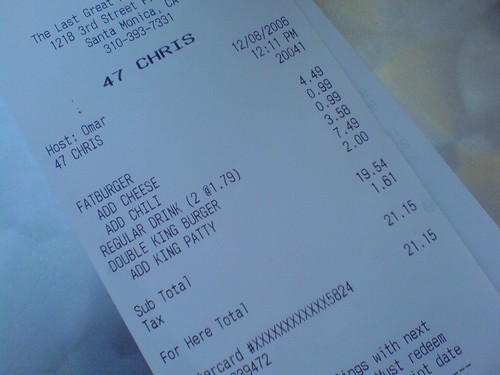
A new bill in California bans “hidden fees” that are added when a bill is totalled. So upfront prices will rise, unsurprisingly. CC-licensed photo by Christian Newton on Flickr.
You can sign up to receive each day’s Start Up post by email. You’ll need to click a confirmation link, so no spam.
It’s Friday, so there’s another post due at the Social Warming Substack at about 0845 UK time. It’s about AI and jobs.
A selection of 10 links for you. Use them wisely. I’m @charlesarthur on Twitter. On Threads: charles_arthur. On Mastodon: https://newsie.social/@charlesarthur. Observations and links welcome.
OpenAI introduces Sora, its text-to-video AI model • The Verge
Emma Roth:
»
OpenAI is launching a new video-generation model, and it’s called Sora. The AI company says Sora “can create realistic and imaginative scenes from text instructions.” The text-to-video model allows users to create photorealistic videos up to a minute long — all based on prompts they’ve written.
Sora is capable of creating “complex scenes with multiple characters, specific types of motion, and accurate details of the subject and background,” according to OpenAI’s introductory blog post. The company also notes that the model can understand how objects “exist in the physical world,” as well as “accurately interpret props and generate compelling characters that express vibrant emotions.”
Prompt: A stylish woman walks down a Tokyo street filled with warm glowing neon and animated city signage. She wears a black leather jacket, a long red dress, and black boots, and carries a black purse. She wears sunglasses and red lipstick. She walks confidently and casually. The street is damp and reflective, creating a mirror effect of the colorful lights. Many pedestrians walk about.The model can also generate a video based on a still image, as well as fill in missing frames on an existing video or extend it. The Sora-generated demos included in OpenAI’s blog post include an aerial scene of California during the gold rush, a video that looks as if it were shot from the inside of a Tokyo train, and others. Many have some telltale signs of AI — like a suspiciously moving floor in a video of a museum — and OpenAI says the model “may struggle with accurately simulating the physics of a complex scene,” but the results are overall pretty impressive.
«
:no_upscale():format(webp)/cdn.vox-cdn.com/uploads/chorus_asset/file/25288007/sora.gif)
This is really amazing. Sam Altman was accepting suggestions on eX-Twitter, and then returning the outputs. Also amazing.
unique link to this extract
How I fell for an Amazon scam call and handed over $50,000 • The Cut
Charlotte Cowles:
»
On a Tuesday evening this past October, I put $50,000 in cash in a shoe box, taped it shut as instructed, and carried it to the sidewalk in front of my apartment, my phone clasped to my ear. “Don’t let anyone hurt me,” I told the man on the line, feeling pathetic.
“You won’t be hurt,” he answered. “Just keep doing exactly as I say.”
Three minutes later, a white Mercedes SUV pulled up to the curb. “The back window will open,” said the man on the phone. “Do not look at the driver or talk to him. Put the box through the window, say ‘thank you,’ and go back inside.”
The man on the phone knew my home address, my Social Security number, the names of my family members, and that my 2-year-old son was playing in our living room. He told me my home was being watched, my laptop had been hacked, and we were in imminent danger. “I can help you, but only if you cooperate,” he said. His first orders: I could not tell anyone about our conversation, not even my spouse, or talk to the police or a lawyer.
Now I know this was all a scam — a cruel and violating one but painfully obvious in retrospect. Here’s what I can’t figure out: Why didn’t I just hang up and call 911? Why didn’t I text my husband, or my brother (a lawyer), or my best friend (also a lawyer), or my parents, or one of the many other people who would have helped me? Why did I hand over all that money — the contents of my savings account, strictly for emergencies — without a bigger fight?
«
Yes, it was a big fat scam. Also: Cowles is the personal finance columnist for NY Mag. Somehow I’m not sure I would follow her personal finance advice that closely after this.
unique link to this extract
Apple confirms iOS 17.4 removes Home Screen web apps in the EU: here’s why • 9to5Mac
Chance Miller:
»
Last week, iPhone users in the European Union noticed that they were no longer able to install and run web apps on their iPhone’s Home Screen in iOS 17.4. Apple has added a number of features over the years to improve support for progressive web apps on iPhone. For example, iOS 16.4 allowed PWAs to deliver push notifications with icon badges.
One change in iOS 17.4 is that the iPhone now supports alternative browser engines in the EU. This allows companies to build browsers that don’t use Apple’s WebKit engine for the first time. Apple says that this change, required by the Digital Markets Act, is why it has been forced to remove Home Screen web apps support in the European Union.
Apple explains that it would have to build an “entirely new integration architecture that does not currently exist in iOS” to address the “complex security and privacy concerns associated with web apps using alternative browser engines.”
This work “was not practical to undertake given the other demands of the DMA and the very low user adoption of Home Screen web apps,” Apple explains. “And so, to comply with the DMA’s requirements, we had to remove the Home Screen web apps feature in the EU.”
«
All the EU’s fault. Well of course it is.
unique link to this extract
The puzzling testimony of Craig Wright, self-styled inventor of bitcoin • WIRED
Condé Nast:
»
Among various acts of alleged forgery, [opposing barrister Jonathan] Hough charged that [Craig] Wright backdated documents to make them seem like precursors to the original 2008 Bitcoin white paper; manipulated email communications in support of his claim to be Nakamoto; inserted material post-factum into his academic papers to imply he conceived of Bitcoin long before its release; and used ChatGPT to help create additional forgeries after experts cast doubt over existing materials. The specific discrepancies identified by Hough included anachronistic use of fonts, metadata that implied computer clocks had been manipulated, internal time stamps that contradicted the outward-facing dating of documents, and more.
Hough gave the appearance of trying to construct an exhaustive catalog of discrete pieces of evidence that, combined, painted a picture of fraud “on an industrial scale,” as he put it in his opening arguments.
In some respects, the cross-examination process was less about Wright’s responses, says Lindsay Gledhill, IP partner at law firm Harper James, and more about the performance of Hough. It was “about the barrister’s grinding, relentless list of detail on detail,” she says.
For every anomaly presented by [opposing client] COPA, Wright supplied an explanation. He claimed, variously, that a printing error had caused a misalignment of pixels that gave the appearance of tampering; the complexity of the IT systems used in the editing and storage of documents was not reflected in the testing conducted by the experts; and that his documents may have been altered by staff members in whose custody they had been left. In instances where Wright agreed that a document was inauthentic, he said he had fallen victim to cybersecurity breaches, had never intended to rely on them to support his claim, or implied that documents had been planted by adversaries to undermine him.
«
The trial continues: there are two weeks more of evidence. It’s a judge, not a jury trial.
unique link to this extract
A new law banning ‘hidden fees’ takes aim at restaurant service charges • Los Angeles Times
Stephanie Breijo:
»
On July 1, Senate Bill 478, which Gov. Gavin Newsom signed into law in October, is set to prohibit “junk fees” across a wide swath of businesses, including online ticket sales, hotels, restaurants, bars and delivery apps.
Sens. Bill Dodd (D-Napa) and Nancy Skinner (D-Berkeley), who co-wrote the bill, say it will offer greater protections for consumers.
“These deceptive fees prevent us from knowing how much we will be charged at the outset,” Atty. Gen. Rob Bonta, who co-sponsored the measure, said in a statement the day it was signed. “They are bad for consumers and bad for competition. … With the signing of SB478, California now has the most effective piece of legislation in the nation to tackle this problem. The price Californians see will be the price they pay.”
Many owners of restaurants and bars rely on now-ubiquitous surcharges to offer employee benefits such as healthcare and higher wages and often note surcharges on menus; some are listed as “elective,” left to the discretion of the diner. As implementation of the law looms, some now say the consequences could be disastrous and “upend” the industry.
The restaurants will need to factor surcharge fees into menu prices, as opposed to simply advertising them at the end of a bill, state officials said.
“At this point, we are going to have to raise our prices a big chunk,” said James Beard Award-winning restaurateur Caroline Styne, co-owner and wine director of the Lucques Group of restaurants and wine director of Hollywood Bowl Food & Wine.
For instance, the famous Ode to Zuni roast chicken with fennel panzanella at A.O.C. is currently priced at $39 and will likely rise to $49 once the law goes into effect, she said.
«
The prices aren’t changing though, are they? It’s just that the charges aren’t being hidden until people come to pay.
unique link to this extract
Pakistani content moderators are exhausted and stuck • Rest of World
Zuha Siddiqui:
»
It was August 2020, Pakistan was under a Covid-19 lockdown, and Asif, who had just graduated with a master’s degree in project management, was struggling to find a job. At the same time, Chinese video-sharing apps like TikTok and Bigo Live were desperately scouting for content moderators in Pakistan. The platforms wanted to hire locally to appease the government, which had accused them of circulating “obscene” and “unlawful” content.
Through LinkedIn, Asif landed a job as a content moderator at Bigo Live. “I didn’t think much of it at the time, because I just wanted a job,” he told Rest of World, requesting a pseudonym because he feared reprisal for breaking a nondisclosure agreement with his employer.
But the stopgap job has now become his career — one he never wanted, and which he is unable to exit despite attempts.
“Everyone who works in this field is there because they have no choice. It’s something you end up in, and then you are just stuck,” said Asif, who moved to Malaysia in April 2023 to work at Accenture, TikTok’s content moderation contractor in South Asia. “No one wants to be a content moderator forever.”
Over a dozen Pakistani professionals who worked in content moderation jobs as a temporary resort due to a lack of employment options told Rest of World they were stuck in a career that was unfulfilling — one that felt like working at a “sweatshop,” because their experience was not transferable. They have degrees in project management, environmental science, engineering, and business administration, and believe that working as content moderators has stunted their careers.
«
The most thankless job; the dead-end career. And no matter how good AI gets, it’s impossible to see it completely wiping out the need for humans to make these decisions.
unique link to this extract
Zoe Schiffer’s ‘Extremely Hardcore’ shows how Elon Musk broke Twitter • The Washington Post
Quinta Jurecic:
»
Musk’s gravitational self-regard tends to collapse all reporting on him into a character study of his whims. Schiffer does her best to escape that orbit, focusing instead on the experiences of the Twitter employees whose lives were almost unilaterally upended by the takeover. Musk is, quite simply, a terrible boss. He makes unreasonable demands, refuses to listen to advice and puts his current and former employees in danger with alarming regularity by unleashing armies of his followers to harass those who cross him. In perhaps the best-known instance, Yoel Roth, who formerly led the company’s now-decimated efforts to make the platform’s users safe from hate speech and harassment, received waves of death threats after Musk outrageously implied that he was sympathetic to paedophiles.
…What matters is money, and Musk has been allowed to acquire enough of it that he appears to be able to do whatever he likes. Even in the instances in “Extremely Hardcore” when Musk is shown being briefly held to account, it’s almost always the influence of money that has led to his comeuppance. His desire to turn Twitter into a playground for the worst parts of human nature has been mitigated only by the squeamishness of advertisers who don’t want their products displayed alongside posts by neo-Nazis. When he was forced to go through with the purchase, it was because of a body of corporate law that privileges the interests of shareholders above all else — an outcome, law professor Ann Lipton has argued, that is “objectively ludicrous” in the case of a platform like Twitter with such “immense social importance.”
Perhaps, then, it shouldn’t be a surprise that so much of Musk’s focus since acquiring the company has been on attacking the few gadflies that remain.
«
Yes but look if he wasn’t doing this he’d be firing space cannons into the atmosphere to try to promote global cooling which would inevitably go wrong even though he’d been told it was a bad idea.
unique link to this extract
NHS nurses being investigated for ‘industrial-scale’ qualifications fraud • The Guardian
Denis Campbell:
»
More than 700 nurses are caught up in a potential scandal, which a former head of the Royal College of Nursing said could put NHS patients at risk.
The scam allegedly involves proxies impersonating nurses and taking a key test in Nigeria, which must be passed for them to become registered and allowed to work in the UK.
“It’s very, very worrying if … there’s an organisation that’s involving themselves in fraudulent activity, enabling nurses to bypass these tests, or if they are using surrogates to do exams for them because the implication is that we end up in the UK with nurses who aren’t competent,” said Peter Carter, the ex-chief executive of the RCN and ex-chair of three NHS trusts, calling it an “industrial-scale fraud”.
He praised the Nursing and Midwifery Council (NMC) for taking action against those involved “to protect the quality of care and patient safety and the reputation of nurses”.
Nurses coming to work in the UK must be properly qualified, given nurses’ role in administering drugs and intravenous infusions and responding to emergencies such as a cardiac arrest, Carter added.
Forty-eight of the nurses are already working as nurses in the NHS because the NMC is unable to rescind their admission to its register, which anyone wanting to work as a nurse or midwife in Britain has to be, unless directed to do so by an independent panel at a hearing. In the meantime, it has told them to retake the test to prove their skills are good enough to meet its standards but cannot suspend them.
The 48 are due to face individual hearings, starting in March, at which they will be asked to explain how they apparently took and passed the computer-based test (CBT) of numeracy and clinical knowledge taken at the Yunnik test centre in the city of Ibadan. At the hearings, a panel may direct the NMC to remove individuals from the register.
«
Along the lines of the HVAC article from earlier this week: junk qualifications in professional spaces. (Thanks Gregory B for the link.)
unique link to this extract
This iOS trojan is harvesting facial-recognition data • PC Mag Australia
Michael Kan:
»
A cybersecurity company has spotted what might be the first iOS Trojan that’s designed to steal facial-recognition data from users.
The iOS malware, dubbed GoldPickaxe, has been targeting users in Thailand and possibly Vietnam, according to Group-IB, a cybersecurity provider based in Singapore.
The malware will harvest biometric data, likely because banks and government agencies in Southeast Asia have been adopting facial-recognition scans to unlock customer access.
“To exploit the stolen biometric data, the threat actor utilizes AI face-swapping services to create deepfakes by replacing their faces with those of the victims,” Group-IB says in the report. “This method could be used by cybercriminals to gain unauthorized access to the victim’s banking account—a new fraud technique, previously unseen by Group-IB researchers.”
(Credit: Group-IB)
The company has so far observed GoldPickaxe disguising itself as Thai government service apps, and then requesting that users take a photo of their ID card and undergo a facial scan.An Android version was also uncovered with even more capabilities. However, the malware isn’t circulating on official app stores. Nor does it exploit any iOS vulnerabilities. Instead, the creators of the malware have been tricking victims into installing the malicious app and then granting all the necessary configurations, including powerful device permissions via Apple’s TestFlight or Mobile Device Management profile system.
«
Apple phone phishing scams getting better • Krebs on Security
Brian Krebs:
»
A new phone-based phishing scam that spoofs Apple Inc. is likely to fool quite a few people. It starts with an automated call that display’s Apple’s logo, address and real phone number, warning about a data breach at the company. The scary part is that if the recipient is an iPhone user who then requests a call back from Apple’s legitimate customer support Web page, the fake call gets indexed in the iPhone’s “recent calls” list as a previous call from the legitimate Apple Support line.
Jody Westby is the CEO of Global Cyber Risk LLC, a security consulting firm based in Washington, D.C. Westby said earlier today she received an automated call on her iPhone warning that multiple servers containing Apple user IDs had been compromised (the same scammers had called her at 4:34 p.m. the day before, but she didn’t answer that call). The message said she needed to call a 1-866 number before doing anything else with her phone.
…KrebsOnSecurity called the number that the scam message asked Westby to contact (866-277-7794). An automated system answered and said I’d reached Apple Support, and that my expected wait time was about one minute and thirty seconds. About a minute later, a man with an Indian accent answered and inquired as to the reason for my call.
Playing the part of someone who had received the scam call, I told him I’d been alerted about a breach at Apple and that I needed to call this number. After asking me to hold for a brief moment, our call was disconnected.
No doubt this is just another scheme to separate the unwary from their personal and financial details, and to extract some kind of payment (for supposed tech support services or some such). But it is remarkable that Apple’s own devices (or AT&T, which sold her the phone) can’t tell the difference between a call from Apple and someone trying to spoof Apple.
«
| • Why do social networks drive us a little mad? • Why does angry content seem to dominate what we see? • How much of a role do algorithms play in affecting what we see and do online? • What can we do about it? • Did Facebook have any inkling of what was coming in Myanmar in 2016? Read Social Warming, my latest book, and find answers – and more. |
Errata, corrigenda and ai no corrida: none notified
 The Overspill: when there's more that I want to say