
Start Up No.2147: how Google Search gets worse, Apple Vision Pro eyes-on, our climate – our fault, California v EVs, and more


The US has discovered Afrobeats music via Spotify, which of course means nobody had ever heard of it before. CC-licensed photo by Rich Anderson on Flickr.

You can sign up to receive each day’s Start Up post by email. You’ll need to click a confirmation link, so no spam.


There’s another post coming this week at the Social Warming Substack on Friday at 0845 UK time. Free signup.


A selection of 9 links for you. Rhythmic harmony. I’m @charlesarthur on Twitter. On Threads: charles_arthur. On Mastodon: https://newsie.social/@charlesarthur. Observations and links welcome.


Google Search really has gotten worse, researchers find • 404 Media

Jason Koebler:

»

Google search really has been taken over by low-quality SEO spam, according to a new, year-long study by German researchers.

The researchers, from Leipzig University, Bauhaus-University Weimar, and the Center for Scalable Data Analytics and Artificial Intelligence, set out to answer the question “Is Google Getting Worse?” by studying search results for 7,392 product-review terms across Google, Bing, and DuckDuckGo over the course of a year. 

They found that, overall, “higher-ranked pages are on average more optimized, more monetized with affiliate marketing, and they show signs of lower text quality …  we find that only a small portion of product reviews on the web uses affiliate marketing, but the majority of all search results do.” 

They also found that spam sites are in a constant war with Google over the rankings, and that spam sites will regularly find ways to game the system, rise to the top of Google’s rankings, and then will be knocked down. “SEO is a constant battle and we see repeated patterns of review spam entering and leaving the results as search engines and SEO engineers take turns adjusting their parameters,” they wrote.

They note that Google, Bing, and DuckDuckGo are regularly tweaking their algorithms and taking down content that is outright spam, but that, overall, this leads only to “a temporary positive effect.”

“Search engines seem to lose the cat-and-mouse game that is SEO spam,” they write. Notably, Google, Bing, and DuckDuckGo all have the same problems, and in many cases, Google performed better than Bing and DuckDuckGo by the researchers’ measures.

«

unique link to this extract


Human ‘behavioural crisis’ at root of climate breakdown, say scientists • The Guardian

Rachel Donald:

»

One month out from Cop28, the world is further than ever from reaching its collective climate goals. At the root of all these problems, according to recent research, is the human “behavioural crisis”, a term coined by an interdisciplinary team of scientists.

“We’ve socially engineered ourselves the way we geoengineered the planet,” says Joseph Merz, lead author of a new paper which proposes that climate breakdown is a symptom of ecological overshoot, which in turn is caused by the deliberate exploitation of human behaviour.

“We need to become mindful of the way we’re being manipulated,” says Merz, who is co-founder of the Merz Institute, an organisation that researches the systemic causes of the climate crisis and how to tackle them.

Merz and colleagues believe that most climate “solutions” proposed so far only tackle symptoms rather than the root cause of the crisis. This, they say, leads to increasing levels of the three “levers” of overshoot: consumption, waste and population.

They claim that unless demand for resources is reduced, many other innovations are just a sticking plaster. “We can deal with climate change and worsen overshoot,” says Merz. “The material footprint of renewable energy is dangerously underdiscussed. These energy farms have to be rebuilt every few decades – they’re not going to solve the bigger problem unless we tackle demand.”

“Overshoot” refers to how many Earths human society is using up to sustain – or grow – itself. Humanity would currently need 1.7 Earths to maintain consumption of resources at a level the planet’s biocapacity can regenerate.

«

unique link to this extract


Will growth in electric cars degrade California roads? • Los Angeles Times

Russ Mitchell:

»

California drivers already rumble across some of the worst pavement in the nation, but the poor condition of the state’s roads and highways could get far worse in coming years as electric cars take over and gasoline cars fade away, according to state analysts.

That’s because money for road repair and maintenance depends on the state’s motor fuel taxes, and that revenue is expected to plunge. Electric vehicles don’t use gasoline, so EV drivers don’t pay the gas tax.

A new report from the Legislative Analyst’s Office warns that loss of state fuel tax revenues could have dire consequences for the upkeep of roadways. Taxes on gasoline and diesel fuel now total about $14.2bn a year. More than $4bn annually could disappear by 2035, when the state’s ban on the sale of new fossil fuel cars takes full effect.

The news comes at a time when the state is wrestling with a $37.9bn budget deficit that has forced cuts to climate programs and other services. The possible solutions outlined in the report are likely to prove unpopular: raise taxes, raise fees or slash spending on road repairs, maintenance and construction.

«

This is the problem that any country or region which imposes fuel taxes faces. The answer is fairly simple – road taxes on vehicles. Possibly mileage-related, but then you have the challenge that some miles are more valuable than others (inside rather than outside cities, for example).
unique link to this extract


A major climate force has been ignored for decades • The Atlantic

Bathsheba Demuth:

»

On a gentle hillside near Toolik [in Alaska] sit three unobtrusive waist-high wire-mesh pens. One pen excludes all voles. The second previously held a large vole population, but now has only a few. The third—in which the duo was now speeding through grasses, mosses, stunted blueberry bushes, and the dozens of other plants that make up the tundra—was stocked with an exorbitant number of voles, caught with live traps on the surrounding hillsides.

…[Populations of] lemmings and voles both pulse and crash in three- to five-year cycles. In Utqiaġvik, a community 250 miles northwest of Toolik [in Alaska], Iñupiat Elders remember years so thick with lemmings that people had to actively avoid stepping on them. In other years, [the research group] Team Vole barely sees a single animal.

The pen with the multitude of voles simulates a boom year. Even at a glance, the tundra inside the pen was transformed: the sedges pruned, the moss trampled, the blueberries nibbled. Here and there along their runways, the voles have piled sedge clippings six or eight inches high; the conical heaps provide food and shelter through the winter. One runway dead-ends in a trampled oval, vole droppings mounded in the middle. The overall effect is a kind of ramshackle coherence. Look close enough, and the tundra suddenly appears built. And not just on a small scale: Scandinavian researchers have tracked Arctic mammals’ transformation of the landscape in satellite images.

All of that construction alters the way that nutrients cycle through the ecosystem, which changes the tundra’s relationship to carbon. Voles cut plants when they’re green and nutrient-rich, so their hay piles are full of nitrogen and phosphorus that the plants would otherwise pull into their roots at the end of the growing season. Hay piles and latrines are basically tiny fertilizer depots. In boom years, they lace the soil with nutrients, allowing microbes to flourish. As the microbes digest, they respire the carbon stored in dead leaves and stems into the atmosphere. A reduced canopy of plants means there are fewer leaves to convert atmospheric carbon into tissue through photosynthesis. It might further boost decomposition by giving soils a hit of sun. In aggregate, Team Vole believes, a high vole year could make the tundra breathe out carbon.

«

unique link to this extract


Apple Vision Pro hands-on, again, for the first time • The Verge

Victoria Song get her first try of Apple’s don’t-call-it-VR system:

»

The virtual world inside the Vision Pro feels like a higher-resolution version of what Meta is trying to accomplish with the Quest but with a vastly more powerful M2-based computer to use inside. It’s neat that I can throw an app over to my upper right so I can look up at the ceiling and view photos if I want. It’s fun to rip the tires off an AR Alfa Romeo F1 car in JigSpace. There is a certain novelty to opening up the Disney Plus app to watch a Star Wars trailer in a virtual environment that looks like Tatooine. I did, in fact, flinch when a T. rex made eye contact with me. A virtual environment of the Haleakalā volcano surprised me because the texture of the rocks looked quite lifelike. This is all familiar stuff. It’s just done well, and done with no lag whatsoever.

Apple had us bring some of our own spatial videos and panoramic photos to look at inside the Vision Pro, and the effect was convincing, although it works best when the camera is held still.

…I spent a half-hour like a kid gawping at an alien planet — even though I’d never left the couch. But by the end of my demo, I started to feel the weight of the headset bring me back to the real world. I’d been furrowing my brow, concentrating so hard, I felt the beginnings of a mild headache. That tension dissipated as soon as I took the headset off, but walking back out into Manhattan, I kept replaying the demo over in my head. I know what I just saw. I’m just still trying to see where it fits in the real world.

«

Of note is that Song was trying the headset with the back strap only, not the back-and-over-the-top strap Apple is also putting in the box. That could partly explain why she felt the weight of the headset. But it’s clear that Apple will have to reduce the weight in the next version, probably by removing the screen on the front, which is overspecified for what it needs to do (communicate to the rest of the world what state the wearer is in).
unique link to this extract


Apple previews new entertainment experiences launching with Apple Vision Pro • Apple

»

Apple today announced a series of groundbreaking entertainment experiences that will be available on Apple Vision Pro beginning Friday, February 2. With more pixels than a 4K TV for each eye, combined with an advanced Spatial Audio system, Vision Pro enables users to watch new shows and films from top streaming services including Apple Originals from Apple TV+, transport themselves to stunning landscapes with Environments, and enjoy all-new spatial experiences that were never possible before, like Encounter Dinosaurs.

“Apple Vision Pro is the ultimate entertainment device,” said Greg Joswiak, Apple’s senior vice president of Worldwide Marketing. “Users can turn any place into the best seat in the house, enjoy personal concerts and adventures with Apple Immersive Video, interact with lifelike prehistoric creatures in Encounter Dinosaurs, and even land on the surface of the moon using Environments. It’s unlike anything users have ever seen before and we can’t wait for them to experience it for themselves.”

…The viewing experience on Apple Vision Pro is unparalleled: When a user begins watching a video, the lights around them automatically dim as the content moves closer to them. Videos can be positioned anywhere in their space or placed in an Environment for the most cinematic experience. With Environments, users can scale videos beyond the dimensions of their room, so the screen feels 100 feet wide, all while preserving the frame rate and aspect ratio. And there is no need for a remote: Users simply invoke controls with their eyes, hands, or voice.

«

I’m quoting directly from the press release to point out what Apple leans on as an expectation for the Vision Pro: entertainment. There’s a partnership with Disney and an emphasis on sports and 3D movies. No mention of sports using immersive video, but that’s sure to come; this is rolling the pitch.
unique link to this extract


Why landing on the moon is proving more difficult today than 50 years ago • The Guardian

Ian Sample:

»

While China and India have both placed robotic landers on the moon, Russia’s Luna 25 crash-landed last year, nearly 60 years after the Soviet Union’s Luna 9 nailed the first gentle touchdown. Landers built by private companies have a 100% failure record on the moon: the Israeli Beresheet lander crashed in 2019, while a Japanese lander built by ispace crashed last year. Peregrine makes it three out of three losses.

One fundamental challenge, says Jan Wörner, a former director general of the European Space Agency (Esa), is weight. “You are always close to failure because you have to be light or the spacecraft will not fly. You cannot have a big safety margin.”

Added to that, almost every spacecraft is a prototype. Apart from rare cases, such as the Galileo communications satellites, spacecraft are bespoke machines. They are not mass produced with the same tried and tested systems and designs. And once they are deployed in space, they are on their own. “If you have trouble with your car, you can have it repaired, but in space there’s no opportunity,” says Wörner. “Space is a different dimension.”

The moon itself presents its own problems. There is gravity – one-sixth as strong as on Earth – but no atmosphere. Unlike Mars, where spacecraft can fly to their destination and brake with parachutes, moon landings depend entirely on engines. If you have a single engine, as smaller probes tend to, it must be steerable, because there is no other way to control the descent.

To complicate matters, the engine must have a throttle, allowing the thrust to be dialled up and down. “Usually you ignite them and they provide a steady state thrust,” says Nico Dettmann, Esa’s lunar exploration group leader. “To change the thrust during operations adds a lot more complexity.”

And yet, with the first lunar landings back in the 60s, it can be hard to grasp why the moon remains such a tough destination. Moon mission records provide a clue: soon after the Apollo programme, lunar landers fell out of favour.

«

Related, and interesting, from last July: guess what percentage of Americans in 1969 thought landing on the moon was a worthwhile endeavour. 10%? 33%? 50%? 66%? 90%? Have a think before you read.
unique link to this extract


How Spotify helped Afrobeats go global • Rest of World

Damilare Dosunmu:

»

Afrobeats has become one of the most popular music genres globally over the past few years. Several artists have sold out big arenas — including stadiums — in the US, the UK, and Europe. There has also been a rise in collaborations between Afrobeats artists and Western pop stars. Much of this success is due to the growth of digital music-streaming platforms, especially Spotify.

Between 2017 and 2022, there was a 550% increase in the number of times Afrobeats songs were streamed on Spotify, according to data released by the company. In 2023 alone, Afrobeats was streamed more than 14 billion times on the app, with London, Paris, and Nairobi ranking among the top five cities.

“[Spotify] has been the largest bridge to connect African talent with the world, and they’ve also been the largest metric for communicating the success and growth of Afrobeats to the rest of the world,” Jude Abaga, rapper and former CEO of Chocolate City, one of Nigeria’s biggest record labels, told Rest of World. People use Spotify’s metrics to define the success of their music and that of the entire industry, he said.

The success of Afrobeats on Spotify is the result of years of on-the-ground work that the company has done in Nigeria, including hiring local staff, according to Nigerian pop culture analyst and consultant Ayomide Tayo. “Spotify has boots on the ground [and] don’t have a standoffish approach,” Tayo told Rest of World. “It doesn’t feel like you are talking to somebody from Berlin, New York, or London. They’ve made Nigerian hires of people with authority, prestige, [and] influence. They’ve also shown that they’re ready to put their money where their mouth is.”

«

My impression is that Afrobeats has always had strong presence in the UK because of – admit it – the colonial past. So maybe this breakthrough is more about the US, where there perhaps hasn’t been much since Paul Simon’s “Graceland” in 1986.
unique link to this extract


Red Ventures explores sale of CNET • Axios

Sara Fischer:

»

Red Ventures, the digital media and marketing juggernaut based in Fort Mill, South Carolina, has approached strategic buyers about offloading tech news and reviews site CNET, five sources familiar with the effort told Axios.

Why it matters: Red Ventures acquired CNET, along with a few smaller websites, from ViacomCBS, now Paramount Global, in 2020 for $500m. It’s hoping to get at least half of that for CNET alone.

…Red Ventures acquired CNET six months into the pandemic when the digital media ecosystem was reeling from pullbacks in advertising and affiliate commerce revenue.

The private equity-backed firm took on debt to fund the deal. (Red Ventures has in the past used debt to facilitate major deals, such as its 2017 acquisition of Bankrate and its 2019 acquisition of HigherEducation.com.)

It hoped to grow CNET’s business by integrating it into the revenue engine that it uses to fuel its other assets, including Bankrate, The Points Guy, and more. (As part of that effort, it redesigned CNET in 2022 and announced expansions to its editorial coverage and commerce opportunities.)

«

The graph attached to the story tells its own tale: monthly global unique visitors to CNet (according to Similarweb) have dropped from about 130m in December 2018 to 36.7m in December 2023. CNet is a husk, especially since it screwed up on AI-generated “news” and dumped 10% of its staff.

Just like The Messenger, CNet isn’t going to please the ventures capitalists. Who’d pay $250m for 36m monthly users, monetisation potential unknown?
unique link to this extract


• Why do social networks drive us a little mad?
• Why does angry content seem to dominate what we see?
• How much of a role do algorithms play in affecting what we see and do online?
• What can we do about it?
• Did Facebook have any inkling of what was coming in Myanmar in 2016?

Read Social Warming, my latest book, and find answers – and more.


Errata, corrigenda and ai no corrida: none notified

Start Up No.2146: the political climate activist, could solar farms affect weather?, Apple Watch to cut oxygen monitor, and more


If you’re a proper audiophile, vinyl is essential. For one man, so was remodelling his house at huge cost. CC-licensed photo by Steve Cadman on Flickr.

You can sign up to receive each day’s Start Up post by email. You’ll need to click a confirmation link, so no spam.


There’s another post coming this week at the Social Warming Substack on Friday at 0845 UK time. Free signup.


A selection of 10 links for you. Time to turn over. I’m @charlesarthur on Twitter. On Threads: charles_arthur. On Mastodon: https://newsie.social/@charlesarthur. Observations and links welcome.


How this climate activist justifies political violence • The New York Times

David Marchese:

»

With the 2021 publication of his unsettling book, “How to Blow Up a Pipeline,” Andreas Malm established himself as a leading thinker of climate radicalism. The provocatively titled manifesto, which, to be clear, does not actually provide instructions for destroying anything, functioned both as a question — why has climate activism remained so steadfastly peaceful in the face of minimal results? — and as a call for the escalation of protest tactics like sabotage. The book found an audience far beyond that of texts typically published by relatively obscure Marxist-influenced Swedish academics, earning thoughtful coverage in The New Yorker, The Economist, The Nation, The New Republic and a host of other decidedly nonradical publications, including this one. (In another sign of the book’s presumed popular appeal, it was even adapted into a well-reviewed movie thriller.) Malm’s follow-up, “Overshoot: How the World Surrendered to Climate Breakdown,” written with Wim Carton and scheduled to be published this year, examines the all-consuming pursuit of fossil-fuel profits and what the authors identify as the highly dubious and hugely dangerous new justifications for that pursuit. But, says Malm, who is 46, “the hope is that humanity is not going to let everything go down the drain without putting up a fight.”

NYT: It’s hard for me to think of a realm outside of climate where mainstream publications would be engaging with someone, like you, who advocates political violence. [NYT note: Just to be explicit about this: Malm does not endorse or advocate any political violence that targets people. His aim is violence against property.] Why are people open to this conversation?

AM: If you know something about the climate crisis, this means that you are aware of the desperation that people feel. It is quite likely that you feel it yourself. With this desperation comes an openness to the idea that what we’ve done so far isn’t enough. But the logic of the situation fundamentally drives this conversation: all attempts to rein in this problem have failed miserably. Which means that, virtually by definition, we have to try something more than we’ve tried.

«

The British SF writer John Brunner imagined eco-terrorists in his book The Sheep Look Up (1972); the SF writer Kim Stanley Robinson imagined UN-slush-money-funded eco-terrorists in his book Ministry For The Future (2020). There’s an undercurrent there which wants something to happen. At some point, people won’t stop at blocking roads.
unique link to this extract


Gigantic solar farms of the future might impact how much solar power can be generated on the other side of the world • The Conversation

Zhengyao Lu and Jingchao Long:

»

In our recent study, we used a computer program to model the Earth system and simulate how hypothetical enormous solar farms covering 20% of the Sahara would affect solar power generation around the world.

A photovoltaic (PV) solar panel is dark-coloured and so absorbs much more heat than reflective desert sand. Although a fraction of the energy is converted to electricity, much of it still heats up the panel. And when you have millions of these panels grouped together, the whole area warms up. If those solar panels were in the Sahara, our simulations show this new heat source would rearrange global climate patterns, shifting rainfall away from the tropics and leading to the desert becoming greener again, much as it was just 5,000 or so years ago.

This would in turn affect patterns of cloud cover and how much solar energy could be generated around the world. Regions that would become cloudier and less able to generate solar power include the Middle East, southern Europe, India, eastern China, Australia, and the US south-west. Areas that would generate more solar include Central and South America, the Caribbean, central and eastern US, Scandinavia and South Africa.

Something similar happened when we simulated the effects of huge solar farms in other hotspots in Central Asia, Australia, south-western US and north-western China – each led to climate changes elsewhere. For instance, huge solar farms covering much of the Australian outback would make it sunnier in South Africa, but cloudier in the UK, particularly during summer.

«

This could trigger NIMBYism on a global scale. Can Britons object to solar farms in Australia?
unique link to this extract


Americans can no longer afford their cars • Newsweek

Giulia Carbonaro:

»

Both new and used car prices rose to record highs during the pandemic, as the car industry was experiencing supply chain disruptions and chip shortages. Since 2020, new car prices have risen by 30%, according to data shared by AI car shopping app CoPilot with Newsweek. Within the same timeframe, used car prices have jumped by 38%.

In 2023—a year during which inflation slowed down to the point that the Federal Reserve decided to stop hiking rates—new car prices rose by 1% to an average of $50,364, while used car prices fell by only 2% to an average of $31,030.

But as things stand, cars are still really expensive for many Americans. Just 10% of new car listings are currently priced below $30,000, according to CoPilot. Things are not much better in the used car market, where only 28% of listings are currently priced below $20,000.

According to an October report by Market Watch, Americans needed an annual income of at least $100,000 to afford a car, at least if they’re following standard budgeting advice, which says you shouldn’t spend more than 10% of your monthly income on car-related expenses.

That means that more than 60% of American households currently cannot afford to buy a new car, based on Census data. For individuals, the numbers are even worse, with 82% of people below the $100,000 line.

«

That probably explains why the average age of cars in the US is over 12 years, and has been rising for the past five years: people aren’t changing their car. The headline is wrong. Americans can afford their cars. They just can’t afford to change them.
unique link to this extract


Apple Watch’s blood-oxygen sensor to be removed to avoid US ban • WSJ

Aaron Tilley:

»

The US Customs and Border Protection agency, which is responsible for enforcing import bans, on Friday approved technical changes to the watches, including the removal of the blood-oxygen sensor, according to a Masimo filing on Monday. A decision on Apple’s request for a permanent stay on the US ban during its appeal is expected in the coming days.

An Apple spokeswoman said that the blood-oxygen feature would continue to be available on the watches for now.

If the US Court of Appeals doesn’t grant a permanent stay while Apple tries to revoke the US trade ban, the removal of the blood-oxygen feature would be implemented. But if the stay is granted, removal of the feature won’t be necessary during the appeals process.

The appeals process is expected to take a year or more, an Apple spokeswoman said.

Masimo alleged in a 2021 complaint that Apple had stolen technology related to the blood-oxygen technology in some versions of its watch, including the Series 9 and Ultra 2. Apple has included a sensor, called a pulse oximeter, in most new models of the Apple Watch since 2020.

«

Most likely way to “remove” the pulse oximeter: software update that disables it. That would have to be applied to watches before sale, given that already-sold watches are clear of the injunction – aren’t they?
unique link to this extract


Beeper Mini users find their Macs are banned from iMessage • Apple Insider

Malcolm Owen:

»

Beeper mini users who used their hardware to register their app with Apple’s iMessage network may find their Mac blocked from the service instead, in what could be retaliation against the use of the controversial messaging app.

Following a cat-and-mouse race between Beeper and Apple to get around Apple’s security and allow Android device users to post to the iMessage network, it seems that some are finding out that they’ve got bigger problems with their own overall access to iMessage.

In December, one of the last fixes for access offered by Beeper was a method of using a real Mac to connect to iMessage, and use that registration with Beeper Cloud and Beeper mini. The logic worked, with the genuine registration data sourced from the user’s own hardware, or a Mac they had access to, allowing access.

However, not all is rosy for users, if the Beeper subreddit is to be believed. A number of posts claim that Apple is banning Macs from being able to make iMessage posts at all.

Pretty surely not “retaliation” but “loophole-closing”. This should be the final, last, ultimate coda on Beeper, may it please the gods. At least until the US Congress starts issuing subpoenas.
unique link to this extract


The fight to control the headset market will intensify • The Economist

Tom Wainwright:

»

Google may re-enter the headset race. A decade ago it launched camera-toting smart specs called Google Glass, which flopped. Plans for high-tech glasses called Iris seem to have gone the same way. Its latest gambit is a partnership with Samsung, a South Korean giant, and Qualcomm, an American chipmaker. The three are working on a mixed-reality project which may produce a headset.

Smaller firms are creating their own niches. Valve, an American video-game company, makes vr headsets for gamers, as does Pico, a Chinese-owned vr firm. Pico’s parent company, Bytedance, also owns TikTok, an app that has aroused suspicion in America—a situation that might make it hard to sell a device that tracks your eyeballs.

Don’t expect any headset to take the world by storm just yet. Worldwide sales of video headgear will grow by a third in 2024, but will still total only 18m units, forecasts Omdia, a market-research company.

(Smartphone sales will exceed 1bn.) Apple’s Vision Pro will probably sell fewer than 200,000 units, because of supply constraints on components, as well as the price tag. It “will be a hit with developers in 2024 and then consumers in 2025”, predicts Dan Ives of Wedbush Securities, an investment company.

The thing to watch in 2024 is what those developers find to do with the device. Smartphones took off only after the launch of apps that turned internet-connected phones from novelties into vital everyday tools. Headsets, used mostly for gaming, still lack compelling use cases for most people. But as programmers begin to play around with the Vision Pro, that could change.

«

People who haven’t used the Vision Pro think it might be fun for Mac-style apps. Developers who have used the Vision Pro suggest thinking of something like an iPad app but viewed on a TV-sized interface. To me, that implies entertainment, moving content, that sort of thing.
unique link to this extract


After US tech layoffs, Indian workers went home to a worse job market • Rest of World

Sanghamitra Kar P:

»

Deepak had been working at Amazon India for six years when he was offered an opportunity for an internal transfer to the company’s headquarters in Seattle. In June 2022, he moved to the US with his wife to live the American dream on a company-sponsored L-1 visa, and a $160,000 paycheck, including stocks. But just seven months later, Deepak was among the 18,000 employees who were let go due to an “uncertain economy” in the largest job cut in Amazon’s history.

Deepak, who asked to be identified by a pseudonym to protect his future employment prospects, told Rest of World he had no option but to return to India immediately because his US visa was linked to his job. Back home, he struggled to find a job for two months. The biggest hurdle was his previous salary, which made him unaffordable for most tech employers in India. “I would tell [Indian] HR that I have no expectations and I am open to negotiations,” he said. 

In March 2023, Deepak finally started a job where his salary is less than a fourth of what he had earned in the US — and doesn’t even match up to what his peers make in India. “I am now getting close to 30 lakh rupees [approximately $36,000] per annum while my peers get around 35–40 lakh rupees.”

Many Indian techies like Deepak, who worked in critical roles across companies such as Amazon, Microsoft, Google, and Meta in the US and Canada, have been forced to move back home over the past year following widespread layoffs. They have returned at a time when Indian companies are also laying off employees, and told Rest of World they have been struggling to navigate the tepid job market.

«

unique link to this extract


Lazy use of AI leads to Amazon products called “I cannot fulfill that request” • Ars Technica

Kyle Orland:

»

Amazon users are at this point used to search results filled with products that are fraudulent, scams, or quite literally garbage. These days, though, they also may have to pick through obviously shady products, with names like “I’m sorry but I cannot fulfill this request it goes against OpenAI use policy.”

As of press time, some version of that telltale OpenAI error message appears in Amazon products ranging from lawn chairs to office furniture to Chinese religious tracts (Update: links in the story now go to archived copies, as the originals were taken down shortly after publication). A few similarly named products that were available as of this morning have been taken down as word of the listings spreads across social media (one such example is archived here).

Other Amazon product names don’t mention OpenAI specifically but feature apparent AI-related error messages, such as “Sorry but I can’t generate a response to that request” or “Sorry but I can’t provide the information you’re looking for,” (available in a variety of colors). Sometimes, the product names even highlight the specific reason why the apparent AI-generation request failed, noting that OpenAI can’t provide content that “requires using trademarked brand names” or “promotes a specific religious institution” or, in one case, “encourage unethical behavior.”

«

There’s a product pictured in the story whose function I can’t quite figure out. The text itself doesn’t help either because it’s all ChatGPT refusing to help the user – who, one guesses, didn’t speak English and so didn’t know what the response actually meant. (Rather like this Welsh road sign.)

unique link to this extract


Ken Fritz built a $1 million stereo. The real cost was unfathomable • Washington Post

Geoff Edgers:

»

Ken Fritz was years into his quest to build the world’s greatest stereo when he realized it would take more than just gear.

It would take more than the Krell amplifiers and the Ampex reel-to-reel. More than the trio of 10-foot speakers he envisioned crafting by hand.

And it would take more than what would come to be the crown jewel of his entire system: the $50,000 custom record player, his “Frankentable,” nestled in a 1,500-pound base designed to thwart any needle-jarring vibrations and equipped with three different tone arms, each calibrated to coax a different sound from the same slab of vinyl.

“If I play jazz, maybe that cartridge might bloom a little more than the other two,” Fritz explained to me. “On classical, maybe this one.”

No, building the world’s greatest stereo would mean transforming the very space that surrounded it — and the lives of the people who dwelt there.

The faded photos tell the story of how the Fritz family helped him turn the living room of their modest split-level ranch on Hybla Road in Richmond’s North Chesterfield neighborhood into something of a concert hall — an environment precisely engineered for the one-of-a-kind acoustic majesty he craved. In one snapshot, his three daughters hold up new siding for their expanding home. In another, his two boys pose next to the massive speaker shells. There’s the man of the house himself, a compact guy with slicked-back hair and a thin goatee, on the floor making adjustments to the system. He later estimated he spent $1 million on his mission, a number that did not begin to reflect the wear and tear on the household, the hidden costs of his children’s unpaid labor.

«

You read these piece and always wonder: can the music possibly live up to their expectations?
unique link to this extract


Federal Trade Commission sanctions location data broker X-Mode • The Markup

Jon Keegan:

»

The location data broker X-Mode has agreed not to share sensitive location data as part of a settlement with the Federal Trade Commission, which had accused the company of selling information that potentially revealed people’s visits to medical facilities, houses of worship, and businesses catering to LGTBQ+ communities. 

The settlement, which was announced this week, also requires X-Mode to honor opt-out requests from consumers and more clearly disclose the collection and use of location data. The FTC had accused X-Mode of collecting identifiers and location data even after users had explicitly opted out. 

X-Mode was rebranded as Outlogic as part of a 2021 acquisition.

The FTC action follows a 2022 Markup story listing 107 third-party apps from which X-Mode was collecting location data, including LGBTQ+ dating apps. The Markup also revealed that X-Mode was one of about a dozen location data companies that purchased precise location data from family tracking app Life360, which limited the sale of such data after our reporting.

«

From the FTC settlement:

»

For at least one contract, X-Mode provided a private clinical research company information for marketing and advertising purposes about consumers who had visited certain internal medical facilities and then pharmacies or specialty infusion centers within a certain radius in the Columbus, Ohio area.

«

unique link to this extract


• Why do social networks drive us a little mad?
• Why does angry content seem to dominate what we see?
• How much of a role do algorithms play in affecting what we see and do online?
• What can we do about it?
• Did Facebook have any inkling of what was coming in Myanmar in 2016?

Read Social Warming, my latest book, and find answers – and more.


Errata, corrigenda and ai no corrida: none notified

Start Up No.2145: preventing another Horizon, pricing EV charging, podcasting’s cash crunch, eBay pays $3m fine, and more


An AI system can apparently identify whether separate fingerprints come from the same person. CC-licensed photo by jakub on Flickr.

You can sign up to receive each day’s Start Up post by email. You’ll need to click a confirmation link, so no spam.

A selection of 10 links for you. Just pointing it out. I’m @charlesarthur on Twitter. On Threads: charles_arthur. On Mastodon: https://newsie.social/@charlesarthur. Observations and links welcome.


Avoiding another Horizon • Public Digital

Mike Bracken:

»

In the early 2010s, I was the UK government’s Chief Digital Officer and running the Government Digital Service (GDS). This was a new team in the heart of government specifically set up to show a different way of working, and stop the state from blundering into more disasters like Horizon. GDS was created in the wake of the NHS National Programme for IT’s £10 billion collapse. This failure, now more than 15 years past, bears similar imprints to what has happened in the Post Office.

Why did this happen again? There is no doubt that as the suppliers of flawed technology, Fujitsu have a case to answer. During my time in government, it was made clear to me that they and the Post Office would be following the same playbook they always had, regardless of how often that had been shown up as inadequate. They had no interest in embracing the new ways of working GDS was advocating for.

But it is important to stress – this is not simply an IT failure or one rogue supplier. This is an organisational and systemic failure. One where senior officials and politicians did not get it right in ways that are predictable and repeated.

Oversight and governance in the departments’ responsible for governing the Post Office (and the Royal Mail previously) should have sounded the alarm far earlier. But they didn’t. I believe one reason they didn’t, based on my Whitehall experience, was that those supposed to be on watch lacked the experience and curiosity required to intervene effectively in technology-enabled programmes. They took the Post Office and Fujitsu at their word, and didn’t know the right questions to ask. Suppliers may occasionally behave badly, but they usually behave rationally. Fujitsu couldn’t have done this if they had been managed differently.

This yawning gap in knowledge and curiosity around technology remains true across senior levels of government, the civil service, parliament, and the judiciary.

«

I worked at The Guardian at the same time as Mike; he was impressive there, and did even better work at GDS, which was transformed. Too late, of course, for Horizon.
unique link to this extract


Gasoline is cheap right now — but charging an EV is still cheaper • Yale Climate Connections

Karin Kirk:

»

It was easy to make the case for the low cost of electric vehicle charging way back in 2022 when gasoline prices were high and charging an EV was about 70% cheaper than filling up at the pump. But now that the price of gasoline is dipping below $3 per gallon, is it still cheaper to fill up a car on electrons rather than gasoline? The answer is yes — by a lot. 

By far the least expensive and least polluting option is to get around on foot, bike, or public transit. But if you need a personal vehicle, EVs cost less to drive compared to a similar gasoline-powered vehicle, and they also emit less carbon pollution. 

The map [at the post] shows the price of charging an EV expressed in “eGallons,” which is the cost of charging an EV by an amount equivalent to one gallon of gasoline. In other words, the map shows how cheap gasoline would have to be in order to be on par with the cost of at-home EV charging.

In most parts of the country, charging an EV is equivalent to a gasoline price of $1 to $2 per gallon. The national average is $1.41 per eGallon, which is less than half the current gasoline price of $3.09 (as of Jan. 5, 2024).

Washington State and Louisiana have the lowest residential electricity rates, so those are the cheapest states to charge up an EV, clocking in at less than one dollar per gallon-equivalent. Electrified driving is an especially good deal in Washington state because gasoline is over $4 per gallon, making EV charging less than one-quarter of the price of gasoline.

«

$3 per US gallon is £2.35 per 3.78 litres, or 62 pence per litre. Present UK petrol prices are £1.51 per litre in my county. Though electricity is pricier too. As are EVs – though that is changing rapidly.
unique link to this extract


The rise and fall of podcasting • Adam Davidson

Davidson (who runs a podcasting company) with a detailed look at its economics, particularly for celebrity ones:

»

If one of these [celebrity] shows hits big, you get: $100,000 PER EPISODE (1 million listeners, paying $100 per 1,000 listeners). And you get to do 50 episodes in a year. So, you get $5m in revenue. Off of ONE show. The other nine shows you do could be total failures. But let’s say two of them become 500,000 listener shows. Then you’re making another $100K/week, or $5m/year. And most of that is pure profit, because you’ve covered all your costs with your one hit. The other shows can all be failures and you’re still profitable. But if those shows can break even at around 60,000 listeners per episode, which is pretty low for a celebrity-driven show. And every listener above that is profit.

For the people laying out the dough – the investors and the executives who control the spend – these are low risk engagements. You do have to promise $250k up front. But most of the profit for the talent is only realized if the show is successful. So, yes, you do have to give something like 25% to 35% to talent and their team. But you are still keeping a ton of dough. And if the show is created and owned by the talent, they get all the upside.

Again, these numbers are quite rough and each company’s picture is different. But you start to see why Conan O’Brien sold his company for $150m and the Smartless folks are getting as much as $80m from Amazon.

And this shows why the companies that focused on highly-produced, non-celebrity shows have gone defunct or are heading there. Gimlet, Three Uncanny Four, Pushkin, and on and on.

I know many (most?) of the people involved in most of these companies. And, yes, we have all made a lot of dumb choices and bad decisions. But that was true during the fast-growth stage of podcasting, too. I’m not sure there was any set of choices in which these companies would have succeeded. What changed is that podcasting became mature and the economics fundamentally shifted.

«

There’s also a piece at the Daily Beast about financial troubles at Pushkin Industries, Malcolm Gladwell’s baby.
unique link to this extract


eBay hit with $3m fine as it admits to “terrorizing innocent people” • Ars Technica

Ashley Belanger:

»

eBay has agreed to pay $3m—the maximum criminal penalty possible—after employees harassed, intimidated, and stalked a Massachusetts couple in retaliation for their critical reporting of the online marketplace in 2019.

“Today’s settlement holds eBay criminally and financially responsible for emotionally, psychologically, and physically terrorizing the publishers of an online newsletter out of fear that bad publicity would adversely impact their Fortune 500 company,” Jodi Cohen, the special agent in charge of the Federal Bureau of Investigation Boston Division, said in a Justice Department press release Thursday.

eBay’s harassment campaign against the couple, David and Ina Steiner, stretched for 18 days in August 2019 and was led by the company’s former senior director of safety and security, Jim Baugh. It started when then-CEO Devin Wenig and then-chief communications officer Steven Wymer decided to “take down” the Steiners after growing frustrated with their coverage of eBay in a newsletter called EcommerceBytes.

Executing the “takedown,” Baugh and six co-conspirators “put the victims through pure hell,” acting US attorney Joshua S. Levy wrote in the DOJ’s press release.

The former eBay employees turned the Steiners’ world “upside-down through a never-ending nightmare of menacing and criminal acts,” Levy said. That included “sending anonymous and disturbing deliveries,” such as “a book on surviving the death of a spouse, a bloody pig mask, a fetal pig and a funeral wreath and live insects,” the DOJ said.

«

You have to wonder about how some people behave once they’re inside organisations. Would they do this to their neighbours? Did they think being at eBay made them beyond the law? Did Baugh tell anyone above him what he would do? (The DoJ letter isn’t clear on that.)
unique link to this extract


Praised for AI breakthrough by Google CEO, Mark Zuckerberg wasn’t sure which one • Business Insider

Kwan Wei Kevin Tan:

»

In 2021, Zuckerberg met Google CEO Sundar Pichai at an Allen & Co. conference in Idaho. During their meeting, Pichai expressed his admiration for an AI breakthrough that Facebook had accomplished.

However, Zuckerberg didn’t know what achievement Pichai was talking about, Bloomberg reported on Thursday, citing sources familiar with the meeting. [Translation: someone at Meta who Zuck talked to about the meeting – Overspill Ed.]

The meeting ended up igniting Zuckerberg’s interest in the field. Zuckerberg requested a briefing on his company’s latest work on AI after talking to Pichai, per Bloomberg.

Meta’s former vice president for AI, Jerome Pesenti, told Bloomberg that Zuckerberg has now “educated himself a lot more” about the subject. [Told you – Overspill Ed.]

Zuckerberg was, at one point, focused on his company’s other fields of work. The Facebook founder flirted with cryptocurrencies in 2019 when the company announced that it was launching its cryptocurrency, Libra. Regulatory hurdles eventually caused interest in the project to peter out.

Zuckerberg then decided to make a huge push into the metaverse. In October 2021, he renamed Facebook, rechristening it “Meta.” That strategy, unfortunately, has yet to pay off for Zuckerberg. The company division that works on virtual and augmented reality projects lost $4bn in the first quarter of 2023.

But Zuckerberg has been quick to pivot his company toward working on AI. “In terms of investment priorities, AI will be our biggest investment area in 2024 for both engineering and compute resources,” Zuckerberg said in an earnings call last year.

«

unique link to this extract


Chrome users now worth 30% less money thanks to Google’s cookie killing, ad firm says • Gizmodo

Thomas Germain:

»

On January 4th, Google disabled tracking cookies for 30 million Chrome users, amounting to just 1% of the 3 billion people who use the internet’s most popular browser. By the end of the year, Google will block these cookies entirely and replace them with a new tracking system that’s a bit more private called “Privacy Sandbox.” That will spell the death of cookies across the web, ushering in one of the biggest changes in the history of the internet. It’s early days for the project, but one company’s data offers a preview of how it will affect the digital economy.

According to Raptive, an ad tech firm, Google’s new cookieless users are bringing in a whopping 30% less revenue. What’s really surprising, however, is that Raptive thinks that’s good news.

“If you had asked me a week ago what I thought the numbers could be, I would have said cookieless users would perform 50% worse, so I’m optimistic,” said Paul Bannister, chief strategy officer at Raptive. “The goal is to design a system to increase privacy and also help publishers keep making money, and a 30% drop in monetization feels like a hill that can be climbed.”

The difference comes down to how digital advertising works. When you visit a website with ads on it (Gizmodo.com, for example), an auction happens in fractions of a second to determine which ads you see. Companies that want to show targeted ads set up bids in advance, saying how much they’re willing to pay for certain demographics, say, up to $1 for a man between 25-30 in Chicago who’s demonstrated an interest in buying a car. So when you load a webpage, a call goes into the advertising system and says, “There’s a guy here, these are the details we know about him. Now who wants to show him an ad?”

The problem is cookies are one of the primary ways that information is collected and shared on the web. Without cookies, it’s hard for websites to tell the ad system much more than “there’s a person here reading this really cool article.” Advertisers aren’t willing to pay as much for random internet users, so every time the page loads for a cookieless Chrome user, it’s bringing in less money than it might have before.

«

However advertisers reckon that 30% is a hill that they can climb by using new tracking technologies. They never give up.
unique link to this extract


AI can now link two separate fingerprints from same person

Kaya Burgess:

»

Scientists have shocked forensics experts by finding that it is possible to detect when two different fingerprints come from the same person, claiming that it could help in reopening cold cases and overturning wrongful convictions.

It is a cornerstone of forensic science that all fingerprints are unique, even among the ten fingers on an individual’s hands.

This means that if a burglar leaves a fingerprint from their index finger at one crime scene and a print from their little finger at another, it is impossible to tell that both came from the same criminal as the fingerprints share no common features.

Scientists from the United States now claim to have “shattered” this understanding. They performed a computer analysis of 60,000 fingerprints, feeding in pairs of prints into an artificially intelligent system called a “deep contrastive network”. Half of the pairs belonged to different people and half came from the same individual, allowing the system to learn to spot similarities between different prints from one person.

The researchers found that their system ultimately learnt to detect with 88% accuracy similarities between any two prints taken from different fingers belonging to an individual. They found that it “performed similarly across genders and races”.

…The findings were deemed so surprising that their study was rejected by an unnamed forensics journal, with researchers hearing back from one anonymous reviewer that, “it is well known that every fingerprint is unique”.

«

This does challenge our understanding of how fingerprints form – as essentially random variations in ridging during development in the womb. If correct, it points to something deeper about fingerprints and even fetal development.
unique link to this extract


Game Over: more than 30% of crypto games have been discontinued • Decrypt

Kate Irwin:

»

Recent research from blockchain gaming group Game7 reported that nearly 50 crypto games stopped development in 2023. But new data collected by Big Blockchain Games List creator Jon Jordan, who also writes for BlockchainGamer.biz, suggests that the number of crypto games that have been shuttered or halted is actually much, much higher.

In fact, it’s well over triple Game7’s initial number.

Big Blockchain Game List found that 248 crypto games were discontinued or became inactive in the first half of 2023, and 162 were discontinued in the second half of last year. This means that an estimated 410 blockchain games went dark last year, making up over 30% of the 1,322 games that have ever appeared on that list.

The most common reason cited for marking a game as “discontinued” is a prolonged period of no updates or activity—meaning, a game simply went radio-silent across all its social media channels and website for months on end.

…In the case of Blankos Block Party, the Mythical Games team quietly announced the desktop game’s closure in December, just a year and a half after a splashy Epic Games Store launch. Now, the NFL Rivals developer is planning a Blankos Mobile game instead. 

Some blockchain games have been marked discontinued because they’ve deleted all their accounts and disappeared. And a few have abandoned their blockchain plans to become a cryptoless game, like Neopets Metaverse and Immortal Game. Neopets CEO Dominic Law previously told Decrypt that they ditched crypto because most of their fans simply don’t care about it, while Immortal’s team said that they transitioned their game away from blockchain because of “heavy cheating.”

«

That last one puzzles me, but doesn’t have any further explanation. I thought the whole point about a blockchain was that it prevented cheating.
unique link to this extract


US Air Force cyber analyst arrested and accused of running NFT scam • Forbes

Cyrus Farivar:

»

Prosecutors in Florida have accused an active duty United States Air Force cyber analyst of conducting a “rug pull” – an NFT-fuelled scam where creators of NFTs fraudulently hype up their value and then abscond with the proceeds before the price crashes.

Devin Alan Rhoden, who had top secret clearance while serving as an airman, according to what appears to be his LinkedIn, was also allegedly involved in creating and promoting “UndeadApes NFTs,” a riff on the then-popular Bored Apes Yacht Club images in 2022, according to a 19-page criminal complaint.

The United States Air Force did not immediately respond to a request for comment from Forbes.

In preparation to release a related set of NFTs called “Undead Tombstones,” Rhoden and another organizer claimed to have made a deal with a more successful group, known as the Stoned Ape Crew. However, federal authorities allege that this arrangement was totally bogus, and the price of the new NFT collection along with two previous ones quickly collapsed.

«

Shocked, I tell you, shocked to hear that pump-and-dump would be used in conjunction with such inherently valuable items as NFTs. You never hear about pump-and-dump with uncut diamonds, do you.
unique link to this extract


Inside the Messenger’s money-torching bet to make media great again • The Washington Post

Laura Wagner:

»

“There’s a group of people who are actually attempting to do the kind of reporting you would expect from an aspiring national news outlet,” said a staffer who also spoke on the condition of anonymity to maintain work relationships. “It just gets drowned out by chum.”

The thing about chum, though, is that a lot of fish are willing to bite. Recent headlines have included: “TikTok Influencer Says She Was Shamed For Wearing ‘Inappropriate’ Amazon Dress to a Wedding,” “Florida Man ‘Launched’ Into Garbage Truck During Trash Pickup Gone Wrong” “Mom of Three Says ‘Crackling’ Noise Inside Her Ear Turned Out To Be a Spider’s Nest.”

[Founder of The Messenger, and previously The Hill, Jimmy] Finkelstein’s new business idea was vintage, harking back to the early 2010s when publishers wanted two things: content and more content. The operating idea back then was that more stories meant more clicks meant more ad sales and, eventually, profitability.

“There’s a direct correlation between traffic and revenue,” he said last week, “because you bring in programmatic revenue by increasing your traffic.”

Yet it’s a business model that many other publishers have lately steered away from.

“The relationship between traffic and sustainable revenue, let alone profit, is not as obvious as it once was,” said Caitlin Petre, author of “All the News That’s Fit to Click” and a Rutgers University professor of media studies. She cited a number of reasons businesses are hesitant to advertise on news sites — social media platforms that have de-emphasized news, privacy-minded regulations that made it harder to target specific reader niches, fear of wasting ad dollars on what might turn out to be junky AI-generated sites.

There is still money to be made from digital advertising, she added. “The question is whether it can keep a media business afloat.”

«

Finkelstein is 74 (maybe 75 now) and I think he’s ten years behind the times in his understanding of modern web media. Which is why The Messenger is gently crisping.
unique link to this extract


• Why do social networks drive us a little mad?
• Why does angry content seem to dominate what we see?
• How much of a role do algorithms play in affecting what we see and do online?
• What can we do about it?
• Did Facebook have any inkling of what was coming in Myanmar in 2016?

Read Social Warming, my latest book, and find answers – and more.


Errata, corrigenda and ai no corrida: none notified

Start Up No.2144: why governments depend on big IT suppliers, Vision Pro faces limited supply, Hertz starts selling its Teslas, and more


Showing off foldable phones like Samsung’s is difficult in the UK retail environment, where security to thwart theft prevents proper handling. CC-licensed photo by HS You on Flickr.

You can sign up to receive each day’s Start Up post by email. You’ll need to click a confirmation link, so no spam.


It’s Friday, so there’s another post due at the Social Warming Substack at about 0845 UK time. It’s about user revolts.


A selection of 9 links for you. Will it bend? I’m @charlesarthur on Twitter. On Threads: charles_arthur. On Mastodon: https://newsie.social/@charlesarthur. Observations and links welcome.


How governments become addicted to suppliers like Fujitsu • The Register

Lindsay Clark:

»

In 2020, six former Post Office subpostmasters caught up in the Horizon scandal became the first to have their names formally cleared after the Court of Appeal quashed their wrongful criminal convictions. The court quashed 39 more convictions in 2021. A statutory inquiry was launched in 2021.

While politicians and commentators call for convictions to be overturned and compensation claims to be expedited, media outlets have also been adding up how much government work Fujitsu has won during the sorry saga.

The Financial Times calculated that the Japanese vendor had won £4.9bn ($6.25bn) — jointly and as sole bidder — since the courts ruled the Horizon system was not robust in December 2019. It reckons the figure is £3.6bn ($4.6bn) since British prime minister Rishi Sunak entered front-line politics, according to the analysis of data compiled by public procurement research firm Tussell.

Broadcaster ITV said Fujitsu had won more than 150 government contracts since the Post Office stopped prosecuting its staff over financial discrepancies. Meanwhile, Sky News announced Fujitsu had won £6.8bn ($8.68bn) in public contracts since 2012, also working with Tussell.

While the public and the mainstream media may be shocked at the figures Fujitsu has been winning, Register readers may not be. After all, El Reg has covered many of these deals as the ink dried, as well as questioning why a proper inquiry was not launched sooner. The question is why a supplier of the system behind the Post Office scandal — the inquiry is yet to determine whether it is culpable for the system’s failures — has been rewarded with a small fortune in work.

«

A good article that does explain what it sets out to explain. Worthwhile.
unique link to this extract


Insights from a mystery shopping trip (part 2) • CCS Insight

Ben Wood:

»

Foldable smartphones pose a tricky challenge for manufacturers and retailers. They’re difficult to display securely and getting people to interact with them is problematic. This is often down to a fear of interacting with unfamiliar technology, combined with concerns that the devices are very different to their current smartphone.

In the relatively secure retail environment of Samsung’s London flagship store in King’s Cross, customers are free to pick up the phones, open and shut them and get a full feel of what the devices can offer. However, even with that freedom, Samsung has had to work hard to overcome people’s reticence. Samsung’s answer came with its £500K Selfie campaign in the second half of 2023. This gave consumers a chance to become a “selfie-made half-millionaire” by using one of Samsung’s foldable phones in a retail store to take a selfie. It saw interactions with devices go up over 10% year-on-year — an impressive achievement.

But at Westfield, it immediately became clear that frequent thefts have compelled retailers to take dramatic steps to secure the foldable smartphones on display. And this is where the problems start.

Passing from one shop to another I was shocked to see how the security fixings severely limited the ability of a customer to interact with a folding phone.

Here are a few examples.

At EE, the Samsung Galaxy Z Flip5 was displayed fully open with all sides secured. At a glance, this meant it looked like yet another monobloc smartphone. Without being able to pick the device up, or at least open and close the screen, it was hard for anyone to appreciate any of the benefits of a foldable phone. To make matters worse, it wasn’t even charged, although this appeared to be a rare oversight rather than a permanent state of affairs.

In Currys, the Samsung Z Fold5 had been stolen, underlining the importance of securing these devices effectively, but the Z Flip5 remained in place. Currys has hit upon a clever way to display the device. A metal plate behind the top half meant the phone wouldn’t fully open, so it was displayed with a slight tilt in the screen, making it immediately obvious that the device could be folded. However, the brackets securing the phone prevented it from fully closing, which meant the external display didn’t activate (see below). This is unfortunate, as the external display is arguably one of the key selling points of the Galaxy Z Flip5.

«

Theft is a recurring theme of Wood’s experience: in the previous example, the Samsung watches had all been stolen from their displays. Who’d work in technology retail?
unique link to this extract


Apple Vision Pro will have limited availability at launch • UploadVR

David Heaney:

»

Apple won’t have a huge number of Vision Pro headsets produced by launch.

Supply chain analyst Ming-Chi Kuo, who has been reporting on Apple’s suppliers for more than 10 years, claims Apple will have somewhere between 60,000 and 80,000 units of Vision Pro manufactured in time for its US release, which Apple announced this week as February 2.

For comparison, in October Kuo claimed Meta would produce 2.5 million Quest 3 headsets by the end of 2023.

The limited production capacity of Apple Vision Pro, and the reasons for it, have been widely reported by multiple reliable sources in the past. It may be the reason Vision Pro is only launching in the US at first.

A week before Vision Pro was unveiled The Information’s Wayne Ma reported it would be Apple’s “most complicated” device ever, with many components tightly packed under a curved three-dimensionally formed glass frontplate reportedly proving challenging for production workers “because they have little room to maneuver tools and have to install components at awkward angles.” These challenges reportedly led the originally planned manufacturer to hand over the project in 2022 after more than four years of preparations.

The main constraint for Vision Pro’s production though, Ma reported, was that its near-4K OLED microdisplays from Sony are even more difficult and expensive to manufacture, with low yield.

South Korean tech news outlet The Elec reported that Sony can’t manufacture more than 900,000 of the microdisplays per year at most, limiting Vision Pro production to less than half a million units since Apple needs two per headset.

«

Not surprising that supply is limited. Apple’s going to sell every one it makes, and production will grow from there. It’s the iPhone, iPad, Watch, AirPods all over again: big noise, lots of excitement, bit too pricey for most people at first, limited supply, not the perfect incarnation to begin with, and then just keeps improving.
unique link to this extract


Hertz is selling its fleet of rental Tesla Model 3s for cheap • Jalopnik

Logan Carter:

»

After Hertz’s full-scale EV adoption plan resulted in its fleet of new Tesla Model 3s getting abused by rideshare drivers and renters alike, Hertz is selling off a portion of its fleet for wildly cheap prices. Before you go snatch up these electrified bargains, keep in mind that Hertz is jettisoning these Model 3s due to their frequency of faults and high repair costs when damaged. Aside from that warning, if you’re looking for an affordable and usable preowned EV, check out Hertz because these admittedly high-mileage Model 3s are listed for sale between $20,000 and $25,000.

There are currently more than 100 Tesla Model 3s listed for sale on the Hertz website for under $25,000, all of which have between 50,000 and 100,000 miles on their odometers. These Model 3s are located in several regions across the United States, so bargain hunters across the country should be able to find a cheap Model 3 in their price range. According to Recurrent Auto, these used EVs should qualify for the IRS used EV tax rebate of $4,000, so the real price of the cheapest Model 3 on the Hertz website can potentially be $16,500.

Questionable reliability aside, a used 2021 Tesla Model 3 Standard Range Plus with about 87,000 miles is a steal at $16,500. Additional value adds for these Model 3s include access to Tesla’s ubiquitous Supercharger network, and the manufacturer powertrain warranty which is still in effect for another 13,000 miles.

Elsewhere on the internet, the cheapest Model 3 for sale from CarMax is nearly $29,000 and has 52,000 miles on its odometer.

«

“No plan survives contact with the enemy”. The enemy in this case being the customers. Buying 10,000 electric cars to hire out is a wonderful idea in principle. In practice? Tricky.
unique link to this extract


Why are American drivers so deadly? • The New York Times

Matthew Shaer:

»

In 1966, at least, politicians were faced with an issue that could be comprehensively addressed by legislation: Vehicles were death traps because manufacturers had little incentive to make them otherwise. Our current predicament is considerably more complex. New cars are stronger and less prone to spontaneously exploding, but they’re also taller and heavier — pickup trucks have added an average of 1,300 pounds [590kg] of curb weight since 1990, while the average full-size SUV now weighs around 5,000 pounds [2,270kg], at least a thousand pounds more than the midcentury sedan. (Angie Schmitt, a transportation writer and planner, has called this the “truckification of the family car.”)

In 1967, Chevrolet made headlines with its sleek new Corvette Stingray, which leaped to 60 miles per hour in 4.7 seconds; in 2023, dozens of midmarket sports cars and sedans can match or beat that time, and the Tesla Model S Plaid, with its stock “drag strip” mode, trounces it by a full 2.6 seconds.

The relationship between car size and injury rates is still being studied, but early research on the American appetite for horizon-blotting machinery points in precisely the direction you’d expect: The bigger the vehicle, the less visibility it affords, and the more destruction it can wreak. In a report published in November, the Insurance Institute for Highway Safety, a nonprofit, concluded that SUVs or vans with a hood height greater than 40 inches [101cm] — standard-issue specs for an American truck in 2023 — are 45% more likely to kill pedestrians than smaller cars.

Meanwhile, 43% of our 4.2 million miles of road are in poor or mediocre condition, according to the American Society of Civil Engineers. And they’re unlikely to be repaired soon, given the $786bn construction backlog.

Above all, though, the problem seems to be us — the American public, the American driver.

«

unique link to this extract


Attack of the week: Airdrop tracing – a few thoughts • Cryptographic Engineering

Matthew Green on reports that Chinese hackers have figured out what identifier belongs to which iPhone for the AirDrop protocol:

»

While AirDrop is not explicitly advertised as an “anonymous” communication protocol, any system that has your phone talking to strangers has implicit privacy concerns baked into it. This drives many choices around how AirDrop works.

Let’s start with the most important one: do AirDrop senders provide their ID to potential recipients? The answer, at some level, must be “yes.”

The reason for this is straightforward. In order for AirDrop recipients in “Contacts only” mode to check that a sender is in their Contacts list, there must be a way for them to check the sender’s ID. This implies that the sender must somehow reveal their identity to the recipient. And since AirDrop presents a list of possible recipients any time a sending user pops up the AirDrop window, this will happen at “discovery” time — typically before you’ve even decided if you really want to send a file.

But this poses a conundrum: the sender’s phone doesn’t actually know which nearby AirDrop users are willing to receive files from it — i.e., which AirDrop users have the sender in their Contacts — and it won’t know this until it actually talks to them.

…If you’re worried about leaking your identifier, an immediate solution is to turn off AirDrop, assuming such a thing is possible. (I haven’t tried it, so I don’t know if turning this off will really stop your phone from talking to other people!) Alternatively you can unregister your Apple ID, or use a bizarre high-entropy Apple ID that nobody will possibly guess. Apple could also reduce their use of logging.

But those solutions are all terrible.

The proper technical solution is for Apple to replace their hashing-based protocol with a proper PSI protocol, which will — as previously discussed — reveal only one bit of information: whether the receiver has the sender’s address(es) in their Contacts list.

«

Apple was apparently warned that this was possible in 2019; Green thinks that the fact it’s being exploited now, five years later, suggests fixing it wasn’t easy.
unique link to this extract


Incentives and the cobra effect • Boz.

Andrew Bosworth (who is chief technology officer at Meta):

»

When Delhi was under colonial rule it suffered from an excess of venomous cobras. To curb the population the government paid a bounty for dead cobras. This triggered entrepreneurs to start breeding cobras to collect the bounty. When the government figured out what was happening, they discontinued the bounty which meant all the cobras being bred were worthless and were thus set free, increasing the cobra population significantly.

The Cobra effect is when the solution for a problem unintentionally makes the problem worse. And it happens more often than you might think. There are similar stories about incentives to kill rats in Hanoi, incentives to reduce greenhouse gasses, incentives to reduce narcotic production, and more.

I am also struck by the idea that incentives that sound terrible might actually produce good outcomes. I heard a story from a friend in South Africa that their town had legalized the hunting of endangered rhinoceroses. This sounds like a shockingly bad idea. But they instituted a very large fee that a hunter would have to pay that would be split with the farmer whose land the rhino was on. Farmers who used to tip off poachers to get rhinos off their land would now aggressively defend the rhino against poachers. I don’t know how widespread the program was but my friend suggested that at least in the first few years the population increased meaningfully.

There are more examples like this. The unsavory practice of keeping animals captive in zoos and aquariums has increased enthusiasm for protecting animals in the wild. Safe injection sites reduce negative externalities of illegal drug use. Sex education reduces incidences of teen pregnancy.

We get caught in these traps all the time as consumers. My favorite example is unlimited data cell phone plans. Everyone thinks they want an unlimited data plan. But at the incentive level the goal for the carrier there is to give you the minimum level of service required just so you won’t switch carriers.

«

But it also applies to companies, and the incentives you give people there, as he points out.
unique link to this extract


Water surprise: microdroplets have potential to produce hydrogen peroxide • Chemistry World

Rebecca Trager:

»

Chemists at Stanford University in the US have made the surprise discovery that microscopic droplets of pure water will spontaneously produce hydrogen peroxide without any other reagents or external stimuli. The unexpected observation could lead to more environmentally-friendly and cheaper production of hydrogen peroxide, and greener chemical synthesis.

The team, led by Richard Zare, made its discovery while trying to synthesise gold nanostructures in microdroplets. The researchers found that water molecules were oxidising to form hydrogen peroxide at concentrations of around 1ppm in the micron-sized drops. 

They suggest that the microdroplet environment itself promotes redox chemistry at the surface of the droplet, where water ionises to form H+  and hydroxyl ions. ‘What seems to be happening is that at the interface between air and water … you have a big charge separation between the OH– and the H+,’ Zare tells Chemistry World. ‘The OH– tends to want to stick to the air more than the H+, which likes water, and this leads to a very large electric field being set up at the interface.’ That electric field is roughly 10 million volts%imetre – much larger than one could generate in the lab, Zare notes.

«

Water is very, very weird stuff. This is reminiscent of black holes producing particles at the event horizon.
unique link to this extract


The entrepreneur who bet his company on a fight with Apple • WSJ

Aaron Tilley:

»

Apple might be [Masimo chief executive Joe] Kiani’s biggest war yet, one that likely won’t be settled for years.

The US International Trade Commission in October ruled that Apple violated Masimo’s patents and ordered a ban on some Apple Watches shipped to the US, which went into effect Dec. 26. Apple on Wednesday won a reprieve to resume sales. In addition to Apple’s appeal, there are several related lawsuits working their way through the court system.

…He founded Masimo in 1989, when he was 24, after the startup he had joined opted not to pursue his design for an improved pulse oximeter that didn’t produce erroneous false alarms when patients moved.

He next took on Nellcor, the leading pulse oximeter provider. In 1994, Nellcor offered to license Masimo’s technology. The money would have been enough for Kiani to retire at a young age, said Steve Jensen, Masimo’s longtime lawyer. Kiani walked away from the deal when Nellcor wouldn’t promise to quickly introduce his technology to patients, Kiani and Jensen said.

Later, Nellcor announced it had technology that allowed blood oxygen to be measured while the user was in motion. In 1999, Masimo sued over patent infringement. In 2006, Nellcor settled and began paying out for damages and royalties that eventually amounted to nearly $800m. A spokeswoman for the company that now owns Nellcor said the company disagrees with Masimo’s characterizations of the early licensing discussions as well as the later patent battle, but declined to share more, citing confidential discussions.

In 2009, Masimo sued Royal Philips over a patent-infringement issue and eventually settled in 2016, with Philips paying out $300m and agreeing to incorporate Masimo’s technology into its product that Kiani said ended up generating more than $1bn for Masimo.

«

Clearly not the sort of person who quails at a court battle. Apple might have quite a challenge on its hands here.
unique link to this extract


• Why do social networks drive us a little mad?
• Why does angry content seem to dominate what we see?
• How much of a role do algorithms play in affecting what we see and do online?
• What can we do about it?
• Did Facebook have any inkling of what was coming in Myanmar in 2016?

Read Social Warming, my latest book, and find answers – and more.


Errata, corrigenda and ai no corrida: none notified
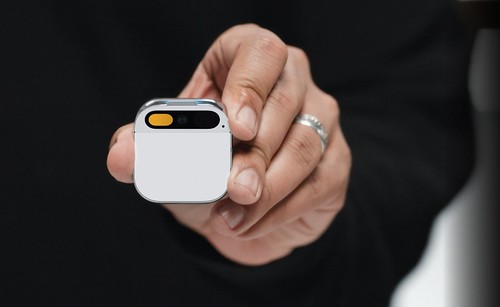
Start Up No.2143: surviving Alaska flight 1282, HyperVerse’s fake ‘CEO’, the genes associated with MS, PC sales fall again, and more


The Humane AI pin isn’t even on sale yet, and the company is already cutting its workforce – an unpromising sign. CC-licensed photo by Ged Carroll on Flickr.

You can sign up to receive each day’s Start Up post by email. You’ll need to click a confirmation link, so no spam.


There’s another post coming this week at the Social Warming Substack on Friday at 0845 UK time. Free signup.


A selection of 9 links for you. Shrinking returns. I’m @charlesarthur on Twitter. On Threads: charles_arthur. On Mastodon: https://newsie.social/@charlesarthur. Observations and links welcome.


Humane lays off 4% of employees before releasing its AI Pin • The Verge

Alex Heath:

»

Humane laid off 4% of employees this week in a move that was described as a cost cutting measure to those who were impacted, according to sources familiar with the matter. Employees were recently told by leadership that budgets would be lowered this year, said one of the people, who requested anonymity to speak without the company’s permission.

The cuts, which numbered 10 people, come ahead of the five-year-old startup shipping its first device: a $699, screenless, AI-powered pin that is pitched as a smartphone replacement. After a lot of hype and secrecy, Humane unveiled the AI Pin to the world in November and began accepting preorders, with shipments planned to begin in March.

Humane has raised over $200m from a who’s-who of Silicon Valley, including OpenAI CEO Sam Altman. CEO Bethany Bongiorno and her husband, Imran Chaudhri, started the company in 2019 after spending long careers at Apple.

«

Not a good look. For comparison, Rabbit – the AI thing that learns to run apps – claims to have had preorders of 10,000 units after its first day on show at CES, for something that looks like a small games console and hasn’t even got a TED talk to its credit.
unique link to this extract


‘I do feel bad about this’: Englishman who posed as HyperVerse CEO says sorry to investors who lost millions • The Guardian

Sarah Martin:

»

The man who posed as the chief executive of the collapsed crypto scheme HyperVerse has confirmed he was paid to act the part, receiving 180,000 Thai baht (about A$7,500 or £4,000) over nine months and a free suit as payment.

Stephen Harrison, an Englishman living in Thailand who posed as chief executive Steven Reece Lewis for the launch of HyperVerse in late 2021 and early 2022, has told Guardian Australia he was “shocked” to learn the company had presented him as having fake credentials to promote the scheme.

He said he felt sorry for those who had lost money in relation to the scheme – which he said he had no role in – an amount Chainalysis estimates at US$1.3bn in 2022 alone.

“I am sorry for these people,” he said. “Because they believed some idea with me at the forefront and believed in what I said, and God knows what these people have lost. And I do feel bad about this.

“I do feel deeply sorry for these people, I really do. You know, it’s horrible for them. I just hope that there is some resolution. I know it’s hard to get the money back off these people or whatever, but I just hope there can be some justice served in all of this where they can get to the bottom of this.”

He said he wanted to make clear he had “certainly not pocketed” any of the money lost by investors.

Harrison, who at the time was a freelance television presenter engaged in unpaid football commentary, said he had been approached and offered the HyperVerse work by a friend of a friend.

«

And on Tuesday, “HyperVerse crypto promoter ‘Bitcoin Rodney’ arrested and charged in the US“. Sounds like they’re rolling the whole network up.
unique link to this extract


Scientists crack mystery of how MS gene spread • BBC News

Philippa Roxby:

»

There are about twice as many cases of multiple sclerosis per 100,000 people in north-western Europe, including the UK and Scandinavia, compared with southern Europe.

Researchers from the universities of Cambridge, Copenhagen and Oxford spent more than 10 years delving into archaeology to investigate why.

MS is a disease where the body’s own immune cells attack the brain and spinal cord, leading to symptoms such as muscle stiffness and problems walking and talking.

They discovered that genes which increase the risk of MS entered into north-western Europe about 5,000 years ago via a massive migration of cattle herders called Yamnaya.

The Yamnaya came from western Russia, Ukraine and Kazhakstan, and moved west into Europe, says one of four Nature journal papers published on the topic.

The findings “astounded us all”, said Dr William Barrie, paper author and expert in computational analysis of ancient DNA at University of Cambridge.

At the time, the gene variants carried by the herding people were an advantage, helping to protect them against diseases in their sheep and cattle. Nowadays, however, with modern lifestyles, diets and better hygiene, these gene variants have taken on a different role. In the present day, these same traits mean a higher risk of developing certain diseases, such as MS.

The research project was a huge undertaking – genetic information was extracted from ancient human remains found in Europe and Western Asia, and compared with the genes of hundreds of thousands of people living in the UK today.

In the process, a bank of DNA from 5,000 ancient humans, kept in museum collections across many countries, has now been set up to help future research.

«

unique link to this extract


Worldwide PC shipments declined 2.7% year over year in the fourth quarter of 2023 • IDC

»

Global shipments of traditional PCs marginally surpassed expectations in the fourth quarter of 2023 (4Q23) with nearly 67.1 million PCs shipped, down 2.7% from the prior year, according to preliminary results from the International Data Corporation (IDC) Worldwide Quarterly Personal Computing Device Tracker. The silver lining in all of this is that the market contractions appear to have bottomed out and growth is expected in 2024.

Despite the improved results, 4Q23 was the eighth consecutive quarter of year-over-year shipment volume contraction. The holiday quarter shipments also marked the lowest fourth quarter volume since 4Q06, underscoring a market recovering slowly amidst weak demand and reliance on substantial promotions.
On an annual basis, the market has experienced unprecedented consecutive declines, marking a stark departure from historical trends tracked since 1995.

In 2022, shipment volume plummeted 16.5% compared to the previous year, and preliminary results suggest an additional 13.9% contraction in 2023 compared to 2022. This downturn, unparalleled in the industry’s recorded history, reflects the aftermath of the significant surge in PC purchases driven by the COVID-19 pandemic

«

IDC makes hopeful noises about the market recovering in 2024, but really, why should it? The overall market for 2023 shrank by 14%, which is nothing short of dramatic.
unique link to this extract


SEC says X account was hacked as false post causes bitcoin price swings • Ars Technica

Jon Brodkin:

»

The Securities and Exchange Commission’s X account was hacked yesterday and briefly displayed a post falsely announcing the approval of bitcoin exchange-traded funds (ETFs), causing an abrupt swing in bitcoin’s price.

“The @SECGov X account was compromised, and an unauthorized post was posted,” the SEC said after the hack. “The SEC has not approved the listing and trading of spot bitcoin exchange-traded products.” SEC Chair Gary Gensler also confirmed the hack and said the commission had not approved bitcoin ETFs.

While the incident highlighted ongoing concerns about the security of government or organizational accounts on X, the social network formerly named Twitter said in a post on its safety account that there was no breach of its systems.

“Based on our investigation, the compromise was not due to any breach of X’s systems, but rather due to an unidentified individual obtaining control over a phone number associated with the @SECGov account through a third party. We can also confirm that the account did not have two-factor authentication enabled at the time the account was compromised. We encourage all users to enable this extra layer of security,” X said.

«

Utterly astonishing that an account with that importance wouldn’t have two-factor enabled. It’s long past the time when Twitter should make it a requirement for any paid-for or government account. (But of course it’s going around putting out fires, not doing important stuff.)

And of course the reason for the hack was to pump (and dump) bitcoin. Some things never change.
unique link to this extract


The Messenger bets survival on huge ad revenue turnaround • CNBC

Alex Sherman and Brian Schwartz:

»

The Messenger, the struggling news media startup co-founded by publishing veteran Jimmy Finkelstein, is urging potential investors to make a long-shot bet on a dramatic rebound in advertising this year.

The company is attempting to stop the cash burn that has put it in jeopardy.

CNBC has obtained an investor deck The Messenger was using as recently as late December to entice potential individuals or companies to infuse it with $20m.

The Messenger, which started in May, launched on the idea of becoming a down-the-middle digital news juggernaut. It initially planned to hire around 550 journalists and generate over $100m in revenue in 2024, according to The New York Times. The company ended up hiring a staff of 300 people and has since struggled financially, which has led to some recent layoffs, according to multiple reports.

The Messenger ended 2023 with a net loss of $43m, according to the documents. The deck tells investors that with the infusion, the company plans to end 2024 profitable, with net income of $13m.

«

TL;DR Stick a fork in it, The Messenger is done. Too big to start with, and that sort of funding is not going to get paid back. I’ve never even seen one of its stories being shared on social media, let alone gone to the site.
unique link to this extract


Brazil’s StopClub app shows Uber drivers a full pay breakdown • Rest of World

Laís Martins:

»

In March 2023, Luisa Pereira made a slight tweak to the way she accepted trips as a ride-hailing driver in São Paulo and almost immediately saw a significant rise in her weekly earnings. “It’s almost like the cost of a gas tank every week — around 200 reais ($41),” she told Rest of World. All Pereira had done was download a free app called StopClub onto her phone.

Ordinarily, when customers book a trip on ride-hailing apps — like Uber and the Didi-owned 99, the two biggest in Brazil — drivers are able to see the full distance, time required, and the amount they’ll be paid for the ride. StopClub gives drivers more clarity: It breaks down the total fare offered by the app and quickly estimates the rate per kilometer or per hour. If the driver finds it to be too low, they can refuse the trip and look for one that offers more bang for the buck.

StopClub’s technique is no secret — plenty of drivers make the same calculations in their heads before accepting a fare. But the speed and clarity of StopClub’s breakdown has helped them increase their earnings by targeting the most profitable rides, drivers told Rest of World. Even those more experienced among them find the app useful, they said, because Uber drivers only have seven seconds to decide whether to accept or decline a ride. (Uber claims it’s 11 seconds.) Pereira said StopClub has made drivers’ lives easier. “I was already used to doing the calculation in my head, but if you think about it, we have to pay attention to so many things: traffic, the passenger, potential thieves, pedestrians,” she said. “At the end of the day, our minds are tired.”

«

I like the idea of warring apps, where (one hopes) the human is the winner from the conflict.
unique link to this extract


Insights from a mystery shopping trip (part 1) • CCS Insight

Ben Wood:

»

To start the year, I thought it’d be interesting to visit some stores retailing mobile phones to assess current trends and challenges. A morning at the Westfield shopping mall in West London saw me and my colleague Vaishali noting a couple of things:

• Dependence on Apple and Samsung is higher than ever
• Retailing foldable devices is challenging

In part one of this blog, I look at the dominance of Apple and Samsung in the UK retail environment. Tomorrow I’ll take a look at the challenges associated with foldables.

A decade ago, a visit to a mobile phone retailer would afford the opportunity to see a multitude of devices from numerous brands.

Those days are largely gone. It’s not a new story, but retailers’ dependence on Apple and Samsung devices in the UK is higher than ever. It has become the path of least resistance as more and more people get hooked on the iPhone. For the rest of the market, Samsung has an attractive range at all prices that satisfies most requirements.

We found the best metaphor for this situation at EE’s flagship Studio store in Westfield, where the phone section of the shop is dominated by two podiums, labelled Apple and Samsung. Other phone-makers barely get a look-in.

At present, the only other player in town seems to be Google, with its Pixel devices. In the UK and many other markets, Google is investing heavily to promote its products and this has enabled it to a place in retail and in people attention. Sales volumes remain relatively small compared with those of Apple and Samsung, but the progress is impressive.

«

unique link to this extract


When Alaska flight 1282 blew open, a mom went into ‘go mode’ to protect her son • The Seattle Times

Dominic Gates:

»

When the Boeing 737 MAX 9’s side blew out explosively on Alaska Airlines Flight 1282 Friday evening, a 15-year-old high school student was in the window seat in the row directly ahead, his shoulder beside the edge of the gaping hole.

His mother, who was seated beside him, in the middle seat of row 25, described the moment as a very loud bang, like “a bomb exploding.”

As the air in the passenger cabin rushed out, the Oregon woman turned and saw her son’s seat twisting backward toward the hole, his seat headrest ripped off and sucked into the void, her son’s arms jerked upward. “He and his seat were pulled back and towards the exterior of the plane in the direction of the hole,” she said. “I reached over and grabbed his body and pulled him towards me over the armrest.”

To avoid being inundated with further media calls, the woman, who is in her 50s, a lawyer and a former journalist, asked to be identified only by her middle name, Faye.

“I was probably as filled with adrenaline as I’ve ever been in my life,” Faye said. “I had my arms underneath his arm, kind of hooked under his shoulders and wrapped around his back,” she continued. “I did not realize until after the flight that his clothing had been torn off of his upper body.”

This account of the traumatic experience of this family aboard Flight 1282 is based upon an exclusive and emotional interview with the woman Monday.

A photo taken after the plane landed shows the boy’s seat pulled back, though by then it had returned partially to its position. At the moment of the incident, Faye’s face was pressed against the rear of her son’s right shoulder and she said the seat “was pulled back to such a degree that I was looking directly out of the hole into the night sky.”

The plane’s oxygen masks had dropped from the ceiling in front of the passengers. The woman in the aisle seat of row 25, a stranger to Faye and her son, put on her own mask, then reached across Faye and put the mask on the son.

…Faye said she had no intention of speaking to the media until she saw the initial statements from Alaska in the aftermath of the accident, which emphasized that there were only minor injuries and to her seemed to diminish the severity of what had happened.

«

Amazing piece of reporting; and once again, a whiff of corporate coverup, so familiar from the Post Office.
unique link to this extract


• Why do social networks drive us a little mad?
• Why does angry content seem to dominate what we see?
• How much of a role do algorithms play in affecting what we see and do online?
• What can we do about it?
• Did Facebook have any inkling of what was coming in Myanmar in 2016?Read Social Warming, my latest book, and find answers – and more.

Errata, corrigenda and ai no corrida: a stray quotation mark screwed up the hotlink to an image on the BBC website yesterday about the excess heat in 2023. It displays perfectly well on the BBC site, which I commend to you. Apologies for the horrendous formatting that the error caused.

Start Up No.2142: Earth breaks heat record, why post office victims didn’t speak up, Substacks acts on content, US v Apple?, and more


The Chinese company BYD has morphed from smartphone battery maker to world’s biggest EV maker. How big can it get? CC-licensed photo by Rutger van der Maar on Flickr.

You can sign up to receive each day’s Start Up post by email. You’ll need to click a confirmation link, so no spam.


There’s another post coming this week at the Social Warming Substack on Friday at 0845 UK time. Free signup.


A selection of 10 links for you. Never heard it coming. I’m @charlesarthur on Twitter. On Threads: charles_arthur. On Mastodon: https://newsie.social/@charlesarthur. Observations and links welcome.


2023 confirmed as world’s hottest year on record • BBC News

Mark Poynting and Erwan Rivault:

»

The year 2023 has been confirmed as the warmest on record, driven by human-caused climate change and boosted by the natural El Niño weather event.

Last year was about 1.48ºC warmer than the long-term average before humans started burning large amounts of fossil fuels, the EU’s climate service says.

Almost every day since July has seen a new global air temperature high for the time of year, BBC analysis shows.
Sea surface temperatures have also smashed previous highs.

The Met Office reported last week that the UK experienced its second warmest year on record in 2023.

These global records are bringing the world closer to breaching key international climate targets.

“What struck me was not just that [2023] was record-breaking, but the amount by which it broke previous records,” notes Andrew Dessler, a professor of atmospheric science at Texas A&M University. “The margin of some of these records – which you can see on the chart below – is “really astonishing”, Prof Dessler says, considering they are averages across the whole world.

<img src="https://ichef.bbci.co.uk/news/976/cpsprodpb/62BB/production/_132257252_global_temp_lines_ribbon_prev_high_640-nc-2x-nc.png.webp&quot; width="100%"

«

As the BBC Environment Editor also pointed out, even with everything we know, 80% of the world’s total energy still comes from fossil fuels. 2023 won’t be the last record-breaking year for so many environmental records, none of them good.
unique link to this extract


Mr Bates vs The Post Office depicts one of the UK’s worst miscarriages of justice: here’s why so many victims didn’t speak out • The Conversation

Grace Augustine, Jan Lodget and Mislav Radic are professors of management and social sciences:

»

Today, we know the Post Office wrongly prosecuted 736 sub-postmasters for theft, false accounting and related charges because of technical faults in the Horizon IT system, and these accusations persisted for 16 years – from 1999 to 2015, which equates to an average of roughly one person charged each week.

By and large, most sub-postmaster victims did not speak out about the injustice they faced. Some took years to come forward, and many still prefer to remain anonymous. As depicted in the drama, the first journalist to help break the story, who was from Computer Weekly, was only able to identify and vet seven victims for her story – and it was published ten years after the Post Office began falsely accusing sub-postmasters of various crimes. So where were the other victims?

Based on a detailed analysis of hundreds of transcripts from the public inquiry and interviews with sub-postmasters across the UK, our ongoing research has enabled us to identify the four main barriers that the victims of this scandal faced when it came to speaking out.

«

Briefly: they were told they were the only ones; they were stigmatised in their communities where they were seen as thieves; they couldn’t defend themselves (because the Post Office, bringing the prosecution, denied them a fair trial); the Post Office was (incredible as it now seems) the nation’s most trusted brand, selling stamps which had the Queen’s head on; and the computer systems were treated as infallible.

There’s a lot of whistleblowing to come on this. But it speaks to something deeper in corporate culture: of nobody challenging what is wrong despite suspicions.
unique link to this extract


The “10,000-hour rule” was debunked again in a replication study. That’s a relief • Vox

Brian Resnick:

»

This week, the journal Royal Society Open Science published a replication of an influential 1993 study on violin players at a music school in the journal Psychological Review.

The original finding was simple, and compelling: The very best, expert players — those who were considered elite — were the ones who had practiced the most. The conclusions implied that deliberate practice was the most important ingredient needed to achieve elite status, more important than inborn characteristics like genetics, or personality.

Perhaps you’ve heard of this. The idea was then popularized in the book Outliers by journalist Malcolm Gladwell. He dubbed it the “10,000-hour rule.” “Ten thousand hours is the magic number of greatness,” Gladwell wrote, drawing on anecdotes from famous success-havers (like Bill Gates and the Beatles), but also on the 1993 paper (which according to Google Scholar has been cited more than 9,800 times).

The replication — conducted by Brooke Macnamara and Megha Maitra of Case Western Reserve University — included a somewhat larger sample size and tighter study controls, and was preregistered (meaning that the scientists locked their methods and analysis plans in place before they collected any data, preventing them from retroactively changing their premise to fit their findings).

It finds that practice does matter for performance, but not nearly as much as the original article claimed, and surprisingly, it works differently for elite performers.

“In fact, the majority of the best violinists had accumulated less practice alone than the average amount of the good violinists,” the authors write. Practice still mattered: It accounted for 26% of the difference between good violinists and the less accomplished students. But the original study claimed that practice accounted for 48% of the difference.

«

You’re surely familiar with this: people in the same pursuit as you who are simply better at it, apparently effortlessly. Genetics? Something in early childhood? Both?
unique link to this extract


Substack says it will remove Nazi publications from the platform • Platformer

Casey Newton:

»

Substack is removing some publications that express support for Nazis, the company said today. The company said this did not represent a reversal of its previous stance, but rather the result of reconsidering how it interprets its existing policies.

As part of the move, the company is also terminating the accounts of several publications that endorse Nazi ideology and that Platformer flagged to the company for review last week.

The company will not change the text of its content policy, it says, and its new policy interpretation will not include proactively removing content related to neo-Nazis and far-right extremism. But Substack will continue to remove any material that includes “credible threats of physical harm,” it said.

In a statement, Substack’s co-founders told Platformer:

»

If and when we become aware of other content that violates our guidelines, we will take appropriate action. 

Relatedly, we’ve heard your feedback about Substack’s content moderation approach, and we understand your concerns and those of some other writers on the platform. We sincerely regret how this controversy has affected writers on Substack. 

We appreciate the input from everyone. Writers are the backbone of Substack and we take this feedback very seriously. We are actively working on more reporting tools that can be used to flag content that potentially violates our guidelines, and we will continue working on tools for user moderation so Substack users can set and refine the terms of their own experience on the platform. 

«

Substack’s statement comes after weeks of controversy related to the company’s mostly laissez-faire approach to content moderation. 

In November, Jonathan M. Katz published an article in The Atlantic titled “Substack Has a Nazi Problem.” In it, he reported that he had identified at least 16 newsletters that depicted overt Nazi symbols, and dozens more devoted to far-right extremism. 

Last month, 247 Substack writers issued an open letter asking the company to clarify its policies. The company responded on December 21, when Substack co-founder published a blog post arguing that “censorship” of Nazi publications would only make extremism worse.

«

unique link to this extract


The Rabbit R1 is an AI-powered gadget that [claims it] can use your apps for you • The Verge

David Pierce:

»

Rather than build a bunch of APIs and try to convince developers to support the R1, though, Rabbit trained its model on how to use existing apps for itself. The large action model, or LAM, was trained by humans interacting with apps like Spotify and Uber, essentially showing the model how they work. The LAM learned what a Settings icon looked like, how to know when an order was confirmed, and where the search menus are. All that, Lyu says, can be applied to any app anywhere.

The R1 also has a dedicated training mode, which you can use to teach the device how to do something, and it will supposedly be able to repeat the action on its own going forward. Lyu gives an example: “You’ll be like, ‘Hey, first of all, go to a software called Photoshop. Open it. Grab your photos here. Make a lasso on the watermark and click click click click. This is how you remove watermark.’” It takes 30 seconds for Rabbit OS to process, Lyu says, and then it can automatically remove all your watermarks going forward.

How all of this actually works in practice, though, is the real question. You’ll be able to do some things on the R1 itself, and there’s a web portal called Rabbit Hole through which you log in to all your various services. And if you want to, say, teach the device how to use Photoshop, you’ll be able to boot one of Rabbit’s virtual machines and teach it there rather than using your own device and software. But how that will work with lots of users, on lots of devices and platforms, will be tricky to get right.

Rabbit’s approach here is pretty clever. Getting anyone to support a new operating system is tough, even if you’re a tech giant, and the LAM way subverts that by just teaching the model how to use apps.

«

Really need to see this in action. It seems like an abstraction device: do we need to abstract across Photoshop and phones when good integration could mean that you just use the appropriate platform whenever you want?
unique link to this extract


US moves closer to filing sweeping antitrust case against Apple • The New York Times

David McCabe and Tripp Mickle:

»

Specifically, investigators have examined how the Apple Watch works better with the iPhone than with other brands, as well as how Apple locks competitors out of its iMessage service. They have also scrutinized Apple’s payments system for the iPhone, which blocks other financial firms from offering similar services, these people said.

Senior leaders in the Justice Department’s antitrust division are reviewing the results of the investigation so far, said two of the people. The agency’s officials have met with Apple multiple times, including in December, to discuss the investigation. No final decision has been made about whether a lawsuit should be filed or what it should include, and Apple has not had a final meeting with the Justice Department in which it can make its case to the government before a lawsuit is filed.

The Justice Department is closing in on what would be the most consequential federal antitrust lawsuit challenging Apple, which is the most valuable tech company in the world. If the lawsuit is filed, American regulators will have sued four of the biggest tech companies for monopolistic business practices in less than five years. The Justice Department is currently facing off against Google in two antitrust cases, focused on its search and ad tech businesses, while the Federal Trade Commission has sued Amazon and Meta for stifling competition.

The Apple suit would likely be even more expansive than previous challenges to the company, attacking its powerful business model that draws together the iPhone with devices like the Apple Watch and services like Apple Pay to attract and keep consumers loyal to its products.

«

The DoJ is going to get nowhere unless it can show that Apple has effective monopolies in those markets which would necessitate providing public APIs. Watch? Maaaybe. iMessage? Nope. Payments? Perhaps. But none is a slam dunk. Lina Khan might like antitrust lawsuits, but she has a poor record so far.
unique link to this extract


How BYD grew from a phone battery maker to EV giant taking on Tesla • CNBC

Arjun Kharpal and Evelyn Cheng:

»

Elon Musk dismissed BYD in 2011 by laughing at their products during a Bloomberg interview.

“Have you seen their car?” Musk quipped. “I don’t think it’s particularly attractive, the technology is not very strong. And BYD as a company has pretty severe problems in their home turf in China. I think their focus is, and rightly should be, on making sure they don’t die in China.”

BYD did not get wiped out. Instead, BYD dethroned Tesla in the fourth quarter as the top EV maker, selling more battery-powered vehicles than its US rival.

“Their goal was to be China’s largest auto manufacturer and put China manufacturing on the map,” Taylor Ogan, CEO of Snow Bull Capital, said of BYD’s long-standing ambition.

So how did the Chinese company, which began by making phone batteries, become an electric car giant?

While BYD is now known as an electric car giant, its tentacles stretch into many areas from batteries to mining and semiconductors, which is a large reason behind its success.

Chemist Wang Chuanfu founded BYD in 1995 in the southern Chinese city of Shenzhen, China’s massive tech hub. It was founded with 20 employees and 2.5 million Chinese yuan of capital, or $351,994 at today’s exchange rate.

In 1996, BYD began manufacturing lithium-ion batteries, the type that are in our modern day smartphones. This coincided with the growth of mobile phones. BYD went onto supply its batteries to Motorola and Nokia in 2000 and 2002, respectively, two of the mobile phone industry’s juggernaughts at the time.

In 2002, BYD listed on the Hong Kong Stock Exchange, riding the wave of its success in lithium-ion batteries. It wasn’t until 2003 that BYD acquired a small automaker called Xi’an Qinchuan Automobile.

«

As Benedict Evans points out, there’s a lot here which resembles the story of China and smartphones: started out with Americans thinking they could do it all, then thought that Chinese products were just junk (see also: Japanese cars v Americans), then saw China come in and eat up the low end.
unique link to this extract


Scientists discover 100 to 1,000 times more plastics in bottled water • The Washington Post

Shannon Osaka:

»

A new paper released Monday in the Proceedings of the National Academy of Sciences found about 240,000 particles in the average liter of bottled water, most of which were “nanoplastics” — particles measuring less than one micrometer (less than 1/70th the width of a human hair).

For the past several years, scientists have been looking for “microplastics,” or pieces of plastic that range from one micrometer to half a centimeter in length, and found them almost everywhere. The tiny shards of plastic have been uncovered in the deepest depths of the ocean, in the frigid recesses of Antarctic sea ice and in the human placenta. They spill out of laundry machines and hide in soils and wildlife. Microplastics are also in the food we eat and the water we drink: In 2018, scientists discovered that a single bottle of water contained, on average, 325 pieces of microplastics.

But researchers at Columbia University have now identified the extent to which nanoplastics also pose a threat.

“Whatever microplastic is doing to human health, I will say nanoplastics are going to be more dangerous,” said Wei Min, a chemistry professor at Columbia and one of the authors of the new paper.
Scientists have also found microplastics in tap water, but in smaller amounts.
Sherri Mason, a professor and director of sustainability at Penn State Behrend in Erie, Pa., says plastic materials are a bit like skin — they slough off pieces into water or food or whatever substance they are touching.

“We know at this point that our skin is constantly shedding,” she said. “And this is what these plastic items are doing — they’re just constantly shedding.”

«

First plastics: 1869. Will the last ones be made before 2069? Or are we just going to live with them as a sort of nano-sized global warming?
unique link to this extract


Asking people to “do the research” on fake news stories makes them seem more believable, not less • Nieman Journalism Lab

Joshua Benton:

»

There sure seems to be something about opening up a new tab to research a false story that makes it seem more believable, at least to a meaningful share of people.

Why would that be the case? One potential culprit is data voids. That term was coined by Microsoft’s Michael Golebiewski in 2018 “to describe search engine queries that turn up few to no results, especially when the query is rather obscure, or not searched often.”

Fake news stories, especially their wilder variants, are often spectacularly new. Part of their shock comes from presenting an idea so at odds with reality that their key words and phrases just haven’t appeared together online much. Like, before Pizzagate, would you have expected a Google search for “comet ping pong child rape pizza basement hillary” to turn up much? No, because that’s just a nonsense string of words without a bonkers conspiracy theory to tie it all together.

But imagine that, in 2016, someone heard that conspiracy theory in some remote tendril of the web and — seeking to SOTEN! [search online to evaluate news] — went to Google and typed those words in. What results would it have returned? Almost certainly it would have shown links to pro-Pizzagate webpages — because those were the only webpages with those keywords at the time. The bunkers always have a time advantage over the debunkers, and data voids are the result.

«

This isn’t a short piece (and this part seems to me the nub of it) but the ramifications are important: research doesn’t necessarily quash fake news.
unique link to this extract


Why do we work so much? • Psychology Today

Peter Gray:

»

in 1930, the economist John Maynard Keynes (1930/1963) predicted that, by the end of the 20th century, because of automation, the average workweek would be about 15 hours. That, he predicted, would be sufficient to produce everything we need for a comfortable life. In one sense he was right: Automation has greatly reduced the amount of human work, whether physical or mental, required to produce everything we reasonably need. But he was wrong in his prediction that we would work less. The average work week for most today is little different than it was a hundred years ago. Why?

…We live in a world where less work is needed, but we have not adapted our economic system in a way that permits less work for most people. We still have a system of work for wages as the means of distributing what people need, and we still have wages set at a level that, for many people, necessitates many hours of work to support themselves and their family. The powers at the top of our economic hierarchy (the so-called “job creators”) have no interest in increasing wages (for anyone other than themselves), so most people still need to work about 40 hours a week to support themselves and their family.

Instead of reducing work, our approach has been to continuously create new jobs. Some of these jobs are useful, with social value, but many are not. In fact, as anthropologist David Graeber has argued in his book Bullshit Jobs (2018), many add no social value or are even harmful to society and the environment (see my previous post for examples).

We could, if we had the political will, reduce through legislation the hours people must work, thereby improving lives and, at the same time, benefiting the environment. We could increase the minimum wage and decrease the workweek gradually, over time, in steps that would not dramatically disrupt the economy, eventuating in something close to the 15-hour week predicted by Keynes.

Or we could, as some have proposed, provide a universal basic income, paid for by increased taxes on the very rich.

«

The puzzle of why there’s so much work about continues to puzzle economists too.
unique link to this extract


• Why do social networks drive us a little mad?
• Why does angry content seem to dominate what we see?
• How much of a role do algorithms play in affecting what we see and do online?
• What can we do about it?
• Did Facebook have any inkling of what was coming in Myanmar in 2016?

Read Social Warming, my latest book, and find answers – and more.


Errata, corrigenda and ai no corrida: none notified

Start Up No.2141: publisher uses AI art after banning AI art, the Stuxnet inception, Vision Pro nears, how Boeing went wrong, and more


At this year’s CES in Las Vegas, LG is showing off its new (optionally) see-through TV. Think it will ever go on sale? CC-licensed photo by LG on Flickr.

You can sign up to receive each day’s Start Up post by email. You’ll need to click a confirmation link, so no spam.


There’s another post coming this week at the Social Warming Substack on Friday at 0845 UK time. Free signup.


A selection of 10 links for you. Use them wisely. I’m @charlesarthur on Twitter. On Threads: charles_arthur. On Mastodon: https://newsie.social/@charlesarthur. Observations and links welcome.


Magic: The Gathering publisher admits using AI art after banning AI art • Polygon

Oli Welsh:

»

Magic: The Gathering publisher Wizards of the Coast has been forced to admit that it published a marketing image for the game featuring “some AI components,” despite an initial insistence that the art was “created by humans and not AI.” Wizards of the Coast had banned the use of AI artwork in its products in 2023, after AI-generated artwork appeared in a Dungeons & Dragons sourcebook and caused an outcry.

The image, since deleted, was posted on X (formerly Twitter) by the official Magic: The Gathering account on Jan. 4. It showed five Magic cards resting on a valve-powered device next to a pressure gauge, in a brass-and-wood-filled steampunk laboratory setting. “It’s positively shocking how good these lands look in retro frame,” the post read.

Many fans were quick to point out elements in the image that bore the hallmarks of generative AI — in particular, difficulty rendering fine details in a consistent way (around bunches of cables, for example, or on the dial of the pressure gauge). But the Magic account initially dismissed these claims.

«

However…

»

“Well, we made a mistake earlier when we said that a marketing image we posted was not created using AI,” the Magic account said in a statement posted to X on Jan. 7. “As you, our diligent community pointed out, it looks like some AI components that are now popping up in industry standard tools like Photoshop crept into our marketing creative, even if a human did the work to create the overall image.”

«

AI hypocrisy is going to catch a lot of people out this year.
unique link to this extract


OpenAI claims The New York Times tricked ChatGPT into copying its articles • The Verge

Emilia David:

»

In a blog post, OpenAI said the Times “is not telling the full story.” It took particular issue with claims that its ChatGPT AI tool reproduced Times stories verbatim, arguing that the Times had manipulated prompts to include regurgitated excerpts of articles. “Even when using such prompts, our models don’t typically behave the way The New York Times insinuates, which suggests they either instructed the model to regurgitate or cherry-picked their examples from many attempts,” OpenAI said.

OpenAI claims it’s attempted to reduce regurgitation from its large language models and that the Times refused to share examples of this reproduction before filing the lawsuit. It said the verbatim examples “appear to be from year-old articles that have proliferated on multiple third-party websites.” The company did admit that it took down a ChatGPT feature, called Browse, that unintentionally reproduced content.

However, the company maintained its long-standing position that in order for AI models to learn and solve new problems, they need access to “the enormous aggregate of human knowledge.” It reiterated that while it respects the legal right to own copyrighted works — and has offered opt-outs to training data inclusion — it believes training AI models with data from the internet falls under fair use rules that allow for repurposing copyrighted works.

«

Essentially, OpenAI says “regurgitation” of training data is a problem that can occur when the same article appears many times in training data, and that the NYT examples of that are from intentionally careful prompts.

I wonder how the court case will work, if it gets that far: will OpenAI be required to have a version of ChatGPT that was running when the NYT did its prompts? Seems a big ask, yet also necessary for the case.
unique link to this extract


Dutch man sabotaged Iranian nuclear program without Dutch government’s knowledge: report • NL Times

»

In 2008, a Dutchman played a crucial role in the United States and Israeli-led operation to sabotage Iran’s nuclear program. The then 36-year-old Erik van Sabben infiltrated an Iranian nuclear complex and released the infamous Stuxnet virus, paralyzing the country’s nuclear program. The AIVD recruited the man, but Dutch politicians knew nothing about the operation, the Volkskrant reports after investigating the sabotage for two years.

A few years ago, the Volkskrant revealed that the Dutch intelligence services AIVD and MIVD had recruited the infiltrator in this sabotage operation. But at the time, it was believed to have been an Iranian engineer. In the meantime, the newspaper continued to investigate the matter, speaking to dozens of people involved, including 19 employees of the AIVD and MIVD.

They told the newspaper that Dutchman Van Sabben infiltrated the underground nuclear complex in the city of Natanz and installed equipment infected with the highly sophisticated Stuxnet virus. According to the newspaper, the software cost over a billion dollars to develop. It caused a large number of nuclear centrifuges to break down, delaying the nuclear program by several years, according to estimates.

No one in the Netherlands knew that this new type of cyber weapon was being used in the operation, the Volkskrant wrote. According to the investigative journalists, the intelligence services knew they were participating in the sabotage of the Iranian nuclear program but not that their agent was bringing in Stuxnet. “The Americans used us,” one intelligence source told the Volkskrant.

«

Oh yes but that’s not really spy stu–

»

Van Sabben immediately left Iran after successfully sabotaging the country’s nuclear program, the researchers concluded. He died two weeks later in a motorcycle accident near his home in Dubai. Nothing points to foul play, the Volkskrant said after speaking with people at the crash scene. Though, an anonymous MIVD employee told the newspaper that Van Sabben “paid a high price.”

«

One of the two writers on the Volksrant piece (subscriber-only, paywalled) is Kim Zetter, who literally wrote the book on Stuxnet, so this is highly likely to be accurate.
unique link to this extract


I want my Vision Pro(TV)! • On my Om

Om Malik:

»

The rumour machine can finally turn itself off — Apple has announced that its spatial computer, Vision Pro, is going on sale on January 19. It will start taking pre-orders for the $3,500 device, which ships on February 2nd. And I am excited. Let me rephrase that — I am super excited. My excitement stems from my hands-on experiences with the device.

Apple touts Vision Pro as a new canvas for productivity and a new way to play games. Maybe, maybe not. Just as the Apple Watch is primarily a health-related device that also does other things, including phone calls, text messages, and making payments. Similarly, the primary function for Vision Pro is ‘media’ — especially how we consume it on the go. Give it a few weeks, and more people will come to the same conclusion.

…There will be a lot of talk about Vision Pro. There will be obvious commentary about it being a disappointment. In time, we will come to realize that this was Steve Jobs’ parting gift to the company he co-founded. He told his biographer, Walter Isaacson, who then shared this in his book:

»

….[Jobs] “very much wanted to do for television sets what he had done for computers, music players, and phones: make them simple and elegant. ‘I’d like to create an integrated television set that is completely easy to use,’ he told me. ‘It would be seamlessly synced with all of your devices and with iCloud.” No longer would users have to fiddle with complex remotes for DVD players and cable channels. ‘It will have the simplest user interface you could imagine. I finally cracked it.’”

«

I don’t know about you, but I am excited and will be getting up early to order a unit for myself.

«

Spatial video of sports is going to be really interesting, and surely a key selling point.
unique link to this extract


iPhone owners get $92 payouts from Apple in phone-throttling settlement • Ars Technica

Jon Brodkin:

»

US-based iPhone users are finally getting long-awaited payments to compensate them for Apple’s decision to throttle the performance of iPhones with degraded batteries.

Apple agreed to settle with iPhone users in March 2020, but class-action lawsuits and settlements often take years to be resolved and paid out. This case took a few years because the settlement’s court approval was temporarily vacated on appeal but later reinstated.

The settlement was for a minimum of $310m and a maximum of $500m, including attorney’s fees of $80.6m and the costs of distributing the settlement fund. Apple agreed to provide $25 payments to affected users for each eligible iPhone, though that amount could have increased or decreased based on the number of approved claims.

It seems the standard payment increased, as various people reported getting $92.17 payments this past weekend. I was one of the people who received an email notice stating I was eligible for the settlement about 3.5 years ago, and I submitted a claim on July 24, 2020. I received a $92.17 deposit to my bank account on Saturday that was labeled “IN RE APPLE INC Payouts.”

iPhone owners were required to submit their claims by October 6, 2020. The payments were for US-based owners of an iPhone 6, 6 Plus, 6s, 6s Plus, 7, 7 Plus, or SE who “experienced diminished performance” on their devices while running affected versions of iOS before December 21, 2017.

«

The UK version of this case got its go-ahead near the end of last year (Apple denies its claims), so shall we put a date in the diary for 2030?
unique link to this extract


SWATting: the new normal in ransomware extortion tactics • The Register

Jessica Lyons Hardcastle:

»

Extortionists are now threatening to “swat” hospital patients — calling in bomb threats or other bogus reports to the police so heavily armed cops show up at victims’ homes — if the medical centers don’t pay the crooks’ ransom demands.

After intruders broke into Seattle’s Fred Hutchinson Cancer Center’s IT network in November and stole medical records – everything from Social Security numbers to diagnoses and lab results – miscreants threatened to turn on the patients themselves directly.

The idea being, it seems, that those patients and the media coverage from any swatting will put pressure on the US hospital to pay up and end the extortion. Other crews do similar when attacking IT service provider: they don’t just extort the suppliers, they also threaten or further extort customers of those providers.

“Fred Hutchinson Cancer Center was aware of cyber criminals issuing swatting threats and immediately notified the FBI and Seattle police, who notified the local police,” a spokesperson told The Register today. “The FBI, as part of its investigation into the cybersecurity incident, also investigated these threats.”

The cancer center, which operates more than 10 clinics in Washington’s Puget Sound region, declined to answer additional comments about the threats.

«

Of course, if American police weren’t on a hair trigger to go and shoot people, there wouldn’t be the same risk. Good luck getting British police to turn up with guns in response to a random phone report.
unique link to this extract


I’ve looked through LG’s new transparent OLED TV and seen something special • The Verge

Chris Welch has gone to CES so none of us has to:

»

LG has seemingly decided that the time has come to ship a real, bona fide transparent TV that people will actually be able to buy this year. At some undisclosed date. For what’s certain to be an exorbitant amount of money.

The company has announced the OLED Signature T (you can guess what the T stands for) here at CES 2024. The product that LG demoed for press in Las Vegas isn’t exactly “final.” The 77-inch display won’t be changing at all, but the company hasn’t decided whether it’ll come bundled with all the side furniture you see in these photos or if it’ll sell those items separately.

Behind the OLED T’s transparent panel is a contrast film that, with the push of a button on the remote, can be raised to make the TV look like any regular OLED, or lowered if you want to see what’s behind the screen.

The TV has custom widgets that take up only a lower section of the screen, which seems like an idea that LG carried over from its roll-up TV.

…here’s one downside: when the contrast filter is up, the OLED T technically isn’t on par with LG’s very best conventional OLEDs like the G series. It lacks the Micro Lens Array technology that has led to major brightness improvements for that line. I’m an unabashed display nerd, so if I owned this thing, I think it would constantly eat at me that it’s an inferior TV compared to the G4 or, if you want to go even fancier, LG’s wireless M series, which does include MLA. And this TV is destined to cost far more than either of those.

You’re making objective sacrifices for the transparency trick, so it’s worth considering how quickly the novelty of this TV might wear off. For certain people, maybe never. But me? I can’t help but feel like I’d be over the whole schtick within a matter of days.

«

Um, back up a minute. LG’s roll-up TV? Ah, a 2019 thing that.. never appeared anywhere. As this won’t.
unique link to this extract


May 2022: Lessons of Boeing’s cultural decline–and how it can recover • From Day One

Jennifer Haupt, in May 2022:

»

Boeing, a creator of the jet age, was once seen as a prestigious American corporate icon. Yet the company’s relationships with employees, investors, and business partners went into a tailspin after its merger with rival McDonnell Douglas in 1997. That’s the thesis of journalist Peter Robison, author of Flying Blind: The 737 MAX Tragedy and the Fall of Boeing, who spoke at a From Day One conference in Seattle about how this revered corporation went astray by neglecting some of its original core values, and what other companies can learn from this cautionary tale.

“The conflict ensued almost immediately with a strike that was the largest white-collar strike in U.S. history at the time,” said Robison, an investigative reporter for Bloomberg and Bloomberg Businessweek. “A federal mediator talked with an engineer I also interviewed who said, ‘This company is doomed.’ The reason he gave was that on one side you had hunter- killer assassins, the McDonnell Douglas side, which was more stockholder focused, and on the Boeing side, you had boy scouts who were customer- and product-focused. So when you look at the Max tragedy, you have to look at the DNA that started with that merger. It had impacts that lasted that long,” he said in a fireside chat with Marissa Nall, staff reporter of the Puget Sound Business Journal.

The Federal Aviation Administration (FAA) grounded the Boeing 737 MAX airliner worldwide between March 2019 and December 2020 after 346 passengers died in two crashes.

«

..and now the 737 Max 9 is grounded. And things are getting worse, as this from The Air Current published on Monday suggests:

»

United Airlines has found loose bolts and other parts on 737 Max 9 plug doors as it inspects its fleet of Boeing jets following the Friday rapid depressurization aboard an Alaska Airlines jet of the same make, according to three people familiar with the findings.

The discrepant bolts and other parts on the plug doors have been found on at least five aircraft, one of the people told The Air Current.

«

Not saying the company is doomed, but things aren’t looking too clever right now.
unique link to this extract


How to put right a grave British miscarriage of justice • FT

The FT’s Editorial Board (ie, this is the view of the paper):

»

The most talked-about holiday TV viewing in Britain was not a Hollywood blockbuster or a Netflix fantasy drama. It was a dramatisation of the real-life scandal of hundreds of sub-postmasters wrongly accused by the Post Office of theft and false accounting that were in fact the result of a faulty computer system. Many were jailed or ruined. Some convictions have been overturned, and a public inquiry is under way. Yet the TV drama has galvanised public outrage and pressure to end delays in compensating victims. This is one of the UK’s widest miscarriages of justice in recent years. It is a lesson for organisations everywhere, especially in the era of AI, in the perils of putting blind trust in technology.

Between 1999, when the Post Office introduced the Horizon IT system supplied by Fujitsu, and 2015, more than 700 local sub-postmasters — who provide post office services often as part of wider businesses — were prosecuted for alleged shortfalls in accounts. For historical reasons, the Post Office can bring its own prosecutions, without the police, and sub-postmasters’ contracts with the state-owned company made them liable for making good any losses. Lives were destroyed and reputations besmirched. At least four people took their own lives.

…A final priority is to secure accountability, via the public inquiry and a police investigation, for what went wrong. No executives of the Post Office or Fujitsu, which took control of the British computer company ICL in 1998, have been punished. Yet Post Office managers, including former chief executive Paula Vennells, continued to insist Horizon was “robust”, and to allow sub-postmasters to be hounded, even as evidence to the contrary piled up.

It is surely time to strip the Post Office of its anachronistic right to bring private prosecutions. Police are now investigating potential “fraud offences” related to the Post Office’s clawback of millions of pounds from sub-postmasters that was never actually missing. But that process could take years.

«

An obvious move would be to call for whistleblowers from inside Fujitsu and the Post Office, and offer them protection from prosecution. And then grind the liars and those who were responsible into the dust.
unique link to this extract


My presentations • Douglas McCarthy

As a followup to yesterday’s item about the National Gallery no longer being able to charge for images of non-copyright items, here’s a set of presentations made by McCarthy, who describes himself as an “open access and cultural heritage specialist”.

Of particular interest is the one called “Insert Coin”, which if you work through it shows that a lot of museums (etc) which charge for image licensing actually lose money on it because of the cost of getting people to look after licences, etc. So they should be happy about the recent Court of Appeal ruling.
unique link to this extract


• Why do social networks drive us a little mad?
• Why does angry content seem to dominate what we see?
• How much of a role do algorithms play in affecting what we see and do online?
• What can we do about it?
• Did Facebook have any inkling of what was coming in Myanmar in 2016?

Read Social Warming, my latest book, and find answers – and more.


Errata, corrigenda and ai no corrida: none notified

Start Up No.2140: plagiarism wars are here, Google settles ‘private mode’ suit, the cyber kidnap scam, Bird’s bankrupt, and more


A recent court decision means the National Gallery can no longer charge licensing fees on images of works that are out of copyright. CC-licensed photo by Dániel Bagó on Flickr.

You can sign up to receive each day’s Start Up post by email. You’ll need to click a confirmation link, so no spam.

A selection of 10 links for you. Happy new year, let’s do better! I’m @charlesarthur on Twitter. On Threads: charles_arthur. On Mastodon: https://newsie.social/@charlesarthur. Observations and links welcome.


The Plagiarism War has begun • The Atlantic

Ian Bogost wondered whether his academic work would survive the sort of examination that brought down Claudine Gay:

»

On December 29, I downloaded my thesis from the institutional repository at UCLA, where I had earned my doctorate, signed up for an iThenticate account [for the Turnitin plagiarism-detection software], and arranged for The Atlantic to pay the standard rate of $300 to analyze my dissertation’s 68,038 words.

Then I started to wonder what the hell I was doing. I had fairly strong confidence in the integrity of my work. My dissertation is about how to do cultural criticism of computational works such as software, simulations, and video games—a topic that was novel enough in 2004, when I filed it, that there wasn’t a ton of material for me to copy even if I’d wanted to. But other factors worked against me. Like Gay, who submitted her dissertation in 1997, I wrote mine during a period when computers were commonplace but the scholarly literature wasn’t yet easily searchable. That made it easier for acts of plagiarism, whether intended or not, to go unnoticed. Was it really worth risking my career to overturn those rocks?

On the principle that only a coward hides from the truth, I pressed the “Upload” button on the iThenticate website, waited for the progress bar to fill, then closed my laptop. When I came back for my report the next day, it felt a little like calling up my doctor’s office for the news, possibly bad, about whatever test they had run on my aging, mortal body. I took a breath and clicked to see my result.

It was 74. Was I a plagiarist? This, apparently, was my answer. Plagiarism isn’t normally summed up as a number, so I didn’t know quite how to respond. It seemed plausible that 74 might be a good score. Turns out it wasn’t

«

This was a brave move. The score is a percentage – but, and it’s a building-sized but, Turnitin doesn’t understand time, so things written after the suspected document will also count if they derive from it. (Bogost has written books building on his earlier work.) In reality once you weeded out those, and boilerplate (such as “reproduced with permission of the copyright owner”) his number was much, much, much lower. (Gay’s thesis was written in 1996, when Turnitin wasn’t even an idea.)

But there’s a plagiarism-detection feeding frenzy just now, being fed by a right-wing venture capitalist who wants to bring down the whole of MIT. Buy popcorn.
unique link to this extract


Google settles $5bn lawsuit for ‘private mode’ tracking • BBC News

Annabelle Liang:

»

Google has agreed to settle a US lawsuit claiming it invaded the privacy of users by tracking them even when they were browsing in “private mode”.

The class action sought at least $5bn (£3.9bn) from the world’s go-to search engine and parent company Alphabet.

…Lawyers representing Google and its users did not immediately respond to the BBC’s requests for comment.

US District Judge Yvonne Gonzalez Rogers put a scheduled trial for the case on hold in California on Thursday, after lawyers said they had reached a preliminary settlement.

Judge Rogers had rejected Google’s bid to have the case dismissed earlier this year, saying she could not agree that users consented to allowing Google to collect information on their browsing activity. The terms of the settlement were not disclosed. However, lawyers are expected to present a formal settlement for the court’s approval by February 2024.

The class action, which was filed by law firm Boies Schiller Flexner in 2020, claimed that Google had tracked users’ activity even when they set the Google Chrome browser to “Incognito” mode and other browsers to “private mode”. It said this had turned Google into an “unaccountable trove of information” on user preferences and “potentially embarrassing things”.

It added that Google could not “continue to engage in the covert and unauthorized data collection from virtually every American with a computer or phone”. Google said it had been upfront about the data it collected when users viewed in private mode, even if many users assumed otherwise.

«

Things aren’t going well for Google’s lawyers in the US: paying $700m to settle a suit brought by states on antitrust and the Play Store; lost to Epic Games.
unique link to this extract


Court of Appeal ruling will prevent UK museums from charging reproduction fees—at last • The Art Newspaper

Bendor Grovesnor:

»

A recent judgement on copyright in the Court of Appeal (20 November) heralds the end of UK museums charging fees to reproduce historic artworks. In fact, it suggests museums have been mis-selling “image licences” for over a decade. For those of us who have been campaigning on the issue for years, it is the news we’ve been waiting for.

The judgement is important because it confirms that museums do not have valid copyright in photographs of (two-dimensional) works which are themselves out of copyright. It means these photographs are in the public domain, and free to use.

Museums use copyright to restrict the circulation of images, obliging people to buy expensive licences. Any thought of scholars sharing images, or using those available on museum websites, was claimed to be a breach of copyright. Not surprisingly, most people paid up. Copyright is the glue that holds the image fee ecosystem in place.

What has now changed? Museums used to rely on the 1988 Copyright, Designs and Patents Act, which placed a low threshold on how copyright was acquired; essentially, if some degree of “skill and labour” was involved in taking a photograph of a painting, then that photograph enjoyed copyright. But subsequent case law has raised the bar, as the new Appeal Court judgement makes clear.

In his ruling (THJ v Sheridan, 2023), Lord Justice Arnold wrote that, for copyright to arise: “What is required is that the author was able to express their creative abilities in the production of the work by making free and creative choices so as to stamp the work created with their personal touch”. Importantly, he went on: “This criterion is not satisfied where the content of the work is dictated by technical considerations, rules or other constraints which leave no room for creative freedom”. In other words, if the aim of a museum photograph is to accurately reproduce a painting (which it must be), then it cannot acquire copyright.

«

The judgment was made in November, but this article only appeared near the end of December. Why? Because the THJ v Sheridan case is about something totally different – whether there’s copyright in an options trading software interface. But it reads across (as they say) to museums and images. Even more remarkable: the National Gallery actually lost money in its image licensing scheme.
unique link to this extract


Chinese student Kai Zhuang found in Utah after cyber kidnapping scam, police say • The Washington Post

Jennifer Hassan:

»

A 17-year-old Chinese student who went missing in Utah last week has been found unharmed, police said, adding that he appeared to be the victim of an elaborate “cyber kidnapping” scheme, a “disturbing criminal trend” in which scammers put people under duress and convince their families that they are being held for ransom.

Kai Zhuang, who was living in Riverdale, was discovered “alive but very cold and scared” inside a tent in remote mountains near Brigham City, Riverdale Police Chief Casey Warren said in a statement Sunday. The teen was probably instructed by those conducting the scam to isolate himself, he said.

Exchange students, particularly from China, are often targeted in virtual kidnapping cases, Warren said, adding that victims “often comply out of fear that their families will be harmed if they do not comply with the cyber kidnappers.” Warren did not identify the perpetrators in Kai’s case or where they were operating from, and said police were still investigating.

According to the FBI, while the crime can take on myriad forms, it is “always an extortion scheme” in which families are tricked into believing that a loved one has been abducted and are coerced into paying a ransom, though the person claimed to be missing has not actually been taken. Families are often sent voice recordings and photos by the perpetrators in a bid to convince them that the crime is taking place, the Riverdale police statement said.

…Police said that the teen was being “manipulated and controlled” by the perpetrators in the days before he was found and that he apparently “was isolating himself at the direction of the cyber kidnappers.”

«

It isn’t exactly this Black Mirror episode, but not that far away. (In passing: the twist at the end of that episode is one of the smartest I’ve ever seen in skewing your view of the protagonist.)

One also wonders if this scheme is going to migrate to the UK and/or Europe. If so, consider yourself forewarned.
unique link to this extract


Amazon Prime Video will start showing ads on January 29th • The Verge

Chris Welch:

»

Earlier this year, Amazon announced plans to start incorporating ads into movies and TV shows streamed from its Prime Video service, and now the company has revealed a specific date when you’ll start seeing them: it’s January 29th. “This will allow us to continue investing in compelling content and keep increasing that investment over a long period of time,” the company said in an email to customers about the pending shift to “limited advertisements.”

“We aim to have meaningfully fewer ads than linear TV and other streaming TV providers. No action is required from you, and there is no change to the current price of your Prime membership,” the company wrote. Customers have the option of paying an additional $2.99 per month to keep avoiding advertisements.

The rest of the email summarizes the many benefits of a Prime subscription — no doubt an attempt to keep customers from canceling over this decision. Verge readers were none too pleased about the initial news back in September.

Amazon Prime currently costs $14.99 each month or $139 annually. (Prime Video can be subscribed to individually for $8.99/month.)

«

If you’re a Prime Video subscriber in the UK, you’ll also have had the “yeah anyway adverts” email. One can’t help thinking that Amazon could have taken a lesson from Apple and pretty much anyone else by not spending $715m on “The Rings of Power”, a LOTR series which was such a yawnathon that it only had a 37% completion rate (50% passes muster at Prime, apparently) and then (or roughly simultaneously) spending more than $200m on Citadel, a would-be action blockbuster series beset with “creative differences” and which was so derivative I didn’t finish the first episode. They’d have been $1bn to the better and maybe we wouldn’t have had the ads.

Slow Horses and Reacher: lower budget, book adaptations, hit the target.
unique link to this extract


Bird’s bankruptcy is bad news for scooter commuters — and cities • The Washington Post

Megan McArdle:

»

If you’ve visited a major city in the past five years, you’ve probably seen Bird’s black-and-white scooters all over the place — perhaps even one or two being driven on the sidewalk. Now the company is in the same position that its scooters are often left in: tipped over on the ground and obviously in need of repair.

In theory, bankruptcy can manage Bird’s repair by allowing it to shed debt and bring costs in line with spending. The company has filed for a Chapter 11 reorganization, from which its operations could conceivably emerge lean and strong enough to carry its investors to the land of profits, and its users everywhere they want to go within about a 10-mile radius.

In practice, though, Bird’s predicament raises questions about the viability of the whole business of “shared micromobility.”

Bird invented this industry in 2017, a major service not just to those of us who love zipping hither and yon but also, I’d argue, to all the cities where they operate. Yes, many folks resent sharing roads and sidewalks with the scooters. But every time a scooter substitutes for a car trip, it means fewer greenhouse emissions, less air pollution and noise, less traffic, and less danger to pedestrians.

All this is valuable! So why isn’t Bird making money?

…Bird’s business, for example, is in many ways more analogous to Avis or Hertz than a tech company, with its high capital expenditures on vehicles and substantial labor costs to keep those vehicles serviced and positioned in the areas of highest demand. Except that there are a lot more close substitutes for a scooter — walking, transit, Uber — than there are for rental cars. So scooter companies can’t necessarily charge what it costs to provide the service. This is one explanation for Bird’s $471.3m operating loss last year. As money becomes more expensive, these kinds of losses become untenable.

«

Though as McArdle points out, rival Lime is (non-GAAP) profitable; micromobility can be made to work, but it’s tricky.
unique link to this extract


Ski resorts battle for a future as snow declines in climate crisis • The Guardian

Sandra Laville:

»

In the ski resorts of Morzine and Les Gets in the French Alps, the heavy rainfall meant that full opening of resorts was delayed until two days before Christmas, leaving the industry and the millions of tourists planning trips to stare at the sky in hope.

But no amount of wishing and hoping will overcome what is an existential threat to skiing in the Alps, an industry worth $30bn (£23.8bn) that provides the most popular ski destination in the world.

The science is clear, and is spelled out in carefully weighed-up peer reviewed reports. The most recent, this year, warned that at 2ºC of global heating above pre-industrial levels, 53% of the 28 European resorts examined would be at very high risk of a scarce amount of snow.

Scarce snow has been defined as the poorest coverage seen on average every five years between 1961 and 1990.

If the world were to hit 4ºC of heating, 98% of the resorts would be at very high risk of scarce snow cover. [Overspill note: if we hit 4ºC of heating, pretty much everyone will have much more serious concerns than how many ski runs are open.]

Another study has revealed the way in which snow cover in the Alps has had an “unprecedented” decline over the past 600 years, with the duration of the cover now shorter by 36 days.

Some respond by holding on to the idea that skiing will and can survive if global temperatures are kept to the limits set by the Paris agreement, and if the industry adapts.

…This year 500 professional winter sports athletes published a letter calling for greater climate action by FIS [International Ski Federation]. They highlighted a competition schedule that forced skiers to take air flights backwards and forwards over the Atlantic from week to week, creating unnecessarily large carbon footprints, and called on the federation to open the season later and end it earlier to respect the changing climate.

«

Ironically, the most effective climate action at present has been taken by whoever at Boeing didn’t properly secure the door frame on one of its planes, leading to the grounding of 737 Max 9 models for an indefinite period.
unique link to this extract


Chief executive of collapsed crypto fund HyperVerse does not appear to exist • The Guardian

Sarah Martin:

»

A man named Steven Reece Lewis was introduced as the chief executive officer of HyperVerse at an online global launch event in December 2021, with video messages of support from a clutch of celebrities released on Twitter the following month, including from the Apple co-founder Steve Wozniak and actor Chuck Norris.

Promotional material released for HyperVerse, which was linked to a previous scheme called HyperFund, said Reece Lewis was a graduate of the University of Leeds and held a master’s degree from the University of Cambridge. A brief career summary of Reece Lewis, which was presented in a video launch for potential investors, said he had worked for Goldman Sachs, sold a web development company to Adobe and launched an IT start-up firm, before being recruited to head up HyperVerse by the HyperTech group. This was the umbrella organisation for a range of Hyper-branded crypto schemes.

Lee spoke at the launch event as “chairman” of the HyperTech group, while Xu was introduced as the group’s “founder”. The company praised Reece Lewis’s “strong performance and drive”, citing his credentials as the reason for his recruitment.

Guardian Australia has confirmed that neither the University of Leeds nor the University of Cambridge has any record of someone by the name Steven Reece Lewis on their databases. No records exist of Steven Reece Lewis on the UK companies register, Companies House, or on the US Securities and Exchange Commission.

Adobe, a publicly listed company since 1986, has no record of any acquisition of a company owned by a Steven Reece Lewis in any of its public SEC filings. It is understood that Goldman Sachs could find no record of Reece Lewis having worked for the company.

Guardian Australia was unable to find a LinkedIn profile for Reece Lewis or any internet presence other than HyperVerse promotional material.

…A report from the US-based blockchain analysts Chainalysis estimates consumer losses to HyperVerse in 2022 amounted to US$1.3bn (A$1.92bn).

«

But but but, you say, Steve Wozniak and Chuck Norris vouched for him! Not so fast: you can hire them through the Cameo website to read out a script saying almost anything. Including what a wonderful person you are, even if you don’t exist.
unique link to this extract


🔮 The horizon for 2024: AI & energy #1 • Exponential View

Azeem Azhar:

»

We are at the very peak of fossil fuel use globally. Coal, which powered the Industrial Revolution from the mid-17th century, will be in decline from now on. As we defossilize, technology-driven energy systems (like solar) will guarantee a declining price ceiling for energy, freeing us of the vagaries of commodity-driven energy provision.

Solar power capacity additions are racing ahead. Renewable investment has exceeded fossil fuel investments for six years. Chinese solar panel prices dropped some 40+% this year to as low as 12.2c a watt, strengthening the case for the ongoing deployment of solar.

The rapid improvements in the technoeconomics of solar are making it increasingly appealing—and making forecasts progressively ropey. External forecasters are having to revise their estimates upwards. Our internal models are more bullish than these because we place more weight on learning effects and positive feedback loops.

EVs are on a tear with more than 40 million in use. Compared to earlier years, consumers have a choice of a more comprehensive selection of EVs.

The virtuous cycle is taking hold. As the market grows, more firms enter. They compete: offering consumers diversity and innovation. In this case, prices come down, and range — the most critical buying factor for an EV — increases.

«

Azhar is always an optimist, and on these particular topics he tends to be proven correct.
unique link to this extract


BT to turn 60,000 redundant street cabinets into EV charge points • The Sunday Times

Nicholas Hellen:

»

BT is revealing plans to convert 60,000 of its dark-green “street cabinets” into electric car-charging stations, in a boost for drivers who worry about where they can top up their vehicles.

At present, Britain has 53,906 public chargers. Many are in petrol stations but only an estimated 20,000 can be found on residential streets, often built into lampposts.

BT’s new pavement chargers, which will be able to power six cars at a time, will output the same 7.4kW as a standard domestic charger. This means an electric vehicle will need to be plugged in for up to six hours for a full recharge.

The initiative will be particularly welcomed by the many drivers without access to off-street parking, or any other way of installing a charger at their home, which leaves them reliant on public chargers. Many say they are put off buying an electric vehicle (EV) due to the dearth of street chargers.

Speaking ahead of the launch at a tech event in Las Vegas, Tom Guy, managing director of Etc, the startup incubation arm of BT Group, said: “It’s for all those customers who don’t have a driveway and are woefully undersupplied.”

There are almost 1 million fully electric cars on the roads, and the government has set a target of 300,000 public chargers by 2030.

The telecoms giant said the cabinets, which are a familiar sight on pavements all around Britain, are becoming increasingly redundant because they contain copper-based wiring for broadband and phone services.

«

Smart thinking by BT (which logically will thus transform into a conglomerate buying and selling electricity, apart from the many non-comms things it already does). Of course the government missed its 2023 target of having at least six rapid (or better) chargers at each motorway service area in England; only 39% did. Four of the 119 have no rapid charging. Spectacularly useless.
unique link to this extract


• Why do social networks drive us a little mad?
• Why does angry content seem to dominate what we see?
• How much of a role do algorithms play in affecting what we see and do online?
• What can we do about it?
• Did Facebook have any inkling of what was coming in Myanmar in 2016?Read Social Warming, my latest book, and find answers – and more.

Errata, corrigenda and ai no corrida: none notified