
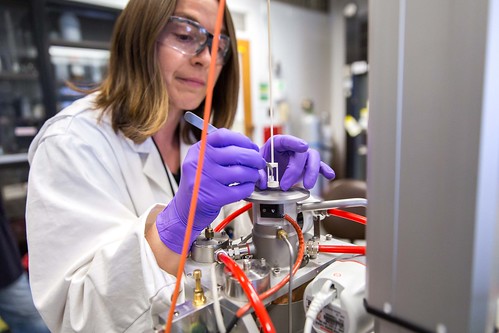
The advent of Small Modular Reactors means informing people about the opportunity – and lack of danger – from nuclear power. CC-licensed photo by Canadian Nuclear Laboratories on Flickr.
You can sign up to receive each day’s Start Up post by email. You’ll need to click a confirmation link, so no spam.
A selection of 9 links for you. Use them wisely. I’m @charlesarthur on Twitter. On Threads: charles_arthur. On Mastodon: https://newsie.social/@charlesarthur. Observations and links welcome.
The myth of technological inevitability • The Future, Now and Then
Dave Karpf:
»
Of all the imagined futures buried in the pages of the WIRED magazine back catalog, I think one of the most instructive is the argument for the “inevitability” of human cloning.
In 1996, researchers at the University of Edinburgh’s Roslin Institute cloned Dolly the sheep. Human cloning, it appeared, could not be too far behind. President Clinton declared a moratorium on federal funding for human cloning research. Governments across the world took similar steps. It was the rare moment when, instead of adopting a laissez-faire/“let markets decide” approach, elected officials asserted themselves on a major social issue.
In the pages of WIRED, this was sacrilege. You can’t stop scientific and technological progress! If the U.S. government wasn’t going to fund this research, that just meant some (privately funded) “rogue lab” would do it on their own. Or maybe (*gasp*) China would seize the initiative.*
*(In the eyes of libertarian tech-optimists, the United States’s historic dominance in science and technology is entirely due to its willingness to let innovators innovate, keeping regulators out of their way. That the US government provided ample public funding for basic research, and that the Defense Department was frequently the sole customer for their products were inconvenient facts, signifying nothing.)
And so, between 1997 and 2002, WIRED routinely articulated the case for why human cloning was the future, and it would be good, and everyone ought to just get used to it.
«
Karpf is always excellent at dissecting this attitude within American technological discourse. Cloned humans are still as far away as ever, though the topic raises its head from time to time: we’re currently in a mild revival.
unique link to this extract
Meta preparing to support iPhone Spatial Video on Quest • UploadVR
David Heaney:
»
I say “natively” because you can already play spatial videos recorded by iPhone 15 Pro on any existing VR headset by converting it to regular side-by-side 3D, the existing standard format for stereoscopic video, using an iPhone app called Spatialify. You then need to send the file to your PC or Mac, and finally transfer it to a standalone headset like Quest via USB or play it directly via PC VR software.
That’s quite an involved process, but it may not be necessary for long. X user M1Astra found strings within the code of the Meta Quest iPhone app referencing uploading spatial videos so that they will show up in the Files app on your Quest headset.
This could significantly reduce the friction of viewing spatial videos captured with iPhone on Quest, cutting out the need to transfer the file to your PC and then to your headset.
The regular non-Pro iPhone 16 coming later this year is rumored to be able to capture Spatial Videos too, so within a few years, the creator base for 3D video could rise to hundreds of millions.
«
Now that’s interesting. Meta clearly sees spatial video as a potential attractor for headsets, and knows that plenty of people won’t want to pay Apple’s prices, and anyway won’t be able to put their hands on a Vision Pro this year.
unique link to this extract
Nuclear meltdown • Polymathic Being
Michael Woudenberg:
»
Most of our ideas of nuclear energy are nearly half a century out of date and involve archaic designs, ancient fuel technologies, and fears about realized events that were blown out of proportion. We view nuclear as especially dangerous to humans and yet, it’s actually saved millions of lives.
For example, air pollution from fossil fuels is responsible for an estimated 7 million deaths per year while nuclear carries about the same risk as wind power and is around 350 times safer than coal. [Translation for mathematicians: has 0.2% of the risk of coal. – Overspill Ed] Going back to Germany, while Fukushima has no acute radiation deaths, German coal burning has been estimated to have killed thousands since they turned off their nuclear reactors.
These fears also don’t take into consideration the incredible advancements in performance, safety, fuel, and size reduction that have occurred over the past 40 years.
What many don’t realize now is that the idea we have of a nuclear reactor like the Simpson’s TV show is an archaic relic of the past. Most of us would never even know a nuclear plant exists today due to the dramatic improvements in design.
How dramatic you ask? Well, they currently have microreactors that can fit in a shipping container in a footprint smaller than a house. These reactors can produce between 5 and 10 megawatts which can power over 2000 homes.
You can distribute these reactors nationwide and provide focused, resilient, and agile power generation to more easily balance wind and solar projects. Conversely, the large and centralized power generators today, nuclear or otherwise, require extensive power grid infrastructure to carry and distribute that volume. Small Modular Reactors require much less intensive delivery infrastructure and are less prone to disruption.
«
Bet people in the UK will go absolutely bananas if someone proposes putting an SMR near them. They go bonkers about solar panels already.
unique link to this extract
Apple’s next iPads are “likely” due at the end of March • The Verge
Wes Davis:
»
Apple’s next iPads are “likely” due at the end of March. So says Mark Gurman in the latest Power On newsletter for Bloomberg. That’s not all — in addition to two iPad Air models (one a 12.9in!) and OLED iPad Pro tablets, he writes that 13in and- 15in MacBook Air models will be updated with M3 chips at the same time.
That would be the first refresh of each iPad and the 13in MacBook Air since 2022.
«
Which feels like a long time between updates for the iPad line in particular. Apple basically took 2023 off when it comes to the iPad.
unique link to this extract
Apple shares more details about the new default web browser prompt in iOS 17.4 • 9to5Mac
Chance Miller:
»
Apple announced that iPhone users in the EU will be prompted to choose a default web browser when they open Safari for the first time after updating to iOS 17.4. The company has now shared more details on this process.
Apple tells me that the popup message in iOS 17.4 will show a list of the 12 most popular browsers from the App Store in that country. That list will be presented in random order for each user.
In addition to making it easier for users to set their default browser, iOS 17.4 will also allow third-party browsers that use different web engines than Safari for the first time. Again, these changes only apply in the European Union.
«
The linked Apple developer document makes it sound like there will be plentiful hoops to jump through in order to be that web browser. Furthermore, it will only apply on the iPhone: Apple says the DMA allows it to not implement that on the iPad. For browser companies such as Firefox, that would mean maintaining a WebKit version on iPadOS, and its own one on iOS. (Me: or just ignore iPadOS?)
unique link to this extract
New Xamalicious Android malware installed 330k times on Google Play • Bleeping Computer
Bill Toulas:
»
A previously unknown Android backdoor named ‘Xamalicious’ has infected approximately 338,300 devices via malicious apps on Google Play, Android’s official app store.
McAfee, a member of the App Defense Alliance, discovered 14 infected apps on Google Play, with three having 100,000 installs each.
Even though the apps have since been removed from Google Play, users who installed them since mid-2020 might still carry active Xamalicious infections on their phones, requiring manual scans and cleanup.
…Also, a separate set of 12 malicious apps carrying the Xamalicious threat, for which download stats aren’t available, are distributed on unofficial third-party app stores, infecting users via downloadable APK (Android package) files.
«
Bet someone at Apple will be clipping stuff like that to put in its “Is THIS what you want?” file for when the EU drops it a line.
unique link to this extract
The new Apple tax every developer [using European third-party app stores] will hate • The Verge
Jacob Kastrenakes:
»
[In Europe only, following the DMA] Apple is introducing a new fee structure for apps that want to operate on these third-party stores. On the surface, it looks great: apps pay no cut of sales to Apple if they’re distributed via a third-party store. And if a developer still wants to be distributed via Apple’s App Store, too, the cut drops from the traditional 30% fee down to 17%. It’s an even lower 10% fee for qualifying “small business” apps, down from the original 15%. So far, a much better deal.
The real caveat comes into play only once apps are popular enough. Any app that sees more than 1 million installs per year must pay Apple a 50 euro cent fee (about 54 cents USD) for every new installation over that first 1 million — that fee is charged once per every user each year. Crucially, app updates count as installations, too. Since no major app goes more than a year without an update, that effectively means any sufficiently popular app is going to be indefinitely paying Apple 50 euro cents per user per year, above that initial 1 million. It’s not just apps, either. Third-party app stores must also pay Apple 50 euro cents per user per year, and they do not receive the 1 million install grace that apps do.
«
Basically, this makes it pointless for free apps to use third-party stores. And app stores need free apps to build up their catalogue so they don’t look like a ghost town. It also murders any freemium business model. What’s left? Paid-only apps, for which the “app store” itself will also have to pay.
If this follows the letter of the DMA law, the EU will be fuming.
unique link to this extract
The news business really is cratering • POLITICO
Jack Shafer:
»
The ongoing flood obviously won’t sweep all journalism away. But except for a few big players, will it become more of a cottage industry than an economic and cultural force? If great cities like Los Angeles, with its many prosperous, educated and engaged citizens, can’t support a decent daily newspaper, what hope is there for the rest of the country? Are we belatedly learning that the great journalism empires — the Times-Mirror chain, Knight Ridder, Gannett, Scripps-Howard, Tribune, McClatchy, Advance Publications, Hearst, Freedom Communications and the rest — weren’t journalism empires as much as they were advertising colossuses, and that they became doomed when they lost status as the best advertising vehicle?
Journalism will survive, of course, even if the business falters as the advertising subsidy that made it viable erodes. Publications for readers who depend on market-moving news like you find in the Wall Street Journal, Bloomberg News and other business titles will endure. So will the aforementioned New York Times, which provides news that moves political markets and has established itself as a national voice worth paying for. So, too, will the gossip and lifestyle magazines remain, as will publications like the New York Review of Books and the New Yorker, which serve, boutique-style, a loyal, educated readership. But like the animals that persisted after the great comet struck the earth, most publications will be tiny and eke out an existence in the shadows. Perhaps organized labor and political parties will step forward to sponsor news. But could you trust either to produce real news? That would be like expecting General Motors or Citibank to give you the honest lowdown on the automotive and financial goings-on.
«
As Shafer also points out, the problem with this situation of fewer big news outlets is that there are fewer lower down to effectively train people in journalism. Quality is certain to drop off as a result.
unique link to this extract
No cervical cancer cases in fully HPV-vaccinated women in Scotland • BBC News
»
A new study has found that no cases of cervical cancer have been detected in young women who have been fully-vaccinated as part of the HPV immunisation programme.
The Public Health Scotland (PHS) research said the HPV (human papillomavirus virus) vaccine was “highly effective” in preventing the development of the cancer.
HPV is a sexually transmitted infection and is responsible for almost all cases of cervical cancer – the fourth most common cause of cancer in women worldwide.
The vaccination programme started in 2008 with girls offered the vaccine in their first year at secondary school, aged 12 or 13.
The vaccine, which is now offered to boys, also helps to protect them from other HPV-related cancers later in life, such as head, neck and anogenital cancers as well as genital warts.
…Cervical cancer is the most common cancer in women aged 25 to 35 years of age in Scotland.
In total, about 300 women in Scotland are diagnosed with cervical cancer every year.
Screening is offered to all women aged 25 to 64.«
Amazing result. You could imagine that in time, it might be possible to stop requiring the hated pap smears.
unique link to this extract
| • Why do social networks drive us a little mad? • Why does angry content seem to dominate what we see? • How much of a role do algorithms play in affecting what we see and do online? • What can we do about it? • Did Facebook have any inkling of what was coming in Myanmar in 2016? Read Social Warming, my latest book, and find answers – and more. |
Errata, corrigenda and ai no corrida: none notified
 The Overspill: when there's more that I want to say
As someone who is just out of treatment for HPV+ oropharyngeal cancer, I am delighted that the vaccines work, and that once vaccinated my son will never* experience the same as me. Science, eh.
*Hopefully
Best wishes for recovery, Joel.