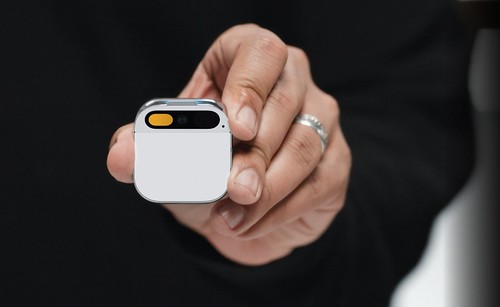
The Humane AI pin isn’t even on sale yet, and the company is already cutting its workforce – an unpromising sign. CC-licensed photo by Ged Carroll on Flickr.
You can sign up to receive each day’s Start Up post by email. You’ll need to click a confirmation link, so no spam.
There’s another post coming this week at the Social Warming Substack on Friday at 0845 UK time. Free signup.
A selection of 9 links for you. Shrinking returns. I’m @charlesarthur on Twitter. On Threads: charles_arthur. On Mastodon: https://newsie.social/@charlesarthur. Observations and links welcome.
Humane lays off 4% of employees before releasing its AI Pin • The Verge
Alex Heath:
»
Humane laid off 4% of employees this week in a move that was described as a cost cutting measure to those who were impacted, according to sources familiar with the matter. Employees were recently told by leadership that budgets would be lowered this year, said one of the people, who requested anonymity to speak without the company’s permission.
The cuts, which numbered 10 people, come ahead of the five-year-old startup shipping its first device: a $699, screenless, AI-powered pin that is pitched as a smartphone replacement. After a lot of hype and secrecy, Humane unveiled the AI Pin to the world in November and began accepting preorders, with shipments planned to begin in March.
Humane has raised over $200m from a who’s-who of Silicon Valley, including OpenAI CEO Sam Altman. CEO Bethany Bongiorno and her husband, Imran Chaudhri, started the company in 2019 after spending long careers at Apple.
«
Not a good look. For comparison, Rabbit – the AI thing that learns to run apps – claims to have had preorders of 10,000 units after its first day on show at CES, for something that looks like a small games console and hasn’t even got a TED talk to its credit.
unique link to this extract
‘I do feel bad about this’: Englishman who posed as HyperVerse CEO says sorry to investors who lost millions • The Guardian
Sarah Martin:
»
The man who posed as the chief executive of the collapsed crypto scheme HyperVerse has confirmed he was paid to act the part, receiving 180,000 Thai baht (about A$7,500 or £4,000) over nine months and a free suit as payment.
Stephen Harrison, an Englishman living in Thailand who posed as chief executive Steven Reece Lewis for the launch of HyperVerse in late 2021 and early 2022, has told Guardian Australia he was “shocked” to learn the company had presented him as having fake credentials to promote the scheme.
He said he felt sorry for those who had lost money in relation to the scheme – which he said he had no role in – an amount Chainalysis estimates at US$1.3bn in 2022 alone.
“I am sorry for these people,” he said. “Because they believed some idea with me at the forefront and believed in what I said, and God knows what these people have lost. And I do feel bad about this.
“I do feel deeply sorry for these people, I really do. You know, it’s horrible for them. I just hope that there is some resolution. I know it’s hard to get the money back off these people or whatever, but I just hope there can be some justice served in all of this where they can get to the bottom of this.”
He said he wanted to make clear he had “certainly not pocketed” any of the money lost by investors.
Harrison, who at the time was a freelance television presenter engaged in unpaid football commentary, said he had been approached and offered the HyperVerse work by a friend of a friend.
«
And on Tuesday, “HyperVerse crypto promoter ‘Bitcoin Rodney’ arrested and charged in the US“. Sounds like they’re rolling the whole network up.
unique link to this extract
Scientists crack mystery of how MS gene spread • BBC News
Philippa Roxby:
»
There are about twice as many cases of multiple sclerosis per 100,000 people in north-western Europe, including the UK and Scandinavia, compared with southern Europe.
Researchers from the universities of Cambridge, Copenhagen and Oxford spent more than 10 years delving into archaeology to investigate why.
MS is a disease where the body’s own immune cells attack the brain and spinal cord, leading to symptoms such as muscle stiffness and problems walking and talking.
They discovered that genes which increase the risk of MS entered into north-western Europe about 5,000 years ago via a massive migration of cattle herders called Yamnaya.
The Yamnaya came from western Russia, Ukraine and Kazhakstan, and moved west into Europe, says one of four Nature journal papers published on the topic.
The findings “astounded us all”, said Dr William Barrie, paper author and expert in computational analysis of ancient DNA at University of Cambridge.
At the time, the gene variants carried by the herding people were an advantage, helping to protect them against diseases in their sheep and cattle. Nowadays, however, with modern lifestyles, diets and better hygiene, these gene variants have taken on a different role. In the present day, these same traits mean a higher risk of developing certain diseases, such as MS.
The research project was a huge undertaking – genetic information was extracted from ancient human remains found in Europe and Western Asia, and compared with the genes of hundreds of thousands of people living in the UK today.
In the process, a bank of DNA from 5,000 ancient humans, kept in museum collections across many countries, has now been set up to help future research.
«
Worldwide PC shipments declined 2.7% year over year in the fourth quarter of 2023 • IDC
»
Global shipments of traditional PCs marginally surpassed expectations in the fourth quarter of 2023 (4Q23) with nearly 67.1 million PCs shipped, down 2.7% from the prior year, according to preliminary results from the International Data Corporation (IDC) Worldwide Quarterly Personal Computing Device Tracker. The silver lining in all of this is that the market contractions appear to have bottomed out and growth is expected in 2024.
Despite the improved results, 4Q23 was the eighth consecutive quarter of year-over-year shipment volume contraction. The holiday quarter shipments also marked the lowest fourth quarter volume since 4Q06, underscoring a market recovering slowly amidst weak demand and reliance on substantial promotions.
On an annual basis, the market has experienced unprecedented consecutive declines, marking a stark departure from historical trends tracked since 1995.In 2022, shipment volume plummeted 16.5% compared to the previous year, and preliminary results suggest an additional 13.9% contraction in 2023 compared to 2022. This downturn, unparalleled in the industry’s recorded history, reflects the aftermath of the significant surge in PC purchases driven by the COVID-19 pandemic
«
IDC makes hopeful noises about the market recovering in 2024, but really, why should it? The overall market for 2023 shrank by 14%, which is nothing short of dramatic.
unique link to this extract
SEC says X account was hacked as false post causes bitcoin price swings • Ars Technica
Jon Brodkin:
»
The Securities and Exchange Commission’s X account was hacked yesterday and briefly displayed a post falsely announcing the approval of bitcoin exchange-traded funds (ETFs), causing an abrupt swing in bitcoin’s price.
“The @SECGov X account was compromised, and an unauthorized post was posted,” the SEC said after the hack. “The SEC has not approved the listing and trading of spot bitcoin exchange-traded products.” SEC Chair Gary Gensler also confirmed the hack and said the commission had not approved bitcoin ETFs.
While the incident highlighted ongoing concerns about the security of government or organizational accounts on X, the social network formerly named Twitter said in a post on its safety account that there was no breach of its systems.
“Based on our investigation, the compromise was not due to any breach of X’s systems, but rather due to an unidentified individual obtaining control over a phone number associated with the @SECGov account through a third party. We can also confirm that the account did not have two-factor authentication enabled at the time the account was compromised. We encourage all users to enable this extra layer of security,” X said.
«
Utterly astonishing that an account with that importance wouldn’t have two-factor enabled. It’s long past the time when Twitter should make it a requirement for any paid-for or government account. (But of course it’s going around putting out fires, not doing important stuff.)
And of course the reason for the hack was to pump (and dump) bitcoin. Some things never change.
unique link to this extract
The Messenger bets survival on huge ad revenue turnaround • CNBC
Alex Sherman and Brian Schwartz:
»
The Messenger, the struggling news media startup co-founded by publishing veteran Jimmy Finkelstein, is urging potential investors to make a long-shot bet on a dramatic rebound in advertising this year.
The company is attempting to stop the cash burn that has put it in jeopardy.
CNBC has obtained an investor deck The Messenger was using as recently as late December to entice potential individuals or companies to infuse it with $20m.
The Messenger, which started in May, launched on the idea of becoming a down-the-middle digital news juggernaut. It initially planned to hire around 550 journalists and generate over $100m in revenue in 2024, according to The New York Times. The company ended up hiring a staff of 300 people and has since struggled financially, which has led to some recent layoffs, according to multiple reports.
The Messenger ended 2023 with a net loss of $43m, according to the documents. The deck tells investors that with the infusion, the company plans to end 2024 profitable, with net income of $13m.
«
TL;DR Stick a fork in it, The Messenger is done. Too big to start with, and that sort of funding is not going to get paid back. I’ve never even seen one of its stories being shared on social media, let alone gone to the site.
unique link to this extract
Brazil’s StopClub app shows Uber drivers a full pay breakdown • Rest of World
Laís Martins:
»
In March 2023, Luisa Pereira made a slight tweak to the way she accepted trips as a ride-hailing driver in São Paulo and almost immediately saw a significant rise in her weekly earnings. “It’s almost like the cost of a gas tank every week — around 200 reais ($41),” she told Rest of World. All Pereira had done was download a free app called StopClub onto her phone.
Ordinarily, when customers book a trip on ride-hailing apps — like Uber and the Didi-owned 99, the two biggest in Brazil — drivers are able to see the full distance, time required, and the amount they’ll be paid for the ride. StopClub gives drivers more clarity: It breaks down the total fare offered by the app and quickly estimates the rate per kilometer or per hour. If the driver finds it to be too low, they can refuse the trip and look for one that offers more bang for the buck.
StopClub’s technique is no secret — plenty of drivers make the same calculations in their heads before accepting a fare. But the speed and clarity of StopClub’s breakdown has helped them increase their earnings by targeting the most profitable rides, drivers told Rest of World. Even those more experienced among them find the app useful, they said, because Uber drivers only have seven seconds to decide whether to accept or decline a ride. (Uber claims it’s 11 seconds.) Pereira said StopClub has made drivers’ lives easier. “I was already used to doing the calculation in my head, but if you think about it, we have to pay attention to so many things: traffic, the passenger, potential thieves, pedestrians,” she said. “At the end of the day, our minds are tired.”
«
I like the idea of warring apps, where (one hopes) the human is the winner from the conflict.
unique link to this extract
Insights from a mystery shopping trip (part 1) • CCS Insight
Ben Wood:
»
To start the year, I thought it’d be interesting to visit some stores retailing mobile phones to assess current trends and challenges. A morning at the Westfield shopping mall in West London saw me and my colleague Vaishali noting a couple of things:
• Dependence on Apple and Samsung is higher than ever
• Retailing foldable devices is challengingIn part one of this blog, I look at the dominance of Apple and Samsung in the UK retail environment. Tomorrow I’ll take a look at the challenges associated with foldables.
A decade ago, a visit to a mobile phone retailer would afford the opportunity to see a multitude of devices from numerous brands.
Those days are largely gone. It’s not a new story, but retailers’ dependence on Apple and Samsung devices in the UK is higher than ever. It has become the path of least resistance as more and more people get hooked on the iPhone. For the rest of the market, Samsung has an attractive range at all prices that satisfies most requirements.
We found the best metaphor for this situation at EE’s flagship Studio store in Westfield, where the phone section of the shop is dominated by two podiums, labelled Apple and Samsung. Other phone-makers barely get a look-in.
At present, the only other player in town seems to be Google, with its Pixel devices. In the UK and many other markets, Google is investing heavily to promote its products and this has enabled it to a place in retail and in people attention. Sales volumes remain relatively small compared with those of Apple and Samsung, but the progress is impressive.
«
When Alaska flight 1282 blew open, a mom went into ‘go mode’ to protect her son • The Seattle Times
Dominic Gates:
»
When the Boeing 737 MAX 9’s side blew out explosively on Alaska Airlines Flight 1282 Friday evening, a 15-year-old high school student was in the window seat in the row directly ahead, his shoulder beside the edge of the gaping hole.
His mother, who was seated beside him, in the middle seat of row 25, described the moment as a very loud bang, like “a bomb exploding.”
As the air in the passenger cabin rushed out, the Oregon woman turned and saw her son’s seat twisting backward toward the hole, his seat headrest ripped off and sucked into the void, her son’s arms jerked upward. “He and his seat were pulled back and towards the exterior of the plane in the direction of the hole,” she said. “I reached over and grabbed his body and pulled him towards me over the armrest.”
To avoid being inundated with further media calls, the woman, who is in her 50s, a lawyer and a former journalist, asked to be identified only by her middle name, Faye.
“I was probably as filled with adrenaline as I’ve ever been in my life,” Faye said. “I had my arms underneath his arm, kind of hooked under his shoulders and wrapped around his back,” she continued. “I did not realize until after the flight that his clothing had been torn off of his upper body.”
This account of the traumatic experience of this family aboard Flight 1282 is based upon an exclusive and emotional interview with the woman Monday.
A photo taken after the plane landed shows the boy’s seat pulled back, though by then it had returned partially to its position. At the moment of the incident, Faye’s face was pressed against the rear of her son’s right shoulder and she said the seat “was pulled back to such a degree that I was looking directly out of the hole into the night sky.”
The plane’s oxygen masks had dropped from the ceiling in front of the passengers. The woman in the aisle seat of row 25, a stranger to Faye and her son, put on her own mask, then reached across Faye and put the mask on the son.
…Faye said she had no intention of speaking to the media until she saw the initial statements from Alaska in the aftermath of the accident, which emphasized that there were only minor injuries and to her seemed to diminish the severity of what had happened.
«
Amazing piece of reporting; and once again, a whiff of corporate coverup, so familiar from the Post Office.
unique link to this extract
| • Why do social networks drive us a little mad? • Why does angry content seem to dominate what we see? • How much of a role do algorithms play in affecting what we see and do online? • What can we do about it? • Did Facebook have any inkling of what was coming in Myanmar in 2016?Read Social Warming, my latest book, and find answers – and more. |
Errata, corrigenda and ai no corrida: a stray quotation mark screwed up the hotlink to an image on the BBC website yesterday about the excess heat in 2023. It displays perfectly well on the BBC site, which I commend to you. Apologies for the horrendous formatting that the error caused.
 The Overspill: when there's more that I want to say