
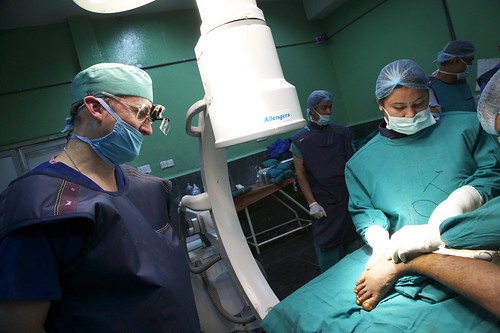
A screwup with Excel meant that Wales nearly turned down scores of completely qualified anaesthetists in 2021. CC-licensed photo by UK Department for International Development on Flickr.
You can sign up to receive each day’s Start Up post by email. You’ll need to click a confirmation link, so no spam.
It’s Friday, so there’s another post due at the Social Warming Substack at about 0845 UK time: it’s about what impact the changes to news headlines will have on Twitter. Plus the final explanation for the programming bug is at the end of this post.
A selection of 9 links for you. Use them wisely. I’m @charlesarthur on Twitter. On Threads: charles_arthur. On Mastodon: https://newsie.social/@charlesarthur. Observations and links welcome.
Alameda’s paper trail leads straight to Sam Bankman-Fried • The Verge
Elizabeth Lopatto:
»
Sam Bankman-Fried wasn’t just a crypto wunderkind, he was an ambassador for improving the world through effective altruism. And if you were wondering how he squared those values with all the lying he allegedly did during his time at FTX, wonder no more: the answer is utilitarianism.
Lying and stealing were permitted, as “the only moral rule that mattered would be maximal utility,” Caroline Ellison testified on her second day at Bankman-Fried’s fraud trial. I glanced over at his parents, Joseph Bankman and Barbara Fried, to see what they made of this; both appeared to be busy scribbling into legal pads. In any case, the approach apparently worked for much of Bankman-Fried’s life — right up to demanding doctored balance sheets for the company Ellison supposedly ran.
Bankman-Fried’s cavalier attitude toward lying rubbed off on her, Ellison testified. Ellison choked up a little as she went on: “When I started working at Alameda, I don’t think I would have believed you if you told me I would be sending false balance sheets to our lenders, or taking customer money, but over time, it was something I became more comfortable with.” Later, testifying about the days when the crypto hedge fund Alameda Research and exchange FTX fell, she cried.
«
The SBF trial is now well into the meat, and the betrayal scenarios are delicious.
unique link to this extract
Ozempic’s early success in kidney disease trial drags down dialysis stocks • Yahoo Finance
Mariam Esunny:
»
Shares of dialysis service providers fell sharply on Wednesday after Novo Nordisk’s Ozempic showed early signs of success in delaying the progression of kidney disease in diabetes patients.
Colorado-based DaVita’s shares closed down about 17% and U.S.-listed shares of German rival Fresenius Medical ended 17.6% lower.
Novo’s announcement is the latest sign of disruption caused by the success of GLP-1 drugs, which have hit shares of food companies, providers of bariatric surgery and glucose-monitoring device makers.
GLP-1 (glucagon-like peptide 1) drugs are used for the treatment of type 2 diabetes and for weight loss.
Shares of US-based Baxter International, which makes products used by dialysis therapy providers, closed down 12.3%.
Danish drugmaker Novo said late on Tuesday it will stop the trial almost a year ahead of schedule based on interim results from the study, which met the pre-set criteria for efficacy according to an independent data monitoring committee.
The dialysis market has for decades been sustained by high rates of obesity and diabetes, which contribute to kidney damage, but GLP-1 drugs such as Novo’s Ozempic and Wegovy have been seen to dramatically improve both conditions.
«
Ozempic and the other GLP-1s really are transforming the world. Over the next few years could make a dramatic difference to how we live.
unique link to this extract
Excel bungling makes top trainee doctors ‘unappointable’ • The Register
Lindsay Clark:
»
In autumn 2021, candidates seeking their third-level specialist training position (ST3) were looking forward to hearing where they would end up in one of the NHS’s most sought-after medical disciplines.
However, the body responsible for their selection and recruitment – the Anaesthetic National Recruitment Office (ANRO) – told all the candidates for positions in Wales they were “unappointable,” despite some of them achieving the highest interview scores.
Only when one of the candidates challenged the decision did ANRO realize its error. A subsequent Significant Incident Review showed a complex and confused approach to using spreadsheets led to the disaster.
“The interview scores are stored in an Excel spreadsheet. Each of the seven [UK] recruitment regions creates a separate spreadsheet, but these have no standardised template, naming convention or structure. After being manually amended, all of the various scores are entered into a Master spreadsheet. This is carried out row-by-row and takes several days, likely to be subject to interruptions,” the report said.
In the process, a ranking column in the Wales Region Spreadsheet had been wrongly transferred to the Master National Spreadsheet, erroneously appearing as an interview score. After their interviews, candidates were ranked 1 to 24 – with 24 actually being the total number of candidates interviewed in the region. But even the highest possible “interview” score of 24 was much lower than candidates’ true scores, and because the candidates had been ranked in order of performance, the best candidates were deemed weakest and vice versa.
«
Excel considered harmful. Actually, Excel’s superpowers are the source of the trouble: most people don’t need anything like the panoply of functions on offer. A few simple columns and some cross-references would be fine. Instead, they’re given an aircraft carrier, and they often steer it onto the rocks.
unique link to this extract
A graphic Hamas video Donald Trump Jr. shared on X is actually real, research confirms • WIRED
David Gilbert:
»
On Tuesday, Donald Trump Jr. posted a graphic video to X (formerly Twitter) that purported to show Hamas fighters murdering Israeli citizens during the attack last Saturday morning. “You don’t negotiate with this,” Trump Jr. wrote. “There’s only one way to handle this.” The son of former US president Donald Trump added that the video had come from a “source within Israel.”
The post was shared widely, and within hours it had amassed over 4 million views.
Then X’s user-generated fact-checking system, Community Notes, appended a message to the tweet, stating: “This is an old video and is not from Israel,” accompanied by a link to the original video. The note suggested that Trump Jr. was contributing to what has been a flood of disinformation on X since Hamas militants attacked Israel on Saturday, supercharged by verified users and accompanied by other conspiracy theories pushed by the company’s owner, Elon Musk.
But WIRED has now verified that the Community Notes system appears to be wrong. According to an independent OSINT analysis published on Wednesday, the video Trump Jr. posted is real. It was recorded during Saturday’s attack and does show Hamas fighters shooting Israelis, the analysis found.
The incident highlights how Community Notes, touted this week by X as one of the crucial ways it was tackling disinformation, is still struggling to function as intended and is, in some instances, adding to the level of disinformation on X rather than correcting it.
«
I mean, you’d certainly start from the working assumption that Cocaine Bear was wrong, but stopped clocks, etc. What this really highlights, though, is that getting rid of Verified accounts for verified sources was stupid. Plus it also highlights that Twitter has reverted to the worst standards that it had when Isis were posting gruesome videos to it. Except now the posts come from the son of a presidential hopeful.
unique link to this extract
Net zero targets “harder because of Rishi Sunak’s policy changes” • TheTimes
Adam Vaughan:
»
Professor Piers Forster, interim chairman of the [UK government’s advisory Climate Change] committee, said he was “mostly concerned” by the indirect effects and signals the retreat sent to consumers and businesses by undermining confidence in the switch to greener technologies.
“I would say it has made the 2030 date more challenging,” Forster told The Times, referring to Britain’s target of cutting greenhouse gas emissions by 68% by then. Since 1990 they have fallen 46%.
While much of the focus on Sunak’s speech was on his postponement of the ban on sales of new petrol and diesel cars, the committee thinks that will have relatively little impact on emissions because the prime minister later passed into law targets requiring 80% of new cars to be electric by 2030.
However, Sunak’s decision to make a fifth of households exempt from a ban on new gas boiler sales by 2035 has made meeting the net zero target by 2050 “considerably harder”, the committee said in its latest update. An unclear definition of who will be exempt created more uncertainty that could hinder cost reductions in alternatives such as heat pumps, it said.
Even the ostensibly positive news of Sunak boosting heat pump grants from £5,000 to £7,500 was not as good as it looked, the committee said. The overall grant budget of £150m for this financial year and the next one is unchanged, so “will serve fewer homes”, the advisers noted.
They said government changes would hurt wallets as well as emissions reductions. Sunak’s undermining of the rollout of electric cars “will ultimately increase costs” because they are cheaper than petrol and diesel models over their lifetimes. Sunak’s U-turn on a plan to make landlords upgrade the energy efficiency of privately-rented homes by 2027 would mean tenants paying up to £325 extra a year in higher energy bills, the CCC calculated.
«
Basically, it’s going to be up to the next government to sort out the mess in a year or so. But that leaves even less time to get it done.
unique link to this extract
Who had the most kids in history? Or, humanity’s near-extinction and why it matters for us all • The Garden of Forking Paths
Brian Klaas:
»
11,000 years ago, cheetahs almost went extinct. Evidence suggests that, in the entire world, there were as few as seven cheetahs alive. This is an example of a population bottleneck, in which the population of a species drastically shrinks, often due to environmental change or a cataclysmic event that wipes most individuals out.
The cheetahs had such an extreme population bottleneck that all modern cheetahs are extremely similar genetically—so much so that you can take skin from any cheetah and graft it onto another. The host animal’s body will immediately accept it as though the other cheetah’s skin is its own.
Now, consider this: how much would it matter which seven cheetahs survived? If even one of them was unusually slow, or had an extremely bushy tail, or had an unusual genetic mutation, well, that would dramatically influence the future trajectory of the species.
Similarly, if we imagine that the entirety of humanity were suddenly restricted to just seven people, I think you’d agree that the future of Homo sapiens would be rather different if one of those seven was, say, Donald Trump or Elon Musk rather than a compassionate, selfless nurse who works on a ward for children with cancer.
«
This then goes on to the topic of the human population bottleneck, which we’ve done here before. However you might get a pub quiz question out of who had the (verified) babies.
Also, seven is a pretty dramatically small number. Well done, cheetahs. Unfortunately it looks like humans might be about to finish the job.
unique link to this extract
Africa’s first carbon-removal plant stokes questions about responsible climate solutions • NBC News
Nidhi Sharma:
»
A greener and more equitable future — that’s the idea behind a first-of-its-kind plant to be built in Kenya that could remove up to 1 million tons of carbon dioxide from the atmosphere every year.
The proposal to build a direct air capture plant, announced in September by Swiss company Climeworks and Kenya-based Great Carbon Valley, has been billed as a springboard for creating a new, green economy in Africa as the world is expected to invest trillions of dollars in climate-related investment in the coming years.
Direct-air capture sucks in carbon dioxide from the atmosphere and stores it underground, a process that is relatively energy intensive. The technology has been criticized by some climate scientists who argue that the technology is a dangerous distraction from the only viable solution to climate change: Cutting greenhouse gas emissions by transitioning en masse away from fossil fuels. Others say that direct air capture is a necessary part of a diverse effort to limit global warming.
“The world is going to need to decarbonize,” said Bilha Ndirangu, CEO of Great Carbon Valley. “There will be different investments and innovations in decarbonization efforts. How do we make sure that some of those investments are happening in Africa?”
…“All direct air capture does is help fossil fuel companies pretend they’re taking climate action while they continue to drill for oil,” Jonathan Foley, a climate scientist and founder of Project Drawdown, a nonprofit climate group, said. “Trading a few seconds of the world’s greenhouse gas emissions to give oil and gas companies a fig leaf is not a good bargain.”
«
I’m with Foley. DAC is one of those constant promises that “honestly, look, we’re trying”. World CO2 emissions in 2021 were just over 37 billion tonnes. So you’d need 37,000 of those Climeworks plants to get us just standing still (but really you need to reduce the CO2 levels to help). And that one won’t be finished before 2028.
For comparison: a 950MW solar park being built in Dubai will power 320,000 homes and reduce emissions by 1.6mt annually. Which is the better investment?
unique link to this extract
Six months ago NPR left Twitter. The effects have been negligible • Nieman Reports
Gabe Bullard:
»
The week after NPR and KCUR left Twitter, the Ralph Yarl shooting happened in Kansas City. Rosenberg says it was “painful” to stay off Twitter as the story unfolded. “We had just taken away one of our big avenues for getting out information, especially in a breaking news situation — a shooting, one that deals with a lot of really thorny issues of racism and police and the justice system. And a lot of that conversation was happening on Twitter,” Rosenberg says. Instead of rejoining Twitter, KCUR set up a live blog and focused on posting to other social networks. NPR’s editors worked with the station to refine SEO and help spread the story. Even though the station itself wasn’t posting to Twitter, Rosenberg says the story found an audience anyway because very engaged local Twitter users shared the piece with their networks. And while the station informed these users through its website, it also reached new users on Instagram, where Rosenberg says KCUR has “tripled down” its engagement efforts.
On Instagram, KCUR’s strategy is less about driving clicks and more about sharing information within the app. “Instagram doesn’t drive traffic, but frankly neither did Twitter,” Rosenberg says. NPR, meanwhile, has been experimenting with Threads, a new app built by Instagram that launched in July, where NPR is among the most-followed news accounts. Threads delivers about 63,000 site visits a week — about 39 percent of what Twitter provided. But NPR’s memo notes that clicks aren’t necessarily the priority, and the network is “taking advantage of the expanded character limit to deliver news natively on-platform to grow audiences — with enough information for a reader to choose whether to click through.”
NPR posts less to Threads than it did to Twitter, and the team spends about half as much time on the new platform as it did on the old. Danielle Nett, an editor with NPR’s engagement team, writes in the staff memo that spending less time on Twitter has helped with staff burnout. “That’s both due to the lower manual lift — and because the audience on Threads is seemingly more welcoming to publishers than on platforms like Twitter and Reddit, where snark and contrarianism reign,” Nett writes.
«
NPR traffic has dropped by a single percentage point. Twitter clearly wasn’t a traffic driver in any sense.
unique link to this extract
This is what an unmoderated internet looks like • Garbage Day
Ryan Broderick:
»
When Musk bought Twitter a year ago, I naively believed that users, especially irl important ones, would react to the increasing noise on their feeds by simply leaving the platform. And, if my own following tab is an indication, many have. But what has actually happened is much more dangerous. Instead of X dissolving into a digital backwater for divorced guys with NFT debt, it has, instead, continued to remain at the top of the digital funnel while also being 4chan-levels of rotten. It is still being used to process current events in “real time” even though it does not have the tools, nor the leadership necessary to handle that responsibility. The inmates are running the asylum and there is nothing on the horizon to convince that that will get better.
And so I think I’m ready to finally face the facts: Community moderation, in almost every form, should be considered a failed project. Our public digital spaces, as they currently exist, cannot be fixed and the companies that control them cannot, or, more likely, will not ensure their safety or quality at a scale that matters anymore. And the main tactic for putting pressure on these companies — reporters and researchers highlighting bad moderation and trust and safety failures and the occasional worthless congressional hearing playing whack-a-mole with offensive content — has amounted to little more than public policy LARPing. We are right back where we started in 2012, but in much more online world. And the companies that built that world have abandoned us to go play with AI.
«
Unfortunately: yes.
unique link to this extract
| • Why do social networks drive us a little mad? • Why does angry content seem to dominate what we see? • How much of a role do algorithms play in affecting what we see and do online? • What can we do about it? • Did Facebook have any inkling of what was coming in Myanmar in 2016? Read Social Warming, my latest book, and find answers – and more. |
Errata, corrigenda and ai no corrida: Yesterday’s little diversion about my problems with Applescript and dates piqued the interest of (real programmer) Seth Finkelstein, who quickly figured out the problem, despite not having access to Applescript or even a Mac.
He asked whether, instead of trying to coerce 2023-01-01 to a date in Applescript, I’d tried coercing 01-01-2023 to a date.
So I did: date "January 1 2023 at 00:00:00"
Thus demonstrating that I’d done something peculiar. I sent him a couple of other examples.
The puzzle was, why did “2023-01-01” get coerced to “16 July 2006”?
Pretty soon he had the answer:
XXXX-YY-ZZ = Y’th month of 20ZZ, plus XXXX days. “2023-01-01” is the 2023’th day starting from January 2001.
So I hope you’re all happy. And don’t repeat my mistake. (Yet to investigate: whether Applescript on an American machine that uses MM-DD-YYYY for the system format coerces to a different date.)
 The Overspill: when there's more that I want to say