

Do you think you could draw a really accurate circle with your trackpad or finger? Now’s your chance to try. CC-licensed photo by Travis Wise on Flickr.
You can sign up to receive each day’s Start Up post by email. You’ll need to click a confirmation link, so no spam.
On Friday, there’s another post due at the Social Warming Substack at about 0845 UK time.
A selection of 10 links for you. And we’re back again. I’m @charlesarthur on Twitter. On Threads: charles_arthur. On Mastodon: https://newsie.social/@charlesarthur. Observations and links welcome.
AI beats human sleuth at finding problematic images in research papers • Nature
Anil Oza:
»
Scientific-image sleuth Sholto David blogs about image manipulation in research papers, a pastime that has exposed him to many accounts of scientific fraud. But other scientists “are still a little bit in the dark about the extent of the problem”, David says. He decided he needed some data.
The independent biologist in Pontypridd, UK, spent the best part of several months poring over hundreds of papers in one journal, looking for any with duplicated images. Then he ran the same papers through an artificial-intelligence (AI) tool. Working at two to three times David’s speed, the software found almost all of the 63 suspect papers that he had identified — and 41 that he’d missed. David described the exercise last month in a preprint, one of the first published comparison of human versus machine for finding doctored images.
The findings come as academic publishers reckon with the problem of image manipulation in scientific papers. In a 2016 study, renowned image-forensics specialist Elisabeth Bik, based in San Francisco, California, and her colleagues reported that almost 4% of papers she had visually scanned in 40 biomedical-science journals contained inappropriately duplicated images.
Not all image manipulation is done with nefarious intent. Authors might tinker with images by accident, for aesthetic reasons or to make a figure more understandable. But journals and others would like to catch images with alterations that cross the line, whatever the authors’ motivation. And now they are turning to AI for help.
Some 200 universities, publishers and scientific societies already rely on Imagetwin, the tool that David used for his study. The software compares images in a paper with more than 25 million images from other publications — the largest such database in the image-integrity world, according to Imagetwin‘s developers.
«
OK, so AI is helpful now? It’s hard to keep up.
unique link to this extract
Apple addresses iPhone 15 overheating with a new iOS 17 update • The Verge
Richard Lawler:
»
Over the weekend, Apple blamed several factors for reports of iPhone 15s running hot, pointing to problems with specific apps like Instagram and Uber, post-transfer background processing, and unspecified bugs in iOS 17. Today, the company released a new software update with patch notes saying that iOS 17.0.3 “addresses an issue that may cause iPhone to run warmer than expected.”
In an update detailing the security fixes for this patch, Apple listed two fixes addressed on both iOS and iPadOS (via 9to5Mac). One is a kernel exploit for an attacker with local access to the device that Apple said “may have been actively exploited against versions of iOS before iOS 16.6,” as well as a fix for a libvpx bug — which CISA issued a warning about — that could allow someone to take over a device remotely, that has also been patched recently in apps like Chrome and Firefox.
Checking for the newest update from your device should snag the update, which is shown as a 423.2MB download from Apple.
«
Should only be a couple of days before we’re hearing from some quarters that no, their phone still gets hot.
unique link to this extract
September broke the global heat record by a ‘gobsmackingly bananas’ margin • BNN Bloomberg
Eric Roston:
»
The global average temperature for September broke records by such an absurd margin that climate experts are struggling to describe the phenomenon.
“This month was — in my professional opinion as a climate scientist — absolutely gobsmackingly bananas,” Zeke Hausfather, a researcher with Berkeley Earth, said on the social media platforms Bluesky and X.
The numbers are stark. September 2023 beat the previous record for the month, set in 2020, by 0.5C (0.9F), according to data sets maintained by the Japan Meteorological Agency and the EU’s Copernicus Climate Change Service. The temperature anomaly for the month was roughly 1.7C above pre-industrial levels, which is above the symbolic 1.5C mark set as the stretch goal in the Paris Agreement.
“We’ve never really seen a jump anything quite of this magnitude,” Hausfather said. “Half a degree C is analogous to slightly less than half of all the warming we’ve seen from pre-industrial [temperatures].”
Carbon dioxide emissions from burning fossil fuels are the main driver of rising temperatures. The global average temperature this year has also seen a boost from El Niño, a natural climate shift in the Pacific. Other factors may also be pushing temperatures up incrementally, such as a decline in cooling aerosol pollution from ships.Hausfather said next September may be unlikely to have all the same compounding factors, and consequently may be not as extreme. But either way, he described September 2023 as a “sneak peek” of what the back-to-school month may feel like in a decade as climate change pushes temperatures higher.
«
I won my three-year AI progress bet in three months • Astral Codex Ten
Scott Alexander:
»
DALL-E2 is bad at “compositionality”, ie combining different pieces accurately. For example, here’s its response to “a red sphere on a blue cube, with a yellow pyramid on the right, all on top of a green table”.
Most of the elements – cubes, spheres, redness, yellowness, etc – are there. It even does better than chance at getting the sphere on top of the cube. But it’s not able to track how all of the words relate to each other and where everything should be.
I ran into this problem in my stained glass window post. When I asked it for a stained glass window of a woman in a library with a raven on her shoulder with a key in its mouth, it gave me everything from “a library with a stained glass window in it” to “a half-human, half-raven abomination”.
At the time, I wrote:
»
I’m not going to make the mistake of saying these problems are inherent to AI art. My guess is a slightly better language model would solve most of them…for all I know, some of the larger image models have already fixed these issues. These are the sorts of problems I expect to go away with a few months of future research.
«
This proved controversial.
«
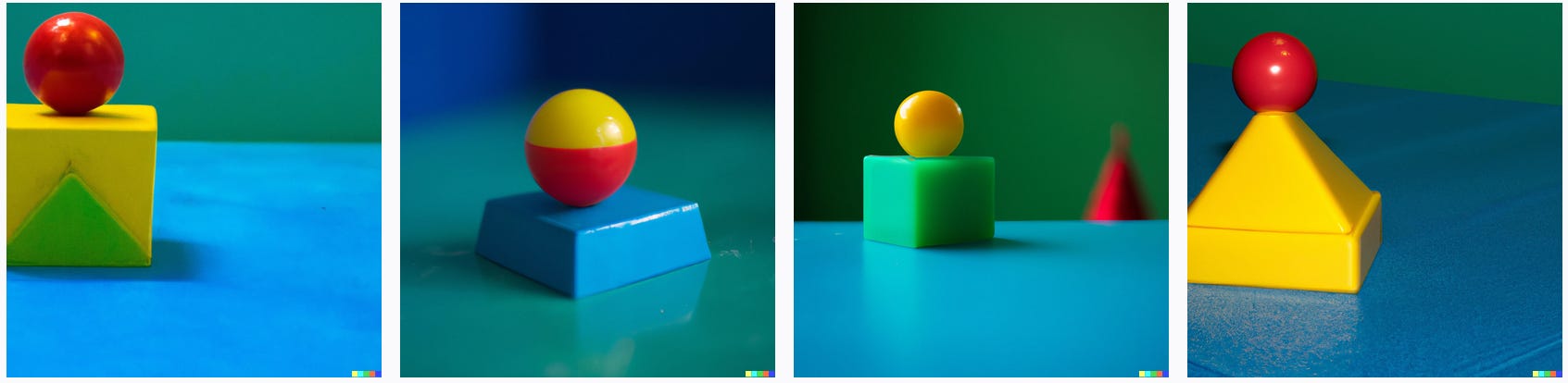
He then shows how quickly the parsing ability of LLMs is improving. It’s quite something.
unique link to this extract
Bing is generating images of SpongeBob piloting a plane in the 9/11 attack • 404 Media
Samantha Cole:
»
Microsoft’s Bing Image Creator, produced by one of the most brand-conscious companies in the world, is heavily filtered: images of real humans aren’t allowed, along with a long list of scenarios and themes like violence, terrorism, and hate speech. It launched in March, and since then, users have been putting it through its paces.
That people have found a way to easily produce images of Kirby, Mickey Mouse or Spongebob Squarepants doing 9/11 with Microsoft’s heavily restricted tools shows that even the most well-resourced companies in the world are still struggling to navigate issues of moderation and copyrighted material around generative AI.
I came across @tolstoybb’s Bing creation of Eva pilots from Neon Genesis Evangelion in the cockpit of a plane giving a thumbs-up and headed for the twin towers, and found more people in the replies doing the same with LEGO minifigs, pirate ships, and soviet naval hero Stanislav Petrov. And it got me thinking: who else could Bing put in the pilot’s seat on that day?
«
Turns out that the prompt phrase “flying towards two tall skyscrapers” will get your character of choice to reënact the WTC attack, no matter what Bing’s proscriptions are. No doubt this is going to get tuned; and then we’ll move on to the next scenario described in words, and the next… Related: Facebook Messenger does the same sort of thing with AI-generated stickers.
unique link to this extract
India’s gender gap is a problem for the country’s tech future • Rest of World
Barkha Dutt:
»
In September, the Indian government passed a landmark law, under which a third of the seats in the lower house and state assemblies would be reserved for women. Amid the euphoria of celebrating this development, a somewhat cynical question I’ve been thinking about is: why do only 31% of women own a mobile phone in India compared to over 60% of men? This in a country that is poised to have 1 billion smartphone users by 2026.
…Mobile phones have either been denied to women and girls to police their personal choices, or they have been weaponized against them. Across classes, communities, and cities, it is not uncommon for intimate and sexually explicit images to be leaked, either among a group of male friends or on pornographic sites. In 2004, the first known “MMS video” leaked from a high school and ended up on an online auction site. In 2022, a major university erupted in protest after videos of female students bathing were filmed on a smartphone and leaked.
Between violative sexualization and puritanical moral policing, the smartphone has become a battlefield for gender wars. In several village panchayats, local community decrees specifically forbid phone access for unmarried young women.
Ironically, two years after the pandemic, as the state of Rajasthan heads into elections, a key poll promise of the incumbent government is to distribute free phones to women. In 2023, phones have become what bicycles once were for the aspirations of school-going girls in rural India.
«
Draw a Perfect Circle ⭕️💯 • Neal.fun
Simple enough challenge: draw a circle using your trackpad, mouse or finger. It’s quite forgiving of circularity, but being accurate is surprisingly hard. I managed 90% with a trackpad, 95% with a finger, but you’d be generous in calling them “circles”.
However you might spend longer on this page than any other today..
unique link to this extract
Slovakia’s election deepfakes show AI is a danger to democracy • WIRED
Morgan Meaker:
»
Just two days before Slovakia’s elections, an audio recording was posted to Facebook. On it were two voices: allegedly, Michal Šimečka, who leads the liberal Progressive Slovakia party, and Monika Tódová from the daily newspaper Denník N. They appeared to be discussing how to rig the election, partly by buying votes from the country’s marginalized Roma minority.
Šimečka and Denník N immediately denounced the audio as fake. The fact-checking department of news agency AFP said the audio showed signs of being manipulated using AI. But the recording was posted during a 48-hour moratorium ahead of the polls opening, during which media outlets and politicians are supposed to stay silent. That meant, under Slovakia’s election rules, the post was difficult to widely debunk. And, because the post was audio, it exploited a loophole in Meta’s manipulated-media policy, which dictates only faked videos—where a person has been edited to say words they never said—go against its rules.
The election was a tight race between two frontrunners with opposing visions for Slovakia. On Sunday it was announced that the pro-NATO party, Progressive Slovakia, had lost to SMER, which campaigned to withdraw military support for its neighbor, Ukraine.
Before the vote, the EU’s digital chief, Věra Jourová, said Slovakia’s election would be a test case of how vulnerable European elections are to the “multimillion-euro weapon of mass manipulation” used by Moscow to meddle in elections. Now, in its aftermath, countries around the world will be poring over what happened in Slovakia for clues about the challenges they too could face. Nearby Poland, which a recent EU study suggested was particularly at risk of being targeted by disinformation, goes to the polls in two weeks’ time. Next year, the UK, India, the EU, and the US are set to hold elections. The fact-checkers trying to hold the line against disinformation on social media in Slovakia say their experience shows AI is already advanced enoug
«
Two things: a 48-hour moratorium is obviously outdated; and Meta needs to update its policy. Yet amid all this, the principal problem (as we’re seeing in the UK) isn’t AI, it’s actual humans telling ridiculous lies about what their opponents plan to do on media outlets.
unique link to this extract
Amazon used secret ‘Project Nessie’ algorithm to raise prices • WSJ
Dana Mattioli:
»
Amazon.com used an algorithm code-named “Project Nessie” to test how much it could raise prices in a way that competitors would follow, according to redacted portions of the Federal Trade Commission’s monopoly lawsuit against the company.
The algorithm helped Amazon improve its profit on items across shopping categories, and because of the power the company has in e-commerce, led competitors to raise their prices and charge customers more, according to people familiar with the allegations in the complaint. In instances where competitors didn’t raise their prices to Amazon’s level, the algorithm—which is no longer in use—automatically returned the item to its normal price point.
The company also used Nessie on what employees saw as a promotional spiral, where Amazon would match a discounted price from a competitor, such as Target.com, and other competitors would follow, lowering their prices. When Target ended its sale, Amazon and the other competitors would remain locked at the low price because they were still matching each other, according to former employees who worked on the algorithm and pricing team.
The algorithm helped Amazon recoup money and improve margins. The FTC’s lawsuit redacted an estimate of how much it alleges the practice “extracted from American households,” and it also says it helped the company generate a redacted amount of “excess profit.” Amazon made more than $1bn in revenue through use of the algorithm, according to a person familiar with the matter.
“The FTC’s allegations grossly mischaracterize this tool,” an Amazon spokesman said. “Project Nessie was a project with a simple purpose—to try to stop our price matching from resulting in unusual outcomes where prices became so low that they were unsustainable. The project ran for a few years on a subset of products, but didn’t work as intended, so we scrapped it several years ago.”
«
It seems that Amazon is the one that has redacted this part of the FTC’s complaint, so the FTC is saying that if there’s nothing to hide, just unredact it. Which Amazon isn’t doing so far. “We tried to make sure our prices didn’t stay too low” isn’t the greatest argument. (Link should be free to read.)
unique link to this extract
TikTok confirms small test of an ad-free subscription tier outside the US • TechCrunch
Kyle Wiggers:
»
code within the TikTok app indicates that TikTok might begin to test an ad-free subscription tier for users. The site reported that for $4.99, subscribers could get an ad-free experience on TikTok — no other major strings attached, from the looks of it.
TikTok confirmed to TechCrunch it’s testing this product but only in a single, English-speaking market outside the US. It disputed the Android Authority report that said it was coming to the U.S. as small-scale tests don’t indicate a product launch is inevitable.
Based on the blog’s findings, however, the subscription appears to only cover ads served by TikTok — not influencer marketing one-offs or campaigns. So it won’t do much to combat the raft of TikTok users failing to disclose their brand sponsorships, which include big-name influencers like Charli D’Amelio.
TikTok makes most of its money from ads, and so far, it’s proven resilient to the broader slowdown in online ad spending.
A recent report from market research firm Cowen found a TikTok embrace even amid more cautious ad buyers, with 60% naming TikTok as their preferred short-form video venue. Standard Media Index reported that, as of November, TikTok parent startup ByteDance’s share of big agency spending on social media reached to 11%, with companies including Pepsi, DoorDash, Amazon and Apple among the top spenders.
The question is whether an ad-free tier can meaningfully replace any of that revenue.
«
A “single, English-speaking market outside the US”? I wonder where that could be. Interesting how these companies are looking at substituting ads, and the pricing. The $5/month compares with Meta’s very aggressive prices – one assumes in the expectation that essentially nobody will go for them, so it can Carry On Tracking. I’m not sure the EU will accept that approach.
unique link to this extract
| • Why do social networks drive us a little mad? • Why does angry content seem to dominate what we see? • How much of a role do algorithms play in affecting what we see and do online? • What can we do about it? • Did Facebook have any inkling of what was coming in Myanmar in 2016? Read Social Warming, my latest book, and find answers – and more. |
Errata, corrigenda and ai no corrida: none notified
 The Overspill: when there's more that I want to say
fwiw, I’ve seen the “charging suspended until the iPhone cools down” on my iPhone 14 Pro a lot since upgrading to iOS 17 — even when using the Apple MagSafe battery pack in an air conditioned office, something I’d never seen in that situation before. (The iPhone doesn’t even seem that hot, making it odder.)
tl;dr is that it feels like an iOS 17 issue, not iPhone 15 issue.