
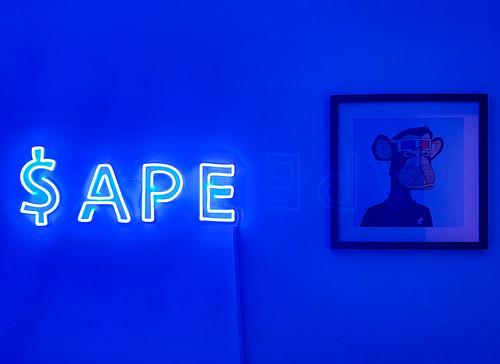
Would you be astonished to hear that NFTs are worthless now? Did you think they were worthful before? CC-licensed photo by Marco Verch on Flickr.
You can sign up to receive each day’s Start Up post by email. You’ll need to click a confirmation link, so no spam.
There’s another post coming this week at the Social Warming Substack at about 0845 UK time. Free signup.
A selection of 9 links for you. Exciting? I’m @charlesarthur on Twitter. On Mastodon: https://newsie.social/@charlesarthur. Observations and links welcome.
Inside Apple’s spectacular failure to build a key part for its new iPhones • WSJ
Aaron Tilley and Yang Jie:
»
Apple had planned to have its modem chip ready to use in the new iPhone models. But tests late last year found the chip was too slow and prone to overheating. Its circuit board was so big it would take up half an iPhone, making it unusable.
…[Apple chip chief Johny] Srouji flew to Munich to greet Apple’s newly acquired Intel wireless employees in December 2019. He told a gathering that the modem-chip project would be a game changer for Apple, the next step in the company’s evolution, said people who watched the meeting. He said the chip would distinguish Apple devices, as Apple’s processors had done.
As Apple filled the project’s ranks with Intel engineers and others hired from Qualcomm, company executives set a goal to have the modem chip ready for fall 2023. It soon became apparent to many of the wireless experts on the project that meeting the goal was impossible.
Apple found that employing the brute force of thousands of engineers, a strategy successful for designing the computer brain of its smartphones and laptops, wasn’t enough to quickly produce a superior modem chip.
Modem chips are trickier to make than processing chips because they must work seamlessly with 5G wireless networks, as well as the 2G, 3G and 4G networks used in countries around the world, each with its own technological quirks. Apple microprocessors run software programs designed solely for its iPhones and laptops.
Apple executives who didn’t have experience with wireless chips set tight timelines that weren’t realistic, former project engineers said. Teams had to build prototype versions of the chips and certify they would work with the many wireless carriers worldwide, a time-consuming job.
Executives better understood the challenge after Apple tested its prototypes late last year. The results weren’t good, according to people familiar with the tests. The chips were essentially three years behind Qualcomm’s best modem chip. Using them threatened to make iPhone wireless speeds slower than its competitors.
«
(The link should be free to read.)
unique link to this extract
Nearly 500 brands exited smartphone market during 2017-2023 • Counterpoint Research
»
At its peak in 2017, the global smartphone market saw more than 700 brands fiercely competing and contributing to the total annual sales of over 1.5 billion units. Fast forward to 2023 and the number of active brands (that have recorded sell-through volumes) is down by a third to almost 250, according to Counterpoint’s Global Handset Model Sales Tracker, which has been tracking sales of these brands across more than 70 key countries.
A maturing user base, improving device quality, longer replacement cycles and a growing refurbished secondary market, along with economic headwinds, supply-chain bottlenecks, major technological transitions such as 4G to 5G, and the growing scale and concentration of power in a handful of brands, have gradually whittled down the number of active brands and their volumes over the years.
It has become difficult to remain profitable and feasible in this maturing marketplace. For example, major local smartphone brands, known as “local kings”, like Micromax, Intex and Karbonn in India; InnJoo and Xtouch in the Middle East and Africa; Meizu, Meitu, Gionee and Coolpad in China; Kyocera and NEC in Japan; and LG in South Korea, have exited over the last five years.
Strikingly, the decline in the number of active brands is almost entirely coming from local brands. The number of global brands has remained consistent at over 30. Most local brands operate in regions that have fragmented markets across wide geographies, like Asia-Pacific, Latin America and Middle East and Africa. Such brands focus on customers looking for affordable devices.
«
Combination of the pandemic, followed by component shortages, followed by the “macroeconomic climate”. Surely overdue, but still dramatic – and shows that the smartphone is well into its maturity.
unique link to this extract
Why TikTok is banned in some African countries • Rest of World
Damilare Dosunmu:
»
TikTok is getting caught in political and moral disputes across several African nations.
In August, Senegal and Somalia banned the app, with calls to do the same in Kenya and Uganda. While local governments and petitioners have cited security risks and morality as reasons to take action against TikTok, lawyers and activists told Rest of World via text and social media messages that the Chinese app is falling prey to politically motivated decisions.
“It seems it’s a political decision shrouded in a morality cloak,” said Mohamed Mubarak, a Somali policy analyst. “The government is unhappy about the political parody of the president and [prime minister] and is using ‘human rights’ as a justification.” In its official announcement of the ban on August 20, the Somali government said its decision was based on the damage the app had caused to the country’s social morals and cultural values.
In an emailed statement to Rest of World, TikTok said it’s engaging with local governments and key stakeholders to arrive at a resolution that ensures it continues operations in Africa. “At TikTok, we have over 40,000 talented safety professionals dedicated to keeping TikTok safe,” the email read. “TikTok is for users aged 13 and above. One of our most important commitments is supporting the safety and well-being of teens, and we recognise this work is never finished.”
«
DuckDuckGo CEO says it takes ‘too many steps’ to switch from Google • Bloomberg via Yahoo
Todd Shields:
»
Founded in 2008, DuckDuckGo currently has about a 2.5% share of the market for search in the US, said CEO Gabriel Weinberg, and conducts about 100 million searches a day globally. In comparison, Google conducts several billion searches daily.
Weinberg said about 30% to 40% of DuckDuckGo’s users have a “strong preference” for privacy and that most of the company’s users switch over from Google.” The company considers Google to be “far and away” its biggest competitor.
“Switching is way harder than it needs to be,” Chief Executive Officer Gabriel Weinberg said in federal court on Thursday. “There’s just too many steps.”
Weinberg testified Thursday in the government’s antitrust trial against Google’s parent, Alphabet Inc. The Department of Justice claims Google pays more than $10 billion a year to tech rivals, smartphone makers and wireless providers to be the preselected option, or default, on PCs and mobile phones.
By illegally maintaining this monopoly, the government alleges, Google has kept rival search engines such as Microsoft Corp.’s Bing and DuckDuckGo from gaining the scale needed to compete. Google says it has won its market share, which the government has pegged at almost 90%, because it has the best search engine.
«
I’ve met Weinberg a couple of times – he’s a nice guy, making a useful search engine (I’ve used DDG for more than a decade). He says it takes 15 or more clicks to change the default search on Android; it should be one. Google said it’s four on iOS.
unique link to this extract
Searching for a breakup • Medium
Scott Galloway:
»
what was the last innovative Google product? Restructuring the brand’s architecture under Alphabet? Earnings growth has, mostly, been a function of finding new ways to extract profits from its monopoly: Google search results have become a billboard for Google-sponsored results interspersed with content harvested from other sites and links to Google’s own services.
In 2020, The Markup found that Google-associated results (ads for or links to the company’s other services) constituted over 60% of the first screen of an average Google search result. And in 1 of 5 searches, the entire first screen is Google results. This is the meat of its business: search ads generate 57% of the company’s revenue.
Despite turning search results into a carousel of ads and Google services, Google has racked up 90% market share in search queries — 95% on mobile. How? As Microsoft once did, it leverages its control over the most popular mobile operating system (Android) and spends unprecedented sums on deals assuring it is the default search engine on computers and phones — more than $10bn per year. Google says it’s the leader because it has the best product, but if that’s so … why pay $10bn a year to be the default?
«
It’s slightly post-hoc to say “it leverages its control over the most popular mobile operating system” – Android’s success wasn’t a foregone conclusion in 2010, for example, when Nokia and Windows Phone were still alive. (Though, strategically, Eric Schmidt – on Apple’s board – had tied up the search deal on the first iPhone.)
But the final question – if you’re so great, why do you have to pay people so much to tell you that you’re great? – is the important one, and is coming under the spotlight in the US antitrust trial.
unique link to this extract
March 2023: a gadget recession • Inside Orchard
Neil Cybart, on his site for observations about the wider tech market, writing back in March (before the Vision Pro was unveiled, but was suspected):
»
While economic and competitive pressures are genuine, there is another factor unfolding in the gadget space that can’t be ignored. Beginning at the tail end of the pandemic, various tech YouTubers began to speak up about a marked slowdown in views and engagement. Things felt off in the tech vertical, and the pandemic didn’t seem to fully explain the situation.
In retrospect, the changes may be the byproduct of something akin to a settling out process in the gadget space. We aren’t quite ready to jump into the face wearables era. Apple is expected to unveil their move into the space in a few months with a launch later in the year. Meanwhile, the smartphone and tablet space has been unfolding along ecosystem grounds. The iPhone business has been a replacement business for years with the majority of sales going to existing iPhone users upgrading their device.
Taking a step back to look at broader industry trends, a gadget recession likely won’t be met with a wave of M&A. Instead, it is far more likely management teams will reassess their commitment to hardware in the first place. News of Microsoft and Google getting out of hardware altogether would not surprise me. There comes a point when years of investment dollars and managerial/talent resources just become too hard to justify when there is little to nothing to show for such efforts. The rationale that these companies gave for being in hardware in the first place has never been strong either.
«
Since then Microsoft’s hardware chief has jumped ship (to Amazon, whose hardware chief departed). There’s a definite feeling that the hardware space has been wrung absolutely dry.
unique link to this extract
Microsoft’s Surface Go 4 gets a much-needed performance boost • The Verge
Jess Weatherbed:
»
Microsoft has announced the Surface Go 4 — the latest version of its affordable 2-in-1 laptop series — at its Surface device launch event today. The new Go 4 features some minor performance upgrades over its predecessor, but it won’t be sold to consumers — the company says it’s specifically targeted at businesses and frontline workers.
…But the overall design being near-identical to its predecessor doesn’t particularly bode well for the Surface Go 4. In our review of the Surface Go 3, The Verge lambasted the convertible device for its flimsy build quality, poor battery life, and being too expensive for what you’re actually getting.
A quick hands-on test of the Surface Go 4 confirmed our suspicions. Performance was slow when running through some everyday tasks like web browsing and took embarrassingly long to switch between display orientations. Still, Microsoft is claiming that performance on the Windows 11 Pro version of the Surface Go 4 should be 80% faster than its predecessor.
«
Businesses only? One could imagine that this is a sign of Microsoft retreating from the wider market, perhaps.
unique link to this extract
The social media panic-mongers have pivoted to AI • The Daily Beast
Louis Anslow:
»
Over a hundred influential leaders in media, government, philanthropy, and business gathered in New York City to hear [Tristan] Harris and his Center for Humane Technology co-founder, Aza Raskan, make a presentation which opened with a comparison of AI to nuclear weapons. This analogy was designed to evoke fear, leaving no room for nuanced discussions of risk and benefit (nuclear technology is also a critical tool for carbon free energy, for example.) This notion was seemingly borrowed from Yuval Noah Harari, whose quote, “What nukes are to the physical world… AI is to everything else,” was also featured later in the presentation.
It was the kind of rhetoric worthy of people the neuroscientist Darshana Narayanan has labeled “science populists”—a group she defined as “gifted storytellers who weave sensationalist yarns around scientific ‘facts’ in simple, emotionally persuasive language.” Narayana’s piece focused on Harari, but could have just as easily been about Harris.
Harris and Raskan’s presentation fit this description throughout and, thankfully, at least two veteran journalists in the audience saw through it. Steven Levy, editor in chief of Wired magazine, wrote a scathing article in March 2023 titled, “How to Start an AI Panic,” laying into their populist, sensationalist rhetoric—and comparing it to the Reefer Madness tone of [Netflix film] The Social Dilemma.
In a post-presentation interview with Harris, veteran tech reporter Kara Swisher asked about the claim that “50% of AI researchers predict a 10% chance of extinction,” noting that the statistics were drawn from “a non-peer reviewed survey, a single question one, with around 150 responses.”
Harris retorted: “Don’t trust one survey.”
«
Anslow makes a valid point: for some people, mongering fear about The New Hotness become a way of life, and when The New Hotness cools down, their options are to cool down with it, or find a New New Hotness to get bothered about. He isn’t sparing over who he points to either.
unique link to this extract
NFT crash: 95% of the market is now worthless, study finds • Business Insider
Phil Rosen:
»
Are NFTs dead?
A recent study looking at the price of thousands of collections seems to suggest the answer is “yes.”
A report by dappGambl based on data provided by NFT Scan and CoinMarketCap indicated that 95% of non-fungible tokens were effectively worthless. Out of 73,257 NFT collections, 69,795 of them had a market cap of zero ether.
By their estimates, almost 23 million people hold these worthless assets.
“This daunting reality should serve as a sobering check on the euphoria that has often surrounded the NFT space,” the researchers said. “Amid stories of digital art pieces selling for millions and overnight success stories, it is easy to overlook the fact that the market is fraught with pitfalls and potential losses.”
NFTs are digital representations of art or collectibles tied to a blockchain, typically ethereum, and each one has a unique signature that cannot be duplicated. In 2021 and 2022, the NFT market saw a huge bull run, at one point leading to $2.8bn in monthly trading volume. [That’s $2.8bn of Monopoly money, not real money – Overspill Ed.]
During that time, popular collections such as Bored Apes and CryptoPunks were selling for millions of dollars, and celebrities such as Stephen Curry and Snoop Dogg participated in the hype. The boom coincided with cryptocurrency’s peak when bitcoin was trading close to $70,000. On Wednesday, the price of the crypto hovered just above $27,000.
But as dappGambl’s study suggests, that’s all come crashing down. 79% of all NFT collections currently remain unsold, and the surplus of supply over demand has created a buyer’s market that isn’t doing anything to revive enthusiasm.
«
Hard to choose between “shocked, I tell you, shocked” and “Oh no! Anyway…” But: 23 million people were that credulous? Well done internet for finding the world’s dimmest people.
unique link to this extract
| • Why do social networks drive us a little mad? • Why does angry content seem to dominate what we see? • How much of a role do algorithms play in affecting what we see and do online? • What can we do about it? • Did Facebook have any inkling of what was coming in Myanmar in 2016? Read Social Warming, my latest book, and find answers – and more. |
Errata, corrigenda and ai no corrida: none notified
 The Overspill: when there's more that I want to say