
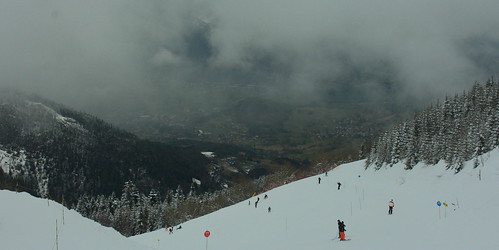
The French ski resort of La Sambuy is now just a resort, after warming winters killed its pistes. CC-licensed photo by dmytrok on Flickr.
You can sign up to receive each day’s Start Up post by email. You’ll need to click a confirmation link, so no spam.
A selection of 9 links for you. Piste off. I’m @charlesarthur on Twitter. On Mastodon: https://newsie.social/@charlesarthur. Observations and links welcome.
Self-publishers must declare if content sold on Amazon’s site is AI-generated • The Guardian
Ella Creamer:
»
Amazon has introduced new rules and guidance for Kindle books generated by artificial intelligence tools, including the requirement that authors inform it when content is AI-generated.
The company announced the new rules on its Kindle Direct Publishing (KDP) forum on Wednesday. It said in a statement: “Beginning today, when you publish a new title or make edits to and republish an existing title through KDP, you will be asked whether your content is AI-generated.” KDP allows authors to self-publish their books and put them up for sale on Amazon’s site.
Amazon also added a new section to its content guidelines focused on AI, which now includes definitions of “AI-generated” and “AI-assisted” content and states that sellers are not required to disclose when content is AI-assisted.
AI-generated content is defined by the company as “text, images or translations created by an AI-based tool”, even if substantial edits are made afterwards. AI-assisted content is classified as that created by authors and sellers themselves but where AI tools are used to “edit, refine, error-check, or otherwise improve”.
The guidelines also state that AI-based tools can be used to “brainstorm and generate ideas” without disclosure, as long as the text or images were ultimately created by the human author.
The new rules come weeks after the site removed suspected AI-generated books that imitated the work of real authors. In August, the author Jane Friedman complained that several books, which she believed were created by AI tools, were falsely listed as being written by her. The books were subsequently removed by Amazon.
«
This is a great solution, because everybody always tells the truth when they’ve used AI to write a book, and Amazon has an AI detection system that is absolutely perfect in distinguishing AI-written content from human-generated stuff.
unique link to this extract
French ski resort closes permanently because there’s not enough snow • CNN
Maya Szaniecki:
»
La Sambuy, a town which runs a family skiing destination near Mont Blanc in the French Alps, has decided to dismantle its ski lifts because global warming has shrunk its ski season to just a few weeks, meaning it’s no longer profitable to keep them open.
“Before, we used to have snow practically from the first of December up until the 30th of March,” La Sambuy’s mayor, Jacques Dalex, told CNN. Last winter, however, there was only “four weeks of snow, and even then, not much snow,” he added. That meant “very quickly, stones and rocks appeared on the piste.”
Able to open for fewer than five weeks during January and February, Dalex said the resort was looking at an annual operating loss of roughly €500,000 ($530,000). Keeping the lifts going alone costs €80,000 per year.
La Sambuy isn’t a huge resort, with just three lifts and a handful of pistes reaching up to a top height of 1,850 meters (about 6,070 feet).
…La Sambuy is not the only French ski resort facing a meltdown. Last year, Saint-Firmin, another small Alpine ski destination, opted to remove its ski lift after seeing its winter season dwindle from months to weeks, a situation also blamed on climate change.
Mountain Wilderness, a French environmental group, says it has dismantled 22 ski lifts in France since 2001, and estimates that there are still 106 abandoned ski lifts across 59 sites in the country.
«
Twitter is still throttling competitors’ links; check for yourself • The Markup
Jon Keegan, Dan Phiffer and Joel Eastwood:
»
Twitter continues to slow traffic to competing sites nearly a month after it partially pulled back from such throttling, a Markup analysis has found.
Users of the social platform, now officially known as X, are made to wait on average about two and a half seconds after clicking on links to Bluesky, Facebook, Instagram, and Substack, the analysis found. That’s more than 60 times longer than the average wait for links to other sites.
While not included in our full tests, the delay appears to also include links to the new Threads platform, which like Facebook and Instagram is owned by Meta.
…Slowing traffic to websites can harm the companies that run the sites and the people who use them. Even a 2.5-second delay after clicking a link can feel extremely slow to users, potentially discouraging them from waiting around for content to load. A 2017 Google study found that the probability of a user “bouncing,” or abandoning a site, increased 32% when page load times increased to three seconds from one second.
Substack co-founders Chris Best, Hamish McKenzie, and Jairaj Seth wrote that they hope X reverses its decision to impose a delay on Substack links. “Writers cannot build sustainable businesses if their connection to their audience depends on unreliable platforms that have proven they are willing to make changes that are hostile to the people who use them,” they said in an email. Meta and Bluesky did not respond to a request for comment.
«
Elon Musk suggests he will charge all X/Twitter users a fee • Variety
Todd Spangler:
»
Elon Musk may flip the switch to make X — the social network formerly known as Twitter — an entirely subscription-based platform.
Musk brought up the idea of charging all users of X/Twitter during a wide-ranging conversation focused on AI that featured Israeli Prime Minister Benjamin Netanyahu on Monday. “We’re moving to having a small monthly payment for use of the X system,” Musk told Netanyahu, claiming that “it’s the only way I can think of to combat vast armies of bots.” His comments were initially reported by Bloomberg’s Dave Lee.
Musk didn’t mention timing of his plan to charge X/Twitter users, nor did he say exactly how much it would cost other than to say a monthly fee of “a few dollars or something” would deter the creation of bot accounts. According to Musk, X has 550 million monthly active users, who share 100 million-200 million posts daily on the social network.
Musk has previously mulled the idea of putting Twitter entirely behind a paywall in internal conversations, according to industry news site Platformer. Musk, who also is CEO of Tesla and SpaceX, has said X/Twitter ad sales have plunged 50% since he bought the company. “We’re still negative cash flow, due to ~50% drop in advertising revenue plus heavy debt load,” Musk posted on July 15.
«
OK, so I did use another part of this (evidently wide-ranging, and bizarre) conversation yesterday, but of course this is the bit that really focuses one’s attention. In passing: the photograph of Musk makes him look as though he’s made of wax and he’s under an infrared lamp. Meanwhile, Bluesky saw record signups after Musk’s announcement.
I’ll write at length about the potential efficacy of this idea on the Social Warming Substack on Friday.
unique link to this extract
U.S. COVID levels approach pandemic’s 2020 peak • Fortune Well
Erin Prater:
»
US COVID infections are hovering near levels of the pandemic’s first peak in 2020, and approaching the Delta peak of late 2021, according to wastewater surveillance and modeling by forecasters.
It’s yet another sign that while the official pandemic state may be over, the days of COVID are far from it.
Viral wastewater levels are not far behind all of the pandemic’s 2020 peaks except for one—the initial peak of March 2020, which they’ve already surpassed. And they lag just slightly levels seen during the deadly Delta peak of late 2021, according to Biobot Analytics, which monitors such data for the federal government.
A forecast issued this week by Jay Weiland, a leading COVID modeler, came to the same conclusions. On Thursday, Weiland estimated that 650,000 Americans are becoming infected daily, with 1 in 51 Americans currently infected with COVID.
«
I wonder about the forecasting here. Testing wasn’t as widespread in early 2020, so levels could have been higher then. And also: the difference is that huge tracts of the population is vaccinated now. The story says that hospitalisations and deaths are rising, but carefully avoids giving any numbers to compare that data with 2020.
unique link to this extract
Why we procrastinate when we have long deadlines • Harvard Business Review
Meng Zhu:
»
“Can you get that to me by the end of the day?” isn’t a request many employees like to hear. But for many people, having shorter deadlines instead of longer ones — “Do you think you can do that by the end of the week?” — might actually help them complete a task and see their work as being less difficult.
In a recent study published in the Journal of Consumer Research, my colleagues Rajesh Bagchi and Stefan Hock and I demonstrate that longer deadlines can lead workers to think an assignment is harder than it actually is, which causes them to commit more resources to the work. This, in turn, increases how much they procrastinate and their likelihood of quitting. This is true even when the deadline length is incidental, such as when a venue or guest isn’t available for an extended period of time.
In our research we asked volunteers at a local community center to answer a short survey about retirement planning. We set two incidental deadlines. In one group, the online survey could be accessed throughout the next seven days, but the other group had 14 days. Results showed that participants who faced the longer deadline wrote longer responses to the survey and spent more time on it. But there was a catch: Those same participants were more likely to procrastinate and were less likely to complete the assignment than their time-constrained counterparts.
«
They could have just asked some journalists, who would have told them that given a day to write 1,000 words, they will do very little until they have around two hours left, and then break into a sprint.
unique link to this extract
How a Ring camera can attract burglars (I learnt the hard way) • The Times
Louise Eccles:
»
Professor Claire Nee, founder of the University of Portsmouth’s International Centre for Research in Forensic Psychology, has interviewed hundreds of convicted burglars. She would not install a Ring doorbell or an alarm.
“The majority of burglars just put a balaclava on because they’re aware of video footage,” she said. “Alarms often actually attract burglars to houses. They are a wealth cue — it means there is going to be something worth stealing.
“Neighbours tend not to respond to alarms unless they go for ages and, even with monitored alarms [which call to police], you’re lucky if anyone arrives within 15 minutes. Most burglaries are over in eight to ten minutes.”
The best deterrents are secure window locks, indoor lights on a timer, external lights on a timer or sensor and double door locks or deadlocks, according to research published in 2019 by criminology professors at UCL and Nottingham Trent and Loughborough universities. They found that alarms increased the burglary risk because they suggested there were valuables and gave “a false sense of protection that makes such households ‘careless’.”
Nee suggests looking for places where people could get in by jumping gates or breaking weak window locks. “A burglar will much prefer to go to the rear of the house if they can,” she said. “That doesn’t mean they won’t go through the front door, because we are absolutely terrible at leaving our bags and car keys really near the front door.”
«
iOS 17 release: everything you need to know about Apple’s big updates • The Guardian
Samuel Gibbs:
»
Announced at the company’s developer conference in June, iOS 17, iPadOS 17 and watchOS 10 add a much-improved keyboard with autocorrect that will let you swear, new standby modes, contact posters, greater customisation and the biggest reworking of the Apple Watch’s interface since launch.
Here’s what you need to know about the updates.
«
More and more there’s less and less to take much notice of; though Stage Manager seems to be tacking iPadOS more towards the full desktop metaphor, and the Apple Watch has changed what the buttons do: less swiping, more pressing.
unique link to this extract
Why is Apple’s second-generation UWB chip exciting? • Estimote Blog
»
Another potential future application of the lower power UWB [ultra-wideband] chip [in the new iPhone and Apple Watch] might involve a technique named Downlink TDoA. This stands for “time difference of arrival,” a new standard championed by the FiRa organization. It lets UWB-enabled phones passively receive signals from UWB beacons or anchors.
Imagine your car in a tunnel where GPS is unavailable. UWB beacons in the tunnel transmit radio signals to your phone. Your phone captures these signals, and using the time difference of their arrival, it can calculate the exact position of the car inside the tunnel. With Downlink TDoA, beacons don’t collect any data from to the phone. The precise location is determined solely by the UWB chip on the phone. This approach is seen as safer and more privacy-centric than traditional real-time location systems (RTLS). As a result, it’s often referred to as Untracked Indoor Positioning.
This innovative, privacy-centric way of determining indoor positioning could also be applied in airports, malls, museums, and more. It could effectively deliver what the iBeacon promised years ago, but with inch-perfect accuracy and superior security.
To make such experiences possible, a low-power UWB processor like the second-gen chip is essential. The phone would need to constantly detect UWB signals from nearby beacons, and it’s crucial that this happens efficiently.
There’s also speculation that the UWB chip may eventually interact with Apple’s new smart glasses. This makes a lot of sense. Currently, Vision Pro determines its spatial orientation in a room using computer vision and image processing. Using the UWB chip and radio signals for this purpose would use order of magnitude less power. Preserving power could allow Apple to design more compact and lighter smart glasses in the future.
«
I always think that sentences beginning “Imagine your car…” or “There’s also speculation…” aren’t the most reliable guides to what’s going to happen, but the Vision Pro point might come through.
unique link to this extract
| • Why do social networks drive us a little mad? • Why does angry content seem to dominate what we see? • How much of a role do algorithms play in affecting what we see and do online? • What can we do about it? • Did Facebook have any inkling of what was coming in Myanmar in 2016? Read Social Warming, my latest book, and find answers – and more. |
Errata, corrigenda and ai no corrida: none notified
 The Overspill: when there's more that I want to say
The more I look at the Vision Pro, the more I think we’re overlooking how many of these gestures and technology will be built into Apple’s other products. Just like we’ve seen with this new two finger gesture with the Apple Watch. That’s where it’s going to have it’s biggest influence over the main market.
I suspect that The Musky Evil One was basically naively re-inventing the old email spam solution of “electronic postage”. As net.graybeards know, there’s a constant stream of people who come up with a supposedly brilliant idea of charging a small fee on every message in order to thwart spammer economics – i.e. essentially zero-cost messages. While I think there’s a lot of Dunning-Kruger when pundits write about Musk, I’ve seen so many smart people propose this as if they are the first to have ever thought of it, that I feel fairly safe in conjecturing that we’re seeing another round of it.
I predict nothing will come of it. The possibility of making Twitter a profitable company was a gamble, but not a completely insane idea, especially for someone who has been very successful at business. But charging for every account is at an entirely different level. Likely the finance people will quietly explain this, and eventually no more will be heard on the topic.