
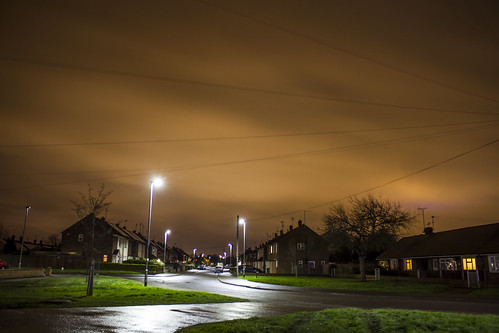
Light pollution is now so pervasive that astronomers have coined a word for wanting the darkness back: “noctalgia”. CC-licensed photo by Nikk on Flickr.
You can sign up to receive each day’s Start Up post by email. You’ll need to click a confirmation link, so no spam.
A selection of 9 links for you. Gotta wear shades. I’m @charlesarthur on Twitter. On Mastodon: https://newsie.social/@charlesarthur. Observations and links welcome.
How to tell if your AI is conscious • The New York Times
Oliver Whang:
»
The fuzziness of consciousness, its imprecision, has made its study anathema in the natural sciences. At least until recently, the project was largely left to philosophers, who often were only marginally better than others at clarifying their object of study. Hod Lipson, a roboticist at Columbia University, said that some people in his field referred to consciousness as “the C-word.” Grace Lindsay, a neuroscientist at New York University, said, “There was this idea that you can’t study consciousness until you have tenure.”
Nonetheless, a few weeks ago, a group of philosophers, neuroscientists and computer scientists, Dr. Lindsay among them, proposed a rubric with which to determine whether an AI system like ChatGPT could be considered conscious. The report, which surveys what Dr. Lindsay calls the “brand-new” science of consciousness, pulls together elements from a half-dozen nascent empirical theories and proposes a list of measurable qualities that might suggest the presence of some presence in a machine.
For instance, recurrent processing theory focuses on the differences between conscious perception (for example, actively studying an apple in front of you) and unconscious perception (such as your sense of an apple flying toward your face). Neuroscientists have argued that we unconsciously perceive things when electrical signals are passed from the nerves in our eyes to the primary visual cortex and then to deeper parts of the brain, like a baton being handed off from one cluster of nerves to another. These perceptions seem to become conscious when the baton is passed back, from the deeper parts of the brain to the primary visual cortex, creating a loop of activity.
«
It’s a subtle discussion, though there seems to be a nod towards recursion as the definition (or causation, or essence) of consciousness, as previously discussed here.
unique link to this extract
Antarctic sea-ice at ‘mind-blowing’ low alarms experts • BBC News
Georgina Rannard, Becky Dale and Erwan Rivault:
»
The sea-ice surrounding Antarctica is well below any previous recorded winter level, satellite data shows, a worrying new benchmark for a region that once seemed resistant to global warming.
“It’s so far outside anything we’ve seen, it’s almost mind-blowing,” says Walter Meier, who monitors sea-ice with the National Snow and Ice Data Center.
An unstable Antarctica could have far-reaching consequences, polar experts warn. Antarctica’s huge ice expanse regulates the planet’s temperature, as the white surface reflects the Sun’s energy back into the atmosphere and also cools the water beneath and near it. Without its ice cooling the planet, Antarctica could transform from Earth’s refrigerator to a radiator, experts say.
The ice that floats on the Antarctic Ocean’s surface now measures less than 17 million sq km – that is 1.5 million sq km of sea-ice less than the September average, and well below previous winter record lows. That’s an area of missing ice about five times the size of the British Isles.
Dr Meier is not optimistic that the sea-ice will recover to a significant degree. Scientists are still trying to identify all the factors that led to this year’s low sea-ice – but studying trends in Antarctica has historically been challenging.
In a year when several global heat and ocean temperature records have broken, some scientists insist the low sea-ice is the measure to pay attention to.
«
Still haven’t come across any good news about the climate itself.
unique link to this extract
Call of Duty Warzone: does UK esports scene need more live events? • BBC News
Shaun Dacosta:
»
The World Series of Warzone (WSOW) held its global final in London over the weekend, and it came at an interesting time for the UK esports scene.
Earlier this month, the Call of Duty League team London Royal Ravens announced it was moving to the United States – leaving Britain without a dedicated team. But if you watched the WSOW final, based on the battle royale offshoot of the first-person shooter, you would think the UK esports scene was doing pretty well.
It drew a crowd of about 3,000 people, competitors from across the world and huge numbers tuned in to watch the event online.
BBC Newsbeat spoke to Call of Duty esports bosses Daniel Tsay and Rob Belk about their decision to hold the event in London. Product manager Rob said previous experience told them the crowd’s “hype and energy” would be “off the charts”.
“People are going to be cheering, people are going to be standing up.”
And general manager Daniel said one of the top requests from the Call of Duty community has been for a UK event. “So when the team were thinking ‘where can we go?’ London came fairly organically to the top of the list,” he said.
«
$100,000 prize, livestream had 100,000 people logged on. That’s a little ahead of the number watching the UK winning a place in the Davis Cup tennis quarterfinals, a global competition, which hit about 85,000 at its peak.
unique link to this extract
Musk and Netanyahu blame “armies of bots” for spreading antisemitism on X • Ars Technica
Ashley Belanger:
»
The livestreamed event started with a one-on-one between Musk and Netanyahu that attracted more than 735,000 views. While much of the one-on-one focused on AI—which Musk claimed was “potentially the biggest civilizational threat” and Netanyahu called “a blessing and a curse”—the men also discussed their views on antisemitism and how Musk deals with hate speech on X.
“I know your commitment to free speech,” Netanyahu said about 20 minutes into the talk. “But I also know your opposition to antisemitism. You’ve spoken about it. You’ve tweeted about it. And all I could say is, I hope you find within the confines of the First Amendment the ability to stop not only antisemitism, or roll it back as best you can, but any collective hatred of people.”
Musk said that he was “sort of against attacking any group” but that defending free speech “does at times mean that there’s someone you don’t like who’s saying something you don’t like.” However, “that doesn’t mean, some sort of negativity should be pushed upon people,” Musk said, noting that X couldn’t afford to let the platform become “unpleasant,” because it would lose users. He said that’s why his platform works to de-amplify hate speech when it’s detected—”because we think probably that’s not what people want to hear.”
“Obviously, I’m against antisemitism,” Musk said. “I’m against anti-really anything that promotes hate and conflict.”
«
*me: stares into camera, blinks very slowly*
unique link to this extract
The loss of dark skies is so painful, astronomers coined a new term for it • Space
Paul Sutter:
»
What good are night-adapted senses in nocturnal species if the night sky isn’t much darker than the daytime sky? Researchers have identified several species whose circadian rhythms are getting thrown off, making them vulnerable to predation (or, the reverse: the inability to effectively locate prey).
Given the harmful effects of light pollution, a pair of astronomers has coined a new term to help focus efforts to combat it. Their term, as reported in a brief paper in the preprint database arXiv and a letter to the journal Science, is “noctalgia.” In general, it means “sky grief,” and it captures the collective pain we are experiencing as we continue to lose access to the night sky.
Thankfully, there is a way to tackle noctalgia, just as there are ways to combat climate change. On the ground, efforts have sprung up across the globe to create dark-sky reserves, where surrounding communities pledge not to encroach with further expansions of light pollution. Still, those are usually in extremely remote and inaccessible regions of the globe, so other efforts have focused on working with community and business leaders to install night-friendly lighting, such as devices that turn off automatically or point only at the ground (or are simply not used at all).
Tackling satellite-based pollution is another matter, as that will require international cooperation and pressure on companies like SpaceX to be better stewards of the skies they are filling with equipment.
«
Neat word.
unique link to this extract
US argues Google wants too much information kept secret in antitrust trial • Reuters
Diane Bartz:
»
The US Justice Department on Monday objected to removing the public from the court during some discussions of how Google prices online advertising, one of the issues at the heart of the antitrust trial under way in Washington.
The government is seeking to show that Alphabet’s Google broke antitrust law to maintain its dominance in online search. The search dominance led to fast-increasing advertising revenues that made Google a $1 trillion company.
David Dahlquist, speaking for the government, pointed to a document that was redacted that had a short back and forth about Google’s pricing for search advertising.
Dahlquist then argued to Judge Amit Mehta, who will decide the case, that information like the tidbit in the document should not be redacted. “This satisfies public interest because it’s at the core of the DOJ case against Google,” he said.
Speaking for Google, John Schmidtlein urged that all discussions of pricing be in a closed session, which means the public and reporters must leave the courtroom.
It is not unusual in merger trials for information like market share and business and pricing strategies to be redacted.
And sometimes the redactions are broader since, essentially, the companies want the information hidden and the government lawyers fighting the merger are working flat out to win rather than worrying about over-sealing, said Katherine Van Dyck, an experienced litigator and senior legal counsel at the American Economic Liberties Project.
“Litigation is a pretty grueling process,” she said.
«
Offset market hit by fresh allegations of false CO2 claims • Bloomberg via Yahoo
Natasha White:
»
A popular category of carbon offsets held by a number of major publicly traded companies is significantly more prone to greenwashing than previously feared, according to a new investigation of the financial instruments.
The conclusion is based on work done by a team of 14 researchers in association with the University of California, Berkeley’s Goldman School of Public Policy. The study looked at so-called REDD+ credits, which represent roughly a quarter of carbon offsets issued globally.
“Many of the researchers have been studying carbon-offset quality for many years, and even we were surprised,” Barbara Haya, director at the Berkeley Carbon Trading Project and the lead researcher behind the report, said in an interview. “We found problems under every stone we turned.”
The findings may have serious implications for companies that have based their climate statements on the offsets probed in the study. That list includes Shell Plc, Eni SpA and Delta Air Lines Inc., according to an analysis of public data by Carbon Market Watch, a nonprofit that commissioned the Berkeley research.
The study also has ramifications for the traders of offsets, according to Gilles Dufrasne, global carbon markets lead at Carbon Market Watch.
Traders and companies that end up buying offsets need to “do some work to figure out which ones are worth something and which ones are worth nothing,” Dufrasne said. “Most credits probably don’t represent any climate benefit.”
«
Which is why I mentioned last week that Apple ought to look closely at its carbon offset programs. They’re a classic form of greenwashing.
unique link to this extract
What’s lost when the New York Times sports section goes away • The Washington Post
Barry Svrluga:
»
Forget print vs. online for a minute, because that war has been over for a long time. The stories and the analysis, the commentary and the accountability journalism — broadly holding the powers that be responsible for how they treated people, narrowly holding teams responsible for the moves they made — were all housed in one place.
Which is not to say the Times won’t still make an impact in sports journalism. The Athletic, the subscription-based website the Times bought for $550m that it will use to replace its sports content, has many capable and talented reporters and editors, and it has produced good work. It’s just hard to imagine, going forward, that it will have 400 of them. And if the reporters go away, so does their ability to dissect the moves of specific franchises for the fans who care so deeply about them. Pro teams have been in the business of generating their own content for more than a decade now, and some of it — behind-the-scenes videos in particular — can be moving. But it’s not critical — ever. That’s a loss.
…There are still great sports writing and sportswriters out there. Where it and they are found is changing. ESPN no longer has a magazine. Sports Illustrated is no longer owned by a journalism company. The New York Times is closing its sports section. The craft is undergoing an overhaul, produced by nontraditional outlets seeking different audiences.
Maybe that’s just fine, a natural and necessary evolution. But I can’t help but think that something is being lost — something has been lost — in all of this. The idea that sports are a valuable and vital part of culture, worthy of being packaged with international and national news, alongside coverage of the theater and art and style. The idea that deep reporting and elegant writing can elevate the understanding of sports, that the stories a publication’s best writers produce can enhance the experience of watching a competition, not just reproduce what everyone saw.
«
There were four hundred people on the NYT’s sports section? Jeepers. I much preferred the writing in Sports Illustrated, back in the day: well-researched articles written with a languid style well removed from the raw Weetabix of the NYT’s style.
unique link to this extract
Windows and Surface chief Panos Panay is leaving Microsoft • The Verge
Emma Roth:
»
Panay’s departure from Microsoft is somewhat abrupt. Just last month, Panay mentioned he was excited to appear at Microsoft’s special event that’s set to take place on Thursday, September 21st, where the company is poised to reveal the latest additions to its Surface lineup and “AI innovation.” However, Microsoft spokesperson Frank Shaw tells The Verge Panay will not appear at this week’s event.
Panay first joined Microsoft in 2004 as a group program manager. After overseeing the company’s Surface line and other key products, Panay became the company’s chief product officer in 2018, where he led the development of Windows 11. In 2021, Panay was promoted to executive vice president as part of the top leadership team that directly advises Microsoft CEO Satya Nadella.
«
Apparently Panay is heading directly to Amazon to head its hardware division. The Surface line never quite made the impact that Microsoft wanted for it; the idea that it would transform the Windows laptop and tablet market by being a north star for product manufacture to all the PC and tablet OEMs didn’t materialise. Expect the Surface line to be quietly deprecated after this.
unique link to this extract
| • Why do social networks drive us a little mad? • Why does angry content seem to dominate what we see? • How much of a role do algorithms play in affecting what we see and do online? • What can we do about it? • Did Facebook have any inkling of what was coming in Myanmar in 2016? Read Social Warming, my latest book, and find answers – and more. |
Errata, corrigenda and ai no corrida: none notified
 The Overspill: when there's more that I want to say