
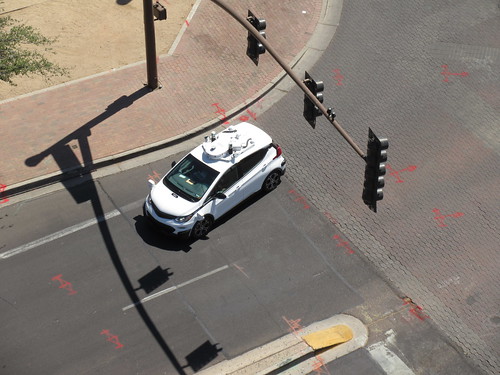
Tying a chatbot to a self-driving car’s system means it can explain what it’s doing to operators. CC-licensed photo by zombieite on Flickr.
You can sign up to receive each day’s Start Up post by email. You’ll need to click a confirmation link, so no spam.
Last Friday there was another post at the Social Warming Substack. It was about the one social network nobody’s been able to build.
A selection of 11 links for you. I checked. I’m @charlesarthur on Twitter. On Mastodon: https://newsie.social/@charlesarthur. Observations and links welcome.
Google to pay California $93m over location-tracking claims • The Verge
Emma Roth:
»
Google has agreed to pay $93m to the state of California to settle claims it tracked the location of users without their knowledge. Under the terms of the proposed agreement, Google must also provide more information about the location data it collects on users.
The settlement follows a “multi-year” investigation by California’s Department of Justice, which found that Google deceived users into thinking they weren’t getting tracked when they actually were. According to the complaint, Google continued to collect and store location data on users even when they disabled the “Location History” setting within its apps and services, allowing the company to use this information for targeted advertising.
Google has since addressed the issues outlined in the complaint, with company spokesperson José Castañeda telling The Verge the allegations are “based on outdated product policies we changed years ago.” California now requires Google to disclose that the location data they collect on users might be used for ad personalization, provide more transparency about location tracking, as well as offer detailed information about the data it collects on its website.
“Our investigation revealed that Google was telling its users one thing — that it would no longer track their location once they opted out — but doing the opposite and continuing to track its users’ movements for its own commercial gain,” California Attorney General Rob Bonta says in a statement.
«
So far Google has paid out $570m to settle similar cases in 42 states. This case covers 2014 to 2018, a period when it was making operating income of around $20bn per quarter.
unique link to this extract
Slack is basically Facebook now • The Atlantic
Ian Bogost:
»
Slack embraces both the light and dark sides of social-media life. A work-chat self now feels distinct from a work self, let alone a whole self. As on social media, the urge to weigh in, react, inveigh—in short, to post—has taken over, whether or not actual work is being facilitated in the process. As on social media, extreme positions proliferate on Slack, with workplace posts reading more like takes than like office talk. Even my Atlantic colleagues’ reactions to Slack’s rebrand seem profoundly overstated, shared because the software and the moment conspired to make them share-worthy.
Slack’s new redesign, with its fresh prods to engage, makes the software feel even more like social media. The interface has always seemed hell-bent on getting you back into the program, even if you’d prefer to do the actual work that your job demands. An icon flags unread posts in brightly colored circles. Channel names are bold until you scroll up and down to clear them. Why pick up the phone when you can do an audio “huddle” inside of a DM? Almost all software wants you to look at it, but Slack, a supposed productivity tool meant to help knowledge workers recover from their email, demands more fixation than email ever did.
So there is a refreshing honesty in the Slack update that my colleagues are lamenting. It admits that work is secondary. Making deals, managing employees, designing products, executing marketing—all of those activities are surely worthwhile pursuits for knowledge workers. But as with all of the great enterprise software that preceded it, one now gets those things done in spite of Slack rather than by means of it. Most important, for the workers using Slack, is using Slack.
«
I used Slack briefly at The Guardian. Stopped using Slack quite quickly because of its amazing potential for being the time equivalent of a black hole.
unique link to this extract
What do view counts mean on X, Tiktok, and Netflix? • NY Mag’s Intelligencer
John Herrman:
»
The internet promised, among other things, absolute audience surveillance, full measurability, and perfect knowledge of who was watching what, when, and for how long. What it delivered, instead, was metric tons of metric bullshit. Endowed with new powers of self-measurement, media companies, advertising firms, and online platforms have turned metrics into something approaching misinformation.
They’re suspicious, context-free numbers, produced in private, selectively shared to tell just the right stories: 264 million peripheral “views” for an X video, on a platform whose owner is simultaneously talking about “unregretted user-minutes;” three billion “family daily active people” making some sort of contact with four distinct but overlapping social-media platforms owned by Meta; 83 million people “watching” a streaming movie by allowing it to play for at least two minutes, or yet another Netflix show “surpassing the billion-hour mark in viewing time.”
In the abstract, metrics are powerful not just for what they convey — power, authority, popularity — but because they imply measurement by some sort of agreed-upon standard. In reality, online, they tend to supply math problems: vexing equations with missing variables and euphemistic names. There are numbers everywhere, and they mean nothing.
«
Apple puts top Apple Silicon exec in charge of Apple Watch blood glucose monitoring project • 9to5Mac
Chance Miller:
»
Apple’s efforts to bring glucose-monitoring features to the Apple Watch are housed under the company’s Exploratory Design Group team. The project was led by engineering executive Bill Athas until 2022, when he unexpectedly passed away.
Today’s report [by Bloomberg] explains that the team was “overseen on an ad-hoc basis” by former Athas deputies in the months following his passing. Those people reported directly to Johny Srouji, Apple’s senior vice president of hardware technologies.
Now, Apple has enlisted Tim Millet to oversee the team working on Apple’s noninvasive blood sugar monitoring technology. Millet has been at Apple for 19 years and has been “one of Srouji’s top two lieutenants for a decade.”
…Apple’s work on noninvasive blood sugar monitoring dates back to 2011 and is viewed as a “moonshot-style project,” with the idea originating during the Steve Jobs era. In February, it was reported that Apple had hit multiple “major milestones” in its work on this technology.
The company’s end goal is to bring this functionality to the Apple Watch, though it’s still years away from that becoming a reality.
«
Both Microsoft and then Google put a fair bit of effort into creating glucose-measuring contact lenses; Google abandoned it in November 2018. Apple just still keeps going, despite never having said it is doing it.
unique link to this extract
Battle of the ages: how America’s gerontocracy is a challenge for democracy • Financial Times
Eva Xiao:
»
[90-year-old California senator Dianne] Feinstein, the oldest member of the chamber, took an extended leave of absence this year following a bout of shingles. As a result, it made it difficult for Democrats, who have a razor-thin majority in the Senate, to push through appointees and legislation. Though Feinstein will step down in 2024, she has resisted calls to retire earlier amid long-running concerns over her memory.
Worries over his health have also plagued Joe Biden, the oldest president in US history, who at 80 years old is running for re-election in a likely rematch against Republican frontrunner Donald Trump, 77. Both men have been urged by former presidential candidate Mitt Romney, 76, to “stand aside” and make way for the next generation.
In August, a poll by the Associated Press and NORC Center for Public Affairs Research indicated that three-quarters of the public think Biden is too old to serve as president for another term, including more than two-thirds of Democrats.
Yet unease over America’s gerontocracy is two-fold: while there are concerns over physical fitness and mental competency, a political class dominated by older people has other consequences.
Similar to other minority groups, the severe underrepresentation of young people likely means their interests are not being adequately addressed by policymakers, argue social scientists, which could contribute to political apathy among youth.
Legislatures should “somewhat resemble the population to make decisions that resemble what the overall population wants”, says Stockemer.
«
Then again, you look at some of the younger members – Marjorie Taylor Greene, Lauren Bobert, Matt Gaetz – and you might ask: do we want it to look exactly like the population? (Yes, AOC is the counterpoint.)
unique link to this extract
Battery cell prices plunge in August, close to tipping point for the end of ICE vehicles • RenewEconomy
Giles Parkinson:
»
The price of battery cells has plunged in the last month, taking it below a key benchmark for the first time in two years, and close to the “tipping point” where the price of battery-powered EVs (electric vehicles) can match that of internal combustion engine (ICE) cars.
According to leading analysts Benchmark Lithium, the global weighted average price of lithium ion battery cells fell 8.7% in August, taking it below the $US100/kWh mark for the first time since August, 2021.
It is now priced at $98.2/kWh, a 33% drop from the recent high in March last year of $US146.4/kWh, and is the result of a drop in key commodity prices, including lithium, nickel and cobalt.
Importantly, it is now not far from the $US80/kWh cell price that is crucial to delivering a $US100/kWh battery pack – the level that is considered a tipping point because it will allow EV makers to build electric cars that cost the same as petrol and diesel alternatives.
“The energy and transport revolution continues!” said Gerard Reid, a leading energy analyst and head of Alexa Capital. Reid said the price of lithium battery cells have fallen 80% in a decade, and will continue to fall as they deliver better performance.
«
Lithium discovery in US volcano could be biggest deposit ever found • Chemistry World
Anthony King:
»
A world-beating deposit of lithium along the Nevada–Oregon border could meet surging demand for this metal, according to a new analysis.
An estimated 20 to 40 million tonnes of lithium metal lie within a volcanic crater formed around 16 million years ago. This is notably larger than the lithium deposits found beneath a Bolivian salt flat, previously considered the largest deposit in the world. Mining at the site is, however, contested by Native Americans for whom the area is sacred, and is believed to be where a massacre took place in 1865.
‘If you believe their back-of-the-envelope estimation, this is a very, very significant deposit of lithium,’ says Anouk Borst, a geologist at KU Leuven University and the Royal Museum for Central Africa in Tervuren, Belgium. ‘It could change the dynamics of lithium globally, in terms of price, security of supply and geopolitics.’
New in situ analysis reveals that an unusual claystone, composed of the mineral illite, contains 1.3% to 2.4% of lithium in the volcanic crater. This is almost double the lithium present in the main lithium-bearing clay mineral, magnesium smectite, which is more common than illite.
«
One suspects there’s going to be a lot of prospecting in volcanic craters all of a sudden.
unique link to this extract
LINGO-1: exploring natural language for autonomous driving • Wayve
Rudi Rankin:
»
The lack of explainability in machine learning models is a common concern, as the decision-making process often seems like a black box. However, by leveraging language, we can shed light on how AI systems make decisions.
Creating natural language interfaces could allow users to engage in meaningful conversations with AI models, enabling them to question choices and gain insight into scene understanding and decision-making.
…LINGO-1 can generate a continuous commentary that explains the reasoning behind [autonomous vehicle] driving actions. This can help us understand in natural language what the model is paying attention to and what it is doing. Below are a few examples:
In this first video, LINGO-1 describes the actions it takes when it overtakes a parked car.
LINGO-1: I’m edging in due to the slow-moving traffic
LINGO-1: I’m overtaking a vehicle that’s parked on the side
LINGO-1: I’m accelerating now since the road ahead is clear.Here is LINGO-1’s explanation as the car approaches a zebra crossing.
LINGO-1: I’m maintaining my speed; the road continues to be clear
LINGO-1: I’m now decelerating, braking, and coming to a stop
LINGO-1: Remaining stopped at the zebra crossing
LINGO-1: I’m now accelerating from a stopped position
LINGO-1: I’m accelerating as the road is clear.«
‘A Pandora’s box’: map of protein-structure families delights scientists • Nature
Ewen Callaway:
»
Last year, Google DeepMind used AlphaFold to predict the structure of nearly every known protein from organisms with genome data, amassing some 214 million structures in the AlphaFold database, which is hosted by the European Molecular Biology Laboratory’s European Bioinformatics Institute (EMBL-EBI) in Hinxton, UK.
Scientists found the resource instantly handy, but many of them looked only at a single structure, or family of related structures, says Martin Steinegger, a computational biologist at Seoul National University, who was interested in mapping the relationships of the entire database. “I thought it would be interesting to see how big our structural universe really is.”
To do this, a team co-led by Steinegger and computational biologist Pedro Beltrao, at ETH Zurich in Switzerland, developed a tool that quickly could compare every structure in the database, based on similarities in their shape. This identified more than 2 million ‘clusters’ of similarly shaped proteins in the AlphaFold database.
…Next to nothing is known about more than one-third of the protein clusters. “I really hope that biologists put some light on this darkness,” Steinegger says.
«
Although it is a direct quote from one of the scientists in Switzerland, I don’t think “Pandora’s box” is quite the right phrase for this. But notice how machine learning is providing the scaffolding for new scientific understanding.
unique link to this extract
VPNs, Verizon, and Reels: how students are getting around TikTok bans • The Verge
Monica Chin:
»
When he first read the email announcing that public universities in Texas had been asked to ban the use of TikTok on their campuses, UT Dallas student Eric Aaberg feared the worst. As a full-time content creator with over 10,000 followers on the platform, the app was central to his life. Would he be forced to delete it? Would he be punished if he were caught using it?
“I was like, ‘Oh my gosh, are you serious?’” Aaberg recalls. “That’s so BS. There’s no way.”
Then he learned the reality. UTD was making TikTok inaccessible on its campus-provided networks. For him, that was the extent of the ban.
Aaberg immediately relaxed. “I was like, ‘Oh, that’s nothing,’” he says.
…among college students — by far the demographic who use the app the most — the reaction has been much more subdued. It’s best summed up, students say, as a collective eye roll and a quick jump into the Settings app.
“They really just did not care”
Thomas Pablo, a sophomore at the University of Oklahoma, describes the day his school announced a TikTok ban as an utter non-event. “It was just another Monday,” he recalls.It happened suddenly — one day, TikToks loaded in the app and in mobile browsers, and the next day, they didn’t. But Pablo and all of his friends knew instinctively what to do: turn off the Wi-Fi and use data. For the past several months since the ban, he’s been switching his phone’s internet on and off around four times per day. Others he knows do it much more often.
Pablo never discussed or brainstormed methods with other students, nor did he hear any outcry about the new restriction. The student body, quietly, in unison, added Wi-Fi toggling to their daily routine. “Everyone was so nonchalant about it,” Pablo says. “They really just did not care.”
«
Very reminiscent of the early Napster, and its successors such as Limewire: colleges tried to ban it but the students were smarter.
unique link to this extract
Oh no, not more tech stuff! • Financial Times
Emma Jacobs:
»
One minute you’re admiring the sky, the next you are an “old man yell[ing] at cloud”, to quote The Simpsons. And so it came to pass for me when Apple announced at its product launch that the new iPhone 15 would use a USB-C charger instead of its proprietary lightning cable.
Of course, Apple being Apple, it positioned the switch as a gift the tech group had bestowed on its fan base, instead of what it actually was: complying with an EU directive the company had fiercely resisted.
Last year, the European parliament announced that by autumn 2024, the USB-C would “become the common charging port for all mobile phones, tablets and cameras”. Next time you’re at an Apple store, instead of paying for your iPad, why not reframe the transaction as your decision to bequeath the company some money, and see how that grabs the “geniuses”.
My reaction to hearing the charger news was exasperation at Apple’s sleight of hand but also at the prospect of yet more stuff. Like many, I already have a box full of expired tech bits and bobs: cables, chargers and some random paraphernalia that might just come in handy one day. In the FT’s recent office reorganisation, I unearthed yet more expired tech.
…The short-term pain of Apple ditching its lightning charger will be worthwhile in the end, I know. Ultimately, it will reduce electronic waste. As Material Focus, a non-profit working to recycle electrical goods, says, e-waste is the UK’s “fastest growing waste stream, with 155,000 tonnes of electricals thrown away every year and 527mn items hoarded in homes”.
«
It’s a bit tedious to point it out, but Apple’s first use of USB-C was in 2015, on the one-port Macbook. It could have kept Lightning on the iPhone for another year. Lightning is 11 years old, and USB-C is all over the place. Would you really rather have micro-USB or mini-USB?
unique link to this extract
| • Why do social networks drive us a little mad? • Why does angry content seem to dominate what we see? • How much of a role do algorithms play in affecting what we see and do online? • What can we do about it? • Did Facebook have any inkling of what was coming in Myanmar in 2016? Read Social Warming, my latest book, and find answers – and more. |
Errata, corrigenda and ai no corrida: none notified
 The Overspill: when there's more that I want to say