
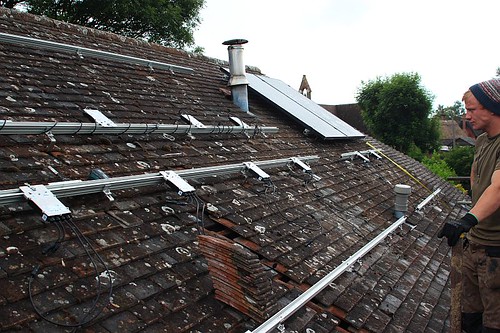
Installations of solar panels in the UK can generate as much energy as the (unfinished) Hinkley C nuclear plant. CC-licensed photo by Andrew Fogg on Flickr.
You can sign up to receive each day’s Start Up post by email. You’ll need to click a confirmation link, so no spam.
A selection of 10 links for you. Fine, thanks. I’m @charlesarthur on Twitter. On Mastodon: https://newsie.social/@charlesarthur. Observations and links welcome.
Fear the cardboard drones • The Droning Company
»
Australian company SYPAQ is helping Ukraine bolster its drone fleet as the country continues its struggle to push back the Russian invasion of its nation.
However, the drones being delivered are not metallic Valkyries of air warfare. They are cardboard.
The SYPAQ Corvo is a drone constructed from waxed cardboard that can be shipped in a flat package. Assembly is simple, requiring just a glue gun, knife, pen, tape, rubber bands, and a wrench to attach the Corvo’s propeller. The Corvo can fly autonomously with a flight plan programmed via an Android tablet interface. It relies on GPS guidance when available, but should GPS be jammed by Russian electronic-warfare defenses, the Corvo’s control software can determine its position from its speed and heading. The drone is launched from a simple catapult and has a range of 74 miles.
SYPAQ has not shared any additional specs for the Corvo, nor how much each drone costs, when they will be delivered, or how many they are supplying the Ukraine forces.
While the Australian Army uses the Corvo to deliver small and urgently needed supplies, the Ukrainian forces are giving it another job entirely: Surveillance, reconnaissance, and intelligence missions. In the future, the Corvo could be further adapted to deploy bombs.
Of course, cardboard is not as tough as some other materials, so the Corvo’s mission lifespan may be short. However, other, more robust and low-cost materials such as plywood could conceivably be incorporated into the drone’s airframe.
SYPAQ is currently working on swarming software that could spell trouble for enemies when thousands of inexpensive and expendable Corvo drones descend on a target. That’s a lot of drones, but an entire fleet of Corvos likely costs significantly less than one $20 million Reaper.
«
This article is from March – so sue me! – but with Ukraine’s drone attacks on Moscow and other Russian targets making news more recently, it could be that this is what they’re succeeding with.
unique link to this extract
Climate change: mapping in 3D where the earth will become uninhabitable • Berliner Morgenpost
Ida Flik, André Pätzold and Benja Zehr:
»
Lethal heat, flooded coastlines, powerful hurricanes, water scarcity: climate models show that by the end of the century, life as normal won’t be possible in many places. Find out where populations are projected to be hit hardest with our 3D interactive visualisation.
«
It’s a nifty visualisation, but it looks forward to the year 2100. Even the youngest reader of this article will be hitting their 80th year by then. Projections that will spur people to action need to have a shorter time range. Climate change is like the worst sort of pension: one that’s going to take everything away, and it’ll be too late if you don’t act now.
unique link to this extract
Generative AI and intellectual property • Benedict Evans
»
I think most people understand that if I post a link to a news story on my Facebook feed and tell my friends to read it, it’s absurd for the newspaper to demand payment for this. A newspaper, indeed, doesn’t pay a restaurant a percentage when it writes a review. If I can ask ChatGPT to read ten newspaper websites and give me a summary of today’s headlines, or explain a big story to me, then suddenly the newspapers’ complaint becomes a lot more reasonable – now the tech company really is ‘using the news’. Unsurprisingly, as soon as ChatGPT announced that it had its own web crawler, news sites started blocking it.
But just as for my ‘make me something like the top ten hits’ example, ChatGPT would not be reproducing the content itself, and indeed I could ask an intern to read the papers for me and give a summary (I often describe AI as giving you infinite interns). That might be breaking the self-declared terms of service, but summaries (as opposed to extracts) are not generally considered to be covered by copyright – indeed, no-one has ever suggested this newsletter is breaking the copyright of the sites I link to.
Does that mean we’ll decide this isn’t a problem? The answer probably has very little to do what that today’s law happens to say today in one or another country. Rather, one way to think about this might be that AI makes practical at a massive scale things that were previously only possible on a small scale. This might be the difference between the police carrying wanted pictures in their pockets and the police putting face recognition cameras on every street corner – a difference in scale can be a difference in principle. What outcomes do we want? What do we want the law to be? What can it be?
«
This is a typically thoughtful piece: Evans’s preference for realism and practicality over sweeping statements makes him unusual among most commentators on topics like this, perhaps because he isn’t gurning for attention.
unique link to this extract
Movie Maths
This neat little site is a sort-of recommendation system for films. So if you want something that’s a cross between “The Endless Summer” (classic film of surfers searching for the perfect wave) and Alien, what about Lilo & Stitch (destructive city-destroying child-friendly alien touches down in Hawaii)?
Simon Carryer, who did the maths bit, explains how it works in a Medium article, though you’ll need a membership there to read it.
unique link to this extract
Organised crime gang steals hard drive containing vital evidence against Channel people smugglers • LBC
Will Taylor:
»
Important evidence about people-smuggling across the Channel has been stolen and it is suspected an organised crime gang is responsible.
Aviation fuel worth about £30,000 and tools were also stolen from Lydd airport, in southern Kent, which contains the control room for drones that watch for small boats. These record migrant crossings via camera and that footage is used to prosecute criminals and help target gangs who bring them over the sea.
A hard drive that was held in a safe in a hangar was stolen in the raid on August 1. It contained footage of crossings from previous days. The clips had not been forwarded to Border Force or other organisations like the National Crime Agency.
Although the fuel was taken, the aeroplane and four drones based at Lydd were unaffected. They were thoroughly examined to ensure they were safe to use.
The raiders managed to break in by climbing over a fence and then cut through tarpaulin outside the hangar using a knife.
«
In its way, very Mission Impossible-y: “we’ve got to find the hard drive that’s got the surveillance footage of the boat crossing!” Except this is done by people who will exploit the most desperate survivors for the last of their money and put them in boats that might kill them. The OCG aspect is emphasised by the fact that they stole tools. Sure, they came for the hard drive, but tools are tools, you know?
unique link to this extract
Scammers cash in on Worldcoin’s Kenya launch • Rest of World
Martin Siele:
»
For the hundreds of thousands who signed up for Worldcoin in Kenya, the Sam Altman-backed global blockchain project couldn’t have come at a better time.
With the country in the throes of an inflation crisis, Worldcoin made a big splash, signing up an estimated 350,000 people before the government stopped the project’s rollout over data protection concerns on August 2. The biggest attraction for many Kenyans who had their eyeballs scanned was the free sign-up bonus of 25 Worldcoin tokens, currently worth around 6,988 Kenyan shillings ($48.75).
But once the coins were in their accounts, getting the money proved harder than they expected. The Worldcoin app offers no direct cash withdrawal option, unlike the mobile money apps used by 96% of Kenyan households. Within days of the launch, Worldcoin was forced to suspend the registration of new users in Kenya as the government launched an investigation into its compliance with data protection laws. To get their cash, Kenyans had to sell their coins through cryptocurrency exchanges like Binance, or find a buyer in Kenya’s informal crypto economy.
“Many of those who signed up don’t know how crypto works exactly or how to sell the Worldcoin tokens they received through exchanges like Binance,” Mathew Morang’a, a day trader based in Nakuru, Kenya, who has dealt in cryptocurrencies since 2020, told Rest of World. “They just want to get the money quickly, in the most straightforward way.”
Since the government decision, traders like Morang’a have flooded social media platforms including WhatsApp, TikTok, Twitter, and Facebook with offers to purchase Worldcoin. A spot check by Rest of World found that most traders were offering between 200–250 Kenyan shillings ($1.40–$1.74) per Worldcoin token (WLD), against its current price of 279 shillings ($1.95) — enabling them to profit as much as 78.8 shillings (55 cents) on each token.
«
Guess it means that we find the actual value of Worldcoin. It doesn’t seem very high. And we seem still to be trying to shake off the whole “web 3” thing still.
unique link to this extract
UK homes install ‘record number’ of solar panels and heat pumps • The Guardian
Jillian Ambrose:
»
British households are making more green energy upgrades than ever before after installing a record number of solar panels and heat pumps in the first half of the year, according to the industry’s official standards body.
The industry figures show there were more green energy installations in June than in previous years.
On average, more than 17,000 households installed solar panels every month this year, while the number of homes installing heat pumps reached 3,000 a month for the first time, according to the data.
Each month of 2023 was a record month for battery technologies, as installation figures consistently surpassed the month before, bringing the total number of batteries installed in homes and businesses across the UK to more than 1,000 in 2023 so far.
The industry’s accreditation body, MCS, said the green energy boom has put households on track to install more renewable energy than the last record set in 2012, when many raced to install solar panels before government subsidies were reduced.
Ian Rippin, the chief executive of MCS, said: “As the cost of energy continues to grow, we are seeing more people turn to renewable technology to generate their own energy and heat at home.”
Small-scale renewable energy installations at homes and businesses across the UK now have a total capacity of 4 gigawatts (GW), greater than the nuclear power plant under construction at Hinkley Point and almost double the capacity of Europe’s biggest gas power plant near Pembroke in Wales.
«
(Hinkley Point C is a 3.2GW plant.) Of course the criticism will be that these panels don’t generate this energy all the time, which is true – but microgeneration (as this is called) has the potential to be colossal. All it takes is a bit of political will. The battery and panel prices will fall in line.
unique link to this extract
China’s 40-year boom is over. What comes next? • WSJ
Lingling Wei and Stella Yifan Xie:
»
For decades, China powered its economy by investing in factories, skyscrapers and roads. The model sparked an extraordinary period of growth that lifted China out of poverty and turned it into a global giant whose export prowess washed across the globe.
Now the model is broken.
What worked when China was playing catch-up makes less sense now that the country is drowning in debt and running out of things to build. Parts of China are saddled with under-used bridges and airports. Millions of apartments are unoccupied. Returns on investment have sharply declined.
Signs of trouble extend beyond China’s dismal economic data to distant provinces, including Yunnan in the southwest, which recently said it would spend millions of dollars to build a new Covid-19 quarantine facility, nearly the size of three football fields, despite China having ended its “zero-Covid” policy months ago, and long after the world moved on from the pandemic.
Other localities are doing the same. With private investment weak and exports flagging, officials say they have little choice but to keep borrowing and building to stimulate their economies.
Economists now believe China is entering an era of much slower growth, made worse by unfavourable demographics and a widening divide with the US and its allies, which is jeopardizing foreign investment and trade. Rather than just a period of economic weakness, this could be the dimming of a long era.
“We’re witnessing a gearshift in what has been the most dramatic trajectory in economic history,” said Adam Tooze, a Columbia University history professor who specializes in economic crises.
What will the future look like? The International Monetary Fund puts China’s GDP growth at below 4% in the coming years, less than half of its tally for most of the past four decades. Capital Economics, a London-based research firm, figures China’s trend growth has slowed to 3% from 5% in 2019, and will fall to around 2% in 2030.
«
Slowing growth? Call Liz Truss! But seriously, this poses huge questions for the world economy. (The link should hop you over the WSJ paywall.)
unique link to this extract
Apple lends support to California State Right to Repair bill • TechCrunch
Brian Heater:
»
In a surprise move, Apple this week penned a letter to California state senator Susan Talamantes Eggman, voicing support for SB 244, a “right to repair” bill currently making its way through Sacramento’s State Capitol building.
Apple has, of course, softened its stance on right to repair legislation in recent years, including last year’s addition of a Self Service Repair program. The offering, which was viewed by many as a preemptive measure against looming state and federal legislation, provides users with rental tools to repair iPhones and Macs at home.
SB 244 is fairly expansive; it includes consumer electronics (phones, laptops, etc.) and appliances (microwaves, washing machines, etc.), though a few exceptions have been carved out, including game consoles and alarm systems. The rational for those appear to be piracy and security, respectively. It shares a good deal (including the proposed name) with the Right to Repair Act, which went into effect in Minnesota this May.
In the letter, Apple expresses its support on the grounds of offering consumers the ability to repair their devices safely, without risking privacy or data issues.
“Apple supports California’s Right to Repair Act so all Californians have even greater access to repairs while also protecting their safety, security, and privacy,” the company says in a statement provided to TechCrunch. “We create our products to last and, if they ever need to be repaired, Apple customers have a growing range of safe, high-quality repair options.”
«
Certainly, you can repair it yourself if you have the eyesight of a hawk and the fingers of a surgeon. Or just pay someone else to do it. Not sure how much difference this will truly make, so perhaps Apple feels there’s nothing to lose or gain in reality, but a bit of PR to gain.
unique link to this extract
“I’ve always dreamed of having a dongle to charge my car” • The Verge
Nilay Patel, editor-in-chief of The Verge :
»
Notable Verge traitor [she left The Verge to join the Wall Street Journal] Joanna Stern has been in the market for an EV for the past few months. (I know because she keeps texting me about it.) Like any true reviewer, she solved her problem by taking the the Hyundai Ioniq 5, the Ford Mustang Mach-E, and the Tesla Model Y head-to-head on a road trip — and called up Marques Brownlee for a little advice along the way.
«
Stern is always good, and this is a typically good video review. Electric cars are coming!
| • Why do social networks drive us a little mad? • Why does angry content seem to dominate what we see? • How much of a role do algorithms play in affecting what we see and do online? • What can we do about it? • Did Facebook have any inkling of what was coming in Myanmar in 2016? Read Social Warming, my latest book, and find answers – and more. |
Errata, corrigenda and ai no corrida: none notified
 The Overspill: when there's more that I want to say
Hmm, thousands of very portable “guided micro-missiles”, just perfect for target assassinations or terrorist bombings, manufactured and spread all over a region – What Could Go Wrong? The drone-as-missile concept is of course an old idea. I think Alan Dershowitz’s very first criminal case, decades ago, involved a guy doing something along those lines. But the technology for, let’s call it, widespread personal deployment, has never been quite there – yet? This company is apparently looking to change that, democratizing the necessary steps in a cheap handy kit. Cut here, glue there, enter the target’s coordinates in the GUI.
William Gibson: “The street finds its own uses for things.”