
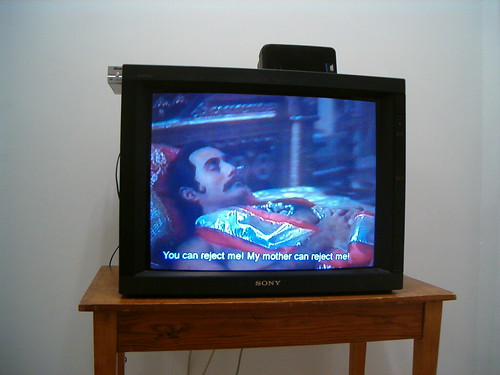
A surprisingly high percentage of people leave subtitles on when watching TV of any sort, research has found. CC-licensed photo by Jean-Etienne Minh-Duy Poirrier on Flickr.
You can sign up to receive each day’s Start Up post by email. You’ll need to click a confirmation link, so no spam.
There’s another blogpost at the Social Warming Substack due at about 0845. It’s about research – or the impending absence of it.
The Overspill is going on a two-week break. By the end of which there should be some news in the world of technology.
A selection of 11 links for you. What did he say? I’m @charlesarthur on Twitter. On Mastodon: https://newsie.social/@charlesarthur. Observations and links welcome.
A new frontier for travel scammers: AI-generated guidebooks • The New York Times
Seth Kugel and Stephen Hiltner:
»
In March, as she planned for an upcoming trip to France, Amy Kolsky, an experienced international traveler who lives in Bucks County, Pa., visited Amazon.com and typed in a few search terms: travel, guidebook, France. Titles from a handful of trusted brands appeared near the top of the page: Rick Steves, Fodor’s, Lonely Planet. Also among the top search results was the highly rated “France Travel Guide,” by Mike Steves, who, according to an Amazon author page, is a renowned travel writer.
“I was immediately drawn by all the amazing reviews,” said Ms. Kolsky, 53, referring to what she saw at that time: universal raves and more than 100 five-star ratings. The guide promised itineraries and recommendations from locals. Its price tag — $16.99, compared with $25.49 for Rick Steves’s book on France — also caught Ms. Kolsky’s attention. She quickly ordered a paperback copy, printed by Amazon’s on-demand service.
When it arrived, Ms. Kolsky was disappointed by its vague descriptions, repetitive text and lack of itineraries. “It seemed like the guy just went on the internet, copied a whole bunch of information from Wikipedia and just pasted it in,” she said. She returned it and left a scathing one-star review.
Though she didn’t know it at the time, Ms. Kolsky had fallen victim to a new form of travel scam: shoddy guidebooks that appear to be compiled with the help of generative artificial intelligence, self-published and bolstered by sham reviews, that have proliferated in recent months on Amazon.
The books are the result of a swirling mix of modern tools: A.I. apps that can produce text and fake portraits; websites with a seemingly endless array of stock photos and graphics; self-publishing platforms — like Amazon’s Kindle Direct Publishing — with few guardrails against the use of A.I.; and the ability to solicit, purchase and post phony online reviews, which runs counter to Amazon’s policies and may soon face increased regulation from the Federal Trade Commission.
«
Really fighting against an inexorable wave here. Where next?
unique link to this extract
Detroit police changing facial-recognition policy after pregnant woman says she was wrongly charged • Associated Press via NBC News
»
Detroit’s police chief said he’s setting new policies on the use of facial-recognition technology, after a woman who was eight months pregnant said she was wrongly charged with robbery and carjacking in a case that was ultimately dismissed by prosecutors.
The technology, which was used on images taken from gas station video, produced leads in the case but was followed by “very poor” police work, Chief James White said.
“We want to ensure that nothing like this happens again,” White said on Wednesday.
His comments came two days after the American Civil Liberties Union of Michigan announced a lawsuit on behalf of Porcha Woodruff, a 32-year-old Black woman, who was arrested in February while trying to get children ready for school. There have been two similar lawsuits against Detroit.
Woodruff was identified as a suspect in a January robbery and carjacking through facial-recognition technology. She denied any role. The Wayne County prosecutor’s office said charges later were dropped because the victim did not appear in court.
White said his officers will not be allowed “to use facial-recognition-derived images in a photographic lineup. Period.”
He said two captains must review arrest warrants when facial technology is used in a case, among other changes. The new policies will be presented to the Detroit Police Board of Commissioners.
White said there must be other evidence, outside the technology, for police to believe a suspect had the “means, ability and opportunity to commit the crime.”
«
Good to know they can change quickly sometimes.
unique link to this extract
Volume down, subtitles on: 51% of us read along with our favourite shows • PC Magazine
Chandra Steele:
»
You’re either a subtitles person or you’re not. But increasingly, people are. Preply followed up on its subtitle-use survey of Americans from 2022 and found a 5% rise, to 58%, in how many people use captioning more than they used to.
Now, just over half (51%) of those surveyed say they use subtitles most of the time. If you’re thinking this habit could be the purview of older folks who are having a hard time hearing—well, 96% of Gen Z survey respondents said they impose words over what they’re watching.
Netflix watchers are using captioning the most; 52% of survey respondents say they turn the feature on while they’re watching. Subtitles help 81% of people better comprehend what they’re watching. A significant part of the time (70%), people use subtitles to understand foreign accents, particularly if a speaker is Scottish, which poses a problem for Outlander fans.
Preply found that Americans have a hard time understanding their own language when someone has a Scottish accent (47%), an Irish accent (20%), a British accent (13%), a South African accent (12%), an Australian accent (5%), and even a Southern US accent (3%). So those who watching Derry Girls, Downton Abbey, and Ozark are adjusting their settings to follow along.
Background music is a reason 61% of viewers give for not being able to hear dialogue in shows and movies, along with muddled audio (15%). And a lot of streaming content was either created for theater speakers or mixed to fit the varying specs between streamers. Adding to the problem: the variations in television and tablet speakers.
Finally, a quarter of those who turn on subtitles do so because a specific actor is hard to understand. We’re looking at you, Tom Hardy. His character Bane’s voice in The Dark Knight Rises might be Hardy’s most infamously baffling choice, but even when he’s speaking without a mask, audiences find him mostly incomprehensible.
«
So basically Americans can’t understand non-American accents. (Ozark, though?)
This all bolsters the case for TVs having subtitles on by default – which helps children. If any still watch TV.
unique link to this extract
Muon discovery moves physicists one step closer to a theoretical showdown • The New York Times
Katrina Miller:
»
Scientists are putting to the test the Standard Model, a grand theory that encompasses all of nature’s known particles and forces. Although the Standard Model has successfully predicted the outcome of countless experiments, physicists have long had a hunch that its framework is incomplete. The theory fails to account for gravity, and it also can’t explain dark matter (the glue holding our universe together), or dark energy (the force pulling it apart).
One of many ways that researchers are looking for physics beyond the Standard Model is by studying muons. As heavier cousins of the electron, muons are unstable, surviving just two-millionths of a second before decaying into lighter particles. They also act like tiny bar magnets: Place a muon in a magnetic field, and it will wobble around like a top. The speed of that motion depends on a property of the muon called the magnetic moment, which physicists abbreviate as g.
In theory, g should exactly equal 2. But physicists know that this value gets ruffled by the “quantum foam” of virtual particles that blip in and out of existence and prevent empty space from being truly empty. These transient particles change the rate of the muon’s wobble. By taking stock of all the forces and particles in the Standard Model, physicists can predict how much g will be offset. They call this deviation g-2.
But if there are unknown particles at play, experimental measurements of g will not match this prediction. “And that’s what makes the muon so exciting to study,” Dr. Binney said. “It’s sensitive to all of the particles that exist, even the ones that we don’t know about yet.” Any difference between theory and experiment, she added, means new physics is on the horizon.
To measure g-2, researchers at Fermilab generated a beam of muons and steered it into a 50-foot-diameter, doughnut-shaped magnet, the inside brimming with virtual particles that were popping into reality. As the muons raced around the ring, detectors along its edge recorded how fast they were wobbling.
Using 40 billion muons — five times as much data as the researchers had in 2021 — the team measured g-2 to be 0.00233184110, a one-tenth of 1% deviation from 2. The result has a precision of 0.2 parts per million. That’s like measuring the distance between New York City and Chicago with an uncertainty of only 10 inches, Dr. Pitts said.
«
However, that doesn’t necessarily confirm the Standard Model. There’s more to come on this. (Miller, who wrote the piece, has a PhD in particle physics. Useful.)
unique link to this extract
How Apple lost the K-12 education market to Google • Business Insider
Michael Gartenberg used to work for Apple, in its marketing department (having moved there from Gartner, the research company):
»
Apple once worked hard to position the iPad as its offering for education. (Remember the 2017 “What’s a computer?” commercial where a school-aged kid spends the day, including doing homework, on the iPad? Or the “Your next computer is not a computer” ad where two high schoolers use their iPads to compete for class president?)
But as one principal of a relatively affluent private school pointed out to me, the cost of an iPad — along with a Magic Keyboard (cover folio keyboards did not meet their needs), plus an Apple pencil — was the equivalent of at least three comparable Chromebooks that could be used by more than one student. Chromebooks are also much easier to repair or replace and log back in. There’s no need for the complex restore process that Apple uses, particularly for iOS devices.
One of Apple’s biggest pushes to make the iPad the standard device used in K-12 schools was back in 2013 when the Los Angeles school system signed a contract to purchase $1 billion worth of devices. I worked at Apple at the time, and that contract was viewed as a huge win and was expected to be the first of many deals that would propel iPads into classrooms across the country. Unfortunately, it didn’t quite turn out that way.
The initial $30m contract was expected to expand to about $500m as the project rolled out over the following year. An additional $500m was to be used to expand internet access and other infrastructure issues at schools. Costs rose quickly as the need for peripherals such as keyboards became apparent, and critics noted that the iPad model the district agreed to buy was already superseded by newer, more capable devices sold at retail stores.
«
The Chromebook, and Google’s related cloud offerings, were always going to be better suited to schools than the iPad, simply on grounds of cost and form factor.
unique link to this extract
X CEO Linda Yaccarino explains reason for getting rid of Twitter name • CNBC
Rohan Goswami:
»
Yaccarino, who started the job in June, said Musk has been working up to this [branding change] since buying Twitter late last year.
“Think about what’s happened since the acquisition,” she said. “Experiences and evolution into long-form video and articles, subscribe to your favorite creators, who are now earning a real living on the platform. You look at video, and soon you’ll be able to make video chat calls without having to give your phone number to anyone on the platform.”
Yaccarino also highlighted the company’s plans to enable payments between users and friends and creators.
“The rebrand represented really a liberation from Twitter,” she said. “A liberation that allowed us to evolve past a legacy mindset and thinking. And to reimagine how everyone, how everyone on Spaces who’s listening, everybody who’s watching around the world. It’s going to change how we congregate, how we entertain, how we transact all in one platform.”
…Yaccarino said she has “autonomy” under Musk, adding that advertisers should be comfortable returning to the platform.
“Mine and Elon’s roles are very clear,” she said.
Yaccarino pointed to the post, announcing her hiring, where Musk underscored his continued control over product design and new technology.
“Elon is working on accelerating the rebrand and working on the future,” Yaccarino said. “And I’m responsible for the rest. Running the company, from partnerships to legal to sales to finance.”
«
At one stage in the interview she talks about “tweets”, which just goes to show how incredibly powerful the old brand works. She’s talking delusional junk, but at least we have clarity now: she’ll just say any old thing.
And the video calls, presumably tied to your handle? One can already think of tons of ways for that to go wrong. (How do you decide who’s allowed to call you? Anyone? Any follower? Only selected people? It will surely be a boon to the pornspambots, but not sure the rest of us are that keen: we have enough video call avenues already.)
unique link to this extract
Meta’s news blackout sparks some Canadian advertisers to boycott • Mashable
Christianna Silva:
»
Stingray Group announced on Tuesday that it will “immediately suspend” all advertising on Facebook and Instagram in Canada. Stingray, which is a Montreal-based music and video content company, said the move is in response to Meta blocking news content in Canada.
“We cannot tolerate Meta’s recent decision to block news from Canadian news media publishers and their potential implications for Canadian news content,” Eric Boyko, co-founder and chief executive officer of Stingray, told MarketWatch. “As a result, we have decided to pause our advertising on Facebook and Instagram.”
Stingray is just the most recent company in Canada to pull advertising from Meta. It follows the British Columbia government, the Canadian federal government, the Quebec and Ottawa governments, and other governments in Canada that also pulled advertising from Meta. Quebec worker’s union also suspended all advertising, along with Canadian telecoms operator Quebecor and Cogeco, which runs radio stations in Quebec, according to Reuters.
«
Absolutely no indication of how much money Stingray spends on Facebook advertising annually in Canada, which seems like a worthwhile question for MarketWatch or Mashable to have asked. Its market cap is ~$250m, which isn’t nothing, but I doubt Facebook is going to melt in terror at this. Publicity stunt.
unique link to this extract
ABC exiting Twitter: Australia’s national broadcaster shuts down almost all accounts on Elon Musk’s X • The Guardian
Amanda Meade:
»
The Australian Broadcasting Corporation (ABC) is shutting down almost all of its official accounts on Twitter – now known as X under Elon Musk’s ownership – citing “toxic interactions”, cost and better interaction with ABC content on other social media platforms.
There will only be four remaining official accounts for Australia’s public broadcaster: @abcnews, @abcsport, @abcchinese and the master @abcaustralia account. ABC Chinese reaches Chinese-speaking audiences on X.
“Starting from today, other ABC accounts will be discontinued,” the ABC managing director, David Anderson, has told staff. Musk responded to the move by accusing the ABC of embracing censorship.
Anderson said the closure of the Insiders, News Breakfast and ABC Politics accounts earlier this year limited the amount of toxic interactions, which had grown more prevalent under Musk and made engagement with the shows more positive.
Several high-profile ABC journalists left Twitter after being subjected to abuse, including News Breakfast host Lisa Millar and Australian Story host Leigh Sales.
“We also found that closing individual program accounts helps limit the exposure of team members to the toxic interactions that unfortunately are becoming more prevalent on X,” Anderson said.
«
“Musk responded to the move by accusing the ABC of embracing censorship” is absolutely classic.
unique link to this extract
Are reports of StackOverflow’s fall greatly exaggerated? • The Pragmatic Engineer
Gergely Orosz:
»
The post [last week] stated Stack Overflow has lost about 50% of its traffic. However, the traffic data turned out to not account for a Google Analytics change. Allowing for this, the drop would be 35%. Still, the most worrying part of the statistics is not traffic, but the drop in questions asked and upvotes.
I pinged engineers at Stack Overflow to get their thoughts about what’s happening. What they said is that they are not seeing so dramatic a drop, internally, and that data shared with the most active contributors is inaccurate. I also reached out via official channels to Stack Overflow, and here’s what the company told me (the company later published a blog post with some of the below data included):
• 5%: the company wrote “overall, we’re seeing an average of ~5% less traffic compared to 2022.”
• 14%: the sharp decrease in traffic in April 2023. The company said: “we can likely attribute this to developers trying GPT-4 after it was released in March.”
• 14%: this is by how much search engine traffic is down, year-on-year.
• A predictable rise and fall, as with any sudden change. When global lockdowns started in 2020, Stack Overflow saw a spike and then a decrease in cloud migration questions and security-related ones. I sense the company is not surprised that AI had an impact on traffic and the types of questions.
• Q&A activity is definitely down: the company is aware of this metric taking a dive, and said they’re actively working to address it.…Could we see the fall of public Q&A sites as AI tools rise? A striking statistic is just how much the volume of questions asked has dropped. It’s not as if people have fewer questions, it’s just that developers are typing these questions into AI tools, instead.
«
Developers have definitely been the quickest – alongside journalists (or publishers) – to adopt generative AI. And we’re already seeing the effects.
Google’s search box changed the meaning of information • WIRED
Elan Ullendorff:
»
I HAVE A theory of technology that places every informational product on a spectrum from Physician to Librarian.
The Physician’s primary aim is to protect you from context. In diagnosing or treating you, they draw on years of training, research, and personal experience, but rather than presenting that information to you in its raw form, they condense and synthesize. This is for good reason: When you go to a doctor’s office, your primary aim is not to have your curiosity sparked or to dive into primary sources; you want answers, in the form of diagnosis or treatment. The Physician saves you time and shelters you from information that might be misconstrued or unnecessarily anxiety-provoking.
In contrast, the Librarian’s primary aim is to point you toward context. In answering your questions, they draw on years of training, research, and personal experience, and they use that to pull you into a conversation with a knowledge system, and with the humans behind that knowledge system. The Librarian may save you time in the short term by getting you to a destination more quickly. But in the long term, their hope is that the destination will reveal itself to be a portal. They find thought enriching, rather than laborious, and understand their expertise to be in wayfinding rather than solutions. Sometimes you ask a Librarian a question and they point you to a book that is an answer to a question you didn’t even think to ask. Sometimes you walk over to the stacks to retrieve the book, only for a different book to catch your eye instead. This too is success to the Librarian.
There are book reviews that say “I read this so you don’t have to” (Physician), and others that say “I read this and you should too” (Librarian). There are apps that put you in a perpetual state of simmering, unrealized wanderlust from the comfort of your couch (Physician) and others that inspire you to get up and go (Librarian).
A search engine, at its core, is a product that tries to help you visit pages made by humans, quintessentially Librarian. In a 2004 Playboy interview, Google cofounder Larry page was unequivocal in his assertion that he wanted to “get you out of Google and to the right place as fast as possible.” But over the past 10 years, let’s just say Google has gone to medical school. The answer is king; a mere link is nothing more than failure of technology.
«
This is just the prelude; the essay (which it is) deserves to be read in full, especially for its concern about “the soft apocalypse of truth”. One can also ask: why do we trust a human to direct us correctly to the truth, but not an algorithm which watches which links people follow searching for the truth?
unique link to this extract
Phil Mickelson’s gambling losses totalled nearly $100m, former associate alleges in new book • GolfDigest.com
Billy Walters is one of the most successful sports gamblers of all time, and now he’s writing an autobiography – which includes his experience forming a betting partnership with US pro golfer Phil Mickelson :
»
In late September 2012, Phil called me from Medinah Country Club just outside Chicago, site of the 39th Ryder Cup matches between the United States and Europe. He was feeling supremely confident that the American squad led by Tiger Woods, Bubba Watson, and Phil himself was about to reclaim the Cup from the Euros. He was so confident that he asked me to place a $400,000 wager for him on the U.S. team to win.
I could not believe what I was hearing.
“Have you lost your fucking mind?” I told him. “Don’t you remember what happened to Pete Rose?” The former Cincinnati Reds manager was banned from baseball for betting on his own team. “You’re seen as a modern-day Arnold Palmer,” I added. “You’d risk all that for this? I want no part of it.”
“Alright, alright,” he replied.
I have no idea whether Phil placed the bet elsewhere. Hopefully, he came to his senses, especially considering the “Miracle at Medinah.” Trailing 10-6 going into the final day of singles matches, the Europeans pulled off the greatest comeback in Ryder Cup history. They won eight matches and tied one to beat the Americans by a single point, 14½ to 13½.
«
Walters’s revelations are stunning – though read to the end of this extract and then marvel at how he is able to maintain such an even tone. (This may be why he is so successful at sports betting.)
I’ve never understood gambling on sports; as a participant, I don’t need any further incentive to want to win; as a spectator, I don’t want to hand over my money to the whims of fate, and isn’t the outcome of the competition itself enough excitement? For sports gamblers, evidently not. It’s a mental space I can’t grasp.
unique link to this extract
| • Why do social networks drive us a little mad? • Why does angry content seem to dominate what we see? • How much of a role do algorithms play in affecting what we see and do online? • What can we do about it? • Did Facebook have any inkling of what was coming in Myanmar in 2016? Read Social Warming, my latest book, and find answers – and more. |
Errata, corrigenda and ai no corrida: none notified
 The Overspill: when there's more that I want to say
While I don’t gamble on sports myself, I do have some insight into it from being around a lot of sports gamblers, both casual and hardcore.
On the hardcore, it’s like any other committed gambler: they think they know how to beat the system, they enjoy the winnings, they… try not to think about the losings, because they are of course just minor and totally unlucky pitfalls on the path to glory. (Don’t ask for an accounting of whether they’re up overall or down, because they will always find a creative way to show that they’re actually up.)
For the casuals, they told me that it adds excitement to what would (to them) normally be meaningless Premier League games — suddenly they have a reason to care about, say, Burnley vs Sheff Utd because they have a stake in the game. I always found that deeply sad, because like you, I enjoy the sport on its own and don’t need another reason to care. But they do.
Yes, your latter point about “it adds excitement” is something I’ve heard from someone I mentioned my lack of interest to.
But there are also the professional gamblers (like Walters), and I suspect for them the thrill is actually *lessened* by what they’re doing. Imagine it: you get up in the morning (or perhaps afternoon, because you’ve had a busy night at the casino, gambling) and now it’s your job–the way you put money on the table–to pick the winner in a competition. You have to be ruthlessly impersonal about it: you might like Player X, and want them to thrive, but the need to succeed means you bet against them, in the full expectation of your winning, and seeing their dreams crushed. It reduces the thrill of sports’ uncertainty to profit/loss lines on a spreadsheet. In that sense, it seems utterly antithetical to what sports is about. (The one line I found surprising in the Walters story was where he told Mickelson he couldn’t bet on himself to win. Why is that a problem? Betting large amounts on yourself to win doesn’t seem bad. It’s when you bet against yourself that the problems begin.)