
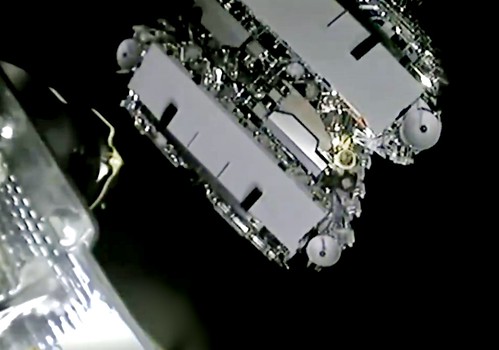
The grip that Elon Musk’s Starlink has on satellite comms is worrying some analysts. CC-licensed photo by Steve Jurvetson on Flickr.
You can sign up to receive each day’s Start Up post by email. You’ll need to click a confirmation link, so no spam.
Did you miss last Friday’s post at the Social Warming Substack? It’s about Threads, again. Free signup.
A selection of 10 links for you. Can you see it? I’m @charlesarthur on Twitter. On Mastodon: https://newsie.social/@charlesarthur. Observations and links welcome.
With Starlink, Elon Musk’s satellite dominance is raising global alarms • The New York Times
Adam Satariano, Scott Reinhard, Cade Metz, Sheera Frenkel and Malika Khurana:
»
On March 17, Gen. Mark A. Milley, the chairman of the Joint Chiefs of Staff, and Gen. Valeriy Zaluzhnyi, the leader of Ukraine’s Armed Forces, dialed into a call to discuss Russia’s invasion of Ukraine. Over the secure line, the two military leaders conferred on air defense systems, real-time battlefield assessments and shared intelligence on Russia’s military losses.
They also talked about Elon Musk.
General Zaluzhnyi raised the topic of Starlink, the satellite internet technology made by Mr. Musk’s rocket company, SpaceX, three people with knowledge of the conversation said. Ukraine’s battlefield decisions depended on the continued use of Starlink for communications, General Zaluzhnyi said, and his country wanted to ensure access and discuss how to cover the cost of the service.
General Zaluzhnyi also asked if the United States had an assessment of Mr. Musk, who has sprawling business interests and murky politics — to which American officials gave no answer.
Mr. Musk, who leads SpaceX, Tesla and Twitter, has become the most dominant player in space as he has steadily amassed power over the strategically significant field of satellite internet. Yet faced with little regulation and oversight, his erratic and personality-driven style has increasingly worried militaries and political leaders around the world, with the tech billionaire sometimes wielding his authority in unpredictable ways.
Since 2019, Mr. Musk has sent SpaceX rockets into space nearly every week that deliver dozens of sofa-size satellites into orbit. The satellites communicate with terminals on Earth, so they can beam high-speed internet to nearly every corner of the planet. Today, more than 4,500 Starlink satellites are in the skies, accounting for more than 50% of all active satellites.
«
As Musk would say: concerning. It is like something out of a James Bond movie, or some sci-fi dystopia plot exposition.
unique link to this extract
Even the over-60s are abandoning broadcast TV – and I fear for the future of pop culture • The Guardian
Scott Bryan:
»
there is no denying that traditional TV watching is on a downward trajectory, which makes my heart sink. We have a lot to lose if it goes away. For one thing, its format and structure is an artform. Programmes are masterfully curated by schedulers who still keep the timings of big shows under wraps until close to transmission so rivals don’t find out. It might seem old hat, but the limited scope of the schedule means that someone has done the hardest work narrowing down what to watch for you. We might have nearly all the greatest television ever made at our disposal, but the abundance of choice can be bewildering.
Despite the hype of streaming, releasing all the episodes of a series at once can derail the collective viewing experience and cause shows to drop out of pop culture relevance prematurely. Some viewers race ahead while others watch more slowly. Take last month’s highly anticipated release of the second season of American comedy-drama The Bear to Disney+. With all of the episodes being released at once, it is often unclear to viewers where their friends and colleagues are up to in the plot, making watercooler chats or social media conversations about specific moments harder to come by. The Bear received a five-star review in the Guardian. But beyond critics’ first impressions, the media are equally in the dark about how many people are watching and where they are up to (or even if anyone is still watching at all, since some streamers don’t share viewing figures), which means that the hype can subside quickly.
It never used to be this complicated. There is something to be said for the simplicity of watching live TV; and knowing that everyone in the country is at the same point in the story, from the prime minister to your mum, can be a real thrill. Cult TV moments become national talking points, from that scene in the kitchen in the finale of Happy Valley to everyone going ugh at the end of Line of Duty.
«
Ofcom data shows broadcast TV in the UK having its biggest recorded annual decline. But as he says, it’s the simultaneous moments that pull us together, and streaming services can’t do that (though notice how some streaming services – Apple, Disney+ – parcel out episodes weekly). Sports remains the best for this sort of unity.
unique link to this extract
Martin Shkreli now has a medical AI chatbot—much to experts’ concern • Fast Company
Chris Stokel-Walker:
»
Martin Shkreli, the convicted fraudster best known for hiking the price of a lifesaving pharmaceutical, has been getting into the AI game—and he’s already making enemies on the internet.
Shkreli was sentenced in 2018 to seven years in jail for two counts of securities fraud and one count of securities fraud conspiracy. He was released early from prison in September 2022, and in April 2023 launched Dr. Gupta, a medical AI chatbot that The Daily Beast called “a medical and legal nightmare.”
Shkreli has been feuding with researchers this week over the validity of his new AI product. After Sasha Luccioni, an AI researcher at Hugging Face, claimed that “[large language models] shouldn’t be used to give medical advice,” Shkreli went on the offensive, calling her an “AI Karen.” He also (seemingly jokingly) threatened critics on Twitter.
The social media scuffles have highlighted broader concerns about both the use of AI in healthcare settings, and about the risks of a platform handling personalized health data being run by someone with Shkreli’s checkered past. “Generative language models are, by design, badly suited for medical diagnosis,” Luccioni tells Fast Company. “They simply generate the most plausible text based on user inputs, which can result in entirely false and misleading information being provided. Diagnostic medicine also involves taking into account patient characteristics such as their medical history, which language models simply can’t do in their current form.”
«
I’d have thought “why not try this AI medicine system back by a convicted fraudster” would be enough to get people to dump it like a hot potato, but some people seem to find such decisions difficult.
unique link to this extract
Cyberattack causes multiple hospitals to shut emergency rooms and divert ambulances • CBS News
Khristopher Brooks:
»
Cybercriminals attacked the computer systems of a California-based health care provider causing emergency rooms in multiple states to close and ambulance services to be redirected.
The ransomware attack happened at Prospect Medical Holdings of Los Angeles, which has hospitals and clinics in Connecticut, Pennsylvania, Rhode Island and Texas. Prospect Medical is investigating how the breach happened and is working on resolving the issue, the company said in a statement Friday.
“Prospect Medical Holdings, Inc. recently experienced a data security incident that has disrupted our operations,” the company said in a statement. “Upon learning of this, we took our systems offline to protect them and launched an investigation with the help of third-party cybersecurity specialists. While our investigation continues, we are focused on addressing the pressing needs of our patients as we work diligently to return to normal operations as quickly as possible.”
The FBI said late Friday that it has also launched an investigation into the breach.
“We continue to encourage anyone who thinks they are a victim of this incident to report to ic3.gov or your local FBI field office,” the agency said in a statement.
Officials with the Pennsylvania Association of Staff Nurses and Allied Professionals, the nurses’ union at Crozer-Chester Medical System in Springfield, say the hospital has reverted to a paper system because most of the computers are offline, CBS News reported. The computers are unlikely to be back online until next week, according to the labor group.
«
This stuff still happens; it’s just become a background noise. One in which people may die. But now imagine though if you had people who were reliant on an AI to do diagnosis, and that got ransomwared too.
unique link to this extract
SoftBank sues IRL over ‘elaborate scheme’ that swallowed $150m • TechCrunch
Amanda Silberling:
»
SoftBank once invested in social app IRL at a $1.1bn valuation. Now, the Japanese investment firm is suing the defunct company for fraud, alleging $150m in damages.
IRL was supposedly poised to become an event organizing alternative for Gen Z, who are using Facebook less and less. Its self-reported numbers were impressive enough to solicit a $170m Series C led by SoftBank in 2021, but earlier this summer, an internal investigation by IRL’s board of directors found that 95% of the app’s users were fake.
In its legal complaint, SoftBank explains that it was moved to invest in IRL because of its impressive user numbers; the app claimed it had been downloaded by 25% of U.S. teens under 28 years old and was growing at a 400% year-over-year rate. But per the IRL board’s investigation, none of these figures were accurate.
Investors don’t always do their due diligence, but SoftBank claims it wouldn’t have been possible to verify IRL’s fake user numbers, since it had “prepared for SoftBank’s due diligence and structured IRL’s business so that SoftBank could not discover evidence of their fraud.” SoftBank explains in detail its attempts at conducting due diligence before forking over a nine-figure sum.
Per SoftBank’s claims, IRL was spending tens of thousands of dollars on proxy services to fraudulently inflate IRL’s user data with bots. SoftBank also accused IRL of paying hundreds of thousands of dollars per month to a secret firm operated by IRL’s head of Growth to cover up this scheme.
«
Former CEO and five of his siblings and cousins named as defendants in the complaint. This one seems likely to run and run, and it’s hard to think Softbank will ever see any of its money back.
unique link to this extract
UK offshore wind at ‘tipping point’ as funding crisis threatens industry • The Guardian
Michael Savage:
»
Offshore wind developers have experienced soaring construction costs as inflation has raged. At the same time, the government has been trying to hold down electricity prices through the contract for difference (CfD) scheme designed to provide investors with certainty over new projects.
For the latest bidding round, which concludes in September, the government set a maximum price of £44 per megawatt hour based on 2012 prices – similar to the previous round that took place before many of the inflationary pressures hit.
Alarm over the mismatch has been increased by the decision of Swedish energy company Vattenfall to stop work on the multibillion-pound Norfolk Boreas windfarm, designed to power the equivalent of 1.5m British homes. It said the project was no longer profitable. Grant Shapps, the energy secretary, was confronted over the issue during a Downing Street gathering last week.
Offshore wind is key to government climate targets. It is committed to decarbonising the electricity system by 2035 and achieving net zero by 2050. It is banking on a near-quadrupling of offshore wind from about 14 gigawatts to 50 gigawatts by 2030.
Jan Matthiesen, head of offshore wind at the Carbon Trust thinktank, said: “The UK offshore wind industry is at a tipping point. The maximum prices set are now too low. Last month, we saw Vattenfall withdraw from the Norfolk Boreas windfarm. This may be the first of many if bold and swift action is not taken.”
«
Maybe they could start building onshore turbines? This government’s utter inability to get anything done, and to get the National Grid to upgrade the grid as is needed, is putting us further behind every day.
unique link to this extract
America’s most tech-forward city has doubts about self-driving cars • WSJ
Meghan Bobrowsky and Miles Kruppa:
»
A city of about 800,000 people, San Francisco has already played host to thousands of self-driving car test miles, and some residents are regular users. Now the companies want to offer ride-hailing businesses that can compete with Lyft and Uber.
If the companies get their wishes, San Francisco will become ground zero for one of the first big urban experiments in transportation using autonomous vehicles. The city, now known for its tech population, has also been a hub for political protest, flower children and fierce guardians of the city’s character.
The California Public Utilities Commission, which regulates passenger transportation, is scheduled to vote this month on whether to allow GM’s Cruise to expand its presence in San Francisco and to allow it and Alphabet’s Waymo to charge for rides at all times. The vote has been delayed twice, and the agency will hold a hearing next week to hear responses from the companies to a list of safety concerns.
“We think that autonomous vehicles are amazing and we believe that someday they will be safer than human drivers,” said Jeffrey Tumlin, director of transportation for San Francisco’s transit authority. “So far, the industry has not demonstrated that.”
Cruise and Waymo are fighting back. Executives at both companies have begun presenting their pitches to the public and government officials with greater urgency, armed with data they say shows the safety benefits of their vehicles.
…Cruise and Waymo have burned through billions of dollars in their attempts to build on-demand taxi services, which they hope will eventually produce greater profits without the need for human drivers. So far, their businesses have produced minimal revenue.
«
Elon Musk’s X can’t send Blue subscribers their ad revenue-sharing payouts on time • The Verge
Richard Lawler:
»
In news that isn’t very surprising given the recent history of Twitter, which Elon Musk is currently rebranding to X, the company won’t be able to make some promised payments on time. The X Support account says that because its “Ads Revenue Sharing” program is so popular, “We need a bit more time to review everything for the next payout and aim to get all eligible accounts paid as soon as possible.”
…That’s not exactly what you’d want to hear from a program touting itself as “part of our effort to help people earn a living directly on X,” and the key to Elon Musk’s X dream for an app that handles banking, stock trading, and other vital financial features. Musk announced the revenue-sharing plan in February, and the company sent out the first round of payments for eligible accounts (with paid verification via Twitter Blue or Verified organizations, 15 million “organic” impressions in the last three months, and at least 500 followers) a couple of weeks ago before opening up registration to more people.
However, hearing that payments aren’t arriving is familiar news to a number of people and organizations involved with X / Twitter since Musk’s takeover. That includes landlords of buildings used by Twitter in San Francisco and London or former employees of Twitter Africa who complain they were “ghosted” and left without promised severance payments.
«
So Twitter, which wants to do payments processing for all its hundreds of millions of users, is struggling to do payments processing? One can predict everything that’s going to happen after every announcement by simply looking back at what happened the last time.
unique link to this extract
Bad behavior at ‘Barbenheimer’ reflects a worrying trend • The Washington Post
Sofia Andrade and Janay Kingsberry:
»
“Barbenheimer” — the twin release of blockbusters “Barbie” and “Oppenheimer” — may have broken box office records and brought people out to the theaters in droves, but it also highlighted a very real problem: some people seem to have forgotten how to go to the movies, with widespread reports of drunken outbursts, rampant cellphone use and exhibitionism.
At a “Barbie” showing at an AMC theater in Washington on Sunday, a man wearing a pink tank top and body glitter loudly identified with the Kens onscreen. Throughout the film — and despite multiple shushes — he would cheer, sing or stand up and pump his fist from his front-section seat whenever the Kens rallied against the Barbies. He apologized to the audience at one point, explaining that he was “wasted” but nevertheless continued disrupting the show until the film’s climax, at which point he got into a slap fight with an acquaintance sitting beside him. (A representative for AMC did not immediately respond to a request for comment.)
Online, stories of unruly or otherwise disrespectful guests at screenings over the past few weeks have gone viral. In one particularly memorable video from what appears to be a “Barbie” screening in Brazil, a woman violently pushes another woman to the floor. The ensuing fight plays out as Billie Eilish’s “Barbie” song (“I used to float, now I just fall down”) plays in the background.
The bad behavior wasn’t limited to energized “Barbie” audiences, either: “Saw ‘Oppenheimer’ last night in one of the worst behaved crowds I’ve ever been in, multiple camera flashes throughout, people in front of us scrolling TikTok half way thru the film,” user @silvergelpen wrote this weekend on Twitter, which has recently been renamed X. “If you don’t have the attention span for a 3 hour movie don’t leave the house to attend one.”
«
Not sure this is only restricted to the US, but perhaps it’s a bit more extreme there. See also the next link, which seems to find things wrong in the US… but in a totally different way. (Thanks G for the link.)
Why America is going backward: being the richest nation in history isn’t enough • Salon.com
Mike Lofgren:
»
If you were transported roughly 80 years back in time, to the house where your grandparents or great-grandparents lived around 1940 (assuming they were Americans and did not live in Appalachia or the Deep South), they would most likely have had indoor plumbing, electric lights, perhaps a washing machine and a refrigerator. Quite possibly a radio, a phone and a car in the driveway as well. It might seem a bit retrograde without high-speed internet and big-screen TV, but in general terms it would be recognizable. But if we time-travelled back another 80 years before that, virtually none of those amenities were found in American houses, and life would seem unbearably primitive from today’s perspective.
[Author of “The Rise and Fall of American Growth”, Robert] Gordon’s thesis is that these inventions, being one-time events, caused a historically unusual economic growth spurt but that over time, the marginal productivity improvements resulting from the inventions tapered off. Modern IT developments like the cell phone and the internet have not had nearly the same impact in terms of improving living standards.
He makes a persuasive case about American economic trends as they relate to invention and productivity, but there is something missing: the international context. Other developed countries also experienced their post-World War II growth spurts: les Trente Glorieuses in France, the Wirtschaftswunder in Germany, il miracolo economico in Italy, or the Japanese economic miracle. Productivity growth was even higher in those countries at those times than in the US, because they started from a much lower baseline after the war’s destruction.
Furthermore, like the US, all those countries experienced a downturn in growth after 1970 (mainly due to the 1973 oil embargo). In recent decades their productivity has mostly been poorer than that of the US Indeed, US median income remains well above that of most developed countries (not counting offshore banking islands and other anomalies). Yet they have overtaken America, and generally pulled far ahead, in the important quality of life measures I cited earlier. How can America be so rich financially and so poor in quality of life? Gordon suggests, certainly correctly, that rising income inequality played a role. But that dodges the question: why specifically did this happen in the United States?
«
Lofgren’s (or maybe Gordon’s, it’s a little unclear) take is that it’s because of the rise of unintellectual “influencers”, and the appetite of a significant chunk of the US population for authoritarianism. (Thanks G for the link.)
unique link to this extract
| • Why do social networks drive us a little mad? • Why does angry content seem to dominate what we see? • How much of a role do algorithms play in affecting what we see and do online? • What can we do about it? • Did Facebook have any inkling of what was coming in Myanmar in 2016? Read Social Warming, my latest book, and find answers – and more. |
Errata, corrigenda and ai no corrida: none notified
 The Overspill: when there's more that I want to say