
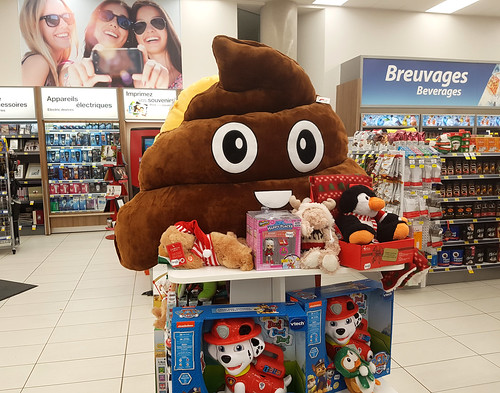
The poo emoji has been retired from its job answering press enquiries at Twitter. Guess it’ll have to do something else. CC-licensed photo by A Disappearing Act on Flickr.
You can sign up to receive each day’s Start Up post by email. You’ll need to click a confirmation link, so no spam.
A selection of 10 links for you. Oppenheimlered. I’m @charlesarthur on Twitter. On Mastodon: https://newsie.social/@charlesarthur. Observations and links welcome.
Apple slams UK surveillance-bill proposals • BBC News
Zoe Kleinman:
»
Apple says it will remove services such as FaceTime and iMessage from the UK rather than weaken security if new proposals are made law and acted upon.
The government is seeking to update the Investigatory Powers Act (IPA) 2016. It wants messaging services to clear security features with the Home Office before releasing them to customers.
The act lets the Home Office demand security features are disabled, without telling the public. Under the update, this would have to be immediate.
Currently, there has to be a review, and there can also be an independent oversight process and a technology company can appeal before taking any action.
Because of the secrecy surrounding these demands, little is known about how many have been issued and whether they have been complied with.
But many messaging services currently offer end-to-end encryption – so messages can be unscrambled by only the devices sending and receiving them.
WhatsApp and Signal are among the platforms to have opposed a clause in the Online Safety Bill allowing the communications regulator to require companies to install technology to scan for child-abuse material in encrypted messaging apps and other services.
They will not comply with it, they say, with Signal threatening to “walk” from the UK. Apple has also opposed the plan.
The government has opened an eight-week consultation on the proposed amendments to the IPA., which already enables the storage of internet browsing records for 12 months and authorises the bulk collection of personal data.
«
For clarity, this is not the Online Harms Bill – it’s an update of existing legislation, which could be passed more easily. Apple isn’t bluffing about this. The Tories seem wilfully blind to what they’re doing.
unique link to this extract
Spotify’s first US price hike for Premium is coming next week • The Verge
Jay Peters:
»
Spotify is going to raise the price of its Premium subscription plan in the US, according to The Wall Street Journal. The price is “likely” to go up by $1, meaning it would cost $10.99 per month, and the change is “expected” to be revealed next week, the publication says. The price of Premium has remained $9.99 per month since it launched in the US 12 years ago.
While perhaps not the most welcome news, it’s not entirely a surprise. Spotify CEO Daniel Ek has been signaling that prices would go up in 2023 and reiterated in April that a price hike would be happening this year. Spotify didn’t immediately respond to a request for comment.
Other music services have also increased prices to that $10.99 amount over the past several months. Apple bumped up the price of Apple Music by $1 last year, Amazon followed suit earlier this year for its Music Unlimited service, Tidal announced a price hike earlier this month, and YouTube raised the price of YouTube Music just this week.
«
Just two years since the last price hike. The frogs keep boiling slowly.
unique link to this extract
Why does Tesla want to build its own $1 billion supercomputer? • QZ
Faustine Ngila:
»
Any time you’re driving a Tesla, it’s collecting data in the background. An autonomous vehicle can collect up to 19 terabytes of data per day, from an array of sensors and cameras. All that data requires increasingly powerful computers to process, secure, and store, particularly as the demand for Teslas and other autonomous EVs soars.
Essentially, this data consists of all the information fed to the car’s 12 sensors and eight external cameras mounted to provide 360-degree visibility for a range of up to 250 meters to enhance safety and convenience for everyone on board.
The data can be voluminous. Tesla’s Autopilot feature, for instance, uses camera-based driver assistance software. Released in 2017, Autopilot has been collecting data from its consenting driver-users and then using it to feed neural networks and also power the Full Self-Driving (FSD) feature. That latter feature, now in beta, has collected up to 300 million miles of driving data. More than half of this data was gathered over the past quarter, according to Tesla’s latest earnings presentation.
The Dojo supercomputer, to be completed by the end of 2024, will make use of these massive amounts of video and sensor data generated by Tesla’s Autopilot and FSD features. As with its vehicle hardware and software, developed internally, Tesla plans to use its extremely large real-world dataset to train Dojo’s neural networks in-house.
«
For its “rapidly growing fleet of autonomous vehicles”, apparently. “Fleet” might be overstating it, a bit.
unique link to this extract
The curse of the Long Boom • The Future, Now and Then
Dave Karpf:
»
Here’s a goofy little thought-experiment: Imagine you are one of The Long Boom’s original co-authors (futurists Peter Leyden and Peter Schwartz). In 1997, you wrote an iconic WIRED magazine cover story, predicting that the future was going to be remarkably bright and prosperous for everyone, everywhere. You included a sidebar with ten reasons why it might not work out so well. And then basically all of those reasons (including, y’know, “Russia devolves into a kleptocracy,” and “an uncontrollable plague”) actually happened.
Would you:
(A) Make a joke of it. “Haha, sorry for the curse, everyone. My next prediction can only be spoiled by free ice cream and zero-point energy for all.”
(B) Write a critical retrospective discussing not just the spoiler sidebar, but everything else that was missing from the rose-colored-glasses scenario.
(C) Reinvent yourself as an Indiana Jones-style swashbuckling world traveller, seeking to unearth whatever Old Gods you apparently offended in 1997.
or (D) Write a follow-up essay, describe it as “The Long Boom Squared,” and including another list of 10 spoilers that might ruin the future?!?
Because folks, I have bad news to report: Peter Leyden chose option D.
This time, he’s predicting that 2025-2050 will be a period of unparalleled progress and abundance, unless we run into spoilers like “Liberal Democracies Fail,” “Quasi Civil War,” “Nuclear Bomb Explodes,” “Desperate Oil States,” and “China Hot War.”
«
Uh-oh. Fortunately, this is a great essay by Karpf, so at least we’ll have that to read in the coming dystopia.
unique link to this extract
Forget designer babies. Here’s how CRISPR is really changing lives • MIT Technology Review
Antonio Regalado:
»
there are now more than 50 experimental studies underway that use gene editing in human volunteers to treat everything from cancer to HIV and blood diseases, according to a tally shared with MIT Technology Review by David Liu, a gene-editing specialist at Harvard University.
Most of these studies—about 40 of them—involve CRISPR, the most versatile of the gene-editing methods, which was developed only 10 years ago.
That is where [sickle-cell sufferer Victoria] Gray comes in. She was one of the first patients treated using a CRISPR procedure, in 2019, and when she addressed the group in London, her story left the room in tears.
“I stand here before you today as proof miracles still happen,” Gray said of her battle with the disease, in which misshapen blood cells that don’t carry enough oxygen can cause severe pain and anemia.
But Gray’s case also shows the obstacles facing the first generation of CRISPR treatments, sometimes referred to as “CRISPR 1.0.” They will be hugely expensive and tricky to implement, and they could be quickly superseded by a next generation of improved editing drugs.
The company developing Gray’s treatment, Vertex Pharmaceuticals, says it’s treated more than 75 people in its studies of sickle cell, and a related disease, beta-thalassemia, and that the therapy could be approved for sale in the US within a year. It is widely expected to be the first treatment using CRISPR to go on sale.
Vertex hasn’t said what it could cost, but you can expect a price tag in the millions.
«
This story is from March, but I couldn’t quickly find a followup to see how all those studies are going. The difficulty about CRISPR, medicinally, is that you have to do it individually. It’s not like you can take a pill; it requires bone marrow transplants at minimum.
unique link to this extract
Twitter is being rebranded as X • The Verge
Wes Davis:
»
X.com now redirects to Twitter.com, following a tweet from Twitter owner Elon Musk today, and an “interim X logo” will replace the Twitter bird logo later today. Leading up to the change, Musk spent a lot of time tweeting about it.
Around 12AM ET last night, he started tweeting — and did so for hours — about the Twitter rebrand to X, the one-letter name he’s used repeatedly in company and product names forever. It started with a tweet saying “soon we shall bid adieu to the twitter brand and, gradually, all the birds,” followed by a second tweet adding that “if a good enough X logo is posted tonight, we’ll make go live worldwide tomorrow.”
Musk then, over the next several hours, gestured at the change in between other posts and replies, tweeting things like “Deus X,” or replying to other users talking about it. At one point, he joined a Twitter Spaces session called “No one talk until we summon Elon Musk,” and sat silently for almost an hour before unmuting and confirming he would be changing Twitter’s logo tomorrow, adding “we’re cutting the Twitter logo from the building with blowtorches.”
Musk also reportedly sent an email last night to Twitter employees telling them the company would become X, and that it was the last time he would email from a Twitter address, according a Threads post from Platformer managing editor Zoe Schiffer.
«
Well, it’s not as if words around the Twitter brand – “tweet”, “retweet” and so on – aren’t embedded in the language, and there’s absolutely zero value in the “Twitter” nam–hang on, I’m getting an update in my earpiece.
unique link to this extract
Elon Musk wants to relive his startup days. He’s repeating the same mistakes • Disconnect
Paris Marx:
»
Since taking over Twitter, Musk has said a lot about his plans for the platform, even if they aren’t always very coherent. The centerpiece of his tenure so far has been the move to turn verification and blue checks into a paid service, resulting in a string of impersonations and concerns among advertisers. But there’s a bigger strategy attached to the shift to paid verification.
In a Q&A on Twitter Spaces in early November, Musk outlined a longer term plan for Twitter. He saw paid verification as a way to reduce bot and scam accounts because they would not only need to pay, but would need a unique credit card. On top of that, “creators” would be able to make money on the service — something Musk reiterated recently, though with no details — and that would be a way to begin promoting Twitter as a payments service because you could keep that money within Twitter and transfer it to others. Musk said Twitter may even offer $10 incentives for people to sign up for its payments service, then it could add additional financial services like debit cards and money market accounts. And that would be part of a “superapp” with many different services on top of social media and payments.
If that sounds ambitious, it is; it’s also the pitch for X.com. Here are some of the similarities:
• After the merger of Confinity and X.com, David Sacks became the head of the product group, working closely with Elon Musk. When Musk took over Twitter, Sacks was among the small group of advisers he brought in to reshape it
• One of the combined team’s actions was to create a “verified” tier for PayPal users that linked their bank accounts to prove they were trustworthy, similar to Twitter’s paid verification
• Both Confinity and X.com offered a signup bonus of $5 to $20 to attract new users
• X.com offered a suite of financial services, and after the merger, tried to use the popularity of PayPal to direct its users to sign up for X.com’s financial products. (It didn’t work very well.)Musk is trying to rerun the playbook for his old finance company by grafting it onto a completely unrelated business. Not to mention that the industry today is very different than in the late 1990s. PayPal and Square are dominant players, there are plenty of other money-transfer apps and online banks, and traditional banks have continually improved their online services. Why would anyone use Twitter — not traditionally the most reliable company — when they can just keep using what works?
«
Elon Musk finally stops sending poop emojis from Twitter’s press email • Daily Beast
Justin Baragona:
»
Edgelord billionaire Elon Musk has finally put an end to his months-long troll of the media, announcing Thursday night that Twitter’s press email will no longer auto-respond to inquiries with a poop emoji. “We are changing the auto-reply from 💩 to a ‘We will get back to you soon’ infinite loop,” the “Chief Twit” tweeted. (The Daily Beast confirmed the automatic response from the email account.)
«
Worth it for “edgelord billionaire”. Musk is 52 years old.
unique link to this extract
Hollywood’s existential threat is attention • David By Design
David Armano:
»
Having recently returned from a trip to visit my parents, both in their eighties, allowed me to witness how most of their screen time is spent.
Spoiler alert that won’t surprise anyone; the number one screen is their phones. But it’s not just the screens; it’s the content. Like many other generations with mobile phones, my parents aren’t watching movies or shows on their phones; they are watching an endless stream of short-form videos and clips powered by AI algorithms.
This is not the content Hollywood produces and profits from. The TikTokification of content that is getting the lion’s share of our time and attention means there is less of it left over for Hollywood products. This includes streaming, BTW.
So however the strikes play out, Hollywood will emerge with a supply and demand problem in the works for years. That supply and demand issue translates to a shortage of attention for Hollywood-produced content and a surplus of products.
Hollywood’s monopoly on content has been over for some time, but it has reached an industry existential inflection point. As much as I personally don’t love what the Kardashians pump into the culture, they have been well ahead of the curve in divesting their massive income streams from Hollywood dependence. They don’t need Hollywood and, unlike it, have built a moat around their influencer/creator-architected revenue models.
«
In that sense, Quibi (remember?) was a sensible response to what was happening. But it had the worst possible luck in its launch time (pandemic! Everyone’s at home all day!) and lacked the algorithms of TikTok. Maybe try again?
unique link to this extract
How the creator economy is incentivizing propaganda • Noema
Renee DiResta:
»
One of the more remarkable artifacts of late-stage social media is the indelible presence of a particular character: the persecution profiteer. They are nearly unavoidable on Twitter: massive accounts with hundreds of thousands to millions of followers, beloved by the recommendation engine and often heavily monetized across multiple platforms, where they rail against the corporate media, Big Tech and elites. Sometimes, the elites have supposedly silenced them; sometimes, they’ve supposedly oppressed you — perhaps both. But either way, manipulation is supposedly everywhere, and they are supposedly getting to the bottom of it.
Many of these polemicists rely on a thinly veiled subtext: They are scrappy truth-tellers, citizen-journalist Davids, exposing the propaganda machine of the Goliaths. That subtext may have been true in last century’s media landscape, when independent media fought for audience scraps left by hardy media behemoths with unassailable gatekeeping power. But that all changed with the collapse of mass media’s revenue model and the rise of a new elite: the media-of-one.
The transition was enabled by tech but realized by entrepreneurs. Platforms like Substack, Patreon and OnlyFans offered infrastructure and monetization services to a galaxy of independent creators — writers, podcasters and artists — while taking a cut of their revenue. Many of these creators adopted the mantle of media through self-declaration and branding, redefining the term and the industry. Many were very talented. More importantly, however, they understood that creating content for a niche — connecting with a very specific online audience segment — offered a path to attention, revenue and clout. In the context of political content in particular, the media-of-one creators offered their readers an editorial page, staffed with one voice and absent the rest of the newspaper.
«
A long time ago, analysts forecast that the internet would atomise newspapers. They didn’t realise it would enable the spontaneous generation of particles of propaganda, quantum theory-style.
unique link to this extract
| • Why do social networks drive us a little mad? • Why does angry content seem to dominate what we see? • How much of a role do algorithms play in affecting what we see and do online? • What can we do about it? • Did Facebook have any inkling of what was coming in Myanmar in 2016? Read Social Warming, my latest book, and find answers – and more. |
Errata, corrigenda and ai no corrida: none notified
 The Overspill: when there's more that I want to say