
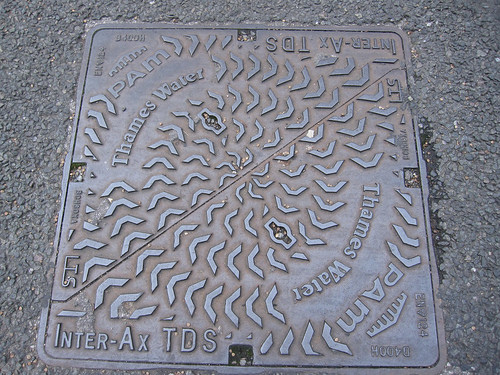
Privatised utility Thames Water is circling the drain as its debt piles up. CC-licensed photo by Liz Henry on Flickr.
You can sign up to receive each day’s Start Up post by email. You’ll need to click a confirmation link, so no spam.
It’s Friday, so there’s another post due at the Social Warming Substack at about 0845 UK time.
A selection of 9 links for you. Aren’t they?. I’m @charlesarthur on Twitter. On Mastodon: https://newsie.social/@charlesarthur. Observations and links welcome.
AI-generated books of nonsense are all over Amazon’s bestseller lists • Vice
Jules Roscoe:
»
Amazon’s Kindle Unlimited young adult romance bestseller list was filled with dozens of AI-generated books of nonsense on Monday and Tuesday. As of Wednesday morning, Amazon appeared to have taken action against the books, but the episode shows that people are spamming AI-generated nonsense to the platform and are finding a way to monetize it.
“The AI bots have broken Amazon,” wrote Caitlyn Lynch, an indie author, in a tweet on Monday. “Take a look at the Best Sellers in Teen & Young Adult Contemporary Romance eBooks top 100 chart. I can see 19 actual legit books. The rest are AI nonsense clearly there to click farm.” Motherboard viewed dozens of clearly AI-generated books Tuesday afternoon; by Wednesday, the vast majority of them had fallen off of the bestseller list but were still available to buy on the platform.
Select titles include: When the three attacks, Apricot bar code architecture, The journey to becoming enlightened is arduous, Department of Vinh Du Stands in Front of His Parents’ Tombstone, The God Tu mutters, Ma La Er snorted scornfully, Jessica’s Attention, etc.
Lynch included a screenshot of one book that, as of Wednesday morning, is in 90th place in the Top 100 Bestseller list for the Teen Contemporary Romance category. The book is called wait you love me and its cover is a black-and-white photo of a seagull with a neon yellow bar stretching across it containing the title text. The book has two one-star reviews, both of which call it a “fake AI book.”
«
No sign of this in the UK Kindle store, but that may be because Amazon has taken action. Indicative of the problem that AI content generation leads to though: if you let anyone put content in your store, and people have tools that can generate endless content, you have a problem. Contrast this with the next book-related problem..
unique link to this extract
How Goodreads reviews can tank a book before it’s published • The New York Times
Alexandra Alter and Elizabeth Harris:
»
Cecilia Rabess figured her debut novel, “Everything’s Fine,” would spark criticism: the story centers on a young Black woman working at Goldman Sachs who falls in love with a conservative white co-worker with bigoted views.
But she didn’t expect a backlash to strike six months before the book was published.
In January, after a Goodreads user who had received an advanced copy posted a plot summary that went viral on Twitter, the review site was flooded with negative comments and one-star reviews, with many calling the book anti-Black and racist. Some of the comments were left by users who said they had never read the book, but objected to its premise.
“It may look like a bunch of one-star reviews on Goodreads, but these are broader campaigns of harassment,” Rabess said. “People were very keen not just to attack the work, but to attack me as well.”
In an era when reaching readers online has become a near-existential problem for publishers, Goodreads has become an essential avenue for building an audience. As a cross between a social media platform and a review site like Yelp, the site has been a boon for publishers hoping to generate excitement for books.But the same features that get users talking about books and authors can also backfire. Reviews can be weaponized, in some cases derailing a book’s publication long before its release.
“It can be incredibly hurtful, and it’s frustrating that people are allowed to review books this way if they haven’t read them,” said Roxane Gay, an author and editor who also posts reviews on Goodreads.
«
Goodreads said it “takes the responsibility of maintaining the authenticity and integrity of ratings and protecting our community of readers and authors very seriously.” Yeah, sure. Simple solution: reviews posted before publication are deleted and the reviewer blocked, unless they’ve got special dispensation. We’re 25 years into online reviews and they haven’t worked this out? (Thanks Gregory for the link.)
unique link to this extract
AI may someday work medical miracles. For now, it helps do paperwork • The New York Times
Steve Lohr:
»
Dr. Michelle Thompson, a family physician in Hermitage, Pennsylvania., who specializes in lifestyle and integrative care, said the software had freed up nearly two hours in her day. Now, she has time to do a yoga class, or to linger over a sit-down family dinner.
Another benefit has been to improve the experience of the patient visit, Dr. Thompson said. There is no longer typing, note-taking or other distractions. She simply asks patients for permission to record their conversation on her phone.
“AI has allowed me, as a physician, to be 100% present for my patients,” she said.
The AI tool, Dr. Thompson added, has also helped patients become more engaged in their own care. Immediately after a visit, the patient receives a summary, accessible through the University of Pittsburgh medical system’s online portal.
The software translates any medical terminology into plain English at about a fourth-grade reading level. It also provides a recording of the visit with “medical moments” color-coded for medications, procedures and diagnoses. The patient can click on a colored tag and listen to a portion of the conversation.
Studies show that patients forget up to 80% of what physicians and nurses say during visits. The recorded and AI-generated summary of the visit, Dr. Thompson said, is a resource her patients can return to for reminders to take medications, exercise or schedule follow-up visits.
After the appointment, physicians receive a clinical note summary to review. There are links back to the transcript of the doctor-patient conversation, so the AI’s work can be checked and verified. “That has really helped me build trust in the AI,” Dr. Thompson said.
«
How easy is it to fool AI detection tools? • The New York Times
Stuart Thompson and Tiffany Hsu:
»
The pope did not wear Balenciaga. And filmmakers did not fake the moon landing. In recent months, however, startlingly lifelike images of these scenes created by artificial intelligence have spread virally online, threatening society’s ability to separate fact from fiction.
To sort through the confusion, a fast-burgeoning crop of companies now offer services to detect what is real and what isn’t.
Their tools analyze content using sophisticated algorithms, picking up on subtle signals to distinguish the images made with computers from the ones produced by human photographers and artists. But some tech leaders and misinformation experts have expressed concern that advances in AI will always stay a step ahead of the tools.
To assess the effectiveness of current AI detection technology, The New York Times tested five new services using more than 100 synthetic images and real photos. The results show that the services are advancing rapidly, but at times fall short.
«
The arms race – the illustrations getting better, the AI detectors too – is probably going to be won by the generators, not the detectors. They have the headstart.
unique link to this extract
Elon Musk’s biographer: I saw him fly into ‘demon mode’ • Business Insider
Grace Kay:
»
[Walter] Isaacson plans to release his biography on Musk in September. He has written biographies on several innovators, including Steve Jobs and Leonardo da Vinci. He said many brilliant and successful people, including Musk and Steve Jobs, had a “dark streak.”
Isaacson said they were not saddled with as much empathy and, as a result, were more able to focus on accomplishing a larger mission.
In Musk’s case, the biographer said the billionaire had a “maniacal sense of urgency” that could frighten some of his workers. He said the CEO’s demeanor would change when people didn’t match his sense of urgency.
“He’d go dark and I’d know that he was just going to rip that person apart,” Isaacson said, adding that it was a common occurrence when the billionaire first took over Twitter and gutted over half of the social-media site’s staff.
The biographer, who observed Musk’s day-to-day life for about two years, said the moments of rage were “uncomfortable” for him to watch.
“He is just brutal,” Isaacson said. “The thing that I noticed is that once he finishes doing it — and it was never physical and it was almost done in a flat monotone — but he would just really attack people and then a few days later, if they absorbed the lesson, he’d forget about it. It would be as if he went from becoming Dr. Jekyll to Mr. Hyde and then didn’t even think that much or remember that much of how tough he had been on people.”
Musk’s criticism seemed effective about 80% of the time and was “problematic” 20% of the time, which he said could even make people “afraid to give him bad news,” Isaacson said. He said that at times he’d later find out that the man Musk had chewed out had made a mistake because of personal issues, like losing a child two weeks prior.
«
Sounds, in its way, a lot like Steve Jobs: if people didn’t see what he saw as urgent, then they’d find out pretty soon. It’s unsurprising that someone successful would do this. But you also see it from people who are unsuccessful. In the latter case, we just call them jerks.
unique link to this extract
How a shady Chinese firm’s encryption chips got inside the US Navy, NATO, and NASA • WIRED
Andy Greenberg:
»
In July of 2021, the Commerce Department’s Bureau of Industry and Security added the Hangzhou, China-based encryption chip manufacturer Hualan Microelectronics, also known as Sage Microelectronics, to its so-called “Entity List,” a vaguely named trade restrictions list that highlights companies “acting contrary to the foreign policy interests of the United States.” Specifically, the bureau noted that Hualan had been added to the list for “acquiring and … attempting to acquire US-origin items in support of military modernization for [China’s] People’s Liberation Army.”
Yet nearly two years later, Hualan—and in particular its subsidiary known as Initio, a company originally headquartered in Taiwan that it acquired in 2016—still supplies encryption microcontroller chips to Western manufacturers of encrypted hard drives, including several that list as customers on their websites Western governments’ aerospace, military, and intelligence agencies: NASA, NATO, and the US and UK militaries. Federal procurement records show that US government agencies from the Federal Aviation Administration to the Drug Enforcement Administration to the US Navy have bought encrypted hard drives that use the chips, too.
The disconnect between the Commerce Department’s warnings and Western government customers means that chips sold by Hualan’s subsidiary have ended up deep inside sensitive Western information networks, perhaps due to the ambiguity of their Initio branding and its Taiwanese origin prior to 2016. The chip vendor’s Chinese ownership has raised fears among security researchers and China-focused national security analysts that they could have a hidden backdoor that would allow China’s government to stealthily decrypt Western agencies’ secrets. And while no such backdoor has been found, security researchers warn that if one did exist, it would be virtually impossible to detect.
«
(Thanks G for the link.)
unique link to this extract
UK government looks at nationalising Thames Water as crisis deepens • Financial Times
Gill Plimmer, Jim Pickard and Michael O’Dwyer:
»
Ministers have discussed a temporary nationalisation of Thames Water as investors and the government braced for the potential collapse of the debt-laden utility.
Wednesday’s contingency planning came a day after the abrupt exit of Thames Water chief executive Sarah Bentley, who was battling to turn round a company with a legacy of under-investment and £14bn of debt just as UK interest rates hit their highest level since 2008.
Shareholders 12 months ago promised to invest £500m in the company — the first equity injection since privatisation — and pledged a further £1bn subject to conditions. But the £500m was only paid this March and the additional £1bn has never been paid.
Cathryn Ross, co-interim chief executive, earlier this month said the company had made a “very large loss and that is not ideal in terms of raising capital”.
“We may need to go back to them [our shareholders] for more equity,” said Ross, a former chief executive at regulator Ofwat, in previously unreported comments.
…More than half the group’s debt is linked to inflation, which the company has justified by noting that customer bills are also linked to it. However, the debt is linked to the RPI [retail prices index] measure, which is at a historically wide premium to CPI [consumer prices index] inflation, which is used in pricing bills.
…After being sold with almost no debt at privatisation three decades ago, UK water companies have taken on borrowings of £60.6bn, diverting income from customer bills to pay interest payments.
«
That debt premium, usually around 1%, is now over 4%. Water companies are very indebted, and very screwed. Renationalisation beckons.
unique link to this extract
National Geographic lays off its last remaining staff writers • The Washington Post
Paul Farhi:
»
Like one of the endangered species whose impending extinction it has chronicled, National Geographic magazine has been on a relentlessly downward path, struggling for vibrancy in an increasingly unforgiving ecosystem.
On Wednesday, the Washington-based magazine that has surveyed science and the natural world for 135 years reached another difficult passage when it laid off all of its last remaining staff writers.
The cutback — the latest in a series under owner Walt Disney Co. — involves some 19 editorial staffers in all, who were notified in April that these terminations were coming. Article assignments will henceforth be contracted out to freelancers or pieced together by editors. The cuts also eliminated the magazine’s small audio department.
The layoffs were the second over the past nine months, and the fourth since a series of ownership changes began in 2015. In September, Disney removed six top editors in an extraordinary reorganization of the magazine’s editorial operations.
Departing staffers said Wednesday the magazine has curtailed photo contracts that enabled photographers to spend months in the field producing the publication’s iconic images.
In a further cost-cutting move, copies of the famous bright-yellow-bordered print publication will no longer be sold on newsstands in the United States starting next year, the company said in an internal announcement last month.
«
Not really National, not very Geographical. Truly a last gasp for a storied title. Perhaps ChatGPT can help write?
unique link to this extract
Decades-long bet on consciousness ends — and it’s philosopher 1, neuroscientist 0 • Nature
Mariana Lenharo:
»
A 25-year science wager has come to an end. In 1998, neuroscientist Christof Koch bet philosopher David Chalmers that the mechanism by which the brain’s neurons produce consciousness would be discovered by 2023. Both scientists agreed publicly on 23 June, at the annual meeting of the Association for the Scientific Study of Consciousness (ASSC) in New York City, that it is an ongoing quest — and declared Chalmers the winner.
What ultimately helped to settle the bet was a study testing two leading hypotheses about the neural basis of consciousness, whose findings were unveiled at the conference.
“It was always a relatively good bet for me and a bold bet for Christof,” says Chalmers, who is now co-director of the Center for Mind, Brain and Consciousness at New York University. But he also says this isn’t the end of the story, and that an answer will come eventually: “There’s been a lot of progress in the field.”
Consciousness is everything that a person experiences — what they taste, hear, feel and more. It is what gives meaning and value to our lives, Chalmers says.
Despite a vast effort, researchers still don’t understand how our brains produce it, however. “It started off as a very big philosophical mystery,” Chalmers adds. “But over the years, it’s gradually been transmuting into, if not a ‘scientific’ mystery, at least one that we can get a partial grip on scientifically.”
…The goal was to set up a series of ‘adversarial’ experiments to test various hypotheses of consciousness by getting rival researchers to collaborate on the studies’ design. “If their predictions didn’t come true, this would be a serious challenge for their theories,” Chalmers says.
The findings from one of the experiments — which involved several researchers, including Koch and Chalmers — were revealed on Friday at the ASSC meeting. It tested two of the leading hypotheses: integrated information theory (IIT) and global network workspace theory (GNWT). IIT proposes that consciousness is a ‘structure’ in the brain formed by a specific type of neuronal connectivity that is active for as long as a certain experience, such as looking at an image, is occurring. This structure is thought to be found in the posterior cortex, at the back of the brain. GNWT, by contrast, suggests that consciousness arises when information is broadcast to areas of the brain through an interconnected network. The transmission, according to the theory, happens at the beginning and end of an experience and involves the prefrontal cortex, at the front of the brain.
«
| • Why do social networks drive us a little mad? • Why does angry content seem to dominate what we see? • How much of a role do algorithms play in affecting what we see and do online? • What can we do about it? • Did Facebook have any inkling of what was coming in Myanmar in 2016? Read Social Warming, my latest book, and find answers – and more. |
Errata, corrigenda and ai no corrida: thanks to Artiste212 for pointing out that whales and dolphins, which are intelligent and which I don’t eat, are mammals, not fish. The search goes on for an intelligent fish, I guess.
 The Overspill: when there's more that I want to say