Start Up No.1671: the climate change doomsters, Apple plans autodial after crashes, jail threat for trolling?, how Street View sees us, and more


Asteroid Bennu is essentially a junk pile of rocks – which means that trying to divert it from an Earth-crossing orbit might be particularly difficult. CC-licensed photo by Kevin Gill on Flickr.

You can sign up to receive each day’s Start Up post by email. You’ll need to click a confirmation link, so no spam.

A selection of 10 links for you. Warming to it. I’m @charlesarthur on Twitter. Observations and links welcome.


Stop telling kids they’ll die from climate change • WIRED UK

Hannah Ritchie:

»

One of the most recent and alarming examples of this doomsday mindset came from a group of young activists before the German elections. The group, who call themselves the Last Generation, went on hunger strike for almost a month. Several ended up in hospital. One told his parents and friends that they might never see him again. Another told a journalist that the hunger was “nothing compared to what we can expect when the climate crisis unleashes a famine here in Europe in 20 years.”

I couldn’t work out where this claim was coming from. Not from scientists. No credible ones have made this claim. Climate change will affect agriculture. In some regions—particularly across some of the world’s poorest countries—this is a major cause for concern. It’s why I spend so much of my time working on it. But famine across temperate Europe? Within 20 years?

There are a couple of ways I think this doomsday scenario has become commonplace. First, you don’t need to look far to find people with large platforms promoting these messages. Take Roger Hallam, the founder of Extinction Rebellion. In one of his most recent videos—titled “Advice to Young People as They Face Annihilation”—he claims we must get emissions to zero within months, otherwise humanity will be wiped out. He claims that this annihilation is now locked in.

The worst thing about this message is that, rather than inspiring action, it resigns us to the falsehood that we are already too late. There is now nothing we can do. It’s easy to dismiss Hallam as an extreme outlier, but he is also the founder of one of the world’s largest environmental movements. A movement whose name is hinged on this premise that we’re heading for a total wipeout. This is out of line with the science, and scientists should call this out more prominently.

Second is a miscommunication of targets and thresholds. The 1.5º Celsius target was written into the Paris Agreement in acknowledgement that 2ºC of warming would risk the livelihoods of some communities—particularly low-lying island states. It was a call for greater ambition. But the likelihood that we would meet this 1.5ºC target was as slim then as it is now. Feasible in the models, but in reality it’s gone. The problem is that many now view 1.5ºC as a tipping point threshold. Once we hit it, the game is up. It’s therefore not surprising—given that we will most likely pass 1.5ºC in the next few decades—that many people believe we’re too late.

«

Boris Johnson’s teeth-grindingly terrible speech – suggesting that COP26 is the world’s James-Bond-disarming-the-bomb moment, where it must be done or that’s it, sayonara – was a classic of the “misrepresenting reality” fare that we’ve had for decades. There was plenty of time. Until there absolutely wasn’t. But that moment passed at least a decade ago.
unique link to this extract


Managing climate change • Financial Times

»

COP26 is a moment of truth to see if world leaders can ‘keep 1.5 alive’. In this report: Biden’s fight to save the US green agenda; why net zero is difficult; investor pressure; action on the ground; the power of small changes. Plus: water and oceans

«

No paywall on all the articles.
unique link to this extract


Apple wants iPhones to detect car crashes, auto-dial 911 • WSJ

Rolfe Winkler:

»

Beginning next year, iPhone users who are in a car accident could have their phone dial 911 automatically.

Apple plans next year to roll out a product feature called “crash detection” for iPhones and Apple Watches, according to documents reviewed by The Wall Street Journal and people familiar with the feature.

Crash detection uses data from sensors built into Apple devices including the accelerometer to detect car accidents as they occur, for instance by measuring a sudden spike in gravity, or “g,” forces on impact.

The feature would mark the latest move by Apple and its competitors to use motion-sensor technology to build safety functions into their devices. Apple introduced a fall-detection feature in its smartwatch several years ago that senses when wearers have taken a hard fall and dials 911 if they don’t respond to a notification asking if they are OK. The company this year added a feature to the newest version of its iPhone operating system that assesses the walking steadiness of users.

…Apple has been testing the crash-detection feature in the past year by collecting data shared anonymously from iPhone and Apple Watch users, the documents show. Apple products have already detected more than 10 million suspected vehicle impacts, of which more than 50,000 included a call to 911.

Apple has been using the 911 call data to improve the accuracy of its crash-detection algorithm, since an emergency call associated with a suspected impact gives Apple more confidence that it is indeed a car crash, according to the documents.

«

Not the first (Google Pixel has it, some apps offer it) but building it in means yet more passive utility.
unique link to this extract


Trolls will be jailed for ‘psychological harm’ • The Times

Matt Dathan:

»

A new offence of “threatening communications” will target messages and social media posts that contain threats of serious harm. It would be an offence where somebody intends a victim to fear the threat will be carried out.

A “knowingly false communication” offence will be created that will criminalise those who send or post a message they know to be false with the intention to cause “emotional, psychological, or physical harm to the likely audience”. Government sources gave the example of antivaxers spreading false information that they know to be untrue.

The new offences will include sol-called “pile-ons” where a number of individuals join others in sending harassing messages to a victim on social media.

The Times was told that the plans had been sent to cabinet for approval. Nadine Dorries, the culture secretary, is intending to add them to the bill when it is introduced to parliament next month, government sources said.

The move is likely to be met with resistance from freedom of speech campaigners and civil libertarians.

David Davis, a former cabinet minister, said assessing based on the impact it has on the receiver was too subjective and urged the government to rethink the proposals, especially given it has hailed the legislation as “world-leading”. Jim Killock, executive director of the Open Rights Group, said the new harm-based offences were too broad.

«

This just sounds wild and unhinged. Of course Dorries, who has instituted various pile-ons, would be doing this now. No shame, no vision, no sense.
unique link to this extract


Asteroid Bennu’s surface lacks dust due to rock porosity • SYFY WIRE

Phil Plait:

»

scientists predict that solid stony asteroids will tend to have more regolith than crumbly ones like Bennu (and Ryugu, another small asteroid recently visited by the Japanese spacecraft Hayabusa2), which are high in carbon and therefore called carbonaceous asteroids.

…Besides the cool science of all this there’s also a streak of self-interest here. If an asteroid is on an impact trajectory with Earth, the best thing we can do is push it out of the way by, for example, slamming a spaceprobe into it. That small change in velocity can move the asteroid onto a path that misses Earth.

But if the asteroid is porous that method doesn’t work as well. A lot of the momentum of the spacecraft is used up in compacting the rocks instead of moving the asteroid as a whole, and the efficiency of the hit is lowered. Instead, we might have detonate a nuke very close to the surface, using the huge flash of heat to vaporize rocks there; the suddenly expanding gas will push on the asteroid like a rocket and move it onto a new path. But we need to know if an asteroid is porous or solid before we launch such a mission to save the world. This new study may help inform such an endeavor.

OSIRIS-REx stands for “Origins, Spectral Interpretation, Resource Identification, Security-Regolith Explorer”. The “regolith explorer” part has turned out to be pretty important to the “security” part. Bennu itself is a Potentially Hazardous Asteroid, one that’s bigger than 140 meters wide and gets within 7.5 million kilometers of Earth; in fact it gets close enough to Earth that there’s a 1-in-2,700 chance of an impact in September of 2182.

«

Just spitballing here, but couldn’t we drive the rocket with the nuke directly at the asteroid to explode on the surface? Two birds one stone (so to speak) and doesn’t require two missions, which would be really hard to organise when everyone was running around like headless chickens. (Also, it’s very Armageddon, isn’t it?)
unique link to this extract


Nigeria’s eNaira digital currency had an embarrassing first week • Quartz

Alexander Onukwue:

»

The eNaira is supposed to live within a mobile wallet (pdf), have the same value and be interchangeable with the physical naira for everyday transactions. Nigerians believe the eNaira, which is governed by a centralized blockchain, is part of the central bank’s drive to discourage cryptocurrencies’ popularity among Nigeria’s youth, just like China’s effort with the digital yuan.

And so this week, Nigeria’s central bank made two types of eNaira wallets available on Google and Apple stores: one for individuals, and another for merchants. But some users say parts of the wallet for individuals have not worked properly.

Fisayo Fosudo, a Nigerian YouTuber who reviews gadgets and apps, said he and three friends initially got error messages that the eNaira app could not match their emails to their bank verification numbers. He would later register successfully but found broken links that did not lead to helpful support pages on the central bank’s website. “Was really looking forward to reviewing the eNaira app but it’s been hard to get it to work seamlessly. We wait,” Fosudo said.

After many users left poor reviews for the Android version of the eNaira app for individuals, it was taken down. It had been downloaded 100,000 times before that. The Apple Store version remained available at press time.

«

Still waiting for more news on how things are going in El Salvador with its bitcoin experiment. Mostly it seems like the government is buying them when prices drop – essentially putting its foreign reserves into crypto. Of course it had to block a feature that allowed arbitrage in transactions.
unique link to this extract


Ex-Googler Gill Whitehead appointed to lead UK’s Digital Regulation Cooperation Forum • VideoWeek

Tim Cross:

»

The UK’s Digital Regulation Cooperation Forum (DRCF) has today announced Gill Whitehead has been appointed as its new chief executive. The DRCF was formally announced last summer as a way of coordinating the regulatory work of Ofcom, the Competitions and Markets Authority, the Information Commissioner’s Office, and the Financial Conduct Authority.

Whitehead’s appointment marks a major milestone for the forum, and she will be tasked with creating a plan of action for the DRCF’s work in streamlining regulation and providing practical assistance for the government’s work.

Gill Whitehead herself is an interesting choice given her previous work in the industry. She most recently worked for Google’s UK Management Group, where she led specialist teams in analytics, measurement, data science, and user experience. She’s also worked for UK broadcasters Channel 4 and the BBC – giving her experience both within one of the tech giants, and within the broadcasters who likely want to see those tech giants more tightly regulated.

«

“Interesting” is a, well, interesting choice of word there. Is Whitehead the perfect person to know what sort of things go on inside Google, and thus make the DCRF a force to be reckoned with? Or will she be compromised by her past? You know any decision she makes or weighs in on will be a Rorschach test for those analysing it.
unique link to this extract


Memory lanes: Google’s map of our lives • The Guardian

Sirin Kale:

»

I am leaning against a wall outside my secondary school in my home town of Canterbury, waiting for my mother to pick me up. She is late, as usual. I rest my head on the stone wall, which is obsidian smooth with the occasional sharp edge. I can feel a flinty knuckle of rock pressing into the base of my skull. I shift uncomfortably in my non-regulation high heels and watch the other parents come and go. I am irritated and worried I won’t have enough time to finish my GCSE coursework that evening. And then she arrives, and I slam the car door shut with more force than is needed.

Only I am no longer a sullen teenager and I am not in Canterbury. I am on my sofa in south London, walking the streets of my former home town on Google Street View. I drag and drop Pegman, the Street View icon, outside my old school. He flails for a moment before freefalling feet-first, and then I am a teenager, walking the passageways of my youth. I can feel the cold stones under my hand as I trace my palm along the wall. I spent so many afternoons waiting for my mother in this spot that it feels as if there is an imprint of me forever leaning there, a ghostlike presence for today’s students to bustle past.

I am not the only person to connect with Google Street View on an emotional level. In June, the poet Sherri Turner went viral after posting a Twitter thread about her experience revisiting her mother’s old house on Street View. “There is a light on in her bedroom,” Turner wrote. “It is her house, she is still alive, I am still visiting every few months on the train to Bodmin Parkway.”

«

This is a strangely lovely piece, about how people have discovered slices of their lives in Google’s indifferent capture – including the theft of a caravan, happening on camera.

I recall the first day it went live: at The Guardian (and everywhere else, I think) everybody’s first reaction was to look up their home address and see if it was there. Of course it was. Their next reaction was to go and look up either their workplace or their favourite childhood home. You could probably know all you need to know about someone by their first 10 GSV lookups.
unique link to this extract


EU investigating leak of private key used to forge Covid passes • Bleeping Computer

Ax Sharma:

»

The private key used to sign EU Digital Covid certificates has been reportedly leaked and is being circulated on messaging apps and online data breach marketplaces.

The key has also been misused to generate forged certificates, such as those for Adolf Hitler, Mickey Mouse, Sponge Bob—all of which are being recognized as valid by the official government apps.

The Digital Covid certificate, or the “Green Pass” helps European Union residents travel across borders seamlessly by proving that they have either been vaccinated against COVID-19, received a negative test result, or successfully recovered from COVID-19.

This week, users reported seeing the private key for EU Digital Covid certificates circulating on messaging apps, like Telegram.

The private key is used to sign “Green Pass,” European Union’s equivalent of a vaccine passport, and/or proof of negative COVID-19 status that can help travelers cross borders seamlessly.

“On various groups (Telegram mainly) are circulating several forged Green Pass with valid signature… There is the possibility that a database of private keys is compromised and this may [end] up in a break of the chain of trust in the Green Pass architecture,” stated GitHub user Emanuele Laface.

«

The hackers have generated a certificate for “Hitler, Adolf” which is valid in Italy, and which gives his birth date – wrongly – as January 1 1900. Since we’re talking about medical matters, you might enjoy this Roald Dahl story, which is “based on true events” – only the dialogue is invented.
unique link to this extract


Covid death toll overtakes that of HIV/AIDS in the US • Boing Boing

Rob Beschizza:

»

The data are imprecise, but October likely saw the death toll from Covid-19 surpass that of HIV/AIDS in the United States. According to Johns Hopkins University, 746,000 people in America have died in the U.S. with Covid-19. The Kaiser Foundation reports that “More than 700,000 people in the U.S. have died from HIV-related illness,” but does not specifically cite the source for that total.

Though Covid took only two years to kill as many people in America as AIDS has in 40, both are ongoing pandemics.

«

Amazing to contemplate the difference between the two diseases. One has a vaccine, one doesn’t; one is a retrovirus (that really *does* change your DNA, at least of infected cells), the other very much isn’t. Though of course HIV is much more of a slow burning fuse compared to the, relative, firecracker of Covid.
unique link to this extract


No Facebook links today! But even so, you should buy my book Social Warming, to find out more about how social networks are affecting us.


Errata, corrigenda and ai no corrida: none notified

Start Up No.1670: Facebook v the journalists, pricing Apple’s privacy changes, zombie energy stats, kids + screens = OK?, and more


This will sound like a brain teaser, and it is. Why would someone walk into an Apple Store and demand the Mac that comes in the smallest box – no other spec matters? CC-licensed photo by Jamie McCall on Flickr.

You can sign up to receive each day’s Start Up post by email. You’ll need to click a confirmation link, so no spam.

A selection of 11 links for you. Does a metaverse imply the existence of a metamiddle eight? I’m @charlesarthur on Twitter. Observations and links welcome.


Learning to live with Mark Zuckerberg • The New York Times

Ben Smith talks to Jessica Lessin (whose outlet was one of just four, none including “big legacy” outlets, to get a Mark Zuckerberg why-the-metaverse interview:

»

Ms. Lessin dates the hostility between journalists and Silicon Valley to the rise in the mid-2010s of Uber, whose leaders treated the worst features of tech culture — arrogance and misogyny, among them — as features, not bugs, and faced a new kind of adversarial coverage for it.

But Donald J. Trump’s election in 2016 was also central to the shift. Mainstream publications woke up to the centrality of Facebook in a new and sometimes violent and anti-democratic strain of global right-wing populism, a connection that Mr. Zuckerberg at first glibly dismissed. (Reporters also resented being forced to police Facebook’s informational byways like underappreciated mall cops, when Facebook should have been doing that itself.)

In their frenzy to provide a simple explanation for Mr. Trump’s victory, journalists sometimes botched the details and oversimplified the story. This was particularly true in the overhyped case of the political consultant Cambridge Analytica, which embodied fears of a new kind of algorithmic propaganda but which, a British government report later found, never actually did most of the sinister things it bragged about. Accurate reporting and erroneous articles alike bred a deep sense of embattlement in Palo Alto.

Ms. Lessin said she sees a few patterns, and a lot of symmetry. One is that journalists and tech figures are bad at reading one another’s motives.

“Tech companies say journalists are doing this hard-hitting reporting for profit motives” and because they’re angry about losing advertising, she said. “That’s obviously absurd.”

“But journalists who are accusing Facebook of making bad content moderation decisions because they’re only concerned about profits are also missing the point. Most of the time the challenges are around free speech.”

“They’re actually making the same mistake in reverse directions about each other,” she said. “I’m kind of baffled by it.”

Ms. Lessin’s second observation is that many tech chief executives see themselves in a battle with news outlets for the hearts and minds of their own employees. When they blast media coverage, they are also speaking to the people whose salaries they pay.

“The woke revolution in Silicon Valley is fueling this, too,” she said. “Tech executives are completely associating their employees’ activism with media outlets.”

«

unique link to this extract


• Want to understand Facebook and social networks, and especially our reaction to them, better? Read Social Warming, my latest book, and find answers – and more.

Snap, Facebook, Twitter and YouTube lose nearly $10bn after iPhone privacy changes • Financial Times

Patrick McGee:

»

Apple’s decision to change the privacy settings of iPhones caused an estimated $9.85bn of revenues to evaporate in the second half of this year at Snap, Facebook, Twitter and YouTube, as their advertising businesses were shaken by the new rules.

Apple introduced its App Tracking Transparency policy in April, which forced apps to ask for permission before they tracked the behaviour of users to serve them personalised ads.

Most users have opted out, leaving advertisers in the dark about how to target them. Advertisers have responded by cutting back their spending at Snap, Facebook, Twitter and YouTube and diverted their budgets elsewhere: in particular to Android phone users and to Apple’s own growing ad business.

Sheryl Sandberg, Facebook’s chief operating officer, has said the iPhone changes meant “the accuracy of our ads targeting decreased, which increased the cost of driving outcomes for our advertisers. And . . . measuring those outcomes became more difficult.”

Lotame, an advertising technology company whose clients include The Weather Company and McClatchy, estimated that the four tech platforms lost 12% of revenue in the third and fourth quarters, or $9.85bn. Snap fared the worst as a percentage of its business because of its focus on smartphones, while Facebook lost the most in absolute terms because of its size.

«

Is it “iPhone privacy changes” or is it “customer privacy changes”? Apple doesn’t force anyone to opt out; it just asks them if they want to let an app track them. Seems that a very large proportion don’t want that, where they didn’t have the chance before.

Which raises the interesting question of how much money, and how big, those companies would be if such a block had been in place to begin with; and also whether it will be, or is, or would have been, something that would lead to Android customers changing to iOS.
unique link to this extract


Google revelations help explain local-news crisis • The Seattle Times

Brier Dudley is editor of the Seattle Times Free Press:

»

New details of the ad-market distortions were revealed Friday when, under a judge’s order, the shroud was lifted from much of a multistate antitrust case against Google. Key details about how extensively the search giant dominates the marketplace for buying, selling and pricing online display advertising, and manipulates things to benefit itself, had been redacted since the case was announced in December.

Among the revelations: Google gets up to a 42% cut of ad sales handled through its system. The extraordinary take shows how much the company dominates the marketplace, the state case led by Texas argues.

Google’s ad exchange handles more than 60% of display ad inventory sold in the US. The company’s own ad buying tools also win more than 80% of auctions hosted on its dominant exchange, unredacted passages state.

In one example cited, a $6 bid for an advertising spot came through Google’s advertising exchange and an $8 bid from a different exchange. But because Google designed the system to prioritize itself, the $6 bid won, shorting the publisher $2.

“Internally, Google employees grappled with the fact that Google was falsely telling publishers that Google’s header bidding alternative enabled competition and improved yield, since in reality, Google created a program that advantaged itself at the expense of publishers,” the case states.

The case also revealed what it called “an illegal agreement” between Google and Facebook made in 2018, when Google’s dominance was threatened by a new bidding system for online ads that Facebook supported. In return for backing off, Facebook received preferential treatment in Google’s system.

«

Worth pointing out how Google is putting its finger on the scale all the time here. But, again, the realisation comes much too late, when ripping these things out will be much more difficult.
unique link to this extract


No, you can’t save £30 per year by switching off your “standby” devices • Terence Eden’s Blog

The aforesaid Eden with a post that annoys me, for reasons I’ll explain:

»

Every few years, a dodgy stat does the rounds claiming you can save £££ if you switch off all your gadgets at the wall. The standby mode of your TV is bleeding you dry!!!

[The BBC quoted the Energy Saving Trust in a story about fuel bills, saying that you’d save £30 per year by switching off devices that were on standby.]

This is known as “Vampire Energy” and, amusingly, is a bit of a zombie statistic. Being the party-pooper that I am, I emailed the Energy Saving Trust to ask how they calculated the stat. They replied quickly with:

»

The calculation for £35 savings from turning off stand-by devices per year per household comes from average 201KWh for stand-by power times GB average standard electricity price 16.471 £p/KWh, then rounded to nearest £5.

201KWh comes from “Further Analysis of the Household Electricity Survey Early Findings: Demand side management”. Please note that the term “stand-by” used in this situation also include device on idle mode. Please refer to the report in more detail about the assumptions used in the analysis. Here is the link for this report.

«

«

Eden then takes those claims apart. It’s nothing like £30 per year these days, and even in the old days it was probably questionable. My annoyance? Because I emailed the EST’s press office, and it took them 10 working days and four emails to come up with a response that wasn’t even as good as Eden got just trying to “Contact” page.
unique link to this extract


Nilay Patel on Facebook’s reckoning with reality—and the Metaverse-size problems yet to come • Vanity Fair

Delia Cai speaks to Patel, who has been running The Verge for a decade now:

»

DC: One more Facebook question. What’s the deal with the rebrand?

NP: They want it to be about the metaverse, right? They’re really focused on Oculus and A.R. But A.R. is a really hard problem. If you step back to the beginning, you’ve gotta build the display that goes on your face that doesn’t make you look ridiculous. You have to find a way to power it; you have to put a battery on your body somewhere; you’ve gotta find a computer that’s fast enough to look at the world around you and put stuff on top that’s also small enough to run off the battery. Very challenging. But that’s just the tech problem.

Once you build it, who is going to augment reality? Who is in charge of that project? If I’m standing at the United States Capitol and you’re standing there, and we’re both looking at the Capitol, what are we seeing—what is the label on that building? Is it the “home of democracy,” or is it “where Donald Trump got screwed”? We’ll actually live in different realities.

Facebook is trying to pivot away from its Facebook problems, which is a content-moderation-at-scale problem. It might well be unsolvable. Meanwhile, they are still racing toward the hardest content moderation at scale that will ever exist: that you and I will live in different realities because we’re wearing headsets on our faces that present to us different realities in the same moment, in the same physical space.

DC: God, that’s spooky.

NP: I think about it all the time.

«

But then he suggests something even worse. (An idea that multiple companies seem to be running towards, and which one is already building for certain.) His comments on data-driven journalism are on point too.
unique link to this extract


Kids and their computers: several hours a day of screen time is OK, study suggests • The Conversation

Katie Paulich is a PhD student at the University of Colorado, Boulder:

»

Even when kids spend five hours a day on screen – whether computers, television or text – it doesn’t appear to be harmful. That’s what my colleagues and I at the University of Colorado Boulder discovered after analyzing data taken from nearly 12,000 participants in the Adolescent Brain Cognitive Development Study – the largest long-term study of its kind ever in the U.S.

The participants included children between the ages of 9 to 10, from diverse backgrounds, income levels and ethnicities. We investigated how screen time was linked to some of the most critical aspects of their lives: sleep, mental health, behavior and friendships.

Our results, recently published in the journal PLOS One, found no association between screens and a child’s depression or anxiety. Greater amounts of screen time were associated with stronger peer relationships for both boys and girls – both have more male and female friends. Social screen use may drive that association; video gaming, for instance, is a social activity that seems to foster more friendships. So does social media and texting.

…Our study also found negative correlations: More screen time predicted higher levels of attention problems, worse sleep, poorer academic performance and an increase in aggression and misbehavior.

Taken at face value, these contrasting positive and negative correlations are confusing. Is screen time good or bad?

Perhaps neither one: when looking at the strength of the correlations, we see only very modest associations. That is, any association between screen time and the various outcomes, whether good or bad, is so small it’s unlikely to be important at a clinical level.

«

unique link to this extract


Willingness to look stupid • Dan Luu

Luu on the benefits of asking (what seem to be) stupid questions:

»

when I look at people who have a very deep understanding of topics, many of them frequently ask naive sounding questions and continue to apply one of the techniques that got them a deep understanding in the first place.

…In general, I’ve found willingness to look stupid to be very effective. Here are some more examples:

• Going into an Apple store and asking for (and buying) the computer that comes in the smallest box, which I had a good reason to want at the time.

The person who helped me, despite being very polite, also clearly thought I was a bozo and kept explaining things like “the size of the box and the size of the computer aren’t the same”. Of course I knew that, but I didn’t want to say something like “I design CPUs. I understand the difference between the size of the box the computer comes and in the size of the computer and I know it’s very unusual to care about the size of the box, but I really want the one that comes in the smallest box”. Just saying the last bit without establishing any kind of authority didn’t convince the person.

I eventually asked them to humor me and just bring out the boxes for the various laptop models so I could see the boxes, which they did, despite clearly thinking that my decision making process made no sense (I also tried explaining why I wanted the smallest box but that didn’t work).

«

There are more, but this one is the most intriguing, because he doesn’t answer it. See if you can think of the potential answers. (Via Ian Leslie’s excellent Substack.)
unique link to this extract


Science confirms it: websites are all starting look the same

Sam Goree:

»

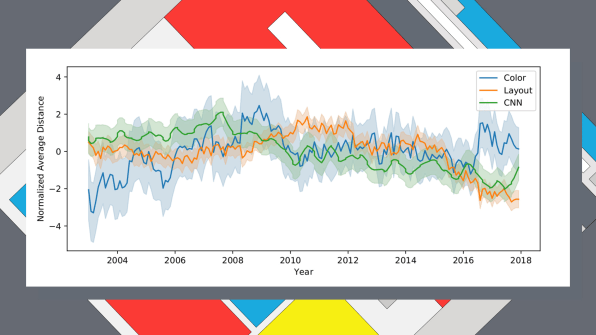
We found that across all three metrics—color, layout, and AI-generated attributes—the average differences between websites peaked between 2008 and 2010 and then decreased between 2010 and 2016. Layout differences decreased the most, declining over 30% in that time frame.


The graph shows website similarity of companies in the Russell 1000. Lower values mean that the sites studied were more similar, on average. [Image: courtesy of the author]

These findings confirm the suspicions of web design bloggers that websites are becoming more similar. After showing this trend, we wanted to study our data to see what kinds of specific changes were causing it.

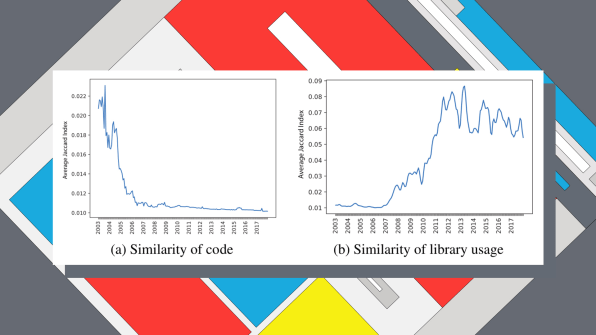
You might think that these sites are simply copying each other’s code, but code similarity has actually significantly decreased over time. However, the use of software libraries has increased a lot.


The graph on the left shows a decline in code similarity among Russell 1000 websites, while the graph on the right indicates an increase in library overlap. [Image: courtesy of the author]

Libraries feature collections of generic code for common tasks, such as resizing a page for mobile devices or making a hamburger menu slide in and out. We looked at which sites had lots of libraries in common and how similar they looked. Sites built with certain libraries—Bootstrap, FontAwesome, and JQuery UI—tended to look much more similar to each other.

«

unique link to this extract


A new world of cronut lines • Garbage Day

Ryan Broderick:

»

During Facebook Connect, Zuckerberg showed of a slew of VR and AR products, including the Project Cambria headset, the Oculus Quest 2 (soon to be Meta Quest), and a social virtual lobby-like platform for Oculus users called Horizon Home. And Bloomberg got ahold of leaked photos of a Facebook Smart Watch, which is believed to have front and back facing cameras and connect to the internet via a cellular connection that wouldn’t require a smartphone.

What we can tell, from all of this, is that for Zuckerberg, the metaverse is an ill-defined hodgepodge of virtual productivity tools and lame wearables. It’s in line with this broader feeling in Silicon Valley right now that if you jam together a conference call and a FitBit, somewhere in the middle there, you’ll end up with the metaverse.

Look, here’s the thing. The metaverse will probably happen at this point, but it won’t look like anything in Zuckerberg’s stupid Connect video. It will be weird and janky and people will use it to have sex with cartoon characters and hide video game achievements in parks and interact with their favorite influencers, who may or may not be real…

…Big platforms will inevitably create products that will facilitate this, but they won’t be Facebook. They’ll be stranger and more specific. They’ll emphasize small localized networks and faster and more visual communication: A Discord-like messaging app that has a Snap Map functionality and seamless live video filters. Digital assets, whether they’re NFTs or just memes you save on your phone, will be displayed in jewelry or small picture frames. You’ll turn a corner on the street and see a group of people standing together, staring at their phones or watches, and you’ll have no idea that they’re seeing together. Maybe one of them airdrops you the piece of content they’re all looking at. Maybe this has already happened to you.

But just think about the internet right now and think about how far beyond Facebook is already. It is laughable to think Zuckerberg is capable of creating a brand new VR-based internet. He couldn’t even beat TikTok!

«

unique link to this extract


Meta acquires VR fitness subscription service Supernatural • CNET

Scott Stein:

»

Supernatural was one of the first subscription-based services on the Oculus Quest (soon to be called the Meta Quest). The app, which uses video avatars of instructors in combination with motion-tracked workout routines (boxing was just added), sometimes feels like a ramped-up fitness version of the VR game Beat Saber.

“Our partnership with Meta means we will have more resources to expand and bring you even more music, more creative ways to work out, more features and more social experiences for VR,” Within CEO Chris Milk said in a statement Friday. 

It looks like a move that could let Meta evolve more fitness and health aspirations on future headsets or products. “Together we will also explore ways we can enhance future hardware to support VR fitness apps, encouraging other developers to bring new fitness experiences to VR. We believe fitness will be a massive success in VR where multiple third-party fitness apps can succeed,” Meta VP of Play Jason Rubin said in a statement.

Ssupport for connected smartwatches for live heart rate readings during workouts may be the app’s most intriguing feature as it applies to Meta. Meta has its own movement-tracking fitness app on the Oculus Quest called Oculus Move, but no deeper support for connected smartwatches yet. Mark Zuckerberg spoke to CNET earlier this year, expressing an interest in both fitness and fitness sensors. Meta is expected to be making its own smartwatch, and is working on wrist-based neural input accessories for future smart glasses.

«

Well, it’s nice to have dreams.
unique link to this extract


Zuckerberg announces fantasy world where Facebook is not a horrible company • Vice

Jason Koebler:

»

Moments before announcing Facebook is changing its name to “Meta” and detailing the company’s “metaverse” plans during a Facebook Connect presentation on Thursday, Mark Zuckerberg said “some people will say this isn’t a time to focus on the future,” referring to the massive, ongoing scandal plaguing his company relating to the myriad ways Facebook has made the world worse. “I believe technology can make our lives better. The future will be built by those willing to stand up and say this is the future we want.”

The future Zuckerberg went on to pitch was a delusional fever dream cribbed most obviously from dystopian science fiction and misleading or outright fabricated virtual reality product pitches from the last decade. In the “metaverse—an “embodied” internet where we are, basically, inside the computer via a headset or other reality-modifying technology of some sort—rather than hang out with people in real life you could meet up with them as Casper-the-friendly-ghost-style holograms to do historically fun and stimulating activities such as attend concerts or play basketball. 

These presentations had the familiar vibe of an overly-ambitious video game reveal. In the concert example, one friend is present in reality while the other is not; the friend joins the concert inexplicably as a blue Force ghost and the pair grab “tickets” to a “metaverse afterparty” in which NFTs are for sale. This theme continued throughout as people wandered seamlessly into virtual fantasy worlds over and over, and the presentation lacked any sense of what this so-called metaverse would look like in practice. It was flagrantly abstract, even metaphorical, showing more the dream of the metaverse than anything resembling reality.

«

Lovely use of “flagrantly”. People have been lining up to dump on Facebook for this, but I think Koebler did it best.
unique link to this extract


Errata, corrigenda and ai no corrida: none notified