Start Up No.1370: the US defence group tracking your phone, how Cook made Apple his own, Gates on Covid and Facebook, and more


The hokey 1960s TV series “Time Tunnel” probably wouldn’t pass muster in China – because of its time-travel theme CC-licensed photo by James Vaughan on Flickr.

You can sign up to receive each day’s Start Up post by email. You’ll need to click a confirmation link, so no spam.

A selection of 13 links for you. Well-baked. I’m @charlesarthur on Twitter. Observations and links welcome.

U.S. government contractor embedded software in apps to track phones • WSJ

Byron Tau:

»

A small U.S. company with ties to the U.S. defense and intelligence communities has embedded its software in numerous mobile apps, allowing it to track the movements of hundreds of millions of mobile phones world-wide, according to interviews and documents reviewed by The Wall Street Journal.

Anomaly Six LLC a Virginia-based company founded by two U.S. military veterans with a background in intelligence, said in marketing material it is able to draw location data from more than 500 mobile applications, in part through its own software development kit, or SDK, that is embedded directly in some of the apps. An SDK allows the company to obtain the phone’s location if consumers have allowed the app containing the software to access the phone’s GPS coordinates.

App publishers often allow third-party companies, for a fee, to insert SDKs into their apps. The SDK maker then sells the consumer data harvested from the app, and the app publisher gets a chunk of revenue. But consumers have no way to know whether SDKs are embedded in apps; most privacy policies don’t disclose that information. Anomaly Six says it embeds its own SDK in some apps, and in other cases gets location data from other partners.

…The company told The Wall Street Journal it restricts the sale of U.S. mobile phone movement data only to nongovernmental, private-sector clients.

Numerous agencies of the U.S. government have concluded that mobile data acquired by federal agencies from advertising is lawful.

«

I’m sure that the security around it is absolutely rock solid and not at all at risk from Chinese state and other hackers.
unique link to this extract


China bans time travel films and shows, citing disrespect of history • Hollywood Reporter

Jonathan Landreth:

»

China’s media authorities have stopped the clock on time travel in film and television, saying the sci-fi notion “disrespects history.”

This would be odd for a country whose big and small screens have long been filled with historically porous period epics about scandalized courts of bygone eras, but not so when one considers that 2011 marks the 90th anniversary of China’s ruling political party.
 
“The rationale [for the time travel ban] is that whatever isn’t possible in the real world belongs to superstition,” said film critic and journalist Raymond Zhou Liming, who notes that time travel is untouched by censors in Chinese literature and theater.
 
In the electronic mass media, however, which in China reaches the world’s largest TV audience and the globe’s fastest growing movie market, the idea of time travel presents a clear and present danger.
 
In time-travel dramas such as Myth (Shen Hua), currently popular on Chinese TV, audiences seem to like the story of a modern man going back to ancient China where, after some adjustment, he finds love and happiness.
 
“Most time travel content that I’ve seen (in literature and theater, that is) is actually not heavy on science, but an excuse to comment on current affairs,” Zhou told The Hollywood Reporter.
 
Apparently unhappy with film and TV presenting even the fictional notion that China’s ability to provide happiness is a thing of the past for the average man, the State Administration of Radio, Film and Television posted its guidance about time travel.

«

The reason why this is in the Hollywood Reporter is that China is often a big source of funds, and viewers, for films. Or at least, it was. Speaking as someone who loves time travel films, I find this Chinese proscription a bit bonkers – but it makes sense in the context of an authority that doesn’t want to admit the possibility of the present being any different from how it is.
unique link to this extract


How Tim Cook made Apple his own • WSJ

Tripp Mickle:

»

Mr. Cook’s command of detail causes underlings to enter meetings with trepidation. He leads through interrogation, with a precision that has reshaped how Apple staff work and think.

“The first question is: ‘Joe, how many units did we produce today?’ ‘It was 10,000.’ ‘What was the yield?’ ‘98%.’ You can answer those and then he’d say, ‘Ok, so 98%, explain how the 2% failed?’ You’d think, ‘F—, I don’t know.’ It drives a level of detail so everyone becomes Cook-like,” said Joe O’Sullivan, a former Apple operations executive. He said Mr. Cook’s first meeting with staff the day he arrived in 1998 lasted 11 hours.

Middle managers today screen staff before meetings with Mr. Cook to make sure they’re knowledgeable. First-timers are advised not to speak. “It’s about protecting your team and protecting him. You don’t waste his time,” said a longtime lieutenant. If he senses someone is insufficiently prepared, he loses patience and says, “Next,” as he flips a page of the meeting agenda, this person said, adding, “people have left crying.”

In late 2012, Mr. Cook was absent when Apple’s senior leadership gathered at the St. Regis hotel in San Francisco to review an early prototype of the Apple Watch, its first new product after Mr. Jobs, according to people in attendance.

Such an absence from a new product discussion would have been unthinkable for Mr. Jobs, associates say. But as Apple continued to rake in record profits, Mr. Cook began to turn his focus toward investors who wanted to know what he would do with an ever-growing pile of cash.

«

Lots of little details about what he does that’s different: hardly ever goes to the design shop, gets annoyed at little errors, isn’t one for the “how might the world look like in five or ten years?” questions (which is part of why the HomePod, for example, was late to market even though Apple had it internally for years).

Anyway, puts the 2014 book “Haunted Empire” by former WSJ reporter Yukari Iwatani Kane, which argued that Apple post-Jobs was doooooooomed, into perspective. (She’s now an adviser to San Quentin News, “the country’s only prisoner-run newspaper”.
unique link to this extract


Snapdragon chip flaws put more than 1 billion Android phones at risk of data theft • Ars Technica

Dan Goodin:

»

A billion or more Android devices are vulnerable to hacks that can turn them into spying tools by exploiting more than 400 vulnerabilities in Qualcomm’s Snapdragon chip, researchers reported this week.

The vulnerabilities can be exploited when a target downloads a video or other content that’s rendered by the chip. Targets can also be attacked by installing malicious apps that require no permissions at all.

From there, attackers can monitor locations and listen to nearby audio in real time and exfiltrate photos and videos. Exploits also make it possible to render the phone completely unresponsive. Infections can be hidden from the operating system in a way that makes disinfecting difficult.

Snapdragon is what’s known as a system on a chip that provides a host of components, such as a CPU and a graphics processor. One of the functions, known as digital signal processing, or DSP, tackles a variety of tasks, including charging abilities and video, audio, augmented reality, and other multimedia functions. Phone makers can also use DSPs to run dedicated apps that enable custom features.

“While DSP chips provide a relatively economical solution that allows mobile phones to provide end users with more functionality and enable innovative features—they do come with a cost,” researchers from security firm Check Point wrote in a brief report of the vulnerabilities they discovered.

…Check Point is withholding technical details about the vulnerabilities and how they can be exploited until fixes make their way into end-user devices.

«

That sounds easy enough to exploit. And could be a while before it’s sorted. (Thanks G for the link.)
unique link to this extract


New ‘unpatchable’ exploit allegedly found on Apple’s Secure Enclave chip; here’s what it could mean • 9to5Mac

Filipe Esposito:

»

Chinese hackers from the Pangu Team have reportedly found an “unpatchable” exploit on Apple’s Secure Enclave chip that could lead to breaking the encryption of private security keys. An unpatchable exploit means that the vulnerability was found in the hardware and not the software, so there’s probably nothing Apple can do to fix it on devices that have already been shipped.

We still don’t have further details on what exactly hackers can do with this specific vulnerability, but having full access to the Security Enclave could also mean having access to passwords, credit cards, and much more. The only thing we know so far is that this vulnerability in Secure Enclave affects all Apple chips between the A7 and A11 Bionic, similar to the checkm8 exploit that allows jailbreak for almost all iOS devices up to iPhone X.

Even though Apple has already fixed this security breach with the A12 and A13 Bionic chips, there are still millions of Apple devices running with the A11 Bionic or older chips that could be affected by this exploit. The impacts that this vulnerability found in the Security Enclave will have on users will likely be known in the coming months.

«

unique link to this extract


New cars can stay in their lane—but might not stop for parked cars • Ars Technica

Timothy Lee:

»

In recent years, a number of car companies have—like Tesla—begun offering driver assistance systems that offer lane-keeping as well as adaptive cruise control. This might seem like a big step toward a “self-driving car,” since a system like this can travel down the freeway for miles without human intervention. But a new report from AAA underscores the limitations of these systems.

Its most dramatic finding: the advanced driver-assistance systems (ADAS) on the latest cars still struggle to avoid collisions with parked vehicles. They tested cars from BMW, Kia, and Subaru; none consistently avoided running into a fake car partially blocking the travel lane.

The researchers also examined the ADAS in the Cadillac CT6 and the Ford Edge, but these cars’ systems weren’t included in the parked-vehicle test because their driver assistance systems wouldn’t engage on AAA’s closed course. They were included in other tests conducted on public highways.

“All test drivers reached a general consensus that combining adaptive cruise and lane-keeping functionalities in a single system did not consistently enhance the driving experience,” the report said. The vehicles made mistakes often enough that drivers often found the experience nerve-wracking rather than relaxing.

«

Soooo you won’t really feel comfortable engaging them.
unique link to this extract


Bill Gates on Covid: most US tests are ‘completely garbage’ • WIRED

Steven Levy speaks to billg:

»

Q: As someone who has built your life on science and logic, I’m curious what you think when you see so many people signing onto this anti-science view of the world.

Gates: Well, strangely, I’m involved in almost everything that anti-science is fighting. I’m involved with climate change, GMOs, and vaccines. The irony is that it’s digital social media that allows this kind of titillating, oversimplistic explanation of, “OK, there’s just an evil person, and that explains all of this.” And when you have [posts] encrypted, there is no way to know what it is. I personally believe government should not allow those types of lies or fraud or child pornography [to be hidden with encryption like WhatsApp or Facebook Messenger].

Well, you’re friends with Mark Zuckerberg. Have you talked to him about this?

After I said this publicly, he sent me mail. I like Mark, I think he’s got very good values, but he and I do disagree on the trade-offs involved there. The lies are so titillating you have to be able to see them and at least slow them down. Like that video where, what do they call her, the demon sperm woman? That got over 10 million views! [Note: It was more than 20 million.] Well how good are these guys at blocking things, where once something got the 10 million views and everybody was talking about it, they didn’t delete the link or the searchability? So it was meaningless. They claim, “Oh, now we don’t have it.” What effect did that have? Anybody can go watch that thing! So I am a little bit at odds with the way that these conspiracy theories spread, many of which are anti-vaccine things. We give literally tens of billions for vaccines to save lives, then people turn around saying, “No, we’re trying to make money and we’re trying to end lives.” That’s kind of a wild inversion of what our values are and what our track record is.

«

“He and I do disagree” is the gentlest possible phrase. Gates was famous, at Microsoft, for going ballistic at people who screwed up. Yet he respects Zuckerberg’s intelligence and instincts. The whole interview is excellent – though note that Gates is now very clever at saying his strong opinions in coded ways.
unique link to this extract


Twitter, TikTok have held preliminary talks about possible combination • WSJ

Georgia Wells and Cara Lombardo:

»

Twitter has had preliminary talks about a potential combination with TikTok, the popular video-sharing app that the Trump administration has declared a national-security threat due to its Chinese ownership, according to people familiar with the matter.

It is unclear whether Twitter will pursue a deal with TikTok, which would face significant challenges. A deal would involve TikTok’s U.S. operations, the people said.

Microsoft has been negotiating for weeks with TikTok’s owner, Beijing-based ByteDance Ltd., and is considered the front-runner for any possible deal, according to the people. Twitter is seen as a long-shot bidder, given that it is much smaller than Microsoft and would have a harder time paying for the deal—and the software giant is further advanced in negotiations.

«

Here’s what it could look like right here, right now. Twitter TikTok. Fabulous.
unique link to this extract


Facebook slams Apple’s App Store policies, launches Facebook Gaming on iOS without games • The Verge

Tom Warren:

»

Facebook is joining Microsoft in condemning Apple’s App Store policies today. The social media company is launching its Facebook Gaming app for iOS — primarily an app used to watch streamers play video games — but has had to remove the app’s mini games feature to pass Apple’s strict App Store approval process. Facebook isn’t happy about the compromise.

“Unfortunately, we had to remove gameplay functionality entirely in order to get Apple’s approval on the standalone Facebook Gaming app — meaning iOS users have an inferior experience to those using Android,” said Sheryl Sandberg, Facebook’s chief operating officer in a press statement given to The Verge. “We’re staying focused on building communities for the more than 380 million people who play games on Facebook every month — whether Apple allows it in a standalone app or not.”

Facebook says it has had the Facebook Gaming app rejected multiple times by Apple in recent months. The company says Apple has cited App Store guideline 4.7 to justify the rejections, claiming the primary purpose of the Facebook Gaming app is to play games. Facebook says it shared usage data from its Android Facebook Gaming app that showed 95% of activity is watching streams, but this didn’t change Apple’s stance.

«

“We’re only completely breaking your rules 5% of the time” isn’t the sort of excuse that washes with any sort of rulemaker, to be honest.
unique link to this extract


To head off regulators, Google makes certain words taboo • The Markup

Adrianne Jeffries:

»

In one of the documents, which appear to be written by the legal team, employees are advised to choose their words carefully and use only third-party data when referencing Google’s “position in search” in sales pitches. They are further cautioned never to print or hand out their slides.

“We use the term ‘User Preference for Google Search’ and never the term market share,” that document says.

Google Search is the company’s most profitable product and, as such, a large target for antitrust regulation. It’s estimated that nine in 10 web searches in the U.S. are completed on Google.

To take action against a company, antitrust regulators must establish that it has a dominant share in a market. The more broadly a market is defined, the easier it is for the company to argue that it has real competition. In the slides, employees are cautioned that defining a market is hard and best avoided.

“These are completely standard competition law compliance trainings that most large companies provide to their employees,” Google spokesperson Julie Tarallo McAlister said in an email. “We instruct employees to compete fairly and build great products, rather than focus or opine on competitors. We’ve had these trainings in place for well over a decade.”

One part of the presentation, subtitled “Communicating Safely,” advises employees on which terms are “Bad” and “Good.” Instead of “market,” employees may say “industry,” “space,” “area,” or simply cite the region, according to the presentation. Instead of “network effects,” the presentation suggests “valuable to users.” And instead of “barriers to entry,” substitute “challenges.”

«

They learned from Microsoft. In place for a decade? It was 2009 when the first antitrust complaint was filed against Google – in Europe, by Foundem. Not surprising these are longstanding systems.
unique link to this extract


The US declared war on TikTok because it can’t handle the truth • The Verge

Sarah Jeong:

»

When it comes down to it, the thorniest privacy dispute of 2020 isn’t about privacy or technology at all — it’s about China. The question “Is Facebook better, worse, or the same as TikTok?” is more or less the same as “Is the United States better, worse, or the same as China?”

And in 2020, this is becoming a genuinely difficult question to answer. China is detaining over a million Uighurs in internment camps, citing national security issues. The United States detains migrants in its own internment camps, even going as far as to place children in cages. China is not a democracy; the American president has proposed to unconstitutionally delay this year’s election. China brutally represses its political dissidents; in America, law enforcement in military camouflage have grabbed protesters off the streets and shoved them into unmarked vans.

Earlier this summer, the American president decided to tweet “when the looting starts, the shooting starts” in response to mass protests — only a few days before the anniversary of the Tiananmen Square massacre. I am writing this column from Portland, Oregon, with my gas mask hanging next to my desk. When I go to tie my shoes, my laces emit faint puffs of residual tear gas.

The protests in my city are the same protests happening elsewhere in the country — protests against police violence and racial discrimination. As these protests were raging, Secretary Pompeo gave a speech at the National Constitution Center in Philadelphia where he attacked The New York Times’ 1619 Project, which originated as a special issue of The New York Times Magazine containing articles examining slavery and its lasting legacy in everything from mass incarceration to pop music.

“They want you to believe that Marxist ideology that America is only the oppressors and the oppressed,” said Pompeo. “The Chinese Communist Party must be gleeful when they see the New York Times spout this ideology.”

…I call this ideology information-nationalism. Here’s how I would describe its assumptions:

1. When your country acknowledges human rights abuses, you are made weak
2. You can weaken rival nation-states by exposing their human rights abuses

«

unique link to this extract


TikTok and the Sorting Hat • Remains of the Day

Eugene Wei on the surprising success of TikTok, which managed to do what almost no other Chinese app managed – to break through the cultural barrier and resonate in the west:

»

They say you learn the most from failure, and in the same way I learn the most about my mental models from the exceptions. How did an app designed by two guys in Shanghai managed to run circles around U.S. video apps from YouTube to Facebook to Instagram to Snapchat, becoming the most fertile source for meme origination, mutation, and dissemination in a culture so different from the one in which it was built?

The answer, I believe, has significant implications for the future of cross-border tech competition, as well as for understanding how product developers achieve product-market-fit. The rise of TikTok updated my thinking. It turns out that in some categories, a machine learning algorithm significantly responsive and accurate can pierce the veil of cultural ignorance. Today, sometimes culture can be abstracted.

…Bytedance has an absurd proportion of their software engineers focused on their algorithms, more than half at last check. It is known as the algorithm company, first for its breakout algorithmic “news” app Toutiao, then for its Musical.ly clone Douyin, and now for TikTok.

Prior to TikTok, I would’ve said YouTube had the strongest exploit algorithm in video, but in comparison to TikTok, YouTube’s algorithm feels primitive (the top creators on YouTube have long ago figured out how to game YouTube’s algorithm’s heavy dependence on click-through rates and watch time, one reason so many YouTube videos are lengthening over time, much to my dismay).

«

unique link to this extract


Toshiba formally and finally exits laptop business • The Register

Simon Sharwood:

»

As the PC market contracted and Lenovo, Dell and HP came to dominate PC sales in the 2010s, Toshiba just became a less likely brand to put on a laptop shopping list.

By 2018 the company saw the writing on the wall and sold its PC business unit to Sharp for a pittance – just $36m changed hands – but retained a 19.9% share of the company with an option in Sharp’s favour to buy that stock.

Sharp quickly renamed the business to “Dynabook”, a product name Toshiba had used in Japan, and set about releasing new models and reviving the brand. And it’s done rather well, as shown in our recent review of the new Portégé X30L-G.

Which brings us to June 30th, 2020, when Sharp exercised its option to acquire the 19.9% of Dynabook shares it did not already own. On Tuesday, Toshiba transferred those shares and announced the transaction on Thursday.

And thus ends Toshiba’s time as a PC vendor.

«

35 years. Not bad. Though it’s rather like politics: all PC vendors end in failure.
unique link to this extract


Errata, corrigenda and ai no corrida: none notified

Start Up No.1369: Facebook’s rightwing insiders, Snapchat helps voter registration, can Trump build a (fire)wall?, Excel prompts gene rethink, and more


You won’t believe how (in)efficient wireless charging is! CC-licensed photo by Aaron Yoo on Flickr.

You can sign up to receive each day’s Start Up post by email. You’ll need to click a confirmation link, so no spam.

A selection of 10 links for you. Another one! I’m @charlesarthur on Twitter. Observations and links welcome.

Facebook employees wonder what would happen if Trump used their platform to dispute election results • Buzzfeed News

Craig Silverman and Ryan Mac:

»

Last Friday, at another all-hands meeting, employees asked Zuckerberg how right-wing publication Breitbart News could remain a Facebook News partner after sharing a video that promoted unproven treatments and said masks were unnecessary to combat the novel coronavirus. The video racked up 14 million views in six hours before it was removed from Breitbart’s page, though other accounts continued to share it.

Zuckerberg danced around the question but did note that Breitbart could be removed from the company’s news tab if it were to receive two strikes for publishing misinformation within 90 days of each other. (Facebook News partners, which include dozens of publications such as BuzzFeed News and the Washington Post, receive compensation and placement in a special news tab on the social network.)

“This was certainly one strike against them for misinformation, but they don’t have others in the last 90 days,” Zuckerberg said. “So by the policies that we have, which by the way I think are generally pretty reasonable on this, it doesn’t make sense to remove them.”

But some of Facebook’s own employees gathered evidence they say shows Breitbart — along with other right-wing outlets and figures including Turning Point USA founder Charlie Kirk, Trump supporters Diamond and Silk, and conservative video production nonprofit Prager University — has received special treatment that helped it avoid running afoul of company policy. They see it as part of a pattern of preferential treatment for right-wing publishers and pages, many of which have alleged that the social network is biased against conservatives.

…On July 22, a Facebook employee posted a message to the company’s internal misinformation policy group noting that some misinformation strikes against Breitbart had been cleared by someone at Facebook seemingly acting on the publication’s behalf.

“A Breitbart escalation marked ‘urgent: end of day’ was resolved on the same day, with all misinformation strikes against Breitbart’s page and against their domain cleared without explanation,” the employee wrote.

The same employee said a partly false rating applied to an Instagram post from Charlie Kirk was flagged for “priority” escalation by Joel Kaplan, the company’s vice president of global public policy. Kaplan once served in George W. Bush’s administration and drew criticism for publicly supporting Brett Kavanaugh’s controversial nomination to the Supreme Court.

«

Kaplan’s influence is creating a disinformation climate that is toxic to the rule of law. Increasingly, the question is whether Facebook can be saved in time for the US to save itself.
unique link to this extract


The White House’s plan to purge Chinese tech from the internet is just bluster — for now • The Verge

James Vincent:

»

It’s an expansion of the White House’s 5G Clean Path initiative, which was announced earlier this year with the aim of keeping Chinese hardware companies like Huawei and ZTE out of America’s 5G infrastructure. The Clean Network program takes that anti-Chinese impulse and applies it not only to 5G but also telecoms carriers, cloud services, undersea cables, apps, and app stores. It would mean no Chinese apps in US app stores, no US data stored on the Chinese cloud, and no US apps on Chinese smartphones.

Announcing the plan yesterday, Secretary of State Mike Pompeo said a major aim of the program was to keep American citizens safe from Chinese spies and censorship. In what would be a serious escalation of the administration’s current war against TikTok, Pompeo said that under the Clean Program, the US government would remove all “untrusted” Chinese apps like TikTok and WeChat from American app stores.

“With parent companies based in China, apps like TikTok and WeChat and others, are significant threats to personal data of American citizens, not to mention tools for Chinese Communist Party content censorship,” said Pompeo in the press briefing, reports CNBC.

But while the Clean Network program is grand in scope, it’s not clear how or if it can be enforced, especially with the Trump administration distracted by an election challenge in a few months’ time.

«

As usual, it’s something vaguely resembling a good idea, done in entirely the wrong way. The US needs rules about how all data is used, not rules about “Chinese” apps. It’s also the usual tipping of the hand of the Trump admin’s authoritarian instincts: other countries that do this sort of blunt-tool approach are Turkey, India, Russia and China. This won’t stop scams and won’t protect American data, because if Chinese state hackers want it, they’ll just grab it from data brokers or the zillions of unsound web servers out there. Including the US government’s.
unique link to this extract


Snapchat adds in-app voter registration targeted at young people • Axios

Sara Fischer:

»

Snapchat successfully registered 450,000 people through its app during the 2018 midterms. Data released in May shows that 50% of those registered actually went out and cast ballots.

What’s next: The new tools will roll out in September, but Snapchat is announcing the tools Thursday on the 55th anniversary of the Voting Rights Act. Snapchat says it will also release new content within its content arm, Discover, that will help inform users about how to register to vote and turn out.

«

For context: Snapchat reaches 80 million users who are over 18 in the US.

Wonder if Facebook will copy this feature?
unique link to this extract


Twitter will label government officials and state-affiliated media accounts • The Verge

Adi Robertson:

»

The state-affiliated media category includes outlets where a government “exercises control over editorial content through financial resources, direct or indirect political pressures, and/or control over production and distribution.” (The labels will also appear on senior staff members’ accounts.) It doesn’t include outlets that receive government funding but maintain editorial independence.

Twitter already banned state-affiliated media from buying Twitter ads, and it’s now going to avoid amplifying these outlets, “including on the home timeline, notifications, and search.” The full extent of this isn’t clear: searching for Russia-affiliated RT, for example, still brings up the account’s name with its new label. A Twitter spokesperson also tells The Verge that “there won’t be a change to the account’s visibility if someone follows them” — so if you follow an account like RT, you’ll still see its tweets in the algorithmically organized “top tweets” timeline.

Twitter is following a similar move by Facebook, which added labels to state-owned media in June, and YouTube, which announced a labeling policy in 2018. However, Twitter is apparently the first major platform to explicitly lock these accounts out of its recommendation algorithms.

«

A lot of fun to be had looking at which Chinese media accounts do and don’t get these.
unique link to this extract


Wireless charging is a disaster waiting to happen • OneZero

Eric Ravenscraft:

»

I tested a Pixel 4 using multiple wireless chargers, as well as the standard charging cable that comes with the phone. I used a high-precision power meter that sits between the charging block and the power outlet to measure power consumption.
In my tests, I found that wireless charging used, on average, around 47% more power than a cable.

Charging the phone from completely dead to 100% using a cable took an average of 14.26 watt-hours (Wh). Using a wireless charger took, on average, 21.01 Wh. That comes out to slightly more than 47% more energy for the convenience of not plugging in a cable. In other words, the phone had to work harder, generate more heat, and suck up more energy when wirelessly charging to fill the same size battery.

How the phone was positioned on the charger significantly affected charging efficiency. The flat Yootech charger I tested was difficult to line up properly. Initially I intended to measure power consumption with the coils aligned as well as possible, then intentionally misalign them to detect the difference.

Instead, during one test, I noticed that the phone wasn’t charging. It looked like it was aligned properly, but while trying to fiddle with it, the difference between positions that charged properly and those that didn’t charge at all could be measured in millimetres.

«

Personally, I long ago gave up wireless charging on a phone: it’s too easy to get the position wrong (hence zero charging), and too slow. It’s hard to see phone companies retreating from it, though, because it has the lustre of convenience.
unique link to this extract


Scientists rename genes because Microsoft Excel reads them as dates • Engadget

Jon Fingas:

»

Microsoft Excel’s automatic formatting is normally helpful for finishing spreadsheets quickly, but it’s proving to be an agent of chaos for geneticists. The Verge has learned that the HUGO Gene Nomenclature Committee has issued guidelines for naming human genes to prevent Excel’s automatic date formatting from altering data. MARCH1 (Membrane Associated Ring-CH-Type Finger 1), for example, should now be labeled MARCHF1 to stop Excel from changing it to 1-Mar.

The names of 27 genes have been changed in the past year to avoid Excel-related errors, HGNC coordinator Elspeth Bruford said. This isn’t a rare error, either, as Excel had affected about a fifth of genetics-related papers examined in a 2016 study.

There will still be a library of discarded names and symbols to help reduce confusion going forward.

The scientific community has changed gene names before, but usually to minimize false positives in search results or to be sensitive to the concerns of patients. Now, it’s directly in response to software design — technology is getting in the way of research rather than speeding it up.

«

Ah yes – noted this problem back in February 2018, and that paper notes that the problem has been ongoing since 2004. That’s 16 years of errors which may have been overlooked. Terrific screenplay plot device.
unique link to this extract


April 2019: Secrecy, self-dealing, and greed at the N.R.A. • The New Yorker

Mike Spies, just over a year ago:

»

The National Rifle Association (N.R.A.) and Ackerman [McQueen, a PR company] have become so intertwined that it is difficult to tell where one ends and the other begins. Top officials and staff move freely between the two organizations; Oliver North, the former Iran-Contra operative, who now serves as the N.R.A.’s president, is paid roughly a million dollars a year through Ackerman, according to two N.R.A. sources.

But this relationship, which in many ways has built the contemporary N.R.A., seems also to be largely responsible for the N.R.A.’s dire financial state. According to interviews and to documents that I obtained—federal tax forms, charity records, contracts, corporate filings, and internal communications—a small group of N.R.A. executives, contractors, and venders has extracted hundreds of millions of dollars from the nonprofit’s budget, through gratuitous payments, sweetheart deals, and opaque financial arrangements.

Memos created by a senior N.R.A. employee describe a workplace distinguished by secrecy, self-dealing, and greed, whose leaders have encouraged disastrous business ventures and questionable partnerships, and have marginalized those who object. “Management has subordinated its judgment to the vendors,” the documents allege. “Trust in the top has eroded.”

«

The New York attorney-general filed on Thursday to have the NRA dissolved on the basis that there’s fraud and self-dealing going on. The article by Spies either triggered the investigation, or was informed by it. A political move, to be sure, but in a sense so was going after Al Capone for non-payment of taxes.
unique link to this extract


Hello! You’ve been referred here because you’re wrong about Section 230 of the Communications Decency Act • Techdirt

Mike Masnick:

»

Hello! Someone has referred you to this post because you’ve said something quite wrong about Section 230 of the Communications Decency Act.
I apologize if it feels a bit cold and rude to respond in such an impersonal way, but I’ve been wasting a ton of time lately responding individually to different people saying the same wrong things over and over again, and I was starting to feel like this guy [from the “Someone is wrong on the internet” XKCD cartoon].

And… I could probably use more sleep, and my blood pressure could probably use a little less time spent responding to random wrong people. And, so, for my own good you get this. Also for you own good. Because you don’t want to be wrong on the internet, do you?

Also I’ve totally copied the idea for this from Ken “Popehat” White, who wrote Hello! You’ve Been Referred Here Because You’re Wrong About The First Amendment a few years ago, and it’s great. You should read it too. Yes, you. Because if you’re wrong about 230, there’s a damn good chance you’re wrong about the 1st Amendment too.

«

One to read – because everywhere I look there are folks who don’t understand S230 – and to keep in the bookmarks so you too can refer people to it.
unique link to this extract


Samsung Galaxy Note 20: this pandemic sure changed smartphone marketing • WSJ

»

Samsung’s Galaxy Note smartphones have always been known for on-the-go productivity, but now we’re not going anywhere. WSJ’s Joanna Stern looks at how Samsung’s changed the phone—and its promotional messages—due to Covid-19.

«

Stern’s are the only videos worth watching about smartphones. And this all rings so, so true. As a comment elsewhere said, “These days, we’re not working from home – we’re living at work.”
unique link to this extract


The Beirut explosion and the dangers of ammonium nitrate • Arc Digital

Joel Looper:

»

Not long before this ammonium nitrate was seized by Lebanese port authorities — and it’s not yet clear why it was seized — a similar explosion happened on the other side of the world in the central Texas town of West, with a population under 3,000. The blast on April 17, 2013 killed fifteen, injured more than 160, and destroyed or damaged more than 150 buildings. Windows were blown out seven miles away in Abbott, Texas, the smoke could be seen twenty miles away in Waco, and the resulting 2.1-magnitude earthquake could be felt as far away as the Dallas-Fort Worth area. 240 tons of ammonium nitrate were involved in that blast. (Watch the West, Texas explosion here.)

Both videos show how violent ammonium nitrate explosions can be. The chemical is an oxidizer. All it needs is contact with an open flame for a chemical reaction to take place, and once it begins, the process is rapid and frighteningly powerful. While ammonium nitrate is cheap and easy to manufacture, useful in fertilizer production — and, yes, bomb-making — under the wrong conditions the compound can become extraordinarily lethal.

That became obvious to U.S. officials after the West explosion. After a three year investigation into conditions at the West Fertilizer Company, the Environmental Protection Agency (EPA) implemented several measures to prevent such a disaster from happening again. These included guidelines to help first responders navigate situations like the one that happened in West, and a requirement that companies make their hazard planning documents available.

«

Now, guess which administration reversed these requirements in November 2019, increasing the possibility of such an explosion happening again? (Thanks G for the link.)
unique link to this extract


Errata, corrigenda and ai no corrida: none notified

Start Up No.1368: Facebook screws up political ads, Instagram screws up political hashtags, Google screws up WearOS v YouTube Music, and more


Will airports still look like this after the pandemic? CC-licensed photo by Jonathan Cutrer on Flickr.

You can sign up to receive each day’s Start Up post by email. You’ll need to click a confirmation link, so no spam.

A selection of 10 links for you. Unticketed. I’m @charlesarthur on Twitter. Observations and links welcome.

Can killing cookies save journalism? • WIRED

Gilad Edelman:

»

A study performed by Google last year, for example, concluded that disabling cookies reduced publisher revenue by more than 50%. (Research by an independent team of economists, however, pegged the cookie premium at only 4%. Needless to say, there were methodological differences.)

If the Google study was right, then [Dutch broadcaster] NPO [which essentially let everyone opt out of targeted advertising] should have been heading for financial disaster. The opposite turned out to be true. Instead, the company found that ads served to users who opted out of cookies were bringing in as much or more money as ads served to users who opted in. The results were so strong that as of January 2020, NPO simply got rid of advertising cookies altogether. And rather than decline, its digital revenue is dramatically up, even after the economic shock of the coronavirus pandemic.

This makes NPO a particularly powerful entrant into a long-running debate over the value of targeted advertising. Ad tech companies, a category dominated by Google and Facebook but which teems with other players, argue that microtargeting is better for everyone: users like “relevant” ads, advertisers like being able to reach potential customers more precisely, and publishers get paid more for ads with a higher click rate.

A growing body of evidence, however, calls each of these premises into question. The significance of the debate goes far beyond internet privacy, implicating the viability of journalism and, by extension, the health of democracy.

«

Not giving money to middlemen turns out to be a great way to keep more money for yourself. I’ve never seen the point in targeted advertising.
unique link to this extract


A “bug” in Instagram’s hashtags has been favouring Donald Trump • Buzzfeed News

Ryan Mac:

»

For at least the last two months, a key Instagram feature, which algorithmically pushes users toward supposedly related content, has been treating hashtags associated with President Donald Trump and presumptive Democratic presidential nominee Joe Biden in very different ways. Searches for Biden also return a variety of pro-Trump messages, while searches for Trump-related topics only returned the specific hashtags, like #MAGA or #Trump — which means searches for Biden-related hashtags also return counter-messaging, while those for Trump do not.

Earlier this week, a search on Instagram for #JoeBiden would have surfaced nearly 390,000 posts tagged with the former vice president’s name along with related hashtags selected by the platform’s algorithm. Users searching Instagram for #JoeBiden might also see results for #joebiden2020, as well as pro-Trump hashtags like #trump2020landslide and #democratsdestroyamerica.

A similar search for #DonaldTrump on the platform, however, provided a totally different experience. Besides showing 7 million posts tagged with the president’s name, Instagram did not present any related hashtags that would have pushed users toward different content or promoted alternative viewpoints.

The difference between these two results, which an Instagram spokesperson told BuzzFeed News was a “bug,” prevented hashtags including #Trump and #MAGA from being associated with potentially negative content. Meanwhile, Instagram hashtags associated with the Democratic presidential candidate — #JoeBiden and #Biden, for example — were presented alongside content that included overtly pro-Trump content and attacks on the former vice president.

«

Instagram then whined, after this was published, that Buzzfeed News had “cherry-picked” from tens of thousands of hashtags that were affected. To which Mac responded that “if Instagram considers comparing the leading hashtags of the top two presidential candidates as ‘cherry-picking,’ I am worried for your platform. How about you guys focus on fixing your platform so reporters don’t have to be your product managers?”

Amen to that last.
unique link to this extract


Trump ads on Facebook about Biden and police are false, fact-checkers find • The Washington Post

Craig Timberg and Andrew Ba Tran:

»

Fact-checkers were unanimous in their assessments when President Trump began claiming in June that Democrat Joe Biden wanted to “defund” police forces. PolitiFact called the allegations “false,” as did CheckYourFact. The Associated Press detailed “distortions” in Trump’s claims. FactCheck.org called an ad airing them “deceptive.” Another site, the Dispatch, said there is “nothing currently to support” Trump’s claims.

But these judgments, made by five fact-checking organizations that are part of Facebook’s independent network for policing falsehoods on the platform, were not shared with Facebook’s users. That is because the company specifically exempts politicians from its rules against deception. Ads containing the falsehoods continue to run freely on the platform, without any kind of warning or label.

Enabled by Facebook’s rules, Trump’s reelection campaign has shown versions of the false claim on Facebook at least 22.5 million times, in more than 1,400 ads costing between $350,000 and $553,000, a Washington Post analysis found based on data from Facebook’s Ad Library.

«

Facebook is awful. Awful.
unique link to this extract


Facebook must better police online hate, state attorneys general say • The New York Times

Davey Alba:

»

Twenty state attorneys general on Wednesday called on Facebook to better prevent messages of hate, bias and disinformation from spreading, and said the company needed to provide more help to users facing online abuse.

In a letter to the social media giant, the officials said they regularly encountered people facing online intimidation and harassment on Facebook. They outlined seven steps the company should take, including allowing third-party audits of hate content and offering real-time assistance to users.

“We hope to work with you to ensure that fewer individuals suffer online harassment and discrimination, and that it is quickly and effectively addressed when they do,” said the letter, which was addressed to Facebook’s chief executive, Mark Zuckerberg, and its chief operating officer, Sheryl Sandberg. The officials who signed the letter, all of them Democrats, represent states including New York, New Jersey, Illinois and California, as well as the District of Columbia.

The letter adds to the rising pressure facing Mr. Zuckerberg and his company to stop disinformation and harassment on Facebook.

«

He’ll ignore it.
unique link to this extract


What travel will look like after coronavirus • WSJ

Scott McCartney:

»

When will we be traveling again in large numbers? And what will travel be like in the future?

The first question depends on a medical solution to the coronavirus pandemic. The second is best answered with experience.

I asked eight travel pioneers for predictions on what the future of travel will be—current and former chairmen and chief executives of travel companies and a former secretary of transportation. All have experience from past crises and recoveries.

Most foresee a lasting decline in business travel, but think leisure travel will bounce back robustly. That means airlines and hotels will have to change their business plans, being unable to rely as much on rich revenue from corporate travelers. Expect higher ticket prices and room rates for vacationers to cover the costs with fewer high-dollar customers to subsidize bargain-seekers.

“The airline industry is going to have to examine its business plan,” says Robert Crandall, former chief executive of American Airlines. “You are never going to see the volume of business travel that you’ve seen in the past.”

He estimates one-third to one-half of business travel will go away. More meetings will take place electronically. Trips once thought necessary will be seen as superfluous. “Everybody who depends on business travel is going to have to rethink their game plan,” Mr. Crandall says.

«

I seem to recall predictions of business travel “going away” after 9/11. That didn’t happen. Perhaps this time it will.
unique link to this extract


The truth is paywalled but the lies are free • Current Affairs

Nathan Robinson, pointing out that reliable news sites almost always have paywalls, but junk ones definitely don’t:

»

people can find their ways around paywalls. SciHub is a completely illegal but extremely convenient means of obtaining academic research for free. (I am purely describing it, not advocating it.) You can find a free version of the article debunking race and IQ myths on ResearchGate, a site that has engaged in mass copyright infringement in order to make research accessible.

Often, because journal publishers tightly control access to their copyrighted work in order to charge those exorbitant fees for PDFs, the versions of articles that you can get for free are drafts that have not yet gone through peer review, and have thus been subjected to less scrutiny. This means that the more reliable an article is, the less accessible it is. On the other hand, pseudo-scholarhip is easy to find.

Right-wing think tanks like the Cato Institute, the Foundation for Economic Education, the Hoover Institution, the Mackinac Center, the American Enterprise Institute, and the Heritage Foundation pump out slickly-produced policy documents on every subject under the sun. They are utterly untrustworthy—the conclusion is always going to be “let the free market handle the problem,” no matter what the problem or what the facts of the case. But it is often dressed up to look sober-minded and non-ideological. 

«

The essay gets into the much bigger question of why we can’t repay creators based on how much their work is read. (Have you seen Medium, Nathan?) And he does acknowledge the existence of The Guardian, though he says “but it’s owned by a trust!” as though that was the answer to everything. It isn’t.
unique link to this extract


Wear OS will lose Google Play Music months before a YouTube Music app exists • Android Police

Jules Wang:

»

Google Play Music is being phased out in favor of YouTube Music starting next month. That change already exacerbates the need for the latter to achieve a desirable feature parity with its predecessor, but it also now presents a challenging chasm for Wear OS users who will lose access to Play Music without a robust YouTube Music experience.

A new Wear OS help page tells users that they won’t be able to download or even use Google Play Music “in the next couple of weeks.” And until a proper YouTube Music experience appears “in the coming months,” that means they’ll have to resort to other apps in order to download and play local files.

People are understandably upset about the lack of commitment Google has to its own wearables platform. It’s been a struggle since day one, after all, and it will continue to be for some time. For the time being, as with almost any media source, Wear OS users will be able to control YouTube Music playback on their phone from their watches.

«

I haven’t been able to keep up with Google’s naming on its music services for ages. Seems like it can’t keep up with keeping them organised across its hardware lines either, which is a terrible indictment of the coordination between the software and hardware sides. And Google doesn’t even offer a smartwatch – this is a mismatch between software for one sort of hardware and software for another sort of hardware. John Gruber argues that Google has just lost interest in Android and WearOS, and it’s hard to make the contrary case.
unique link to this extract


Microsoft integrates Android apps into Windows 10 with new Your Phone update • The Verge

Tom Warren:

»

Microsoft is now allowing Windows 10 users to run Android apps side by side with Windows applications on a PC. It’s part of a new feature in Your Phone, and it builds upon the mirroring that Microsoft’s Your Phone app already provides. You can now access a list of Android apps in Microsoft’s Your Phone app and launch these mobile apps accordingly. These will run in a separate window outside of the Your Phone app, mirrored from your phone.

This new Android app support also allows Windows 10 users to multitask with other Windows apps with alt+tab support, and you’ll even be able to pin these Android apps to the Windows 10 taskbar or Start menu. The ability to launch apps directly from Your Phone means you no longer have to search around on a mirrored experience of your phone, you can simply pin your favorite Android apps to the taskbar and run them as if they’re regular Windows apps.

«

Pretty good! Beat Apple in getting to–

»

Not all Android apps will work seamlessly with this new Your Phone feature, though. Microsoft warns that some may block the ability to cast to other screens, producing a black screen instead. Some apps and games will also not respond to a keyboard or mouse, and others may play audio from your phone.

«

Oh well. But certainly cements the two dominant ecosystems for mobile and phone. A far wiser move by Microsoft than the quixotic pursuit of Windows Phone.
unique link to this extract


Levandowski gets 18 months in prison for stealing Google files • Reuters

Paresh Dave:

»

A U.S. judge on Tuesday sentenced former Google engineer Anthony Levandowski to 18 months in prison for stealing a trade secret from Google related to self-driving cars months before becoming the head of Uber Technologies Inc’s rival unit.

U.S. District Judge William Alsup in San Francisco said Levandowski, who was convicted on Tuesday following a March plea agreement, said Levandowski could enter custody once the COVID-19 pandemic has subsided.

Alsup said a sentence short of imprisonment would have given “a green light to every future brilliant engineer to steal trade secrets,” comparing what Levandowski took to a “competitor’s game plan.”

The 75-year-old judge, who has been involved in Silicon Valley litigation for nearly five decades, described Levandowski’s conviction as the “biggest trade secret crime I have ever seen.”

“Billions [of dollars] in the future were at play, and when those kind of financial incentives are there good people will do terrible things, and that’s what happened here,” Alsup said.

Prosecutors sought a 27-month prison sentence. Levandowski requested one-year confinement at his Marin County home, contending that bouts with pneumonia in recent years would make him susceptible to death from the novel coronavirus while in prison. His attorneys asked the judge to consider that investigators found no evidence that “Levandowski used any of Google’s trade secrets after leaving Google’s employment.”

Levandowski transferred more than 14,000 Google files including development schedules and product designs to his personal laptop before leaving the company and while negotiating a deal with Uber, where he briefly led its self-driving car unit.

«

unique link to this extract


Files by Google adds PIN protection for your most sensitive files on Android • The Verge

Jon Porter:

»

The Files by Google app, which primarily gives Android users an easy way to manage files and free up space on their phone, is getting a new PIN-protected “Safe Folder” feature. After setting up a four-digit PIN, you can store any of your sensitive files in this encrypted folder. The folder is locked the moment you switch away to another app, and its contents are only accessible through Files by Google.

According to Google, the feature is mainly designed to help people who share Android devices, which it says is common for women in many parts of the world. Safe Folders keep important files like identity documents safe and secure from accidental deletion or sharing by kids, for example. And yes, it could also help anyone who wants to keep any “sensitive photos” private.

«

If my own experience with files you can PIN-lock is any guide, the world will soon be full of people who have either used their cashcard PIN or birthday to lock these folders, or who cannot remember the PIN to unlock the folder one day after they lock it.
unique link to this extract


Errata, corrigenda and ai no corrida: none notified

Start Up No.1367: how to escape an island, coal use slumps further, Apple’s Schiller steps aside, Google’s Fitbit acquisition investigated, and more


The UK Home Office is to stop using an algorithm deemed ‘racist’ for processing visa applications. CC-licensed photo by Jon Evans on Flickr.

You can sign up to receive each day’s Start Up post by email. You’ll need to click a confirmation link, so no spam.

A selection of 11 links for you. Not stranded (yet). I’m @charlesarthur on Twitter. Observations and links welcome.

Missing sailors stranded on Pacific island saved by giant SOS in the sand • The Guardian

Ben Doherty:

»

Three Micronesian sailors stranded on a remote Pacific island have been found alive and well after a rescue team spotted their giant SOS message written into the sand on a beach.

Australian and US military aircraft found the three men on tiny Pikelot Island, nearly 200km west of where they’d set off. Rescuers said they were “in good condition” with no significant injuries.

The men had been missing for three days after their seven-metre skiff ran out of fuel and strayed off course.

Authorities in the US territory of Guam raised the alarm on Saturday after the men failed to complete a 42km trip from Poluwat to Pulap atolls.

Australia’s HMAS Canberra was sailing between Australia and Hawaii when it received the call for help.

On Sunday, a helicopter from the Canberra spotted the giant SOS, close to a small makeshift shelter on the beach, and it landed on the tiny island to check the men’s condition and give them food and water.

«

I find this really heartening. I’d only ever seen it in Tintin-style cartoons, but it’s great to know that it really works in practice. Next time, lads, please also set fire to things inside the letters so it shows at night.
unique link to this extract


We won! Home Office to stop using racist visa algorithm • Joint Council for the Welfare of Immigrants

»

We are delighted to announce that the Home Office has agreed to scrap its ‘visa streaming’ algorithm, in response to legal action we launched with tech-justice group Foxglove.

From Friday, 7 August, Home Secretary Priti Patel will suspend the “visa streaming” algorithm “pending a redesign of the process,” which will consider “issues around unconscious bias and the use of nationality” in automated visa applications.

»

“The Home Office’s own independent review of the Windrush scandal, found that it was oblivious to the racist assumptions and systems it operates. This streaming tool took decades of institutionally racist practices, such as targeting particular nationalities for immigration raids, and turned them into software. The immigration system needs to be rebuilt from the ground up to monitor for such bias and to root it out.”

«

–Chai Patel, Legal Policy Director of JCWI

Today’s win represents the UK’s first successful court challenge to an algorithmic decision system. We had asked the Court to declare the streaming algorithm unlawful, and to order a halt to its use to assess visa applications, pending a review. The Home Office’s decision effectively concedes the claim.

«

Small – and not-so-small – victories. Important to challenge this, but you have to know that these systems are being used in order to mount the challenge. That’s the real problem. Because you know that once you dig into them, they’ll be rotten with assumptions.
unique link to this extract


UK coal use to fall to lowest level since industrial revolution • Carbon Brief

Simon Evans:

»

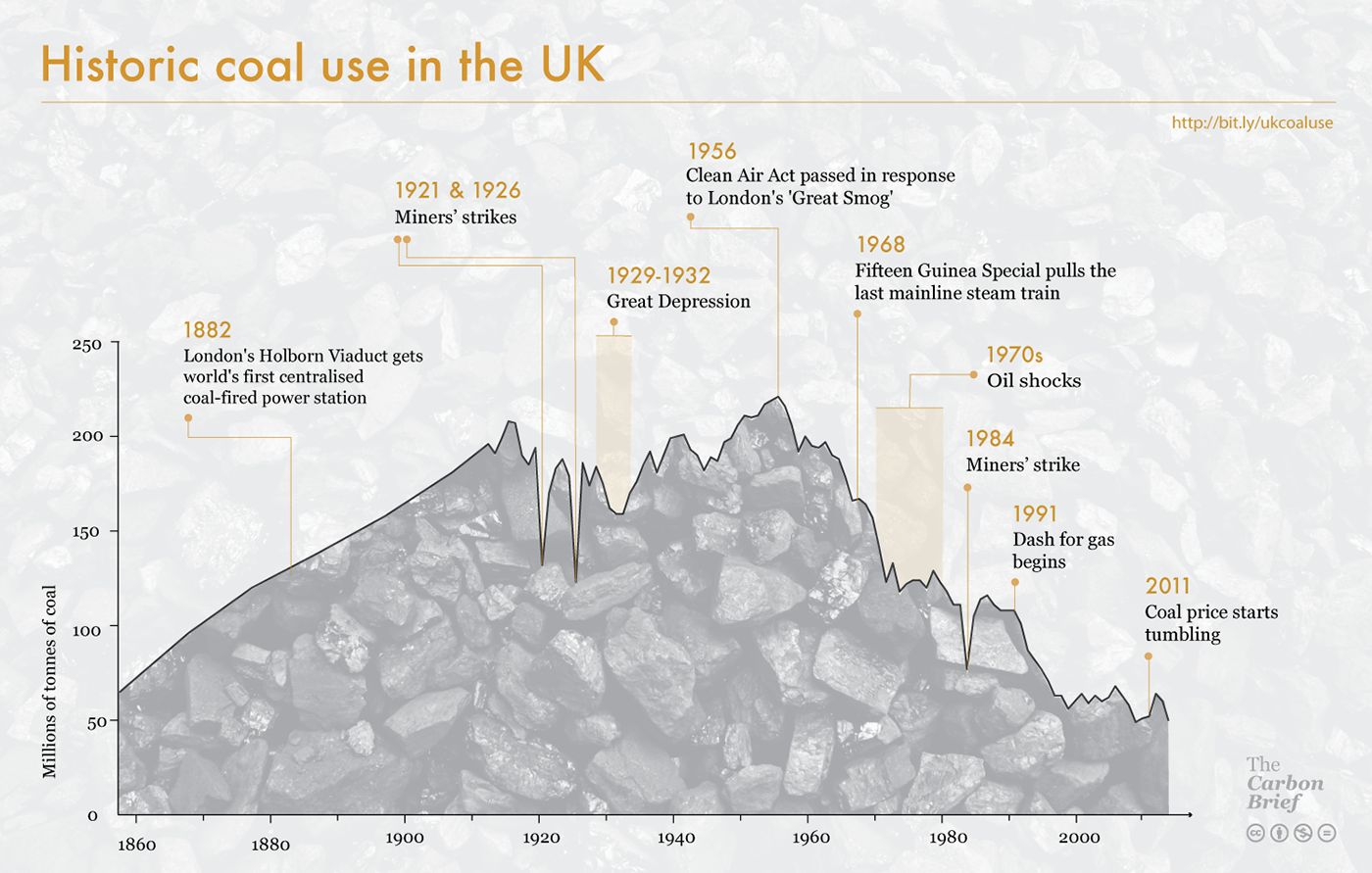
UK coal use is likely to soon fall back to levels last seen during the industrial revolution, Carbon Brief analysis of official figures suggests.

The UK used 49 million tonnes of coal in 2014 according to Carbon Brief estimates. That’s more than a 20% reduction compared to the previous year, and the joint lowest coal use in  records going back to the 1850s. Only 2009, when the country was in the depths of the financial crisis, had equally low coal consumption.

There are several reasons to expect coal use to continue falling this year, suggesting a clear historic low is in store for 2015.

Getting out of coal as quickly as possible is necessary in developed countries, to prevent dangerous global warming. To assess UK progress we’ve looked back at its changing relationship with coal, and what that means for the climate.

«

A longer-term view shows that we’re now using as little (or as much) coal as when Stephenson got his patent for the Rocket steam engine. I guess there was a lot being used to heat houses.
unique link to this extract


Greg Joswiak replaces Phil Schiller as head of Apple marketing • The Verge

Jacob Kastrenakes:

»

Apple’s longtime marketing chief, Phil Schiller, is stepping into a somewhat smaller role after decades with the company. Schiller is dropping his role as senior vice president of worldwide marketing, but he’ll remain in charge of the App Store and Apple Events. Greg Joswiak, previously the head of product marketing, will take over Schiller’s former position as Apple’s overall marketing leader.

Marketing is a huge role inside of Apple that goes beyond simply advertising products, so this marks a significant change within the company. As Apple puts it, the marketing division is “responsible for Apple’s product management and product marketing, developer relations, market research, business management, as well as education, enterprise, and international marketing.” Joswiak has been in Apple leadership roles for more than two decades, and he’s led Apple’s worldwide product marketing for the last four years.

Schiller has been with Apple since 1997, helping to steer the company from one of its lowest points to the technology juggernaut that it is today. While he’s been in charge of marketing, Schiller is also known for his involvement in Apple’s hardware, often presenting new products — like the previous Mac Pro — onstage at events.

«

Schiller has been a crucial member of Apple. Incredible to think that he joined at the age of 27, and this year turned 60. More than three decades, from just after its darkest hour to its biggest. And he’s been involved in crucial decisions: he was one of the people who lobbied Steve Jobs to allow third-party developers to create the App Store in 2007. Jobs was Apple, but Schiller in many ways is even more the embodiment of Apple: outwardly calm, amiable, and prepared, but behind his eyes always working the angles and looking to the future. I interviewed him many times on and off the record and never felt I was being shortchanged.
unique link to this extract


Last hurrah? 27-inch iMac get Intel processor upgrade, all-SSD storage, T2 chip – Six Colors

Jason Snell:

»

At Apple’s developer conference in June, Tim Cook said that the company still had Macs with Intel processors in its pipeline. It must be rapidly filling with Macs with Apple silicon, but on Tuesday that pipeline disgorged a new Intel-based 27-inch iMac with a bunch of technical improvements, while retaining the prices of previous models.

For those expecting a redesign to the exterior of the iMac, which has been largely unchanged for many years now, it’s clear that any major rethinking of Apple’s venerable all-in-one is going to have to wait for the Apple silicon era. Apple’s not doing what it did with the iMac back during the last processor transition and redesigning the exterior just before swapping chips, and future Mac historians will be thankful for that.

…As for the future, is this the last Intel Mac we’ll see? There’s no way to tell, though reading between the lines, it wouldn’t be surprising if there were some more Intel-based Mac releases as Apple progresses through its two-year-long processor transition. But I’d wager good money that the next time we see an iMac update, there won’t be an Intel processor at its heart. And perhaps it will look appreciably different, too.

«

My guess for the order of Apple Silicon (ARM) updates is: MacBook, MacBook Pro 13in, Mac mini, MacBook Pro 16in, iMacs, MacBook Air, Mac Pro.

The Air as the last laptop to join because it’s insanely profitable once they’ve locked down the design, and they only updated it recently. They’ll want 18 months of that lovely profit first – and people don’t mind about the speed; it’s the name and the shape.

Also, I bet Schiller will want to introduce at least one of these machines.
unique link to this extract


Science Twitter got catfished by a fake professor who ‘died from Covid’ • Gizmodo

Ed Cara:

»

A bizarre saga of events played out on social media over the weekend, embroiling much of the close-knit world of scientists, academics, and researchers on Twitter. It started with accusations that Arizona State University’s actions had exposed one of their faculty members, an Indigenous woman and anthropologist, to an ultimately fatal case of covid-19. But it ended with allegations that the death was a hoax, carried out by someone who also faked the supposed professor’s entire existence.

Given that many colleges and schools are debating if and how it’s possible to reopen physically this fall in the midst of the pandemic, the accusations of negligence on the part of Arizona State University carry a heavy weight. But many members of the science Twitter community now suspect that the academic who was the first to report the woman’s death, Tennessee-based neuroscientist BethAnn McLaughlin, has pulled off a catfishing scam for years, citing inconsistencies in the woman’s accounts of events in her now-gone tweets.

“Unfortunately, this appears to be a hoax. We have been looking into this since this weekend and cannot verify any connection with the university,” an ASU representative said in an email. If this was indeed a catfishing scheme, the faux death would not only make a mockery of the concerns people have about covid-19, but also the challenges that women of color continue to face in science. 

«

A fabulous example of people wanting to believe, and ignoring a fair amount of evidence to the contrary. But equally, when you have someone who’s determined to catfish you hard, you need a very suspicious mind to detect it, which most people don’t come with. (Or read the NYTimes version of the story.)
unique link to this extract


Theoretical physicists say 90% chance of societal collapse within several decades • Vice

Nafeez Ahmed:

»

Two theoretical physicists specializing in complex systems conclude that global deforestation due to human activities is on track to trigger the “irreversible collapse” of human civilization within the next two to four decades. 

If we continue destroying and degrading the world’s forests, Earth will no longer be able to sustain a large human population, according to a peer-reviewed paper published this May in Nature Scientific Reports. They say that if the rate of deforestation continues, “all the forests would disappear approximately in 100–200 years.”

“Clearly it is unrealistic to imagine that the human society would start to be affected by the deforestation only when the last tree would be cut down,” they write.  

This trajectory would make the collapse of human civilization take place much earlier due to the escalating impacts of deforestation on the planetary life-support systems necessary for human survival—including carbon storage, oxygen production, soil conservation, water cycle regulation, support for natural and human food systems, and homes for countless species.  

«

You wanted good news? Sorry.
unique link to this extract


Google’s secret home security superpower: your smart speaker with its always-on mics •

Janko Roettgers:

»

Last week, Reddit user Brazedowl received a curious notification on his phone: Google was telling him that a smoke detector in his home had gone off. Brazedowl, a teacher from North Carolina who goes by Drew in real life, knew about the smoke alarm — he was at home himself and had just fried some sausages in his kitchen. But up until that moment, he had no idea that his smart speaker was able to detect such events. “Google just made my dumb smoke detectors smart,” he wrote on Reddit. “Pretty rad.”

A Google spokesperson told Protocol that the feature was accidentally enabled for some users through a recent software update and has since been rolled back. But in light of Monday’s news that Google invested $450 million — acquiring a 6.6% stake — in home security provider ADT, it may be a sign of things to come for Google, as it hints at the company’s secret home security superpower: millions of smart speakers already in people’s homes.

Once the deal closes, ADT’s more than 20,000 installers will also sell Google-made smart displays, security cameras and other hardware, and ADT will more closely integrate Google technology into its own home security offerings. “The goal is to give customers fewer false alarms, more ways to receive alarm events, and better detection of potential incidents inside and around the home,” Google Nest VP and GM Rishi Chandra said in a blog post.

Brazedowl wasn’t the only Google smart speaker user receiving a possible preview of this kind of incident detection in recent days. Other Reddit users reported getting security alerts after breaking glassware, as well as some false alarms triggered by sounds like popped bubble wrap and high-frequency noises that could be confused with a smoke alarm.

«

Google announced this in May for paying subscribers of its Nest Aware service. But it must be feasible for any Google Home to do this. Always listening, all the time.
unique link to this extract


Mergers: proposed acquisition of Fitbit by Google • EU Competition Commissioner

Margrethe Vestager:

»

Following its first phase investigation, the Commission has concerns about the impact of the transaction on the supply of online search and display advertising services (the sale of advertising space on, respectively, the result page of an internet search engine or other internet pages), as well as on the supply of ”ad tech” services (analytics and digital tools used to facilitate the programmatic sale and purchase of digital advertising). By acquiring Fitbit, Google would acquire (i) the database maintained by Fitbit about its users’ health and fitness; and (ii) the technology to develop a database similar to Fitbit’s one.

The data collected via wrist-worn wearable devices appears, at this stage of the Commission’s review of the transaction, to be an important advantage in the online advertising markets. By increasing the data advantage of Google in the personalisation of the ads it serves via its search engine and displays on other internet pages, it would be more difficult for rivals to match Google’s online advertising services. Thus, the transaction would raise barriers to entry and expansion for Google’s competitors for these services, to the ultimate detriment of advertisers and publishers that would face higher prices and have less choice.

…the Commission will also further examine:

• the effects of the combination of Fitbit’s and Google’s databases and capabilities in the digital healthcare sector, which is still at a nascent stage in Europe; and
• whether Google would have the ability and incentive to degrade the interoperability of rivals’ wearables with Google’s Android operating system for smartphones once it owns Fitbit.

«

Could take until December. Again, I wonder how Fitbit stays afloat during this.
unique link to this extract


First cruises to set sail post COVID-19 abruptly canceled due to outbreak • Ars Technica

Beth Mole:

»

At least 36 crew members and five passengers of the Norwegian cruise ship, MS Roald Amundsen, have tested positive for COVID-19.

Four of the infected crew members have been hospitalized and hundreds of passengers are in quarantine, awaiting test results.

MS Roald Amundsen is run by the Norwegian firm Hurtigruten, which in mid-June became the first cruise ship operator in the world to resume voyages amid the coronavirus pandemic. Hurtigruten assured travelers that it followed national public health guidelines and touted safety precautions for passengers on board, including social distancing, increased hygiene and sanitation protocols, and a vow to sail at no more than 50% capacity.

“At Hurtigruten, safety always has been, and always will be, our number one priority,” the company says on a COVID-19 safety page on its website. “With over 127 years of experience, we have established strict procedures for protection against infectious [sic] on board our ships.”

In the wake of the outbreak, the company has suspended all cruises. Norway’s government has also banned cruise ships carrying more than 100 people from disembarking passengers at its ports for 14 days.

«

I cannot imagine what in the world would tempt anyone to take a cruise at the moment, unless they’re affiliated with Dignitas.
unique link to this extract


Coronavirus future in USA will be whack-a-mole: Q&A with epidemiologist • USA Today

USA Today interviewed Larry Brilliant, the epidemiologist who helped eradicate smallpox:

»

Q: What do you predict is going to happen when schools open in person?

A. I think a lot of schools will be able to open just fine. But the models all say that the single most important factor in the safety of an internal area that you’re trying to make safe — whether it’s a convention or a company or movie production or a theater — is the ambient viral burden. How bad are the incidence and the prevalence and the death rates in hospitals right outside that school? There will be schools that are located in fortunate places that have, at this point, very low incidence. But this virus hopscotches around.

Q. Even if relatively few kids get seriously ill, don’t they spread the disease? 

A. The school season has been, historically, the place that sets off the fall set of respiratory diseases. We talk about it as the spark that begins the American portion of influenza season. Respiratory viruses begin with the kids going to school and sharing viruses and then taking them home. And then a few weeks later, I’m sure you’ve had this experience: Your kids go to kindergarten and two weeks later, you’re getting a cold. So, I think it will help the virus to continue its growth, and it will spread it everywhere around the country that doesn’t already have it.

Q: Are we on the verge of the perfect storm?

A. Well, it can get really bad. If the epidemic isn’t stopped, it’ll just keep going. Right now maybe 10% of (the 330 million) Americans have had the disease. That means you got 300 million more customers for this disease who have not bought it yet.

«

I’d be surprised if it’s even 10% that have had it. There’s a long way to go. (Thanks G for the link.)
unique link to this extract


Errata, corrigenda and ai no corrida: none notified
Start Up No.1366: the impatient media election, a teen hacker’s trajectory, Iran’s coronavirus coverup, Tim Maughan interview, and more


“And from here you can see the Russian hackers downloading all your email, Dr Fox.” CC-licensed photo by British High Commission, New Delhi on Flickr.

You can sign up to receive each day’s Start Up post by email. You’ll need to click a confirmation link, so no spam.

A selection of 11 links for you. Not available on TikTok. I’m @charlesarthur on Twitter. Observations and links welcome.

Exclusive: Papers leaked before UK election in suspected Russian operation were hacked from ex-trade minister – sources • Reuters

Jack Stubbs and Guy Faulconbridge:

»

Classified U.S.-UK trade documents leaked ahead of Britain’s 2019 election were stolen from the email account of former trade minister Liam Fox by suspected Russian hackers, two sources with direct knowledge of the matter told Reuters.

The sources, who spoke on condition of anonymity because a law enforcement investigation is underway, said the hackers accessed the account multiple times between July 12 and Oct. 21 last year.

They declined to name which Russian group or organisation they believed was responsible, but said the attack bore the hallmarks of a state-backed operation.

The Kremlin did not immediately respond to a request for comment on Monday.

Among the stolen information were six tranches of documents detailing British trade negotiations with the United States, which Reuters first reported last year were leaked and disseminated online by a Russian disinformation campaign.

British foreign minister Dominic Raab confirmed that report last month, saying that “Russian actors” had sought to interfere in the election “through the online amplification of illicitly acquired and leaked Government documents”.

Reuters was not able to determine which of Fox’s email accounts was hacked and when it was first compromised. It is not clear if Fox, who is still a member of parliament but stood down as trade minister on July 24 last year in a cabinet reshuffle, was a minister at the time.

«

“Which of his accounts”? That’s a worrying sentence: either it was his government account, which you would pray would be hack proof; or it was his personal account, in which case why are highly sensitive documents on there? The suspicion therefore is also that he didn’t use two-factor authentication, and that there wasn’t any network monitoring to see if there were connections to suspicious networks. All in all, a very concerning incident, far more than the simple contents of the emails.

If they were on his personal account, might there be grounds for prosecution under the Official Secrets Act?
unique link to this extract


How the media could get the election story wrong • The New York Times

Ben Smith on how TV and social networks are trying to prepare for an election which could well be decided by postal votes that will take days to count:

»

what the moment calls for, most of all, is patience. And good luck with that.

Nobody I talked to had any real idea how cable talkers or Twitter take-mongers would fill hours, days and, possibly, weeks of counting or how to apply a sober, careful lens to the wild allegations — rigged voting machines, mysterious buses of outsiders turning up at poll sites — that surface every election night, only to dissolve in the light of day.

Facebook’s chief executive, Mark Zuckerberg, told me in a brief interview on Saturday that he’s planning to brace his audience for the postelection period. He said the site planned a round of education aimed at “getting people ready for the fact that there’s a high likelihood that it takes days or weeks to count this — and there’s nothing wrong or illegitimate about that.” And he said that Facebook is considering new rules regarding premature claims of victory or other statements about the results. He added that the company’s election center will rely on wire services for definitive results.

It’s possible, of course, that Joe Biden will win by a margin so large that Florida will be called for him early. Barring that, it’s tempting to say responsible voices should keep their mouths shut and switch over for a few days to Floor Is Lava, and give the nice local volunteers time to count the votes. That, however, would just cede the conversation to the least responsible, and conspiratorial, voices.

«

Facebook is possibly the most important player here, but it’s totally predictable too that it’s going to be too pusillanimous about preventing people posting content that will cause real unrest. Maybe if it could just be shut down for a few days? Would anyone notice?
unique link to this extract


From Minecraft tricks to Twitter hack: a Florida teen’s troubled online path • The New York Times

Nathaniel Popper, Kate Conger and Kellen Browning:

»

For Graham Ivan Clark, the online mischief-making started early.

By the age of 10, he was playing the video game Minecraft, in part to escape what he told friends was an unhappy home life. In Minecraft, he became known as an adept scammer with an explosive temper who cheated people out of their money, several friends said.

At 15, he joined an online hackers’ forum. By 16, he had gravitated to the world of Bitcoin, appearing to involve himself in a theft of $856,000 of the cryptocurrency, though he was never charged for it, social media and legal records show. On Instagram posts afterward, he showed up with designer sneakers and a bling-encrusted Rolex.

The teenager’s digital misbehavior ended on Friday when the police arrested him at a Tampa, Fla., apartment. Florida prosecutors said Mr. Clark, now 17, was the “mastermind” of a prominent hack last month, accusing him of tricking his way into Twitter’s systems and taking over the accounts of some of the world’s most famous people, including Barack Obama, Kanye West and Jeff Bezos.

His arrest raised questions about how someone so young could penetrate the defences of what was supposedly one of Silicon Valley’s most sophisticated technology companies.

«

Because… the defences were crap?
unique link to this extract


Coronavirus: Iran cover-up of deaths revealed by data leak • BBC News

»

The number of deaths from coronavirus in Iran is nearly triple what Iran’s government claims, a BBC Persian service investigation has found.

The government’s own records appear to show almost 42,000 people died with Covid-19 symptoms up to 20 July, versus 14,405 reported by its health ministry.

The number of people known to be infected is also almost double official figures: 451,024 as opposed to 278,827.

The official numbers still make Iran the worst-hit in the Middle East. In recent weeks, it has suffered a second steep rise in the number of cases.

The first death in Iran from Covid-19 was recorded on 22 January, according to lists and medical records that have been passed to the BBC. This was almost a month before the first official case of coronavirus was reported there.

«

unique link to this extract


Why the pandemic is so bad in America • The Atlantic

Ed Yong:

»

A pandemic can be prevented in two ways: Stop an infection from ever arising, or stop an infection from becoming thousands more. The first way is likely impossible. There are simply too many viruses and too many animals that harbor them. Bats alone could host thousands of unknown coronaviruses; in some Chinese caves, one out of every 20 bats is infected. Many people live near these caves, shelter in them, or collect guano from them for fertilizer. Thousands of bats also fly over these people’s villages and roost in their homes, creating opportunities for the bats’ viral stowaways to spill over into human hosts. Based on antibody testing in rural parts of China, Peter Daszak of EcoHealth Alliance, a nonprofit that studies emerging diseases, estimates that such viruses infect a substantial number of people every year. “Most infected people don’t know about it, and most of the viruses aren’t transmissible,” Daszak says. But it takes just one transmissible virus to start a pandemic.

Sometime in late 2019, the wrong virus left a bat and ended up, perhaps via an intermediate host, in a human—and another, and another. Eventually it found its way to the Huanan seafood market, and jumped into dozens of new hosts in an explosive super-spreading event. The COVID‑19 pandemic had begun.

…Being prepared means being ready to spring into action, “so that when something like this happens, you’re moving quickly,” Ronald Klain, who coordinated the U.S. response to the West African Ebola outbreak in 2014, told me. “By early February, we should have triggered a series of actions, precisely zero of which were taken.” Trump could have spent those crucial early weeks mass-producing tests to detect the virus, asking companies to manufacture protective equipment and ventilators, and otherwise steeling the nation for the worst. Instead, he focused on the border.

«

TL;DR: inevitability and incompetence.
unique link to this extract


The man whose science fiction keeps turning into our shitty cyberpunk reality • OneZero

Brian Merchant interviews Tim Maughan, whose SF book “Infinite Detail” was called the best of 2019 by The Guardian:

»

Tim Maughan: Before Infinite Detail came out, I was at a workshop incubator thing in Brooklyn. And there was a couple of kids there — this is before Infinite Detail — and they said, “Oh, yeah, we’re making a smart trash can.”

And I had started working on the recycling bit in Intimate Detail. I had written that chapter at the time, and my heart just fell. I said, “Right, so what is that? How does it work?” And they were like, “Well, it’s got a screen on the side. And when you put a can in, it thanks you for putting it in.” And I said, “Well, what’s the point? Why?” And they said, “Well, because it would encourage kids to recycle more. It’d be like little video games they can play.” And I’m thinking, “Okay, is it really that hard to get kids to recycle? I don’t feel like it is, but, anyway, whatever.”

I said, “What’s your business model?” He said, “Well, hopefully, we’ll get cities invested in it.” And I said, “Yeah, but…” And I knew exactly what his answer was going to be, and I kept pushing him on it. He said, “Well, yeah, eventually we do want to monetize the data it collects. Yeah, eventually we could be monitoring who’s walking past from the IDs on the phone or the footfall.” And that’s it. People are not even interested in fixing these problems. They’re interested in finding “solutions.” They’re finding other trajectories, other vectors to get data collection, that’s it because they literally have all been told data is new oil, and they fully fucking bought into this.

«

I finished Infinite Detail yesterday. It’s the flip side of Shockwave Rider, by another (sadly deceased) British SF writer John Brunner: Infinite Detail is a hyperconnected world that becomes disconnected, Shockwave Rider is a hyperconnected world that becomes overconnected. Container ships play a large part in this interview, and it’s fascinating. Recommended. (Infinite Detail might also feel familiar to anyone who has read John Lanchester’s The Wall.)
unique link to this extract


‘This is a new phase’: Europe shifts tactics to limit tech’s power • The New York Times

Adam Satariano:

»

European Union leaders are pursuing a new law to make it illegal for Amazon and Apple to give their own products preferential treatment over those of rivals that are sold on their online stores.

In Britain, officials are drawing up a law to force Facebook to make its services work more easily with rival social networks, and to push Google to share some search data with smaller competitors.

And in Germany, authorities are debating a rule that would let regulators essentially halt certain business practices at the tech companies during an antitrust investigation.

Europe’s lawmakers and regulators … are drafting at least half a dozen new laws and regulations to aim at the heart of how those tech companies’ businesses work.

…“We have crossed a line,” said Andrea Coscelli, the head of Britain’s antitrust agency, the Competition and Markets Authority, which published a 400-plus-page report this month accusing Google and Facebook of anticompetitive behavior in online advertising. “Something needs to happen sooner rather than later, and it needs to be done in an intelligent way.”

Mr. Coscelli said the lack of specific tech regulation reminded him of the lax oversight of banks before the 2008 financial crisis. Regulators should treat the tech giants more like formerly state-owned enterprises such as British Telecom and Deutsche Telekom, he said.

«

unique link to this extract


I tried to live without the tech giants. It was impossible • The New York Times

Kashmir Hill:

»

When I blocked Google, the entire internet slowed down for me, because almost every site I visited was using Google to supply its fonts, run its ads, track its users, or determine if its users were humans or bots. While blocking Google, I couldn’t sign into the data storage service Dropbox because the site thought I wasn’t a real person. Uber and Lyft stopped working for me, because they were both dependent on Google Maps for navigating the world. I discovered that Google Maps had a de facto monopoly on online maps. Even Google’s longtime critic Yelp used it to tell computer users where businesses could be found.

I came to think of Amazon and Google as the providers of the very infrastructure of the internet, so embedded in the architecture of the digital world that even their competitors had to rely on their services.

Facebook, Apple and Microsoft came with their own challenges. While Facebook was less debilitating to block, I missed Instagram (which Facebook owns) terribly, and I stopped getting news from my social circle, like the birth of a good friend’s child. “I just assume that if I post something on Facebook, everyone will know about it,” she told me when I called her weeks later to congratulate her. I tried out an alternative called Mastodon, but a social network devoid of any of your friends isn’t much fun.

Apple was hard to leave because I had two Apple computers and an iPhone, so I wound up getting some radical new hardware in order to keep accessing the internet and making phone calls.

«

Cannot escape any of them.
unique link to this extract


Pixel 4A review: Google’s smartphone camera for $349 • The Verge

Dieter Bohn:

»

The specs are a good news / worrisome news kind situation. The good news is that Google has put in enough RAM (6GB) to run Android well and put in enough storage (128GB) to accommodate most users without hassle or annoyance. That 128GB of storage is especially notable because it’s double what the base iPhone SE offers — meaning an equivalent iPhone SE with 128GB of storage is $100 more than the Pixel 4A.

That all seems great, but the iPhone SE has a ridiculous advantage over the Pixel: its processor. Where Apple can use its economies of scale to put the fastest mobile processor ever made into its low-cost iPhone SE, Google has to make do with the options Qualcomm offers at this price point. That means the Pixel 4A uses the midtier Snapdragon 730G, which is the worrisome news.

It is fast enough for day-to-day use. Out of the box (and after Android gets over the usual first-day sync chug), it’s the kind of phone I would be happy to use every day. It takes a beat longer to open apps, and there’s some wonky scrolling in Chrome and Twitter, but it’s not slow.

What I worry more about is longevity. Android phones have a reputation for not lasting as many years as iPhones — and the processor is a big part of that. There’s just not as much headroom for future software complexity here. Google promises at least three years of software updates and says last year’s Pixel 3A (which also has a lower-tier processor) is aging well, but it’s something to think about. I would say if you want a phone that’s sure to last four or more years, look elsewhere.

«

Good camera, doubts about the longevity of the support.
unique link to this extract


Trump says US should get slice of TikTok sale price • WSJ

Alex Leary:

»

President Trump confirmed Monday he is open to a deal in which Microsoft or another US company buys the video-sharing app TikTok, but said the government should receive payment for clearing a purchase.

Speaking to reporters at the White House, Mr. Trump described the Sunday conversation he had with Microsoft CEO Satya Nadella over the company’s interest in buying TikTok from its Chinese owner, Beijing-based ByteDance Ltd.

“I said, ’Look it can’t be controlled for security reasons by China,’” Mr. Trump said. “Here’s the deal, I don’t mind whether it’s Microsoft or somebody else—a big company, a secure company, a very American company buy it.”

But the president, who on Friday floated banning TikTok, also said there would be conditions to a sale and he did not see how only part of the company could be purchased. Microsoft has said it is interested in buying TikTok operations in the U.S., Canada, New Zealand and Australia, leaving other parts of the business in Chinese ownership.

“I did say that ‘If you buy it…a very substantial portion of that price is going to have to come into the Treasury of the United States, because we’re making it possible for this deal to happen.’ Right now they don’t have any rights unless we give it to them.”

«

I’m hoping for “Microsoft to Trump: Drop Dead”. There’s absolutely no legal basis on which Microsoft or TikTok would owe any part of a sale price to the US government. This is just another part of the ongoing Trump corruption; except he now says it out loud, in front of cameras, rather than on phone calls or in the Oval Office. It could only be worse if one of Trump’s children or in-laws was buying or selling the company, and was getting a kickback. If by some opposite of a miracle Trump gets back in, that’ll be what you’ll see: it’ll be as corrupt as Zimbabwe.

Also, Microsoft can’t buy all of the company outside China: there are elements which are non-US and are expected to remain under control of ByteDance.
unique link to this extract


Worldwide tablet PC market grew 26% in Q2 2020 • Canalys

»

Worldwide tablet shipments hit 37.5 million units in Q2 2020, a remarkable 26% year-on-year increase. Tablets, part of the PC market, had faltered in recent years, but demand in Q2 2020 was boosted by consumers and businesses wanting affordable access to basic computing power and larger screens to facilitate remote work, learning and leisure. Vendors were able to ramp up production to meet this renewed demand. At the same time, retailers and carriers in various markets provided financial incentives on devices and data to encourage tablet purchases.

«

Pretty dramatic: 37.5m for the quarter, of which Apple (predictably enough) had just under 40%. There still isn’t a tablet market beyond Apple and Samsung, which together have nearly 60% of the whole market.
unique link to this extract


Errata, corrigenda and ai no corrida: none notified

Start Up No.1365: social media’s failing news diet, Twitter ejects David Duke, TikTok races Trump, is GPT-3 going to screw up comments?, and more


Algorithmic repetition: but how does Twitter’s function when fed a simalucrum of Trump’s tweets? CC-licensed photo by Ethan Miller on Flickr.

You can sign up to receive each day’s Start Up post by email. You’ll need to click a confirmation link, so no spam.

A selection of 11 links for you. Use them wisely. I’m @charlesarthur on Twitter. Observations and links welcome.

Americans who mainly get their news on social media are less engaged, less knowledgeable • Pew Research Center

Amy Mitchell, Mark Jurkowitz, J. Baxter Oliphant and Elisa Shearer:

»

The rise of social media has changed the information landscape in myriad ways, including the manner in which many Americans keep up with current events. In fact, social media is now among the most common pathways where people – particularly young adults – get their political news.

A new Pew Research Center analysis of surveys conducted between October 2019 and June 2020 finds that those who rely most on social media for political news stand apart from other news consumers in a number of ways. These U.S. adults, for instance, tend to be less likely than other news consumers to closely follow major news stories, such as the coronavirus outbreak and the 2020 presidential election. And, perhaps tied to that, this group also tends to be less knowledgeable about these topics.

«

Also tend to be under 30, and have heard more conspiracy junk. Not investigated but likely: they’re more politically polarised than people who don’t use social media so much.

Would be great if there were comparative studies for other countries.
unique link to this extract


Relevant content: Twitter’s algorithm does not seem to silence conservatives • The Economist

»

The [US] president says that “social media platforms totally silence conservatives’ voices.” However, a study by The Economist finds the opposite. Twitter’s feed used to show people the latest posts from accounts they followed, but in 2016 it launched an algorithm to serve “relevant” tweets to users, even if they were days old and from unfamiliar accounts. We compared the two systems, and found that the recommendation engine appears to reward inflammatory language and outlandish claims.

Our experiment began in June 2019, when we created a clone of Mr Trump’s profile. This bot used his picture, biography and location, and followed the same people as he did. We used it to re-post some of the president’s old tweets over several weeks, so that the algorithm could learn what our Trump clone cared about.

Then from September to December we checked every ten minutes if Mr Trump had tweeted something. If so, three things happened. First, our clone repeated the tweet. Second, we checked its Twitter feed and recorded the first 24 posts served by the algorithm. Finally, we simulated what a chronological feed might have looked like, using the 24 most recent tweets by accounts that Mr Trump follows.

Our algorithmic and chronological feeds differed starkly. Nearly half the recommended tweets were from users whom Mr Trump does not follow. Using sentiment-analysis tools to extract feelings from text, we found the average curated tweet was more emotive, on every scale, than its chronological equivalent—and more so than Mr Trump’s own posts, too.

«

The algorithm is picking for engagement – and emotive words do that. There’s plenty of solid academic research on this. Suitable material for a book, really.
unique link to this extract


Twitter bans former KKK leader David Duke • The Washington Post

Jacob Bogage and Eugene Scott:

»

Avowed white supremacist David Duke was permanently banned from Twitter for repeated violations of the social media platform’s rules on hate speech.

The former Ku Klux Klan leader and one-time Louisiana legislator’s most recent tweets included a link to an interview he conducted with Holocaust denier Germar Rudolf. Other posts promised to expose the “systemic racism lie,” as well as the “incitement of violence against white people” by Jewish-owned media. He also shared misinformation about the danger and spread of the coronavirus.

“People who refuse the mask are the real heroes,” he tweeted.

Duke, who most recently is known for endorsing President Trump, was banned in June, which Twitter confirmed Thursday evening. He also was banned by YouTube that month.

Twitter and other social media platforms have been under fire for years for lax regulations on racist, anti-Semitic and misogynistic commentary from users, especially those who self-identify with hate groups.

«

Good to see Twitter focusing on the aim of reducing its user numbers to the nominal 250 million. Though seriously, this is long overdue. A platform that removed Graham Linehan (for his noise over the trans issue) before it removed David Duke needs to think about its priorities.

Obvious question: is Duke (still) on Facebook? Does he say the same things?
unique link to this extract


Three people have been charged for Twitter’s huge hack, and a Florida teen is in jail • The Verge

Sean Hollister:

»

Early on July 31st, the FBI, IRS, US Secret Service, and Florida law enforcement placed 17-year-old Graham Clark of Tampa, Florida, under arrest. He’s accused of being the “mastermind” behind the biggest security and privacy breach in Twitter’s history, one that took over the accounts of President Barack Obama, Democratic presidential candidate Joe Biden, Bill Gates, Elon Musk, Kanye West, Apple, and more to perpetrate a huge bitcoin scam on July 15th.

Apparently, he wasn’t alone: shortly after the Tampa arrest was revealed and after we published this story, two more individuals were formally charged by the US Department of Justice: 22-year-old Nima Fazeli in Orlando and 19-year-old Mason Sheppard in the UK. They go by the hacker aliases “Rolex” and “Chaewon,” respectively, according to the DOJ. The FBI says that two individuals in total are in custody. An unidentified minor in California also admitted to federal agents that they’d helped Chaewon sell access to Twitter accounts.

But according to an affidavit released late Friday, authorities have probable cause to believe Clark, the Tampa teen, was the one who got access to Twitter’s internal tools and directly carried out the scam. Specifically, he allegedly convinced a Twitter employee that he worked in the Twitter IT department and tricked that employee into giving him the credentials.

«

As others have observed, if this is what some script kiddies with plausible social engineering can do, what might state actors who are really working on it be up to? We know the Saudis infiltrated the company. What else might be happening?
unique link to this extract


AI-generated text is the scariest deepfake of all • WIRED

Renee DiResta:

»

undetectable textfakes—masked as regular chatter on Twitter, Facebook, Reddit, and the like—have the potential to be far more subtle, far more prevalent, and far more sinister. The ability to manufacture a majority opinion, or create a fake-commenter arms race—with minimal potential for detection—would enable sophisticated, extensive influence campaigns. Pervasive generated text has the potential to warp our social communication ecosystem: algorithmically generated content receives algorithmically generated responses, which feeds into algorithmically mediated curation systems that surface information based on engagement.

Our trust in each other is fragmenting, and polarization is increasingly prevalent. As synthetic media of all types—text, video, photo, and audio—increases in prevalence, and as detection becomes more of a challenge, we will find it increasingly difficult to trust the content that we see. It may not be so simple to adapt, as we did to Photoshop, by using social pressure to moderate the extent of these tools’ use and accepting that the media surrounding us is not quite as it seems. This time around, we’ll also have to learn to be much more critical consumers of online content, evaluating the substance on its merits rather than its prevalence.

«

I hardly ever disagree with DiResta, but I just don’t see why, this many years into social media and our knowledge of bots, anyone takes “comments on Facebook/Twitter” as a metric of anything. It’s so easy to fake – even before GPT-3 – that there’s no value in trusting it.
unique link to this extract


One flight is worth a thousand Big Macs: digesting these hard facts killed my appetite for flying • The Correspondent

Jelmer Mommers:

»

We really do have to acknowledge the hard truth. If we return to flying as we did before Covid-19, we’ll never bring global warming under control.

The urgent need to fly less may feel painful. It spells the end for a certain way of living. Since the ending of the second world war, flying has been associated with shifting boundaries, meeting people, new experiences and the discovery of new cultures. “Travel is fatal to prejudice, bigotry, and narrow-mindedness,” wrote Mark Twain. He was right.

In flight over planet earth, holidaymakers, business people, academics would all sit together, paging through the same magazines, listening to announcements from the cockpit. It was sweet. 

But looking at the facts about flying and climate, we can arrive at only one conclusion. To keep the planet liveable, those of us who fly need to do it much less, or stop altogether.

Flying is a small but growing source of emissions. At just over 2% of global CO₂ emissions, it currently represents only a limited share of the total. But prior to coronavirus, this expanding industry was forecast to account for a fifth of all emissions by 2050. 

…Perhaps you have already decided to give up meat for the sake of the climate: did you know that one return flight from London to New York is as bad for the climate as consuming almost 1,000 Big Macs? Have you swapped old lightbulbs at home for environmentally friendly LEDs? The CO₂ you will save over five years is cancelled out by one medium-haul flight, from, say, Berlin to Lisbon.

I’m not saying these things to suggest that vegetarianism and energy saving are pointless. On the contrary, these are effective steps to lower your carbon footprint. But here’s that uncomfortable truth again: if we continue to fly, we will undo the progress made in many other areas.

«

(Via John Naughton)
unique link to this extract


Why America is afraid of TikTok • The Atlantic

Michael Schuman:

»

Companies that operate in China, both local and foreign, repeatedly get into [political] scuffles with thin-skinned officials over perceived political incorrectness. But this type of interference has heightened scrutiny of TikTok’s decisions about content. All social-media outfits have challenges with content moderation, but with TikTok, critics make the assumption that choices about what should and should not be on the app are made to please Chinese censors. TikTok, of course, denies this, and insists that decisions are made by the U.S. team.

The inevitable controversies have ensued anyway. Critics accused TikTok of scrubbing videos supportive of prodemocracy protesters in Hong Kong, whom Beijing considers “terrorists,” and of locking the account of a teen who shared a video critical of the Chinese government’s ill-treatment of the country’s minority Uighur community. (The company has denied both accusations. In the former case, an investigation by BuzzFeed News backed up TikTok’s assertion, and in the latter one, TikTok said the video was not the reason the account was frozen, and it apologized and reinstated the user’s access.) In the U.S., following the death of George Floyd, TikTok came under fire for allegedly suppressing videos related to Black Lives Matter and the protests against police brutality and racism. The company has said that this was a temporary technical glitch.

Facing perceived threats from China, Congress and the White House have tended to confront them with measures American officials previously preferred to avoid—restrictions on businesses and people.

«

unique link to this extract


US to widen action against Chinese tech groups beyond TikTok • Financial Times

Aime Williams and Hannah Murphy:

»

The Trump administration has vowed to “take action” in a matter of days against Chinese software companies that it perceives as a risk to security, in a sign that Washington is set to broaden its offensive beyond the video-sharing app TikTok.

ByteDance, the Chinese owner of TikTok, is racing to save the app’s US operations with a plea to the administration to allow it to sell the unit to Microsoft.

Comments from US secretary of state Mike Pompeo on Sunday suggested that additional action against a wider range of Chinese technology companies would follow.

“These Chinese software companies doing business in the United States, whether it’s TikTok or WeChat — there are countless more . . . are feeding data directly to the Chinese Communist party, their national security apparatus,” Mr Pompeo told Fox News. 

“President Trump has said ‘enough’ and we’re going to fix it and so he will take action in the coming days with respect to a broad array of national security risks that are presented by software connected to the Chinese Communist party.”

«

Pompeo is an pompous enabling windbag, but questioning what data gets collected is a start. Maybe someone will question the data that gets collected about all Americans and sold to data brokers, who can then sell it to intermediaries run by Chinese companies who could be beholden to the CCP in just the same way. If there’s a leak, water will flow.
unique link to this extract


Apple leaks reveal upcoming product launch dates • Seeking Alpha

SA Editor Yoel Minkoff:

»

It’s going to be a busy fall season for Apple, according to well-known leakers iHacktu Pro and Komiya, who published the launch dates for every upcoming company product.

The late 2020 updates will begin on August 19 with a new iMac, AirPods Studio, HomePod 2 and HomePod Mini, followed by an event on September 8 that will unveil the iPhone 12 line, iPad, Apple Watch Series 6 and AirTags.

Another special event on October 27 will show off the Apple Silicon MacBook and MacBook Pro 13″, iPad Pro and Apple TV 4K.

There’s also big expectations for a renewed AirPower charging mat, and smaller wireless charger AirPower Mini, as well as Apple Glass – the reported augmented reality smart glasses.

«

Just had to go over the edge with the “Apple Glass” thing at the end. (No. Way.) The dates and products otherwise sound… possible?, although the 19th is a Wednesday – Apple prefers Tuesdays. The August thing sounds a bit ambitious, but the October date for the MacBook (back with a bang, sorry, ARM, sorry, Apple Silicon chip) and similar MacBook Pro 13in all makes sense. Anyway, you could put the dates in your diary and see how they fare.

Related: Apple confirmed last week that the iPhone won’t arrive in September (though everyone expects it to be announced in September). Last times that’s happened was the iPhone XR in 2018, the iPhone X in 2017 (didn’t arrive until November), and before that the iPhone 4S in 2011 (launched October).
unique link to this extract


Apple vs Google: a tale of two ecosystems • Android Authority

Chruv Bhutani isn’t thrilled by the lack of integration between Android, Google, Chromebooks and WearOS, especially compared to Apple’s cross-device integration:

»

It could be argued that by licensing out its software and operating system Google is just an enabler for a broader ecosystem running on its platform, and that’s fair enough but you don’t invest a fortune, buy two smartphone companies, and a wearable manufacturer without having serious hardware ambitions. Between the Chrome OS running Pixelbooks, the Pixel series of phones, and Nest hardware, Google has been trying to create a semblance of an alternative to Apple’s hegemony, and with it comes the responsibility to do it right.

However, operating in silos with each product acting as a distinct vertical just hasn’t worked to Google’s advantage. This lack of a unified focus and unwillingness to listen to what the market demands was epitomized by the launch of the flawed Pixel 4 and the subsequent departure of key executives. This is all the more astonishing in a time when even the notoriously stubborn Apple is willing to budge and add widgets to iPhones and iPad.

Look, I get that Google can’t or doesn’t want to miff its partner relations. That doesn’t mean gimping your own hardware is acceptable, however.

«

unique link to this extract


Alphabet grows up – but Google’s problems are bigger than just the antitrust case • The Economist

»

These days employees are being told to access sensitive documents only if they “need to know”. Some staff talk of creating if not a labour union, then at least a group to defend their interests.

In the wake of the killing of George Floyd many Googlers criticised their top management for doing too little, too late to make the company more diverse; after a couple of weeks the firm vowed to raise the “leadership representation of underrepresented groups” by 30% over the next five years. In June more than 2,000 employees signed an open letter to Mr Pichai demanding that the company stop selling its technology to police forces across America.

Over the past few weeks things have seemed to calm down internally. But the respite may be superficial. Many workers are keeping their mouths shut for fear of being laid off, one Googler reports. Few relish the thought of losing a cushy job in a recession. Activists now shun the firm’s communication tools and organise elsewhere online.

All this fuels murmurings and speculation, both inside and outside Alphabet, over whether Mr Pichai is the right person for the job. Some Google executives and engineers describe him as “too checked out” and his leadership as “uninspired”. He is also accused of excessive risk aversion. “I’ve never shied away from making big bets and following my instincts,” Mr Pichai insists. But it is hard to argue that he has shown the vision of Amazon’s Jeff Bezos or Microsoft’s Satya Nadella.

«

He’s hardly in the position of Bezos, building from the ground up, or Nadella, trying to fix a very broken company. All he can easily do is screw things up; getting it right is harder.
unique link to this extract


Errata, corrigenda and ai no corrida: none notified