
Start Up No.1,158: Pew Research on social media and news, Reddit moderates harder, Libra backers stepping back?, the location builders, and more


“You mean WannaCry’s main effect was to lead to fewer cancelled appointments? Does that make it good?” CC-licensed photo by DataCorp Technology LTD on Flickr.

You can sign up to receive each day’s Start Up post by email. You’ll need to click a confirmation link, so no spam.

A selection of 10 links for you. Peachy. I’m @charlesarthur on Twitter. Observations and links welcome.

Americans are wary of the role social media sites play in delivering the news • Pew Research Center

From a just-released study:

»

Almost all Americans – about nine-in-ten (88%) – recognize that social media companies have at least some control over the mix of news people see. And most Americans feel this is a problem: About six-in-ten (62%) say social media companies have too much control over the mix of news that people see on their sites, roughly four times as many as say that they don’t have enough control (15%). Just 21% say that social media companies have the right amount of control over the news people see.

The largest social media platforms control the content on their feeds using computer algorithms that rank and prioritize posts and other content tailored to the interests of each user. These sites allow users to customize these settings, though previous research has found that many Americans feel uncertain about why certain posts appear in their news feed on Facebook specifically. Social media companies have also been public about their efforts to fight both false information and fake accounts on their sites.

While social media companies say these efforts are meant to make the news experience on their sites better for everyone, most Americans think they just make things worse. A majority (55%) say that the role social media companies play in delivering the news on their sites results in a worse mix of news. Only a small share (15%) say it results in a better mix of news, while about three-in-ten (28%) think their efforts make no real difference.

«

This will doubtless trigger another replacement of algorithms by humans at one company, and humans by algorithms at another. Though one shocking piece of data is that 28% of Americans say they get news from YouTube.
unique link to this extract


Reddit moderation gets update with new anti-bullying rules • Daily Dot

Matthew Hughes:

»

today’s change to Reddit’s policies against harassment and bullying is a landmark. In a post to /r/announcements, Reddit administrator landoflobsters explained that abusive behavior would no longer need to meet the criteria of “continued” or “systematic” in order to become actionable by the company.

“Chiefly, Reddit is a place for conversation,” they said. “Thus, behavior whose core effect is to shut people out of that conversation through intimidation or abuse has no place on our platform.”

For the first-time, Reddit also plans to accept reports from “bystanders” who have witnessed abuse but were not the recipient of it. Previously, the company only accepted reports from those who had received inappropriate comments first-hand.

Hoping to assuage the fears of users wary of heavy-handed enforcement, the Reddit representative explained that it’ll attempt to pay attention to context. The site plans to use machine-learning tools to prioritize reports, but these will play no role in actual enforcement. That job will remain in the hands of human moderators.

By lowering the threshold where a post or subreddit becomes objectionable, and allowing anyone to report a post, users will inevitably report more posts. The question remains whether the so-called “Frontpage of the Internet” can cope.

«

They’re going to need a bigger moderation team. But: indicative of a wider trend in moderation. First we saw news sites turning off comments; then we saw social media sites cracking down. Now we’re seeing comment sites cracking down.
unique link to this extract


A retrospective impact analysis of the WannaCry cyberattack on the NHS • npj Digital Medicine

S. Ghafur, S. Kristensen, K. Honeyford, G. Martin, A. Darzi and P. Aylin:

»

Compared with the baseline, there was no significant difference in the total activity across all trusts during the week of the WannaCry attack [on Friday 12 May 2017]. Trusts had 1% more emergency admissions and 1% fewer A&E attendances per day during the WannaCry week compared with baseline.

Hospitals directly infected with the ransomware, however, had significantly fewer emergency and elective admissions: a decrease of about 6% in total admissions per infected hospital per day was observed, with 4% fewer emergency admissions and 9% fewer elective admissions. No difference in mortality was noted.

The total economic value of the lower activity at the infected trusts during this time was £5.9m including £4m in lost inpatient admissions, £0.6m from lost A&E activity, and £1.3m from cancelled outpatient appointments. Among hospitals infected with WannaCry ransomware, there was a significant decrease in the number of attendances and admissions, which corresponded to £5.9 m in lost hospital activity. There was no increase in mortality reported, though this is a crude measure of patient harm.

«

This is a remarkable finding, though what it demonstrates is the resilience of the UK healthcare system when only a few organisations are hit, and the attack is brief – the kill switch was found on the same day. It’s possible that Marcus Hutchins (who found the dummy site) saved as many lives as the doctors that day.
unique link to this extract


Ransomware forces three hospitals to turn away all but the most critical patients • Ars Technica

Dan Goodin:

»

Ten hospitals—three in Alabama and seven in Australia—have been hit with paralyzing ransomware attacks that are affecting their ability to take new patients, it was widely reported on Tuesday.

All three hospitals that make up the DCH Health System in Alabama were closed to new patients on Tuesday as officials there coped with an attack that paralyzed the health network’s computer system. The hospitals—DCH Regional Medical Center in Tuscaloosa, Northport Medical Center, and Fayette Medical Center—are turning away “all but the most critical new patients” at the time this post was going live. Local ambulances were being instructed to take patients to other hospitals when possible. Patients coming to DCH emergency rooms faced the possibility of being transferred to another hospital once they were stabilized.

“A criminal is limiting our ability to use our computer systems in exchange for an as-yet unknown payment,” DCH representatives wrote in a release. “Our hospitals have implemented our emergency procedures to ensure safe and efficient operations in the event technology dependent on computers is not available.”

«

Typically the problem is temporary staff who haven’t been clued up about not clicking on attachments to plausible-looking emails. But ransomware authors are now targeting public sector organisations like this, because they know there are plenty of weak links, and that the public-service requirements they face along with the likely underinvestment in backups means they’re likely to pay up.
unique link to this extract


What really happens when you become an overnight millionaire? • Marker

Stephanie Clifford:

»

Peter Rahal, a 33-year-old energy-bar impresario who sold RxBar to Kellogg for $600m and became something of a consumer-products legend in the process, stood in the gigantic, spotless kitchen in his new Miami Beach mansion. Behind him, floor-to-ceiling windows revealed his pool, his outdoor bar, and Sunset Harbour. Throughout the house were expensive-looking modernist metal chandeliers; in the kitchen’s drawers, there were gold utensils.

And for dinner, Rahal was eating a can of beans.

Correction: he wasn’t even eating the beans, just showing the dinner-for-one — chickpeas, eggs, avocado — that he makes most nights.

Rahal bought the fully furnished house for about $19m in May. He splits his time between his longtime Chicago apartment and this place; he chose Miami Beach in part because Florida has no personal income tax. There’s a Ferrari 488 and a cream Vespa in the driveway. A housekeeper, who comes daily, keeps the seven bedrooms spotless, though most are usually empty. Upstairs, there are his/hers dressing rooms, and the “hers” — which has a Lucite-leg stool topped with pink tufts sitting forlornly at a vanity — is untouched. It’s as if, when Rahal were sending wire instructions to get his RxBar money from Kellogg, he ticked a box requesting the newly-rich-bachelor package, and this setup fell from the sky.

For a guy who’s been working ferociously for years, it’s a jarring shift. He and a buddy from elementary school started RxBar in 2012 after seeing an improbable opportunity in a very crowded energy-bar market. They concocted their original date-nut-egg-white recipe in Rahal’s mom’s suburban kitchen; ginned up the brand’s package design on a PowerPoint slide; sold the bars to CrossFit gyms in Chicago, then Indiana, then across the Midwest. By the time RxBar became a business with revenues north of $100m, with virtually no outside investment, Rahal was grinding at it from 7 a.m. to 10 p.m daily.

Rahal prides himself on struggle, and he says that’s how he built RxBar into a breakout success. Yet now he exists in a rich-person’s wonderland, where workers appear and disappear on some imperceptible schedule to clean the pool or fix the elevator, where the kitchen’s surfaces are entirely smooth and glossy. The many contradictions now swirling in Rahal’s daily existence are not lost on him. “As life moves forward,” he says, “an easier life isn’t always a better life.”

«

Love how he has more money than he knows what to do with, but still chose a location which doesn’t have personal income tax. Because who wants to give their money to help pay for communal items such as roads, libraries, schools, police, fire services and buses? Maybe his next startup could manufacture empathy bars.
unique link to this extract


Microsoft Surface event: Surface Duo Phone, Pro 7, Pro X, Laptop 3, Earbuds, Neo • The Verge

I honestly don’t see much point in picking any of these out: they’re all either me-too products (Surface Earbuds! Another iteration of the Surface Laptop!) or so far off – the Surface Neo, slated for “holiday [ie Christmas] 2020” – that it doesn’t seem worth bothering with. Though the Neo is essentially the Microsoft Courier tablet which J Allard suggested back in 2008, but because he thought it shouldn’t run Windows, got squished by Steve Ballmer, then CEO. Times change.
unique link to this extract


Visa, Mastercard, others reconsider involvement in Facebook’s Libra network • WSJ

AnnaMaria Andriotis and Peter Rudegeair:

»

Privately, US regulators have leaned on Libra’s backers. The Treasury Department sent letters to companies including Visa, Mastercard, PayPal and Stripe asking for a complete overview of their money-laundering compliance programs and how Libra will fit into them, people familiar with the matter said.

Dante Disparte, head of policy and communications at the Libra Association, said in an email that the group has held regular meetings with regulators and policy makers to discuss conforming to anti-money-laundering laws and preventing terrorism financing.

Libra Association members, meanwhile, have been pressing Facebook for more information. They have asked Mr. Marcus and other Facebook executives how illegal activities such as money laundering and terrorist financing would be kept off Libra and haven’t received detailed answers, one of the people said.

Mr. Marcus said on Twitter on Tuesday evening that it was “categorically untrue” that detailed information about how to protect the Libra network from illegal activity wasn’t shared.

“I can tell you that we’re very calmly, and confidently working through the legitimate concerns that Libra has raised by bringing conversations about the value of digital currencies to the forefront,” Mr. Marcus said.

It is unclear how many of the initial Libra Association members ultimately will commit to the network. So far, association members have signed nonbinding letters of intent, and they haven’t yet handed over the $10m that Facebook requested from each member to fund the creation of the digital coin and build out the payments network, people familiar with the matter said.

“It’s important to understand the facts here and not any of us get out ahead of ourselves,” Visa Chief Executive Al Kelly said on the company’s earnings conference call in July. “No one has yet officially joined.”

«

A cloud on the horizon the size of a man’s fist.
unique link to this extract


Ocean plastic waste probably comes from ships, report says • AFP.com

»

Most of the plastic bottles washing up on the rocky shores of Inaccessible Island, aptly named for its sheer cliffs rising from the middle of the South Atlantic, probably come from Chinese merchant ships, a study published Monday said.

The study offers fresh evidence that the vast garbage patches floating in the middle of oceans, which have sparked much consumer hand-wringing in recent years, are less the product of people dumping single-use plastics in waterways or on land, than they are the result of merchant marine vessels tossing their waste overboard by the ton.

The authors of the study published in the Proceedings of the National Academy of Sciences, or PNAS, collected thousands of pieces of waste during visits to the tiny island in 1984, 2009 and again in 2018.

The island is located roughly midway between Argentina and South Africa in the South Atlantic gyre, a vast whirlpool of currents that has created what has come to be known as an oceanic garbage patch.

While initial inspections of the trash washing up on the island showed labels indicating it had come from South America, some 2,000 miles (3,000 kilometers) to the west, by 2018 three-quarters of the garbage appeared to originate from Asia, mostly China.

«

Maybe sort this out before shooting Hong Kong protesters seeking better representation?
unique link to this extract


Google – polling like it’s the 90s • Ably Blog: Data in Motion

Matt O’Riordan (who is CEO and co-founder of Ably):

»

Ably recently had the pleasure of delivering realtime scoring and commentary updates to fans of the Laver Cup tennis championship, on behalf of Tennis Australia, for the third year in a row.  During the event, I saw that Google embeds live score updates within search results, which is pretty nifty. It seems this first appeared in results sometime in 2016 and received an update for the 2018 World Cup.

Being the curious engineer and realtime geek I am, I jumped in to my browser dev console and started reverse engineering the Google magic.  Given the sheer scale of everything Google does, I was anticipating some off-the-wall micro-optimization work to squeeze out every last byte to minimize bandwidth and energy consumption.  After all Google, has been pioneering the “light web” for years now, with initiatives like AMP, so I expected nothing less

So what did I find? Literally, technology from the 90s.

In this blog post I dive into why Google’s design choices are surprisingly bad in terms of bandwidth demand, energy consumption (battery life and unnecessary contribution to global warming), and ultimately a sluggish user experience.  At Google’s scale, I expected to see the use of common shared primitives such as an efficient streaming pub/sub API, or dogfooding of their own products.

«

Certainly seems to be done sub-optimally: 38x higher bandwidth than necessarily, 25x higher latency. Is this the same Google where Page and Brin used to scream for faster loading of the home page?
unique link to this extract


Amazon and Apple are quietly building rival networks that know where everything is • WIRED UK

Sophie Charara:

»

it’s clear that both Amazon and Apple have embarked on similar missions to extend their control of their customers’ connectivity in and around the home. Amazon’s Sidewalk, which operates on the 900MHz band typically used for amateur radio and emergency services, and Apple’s close-range, ultra-wideband positioning with the U1 are designed to get Amazon out of the home and Apple inside it. Or at least give each company more power in their respective weak areas.

Amazon dominates Google and Apple’s smart-home ecosystems with a base of controllers, sensors and routers, but it abandoned designs on Fire phones years ago; now its Echo Buds and experimental smartglasses are breaking out of the home.

Apple, meanwhile, still doesn’t have the third-party hardware compatibility of its rivals inside the home with HomeKit, but, despite slowing sales, can’t be matched for tight control over software and services on its iPhones, not to mention its existing initiatives around spatial positioning and location like Bluetooth iBeacons.

Many a promising Internet of Things protocol has vowed to fill the gaps between Wi-Fi, Bluetooth and cellular but failed to get off the ground, most recently Thread, which is backed by a consortium including Google, Qualcomm and Samsung. Both Amazon and Apple have the hardware scale, though, to build up the base of access points needed to create a useful network before reaching out to, most likely, iOS developers in Apple’s case, and hardware makers already on board with Alexa in Amazon’s case…

…Why so muted then from the two tech giants? Amazon’s Dave Limp described Sidewalk, which has launched for developers, as in the “very early” stages, and Apple, too, hasn’t announced any partners for its indoor positioning yet. In fact, even its own long-rumoured Tag tracker, similar to Tile’s devices, which was said to use the same network of UWB devices as the AirDrop feature instead of Bluetooth and GPS, didn’t make an appearance at the Cupertino launch in September.

It could be that with the privacy-focused techlash of recent years, both are treading carefully in the launch stages. Just look at how Amazon’s acquisition of mesh networking company eero was received earlier this year or the widespread interest in Huawei’s level of involvement with 5G networks. Location tracking in particular is currently the focus of much more granular controls in iOS 13 and Android 10 than ever before.

«

unique link to this extract


Errata, corrigenda and ai no corrida: none notified

Start Up No.1,157: Huawei Mate 30 workaround blocked, games competition intensifies, Ladybirding Trump, and more


Does the sight or sound of this person annoy the hell out of you? Then we can make a lot of predictions about you. CC-licensed photo by World Economic Forum on Flickr.

You can sign up to receive each day’s Start Up post by email. You’ll need to click a confirmation link, so no spam.

A selection of 10 links for you. No quid, not a pro. I’m @charlesarthur on Twitter. Observations and links welcome.

Huawei Mate30 loses SafetyNet certification and Google Apps install workaround • Android Police

Ryne Hager:

»

John Wu’s explanation appears to have caught some other critical eyes as well, as shortly after it made the rounds earlier today, the site hosting the LZ Play app was taken down. We aren’t sure if it was taken down by the developer behind the app (someone named QiHoo Jiagu, according to Wu) or the site’s hosting service Alibaba. It’s possible that Huawei was concerned regarding the bad press circulated about the technical details and sent the project or its host the Chinese equivalent of a cease and desist — though, presumably, the app would have needed Huawei’s blessing in the first place to work.

Whatever the cause or explanation, lzplay.net is down, and the Mate 30’s workaround for the Google Play Store has disappeared with it. In the meantime, folks interested in installing Google’s apps onto their devices will probably just find even less trustworthy sources for the LZ Play app now that it’s already out in the wild.

Shortly after publication of the original version of this post, our friends at Android Central noticed that the Huawei Mate 30 no longer passes Google’s SafetyNet security test:

It’s a little odd that the Mate 30 Pro passed SafetyNet to begin with. While some of the inner workings behind SafetyNet are unknown, it’s supposed to work by comparing a signature generated on the phone with “reference data for approved Android devices” held by Google. While that doesn’t mean that Google necessarily has to coordinate with Huawei to get that data in a way that might violate the current trade ban, it does imply the possibility. Google, as a US company, isn’t supposed to be playing that sort of pattycake with Huawei.

«

Seems like Google noticed this workaround, and blocked it. Plus the method that enabled it was super-unsafe. The Mate 30’s problems continue.
unique link to this extract


Misogyny, male rage and the words men use to describe Greta Thunberg • The Conversation

Camilla Nelson:

»

At a deep level, the language of climate denialism is tied up with a form of masculine identity predicated on modern industrial capitalism – specifically, the Promethean idea of the conquest of nature by man, in a world especially made for men.

By attacking industrial capitalism, and its ethos of politics as usual, Thunberg is not only attacking the core beliefs and world view of certain sorts of men, but also their sense of masculine self-worth. Male rage is their knee-jerk response.

Thunberg did not try to be “nice” when she confronted world leaders at the United Nations last week. She did not defer or smile. She did not attempt to make anybody feel comfortable.

US President Donald Trump tweeted: “She seems like a very happy young girl looking forward to a bright and wonderful future. So nice to see!” Happiness here aligns itself with conformity, and an unspoken idea that women and children are expected to be docile and complacent.

But in reality, Thunberg is cutting through – rather than displaying – emotionalism. What certain kinds of men do not wish to acknowledge is that asking for action on climate change is entirely rational.

«

To quote someone from Twitter, Thunberg really boils a lot of these peoples’ piss. (Nelson is a professor of media.)
unique link to this extract


Apple Arcade is a home for premium games that lost their place on mobile • The Verge

Andrew Webster:

»

Noodlecake was in a similar position. The studio is best-known for the Super Stickman Golf series, but it’s also become a major publisher of indie titles on both iOS and Android. There were a number of titles the studio was looking at, but was unsure of where they could live before Arcade came along. Holowaty cites his studio’s Arcade launch title Possessions — an emotional puzzle game about looking at objects from different perspectives — as an example. “It would’ve been a hard decision as to how we would go about publishing that game, because it’s a shorter experience. It’s a more artsy puzzle game, and a premium experience like that on the App Store isn’t really selling anymore,” he explains. “We knew that would be a struggle.”

It helps that games don’t have to be exclusive to Apple Arcade. They can’t appear on other mobile platforms or subscription services, but otherwise developers are free to support Arcade and sell their games on console or PC. Standout launch title Sayonara Wild Hearts, for instance, is also available on the Nintendo Switch and on PS4. The real loser in this scenario is Android users, who likely won’t see many of the biggest iPhone games ported to their platform of choice. For developers, though, this may not be a huge loss. “If premium games were dying on iOS,” Holowaty says, “they’ve been a rotting corpse on Android.” (Holowaty speaks from experience: Noodlecake has long been the go-to studio for porting iOS hits to Android.)

«

It’s the Netflix model, essentially, but brought to games.
unique link to this extract


Sony cuts PlayStation Now monthly price by 50%, to $9.99 in the US • Variety

Todd Spangler:

»

Facing new competition for consumers’ entertainment spending, Sony is slashing the price of the PlayStation Now game-subscription service — with the monthly tier now starting at $9.99, down from $19.99 previously.

Sony Interactive Entertainment also said PlayStation Now will add new limited-time blockbuster titles including “Grand Theft Auto V” and “God of War” to its lineup of more than 800 games available on the service.

The move comes after Apple and Google each launched app subscription services priced at $4.99 per month: Apple Arcade includes over 100 exclusive game titles, and Google bowed the $5-per-month app subscription service with access to more than 350 games and apps. Other game subscription plans include Microsoft’s Xbox Game Pass, regularly priced at $9.99 (for console or PC only) or $14.99 per month (console plus PC), which offers 100 titles including “PUBG,” “Minecraft” and “Gears of War 4.”

«

Odd that Sony appears to be feeling pressure from Apple and Google; they’re totally different offerings from a console. It seems more likely that it’s about Microsoft, doesn’t it?
unique link to this extract


Trump is too dangerous for Twitter • The New York Times

Kara Swisher:

»

in recent weeks, including at a fancy-pants Washington dinner party this past weekend, I have been testing my companions with a hypothetical scenario. My premise has been to ask what Twitter management should do if Mr. Trump loses the 2020 election and tweets inaccurately the next day that there had been widespread fraud and, moreover, that people should rise up in armed insurrection to keep him in office.

Most people I have posed this question to have had the same response: Throw Mr. Trump off Twitter for inciting violence. A few have said he should be only temporarily suspended to quell any unrest. Very few said he should be allowed to continue to use the service without repercussions if he was no longer the president. One high-level government official asked me what I would do. My answer: I would never have let it get this bad to begin with.

Now my hypothetical game has come much closer to reality. In using a quote to hide behind what he was actually trying to say, Mr. Trump was testing the system, using a tactic that is enormously dangerous.

It’s important to stress that what Mr. Trump is doing is no different from what various autocrats and haters around the world are doing with social media platforms to push their malevolent agendas. With this latest move by the troller in chief, with no reaction from Twitter, it’s official that the medium has been hijacked by those who want to take advantage of its porous and sloppy rules.

«

Anyone else would indeed have been thrown off Twitter; people have been barred forever for much, much less. The absurd latitude that “politicians” are afforded by Twitter and Facebook is indefensible.
unique link to this extract


How to write a Ladybird book about Trump without quoting Trump: the comics’ dilemma • The i

Jason Hazeley and Joel Morris are comedy writers who created the “adult Ladybird” books, which show the ennui of life:

»

the Brexit debate had been redefined as a tribal battle for the soul of an imagined Britain, and we had unprecedented access [in the Ladybird picture archive] to a collection of nostalgic images of sunlit uplands and vintage certainty; a fantasy land that clearly resembled the inside of Jacob Rees-Mogg’s head. A Brexit Ladybird book could blend nostalgia and knackeredness, and maybe that was the non-divisive joke we’d been looking for.

The Story of Brexit: A Ladybird Book turned out to be a surprise hit. We were initially concerned that our book might be overtaken by events, but at a research lunch with a prominent political editor, we were assured that despite the appearance of a frenzied news cycle, politics was actually trapped in a Groundhog Day stalemate. Sure enough, over a year later, the book is still selling, maybe because it remains a topical depiction of a nation attempting to achieve six impossible things before breakfast.

And that was that. But a few months later our editor sent us a mock-up of a Ladybird cover – something we occasionally did to entertain each other, trying out impossible titles (The Ladybird Book of Mark Rylance or People at Work: The KLF) that we knew would never get off the drawing board.

His cut-up had a fat, painterly orange on a plain background – a baby-friendly image from a First Words book. Above it, in stern block capitals: The Ladybird Book of Donald Trump. We replied with an email laugh, and forgot all about it. A week later our publicist messaged us: “Are you guys doing that Trump book, then?” We answered, slightly baffled. “Sorry – was that joke a commission?”

With a bit of effort we could surely find Trumpian images of wealth, power and vulgarity
Our editor came back and said: “No, it was only a joke.” Then, about five minutes later, another email: “But if we asked, could you do it?” Maybe we could. The orange was very funny.

So we found ourselves doing the other book we said we would never do.

«

Their podcast “Rule of Three”, where they deconstruct comedy work with another comic, is consistently excellent.
unique link to this extract


Apple Watch Series 5 review: the best smartwatch is now a watch • WSJ

Joanna Stern:

»

For Apple Watch owners, it has become muscle memory: Tap the screen—even with your nose—or lift your wrist to wake the display. The Series 5 allows you to break that habit, with a screen that always shows the time but dims nonvital information and graphics until you wake it up.

Two technical changes allow the screen to be on all day without killing the battery: a new screen component that adjusts the refresh rate, along with optimized watch faces that go bare bones when not in use. Mickey Mouse, for instance, still points to the hour and minute, but stops tapping his foot to count out every second. Apple optimized all watch faces to support this.

I’ve already found the always-on helpful in some situations. When racing through the airport, for example, coffee in one hand, roller-bag handle in the other, I could glance down at my arm to see if I had time to grab a snack. When running, I found the dimmer, optimized version of the Workout app great for tracking my pace—though bright sunlight made it harder to see.

With the always-on display, I was able to make it through a full day—7 a.m. to 11 p.m.—with just under 10% battery left. But when I disabled the always-on feature in settings, I had 30% remaining—just like with my Series 4. (I have been testing the smaller 40mm model—not the larger 44mm model.)

I have so far used the trusty compass, enabled by the watch’s new magnetometer, just once. I was coming out of the subway and wanted to make sure I was headed in the right direction.

The Series 5 is, otherwise, just like the Series 4. And that’s a great thing. The Series 4’s bigger screen and health features made it the first watch I could confidently recommend to all. (If you weren’t confused enough: The 4 is no longer on sale; Apple replaced it with the 5, which costs the same amount.)

«

Stern really does do the (wo)man-in-the-street reviews, which I’ve always thought were the way to go for this equipment, rather than spec-laden jargon. Her email inbox shows that’s what people want, too.
unique link to this extract


I used to fear being a nobody. Then I left social media • The New York Times

Bianca Vivion Brooks:

»

I began using Twitter in 2010 as a newly minted high school freshman. Though it began as a hub for my quirky adolescent thoughts, over the years it became an archive of my emotional and intellectual voice — a kind of virtual display for the evolution of my politics and artistic identity. But after nine years, it was time to close the archive. My wanting to share my every waking thought became eclipsed by a desire for an increasingly rare commodity — a private life.

Though I thought disappearing from social media would be as simple as logging off, my refusal to post anything caused a bit of a stir among my small but loyal following. I began to receive emails from strangers asking me where I had gone and when I would return. One message read: “Not to be over familiar, but you have to come back eventually. You’re a writer after all. How will we read your writing?” Another follower inquired, “Where will you go?”

The truth is I have not gone anywhere. I am, in fact, more present than ever.

Over time, I have begun to sense these messages reveal more than a lack of respect for privacy. I realize that to many millennials, a life without a social media presence is not simply a private life; it is no life at all: We possess a widespread, genuine fear of obscurity.

«

I think that “widespread, genuine fear of obscurity” is comparatively new. Rewind 30 or 40 years, and all that most people knew was obscurity, but to their friends, partners and family they weren’t obscure at all; they were well-known, because our potential social circle was much smaller. Now it encompasses the entire world, and we have a view of our position among a few billion people. That drives a “fear of obscurity”.

Also, in passing, a note from the article: “Ms. Brooks hosts a weekly culture podcast, ‘Ask Viv.'” So, not that removed from the social whirl, then.
unique link to this extract


Graphics that seem clear can easily be misread • Scientific American

Alberto Cairo:

»

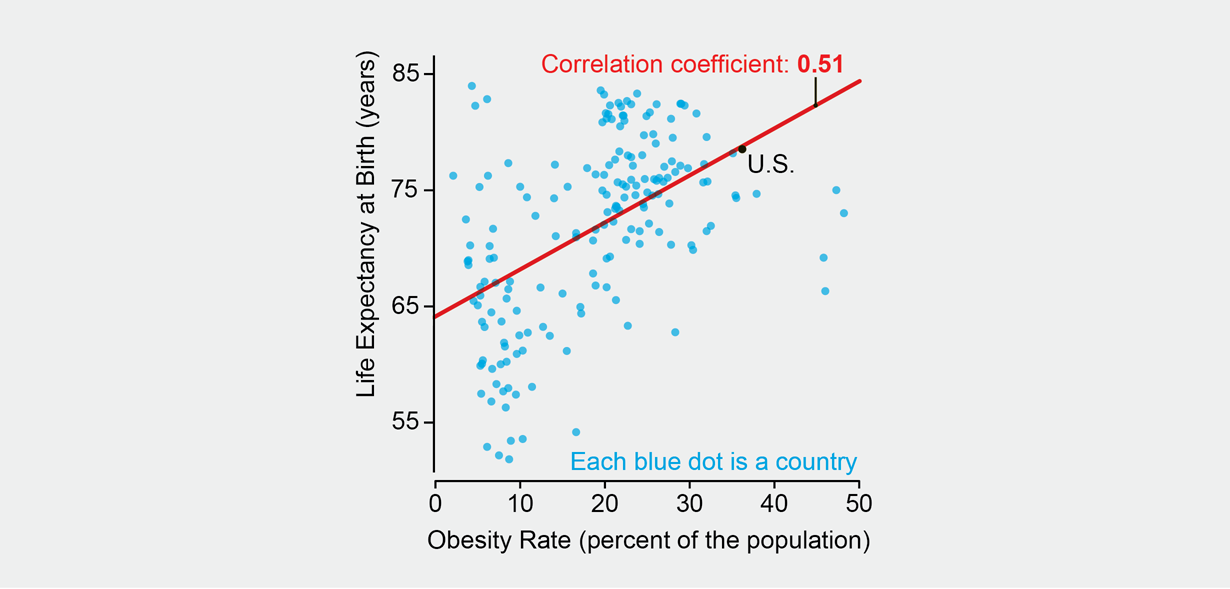
Say that you are obese, and you’ve grown tired of family, friends and your doctor telling you that obesity may increase your risk for diabetes, heart disease, even cancer—all of which could shorten your life. One day you see this chart (below). Suddenly you feel better because it shows that, in general, the more obese people a country has (right side of chart), the higher the life expectancy (top of chart). Therefore, obese people must live longer, you think. After all, the correlation (red line) is quite strong.


Credit: Alberto Cairo; Consultant: Heather Krause, Datassist; Sources: “Association between Class III Obesity (BMI of 40-59 kg/m2) and Mortality: A Polled Analysis of 20 Prospective Studies,” by Cari M. Kitahara et al., in PLOS Medicine; July 8 2014; CIA World Factbook (worldwide obesity rates, 2016); How Charts Lie: Getting Smarter about Visual Information, by Alberto Cairo, W. W. Norton (in press)

The chart itself is not incorrect. But it doesn’t really show that the more obese people are, the longer they live. A more thorough description would be: “At the national level—country by country—there is a positive association between obesity rates and life expectancy at birth, and vice versa.” Still, this does not mean that a positive association will hold at the local or individual level or that there is a causal link. Two fallacies are involved.

«

The graphic might be clear, but its axes are poorly chosen, as you’ve probably already figured out. But the rest of the post is interesting too, because it shows that you can slice and dice all sorts of data around just this question, and not quite get to the core of its cause.
unique link to this extract


EU brings in ‘right to repair’ rules for appliances • BBC News

Roger Harribin:

»

Household appliances will become easier to repair thanks to new standards being adopted across the European Union.

From 2021, firms will have to make appliances longer-lasting, and they will have to supply spare parts for machines for up to 10 years. The rules apply to lighting, washing machines, dishwashers and fridges.

But campaigners for the “right to repair” say they do not go far enough as only professionals – not consumers – will be able carry out the repairs.

The legislation has been prompted by complaints from consumers across Europe and North America infuriated by machines that break down when they are just out of warranty.

Owners are usually unable to repair the machines themselves – or find anyone else to do it at a decent price – so are forced to buy a replacement. This creates waste and fuels global warming through the greenhouse gases created in the manufacturing process for new machines.

In the US, around 20 states are said to have right to repair legislation in progress.

Under the European Commission’s new standards, manufacturers will have to make spares, such as door gaskets and thermostats, available to professional repairers. These parts will have to be accessible with commonly-available tools and without damaging the product.

«

Nice, but for British readers we’ll be outside the EU by then (almost certainly). Oh, so the UK’s going to follow the same rules? Great. The other problem is diagnosing the problem correctly – at this point one hopes YouTube and installation/repair manuals will also have to go online. There’s still a problem, though, in doing it well. Repair technicians do it again and again, rather than coming to it for the first time. And no, this doesn’t apply to phones.
unique link to this extract


Errata, corrigenda and ai no corrida: none notified
Start Up No.1,156: Simjacker debunked, Medium’s content problem, Mozilla and DoH, WeWork still in trouble, and more


Asimov’s Three Laws were great for stories about robots; less so for real life robots. CC-licensed photo by Simon Liu on Flickr.

You can sign up to receive each day’s Start Up post by email. You’ll need to click a confirmation link, so no spam.

A selection of 10 links for you. Use them wisely. I’m @charlesarthur on Twitter. Observations and links welcome.

The Three Laws of Robotics have failed the robots • Mind Matters

:

»

Chris Stokes, a philosopher at Wuhan University in China, says, “Many computer engineers use the three laws as a tool for how they think about programming.” But the trouble is, they don’t work.
He explains in an open-access paper:

»

The First Law fails because of ambiguity in language, and because of complicated ethical problems that are too complex to have a simple yes or no answer.

The Second Law fails because of the unethical nature of having a law that requires sentient beings to remain as slaves.

The Third Law fails because it results in a permanent social stratification, with the vast amount of potential exploitation built into this system of laws.

The ‘Zeroth’ Law, like the first, fails because of ambiguous ideology. All of the Laws also fail because of how easy it is to circumvent the spirit of the law but still remaining bound by the letter of the law.

«

Maybe we’d better hope it never gets tested in real life? At any rate, here at Mind Matters News, it’s Sci-Fi Saturday so we asked some of our contributors for reactions to the laws and to Stokes’s doubts about them.

«

Odd how we keep trying to wrestle ideas for films, TV and books into things to live by. (Other examples: Star Trek.)
unique link to this extract


New SIM attacks demystified, protection tools now available • Security Research Labs

»

We wanted to understand the extent to which users need to worry about Simjacker and create ways to know whether your SIM is vulnerable or even under attack.

Key research findings

• Around 6% of 800 tested SIM cards in recent years were vulnerable to Simjacker
• A second, previously unreported, vulnerability affects an additional 3.5% of SIM cards
• The tool SIMtester provides a simple way to check any SIM card for both vulnerabilities (and for a range of other issues reported in 2013)
• The SnoopSnitch Android app warns users about binary SMS attacks including Simjacker since 2014. (Attack alerting requires a rooted Android phone with Qualcomm chipset.)
• A few Simjacker attacks have been reported since 2016 by the thousands of SnoopSnitch users that actively contribute data (Thank you!)

«

OK, so it sounds like the concerns were overblown.
unique link to this extract


With Facebook’s coming News Tab, only some will get paid • WSJ

Lukas I. Alpert and Sahil Patel:

»

Facebook is planning to pay only a minority of publishers whose headlines will be featured in its coming news section, according to people familiar with the matter.

The specialized news section—which will appear on the toolbar at the bottom of Facebook’s mobile app—is set to launch as early as the end of October and will include links to stories from about 200 publications, the people said.

A person familiar with the matter said Facebook had never planned to pay all the news outlets whose content it would link to in its news section. The plan is similar to what Facebook has done with its Watch section, which includes videos not paid for by Facebook, the person said. Taking into account companies that own multiple publications, Facebook will pay fees to about one-quarter of the organizations that will be involved at launch, the person said.

Facebook is still negotiating with several big publishers, and in most cases talks have centered around how much of their reporting publishers would allow to be posted on the Facebook tab, the people familiar with the matter said. Facebook wants news organizations to allow access to all their stories for possible inclusion in the news tab, but some outlets have pushed for only allowing limited access.

«

Well of course it wasn’t looking to pay everyone. It just let them think that.
unique link to this extract


Will 10 million people pay for personal essays? • Simon Owens Substack

Simon Owens (who has Tech and Media Newsletter – doesn’t everyone?):

»

Last week I posted a tweet thread that you should check out. It starts with a screen capture of a headline for an article that appeared behind Medium’s paywall. This article fits into a content category that I’ve noticed is proliferating on Medium. It’s what I call “shitty personal advice column.”

In fact, anytime I see someone bragging about how much money they’re making through Medium’s partnership program – which allows users to place their content behind its paywall and get paid for the amount of engagement it generates – I then click on their user profile to see what kind of articles this person is regularly producing, and it almost always falls under this category. Often, the person is publishing upward of two or three articles a day, with each headline over-promising and under-delivering on its premise. 

And this makes sense. If you’re going to make real money on a platform that’s doling it out based on the amount of engagement it receives, you’ll need to produce a high volume of low calorie articles that require very little original research and contain clickable headlines. And with engagement being one of the required metrics, you’d want to stick to inspirational content, with the kind of shareable aphorisms that can be found in most career advice columns.

Which is all fine and good, but here’s the thing: Medium CEO Ev Williams has stated his goal is to reach 10 million paying subscribers. No text-based platform has attracted that many digital subscribers. The New York Times only has about 3 million. So can you get 10 million people to pay up to $5 a month so they can be flooded with a high volume of dashed-off columns that were written and published in the span of a few hours? 

«

Sounds like the long-lost Demand Media, killed by Google changing its algorithm. Wonder if the same fate lies ahead for those essays.

unique link to this extract


Mozilla won’t turn on DoH as default in the UK like it’s planning to do in the US • Gizmodo UK

Shabana Arif:

»

DoH [DNS over HTTPS, ie encrypted domain lookup queries] has been fairly controversial, with the Internet Services Providers Association (ISPAUK) nominating Mozilla for an ‘Internet Villain’ over the whole thing, saying it will “bypass UK filtering obligations and parental controls, undermining internet safety standards in the UK.”

In his letter to Morgan, Mozilla vice president of global policy, trust and security, Alan Davidson, stressed that the company “has no plans to turn on our DoH feature by default in the United Kingdom and will not do so without further engagement with public and private stakeholders”.

He did add that Mozilla does “strongly believe that DoH would offer real security benefits to UK citizens. The DNS is one of the oldest parts of the internet’s architecture, and remains largely untouched by efforts to make the web more secure.

“Because current DNS requests are unencrypted, the road that connects your citizens to their online destination is still open and used by bad actors looking to violate user privacy, attack communications, and spy on browsing activity. People’s most personal information, such as their health-related data, can be tracked, collected, leaked and used against people’s best interest. Your citizens deserve to be protected from that threat.”

Whilst safety is an issue, it has to be balanced with privacy, and walking the line between freedom and forms of censorship is never easy. The sexual abuse and exploitation of children is often cited in this debate, with a government spokesperson stating that it’s “an abhorrent crime that this Government is committed to tackling,” and one of the measures is blocking certain websites that DoH would allow users to circumvent.

«

The difference in dialogue between the US and UK over DoH is notable: preventing malware and chid abuse imagery is a much bigger talking point in the UK. In the US it doesn’t seem to enter the discussion.
unique link to this extract


Apple denied tariff relief on Mac Pro parts after staying in Texas • Bloomberg

Mark Gurman and Mark Niquette:

»

Apple Inc. won’t be exempted from tariffs on five Chinese-made components for the upcoming Mac Pro computer, even after the company announced it was keeping some assembly operations in the US.

The US Trade Representative’s office denied Apple’s request for relief from 25% tariffs on the much-discussed optional wheels for Apple’s Mac Pro, a circuit board for managing input and output ports, power adapter, charging cable and a cooling system for the computer’s processor.

The decisions, posted Monday, come about a week after Apple announced it would make new Mac Pro computers at a plant in Austin, Texas – which it’s operated since 2013 – after originally considering shifting production to China like its other products. The move followed an announcement this month that the US trade office had agreed to Apple’s request for tariff waivers on 10 of 15 Chinese parts.

«

There are tariffs on the wheels. Wheels. How do wheels attract tariffs? It’s weird.
unique link to this extract


WeWork still needs cash after pulling IPO • WSJ

Eliot Brown:

»

To cut costs, the company’s new co-CEOs, Sebastian Gunningham and Artie Minson, are planning thousands of job cuts, putting extraneous businesses up for sale and purging some luxuries from the previous CEO, such as a G650ER jet purchased for more than $60m last year, people familiar with the matter have said.

New York-based We had $2.5bn in cash as of June 30. At the current rate of cash burn—about $700m a quarter—it would run out of money some time after the first quarter of 2020, according to Chris Lane, an analyst at Sanford C. Bernstein & Co. Mr. Lane and his colleagues projected in a recent note to clients that We would burn through nearly $10bn in cash between 2019 and 2022, assuming it keeps growing.

Messrs. Gunningham and Minson said in a joint email to We staff last week that they “anticipate difficult decisions ahead.”

“As we look toward a future IPO, we will closely review all aspects of our company with the intention of strengthening our core business and improving our management and operations,” the co-CEOs wrote.

Further adding pressure are agreements We made in a bond offering last year for which it must keep at least $500m of cash, according to S&P Global Ratings, which downgraded We’s bonds last week.

«

Wow, they’re down to their last executive jet. Times are tough. Set an alarm for February, when things are going to be getting frantic there.
unique link to this extract


October 2015: WeWork used these documents to convince investors it’s worth billions • Buzzfeed

Nitasha Tiku in October 2015:

»

Neumann likes to present WeWork as a star of the sharing economy, a technology platform that connects consumers to office space, just like Uber and Airbnb connect them to cars and homes, respectively.

But how can an infrastructure-dependent real estate venture scale like a low-overhead software startup? How can a company that signs 15-year leases — but sells monthly memberships — expect to survive a downturn? How can an entity that doesn’t own its own real estate be “worth” more than three times as much as the New York Yankees? Why does WeWork’s future look so bright when it sits smack in the middle of two bubbling markets (that is, tech and commercial real estate)? Why would a business model that drove one high-profile dot-com darling [Regus] promising “the office of the future” into bankruptcy succeed this time around?

October 2014 fundraising documents obtained by BuzzFeed News reveal how Neumann answers those questions behind closed doors. The material was shared with BuzzFeed by someone familiar with the company, on the condition of anonymity, and independently verified. WeWork would only comment on a couple of aspects of its fundraising pitch. It includes a five-year financial forecast and a slide presentation (also known as a pitch deck), both embedded below, as well as a company overview.

«

In 2014 its forecast for 2018 was $2.86bn in revenues; in fact it managed $1.8bn. Not bad, but still a substantial miss.
unique link to this extract


Looking back at the Snowden revelations • A Few Thoughts on Cryptographic Engineering

Matthew Green (who is a highly respected cryptographer:

»

Have things improved?

This is the $250 million question.

Some of the top-level indicators are surprisingly healthy. HTTPS adoption has taken off like a rocket, driven in part by Google’s willingness to use it as a signal for search rankings — and the rise of free Certificate Authorities like LetsEncrypt. It’s possible that these things would have happened eventually without Snowden, but it’s less likely.

End-to-end encrypted messaging has also taken off, largely due to adoption by WhatsApp and a host of relatively new apps. It’s reached the point where law enforcement agencies have begun to freak out, as the slide below illustrates.


Slightly dated numbers, source: CSIS (or this article)

Does Snowden deserve credit for this? Maybe not directly, but it’s almost certain that concerns over the surveillance he revealed did play a role. (It’s worth noting that this adoption is not evenly distributed across the globe.)

It’s also worth pointing out that at least in the open source community the quality of our encryption software has improved enormously, largely due to the fact that major companies made well-funded efforts to harden their systems, in part as a result of serious flaws like Heartbleed — and in part as a response to the company’s own concerns about surveillance.

It might very well be that the NSA has lost a significant portion of its capability since Snowden.

The future isn’t American.

I’ve said this before, as have many others: even if you support the NSA’s mission, and believe that the U.S. is doing everything right, it doesn’t matter. Unfortunately, the future of surveillance has very little to do with what happens in Ft. Meade, Maryland. In fact, the world that Snowden brought to our attention isn’t necessarily a world that Americans have much say in.

«

unique link to this extract


iOS 13.1.1 and iOS 13.1.2: Apple takes an aggressive update cadence to clean up iOS 13 • Ars Technica

Samuel Axon:

»

Just this past Friday, Apple released iOS and iPadOS 13.1.1, a small bug-fix update that repaired a security problem for third-party keyboard applications whereby those apps could get permissions before users had given them; an issue that precluded iPhones from restoring from backups in some cases; and an issue affecting battery life. The update also included minor bug fixes for Apple’s own apps like Safari and Reminders.

Apple doesn’t usually release so many updates in rapid succession. iOS 13 only launched 11 days ago, and it has already received three updates. As we noted in our review of iOS 13, it’s a major and ambitious update compared to last year’s iOS 12, but iOS 13 had a relatively rocky beta period, and a number of kinks still need to be ironed out even after today’s update.

«

This is very unusual to have so many updates without a calamitous mistake (eg knocking out cellular connectivity) or giant security hole.
unique link to this extract


Errata, corrigenda and ai no corrida: in last week’s article about offshore wind v nuclear, I suggested that wind farms’ rating could be comparable with nuclear power stations. They’re not though; they’re typically rated as capable of generating an average of half their maximum power. That changes the maths somewhat compared to nuclear, which can maintain a much higher output consistently.