Start Up No.1,059: Facebook bans right-wing extremists, esports takes training!, questions over Apple’s kids app ban, and more


Take two layers of graphene (this is one), twist one by 1.1 degrees, and you get a superconductor. CC-licensed photo by UCL Mathematical + Physical Sciences on Flickr

»You can sign up to receive each day’s Start Up post by email (arriving at about 0700GMT each weekday). You’ll need to click a confirmation link, so no spam.«

A selection of 11 links for you. Use them wisely. I’m @charlesarthur on Twitter. Observations and links welcome.

Instagram and Facebook ban far-right extremists • The Atlantic

Taylor Lorenz:

»

In an effort to contain misinformation and extremism that have spread across the platforms, Instagram and its parent company, Facebook, have banned Alex Jones, Infowars, Milo Yiannopoulos, Paul Joseph Watson, Laura Loomer, and Paul Nehlen under their policies against dangerous individuals and organizations. They also banned the Nation of Islam leader Louis Farrakhan, who has repeatedly made anti-Semitic statements.

Infowars is subject to the strictest ban. Facebook and Instagram will remove any content containing Infowars videos, radio segments, or articles (unless the post is explicitly condemning the content), and Facebook will also remove any groups set up to share Infowars content and events promoting any of the banned extremist figures, according to a company spokesperson. (Twitter, YouTube, and Apple have also banned Jones and Infowars.)

Jones, Yiannopoulos, Watson, Loomer, Nehlen, and Farrakhan are all personally banned, as are any accounts set up in their likeness. But users may still praise those figures on Instagram and share content related to them that doesn’t violate other Instagram and Facebook terms of service. “We’ve always banned individuals or organizations that promote or engage in violence and hate, regardless of ideology. The process for evaluating potential violators is extensive and it is what led us to our decision to remove these accounts today,” a Facebook spokesperson said via email.

«

So overdue. Very interesting to see Facebook (and thus of course Instagram) decide that they want to be known for not hosting extremism, and in favour of truth. It also puts a lot of the edge cases on notice: tip too far over, and you’re out.
unique link to this extract


Hitting the gym makes esports athletes more successful • The Next Web

Rachel Kaser:

»

A study by Professor Ingo Froböse of the University of Cologne found that, even though they appear to be sitting still, esports players are frequently putting out a lot of effort. As Froböse told Deutsche Welle, “The amount of cortisol produced is about the same level as that of a race-car driver. This is combined with a high pulse, sometimes as high as 160 to 180 beats per minute, which is equivalent to what happened during a very fast run, almost a marathon.”

Given those demands, and how often and how long players have to practice, it’s probably no surprise esports pros have to maintain good fitness just to survive.

Eric Sanders, head of eSports operations with 100 Thieves, which has pros in League of Legends, Call of Duty, Fortnite, and Apex Legends, told TNW players often get up early or stay up late in order to hit the gym while still getting their hours in with the game. “We have a fair amount of players who work out 5-6 days a week… we have a few guys on our Call of Duty team who’ll play until 11 at night and go lift at 11:30.”

So what do esports players do when they hit the gym? There’s no one answer that best suits all pros — many have their own trainers and routines they follow. But most team managers and coaches who spoke with TNW said it’s not the specific exercise that matters, but the consistent routine.

Jasper Schellens, fitness and nutrition coach with FaZe Clan, an organization that started with three YouTubers but has since ballooned into teams in six separate esports, said to TNW of the exercises he assigns, “rowing exercises, chin-ups… they’re sitting down a lot and leaning forward a little bit, so I try to focus a lot more on the back exercises because it pulls them straight so they don’t get neck or back pain… I also try to work on their cardio so they don’t fatigue as much or as fast.”

«

OK, they might have an elevated pulse, but that’s not the same as being in aerobic or anaerobic stress, which is what athletes encounter.
unique link to this extract


Pornhub is “extremely interested” in acquiring Tumblr • Buzzfeed News

Ryan Broderick:

»

Pornhub Vice President Corey Price said in an email to BuzzFeed News that the porn-streaming giant is extremely interested in buying Tumblr, the once uniquely horny hub for young women and queer people that banned adult content last December to the disappointment of many of its users.

Price said that restoring Tumblr’s NSFW edge would be central to their acquisition of it, were it to actually happen.

Tumblr owner Verizon is reportedly currently seeking a buyer for the blogging platform, which according to the Wall Street Journal has struggled to meet revenue targets.

“Tumblr was a safe haven for those who wanted to explore and express their sexuality, adult entertainment aficionados included,” Price told BuzzFeed News. “We’ve long been dismayed that such measures were taken to eradicate erotic communities on the platform, leaving many individuals without an asylum through which they could comfortably peruse adult content.”

«

You know, I can see that being a really good fit. Pornhub would know how to monetise the porn, and it could expand its income base with the non-porn on Tumblr.

And of course Verizon didn’t have a clue what to do with Tumblr.
unique link to this extract


The US government wants a man at the center of a massive “cryptocurrency scheme” held without bail • Amy Castor

Amy Castor is a freelance journalist who has been covering many of the twists and turns of the crypto world:

»

The US government wants a football businessman linked to an investigation into $850 million of missing Tether and Bitfinex funds to be held without bail.

According to a memorandum in support of detention filed with the District Court of Arizona on May 1, Reginald Fowler poses a serious fight risk due to his overseas connections and access to hundreds of millions of dollars.

The court doc also presents startling new twists in an already tangled plot—a “Master US Workbook,” which details the financial operations of the “cryptocurrency scheme,” fake bond certificates worth billions of dollars, and a counterfeit money operation.

Reggie Fowler

Fowler, 60, is a football businessman. He was a former co-owner of the Minnesota Vikings and the original main investor in the Alliance of American Football (AAF)—an attempt to form a new football league. The AAF collapsed when Fowler withdrew funding—after the Department of Justice froze his bank accounts in late 2018.

I did a search on Pacer and got a number of hits showing Fowler has been in and out of courts for years. In fact, in 2005, ESPN reported that he had been sued 36 times.

«

The allegations against Fowler are jawdropping – including one that says he tried to pass off fake bonds for billions of dollars.
unique link to this extract


The successful conspiracy inside YouTube to kill Internet Explorer 6 • Chris Zacharias

Chris Zacharias:

»

I do not recall the exact triggering event that led to our web development team laying out plans to kill IE6 over lunch in the YouTube cafeteria. Perhaps it was the time I pushed out a CSS stylesheet that included an attribute selector on a semi-supported HTML element. Any reasonable web developer would expect this to be ignored by browsers not up to the task. This was not the case with older flavors of IE. Under very specific conditions, an attribute selector on an unsupported HTML element in IE would create an internal recursion that would at best, cause the browser to crash and at worst, trigger a blue screen of death. Or perhaps it was the hundredth time one of our software engineers had innocently pushed out an tag with an empty src attribute. Nobody joining the team could be expected to know that in early versions of IE, the browser would load the root path “/” for empty src attributes. The tag would suddenly behave like an , loading our homepage and all of its dependent resources in what could become an exponentially expanding recursive loop. Whenever an empty image tag found its way on to the homepage, it was all-hands-on-deck emergency to locate and replace the offending code before we melted our servers into paperweights.

Regardless of whatever the event at that time was, it had been brutal and it had been IE6 related.

«

I love how this account begins in the tone of an old man at the opening of a film talking to a young helper. I think the screenplay then says “DISSOLVE TO YOUTUBE CAFETERIA”. Like tears in the rain…

Also, it’s not a conspiracy if it’s for good, right?
unique link to this extract


There used to be an app for that • Medium

OurPact makes a “control your kid’s screen time” app which Apple recently yanked from the App Store, saying that its use of Mobile Device Management (MDM) – an API Apple provides – left it vulnerable to hacking:

»

Shortly after the release of the iPhone in 2007, a growing body of research confirmed the negative impact of excessive screen time exposure for growing children and teens. In 2012, the OurPact team recognized the lack of solutions available on iOS and set out to develop comprehensive parental controls for families. We don’t just develop OurPact, we use it in our own homes.

From day one, our focus has been what’s best for parents and their children. A core part of that mission is a commitment to data protection and user privacy — we never have and never will sell or provide any user data to any third party.

Since its initial release, OurPact has employed a public, documented Apple technology known as MDM.

While MDM was initially intended for company-owned or personally-owned BYOD implementations, it has also been used by many parental control applications to give parents more freedom to manage their children’s mobile devices. In recent years, Apple has also extended MDM for use by children and teachers in schools.
OurPact’s core functionality would not be possible without the use of MDM; it is the only API available for the Apple platform that enables the remote management of applications and functions on children’s devices. We have also been transparent about our use of this technology since the outset, and have documented its use in our submissions to the App Store.

«

Plenty of detail in this, and Apple doesn’t come out looking at all good. The MDM point looks extremely weak, in fact.
unique link to this extract


Amazing AI generates entire bodies of people who don’t exist • Futurism

Dan Robitzski:

»

A new deep learning algorithm can generate high-resolution, photorealistic images of people — faces, hair, outfits, and all — from scratch.

The AI-generated models are the most realistic we’ve encountered, and the tech will soon be licensed out to clothing companies and advertising agencies interested in whipping up photogenic models without paying for lights or a catering budget. At the same time, similar algorithms could be misused to undermine public trust in digital media.

The algorithm was developed by DataGrid, a tech company housed on the campus of Japan’s Kyoto University, according to a press release.

In a video showing off the tech, the AI morphs and poses model after model as their outfits transform, bomber jackets turning into winter coats and dresses melting into graphic tees.

«

So that’s another group of jobs gone. (Thanks Charles Knight for the link.)
unique link to this extract


With a simple twist, a ‘magic’ material is now the big thing in physics • Quanta Magazine

David Freedman:

»

Physicists are excited about magic-angle twisted bilayer graphene [which becomes superconducting when two layers are rotated by 1.1 degrees] not because it’s likely to be a practical superconductor but because they’re convinced it can illuminate the mysterious properties of superconductivity itself. For one thing, the material seems to act suspiciously like a cuprate, a type of exotic ceramic in which superconductivity can occur at temperatures up to about 140 kelvin, or halfway between absolute zero and room temperature. In addition, the sudden jumps in twisted bilayer graphene — from conducting to insulating to superconducting — with just a tweak of an external electric field indicate that free electrons are slowing to a virtual halt, notes physicist Dmitri Efetov of the Institute of Photonic Sciences (ICFO) in Barcelona, Spain. “When they stop, [the electrons] interact all the more strongly,” he said. “Then they can pair up and form a superfluid.” That fluidlike electron state is considered a core feature of all superconductors.

The main reason 30 years of studying cuprates has shed relatively little light on the phenomenon is that cuprates are complex, multi-element crystals. “They’re poorly understood materials,” said Efetov, noting that they superconduct only when precisely doped with impurities during their demanding fabrication in order to add free electrons. Twisted bilayer graphene, on the other hand, is nothing but carbon, and “doping” it with more electrons merely requires applying a readily varied electric field. “If there’s any system where we can hope to understand strongly correlated electrons, it’s this one,” said Jarillo-Herrero. “Instead of having to grow different crystals, we just turn a voltage knob, or apply more pressure with the stamps, or change the rotation angle.” A student can try to change the doping in an hour at virtually no cost, he notes, versus the months and tens of thousands of dollars it might take to try out a slightly different doping scheme on a cuprate.

Also unique, said MacDonald, is the small number of electrons that seem to be doing the heavy lifting in magic-angle twisted bilayer graphene — about one for every 100,000 carbon atoms.

«

unique link to this extract


Helping small business phones get smart with CallJoy • Google blog

Bob Summers, general manager for CallJoy:

»

My team within Area 120, Google’s workshop for experimental projects, conducted testing and found that small businesses receive an average of 13 phone calls every day. If you apply that average to America’s 30.2 million small businesses, that would equal roughly 400 million incoming daily calls to local businesses from consumers placing a to-go order, booking an appointment, inquiring about inventory and more. That’s why we built CallJoy, a cloud-based phone agent that enables small business owners to measure, improve and automate customer service.

With CallJoy, small businesses have access to the same customer service options that have historically only been available to larger corporations. If you’re associated with small business using CallJoy, here’s how it works: After a quick setup, you’ll receive a local phone number. CallJoy will immediately begin blocking unwanted spam calls so you receive the calls that matter—the ones from customers. Then, when the phone rings, the automated CallJoy agent answers, greets callers with a custom message and provides basic business information (like hours of operation).

«

Wait – 13 calls per day? That’s about one every 45 minutes. Maybe every half hour, if you have a lunch break. That’s not a lot, is it? Basically Google seems to be turning the human responder into a web page. Wonderfully annoying for customers: now it’s a call centre!
unique link to this extract


You’re holding it wrong — touching the corner of the Samsung Galaxy Tab S5e reportedly kills Wi-Fi performance • Android Police

Ryan Whitwam:

»

The Samsung Tab S4 is a nice piece of hardware if you’re into Android tablets, but it’s very expensive. The new Tab S5e has some of the S4’s features but drops the price to $400. It turns out it also drops the WiFi signal when you touch the corner. Maybe we’re all just holding it wrong.

Based on reports from multiple users, the tablet’s upper left corner (in portrait) needs to remain unobstructed to maintain WiFi performance. The Tab S5e is a large-ish 10.5-inch tablet with a widescreen ratio. So, it’s a bit ungainly to hold in portrait orientation. However, in landscape, the aforementioned corner is where you’d naturally want to place your hand.

Users on Instagram have shown that WiFi connectivity can drop completely when touching the corner. Meanwhile, SamMobile has confirmed there’s an issue by eliciting a 50% drop in signal strength when covering the corner. The issue brings to mind Apple’s “you’re holding it wrong” incident with the iPhone 4.

«

Though I bet many more iPhone 4s were sold than Galaxy Tab S4Es. Wonder if this person also worked on the Fold?
unique link to this extract


Japan to develop computer virus to defend against cyberattacks • Japan Times

»

Japan will develop its first-ever computer virus by next March as a defense measure against cyberattacks, sources have said.

The Defense Ministry is considering malware that can break into a computer system, hoping such a computer virus could work as a deterrent against cyberattacks, the sources said Monday.

The government has said it is looking to enhance its defense capabilities beyond the ground, marine and air domains to address security challenges in new areas such as cyberspace and outer space amid technological advances in recent years.

Japan lags behind other countries in addressing the threat of cyberattacks. It plans to increase the number of personnel in its cyberspace unit to 220 from 150, compared with 6,200 in the United States, 7,000 in North Korea and 130,000 in China, according to the ministry.

«

“Only to be used for defensive purposes”, apparently.
unique link to this extract


Errata, corrigenda and ai no corrida: none notified.

Start Up No.1,058: Silicon Valley’s new money worries, Apple’s big Watch, the trouble with Slack, the unprivate lock, and more


Every catastrophe has its deniers: the latest suggests Notre Dame’s fire wasn’t an accident. CC-licensed photo by Bradley Weber on Flickr

»You can sign up to receive each day’s Start Up post by email (arriving at about 0700GMT each weekday). You’ll need to click a confirmation link, so no spam.«

A selection of 10 links for you. Isn’t that enough? I’m @charlesarthur on Twitter. Observations and links welcome.

Silicon valley is awash in Chinese and Saudi cash — and no one is paying attention (except Trump) • Vox

Theodore Schleifer:

»

This is Silicon Valley in 2019 — a playground for foreign countries eager to fulfill their grand strategies. To some extent, this is to be embraced: If the United States has a comparative advantage in tech companies — and if capitalism is global — then it should welcome the transformation of Silicon Valley. America welcomes foreign money in the New York Stock Exchange and Nasdaq; so, too, should it welcome foreign money in US private companies, especially from close partners like Singapore.

But the rise of foreign money has turned Silicon Valley into a geopolitical minefield for venture capitalists and startups, requiring American startups to make judgment calls and react to crosscurrents that would’ve been strange to the industry decades ago.

Who in Saudi Arabia exactly was directly liable for the murder of Jamal Khashoggi?

Was Huawei actually a threat to America’s national security?

“It’s the world of geopolitics coming to venture,” Rob Ackerman, a venture capitalist active in cybersecurity, said. “It’s got a lot more gray than black and white — and we’re all trying to figure that out.”

Or as an American investor now living in Israel, Mike Eisenberg, recalled telling an entrepreneur recently: “You thought you’re in business. You’re actually in politics.”

This was all true even before the force that has reshaped every American industry over the past two years — Donald Trump — exacerbated that reality. Foreign money courses through the Silicon Valley bloodstream, and his administration isn’t happy about it.

But for too long, most people in Silicon Valley have treated foreign cash with a collective shrug, seeing money as money and not truly considering the ethical and regulatory challenges of taking investment from certain foreign countries, Recode interviews with more than 50 venture capitalists, startups, lawyers, and others involved in cross-border investing reveal. Now Silicon Valley is scrambling to assess its own exposure in this new world order.

Money from two countries in particular has ignited a debate in Silicon Valley about the responsibilities of startups and their investors: China and Saudi Arabia.

«

It’s all changed a hell of a lot from the days when it was a few VCs on Sand Hill Drive.
unique link to this extract


America’s favorite door-locking app has a data privacy problem • OneZero

Sage Lazzaro:

»

Latch is on a mission to digitize the front door, offering apartment entry systems that forgo traditional keys in favor of being able to unlock entries with a smartphone. The company touts convenience — who wants to fiddle with a metal key? — and has a partnership with UPS, so you can get packages delivered inside your lobby without a doorman. But while it may keep homes private and secure, the same can’t be said about tenants’ personal data.

Latch — which has raised $96m in venture capital funding since launching in 2014, including $70m in its Series B last year — offers three products. Two are entry systems for specific units, and one is for lobbies and other common areas like elevators and garages. The company claims one in 10 new apartment buildings in the U.S. is being built with its products, with leading real estate developers like Brookfield and Alliance Residential now installing them across the country.

Experts say they’re concerned about the app’s privacy policy, which allows Latch to collect, store, and share sensitive personally identifiable information (PII) with its partners and, in some cases, landlords. And while Latch is far from the only tech company with questionable data practices, it’s harder for a tenant to decouple from their building’s door than, say, Instagram: If your landlord installs a product like the keyhole-free Latch R, you’re stuck. The issue of tenant consent is currently coming to a head in New York City, where residents of a Manhattan building are suing their landlord in part over privacy concerns related to the app.

«

Latch wouldn’t be interviewed but said that it offers smartphone app unlocking, Bluetooth proximity, or keycard. But the problem is still about controlling where the information goes.
unique link to this extract


Facebook users are posting videos of themselves lighting wood on fire to spread hoaxes about the Notre Dame fire • Poynter

Daniel Funke:

»

To debunk the viral beam-burning videos, Les Décodeurs and AFP didn’t use standard digital verification tools like InVid and Google’s reverse image search. The videos are false, but they’re real.

Instead, the fact-checkers did what many outlets call “triangulating the truth” — speaking to a variety of different experts in order to prove whether or not a claim without obvious concrete evidence is true or false. In this case, AFP and Les Décodeurs spoke to scientists, fire safety experts and engineers, all of whom told them that it’s difficult to set anything on fire in the open air.

That’s no reason to conclude the Notre Dame fire, which started inside the cathedral — not in the open air — was set intentionally, the fact-checkers reported.

The viral, do-it-yourself beam-burning videos are part of a larger effort to spread misinformation about the cause of the Notre Dame fire April 15. That effort has been amplified extensively by the American right, Laurent said.

The goal is to continue pushing the false, Islamophobic narrative that Muslim terrorists were somehow behind the Notre Dame fire.

«

The article also has a graphic showing the reach of the viral nonsense, and of the fact-checking. The latter pales into insignificance.
unique link to this extract


Apple Watch has record breaking quarter and it’s not letting up • Wareable

James Stables:

»

“The [Apple Watch business] is now about the size of a Fortune 200 company, an amazing statistic when you consider it’s only been four years since we delivered the very first Apple Watch,” said Tim Cook, Apple CEO.

Impressive stuff, as Apple CFO Luca Maestri explained:

“Wearables, home and accessories revenue set a new March quarter revenue record at 5.1 billion, fuelled primarily by the strong performance of our wearables business, which grew close to 50%.

“Within this category, Apple Watch is the best-selling and most loved smartwatch in the world, and produced its best results ever for a non-holiday quarter. It’s reaching many new customers, with three-quarters of purchases going to customers who have never owned an Apple Watch before,”

This confirms what we already know – that Apple is totally bossing the smartwatch market.

But it shows how much appetite there is for this segment, and that’s good news for everyone. The walled garden of iOS and high ticket price means there’s always room for other companies to play, which explains the success of the Fitbit Versa and Samsung Galaxy Watch.

However, as CCS Insight’s Ben Wood tweeted, it’s also a great lock-in. The Apple Watch can only be used with iPhones, so those millions of people who are investing are far more likely to stay within the iOS ecosystem with a new iPhone.

«

Since you’re wondering, Fortune 200 companies in 2018 had annual revenues of more than $14.6bn. If you assume a $400 ASP, that’s 36.5m Watches sold in the 12-month period. Meanwhile, everyone in London seems to have AirPods.
unique link to this extract


The productivity pit: how Slack is ruining work • Vox

Rani Molla:

»

Consulting firm McKinsey said back in 2012 that workplace communications technologies have the potential to increase employee productivity by up to 25%.

“The average interaction worker spends an estimated 28% of the workweek managing email and nearly 20% looking for internal information or tracking down colleagues who can help with specific tasks,” according to the study. McKinsey figured people would be able to more easily and quickly accomplish these task using new workplace software.

That’s happened to an extent, but other problems have arisen.

Much like the ubiquitous open-floor plan, this type of software is meant to get different parts of a company working together, to break down hierarchies, to spark chance interactions and innovations.

In practice it can be hell.

The addition of yet another communications tool can result in a surfeit of information.

On average, employees at large companies are each sending more than 200 Slack messages per week, according to Time Is Ltd., a productivity-analytics company that taps into workplace programs — including Slack, calendar apps, and the Office Suite — in order to give companies recommendations on how to be more productive. Power users sending out more than 1,000 messages per day are “not an exception.”

Keeping up with these conversations can seem like a full-time job. After a while, the software goes from helping you work to making it impossible to get work done.

«

“Power users” are the curse of these, and many other systems. They dominate conversations, flood the zone, and make it hard to feel you’re keeping up. Similarly on social media, they’re the ones who drag the conversation around to what they want to talk about – not necessarily what it should be about.
unique link to this extract


Feds just seized part of Bitfinex’s ‘missing’ $850m, arrest made • Modern Consensus

Leo Jakobson:

»

Funds seized by the feds from an HSBC Bank account were allegedly used to commit bank fraud by secretly transferring U.S. dollars to and from customers of cryptocurrency exchanges, according to an indictment issued Tuesday.

That same bank account was reportedly used by Bitfinex to transfer money to its customers when it was having trouble finding a mainstream bank willing to work with after Wells Fargo ceased doing business with it.

In an indictment announced on April 30, the U.S. Department of Justice said that funds were seized from HSBC Bank USA account 141000147, among others. That account is notable because on Oct. 6 , 2018, The Block Managing Editor Larry Cermak tweeted a screenshot of instructions from Bitfinex showing customers how to wire U.S. dollars to their wallets via HSBC Bank N.A. account 141000147, identified as belonging to Global Trading Solution, LLC.

Bitfinex appears to have gotten caught up in the case after the payment processor it was using as a bank, Crypto Capital, told them in August 2018 that $850m the exchange had on account with them had been seized by authorities. Those governments were identified by Bitfinex General Counsel Stuart Hoegner as the US, Portugal, and Poland. Crypto Capital is owned by Global Trading Solution, LLC.

«

It’s not clear if this is money laundering, outright scamming, trying to evade the authorities, or what, but Bitfinex and Tether are starting to unravel: Tether is now apparently “only 74% backed” by actual money.
unique link to this extract


Smartphone shipments experience deeper decline in Q1 2019 with a clear shakeup among the market leaders • IDC

Worldwide volumes down 6.6%; stagnation rules the day:

»

“The less than stellar first quarter in the United States can be attributed to the continued slowdown we are witnessing at the high end of the market,” said Anthony Scarsella, research manager with IDC’s Worldwide Quarterly Mobile Phone Tracker. “Consumers continue to hold on to their phones longer than before as newer higher priced models offer little incentive to shell out top dollar to upgrade. Moreover, the pending arrival of 5G handsets could have consumers waiting until both the networks and devices are ready for prime time in 2020.”

Samsung saw volumes drop 8.1% in 1Q19 with shipments of 71.9m. The results were enough to keep Samsung in the top spot of the market, but Huawei is continuing to close the gap between the two smartphone leaders. Despite challenging earnings in terms of profits, Samsung did say that the recently launched Galaxy S10 series did sell well during the quarter. With the 5G variant now launched in its home market of Korea and plans to bring this device and other 5G SKUs to other important markets in 2019, it will be equally crucial for Samsung not to lose focus on its mid-tier product strategy to fend off Huawei.

Huawei moved its way into a clear number two spot as the only smartphone vendor at the top of the market that saw volumes grow during 1Q19. Impressively, the company had year-over-year growth of 50.3% in 1Q19 with volumes of 59.1m units and a 19.0% market share. Huawei is now within striking distance of Samsung at the top of the global market. In China, Huawei continued its positive momentum with a well-rounded portfolio targeting all segments from low to high. Huawei’s high-end models continued to create a strong affiliation for the mid to low-end models, which are supporting the company’s overall shipment performance.

Apple had a challenging first quarter as shipments dropped to 36.4m units representing a staggering 30.2% decline from last year. The iPhone struggled to win over conusmers in most major markets as competitors continue to eat away at Apple’s market share. Price cuts in China throughout the quarter along with favorable trade-in deals in many markets were still not enough to encourage consumers to upgrade. Combine this with the fact that most competitors will shortly launch 5G phones and new foldable devices, the iPhone could face a difficult remainder of the year. Despite the lackluster quarter, Apple’s strong installed base along with its recent agreement with Qualcomm will be viewed as the light at the end of the tunnel heading into 2020 for the Cupertino-based giant.

«

Neil Cybart, a former sell-side analyst who has his own model for how Apple’s numbers fit together, reckons IDC is lowballing by a mile with its 36m figure; reckons it sold “way more”. The unit figure sales are all over the place, depending which analyst company you go to.
unique link to this extract


How taxpayers covered a $1,000 liquor bill for Trump staffers (and more) at Trump’s club • Pro Publica

Derek Kravitz:

»

At some point later that evening [during Chinese president Xi’s visit to Mar-a-Lago], a group repaired to Mar-a-Lago’s Library Bar, a wood-paneled study with a portrait of Trump in tennis whites (titled “The Visionary”) hanging nearby. The group asked the bartender to leave the room so it “could speak confidentially,” according to an email written by Mar-a-Lago’s catering director, Brooke Watson.

The Secret Service guarded the door, according to the email. The bartender wasn’t allowed to return. And members of the group began pouring themselves drinks. No one paid.

Six days later, on April 13, Mar-a-Lago created a bill for those drinks, tallying $838 worth of alcohol plus a 20% service charge. It covered 54 drinks (making for an average price of $18.62 each) of premium liquor: Chopin vodka, Patron and Don Julio Blanco tequilas and Woodford Reserve bourbon. Watson’s email did not specify how many people consumed the alcohol or who the participants were. (It stated that she “was told” the participants included then-strategist Steve Bannon and then-deputy chief of staff Joe Hagin. Bannon, who has said he stopped drinking years ago, said he didn’t drink at Mar-a-Lago and didn’t recall the episode. Hagin did not respond to requests for comment.)

The bill was sent to the State Department, which objected to covering it. It was then forwarded to the White House, which paid the tab.

The unusual cocktail hour underscores a unique push and pull in the current administration: Donald Trump’s White House pays a bill and Donald Trump’s club reaps the revenue. (It’s unclear if the White House asked any of those drinking to reimburse the government; the White House declined to comment.)

«

Still astonished that this behaviour is countenanced; there’s plenty similar in the story. It would be like Jimmy Carter insisting that the White House serve peanuts with every meal and at every function, sourced from his peanut farm – which he’d handed to his kids. (Carter was forced to sell his peanut farm on becoming president in 1976.)
unique link to this extract


Amazon’s facial-recognition technology is supercharging local police • Washington Post

Drew Harwell:

»

A grainy picture of someone’s face — captured by a security camera, a social-media account or a deputy’s smartphone — can quickly become a link to their identity, including their name, family and address. More than 1,000 facial-recognition searches were logged last year, said deputies, who sometimes used the results to find a suspect’s Facebook page, visit their home or make an arrest.

But Washington County [where Amazon’s system has been used since late 2017] also became ground zero for a high-stakes battle over the unregulated growth of policing by algorithm. Defense attorneys, artificial-intelligence researchers and civil rights experts argue that the technology could lead to the wrongful arrest of innocent people who bear only a resemblance to a video image. [Amazon’s system] Rekognition’s accuracy is also hotly disputed, and some experts worry that a case of mistaken identity by armed deputies could have dangerous implications, threatening privacy and people’s lives.

Some police agencies have in recent years run facial-recognition searches against state or FBI databases using systems built by contractors such as Cognitec, IDEMIA and NEC. But the rollout by Amazon has marked perhaps the biggest step in making the controversial face-scanning technology mainstream. Rekognition is easy to activate, requires no major technical infrastructure, and is offered to virtually anyone at bargain-barrel prices. Washington County spent about $700 to upload its first big haul of photos, and now, for all its searches, pays about $7 a month.

It’s impossible to tell, though, just how accurate or effective the technology has been during its first 18 months of real-world tests.

«

That last bit feels like it ought to have a lot more emphasis, doesn’t it? But wow, that is cheap. $7, compared with all the shoe leather and time of hunting down and going through photos.
unique link to this extract


A weather tech startup wants to do forecasts based on cell phone signals • MIT Technology Review

Douglas Heaven:

»

Other forecasters use proxies, such as radar signals. But by using information from millions of everyday wireless devices [ie mobile phones], ClimaCell claims it has a far more fine-grained view of most of the globe than other forecasters get from the existing network of weather sensors, which range from ground-based devices to satellites. (ClimaCell taps into those, too.)

The company has now opened a new research center in Boulder, Colorado, where it is developing a new mathematical model that turns cell phone observations into weather data that can be plugged into a simulation. The more accurate your picture of the weather today, the more accurate your forecast for tomorrow.

The model can be tweaked to focus on the region, the type of weather, and the frequency of updates a subscriber wants. That would help renewable-energy companies know how much sunshine is going to hit their solar panels or how much wind will hit their turbines, for example. Better forecasting lets power providers match up supply and demand.

“There’s always a need for better forecasting,” says weather scientist Ken Mylne at the Met Office, the UK’s national weather service. “It’s impossible to do perfect forecasts, but we keep trying to narrow that gap between impossibility and perfection.”

«

What isn’t made clear in the story is quite what data gets collected – barometric? (Not all phones do that.) Temperature? (Very few phones do that, if any.) It seems promising yet also hand-wavy.
unique link to this extract


Errata, corrigenda and ai no corrida: none notified.

Start Up No.1,057: WeWork’s mad S-1, Apple’s mixed results, carbon-capturing technology, Pixel 3 fluffs it, and more


Jakarta is sinking fast – so Indonesia’s government will name a different city as its capital. CC-licensed photo by Mulya Amri on Flickr.

You can sign up to receive each day’s Start Up post by email. You’ll need to click a confirmation link, so no spam.

A selection of 9 links for you. Use them wisely. I’m @charlesarthur on Twitter. Observations and links welcome.

WeWork files for IPO…which is funny all by itself • Dealbreaker

Thornton McEnery:

»

Every time we’ve learned anything about WeWork, it looks more and more like the company is a financial sandcastle built on a rainy day using sand that SoftBank bought at a 500% markup. We know we like to make a big deal here about spending more than you make, but we sometimes get the urge to give WeWork a pass, because it spends sooooo much more than it makes and then creates nonsense accounting principles out of thin air to justify said drunken sailor budgeting decisions. WeWork is so brazenly full of shit about so many things that we legitimately respect the company at this point. After all, how can you not kind of love a real estate arbitrage plan that has spent so much time cosplaying up as a tech unicorn that it has staked claim to new frontiers in the exploration of affected tech pomposity? 

The release of the WeWork S-1 is going to be something of a secular holiday at Dealbreaker HQ. We look forward to waking up late, eating a reasonably strong THC edible to prepare our minds properly and then digging into the document, reading line after line composed with the single objective of pretending that “The We Company” is indeed a $70bn revolution in modern living and not just a wildly overvalued machine powered by its founder and CEO passing money between his own hands with such speed and force that he has somehow created the financial accounting equivalent of cold fusion.

Man, this IPO is gonna be a rocket.

«

“Dude, are you one of the dragons in Game of Thrones because you sure burnt them to a crisp.”
unique link to this extract


Apple’s iPhone sales drop 17% • WSJ

Tripp Mickle:

»

Apple’s core iPhone business, which accounts for about two-thirds of total sales, has been hobbled by smartphone owners holding onto devices longer and by competition in China where local competitors offer lower-priced, feature-rich handsets. Its iPhone sales fell 17% in the quarter to about $31bn.

Apple blunted the damage from its iPhone business by extending the robust growth of services like app sales and streaming-music subscriptions, which collectively jumped 16%. It also said it would increase the size of its ongoing share buyback program by $75bn.

The report on Tuesday capped off a mixed bag of results from tech giants, including a major stumble by Google’s parent company Alphabet Inc. that caused its stock to plunge nearly 8% on Tuesday. The digital-advertising giant and e-commerce giant Amazon.com Inc. both over the past week reported their slowest revenue growth in four years as their core businesses showed signs of maturity.

«

The headline’s a little misleading: Apple’s iPhone revenues dropped 17%. (Counterpoint Research reckons iPhone unit sales dropped by 20%.) Mac revenues dropped 5%, but iPad revenues were up 21% (!), “Wearables, Home and Accessories” up 30% (!!) and Services up 16% (~, wait for News+ and TV+ and so on to feed in). China was down 22%, which apparently isn’t as bad as some had been expecting. The revenue falloff – and iPhone sales drop – was all in emerging markets, and China.
unique link to this extract


Bloomberg alleges Huawei routers and network gear are backdoored • Ars Technica

Peter Bright:

»

Vodafone, the largest mobile network operator in Europe, found backdoors in Huawei equipment between 2009 and 2011, reports Bloomberg. With these backdoors, Huawei could have gained unauthorized access to Vodafone’s “fixed-line network in Italy.” But Vodafone disagrees, saying that while it did discover some security vulnerabilities in Huawei equipment, these were fixed by Huawei and in any case were not remotely accessible, and hence they could not be used by Huawei.

Bloomberg’s claims are based on Vodafone’s internal security documentation and “people involved in the situation.” Several different “backdoors” are described: unsecured telnet access to home routers, along with “backdoors” in optical service nodes (which connect last-mile distribution networks to optical backbone networks) and “broadband network gateways” (BNG) (which sit between broadband users and the backbone network, providing access control, authentication, and similar services).

In response to Bloomberg, Vodafone said that the router vulnerabilities were found and fixed in 2011 and the BNG flaws were found and fixed in 2012. While it has documentation about some optical service node vulnerabilities, Vodafone continued, it has no information about when they were fixed. Further, the network operator said that it has no evidence of issues outside Italy.

«

Bloomberg hyped this like crazy, but it feels storm-teacuppy here.
unique link to this extract


These ads think they know you • The New York Times

Stuart Thompson:

»

“The way ads are targeted today is radically different from the way it was done 10 or 15 years ago,” said Frederike Kaltheuner, who heads the corporate exploitation program at Privacy International. “It’s become exponentially more invasive, and most people are completely unaware of what kinds of data feeds into the targeting.”

With that in mind, we want to share how we targeted these ads, what we learned, and why it might disturb you.

Targeted advertising was once limited to simple contextual cues: visiting ESPN probably meant you’d see an ad for Nike. But advertising services today use narrow categories drawn from a mind-boggling number of sources to single out consumers. (Like many publishers, The Times uses targeted advertising to find potential subscribers and readers.)

To build the ads for our experiment, we imagined some extremely specific targets and built profiles of those people. Then we chose 16 attributes that matched those profiles from a list of about 30,000 – a list that’s rarely seen by people outside the industry.

We could do this because many companies, like retailers and credit card providers, sell customer information to data companies. Most data providers declined to tell us where their data comes from or how they built their models, so the sources in the ads below come from the ad experts who helped us create the campaign. Our experiment would have been blocked on Facebook because the company bans most ads showing how you’ve been targeted…

…“In the next election, I think it is inevitable that every single voter will have been profiled based on what they have been reading, watching and listening to for years online,” said Johnny Ryan, the chief policy officer at Brave, a private web browser that allows users to block ads and trackers.

«

Very clever piece of work.
unique link to this extract


Indonesia’s planning minister announces capital city move • BBC News

»

Indonesia is moving its capital city away from Jakarta, according to the country’s planning minister.

Bambang Brodjonegoro said President Joko Widodo had chosen to relocate the capital in “an important decision”.

The new location is not yet known. However state media reports one of the front runners is Palangkaraya, on the island of Borneo.

Jakarta, home to over 10 million people, is sinking at one of the fastest rates in the world.

The announcement comes after Mr Widodo declared victory in the country’s general election earlier this month, though official results will not be announced until May 22.

The idea of moving the capital has been floated several times since the country gained independence from the Dutch in 1945. In 2016, a survey found that the mega-city had the world’s worst traffic congestion. Government ministers have to be escorted by police convoys to get to meetings on time.

«

They’re moving it because of the sinking, not the traffic: at present rates the whole city will be underwater by 2050. That’s 30 years away. One generation.
unique link to this extract


Lackner’s carbon-capture technology moves to commercialization • Arizona State University

»

The proprietary technology acts like a tree that is thousands of times more efficient at removing CO2 from the air. The “mechanical trees” allow the captured gas to be sequestered or sold for re-use in a variety of applications, such as synthetic fuels, enhanced oil recovery or in food, beverage and agriculture industries. 

Unlike other carbon-capture technologies, SKH’s technology can remove CO2 from the atmosphere without the need to draw air through the system mechanically using energy-intensive devices. Instead, the technology uses the wind to blow air through the system. This makes it a passive, relatively low-cost and scalable solution that is commercially viable. If deployed at scale, the technology could lead to significant reductions in the levels of CO2 in Earth’s atmosphere, helping to combat global warming…

…The “mechanical tree” is a novel geometery that is agnostic to wind direction. Each one contains a stack of sorbent-filled disks. When the tree-like column is fully extended and the disks spread apart, air flow makes contact with the disk surfaces and the CO2 gets bound up. During regeneration, the disks are lowered inside the bottom container. Inside the chamber, the CO2 is released from the sorbent. The released gas is then collected, purified, processed and put to other uses, while the disks are redeployed to capture more CO2.

«

Promising, though shouldn’t it just be sequestration?
unique link to this extract


This pollution-busting window cleans the air with photosynthesis • WIRED UK

Anna Marks:

»

What if your windows could photosynthesise? London-based design practice ecoLogicStudio has created Photo.Synth.Etica, a “biocurtain” that captures one kilogram of carbon dioxide per day – the equivalent of 20 large trees. The carbon-neutral biocurtain uses microalgae to capture carbon dioxide from polluted air and produce oxygen. “It is a new kind of urban symbiosis,” says co-founder Claudia Pasquero.

As the Sun’s rays shine through Photo.Synth.Etica, the microalgae photosynthesise: polluted urban air enters the bottom of the curtain and gradually rises to meet the cyanobacteria cells in the living cultures. These consume the toxic particles so that the air is cleaned as it rises, while also sequestering the carbon and producing oxygen, which is released at the top. “The curtain interacts with the air of the environment in which it is embedded,” Pasquero explains. “It acts as a medium that allows the air to flow through and trade CO2 with the microalgae before escaping the system.”

The curtain is designed to be hung from the side of a building. It is composed of 16 modules, each 2m x 7m, and made from two layers of transparent bioplastic, which are welded together to create pockets of microalgae suspended in a biogel medium. This results in a bright green, snake-like pattern that becomes luminescent at night.

«

Price between £270 to £1,800 per square metre, depending. Trees are pretty much free, of course, though they take a lot longer to “fabricate”.
unique link to this extract


Google Pixel 3 is a sales disappointment, sells less than the Pixel 2 • Ars Technica

Ron Amadeo:

»

basically Google is admitting that there is some tough competition out there for the Pixel 3 and that the phone isn’t selling as well as its predecessor. Google doesn’t break out “hardware results” in its earnings report, so we can only guess at what the year-over-year difference is. It was bad enough to mention in an earnings call, though.

We weren’t huge fans of the changes in the Pixel 3. The smaller version was $799—$150 more than the Pixel 2 from the year earlier—and the larger Pixel 3 XL was $50 more than the Pixel 2 XL, or $899. For this extra money, Google downgraded from a metal back to glass, it stuck with a meager 4GB of RAM—the lowest of any Android flagship—and it even made some software blunders like locking users into its half-baked gesture navigation system (which it is still trying to fix in this year’s Android Q release). To top it all off, the designs were pretty ugly, ranging from the dated Pixel 3 bezels to the outrageously large display notch on the Pixel 3 XL.

As for the Pixel 3’s competition, Google has to deal with mainstream juggernauts like Apple’s iPhone XS and Samsung’s Galaxy S10—phones from two companies with a stronger focus on hardware, more carrier deals, and bigger advertising budgets. In the enthusiast market, Samsung offers higher specs, and OnePlus offers better value with a device like the OnePlus 6T.

Google’s Pixel distribution network is also downright terrible compared to the competition. Google sells the Pixel in only a tiny handful of countries, while its competitors have a worldwide presence. The Pixel 3 is for sale in a whopping 12 countries and has zero retail stores. In the US, Google’s only real carrier partner is Verizon.

«

The distribution network is much the same as last year. The key difference is the price, really. And would Pixel 2 owners upgrade? Google would be looking to get Pixel 1 owners, and skim off others. Too late, it seems.
unique link to this extract


Huawei gains record 34% of China’s declining smartphone market • Canalys

»

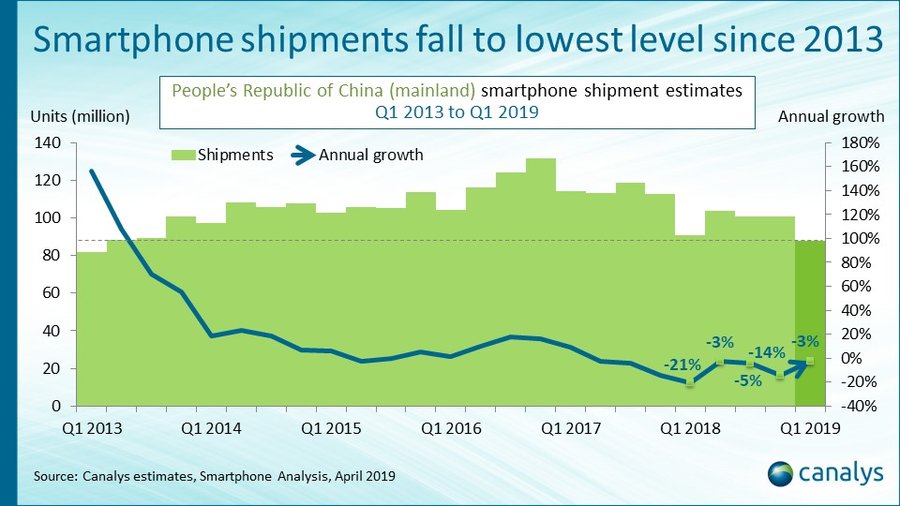
China’s smartphone market contracted 3% to 88.0m units in Q1 2019, making it the market’s worst performance since 2013. Market leader Huawei grew its share to a record 34%, up by more than 10% on the same period last year, making it the only vendor in the top five to report growth in an otherwise declining market. Huawei (including Honor) shipped just under 30m smartphones. It was followed by Oppo, Vivo, Xiaomi and Apple, which each suffered year-on-year declines.

…”Oppo and Vivo are both shifting their product strategies to refresh their brands,” said Canalys Research Analyst Yiting Guan. Vivo is going for a bigger product portfolio in China to cover a wider range of consumer demographics than before, and now offers seven product families. Oppo has put a strong emphasis on its new Reno series to renew its appeal in the mid-to-high-end segment. More interestingly, its RealMe spin-off has been brought from India to China to compete at the low end with Xiaomi and Huawei, including Honor.

Xiaomi recorded quarterly growth against its weak Q4 last year as it improved its channel inventory situation, but still suffered a year-on-year decline in both shipments and market share…Apple shipped 6.5m iPhones in the last quarter, suffering its worst decline in two years. “Despite the iPhone’s installed base in China being well over 300 million, it is vital that Apple prevents users deserting it for Android vendors. Apple faces a challenge in China to localize its software and services offerings as quickly as in Western markets,” said Jia.

«

unique link to this extract


Errata, corrigenda and ai no corrida: none notified