
Start Up No.1,036: the dinosaur proof, the birth control app, Google employees’ AI panel backlash, Apple News plus or minus?, and more


From this summer, you won’t have to put your laptop in here in a growing number of US airports. CC-licensed photo by Rakesh A on Flickr.

A selection of 10 links for you. Was your April Fool’s joke funny? I’m @charlesarthur on Twitter. Observations and links welcome.

The day the dinosaurs died • The New Yorker

Douglas Preston on a find – in south west North Dakota (try saying it out loud) – of fossils from the day when the asteroid struck and wiped out the dinosaurs:

»

[Robert] DePalma returned to do a preliminary excavation of the site. “Almost right away, I saw it was unusual,” he told me. He began shovelling off the layers of soil above where he’d found the fish. This “overburden” is typically material that was deposited long after the specimen lived; there’s little in it to interest a paleontologist, and it is usually discarded. But as soon as DePalma started digging he noticed grayish-white specks in the layers which looked like grains of sand but which, under a hand lens, proved to be tiny spheres and elongated droplets. “I think, Holy shit, these look like microtektites!” DePalma recalled. Micro tektites are the blobs of glass that form when molten rock is blasted into the air by an asteroid impact and falls back to Earth in a solidifying drizzle. The site appeared to contain micro tektites by the million.

As DePalma carefully excavated the upper layers, he began uncovering an extraordinary array of fossils, exceedingly delicate but marvellously well preserved. “There’s amazing plant material in there, all interlaced and interlocked,” he recalled. “There are logjams of wood, fish pressed against cypress- tree root bundles, tree trunks smeared with amber.” Most fossils end up being squashed flat by the pressure of the overlying stone, but here everything was three-dimensional, including the fish, having been encased in sediment all at once, which acted as a support. “You see skin, you see dorsal fins literally sticking straight up in the sediments, species new to science,” he said. As he dug, the momentousness of what he had come across slowly dawned on him. If the site was what he hoped, he had made the most important paleontological discovery of the new century.

«

The thought at the back of one’s mind is always what struck one of the first people to realise what wiped out the dinosaurs: one day, this could easily happen to us. A 300-metre object would end world agriculture.
unique link to this extract


Laptops to stay in bags as TSA brings new technology to airports • Bloomberg Government

:

»

Air passengers at a growing number of US airports will no longer need to remove electronics, liquids, and other items from their carry-on luggage at security checkpoints as the Transportation Security Administration rolls out new technology.

The TSA took a major step in a broader plan to revamp its overall screening process with faster, more advanced technology when it signed a contract Thursday for hundreds of new carry-on baggage screening machines, Administrator David Pekoske said on a press call Friday. The agency has tested the new technology at more than a dozen airports since 2017, along with the relaxed protocols that allow passengers to leave items such as laptops and toiletries inside their luggage.

The rollout of the computed tomography, or CT, machines will begin this summer, Pekoske said. The $97m contract will buy 300 machines, but the list of airports receiving them has yet to be made final, Pekoske said.

The technology creates 3-D images of bags’ contents and will eventually be able to detect items automatically that the TSA now asks passengers to remove, he said.

“It’s not a little bit better, it’s a lot better,” Pekoske said of the technology.

«

This is going to be introduced over the next eight years – so it’s going to be “do I need to..?” all over the place. By the time it’s everywhere, we’ll only notice the places where it’s slow.
unique link to this extract


It’s tough being the first birth control app • Bloomberg

Esmé Deprez:

»

[Elina] Berglund won’t divulge many details about [period-tracking/pregnancy likelihood predictor] Natural Cycles’ technology, lest competitors seek to copy it. But she does say it reliably predicts ovulation by taking into account a user’s menstruation dates, fluctuations in her body temperature, and data on the cycles of hundreds of thousands of women. It also adapts to each user: The app will err on the side of caution by showing additional red days when it doesn’t have enough information. The more data a user inputs, the more precise its red day-green day predictions become.

Clinical studies show Natural Cycles is 93% effective at preventing pregnancy with typical use, meaning that after a year, seven women out of 100 users will become pregnant. (With perfect use, Natural Cycles is 99% effective, according to its research.) That puts it about on par with hormonal birth control pills (91%) and beats condoms (82%) and the rhythm method (76%). But it’s less effective than long-acting reversible contraceptives such as intrauterine devices (almost 100%). Even though Natural Cycles wasn’t developed with proponents of so-called natural family planning methods such as the Catholic Church in mind, it’s won praise from those quarters because it isn’t “artificial” birth control that divorces sex from procreation.

«

However, it then ran slap bang into a PR crisis. Side note: Berglund was on the team at CERN which discovered the Higgs Boson. Now she’s cofounded an app which has several hundred thousand users paying $99 per year. That’s serious money.
unique link to this extract


Inside the Google employee backlash against the Heritage Foundation • The Verge

Colin Lecher:

»

“This group [of outside people chosen for Google’s external advisory board on AI] will consider some of Google’s most complex challenges that arise under our AI Principles, like facial recognition and fairness in machine learning, providing diverse perspectives to inform our work,” the company said in an announcement. The board, called the Advanced Technology External Advisory Council (ATEAC), included recognized experts in AI research who had worked in the field for years.

But some members of the new board drew immediate scrutiny, especially Kay Coles James, president of the conservative Heritage Foundation. On social media, some characterized the decision as an attempt to cater to conservatives at the expense of true expertise in the field. By Saturday, one AI expert who was invited to the board had dropped out, vaguely noting that it may not be “the right forum” for the work.

Privately, several Google employees were also livid about the decision to include James, according to sources familiar with the discussions. On internal message boards, employees described James as “intolerant” and the Heritage Foundation as “amazingly wrong” in their policies on topics like climate change, immigration, and, particularly, on issues of LGBTQ equality. A person with James’ views, the employees said, “doesn’t deserve a Google-legitimized platform, and certainly doesn’t belong in any conversation about how Google tech should be applied to the world.”

«

There’s also a Medium petition by Google employees. The Heritage Foundation is the sort of bonkers institution that could only grow up in the US. Why not ask a group that represents minorities or women, since they’ll be at far more risk from any inequity introduced by AI?
unique link to this extract


Apple News+ could lead to a massive value destruction for the magazine industry • Monday Note

Frederic Filloux:

»

To assess the impact of a fully deployed AppleNews+ I did the following calculation.
• In the United States, the magazine industry generates annual revenue of $27B, a loss of more than 40% in ten years.
• Divided by 225 million readers of magazines (according to the trade association), the Average Revenue per User (ARPU) amounts to $120 per reader and per year, all sources included.
• The revenue promised by Apple News+ is $9.9 a month => $119 a year. Minus Apple’s 50% cut, it gives a net income per reader of $59.
➜ By joining Apple News+, the US magazine industry will lose 50% of its revenue per reader.

Of course, we are talking of transfer here: magazine readers who will join Apple News+ will inevitably cancel their subscription to its preferred publication. (I will carefully review my personal subscription portfolio that amounts to $1500/year, although my most expensive subs — digital newspapers — won’t be in Apple News+, for a good reason)…

To put it differently, for each magazine reader switching to Apple News+, the platform would need to recruit one additional subscriber, only to preserve the size of the sector. The real uncertainty here is the ability of Apple to nearly double the number of people paying for a magazine in the United States where most subscriptions are already dirt cheap (only 13% of the magazines’ circulation revenue come from digital).

«

These are pretty brutal numbers, though I think there’s a counter-argument that each subscriber *is* a new subscriber; that most Apple News+ users will be those who haven’t previously subscribed, rather than “churners”.
unique link to this extract


“Are we at a party, or a wake?”: journalists wonder if Apple News+ is a trojan horse • Vanity Fair

Joe Pompeo:

»

[Rafat Ali commented of News+:] “They’ll just cherry pick what they want via News+, and Apple will shave off a few cents for the publisher while owning all the data, customer relationship and power.”

That would appear to be the primary concern of the two major News+ holdouts: The New York Times and The Washington Post. Apple badly wanted to lock down at least one of them, and it began a vigorous courtship of the papers last spring, not long after the Texture deal closed and Apple’s plans for its content bundle were beginning to materialize, according to people familiar with the matter. “They put a tremendous amount of pressure on,” one source said. “Eddy Cue was in and out of their offices really trying to woo them.” Cue’s elevator pitch, according to people familiar with the discussions, was, “We’ll make you the most-read newspaper in the world.”

In multiple meetings with top brass at both newspapers, Apple made it clear that they wanted the whole shebang, as opposed to a pared down offering or a specialized sliver of stories. “They didn’t want to have limitations in terms of content,” according to a person with knowledge of the talks. But Apple dangled flexible terms governing the duration after which they could pull out, as well as exclusivity. “You’d be protected against a competitor coming in,” the same source said. “If this thing was really successful and everyone else came back to the table, there was a period where you’d have exclusivity.”

But the Times and the Post couldn’t be swayed. Over the past several years, both publications have developed substantial digital subscription businesses that are now vital moneymakers, helping to offset the industry’s advertising collapse. Those businesses continue to grow, and the Times and the Post, put simply, want their own subscribers, not Apple’s subscribers—and they certainly don’t want Apple subscribers if Apple is going to keep a 50% cut of the revenues.

«

unique link to this extract


Huawei’s P30 Pro raises the bar for low-light photography • The Verge

Vlad Savov:

»

It will still be a few days before I can publish my full review of the P30 Pro, but I spent this past weekend comparing its camera against Google’s Pixel 3 and struggling to believe my eyes. The Pixel 3’s Night Sight mode is algorithmic magic, granting that camera something akin to superhuman night vision. It requires up to six seconds of exposure time, during which you have to hold the phone steady to obtain a sharp image. Huawei has a similar night mode, but I find that completely unnecessary with the P30 Pro: this camera shoots better low-light photos than Google Night Sight without the need for a long exposure.

Let’s dive into some examples. This first one includes the output from the default Google Pixel camera to give you an idea of what the human eye sees. It’s also an accurate representation of what you’ll be able to obtain using an iPhone without the help of either the flash or RAW image processing. Even adapted to the pre-sunrise darkness in the room, my eyes couldn’t discern any color. Google’s Night Sight image is the best, I’m confident in saying, that any smartphone before the P30 Pro could achieve in the circumstances. And the P30 Pro makes that shot look like a splotchy mess.

«

I’d love to know how Huawei is doing this; one would have thought that camera sensors were pretty much equal everywhere, and that Google was taking it further by its use of AI. But Huawei is pulling in photons that others lose. One for iFixit to answer, at least in part?

I was going to say that sometimes you want a night shot to look like a night shot, but of course you can just darken it in the edit.
unique link to this extract


Great Escape: travel inspiration by price

Rather neat: finds cheap flights from nearby you to various points around the world. The sort of thing that could be enjoyable around the Easter break. Apologies to Australians and New Zealanders, though then again you’ve already got it good.
unique link to this extract


Can we stop AI outsmarting humanity? • The Guardian

Mara Hvistendahl:

»

[Skype co-founder Jaan] Tallinn warns that any approach to AI safety will be hard to get right. If an AI is sufficiently smart, it might have a better understanding of the constraints than its creators do. Imagine, he said, “waking up in a prison built by a bunch of blind five-year-olds.” That is what it might be like for a super-intelligent AI that is confined by humans.

The theorist Yudkowsky found evidence this might be true when, starting in 2002, he conducted chat sessions in which he played the role of an AI enclosed in a box, while a rotation of other people played the gatekeeper tasked with keeping the AI in. Three out of five times, Yudkowsky – a mere mortal – says he convinced the gatekeeper to release him. His experiments have not discouraged researchers from trying to design a better box, however.

The researchers that Tallinn funds are pursuing a broad variety of strategies, from the practical to the seemingly far-fetched. Some theorise about boxing AI, either physically, by building an actual structure to contain it, or by programming in limits to what it can do. Others are trying to teach AI to adhere to human values. A few are working on a last-ditch off-switch. One researcher who is delving into all three is mathematician and philosopher Stuart Armstrong at Oxford University’s Future of Humanity Institute, which Tallinn calls “the most interesting place in the universe.” (Tallinn has given FHI more than $310,000.)

Armstrong is one of the few researchers in the world who focuses full-time on AI safety. When I met him for coffee in Oxford, he wore an unbuttoned rugby shirt and had the look of someone who spends his life behind a screen, with a pale face framed by a mess of sandy hair. He peppered his explanations with a disorienting mixture of popular-culture references and math. When I asked him what it might look like to succeed at AI safety, he said: “Have you seen the Lego movie? Everything is awesome.”

«

unique link to this extract


Why do we watch terrorist videos and what effect do they have on us? • New Statesman

Sophie McBain:

»

The University of California study identified several traits that were associated with being more likely to view the video: being male, Christian and unemployed, watching a lot of TV, having a pre-existing heightened fear of terrorism and having previously being exposed to violence (such as having been the victim of assault or domestic violence, or having lost a loved one to suicide or murder).

Crucially, they found that even two years after the beheading videos went viral, those who watched them were more fearful of future events, including potential terrorist attacks. In this way then, when large numbers of people watch terrorist videos it helps further militants’ central aim: to spread terror.

Authoritarian regimes have long understood that public executions are an effective form of social control because they spread fear, terrorist groups such as Isis have learned that you don’t necessarily have to force people to witness such atrocities – many of us will seek them out.

Sarah Redmond, one of the authors of the report and a PhD student at the University of California, acknowledged that a different demographic might be attracted to graphic footage posted by far-right terrorists, and that we can’t confidently extrapolate much information from the Isis study about the types of people most likely to watch the mosque attacks online. But the study does underline why it’s crucial for internet companies to develop effective ways to block content posted by terrorist groups, or else risk aiding militants.

It also offers lessons for the media: the authors suggest that by publishing screen shots of the beheading and warning that the footage was too graphic to share, the media inadvertently stoked interest in the original footage, the horrifying images working in the manner of a film trailer

«

unique link to this extract


Errata, corrigenda and ai no corrida: none notified

You can sign up to receive each day’s Start Up post by email. You’ll need to click a confirmation link, so no spam.

Start Up No.1,035: YouTube on radicalisation, is Trump a golf cheat?, AirPower crash-lands, Sandy Hook hoaxers, and more


Chimpanzees’ propensity for murderous violence is quite unlike humans’. CC-licensed photo by Aaron Logan on Flickr.

You can sign up to receive each day’s Start Up post by email. You’ll need to click a confirmation link, so no spam.

A selection of 13 links for you. Contains no April Fool’s jokes, and by the end of today you’ll probably be glad of that. I’m @charlesarthur on Twitter. Observations and links welcome.

YouTube’s product chief on online radicalization and algorithmic rabbit holes • The New York Times

Kevin Roose talks to Neal Mohan:

»

KR: I hear a lot about the “rabbit hole” effect, where you start watching one video and you get nudged with recommendations toward a slightly more sort of extreme video, and so on, and all of a sudden you’re watching something really extreme. Is that a real phenomenon?

NM: Yeah, so I’ve heard this before, and I think that there are some myths that go into that description that I think it would be useful for me to debunk.

The first is this notion that it’s somehow in our interests for the recommendations to shift people in this direction because it boosts watch time or what have you. I can say categorically that’s not the way that our recommendation systems are designed. Watch time is one signal that they use, but they use a number of other engagement and satisfaction signals from the user. It is not the case that “extreme” content drives a higher version of engagement or watch time than content of other types.

I can also say that it’s not in our business interest to promote any of this sort of content. It’s not something that has a disproportionate effect in terms of watch time. Just as importantly, the watch time that it does generate doesn’t monetize, because advertisers many times don’t want to be associated with this sort of content.

And so the idea that it has anything to do with our business interests, I think it’s just purely a myth.

KR: So, why do people talk about this rabbit hole effect — you know, I went to watch one video about President Trump and now I’m just getting a stream of recommendations of increasingly more partisan content. Why do you think there’s this perception that this is what happens on YouTube?

This is one of the things that we looked at closely as we were developing the technology that went into that recommendation change that I described to you from a few weeks back.

We really looked at this to see what was happening on those “watch next” panels, in terms of the videos that were being recommended. And the first thing that I should say is that when we make recommendations after a video has been consumed, we don’t take into account any notion of whether that’s less or more extreme.

«

Well, duh. Mohan dances around this, unconvincingly. It’s clearly on his radar, but clearly also he doesn’t know how to solve it (yet?), and also doesn’t want to admit it.
unique link to this extract


Trump is world’s worst cheater at golf: book • NY Post

Gavin Newsham:

»

“To say ‘Donald Trump cheats’ is like saying ‘Michael Phelps swims,’” writes Rick Reilly in the new book “Commander in Cheat: How Golf Explains Trump” (Hachette Book Group), out Tuesday. “He cheats at the highest level. He cheats when people are watching and he cheats when they aren’t. He cheats whether you like it or not. He cheats because that’s how he plays golf … if you’re playing golf with him, he’s going to cheat.”

Reilly, a former Sports Illustrated columnist who has played with Trump in the past, spoke to dozens of players — both amateur and professional — to recount some of the president’s worst cons on the course, starting with his declared handicap of 2.8.

In layman’s terms, the lower the handicap, the better the player. Jack Nicklaus, winner of a record 18 major golf titles and generally considered the greatest golfer in the history of the game, has a handicap of 3.4. Nicklaus’ handicap is listed on the same Golf Handicap and Information Network website used by Trump, where players post their scores.

“If Trump is a 2.8,” writes Reilly, “Queen Elizabeth is a pole vaulter.”

Shortly after he became president, Trump played with Tiger Woods, the current world No. 1 Dustin Johnson and the veteran PGA Tour pro Brad Faxon. Given the quality and profile of his companions, you might have thought Trump would have been on his best behavior. Not so.

On one hole, Trump dunked a shot into the lake, but as his opponents weren’t looking he simply dropped another ball — and then hit that into the water, too.

“So he drives up and drops where he should’ve dropped the first time and hits it on the green,” recalls Faxon.

«

I guess we shouldn’t be surprised, but I had honestly thought this was one area where he had ability, and would respect the rul… OK, I see the mistake. And do read the piece for its last line.
unique link to this extract


Portable TV and music • AVC

Fred Wilson:

»

That is an AppleTV and a Sonos Connect in between my “shaving kit” and my sneakers.

I brought these two devices out west and connected the AppleTV to the one TV in the Airbnb and I connected the Sonos to the receiver that powered the in ceiling speakers in the main living space in the house.

Even if the Airbnb had come with an AppleTV and a Sonos device, I would have swapped out theirs for ours for the length of our stay because these two devices have all of our services pre-confgured on them and we are logged into all of the services.

That is where the big difference is for me and the reason it is worth schlepping these devices cross country and back. The devices aren’t crazy expensive. The AppleTV is around $150 and the Sonos Connect is around $300. But setting these devices up, connecting them to all of the various services we subscribe to, and logging into each and every one can be an hour or more of work each time you do it.

All I had to do was power them up, connect to Wi-Fi, and connect to the TV and/or the receiver, and we were good to go.

«

Hadn’t thought about the logging-in nature of this, but it’s completely true. If, that is, you spend any time travelling. Might pack a HomePod in there too, for the sound quality.
unique link to this extract


‘Those who obeyed the rules were favoured by evolution’ • SPIEGEL ONLINE

SPIEGEL ONLINE, Hamburg, Germany:

»

DER SPIEGEL: If it wasn’t women, who tamed men?

Richard Wrangham [a British anthropologist who has worked with Jane Goodall]: Here we enter the terrain of speculation, because fossils don’t tell us exactly what happened. What we have to do instead is to see how today’s hunters and gatherers treat individuals that behave aggressively. There are, in fact, even in these generally peaceable peoples, some individuals who, like alpha chimpanzees, try to dominate the others by violence. How do the members of such a community react – without prisons, without military, without police? There is only one way for them to defend themselves against the determined perpetrator: He is executed. The killing is done by agreement among the other men in the society.

DER SPIEGEL: You argue that this is how aggressiveness was systematically eradicated from the gene pool of mankind?

Wrangham: Well yes, aggressiveness was reduced, even if it was not eradicated. Virtue seems to have evolved from something as violent as killing. But don’t misunderstand. I am not advocating executions in today’s world. Justice is fallible, so the death penalty inevitably leads to the killing of innocent people; furthermore, there is no evidence that it really effectively deters people from committing crimes.

DER SPIEGEL: It is quite a daring hypothesis to argue that the death penalty has made us what we are. How did you come up with it?

Wrangham: It was when I read a book by Christopher Boehm entitled “Hierarchy in the Forest”. In this book, he describes how aggression in communities of hunters and gatherers is controlled by executions. My goodness, I thought when I read this, maybe this mechanism has even shaped our evolution?

«

A really fascinating interview; you think humans are violent, but it turns out we really aren’t, compared to pretty much everything else. Or at least not actively so. Passively, we’re terrific at wiping out species.
unique link to this extract


AirPower fail: The latest victim of Apple’s OCD • ZDNet

Jason Perlow:

»

Allegedly, based on conceptual patent filings, the AirPower was able to achieve this flexible orientation wireless charging by having many 3D coils in extremely close proximity to each other – which also required extremely complex power management in order to prevent the coils from generating excessive heat and to mitigate the generation of overlapping harmonic frequencies between the coils.

As it is, Apple’s own Qi implementation runs at a lower 7.5W rather than the maximum 10W and 15W of its Android competitors, reportedly because the newer generation iPhones with wireless charging capability got way too hot at those increased power levels.

Ultimately, I believe Apple did the right thing. Can you imagine the potential “PowerGate” of cooked iPhones, Watches and AirPods? It’s far less egg on Apple’s face to cancel the product outright than to release a dangerous dud.

Apple very rarely cancels products outright after announcing them. The last time it did this was in August of 1996, when it decided to cancel its Copland OS, which proved too difficult a project for the company. It eventually ended up migrating to Mac OS X, which is heavily based on NeXT’s (and Steve Jobs’) BSD UNIX OpenStep object-oriented graphical OS instead.

The public cancellation of AirPower is a huge embarrassment for Apple. But given the company’s obsession with bleeding edge engineering and its compulsion for thinner, lighter, faster, more densely packed and difficult-to-repair products, such an embarrassment was inevitable.

«

*mumbles something about cancelling butterfly keyboards before they get out of the gate*
unique link to this extract


The death of Apple’s AirPower’ may be the best thing for you and your iPhone • CNet

Jessica Dolcourt:

»

we’d never seen AirPower in action beyond the video in Apple’s initial presentation. By postponing and then finally squashing it, Apple may have saved iPhone users – and its own reputation – from a poorly working product. Imagine your disappointment and anger if you bought AirPower and it never functioned smoothly.

AirPower could have also been costly. Apple never announced pricing, but an optional wireless charging case for the new generation of AirPods costs $80, and that’s to power up one device, not communicate with three. AirPower could have easily sold for $150. Meanwhile, plenty of other wireless charging pads sell for $30 or less.

Apple’s abdication of AirPower doesn’t mean it’s done with wireless charging. For all we know, it could have killed its darling to start work on a new wireless charging project for 2019 or 2020; maybe one – and this is pure speculation – that would also work with a foldable iPhone.

It’s not beyond the realm of possibility that Samsung’s Galaxy S10 phones and Huawei’s P30 Pro have inspired Apple to give its next iPhone or MacBook Air the ability to wirelessly charge other devices.

AirPower may have withered on the vine, but I’m confident that Apple isn’t done with wireless charging yet. That’s clear by the tech giant’s continued investment in the feature for its iPhone and accessories. Consider this: we know that the first smartphone is slated to get over-the-air wireless charging in the near future. There’s no way Apple would miss out on a groundbreaking development like that.

«

Nothing to do with foldable phones; and wirelessly charging other devices is not a functionality that I feel any need to have, ever. AirPower was just too difficult an engineering challenge: the risk was the thing would overheat something or other, because the batteries (AirPods, Watch, iPhone) are so different in their demands.
unique link to this extract


Why bother with What Three Words? • Terence Eden’s Blog

The aforesaid Eden has some problems with the system that’s meant to make your life easier:

»

W3W splits the world into a grid, and gives every square a unique three-word phrase. So the location 51.50799,-0.12803 becomes ///mile.crazy.shade

Brilliant, right?

No. Here’s all the problems I have with W3W.

1) It isn’t open
The algorithm used to generate the words is proprietary. You are not allowed to see it. You cannot find out your location without asking W3W for permission. If you want permission, you have to agree to some pretty long terms and conditions. And understand their privacy policy. Oh, and an API agreement. And then make sure you don’t infringe their patents. You cannot store locations. You have to let them analyse the locations you look up. Want to use more than 10,000 addresses? Contact them for prices! It is the antithesis of open.

2) Cost
W3W refuses to publish their prices. You have to contact their sales team if you want to know what it will cost your organisation. Open standards are free to use.

3) Earthquakes
When an earthquake struck Japan, street addresses didn’t change but that their physical location did.

That is, a street address is still 42 Acacia Avenue – but the Longitude and Latitude has changed.
Perhaps you think this is an edge case? It isn’t. Australia is drifting so fast that GPS can’t keep up.
How does W3W deal with this? Their grid is static, so any tectonic activity means your W3W changes.

«

There’s also a few others – the internationalisation one is pretty big. I still don’t see it getting traction; we just send each other location blobs these days, and Google Maps is pretty much universal.
unique link to this extract


The Sandy Hook hoax, and the parent who believed in conspiracy theories – until his child died there • NY Mag

Reeves Wiedeman:

»

Lenny [Pozner] may have been the first Newtown parent to discover that conspiracy theorists didn’t believe his son had been killed, because he used to be a serious conspiracy theorist himself. “I probably listened to an Alex Jones podcast after I dropped the kids off at school that morning,” Pozner said, referencing the fearmongering proprietor of InfoWars. Pozner had entertained everything from specific cover-ups (the moon landing was faked) to geopolitical intrigue (the “real” reasons why the price of gold sometimes shifted so dramatically) and saw value in skepticism. But for him, the appeal of conspiracy theories was the same as watching a good science-fiction movie. “I have an imaginative mind,” he said.

When he first discovered the theories about Noah, Lenny, who grew up in Brooklyn, made only a halfhearted attempt to respond. “I feel that your type of show created these hateful people,” Pozner wrote in an email to Alex Jones, to which one of Jones’s employees replied that Jones would love to speak to him if “we confirm that you are the real Lenny Pozner.” Pozner declined, in part because he found himself unable to do much of anything.

While Noah’s death had given [his wife] Veronique a mission [advocating gun control], Lenny “was just numb,” he said. Lenny had worked for two decades as an IT consultant but now found the crisis management that the job required to be too overwhelming. In the year after Noah’s death, Lenny’s mother died following a battle with Alzheimer’s, and he and Veronique separated. “People tell me it’s supposed to get easier,” Lenny said at the shooting’s first anniversary. “We’re waiting for that to happen.”

But by the spring of 2014, as he watched the hoaxer movement bloom, Pozner decided to try fighting back. He released Noah’s death certificate, to convince those who believed he had not been killed, and his report card — “Noah is a bright, inquisitive boy” — for those who believed he had never lived at all. One Friday night, a year and a half after the shooting, he joined a Facebook group called Sandy Hook Hoax, one of the more prominent hoaxer meeting grounds. (Its logo features a ghostly child holding an index finger to her mouth.) Pozner told the group he was there to answer questions, and he expressed empathy for their mind-set. “I used to argue with people about 9/11 being an inside job,” he wrote.

«

Eye-opening piece.
unique link to this extract


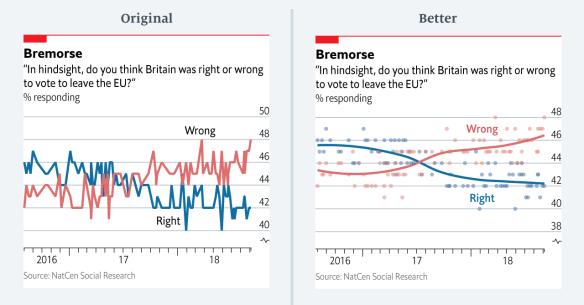
Mistakes, we’ve drawn a few • The Economist

Sarah Leo:

»

At The Economist, we take data visualisation seriously. Every week we publish around 40 charts across print, the website and our apps. With every single one, we try our best to visualise the numbers accurately and in a way that best supports the story. But sometimes we get it wrong. We can do better in future if we learn from our mistakes — and other people may be able to learn from them, too.

After a deep dive into our archive, I found several instructive examples. I grouped our crimes against data visualisation into three categories: charts that are (1) misleading, (2) confusing and (3) failing to make a point. For each, I suggest an improved version that requires a similar amount of space — an important consideration when drawing charts to be published in print.

«

This is good to see being done. I like this one best:

And its advice: “aim for leaving at least 33% of the plot area free under a line chart that doesn’t start at zero.”
unique link to this extract


Jeff Bezos’ investigator Gavin de Becker finds the Saudis obtained the Amazon chief’s private data • Daily Beast

De Becker points out that the Daily Beast wanted him and Bezos to sign a document saying there hadn’t been any electronic surveillance – before they’d suggested there had:

»

As has been reported elsewhere, my results have been turned over to federal officials. Since it is now out of my hands, I intend today’s writing to be my last public statement on the matter. Further, to respect officials pursuing this case, I won’t disclose details from our investigation. I am, however, comfortable confirming one key fact:

Our investigators and several experts concluded with high confidence that the Saudis had access to Bezos’ phone, and gained private information. As of today, it is unclear to what degree, if any, AMI was aware of the details.

We did not reach our conclusions lightly. The inquiry included a broad array of resources: investigative interviews with current and former AMI executives and sources, extensive discussions with top Middle East experts in the intelligence community, leading cyber security experts who have tracked Saudi spyware, discussions with current and former advisers to President Trump, Saudi whistleblowers, people who personally know the Saudi Crown Prince Mohammad bin Salman (also known as MBS), people who work with his close associate Saud al-Qahtani, Saudi dissidents, and other targets of Saudi action, including writer/activist Iyad el-Baghdadi.

Experts with whom we consulted confirmed New York Times reports on the Saudi capability to “collect vast amounts of previously inaccessible data from smartphones in the air without leaving a trace—including phone calls, texts, emails”—and confirmed that hacking was a key part of the Saudi’s “extensive surveillance efforts that ultimately led to the killing of [Washington Post] journalist Jamal Khashoggi.”

«

He doesn’t provide any of that evidence, though. Little tricky to put all one’s faith in that.
unique link to this extract


Government delays controversial internet porn ‘block’ law • Sky News

Lucy Cotter:

»

The government’s much heralded porn “block” has been delayed once again.

Under the controversial plans, people will have to verify their age to access UK commercial pornographic websites in a bid to stop children accessing the content.

The legislation, which was passed as part of the 2017 Digital Economy Act, was initially expected to be in place by April 2018. After being delayed last year, the minister for the department of digital, culture, media and sport, Margot James, told MPs: “We expect it to be in force by Easter of next year”.

However, the department said a date has not been set for the roll-out of the policy. “This work is a world-leading step forward to protect our children from adult content which is currently far too easy to access online,” it said. “We are taking the time to get the implementation of this policy right and to ensure it is effective, and we will announce a commencement date shortly”.

Jim Killock from the Open Rights Group says the delays are due to serious concerns about privacy and data collection.

«

Yeaahh they’ve delayed it because they’re not going to get it through Parliament before the general election that without a doubt is coming as soon either as May’s Withdrawal Agreement gets Parliamentary approval, or the WA is finally drowned in a sack. (The latter would be worse, since it implies a no-deal exit.) It will then take at least another year before a new government gets round to implementing it – if it wants to follow on.
unique link to this extract


Sony to slash smartphone workforce 50% by 2020 • Nikkei Asian Review

Akihide Anzai and Wataru Suzuki:

»

The decision to scale back its smartphone workforce, which could see up to 2,000 of the total 4,000 jobs cut by March 2020, is part of a move to reduce fixed costs in the business, and also includes procurement reform.

Some of the Japanese employees affected by the decision will be transferred to other divisions, but the company will offer voluntary retirement in its Europe and China operations.

Sony will limit smartphone sales in Southeast Asia and other areas to focus on Europe and East Asia.

The company’s smartphone sales for fiscal 2018 are projected to come in at a dismal 6.5m units, half the previous year’s figure and just one-sixth that of five years ago.

In fiscal 2014, Sony pulled 1,000 employees from its smartphone operations, but sales have plunged faster than expected, necessitating a further round of cuts.

Sony’s smartphone business generates annual revenue of about 500bn yen, but is expected to post an operating loss for the third straight year through fiscal 2019. By halving operating expenses from fiscal 2017, the company hopes the business will turn a profit by fiscal 2020.

«

So when I wondered about the magical thinking protecting jobs, I guess I wasn’t accounting for the senior management who can spot it where they see it.

The mobile division is going to be on a one-way ride to the mountains pretty soon.
unique link to this extract


Asus was warned of hacking risks months ago, thanks to leaky passwords • TechCrunch

Zack Whittaker:

»

A security researcher warned Asus two months ago that employees were improperly publishing passwords in their GitHub repositories that could be used to access the company’s corporate network.

One password, found in an employee repo on the code sharing, allowed the researcher to access an email account used by internal developers and engineers to share nightly builds of apps, drivers and tools to computer owners. The repo in question was owned by an Asus engineer who left the email account’s passwords publicly exposed for at least a year. The repo has since been wiped clean, though the GitHub account still exists.

“It was a daily release mailbox where automated builds were sent,” said the researcher, who goes by the online handle SchizoDuckie, in a message to TechCrunch. Emails in the mailbox contained the exact internal network path where drivers and files were stored…

…The researcher’s findings would not have stopped the hackers who targeted Asus’ software update tool with a backdoor, revealed this week, but reveals a glaring security lapse that could have put the company at risk from similar or other attacks. Security firm Kaspersky warned Asus on January 31 — just a day before the researcher’s own disclosure on February 1 — that hackers had installed a backdoor in the company’s Asus Live Update app.

«

That’s two strikes against Asus; not looking good. Security is hard, especially when you do it badly.
unique link to this extract


Errata, corrigenda and ai no corrida: none notified