Start Up No.959: US v Huawei, ranking Gmail’s answers, Wikitribune in view, the art of The Incredibles 2, Square Enix dumps loot boxes in Belgium, and more


Guess which top-selling band has the most repetitive lyrics of the past 50 years. CC-licensed photo by Andreas H on Flickr.

You can sign up to receive each day’s Start Up post by email. You’ll need to click a confirmation link, so no spam.

A selection of 11 links for you. Turkey sandwiches OK? I’m @charlesarthur on Twitter. Observations and links welcome.

Washington asks allies to drop Huawei • WSJ

Stu Woo and Kate O’Keeffe:

»

The US government has initiated an extraordinary outreach campaign to foreign allies, trying to persuade wireless and internet providers in these countries to avoid telecommunications equipment from China’s Huawei Technologies Co., according to people familiar with the situation.

American officials have briefed their government counterparts and telecom executives in friendly countries where Huawei equipment is already in wide use, including Germany, Italy and Japan, about what they see as cybersecurity risks, these people said. The US is also considering increasing financial aid for telecommunications development in countries that shun Chinese-made equipment, some of these people say.

One US concern centers on the use of Chinese telecom equipment in countries that host American military bases, according to people familiar with the matter, such as Germany, Italy and Japan. The Defense Department has its own satellite-and-telecom network for especially sensitive communications, but most traffic at many military installations travels through commercial networks.

The international effort pushes out the battle lines of a US campaign to keep Huawei electronics out of the US. Some officials see the initiative as part of a broader technological Cold War between US-led allies and China for control of a world that is increasingly digitally connected—and thus increasingly vulnerable to surveillance and malfeasance.

«

Wow. Huawei is deeply embedded in the UK’s communications network, and an analyst meeting this week heard that it’s the only company really doing 5G – everyone else is trying to catch up.

This story makes me think that Bloomberg’s story a little while back – about Apple and Amazon having subversive chips inserted in Chinese factories – was part of a US attempt to destabilise trust in Chinese factories and manufacturers.
link to this extract


Ranking Gmail’s AI-fuelled Smart Replies • NY Mag

Christopher Bonanos:

»

The most recognizable feature of Gmail’s newly rolled-out redesign is the so-called smart reply, wherein bots offer three one-click responses to each mail message. Say your email contains the words “you free for lunch?” The autoreplies Gmail presents will be something like “Sure!” and “Yes!” and “Looking forward to it!” The idea, especially on a small, one-hand phone screen, is that you can tap and send using one thumb, without typing. It’s not clear just how many of these prewritten options there are, or how sophisticated the machine learning behind them is. The AI is not yet sharp enough to offer genuinely useful responses like “Please, for the love of Christ, stop sending me these offers to buy those sandals whose ad I clicked on last month” or emotionally honest ones like “Hey, it would be wonderful if someone in our group cancels our drinks tonight because I would rather stay home and order dan dan noodles while watching Succession.” Until then, we’re stuck with the few dozen simple responses that appear regularly. Some are better than others. Shall we rank? 

«

≥ Ok, sounds good! ≤
≥ We should rethink this ≤
≥ I can see everything you type you know ≤

But the idea that the answers might change over time is rather interesting.
link to this extract


Wikipedia’s co-founder wanted to let readers edit the news. What went wrong? • Columbia Journalism Review

Mathew Ingram on the site which burnt through about $0.6m in a year:

»

Is it possible that news just isn’t a great fit for the wiki model where anyone can contribute? “That’s a legitimate question—is it suitable?” [Jimmy] Wales says. “Clearly there are certain types of news that are very difficult to do in a community setting, if you have to go somewhere to report and so on, but there are other things that are quite straightforward. People can do desk research, but they can’t drop everything and pursue the story for four days or be on the scene the way a reporter can. So we’re still exploring what are the things that work.”

So are more people using the site and contributing to the news since the most recent design changes? Wales says yes, although he wouldn’t provide specific numbers. “The main metrics are participation, that’s fundamental,” he says. “And the number of people editing things is up this month and up considerably from our redesign.”

Wales says he is still going through the site looking for language that might be intimidating. For example, he says he has made multiple changes to the introductory post on “How to write a piece of journalism for WikiTribune.” (The changes can be seen on the piece’s history page, which keeps track of every edit). Among other things, Wales removed references to things like “getting your copy out faster,” which is something traditional journalists think about, but not relevant to a wiki approach to the news, he says.

«

The real question is, what *is* a wiki approach to the news? How does that really work? Wikipedia does it effectively, but that’s almost an accident; Wikitribune doesn’t have a critical mass of users to make it happen.

link to this extract


Are Pop Lyrics Getting More Repetitive?

»

In 1977, the great computer scientist Donald Knuth published a paper called The Complexity of Songs, which is basically one long joke about the repetitive lyrics of newfangled music (example quote: “the advent of modern drugs has led to demands for still less memory, and the ultimate improvement of Theorem 1 has consequently just been announced”).

I’m going to try to test this hypothesis with data. I’ll be analyzing the repetitiveness of a dataset of 15,000 songs that charted on the Billboard Hot 100 between 1958 and 2017…

«

But how?

»

You may not have heard of the Lempel-Ziv algorithm, but you probably use it every day. It’s a lossless compression algorithm that powers gifs, pngs, and most archive formats (zip, gzip, rar…).

What does this have to do with pop music? The Lempel-Ziv algorithm works by exploiting repeated sequences. How efficiently LZ can compress a text is directly related to the number and length of the repeated sections in that text.

«

This is wonderful: the graphics are brilliantly done, and the discoveries (top 10 songs are always more repetitive than most) unexpected.
link to this extract


The graphic art of Incredibles 2 • Josh Holtsclaw

»

I remember seeing the first Incredibles film in college with a few friends. We went on opening night and the theater was packed. I remember thinking that the way the movie opened with the old film footage of a younger Mr Incredible, Elastigirl and Frozone being interviewed was such a different way to open an animated film, and it just got better from there. The whole thing was so stylized and just…cool. I loved the mid century aesthetic. When I got to Pixar and heard that they were working on a sequel, I knew I wanted to be a part of it.

I joined the Incredibles 2 art department in the Fall of 2016 and one of the first things we did as a group was take a research trip to Palm Springs. At the time, the story was still in its early stages and a few of the sets were under way. There was still a lot left to do and Palm Springs was the perfect one-stop-spot for us to find design inspiration.

«

The photos of locations used to inspire the pictures, and the description of how The Incredibles aesthetic was created, is just… incredible.
link to this extract


After 20,000 workers walked out, Google said it got the message. The workers disagree • Recode

Shirin Ghaffary and Eric Johnson:

»

[Stephanie] Parker, a policy specialist at YouTube, initially read a prepared statement to her San Bruno, Calif., colleagues during the walkout, but then asked them a question she hadn’t written down. Where, she asked, did Google get the tens of millions of dollars it paid to Rubin and other senior executives accused of sexual misconduct?

“They got it from every time you worked late,” Parker said. “Every promotion you didn’t get because they said there’s not enough budget, you have to wait. It’s from every contractor who came to work sick because they have no paid time off. These are conscious decisions that the company is making, and abusers are getting rich off of our hard work.”

And the walkouts, the organizers agreed, have in some cases turned strangers into allies. People who had been raising red flags for years and felt they weren’t being heard suddenly realized that they were not the only ones who thought Google wasn’t hearing what it needed to hear.

“We’re giving our feedback about what’s wrong through all of the official channels,” Parker said. “We’re filling out the surveys every year. We are talking back in TGIF [all hands meetings] and asking these questions, and nothing is happening. But once we begin to find each other, and see each other all speaking out and all saying, fundamentally, the same thing, then the fear starts to go away. Once we start taking collective action, then we can’t be stopped.”

«

There’s a subtle dislocation happening at Google and Facebook – and others? – where the rank-and-file are disconcerted by things that the senior managers and/or founders aren’t aware of. How big can the disconnect get?
link to this extract


Square Enix pulls three games from Belgium after loot box ban • The Guardian

Alex Hern:

»

The games publisher Square Enix is pulling three mobile games from Belgium following the introduction of a law in the European nation that bans “loot boxes” as a form of gambling.

The games – Mobius Final Fantasy, Kingdom Hearts Union X and Dissidia Final Fantasy Opera Omnia – are some of largest titles in the publisher’s mobile roster, although it is better known for its console games such as Tomb Raider, Final Fantasy and Hitman.

In statements posted in the games, Square Enix confirmed that the new law was to blame for their removal, citing “the present uncertain legal status of ‘loot boxes’ under Belgian law” in a statement posted on the games.

Belgium first took action against “loot boxes”, digital reward packs which can be be bought with real or virtual money and contain a semi-random array of in-game items, back in April. The country’s gaming commission ruled that the mechanics, as implemented in three popular games – Overwatch, Fifa 18 and Counter-Strike: Global Offensive – were in violation of gambling legislation.

“Mixing games and gambling, especially at a young age, is dangerous for mental health,” the country’s justice minister, Koen Geens, said at the time. “That is why we must also ensure that children and adults are not confronted with games of chance when they are looking for fun in a video game.”

Other games have been similarly hit by the law, with the developers of popular online RPG Guild Wars 2 removing real-money purchases from the game back in September. But the economics of free-to-play mobile games, such as those pulled by Square Enix, means that they often feature no monetisation elements beyond loot boxes, leaving little reason for publishers to support them in the absence of the pseudo-gambling feature.

«

Good. Loot boxes are really insidious.
link to this extract


How Facebook’s PR firm brought political trickery to tech • The New York Times

Jack Nicas:

»

Definers quickly found plenty of business, from start-ups like Lyft, Lime and Juul to giants like Facebook and Qualcomm, the influential chip company that was in a nasty legal fight with Apple over royalties, according to five people with direct knowledge of Mr. Miller’s work who declined to be named because of confidentiality agreements.
While working for Qualcomm, Definers pushed the idea that Apple’s chief executive, Timothy D. Cook, was a viable presidential candidate in 2020, according to a former Definers employee and digital records. Presumably, it was an attempt to chill the cordial relations that Mr. Cook had cultivated with the Trump administration.

The campaign by Definers signaled an escalation of Silicon Valley’s already brass-knuckled approach to public relations.

“This type of dirty P.R.? It’s always been there, but it’s definitely on the upswing,” said Jonathan Hirshon, who was a public relations representative for technology companies for three decades, including Apple and Sony. “The idealism is still there, but the truth is, the big companies have become a lot more authoritarian in their approach to the media.”

Facebook fired Definers last week after The New York Times detailed the work Mr. Miller’s firm had done on behalf of the social media company. Definers encouraged reporters to write about the financial connections between anti-Facebook activists and the liberal financier George Soros, drawing accusations that it was relying on anti-Semitic tropes.

Definers’s strategy played to a target’s pressure points. Most of what Definers produced for Qualcomm had nothing to do with its beef with Apple, which was a complex legal fight over the royalties Apple should pay for the Qualcomm chips it was using in iPhones.

Definers employees distributed anti-Apple research to reporters and would not say who was paying for it. Definers distributed a 13-page memo titled “Apple Bowing to Chinese Cyber Regulators” that detailed how Apple’s activity in China contradicted its public stance on privacy elsewhere. It also planted dozens of negative articles about Apple on conservative news sites, according to a person familiar with the work and emails reviewed by The New York Times.

«

Facebook coughed to all this in a news dump at 5pm before the US headed off for Thanksgiving. Talk about taking out the trash.
link to this extract


Google rivals claim product search remains unfair • BBC News

»

Google is not complying with European demands that it make the search for products fairer, rivals say.

In an open letter to the EU’s competition commissioner, 14 European shopping comparison services said the measures put in place by the search giant to improve things, actually make matters worse.

They urged the commission to demand a new remedy.

Google said it had complied with the European Commission demands.

The search giant has faced a seven-year long battle with the European Commission over its dominance in the search market.

In June 2017, European competition commissioner Margrethe Vestager ruled that Google had abused its power by promoting its own shopping service at the top of search results, and demanded that it provide equal treatment to rival comparison sites in future.

She issued a record fine of €2.42bn ($2.7bn; £2.1bn) – the largest penalty the European Commission has ever imposed. She also demanded that Google end its anti-competitive practices within 90 days or face further costs.

Google is still appealing against the fine, but has come up with a system that it says makes shopping fairer.

It changed the shopping box, which is displayed at the top of search results, so that it is no longer populated with just Google Shopping ad results, but gives space to other shopping comparison services, who can bid for advertising slots.

«

The Google “solution” is unsatisfactory in so many ways, as the letter sets out. Its market dominance in Europe shuts out others; this “solution” just lets it charge them a door fee to reach people, instead of competing equally.
link to this extract


Leaning tower of Pisa is leaning less than before, say experts • The Guardian

Angela Giuffrida:

»

Stabilisation work means the Leaning Tower of Pisa is leaning slightly less than it used to, experts have said.

The tower, which has leaned to one side ever since it began to take shape in 1173, has lost 4cm of its tilt over the past two decades, according to a report from the surveillance group that meets every three months to give updates on the monument’s condition.

“Since restorative work began, the tower is leaning about half a degree less,” said Nunziante Squeglia, a geotechnics professor at the University of Pisa who works with the group. “But what counts is the stability of the tower, which is better than initially predicted.”

The structure, which was badly damaged during the second world war, was closed to the public in 1990 over safety fears and did not reopen for 11 years.

The surveillance group was set up in 2001 ago after Michele Jamiolkowski, an engineer of Polish origin, coordinated an international committee to save the landmark.

The bell tower, a symbol of the power of the maritime republic of Pisa in the Middle Ages, was defective from the beginning due to the porous clay soil beneath its foundations. After three floors were completed, construction stopped and did not resume until 90 years later when workers started building additional floors on a diagonal to offset the lean. But work was again disrupted before finally being completed in 1372.

«

I went up that thing in the 1980s. It’s fine when you’re on the “front”, with the tilt behind you. But when you’re on the down-tilt side, with only a thin metal rail between you and eternity, those few degrees feel like an invitation to gravity to eat you up.
link to this extract


Real time economics: what are markets telling us about the economy? • Wall Street Journal

Greg Ip:

»

The US economy is firing on all cylinders—job growth is strong, wages are climbing, factories are humming and inflation is on target. Yet stocks are sinking, yields on corporate bonds are rising and commodity prices are tumbling, all typical precursors of a slowdown or recession. The causes: Growth outside the US is deteriorating and the Federal Reserve is steadily withdrawing the unprecedented monetary stimulus that buoyed the economy and almost every asset class over the last decade.

The question is whether markets, in adjusting to these new realities, will overreact to the point that they endanger the expansion, on track to become the longest ever next summer. The answer for now appears to be no, but the trends are troubling.

Stan Druckenmiller is a legend among hedge fund managers, as lieutenant to George Soros and head of his own firm. The market has him worried. “The defensive stocks have been going straight up since May. All the economically sensitive stocks have been going down since May. They’re predicting we’re in a very, very late cycle,” he said Tuesday. The signs are the “same stuff I screamed about in 2007.” He’s not saying the Fed shouldn’t tighten, ever; but it should wait, and “see what happens.” The time to tighten was a few years ago; now, it’s more dangerous: “The leveraged loan market is two times what it was in 2007.” He pins the blame on the Fed’s quantitative easing which “encouraged more malinvestment…than at any time I can ever remember. We’re in the most economically disruptive period since the 1880s and there’s been no bankruptcies. As quantitative easing turns to quantitative tightening, all these zombies are going to be exposed.”

«

Such delightful news. Off to the shops now.
link to this extract


Errata, corrigenda and ai no corrida: reader feedback notes that, regarding mobile payments, some (but not all) payments systems have a “tip” option so that you can add a tip (though I’d observe this adds more friction than the simple method of overpaying and letting the recipient keep the change). Some places incorporate tips into the charge.

Also: CNBC’s article on Diane Greene said there was a struggle between Google and Microsoft for the lead in cloud; that should have been Amazon and Microsoft. Their mistake, since rectified.

Start Up No.958: Amazon hacked?, how bots spread lies, another bitcoin casualty, hello Mars!, and more


Mobile payments are growing fast in rapid-service locations – but what does that mean for tipping? CC-licensed photo by Jason Tester Guerrilla Futures on Flickr

»You can sign up to receive each day’s Start Up post by email (arriving at about 0700GMT each weekday). You’ll need to click a confirmation link, so no spam.«

A selection of 12 links for you. Use them wisely. I’m @charlesarthur on Twitter. Observations and links welcome.

Study: it only takes a few seconds for bots to spread misinformation • Ars Technica

Jennifer Ouellette:

»

Shortly after the 2016 election, newly elected President Donald Trump—peeved at losing the popular vote to Democratic opponent Hillary Clinton—falsely claimed he would have won the popular vote if not for the supposed votes of three million illegal immigrants. The lie spread rapidly across social media—far faster than factual attempts to debunk it. And Twitter bots played a disproportionate role in spreading that false information.

That’s according to a new study by researchers at Indiana University, published in Nature Communications. They examined 14 million messages shared on Twitter between May 2016 and May 2017, spanning the presidential primaries and Trump’s inauguration. And they found it took just 6% of Twitter accounts identified as bots to spread 31% of what they term “low-credibility” information on the social network. The bots managed this feat in just two to 10 seconds, thanks in large part to automated amplification.

Why are bots so effective at spreading false information? Study co-author Filippo Menczer attributes their success to so-called “social bias:” the human tendency to pay more attention to things that seem to be popular. Bots can create the appearance of popularity or that a certain opinion is more widely held than it actually is. “People tend to put greater trust in messages that appear to originate from many people,” said Menczer’s co-author, Giovanni Luca Ciampaglia. “Bots prey upon this trust by making messages seem so popular that real people are tricked into spreading their messages for them.”

Their findings are consistent with those of an earlier study, published by MIT researchers this past March in Science. Those researchers concluded that false stories travel “farther, faster, deeper, and more broadly than the truth in all categories of information.” The MIT study was based on analysis of 126,000 stories tweeted by around 3 million people more than 4.5 million times, from 2007-2017. The result: a false story only needs roughly 10 hours to reach 1,500 users on Twitter, compared to 60 hours for a true story.

“No matter how you slice it, falsity wins out,” said co-author Deb Roy, who runs MIT’s Laboratory for Social Machines.

Roy and his colleagues also found that bots sped up the spread of both true and false news at equal rates. So he concluded that it’s the human factor, more than bots, that is responsible for the spread of false news.

«

Happy.. whatever day the bots have decided it is!
link to this extract


Amazon admits it exposed customer email addresses, but refuses to give details • Techcrunch

Zack Whittaker and
Josh Constine:

»

Users don’t know which of Amazon’s sites was impacted, who their email address could have been exposed to, or any ballpark figure of the number of victims. It’s also unclear whether it has or plans to contact any government regulatory bodies.

“We’re contacting you to let you know that our website inadvertently disclosed your email address due to a technical error,” said Amazon in the email with the subject line: “Important Information about your Amazon.com Account.” The only details Amazon provided were that: “The issue has been fixed. This is not a result of anything you have done, and there is no need for you to change your password or take any other action.”

The security lapse comes days ahead of one of the busiest retail days of the year, the post-Thanksgiving holiday sales day, Black Friday. The issue could scare users away from Amazon, which could be problematic for revenue if the issue impacted a wide number of users just before the heavy shopping day.

Amazon’s vague and non-specific email also sparked criticism from users — including security experts — who accused the company of withholding information. Some said that the correspondence looked like a phishing email, used to trick customers into turning over account information.

Customers in the US, the UK and Europe have reported receiving an email from Amazon.

«

Wait long enough, and everyone gets hacked. I think at this point only Apple and Google haven’t had a serious breach of their systems. (Users of both have been phished many, many times but the core systems haven’t.)

By the way, if you haven’t already turned on two-factor authentication for your Amazon account, this is a good time to do it. (Look under Account – Security.)
link to this extract


Harvesting in a trade war – US crops rot as storage costs soar • Reuters

Mark Weinraub:

»

U.S. farmers planted 89.1m acres of soybeans this year, the second most ever, expecting China’s rising demand to give them better returns than other bulk crops.

But Beijing slapped a 25% tariff on US soybeans in retaliation for duties imposed by Washington on Chinese exports. That effectively shut down U.S. soybean exports to China, worth around $12bn last year. China typically takes around 60% of US supplies.

The US government rolled out an aid programme of around the same size – $12bn – to help farmers absorb the cost of the trade war. As of mid-November, $837.8m had been paid out.

Some of that money will pass from farmers to grain merchants such as Archer Daniels Midland Co and Bunge Ltd, who are charging farmers more to store crops at elevators where there is limited space. Bunge and ADM did not respond to requests for comment on storage fees.

The storage crunch and higher fees have boosted revenues at grain elevator Andersons, Chief Executive Officer Pat Bowe said in an interview.

“It’s paying a grain handler to store – it’s the old-fashioned way to make money,” Bowe said.

These are also boom times for John Wierenga, president of grain storage bag retailer Neeralta. Sales of their bags – white tubes up to 300 feet now littering Midwest fields – are up 30% from a year ago.

“The demand has been huge,” Wierenga said. “We are sold out.”

Farmers are feeling the pinch. Those in central Illinois could pay up to 40% more than in previous years to store crops over the coming weeks, agricultural consultant Matt Bennett estimated.

«

Also: next year, China will go back to this year’s sources of soybeans – not the US.
link to this extract


You snooze, you lose: insurers make the old adage literally true • ProPublica

Marshall Allen:

»

[Tony] Schmidt, 59, has sleep apnea, a disorder that causes worrisome breaks in his breathing at night. Like millions of people, he relies on a continuous positive airway pressure, or CPAP, machine that streams warm air into his nose while he sleeps, keeping his airway open. Without it, Schmidt would wake up hundreds of times a night; then, during the day, he’d nod off at work, sometimes while driving and even as he sat on the toilet.

“I couldn’t keep a job,” he said. “I couldn’t stay awake.” The CPAP, he said, saved his career, maybe even his life.

As many CPAP users discover, the life-altering device comes with caveats: health insurance companies are often tracking whether patients use them. If they aren’t, the insurers might not cover the machines or the supplies that go with them.

In fact, faced with the popularity of CPAPs, which can cost $400 to $800, and their need for replacement filters, face masks and hoses, health insurers have deployed a host of tactics that can make the therapy more expensive or even price it out of reach.

Patients have been required to rent CPAPs at rates that total much more than the retail price of the devices, or they’ve discovered that the supplies would be substantially cheaper if they didn’t have insurance at all.

Experts who study health care costs say insurers’ CPAP strategies are part of the industry’s playbook of shifting the costs of widely used therapies, devices and tests to unsuspecting patients.

«

It would be OK to check whether people are using them – but pricing them out of reach? Truly, US health insurers are the problem, not the solution.
link to this extract


UK sugar tax raises well under half forecast amount • FT

Madison Marriage:

»

Britain’s sugar tax has raised well under half the originally forecast amount in its first seven months, reflecting a huge shift by drinks manufacturers to cut the amount of sugar in their products.

The levy has raised £154m since it came into force in April. It will be used to tackle childhood obesity and to fund physical education activities and breakfast clubs in schools.

When former chancellor George Osborne announced the tax in 2016, he forecast it would raise around £520m a year. But manufacturers reduced the amount of sugar they use to avoid the levy — one of the government’s intended goals.

HM Revenue & Customs said on Tuesday that 457 traders had registered to pay the levy, which imposed an additional tax of 18p a litre on drinks that contain 5g of sugar per 100ml; and 24p a litre on drinks with more than 8g of sugar per 100ml.

It added that between the announcement and implementation more than 50% of drinks by volume had had enough sugar removed to no longer be affected by the levy. It now expects the levy to generate £240m annually.

«

The intro (lede; first paragraph) makes it sound as though it’s a failure. But it has had exactly the desired effect: there’s less sugar in drinks. Next step: ratchet down the amount of sugar allowed before the tax applies.
link to this extract


Bitcoin mining firm Giga Watt declares bankruptcy owing millions • Coindesk

Yogita Khatri:

»

US-based bitcoin mining firm Giga Watt has declared bankruptcy with millions still owed to creditors.

The firm filed for Chapter 11 bankruptcy at a court in the Eastern District of Washington on Monday, revealing that it still owes its biggest 20 unsecured creditors nearly $7m in court documents seen by CoinDesk.

Creditors include the utilities provider in its Douglas County base, having a claim of over $310,000, and electricity provider Neppel Electric, which is owed almost half a million dollars.

Giga Watt has estimated assets worth less than $50,000, whereas estimated liabilities are in the range of $10–50m, according to the court documents.

“The corporation is insolvent and unable to pay its debts when due,” read the minutes of a special meeting of the shareholders of Giga Watt, which was held on Nov. 18. “The corporation and its creditors would best be served by reorganization of the corporation under Chapter 11 of the Bankruptcy Code.”

The meeting was called by Andrey Kuzenny, a director owning more than 10% of the mining firm.

Giga Watt was founded by bitcoin miner Dave Carlson with the plan being to open up the industry to smaller scale miners by creating customized mining “pods” along with a cheap and stable electricity supply and round-the-clock maintenance at a facility in central Washington.

As part of a plan to allow investors to buy a stake in the company’s services, it held an initial coin offering (ICO) in May 2017 that raised about $22m-worth of cryptocurrency at the time.

However, this January, a group of plaintiffs sued Giga Watt for allegedly conducting an unregistered securities offering.

«

Oof. The fallout continues.
link to this extract


Google’s cloud business under Greene was plagued by internal clashes, missed acquisitions, insiders say • CNBC

Jillian D’Onfro:

»

[Google chief Sundar] Pichai wrote in his introductory blog post in November 2015 that “Diane [Greene, ex-VMWare, now appointed Google’s cloud chief – and already on Alphabet’s board.. before Pichai] needs no introduction.” She would get her own dedicated sales team, pulling cloud software sales out from under the control of the core advertising business.

On Friday, that plan came to an abrupt halt when Greene announced that she will leave her post in January. Greene will be replaced by Thomas Kurian, who recently left a top executive role at Oracle, where he spent 22 years.

During Greene’s tenure, Google increased its annual capital expenditures from $10bn to over $13bn, and went on a hiring spree — the cloud group has added more people than any other at Alphabet over the last two years. It got some key customer wins and built out several important functions for selling to enterprises, including professional services, training and marketing.

Despite all that, Google continues to struggle. People who follow the industry say it’s a two-horse race between Google and Microsoft, with Google failing to keep pace in a cloud infrastructure market that Gartner expects to grow to $39.5 billion next year from $31bn in 2018. In terms of market share, Google has yet to crack double digits.

“They figured out and monetized search like nobody probably ever will, but I don’t think they care about the enterprise,” said Tom Siebel, the co-founder of software company Siebel Systems, which Oracle acquired for almost $6bn in 2006. Siebel, who has known Greene for about 15 years and is now CEO of cloud software company C3, said that when it comes to helping big businesses solve their infrastructure problems, “Google is just not a factor.”

«

This is a mixed story: it sounds more like Greene was struggling with the whole Google culture, which isn’t tuned towards selling into enterprise, than failing on her own terms.
link to this extract


Mobile payments now account for 6% of all UK card transactions • NFC World

Sarah Clark:

»

The percentage of payments made with a mobile phone in UK stores has jumped from 1.3% in Q3 2016 to 5.6% in Q3 2018, an analysis of 190m card transactions has shown. Compared to this time last year, the volume of contactless mobile payments has increased by 60%.

For payments under the £30 contactless payments limit, the number of transactions accounted for by mobile payments increased from 1.8% in Q3 2016, to 4.6% in Q3 2017 and then 7% in Q3 2018, the analysis by Cardlytics found.

“The biggest beneficiaries of growing mobile payments are quick-service merchants who have introduced contactless payment methods,” the company says. “This includes quick-service-restaurants (11.3%), coffee shops (11%), public transport (11%) and bars and pubs (9.25%).

“This reflects that mobile payments are used more readily at merchants that people visit on a daily basis and wish to pay more expediently, while less popular amongst bigger-ticket, one off purchases.”

«

That’s roughly a doubling every year. One observation: for places where some staff might rely on or hope for tips, mobile payments preclude them. If this is repeated in the US, where tipping is pretty much essential as a salary topup for many service jobs, it’s going to create a big disjoint.
link to this extract


On November 26th, a mole will land on Mars • The Oatmeal

Matthew Inman:

»

«

Really can’t summarise Inman’s wonderful examination of this mission (which you’d probably all forgotten about). Enjoy it.
link to this extract


The land that failed to fail • NY Times

»

China’s Communist leaders have defied expectations again and again. They embraced capitalism even as they continued to call themselves Marxists. They used repression to maintain power but without stifling entrepreneurship or innovation. Surrounded by foes and rivals, they avoided war, with one brief exception, even as they fanned nationalist sentiment at home. And they presided over 40 years of uninterrupted growth, often with unorthodox policies the textbooks said would fail.

In late September, the People’s Republic of China marked a milestone, surpassing the Soviet Union in longevity. Days later, it celebrated a record 69 years of Communist rule. And China may be just hitting its stride — a new superpower with an economy on track to become not just the world’s largest but, quite soon, the largest by a wide margin.

The world thought it could change China, and in many ways it has. But China’s success has been so spectacular that it has just as often changed the world — and the American understanding of how the world works.

There is no simple explanation for how China’s leaders pulled this off. There was foresight and luck, skill and violent resolve, but perhaps most important was the fear — a sense of crisis among Mao’s successors that they never shook, and that intensified after the Tiananmen Square massacre and the collapse of the Soviet Union.

Even as they put the disasters of Mao’s rule behind them, China’s Communists studied and obsessed over the fate of their old ideological allies in Moscow, determined to learn from their mistakes. They drew two lessons: The party needed to embrace “reform” to survive — but “reform” must never include democratization.

China has veered between these competing impulses ever since, between opening up and clamping down, between experimenting with change and resisting it, always pulling back before going too far in either direction for fear of running aground.

Many people said that the party would fail, that this tension between openness and repression would be too much for a nation as big as China to sustain. But it may be precisely why China soared.

Whether it can continue to do so with the US trying to stop it is another question entirely.

«

A quietly important article: that China’s authoritarian rule has lasted longer than the USSR is a surprising but telling fact.
link to this extract


RBS customer lost thousands of pounds in scam • BBC News

David Quinn:

»

A Royal Bank of Scotland customer had more than £4,300 stolen from her account by a fraudulent caller who got one of her security questions wrong, BBC Watchdog Live has found.

The bank insisted for more than a year that Charlotte Higman was aware of the transaction and refused to refund her.

The Financial Ombudsman Service (FOS) agreed with the bank when a complaint was raised in October 2017.

But earlier this month, RBS apologised and issued Charlotte a full refund.

Charlotte, from Totnes in Devon, believes that RBS repeatedly failed to pick up on evidence, including warnings raised in its own security processes.

In a recording of the fraudulent phone call obtained by Watchdog Live, a woman can be heard incorrectly answering a security question relating to Charlotte’s occupation.

Despite this, a transaction of £4,318 is approved by the bank and it is only after the caller requests a second transaction, and is unable to answer additional security questions, that a warning is raised on Charlotte’s account.

The bank’s own records show that the phone call, in January 2017, was marked as a “potential account takeover” and the caller failed the bank’s voice recognition checks. Despite this, the initial transaction was not reversed.

«

Reading between the lines, the only reason the customer (Charlotte) was able to prove this was because she got hold of the recordings – presumably through data protection law (because it relates to “her”). The fraudster had already conned her landline provider to divert her number to a mobile phone – which the bank rang to confirm the transaction.

Clearly, humans aren’t good at spotting chained fraud.
link to this extract


Tech shoppers ditch desktop PCs and DVD players • Ofcom

»

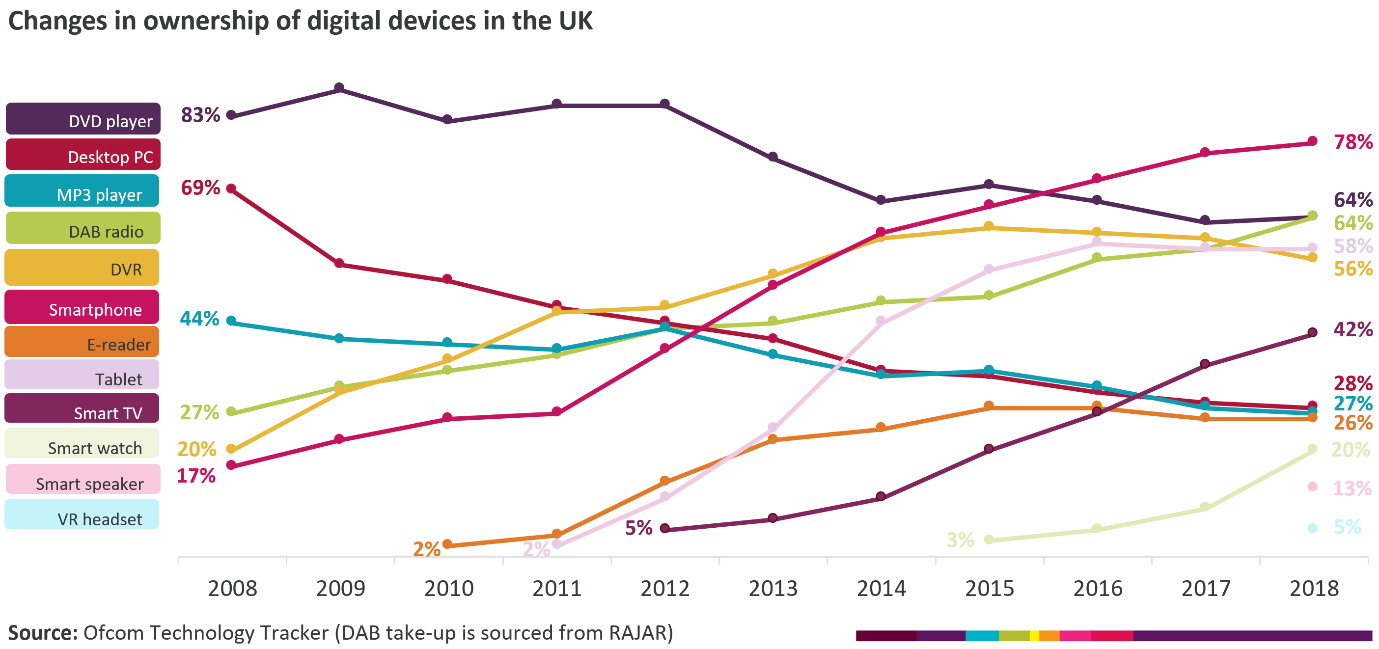
Ownership of digital devices such as smart TVs, smart watches and smartphones has grown significantly in recent years, as more people need a constant connection to the internet – internet users say they spend an average of 24 hours a week online.

By contrast, MP3 players, DVD players and desktop computers seem to be falling out of favour as smartphone use continues to grow, particularly for browsing and streaming.

Meanwhile, the popularity of tablets and e-readers seems to have peaked. Ownership of both is significantly higher than it was seven years ago, but has levelled out in the last few years.

Ofcom now measures ownership of smart speakers (owned by 13% of households) and virtual reality (VR) headsets (5%). The first VR headset went on sale in the UK in 2015 – a year earlier than smart speakers, which have been quicker to capture the imagination of tech shoppers.

Other emerging trends include wearable tech, such as smart watches and fitness trackers. One in five households now owns these devices, and ownership has been doubling every year since 2016.

Ian Macrae, Ofcom’s Director of Market Intelligence, said: “As technology evolves and transforms how we live our lives, the devices we rely on are constantly changing.

“The growth in popularity of streaming services has created tremendous demand for connected TVs, which for many people are replacing DVD players, and the smartphone is replacing several other devices at once.

“The range of connected devices is expanding rapidly. Smart speakers really took off last year and along with other smart home devices will again be ones to watch this year.”

«

link to this extract


Errata, corrigenda and ai no corrida: none notified.

Start Up No.957: Facebook’s dark PR pitches, lots of bitcoin, Google to stop News?, Snap spectacles 2, and more

Bitcoin's fall in price on 20 November: down about $1,000
Bitcoin has been rivalling Theresa May’s Draft Withdrawal Agreement for popularity

A selection of 12 links for you. Look, it’s a tactical thing, you wouldn’t understand. I’m @charlesarthur on Twitter. Observations and links welcome.

Read the mud-slinging pitches Facebook’s PR firm sent us  • TechCrunch

Natasha Lomas:

»

Zooming out for a second, you do also have to pause and wonder at quite how radioactive the corporate culture must be when the “solution” to a string of hugely damaging disinformation scandals is to reach for whataboutery and even actual fake news, as the NYT has claimed, to try to muddy the waters in your favor.

It’s almost as if manipulation is in the corporate DNA.

Though, again, Facebook has decried knowledge of exactly what Definers was up to on its behalf. Yet not knowing isn’t any kind of defence when your business stands accused of defective oversight, self-serving opacity and having a vacuum where its moral compass should be…

…Since the NYT story broke, Facebook has claimed journalists were well aware that Definers was working on its behalf. But the truth is rather murkier there, too.

We checked our inboxes and none of the pitches Definers sent to TechCrunch made an explicit disclosure that the messages they contained had been paid for by Facebook to push a pro-Facebook agenda. They all required the recipient to join those dots themselves.

A proper journalist engaging their critical faculties should have been able to deduce Facebook was the paying customer, given the usually obvious skew.

But if Definers was also sending out this stuff (and indeed worse things than we were pitched) more widely, to content seeders and fencers that trade on framed outrage to drive online clicks, their tasty-sounding tidbits would not have been so critically parsed. And angles they were pushing likely still flowed where they could influence opinion — thanks to the “inverse” osmosis of social media.

(As far as we can tell none of the Definers’ oppo research pitches that we received ended up in a TechCrunch article — well, until now… )

«

And yes, some of the pitches do follow. I’d have lifted my weary eyes skywards at them too; they’re transparent whataboutery, and aren’t “stories”. Facebook was wasting its money.
link to this extract


Men behind TalkTalk data breach jailed • Out-law

»

Matthew Hanley, 23, and Conner Allsopp, 21, both of Tamworth in England, received their sentences at the Old Bailey in London on Monday. Hanley was sentenced to 12 months’ imprisonment and Allsopp to eight months.

The sentences were issued after both men had previously pled guilty to offences under the UK’s Computer Misuse Act.

Hanley was responsible for “hacking the TalkTalk database, obtaining files to enable the hack of websites and supplying these files to others”. He also supplied a spreadsheet of TalkTalk customer details for use in fraud, the Metropolitan Police Service said in a statement.

Allsopp was responsible for supplying an article for use in fraud and supplying a computer file to enable hacking intended for the commission of an offence under the Computer Misuse Act, the Met said.

«

This is quite weird: the breach was in October 2015, more than three years ago, and these two were arrested within a year. (The story of what they did is one of the chapters in my book Cyber Wars. Now we’ll need another edition..) What on earth has been going on for two years?
link to this extract


Google News may shut over EU plans to charge tax for links • The Guardian

Jim Waterson:

»

Richard Gingras, the search engine’s vice-president of news, said while “it’s not desirable to shut down services” the company was deeply concerned about the current proposals, which are designed to compensate struggling news publishers if snippets of their articles appear in search results.

He told the Guardian that the future of Google News could depend on whether the EU was willing to alter the phrasing of the legislation [on copyright which could demand a “link tax” for large companies]. “We can’t make a decision until we see the final language,” he said.

He pointed out the last time a government attempted to charge Google for links, in 2014 in Spain, the company responded by shutting down Google News in the country. Spain passed a law requiring aggregation sites to pay for news links, in a bid to prop up struggling print news outlets. Google responded by closing the service for Spanish consumers, which he said prompted a fall in traffic to Spanish news websites.

“We would not like to see that happen in Europe,” said Gingras. “Right now what we want to do is work with stakeholders.”

Traditional news publishers have a difficult relationship with Google, which they blame for sucking up much of the advertising revenue which used to prop up print newspapers. However, many are also heavily dependent on Google News to send millions of readers to their websites, which can help boost digital revenues.

«

I’m actually a bit Brexit on this one. Google says it’s not a moneymaker for it? Fine – close it. Wouldn’t this create an opportunity for a new, European aggregator to replace it? Or would people just use apps and go to sites?
link to this extract


These secret settings instantly make any Android phone feel twice as fast • BGR

Zach Epstein:

»

When you switch apps or top around through pop-ups, the speed of the animations that transition you from one screen to the next actually have a huge impact on the speed of the user interface. They already seem to move so quickly that you barely notice them. But believe it or not, doubling the speed of these animations actually has a massive impact on how fast your Android phone feels. And as you might have surmised by now, that’s exactly what we’re going to teach you how to do in this post.

As we mentioned, each time you open an app, close an app, open or tap out of pop-ups, or switch between apps, your phone plays a transition animation. This way there’s a smooth transition from one screen to the next, rather than just an abrupt image change. Those animations might seem fast, but there’s an easy way to speed them up even more and the end result is a phone that feel much faster with a UI that seems much more fluid. And the best part is that it couldn’t be easier to adjust these settings.

There’s a secret Settings menu inside Android’s Settings app called “Developer options” and it’s filled with a wide range of advanced options. It’s hidden by default — it is a secret, after all — but it’s simple to gain access to it on your phone.

«

Including this because some people might not know it.
link to this extract


iPhone owners are losing their minds over this keyboard cursor trick • BGR

Jacob Siegal:

»

iPhone owners are appreciative of the fact that iOS allows them to tap or drag the cursor in order to change or delete a specific word in a text message, but it can be a surprisingly difficult task to perform. No matter how small your hands are, trying to tap the invisible gap between two letters can be maddening, and it often takes several tries to get it right. More often than not, I just hold down the backspace key until I reach the problem area.

But it turns out that it doesn’t have to be this way. While you can try to manually adjust the cursor with your fat fingers, Apple has also included an alternate control scheme that most people don’t know about.

On Sunday, food blogger Krissy Brierre-Davis shared a tip on Twitter which immediately went viral. It turns out that if you click and hold on the space bar when the keyboard appears, the keyboard turns into a touchpad which you can use to drag the cursor freely around the text box. This trick works for phones without 3D touch like the iPhone XR. On handsets with 3D Touch, you can press firmly and hold anywhere on the keyboard for a second or two to activate the touchpad, eliminating the need for tapping on words.

«

Including this just in case anyone didn’t know this already. Someone won’t. Been in iPhones since 2015. But discoverability is very low.
link to this extract


Samsung CEO seeks breakthrough with Galaxy 10, foldable phone • Korea Herald

Song Su-hyun:

»

[Samsung CEO Koh Dong-jin] recently said in a corporate message to executives and employees of the information technology and mobile communications division of Samsung that he felt “sorry about the currently struggling status of the Samsung smartphone business and will do my best to overcome the crisis with the upcoming Galaxy 10 and foldable phones.” 

The message comes amid rumors concerning his position, as the tech giant approaches its year-end personnel reshuffle and organizational restructuring.

Koh was reportedly criticized for weakening competitiveness of Samsung phones by Vice Chairman Lee Jae-yong, who ordered improvement in camera technology for the smartphones after personally visiting a shop in Europe. 

“Koh’s message appeared to show how much of a critical position Samsung’s mobile business is in at the moment. The atmosphere within the company is currently serious as we hear outside criticism toward the products,” said an insider.

Samsung recorded 2.2 trillion won ($1.95bn) in operating profit for mobile business in the third quarter, down more than 30% from the previous quarter.

«

Samsung is struggling? That’s news to me.
link to this extract


Snap to release new spectacles with two cameras for $350 • Cheddar

Alex Heath:

»

Snap is planning to release a new version of its Spectacles glasses with two cameras and a higher price point of $350 by the end of the year, Cheddar has learned.

The new Spectacles, internally codenamed Newport, will feature an all-new design with a more premium frame made of aluminum and cameras capable of producing augmented reality effects in videos, according to people familiar with the matter. With a $350 price point, the new glasses will be more than double the cost of the first iteration of Spectacles, which were released in 2016.

A Snap spokesperson declined to comment.

By utilizing two cameras, the Snapchat app will be able to overlay AR lenses and create 3D-like photo effects from footage taken by the Spectacles, the people said. The new hardware is intended to further CEO Evan Spiegel’s grand vision of eventually creating eyewear technology that seamlessly overlays virtual objects onto the real world.

Snap initially captivated the tech industry with the surprise release of Spectacles and its rebranding as a “camera company” in the fall of 2016. But early buzz around the glasses led Snap to widely overestimate demand, leading to a charge of roughly $40m in unsold inventory after the company ordered roughly 800,000 units from its Chinese supplier.

«

It’s almost a good idea, except you’d really want to be able to superimpose content from other social networks in there. In which case, why Snap? Or would Snap make enough profit from them even so? It’s not the price that’s an obstacle if they’re good enough; it’s the content.
link to this extract


Nvidia grapples with cryptocurrency miners’ exit • WSJ

Sarah Needleman:

»

At the height of the cryptocurrency boom, when even moms in British Columbia were stockpiling videogame graphics cards to generate digital currency, average gamers couldn’t get their hands on their favored hardware. Prices ballooned and inventory vanished.

Those days are over. But inflated prices have taken longer than expected to come down, says Nvidia Corp. , particularly for its moderately powerful chips built on an architecture it calls Pascal.

Nvidia misjudged how quickly prices for the graphics cards that those chips go into would normalize now that cryptocurrency mining isn’t as hot, and the company is now dealing with months of expensive inventory that price-conscious gamers won’t touch.

The company’s message to Wall Street: Videogaming is fine, and the crypto hangover is lasting longer than expected. Still, some analysts don’t see a quick fix.

“The real recovery won’t take place until the second, third and fourth quarters of fiscal 2020,” said Gary Mobley, analyst at Benchmark. “It’s 12 weeks of inventory out there we’re dealing with.”

«

The cryptocurrency crash – presently underway, because we’re just past the anniversary of the big runup in bitcoin’s “value” – is going to ripple out in all sorts of interesting directions. Nvidia is just a first-order one.
link to this extract


Taiwan chipmakers asked to defer mining ASIC shipments • Digitimes

Cage Chao and Willis Ke:

»

Taiwan IC designers capable of providing crypto mining ASIC solutions are feeling increasing pressure from customers postponing shipments and new product development amid Bitcoin plunging to a new low of under US$5,000 recently, and the waning mining fever is expected to undermine revenue performances of the chipmakers in the first half of 2019, according to industry sources.

The sources said that since the beginning of 2018, many new mining customers have moved to contract Taiwan chipmakers, including MediaTek, Global Unichip, Alchip, Faraday Technology and RDC Semiconductor, to design exclusive ASICS fabricated on advanced 7nm process to effectively save power consumption and better mining performance.

But the ever-declining prices of Bitcoin and other virtual currencies have not only built up record-high inventory levels of mining graphic cards at suppliers, but also sent mining ASIC clients asking Taiwan IC designers to delay shipments.

Among the designers, RDC Semiconductor has suspended development of ASIC solutions for mining customers; MediaTelk is not expected to enforce its 7nm mining ASIC plan until the first half of 2019; and other peer chipmakers Global Unichip, Alchip and Faraday do not have clear delivery schedules for such customers, the sources said. Even TSMC has directly scaled down mining ASIC foundry orders to near zero, according to industry sources.

«

link to this extract


Grifter journalist Jerry Ji Guo remanded in jail for alleged bitcoin long con • The Daily Beast

Kevin Poulsen:

»

He bounced right into New York’s “Silicon Alley” tech startup community, scoring YCombinator seed funding for a group-dating service called Grouper that lasted eight months.

In the years since, according to his LinkedIn profile, the Chinese-American Yale graduate has been owner and head chef of a burger bar in Beijing and founded a “growth hacking” marketing firm in Atlanta. Last year he finally landed in the field he seemed born to occupy, cryptocurrency, launching a $2m ICO for a content-sharing platform he claimed had deals in place with American Idol and The Voice.

Now Guo is on a new adventure, potentially his last for the next 63 to 78 months. On Nov. 9, FBI agents in Puerto Rico arrested the self-described “serial blockchain entrepreneur” on wire-fraud charges for allegedly stealing over $3.5m worth of cryptocurrency from startups that hired him as a consultant.

On Friday a federal judge in San Juan ordered Guo’s transfer to San Jose, California, to face the eight-count indictment, which carries a sentence of up to 20 years in prison by statute, and at least five years, three months under federal sentencing guidelines.

At the center of the case is Guo’s career in the fast money world of initial coin offerings.

«

Say no more – ICOs are of course grifter central. But some of the detail here in the indictments is amazing.
link to this extract


Bitcoin-rigging criminal probe focused on tie to Tether • Bloomberg

Matt Robinson and Tom Schoenberg:

»

A focus of the Justice Department’s investigation is whether the dramatic rise of digital tokens in recent years was purely driven by actual demand, or was partially fanned on by market tricks. Along with the CFTC, prosecutors have been looking into a number of trading strategies, including spoofing — the illegal practice of flooding the market with fake orders to trick other traders into buying or selling, Bloomberg reported in May.

While not as well known as Bitcoin, Tether is widely used by traders to bet on price moves for other cryptocurrencies. That’s because the token is more stable than other digital coins but remains outside the traditional banking system, making it relatively easy to transfer between different crypto exchanges.

Tether’s stability, and it’s name, comes from the fact that its value is supposed to be tethered to the U.S. dollar. Tether Ltd. even says that for each digital coin issued, it has $1 in the bank. Some investors have questioned that claim. One reason the CFTC subpoenaed the company was to seek proof that tokens are backed by a reserve of U.S. dollars, Bloomberg reported in June.

Among the issues the Justice Department is examining is how Tether Ltd. creates new coins and why they enter the market predominantly through Bitfinex, the people said.

The probe follows allegations made in a June paper by University of Texas Professor John Griffin and co-author Amin Shams. Griffin and Shams wrote that trading in Tether shows a pattern of underpinning, and manipulating, Bitcoin.

They claimed that Tether was used to buy Bitcoin at pivotal periods, and that about half of Bitcoin’s 1,400% gain last year was attributable to such transactions. Griffin briefed the CFTC on his findings earlier this year, according to two people with direct knowledge of the matter.

«

link to this extract


ICOs and crypto fund managers are in trouble • Off The Chain

Anthony Pompliano:

»

The SEC announced two new enforcement actions and settlements against ICO projects last week. In the case materials, the regulatory body used language that (1) indicates most ICOs will be deemed sales of unregistered securities and (2) the projects that violated the law will have to comply and pay financial fines.

There is a nuance to the financial fines that could be devastating to the industry though. Regulators are requiring teams to issues refunds to investors (if the investors would like one), at the US dollar price when the investor invested. Almost every project raised capital in the form of cryptocurrency — for example, lets say investors contributed 50 BTC to a project at a price of $10,000 for a total of $500,000 raised. This example team would be on the the hook for returning $500,000 to investors on top of the financial fine levied by the SEC.

Normally this wouldn’t be a big problem, except crypto prices are down 50-90% since the all-time high. It is unlikely that an ICO project has enough funds, based in US dollars, to pay investors back (depending on when the ICO was raised — most were in Q3 & Q4 2017). In our example, if Bitcoin is down 50% since investors contributed the 50 BTC, the team would only have $250,000 on hand to repay investors (if the team didn’t spend any of the money yet either). The only options they have is to raise more capital (unlikely) or declare bankruptcy.

The current bear market is going to go from bad to worse very quickly for both crypto funds and ICO projects. The pain ahead is something that many of these entrepreneurs and fund managers have never had to deal with. Fortunately, some teams listened to folks like Keith Rabois as they warned against these future challenges, but not nearly as many as should have.

«

Uh-oh. So this is probably all going to start crashing down next year.
link to this extract


Errata, corrigenda and ai no corrida: none notified

You can sign up to receive each day’s Start Up post by email. You’ll need to click a confirmation link, so no spam.

Start Up No.956: the smartphone crunch begins, Apple cutting orders?, kill that dropdown menu!, flat earth dunces, and more


QWERTY: also known as EMBEDDED. CC-licensed photo by Dennis Wilkinson on Flickr.

You can sign up to receive each day’s Start Up post by email. You’ll need to click a confirmation link, so no spam.

A selection of 48 links for you. Links counted by the European Research Group. I’m @charlesarthur on Twitter. Observations and links welcome.

Meitu leaves the dancefloor – and the brutal smartphone OEM crunch begins • Medium

I wrote a piece over at Medium:

»

“They shoot horses, don’t they?” asks the beautiful woman near the end of the film of the same name, as she and her partner consider their hopeless struggle to stay awake in a dance marathon – one of the US Depression’s little entertainments, where you could win a prize, and more importantly get food, if you could only stay on your feet.

The modern form of the dance marathon is the smartphone business. The latest to take one to the head is Meitu. It’s a Chinese smartphone company which previously attracted some attention for its “beauty shot” selfie system (and some more attention for its data-grabbing ways). The reason you probably haven’t heard of it is because it’s pretty small on a global scale: since launching in 2013, it has sold a total of just 3.5m smartphones. That’s about 0.7m per year. Apple sells about that many per day in a slow quarter.

Now, though, Meitu is interesting for a different reason: it’s an early casualty of the coming smartphone crunch. The whole business is in a recession, and small players are going to get squeezed out.

«

Meitu said that its full-year loss will be about $144m, up from half-year losses of $18.4m. It’s all going south. The Android OEM business is murderous.
link to this extract


Apple suppliers suffer with uncertainty around iPhone demand • WSJ

Yoko Kubota, Takashi Mochizuki and Tripp Mickle:

»

Lower-than-expected demand for Apple’s new iPhones and the company’s decision to offer more models have created turmoil along its supply chain and made it harder to predict the number of components and phones it needs, people familiar with the situation say.

In recent weeks, Apple slashed production orders for all three of the iPhone models that it unveiled in September, these people said, frustrating executives at Apple suppliers as well as workers who assemble the handsets and their components.

Forecasts have been especially problematic in the case of the iPhone XR. Around late October, Apple slashed its production plan by up to a third of the approximately 70 million units it had asked some suppliers to produce between September and February, people familiar with the matter said.

And in the past week, Apple told several suppliers that it cut its production plan again for the iPhone XR, some of the people said Monday, as Apple battles a maturing smartphone market and stiff competition from Chinese producers.

«

Neil Cybart (over at AboveAvalon) looked at this; he reckons that what is probably happening is that older models such as the iPhone 8 are selling better than Apple had expected compared to the newer models – because people don’t see the need to spend that much on an upgrade – and that the XR has been hardest-hit by that shift. Doesn’t mean that it’s selling fewer units overall, though; it’s just the suppliers for the old models haven’t got any complaints, so they would be hard to get to talk.
link to this extract


Drop-down usability: when you should (and shouldn’t) use them • Baymard Institute

Christian Holst:

»

If, for a particular input, there are many more than 10 options, but the input doesn’t have to be validated, an open text form field will often be simpler than a drop-down, as users don’t have to read and understand all options before making a choice.


A “Full Name” text field, seen here at Wayfair, eliminates the need for “Title”, “Middle Name”, and “Suffix” drop-downs.

For example, a “Full Name” field is a very flexible way of supporting optional “Title” and “Suffix” fields (inputs often wrongly displayed in a drop-down). Similarly, an optional text field for delivery instructions will often be simpler than an optional drop-down.

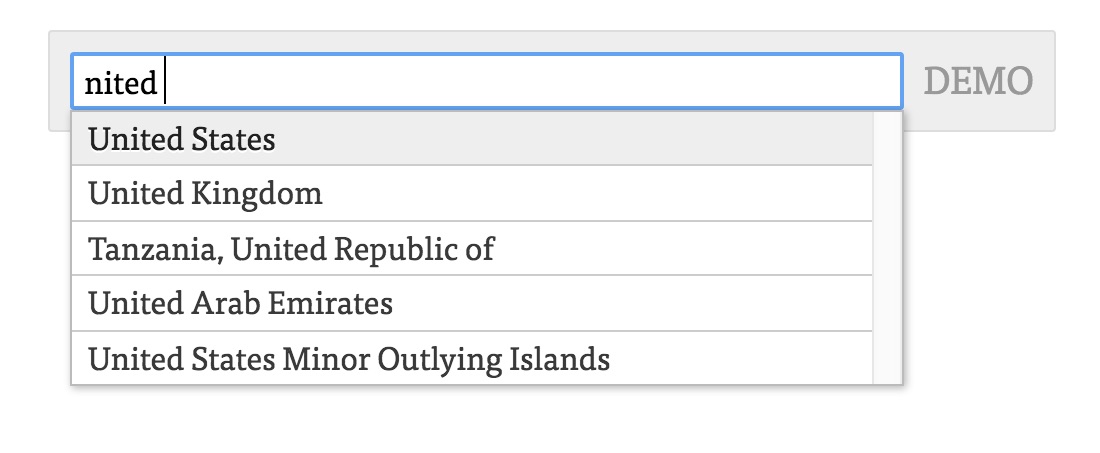
For some fields, such as the “Country Selection” field, where the input often does have to be validated, we observe that a well-performing alternative to a drop-down is an autocomplete field.

This addresses the issues of drop-down selectors by letting the user begin to type their country themselves. As they begin typing, the possible matches are suggested, which simplifies the task of locating and selecting a value, and is observed to greatly speed up the country-selection process altogether.


A country autocomplete solves the issue of having a massive drop-down that’s difficult to use, while it can also support typos and sequencing, synonyms, common names, local spellings, and abbreviations.

«

Oh man country drop-downs are the WORST.
link to this extract


Why we can’t quit the QWERTY keyboard • MIT Technology Review

»

In 2011, Kyoto University researchers proposed that QWERTY stemmed from key rearrangements made to satisfy the habits of the typewriter’s earliest customers: telegraph operators, who used it to transcribe Morse code messages. (For instance, some letters that are often confused for one another in Morse are close together on the keyboard.) Those researchers were challenging the oft-invoked bit of folklore that QWERTY was chosen to prevent typewriters from jamming when people hit commonly used letters in quick succession. Either way, in 1893, several of the largest typewriter makers combined to form the Union Typewriter Company. By the turn of the century, QWERTY was the typing standard.

After that, it wasn’t long before children started learning QWERTY. These days, US kids are required to be able to type with a keyboard by third grade, and some schools are teaching kids as young as kindergarten basic keyboard skills.

QWERTY dominates not just in countries that use alphabets (with some regional variations), but in countries like China that developed their own systems, such as Pinyin, to type a vast array of characters with the same simple keyboard.

But the QWERTY keyboard’s success has not been due to lack of competition.

«

The biggest – and in many places still the most-used – competitor is T9, for mobile phone keyboards. Though this article looks at the many, many other possibilities.
link to this extract


China’s Orwellian social credit score isn’t real • Foreign Policy

Jamie Horsley:

»

Under the system, government agencies compile and share across departments, regions, and sectors, and with the public, data on compliance with specified industry or sectoral laws, regulations, and agreements by individuals, companies, social organizations, government departments, and the judiciary. Serious offenders may be placed on blacklists published on an integrated national platform called Credit China and subjected to a range of government-imposed inconveniences and exclusions. These are often enforced by multiple agencies pursuant to joint punishment agreements covering such sectors as taxation, the environment, transportation, e-commerce, food safety, and foreign economic cooperation, as well as failing to carry out court judgments.

These punishments are intended to incentivize legal and regulatory compliance under the often-repeated slogan of “whoever violates the rules somewhere shall be restricted everywhere.” Conversely, “red lists” of the trustworthy are also published and accessed nationally through Credit China.

The scope, scale, diversity, and language of the evolving system have caused a lot of confusion, particularly with respect to the existence of a single social credit score. There is no such thing as a national “social credit score. A few dozen towns and cities in China, as well as private companies running loyalty-type programs for their customers, do currently compute scores, primarily to determine rewards or access to various programs. That was the source of at least some of the confusion. Ant Financial’s Sesame Credit program, for instance, which gives rewards on various platforms and easier access to credit, was often cited as a precursor of a planned government program, despite being a private enterprise.

The government does assign universal social credit codes to companies and organizations, which they use as an ID number for registration, tax payments, and other activities, while all individuals have a national ID number. The existing social credit blacklists use these numbers, as do almost all activities in China. But these codes are not scores or rankings.

«

For something that isn’t real, that seems pretty real to me.
link to this extract


Apple’s tools sneak into business • WSJ CIO Journal

Sara Castellanos:

»

This year, individual sellers have sold more than $10m worth of sneakers through GOAT’s app and the Flight Club consignment store, up from $2m a year ago. The companies have an inventory of 35,000 unique sneaker styles and hold over 200,000 pairs of sneakers at four warehouses around the country including one at the Flight Club store in the SoHo neighborhood of New York. A rare pair of sneakers such as the DJ Khaled Jordan 3 can sell for as much as $40,000.

The two companies combined have nearly 800 Apple devices deployed throughout their workforce including iPads and MacBooks. Apple’s Device Enrollment Program allows the companies to purchase laptops, iPads and other Apple products with company-specific security preferences and apps already installed.

When the device ships to an employee, it’s already configured with the appropriate business settings as soon as it’s turned on. The program has been a crucial component in the effort to accommodate growth, Mr. Arndt said, because it doesn’t require the device to be configured by an IT person before it gets to an employee, saving days worth of time.

“It’s fully configured without any interaction required, which is an easy transition in on-boarding (employees) and relieves some of that stress of first-day training,” Mr. Arndt said.

Flight Club uses Apple iPads in its brick-and-mortar SoHo store, where employees can look up and purchase inventory for customers using a sales floor application that was built in-house. Employees don’t need much training in the store because they’re familiar with the intuitive, easy-to-use Apple products they use in their consumer lives, Mr. Arndt said. “Everybody already knows what it’s like to use one of these devices,” he said.

«

Isn’t marked as sponsored content, so I guess it’s just a CIO Journal thing. Will look out for the article on businesses using Android tablets for similar jobs – must be coming next week.
link to this extract


Inside the Flat Earth conference, where the world’s oldest conspiracy theory is hot again • The Daily Beast

Kelly Weill:

»

“In five years, everyone will know the Earth is flat,” Scott Simons tells me as we wait in line for the second annual Flat Earth Conference.

Scott, holding the Utah license plate “ITSFLAT,” is explaining how the Flat Earth revolution will bring “societal collapse” because the bulk of our knowledge comes from Round Earth institutions.

“It’s globalism,” his wife Julie interjects. The term, a favorite of President Donald Trump, has become an anti-Semitic euphemism, attached to a far-right conspiracy about Jews controlling the world. I make what must be a funny face, because Julie tries to clarify.

“Globalism,” she repeats, and draws a circle with her hands to illustrate.

Ah. Globe. Yes…

…On the first day of the conference, I ask Flat Earthers when they converted. When did they chuck out the globe, renounce outer space as fake, and decide we live on a flat plane covered by a dome?

The answer, for most, is three years ago. That’s when some of the movement’s biggest names launched YouTube channels with hours-long videos explaining not so much why the Earth is flat (it isn’t) but why elements of the “globe model” are suspicious, particularly when they clash with a literal reading of the Bible.

“August 2015,” Ginny, a California woman tells me. That’s when a friend forwarded her a video series on Flat Earth. “I spent like three nights wide awake and then I was hooked.”

This is the real currency in the Flat Earth community. Between speeches, everyone is showing each other YouTube videos on their phones. People reference each other by their YouTube names, and twice when I leave my seat I return to find advertisements for YouTube channels on the chair. A panel on Women in Flat Earth is more of a how-to on running a Flat Earth YouTube channel while female…

Conference speaker Joshua Swift tells me a popular Flat Earth video “woke him up” to the movement. “It came on autoplay,” he says. “So I didn’t actively search for Flat Earth. Even months before, I was listening to Alex Jones.”

«

link to this extract


Snap’s Spiegel flies high above Wall Street worries • The Information

Tom Dotan:

»

Although Android has been a longstanding issue—even an ongoing joke at the company—staffers are optimistic that the rebuilt app will help jumpstart user growth in markets like Western Europe and the Middle East where some Snapchat users dropped off, according to people familiar with the matter. There’s also a large cohort of potential users who don’t have Snapchat, but have friends who do, that Snap employees also see as low-hanging fruit. Insiders are less confident about some markets that Instagram has targeted, like Brazil.

Meanwhile, another facet of of Mr. Spiegel’s growth strategy—attracting older users— remains up in the air. Snapchat has always been most popular for people in their mid- 20s and younger; Mr. Spiegel has suggested a combination of product fixes and better outreach on the value of communicating through pictures will help bring along older users.

The optimist case that people see for Snap in the near term is to follow the same trajectory Twitter did after its stock crashed to a low of $14 in 2016 from $50 in early 2015: stabilize the leadership, slowly build the business and start turning a profit. While Twitter’s user base has been stagnant for the past few years, it is solidly profitable, thanks to steadily growing ad revenues. Twitter stock is up 73% in the last year to $33.

“No one says [Snap] need to be ubiquitous. They can still be a real business even if they’re not taking over the world,” said Pivotal Research analyst Brian Wieser. He says Snap can succeed, even at its current size, if it keeps being an essential advertising outlet for a small number of large industries, like entertainment.

To follow in Twitter’s footsteps, Snap has to survive—which means it needs to stop the losses before it runs out of cash. At the end of September, the company had $1.4bn in cash. But it is burning through cash, with spending overwhelming revenue, by $661m in the first nine months of this year.

Snap has reduced its cash burn in the past year and has a little over two years of cash left. In a recent memo to staff reported by Cheddar, Mr. Spiegel set becoming profitable in 2019 as a “stretch” goal.

«

Might be tight not running out of cash.
link to this extract


‘They’ll squash you like a bug’: how Silicon Valley keeps a lid on leakers • The Guardian

Olivia Solon:

»

Since [James] Damore’s [infamous] memo, Google has become much leakier, particularly around internal discussions of racial and gender diversity.

“It’s a cry for help internally,” said another former Googler, who now runs a startup.

He said people at Google had for years put up with covert sexism, internal biases or, in his case, a manager with anger management problems. “No one would do anything until one day a VP saw the guy yelling at me in the hallway.

“People have been dealing with this stuff for years and are finally thinking ‘if Google isn’t going to do something about it, we’re going to leak it’.”

For low-paid contractors who do the grunt work for big tech companies, the incentive to keep silent is more stick than carrot. What they lack in stock options and a sense of corporate tribalism, they make up for in fear of losing their jobs.

One European Facebook content moderator signed a contract, seen by the Guardian, which granted the company the right to monitor and record his social media activities, including his personal Facebook account, as well as emails, phone calls and internet use. He also agreed to random personal searches of his belongings including bags, briefcases and car while on company premises. Refusal to allow such searches would be treated as gross misconduct.

Following Guardian reporting into working conditions of community operations analysts at Facebook’s European headquarters in Dublin, the company clamped down further, he said.

Contractors would be questioned if they took photographs in the office or printed emails or documents. “On more than one occasion someone would print something and you’d find management going through the log to see what they had printed,” said one former worker.

Security teams would leave “mouse traps” – USB keys containing data that were left around the office to test staff loyalty. “If you find a USB or something you’d have to give it in straight away. If you plugged it into a computer it would throw up a flare and you’d be instantly escorted out of the building.”

“Everyone was paranoid. When we texted each other we’d use code if we needed to talk about work and meet up in person to talk about it in private,” he said.

«

Easy to overlook how difficult it must have been to gather the information for this story. Solon is doing really terrific work.
link to this extract


Errata, corrigenda and ai no corrida: none notified

Start Up No.955: all Amazon all the time!, busting tech’s mythology, SEC rolls ICOs, knitting in code, and more


Everest: the highest mountain, but not the furthest you can get from the Earth’s centre. CC-licensed photo by Jerome Bon on Flickr.

You can sign up to receive each day’s Start Up post by email. You’ll need to click a confirmation link, so no spam.

A selection of 14 links for you. Neither inflammable nor flammable. I’m @charlesarthur on Twitter. Observations and links welcome.

Everything on Amazon is Amazon! • The New York Times

John Herrman:

»

There are vanishingly few types of consumer goods that you can’t buy, in some form, on Amazon. But it is missing plenty of brands. In 2009, the company started selling products under its own name. It soon moved beyond the first AmazonBasics — items including budget electronics and batteries — to a wider range of Amazon-branded products. This was followed by an explosion of company-owned brands, including dozens with Amazon-free names.

Lark & Ro sells women’s wear, Buttoned Down sells men’s dress shirts; Pike Street sells linens; Strathwood sells furniture. These brands are intended to stand on their own, sort of. They are associated with Amazon, and listed on the site’s dozens of different contexts as “Our Brand” or “by Amazon” or “An Amazon Brand.” (Some new brands are undercover but then blow their cover, as in “Amazon Brand – Solimo Pasta, Thin Spaghetti, 16oz.”)

A lot of these brands — most explicitly the Basics products and various household staples — appear to be straightforward margin plays. Others, clothing brands in particular, fill gaps left by companies that have steered clear of the platform altogether. Others, well, who’s to say?

«

link to this extract


What is the highest point on Earth as measured from Earth’s center? • NOAA

»

Mount Everest, located in Nepal and Tibet, is usually said to be the highest mountain on Earth. Reaching 29,029 feet at its summit, Everest is indeed the highest point above global mean sea level—the average level for the ocean surface from which elevations are measured. But the summit of Mt. Everest is not the farthest point from Earth’s center.

«

You’ll have to read on to find out. You’ve probably never heard of the mountain whose summit is the one. Remembering that the Earth is an oblate spheroid. And no, it’s not Kilimanjaro.
link to this extract


A leaky database of SMS text messages exposed password resets and two-factor codes • TechCrunch

Zack Whittaker:

»

A security lapse has exposed a massive database containing tens of millions of text messages, including password reset links, two-factor codes, shipping notifications and more.

The exposed server belongs to Voxox (formerly Telcentris), a San Diego, Calif.-based communications company. The server wasn’t protected with a password, allowing anyone who knew where to look to peek in and snoop on a near-real-time stream of text messages.

For Sébastien Kaul, a Berlin-based security researcher, it didn’t take long to find.

Although Kaul found the exposed server on Shodan, a search engine for publicly available devices and databases, it was also attached to to one of Voxox’s own subdomains. Worse, the database — running on Amazon’s Elasticsearch — was configured with a Kibana front-end, making the data within easily readable, browsable and searchable for names, cell numbers and the contents of the text messages themselves.

«

Everyone gets hacked. Sometimes, they just do it to themselves.
link to this extract


Facebook, Google, Amazon, and the collapse of the tech mythology • The Atlantic

Alexis Madrigal:

»

Where does this almost unbelievably bad news cycle end for these companies? And what if the news stays bad, but the people using their products can’t extract themselves from the platforms tech has built?

A historical analog for this fall from grace does exist. There was a time when Americans loved and talked about the transcontinental railroads the way we loved and talked about the internet. The steel lines spanning the nation were, as the Stanford historian Richard White put it, “the epitome of modernity.” “[Americans] were in love with railroads because railroads defined the age. The claims made for railroads by men who wrote about them were always extravagant,” White wrote in Railroaded: The Transcontinentals and the Making of Modern America. “The kind of hyperbole recently lavished on the Internet was once the mark of railroad talk.”

Then the public turned on the transcontinental railroads. “The innovations entrepreneurs brought to the railroads—financial mechanisms, pricing innovations, and political techniques—were as harmful to the public, to the republic, and even to the corporation as they were profitable to many of the innovators,” White continued.

The railroads became some of the most despised institutions in the country and a core reason why monopoly became such a terrible word. When the railroad mythology collapsed, it helped create an entire political ideology: the progressivism of the late 19th and early 20th centuries.

«

link to this extract


SEC settles enforcement actions over two initial coin offerings – WSJ

Dave Michaels:

»

both settlements require the companies to file audited financial statements and other disclosures about their businesses, providing the information that investors typically need to decide if a stock is a good investment.

Paragon and CarrierEQ, which conducted unregistered coin offerings, each agreed to pay $250,000 in civil penalties and to notify investors they are eligible for refunds if they still own the token or can show they sold it at a loss. Paragon sold to 8,300 investors, while CarrierEQ’s coin offering reached 2,500 buyers, the SEC said.

Paragon, founded by Russian internet entrepreneur Egor Lavrov and former model Jessica VerSteeg, staged a widely noticed coin sale in August 2017 that raised about $12 million, according to the SEC. The company said it would fuse blockchain, the technology underpinning virtual currencies, with the marijuana industry.

The startup launched at a time when many initial coin offerings used athletes and other celebrities to generate buzz. Paragon enlisted The Game, a rapper, to tout its coin. The company said it could control the supply of its token in order to stabilize or raise its price, the SEC said in a settlement order.

Paragon was one of hundreds of coin issuers identified by The Wall Street Journal in May as displaying signs of possible fraud. The Journal’s analysis reviewed the companies’ marketing documents and identified red flags such as plagiarized language, promises of guaranteed returns and missing or fake executive teams.

«

First two of scores. The ICO joyride is over.
link to this extract


‘Nothing on this page is real’: How lies become truth in online America – The Washington Post

Eli Saslow:

»

The only light in the house came from the glow of three computer monitors, and Christopher Blair, 46, sat down at a keyboard and started to type. His wife had left for work and his children were on their way to school, but waiting online was his other community, an unreality where nothing was exactly as it seemed. He logged onto his website and began to invent his first news story of the day.

“BREAKING,” he wrote, pecking out each letter with his index fingers as he considered the possibilities. Maybe he would announce that Hillary Clinton had died during a secret overseas mission to smuggle more refugees into America. Maybe he would award President Trump the Nobel Peace Prize for his courage in denying climate change.

A new message popped onto Blair’s screen from a friend who helped with his website. “What viral insanity should we spread this morning?” the friend asked.

“The more extreme we become, the more people believe it,” Blair replied.

He had launched his new website on Facebook during the 2016 presidential campaign as a practical joke among friends — a political satire site started by Blair and a few other liberal bloggers who wanted to make fun of what they considered to be extremist ideas spreading throughout the far right. In the last two years on his page, America’s Last Line of Defense, Blair had made up stories about California instituting sharia, former president Bill Clinton becoming a serial killer, undocumented immigrants defacing Mount Rushmore, and former president Barack Obama dodging the Vietnam draft when he was 9. “Share if you’re outraged!” his posts often read, and thousands of people on Facebook had clicked “like” and then “share,” most of whom did not recognize his posts as satire. Instead, Blair’s page had become one of the most popular on Facebook among Trump-supporting conservatives over 55.

«

Blair is himself astonished by peoples’ credulousness. He’s a Democrat, and earning thousands per month from it.

And then Saslow finds someone who does believe it. And then it all rolls around.
link to this extract


The wartime spies who used knitting as an espionage tool • Atlas Obscura

Natalie Zarrelli:

»

During World War 1, A grandmother in Belgium knitted at her window, watching the passing trains. As one train chugged by, she made a bumpy stitch in the fabric with her two needles. Another passed, and she dropped a stitch from the fabric, making an intentional hole. Later, she would risk her life by handing the fabric to a soldier—a fellow spy in the Belgian resistance, working to defeat the occupying German force.

Whether women knitted codes into fabric or used stereotypes of knitting women as a cover, there’s a history between knitting and espionage. “Spies have been known to work code messages into knitting, embroidery, hooked rugs, etc,” according to the 1942 book A Guide to Codes and Signals. During wartime, where there were knitters, there were often spies; a pair of eyes, watching between the click of two needles.

When knitters used knitting to encode messages, the message was a form of steganography, a way to hide a message physically (which includes, for example, hiding morse code somewhere on a postcard, or digitally disguising one image within another). If the message must be low-tech, knitting is great for this; every knitted garment is made of different combinations of just two stitches: a knit stitch, which is smooth and looks like a “v”, and a purl stitch, which looks like a horizontal line or a little bump. By making a specific combination of knits and purls in a predetermined pattern, spies could pass on a custom piece of fabric and read the secret message, buried in the innocent warmth of a scarf or hat.

«

And lots more examples; you can see why a male-oriented armed forces would completely overlook such communication. (Via Graham Cluley.)
link to this extract


Apple’s new map: has Apple closed the gap with Google’s map? • Justin O’Beirne

O’Beirne does periodic, incredibly detailed (and fascinating) updates comparing Apple’s maps with Google’s. This is no exception, looking at the space where Apple has introduced new maps in California, which turns out to have some gotchas in tiny towns:

»

It’s surprising that Apple mislabels the general store because TechCrunch said that Apple’s vans were capturing addresses and points of interest along the roads:

“After the downstream data has been cleaned up of license plates and faces, it gets run through a bunch of computer vision programming to pull out addresses, street signs and other points of interest.”

But what’s even stranger is that “Markleeville General Store” is written on both the front and the side of the building—and according to TechCrunch:

“The computer vision system Apple is using can absolutely recognize storefronts and business names.”

Yet the businesses that Apple is missing—but that Google has—all have signs along the road.

This suggests that Apple isn’t algorithmically extracting businesses and other places out of the imagery its vans are collecting.

Instead, all of the businesses shown on Apple’s Markleeville map seem to be coming from Yelp, Apple’s primary place data provider…

«

It seems that while Google uses algorithms on visual data, Apple is using a lot of low-cost humans. Both have their advantages.
link to this extract


It’s easy to fact check Trump’s lies: he tells the same ones all the time • Washington Post

Daniel Dale is the Toronto Star’s correspondent in Washington, and fact-checks Trump all the time:

»

Even the best of Trump’s interviewers seldom challenge him when he lies to their faces — despite the fact that almost all of the lies have been fact-checked before.

Trump regularly makes 20 to 30 false claims in his rally speeches. But if you watched a network news segment, read an Associated Press article or glanced at the front page of the newspaper in the city that hosted him, you’d typically have no idea that he was so wholly inaccurate.

If a car salesman told you 36 untrue things in 75 minutes, that would probably be the first thing you told your friends about your trip to the dealership. It should have been the first thing we all told our readers about Trump’s August rally in Wilkes-Barre, Pa.

This issue is so urgent because Trump is getting worse and worse. In 2017, he averaged three false claims per day. In 2018, it is about nine per day. In the month leading up to the midterms: a staggering 26 per day. By my count, he’s now at 3,749 false claims since his inauguration. The Post, which tracks both false and misleading claims, has tallied up to 6,420.

Meanwhile, the press continues to blast out the lies unnoted. Two weeks ago, Axios and the AP uncritically tweeted his nonsense about the United States being the only nation to grant birthright citizenship. (They updated after they were criticized.) It happened again Monday, when Trump earned credulous tweets and headlines from ABC, NBC and others for his groundless assertion about “massively infected” ballots in Florida.

There’s nothing especially strategic about much of Trump’s lying; he does it because that is what he has always done. But the president also knows the lies will be broadcast unfiltered to tens of millions of people — by some of the very outlets he disparages as “fake news.”

«

As he says, it’s important that people know *on what topics* Trump is being misleading – though it generally boils down to “all of them”.
link to this extract


Trump’s Iran oil export sanctions aren’t living up to the hype • Bloomberg

Julian Lee:

»

These were billed as the “strongest sanctions in history,” intended to prevent the Persian Gulf country from exporting any oil at all. But the reality hasn’t quite lived up to the hype: In the six months before they fully took effect, the impact of the Trump sanctions looks remarkably similar to those of his predecessor in 2012.

With the November deadline looming, it became clear that buyers which agreed to reduce their purchases of Iranian oil might be able secure waivers from the sanctions. Back in August, Trump’s national security adviser, John Bolton, said these would be “few and far between.” This week, it emerged that the US has agreed to let eight countries keep buying Iranian oil.

Details of the deal are sketchy, although Secretary of State Michael Pompeo has promised they will be revealed on Monday. The eight include China and India, the biggest buyers of Iran’s oil, as well as other key U.S. allies in Asia, Japan and South Korea. Turkey will also be permitted to continue buying, but the softening doesn’t extend to Europe. It isn’t yet clear how frequently the waivers will need to be re-validated, or by how much buyers will need to reduce their purchases to avoid penalties.

«

If China can still buy Iranian oil, the “sanctions” aren’t really going to hurt it much.
link to this extract


Never mind the iPad — where are the full-time Android tablet users? • Medium

I wrote a thing over at Medium:

»

It is absolutely true that Android-powered tablets sell in greater numbers than iPads. You can see that in this graph, sourced from IDC and Strategy Analytics (IDC for the total tablet numbers, Strategy Analytics for the Windows tablet figures):

If you go strictly on the number of tablets sold, then Androids have sold plenty more than iPads or Windows tablets (same sources as before):

They also tend to be cheaper than iPads (though that’s not necessarily true since Apple cut the price on the entry-level iPad earlier this year).

So given all that, here’s my question: why aren’t we talking about full-time Android tablet users, rather than discussing whether the iPad Pro can replace/supplant your laptop? After all, Android tablets have pretty much the same apps as iOS, and you can even access a file system if you want.

«

I also asked the folks over at Android Police for their input – which is in the piece too. It’s quite surprising.
link to this extract


Facebook and the age of manipulation • New Yorker

Evan Osnos:

»

The most disturbing revelation is that Facebook employed Definers Public Affairs, a conservative Washington-based consultant, to promote negative stories about Facebook’s competitors by pushing them on the NTK Network, which calls itself “a unique news website that brings together data points from all platforms to tell the whole story.” NTK is not, in fact, a news Web site; it shares offices and staff with Definers. As the Times reported, “Many NTK Network stories are written by staff members at Definers or America Rising, the company’s political opposition-research arm, to attack their clients’ enemies. While the NTK Network does not have a large audience of its own, its content is frequently picked up by popular conservative outlets, including Breitbart.” In other words, Facebook employed a political P.R. firm that circulated exactly the kind of pseudo-news that Facebook has, in its announcements, sought to prevent from eroding Americans’ confidence in fact versus fiction.

On another front, Definers also sought to discredit Freedom from Facebook, a nonprofit opposition group, by encouraging reporters to write about its ties to George Soros, the liberal financier who is a subject of obsessive, often conspiratorial attention in conservative circles. On Thursday, Sarah Miller, a spokesperson for Freedom from Facebook, told me, “Congress and the Federal Trade Commission should come to terms with the fact that Facebook will never change, unless they force it to—and they should, without delay, to protect our democracy.” (On Thursday, as the report of the P.R. firm’s activities stirred criticism, Facebook said that it had ended its relationship. The company said that it had not asked the firm to circulate false stories.)

«

link to this extract


Alphabet Verily stops Smart Lens, glucose-measuring contact lens • CNBC

Christina Farr:

»

Verily, Alphabet’s life sciences arm, has paused work on its so-called “smart lens” program, which was aiming to put tiny sensors on contact lenses to measure blood sugar levels in tears.

If it worked, the lenses could help diabetics track their glucose levels in real time and in less invasive ways than the traditional meters that require piercing the skin. But in a blog post on Friday, Verily said that after four years of research it has determined that detecting blood sugar in tears is a massive — and potentially insurmountable — technical and scientific undertaking.

“Our clinical work on the glucose-sensing lens demonstrated that there was insufficient consistency in our measurements of the correlation between tear glucose and blood glucose concentrations to support the requirements of a medical device,” the company said.

«

This is a project with a long, long heritage going back to 2004 and which has gone from the University of Waterloo to Microsoft Research and on to Google (and hence to Verily). Another big PR scheme bites the dust.
link to this extract


Bitcoin giveaway scams are flourishing on Twitter. They’re probably coming from Russia • Buzzfeed News

Jane Lytvynenko:

»

A BuzzFeed News analysis of the Target and G Suite account hacks suggest the perpetrators may have been the same ones responsible for similar schemes back in March. BuzzFeed News examined the websites touted in the Target and G Suite promoted tweet scams and determined they share a web server that also hosts sites like btc-back.net, elonmusk.gift, and eth-giving.com.

While domain registration information for those scam sites is hidden, other sites hosted the server are registered to Russian names with associated emails, and Russian addresses. A QR posted in one of the tweets was hosted on a Russian domain. The server currently hosts 600 Russian and English-language websites for illegal pharmacies, escort services, and a business that promises to improve the levels of World of Warcraft characters. Many of them appear to be based in Russia.

“The phrasing of the tweet themselves seem to suggest a Russian or Ukrainian language actor,” Kalember said. The researcher has also examined phishing emails sent by scammers to marketing and social media managers, which ultimately help them post from verified accounts like @Target. According to Kalember, those emails also show strong connections to Eastern European actors.

Twitter declined a request for technical details on the promoted scam ads.

«

link to this extract


Errata, corrigenda and ai no corrida: none notified

Start Up No.954: the cyborg cockup, Google steps away from robots, quitting Instagram, hacking kids’ smartwatches, and more


Want to expense a visit here? An AI might be checking that. Photo by Joshua Ganderson on Flickr

»You can sign up to receive each day’s Start Up post by email (arriving at about 0700GMT each weekday). You’ll need to click a confirmation link, so no spam.«

A selection of 12 links for you. Use them wisely. I’m @charlesarthur on Twitter. Observations and links welcome.

How I lost and regained control of my microchip implant • Motherboard

Daniel Oberhaus:

»

The NFC chip I got injected in my hand was made by Dangerous Things, a biohacking company started by Amal Graafstra that has also pioneered DIY biometric guns. Graafstra has been selling these chips since he raised $30,000 in a crowdfunding campaign in 2014. The chip is encased in a small glass tube that’s a little under a half an inch in length and just two millimeters in diameter. This tube is injected into the soft flesh between your thumb and index finger just above the webbing. When you hold your hand in certain positions, the outline of the chip can just barely be seen pushing against the skin.

The actual process of getting the implant went off without a hitch, but things quickly devolved after that. The thing about NFC chips is that anyone with a reader can also write to the device if it is not protected. While this isn’t exactly a huge security threat, given that someone would have to get the reader within several centimeters of your hand to write to the chip, when you’re at the world’s largest hacker conference it’s better to play it safe.

So, at the urging of everyone at the implant station, the first thing I did with my implant was secure it with a four-digit pin. I hadn’t decided what sort of data I wanted to put on the chip, but I sure as hell didn’t want someone else to write to my chip first and potentially lock me out. I chose the same pin that I used for my phone so I wouldn’t forget it in the morning—or at least, I thought I did.

If I had a single piece of advice for anyone thinking about getting an NFC chip implant it would be to do it sober. For starters, the piercer probably won’t even give you the implant if they suspect you’re intoxicated for reasons involving consent and safety (alcohol thins your blood, which is also why you shouldn’t get a tattoo while drunk.) But more importantly, you won’t wake up the next morning with a splitting headache and absolutely no idea how to unlock your hand.

«

It’s basically like getting a hi-tech tattoo, isn’t it? Except you set off airport security systems forever.
link to this extract


Google parent to pull plug on bipedal robot development • Nikkei Asian Review

»

Google entered the robotics business in 2013 by buying Schaft, a tech startup founded by University of Tokyo researchers, and other companies. But the company scaled back the business, due in part to the departure of Andy Rubin in 2014, who has led the robotics business.

SoftBank Group in June 2017 announced that it had agreed with Alphabet to purchase Schaft, but one or more Schaft employees refused to be part of SoftBank, according to people familiar with the matter. SoftBank’s attempt to buy Schaft apparently broke down.

“Following Softbank’s decision not to move forward with the Schaft acquisition,” an Alphabet spokesperson told Nikkei, “we explored many options but ultimately decided to wind down Schaft. We’re working with employees to help them find jobs elsewhere within or outside of Alphabet.”

Yuto Nakanishi, assistant professor of the University of Tokyo, and others established Schaft in 2012. The startup has developed bipedal robots, which can be used to save human lives at disaster sites.

«

Does this mean the end of the quadripedal robots too?
link to this extract


Quitting Instagram: she’s one of the millions disillusioned with social media. But she also helped create it • Washington Post

Elizabeth Dwoskin:

»

“In the early days, you felt your post was seen by people who cared about you and that you cared about,” said [early Instagram employee Bailey] Richardson, who left Instagram in 2014 and later founded a start-up. “That feeling is completely gone for me now.”

The catalyst for Richardson’s decision to quit Instagram came when its co-founders, Kevin Systrom and Mike Krieger, unexpectedly announced that they were leaving the company. With their exit, Richardson and other former Instagram employees worried Facebook would squash whatever independent identity the company had managed to retain.

She sent her goodbye to Instagram the next day.

Even in Silicon Valley, where it’s common to hear start-up workers become frustrated with management after an acquisition, the disillusionment of the early Instagram employees is striking: People seldom swear off or criticize the product they built, particularly when it has enjoyed such remarkable success. Instagram reached 1 billion users this year.

The people who worked at social networks long saw the connection and free expression they facilitated as a powerful force for good and evidence of the contribution they were making to society. For them, the public questioning of the role social networks play in democracy and in individual lives, sparked by concerns over privacy and health, is deeply personal.

Three of the early Instagram employees, including Richardson, have deleted it — permanently or periodically, comparing it to a drug that produces a diminishing high. One of the people said he felt a little embarrassed to tell people that he worked there. Two of the other early employees said they used it far less than before.

«

link to this extract


The story behind the story that created a political nightmare for Facebook • Huffington Post

John Cook was the editor-in-chief at Gawker and helped write the headline about Facebook ‘interfering’ with right-wing stories in the Newsfeed:

»

For that system to work the way it was designed to, Facebook had to maintain a veneer of neutrality — i.e., non-complicity in the uses to which bad actors put Facebook’s engine — which is why you saw Zuckerberg recently trying to thread a needle on Holocaust denial. He wants to profit from its popularity on his platform without feeling bad about it.

The news curation story struck such a nerve both for the company and for its users because it put the lie to that posture of non-intervention. If people realized that Facebook did intervene in what stories it felt were worthy of a spot in the Trending Module, by using editors, then perhaps they might begin to interrogate the quieter interventions, too, the ones happening by way of the News Feed’s algorithm, which was privileging divisive, hateful and propagandistic content. The trending module was public, and as such, it needed to be handcrafted in order to reflect the values that the company wanted to project. The News Feed was a private flow, where Facebook’s actual values could be found in the sewage. Hiring editors to moderate that sewage in the trending module was the closest Facebook came in this whole mess to a noble act.

That’s the irony: This small, self-interested gesture at information hygiene alone rendered Facebook vulnerable to the right-wing outrage cycle. Not because Facebook sought to stifle conservative speech — it is by far the most extensive publisher and amplifier of Trumpist propaganda on the planet — but because the Fox News- and Breitbart-driven grievance brigades have been so successful that the mere imposition of value-based editorial standards is in itself an act of, ahem, suppression. Indeed, so successful that that vulnerability — the way that conservatives would inevitably seize on it, had already seized on it, within the organization — was part of what made the whole thing newsworthy to begin with. And so successful that a left-of-center tech site, in packaging its report, couldn’t resist trying to have it both ways by characterizing it as suppression in the headline and as editing in the story.

«

link to this extract


People who live in smart houses shouldn’t throw parties • Terence Eden’s Blog

»

I have friends. More than one! I also have a home full of smart-gadgets which are controlled by apps.

The two don’t mix.

This is yet another complaint about solipsistic app design.

Let’s take my Lifx bulbs. I have a friend staying for a few days, and he needs to be able to turn lights on and off. Lifx make this functionally impossible. The available options are…
• Give my full email address & password to him. This feels suboptimal.
• Allow him on to my main WiFi. Again, suboptimal.

This is why my ISP-provided router has a guest mode.

Bleugh. Neither is a good solution. Luckily I have an Amazon Alexa hooked up to the lights. But because Alexa’s “AI” is barely above the level of a speak-n-spell, that’s also unsatisfactory.

My guest tried to turn off the hall lights. Only he used the wrong invocation. “Alexa, turn off the landing light” just doesn’t cut it. Such AI, much recognition, big data mood.

«

As he points out, the answer is obvious: guest accounts. “I know it is a cliche – but Silicon Valley geeks who are too anti-social to have friends and family is a right pain in the arse for everyone else.” See also his advice to commenters.
link to this extract


MiSafes’ child-tracking smartwatches are ‘easy to hack’ • BBC News

Leo Kelion:

»

A location-tracking smartwatch worn by thousands of children has proven relatively easy to hack.

A security researcher found the devices neither encrypted the data they used nor secured each child’s account. As a result, he said, he could track children’s movements, surreptitiously listen in to their activities and make spoof calls to the watches that appeared to be from parents.

Experts say the issues are so severe that the product should be discarded.

Both the BBC and the researcher involved tried to contact the makers of the MiSafes Kid’s Watcher Plus to alert them to the problem but received no reply.

Likewise, a China-based company listed as the product’s supplier did not respond to requests…

Pen Test Partner’s Ken Munro and Alan Monie learned of the product’s existence when a friend bought one for his son earlier this year. Out of curiosity, they probed its security measures and found that easy-to-find PC software could be used to mimic the app’s communications. This software could be used to change the assigned ID number, which was all it took to get access to others’ accounts.
This made it possible to see personal information used to register the product, including: a photo of the child;
their name, gender and date of birth; their height and weight; the parents’ phone numbers; and the phone number assigned to the watch’s Sim card.

“It’s probably the simplest hack we have ever seen,” he told the BBC. “I wish it was more complicated. It isn’t.”

«

Securing the internet of things is all about business model. Security costs money.
link to this extract


American executives are becoming China sceptics • Financial Times

Jamil Anderlini:

»

Faced with worsening barriers to entry and pressure to hand over their prized technology in exchange for market access, western companies operating in China have become Mr Trump’s biggest cheerleaders in the trade war.

A speech last week in Singapore by former Goldman Sachs chief executive and the US Treasury Secretary Henry Paulson gives a sense of just how few American friends China has left.

“The American business community has turned from advocate to sceptic and even opponent of past US policies toward China,” Mr Paulson said. “How can it be that those who know China best . . . and have advocated for productive relations in the past, are among those now arguing for confrontation?”

Mr Paulson used to be one of the most ardent “old friends of China” — a group that includes people such as Henry Kissinger and Blackstone’s Stephen Schwarzman who see themselves as a bridge between Beijing and Washington. His uncharacteristically harsh words should serve as a wake-up call for Mr Xi.

Some people who know Mr Paulson believe his criticism was actually encouraged by senior members of Mr Xi’s own administration, who feel the Chinese president has over-reached but are too scared to say it to his face.

These remnants of the Communist party’s liberal, reform-minded faction are concerned that China’s teetering economy will not be able to withstand a full-blown trade war.

For all the hype surrounding companies like Alibaba and Tencent, China remains predominantly a low-margin, mass production economy that relies on imports for most high-tech components. Despite decades of effort and billions of dollars invested in developing homegrown semi-conductors, China still imports more than 95% of the high-end chips used in computers and servers. As a result, the world’s biggest energy importer spends more on buying foreign-made microchips than it does on imports of crude oil.

«

link to this extract


Mark Zuckerberg reportedly ordered all Facebook executives to use Android phones • The Verge

Shannon Liao, given the task of filleting the NYT’s blockbuster article about Facebook from yesterday:

»

Facebook CEO Mark Zuckerberg ordered his management team to only use Android phones, according to The New York Times. The decision reportedly occurred after Apple CEO Tim Cook criticized Facebook in an MSNBC interview for being a service that traffics “in your personal life.”

In those comments made back in March, Cook dismissed a question asking him what he would do if he were in Zuckerberg’s shoes dealing with the fallout from the Cambridge Analytica scandal by saying, “I wouldn’t be in this situation.” Cook’s comments “infuriated” Zuckerberg, according to the NYT. In an interview with Recode, Zuck said he found Cook’s comments to be “extremely glib,” and that “I think it’s important that we don’t all get Stockholm syndrome and let the companies that work hard to charge you more convince you that they actually care more about you. Because that sounds ridiculous to me.”

“We’ve long encouraged our employees and executives to use Android because it is the most popular operating system in the world,” said Facebook in response to the New York Times article.

While it’s not clear from the NYT’s reporting that Cook’s aggressive comments directly provoked Zuckerberg into issuing his Android-only order, it’s still a rational decision to make American executives use Android. Android is the dominant operating system in many regions outside of the US, including South America, Europe, Russia, South Asia, and parts of the Middle East.

«

Narrator’s voice: a number of Facebook executives ignored Zuckerberg’s order.
link to this extract


Tempted to expense that strip club as a business dinner? AI is watching • Bloomberg

Olivia Carville:

»

One employee traveling for work checked his dog into a kennel and billed it to his boss as a hotel expense. Another charged yoga classes to the corporate credit card as client entertainment. A third, after racking up a small fortune at a strip club, submitted the expense as a steakhouse business dinner.

These bogus expenses, which occurred recently at major U.S. companies, have one thing in common: All were exposed by artificial intelligence algorithms that can in a matter of seconds sniff out fraudulent claims and forged receipts that are often undetectable to human auditors—certainly not without hours of tedious labor.

AppZen, an 18-month-old AI accounting startup, has already signed up several big companies, including Amazon.com Inc., International Business Machine Corp., Salesforce.com Inc. and Comcast Corp. and claims to have saved its clients $40 million in fraudulent expenses. AppZen and traditional firms like Oversight Systems say their technology isn’t erasing jobs—so far—but rather freeing up auditors to dig deeper into dubious claims and educate employees about travel and expense policies.

“People don’t have time to look at every expense item,” says AppZen Chief Executive Officer Anant Kale. “We wanted to get AI to do it for them and to find things the human eye might miss.”

«

link to this extract


Apple outgrew unit sales • Above Avalon

Neil Cybart:

»

Apple management’s decision to no longer disclose unit sales makes plenty of sense. In recent years, it was becoming increasingly clear that unit sales weren’t as useful of a metric for analyzing Apple’s business now as it had been in the past. The primary problem found with unit sales was how the data provided a limited look inside the Apple machine.

Consider the following items:

• Despite iPhone unit sales being mostly flat for the past three years, Apple expanded the iPhone installed base by nearly 300m users.

Despite annual iPad unit sales contracting by 40% from the sales peak in 2013, Apple was able to expand the iPad installed base by more than 120m users over the same time period.

Despite Mac unit sales trending flat, Apple has been able to add approximately 10m new people to the Mac installed base each year.

Unit sales became a crutch for financial analysts. The quarterly numbers were telling us less about Apple’s business and were instead providing a false sense of security to outsiders. As it turned out, unit sales were painting a less attractive picture of Apple’s business fundamentals.

The primary reason unit sales data lost much of its value is Apple’s significant growth over the years. With an iPhone installed base of more than 750m people, quarterly iPhone unit sales were providing less information about the iPhone business. Unit sales went from a measure of the market’s reception to iPhone to a financial data point more likely to be misinterpreted than anything else. The same can be said about the iPad and its installed base of 240m people. Years of unit sales declines gave many the impression that iPad was a dead-end. In reality, iPad fundamentals have been improving for years. Unit sales data was masking the improvement.

«

Those two links are paywalled; they go to Cybart’s own calculations about the user base. Certainly Apple doesn’t want Wall St to interpret a flat or falling unit sales figure as indicative of a shrinking base. The problem then is that you need some way to persuade people the base is expanding. The best way is to tell them the number. The second best is to point to an expanding Services business, ideally with ARPU (average revenue per user) data.
link to this extract


The IoT needs a new set of eyes • IEEE Spectrum

Stacey Higginbotham:

»

two challenges [are] driving the silicon shift. First, processing power: Many of these [IoT] cameras try to identify specific objects by using machine learning. For example, an oil company might want a drone that can identify leaks as it flies over remote oil pipelines. Typically, training these identification models is done in the cloud because of the enormous computing power required. Some of the more ambitious chip providers believe that in a few years, not only will edge-based chips be able to match images using these models, but they will also be able to train models directly on the device.

That’s not happening yet, due to the second challenge that silicon providers face. Comparing images with models requires not just computing power but actual power. Silicon providers are trying to build chips that sip power while still doing their job. Qualcomm has one such chip, called Glance, in its research labs. The chip combines a lens, an image processor, and a Bluetooth radio on a module smaller than a sugar cube.

Glance can manage only three or four simple models, such as identifying a shape as a person, but it can do it using fewer than 2 milliwatts of power. Qualcomm hasn’t commercialized this technology yet, but some of its latest computer-vision chips combine on-chip image processing with an emphasis on reducing power consumption.

But does a camera even need a lens? Researchers at the University of Utah suggest not, having invented a lensless camera that eliminates some of a traditional camera’s hardware and high data rates. Their camera is a photodetector against a pane of plexiglass that takes basic images and converts them into shapes a computer can be trained to recognize.

This won’t work for jobs where high levels of detail are important, but it could provide a cheaper, more power-efficient view of the world for computers fulfilling basic functions.

«

If you know the lens’s distortion, you can adjust for it in software.
link to this extract


Google Maps will let you chat with businesses • The Verge

Dieter Bohn:

»

shall we make the easy joke that Google can’t seem to stop launching new messaging platforms while its primary messaging platform strategy is still a mess? Yes, yes we shall. Hangouts is dead for consumers and Allo is “paused” and RCS Chat still hasn’t launched here in the US across all major carriers. Neither AT&T nor Verizon will commit to a launch date. (I asked them both this week.)

I bring up RCS not just for the cheap shot, but also because it’s a good example of how “business messaging” is quickly becoming big business. It’s part of the plan for RCS Chat, it exists inside Facebook Messenger and iMessage, and it’s a big part of the eventual business plan for WhatsApp. So it makes sense that Google would want to be in this space and, honestly, it makes some sense to put it inside Maps instead of in another messaging app. As Google notes, it keeps your business chat messages separate from your personal messages.

So let’s leave messaging aside and give Google this one. It can’t push harder on business messaging inside Android Messages, because it can’t leverage RCS, because it ceded control of its message platform to the whims of its carrier partners. Putting business messaging inside Google Maps is a good solution in that context. And anyway, this messaging feature already existed and the news here is simply that you can get to it inside Google Maps.

But that leads me to my third feeling: what the heck is going on with Google Maps? It is becoming overburdened with so many features and design changes that it’s becoming harder and harder to just get directions in it. There’s Group Planning, there’s a social-esque “follow” button for local businesses, you can share your ETA, there’s a redesigned “Explore” section, and there’s almost no way to get the damn thing to show you a cross street near your destination without three full minutes of desperate pinching and zooming and re-zooming.

«

Product hits maturity; revenue growth slows; team in charge still has old growth targets, plus needs to justify their existence. (To quote Ryan Ford, a product designer.)
link to this extract


Errata, corrigenda and ai no corrida: none notified.

Start Up No.953: Facebook’s internal fight, Tesla dinged on Autopilot, faking fingerprints, Deepmind Health into Google, and more


Want to know what women think of period-tracking apps? CC-licensed photo by calitexican on Flickr.

You can sign up to receive each day’s Start Up post by email. You’ll need to click a confirmation link, so no spam.

A selection of 10 links for you. There you go. I’m @charlesarthur on Twitter. Observations and links welcome.

Delay, deny and deflect: how Facebook’s leaders fought through crisis • The New York Times

Sheera Frenkel, Nicholas Confessore, Cecilia Kang, Matthew Rosenberg and Jack Nicas:

»

When Facebook users learned last spring that the company had compromised their privacy in its rush to expand, allowing access to the personal information of tens of millions of people to a political data firm linked to President Trump, Facebook sought to deflect blame and mask the extent of the problem.

And when that failed — as the company’s stock price plummeted and sparked a consumer backlash — Facebook went on the attack.

While Mr. Zuckerberg conducted a public apology tour in the last year, Ms. Sandberg has overseen an aggressive lobbying campaign to combat Facebook’s critics, shift public anger toward rival companies and ward off damaging regulation. Facebook employed a Republican opposition-research firm to discredit activist protesters, in part by linking them to the liberal financier George Soros. It also tapped its business relationships, persuading a Jewish civil rights group to cast some criticism of the company as anti-Semitic.

In Washington, allies of Facebook, including Senator Chuck Schumer, the Democratic Senate leader, intervened on its behalf. And Ms. Sandberg wooed or cajoled hostile lawmakers, while trying to dispel Facebook’s reputation as a bastion of Bay Area liberalism.

This account of how Mr. Zuckerberg and Ms. Sandberg navigated Facebook’s cascading crises, much of which has not been previously reported, is based on interviews with more than 50 people. They include current and former Facebook executives and other employees, lawmakers and government officials, lobbyists and congressional staff members. Most spoke on the condition of anonymity because they had signed confidentiality agreements, were not authorized to speak to reporters or feared retaliation.

«

Charlie Warzel of Buzzfeed had some commentary on this story: “story nails down what i’ve always heard in vague whispers from fmr senior employees: sandberg helped install a DC establishment mentality inside the company — one that didn’t think globally/was afraid of its own shadow/wanted to operate like a think tank rather than a tech co”. Sandberg seems like the problem. Soros smears *and* alleging anti-Semitism? Geez.
link to this extract


Oi, Elon: you Musk sort out your Autopilot! Tesla loyalists tell of code crashes, near-misses • The Register

Thomas Claburn:

»

The car biz has plenty of ardent fans who love the idea of beta testing buggy code at high speeds and reflexively characterize critics as trolls or short sellers of Tesla stock. There are of course people who highlight Autopilot problems with an eye toward investment, as can be seen from this tweet.

But there are also customers who worry the technology isn’t ready and isn’t safe, without an ulterior motive.

Effusive reviews of the latest Autopilot update can be found, as can less positive ones, such as a detailed critique posted to the Tesla Motors Club forum earlier this month that notes Navigate on Autopilot “tries to kill you any time a lane ends.”

Twitter user @trumpery45, posting under the name Justin, gathered a collection of replies to the Tesla’s leader’s request for fix suggestions in his Twitter feed. The Register asked Justin whether we could attribute his observations to a full name but he expressed reticence, citing the potential for harassment by Tesla fanatics.

«

I wonder if the Tesla fanatics (there’s a ton of them on Twitter) actually own Tesla cars and use Autopilot, because you’d think their numbers would be getting thinned out. The tweets that follow in the story show there’s a significant problem.
link to this extract


California man pleads guilty in deadly Wichita Swatting case • Department of Justice

»

Tyler Barriss, 25, Los Angeles, Calif., pleaded guilty to causing a deadly swatting incident in Wichita on Dec. 28, 2017, as well as dozens of similar crimes in which no one was injured. In those cases, Barriss was charged in federal courts in California and the District of Columbia.

In the Wichita case, Barriss entered guilty pleas to count one (making a false report resulting in a death), count two (cyberstalking) and count 12 (conspiracy) of a superseding indictment.

“Without ever stepping foot in Wichita, the defendant created a chaotic situation that quickly turned from dangerous to deadly,” US Attorney Stephen McAllister said. “His reasons were trivial and his disregard for the safety of other people was staggering.”

In the Kansas case, Barriss admitted making hoax calls that resulted in Wichita police surrounding an old house at 1033 W. McCormick. When officers arrived, they believed there was a man inside who had killed his own father and was holding family members hostage. A man who came outside to face police, however, had done nothing wrong and did not know about the swatting call. As he stepped onto the porch, police told him to put up his hands. When he unexpectedly dropped his hands, he was shot and killed…

…In Barriss’ plea, he admitted he got involved with Viner and Gaskill after they had a falling out while playing the game Call of Duty online. As a result, Viner, who was in Ohio, asked Barriss, who was in California, to swat Gaskill, who was in Wichita. Gaskill found out Barriss was stalking him and in messages over the internet he dared Barriss to carry out the swat. Gaskill fooled Barriss, however, by claiming to live at 1033 W. McCormick. In fact, Gaskill no longer lived there.

«

The weird thing is that the danger that the police pose to the public is simply accepted. The police officer who fired the fatal shot will not face any disciplinary or other action.
link to this extract


Period-tracking apps are not for women • Vox

Kaitlyn Tiffany:

»

There have been free period-tracking apps ever since there have been apps, but they didn’t really boom until the rise of Glow — founded by PayPal’s Max Levchin and four other men — in 2013, which raised $23m in venture funding in its first year, and made it clear that the menstrual cycle was a big business opportunity.

By 2016, there were so many choices, surrounded by so little coherent information and virtually zero regulation, that researchers at Columbia University Medical Center buckled down to investigate the entire field. Looking at 108 free apps, they concluded, “Most free smartphone menstrual cycle tracking apps for patient use are inaccurate. Few cite medical literature or health professional involvement.” They also clarified that “most” meant 95 percent.

The Berlin-based, anti-fluff app Clue, founded by Ida Tin, would seem like an answer to this concern. It’s science-backed and science-obsessed, and offers a robust, doctor-sourced blog on women’s health topics. It arrived the same year as Glow but took several more to raise serious funding, provided mostly by Nokia in 2016. Today, Glow has around 15 million users and Clue has 10 million. There are still dozens of other options, but they’re undeniably the big two.

Still, they are not built for women.

“The design of these tools often doesn’t acknowledge the full range of women’s needs. There are strong assumptions built into their design that can marginalize a lot of women’s sexual health experiences,” Karen Levy, an assistant professor of information science at Cornell University, tells me in an email, after explaining that her period tracker couldn’t understand her pregnancy, “a several-hundred-day menstrual cycle.”

Levy coined the term “intimate surveillance” in an expansive paper on the topic in the Iowa Law Review in 2015. At the time, when she described intimate data collection as having passed from the state’s public health authorities to every citizen with a smartphone, she was mostly alone in her level of alarm.

«

link to this extract


DeepMasterPrints: generating MasterPrints for dictionary attacks via latent variable evolution • ArXiv

A team at New York University:

»

Recent research has demonstrated the vulnerability of fingerprint recognition systems to dictionary attacks based on MasterPrints. MasterPrints are real or synthetic fingerprints that can fortuitously match with a large number of fingerprints thereby undermining the security afforded by fingerprint systems. Previous work by Roy et al. generated synthetic MasterPrints at the feature-level. In this work we generate complete image-level MasterPrints known as DeepMasterPrints, whose attack accuracy is found to be much superior than that of previous methods. The proposed method, referred to as Latent Variable Evolution, is based on training a Generative Adversarial Network on a set of real fingerprint images.

«

Yes – machine learning to generate fake fingerprints. They don’t take the extra step to try it on actual phones, from my reading, but that’s the obvious next paper.
link to this extract


Google ‘betrays patient trust’ with DeepMind Health move • The Guardian

Alex Hern:

»

The restructure, critics argue, breaks a pledge DeepMind made when it started working with the NHS that “data will never be connected to Google accounts or services”. The change has also resulted in the dismantling of an independent review board, created to oversee the company’s work with the healthcare sector, with Google arguing that the board was too focused on Britain to provide effective oversight for a newly global body.

Google says the restructure is necessary to allow DeepMind’s flagship health app, Streams, to scale up globally. The app, which was created to help doctors and nurses monitor patients for AKI, a severe form of kidney injury, has since grown to offer a full digital dashboard for patient records.

“Our vision is for Streams to now become an AI-powered assistant for nurses and doctors everywhere – combining the best algorithms with intuitive design, all backed up by rigorous evidence,” DeepMind said, announcing the transfer. “The team working within Google, alongside brilliant colleagues from across the organisation, will help make this vision a reality.”

DeepMind Health was previously part of the AI-focused research group DeepMind, which is officially a sibling to Google, with both divisions being owned by the organisation’s holding company Alphabet.

But the transfer and vision for Streams looks hard to reconcile with DeepMind’s previous comments about the app. In July 2016, following criticism that the company’s data-sharing agreement with the NHS was overly broad, co-founder Mustafa Suleyman wrote: “We’ve been clear from the outset that at no stage will patient data ever be linked or associated with Google accounts, products or services.”

Now that Streams is a Google product itself, that promise appears to have been broken, says privacy researcher Julia Powles: “Making this about semantics is a sleight of hand. DeepMind said it would never connect Streams with Google. The whole Streams app is now a Google product. That is an atrocious breach of trust, for an already beleaguered product.”

A DeepMind spokesperson emphasised that the core of the promise remains intact: “All patient data remains under our partners’ strict control, and all decisions about its use lie with them. This data remains subject to strict audit and access controls and its processing remains subject to both our contracts and data protection legislation. The move to Google does not affect this.”

«

Strict audit and access controls.. but there’s no independent review board any more? Google, like Facebook, can’t deny its nature. It always wants the data.

link to this extract


The Asus Eee: how close did the world come to a Linux desktop? • Linux Journal

Jeff Siegel:

»

How did Asus get the price so low? Cutting the weight helped. Using cheaper materials for the body, keyboard and screen made a difference too, as did the less expensive processor and memory. But one of the most important factors was substituting Linux for Windows.

An Asus spokesman did not respond to several requests for information for this story, but those with knowledge of the company’s thinking said choice of operating system was crucial in lowering the Eee’s price. A Microsoft license, depending on who you talk to, could have cost almost as much as the netbook’s suggested retail price. Even if Asus had absorbed some of the license fee, it would have been almost impossible to hit $199, then considered the sweet spot for pricing.

Enter Xandros, the operating system that Asus used on the Linux-powered versions of the Eee. It was perhaps the machine’s greatest asset and its biggest weakness. Since it was Linux, there was no Microsoft licensing fee, making it easier for Asus to hit $199. But Xandros was not quite open-source Linux—it was a commercial product from the same-named British company whose revenue came from “partnering” with OEMs. Which, of course, is what Microsoft did.

And, as anyone who knows anything about the Linux community will tell you, any open-source company with a Microsoft-like business plan can’t really be open-source or true to the spirit of Linux. In this, Asus alienated the people who should have been the Eee’s biggest supporters. Look on bulletin board and Reddit posts, and you’ll still see some of the resentment at the choice of Xandros.

Xandros’ other problem? It was just a little too Linux for the millions of people who bought it and who were used to Windows…

…It’s almost impossible to believe, a decade later, how popular netbooks were in the wake of the Eee. Way past popular, actually: the netbook was the best-selling computer in the world in 2009, with seven-fold growth from 2008 and some 20 million sold. That accounted for almost 10% of the entire computer market at a time when the recession saw desktop computer sales fall 12%, the worst decline in its history.

«

Arguably the Eee and netbooks propped up the PC market for a while. Then they didn’t.
link to this extract


Backlash from locals, politicians erupts over Amazon’s HQ2 split • The Washington Post

Taylor Telford:

»

While Amazon has touted the prosperity the headquarters would bring — pledging to make $5bn in capital investments and create 50,000 jobs between the two headquarters — politicians voiced concerns that the influx of tech workers would fuel inequality and hurt lower-income populations. Others slammed the company for settling on obvious cities after a lengthy search that drew 238 bids, including many from smaller cities in need of the “transformation” Amazon promised.

While New York Gov. Andrew Cuomo implored Amazon to come to New York City, reportedly saying he’d “change his name to Amazon Cuomo if that’s what it takes”, local politicians were wary about the deal. Prior to the announcement, New York City council member Jimmy Van Bramer and state senator Michael Gianaris published a joint statement in the Yonkers Tribune criticizing the use of “scarce public resources” as “massive corporate welfare. Now, Van Bramer and Gianaris are teaming up with local activist groups to protest Amazon’s plans on Wednesday.

“Say no to the richest company in the world robbing over $1bn from state funding for our schools, transit and housing,” the ad for the protest reads.

Democratic Rep.-elect Alexandria Ocasio-Cortez tweeted Monday that her office had been flooded with calls from residents who were outraged by the pending Amazon deal. She also questioned who would truly benefit from — and who would pay for — the transformation the company touted.

“Amazon is a billion-dollar company. The idea that it will receive hundreds of millions of dollars in tax breaks at a time when our subway is crumbling and our communities need MORE investment, not less, is extremely concerning to residents here,” Ocasio-Cortez tweeted Monday.

«

Hmm. Think Amazon and/or New York will be dialling back on the subsidies over the course of the next few.. time periods.
link to this extract


Astronomers discover super-Earth around Barnard’s star • Phys.org

»

Astronomers have discovered a planet in orbit around one of the closest stars to the Sun, Barnard’s star.

The study was co-led by researchers from Queen Mary University of London, and from the Institut d’Estudis Espacials de Catalunya and the Institute of Space Sciences/CSIC in Spain.
The potentially rocky planet, known as Barnard’s star b, is a ‘super-Earth’ with a mass of at least 3.2 times that of the Earth, and it orbits around its host star once every 233 days.

The results, published in the journal Nature, show the planet lies at a distant region from the star known as the ‘snow line’. This is well beyond the habitable zone in which liquid water, and possibly life, could exist.

The planet’s surface temperature is estimated to be around -170 degrees Celsius meaning it is likely to be a frozen world which is uninviting to Earth-like life.

However, if the planet has a substantial atmosphere the temperature could be higher and conditions potentially more hospitable.

«

It’s only six lightyears away. Look, we should go – perhaps they could lend us money. Or we could sell them bitcoin. Same thing.
link to this extract


How podcasts became a seductive—and sometimes slippery—mode of storytelling • The New Yorker

Rebecca Mead looks at Serial and the millions of other podcasts, and their sometimes unreliable narration, with this sidetrack on monetisation:

»

Podcasting has offered advertisers a new means of reaching demographically targeted consumers. Many podcasts feature extended endorsements, read by the host, that often include a discount code for a product or service. For listeners accustomed to a separation between advertising and editorial, the blurring of lines can be disconcerting (or embarrassing, such as when podcast hosts like Joe Rogan and Tim Ferriss expound on how much they enjoy wearing Me Undies). For advertisers that have spent heavily on podcasts, like the omnipresent Casper and Blue Apron, the effectiveness of such campaigns can be measured in increased sales. A representative for Blue Apron, which has launched its own branded podcast, “Why We Eat What We Eat,” in addition to advertising on hundreds of shows, told me, “We view podcasts less as an advertising channel and more as a content channel to win new customers and engage existing customers.”

Podcast advertising remains a relatively new science. Producers and advertisers can instantly tabulate how many times a show has been downloaded, but it’s harder to ascertain how many people have listened to the whole thing. A commercial marketplace puts pressure on podcasters to create content that can attract millions of listeners, which does not necessarily make for the strongest, or most subtle, content. Linsky, with some frustration, noted that it doesn’t matter much to an advertiser if a podcast takes an hour to record or months to report; all that matters is whether it attracts a lot of listeners. New ways of monetizing podcasts are being explored, including a paid-subscription model; apps such as Stitcher Premium offer ad-free listening and bonus episodes.

«

link to this extract


Errata, corrigenda and ai no corrida: none notified

Start Up No.952: jigsaw melding, Russia jamming GPS?, the faked heavy metal fans, YouTube v Article 13, and more


Editing: please can we not have it for tweets? Photo by Wesley Fryer on Flickr.

You can sign up to receive each day’s Start Up post by email. You’ll need to click a confirmation link, so no spam.

A selection of 10 links for you. Formatted correctly this time. I’m @charlesarthur on Twitter. Observations and links welcome.

This artist uses jigsaw puzzles, with the same die cut pattern, to make these terrific mashups • Boing Boing

Rusty Blazenhoff:

»

Oh boy, I think I have a new hobby. I’ve just learned that you can combine puzzles, that have the same die cut, to make really awesome pieces of art. It had never occurred to me that manufacturers of mass-produced puzzles cut different puzzles of theirs in the same way, making the pieces interchangeable. It makes complete sense, of course, but my mind is still blown!

I learned about the art of “puzzle montage” from one of the readers of my inbox zine, Marcia Wiley (she’s the gal in Seattle who’s fixing up that cool old Checker Cab). She was visiting the Bay Area and we met up for the first time this past Friday. That’s when she told me about her friend Tim Klein, who makes incredible puzzle montages. I’m excited to share his work with you.

In an email exchange, Tim told me that he learned about puzzle montages from the man who first made them, art professor Mel Andringa of Cedar Rapids, Iowa, “As far as I know, he and I are the only artists ever to pursue it seriously. And I think he’s moved on to other things nowadays, so I may be the sole surviving practitioner.”

«

They’re absolutely amazing. I think the below one is my favourite. More at Puzzle Montages.


link to this extract


Dorsey says Twitter is thinking about an edit button to fix typos in tweets • The Next Web

Ivan Mehta:

»

For the first time since the end of 2016, Twitter CEO Jack Dorsey shed some light on the company’s thoughts about building an edit button for tweets. Speaking at an event in India’s capital of New Delhi, he said that the company has to carefully consider use cases for the edit button before making it a reality – and it could potentially be tooled to help fix typos.

“You have to pay attention to what are the use cases for the edit button. A lot of people want the edit button because they want to quickly fix a mistake they made. Like a misspelling or tweeting the wrong URL. That’s a lot more achievable than allowing people to edit any tweet all the way back in time,” Dorsey said.

He added that Twitter will ideally prevent unlimited editing, because then anyone could abuse the feature to alter their controversial or damning statements later on. Dorsey noted that the company wants to implement a solution that solves a problem and removes what “people see as friction in the service.”

“We have been considering this for a while and we have to do in the right way. We can’t just rush it out. We can’t make something which is distracting or takes anything away from the public record,” said the Twitter CEO.

«

I wish Dorsey just had the courage to say that an edit button is a bad idea because it will be abused, and leave it at that. You know it will be: trolls will change tweets to alter their meaning, not for typos. Accept that we make mistakes and leave it at that and focus on making the network better – for example, by preventing verified accounts being taken over and used for bitcoin scams.
link to this extract


Russia suspected of jamming GPS signal in Finland • BBC News

»

“It is difficult to say what the reasons could be but there are reasons to believe it could be related to military exercise activities outside Norway’s borders,” Wenche Olsen, director of the Civil Aviation Authority of Norway, told the Barents Observer earlier this month.

Russia is also suspected of jamming the GPS signal in Norway’s border area last year when it held its own war games.

Relations between Nato and Russia have been strained since Russia annexed Crimea from Ukraine in 2014.

The Finnish region of Lapland and northern parts of Norway close to the Russian border were affected, with the Norwegian regional airline Widerøe confirming its pilots had experienced GPS disruption, Germany’s DW news site reports.

However, the airline pointed out that pilots aboard civilian aircraft had other options when a GPS signal failed. “This is not a joke, it threatened the air security of ordinary people,” said Mr Sipila, who is himself an experienced pilot. “It is possible that Russia has been the disrupting party in this. Russia is known to possess such capabilities.”

GPS is a global navigation system originally devised by the US military which works by sending signals from satellites above the Earth back down to receivers. “Technology-wise, it’s relatively easy to disturb a radio signal, and it’s possible that Russia was behind it,” Mr Sipila was quoted as saying.

«

At ground level, GPS signals are incredibly weak, essentially lost in background noise; it’s only by knowing how the signal varies that it can be picked out. In turn, that means you can jam them.
link to this extract


LA band Threatin faked a fanbase to land a European tour no one attended • MetalSucks

Vince Neilstein:

»

Talking up your own band a little bit to make it appear that you’re more popular than you are is a rite of passage for young acts. We’ve heard of plenty of bands that’ve exaggerated sales or live show numbers to land a gig or two, or talked themselves up to national media for some press attention. It comes with the territory, and it’s usually harmless.

But the Los Angeles band Threatin have taken that idea to a level previously thought unimaginable: the band was able to book an entire tour of Europe despite having no fanbase whatsoever, and it’s all in the process of crashing down around them.

¶ To do it, the band’s frontman and leader, Jered Threatin, posed as a nonexistent booking agent / promoter to land the gigs, used faked live footage of allegedly packed shows in L.A., bought Facebook likes, event RSVPs and YouTube views and lied about ticket sales numbers to swindle venue owners and talent buyers into taking on the shows.

Posts started making the rounds on social media when the tour kicked off on November 1st in London. A post by the venue The Underworld, which hosted the show, alleged that the band’s agent claimed the band had sold 291 tickets in advance but only three people turned up:

Things didn’t get any better from there. The Exchange in Bristol realized they’d had a similar hoax pulled on them a few days later, with the “promoter” saying 180 tickets had been sold in advance only to have no one show up but a few people from the opening band’s guest list.

«

There’s cocky, and then there’s this. Seems they also created a fake record label, phony press outlet, nonexistent award “and more”. Seems there’s also live footage. Oo.
link to this extract


The potential unintended consequences of Article 13 • YouTube Creator Blog

Susan Wojcicki is CEO of YouTube:

»

We have worked hard to ensure creators and artists are fairly compensated for their work. In the last year, YouTube paid content owners across the EU €800m. We have also paid the global music industry more than €1.5bn from advert-generated revenue alone.

However, this creator economy is under threat from a section of the EU’s efforts to revise its copyright directive, known as article 13, which holds internet companies directly responsible for any copyright infringement in the content shared on their platform.

While we support the goals of article 13, the European Parliament’s current proposal will create unintended consequences that will have a profound impact on the livelihoods of hundreds of thousands of people.

The parliament’s approach is unrealistic in many cases because copyright owners often disagree over who owns what rights. If the owners cannot agree, it is impossible to expect the open platforms that host this content to make the correct rights decisions.

Take the global music hit “Despacito”. This video contains multiple copyrights, ranging from sound recording to publishing rights. Although YouTube has agreements with multiple entities to license and pay for the video, some of the rights holders remain unknown. That uncertainty means we might have to block videos like this to avoid liability under article 13.

«

One suspects there’s a teensy bit of dissembling going on here. An FT article from September says

»

One of the most contentious elements of the draft legislation, known as article 13, would require the use of “upload filters” to pre-scan user uploaded content to ensure it did not breach copyright rules. Critics say this would hamper internet freedom and kill off content such as social media memes.

«

Come on, Google. Despacito is a piece of licensed music. Where rightsholders are unknown, money gets paid into account for when they turn up. The filter stuff is going to hurt YouTube.
link to this extract


Facebook failed to police how its partners handled user data • The New York Times

Nicholas Confessore, Michael LaForgia and Gabriel J.X. Dance:

»

When a team from PricewaterhouseCoopers conducted the initial F.T.C.-mandated assessment in 2013, it tested Facebook’s partnerships with Microsoft and Research in Motion, maker of the BlackBerry handset. In both cases, PricewaterhouseCoopers found only “limited evidence” that Facebook had monitored or checked its partners’ compliance with its data use policies. That finding was redacted from a public version of PricewaterhouseCoopers’s report released by the F.T.C. in June.

“Facebook claimed that its data-sharing partnerships with smartphone manufacturers were on the up and up,” [Oregon Democratic senator Ron] Wyden said. “But Facebook’s own, handpicked auditors said the company wasn’t monitoring what smartphone manufacturers did with Americans’ personal information, or making sure these manufacturers were following Facebook’s own policies.” He added, “It’s not good enough to just take the word of Facebook — or any major corporation — that they’re safeguarding our personal information.”

In a statement, a Facebook spokeswoman said, “We take the F.T.C. consent order incredibly seriously and have for years submitted to extensive assessments of our systems.” She added, “We remain strongly committed to the consent order and to protecting people’s information.”

Facebook, like other companies under F.T.C. consent decree, largely dictates the scope of each assessment. In two subsequent assessments, Facebook’s October letter suggests, the company was graded on a seemingly less stringent policy with data partners. On those two, Facebook had to show that its partners had agreed to its data use policies.

A Wyden aide who reviewed the unredacted assessments said they contained no evidence that Facebook had ever addressed the original problem. The Facebook spokeswoman did not directly address the 2013 test failure, or the company’s apparent decision to change the test in question.

«

The FTC hit Facebook with a privacy consent decree in 2010. Except Facebook gets to decide the scope of the assessment? That’s ludicrous. And then PWC redacts important content?
link to this extract


Amazon’s HQ2 spectacle isn’t just shameful—it should be illegal • The Atlantic

Derek Thompson:

»

there are three major problems with America’s system of corporate giveaways.

First, they’re redundant. One recent study by Nathan Jensen, then an economist at George Washington University, found that these incentives “have no discernible impact on firm expansion, measured by job creation.” Companies often decide where they want to go and then find ways to get their dream city, or hometown, to pay them to do what they were going to do anyway. For example, Amazon is a multinational company with large media and advertising divisions. The drama of the past 13 months probably wasn’t crucial to its (probable) decision to expand to New York City, the unambiguous capital of media and advertising.

Second, companies don’t always hold up their end of the deal. Consider the saga of Wisconsin and the Chinese manufacturing giant Foxconn. Several years ago, Wisconsin Governor Scott Walker lured Foxconn with a subsidy plan totaling more than $3bn. (For the same amount, you could give every household in Wisconsin about $1,700.) Foxconn said it would build a large manufacturing plant that would create about 13,000 jobs near Racine. Now it seems the company is building a much smaller factory with just one quarter of its initial promised investment, and much of the assembly work may be done by robots. Meanwhile, the expected value of Wisconsin’s subsidy has grown to more than $4bn. Thus a state with declining wages for many public-school teachers could wind up paying more than $500,000 per net new Foxconn job—about 10 times the average salary of a Wisconsin teacher.

Third, even when the incentives aren’t redundant, and even when companies do hold up their end of the bargain, it’s still ludicrous for Americans to collectively pay tens of billions of dollars for huge corporations to relocate within the United States.

«

His suggestion: federal legislation which claws back 100% of any state subsidy.
link to this extract


Amazon selects New York City and northern Virginia for new headquarters • About Amazon official blog

Day One Staff:

»

• As part of Amazon’s new headquarters, New York and Long Island City will benefit from more than 25,000 full-time high-paying jobs; approximately $2.5bn in Amazon investment; 4m square feet of energy-efficient office space with an opportunity to expand to 8m square feet; and an estimated incremental tax revenue of more than $10bn over the next 20 years as a result of Amazon’s investment and job creation.

• Amazon will receive performance-based direct incentives of $1.525bn based on the company creating 25,000 jobs in Long Island City. This includes a refundable tax credit through New York State’s Excelsior Program of up to $1.2bn calculated as a percentage of the salaries Amazon expects to pay employees over the next 10 years, which equates to $48,000 per job for 25,000 jobs with an average wage of over $150,000; and a cash grant from Empire State Development of $325m based on the square footage of buildings occupied in the next 10 years. Amazon will receive these incentives over the next decade based on the incremental jobs it creates each year and as it reaches building occupancy targets. The company will separately apply for as-of-right incentives including New York City’s Industrial & Commercial Abatement Program (ICAP) and New York City’s Relocation and Employment Assistance Program (REAP).

• The community will benefit from New York City providing funding through a Payment In Lieu Of Tax (PILOT) program based on Amazon’s property taxes on a portion of the development site to fund community infrastructure improvements developed through input from residents during the planning process. Amazon has agreed to donate space on its campus for a tech startup incubator and for use by artists and industrial businesses, and Amazon will donate a site for a new primary or intermediary public school. The company will also invest in infrastructure improvements and new green spaces.

«

Struggling startup Amazon getting a billion-dollar helping hand there from NYC. So kind.

A reminder that the kickback to Foxconn helped get Scott Walker kicked out in Wisconsin. I wonder how it’s going to play for the politicians who were behind this? The ones who aren’t – notably new electee Alexandra Ocasio-Cortez – are making a lot of noise about it.
link to this extract


This is all Donald Trump has left • Deadspin

David Roth:

»

All Trump wants, all he has ever wanted, is to be able to keep doing and taking and saying whatever he wants whenever he wants. He ran for president for this reason and this reason only.

His politics, to the extent that they’ve ever been legible, have always been off-the-rack big city tabloid bullshit—crudely racist exterminate the brutes/back the blue authoritarianism in the background and ruthless petty rich person squabbling in the front. His actions since becoming president have been those of a dim, cruel child playacting at being a powerful—giving orders without quite knowing what they mean or how they might be carried out, taunting enemies, beating up the people he can afford to beat up without having to be called to account for it, lying as needed or just for yuks. He hasn’t changed a thing since graduating from punchline to president. It’s been clear for decades that Trump was both an asshole and a dummy; this is now a problem not just for the odd unlucky cocktail waitress and his staff of cheesy apparatchiks but literally every person on earth.

Presidents exert a kind of ambient influence on the culture, but as Trump is different than previous presidents his influence necessarily feels different. Barack Obama wanted to be a cosmopolitan leader who brought people together and into a deeper empathy through a mastery of reason and rules; the country he governed doesn’t work like that, though, and the tension between that cool vision and this seething reality grew and grew. By the end, his presidency had the feeling of a prestige television show in its fifth season—handsomely produced and reliably well-performed but ultimately not really as sure what it was about as it first appeared to be. Trump has no such pretense or noble aspiration, and has only made the country more like himself; living in his America feels like being trapped in a garish casino that is filling with seawater, because that is what it is.

«

It’s a tour de force, and should be obligatory reading from the top. This is Trump’s obituary; nothing more true can be said about him.
link to this extract


Amazon asked to share Echo data in US murder case • BBC News

»

A judge in the US has asked Amazon to hand over audio recordings from an Amazon Echo which was in a house where two women died.
Their bodies were found under the porch of a home in New Hampshire with multiple stab wounds.

The man accused of their murder has pleaded not guilty and is due to stand trial next year.

Amazon said it would not hand over any data about the device without a legally-binding instruction.

The judge had also requested any additional data, such as which devices were paired with it at the time the women were attacked in January 2017.

Amazon told the Associated Press it would not hand over anything “without a valid and binding legal demand properly served on us”.

Last year the tech giant did agree to hand over data from an Echo that may have been operating at the time of a murder in Arkansas – but only after the defendant consented.

«

This is going to become standard operating procedure for police forces very quickly. And that’s before you get to Nest devices, proximity sensors and so on.
link to this extract


Errata, corrigenda and ai no corrida: the email for Start Up 951 had a formatting glitch – this happened because Flickr allows PNG format as well as JPG, and my composition script only expects JPG, so it pulled in a ton of extra stuff, and after the edit I overlooked a size setting on the main image, so the email tried to be super-wide like the image. But let’s talk about how HTML is too easy.

Start Up No.951: Xiaomi under fire, Apple shares drop, Wear OS’s missing link, the smart speaker revolution, and more


Guess what pursuit the music company BMG gave up as a waste of time and money? Photo by Ashley Richards on Flickr

A selection of 9 links for you. It’s what they’re meant to do. I’m @charlesarthur on Twitter. Observations and links welcome.

Xiaomi criticised for UK smartphone £1 flash sale • BBC

Leo Kelion:

»

Xiaomi’s business model is based on selling its hardware at low profit margins and it has regularly held flash sales in other markets as a relatively cheap way to attract attention and gauge demand.

It typically offers thousands of devices at a more realistic prices when doing so. But even when it held a similar €1 (88p) event in Spain last year, it provided 50 units.

By contrast, the first two UK flash sales involved only three phones apiece, while two follow-ups were limited to two units.

This fact was not mentioned on the main sales page. Instead, users had to click on a link to its terms and conditions, found at the foot of the site, and then scroll halfway through them.

Dozens of users complained on Xiaomi’s Facebook page after failing to obtain a phone.

“For a company worth around $50bn launching in a brand new country and making a big deal about it they could have done 50 easily. They didn’t. They’ll lose potential customers over this,” wrote Simon Hodge.

Another user, James Bowen, said: “What a joke, as soon as the timer hit zero, it was out of stock – just clickbait to get people to visit the website.”

One user subsequently analysed the webpage’s code and pointed out it had been set to say: “Sold out,” as soon as the sale had opened – without even checking to see if the allocated stock had indeed been purchased.

«

A single phone? Hard to know if Xiaomi thought it wouldn’t get caught, or it wouldn’t matter, but this has left a bad taste with a number of people. And it will live forever in its history, meaning it’s starting below the bottom of the PR ladder.
link to this extract


Apple shares drop after iPhone supplier Lumentum cuts forecast • Reuters

Vibhuti Sharma:

»

Stoking fears among investors that demand for iPhones is waning, Lumentum said in its statement the customer was “one of our largest… for laser diodes for 3D sensing”, which analysts said could only be Apple.

Shares in the iPhone maker dropped 4%, wiping $40bn off its market value. Those in Lumentum, which gave its original forecast just two weeks ago, fell 27%, dragging down shares of other Apple suppliers.

That also followed a separate warning from another Apple supplier, screen maker Japan Display, on Monday.

“Many suppliers have lowered numbers because of their unnamed ‘largest customer,’ which is Apple. Apple got cautious in their guidance and it’s hitting their suppliers,” Elazar Capital analyst Chaim Siegel said.

JP Morgan analysts weighed in by cutting their price target for Apple by $4 to $270 pointing to poor orders for the new iPhone XR.

Lumentum now expects net revenue of $335m to $355m, compared with its prior range of $405m to $430m, and earnings per share of $1.15 to $1.34, down from $1.60 to $1.75 estimated previously.

Three analysts told Reuters that Lumentum’s forecast points to a reduction of 18m to 20m iPhones on earlier estimates, based on the average selling price of 3D sensing parts. Apple accounted for 30% of the company’s revenue as of June 30.

“Apple could have accumulated too much Lumentum inventory, and needs to work it off, in which case the unit shortfall is less, although it is still indicative of weak iPhone sales.” D.A. Davidson analyst Mark Kelleher said.

«

Feels like we get this same story every single year. In the past, Apple’s sales have then shown that sales kept up. This time, we won’t know.
link to this extract


Voice tech like Alexa and Siri hasn’t found its true calling yet: inside the voice assistant ‘revolution’ • Recode

Rani Molla:

»

As the holiday shopping season approaches, voice-powered smart speakers are again expected to be big sellers, adding to the approximately one-quarter to one-third of the U.S. population that already owns a smart speaker and uses a voice assistant at least once a month.

Voice interfaces have been adopted faster than nearly any other technology in history. And with big sales has come big hype, thanks in part to breathless prognostications about our voice-driven future:

The global number of installed smart speakers is going to more than double to 225m units in two years, says Canalys.
• Voice shopping on Alexa alone could generate more than $5bn per year in revenue by 2020, according to RBC Capital Markets.
• Global ad spending on voice assistants — currently nonexistent — will reach $19bn by 2022, nearly the size of the current magazine ad business, per Juniper Research.

While some of this will likely come to pass, the hype might be disguising where we really are with voice technology: earlier than we think.

About a third of smart speaker owners end up using them less after the first month, according to an NPR and Edison Research report earlier this year. Just a little more than half said they wouldn’t want to go back to life without a smart speaker.

While people are certainly enthusiastic about the new technology, it’s not exactly life-changing yet.

Today, voice assistants and smart speakers have proven to be popular ways to turn on the radio or dim the lights or get weather information. But to be revolutionary, they will need to find a greater calling — a new, breakout application.

«

Turns out that “radio” is a big new category here: podcasts or radio stations. And that’s where adverts come in: people don’t bother to ask their device to skip forward 30 seconds past an ad. Easier to let it play. “Smart speaker listeners are much more passive,” in the words of one analyst.

A good, thorough piece with lots of insights.
link to this extract


Fixing Wear OS: how Google could fight back against the Apple Watch • Wareable

David Nield:

»

Both our developers were adamant: Wear OS needs a flagship wearable to compete with the Apple Watch. “When people buy an Apple watch, they buy the Apple Watch,” says Jason. “When people buy an Wear OS device, they buy… what? The release of a Google Pixel Watch could change that as it would give users one device to focus on.”

“The platform really needs a flagship watch,” agrees Kris. “No Wear OS watch comes close to the Apple or even Samsung Galaxy watches. Google is clear it wants its partners to focus on the hardware while they focus on the software but neither is doing a good job. Maybe the problem is fashion companies aren’t good at building tech hardware.”

While we’d say there are in fact some very good Wear OS smartwatches on the market, we can see the point – while earlier models had their flaws, the Apple Watch Series 4 really brings hardware and software together impressively well. It’s particularly adept at health and fitness tracking, something Wear OS is still struggling to excel at.

The Wear OS users we spoke to had different ideas about how to push Wear OS forward. Aaron Gumbs wants to see more user customisation options and less of a reliance on Google’s apps and services, while Iwan van Ee would like tighter and more useful integrations with the apps already on his phone.

For Juhani Lehtimäki though, less is more. He points to the Google Chromecast and the Google Home smart speaker as devices that are brilliant in their simplicity.

“Google needs to bring Wear back to being extension of our phones,” says Juhani. “The amount of standalone apps available for a watch doesn’t matter… how well it extends my Google Fit, Android notification system and others is what matters. Take out the Play Store, take out the keyboard support, and focus on being helpful.”

«

That “keyboard support” even exists tells you exactly who Wear OS’s audience tends to be: geeks who want to noodle. Nobody sensible tries to type anything harder than a passcode on a watch. (Wear OS is apparently 7% of smartwatch sales.) The point about too much choice is a good one too.
link to this extract


Police: woman remotely wipes phone in evidence after shooting • Schenectady NY Daily Gazette

Steven Cook:

»

A cellphone seized by police as part of an investigation into a drive-by shooting last month was remotely wiped by its owner, authorities said this week.

Police believe Juelle L. Grant, 24, of Willow Avenue, may have been the driver of a vehicle involved in an Oct. 23 drive-by shooting on Van Vranken Avenue, near Lang Street, so they obtained her phone, according to police allegations filed in court. No one was injured in the shooting.

After police took her iPhone X, telling her it was considered evidence, “she did remotely wipe” the device, according to police.

“The defendant was aware of the intentions of the police department at the conclusion of the interview with her,” according to court documents.

Police arrested Grant on Nov. 2 and charged her with three felonies – two counts of tampering with physical evidence and one count of hindering prosecution.

One of the tampering counts relates to the phone. The other, as well as the hindering count, relate to her alleged actions the day of the shooting.

«

New ways to commit crime! In the only episode of Breaking Bad I’ve ever watched, they used a giant magnet. But that wouldn’t work against a phone. Hm.
link to this extract


AI is not “magic dust” for your company, says Google’s cloud AI boss • Technology Review

Will Knight interviews Andrew Knight, ex-Carnegie-Mellon University:

»

Q: Like you, lots of AI researchers are being sucked into big companies. Isn’t that bad for AI?

AK: It’s healthy for the world to have people who are thinking about 25 years into the future—and people who are saying “What can we do right now?”

There’s one project at Carnegie Mellon that involves a 70-foot-tall robot designed to pick up huge slabs of concrete and rapidly create levees against major flooding. It’s really important for the world that there are places that are doing that—but it’s kind of pointless if that’s all that’s going on in artificial intelligence.

While I’ve been at Carnegie Mellon, I’ve had hundreds of meetings with principals in large organizations and companies who are saying, “I am worried my business will be completely replaced by some Silicon Valley startup. How can I build something to counter that?”

I can’t think of anything more exciting than being at a place that is not just doing AI for its own sake anymore, but is determined to bring it out to all these other stakeholders who need it.

Q: How big of a technology shift is this for businesses?

AK: It’s like electrification. And it took about two or three decades for electrification to pretty much change the way the world was. Sometimes I meet very senior people with big responsibilities who have been led to believe that artificial intelligence is some kind of “magic dust” that you sprinkle on an organization and it just gets smarter. In fact, implementing artificial intelligence successfully is a slog.

When people come in and say “How do I actually implement this artificial-intelligence project?” we immediately start breaking the problems down in our brains into the traditional components of AI—perception, decision making, action (and this decision-making component is a critical part of it now; you can use machine learning to make decisions much more effectively)—and we map those onto different parts of the business. One of the things Google Cloud has in place is these building blocks that you can slot together.

Solving artificial-intelligence problems involves a lot of tough engineering and math and linear algebra and all that stuff. It very much isn’t the magic-dust type of solution.

«

But tell me more about the 70-foot robot that moves paving slabs.
link to this extract


Global tablet shipments to decline 4.3% in 2018; Huawei to become 3rd largest manufacturer, surpassing Amazon • TrendForce

»

“With the launch of new devices in the coming era of 5G, the tablet category will still help the brands build a strategic future, retaining their customer bases and becoming more influential in the global IoT network,” says Kou-Han Tseng, TrendForce notebook analyst. Therefore, major brands will not give up their tablet product lines, even at the expense of downsizing their entry-level product ranges. Particularly, Google continues the ambitions about its tablet business and Huawei expands fast in this segment, whose growth momentum jointly remains key to the overall performance of the tablet market. For 2019, TrendForce forecasts the global tablet shipments at 139.6m units, a YoY decline of 4%.

Amid the overall decline of tablet sales worldwide, brands tend to offer lower prices to retain customers and invest less in new tablet development. In contrast, Huawei appears to be rather positive in developing new mobile devices, including both smartphones and tablets. Huawei’s shipments of tablets for 2018 are expected to rise by over 30% to more than 14m units, with a market share of 9.8%, 2.6 percentage points up from last year. The impressive shipments will also enable Huawei to become the 3rd largest tablet manufacturer this year, surpassing Amazon.

Amazon’s growth momentum for tablet grows conservative as the brand shifts some focus to its smart speaker business. The company expects a fall in its annual tablet shipments for 2018, although it has been adjusting its product portfolio faster and increasing the share of its 8in and larger products. After three years of strong growth, Amazon is expected to record a more conservative shipment of 13.4m units this year, a YoY decline of 1%.

The leading tablet maker Apple has revealed its new 11in and 12.9in iPad Pro models ahead of the coming holiday sales in Europe and the US. However, its launch not long after new iPhones and the premium price tags, 25% higher than its ancestors, may prevent the new iPad series from achieving mass market success. As the result, TrendForce expects the iPad shipment to fall by 2% YoY, recording 43m units for 2018.

«

The Pro tablets aren’t intended to get “mass market success”; the clue is in the name. TrendForce excludes 2-in-1 PCs (such as the Surface genus?).
link to this extract


Was this the biggest mistake in the history of the music business? • Music Business Worldwide

Tim Ingham:

»

Back in 1990, London-born Sam Houser, aged 19, landed a dream first job – working in the post-room at BMG’s UK HQ. Houser then supplemented his university studies by continuing to work at BMG for the next four years, focusing on pop music videos and VHS releases.

By 1994, he’d graduated, and took a full-time role within BMG’s new interactive entertainment division.

Houser, it turned out, had a natural talent for ‘A&R’ing’ video games – spotting titles that would sell big and signing them up as a label would an artist – and, by 1996, he was named Head of Development at BMG Interactive in the UK.

Got your palm located somewhere roughly near your forehead? Good. Prepare for the two to forcibly meet.

In late 1997, BMG Interactive released Grand Theft Auto, a 2D action-adventure game, which saw players fulfilling the objectives of criminal overlords across three cities.

The title was a commercial smash in the US and Europe – yet it emerged amid serious corporate turbulence.

In March 1998, convinced that its foray into video games had been a waste of time and money, BMG – under the instruction of owner Bertelsmann – agreed to sell off BMG Interactive.

According to Sam Houser, BMG let the company go, to New York-based Take Two Interactive, for a total consideration of $9m.

This deal included the BMG Interactive staff, plus all rights to the Grand Theft Auto franchise.

(For those who can see where this narrative is going: Red Dead Redemption 2 generated that $9m back within an hour of going on sale last month.)

«

Yes, Houser is one of the team behind Red Dead Redemption (1 2), which smashed records the other week. It’s a fascinating tale of “bad fit”: the music business just couldn’t work in the way the video games business does. So it dumped it.
link to this extract


This banking malware just added password and browser history stealing to its playbook • ZDNet

Danny Palmer:

»

The Trickbot banking malware has added yet another tool to its arsenal, allowing crooks to steal passwords as well as steal browser data including web history and usernames.

The malware first appeared in 2016, initially focused on stealing banking credentials – but Trickbot is highly customisable and has undergone a series of updates since then. The latest trick – picked up by researchers at both Trend Micro and Fortinet – is the addition of a new module designed to steal passwords.

This new Trickbot variant first emerged in October and is delivered to victims via a malicious Excel document.

Like many forms of malware, the malicious package is spread via macros: the user is told their document was created in an older version of Excel and that they must ‘enable content’ to view the file. This allows macros to run and executes malicious VBS code which kicks off the process of the malware download.

«

Social engineering is still one of the most reliable ways to hack people.
link to this extract


Errata, corrigenda and ai no corrida: none notified.

»You can sign up to receive each day’s Start Up post by email (arriving at about 0700GMT each weekday). You’ll need to click a confirmation link, so no spam.«

Start Up No.950: Pakistan’s banks hacked?, smartphones in Africa v China, the human bot problem, unzip for iPhone!, and more


Americans are paying more for the components of self-build PCs. Yup, tariffs. Photo by GokuPhoto on Flickr.

You can sign up to receive each day’s Start Up post by email. You’ll need to click a confirmation link, so no spam.

A selection of 14 links for you. OK, but some are short. I’m @charlesarthur on Twitter. Observations and links welcome.

Data from ‘almost all’ Pakistani banks stolen, says FIA cyber-crime chief in Pakistan • Geo.tv

Azaz Syed:

»

The Federal Investigation Agency’s (FIA) cyber-crime chief set off alarm bells on Tuesday when he revealed that customers’ data from “almost all major Pakistani banks” was stolen in a recent security breach.

“Almost all [Pakistani] banks’ data has been breached. According to the reports that we have, most of the banks have been affected,” Director of FIA Cyber-Crimes wing Captain (retd) Mohammad Shoaib told Geo News.

The FIA official’s comments follow a recent report from Group-IB, a global cyber security firm, that hackers had released a new dump of Pakistani credit and debit cards on dark web forums.

By the end of last week, at least six Pakistani banks had suspended usage of their debit cards outside the country and blocked all international transactions on their cards.

Concerns about a breach of credit and debit card data spread in the banking circles, after a cyber attack on Bank Islami last week that siphoned off at least Rs2.6 million from its accounts.

The cyber-crime chief did not reveal exactly when the security breach took place that had affected most Pakistani banks.

“More than 100 cases [of cyber-attack] have been registered with the FIA and are under investigation. We have made several arrests in the case, including that of an international gang [last month],” Capt (retd) Shoaib said.

«

link to this extract


Android security auditing (investigating unauthorized screenshots) • Michael Altfield’s Tech Blog

»

About six months ago, I discovered something on my smartphone that horrified me: I went to undelete a file in DiskDigger, and I stumbled upon a plethora of unexpected jpegs: screenshots of my activity. Screenshots that I didn’t take. Screenshots of my conversations within my encrypted-messaging-app-of-choice. Screenshots of my news feed. Screenshots showing my GPS position in my open source map app. And screnshots of my bitcoin wallet.

I was perplexed. I was astonished. And, to be honest, I was scared. How did this happen? Was it a vulnerability shipped with LineageOS? Could it be some malicious binary embedded into AOSP? Or is it some exploit in one of those damned closed-source apps that I was forced to install through social pressure (*cough* whatsapp).

This week I was honored to be accepted into a 1-week mini batch at the Recurse Center (formerly “Hacker School”) in Brooklyn, NY. And, finally, I decided to roll-up my sleeves and dig into Android Security Auditing with the ultimate goal of finding out what was responsible for creating (and then deleting) all these screenshots. Well, with no thanks to Google, I did find the source. And the codebase is integrated into AOSP. But (spoiler), it’s not something to sweat about. Though it is a fun journey.

«

The answer – as he says, nothing to sweat about – is surprising.
link to this extract


Africa’s biggest markets drive strong growth in continent’s smartphone shipments • IDC

»

A total of 22.4m smartphones were shipped in Africa during the second quarter of this year (Q2 2018), according to the latest insights from International Data Corporation (IDC). The global technology research and consulting firm’s Quarterly Mobile Phone Tracker shows that Africa’s smartphone shipments increased 9.8% quarter on quarter (QoQ) and 6.0% year on year (YoY) in Q2 2018.

The market’s buoyant performance was spurred by the growing popularity of low-end to mid-range devices. Transsion brands continued to lead the continent’s smartphone space in Q2 2018, accounting 35.4% of shipments. Samsung followed in second place with 23.2% share.

By contrast, the feature phone market was down 1.1% QoQ and 5.8% YoY in Q2 2018, but – with shipments totaling 31.4m units – these devices still constitute a 58.3% share of Africa’s overall mobile phone market as they cater to the needs of the continent’s huge low-income population (mainly in rural areas) by providing basic mobile communications that are priced very competitively.

«

That’s just to give you the contrast of the size of the market. Africa’s total population is about 1.3bn; China, with about 1bn population, the Q3 figure was 305m, or about 13x bigger.
link to this extract


Cesar Sayoc and others on Twitter are behaving like bots • Slate

Charles Seife:

»

If you plot the time of the account’s tweets on a 24-hour clock (midnight at top, noon at bottom), you see that it never seems to sleep, and its predilection for posting on the half-hour makes a sunburst pattern. I’m very comfortable saying this is a bot. (I tweeted to ask but have received no response, even as the account continued to post right-wing news.)

Compare that to a typical humanoid—such as me. Below, you can see a seven-to eight-hour period when I stop my online activity, and you can tell that my sleep pattern is pretty normal.

Sayoc’s sleep pattern was apparently not ordinary; the carve-out in his daily clock is quite short and in the wrong place. It looks like Sayoc wasn’t getting much sleep, and when he did, it was in the middle of the day.

And, on the other hand, a bot can pretend to sleep, and a lot of bots, in fact, have a diurnal pattern. In many cases, they seem more natural than Sayoc’s.

«

I like the polar plot – a clever way to visualise it. He also looks at “time between tweets” – another element you’d think would be a giveaway. Not so.
link to this extract


An unzipping shortcut • All this

Dr Drang (who works in engineering, usually calculating how to stop bridges falling down, etc) likes noodling with scripts; here he tackles a problem many people face: how do you handle ZIP files on iOS?

»

Apple provides the product images as zipped archives, so when I clicked on the link in the press release, I was confronted with this “what do I do?” screen in Safari.

The efficient thing would have been to walk ten feet over to my iMac and download the zip files there, where they can be expanded with almost no thought. But I took the procrastinator’s way out, deciding to solve the problem of dealing with zip files on iOS once and for all.

In the past, I’ve tried out a few zipping/unzipping apps, and they’ve all sucked, with user interfaces that are clumsy to navigate and look like something out of Windows 3.1. What I wanted was a clean, one-click solution similar to what we have on a Mac. A shortcut, if you will…

I went to the Shortcuts Gallery and searched on “zip,” “unzip,” and “archive.” There was a shortcut for zipping up a bunch of files and putting them into an email message, but nothing for unzipping and saving. I also couldn’t find anything by Googling. So I made my own.

«

It will take you 30 seconds to write this Shortcut, perhaps less to download it from him. Anyway, that’s another obstacle to “real work” solved.
link to this extract


The US is in a state of perpetual minority rule • The Washington Post

Daniel Markovits and Ian Ayres (who teach law, economics and politics at Yale Law School) on the inbuilt bias of the state-oriented, first-past-the-post system in the US:

»

The electoral college system extends these biases into presidential elections. Donald Trump himself also lost the popular vote — by 2 percentage points, or nearly 3 million votes — in 2016. This difference represents the greatest popular-vote loss suffered by any winning president in history.

President Trump and the Republican senators have used their offices to remake the judiciary in their own image. Justices Neil M. Gorsuch and Brett M. Kavanaugh entrench a reliable conservative majority at the Supreme Court, in spite of being nominated by a popular-vote-losing president and confirmed by senators who, our research shows, collectively won (in each case) about 24 million fewer votes than the senators who voted against the nominations.

All in all, then, a Democratic Party that has dominated the popular vote across all federal offices enjoys only a narrow elective majority in one half of one branch of the federal government. And Trump and Republican senators are using their control of the rest of the government to promote policies that will extend and entrench the Republican skew in elections. The Supreme Court will likely soon hear a series of cases in election law that review the very practices that underwrite Republican power.

Finally, these patterns follow a dark demographic logic. White men — roughly one-quarter of the total US population — constitute Trumpism’s core constituency. Exit polls showed they favoured Trump over Hillary Clinton by 62% to 31% and favoured Republicans over Democrats in this year’s midterms by 60% to 39%. No other major demographic group supports the Trump agenda with anything approaching this enthusiasm. We’ve estimated that if white men voted like the rest of America, Democrats would have won the 2016 presidential election by 19% and would, following the midterms, control a majority of the Senate with at least 20 more seats.

«

The urban-rural divide in the US is going to create increasing rifts unless the US revises its representation system. That Wyoming, with fewer than 600,000 inhabitants, sends as many senators as California, with 37m, is crazy. Reform might even allow a third party to emerge and influence change.
link to this extract


Getting the iPad to Pro • Craig Mod

»

Let’s assume — as all the marketing seems to imply — that Apple wants us to treat these machines as primary computers. And assume we’re professional computer folk, who do complicated computer things. [Footnote: I would not be surprised to see iPads run both iOS and macOS, and switch between OSes when plugged into external monitors, thus fixing the weird UX snafu of touchscreen on a screen without touch.]

Having used the heck out of iPads these past few years, I believe there are two big software flaws that both make iOS great, and keep it from succeeding as a “pro” device: [Footnote: Contrary to a lot of complaints I see about iPads, I don’t find the lack of a track pad / pointer to be an issue. Touch / Pencil and a Smart Keyboard have worked really well for me.]

1. iOS is primarily designed for — and overly dependent on — single-context computing
2. Access to a lower level (i.e., a file-like system) components is necessary for professional edge-tasks

And one big general flaw that keeps it from being superb:

1. Many software companies still don’t treat the iPad as a first class computing platform [Footnote: Including Apple! I asked for (the quite excellent) archive of all the data Apple has collected about me (fascinating, well-structured, illuminating, worth retrieving) and, when my archive was ready, upon visiting the archive download page on an iPad was told: This device is not supported.]

Let’s dig into real-world examples of where these issues present problems…

«

Excellent piece.

link to this extract


CNN headlines, according to a neural net • Letting neural networks be weird

The wonderful Janelle Shane:

»

After much more training (about 30 min total on a fast GPU), it grew confident enough to use actual words more often. It had learned something about business as well.

Why the Stock Market is Trying to Get a Lot of Money
The US China Trade War is so Middle Class
Bank of the Stock Market is Now Now the Biggest Ever
The Best Way to Avoid Your Money
How Much You Need to Know About the New York City
How to Make a New Tax Law for Your Boss
The Stock Market Market is the Most Powerful Money
Goldman Sachs is a New Super Bowl
Facebook is Buying a Big Big Deal
Why Apps in the Country
5 Ways to Trump on Chipotle Industry is the Random Wedding
Premarket Stocks Surge on Report of Philadelphia Starbucks Starbucks Starbucks

One curious pattern that emerged: companies behaving badly.

Walmart Grilled With a New Leader in Murder Tech
Coca-Cola is Scanning Your Messages for Big Chinese Tech
Amazon Wants to Make Money Broadcasting from Your Phone
Should I Pay My Workers
Amazon is Recalling 1 Trillion Jobs

My favorite headlines, though, were the most surreal.

Star Wars Episode IX Has New Lime Blazer
Mister Rogers in Washington
Black Panther Crushes the iPhone XS and XS Max Max
How to Build a Flying Car Car
You Make Doom Stocks
The Fly Species Came Back to Life
India Gets a Bad Mocktail Non Alcoholic Spirit
How to Buy a Nightmare

«

I think “Star Wars Episode IX Has New Lime Blazer” is my favourite because I feel pretty sure I’ve read it somewhere. Next train it on clickbait? Speaking of which…
link to this extract


Meeting Kosovo’s clickbait merchants • BBC News

Carl Miller spoke to Kosovan fake news generators a year ago; now he has gone back to see how the crackdown by Facebook et al is going:

»

although less profitable, the practice was still widespread. “Forty% of Kosovan youth are doing this,” one merchant told me. “Thousands upon thousands,” said another.

And it’s little wonder. 100 euros a day is still life-changing for someone, like him, who’d earned seven euros a day as a waiter before he started. The “why” was clear. In the face of Facebook’s reforms, the bigger surprise was “how”.

There is another side to this fake news and clickbait industry that isn’t visible to us. I learned that a network of closed groups exist, with memberships that can number from a few hundred to several thousand. To be part of such a closed group, you have to be invited.

But inside, it was clear that Facebook wasn’t just the place where they harvested audiences. It was also where the fake news merchants themselves traded with each other.

I saw Facebook pages with hundreds of thousands of likes traded for thousands of dollars. Others sold fake likes, or fake accounts, or offered advice on how to get around Facebook’s enforcement.

We even found a “fake news starter pack” for a beginner, complete with a collection of Facebook pages to gather an audience, along with websites to monetise your activity. This was a service sector economy for misinformation.

It wasn’t just Facebook that was innovating, the misinformation merchants were too. Some were specialised in growing pages and selling them on. Others would sell content, and more still concentrated on getting around Facebook’s enforcement.

Even within small groups, this was happening routinely and dozens of times a day. It was industrial-scale gaming of Facebook’s policies and systems.

Around the world, there are thousands of people like those I spoke to. Usually young, male and digitally savvy, they are willing to share any content for the clicks. And in the chase for clicks online, the horrifying, shocking, exaggerated, or divisive wins out again and again.

«

Huh.
link to this extract


Why PC builders should stock up on components now • PCMag UK

Michael Kan:

»

NZXT is a popular PC desktop case vendor, but the California-based company recently had to raise its prices.

The reason? The new US tariffs on Chinese imports includes PC cases. In September, the Trump administration imposed the 10% duty, which also cover motherboards, graphics cards, and CPU coolers from the country. As a result, NZXT had to introduce a 10% price increase on PC cases to deal with the added costs, VP Jim Carlton told PCMag in an interview.

And building a PC could get even more expensive in 2019; US tariffs on Chinese-made goods will rise from 10% to 25% in January.

“If I needed to build a system in the next six months, I’d definitely build it before the end of the year,” Carlton told us.

For PC builders, the tariffs risk adding a few hundred dollars to the total cost of components for a custom desktop. “If it’s a $2,000 purchase on 25% tariffs, it’s going to be a $2,500 purchase,” Carlton said. “So we are very concerned with the direction of where this is going.”

“I don’t have a 10% [profit] margin I can just throw away and absorb the tariffs,” he added. “And certainly no one has a margin for 25%.”

But retail consumers won’t be the only buyers affected by the tariffs. MBX Systems is another US provider of hardware systems, which focuses on enterprise customers. The Illinois-based company specializes in assembling servers, which are then resold by its clients, such as cybersecurity firms.

Last month, the company told its customers the bad news; more than 30 component suppliers—including Intel, Samsung, and Seagate—had been affected by the tariffs, forcing server component costs to go up.

“We’ve seen anywhere from reluctant acceptance by the customer—where they’re not going to increase the cost to the end user—to others that will push back heavily,” MBX Systems president Chris Tucker told PCMag.

«

Looking outside China doesn’t help: manufacturing prices are higher.. by at least the tariff amount. Trade wars: not so easy to win.
link to this extract


Researchers claim to have permanently neutralized ad-blocking’s most promising weapons • Boing Boing

Cory Doctorow:

»

Last year, Princeton researchers revealed a powerful new ad-blocking technique: perceptual ad-blocking uses a machine-learning model trained on images of pages with the ads identified to make predictions about which page elements are ads to block and which parts are not.

However, a new paper from a group of Stanford and CISPA Helmholtz Center researchers reveals a powerful machine learning countermeasure that, they say, will permanently tilt the advantage toward advertisers and away from ad-blockers.

The team revealed a set of eight techniques to generate adversarial examples of slightly modified ads that completely flummoxed the perceptual ad-blocker’s model: from overlaying a transparent image to modifying a few pixels in the logo used to demarcate an ad.

What’s more, the team showed that they could cause the perceptual blocker’s model to erroneously identify a page’s actual content as an ad and block it, while leaving the ads unblocked.

The team says that these techniques will always outrace the ability of perceptual blocking models to detect them, suggesting that perceptual blocking may be a dead letter.

«

Dead letter? Dead end maybe. Please now view this advert for “arms race”.
link to this extract


Facebook Portal non-review: why I didn’t put Facebook’s camera in my home • WSJ

Joanna Stern refused to review the Portal in her house, citing privacy concerns, though she did use it in the office:

»

When I asked about the popular Facebook mic conspiracy, Mr. Bosworth assured me that “it is not true, it will continue to not be true.” On the Portals, specifically, he made a number of privacy and security assurances:

• You can disable the camera and microphone by pressing the button on top of the device. This physically disconnects them so even if the Portal were hacked, they wouldn’t be accessible.
• As an added measure, you can block the camera lens with an included plastic camera cover.
• All the smart-camera technology—the person detection, etc.—happens locally on Portal, not on Facebook servers. Portal’s camera doesn’t use facial recognition to identify people on the call.
• Like all Messenger calls and messages, all communications are encrypted.
• Like Amazon Echo or Google Home, Portal only sends voice commands to Facebook servers after you say, “Hey Portal.” You can delete Portal’s voice history in your Facebook Activity Log.

However, because this is using Facebook Messenger, the data that is typically collected from a call is still collected. That includes your call history, how long you spent talking to certain contacts, etc. Also, the sheer use of the device indicates to Facebook you’re interested in video calling, so you may be targeted for that. Speaking of ads, Facebook said there are no ads on the Portal’s screen, and the company doesn’t have plans to show ads there.

Facebook’s Promise: The Portal was designed so you’re always in control of your privacy and security.

My Assessment: It’s hard to believe we really have any control of our Facebook data and privacy given the last year.

«

Facebook execs are clearly sincere about their desire to make the Portal private. But it’s the scorpion riding on the frog’s back: it’ll sting you somehow eventually. That’s just its nature. At the same time, the technology is smart. But will the people who can afford it be the ones prepared to let go of their privacy?
link to this extract


Apple pumps up its Amazon listings with iPhones, iPads and more • CNET

Ben Fox Rubin:

»

Amazon has signed a deal to expand the selection of Apple products on its sites worldwide.

The world’s largest e-commerce company said Friday it’ll soon start selling more Apple products directly and have access to Apple’s latest devices, including the new iPad Pro, iPhone XR, iPhone XS, and Apple Watch Series 4, as well as Apple’s lineup of Beats headphones. The Amazon-Apple deal encompasses the US, UK, France, Germany, Italy, Spain, Japan and India, with the new products hitting Amazon sites in the coming weeks.

Only Apple-authorized resellers will now be allowed to sell Apple and Beats products on Amazon’s marketplace.

Currently, many of these Apple products are either unavailable on Amazon or are on sale only through its third-party marketplace at varied prices and conditions. Amazon does already directly sell some Apple devices, such as MacBook laptops and Beats headphones.

«

Pull in those marginal sales at a time when things might be getting tough.
link to this extract


Creation and consumption • Benedict Evans

Benedict Evans:

»

It seems to me that when people talk about what you ‘can’t’ do on a device, there are actually two different meanings of ‘can’t’ in computing. There is ‘can’t’ as meaning the feature doesn’t exist, and there is ‘can’t’ as meaning you don’t know how to do it. If you don’t know how to do it, the feature might as well not be there. So, there is what an expert can’t do on a smartphone or tablet that they could do on a PC. But then there are all of the things that a normal person (the other 90% or 95%) can’t do on a PC but can do on a smartphone, because the step change in user interface abstraction and simplicity means that they know how to do it on a phone and didn’t know how to do it on a PC. That is, the step change in user interface models that comes with the shift from Windows and Mac to iOS and Android is really a shift in the accessibility of capability. A small proportion of people might temporarily go from can to can’t, but vastly more go from can’t to can. 

Meanwhile, while there are 1.5bn PCs, many of them shared, there are today around 3bn smartphones, and this will rise to 5bn or more in the next few years, out of 5.5bn people on Earth aged over 14… the price and distribution of smartphones means that billions more people will use smartphones for something than ever used a PC for anything at all. 

So, 100m or so people are doing things on PCs now that can’t be done on tablets or smartphones. Some portion of those tasks will change and become possible on mobile, and some portion of them will remain restricted to PCs for a long time. But there are another 3bn people who were using PCs (but mostly sharing them) but who weren’t doing any of those things with them, and are now doing on mobile almost all of the stuff that they actually did do on PCs, plus a lot more. And, there’s another 2bn or so people whose first computer of any kind is or will be a smartphone. ‘Creation on PC, consumption on mobile’ seems like a singularly bad way to describe this: vastly more is being created on mobile now by vastly more people than was ever created on PCs.

«

link to this extract


Errata, corrigenda and ai no corrida: none notified